In this interview, the celebrated Mexican architect Frida Escobedo explains the intricacies of her design practice and her longstanding interests in Minimalism, Mexican Modernism, and the socio-political concerns facing architecture. The interview provides an insightful mid-career look at one of the most creative and compelling architects working in the world today. Escobedo and Gardner engage in a lively discussion that ranges from design theory to feminism in contemporary architecture. The interview was conducted at Harvard University on 12 December 2019.
Ronna Gardner (RG): Could you begin by describing how your approach to architecture engages with certain key events in architectural history, art history and literary theory?
Frida Escobedo (FE): It depends on the project I am working on, but I’ve continuously been interested in Mexican Modernism over the years. It is probably because I grew up in an area where it is ubiquitous. I have come to appreciate how Mexican Modernism is drastically different from European and American Modernism, which are generally taught more in architecture schools. Those forms of Modernism are about efficiency and neutrality. Mexican Modernism is nothing like that. Mexican Modernism was an interpretation that shared similarities with Euro-American Modernism, but it was handcrafted and incorporated ornament more than we see in the canonical Modernist narrative. I have continuously been interested in these differences. For example, houses built in Mexico, not by architects but by engineers or owners themselves, demonstrate a more playful version of Modernism. Or, when José Rojas and I were designing the Hotel Boca Chica in 2010, we would go to Acapulco, where I saw how Modernism was tropicalized in a striking way. Buildings were painted bright green, and they had ornament, which fights against the essence of Modernism, but it still looked modern. The idea of reinterpreting influences from outside and making them your own is what I became interested in.
RG: Would you say that you are practising an interpretation of Modernism then?
FE: I would not say that I am a Modernist. It is an exchange; whatever you are looking at you absorb and you translate into something else. This is how you create. You are influenced by everything you see, so if you look at abstract art that will affect your work, or if you look at a specific filmmaker, that might also shape the way you think. I would like to see myself as open and not profoundly marked by a particular moment.
RG: You often reference Minimalism when describing your projects. Do you understand your work via an openness to or reinterpretation of Minimalist practice?
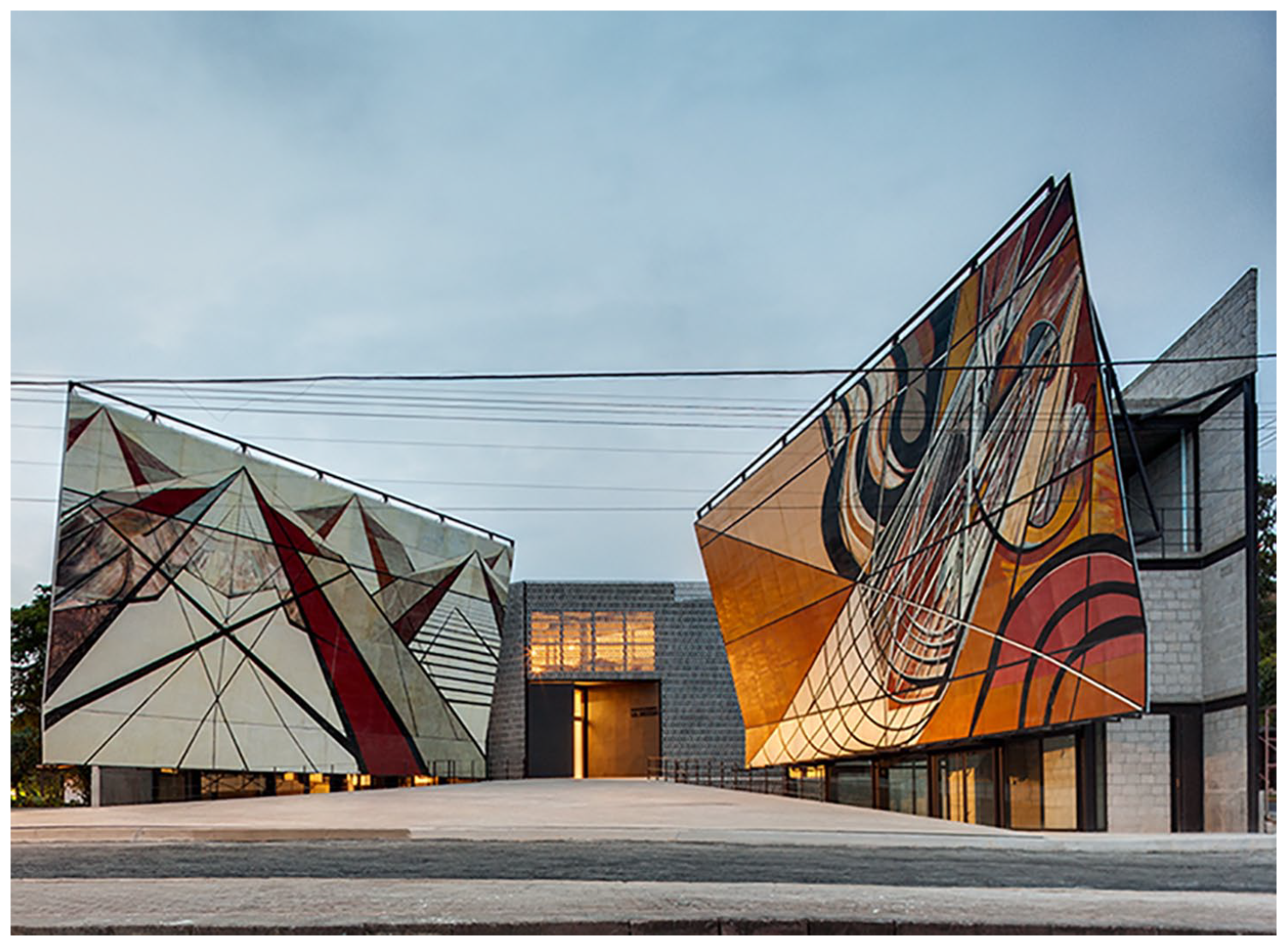
FE: The reference to Minimalism has to do with the economy of means we need to have in Mexico. It is about being able to extend the capacity of what you can do. We usually have limited resources and people want to do more than what they have the means to do, especially in public institutions. So, I try to put the resources where they are most helpful, as in the La Tallera project (2012) (see Figure 1). I wouldn’t say it is a Minimalist project; it is quite Brutalist. Our approach to having few resources meant that we needed to have bare walls, expose the structure and find materials that age well. I knew that maintenance was going to be an issue in the future for this project. So, it was more about that type of economy rather than a direct reference to Minimalist art.
But I do like straightforward shapes and approaches. That kind of neutrality provides room for the life inside the building to flourish and to be made visible. There is a project that I have been working on for several years now. It started at the Harvard Graduate School of Design (GSD). Split Subject is an analysis of an anonymous Modernist building in Mexico that has a great façade. It’s very simple. It wasn’t designed by an architect, but because it was so neutral and so simple people appropriated it. It became almost like a collection of tiny interior moments that lived behind the glass façade and were able to grow like a coral reef while the people inside were still anonymous. I am very interested in that kind of relationship.
RG: So, you are interested in how the occupants of a building interact with the structure?
FE: Yes, and I think it is only highlighted by the neutrality and the rigidity of the façade. If you had this in a complex building with a lot of ornament, it would get lost somehow. By creating a neutral structure, the life of the building can be seen. Ornament becomes something that happens continuously, and thus it is not ornament in a superficial sense; it is an expression of life as such. Similarly, the texture we see in wood or in marble shows how that material is made. The accumulation of layers is constructed by people’s personalities, the way they live, their interpretation of their own aspirations and expectations of what is aesthetically compelling to them. I think it is interesting that all of this could be manifested in a building unintentionally.
RG: How does this help you see new perspectives while developing concepts for your own projects?
FE: I started practising as soon as I got out of school in 2003. I worked independently, mainly on small renovations at first. After that, I began participating in competitions. Of course, it started out as a tiny office; sometimes it was just me, or me and someone else. It was financially challenging, so I had to do it with the assistance of sponsorships, scholarships and grants. The truth is that architecture takes a lot of time and money, and it can become very dependent on a specific type of client. When you are young, you cannot access public projects or things that might be a little bit outside the arena of developer interest. Even though we think we are changing the world as architects, we are not because we are just contributing to economic interests. This is a risk that architects should be very aware of. A few years after I started practising, I became tired of this situation and started looking for other ways to think about space. Around that time, I came across a program at the Harvard GSD called Art, Design, and the Public Domain. The program’s goal was to expand the idea of architecture and spatial practice. I read the program’s description and thought this would be a nice opportunity to think about architecture and the built environment in a different way. During the program, I gained new perspectives and realized architecture can help understand complex formal and social problems. The program allows each individual to use architecture as a tool to discover unique problems rather than solutions. This was a turning point for my practice.
RG: How did your practice change after the program? More importantly, perhaps, how have you tried to integrate these new concepts into the constraints of today’s architectural practice?
FE: I came to the GSD with the support of the CEMEX Grant in Mexico. While I was applying to the GSD, I was also competing in the Tallera competition. I never imagined that I would win both, but I did. I was quite nervous about doing both but, at the same time, it was a moment where all these things that I was learning in the program – the theory and creative thinking – I could translate into being at an actual construction site. Seeing the limitations of budgets and contractors saying, ‘I don’t think the electric wiring believes what you’re saying’, grounded my methods and thoughts around how theory could be integrated into actual architectural practice. Practising while studying became a reality check. I was aware that I had to do both things.
RG: Are there benefits to approaching architecture with an interdisciplinary mindset?
FE: I think the more you look at architecture through different perspectives, the more significant return you will get. Architecture cannot consist of just one vision. It needs to have many different layers and many outcomes. With multiple characters involved in a project and various ideas, you get a better, richer, more resilient and unique project. Even if I have a very small project, I still ask questions about it and its relation to a larger narrative. If you’re not asking questions with your work, even if it’s designing a chair or a small object – if you’re not able to tell a story or understand a part of the world with that thing that you’re doing – then it’s not worth doing. Or, you are probably doing it for the wrong reasons.
RG: Umberto Eco’s The Open Work (1989[1962]) is a canonical theoretical text that many artists, writers, musicians and architects have referenced. Eco describes an openness as a primary characteristic of modern and contemporary cultural practice, and he emphasizes the role of reader/viewer/listener as part of a requisite and interactive process between reader and text. For me, it appears that your work closely aligns with some of the key points of Eco’s text, especially when it comes to the ‘unit’ you often refer to and how a building is always both conceptually and materially ‘unfinished’. Do you see the unit in your projects having cultural significance? A cinderblock in Mexico City, the brick for Material Reservoir (2015) at the Stony Island Arts Bank, the tile at the Serpentine Pavilion (2018). If so, how do you select your unit? Does the unit act as a conceptual grid superimposed onto the site? Or is the unit’s meaning insignificant in your work?
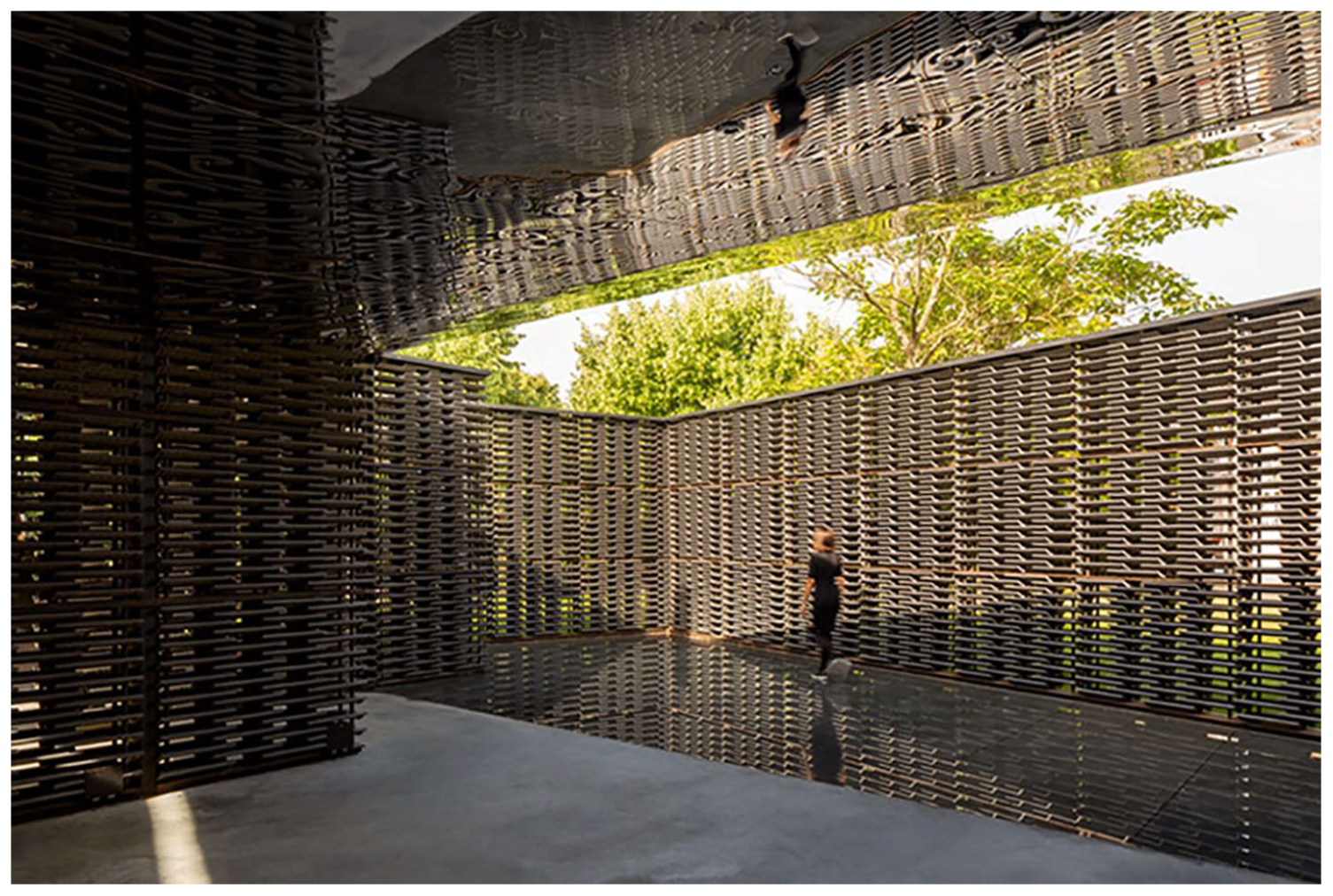
FE: That is a very interesting question and I like that you asked. It should not be dependent on the material. It cannot just be about the material but, at the same time, the material tells a big part of the story. It is complex. I often reference how Carl Andre used materials as a way to frame specific moments in time. For me, materials tell the story of their own production process and the particular moment they were produced. A brick can speak about one particular social dynamic that happens in a specific economy. For example, the cinderblock we have used in Mexico City has a particular story behind it, and the ones we used at the Chicago Biennial have a completely different one. The bricks in the Stony Island Bank project came from building demolitions on the South Side of Chicago, which had a higher symbolic meaning to the area and culture than the material itself. For the Serpentine Pavilion (see Figure 2), we just wanted to have something modular and something that we could weave with: we wanted to create an open lattice, and the material narrative wasn’t as critical.
RG: Could you describe your design process for the Serpentine Pavilion in more detail?
FE: The Serpentine Pavilion was about the idea of permanence and context, which was complex because the pavilion itself disrupted those two ideas. The pavilion proportions are aligned with the Serpentine Gallery, so you can say it uses its context as a compositional element. And, of course, we had to address some practical needs, such as the number of people needed to fit in the event and the required seating room. These practicalities helped us create the overall dimensions. The piece then became specific to the park, but it would only be there for four months and then be sold. After that, it could be installed anywhere and therefore could not be site-specific. The pavilion needed to be an object that could absorb the context where it would be inserted. Still, at the same time, I wanted it to be about a specific moment at the original location. At first, it was difficult to figure out how to do it because we did not want to create an ‘object’ that could be placed anywhere. It was not about the object; it was about what happens inside it.
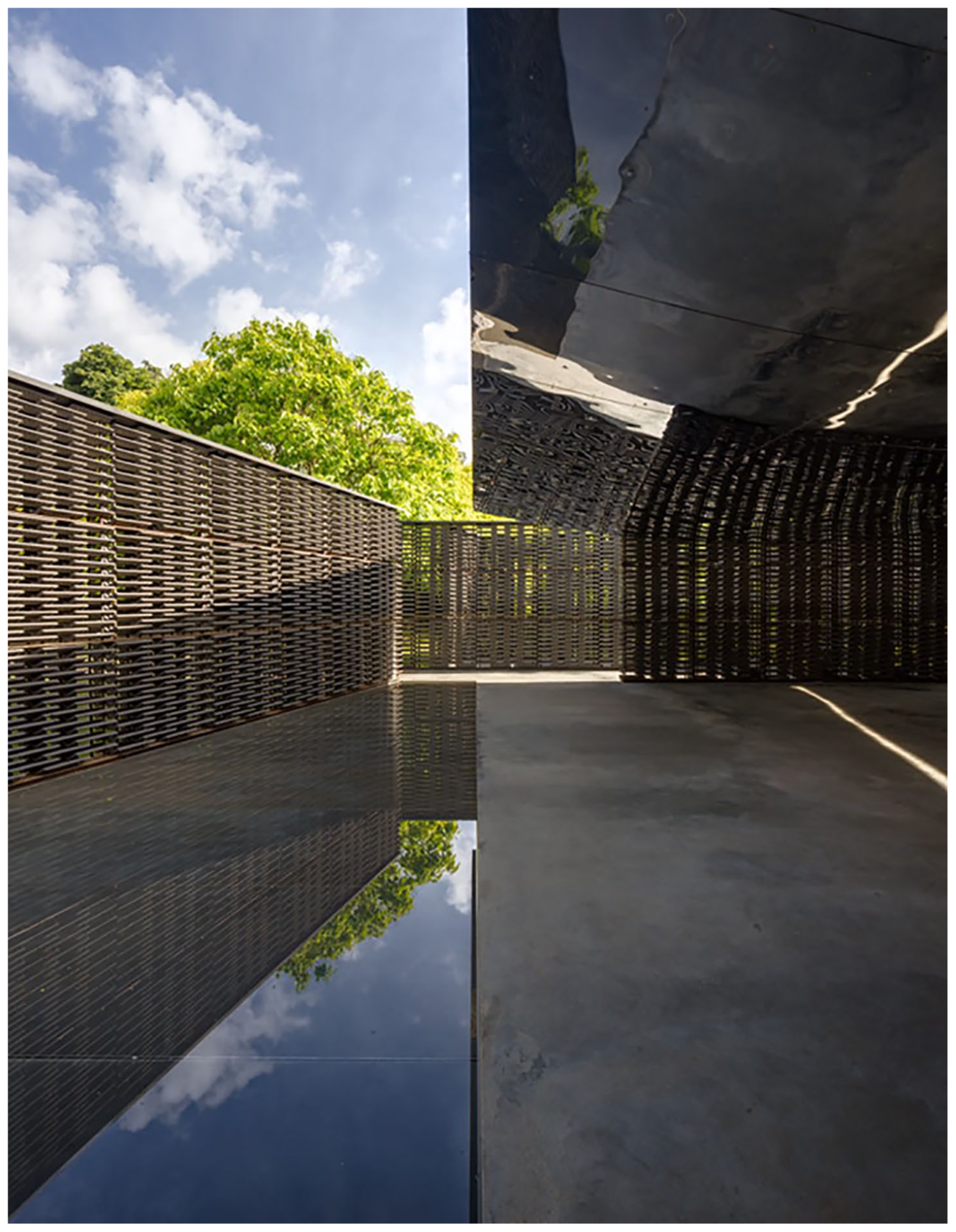
So, we started thinking about abstract notions of space and time to resolve that problem, which everyone does on a regular basis (e.g. the way we measure time in 24 hours is a complete social construction). There are many ways to understand time and also space: the metric system, the imperial system, or the Jeffersonian grid, parallels and meridians, and so forth. For us, framing this project around parallels and meridians was the perfect fit. The pavilion became a piece that could mentally and internally organize time and space. A diagonal line runs through the pavilion to highlight a division between the roofed area and reflective pool, which creates an invisible threshold that aligns with the meridian lines. This threshold emphasizes the sun’s path. As the sun moves, the pavilion acts as a real sundial. Thus the pavilion functions simultaneously as a compass and a sundial. In other words, it could serve as a tool to help calibrate how we perceive time and space. Once you notice this when you visit the space, you realize that the pavilion is never static. From one day to another, it was apparent how the sun was moving and changing. You would see that, during the summer solstice, the shadow projected by the ceiling was perfectly aligned to the edge of the shallow pool (see Figure 3). So, even when the pavilion finds its final location, there will always be a reference to the Greenwich Meridian line that runs across London.
In terms of its materiality, the open lattice walls were made of roof tiles, which created a very permeable, textured screen. The lattice creates an effect of different degrees of opacity and transparency, which allows you to see the landscape behind it or to feel protected and contained in a defined space.
RG: In your analysis of the façade in Split Subject project, a façade is similar to a mask. It expresses the duality between the public representation and the more accurate depiction of the occupant. Can you explain how this concept influences your own practice and approach to design?
FE: I think the idea of concealing and revealing is not exclusive to façades. El Eco Pavilion project in Mexico City (2010) is a good example of that. The project doesn’t have a façade, but you can see two layers of things happening simultaneously – the programmed one and the spontaneous one. The cinderblocks were laid in a strict pattern, but people could move the cinderblocks however they wanted, making visible the occupation and appropriation of that space. I have not been able to create something that expresses that idea so clearly on a larger scale, simply because the layering effect of use and appropriation takes a long time to happen.
RG: Do you see your work as a self-expression, or do you see it more as an impersonal practice?
FE: I would say that my practice is a form of self-expression informed by context. It is my way of understanding the world, making things clear to myself and, hopefully, others; it is a way of communicating. Craft often has a lot to do with whoever is doing it; one cannot say: ‘I’m neutral.’ There is no way to do that. It would be a tragedy if something would be neutral. I think everything has some kind of story to tell: telling where work was produced, how it was made, who thought about it, the interests behind it, and so on.
RG: What do you aim to render visible in your work? Is there a specific problematic that you are trying to work through, understand and learn from?
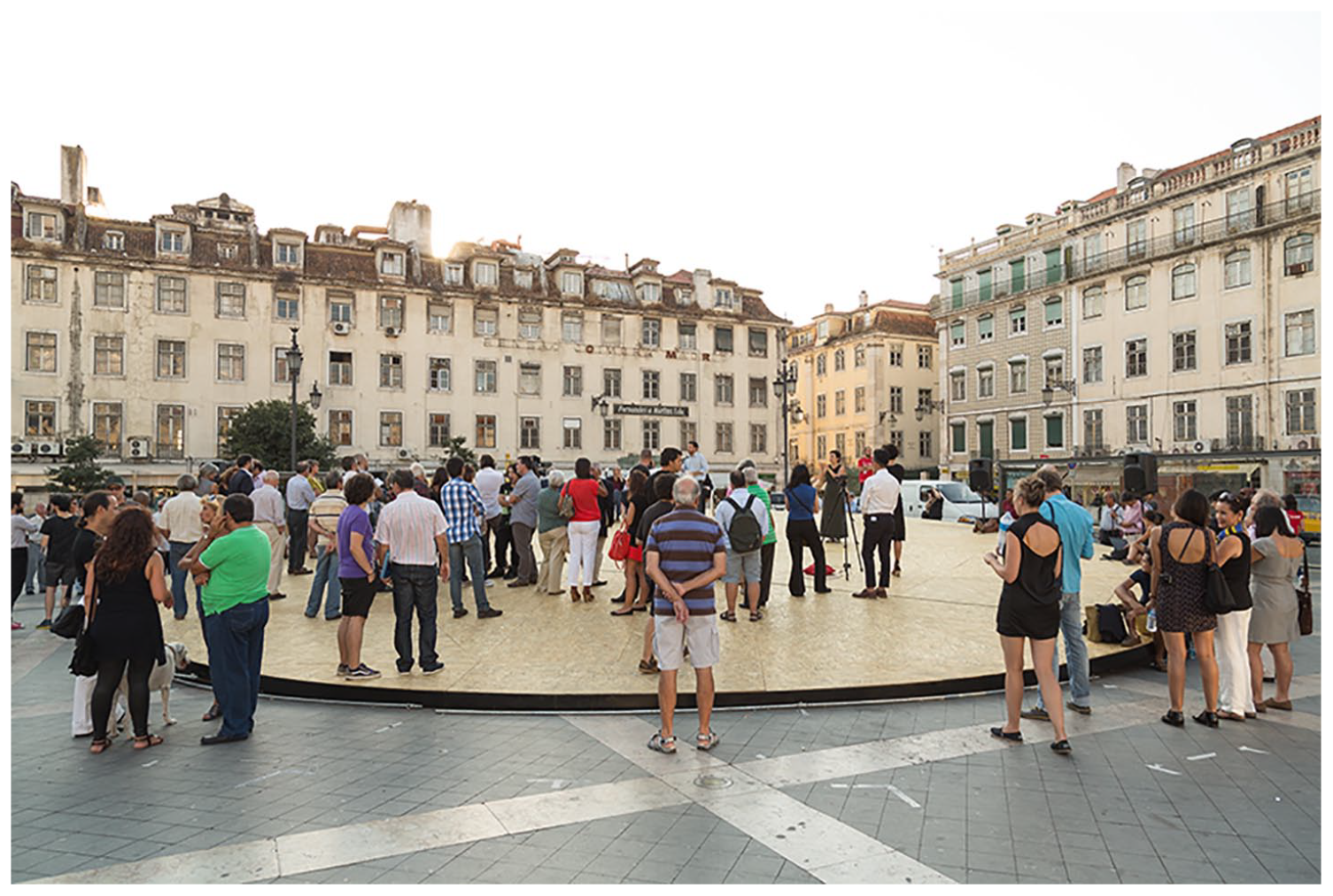
FE: I think it changes with each one of the projects, but social dynamics are important because spaces are meant for people to occupy them. But sometimes it’s about other things. El Eco Pavilion and Civic Stage (a project for the Lisbon Architecture Triennial in 2013, see Figure 4) represent how we behave with each other and how we collectively share that space. Some other projects are just trying to present how aging happens or how materiality has its own history. Mostly, however, I am interested in the relationships of people within the space.
RG: It seems evident to me that architectural practice must continue to engage with interdisciplinary fields like visual culture studies, philosophy, art history, and even evolutionary biology rather than turning more inward on itself. How can you see the profession of architecture improve by integrating the study of visual culture more deliberately and directly into our daily practices?
FE: This is a difficult challenge. I have tried in so many ways. Developers come to us and say, ‘I want to develop this property, I want to do it in two weeks and spend only two dollars, but make it look like it is worth 10, so I can profit 15’. They are selling people an illusion of an aspirational lifestyle, but the buildings are basically trash. People unknowingly buy into this negative dynamic of relentless consumption. We are all familiar with it on a smaller scale, like fast fashion, but it also happens with architecture. This attitude of buying something, only wearing it twice, then tossing it aside for something new has infiltrated our understanding of the built environment. It is an architectural problem, but also a political, legal and ethical problem.
RG: Shared cultural space becomes very limited in this model, no?
FE: Yes, and we are the ones isolating ourselves. Similar to the idea of the gated community. The idea is interesting because it gives a sense of security to people, but it also isolates them. Diversity in this scenario is lost. We are told continuously that conflict and friction are negative and that everything should be running smoothly in public space. But this flattens life out and creates many more tensions because we don’t know how to deal with ‘the other’ any more. It is essential to create public cultural spaces to learn how to deal with the smaller frictions. But the disagreements do not have to be resolved, they are going to happen, and we need to live with each other’s differences. Everyone in the world right now seems to be focused on polarization, segregation and differentiation.
RG: You have stated that ‘architecture is forever unfinished’. Is ‘architecture’ in your statement a building or the history of architecture as such?
FE: It could be both. If a building is unfinished, then the history of architecture is too. But in the particular context in which I stated that I was talking about a building. When an architectural object is conceptualized, one never truly grasps the building’s totality, not even now with technology that makes it possible to model the whole thing three-dimensionally. There are certain aspects that escape the initial project. When a building is under construction, there are sets of things one encounters that will change the original idea and will require reinterpretation. When the building is finished, it will be inhabited and will change. So, the building is always in a state of becoming. Always changing. There is this beautiful piece that interprets Mies van der Rohe’s Barcelona Pavilion by Andrés Jaque (2013). He exposed all the maintenance tools normally located in the basement of the pavilion. The fragments of marble, tiles that were replaced, broken windows and the faded curtain. He revealed the icon of architectural perfection as a ghost of itself. It is no longer the original pavilion because it would be old and decrepit, but this is how we understand the pavilion. Even if it looks exactly the same, it’s never going to be the same.
RG: In these terms, Jaque’s work sounds like an even more intense intervention than Jeff Wall’s photograph Morning Cleaning, Mies van der Rohe Foundation, Barcelona (1999). In that light, what would you say we gain from ‘living architecture’ that is forever changing?
FE: It is a natural thing to happen. Everything is always becoming something else, not just architecture, but people, language, etc. When I realized this, it was really liberating: work does not need to be perfect and permanent as we are taught in architecture school. What does permanence even mean? We are obsessed with the idea of time and yet forget we are part of just the tiniest moment in history.
RG: One work you reference is Robert Smithson’s A Heap of Language (1966), where he demonstrates language can be constructed by version, translation, interpretation, accumulation and erosion. This kind of complex temporal becoming is at work in language itself. In fact, you often reference language when describing architecture as a creative practice. What are the similarities between language and building architecture? Have you used the concept of erosion in any of your projects?
FE: The most evident use of erosion would be the Stony Island Bank project. It was meant to be a series of courtyards defined by walls made out of bricks stacked on top of each other with no mortar. This made them removable. Some people were concerned they might get stolen, but that was the point. People would eventually move them or naturally start to become heaps of landscape rather than a more defined construction, similar to an inverse Tower of Babel.
RG: Similar to the concept of entropy, moving to a simpler shared state.
FE: That’s right. When everything is in chaos, nothing is distinguishable. But, when you have something very strict to start with, these moments of change become evident.
RG: You have discussed the concept of strata in the past. Can you explain how this concept relates to and influences your work?
FE: This is my reading of how architecture happens; I just think everything is layered. It happens both because there is a practical need or as a form of expression. The most obvious example is how cities are composed of different historical layers. But it also happens on a smaller scale. For example, a 19th-century house with modern plumbing makes it evident that architecture couldn’t endure if it was detached from change. So, maybe on a shorter timeframe, we should allow these things to happen to a building and let it adapt to people’s needs because we change a lot faster than the buildings do.
RG: Who has influenced you the most in your work?
FE: Mostly the people that I surround myself with, my friends, my mentors. They are the most influential to me. Alejandro Hernández has always been inspiring and fun to talk to. We have known each other for a while and sometimes work on publications or other types of projects together. He is a walking constellation of references. While I was in school, I took his class on architecture and philosophy. He’s currently the editor of Arquine, an international architectural journal based in Mexico City. Later on, during my time at the GSD, Krzysztof Wodiczko and Erika Naginski became really influential. Krzysztof is a fantastic teacher and a great human being; he was always positively challenging you. He used to tell me ‘Don’t be so modern’. Erika is a professor of architectural history and was my thesis advisor. She is undoubtedly one of the people who really changed the way I saw my profession. She opened a whole new universe to me, so I am forever grateful to her. Before them, Mauricio Rocha was my tutor while I was at the Young Creators grant program. As I mentioned before, I never worked in someone else’s office, so I hadn’t had that kind of professional mentorship before. Mauricio’s advice was:
If you surround yourself with architects, you’re going to be very boring, very soon, and if you surround yourself with people that tell you all the time how great you are, you’re going to be very bad, very soon. So you need to find people who challenge you, who push you, and who make you uncomfortable sometimes.
RG: Lastly, I would love to hear about your current projects.
FE: We are about to start the construction phase of a hotel in Bacalar, a beautiful lagoon in the Yucatán Peninsula. The landscape is fantastic, so we are trying to barely touch the ground and are very cautious with the surrounding context. Last year we did the exhibition design for the Lina Bo Bardi exhibition Habitat, a major retrospective of her life and work for Museo Jumex in Mexico City. We are also working on a residential project and in a public space in the US, a hospitality project in Europe and two private houses. We have also recently started a very interesting project for a Palenque (where mezcal is produced). It is owned by a fantastic group of women who have a completely different and progressive vision of what a production plant should be. This is the first time we can incorporate a gender perspective in a project in a significant way, and it changes every aspect of the design process. We are very excited about it. And finally, we are developing a limited edition of objects that will launch hopefully this year.
Footnotes
Frida Escobedo is an architect based in Mexico City. Her design philosophy and images of all her work to date can be found at:
Address: Mexico City, Mexico. [email: info@fridaescobedo.com]
Ronna Gardner is an architect and artist. She co-wrote the introduction to the Journal of Visual Culture themed issued Architecture! (2016). She is also the founding member of Ezra Klee Studios:
Address: Jenkins Peer Architects, 112 South Tryon Street, Suite 1300, Charlotte, NC 28284, USA. [email: ezrakleestudios@gmail.com]
References
1.
EcoU (1989[1962]) The Open Work, trans. ACancogni, introduction by RobeyD. Cambridge, MA: Harvard University Press.