







Abstract
This article addresses the racializing logic of white feminism and its alignment with white heteronormative registers of human life. It does so by considering Julia Ducournau’s (2017) film Raw in relation to cannibalism’s intersections of gender, sexuality and race. The film invokes feminist pleasures, centring on female desire and pitting Justine’s compulsive appetites against an inflexible social hierarchy of gender and species. However, its articulation of cannibal consumption and female subjectivity is dangerously ambivalent. By focusing on the colonial history and racializing logic of the cannibal, this article reads Raw as symptomatic of the subjective formations and social violence of white feminism. Raw portrays cannibalism as a feminist practice of posthuman resistance, but its seductive appeal also produces a troubling ambivalence around non-white and queer bodies, which resonates with black critiques of posthumanism’s reproduction of whiteness. The film invites us to inhabit our raw desires as a monstrous resistance, but what genres of human and nonhuman haunt this politics of monstrosity?
This article addresses the racializing logic and cultural potency of white feminism. It does so by considering Julia Ducournau’s 2017 film Raw in relation to cannibalism’s intersections of gender, sexuality and race. In an article in Indiewire, Staubli (2018) compares Raw to Get Out as horror films that trade in allegory. She says:
Recent films have demonstrated the power of traditional horror cinema as allegory and cultural expression, such as the cannibal film Raw (2017), a feminist coming-of-age story, and the record-breaking Get Out (2017), a commentary on white violence and racism towards African-Americans.
We find this comparison suggestive for several reasons. Firstly, it raises the topic of allegory, an all-too-often over-simplified way of understanding a text’s mode of speaking about the world. Both Get Out and Raw develop resonant allegorical systems that speak otherwise about power and social violence. But Staubli perhaps inadvertently also alludes to a difference between the films: whereas Get Out provides a direct commentary on a specific formation of white racism, Raw might appear to be somehow allegorical, but it is less clear precisely what its narrative says about gender and power. Its cannibal story certainly evokes feminism, centring on female subjectivity and desire, and pitting Justine’s compulsive appetite for human flesh against an inflexible social hierarchy of generation, species and gender. As Reeves Sanday (1986: 3) puts it, ‘Cannibalism is never just about eating but is primarily a medium for nongustatory messages – messages having to do with the maintenance, regeneration, and, in some cases, the foundation of the cultural order.’ We propose that Raw’s nongustatory discourse is strangely ambivalent about the place of female desire in this process of ideological reproduction. The feminist potential of the cannibal is not straightforward in Raw, but is complexly intertwined with intimations of race, animality and monstrosity. The ambivalence of the film’s cannibal figure can be located between the nonhuman (as a celebrated site of resistance in posthumanism) and the inhuman (as colonial animal other), both of which the film simultaneously evokes and occludes through its accounting of dangerous female desire. Understood only as feminist, Raw threatens to become fragmented and contradictory. We will argue that its textual system only resolves when we see it more specifically as an allegory of white feminism. By drawing on postcolonial theories of the cannibal and black studies approaches to posthumanism, we trace the film’s troubled play with the nonhuman and the inhuman, and grapple with what seduces and repels in such an allegory.
Punk feminism
Let’s begin by reading the film close to its own grain, as cannibal feminism. Ducournau has linked the two in interviews, explaining, ‘I wanted the cannibalism to become a punk gesture against this patriarchy’ (Thomas, 2017). The cannibalism of the main characters Justine and Alexia is primarily a gesture of rebellion, rejecting patriarchal order. For Kilgour (1998), the cannibalism trope is used to attack forces destructive of social order, but in a feminist accounting of Raw, the destruction of patriarchal social order is precisely what is desirable. Constructing a space within which the stakes of a punk feminist cannibalism can become visible, the film proposes two striking and interconnected systems: a logic of power and resistance, and a relationship between human and animal. We see this social order most centrally in the setting of the veterinary school. Here, the operation of power and the film’s feminist critique of it are asserted in the school’s violent hazing rituals, in Justine’s resistance to its sexist cultures and in the forms of coercion that Justine experiences. Through her point of view, we see hazing rituals involving marching bodies as male violence, in which male students wearing balaclavas shout aggressively and force new students to crawl submissively. This form of social violence will bring Justine into the knowledge of her cannibal self but she is alienated from it from the start. In a particularly unpleasant scene, new students are forced to eat raw rabbit kidney. Justine doesn’t want to eat meat and the narrative implies that this patriarchal imperative to eat flesh makes manifest her cannibal interiority. Coercion traverses the body, moving from the gustatory to the sexual when, in another hazing ritual, Justine is forced into sex with a fellow student while covered in paint. After both events she is asked ‘were you forced’, and she answers ‘no’. We are not so sure.
The effect of these coercive events on Justine’s body is physical. She develops rashes and soon finds herself uncontrollably compelled to eat flesh: animal and, soon after, human. As a cannibal, Justine becomes a feminist monster, taking on the masculine prerogatives of narcissism, violence, appetite, lack of social control, pleasure in the body and devouring at will. Her growing awareness of her fleshly appetite parallels her emerging sexuality, with body horror tropes linking physical transformation with her dangerous conflation of sexual and gastronomic object choice. Feminist revisions of body horror cinema abound: Justine vomits hair, has a doctor peel skin off her body, and her first experience of eating flesh comes after a failed bikini wax that is surely aimed at creating feelings of sympathetic anxiety in many female spectators. Our gendered horror at the things that happen to Justine’s body is gradually reversed by her emerging agency, so that horror is directed outward, and cannibalism is the answer to the travails of female embodiment. As she develops a new subjectivity, Justine becomes confident in both her sexuality and her cannibalism. She grows from listening curiously outside her dorm room as her roommate Adrien receives a blow job to wearing a sexy dress, dancing to a raunchy song and fucking Adrien herself.
At the same time, she shifts from guiltily stealing meat from the canteen to chomping heartily on her sister’s severed finger. This cannibal feminist monstrosity is most vividly illustrated in the scene alluded to above in which she is covered in paint and forced into a closet to have sex with a stranger. The male student says, ‘don’t worry, I’ll go slow’, constructing her as a delicate flower whom he intends to protect, even as he assents to the demand of the frat boys to participate in non-consensual sex. In response, Justine kisses him and bites off a chunk of his lip. Resistance to the college rape culture combines with sexual and gustatory urges, so that Justine’s cannibalism stages at once a punk political intervention and a claim on unconstrained female sexual agency.
These scenes of coercion immediately set up a punk feminism of violent resistance to patriarchal and institutional power, but what is striking is how consistently they are shot through with human/animal relations. During the hazing scenes, we see students crawling on the floor like animals, but in addition to being compared to animals, these scenes of student life are interposed with evocative sequences of animals. For instance, after the party on the first hazing night, we cut without explanation to a short scene of a horse being anaesthetized. The scene makes narrative sense as an example of veterinary education: more experienced vets handle the animal’s mouth, hooves and the equipment required to lift it, while new students look on. But it makes affective sense as a rhyming site of corporeal constraint and domination, in which the horse, like the human students, is compelled by others into movements beyond its control. In another scene, as a consequence of eating the rabbit kidney, Justine’s body breaks out into an unbearably itchy rash (see Figure 1). As she scratches wildly, we cut to the same horse running in constraints (see Figure 2). Justine’s red and inflamed skin is compared via parallel editing to the horse’s glistening, sweaty flank, as both bodies labour under stressful conditions. When Justine returns to school, we see her in a classroom where the lecturer shows a cow uterus. The link between the instrumental use of animals’ bodies and the status of women’s bodies as sites of sexual violation is made clear by this objectification of the cow’s reproductive system. The film repeatedly compares humans to animals in an affirmative sense, as subjects rendered powerless within violently biopolitical systems.
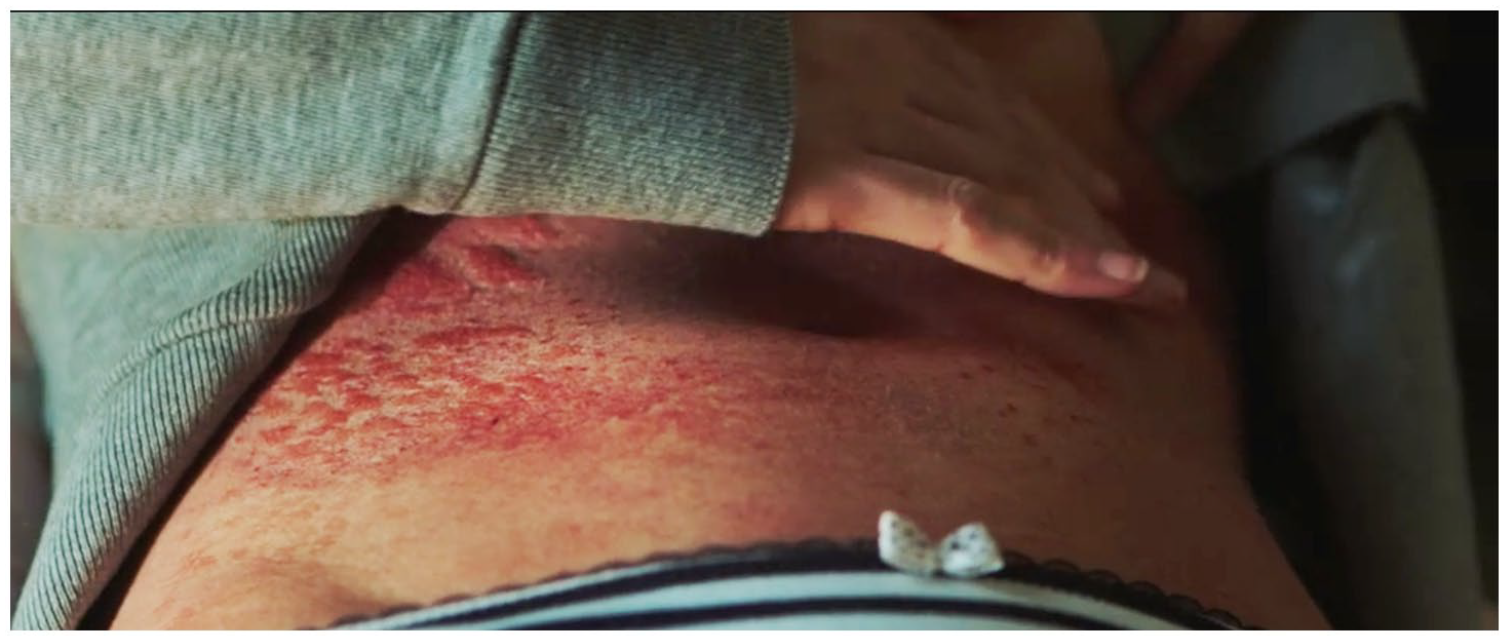
In Raw (Ducournau, 2017), close ups of Justine’s torso emphasize the body horror of her skin rash. Screen grab from Julia Ducournau’s film Raw (2017).
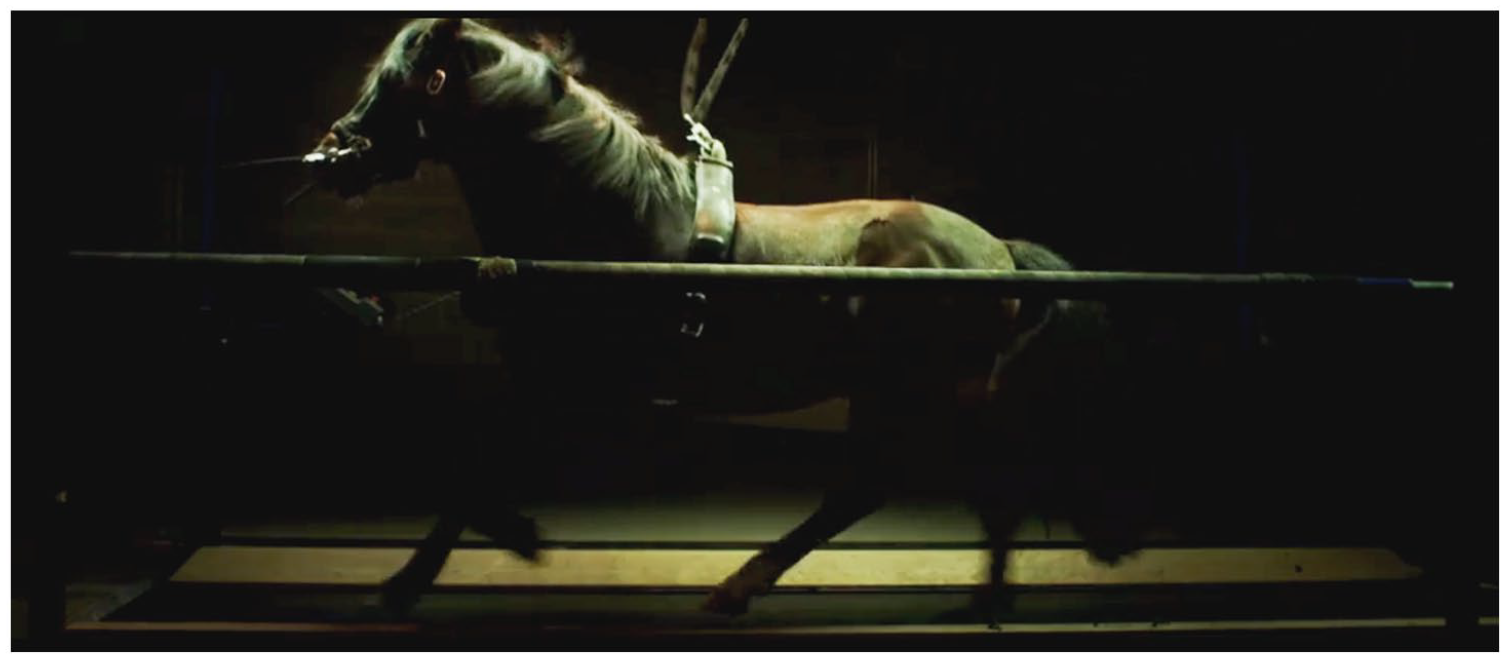
Shots of a horse running in restraints are cross cut with those of Justine, comparing animal and human physical sensations. Screen grab from Julia Ducournau’s film Raw (2017).
In this reading, cannibalism emerges as a form of posthuman resistance. Justine’s cannibalism, her animalistic and sexualized desire for flesh comes crashing through systems of power. The distinction between humans and animals is broken, along with boundaries of bodily autonomy and institutional monopolies on violence. Justine’s cannibalism is a mode of resistance that is deeply sexual and visceral, trading both on discourses of femininity as animalistic and on ideas of monstrosity as feminine. It is a posthuman mode of overthrowing patriarchal power.
Ambivalence
This punk feminism, however, is deeply ambivalent. Ducournau’s interviews illustrate the limitations of the female monster as feminist figure. The director says:
I’m fed up with the way young women and their discovery of sexuality is portrayed on screens . . . For me, sexuality is in the body. And you should certainly not be a victim. It’s not something that you go through, it’s something that you are active in, and it’s perfectly okay. (Thomas, 2017)
As a claim on empowering representations, this seems entirely reasonable, but the refusal of victimhood might give us pause. Moreover, Ducournau insists that Raw is not a feminist film but a universal one. There’s something necessary, of course, in female directors claiming their stories as universal, but her reluctance to understand the film as feminist also speaks to a resistance to feminist modes of thought, especially those that imagine new forms of public life. Justine’s cannibal subjectivity is a model of female agency more interested in personal freedom than in collective living, and this vision undermines the film’s ability to reflect on structural violence. When Ducournau describes the film as universal, what kinds of human are included in this universality? What kind of feminist resistance is produced by Justine’s animality and her cannibalism? Who is empowered and who is excluded by such evocations of the nonhuman? Raw’s twin insistence on both the individual (heroic punk subjectivity) and the universal (a politics that is not feminist, not willing to account for the distribution of power across difference) allows us to see what it has trouble with: the racialization of its categories of the human and the nonhuman.
To bring into focus the racial dynamics of Raw’s universalist feminism, we must consider first how the film articulates feminism to cannibalism – both discourses with histories that are themselves steeped in ideas about race and gender. Raw works by reversing the binaries that have defined the cannibal, who has been variously imagined as non-white, non-Western, male and, more recently, as gay. The cannibal as such is a European colonial invention and, as Phillips (1998: 192) argues, ‘civility and cannibalism were born together in the colonial imaginary, insofar as the former made of the latter its absolute moral antithesis.’ Cannibalism is historically used to define civilization through its other and thus to project outward the barbarity of colonialism, creating the non-white cannibal as the figure who marks the boundaries of European subjectivity. From the beginning, the cannibal is a figure of the European colonial imaginary, a monster that instantiates at once the European ability to view non-white people as nonhuman and their propensity to displace their own violence onto the bodies of their indigenous and black victims. Raw flips these terms, turning the racialized primitive cannibal into the white feminist one, who rejects the oppressive norms of European civility from within. This idea accords with the 20th-century cultural shift that Walton (2004) describes from the cannibal as a figure encountered elsewhere to cannibals found within the national or domestic space. ‘Consequently’, she says, ‘as the threat is brought home, so there is a transition from the cannibal as object of the gaze to the cannibal as subject with a gaze’ (p. 3). As cannibals become white and Western, so they are granted subjectivity, agency and cinematic point of view.
This shift from cannibal as Other to cannibal as protagonist resonates with the posthumanist inhabitation of the nonhuman as a space of resistance and, indeed, the cannibal has been adopted as a political figure. We could compare this move to radical European adaptations of the cannibal to anti-capitalism, e.g. in Pier Paolo Pasolini’s Porcile (1969), Liliani Cavani’s I Cannibali (1970) and Jean-Luc Godard’s Weekend (1967). We might even link it to the anticolonial cannibal imaginary in Brazil, beginning with Oswald de Andrade’s Cannibalist Manifesto and continuing in films such as Nelson Pereira dos Santos’ How Tasty Was My Little Frenchman? (1971). For these strands of political cinema, cannibalism embodies a reversal of power, in which the proletariat or the postcolony consumes European wealth, culture and bodies. But, although Raw’s cannibals do resist patriarchy, they are oddly disconnected from the racial and colonial power structures that are intrinsic to the figure. The film does not focus on the reversal of terms intrinsic to the white European cannibal. Instead, in its emphasis on freedom and appetite, Raw’s protagonist is closer to a French romanticization of the cannibal from Montaigne onward. The cannibal comes to France in 1517, in documentation of voyages to the New World, and is immediately taken up as a cultural icon. Kilgour (1998: 243) asserts that, ‘For Montaigne, the cannibal is the pure, direct self, uncontaminated by society – a proto-romantic reading of the “natural”.’ This unmediated subjectivity, outside of society’s rules, is closer to Raw’s punk refusals than are the materialist critiques of Pasolini or Andrade.
The cannibal of Montaigne is an individualist and is linked to sexual licence. Amerigo Vespucci’s account of his travels to Brazil was embroidered in translation to depict cannibals as incestuous, demonstrating unconstrained sexual and meaty appetites (Lestringent, 1997). Duggan (2013) analyses a 17th-century association of cannibalism with a libertinism that signified desires outside the Catholic moral order. The supposedly bad behaviour noted by Duggan includes eating meat, drunkenness and homosexuality, and Raw depicts all these acts. More recently, the cannibal has been viewed as gay, with scholars such as Fuss (1993) exploring the linkages among sexual deviance, orality and aggression. Thus, while many pop cultural visions of cannibalism retain the figure’s monstrosity in order either to denounce consumerism or to question normativity, Raw harks back to a Romanticist version of the cannibal as, in Kilgour’s (1998: 247) terms, ‘the natural, the wild, the savage’. Its feminist intervention is to insist that women, too, can be untamed, insatiable, polymorphous and blissed out on incorporation. The rapacious ego of the cannibalistic modern subject is acceptable in the film’s logic – radical even – because it gifts women as well as men with the desire and ability to consume others. To appropriate the savage and Romantic nonhuman as a figure of freedom and a pathway to humanity is, of course, an imaginary recourse only available to white women and certainly not to racialized subjects.
There is assuredly something desirable about untamed women who consume men and Raw makes white feminism incredibly seductive. It is not simply an exploitation flick in which the only non-white character is murdered and eaten (although it is also exactly this). Justine’s cannibalism fucks with patriarchy in appealing ways, both ideologically and affectively. Body horror is the place where the film makes its primary affective appeal, providing the pleasures of biting a rapist’s mouth, chomping a sibling’s finger, resisting patriarchal rituals of hair waxing, countering male power with violence. Justine’s illness literalizes being sick of patriarchy and her cannibalism overthrows oppressive femininity in several registers at once. For instance, let’s consider the scene in which Justine eats her sister’s accidentally severed finger (Figure 3). The finger is a body part that points, and this finger points in several significant directions. Firstly, it points reflexively to its own status as an object of body horror. The finger is the part of the body that we primarily use to touch and is thus an instrument of tactility. Film theory’s haptic turn examines how films produce sensations of tactility, often provoking responses in the spectator’s own body as if we could feel the objects on screen. A haptic perspective highlights the peculiarly horrific sensation of watching a finger being eaten – do we imagine the finger uncannily feeling the teeth that chomp? – so that the scene evokes a shuddering awareness of cinema’s affective relationship to the body. This body horror is set to feminist purpose, showing Justine as someone who rewrites the ways in which women’s bodies become objects and who resists ontologies of patriarchy. The finger is an example of deixis – a pointing finger communicates this one here, that one there – and it thus corporealizes on screen the indexical qualities of the cinematic image. By nibbling on this signifier of signification itself, Justine gains confidence in her desire to destroy the systems of cinematic meaning that weigh heavily on female bodies. We like this Justine, who rejects boundaries of the body, of the family, of taste. But the finger also points to the film’s other investment in the body, in which the (female) person is universalized as subject. In making a claim on the subject as abstract, Ducournau’s universality is the opposite to this finger, this body. What is elided in this move from the specific to the universal is the whiteness that enables a cannibal heroine. Whose unconstrained body gets to be human? Alexia’s finger also points to this whiteness.
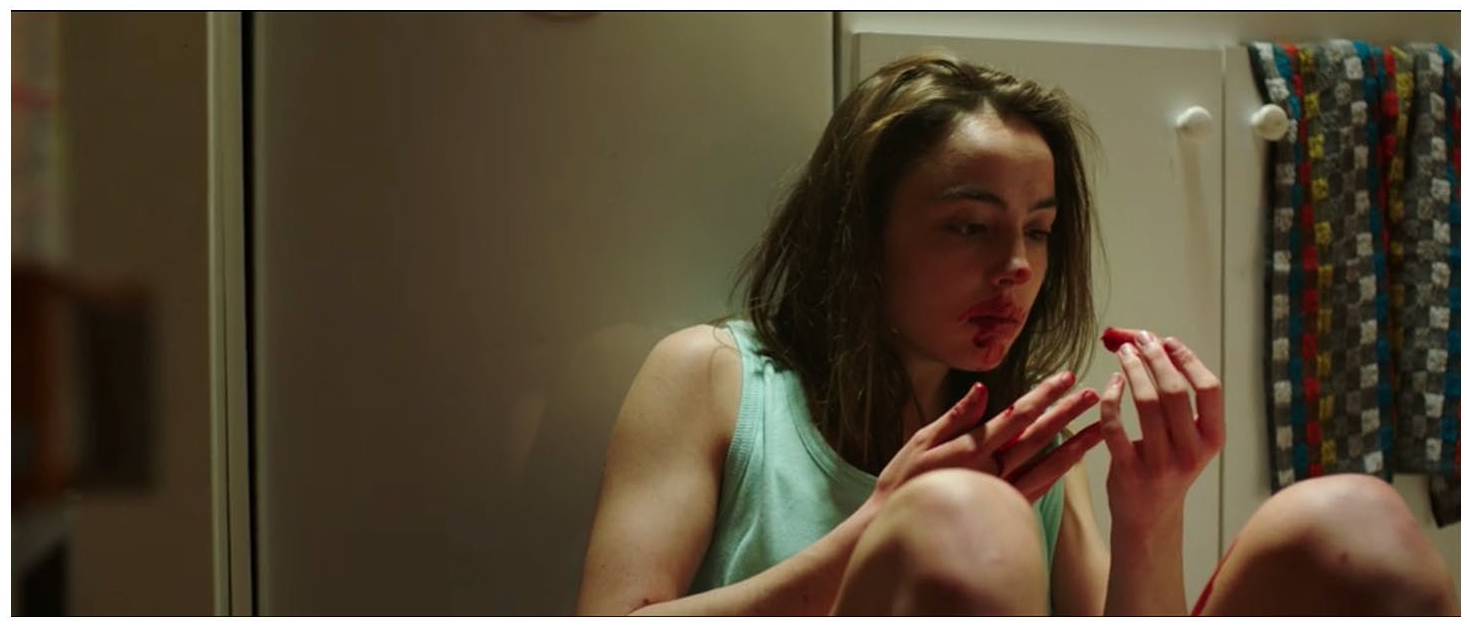
Justine discovers the pleasure of eating her sister’s finger. Screen grab from Julia Ducournau’s film Raw (2017).
By claiming the individual freedom and violent savagery of the modern subject, Raw folds white women into the universalist category of the human. This is why Justine reconciles with her family at the end, sororal bonds triumphing despite the finger-eating. Justine does not overthrow the patriarchal structures that most benefit her, and systems of white social reproduction are maintained, along with a heteronormative binary model of sexual difference. The traditional family, heteronormativity and reproduction are aligned with its feminist voice, so the film’s white feminism also simplifies gender. Adding white women to humanity is its goal, and if this project may not be so appealing to many feminist viewers, perhaps the punk body horror softens us up, making the faux-universalism of whiteness feel like resistance?
We argue that Raw is dangerously ambivalent and, moreover, that it reveals crucial fractures in the posthuman and the monster. The feminist cannibal is a seductive figure that stakes claims for a potentially radical posthuman politics. Nonetheless, it seems able to resist patriarchal systems of oppression only by staking its claim within some murky territories of racialization, in which access to humanity comes at the cost of those historically excluded from the category of the human. The tension between feminism and white feminism runs in parallel to that between the politics of monstrosity and the racialization of the nonhuman. Posthumanism provides us with a critical language with which to unpack Raw’s feminist monstrosity. By tracing the film’s investments in – and its often pleasurably perverse desires for – the human, the animal and the less-than-human, we interrogate Raw’s feminist resistance to ideologies of the human and its seductive reproduction of whiteness.
The problem with Adrien
Raw’s feminism appropriates the unconstrained appetite and savagery of the colonial cannibal and tethers them to the individual freedom and violent power of European whiteness. Justine and Alexia’s monstrous individualism can only be seen as heroic in opposition to the rigid patriarchy of the school’s system. But their punk aggression is not, in the end, directed against this system: the only named character to be killed and eaten is Justine’s Arab, queer roommate Adrien. Here, we have the cannibal as heroine and yet the cannibal also as white European predator of racialized bodies. We can only celebrate transgressive female appetite by not finding it noteworthy that the only character of colour and the only queer character in the film is killed by these feminists. In less lauded films and television shows, the poor life expectancy for non-white or queer characters has become both a cliché and a source of fan activism (e.g. the ‘bury your gays’ trope, see Hulan, 2017). At the very least, we might locate Raw’s choice to kill Adrien within these contemporary debates on representation. But, given the film’s engagement with cannibalism as cultural discourse, we think we can go further. The consumption of Adrien allegorizes the operation of white feminism, which gains power only through a simultaneous and violent cannibalization of difference.
Adrien’s character is racialized from the outset. He is played by Rabah Naït Oufella, a French-Algerian actor known for his work in The Class (Laurent Cantet, 2008) and Girlhood (Céline Sciamma, 2014). Despite his generically French name in Raw, he is clearly marked as Arab. Early in their friendship, Justine and Adrien have a strange conversation with another student about the imagined origin of AIDS in African men fucking monkeys. The student ponders: ‘Maybe not all animals, but monkeys. It comes from them. Do you think a monkey can get AIDS today?’ Adrien responds: ‘No clue. Why are you thinking about this shit?’ The student continues, ‘Take a guy who wants to fuck a monkey. The theory is AIDS started that way. If a guy wants to fuck a monkey today, should he use a condom?’ Adrien replies, riled, ‘I’m eating man. Don’t talk about fucking monkeys! Did wolves raise you? What do I care? Cause I fuck monkeys or have AIDS? What the fuck.’ The student says, defensively, ‘Okay sorry. It was a valid question.’
Much happens in this conversation, in which the white student’s questions are not innocent or valid. His words enact a dehumanization of Adrien, through imagined sexual relations between human and nonhuman animal. Adrien is asked these questions precisely because he is racialized and sexualized. For the white student, AIDS makes black bodies animalistic because of their desire for monkeys. The student takes up the positionality of the white male doctor, the disembodied voice of rationality asking what is after all a ‘valid question’. Adrien is the target of such dehumanization because of his queerness and the colour of his skin. Adrien’s response challenges the white student by rhetorically embodying his narrative’s black, gay object of disgust. This conversation is narratively inconsequential, but the scene is pivotal in demonstrating how human/animal relations can be invoked to effect racist and homophobic dehumanization. Moreover, it reveals that the film is not unaware of the colonial legacies of the cannibal. By putting such a racist account in the mouth of an antagonistic white student, the scene gestures toward a self-reflexive critique. 1
The discussion quickly shifts from race and homophobia to rape, as Justine intervenes: ‘They only ate the monkey. The rest was made up. Who’d be so sick he’d rape an animal?’ Adrien responds, ‘Legally, I’m not sure monkey rape exists’, to which Justine says, ‘Sure it does. Animals have rights.’ Adrien says, ‘The monkey won’t turn anorexic and see a therapist. It’s not the same’, and Justine retorts, ‘Monkeys are self-aware. They see themselves in a mirror, right? I bet a raped monkey suffers like a woman.’ Justine foregrounds the raped woman by anthropomorphizing the monkey and envisioning it going through a Lacanian mirror stage, but she does more than that. The relation that she draws between animal and human, raped monkey and raped woman is significant. As with the parallel editing of female and animal bodies in positions of constraint, this scene enables Justine to deploy the nonhuman to construct a feminist political space. Furthermore, that space is carved out by transforming a problem of racist dehumanization into an affirmative affiliation with the nonhuman as female. The uncomfortably racist and homophobic conversation sets Adrien apart from the other students, but these evidently troubling aspects are rapidly overwritten by a conflict between Justine and another white woman about whether it is equally bad to rape a monkey as a woman. For Ducournau, this scene is about Justine’s need to learn her own value: she must learn that she is more important than an animal because she has both femininity and agency. In other words, white feminism confers power right where racial and sexual otherness is made violently visible and then erased.
If Adrien is racialized from the beginning, he is also marked as queer in a way that makes him a target for the cannibals’ desires. Early in the film, Adrien’s sexuality is a problem for Justine. During the hazing, she looks for a familiar face and finds Adrien, but he is kissing a man so she turns away. When she has to drag her mattress upstairs she looks for him again, but he’s receiving a blow job, so she struggles with it alone. His queerness manifests as not helping her when she needs it and not being in solidarity with her struggles against the patriarchal hazing culture. Something changes as her cannibal nature emerges and his queerness becomes desirable to her. She first looks at his body with hunger in a scene in which the students perform autopsies on dogs. When he plays football shirtless, we see him through her lustful eyes, objectified by the camera, his body visible and open to Justine’s violent desire. The apparent feminist reversal of the gaze is undermined both by the misalignment of the straight woman aiming her visual power at a gay man and by the blood lust of her urges. When Adrien tries to understand her, asking ‘are you into SM shit or worse?’, she responds ‘c’est grave’ (‘it’s serious’ but Grave is also the film’s original title) and we cut to them fucking. Throughout the scene, she can’t stop biting him and, after he pulls her back repeatedly, she finally bites her own wrist in a moment of auto-erotic cannibalism (see Figure 4). Her action is barely constrained, but it is also contrary to Adrien’s stated sexual identity. Afterwards, he angrily insists that he spent years in the closet and doesn’t want to fuck girls now. Raw punishes this refusal and breaching his sexual boundaries is a precursor to breaking down his body entirely. The morning after their sex, Justine wakes to find the bed covered in blood. Pulling back the sheet, she reveals the horrific spectacle of Adrien’s corpse (see Figure 5), his leg and thigh eaten down to the bones.
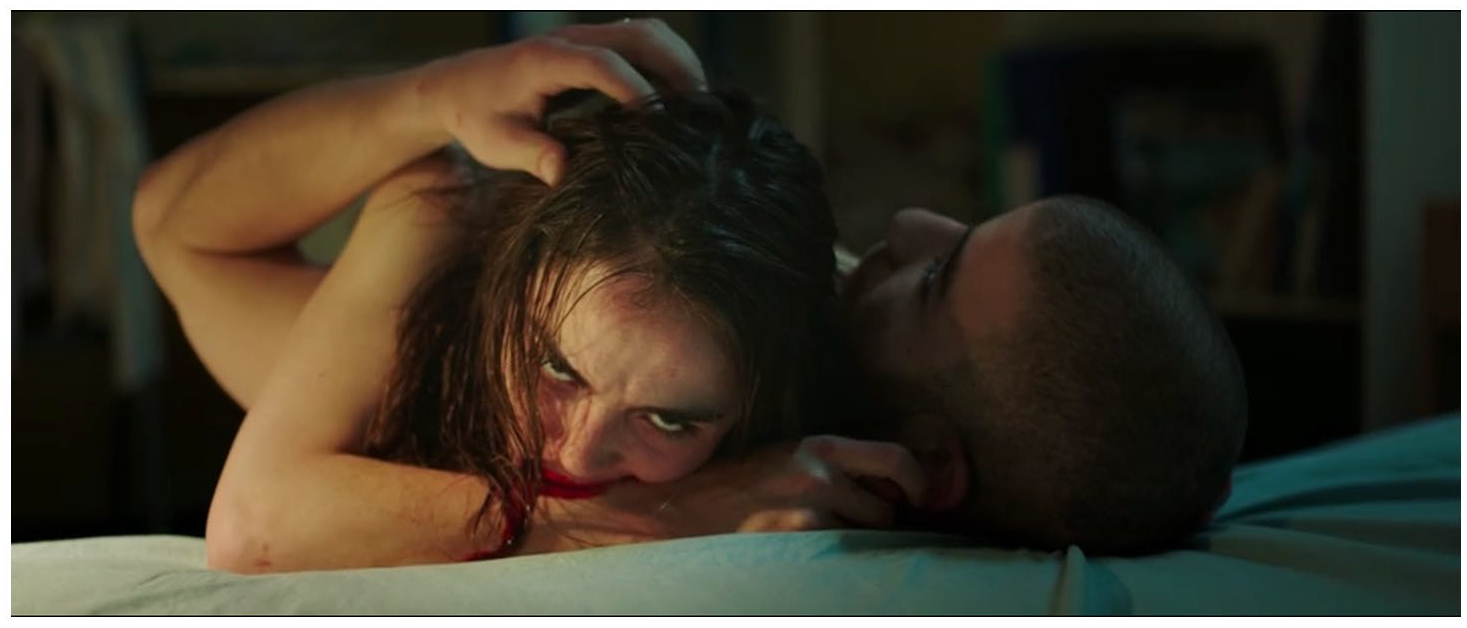
During sex with Adrien, Justine bites her own wrist to stop herself from consuming his flesh. Screen grab from Julia Ducournau’s film Raw (2017).
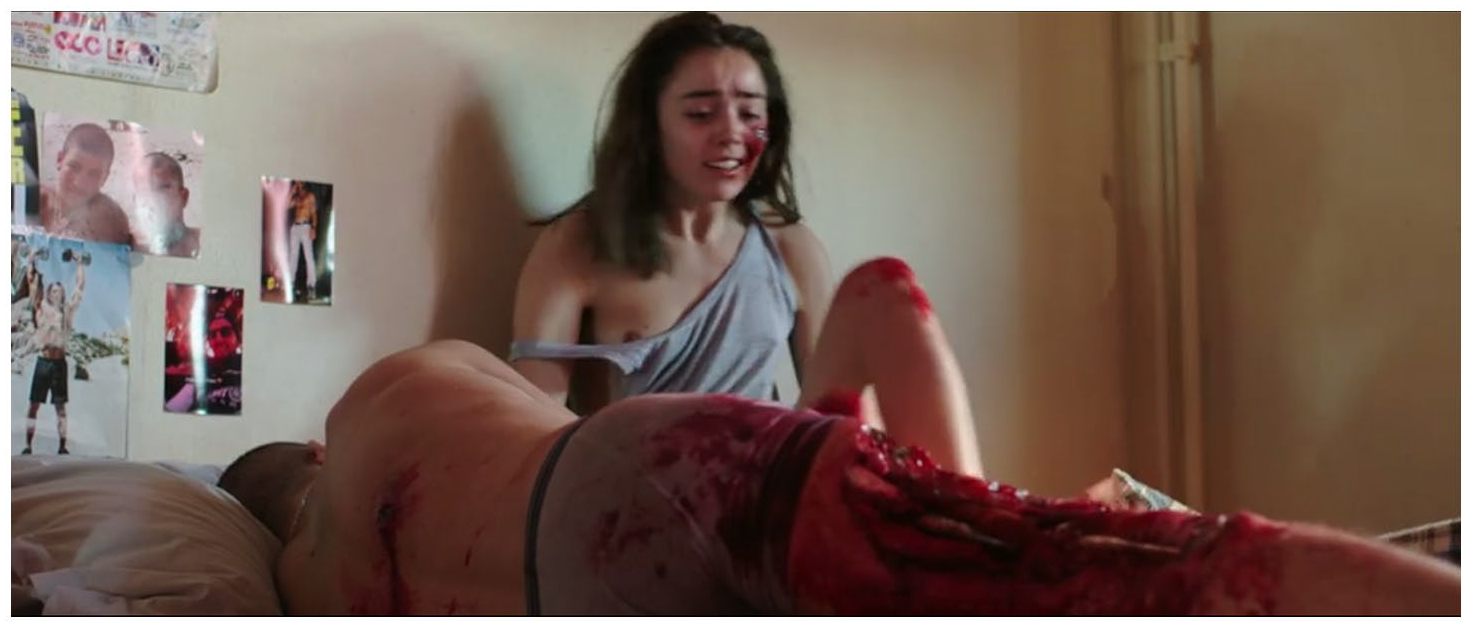
In the film’s most explicit spectacle of cannibalism, Adrien’s body is revealed to Justine and the spectator. Screen grab from Julia Ducournau’s film Raw (2017).
Why does Raw kill Adrien? He is the only victim who is not randomly chosen and something about Adrien makes both Justine and Alexia lose control. So-called ‘white cannibalism’ has a history of consuming victims of colour. Walton (2004: 19–20) traces such histories at sea and in the American West, and finds that a suspicious number of victims of historical white cannibalism were non-white. Probyn (2000: 81) writes that:
If the figure of the cannibal reminds us of hunger, what exactly are we hungry for? . . . it would seem we are hungry for difference, more often than not understood in terms of ethnic difference. In terms of these debates, whiteness is increasingly seen as a ‘state of incompleteness’ that needs to be supplemented by ethnic difference.
These urges link racist violence to the desire for ownership identified by hooks (1992), in which white culture consumes and appropriates the ‘spice’ of racialized otherness. Alexia and Justine desire Adrien’s difference, but neither can maintain appropriate boundaries around his queer Arab body.
Narratively, his death serves to bring the sisters together. When Justine realizes that Alexia has killed and eaten Adrien, she takes her into the shower and gently washes the blood from her naked body. Despite Alexia’s murderous action, Justine immediately forgives her. In jail, Alexia mimes ‘I love you’ and Justine responds by offering her bitten cheek to the glass that separates them. They may be cannibals who have just consumed Adrien but sisterhood renders this outcome poignant and even triumphant. Despite itself, the film’s feminism ends up in a weird familial gender normativity. In its account of the cannibal as modern female subject coming of age, who is the other against whom she must define her autonomous self? Not her sister, whom she keeps close and whose freedom she protects with her own. Not her parents, to whom she returns in the final scene. Her father reveals that their mother is also a cannibal and that he allows her to feed on his body. Cannibalism finds a way to thrive and white bodies are spared. Only Adrien is left to take on the role of the Other and his death is required for Justine to grow up. (In this role, he is again compared to an animal since the narrative’s other sacrifice is the family dog, who takes the blame for eating Alexia’s finger and is euthanized.) Justine devours in order to produce identification, and both her punk feminism and her familial solidarity emerge out of the destruction of the queer non-white Other.
A monstrous politics
Raw’s appetite for the Other cannot be seen in isolation from Ducournau’s insistence that Raw is not a feminist but a universal film. This attachment to the universal emerges through the film’s racializing and sexualizing gestures, which both produce and complicate its political monstrosity. Key to Justine’s monstrous resistance are the human/nonhuman relations that traverse the film, both through her cannibalistic desire and in the animal figures in the narrative. Justine’s relation to the animal substantiates a monstrous politics, revealing constraint and suggesting resistance. Yet the film’s insistence on the universal inevitably racializes its feminist claim exactly through its play with human/nonhuman relations. Consequently, the monstrous in Raw appears as a site of ideological reproduction as well as resistance. Such structural ambivalence is potentially troubling, but this trouble is also the intent of a politics of monsters.
The monster as a figure is always more than itself. It embodies a site of what Halberstam (1995: 2) terms ‘interpretive mayhem’, a form that illuminates the significatory frictions and historically high stakes of who counts as human. Ideological and affective indeterminacy are always at play in a politics of monstrosity since inhabiting ‘the monster’ hovers in close proximity to the very dehumanization its subversive practices endeavour to resist. Such a politics invites us to reflect on the human as an unstable construct determined by its historic relation to the worlds they, and we, inhabit. It urges us to look for a language and an imaginary with which to think of dehumanization as a practice, to interrogate the discursive relations of human and nonhuman, and to explore the nonhuman as a site of resistance. In its classic forms, the monster puts normative accounts of the human into question. Raw’s attachment to the universal as a signifier of humanity complicates this monstrous politics, by revealing a tension between posthuman resistance to patriarchal regimes and the film’s racialization of the Other. Ambivalence is not always and everywhere the same. The indeterminacy of a monstrous politics as ‘interpretive mayhem’ is not identical with Raw’s racialized ambivalence around the status of the human. As much as the film conjures the monster as a posthuman site of resistance, it elides the relationship between the dehumanization of certain bodies and the constitution of the human in others.
Thus, Justine might chomp on human flesh but she herself never loses her humanity: her cannibal figuration remains legible within normative grids of human existence. Part of the film’s feminist appeal is Justine’s normality: she is not a monster who stalks victims from outside human society, but rather she is represented as an average girl located within typical social relations. Despite her ravenous flesh-eating outbursts, Justine retains what makes her recognizably human and her ‘coming of age’ trajectory returns her to the nuclear family. If the film’s feminist move is to suggest that patriarchy makes a girl want to kill, a posthumanist perspective discloses the implications of a monster who, nonetheless, retains all the normative advantages of human status. This benefit has not always been extended to monsters and nor has it always been extended to humans. In arguing that Raw works to include white women in the universalist category of the human, we ask what genres of human and nonhuman haunt its politics of monstrosity?
Such questioning leads us to the nonhuman carnage that gathers around Justine. As much as Justine is aligned with nonhuman animals such as the horse, she is also the subject who lives when they die. She shares their victimhood but, unlike them, can leverage exclusion into new forms of life. The same can be said of her relationship to Adrien: like the nonhuman animals, he begins as a fellow outsider and ends as flesh to be consumed. These deaths resonate with the intrinsic ambivalence of posthumanism: Raw may be filled with feminist transformational energy, but its colonial traces erupt into the present through its display of dehumanization. To look at the bodies that accumulate around Justine is to pose the question of the status of the nonhuman and to ask how the film understands the human/nonhuman relations it elaborates? Raw’s flirtation with posthumanism enables us to question what it means to be human, or rather who gets to count as human and through what processes of exclusion the human takes shape. This line of questioning seeks to disrupt the universal ideal of the Human as Enlightenment subject, and it thus shares stakes with feminist, queer, trans and black theories of the human and its dehumanized others. Yet posthumanism, in its monstrous politics, goes one step further, arguing for an inhabitation of the nonhuman. Posthumanism is compelling as a feminist imaginary because its political move is not to ask for inclusion, or to find ways to become human within this Enlightenment ideal of Man. Rather, posthumanism says: Keep your humanity, I don’t want it, I will stand with those excluded from society; those defined by their bodies and desires as abject. We inhabit the signs of our exclusion as politics and inhabit our bodies as sites of resistance.
For Raw, posthumanism is a way of standing with the monsters of society as politics. It is here, at this site of resistance, in this politics of monsters, that Justine’s cannibalism can be located. Yet this is also where Raw’s whiteness resides.
Black theories have criticized posthumanism for the reproduction of whiteness in its imaginaries. Weheliye (2014: 47) cuttingly argues that ‘the posthuman’ does not necessarily signify a time after the human as we know it, but rather indicates a particular geography, a Eurocentric Western index, a ‘snowy’ landscape of whiteness. This whiteness is systemically reproduced under the rubric of the posthuman, which he understands ultimately as a revalidation of humanist ideals, as the Human it ironically seeks to transcend. This tactic of whiteness occludes all the Other bodies that accumulate on the outside of Man and the processes of dehumanization that work to justify those exclusions. The nonhuman becomes a celebrated site of resistance, obscuring the historic and present vulnerability, and premature death that still cleaves to those dehumanized and on the outside of Man. To understand the posthuman as beyond the Human is to assume that ‘we’ all have unfettered access to this category that ‘we’ now desire to overcome. Reading monstrosity in relation to black theory allows us to see how the dehumanization always dangerously present in a politics of monstrosity is complicit in allowing continued injustice to be rewritten as freedom (Sharpe, 2009: 3). Black film theory insists on the formal operation of blackness in cinema, as something other than a corporeal ontology (Gillespie, 2016: 1–5). In other words, reading monstrosity with blackness illuminates the racialized inhuman that haunts the disavowal of the Human, but which remains occluded in posthumanism’s celebration of nonhuman agency and monstrous resistance.
Many accounts of posthumanism press against the Enlightenment definition of Man, toward something envisioned as beyond the human. What is neglected in the excitement of leaving behind Enlightenment Man are all those ways of being human that exist and have existed before and outside the European colonial project. Wynter (2003) articulates this neglect in terms of genres of humanity: she points to the Eurocentric overrepresentation of Man, in which the rational human originating in Europe, despite being but one genre of human, is made to signify all of Humanity in (post)colonial grids of knowledge production, embodiment and ideology. We argue that, despite themselves, many posthumanisms reiterate this Eurocentric Human. Thus, to speak with Jackson (2015: 215), the move ‘“beyond the human” may actually reintroduce the Eurocentric transcendentalism this movement purports to disrupt, particularly with regard to the historical and ongoing distributive ordering of race’. Within posthuman deliberations on the non/human divide and its celebration of nonhuman life, the racializing formations of the inhuman as Humanity’s Other go underanalysed, if not fully neglected. As a consequence, posthumanism does not take us beyond the human but returns us to this figure and its historic location.
In Raw, posthumanism’s colonial spectre is evocatively present in discourses on the human and animal. This rhetoric carries a colonial history, in which producing and policing the human/animal dichotomy has been intrinsic to the dehumanization of racialized others (Mbembe, 2001). The categorization of animal life is historically intertwined with the production of the inhuman, yet both categories often fail to figure in posthuman thought. Consequently, the Eurocentric genre of the human is reiterated in the critique and occluded as a problem, and any critical investigation into posthumanism’s own complicity in reinstating Enlightenment humanity is foreclosed. Similarly, Raw tells us that it is conscious of the colonial legacies of the cannibal. In the conversation about monkeys and AIDS, it tells us that it is conscious of dehumanization and racialization. Yet, in the construction of the film’s narrative, this colonial awareness cannot go anywhere. The manner in which the nonhuman is staged mutes its own inhuman dimensions. On the surface, Justine enacts a punk feminism, a monstrosity in which her animality or nonhumanity resists patriarchal coercion (and it does). Below the surface, though, in the corners of the frame, a different narrative shows all the nonhuman bodies that have to suffer for Justine to stage her resistance and retain her humanity. Shifting focus away from cannibalism, toward less spectacular non/human relations, reveals that the cannibal was an enactment of humanity all along.
The cannibal as human directs us to the film’s attachment to the universal and to how this normative grid emerges in its return to the nuclear family. Sororal bonds constitute a stickiness that allows Justine to become a cannibal while remaining legible within white heteronormative registers of human life and social reproduction. Rather than bringing the spectator beyond the human, the film reinstates a particular ideology of humanity. The violence of this ‘humanization’ becomes visible if we return to the scene in which the white student frames Adrien in relation to monkeys and AIDS, which we read as a scene of dehumanization. And it is certainly that. Yet we can read the violence enacted in that scene differently, as a moment in which both Adrien and Justine are humanized, and in which Raw’s investment in a particular genre of the human can be discerned.
Jackson (2020) argues that the human–animal distinction found in Western thought is persistently racialized, where blackened bodies constitute the animalized abject propping up white modern Man. Instead of arguing for animalization as a process of dehumanization, however, she proposes the animalization of blackened bodies as a particular humanization co-constitutive with racialization. Thus, ‘animalisation is not incompatible with humanization’ (p. 18), since it is not that blackness places bodies outside the human, but that animalization takes place within – and indeed constitutes the racial work of – humanization. Rather, she insists that the animalization of black bodies as a racializing genre of the human is constitutive of whiteness, enabling white bodies to emerge as human in contradistinction to ‘the animal’. Jackson’s critique of Enlightenment Man is thus ‘not as black “exclusion” or “denied humanity” but rather as the violent imposition and appropriation’ (p. 3). As a consequence, the violence of race becomes legible through particular formations of the human and the animal.
Read through this lens, Raw’s ‘violence of humanisation’ (p. 4) not only refers to Justine’s ability to retain her humanity through the suffering of her animal Other, but also to the way in which animals are called upon to substantiate that humanity: creating and affirming her whiteness. Thus, the animal figures that traverse the film are not outside Raw’s process of humanization and their suffering does not point us outside humanity but to ‘the burden of inclusion into a racially hierarchized universal humanity’ (p. 18). Dehumanization does not place us outside the frame of Humanity but smack in the middle, and the film’s animals do not remove us from the Human but guide us toward this hierarchized universal. As a consequence, Raw’s monstrous politics never escapes the humanist ideal: its monstrous feminism was never as promiscuous as its seduction made us believe. These are the contradictions that make the film so compelling and so troubling. Raw does not offer simple exploitation, nor is it simply a bad object. Even when we focus on the problems of white feminism, the film brings its own tensions into sharp relief. It could avoid these messy questions, but instead it returns to them. Its blindness to the problems of the human is nonetheless matched by its compulsive attempt to destroy this thing it cannot quite see. In two particularly opaque and disturbing scenes, Raw offers a vision of boundary breakdown that might imagine cannibal humanity differently.
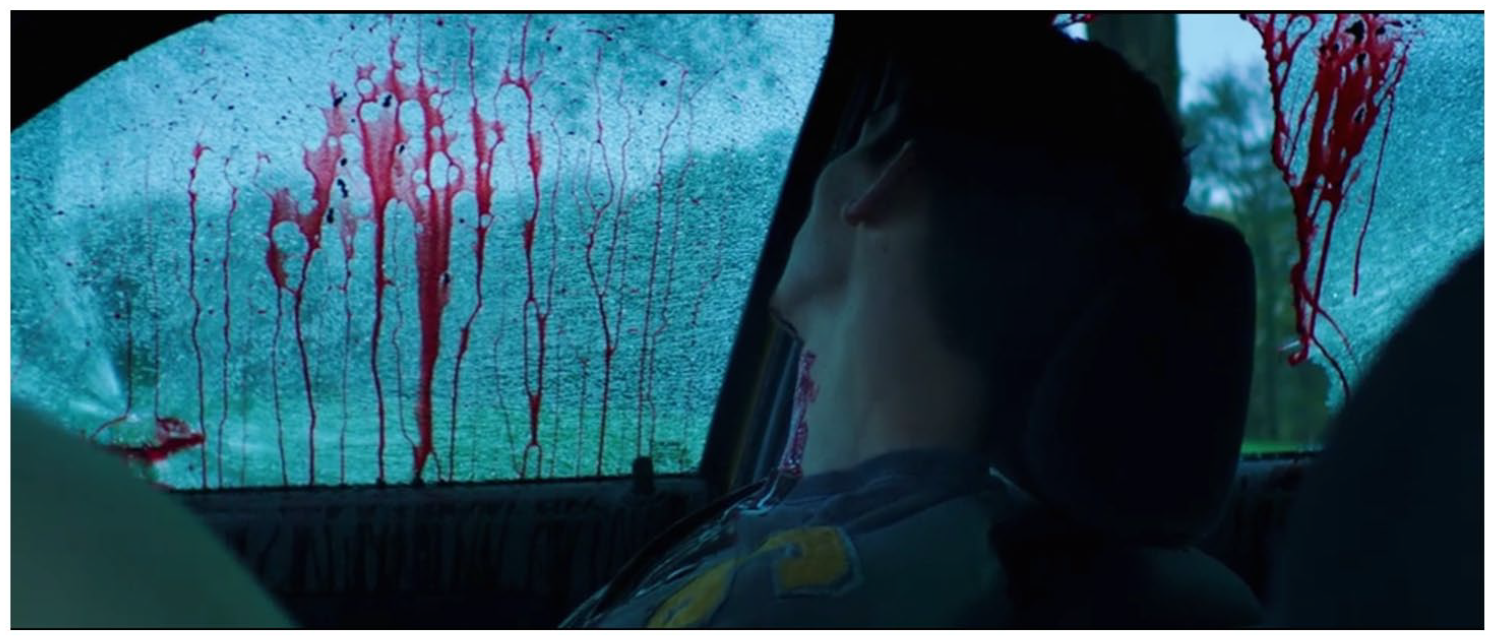
The film’s car crashes disfigure representation, making the subjectivity of their victims hard to read. Screen grab from Julia Ducournau’s film Raw (2017).
Shortly after Justine eats her sister’s finger, Alexia takes her to a rural roadside. As a car approaches, Alexia runs in front of it and makes it crash into a tree. There is blood everywhere, the driver lies slumped over the steering wheel unconscious and the passenger is badly hurt and moaning. Alexia approaches the car and sticks her head in, saying eagerly, ‘he won’t make it.’ She reaches into the car and starts sucking the passenger’s bleeding head. We see chunks of undefined flesh coming off the body. This scene, halfway through the film, retrospectively makes legible the opening, which depicts a similar car crash. In the first iteration, we don’t understand quite what has occurred. In these scenes, the ‘cannibal’ is not an easily legible figure, instead provoking chaos and confusion. We cannot discern what is being eaten, or who is in the car. The scenes rather depict fragments of bodies alongside shattered glass, blood and flesh. Instead of constructing a humanized cannibal, they disfigure subjectivity and representation. They can be read, we propose, as a fleeting way out of the film’s rhetoric of humanization. Cannibal car crashes stage a posthuman resistance, evoking the indeterminacy of a monstrous politics in which there is no clear inside or outside. This chaotic assemblage of human and nonhuman components is cut together/apart (Barad, 2014) to form a monstrous affect. If the animal does not provide a way to resist the Human, these scenes might. Here, political affect is prompted not by Justine as a cannibal figure but by the cannibal car crash as a monstrous disfiguration. This chaos, ‘interpretive mayhem’, constitutes a fertile ground for a different story that steps out of line (Bey, 2019) and neither resists nor reproduces white feminism.
Conclusion
In concluding, we return to Staubli’s (2018) sense of the film as allegorical to grapple with its ambivalence. It is plausible to view the film as unthinkingly racist, but even in such a critical reading, Raw reveals much about the racializing logics of white feminism. We propose three ways in which Raw might be seen as politically valuable. First is the claim of feminism that we have critiqued as a reproduction of whiteness, and which comes at the expense of violently erasing the humanity of marginalized people. Second would be to accept the first critique but to propose that the film renders visible the structures of racialization at work in its feminism. Its engagement with cannibal discourse stages an allegory of how white feminism devours its others, and indeed it is possible to read a reflection on this violent structure as immanent in the text. As we have argued, Raw’s discourse on gender, race and social reproduction is complexly overdetermined. Despite Ducournau’s heroic accounts of her protagonists, the film lays bare a logic in which the Arab queer becomes collateral damage to the successful reproduction of white female subjectivity. In staging so vividly a mise-en-scène in which non-white and queer people are consumed by white feminist empowerment narratives, Raw offers an uncomfortable and perhaps indigestible allegory.
Thirdly, we wonder if Raw transcends its own limitations, if it offers a politics of monstrosity that is something other than a reproduction of whiteness? We return a final time to the question of whom Justine and Alexia eat. Alexia teaches Justine to run in front of cars, making them crash, and eating the dead or dying victims. This method of finding humans to eat is crucially random, in the way that police traffic stops are supposed to be (but of course generally are not). In their randomness, these fatal traffic stops posit the victims of cannibal feminism as abstract humans. In other words, they use the abstraction of the Enlightenment human against itself. Without being able to see these anonymous victims, we might well envisage them as white men. These abstract figures deploy the overrepresentation of whiteness as a feminist move. The spectator is much more able to perceive these unseen bodies as part of a punk feminist cannibal resistance. Justine’s life falls apart when Alexia kills Adrien – which is to say, when she kills not an abstract human but an embodied one, an intimate. This is double trouble, for not only is the victim a queer Arab (rendering visible the racialization and sexual exclusions of the category of the human), but the killer is a family member. With this murder, Justine is drawn back into the violent whiteness of her nuclear family. There might be a powerful critique in the film’s destruction of Justine’s freedom in the very moment that her sister kills her only friend. In the end, Raw forecloses on any sense of feminist cannibalesque, but it makes it clear who and what is responsible for the return of social order.
Footnotes

Notes
Address: King’s College London, 449N Norfolk Building, Strand, London WC2R 2LS, UK. [email:
Address: Erasmus University College, Nieuwemarkt 1A, 3011HP Rotterdam, Netherlands. [email: