






Abstract
Contemporary marketers build online brand communities to communicate with the organization’s social surroundings, yet there is a lack of understanding of how brand legitimization unfolds in these platforms. To understand how legitimacy is constructed and contested every day, the current study adopts a practice-theoretical lens and discourse analysis to investigate two online communities. The contribution of the study is twofold: First, the insights from the discursive praxis, online community posts, comments and reactions illustrate the connections between multiple levels of legitimization discourse. Second, this study builds a theoretical framework for legitimization practice. Individual perceptions, judgements of the texts and actions on them in the online community intertwine with the organizational and societal context shaping the legitimacy of the brand in the community and beyond. This practice supports or challenges the brand as an institution and may legitimize or delegitimize the brand.
Introduction
Brands have been described as ‘entities experienced, shaped and changed in communities’ (Brown et al., 2003: 31). Consumers make regular judgements on whether the consumption of a particular brand is righteous or ridiculous (Kozinets, 2001; Luedicke et al., 2010). The righteous form of consumption is considered legitimate, referring to the ‘perception or assumption that the actions of an entity are desirable, proper, or appropriate within some socially constructed system of norms, values, beliefs, and definitions’ (Suchman, 1995: 574). Prior marketing studies have investigated how cultural products (Coskuner-Balli and Ertimur, 2016), marketing activity (Ardley and Quinn, 2014) and academic fields (Coskuner-Balli, 2013) obtain legitimacy and how a firm’s operational context affects its legitimacy (Grayson et al., 2008; Handelman and Arnold, 1999). Studies have also investigated how product categories such as gambling (Humphreys, 2010a, 2010b) or marginalized consumers (Kates, 2004; Scaraboto and Fischer, 2013) seek legitimacy at a societal level. While social structures shape our lives and cannot be ignored, legitimization is also a micro-level phenomenon that individuals make sense of and one that affects their everyday lives (Coskuner-Balli, 2013; Roleau, 2005). Acquiring legitimacy is also an important foundation for long-term organizational success (Zimmerman and Zeitz, 2002), an understanding that led Bitektine and Haack (2015) to call for additional research on how legitimacy is construed at the micro-level. However, despite the central role of social media in contemporary society, there is little understanding of how legitimization practice unfolds in these platforms (Humphreys and Latour, 2013).
Previous studies of online communities demonstrate that communication styles affect members’ evaluations of the brand (Steinmann et al., 2015) and their perceptions of legitimacy (Handelman and Arnold, 1999). Research has also investigated social control (Sibai et al., 2015), consumers’ reasons for participating in social media (Lin and Lu, 2011; Muntinga et al., 2011) and the motivational aspects of spreading positive word-of-mouth (Hennig-Thurau et al., 2004). Individuals within brand communities interact; they develop feelings of bonding and act to resolve conflicts; however, they also negotiate what is valuable and legitimate (Husemann et al., 2015; Seraj, 2012). Prior research has also indicated that media framing plays a critical role in establishing legitimacy (Humphreys and Latour, 2013) and that everyday practices can be full of symbolic meaning (Gram et al., 2015); yet, we know surprisingly little of how an organization’s actions and social influences play out in online brand communities (Steinmann et al., 2015).
Legitimacy is a precondition of the creation of value, as a brand lacking legitimacy is unlikely be favourably evaluated by the consumer (Deephouse and Suchman, 2008). Participation in online communities has become increasingly popular (de Valck et al., 2009). As consumers get hooked on sharing their ideas, pictures, videos, recommendations, reviews and experiences, they form their own subcultures with people they have never met in person but with whom they share interests (Iriberri and Leroy, 2009). The legitimacy of brands is also contested in online communities every day, and ‘the need for legitimacy shape[s] the diverse subcultures’ consumption meanings and practices’ (Kozinets, 2001: 67). On the other hand, studies have found that acceptance by friends (Albers-Miller, 1999) and perceptions that some action constitutes normal behaviour (Harris and Dumas, 2009) affect the willingness to buy unethical goods. It follows that understanding how legitimization works is also an important way of preventing consumers from engaging in undesirable behaviour, such as purchasing counterfeit, or otherwise unethical or illicit goods (Albers-Miller, 1999; O’Sullivan, 2015).
In response to these challenges, the present study contributes to the literature on value creation in social media by demonstrating how online community practices facilitate construction of legitimacy within online brand communities. The study proposes that the legitimization practice in an online community incorporates the perceptions, judgements and actions of the consumers. These are intertwined with the actions of the marketer and prior collective legitimacy judgements within and outside of the online brand community, shaping the consumer perceptions and judgements with regard to the brand.
Theoretical background
Legitimacy
According to Suchman (1995: 574) Legitimacy is socially constructed in that it reflects congruence between the behaviour of the legitimated entity and the shared (or assumedly shared) beliefs of some social group; thus, legitimacy is dependent on a collective audience, yet independent of particular observers.
Legitimacy can be viewed as an asset or resource possessed by an organization, brand or individual but is always a product of evaluation created by evaluators other than the legitimized organization or individual (Bitektine and Haack, 2015). On a societal level, the legal system, regulation and social norms give rise to general legitimacy judgements. Organizations can derive legitimacy from their cultural environment and employ it to achieve their goals. Marketers can build legitimacy through frequent and intense communication within the organization’s social surroundings (Suchman, 1995). Several studies emphasize that communications through print media, TV or radio broadcasts serve as a central legitimating arena (Bansal and Clelland, 2004; Bednar, 2012; Bitektine, 2011; Deephouse, 1996; Lamertz and Baum, 1998; Pollock and Rindova, 2003).
Online brand communities
A brand community is ‘a specialized, non-geographically bound community, based on a structured set of social relationships among admirers of a brand’ (Muniz and O’Guinn, 2001: 412). Prior research has demonstrated the efficacy of brand communities in helping to establish long-term relationships with customers (Aaker et al., 2004; Fournier, 1998). Brand communities allow the sharing of essential resources such as information and experiences, thus strengthening the cultural norms and values of the brand (Muniz and O’Guinn, 2001). Accordingly, companies are very anxious to learn about, organize and develop these communities (e.g. Schau et al., 2009; Zhou et al., 2012) because they offer the advantages of acquiring loyal customers, maximizing collaboration opportunities with customers (McAlexander et al., 2002) and influencing the actions of those customers (Muniz and Schau, 2005).
Social media and brand communities are well suited. The creation and sharing of meaning is the most important aspect of a brand community (McAlexander et al., 2002) and the creation and sharing of content is the most important aspect of social media (Kaplan and Haenlein, 2010). As with offline brand communities, people join online communities to fill some need such as for self-presentation, self-expression or to raise their self-esteem (Back et al., 2010; Wilcox and Stephen, 2013; Yeo, 2012). Online brand communities are very similar to traditional brand communities in that they respond to consumers’ desires to feel accepted and create a social identity through the brands with which they interact (Simmons, 2008). Nevertheless, they also differ in some important ways. The speed of the communication is faster and reach is potentially global (Habibi et al., 2014). Consumers can convey their dissatisfaction with a brand to 10 million people rather than a network of 10 people. As a result, the activities of the brand also become far more transparent (Fournier and Avery, 2011). In many cases, anyone can join the online brand community, while traditional brand communities may be more targeted to those who are owners of the product or brand (Algesheimer et al., 2005; McAlexander et al., 2002). Social media allows people to gather more easily and efficiently, to form special interest subgroups, and share the experience of, and knowledge about, brands (Kozinets et al., 2008; Mangold and Faulds, 2009). The interaction with customers is quicker (Gensler et al., 2013) and consumers feel more engaged with organizations when they are able to submit feedback (Mangold and Faulds, 2009). While journalists in the traditional media shape legitimization by selecting what information is presented and how it is discussed (Humphreys, 2010a), journalistic intervention is clearly not such an issue within the social media environment. However, there might be a moderator who removes inappropriate comments from the brand community, and of course, the marketer does steer the conversation by deciding which topics are presented for discussion within the online brand community.
Online community legitimization practice
Practices are a routinized type of behaviour consisting of bodily and mental activities, things and their use, as well as knowledge in the form of understanding, knowledge and emotions (Reckwitz, 2002). Practice theory suggests that these combinations of mental frames, artefacts, technology, discourse, values and symbols (Orlikowski, 2007; Schatzki, 2006) are tightly interconnected and cannot be reduced to any one of their elements (Reckwitz, 2002). In other words, practice is a nexus of doings and sayings (e.g. Schatzki, 2001), meaning that the things we do ‘cannot be analysed without incorporating mental processes’ (Ellway and Dean, 2016: 230), that is, our perceptions and judgements of ‘things’ (Prinz, 1984). Undertaking any act creates bidirectional associations, coupling the perceptions and actions tightly together through a judgement mechanism (Fuster, 2004; Gerstadt et al., 1994).
Online communities are an interesting context in which to study legitimization practice. Social order in online communities is not only about compliance with normative expectations but, as proposed by practice theorists, is embedded in collective cognitive–symbolic structures (Reckwitz, 2002). These structures (language being the prominent example) reproduce a social order in which a normative consensus does not exist (Reckwitz, 2002), producing dialogues within communities that are motivated by a need to legitimize the actions of the actors (Girardelli, 2004). In the course of providing legitimacy for organizations, products and brands, consumers also seek to legitimize their own consumption of particular goods (Humphreys, 2010a, 2010b). Sources of legitimacy extend beyond individual actors (Johnson et al., 2006) and diffuse across institutional fields through interactions between various groups of participants and the related institutional context (Lawrence and Phillips, 2004). Online community legitimization is an ongoing social practice that institutionalizes ‘things’ and is shaped by a number of factors, with both an intentional and unintentional impact. Hence, in this study, brand legitimacy is a social practice in which the perceptions, judgements and actions as well as things, observable performances of the brand and its consumers collectively forge a routine, the practice of legitimization (Figure 1).

The elements shaping legitimacy in online communities.
Research context and methods
To understand how legitimization unfolds in online communities, we needed to obtain insights from a different kind of brand environments representing both well institutionalized, stable brands and a more dynamic, changing institutional context. We chose to investigate the carmaker BMW (www.facebook.com/BMW) and the craft beer maker BrewDog (www.facebook.com/BrewDogOfficial) also on the basis of ample material and prior knowledge on the contexts, allowing us to understand the lively discussions on these openly accessible forums. At the beginning of the study, the BMW site had more than 14 million followers; the BrewDog site was considerably smaller but still had more than 48,000 followers. The followers represent people who have opted to follow the activity on the brand site and receive updates to their own Facebook news stream from the sites. The number of active members who had participated in the discussions within the study period was 10,782 for BMW and 5162 for BrewDog. The number of comments by one person varies from 1 to 68 (1–62 for BMW) and only about 10% (2% for BMW) have commented on 5 or more occasions. However, both sites are open to anyone to view, even people without their own Facebook account, suggesting that the number of people exposed to the sites could be considerably larger than the number of followers. In fact, it is estimated that somewhere between 20% and 90% of visitors to an online community website do not actively participate (Hartmann et al., 2015). We considered 1736 organizational posts and 15,490 written comments from the BMW Facebook pages that appeared between September and November 2013 and subsequently 1370 posts and 12,350 written comments published on the BrewDog Facebook site between April 2013 and November 2013. While the Facebook sites act as the primary source of data for this study, we also investigated the official websites, blogs and other electronic materials available from the case organizations.
Several scholars have employed online discussion forums, blogs and social network sites to inform their research (e.g. Cova and Pace, 2006; Healy and McDonagh, 2013; Skålén et al., 2015). Netnographic methods (Kozinets, 1997, 2001, 2002, 2010) make it possible to delve into online communities to reveal the meanings experienced by and the feelings of consumers. The present study opted for non-participant observation in order to capture social action and interactions as they occurred. In this, the researcher acts as a specialized type of ‘lurker’ in the community (Kozinets, 2010) in order to avoid any undesirable influence of the outsider on the group (Elliott and Jankel-Elliot, 2003). Concerns over research ethics, privacy and anonymity do not disappear simply because the subjects participate in public online social networks (Zimmer, 2010). The individuals actually tend to reveal more about themselves within online environments than they would in offline equivalents (Stewart and Williams, 2012). Hence, while all data quotes have been transcribed exactly as found in the source text, our data set does not include any demographic, relational or cultural information on the community members. All the information that might identify the community members, such as references to their private profiles or other personal information like usernames, was deleted or encoded immediately after the data were downloaded into NVivo 10. Brand postings and comments were separated because the study identified that marketers and other community members have different roles and ambitions in relation to the community.
We began our analysis by identifying online community participation practices following the examples from prior literature (e.g. Hartmann et al., 2015; Schau et al., 2009) and searched for instances of legitimacy praxis within those generic online participation practices. Second, we identified discourses within the data using Fairclough’s (1992) three-dimensional model of discourse. Discourses are specific ways of knowing social practices that are used as resources to represent social practices in texts (Van Leeuwen, 2008). Through discourse analysis we can better understand the practices of legitimization. Discourse analysis as a method explicitly focuses on the process through which ‘things’ become legitimized and institutionalized (Phillips et al., 2004). Hence, we were able to link the linguistic forms of conversations to broader macrolevel legitimization discourses that emerge mainly beyond the online brand communities. We focussed on the text and the linguistic forms (e.g. metaphors, grammar, metonyms) of the postings and comments. Ultimately, through moving back and forth between theory and our analysis of the data, we built a framework to facilitate understanding legitimization practice in the online community. Through that action, we theoretically linked our empirical analysis with both the practice approach and the research on legitimacy conducted within the institutional approach (e.g. Bitektine and Haack, 2015) as well as with the cycle of perceptions, judgements and action adapted from the cognitive sciences (Neumann and Prinz, 1990).
The online brand community as a discursive platform for legitimizing brands
Legitimization praxis within online community practices
The online community practices fulfil consumers’ desires to feel accepted and create a social identity through the brands with which they interact (Fournier and Avery, 2011). Within the practices, we found instances of discursive praxis, not only related to these generic online practices but also related to different types of legitimacy (Figure 2). For example, praxis within the practices of sharing symbols, experiences and pictures of consumption and greeting other community members relate to normative approval and social acceptance and therefore to moral legitimacy. Specific advice and undistorted information about the use and benefits of the product in turn appears to be more closely related to pragmatic legitimacy. The cognitive, subjective, contextual nature of legitimacy unfolds, for example, in the form of stories, often links with the idea of cognitive legitimacy because the stories portray a certain product as necessary and not owning it to be inconceivable. Further, organizations facilitate discussions to reinforce legitimacy by setting competitions and encouraging members to post pictures of themselves using the product. It also appeared that some consumers attempt to destabilize brand legitimacy through critical rhetoric (Suddaby and Greenwood, 2005) or discursive construction (Vaara and Tienari, 2011). Drawing upon Reckwitz (2002) and Sztompka (1991), praxis may be seen as a stream of activity that interconnects the micro-actions of individuals and groups with the wider institutions in which those actions are located and to which they contribute. The idea that the same praxis contributes towards multiple practices, for example, towards value creation and legitimacy, encouraged us to view legitimization as a discursive practice emerging inside and across online community practices through perceptions, judgements and actions of individuals.
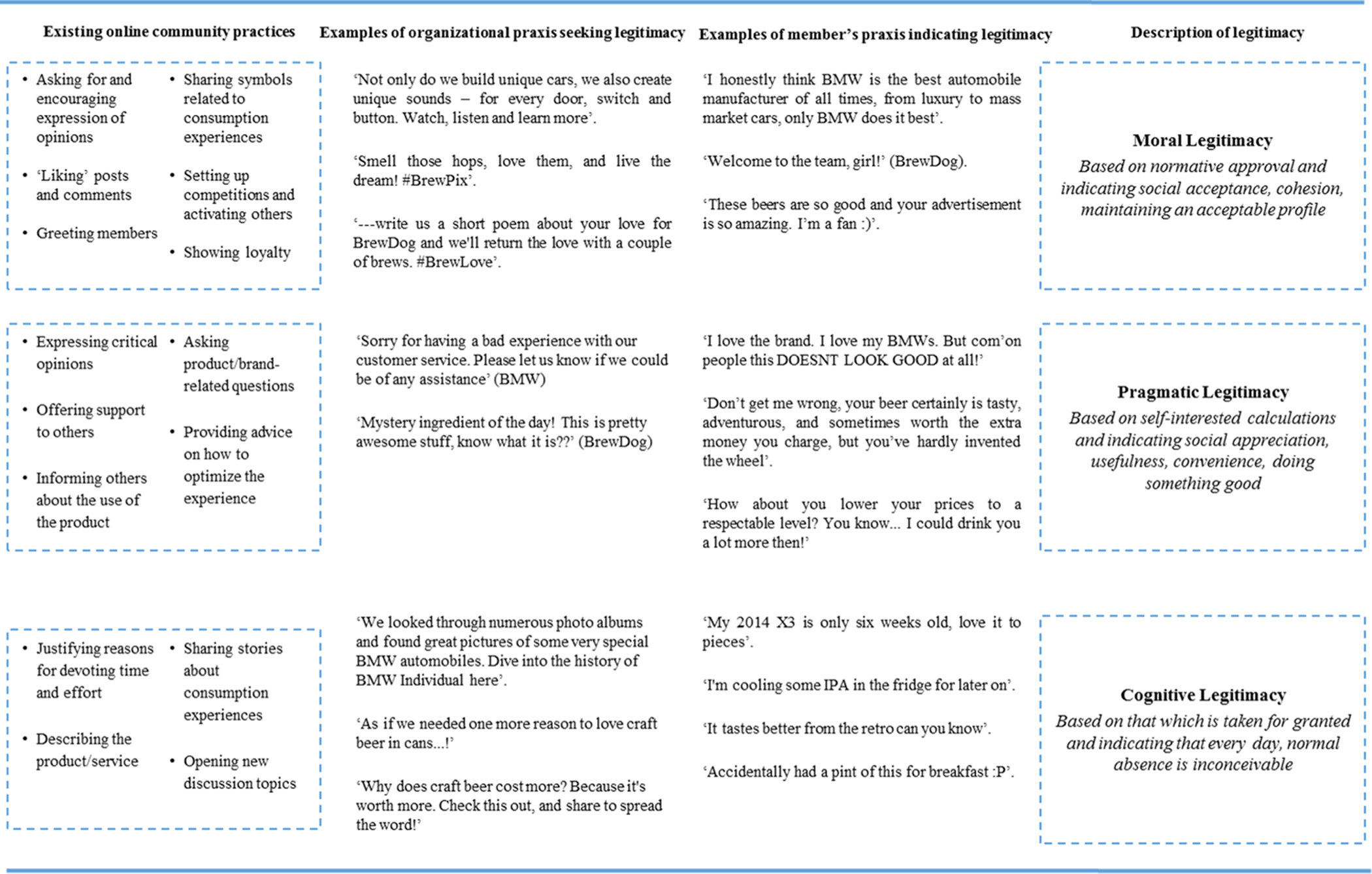
Online community practices and examples of praxis linking to different types of legitimacy.
Perceptions of legitimacy
In both communities, a marketer’s postings typically relate to new products or other activities. Spontaneous responses from the community members, such as ‘WOW’ ‘That’s just plain brilliance.’ ‘My favourite <3’ ‘Finally! Thank you BD’! ‘Love it! Amazing taste!’, exemplify the simple positive perceptions created by the new activities of the brands. The sense of legitimacy is established in connection to individual discourse, which creates boundaries for the judgement and assessment of specific actions. A poem from a BrewDog fan, in response to a poetry competition, illustrates well how the deeper individual meaning and the perception of legitimacy is established in connection to discourses outside the online community: This is my craft beer. There are many others like it, but this one is mine. My craft beer is my best friend. It is my life. I must master it as I must master my life. Without me, my craft beer is useless. Without my craft beer, I am useless. I must drink my craft beer true.
However, not everything is embraced with equal enthusiasm. Comments like ‘Another disappointment for real BMW fans’ or ‘We love you, but that brewery is starting to look a little too large scale, commercial style’ also challenge the legitimacy of the brand enabling more negative perceptions to emerge. However, social norms significantly affect how individual actors perceive and make sense of things (Scheufele, 1999), and brand community members are influenced by multiple discourses (Hardy et al., 2000). The outcomes of these perceptions on the discursive action, and vice versa, are beyond the control of individuals.
There are, beyond the actual properties and actions, also other factors capable of affecting perceptions; these include the collective judgement of validity and the framing of the brand influenced by regulations, the media and both users and non-users of the brand (Humphreys and Latour, 2013). So while perceptions affect judgements, judgements also affect perceptions.
Judgements of legitimacy
Legitimacy judgements are closely linked with perceptions and the choice of social norm that is being applied. The legitimacy judgement itself consists of two components, a validity judgement – stemming from the collective level – and a propriety judgement at the individual level. In the current research, validity is used to refer to the general consensus within the community that the brand is appropriate and desirable (Tost, 2011). Propriety represents the evaluator’s personal approval that the brand represents something desirable and appropriate (Johnson et al., 2006).
Following the validity judgements of other people, and ultimately their choice of brand, is easy and common and requires little mental effort of the individual (Kahneman, 2011). Community members signal agreement with common validity judgements easily by responding with ‘likes’, ‘<3’, ‘⌣’ and thumbs up symbols. Individuals often desire to belong to a group with which they can identify and share feelings, beliefs and common interests (Bauman, 2001). The reference groups may alter consumer choices through informational influence, normative acquiescence and their influence on value expression (Bearden et al., 1989; Wood, 2000). The BrewDog community member’s comment, ‘Good people drink good beer and listen to good music’, illustrates well the collective judgement created by the actions and discourse of the members of the brand community. The BrewDog brand is judged as good beer collectively within the brand community. Since this type of institutionalized legitimacy judgement means that only some (positive) judgements are appropriate, and some other opinions may not be approved of by the social control of the group (Sibai et al., 2015), the individual propriety judgements and collective validity judgements in the brand community further strengthen the legitimacy of the brand.
However, individuals may also behave in a more active, evaluative manner to form their opinions and individual propriety judgements. Individual perceptions of the propriety of a particular brand depend on its properties, the behaviour of the organization in question (Handelman and Arnold, 1999). The texts that provide reasons, arguments or comparisons suggest that this kind of active judgements is taking place. ‘Now this looks fantastic, move aside Porsche’ or ‘Don’t get me wrong, your beer certainly is tasty, adventurous, and sometimes worth the extra money you charge, but you’ve hardly invented the wheel’ and ‘Fail…doing what everyone is doing. It’s not…unique.’ posted in the community are visible expressions of individual propriety judgements.
As with perceptions, not all judgements are positive. For example: ‘Merchandise too far’ or ‘Just make beer, simple’ in response to BrewDog posting about its new fan merchandise products, or judgement on the video of the BMW X4 model concept: ‘NO! BMW! NO! Stop making your cars look like Audi’ confirm that community members also make deviant judgements in an active evaluative manner. This active evaluation of the properties of an object has been connected to the personal characteristics of the evaluator (Zaller, 1992). So, for example, individualistic consumers want to be the first to consume a product, value the scarcity of a product and reject a particular product when it is perceived to be consumed by a broad mass of people or generally people different from themselves (Vigneron and Johnson, 1999). On the other hand, more collectivist consumers, making judgements more passively on the basis of the collective norm, may actually not like the particular beer or car that much but do not criticize the brand as their assessment of the prevailing social norm suggests that to do so would be inappropriate (Kahneman, 2011; Noelle-Neumann and Petersen, 2004).
Actively challenging established standards of appropriate behaviour links with the search for and expression of a distinctive personal and social identity (Belk, 1988; Solomon and Rabolt, 2004). The need to feel different from others arises when a person perceives that his or her identity is threatened as a result of being too similar to others (Cooper et al., 2005) and may result in attempts to legitimize a marginalized culture (Scaraboto and Fischer, 2013). The individual’s search for uniqueness (e.g. Tian and McKenzie, 2001) and need to conform at the collective level intertwine through an ongoing social process, pushing the boundaries of what is considered legitimate (Coskuner-Balli, 2013). However, prior investigations suggest that the impact of the reference group is not equally important at all stages and for all types of consumption. It is also expected that the relevance of the influence of reference groups on consumer decisions will vary across cultures and social groups (Bearden and Etzel, 1982; Chattalas and Harper, 2007; Childers and Rao, 1992). Legitimization occurs in a shared social reality, and its elements correspond to collective norms, values and beliefs that are relevant for the online community members. These collective elements of social order are assumed to be widely shared by the group, even if they are not shared by each individual member of it (Johnson et al., 2006).
Legitimating actions
Demonstrating the presence of social bonds and supporting the brand and other members of the community on Facebook are relatively effortless. The smallest and easiest action is simply to press the like button on posts and status updates or share the posting on your own Facebook page. 1 The most frequent type of posting from BMW informs community members about a new product or prototype. Transcending the perception–judgement link, these postings create action in the form of likes. 2 These likes are also easy to observe and function as a sign of the collective positive legitimacy judgement linking the actions back to perceptions and judgements. From the perspective of promoting legitimacy, an increasing volume of likes signals that an increasing number of actors approve the product, and therefore having more likes promotes collective validity beliefs. Short comments, such as ‘I’m involved!’ ‘Glad to be part of the revolution’, require just a little more effort and can support legitimacy or challenge it. The endorsements function as signals of brand validity and provide value, especially for collectivist consumers (Erdem et al., 2006), through lower information costs, reduced uncertainty and improved perceptions of quality (Erdem and Swait, 1998).
While marketers encourage participation in the online brand community to retain its vitality, in essence, marketers ultimately want consumers to take specific action to purchase their firm’s products and services. Purchasing the product or recommending the product to actors beyond the brand community represents a cross-level or offline effect of the legitimacy judgement (Keeling et al., 2015). These actions (or intentions to act) are also made visible within the brand community via comments such as: ‘Just bought mine, can’t wait to open it!’, ‘Will buy it as soon as it comes out’, ‘my wife is getting me some [beer]’, ‘My 2014 X3 is only six weeks old, love it to pieces’. Further, some community members also expressed their willingness to make a considerable effort to purchase the product: ‘I love your beer so much that I strapped a case to the back of my bike and rode 45 miles to get home!’, or ‘When can I see your products in Russia? Have to travel to Finland for your beer’.
Multilevel discourses of legitimacy
Even if a brand community is creating its own evaluations of legitimacy, it is not isolated from the outside world. Media (visible through links to websites and press articles evaluating the products) and other authorities (‘I reckon it needs to be a sort of Michelin Star type thing by respected people who can rate breweries’) that could provide legitimacy judgements were frequently referenced in the conversations on the Facebook sites. Brand owners may also use the online brand community as a tool to discuss the legitimacy of their action, as opposed to relying on external evaluators beyond the brand community; as the following posting from BrewDog illustrates: So, this morning the ASA [Advertising Standards Authority] decided we’d been very naughty with the words on our website. We say bollocks. What do you guys have to say to the ASA about this? Tell us, and we will tell them! (BrewDog) [—] and the ASA needs to realize that only adults are allowed to visit your page so you should be able to say whatever the fu*k you want. How many other millions of websites out there have uncensored curse words on their pages!? Also, I think it’s time for a new beer, to celebrate this ridiculous censorship. Freedom of speech’!
Hence, it is clear that the sources of legitimacy are not restricted to the online community alone but spread beyond individual actors (Johnson et al., 2006) and diffuse through interactions between various groups of participants and the related institutional context (Lawrence and Phillips, 2004). One of the most effective methods to ensure things become accepted is legitimization through linguistic forms of conversation (Fairclough, 2003). To further understand the multiple levels of legitimization, we adopted Fairclough’s (1992) three-dimensional model of discourse to analyse the legitimization praxis across different levels of conversation. As an example of the multiple levels of legitimization discourse (Figure 3), which appears at the macro level, BMW establishes itself as one of the legitimate innovators of the automotive industry. To reinforce this position, BMW posts (among other marketing activities) continuous updates on their new upgrades, products and technologies to its Facebook community. These postings are actively evaluated by the community members for legitimacy. However, what is missing from the BMW community are the reactions and actions taken by the brand owners as a result of these online community legitimacy practices. Such reactions are clearly visible in the BrewDog community example (Figure 4). At the macro level, BrewDog is in the midst of the societal-level legitimization of craft beer markets and culture, which are changing far more and are less institutionalized compared to BMW’s car manufacturing environment. In this context, BrewDog has been very successful in its internationalization efforts and has experienced rapid growth. However, craft brewers are often perceived more favourably if they are small, humanized and seen as offering home-made local brands (Hede and Watne, 2013) rather than growing, successful, and large. Hence, there are tensions within the BrewDog growth story that are discussed openly in its Facebook community, and hence the brand’s legitimacy struggles are visible in many conversation threads.

An example from the BMW community of how micro-level conversations are connected to a broader context.

An example from the BrewDog community of how micro-level conversations are connected to a broader context.
Discussion
Legitimacy is a dynamic, non-dichotomous concept that manifests in the praxis of an online community and is eventually echoed in organizational success. Although previous work has illustrated the power of online communities to shape the consumer evaluations of the brand and consumption practices (Steinmann et al., 2015), and media can be a powerful factor in legitimizing organizations (e.g. Pollock and Rindova, 2003; Rindova and Fombrun, 1999), there has been limited research on how legitimization praxis unfolds on social media platforms (Humphreys and Latour, 2013). We find that in online brand communities, the legitimacy of the brands is not only reinforced but also challenged and contested every day.
The legitimization praxis is embedded within the more generic online community practices. For example, the community practices relating to brand use, documenting and sharing stories and participating in impression management practices, appear to reinforce the legitimacy of the brand. Already the act of allowing a discussion on a particular topic gives it cognitive legitimacy by making it part of the reality of the community (Humphreys, 2010a). However, the ways in which topics are discussed often reflect the moral or pragmatic valuations related to the brand or the consumption act. This finding also ties in with prior studies on how product categories become legitimized at the societal level over time (Humpreys, 2010a) or how new product markets develop through societal legitimization (Humpreys, 2010b; Scaraboto and Fischer, 2013). Our study adds insights from the online community praxis and into how it connects with organizational- and societal-level legitimization discourses. The discourse analysis exposes the link between social practices and discourses. This connection is established by producing and consuming texts, and doing so in turn creates new entities, perceptions and notions developing the brand as an institution (Munir and Phillips, 2005; Phillips et al., 2004). Of course, large volumes of text must be generated and popularized within the brand community too and must be complemented by other activity outside the online community if the firm’s marketing is to make an impact on the world beyond the online community.
To synthesize our findings and discussion, we propose the following framework (Figure 5) to assist in understanding the elements of legitimization practice in online brand communities.

Elements of legitimization practice within online brand community.
By combining the perception–judgement action cycles taking place within the community context with the multiple levels of observation, the framework extends the understanding of how organizations and individuals in online brand communities interact with other contexts to build up legitimacy. The framework contributes to the practice-theoretical perspective in online communities by situating the mundane, everyday praxis of online communities within the framework of legitimization at the organizational and societal levels. Simultaneously, it distinguishes legitimization practice from online community participation or value creation practices, as explicated in prior research (Hartmann et al., 2015; Schau et al., 2009). It also outlines how brand legitimacy is shaped in social media platforms through the perceptions, judgements and actions of individual contributors. The prior marketing research on legitimization has focussed mainly on the societal level (e.g. Coskuner-Balli, 2013; Humphreys, 2010a, 2010b; Kates, 2004; Scaraboto and Fischer, 2013), and hence this study takes steps towards establishing a multilevel theory of brand legitimization. The framework aligns with the latest theoretical developments in the research on social judgements (Neumann and Prinz, 1990; Bitektine, 2011; Bitektine and Haack, 2015; Tost, 2011) in proposing that legitimacy is built up through the perception–judgement–action logic. This legitimization practice connects with broader societal-level legitimacy through bipolar relationships (or teleoaffective structures) with the social norms and associated, generic legitimacy judgements, and the actual performance of the organization outside the online community. Prior study has suggested that the legitimization is shaped by brand community cultural codes (Pongsakornrungsilp and Schroeder, 2011; Schroeder, 2009). However, we add to these findings by proposing that the legitimacy perceptions, judgements and actions people communicate within the brand community also shape these cultural codes. If the actions are aligned with the existing norm, they strengthen and stabilize the code, but if they diverge from the existing norm they might actually change the collective norm. We observed a number of challenging comments that could be interpreted as attempts to shape the collective validity judgement. Bitektine and Haack (2015) suggest that this type of bottom-up discursive action has a greater effect on collective legitimacy judgements in times of change, and our observations support this notion. It appears that this is more relevant within the BrewDog community and may not be quite so significant for an established brand like BMW. Finally, our observations relating to specific investments, such as that made by BrewDog in choosing the location for their new pub after the online community had legitimized the choice, support the idea that actors within an online community are not entirely dependent on institutions but also that individual agency can change institutions (Battilana et al., 2009). This also contributes to the discussion on the tangible offline outcomes that online communities can produce (Keeling et al., 2015) and illustrates a more macro-level effect created by a wealth of small online discussions.
It has been claimed that consumers consider information they obtain from social media to be more trustworthy than marketing messages received through traditional channels (Foux, 2006). It follows that understanding the formation of brand legitimacy in a social media environment is essential for practitioners in charge of online brand communities. While marketers routinely utilize online communities to communicate information and increase knowledge of the brand, our findings suggest that online communities could also be used more actively to discuss what the customers consider legitimate courses of action for the brand. Our findings highlight that an online brand community can also be used as a sounding board to challenge issues to test the responses of consumers to new strategies, products or ways of communicating. This can have a profound impact on what type of conversations the marketer should initiate. The increased interaction between the organization and the customer affects customer perceptions of the brand (e.g. Brodie, 2009; Grönroos, 2006; Vargo and Lusch, 2004), and reinforcing brand legitimacy through upbeat, attractive postings, is of course an essential target of online activity. Moreover, marketers could also use online brand communities to actively change brand perceptions, judgements, and eventually also action, by taking discussions in new and unexpected directions. The ongoing, dynamic challenge that online communities pose to brand legitimacy also suggests it might be wise to reconsider online community moderation policies, as sometimes negative comments and the discussion they spark in the community can eventually reinforce the legitimacy of the brand.
Limitations and further research
The theory and findings presented here are not without their limitations. We realize that the boundaries between perceptions, judgements and actions in the legitimization practice are blurred and are also intrinsically linked with activity beyond the brand community. Thus, while we have focussed on the legitimization developing within the brand community, subsequent research efforts might focus on the strategies, rhetoric and discursive constructions that organizations use in their brand communications to sway individual and community-level legitimacy judgements. Additional interview data from the marketers making the decisions on what kind of conversations are initiated, how brand community discussions are moderated and how they are being utilized could provide further insights. Furthermore, given that our study focussed on studying legitimization praxis in communities established by firms that own the brand, future research could compare legitimization in different social media contexts. For instance, a study on brandfest communities emerging around customer experiences (McAlexander et al., 2002) might provide additional insights into how legitimization takes place across different types of communities.
Finally, legitimization links with value (co)creation processes. Early institutional theory suggests that institutionalization is a process that infuses ‘value beyond the technical requirements of the task at hand’ (Selznick, 1984: 17). Nevertheless, while value creation and legitimization are closely linked, they are not the same. The definition of value for customers is that, ‘they are or feel better off than before’ (Grönroos, 2008: 303), whereas legitimization means that something is considered proper or appropriate (Suchman, 1995). Despite the fact that legitimacy is built upon the subjective propriety judgements of individuals and collective validity beliefs, it is still a ‘generalized, collective perception or assumption that the actions of an entity are desirable, proper or appropriate’ (Suchman, 1995: 574). Legitimacy is hence aggregated and objectified (Berger and Luckmann, 1991) at the collective level, whereas consumer value is a rather more subjective feeling on the part of the individual consumer. Accordingly, as our findings suggest that legitimization incorporates individual action, it is actions that prompt value (co)creation to occur. Consequently, successful value (co)creation creates positive feelings that reinforce the positive propriety judgements on the individual level. If these are communicated back to the brand community, they also reinforce the collective validity judgement. In conclusion, the practice of legitimization suggests some interplay between agency and structure, an issue that has not attracted a great deal of attention in the value creation literature that primarily focuses on the interplay between actors. We wish to initiate a discussion of the duality under which legitimacy and value are fundamentally interdependent and mutually enabling. Prior studies have offered value incongruity (Healy and McDonagh, 2013), or a misaligned enactment of procedures and understandings (Skålén et al., 2015) as reasons for failed attempts at value co-creation. While the concept of legitimacy potentially offers an additional angle on this discussion, further research could add to our understanding significantly by investigating the relationship between legitimacy and value co-creation.
Footnotes
Declaration of Conflicting Interests
The author(s) declared no potential conflicts of interest with respect to the research, authorship, and/or publication of this article.
Funding
The author(s) disclosed receipt of the following financial support for the research, authorship, and/or publication of this article: This study is part of the research project VIPSE, funded by Finnish Funding Agency for Technology and Innovation (Tekes).