







Abstract
In this article we extend theory relating to the imagination and markets by reviewing explicit and implicit work in marketing, consumer research and sociology, drawing on a broader literature that provides a more comprehensive characterization of imagining. We map consumption in the imagination in order to better define the concept and to differentiate forms of imagining according to a number of characteristics that are identified in the literature. These are as follows: (1) temporal location, (2) range of emotions, (3) degree of elaboration, (4) level of abstraction (5) purpose, and (6) prompts. We also consider the role of consumption in terms of its level of presence and absence in the imagination. We then present a trajectory of consumption in the imagination that seeks to account for the relationships and movements between forms of imagining and the marketplace, noting the importance of the imagination in terms of implications for macro-level market structures and individual consumption practice.
The imagination is a distinctive and significant aspect of being human, yet is under theorized in marketing such that its ability to account for both individual market behaviours and changes in market structure is largely ignored.
Killingsworth and Gilbert (2010: 932) claim that ‘Daydreaming, contemplating the future and raking over the past take up nearly half of our waking hours’. Uniquely among living things, the imagination provides humans with the ability to mentally experience things in the absence of their material presence (Casey, 2000; Lanier and Rader, 2010). Similarly, Sutton-Smith (1997: 127) confirms that the imagination as ‘the act of making what is present absent or what is absent present’ is fundamental to being human (also see Huizinga, 1949). The result is that the imagination is responsible for a wide variety of thoughts about ourselves and the world around us (Thomas, 2004) and may even be the brain’s default mode of operation (Killingsworth and Gilbert, 2010).
The consumer imagination is currently grounded in well-cited works including Campbell’s (1987) positioning of the consumer as indulging in imaginary, desire-laden pleasures and McCracken’s (1988) explanation of daydreams in which consumption provides bridges to hopes and ideals. It is also presented as a component of the consumption experience (Holbrook and Hirschman, 1982) and in consumer research itself, it is perhaps best represented by Belk et al.’s (2003) empirical work on cycles of desire for consumption objects. Notwithstanding such narratives, there remain repeated observations that the imagination is underrepresented in consumer research. Rook (1988) identifies fantasy as a consumer research lacuna; Scott (1994: 475) notes that consumer researchers ‘have closed off what is clearly an important aspect of human mental experience: the work of the imagination’; Martin (2004) confirms that in focusing on concrete aspects of consumption, information processing ignores the imagination; and Solomon et al. (2013: 33), in calling for further research, acknowledge that ‘a lot of our everyday imaginations…take shape using consumer culture as positive or negative frames of reference’.
In this conceptual article, we start to address the full significance of the imagination in marketing theory, arguing that the positioning of the imagination in consumption might be usefully reversed to consider how consumption becomes present in different forms of imagining. Recognizing that the broad and varied approaches to understanding the imagination cannot be covered in one paper, we draw on established theories of imagination that are yet to be well covered in the context of marketing to provide (1) an overview of how the imagination is recognized in consumer studies that highlight both its fragmentation and ‘manifest absence’, followed by (2) an overview of how other fields present the imagination as important, especially the work of Singer (1966, 1975). We then (3) present the characteristics of the practices of imagining that allow us to see how consumption can become present in the imagination and to map out different imaginative experiences according to how they exhibit each characteristic. In recognizing that objects or experiences lend themselves to a variety of imaginative forms over time, we are then able to present (4) a trajectory of consumption in the imagination that illustrates movements between imaginative forms. Finally, (5) we consider the significance of this trajectory of consumption in the imagination for marketers and for future research.
Imagination in a marketing context
Before we unpack the different aspects of imagining, we first explore how the imagination is currently dealt with as an aspect of consumption.
Within the interpretivist tradition in consumer research, it is accepted that consumers experience pleasure through imagining (Belk et al., 2003; Campbell, 1987; Holbrook and Hirschman, 1982; Rook, 1988). However, in their seminal article, Holbrook and Hirschman (1982) also acknowledge similarities between Dichter’s (1960) motivation research and their consideration of daydreams and fantasies that mask embarrassing or socially sensitive ideas but that also lead to consumption. Consumption practice is therefore understood as potentially derived from repressed matter, surfaced through the imagination. Developed largely in response to complaints that information processing approaches did not satisfactorily explain advertising and marketing techniques (e.g. that make no reference to utility or even value), Holbrook (2015) later confirms that marketing likely appeals to unconscious and irrational drives, and so that aspect of the imagination is also actually central to our consuming society.
However, these were not the first projects to connect consumer culture, psychoanalytic repression and the imagination. For critical theorists, and Marcuse (1964) in particular, one-dimensionality describes a society-wide failure in the imagination that allows for critical thoughts about consumerist social conditions. Marcuse (1955) revised Freud’s pleasure principle to a performance principle, under which individuals persist in alienated work for the benefit of capitalist owners beyond that required to meet needs, repress such exploitation, and then accept consumer desires as compensation for work instead. For Marcuse, there needed to be both an awakening of new forms of imagination that allow for ways of being that are not alienated, and where there is not this ‘surplus repression’.
This more critical approach to how consumption dominates the imagination continues. For example, we might think of Soper’s (1998; 2007) work on Alternative Hedonism and Schor’s (1998) work on voluntary simplicity, where consumers might imagine the ‘good life’ differently. Alternatively and more implicitly, we see the marketization of fantasy, for example, Denegri-Knott and Molesworth’s (2010) arguments that digital media provide ever more elaborate forms of consumer wish fulfilment. We will return to these examples later to illustrate how market structures directly relate to the ways individuals imagine.
Despite critical lines of argument about how we imagine consumption, the focus of the imagination in consumer research is pre-consumption imagining that places goods and experiences at the centre of imaginative activity. Studies of daydreaming (Campbell, 1987), pre-purchase dreaming (Fournier and Guiry, 1993), consumption visions (Christensen, 2002), consumption dreaming (d’Astous and Deschênes, 2005) and consumer fantasies (Leonard, 2005) conceptualize the consumer imagination as future orientated, pleasurable and based on desire. Research has focused on the positive experience of such imagining, the conscious manifestations of desire within imagined scenarios and consequences for action, rather than either the unconscious origins of consumer desire or the broader implications of what is imagined by members of a society. That noted, Belk et al. (2003) do acknowledge the psychoanalytic perspective of desire via Lacan (1992), as part of a broader review of theories of desire.
Conceptual and empirical consumer research tells us that consumption is driven via cycles of desire for specific goods or experiences that symbolize certain ways of being. These desires are cultivated in the imagination via the creation of pleasurable daydreams that stimulate actual purchase but then result in disillusionment when objects fail to live up to their imagined promises (Belk et al., 2003; Campbell, 1987; Christensen et al., 2004; D’Astous and Deschênes, 2005; McCracken, 1988; Phillips et al., 1995). However, this focus has prompted further reflection on the concept of desire (Boujbel, 2008; Boujbel and D’Astous, 2015; Dholakia, 2014), including its limitations, particularly in terms of a lack of differentiation of emotions which might better capture the varied motivations for consumption. As Illouz (2009: 394) argues, ‘it is unreasonable to assume that one single emotion is at the heart of consumer culture’ (Illouz, 2009: 394). If a variety of emotions must be used to explain consumption, then so too must they be reflected in theories of imagining consumption. Just as desire cannot account for all the ways that goods are wanted or purchased (Illouz, 2009), likewise, it cannot account for all the ways in which consumption is experienced in the imagination. That is, desire-based, pleasurable consumer daydreams, as theorized most notably by Campbell (1987) and McCracken (1990) and supported with empirical research conducted by marketing and consumer researchers (e.g. Belk et al., 2003; Christensen, 2002; Christensen et al., 2004; d’Astous and Deschênes, 2005; Phillips et al., 1995) do not reveal the full extent of the role of consumption in the imagination.
Research on the consumer imagination to date has also been referred to as fragmented (Christensen, 2002) and so lacking a comprehensive framework (our task here). Since ‘the imagined precedes the deed’ (Levitt, 1983) providing such a framework is important to understand how the imagination impacts material reality and so also market reality. Despite the synthesis of Marx and Freud by 1960’s critical theorists to explore both the origin and critical purpose of the consumer imagination, interpretivist consumer research has closed off the imagination as merely ‘desire’, disabled critique in favour of a benign view of the consumer as ‘dream artist’ (see Gabriel and Lang, 2015) and markets as providers of such pleasure.
Theories of the imagination
The term imagination has been used to refer to a variety of experiences with little differentiation, resulting in ambiguity surrounding the phenomenon (Casey, 2000). There are also established disciplinary differences in how it is understood. For example, the philosophy literature deals with the status of imagination as a human mental faculty or the ontology of the imagination, while psychology, including psychoanalysis, offers an explanation of the experience, origin or purpose of imagining. A full review is beyond the scope of this article, so what we aim to demonstrate is how outside of marketing, the imagination is given greater prominence as central to human activity and therefore highlights what marketing theory has made absent.
The concept of the imagination can be traced back to Plato and Aristotle where imagination is taken from the Greek phantasia (White, 1990). Plato initially relegated the imagination to the ‘lowest rank of mental faculties’ (Casey, 2000: 15), a mere instance of supposing. Aristotle, however, elevated the imagination to a faculty between perception and intellect that results in knowledge and is linked with memory (Schau, 2000). For Aristotle, perception regards the present, memory the past, and imagination the future (Casey, 2000). Later, romantic thinkers such as Coleridge raised the significance of the imagination further, recognizing it as ‘the uppermost position in the hierarchy of mental faculties’ (Casey, 2000: 17) from where all knowledge is deduced or exists first (Schau, 2000).
Other accounts, for instance, Sutton-Smith (1997) note the enduring importance of the imagination as ‘play’, which has only recently, and incompletely, been suppressed in its significance by modernist rationalism. For Spariosu (1989), the imagination is actually part of a group of ideas relating to play that tend to emerge and recede in both philosophical and scientific thought. Nevertheless, through philosophy, we may recognize the imagination as a central human faculty; our ability and compulsion to experience things in our mind in the absence of their material presence (Casey 2000; Sutton-Smith, 1997), bringing with it thoughts and feelings as if they were present (Feagin and Maynard, 1997). This centrality of the imagination to the human condition is seldom captured in contemporary marketing theory despite the recognition that consumption now represents a core organizing feature of life, and despite its importance in standing critiques of our consumer culture.
We have already noted that psychoanalysis offers an explanation of an unconscious underpinning of the imagination (Casey, 2000). Here, the imagination, in the form of both sleeping and waking dreams, is where experiences that have been repressed can return to consciousness. Freud (1944 [2003]) accounts for such thoughts as wish fulfilment. Repressed wishes combine with current events to produce catharsis that satisfies the unfulfilled desire. For Freud, fantasies and imaginings are typified by daydreams as continuation of childhood play hidden from others. This therefore also suggests a biographical origin to daydreams. Later, post-psychoanalytic work maintains this tradition, for example, through the life scripts of Transactional Analysis (Berne, 1964) that form from early parental injunctions. In Transactional Analysis, there is a direct relationship between these barely conscious scripts and the activities that individuals subsequently undertake, including through consumption (see Molesworth et al., 2017). In both Transactional Analysis and psychoanalysis, a current event may awaken a repressed childhood experience leading to daydreams that proceed through wish fulfilment by using existing resources that maintain a mask of the repressed experience of childhood. As Freud notes, the opposite of play is not seriousness but reality. It is reality that is carefully manipulated by the ego such that the outcome of daydreams is pleasure (and an ego repair of the repressed damage done to it in early childhood).
Although an emphasis here is early experience, Freud does speculate that myth and common shared stories are likely the wishful fantasies of whole societies, shared and made public. Indeed Fromm’s (1944) critique of Freud is that he insufficiently recognized the importance of the shared ‘social character’ – the common assumptions we hold about the world – on human motivation. Illouz (2007) continues this tradition of emphasizing the social and cultural in the imagination over the biographical.
A more sociological explanation is captured by Cohen and Taylor (2003) who conceptualize the imagination as an ‘escape attempt’ from the routines experienced in everyday life – that is, the present social experience – although in this case, individuals are more conscious of the unsatisfactory aspects of existence from which fantasy provides relief. In this ‘playful’ model of imagining, the emphasis is on how the individual can imagine themselves out of what they recognize as failures, limitations and restrictions in life, and in this sense, the discourse is closer to the dominant view of the consumer imagination as a desire-laden hope for the future with goods as potential bridges to those possibilities (see McCraken, 1988 especially). Similar ideas about the relationship between reality and play are also present in Sutton-Smith’s (1997) review of play of the imagination and accompanying critique of the modernist rejection of adult play as trivial. Here, more conscious imaginative adult play may be more creative and therefore also more transformative than the catharsis of repressed matter.
While we recognize a legitimate call for a return to psychoanalysis in marketing (Cluley and Desmond, 2015) that might acknowledge the unconscious motivations that invade the imagination, our focus is on conscious processes of how and where consumption, as a set of cultural resources, ‘fits’ into the practice of imagining, rather than how repressed matter makes itself manifest. In this respect, our work is closer to that of psychologists Singer (1966) and Klinger (1971, 1990).
Jerome Singer is heralded as responsible for normalizing the study of daydreaming, making it a scientifically respectable area of study (Klinger, 1990; Storr, 1991). Singer’s work focused on the ordinariness of imagining, as opposed to the primary concern of psychoanalytic theory, which Singer states is ‘oriented toward treatment of [patients] emotional problems’ (Singer 1975: 8). Although trained in psychoanalysis, Singer expressed frustration that psychoanalysis tended to reduce the imagination to basic drives and themes from early childhood. His preference is to draw from Piaget to see adult imagining as a continuation of childhood assimilation and accommodation. However, Singer’s desire is not intended to replace psychoanalysis but rather to expand our understanding of the rich and varied ways in which the imagination is important to us. Singer (1966; 1975) conducted large-scale studies on ‘normal’ people to ascertain how, what and why they daydream. His work established that people often daydream about consumer goods, consequently, he has been cited in imagination-based consumer research and is arguably responsible for prompting subsequent research in consumer behaviour on pre-consumption daydreaming (Fournier and Guiry, 1993; Holbrook and Hirschman, 1982), although his ideas about the imagination go far beyond this. Although Singer’s work is closer to the phenomenological approach to the imagination in consumer research, in revisiting the imagination as potentially more than just future-orientated desire, we are actually able to reconnect consumption in the imagination with earlier critical ideas about consumer cultures.
We therefore regard the term ‘imagination’ as an umbrella term, under which a variety of experiences and associated terminologies sit. The definition provided by Thomas (2004, lines 1–4) captures this notion that a range of mental activities are bound up in imagination: The mental capacity for experiencing, constructing, or manipulating ‘mental imagery’…Imagination is also regarded as responsible for fantasy, inventiveness, idiosyncrasy, and creative, original, and insightful thought in general, and, sometimes, for a much wider range of mental activities dealing with the non-actual, such as supposing, pretending, ‘seeing as’, thinking of possibilities, and even being mistaken.
A framework for conceptualizing consumption in the imagination
Work by Singer (1966; 1975), Cohen and Talyor (2003) and Klinger (1990) provides detail on the characteristics of the imagination as a significant everyday activity. Singer (1966; 1975), in particular, acknowledges that imagining involves a series of components – thoughts, images, emotions and bodily sensations – that can be experienced to different extents and in different ways. He also refers to daydreams having different temporal locations, the spontaneous nature of daydreams and their ‘varying degrees of probability of taking place’ (p. 3), that is, the distance from material reality in terms of how abstract or probable an imagined event is (also see Shields, 2002). We now unpack these components and characteristics to provide a more complete conceptualization of the imagination.
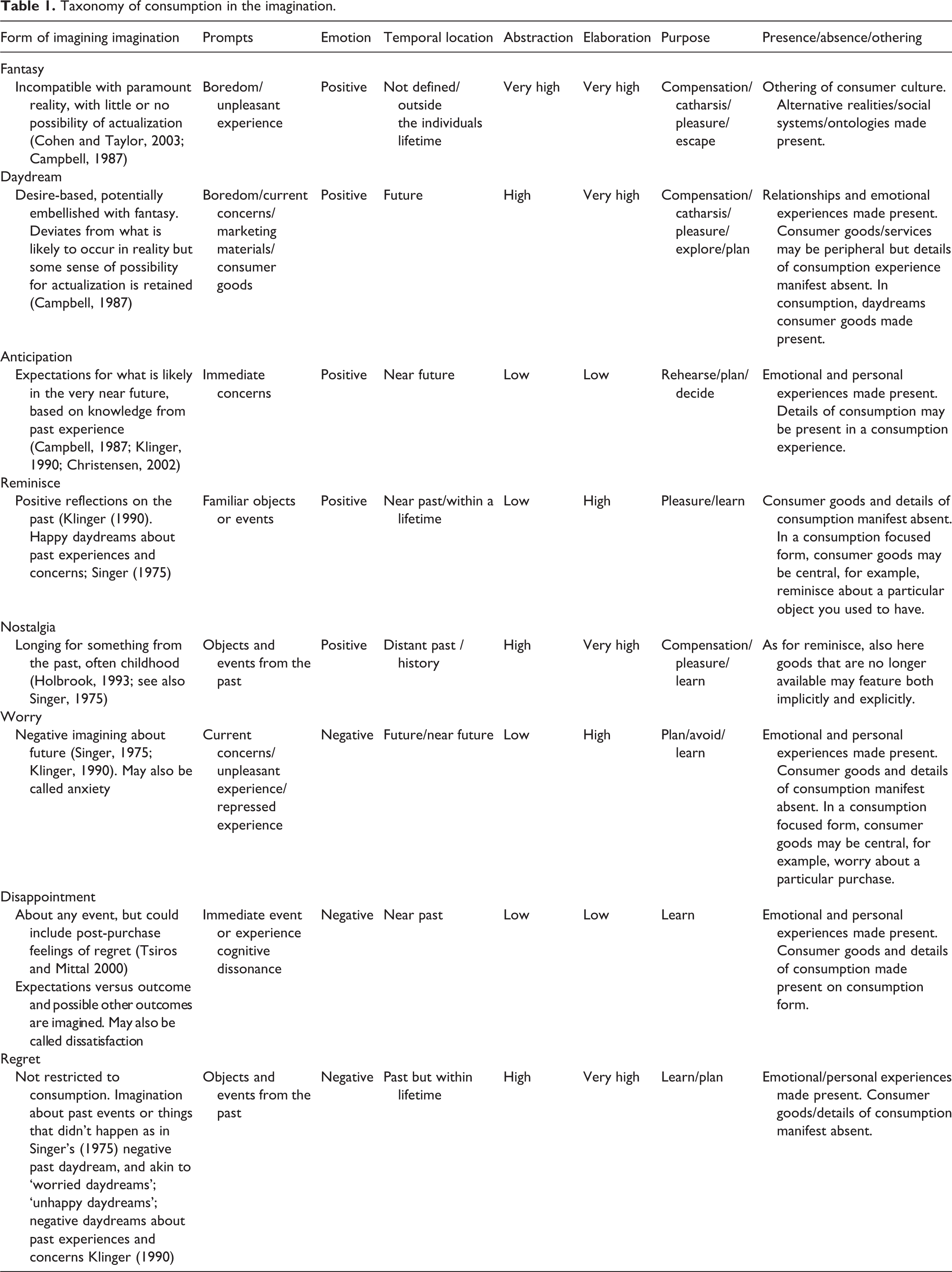
We start with prompts for imagining which, although not a characteristic per se, are important because they illustrate how the marketplace (among other things) may stimulate imaginative activity. We then consider temporal location, type and strength of emotion, degree of elaboration, level of abstraction and purpose. Finally, we consider specifically the role for consumption. We explain each of these to create a framework that classifies forms of imagination accordingly (see Table 1).
Taxonomy of consumption in the imagination.
Prompts for imaginative experiences
Although imagining is recognized as intentional (Sartre 1940 [1991]), activated on demand and autonomous (Campbell, 1987) such that we can ‘choose’ to daydream, stimuli may also direct attention away from paramount reality and towards spontaneous daydreams (Singer, 1975) such that ‘their timing and substance…are definitely not random’ (Klinger, 1990: 76). Rather, they may be triggered by ‘goal reminders’ (Klinger, 1990: 35). When we experience a goal reminder at a time when we are unable to meet the goal, we may react with a daydream (Klinger 1990). For example, seeing alcohol at the supermarket reminds you about a party you are going to, which then sends you into a daydream about food and conversations you might have. Such stimuli may then be used intentionally by individuals to intensify their desire for consumption (Belk, 2001, Belk et al., 2003). However, unintentional past-orientated daydreams may also be triggered by stimuli that we have an emotional bond with because they were once related to our goals (Klinger, 1990). For example, you may imagine pleasurable experiences from a holiday because a sound, smell or photograph reminds you of it. As many past experiences include moments of consumption, the market is well placed to prompt such imagining. Hence, commercial messages about things we can, might and should want and that remind us of past experiences may frequently trigger all sorts of imagining, but the focus may not be the advertised goods themselves. Although there is also plenty of room here for repressed experiences to present themselves, we don’t necessarily need to reduce the significance of the current environment in shaping the range of imagined experiences in this way, which is Singer’s (1975) argument, and also an aspect of Cohen and Taylor’s (2003) elaboration of the social character of imagining.
Temporal location
While imagination-based consumer research has a focus on future desire (although McCraken (1988) notes that both past and future are suitable for displaced meaning), we have also just suggested the potential for different temporal locations for imagining. We imagine, or ‘relive’ a range of scenarios from the past (near and far), what is just about to happen in the present as well as fantasize about all kinds of different futures for ourselves (Giambra, 2000; Klinger 1990; Singer, 1975). In psychology, both Singer (1975) and Klinger (1990) acknowledge that a daydream can be based in any temporal setting and its level of intensity may vary from mundane anticipation to elaborate wishes. As such, ‘daydream’ may actually be considered a generic term that refers to many types of imaginative experience (Singer, 1975). Temporal location can, however, allow us to distinguish these forms. For example, terms like anticipation, wishing and longing refer to the future, with differing degrees of intensity (see Campbell, 1987) and when imagining the past terms like remember, reflect, reminisce and nostalgia are commonly used.
We can then reconsider well-researched concepts in consumer research in terms of their temporal location. For example, perhaps the opposite of future-orientated desire is dissonance, or buyers regret, a form of negative post-consumption thoughts and feelings (Festinger, 1957) that occur after making a purchase decision (Oshikawa, 1969). Such regret is experienced in light of how a foregone alternative may have had a better outcome (Tsiros and Mittal, 2000). These lend themselves to forms of imagining where consumers may reflect on what might have been, or what was and the negative imaginings they have later.
Type and strength of emotion
This also suggests that the existing focus on the emotion of desire in the consumer imagination makes absent the full variety of emotions experienced when imagining. These are therefore under explored in consumer research (Boujbel, 2008; Illouz, 2009). Klinger (1990) actually notes that the majority of daydreams are fleeting and unmemorable with a focus on the present (or rather the immediate future), as we imagine how a situation may unfold in the next few moments. This mundane type of daydream mirrors Campbell’s (1987) ‘imaginative anticipation’ and Christensen’s (2002) notion of ‘anticipating reality’, which requires little emotional effort because our expectations are based on routine, previous experience. Both past- and future-orientated imaginings, however, may involve considerable emotion (Klinger, 1990), and so we can also identify forms of imagining based on emotional intensity and a variety of possible positive and negative emotions (Singer, 1975).
Emotion experienced by imagining also arouses bodily sensations. For example, visualizing something may arouse the same emotions and have much the same effect on the body as those produced in material reality, so that we react as if it were ‘real’ (Campbell, 1987; MacInnis and Price, 1987). We can also have subsequent emotional reactions that may conflict with how we felt during the daydream. For instance, you may feel happy during a daydream about moving to a new city, but afterwards realize that it is unlikely to materialize due to various constraints and feel negatively towards it as a consequence (d’Astous and Deschênes, 2005). This is important to consider as it could have consequences for material reality in terms of behaviour, actual consumption and for future imagining as well.
Degree of elaboration
Elaboration deals with how detailed imaginings are – they may incorporate sight, sound, smell, taste and touch (MacInnis and Price, 1987), although visual imagery is the most common (Klinger, 1990; Singer, 1975). For example, we can picture what our living room looks like, the sound of a sports car, the smell of fresh bread, the taste of strong coffee and the warmth of a fire. These ‘images’ may be retrieved from memory when we reconstruct an experience from our past or may be created in the imagination when we anticipate possible future experiences (Singer, 1975). Imagining may also contain an ‘interior monologue’ (Singer, 1975) where we ‘silently talk to ourselves’ (Klinger 1990: 68), providing a running commentary that accompanies the mental imagery we create. As the amount of ‘self talk’ and range of senses evoked differs, imagining therefore occurs at varying levels of elaboration. Emotional intensity is also part of such elaboration – for example, daydreams about an important future goal and about important things from the past are more emotional and memorable than the routine anticipation of the immediate future and so are also elaborated in more detail.
Level of abstraction
The level of abstraction refers to the degree to which a probable material reality is adhered to. According to Singer (1975) and Klinger (1990), daydreams vary from ‘mundane’ anticipation of immediate activities, to elaborate distant wishes, however, they are always about something possible. Fantasy on the other hand is an ‘alternative’ to the present reality (Campbell, 1987; Cohen and Taylor, 1992).
Borrowing from Shields (2002), we can consider a scale from ideally possible to actually probable forms of imagining. At one end, imaginative anticipation about near future events that are almost certain to happen – ‘those things we can “count” on’ (Shields, 2002: 29) – are ‘probable’. It is aligned to the present and governed by what has gone before but offers little scope for embellishment (Campbell, 1987; Klinger, 1990). At the other end, ‘fantasy’ is the most abstract form of imagining (Campbell 1987) that is ‘incompatible with paramount reality’ (Cohen and Taylor, 1992: 73), for instance, imagining oneself as having magical powers. Daydreams, as defined by Campbell (1987), sit in the middle. They are probable, but embellished with fantasy, involving abstraction but remaining tenuously within the realm of probability. For example, Cohen and Taylor (2003) note the ‘popularity’ of daydreams involving a catastrophic event in which the daydreamer is a hero, or typically ‘Walter Mitty’ – type scenarios (also see Campbell, 1987). Here, the probable element offers something to believe in, aspire to or aim for, and the embellishment with fantasy offers greater pleasure (Campbell, 1987; Christensen, 2002). The level of abstraction can therefore also distinguish forms of imagining, and when combined with the other characteristics set out in this framework, helps us distinguish different imaginative practices.
Purpose and outcome
Without rejecting the value of repression and catharsis in imaginings, the imagination is reported to have many uses (Klinger, 1990). For example, anticipation is indicative of planning or rehearsing, a daydream offers pleasure (Campbell, 1987), while fantasy is indicative of escape (Cohen and Taylor, 2003). When constraints prevent us from achieving our dreams, imagining may also provide compensatory pleasure (d’Astous and Deschênes, 2005; Fournier and Guiry, 1993) with purposive imagining as a coping mechanism (Christensen et al., 2004) or surrogate experience (MacInnis and Price, 1987). Again, we may turn to our imagination to escape routines of daily life (Cohen and Taylor, 2003) including dull and repetitive aspects of consumption. As Cohen and Taylor (2003) point out, in addition to ‘starter fantasies’ that motivate routine tasks by imbuing it with extra emotion, the imagination may also be used as a ‘stopper’ to intense emotions in the present. In this sense, the imagination can be used to regulate what we feel about the things we do and about our lives.
Imagining future events also provides opportunities to explore and rehearse, aiding decision-making and planning (Christensen et al., 2004). Although these imagined plans may not directly focus on consumption objects, their consequences may feed into decisions over what actions to take (Phillips et al., 1995). This is consistent with Klinger’s (1990) organization function of daydreaming where we prepare, anticipate and organize ourselves through imagining both positive and negative events. As well as helping us to figure out what we want to pursue, worried and unhappy daydreams are a rehearsal for what to avoid (Klinger, 1990) and we see this being exploited in the marketplace in the selling of financial, insurance and health services that rely on consumers being able to imagine negative scenarios and purchase products in a bid to avoid these being actualized. In addition, past-orientated daydreams, potentially as abreaction, can provide lessons to learn, teaching us how to behave in the future (Klinger, 1990). Key here is that unlike escapism or desire, the rehearsal, planning, learning and decision-making processes of imagining offer more direct motivation for action as preparation for ‘real’ life (Belk et al,. 2003; Klinger, 1990; Sutton-Smith, 1997). The stuff of both pleasurable daydreams and of worries therefore constantly provides something for us to aim for, or to avoid, not just by thinking about the benefits and limitations of an action but by ‘playing them out’.
Mapping imaginative experiences
We can now build a framework to map consumption in the imagination, drawing from existing experiences and phenomena in the available literature to account for and define distinct forms (see Table 1). Although many of our terms have been used synonymously elsewhere, here we separate them to provide a language with which to describe the different ways in which consumption appears in the imagination, using terms that capture the different combinations of characteristics we have described above.
Our descriptions of fantasy, daydreams and anticipation are consistent with existing consumer research, but the additional characteristics make the distinctions between them and other forms of imagining more explicit and allows their unique characteristics to be better understood.
Nostalgia is also documented in marketing theory (though not necessarily as a form of imagination) and regarded as a pleasurable and intense emotional experience (Havlena and Holak, 1991; Holbrook, 1993; Holbrook and Schindler 2003). Recognizing that daydreams can be past orientated and elaborate (Klinger, 1990; Singer, 1975), we define nostalgia as a specific form of imagining according to the six characteristics identified. Negative anticipatory imagining is worry or anxiety, effectively a negative equivalent of daydreaming or anticipation. Rather than talk about ‘negative daydreams’ and ‘positive daydreams’, using different terms again better differentiates the experiences.
Disappointment, often in the form of buyer’s regret is also well grounded in the consumer research literature that identifies it as reflections or feelings about how a foregone alternative may have had a better outcome (Tsiros and Mittal, 2000). As a form of imagining, it may be centred on consumer goods purchased in the near past. Due to the focal point being consumer goods or services, it is differentiated from the broader concept of regret, which is not always focused on consumption and potentially more emotionally intense and set further in the past.
Although not an exhaustive list, these eight forms of imagining conceptually clarify different practices of imagining that have been either explicitly or implicitly identified elsewhere, defining them according to a set of common criteria. From this, we can see that as such a pervasive activity it is likely to be more significant for marketing than is currently explicitly recognized. In daily life, our hopes, fantasies, worries and regrets may all contain, be framed by, or make absent consumer goods and services.
Yet as we have also suggested, these practices are not separate and discrete such that they have no impact on each other. To understand consumption in the imagination, we must also consider the relationships between different forms and the role consumption matter takes in each.
A trajectory of consumption in the imagination
Our illustrations already suggest that consumption runs through different forms of imagining, yet is seldom focal (as it is with theories of consumer desire). Our expansion of forms of imagining therefore acts as a starting point for further conceptualizing the relationships and movements between imagining and the market. Although there are practical implications for marketing campaigns in recognizing how and where different goods and services become present in the imagination, we may also revisit more critical lines of argument about our consumer society.
Miller (2010) states that goods may have the most influence when they are invisible. Likewise, Illouz (1997) notes that the consumption aspects of an apparently non-consumption-based activity are often necessary, yet imperceptible, and Warde (2005) notes that consumption is just a ‘moment’ in practice. This logic may be applied to practices of imagining too. We should therefore pay attention to the specific moments where market activity is made present and absent when imagining. For example, as a pleasurable escape, the imagination is a place where routine and detail can be made absent in favour of more pleasurable possibilities (e.g. Cohen and Taylor, 1992; Fournier and Guiry, 1993; Klinger, 1990). Campbell (1987) also asserts that our visions of the future are ‘free from all blemishes and imperfections’ (p. 86), coming to ‘represent a perfected vision of life…deviating more and more from that which anyone has good reason to expect’ (p. 84). In other words, to make our ideals present, we make absent the mundane or constraining aspects of a scenario that might be more prominent in everyday life and in this context consumption is not necessarily central to imaginative activity that deals with broader concerns with everyday life (see Illouz, 1997; Jenkins et al., 2011; Klinger, 1990).
Law (2004) brings such ideas together with a way of thinking about how a scenario is assembled that may also allow for an understanding of consumption in the imagination by noting a distinction between what is present and what is manifest absent in that presence but is necessary in order for an experience to take place. Although consumer research presents the importance of the imagination as relating to desire built around consumer goods and services that are very present, we might recognize how goods may also ‘silently’ assemble sought after imagined experiences.
Our dreams of an ideal life may be ‘uncontaminated’ by the reality of consumer choice, purchase and satisfaction even where consumer goods feature. When we think of a new car for instance, we don’t imagine the stress of the dealership, finance agreements and warranty claims (these remain manifest absent as we imagine the open road, or the admiring looks of others), but as we move to buy the car, our thoughts may turn to the reality of what is involved. Alternatively, prior to even imagining a new car, we must first imagine a future in which a car has a meaning to us. For example, Singer (1975) notes the potential role for a car in a teenager’s imaginings of ‘getting a girl’, and so becoming an adult. For any particular product, there may be different types of imagining from idealized desire, through anticipation and planning of the purchase itself, and later regrets or reminiscing. Through this pattern, aspects of the market may be made absent or may alternatively force their presence as we come to deal with them.
Law (2004) also explores the idea of ‘othering’ alternative realities that must be absent in order for a particular one to be assembled. It is perhaps only in our most ambitious fantasies that we focus on experiences that do not draw from the current reality of the market. Fantasy then, in addition to a prime location for repressed thoughts, presents the opportunity for our consumer society to be altogether othered and so for different ways of being to be enjoyed and explored. For Marcuse (1964), it is something like this that needs to happen to transform capitalism but that can’t as long as critique is repressed.
Current consumer research focuses on imagining as an explicit activity only at the pre-consumption stage, but this represents only part of consumption in the imagination. Our framework acknowledges the variety of imaginative forms where consumption may be othered, manifest absent or present. For example, we may fantasize about status and independence afforded by a car, escape through daydreams of a specific model, daydream about actually buying it, anticipate its purchase, have worries both before and after purchase, regret buying it and then reminisce over our time with it. It is also possible that we may imagine a life where a car has no role, for example, independence as owning land and growing food.
Such biographical aspects of imagining expose the scope of the role of consumption in the imagination and indeed the role of the imagination in consumption, alerting us to the movements and complexities of imagining just one event, including related consumption activity. In revealing connections between the ideal and the material, the trajectory of the imagination also connects the macro and micro. For example, capitalist structures require that we see the good life through the acquisition of consumer goods, the market for cars relies on such daydreams forming so they may be actualized and whether deploying the unconscious as in Dichter (1960), or more explicitly presenting goods as meeting various goals, advertising represents a resource for such imagination (see Campbell, 1987).
If our hopes for future success were attached to different objects or practices, however, this in turn may transform marketing and markets. Indeed, this is another way of seeing projects like alternative hedonism (Soper, 1998; 2007) where individuals might imagine a different future and are encouraged to do so. At this macro level, a trajectory of the imagination therefore also reinvigorates the critiques about the consumer imagination implicit in the work of Marcuse (1955, 1964) and Fromm (1976). Capitalism requires a particular type of imagination and related emotions that might just be transformed. However, Denegri-Knott and Molesworth, (2010) suggests a different outcome where the online and videogame markets aid consumers in actualizing more elaborate fantasies of owning a spaceship, a magic sword or exotic car. Indeed, we can see various recent experiential markets emerge to exploit fantasies. For example, not just through fantasy and science fiction novels and movies but also in science fiction conventions (Kozinets, 2001), mountain man recreation (Belk and Costa, 1988) and the Burning Man festival (Kozinets, 2002).
Ultimately, as imagining deals with more pleasurable and abstract matter (e.g. fantasy, daydream, nostalgia), specific consumption practices and individual consumption objects become less prominent. They may form a vague, or manifest absent part of the script as relationships, experiences and feelings come to the fore. As and when these hopes are actualized (when a consumer is closer to experiencing a specific activity in material reality), consumption objects and their accompanying brand associations become manifest and the imaginative process becomes more plan-based to aid decision-making. Although, even here, we might note that those decisions may be rehearsed and ‘played’ out in different ways in the imagination rather than only carefully weighed up and evaluated.
We obviously need care in describing this as ‘autonomous’ though. Consumer matter seems to have a ‘will’ to present itself in the mind of consumers. When abstraction needs to give way to planning the imagination may fill with consumer matter and more practical concerns as the market provides key resources to help us actualize our desires or quash our worries. Individuals must therefore manage their imagination, attempting to focus on pleasurable aspects, and trying not to think about things that cause concern. Here, we see fantasy as a way to enjoy the emotional experiences of imagining, with no risk of future disappointment. Yet within everyday life, we can again consider circumstances where we are prompted to imagine. This could be the media, or marketing messages, but this might not be the only interaction between the imagination and consumer goods. For example, we drive our new car into a crowded car park and suddenly imagine the potential for it to be scratched or hit. The vividness of this ‘spontaneous’ vision may be enough to motivate the careful choosing of a parking space. Certain goods or situations in material reality may at times therefore ‘bear down’ on our imagination such that we cannot always negate them.
A way to understand the scope of the consumer imagination complete with its movements and complexity is to study a range of imaginative phenomena as they occur alongside a material practice and existing qualitative approaches may not yet capture the significance of imagining that accompanies a consumer practice. While Campbell (1987) and Belk et al’s (2003) work considers movement, this is restricted to desire-based, actualization and disillusionment. Given that there are more forms of imagining in relation to consumption, and more roles for consumption in the imagination, there is more to consider than this. In particular, a study that focuses only on desire cannot capture how hopes, aspirations and anxieties, and with them, specific life events (coming of age, marriage, children, etc.) come to be associated with specific consumption practices. Singer’s (1975) and Cohen and Taylor’s (2003) approach to understanding both the range and patterning of imagining in a society may therefore provide new insights into market structures (indeed both studies recognize how consumer goods may often be present in the daydreams participants revealed). To-date research also focuses on categories of products in relation to a specific (imaginative) concept. For example, studies of buyer’s regret and satisfaction have looked at the purchase of cars (Keaveney et al., 2007). While this gives research a context, it too may limit the scope of exploration possible with regard to the variety of imaginative forms that a given product category may evoke. A more complete understanding of such a context would require research that traces the ebbs and flows of imaginative experiences, noting how they drift from one to another and where consumption matter occurs.
In Figure 1, we therefore present a trajectory of imagining, in which we recognize the different forms of imagining (as identified in Table 1), how they relate to consumption/the marketplace, and more specifically to one another.
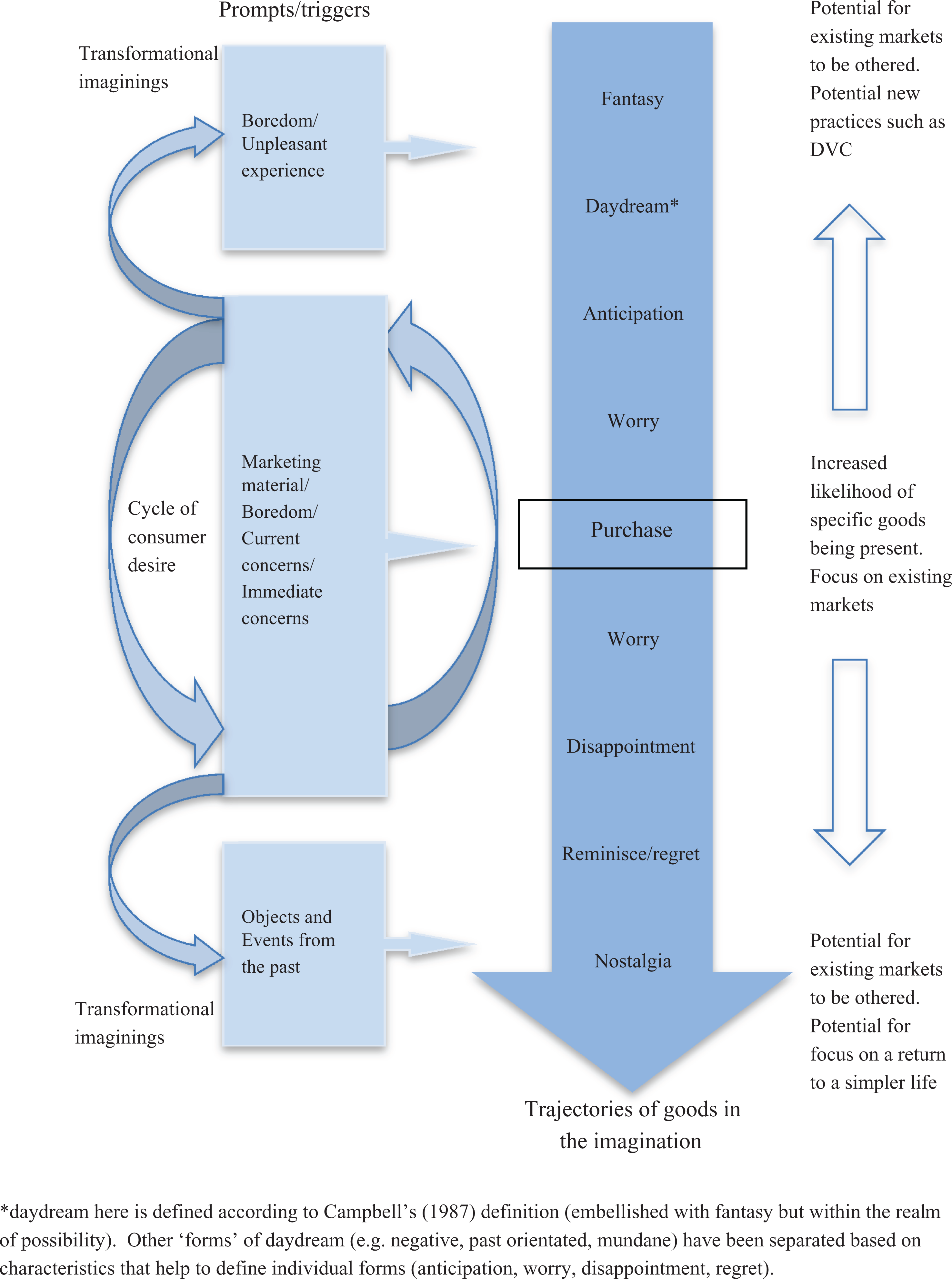
Trajectories of consumption in the imagination.
Our trajectory of goods in the imagination places acts of purchase in the middle – where goods are most prominent and where we also see pre- and post-purchase worry or anxiety that deals with specific consumption experience. Moving further away from the centre (in both directions in terms of temporality), the role of goods becomes less central. Further, still we see the well-documented cycle of desire with anticipation for purchase and subsequent disappointment. In daydreaming and reminiscing, goods may be manifest absent, featuring as props to other experiences and relationships that dominate these kinds of imaginings (memories from childhood about a holiday that centres on family, otherness and fun, for example). And finally, at the extreme ends of our framework, fantasy and nostalgia are experiences in which consumer goods may be othered and therefore much less relevant. Yet even these must be connected to life experiences, dealing with them through elaborated and abstract thoughts that are significant for markets. As we move further away from the act of consumption (purchase), our imagination may also move further away from it such that more temporally distant forms of imagining provide the context within which specific goods may at some point become present or not, precluding or facilitating later consumer desire. For example, a distant hope for a family may lead to desire for a house, furniture and a family car, whereas the hope for freedom and exploration may preclude these in favour of travel and mobility.
Goods move through different imaginative forms, with different things becoming absent and present as they do so. These movements are neglected in consumer research but may have more value in terms of understanding the prevalence of imagination, how particular objects and experiences come to be the focus, and therefore implications for market structures – these forms are potentially most transformative. We have already noted examples. Sustainability requires individuals to surrender exotic travel and high performance cars (as well as a range of other energy intensive goods and services) as a way to fulfil life goals. They must therefore imagine themselves and the world differently. This is perhaps well captured in Soper’s (1998; 2007) Alternative Hedonism and is central to Marcuse’s work too. Alternatively, the entire videogame market requires consumers to fantasize about exotic worlds and scenarios where paramount reality is othered, and where the digital virtual allows actualization instead (again captured by Denegri-Knott and Molesworth, 2010). We can also consider other illustrations – what changes in the imagination are required by the new ‘sharing’ economy, for example, Uber and Air B&B don’t just require changes in how we imagine transport and travel, but also how we think of a home, or the status of a car. Attention to how and what we imagine sensitizes us to how easy it is for individuals to imagine alternatives to our current consumer culture.
In our trajectory, we also highlight the various prompts and triggers for forms of imagining, noting that more general issues such as boredom or objects we have an emotional bond with (e.g. from the past) can trigger more elaborate and abstract forms of imagining that are less concerned with consumption – such as fantasy and nostalgia. While more current pressing concerns of material reality, along with marketing material trigger those forms of imagining where consumption plays a more prominent role (e.g. anticipation, worry, buyers regret). A further implication is that a particular experience is not just imagined in one way, but many ways in response to everyday life. The purpose of imagining and the role of goods within it vary over time and over the course of an individual’s biography. We can illustrate with another example. A woman may fantasize about her ideal husband and proposal when she is single, once in a relationship she may daydream about her ideal wedding. When engaged and arranging the wedding, her imagination may serve a rehearsal purpose, and then there is anticipation which is less ideal and more probable, and also worries and concerns about the day – about whether the food will be OK, or if the hairdresser will do a good job – and afterwards, there is of course reminiscing, possibly even regret over specific choices about aspects of the wedding. We can think about particular goods in these scenarios as they come in and out of imagining. The ring, for example, may not be included in a fantasy about the ideal romantic proposal other than a vague notion that there is one, then it may become a particular desired object, a certain style or stone, then it may cause anticipation – ‘will he choose one I like?’, or cause nervous angst – ‘what if I don’t like what he chooses?’, and then it may be one that is regretted – ‘I should have gone for a more unusual ring’. Here, the detail may include specific brands and retailers. Later, the ring may become a precious source of reminiscing or may be sold and forgotten depending on the path of the marriage and indeed ideas about both may be passed on to children (and here there is again room for psychoanalysis to explore how such matter is dealt with by individuals).
Over the course of one life event, a large amount of work on the imaginative takes place, with consumption objects at times more present than others. Although this may seem obvious, it has yet to catch the attention of consumer researchers in such a way that recognizes its impact on everyday life and, of course, on markets. For example, for this series of imaginings to happen at all people must first imagine that their lives should include marriage and that the practice should include a ring – a belief that, in 1948, DeBeers’ ‘A Diamond is Forever’ campaign invoked particularly strongly in building the idea that a diamond is a necessary luxury, synonymous with engagement and marriage. Again, this suggests a connection between macro-market issues and the stuff of the imagination.
While the conditions of material reality are important, it is not the case that we merely respond to its external influences. Findings from Jenkins et al. (2011) also prompt us to consider individuals’ autonomy over the imagination. What seems apparent is that imagining becomes a means for individuals to grasp a sense of control, a domain where we may negotiate and manage our emotions and potential outcomes for everyday life, especially when circumstances in material reality deny such control (see Cohen and Taylor, 1992; Molesworth and Watkins, 2016), even where the things we are dealing with emerge from matter that has been repressed and cannot be accessed directly. The imagination then combines repressed matter, our phenomenological experience, and the cultural resources available to us as we negotiate our imagined lives alongside our material ones.
Conclusions
Consumption in the imagination cannot be contained within the construct of future-orientated desire and is deserving of more attention in marketing theory. Our framework represents different forms of imagining identified from the literature. This helps to resolve the previous fragmented and at times contradictory use of terms by enabling us to differentiate them. We further recognize the movements between imaginative forms that existing conceptualizations neglect. Beyond cycles of desire and actualization, there are larger trajectories that relate to the role of consumer goods in the imagination. Seen this way our consumer culture, ripe with calls to the good life, to normative aspirations, but also full of potential anxieties and worries, is rich with resources available for the refinement and crafting of the imagination, as much as it is a matter of material practice. This recognition is important because it expands and challenges existing discourse on how the imagination relates to the maintenance and transformation of consumption practices.
To borrow Law’s term (2004), what we see is the imagination as the ‘hinterland’ from which action – including consumption – emerges. Not acknowledging this seems incongruous with the time and effort that goes into imagining (Killingsworth and Gilbert, 2010) as understanding when and how consumption enters the imagination becomes an important context for both micro-decision-making and macro issues of market formation. Changes in what make up our hopes and dreams, anxieties and memories, all influence engagement with the market. For example, the fantastic escapes of digital virtual consumption support growing digital games markets (Denegri-Knott and Molesworth, 2010); whereas consumer ambivalence, as noted in Soper’s (1998, 2007) work on alternative hedonism, might direct the imagination (and subsequent behaviour) away from consumption altogether. The former has implications for our digital economy; the latter has implications for sustainability. If consumption is now best understood through its role in a practice (Warde, 2005), then so too should imagining be considered and explored in this way, as an important aspect of life that almost always contains consumption, but is significant for markets even when it doesn’t.
The task now is to better understand this wider view of consumption in the imagination and therefore the ways in which individuals come to think about their lives in ways in which the market, and specific goods and services, ranges from strongly present to completely othered. We need to explore the complex and changing processes of presence and absence, including the prompts that lead to imagining, the level of elaboration and the purposes of such mental activity. Our framework and trajectory provide a set of definitions and their relationships that allow such work to be progressed.
Footnotes
Declaration of Conflicting Interests
The author(s) declared no potential conflicts of interest with respect to the research, authorship, and/or publication of this article.
Funding
The author(s) received no financial support for the research, authorship, and/or publication of this article.