







Abstract
This paper addresses the question of the resources that consumers rely on when faced with products that communicate very little. When consumers purchase items from Christian abbeys, this question is particularly significant given that these organizations, while sharing a common history, are spatially dispersed. Through qualitative interviews with purchasers of monastic products, our research confirms the contagion process from products’ origin to consumers, and proposes the new concept of World of Origin (WOO), a cloud-like representation serving as an extrinsic source of meaning and acting as a substitute for strong brand narratives. Distinct from Country of Origin, terroir, brand aura, and heritage, WOO is an addition to the marketing conceptual toolbox, facilitating a thinner grain analysis of consumption phenomena. The contagious power of WOO enriches the research on the context’s influence and enables a discussion of the consequences of consumers themselves creating embellished or even false inventions of the past.
Keywords
Introduction
“I spontaneously think that they are good products, made in an artisan way. I think it is ethical and honest, because of where it comes from. They are spiritual products with values associated with the monastic life, charity, and with honesty.” (Tamié 32)
In management research, abbeys have been mainly studied from the perspectives of organizational behavior (Davidson, 1995; Kieser, 1987; Mercier and Deslandes, 2016; Tredget, 2002) and of tourism (Della Dora, 2012; Stànciulescu and Tîrca, 2010). In marketing, there is substantial research on the overlap between spirituality and consumption (Aadland and Skjorshammer, 2012; Giacalone and Jurkiewicz, 2003; Rinallo et al., 2012), on religious practices as merchant experiences (Karataş and Sandıkcı, 2013; McAlexander et al., 2014; McDaniel, 1986), and on pilgrimages as contexts for purchasing religious souvenirs (Moufahim, 2013; Zaidman and Lowengart, 2001). However, there is less research on abbeys as market players, or on the consumption of their goods and services, with the notable exception of some studies published on the French context (Paquier, 2015; Paquier and Morin-Delerm, 2016, 2019). Yet, in many European countries, the trade of monastic products has existed for centuries (Poelmans and Swinnen, 2011; Raftis, 1961), and more recently has become increasingly common in the USA (Bolongaro, 2016).
Today in France, around three million people per year buy products such as biscuits, soap, beer, and ceramics from abbeys. This 80-million-euro business involves more than 200 Christian communities that joined forces by creating the Monastic association in 1989, while remaining completely independent communities in relation to each other. This network of small producers is discreet by nature, drawing on the monastic vow of silence. Yet this discretion generates a fascinating conversation among consumers, as expressed above by this purchaser interviewed just after buying items from the shop at the Cistercian abbey of Tamié in the Alps. This scenario contradicts storytelling theory, which establishes that companies need to give consumers plots and characters which they process to build their own transporting stories (Van Laer et al., 2014). When an organization communicates very little, what are the resources and processes that consumers rely on to build their perception of the product?
In this paper, we investigate the consumption of goods produced by abbeys as an extreme case (Yin, 2014), while considering that a broad acceptance of the context of origin of the product and the archetypes associated with it can compensate for this minimal communication. After describing the monastic environment that forms the basis of our study, we review the aforementioned fields of literature. Then, we analyze 56 interviews with purchasers of monastic products, conducted in four abbeys, and with online shoppers. When asked to put into words the meaning of their purchase, the consumers of monastic products talk primarily about the image they have of the monastic world in general. The overarching observation framing our findings relates to the fact that interviewees say very little about the product they have bought, about the product category, or about the particular abbey that made it. Rather than just buying a soap, or a soap from abbey X, they focus on buying from abbeys in general. In this context, the product and the abbey from which it comes seem to disappear behind the acceptance of an idealized context of origin which goes beyond a physical spatial acceptance. This extreme case confirms a chain of contagion from the origin of the product to the consumer. In addition, our substantive findings put forward the new concept of World of Origin (WOO) as a cloud-like representation, a de-territorialized place disconnected from the land, a virtual space that is not grounded in a location (Chatzidakis et al., 2018). In the discussion, we introduce WOO as a substitute to strong brand narratives, an extrinsic source of meaning for consumers, that is different from other closely related concepts like COO, terroir, brand aura, and heritage. As such, this is an addition to the marketing conceptual toolbox, facilitating a thinner grain analysis of consumption phenomena in which there are powerful and extensive narratives, but no brand involved. Moreover, the evocative power of WOO contributes to the research on the influence of the purchasing and consumption contexts and enables a discussion of the consequences of consumers themselves creating embellished or even false inventions of the past.
The current context of the monastic market
The monastic ecosystem
Since the Middle Ages, Catholic abbeys have played a major economic role around Europe (Raftis, 1961). These contemplative communities still follow the medieval St. Benedict precept of Ora et Labora (Nursia 6th century), which advocates a balance between individual prayer (lectio divina), collective prayer (mass and services), and work. Monks and nuns work up to four or five hours per day, mostly as an act of faith rather than an obligation, seeing work as a form of horizontal prayer that connects them to the earth and to others. The current monastic market has the features of a business ecosystem (Moore, 1993): extending from abbeys, it has become a complex network of heterogeneous players (including secular suppliers and distributors, charities, organizations, and volunteers). Monastic communities are now relying more on the outside world given that younger people are joining communities increasingly rarely, and that stricter standards in agri-food and cosmetics have made investments costly (Hiltner, 2018). They no longer exist as self-sufficient entities, and the monastic origin of the products they sell has been called into question (Marson, 2021). Indeed, these products are often designed, conceived, or assembled out of the abbeys by lay people: monastic communities also outsource a significant part of their distribution. Monks and nuns of the 21st century are thus less and less “homo faber” (Bergson, 1959) and are becoming “homo vigilax” (Luc, 2018), living less from the work of their hands and more from the results of their outsourcing.
In Europe, France has a particularly tumultuous relationship with the Catholic Church. Once the “elder daughter of the Church” (Rémond, 1992), France expelled part of the clergy during the Revolution, and abbeys were vandalized or secularized. The clergy were able to recover part of their estate and position during the 19th century, but since 1905, the Republic has enforced a strict separation of the Church and State (Betros, 2010). These events encouraged monks to keep a safe distance from lay society, maybe more so than in any other European country. French abbeys are therefore particularly vigilant in adhering to the essence of the original monastic rules, and in never compromising their spirituality in the advancement of their economic activities (Jonveaux, 2014).
A coherent monastic offer with little communication
The abbeys organize their production and trade: they grow products on their estates (e.g., to produce jams, oils etc.), they craft other products such as soap or leather items, they outsource part of the production to lay people, and ultimately, they manage their selective multi-channel distribution themselves. At the center of the monastic ecosystem, the Monastic association authenticates the monastic origin of the products and supports the commercial activities of the 230 member abbeys, without directly engaging with the production or the distribution.
1
The processes set up by the association (training, sharing of experiences, and peer-to-peer evaluations, for example) have raised the professionalism of the abbeys’ commercial activities. The range of 2000 monastic items constitutes a coherent offer. There is a wide variety of products such as jams, biscuits, chocolates, condiments, cheeses, alcohol, lotions, soaps, and eau de toilette, all crafted from natural raw materials. Half of them are sold under the Monastic brand, and the other half are sold under the name of the individual abbey. Due to their craft characteristics, and to the small series production involved, monastic products are high quality and highly priced. They are sold in a multi-channel approach, through physical and virtual, secular or religious outlets (Figure 1). However, the communication on these products is discreet and mainly based on word-of-mouth (Paquier and Morin-Delerm, 2016). Examples of monastic shops in abbeys (photos taken by Paquier).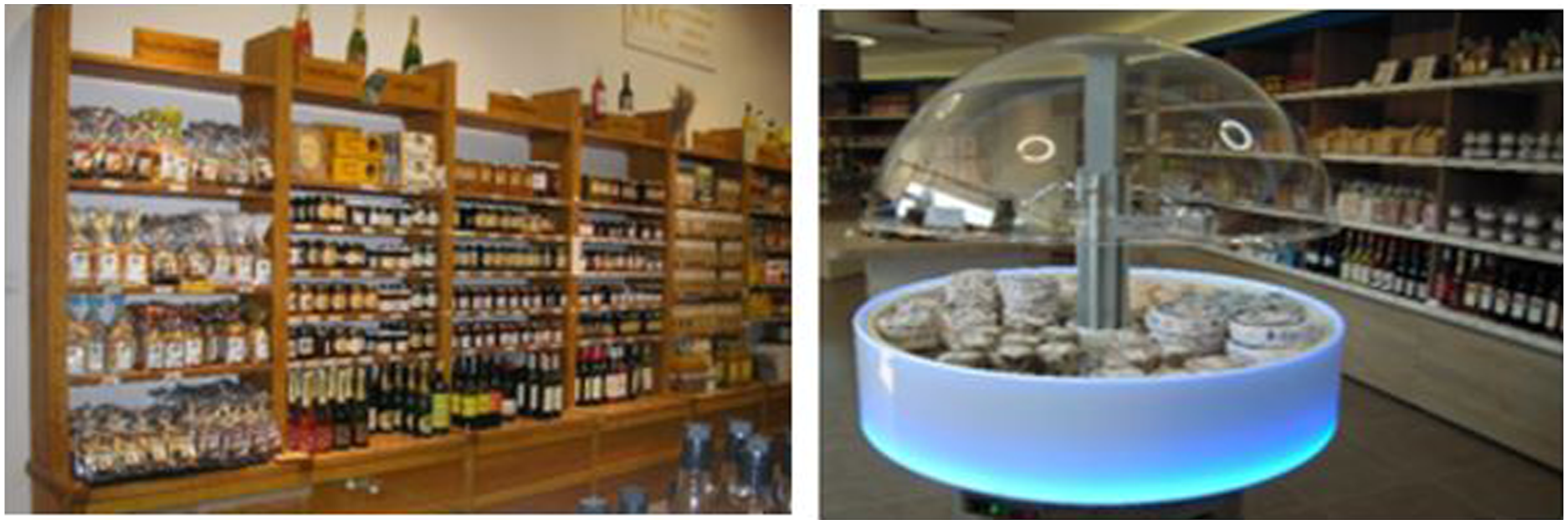
Recent research has shown the asymmetry between the rational, sober, and unemotional view of the monastic ecosystem suggested by the Monastic association discourse, and the meaning constructed by the imagination of the purchaser (Paquier and Morin-Delerm, 2019). Indeed, the medieval archetypes of the monk as a settler or as a self-sufficient person, reinforced by the atmosphere and the environment of the monastic shop, activate the imagination of the buyer, and help to construct a story with rich imagery. These universal archetypes (Torelli and Ahluwalia, 2012) include temporal and spatial references, incarnate identifiable characters, verisimilar and meaningful plots, utopian ambience, and perpetuate their sleeper effect through centuries (Van Laer et al., 2014). The less familiar people are with Christianity and abbeys, the more extensive the consumer storytelling is, and imagination is inversely proportional to monastic familiarity (Paquier and Morin-Delerm, 2019).
Actively built by post-modern customers (Fırat and Dholakia, 2006), this consumer storytelling (Woodside et al., 2008) pushes the boundaries of imagination by creating an idealized self-mythologizing narrative (Thompson, 2004) around the authentic monastic product. This is comparable to what happens with the construction of the halo around the country image (Han, 1989) and the construction of the elite authenticity (Mapes, 2020), and is opposed to the habitual scepticism of the consumer faced with manufactured terroir products (Dunn and Harness, 2019). In some cases, consumers also use monastic marketplace mythology to contest dominant discourses of power about materialist over-consumption (Thompson, 2004). These observations highlight the discrepancy between the genuineness of the production and the narratives that consumers create (Brunninge and Hartmann, 2019). This example of a talkative consumer reacting to organizations that communicate very little is unusual. In most situations involving consumption, brands and advertisements continuously display signals (McCracken, 1986) to attract consumers’ attention (Pieters and Wedel, 2004) or to legitimize strategies with historical references (Brunninge, 2009). In contrast, abbeys do not communicate much, and consumers compensate for this silence by building their own narrative (Thompson, 2004; Woodside et al., 2008). This situation does not fit with existing theories of storytelling. We suggest here that the cultural schema composed of cognitive and affective representations of the monastic origin operate as a resource (Torelli and Ahluwalia, 2012), providing conditions under which the absence of intrinsic cues from the products generate intense storytelling. The next section reviews the relevant literature that frames our research.
Related literature
Contagious sources of meaning
The French monastic market demonstrates the extent to which people’s perception of a product is influenced by its origin. Contagion provides a theoretical framework to analyze the way in which the origin transfers meaning to the products. The anthropologic law of contagion “holds that people, objects, and so forth, that come into contact with each other may influence each other through the transfer of some or all of their properties. The influence continues after the physical contact has ended and may be permanent” (Nemeroff and Rozin, 1994: 159). There is a first effect of transferred essence from the original source of contagion to the object itself, and a second-order effect when the essence is transmitted to people in contact with the object (Rozin et al., 1986). In consumption, contagion builds on the idea that objects acquire a special essence from their past (Newman and Dhar, 2014), and that mood contagion radiates from positive or negative sources such as places, persons, symbols, objects, or smells (Canniford et al., 2018; Grayson and Martinec, 2004; Neumann and Strack, 2000).
In the related literature, “intrinsic” and “extrinsic” sources of contagion are presented. The former relates to inputs from the brand system, sources that are internal and would not exist if it was not for the managerial work that constructed them. The latter refers to inputs from the origin of production or from consumers. They are social constructions too, but they pre-exist the brand, are used by multiple actors, and can even compensate for the absence of formal branding.
Intrinsic sources of contagion
The literature on brand management explains how elements related to the place, to the heritage, and to the broader origin of the products are crafted into the brand positioning and emerge in the marketing mix. Managers use them to anchor their brands into a particular spatiotemporal context (Arora et al., 2016). When the branding is successful, the meaning attached to the products by the consumers reflects these intended elements.
Place of selling atmosphere is defined as a combination of ambience, design, and social factors, and it can be a provider of cultural resources (Arnould, 2005; Chattalas et al., 2008), even a restorative environment where consumers find support (Rosenbaum et al., 2017). The place of selling is designed to give life to the brand positioning and reflects the products themselves (Kumar and Kim, 2014). A contextualized approach to the place shows that the store can help in the transfer of meaning from external contexts to the products sold (Lam, 2001), particularly in the context of religious pilgrimages (Zaidman and Lowengart, 2001).
Corporate brand heritage literature shows that some brands are particularly conscious of their past and decide to give their heritage a central part in their value proposition (Balmer and Burghausen, 2019). This involves brands communicating a discourse linking the past, present, and prospective future to internal and external stakeholders (Burghausen and Balmer, 2014). In this process, managers tap into their archives and use the figure of the founders and/or original recipes, for example, both at the strategic level and at the marketing mix level (Santos et al., 2016). Although centered on time, corporate brand heritage usually relates to a specific territory of which the company can be emblematic (Balmer et al., 2017; Balmer, 2011).
Authenticity and brand aura. The literature has widely studied the perceived authenticity of the brand (Alexander, 2009; Beverland, 2006; Morhart et al., 2015) as the perception of brand genuineness. This multifaceted concept involves up to six brand attributes: heritage, stylistic consistency, quality commitment, relation to a place, method of production and the downplay of commercial motives (Beverland, 2006). “Aura” refers to the essence of the brand that crystallizes the attributes of authenticity; it includes the place of manufacture, the corporate brand heritage, and the methods of production, but it goes beyond this—it designates the way in which all of these factors are combined and put forward by managers (Alexander, 2009). It has also been suggested that religiosity could contribute to creating a brand aura (Wahyuni & Fitriani, 2017). This concept is therefore able to capture the origin of production, particularly because it suggests a combination of spatiotemporal factors, with other elements.
However, these streams of literature consider such resources as part of well-crafted strategies (Alexander, 2009; Balmer and Burghausen, 2019), and not as an extrinsic resource that companies can use. Corporate brand heritage and brand aura are brand-centric concepts, and the place of selling reveals the importance of an atmosphere stemming from the brand positioning. These concepts do not allow us to capture the situation of abbeys because the way in which they sell products is characterized precisely by a lack of marketing strategy.
Extrinsic sources of contagion
Other streams of research consider the influence of elements relating to the place, to the heritage, or to the broader origin of the products on people’s perceptions of the offerings. However, these elements are not necessarily integrated in a marketing strategy, and even when they are, they cannot be linked with a single brand.
For instance, Country of Origin (COO) conveys an administrative and territorialized view of the place of origin, operating as an extrinsic informational cue that influences consumers’ evaluations (Chen et al., 2014; Kock et al., 2019; Papadopoulos, 1993; Suter et al., 2018). COO, as the association of stereotypes to countries, is a social construction but it exists independently from a specific brand. Research on COO makes a distinction between different aspects such as country of manufacture or design, which have cognitive, affective, normative, and conative effects on the product-country image perceived by consumers (for a detailed review, see Verlegh and Steenkamp, 1999). Iconic perceived authenticity is one of the components of the product-country image and shows the link between the cultural schema of the consumer and the object (Moulard et al., 2015).
Terroir (or locality of origin) is a smaller geographical area indicating a particular and irreproducible origin and shaping the value of consumption (Spielmann and Gélinas-Chebat, 2012). In the concept of terroir, it is the land—rather than national boundaries—which frames the characteristics of the place. It is also a social construction that does not depend on a single brand. As a combination of physical environment, philosophical place, and human capital, terroir is a marketing vehicle to promote a unique, irreplaceable, and irreplicable product (Charter et al., 2017). Terroir offers an idealized vision of landscape and local cultures and thus conveys identification and indexical authenticity (Moulard et al., 2015). This perceived indexical authenticity is based on consumer imagination about the origin of the product if raw materials and local expertise are maintained through the ages (Spielmann and Charters, 2013).
In the study of corporate brand heritage, the notions of mythical heritage and cultural heritage are resources that exist outside the scope of the brand. Myths are collective inventions that are purposefully put forward by the corporate brand to sustain its identity (Hudson and Balmer, 2013). While mythmaking is not essential to corporate brand heritage (Urde et al., 2007), it facilitates the escape and projection of consumers into the past (Hudson and Balmer, 2013). Cultural heritage relates to the history of a particular location (Hakala et al., 2011) in the same way as the myths, the stories, customs, or characters from the cultural heritage can be appropriated by the corporate brand (Schroeder et al., 2015; Spielmann et al., 2019).
COO, terroir, mythical, and cultural heritage provide valuable insights in the study of abbeys. These concepts remind us of the way in which spatiotemporal factors influence perceptions of the products for sale. However, they are very much grounded in one particular location rather than existing in multiple places at the same time. Unlike the examples discussed in these streams of related literature, all abbeys convey similar archetypes and follow similar rules, although they are based in very different locations. Their products are not always grown on the surrounding land, yet consumers build a powerful and consistent storytelling around them.
To summarize, we start from the specific context of French abbeys and explain that they represent an extreme case of a network of organizations that communicates very little but generates an intense narrative around the monastic origin. This situation challenges existing theories of storytelling and opens up a new field of enquiry. We use the framework of contagion to show how people’s perception of products is influenced by the origin of the products. The literature provides conceptual tools to study the influence of the origin of the products when it intrinsically stems from brand management (e.g., brand aura, corporate brand heritage), or when it extrinsically stems from place or heritage (e.g., COO, terroir, mythical, and cultural heritage). However, it does not provide a concept able to capture the influence of an origin that exists in multiple places simultaneously without being related to a brand. In this research, we adopt a flexible approach toward the origin of the products, unrelated to brand management, and we embrace the entire substrate of the origin of the product, whether it is territorialized or not (Andéhn et al., 2020; Chatzidakis et al., 2018; Cheetham et al., 2018).
Methodological considerations
Data collection
To understand the resources and processes that individuals use to build their own perception of products when faced with an organization or products that communicate very little, we conducted interviews with purchasers of monastic products in each of the two types of monastic sales outlets most commonly used by the abbeys. In physical stores, 41 interviewees were questioned live in situ just after finishing their shopping in stores run by the religious communities themselves (Chantelle Benedictine abbey, and Aiguebelle, La Trappe de Soligny, and Tamié Cistercian abbeys). On the Internet, 15 pre-selected interviewees were questioned after a browsing and purchasing session on an online collaborative monastic store (Les Boutiques de Théophile). The questions covered the specificities of the purchase according to the type of sales outlet (physical or virtual), and were constructed in three stages: the meaning of the atmosphere in the store (fittings, layout, design, information provided, personnel, similar to or unlike other shops or websites); the meaning of the products on display (presentation, characteristics, ingredients, manufacturing method, origin, similar to or unlike other products, etc.); the meaning of the purchase itself (one-off, regular, unusual, habitual, similar to or unlike other purchases, etc). The individual semi-structured interviews, using an empathetic approach, were conducted face-to-face in the physical monastic shops and face-to-face or by telephone with the online purchasers, and satisfied fundamental research requirements: they were instigated by the researchers, they were clearly being conducted for research purposes, and they were based on a pre-tested interview guide (Belk et al., 2012). The 56 interviewees were equally gender-distributed, mostly aged 45 and over, and most of them considered themselves Christians. The interviews were conducted until semantic saturation, lasting from 15 to 40 minutes each, and producing a corpus of 26,810 words used for data processing and analysis.
Data processing and analysis
The corpus was subjected to two data-handling phases assisted by N’Vivo software, following the methodical and rigorous prescriptions for inductive research (Gioa et al., 2013) in line with the “reformulated grounded theory” (Hallberg, 2006: 145). In a first emic phase grounded in data from the interviews, we conducted focused and then axial coding using the strong and faint signals emerging from the corpus (Saldaña, 2021). Then, in a second etic phase rooted in the “theoretical realm” (Gioia et al., 2013: 20) of contagion and sources of authenticity, we built the theoretical coding (Saldaña, 2021) to finalize two data structures (Corley and Gioia, 2004): the first structure on the contagion process during the purchase of monastic products (Appendix I, A & B), and the second on the image of the monastic origin of the products bought (Appendix II). Using these data structures, an inferential process of methodical analysis followed by creative interpretation was then adopted (Belk et al., 2012; Spiggle, 1994). This process of data analysis firstly highlighted the contagion role of the monastic origin on the perceived authenticity and quality of the monastic products and toward the individuals themselves, and secondly the conceptual pillars of the monastic World of Origin (Belk et al., 2012) clearly emerged. With this methodical iterative process from raw data to phenomenon comprehension (Gioia et al., 2013), boundaries between data processing and interpretation are porous (Saldaña, 2021) and imbued with a certain amount of framed subjectivity (Flick, 2018; Hallberg, 2006).
Findings
Our study confirms the chain of contagion during the purchase of monastic products. As shown in Appendix I, A & B, the etic phase, supported by contagion literature, highlights six theoretical codes showing transfers of essence. Thus, consumers’ comments reveal that the physical abbey shops provide well-being and restorative resources to purchasers (Rosenbaum et al., 2017), with their calm and spiritual atmosphere, the presence of monks or nuns, and olfactory, auditory, and visual sensations; while the postal parcel ordered online, with its written messages and prayers from the monks or nuns themselves, ensures the transmission of these resources at home and allows the shop or product intermediation to be skipped. Through a process of contagion, the representation of the monastic world in which the product was developed is transferred to the product itself, to the shop, and to the consumers; all become imbued with monastic essence. Having outlined the contagion process, we can now present the findings of our research.
The cloud-like and idealized monastic world
The six characteristics of the monastic world and some significant verbatim.
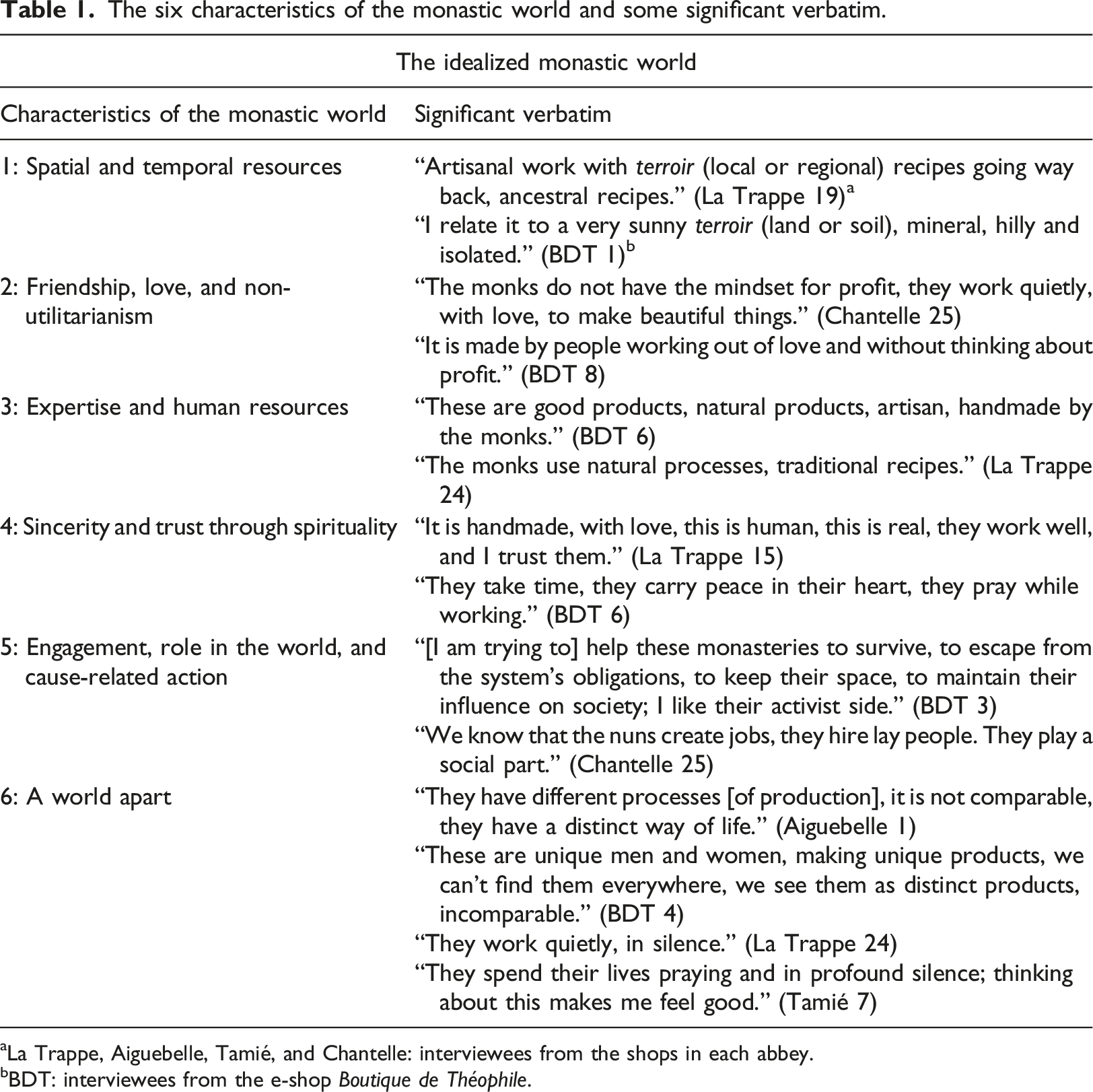
aLa Trappe, Aiguebelle, Tamié, and Chantelle: interviewees from the shops in each abbey.
bBDT: interviewees from the e-shop Boutique de Théophile.
These six theoretical codes show the characteristics that purchasers associate with the monastic origin of the products they bought, seeing it as a sort of de-territorialized and idealized world. We noticed that only 3 of the 56 interviewees mentioned the Monastic brand, and each of them made negative comments about the lack of information provided by the brand, showing how the Monastic association has not engaged with marketing. Moreover, only 8 of the 56 respondents evoked specific and localized abbeys as meaningful origins; the generic “monastic products” category is much more verbalized as a source of meaning both for the products and for the act of purchasing. Instead of refering to the specific abbey where they bought the product, consumers evoke a series of characteristics that are developed predominantly from their own beliefs and representations of this specific world, rather than from the local origin of the product. For the respondents, what makes the abbeys and their products special relates more to a process and a shared ethos rather than to a specific location, as highlighted in Table 1.
To continue with the process of interpretation and theory building (Belk et al., 2012; Spiggle, 1994), we then extracted four conceptual pillars from the six characteristics which had emerged from the emic and etic coding: world apart (corresponding to characteristic 6), practices (corresponding to characteristics 1 and 3, as practices result from the spatial and temporal resources, and expertise and human resources), sincerity (corresponding to characteristic 4), and engagement (corresponding to characteristics 2 and 5, since engagement is the synthesis of friendship and non-utilitarianism, and of the role in the world), and all together they constitute what we call World of Origin.
At this transition stage, when “the processes of gathering and of using (i.e., analyzing, interpreting, and building new theory from) qualitative data are deeply intertwined” (Belk et al., 2012: 138), we put forward the concept of World of Origin (WOO) as a de-territorialized place of origin, broadening the idea of origin usually contained in COO literature (Newman and Dhar, 2014). We use “cloud-like” (i.e., disconnected from the land) to describe a virtual space that is not grounded in a single location. Rather, like a cloud, it connects a multitude of entities together regardless of their physical location. These entities might be based in very different locations, but they share characteristics (rules, commitment, methods, etc.) that influence how people perceive the products they make or sell, regardless of the product category. Unlike the concepts of COO and terroir which use analogies with roots in the soil, what makes the WOO concept special is that it is cloud-like, similar to an overhanging cloud. Figure 2 synthesizes the concept of the WOO: underneath, various entities are scattered in different locations but share common history and rules, and above, the cloud-like WOO demonstrates the shared ethos, and is made up of four pillars which transcend product categorization: world apart, practices, sincerity, and engagement. The World of Origin (WOO) concept.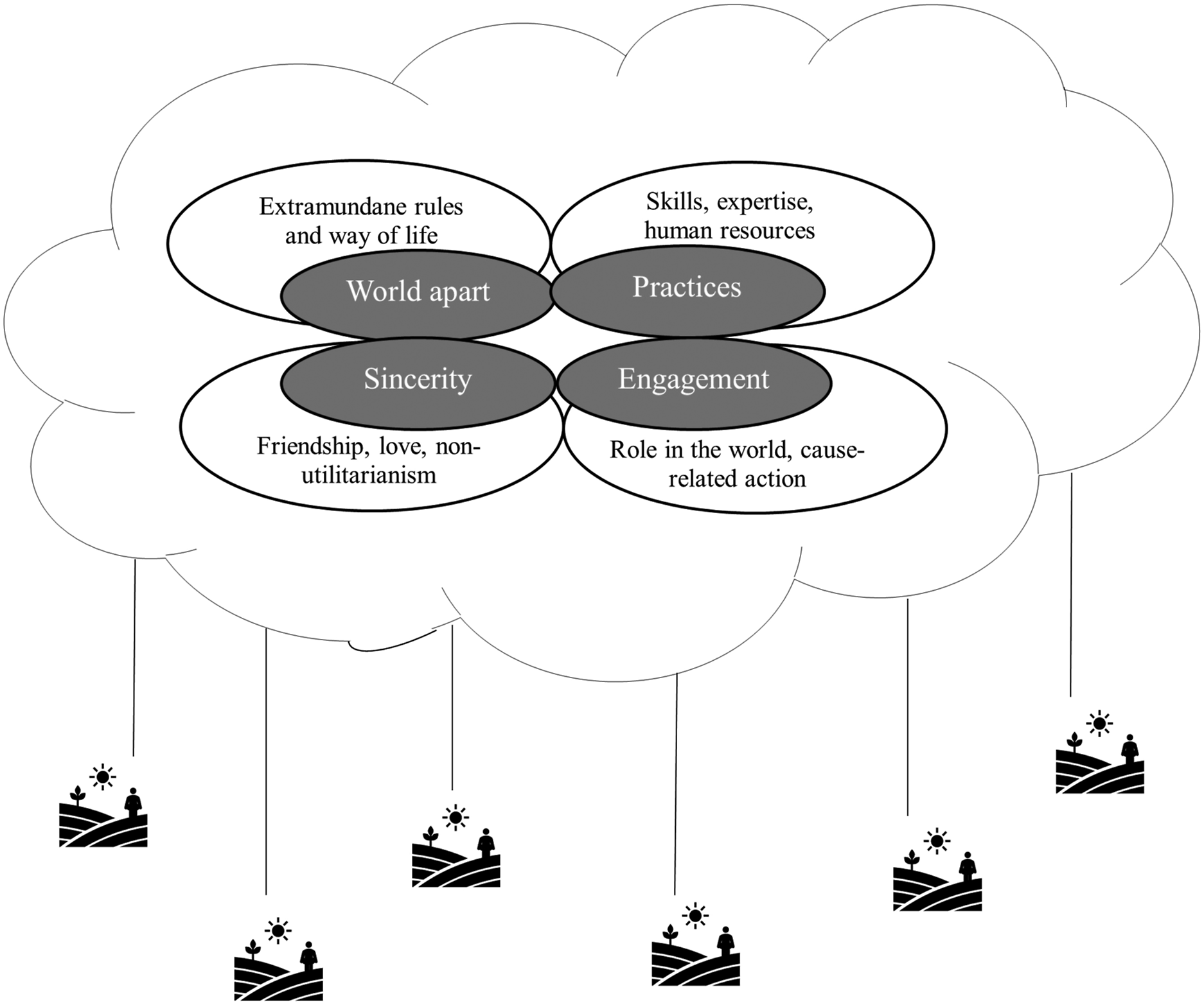
Discussion
Defining world of origin
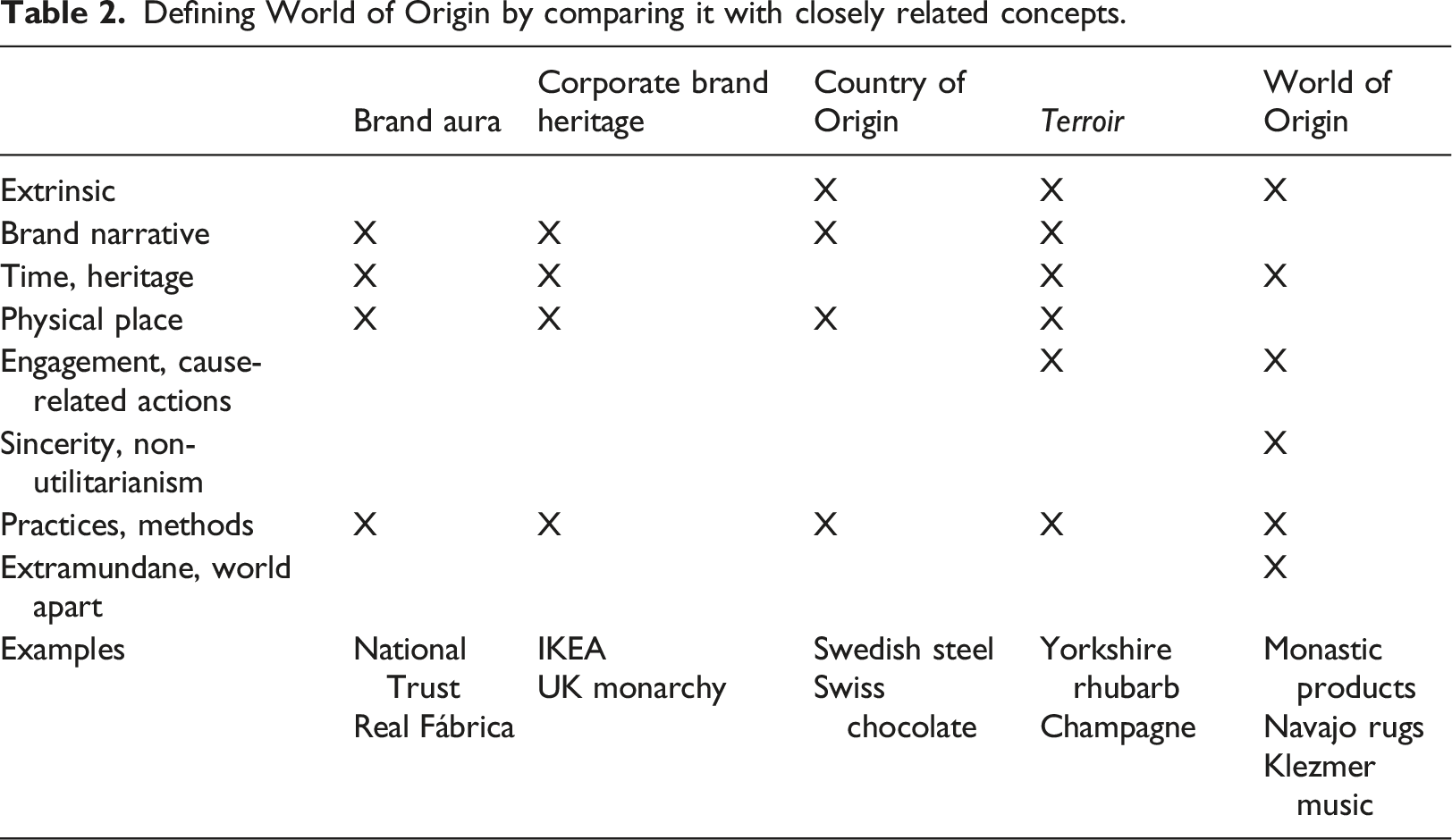
We propose the concept of World of Origin as an extrinsic resource which is used by consumers to build their own narrative and perception. This WOO concept is cloud-like, and the blurry World of Origin of products conveys properties to the products, regardless of their actual place of manufacture. WOO therefore goes beyond the physical restriction of place proposed by Castilho et al. (2017: 6): “places physically instantiate elements of market systems (meaning), frame market actors’ experiences (identities) and are conducive to the creation of bonds among market actors, objects, and between market actors and places (intersubjectivities).” As an extension of the geographical notion of country, place, even space (Andéhn et al., 2020; Chatzidakis et al., 2018; Cheetham et al., 2018) to world, we suggest that place is only one unit among others that constitute WOO, a concept with four pillars: world apart, practices, sincerity, and engagement. - World apart is the only pillar which refers to a specific segregating place, among other references such as temporal relationships apart, rules apart, and usages apart defining an “elsewhere.” It expresses the idea of indistinct and de-territorialized boundaries (Castilhos et al., 2017; Chatzidakis et al., 2018; Cheetham et al., 2018) demarcating an extramundane, different, and cloud-like world. WOO is separated from and in opposition to the world in which the consumers live. Like the mythical past in the corporate heritage literature, WOO can be an escape because it is different (Hudson and Balmer, 2013). This separation creates a distance that might be necessary to stimulate the consumer’s imagination. We have certainly observed that people who are less familiar with the reality of the monastic ecosystem seem more likely to rely on WOO. Some kind of distance therefore seems necessary for WOO to exist and play its role. - Practices are very close to competences in COO literature and to the methods of production in the brand aura literature. Practices feed into performance-related cognition about this world apart (Chen et al., 2014). However, more than a stereotyped halo (Chattalas et al., 2008), these practices play two roles. First, they refer to the precise rules attached to this WOO, such as the rule of St. Benedict for the monks or nuns. Second, these practices legitimize the expertise acquired by humans as a result of these rules, just as rules are part of the definition of the terroir (Charters et al., 2017) and relate to the use of labels and other certifications in marketing. The rules of monastic life provide credibility in the same way that an eco-certification or protected designation of origin would. Yet, while it is a similar process, it appears very different because of its anteriority (it has existed for centuries), and its disconnection from traditional certification bodies and from brand narrative. - Sincerity evokes the good intentions of people belonging to this WOO. It complements the previous cognitive pillar related to practices by insufflating warmth (Chattalas et al., 2008) and emotions that are not related to performance (Kock et al., 2019). Moreover, sincerity refers to the purity and genuineness of the people who make up this WOO and sell the products. It is one of the ingredients of the authenticity perceived by consumers (Brunninge and Hartmann, 2019). These findings echo prior research on authenticity and on the role of playing down the commercial exchange (Alexander, 2009; Cova and Cova, 2002), although it does not relate to a particular brand in the present case. Sincerity can be illustrated by a detachment from commercial exchanges, which are here only a consequence of the need to sell manufactured products to survive, in a non-utilitarian way. - Engagement is the other affective cue of WOO which is not related to performance (Chen et al., 2014; Kock et al., 2019). It shows the committed role played by this world apart in society through cause-related action, generosity or providing an alternative, and allows consumers to get involved themselves to support this WOO (Andéhn et al., 2020), either to help the “endangered species” of the abbey to survive, or to act against the domination of mainstream offers. This commitment toward preserving the monastic ecosystem seems related to the fact that it is separated from traditional circuits. It is because consumers recognize and value the singular nature of the monastic WOO that they make efforts to protect it.
Unlike brand aura and corporate brand heritage, WOO is not brand centric. Consumers use it as a substitute to nourish their storytelling, thus compensating for the discretion of the brand. In this way, it operates like other extrinsic cues discussed in the related literature: COO, terroir, and mythical or cultural heritage. However, WOO is a broader extrinsic cue that designates beliefs and stereotypes around the context of origin of a particular offering that influences consumers’ perceptions. More than an assemblage of geographical market elements (Castilhos et al., 2017), this cloud-like representation not only brings together beliefs about production practices, but it also involves the sincere and possibly even politically motivated intentions of the producers from this world apart. By combining the two dimensions that COO literature has considered in isolation so far, we take on the indistinct boundaries between cognition and affect (Verlegh and Steenkamp, 1999) that sustain the stereotyping (Kock et al., 2019). This concept does not distinguish competence from warmth (Chattalas et al., 2008) or performance-related country cognition and performance-unrelated country emotions (Kock et al., 2019; Laroche et al., 2005). WOO is therefore a combination of COO, of terroir, and of something extra—involving the sincerity and the commitment of people belonging to this WOO. As it encompasses a broad understanding of the origin, it is similar to brand aura except for the fact that there is no managed brand.
The introduction of WOO contributes to the meaning attached to origin in marketing by designating a cloud-like place that does not have distinct geographical boundaries but has temporal ramifications in cultural and mythical heritage. WOO broadens the notion of physical place and of origin and goes beyond the notion of COO or terroir since it can originate in different locations simultaneously, but only in these genuine locations. WOO could apply to a range of specific consumption contexts given that their origin is linked to specific types of location, practices, and moods. WOO could thus be used in the research of many other situations where there is an absence of brands, such as farmers’ markets and maritime cooperatives, as well as in the consumption of “indigenous” products such as Navajo rugs, Klezmer music, Amerindian pottery, and more broadly, other products from “endangered species”. It cannot be appropriated or replicated anywhere else or by anyone else in the same way as a technique could be. In that respect, it gives a product a competitive advantage in the same way as a “Made in Italy” label or a Champagne PDO would, but with non-territorialized aspects. The importance of the WOO is not geographical but relates to the acceptance of the rule and integrating production into a way of life going beyond the production itself. More precisely, WOO assumes that its community has moved geographically over years or centuries, and/or changed in its ways of life and ways of working and has sincerely committed to maintaining certain practices—sometimes against all the odds.
Defining World of Origin by comparing it with closely related concepts.
The power of contagion of World of Origin
In the process of contagion as set out by Arora et al. (2016), WOO operates as an extrinsic cue conveying perceived authenticity to the product through the first and second-order effect of transferred essence (Argo et al., 2008; Rozin et al., 1986). WOO carries a mix of technical indexical and iconic authenticity (Moulard et al., 2015): in a similar way to terroir, it carries indexical authenticity based on the legal recognition and physical nature of terroir products, together with subjective perceptions of them (Spielmann and Charters, 2013). In a similar way to COO, WOO also has an iconic authenticity based on the match between the object and how it should be in the cultural preconceived schema of the consumer (Moulard et al., 2015). It is similar to aura because it encompasses spatiotemporal aspects with spiritual elements, but also encompasses techniques of production and overall intentions of the producers (Alexander, 2009). However, unlike the definition of aura in marketing, it does not designate the essence of the brand because it does not relate to the brand. In the case of abbeys, WOO compensates for the lack of a brand discourse.
We argue that WOO transfers meaning to the shop, to the products, and to the consumers. From our interviews, it appears that consumers are more interested in purchasing a part of this WOO, than in the purchase of the product itself. This purchase allows them to express values and to support a specific origin that they believe is beneficial to wider society. The affect related to this WOO triggers an affect-transfer process in the same way that a country-related affect would (Chen et al., 2014; Laroche et al., 2005): this WOO is transferred to the product which becomes imbued with its essence as a result of the three-step contagion role of the shop, whether it is physical or virtual. These findings deepen previous results on the amplificatory role of the purchasing contexts on the experience (Paquier and Morin-Delerm, 2016). They also enrich the resources-exchange place perspective (Rosenbaum et al., 2017), and extend the two-step contagion proposal (Newman and Dhar, 2014; Rozin et al., 1986) toward a three-step contagion transmitted by the purchasing context.
Moreover, we argue that the role of the shop as a carrier of meaning is not only confirmed (McCracken, 1986; Rosenbaum et al., 2017; Zaidman and Lowengart, 2001), but is also completed by a contagion process without intermediation. This direct transfer from this WOO to the product, to the act of purchase, or to the consumer itself, shows the WOO’s power of contagion. Compared to COO, WOO includes more human cues; one could say it refers mainly to human communities that live alongside society: rather than living within society, these communities are spatially or temporally apart from the world. They may be historically attached to a physical space (a country, land, region, or continent, for example), but they are currently detached from it, due to migration, historical events, persecutions, or other developments. We posit that it is precisely their distance from the rest of society that gives them value. Through their spatial or temporal journeys, these “communities apart” take their “world” with them, their combination of rules, specificities, sincerity, engagement, and commitment, and create a spatial network which feeds into market dynamics. WOO is stronger than a marketed discourse, conveying meaning and an aura of authenticity through the genuineness of its practices and the sincerity and engagement of its human resources (Brunninge and Hartmann, 2019), so that what purchasers buy is an origin rather than a product with specific attributes. Meaning associated with the product is thus less important than the meaning of the purchase itself as a commitment to this WOO or against mainstream trends, and is less important than the meaning purchasers want to transmit to their friends through the gift (Paquier, 2015).
Finally, the power of contagion of this WOO highlights the descendant chain of contagion from the monastic origin to the consumer. To complete our approach, it would be interesting to consider the process of contagion from the market to the monastic origin, that is, the marketization of a cloistered segregating place (Castilhos and Dolbec, 2018). What are the influences of external purchasers on the cloistered community, and what are the resultant frictions with internal established rules? What is the dynamic which orchestrates the chain of contagion from the marketplace outside to the segregated place inside?
The tipping points
The corollary of this strategy which leaves the field open to WOO’s power of contagion is to accept a loss of control. It paves the way for an uncontrolled construct of perceived authenticity by the consumers, when they idealize the pillars of WOO (Brunninge and Hartmann, 2019). Between the meaning built and controlled by the brand (McCracken, 1986) and the meaning built by the consumer (Woodside et al., 2008), the tipping point from control to wildness must be managed by the companies (Miles, 2014).
In the case of a powerful WOO, marketers can remain discreet and let media and consumers play the multi-vocal presence of meanings (Hirschman, 2007). But firms must pay attention to anachronisms (Cantone et al., 2020), heterotopia (Roux et al., 2018), and metaphors (Hirschman, 2007) when they convey falseness instead of trueness (Miles, 2014). Indeed, without any discourse, the authenticity aura is transmitted to the consumer by the meaning of this WOO, which is itself based on archetypes and the imagination of the consumer who activates its cultural schemas (Torelli and Ahluwalia, 2012). We come up against the situation in which consumers themselves stage the play of authenticity, when there is a danger of consumers tending to indulge in a false representation of reality instead of questioning its genuineness (Pine and Gilmore, 1999). We can return to the assertion of Brunninge and Hartmann (2019) who deplore reinvention of the past by companies because “such inventions carry considerable risks since they represent a fabrication of the past” (p.229): in our case, the narrative is constructed by a bona fide consumer and not by a marketer (Hirschman, 2007). We fear that an excess of meaning and authenticity which is perceived too strongly becomes un-genuine and un-true and can later damage consumers’ trust in the sincerity and commitment of this WOO. For example, after becoming conscious of this danger, the Monastic French association has recently decided to send out an educational communication to explain to consumers how current monastic communities use subcontractors but remain entirely in control of each step of the product’s life. The difficulty lies in telling consumers about the reality of current practices without altering their enjoyment of the appealing fairy tale they love. In other words, how can companies disembellish without disenchanting consumers? Is it ultimately the responsibility of the company to tone down consumers’ discourse when they exaggerate? Our results indicate that abbeys benefit from some exaggeration in the short term.
However, we can challenge the companies’ ability to maintain the same aura in the long run. For monastic products, the distance between the abbeys and the rest of society in France acts in the abbeys’ favor because it is presumed that they are doing good, but it is reasonable to assume that consumers would prefer to be informed by the abbeys that their beliefs are not entirely true, rather than by a third party. For example, organic suppliers could pay attention to the tipping point between controlled and uncontrolled narrative, when consumers auto-create their self-narrative, confusing organic, local, and fairtrade attributes. The role of the shop in the contagion chain also pinpoints the necessary coherence of the shop’s location and atmosphere with the characteristics of this WOO. But the power of contagion of WOO warns us against practitioners who are too discreet, which can unintentionally transmit a strong perception of authenticity, so much so that this perception can be false. Companies are thus faced with an ethical choice to lightly bend—or not—the truth of their representations to consumers through educational communication.
Footnotes
Declaration of conflicting interests
The author(s) declared no potential conflicts of interest with respect to the research, authorship, and/or publication of this article.
Funding
The author(s) received no financial support for the research, authorship, and/or publication of this article.

Note
Appendix I. A: Data structure on the chain of contagion: from open coding to the emergence of refining codes,foundations of the power of contagion,and monastic origin
In total, 73 inductive open codes emerged from the data (column 1), which we assembled into 12 axial codes (column 2). The etic phase, supported by contagion literature, highlights six theoretical codes showing transfers of essence (columns 3 and 4).
Open coding (emic)
Theoretical coding (etic)
Focused coding
Axial coding
Theoretical codes and main relevant authors from contagion effects literature
Refining codes as a result of our data
Peaceful atmosphere
Atmosphere
(1) Transferred essence from the monastic context to the shop (Rozin et al., 1986; Nemeroff and Rozin, 1994; Chattalas et al., 2008; Newman and Dhar, 2014)
Warm atmosphere
Traditional atmosphere
Not impersonal atmosphere
Calm atmosphere
Simple atmosphere
Old-fashioned atmosphere
Monastic atmosphere
Coherence with the monastic origin
Yes
Monastic atmosphere
No
Spiritual atmosphere
Presence of monks/nuns
Too commercial
Somewhat commercial
Not commercial
Monastic bubble
Unique point of sale
Non–business-like point of sale
Welcome with a smile
Welcoming
Welcome with a listening ear
Hospitable welcome
Friendly welcome
Auditory, music
Sensorial
Auditory, silence
Olfactory
Visual
Choice, touch
Bond with lay staff
Relational
Bond with monks/nuns
Bond with other shoppers
Inimitable point of sale
Point of sale apart
(2) Transferred essence from the monastic shop to the products (Lam, 2001; Zaidman and Lowengart, 2001; Argo et al., 2008; Newman and Dhar, 2014; Paquier and Morin-Delerm, 2016)
Non–business-like point of sale
Business-like point of sale
Point of sale that transfers something
Quality product
Products’ attributes
(2) Transferred essence from the monastic shop to the products (Lam, 2001; Zaidman and Lowengart, 2001; Argo et al., 2008; Newman and Dhar, 2014; Paquier and Morin-Delerm, 2016)
Good product
Artisan product
Terroir (local) product
Natural product
Traditional product
Handmade product
Responsible product
Ethical product
Wholesome product
Simple product
Authentic product
Spiritual product
Unique product
Product apart
(4) Transferred essence from the monastic context to the product (Rozin et al., 1986; Nemeroff and Rozin, 1994; Chattalas et al., 2008; Chen et al., 2014; Newman and Dhar, 2014; Kock et al., 2019)
Special product
Original product
Inimitable product
Integrated product
Carrier product
(3) Transferred essence from the product to the consumer (Rozin et al., 1986)
Product made with love
Product as a gift
Product as a thank you
Product as living history
Purchase as a gift
Gift and source of enjoyment for oneself and others
(5) Transferred essence from the monastic context to the consumer (Rozin et al., 1986; Chen et al., 2014; Kock et al., 2019)
Purchase to support abbeys
Purchase to treat oneself
Purchase to treat others
A responsible purchase
Purchasing meaning
A meaningful purchase
A purchase as a way of keeping a clean conscience
A conscious purchase to support the monks
A conscious purchase against the system
A purchase as a spiritual journey
Useful purchase
Emotion, Yes
Emotions
(6) Transferred essence from the monastic shop to the consumer (Rozin, Millman, and Nemeroff, 1986; Paquier and Morin-Delerm, 2016)
Emotion, No
A moment of enjoyment
A slow moment
A nice moment
Astonishment, curiosity
A moment of nostalgia
Appendix I. B: The six paths of the contagion chain from the monastic origin to consumers and significant verbatim extracted from the interviews.
*La Trappe, Aiguebelle, Tamié, and Chantelle: interviewees from the shops in each abbey. **BDT: interviewees from the e-shop Boutique de Théophile.
The contagion chain from the monastic origin to consumer with or without shop or product intermediation
Contagion path
Significant verbatim from interviews
From the monastic origin to the shop
“The shop creates a more friendly atmosphere for people who are scared by the monastic aspect, it is like a bridge with the monastery.” (Tamié 34) *
“The monk at the cash register… this is great, we can feel him, we can talk, there is a smile, he is at home, he welcomes us.” (La Trappe 12)
From the monastic shop to the product
“We trust the products on display, we like the shop’s atmosphere, I could buy with my eyes closed.” (La Trappe 15)
“I could buy it in a supermarket, but it is better here! Here I can feel the provenance, the poverty, and the love for work well-done, the quality. Here, we are close to the monks, we are on their territory.” (Tamié 39)
From the product to the consumer
“It is a special purchase because I think about the person I am going to give it to. I will show them my gratitude with this pot of honey, this is important” (Chantelle 30)
“I leave here with my small bag, this is concrete, I have a good product in exchange for my help, and the relationship with the monks continues when I eat the products at home, I remain in contact with them.” (La Trappe 23)
From the monastic origin to the product
“What I love is the little prayer that the sister puts into the soap box, I always look forward to it, it is delightful” (BDT 8) **
“The fact that it comes from this monastery gives value to this gift” (BDT 13)
“There is of course something different about the dark chocolate from monasteries, a different way of making it.” (BDT 3)
From the monastic origin to the consumer
“It’s a purchase for me; I give myself a little treat by remembering my grandmother’s, and knowing that it’s from a community I know is something that also give me pleasure” (BDT 7)
“In the act of buying there is the mystery of the monks which affects me directly, it intrigues me.” (BDT 9)
From the monastic shop to the consumer
“When you browse this website you can find out about the monasteries, it is like doing spiritual tourism on a screen” (BDT 10)
“Relaxing, calm atmosphere, people don’t shout, don’t speak loudly, the music is relaxing, the place is conducive to peace and quiet, with the abbey just next door.” (La Trappe 16)
Appendix II: Data structure on the image of the monastic origin of the products bought: from open coding to the emergence of new codes,foundations of the WOO construct.
Open coding (emic)
Theoretical coding (etic)
Focused coding
Axial coding
Theoretical codes and the most relevant authors from COO and Terroir literature
New codes as a result of our data
Geographical/spatial anchorage
Spatial and temporal resources
(1) Spatial resources (Spielmann and Gélinas-Chebat, 2012; Suter et al., 2018)
Temporal anchorage
(1) Temporal resources (Suter et al., 2018)
Ethical work
Work perception
(2) Friendship, likeable people, good intentions (Charters et al., 2017; Chattalas et al., 2008; Papadopoulos, 1993)
Traditional work
(3) Competence and human resources (Spielmann and Gélinas-Chebat, 2012; Suter et al., 2018; Chattalas et al., 2008; Papadopoulos, 1993)
Respected work
(4) Sincerity and trust, country affect, and emotion which is not related to performance (Charters et al., 2017; Chattalas et al., 2008; Chen et al., 2014; Kock et al., 2019)
Rewarded work
(2) Friendship, likeable people, good intentions (Chattalas et al., 2008; Papadopoulos, 1993)
Work with love
(2) Friendship, likeable people, good intentions (Chattalas et al., 2008; Papadopoulos, 1993)
Nostalgia
Emotions
(1) Temporal resources (Hudson and Balmer, 2013; Suter et al., 2018)
Doubt
(4) Sincerity and trust, country affect, and emotion which is not related to performance (Chattalas et al., 2008; Chen et al., 2014; Kock et al., 2019)
Endangered species
(2) Friendship, likeable people, good intentions (Chattalas et al., 2008; Papadopoulos, 1993)
An extra dimension
(6) World apart (specific spaces, rules and norms)
Trust in the origin
Trust
(4) Sincerity and trust, country affect, emotion which is not related to performance and temporal resources (Chattalas et al., 2008; Chen et al., 2014; Suter et al., 2018; Kock et al., 2019; Shroeder et al., 2015; Moulard et al., 015)
(6) World apart (specific spaces, rules and norms)
Trust in the choice of ingredients
Trust in the monks’ work
Trust in the production process
Trust in the time taken for production
A priori trust
Rewarding origin
(2) Friendship, likeable people, good intentions (Chattalas et al., 2008; Papadopoulos, 1993)
Alternative to mass consumption and to the system
Engagement
(5) Engagement, role in the world (Charters et al., 2017; Suter et al., 2018; Papadopoulos, 1993)
Short circuit of local products, an alternative to mass retail
Ethical world
Spirituality, prayer
Solidarity, charity, gift
Love
Useful world
Author biographies
Marie-Catherine Paquier is Associate Professor of Marketing at European Business School-Paris and Associate Researcher at Conservatoire National des Arts et Métiers-Paris. Monasteries and their ecosystem are her main field of study, and she is involved in self-sufficiency and demarketing strategies. She is also interested in other spaces which are currently in commercial transformation. Her research has been published in International and French journals such as Journal of Management, Spirituality and Religion, Decision Marketing, or Revue Française de Gestion. Address: European Business School, 10 rue Sextius Michel, 75015 Paris, France [email:
Sophie Morin-Delerm is a full professor in marketing at Paris-Saclay University (RITM laboratory) and the first vice-president of Paris-Saclay University, in charge of the board, human resources and finance. Her research projects explore the marketing of innovation as well as the marketing of heritage organizations. She also conducted research on the communication of sustainability commitments of various public and private organizations. Her research has been published in many books and leading academic journals. She held a PhD from the Sorbonne University and a Habilitation à Diriger des Recherches from Paris II-Panthéon-Assas University. Address : Université Paris-Saclay - Bâtiment Bréguet, 3 Rue Joliot Curie, 91190 Gif-sur-Yvette, France. [email :
Fabien Pecot is an Associate Professor in Marketing at TBS Barcelona (Spain). His research interests focus on commercial representations of the past, the concept of brand heritage and the role of political ideology in anti-consumption. He is particularly interested in studying situations of exchanges in which the actors involved prefer continuity and stability over change or novelty. His research appears in the Journal of Business Research, Marketing Theory, Recherche et Applications en Marketing among others. Address: TBS Education, Carrer de Veneçuela, 116, 08019 Barcelona, Spain. [email :