







Abstract

We live in uncertain and challenging times. We have recently emerged from a pandemic and are staring at various other consequences of rapacious capitalist exploitation, environmental destruction, and rising inequalities. Some have argued that neoliberalism and financialization have fundamentally altered the nature of capitalism (Giroux, 2011; Haiven, 2020; Philips, 2018). Perhaps, we are in an interregnum, as Gramsci (2020) described, in which the old order is dying, but the new one is yet to be born, and in the interim, we see various morbid tendencies.
In these challenging times, Marketing Theory firmly stands as an outlet that is committed to critically examining markets, marketing, consumption, and capitalism. We would like to reaffirm our unwavering commitment to what the founding editors of Marketing Theory wrote in the first editorial in 2001, ‘Marketing Theory has been designed as a specialized academic journal for the development and dissemination of alternative and critical perspectives on marketing theory’. Since its founding Marketing Theory has been promoting an understanding of markets, consumption, and marketing across societies. It has never been the motive of Marketing Theory to address instrumental concerns, financial performance, or narrow corporate interests (Chatzidakis et al., 2023). Ever since its first issue, the emphasis and core quest have been on the study of markets, consumers and marketing beyond mere managerial phenomena. In so doing, the journal has revealed important insights on markets, consumption, marketing, and societies. In the coming years, it will continue to make important contributions to the field. Its commitment to critical, unorthodox, and marginalized perspectives (Chatzidakis et al., 2023) cannot be suppressed.
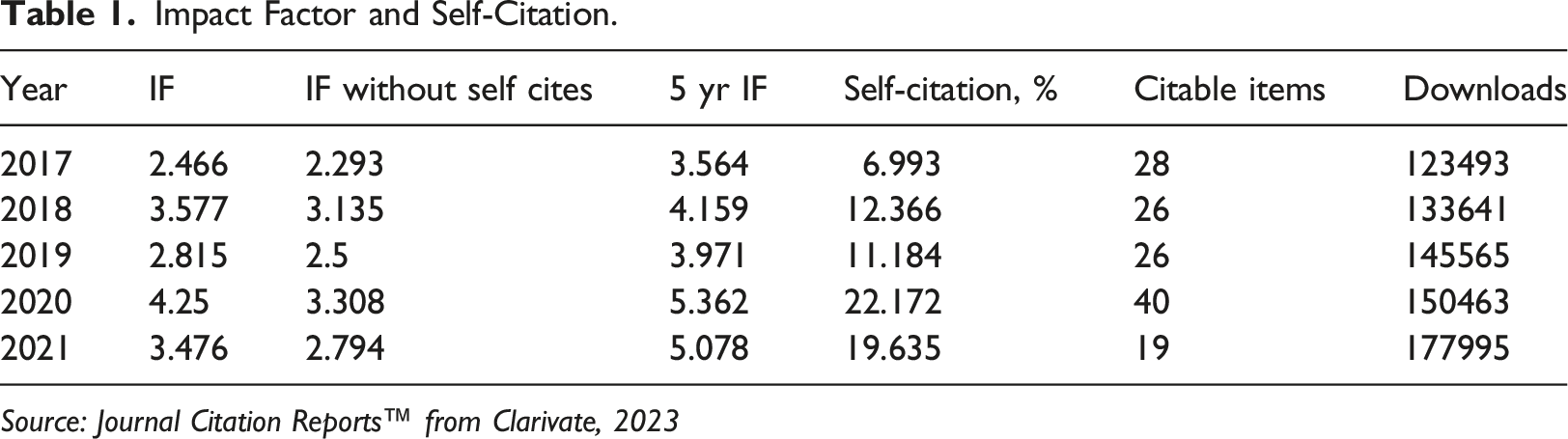
There is a reason why we use the word ‘suppressed’. A few weeks ago, we were informed by Clarivate that it would be suppressing our Journal Impact Factor (JIF) because of 34% self-citation in 2022. The JIF for a journal represents the average number of times that papers published in the past 2 years have been cited by other research articles in the current year. For example, Marketing Theory published 59 papers in 2020 and 2021, and those papers appeared 222 times in the reference lists of other papers published in 2022; the JIF for 2022 should be 222 ÷ 59 = 3.8. In the light of the suppression of the JIF for 2022, it is important to put the record straight.
Impact Factor and Self-Citation.
Source: Journal Citation Reports™ from Clarivate, 2023
Our authors and readers will understand that Marketing Theory is unique in terms of focusing on the advancement of theory, commonly through the use of alternative and critical perspectives. Many of our papers are purely conceptual and those that are empirical emphasise theory building. A vast majority of our published papers comes from interpretivist, critical, and consumer culture scholars. The journal rarely publishes any paper by more mainstream experimental and positivist marketing scholars, although submissions in these areas that seek to advance marketing theory are welcomed. Due to the specialised nature of the academic community that contributes to Marketing Theory, there is a limited set of authors and therefore, the journal has published some authors multiple times. In certain years, it can lead to inflation in self-citations. For example, papers by two authors contributed to 29% of the total self-citation in 2022. The journal’s emphases on theory and critical perspectives also limit the extent to which more mainstream and managerialist marketing journals engage with it. This is evident in our citation data. While there is a 28% increase in the last 5 years in external citations of Marketing Theory articles, it has not kept pace with the self-citation that has increased by 125%. As a result, the external citation as a proportion of total citation has declined in this period.
Clarivate’s decision does not take the uniqueness of the outlet, quality of contributions, and the nature of the academic field into account. Clarivate only provides a 5 days window for any appeal, which does not allow enough time for the necessary data gathering and detailed responses needed to rebut what becomes a unilateral and opaque decision. We are not the only ones who point in this direction and numerous studies on the JIF have identified flaws in the metric (e.g., Langley-Evans 2023; Ramsden, 2009). Scholars have noted that the JIF is both a faulty metric and contributes to flawed assessments of academic quality (Gruber 2014; Schekman, 2013). In fact, Curry (2012) goes on to label impact factor as damaging to research and laments that it has become a, ‘cancer that can no longer be ignored. The malady seems to particularly afflict researchers in science, technology and medicine who, astonishingly for a group that prizes its intelligence, have acquired a dependency on a valuation system that is grounded in falsity’. Furthermore, in a damaging review of the business activities of Clarivate and Reed Elsevier LexisNexis, Lamdan (2022) labels their metrics, the JIF and CiteScore, as oligopolistic tools of profiteering that distort research agendas.
We, therefore, refuse to accept the JIF or CiteScore as the only measures of the academic writings appearing in the journal. After all, we never equated our ‘success’ with impact factor measurements (Chatzidakis et al., 2023). We have several reasons to believe that the journal is making strong contributions to the field. It has witnessed exciting conversations on market system dynamics, service eco-systems, hierarchies of knowledge, and heroic marketing and marketing of heroes in the last few years. The journal has published some key writings in the areas of critical marketing studies, psychoanalysis in marketing theory, history of marketing thought, and reflections on power-knowledge and marketplace agency. As a result of its strong reputation, the total submissions have increased by 36% in the last 5 years and our rejection rates have consistently been above 80%. We have also witnessed a 44% increase in the downloads of our papers in the last 5 years with an enhanced geographical spread across the globe.
Our past success does not mean that we do not seek improvements or changes. We would like to further expand the readership of our papers. It will require taking the conversations published in Marketing Theory to different scholars, disciplines, outlets, and geographies. The papers published in Marketing Theory can inform the research happening in marketing and consumer research, management and organization studies, and various disciplines in humanities and social sciences. We have to make concerted efforts to increase the reach of the journal – a realization that was already driving our agenda (see also, Chatzidakis et al., 2023). As part of these plans, we will appoint a media editor who will be in-charge of disseminating the published work. We also plan to introduce newer sections in the journal. We will invite more review articles that contribute to theory building. Moreover, we plan to introduce a new section on book reviews that will be handled by a book review editor. In making these changes, we have to move ahead without deviating from our foundations or losing the great achievements of Marketing Theory.
Talking about great achievements, this editorial will be incomplete without acknowledging the efforts of our authors, reviewers, and associate editors. The journal and its reputation have been built by the collective academic labour of all our stakeholders. In guiding the process, the outgoing editors – Pauline Maclaran and Elizabeth Parsons – have played a stellar role. Pauline and Liz put enormous efforts in continuing the work to establish Marketing Theory as one of the leading outlets in the discipline and, more importantly, in instituting a community of scholars. As stated by them in a recent commentary: ‘The realisation of a strong supportive community of scholars who are producing innovative research is our key measure of success’ (Chatzidakis et al., 2023). The field will always be indebted to them for their contributions and for galvanizing this community of scholars. We take this opportunity to thank Pauline and Liz for their work, and to hereby invite new members to join us as members of our editorial board, authors or reviewers – particularly those from the Global South and from marginalised groups.
We close this Editorial with the assertion that we are aware of the great responsibility that comes with our role, and express our gratitude towards our authors, readers, reviewers, associate editors, and editorial board members for their contributions to the outlet. We call for a continued collective effort to overcome the current situation and to move ahead. We require the unwavering support of every scholar who believes in another imagination of the discipline. We urge every author who has believed in Marketing Theory to contribute to the outlet by continuing to submit their high-quality writings and by sharing work published here with their broader academic communities. In doing so, we should remind each other that Marketing Theory stands on the pillars of academic integrity, critical perspectives, and top-quality scholarship which cannot be suppressed or reduced to a metric.
Footnotes
Declaration of conflicting interests
The author(s) declared no potential conflicts of interest with respect to the research, authorship, and/or publication of this article.
Funding
The author(s) received no financial support for the research, authorship, and/or publication of this article.