







Abstract
This paper explores the phenomenon of rituals as a contested intersection of religion and ethnicity and demonstrates how changes in religio-ethnic inclinations of various generations of immigrant communities influence the religious authenticity/inauthenticity of rituals. Its focus is the British Pakistani Muslim community in the UK where the emerging second and subsequent generations of British Muslims have started to redefine and contest their religious and ethnic identities. The findings, derived through interview and observation, reveal that religion has become the preeminent marker of identity, eclipsing that of ethnic identity. Through reciprocal socialization, the first generation are relearning an Islam from younger generations that is unfettered by cultural bonds. We illustrate how and why rituals are deemed inauthentic and abandoned. Findings demonstrate that authenticity/inauthenticity provides a potential outlet for reflexive consumers to assert agency against ethnic norms and ideological hailings that are at odds with their emergent religious identities. Accordingly, the study conceptualizes emergent inauthenticity to explain this phenomenon and delineates the role of boundary work and contamination in the authentication and rejection of rituals.
Keywords
Introduction
The last five decades have seen several waves of immigration to the West. Emerging second and subsequent generations of immigrants, especially within Muslim communities, have started to redefine and contest their religious and ethnic identities. Religion and ethnicity are intertwined in their everyday practices and social relations and have become more relevant than ever in this rapidly globalizing world (Jafari et al., 2015; Sirkeci, 2009). Religious practices and ritual play a fundamental role in constructing a distinct ethnic identity especially within the Muslim diaspora in the West (Izberk-Bilgin, 2015). Religion wields significant influence in the life and lifestyle choices of its adherents. In the case of Muslims, particularly the succeeding generations, whose association with the home culture is attenuated as a result of growing up in the host country, religion is replacing ethnicity as the most important identity marker. In this context, this paper explores the phenomenon of ritual as a contested intersection of religious and ethnic identity. Religious rituals observed by immigrant communities are usually inlaid with cultural practices that are drawn from the ancestral homeland (Chatterji and Washbrook, 2014). This transposing of customs, norms, rites and artifacts from one cultural context to another is a prevailing feature of immigrant communities. Yet the theoretical implications raised by the transplantation of such ritual practices have been sparsely explored. Furthermore, few studies have endeavoured to unravel the in/authenticity and abandonment of rituals, therefore, we explore how changes in ethnic and religious proclivities shifts understanding of the sacred and the profane to deem some ritual practices inauthentic.
Rituals are broadly categorized into two main types, religious rituals or secular rituals. According to Rook (1985) religious rituals are considered to be amongst the most important and popular sources of human-ritual experiences. Likewise, Moore and Myerhoff (1977) note that the bonds between rituals and religious expression have been intertwined to such an extent that the analysis of the two has almost always gone hand in hand. A number of scholars (Gordon-Lennox, 2017; Groupp, 2018) construe secular rituals as those rituals that are practiced with limited religious capital or involvement, a mixture of one or more religion, or the absence of any religious institutional authority. Groupp (2018) underscores that ‘secular’ does not refer to the absence of religion, but rather to the focus on a combination of personalized symbols, language and gestures that add to the ceremony’s emotional effects and its significance to the participants. This study demonstrates how rituals and ideas once considered sacrosanct and fixed are modified, sometimes irrevocably, and in certain situations abandoned.
The focus of this paper, then, is to explore how changing religious and ethnic inclinations and practices influence the religious authenticity of rituals. We examine how ethnic communities reconstitute and renounce these taken for granted rites and symbols (Chatterji and Washbrook, 2014). We show how ethnic communities create and work with symbolic boundaries (Douglas, 1966) to authenticate or deem inauthentic (Zhou et al., 2018) certain rituals to the practice of Islam. In doing so, this paper brings to the fore the power of religious inauthenticity in shaping the practice and acceptance of ritual and participants concomitant religious identity. The aim is to understand how individuals and family groups maintain and protect their religious identity by employing in/authenticity to appropriate or reject ethnic and religious affiliations. In this endeavour we advance theoretical understanding of ‘emergent authenticity’, a socio-cultural phenomenon that Cohen (1988, p. 379) defines as the belief that what is regarded as inauthentic may become authentic over time. We extend this thinking to show that, in the case of religious rituals, what is considered authentic may also become inauthentic, thus we develop the concept of emergent inauthenticity. Ergo, we contribute to authenticity and consumer reflexivity discourses (Beverland and Farrelly, 2010; Thompson et al., 2018) by demonstrating how individuals and collectives, such as the family, embark on critical reflexive projects to in/authenticate ritual consumption in order to shape their individual and shared religious identity.
This research addresses a gap in the existing literature by exploring the consumption of ritual in three generations of British Pakistani Muslims, a community which has not garnered much research attention despite being one of the fastest-growing in the UK (Casey, 2016). The significance of exploring the British Pakistani Muslims is accentuated by the fact that in Europe, the UK has the largest Pakistani ethnic community. This is the largest ethnic Muslim community in the U.K. and exhibits significant religious tendencies, particularly amongst the younger generations (Casey, 2016). Studies suggest that religious and ethnic identity is in flux for this community and religion will supersede ethnicity as the most prominent marker of identity for second and later generations (Echchaibi, 2008; Voas and Fleischmann, 2012). We focus on these identity changes (Penaloza, 2010), contrasting insights from the first generation with those of the second and third generation of British Pakistani Muslims. To do so qualitative interviews were conducted with different generations of British Pakistani families to understand their perceptions, motives, attitudes and predispositions relevant to consumption of ritual and religious identity construction and negotiation. This intergenerational approach proved beneficial in unearthing how religious identities and ritual practices have evolved and been disseminated within the British Pakistani ethnic community.
Literature review
Intergenerational dynamic and religious negotiations
Contemporary research has mostly portrayed younger immigrant generations as passive victims of their circumstances (Sekhon and Szmigin, 2011). That they live conflicted lifestyles and can do little but suffer their parent’s imposition of alien cultural values. They have been ascribed the terms ‘torn self’ and ‘fragmented selves’ and lives are seen to continually oscillate between their desire to preserve their ancestral origin and embrace Western culture (Askegaard et al., 2005; Jafari and Goulding, 2008). We proffer a counter narrative showing that these later generations are active in negotiating not only their religious and ethnic identities but those of their family members as well.
Researchers have objected to the idea of the unidirectional, intergenerational passing on of religion, which assumes that children are disposed to passive socialization from parents, contending instead that the process is bi-directional (Scourfield et al., 2012). Contemporary studies have demonstrated that the relative influence and role of the younger generations tends to increase as they grow up (Goodrich and Mangleburg, 2010). Husain and O’Brien (2000) highlight the shift in the balance of power within Muslim households because of changing dynamics of intergenerational relationships. They assert that immigrant parents’ empowerment attenuates as their children become more fluent in the native language and have acquired a better knowledge of the society to which the families have migrated. This intergenerational gap also impacts the respect and deference parents typically expect within the home as children have stepped in as translators/interpreters for their parents in their day-to-day interactions with society. These shifts in the balance of power have implications for the construction of religious identity and perceptions of authenticity. This paper, therefore, explores how the influence of the younger generations shapes ideas of religious authenticity and inauthenticity in the parental generation (Wang et al., 2007).
Rituals at a crossroads of religion and ethnicity
According to Rook (1985), the term ritual refers to a type of expressive, symbolic activity constructed of multiple behaviours that occur in a fixed, episodic sequence, and that tend to be repeated over time. Durrani and Khan (2014) show that rituals are not just festive activities or actions performed on social occasions, but they entail social and symbolic meanings for those who practice them. By participating and engaging in rituals, people ratify the authenticity of the ritual and the prevailing societal order and structure.
The vast majority of the Muslim population are born in countries where the main religion is Islam. From birth, these societies are exposed to the prevailing cultural practices which are infused with religion. However, religion is just one of the constitutive resources, such as politics, norms, traditions and incoming ideologies, that influence these individuals’ everyday lives, relationships and worldviews. In the daily routine of these communities, religion becomes intermingled with culture such that religious practices become mundane cultural norms without necessarily being extraordinary transcendental rituals (Jafari and Suerdem, 2012). Immigrant populations in many cases become more devout adherents of their faith as a result of their endeavours to create, sustain and safeguard their cultural and ethnic identities in their country of settlement (Pearson, 2001). Consequently, scholars emphasize the need to understand how religious beliefs and identities influence the ritual consumption of immigrant communities (Fernandez et al., 2011). Rook (1985) points out that rituals, such as Christmas, that were in the past predominantly practiced in a religious/spiritual context, have evolved from a religious festival to a secular celebration. He explains that the material superstructure eclipses the spiritual/religious dimension for many individuals engaging in the Christmas festivities. Werbner (2014) notes, there is a need to explore how immigrants reconstitute the taken for granted features of ritual and endow symbols with a direct and immediate bearing on their everyday world. We add to this debate by showing that in certain ethnic communities where religion is an important marker of identity, rituals that were taken for granted as expressions of cultural affiliation and religiosity are being increasingly scrutinized through a new religious lens. As a result, religious rituals embedded in cultural norms are rebuffed in line with reconfigured religious identities cultivated devoid of cultural baggage.
Mary Douglas’ work is useful to understand the symbolic boundaries which classify cultures, societies, people and objects and in our case, ritual. These lines of inclusion and exclusion demarcate boundaries within and between groups creating distinctions and hierarchies (Douglas, 1966). Our paper explores the boundary work inherent in the practice and authentication of rituals. Boundary maintenance and boundary work are central to the construction of the self and to the wider system of order. Douglas highlights that old rituals can lose their meaning and we show how this shift in meaning can happen at the nexus of ethnic culture and religious ideology. Rituals are expressive of social systems yet also shape and control social systems and can be seen as outside the world of man, as divine (Douglas, 1968). Douglas is particularly helpful in thinking about the lines drawn between the divine and the secular, through notions of contamination, pollution and dirt and we draw on this work to explore the cultural contamination of ritual, or as Douglas would have it, the secular defilement of symbolic rites (Douglas, 1966).
In his essay The Ritual Process, Turner (1969) argues that rituals are societies’ most privileged moments. As such, rituals are always political in the sense of creating boundaries between groups, especially when group cohesion is threatened or has been destabilized. The idea that ritual performances foster various kinds of communitas among practitioners permeates contemporary scholarship (Turner, 1969). According to Turner (1969), in a ritual performance, ritual subjects are stripped of all structural characteristics that form the bases of their social and hierarchical distinctions. Consequently, the ritual participants, at least for a while, foster a community where structures of hierarchy become irrelevant, resulting in them being treated equally. Although ritual participants may share a common experience, the meaning they ascribe to the ritual may be different: ‘Rituals reveal values at their deepest level. Men express in ritual what moves them most, and since the form of expression is conventionalized and obligatory, it is the values of the group that are revealed’ (Turner, 1969, Page 6). Applying these perspectives to the immigrant context, we argue that the same holds in the case of rituals that have been forsaken. The renouncement of certain rituals among the ethnic communities is also a vivid manifestation of the transformation and transition of the values and norms of the group. Our study shows that, just as rituals are pivotal in group cohesion particularly when group unity is at risk, abandoning certain rituals can also be a rallying point for group cohesion and stability.
Reflexivity and religious authenticity/inauthenticity
Franzese (2009), defines authenticity as a person’s subjective sense that their appearance, self and behaviour reflect their sense of core being. An individual’s sense of core being comprises facets such as beliefs, identities, feelings, self-meanings and values. Vannini and Williams (2009), with echoes of Douglas (1966), conceptualize authenticity as something strategically invoked as a means of social control or a symbol of status. In this sense, the authentic signifies a set of qualities that individuals in a particular place and time concur serves as an exemplar or an ideal. Changes to culture, as changes in beliefs, practices, values and tastes, also affect, and are affected by, understandings of what constitutes the authentic. Thus, authenticity is negotiated at the level of self, society and culture (Vannini and Williams, 2009).
Authenticity is an intrinsic aspect of religion. A string of scholars consider the pursuit of religious authenticity as a means of seeking lost certainties and positive values that ultimately imbue a sense of liberation (Taylor, 2018; Jung, 2014; Tillich, 1964). We show that emergent processes of authentication and inauthentication are fundamentally rooted in the claims of literal and authentic comprehension of the canonized religious sources (i.e. the Holy Quaran and the Sunnah) and close emulation of the companions of the Prophet. According to Poljarevic (2014), religious comportments that primarily hinge on the notion of authenticity offer adherents several benefits. They clarify and demarcate symbolic boundaries between Muslim groups and resonate with reflexive Muslims who seek individual interpretation and understanding of religious dogmas rather than scholarly interpretations. This is a somewhat egalitarian approach, which distributes religious authority more evenly among the believing public (Poljarevic, 2014).
The concept of critical reflexivity recognizes that the consumer identity work of in/authentication is situated in networks of social, economic and status hierarchies, ideological discourses and normative classifications. To assume independent agency outside prefigured ideological discourses and norms, individuals develop a critical consciousness and proactively confront these deeply rooted, restraining forces (Thompson et al., 2018; Crockett and Wallendorf, 2004; Holt and Thompson, 2004). Critical reflexivity comprises of two distinctive states of agency. One is a prereflective, inhibited agency and the other is a critical liberating agency that emanates once individuals become reflexively conscious of their subjugations to dominant institutionalized norms, and ideology (Izberk-Bilgin, 2010; Thompson et al., 2018). In the prereflective phase orthodox conditions and prevailing power structures govern the ascendency and legitimization of different identity positions (Penaloza and Barnhart, 2011) as well as the processes of socialization that endow and give rise to status hierarchies (Ustuner and Holt 2007, 2010). When the orthodox ideological repositories of influence are debilitated, for instance, through socioeconomic disruptions or pronounced cultural upheaval, individuals may become cognizant of the limitations to their identity construal posed by prevailing ideological, institutional and cultural constrains. This can lead to defiance in the face of formerly axiomatic cultural norms (Barnhart and Penaloza, 2013; Izberk-Bilgin, 2010). In light of this we suggest that, in the case of rituals that are at a crossroads with religion and ethnicity, consumers engage in projects of critical reflexivity questioning authenticity to delegitimizing and proactively deem inauthentic the constraining forces of ethnic culture and norms.
Meaningful exploration of authenticity must consider the significance of its counterpart, inauthenticity. This is an unpleasant state that individuals strive to avoid since it is linked with negative sentiments like shame, self-contempt, meaninglessness and guilt (Vannini and Williams, 2009). Despite contemporary marketing research focus on the notion of authenticity, there is a dearth of literature exploring how reflexive consumers shape ideas of inauthenticity (Canavan, 2022; Mkono, 2020; Hede and Thyne, 2010; Alexander, 2009). In the eyes of Canavan (2022), authenticity and inauthenticity are dialectical. Canavan (2022) contends that to advance the theoretical understanding of authenticity in relation to consumption there is a need to unfold the inauthenticity facet of the dialectic. We advance the theoretical understanding of inauthenticity by conceptualizing emergent inauthenticity, the counter perspective of emergent authenticity put forth by Cohen (1988). Cohen (1988) suggested that over time new cultural dynamics may render inauthentic and contrived cultural products, traits or practices as authentic manifestations of local culture. Cohen suggests that emergent authenticity is ingrained in the phenomenon of ‘invention of traditions’. We present an antithesis of emergent authenticity and contend that over time, and under appropriate conditions, widely recognized authentic practices that are construed as manifestation of both religious and ethnic culture can be deemed inauthentic and therefore rejected.
Methodology
Characteristics of the interview participants.
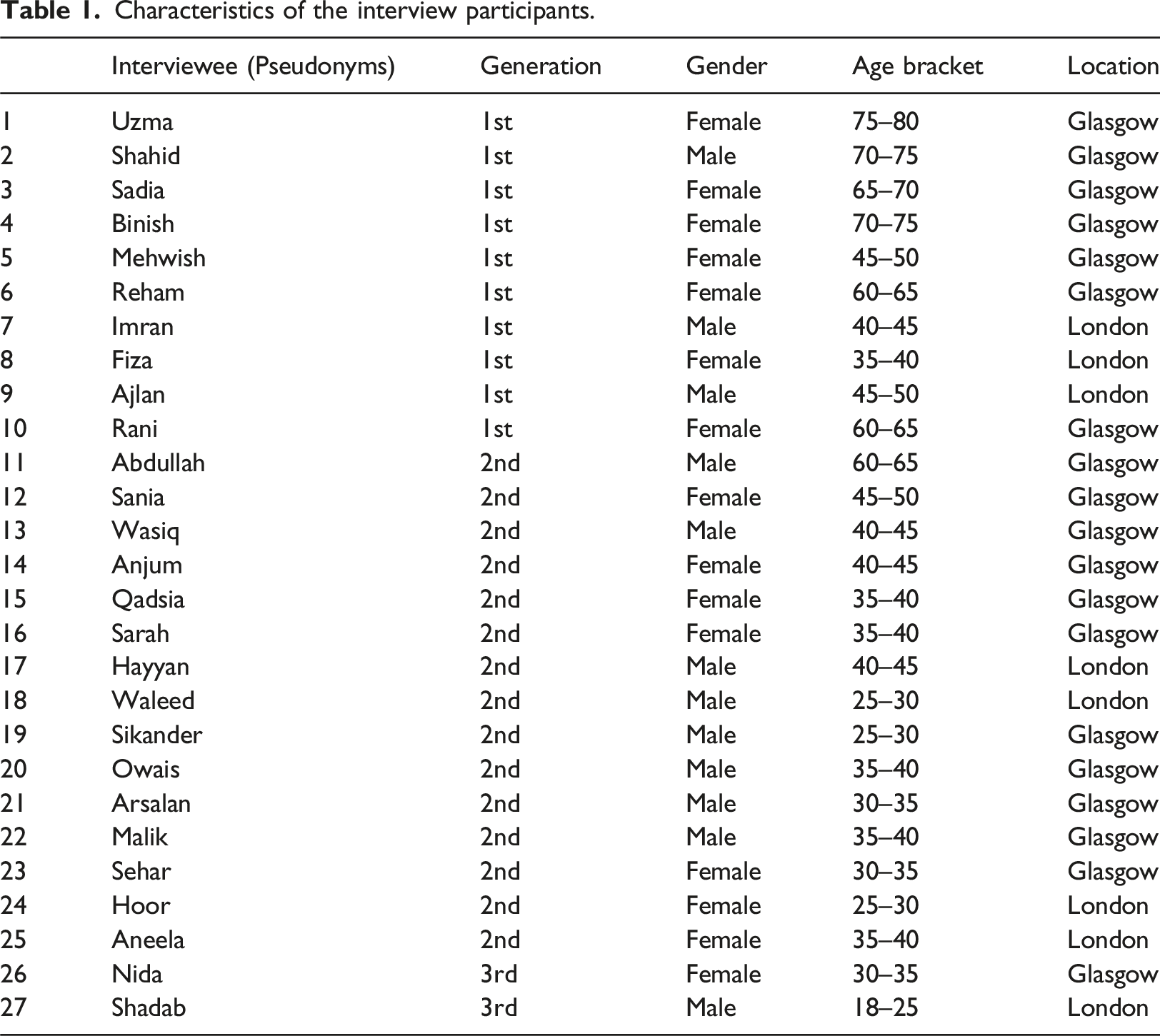
Primary data were derived from semi-structured in-depth interview which lasted for approximately an hour. The interviews were broad and semi-structured giving space for exploration and clarification. Long interviews allowed access to consumers’ firsthand experiences and meanings associated with religion, ethnicity, rituals and authenticity. The lead author is a Muslim of Pakistani origin, this allowed an ethnically and religiously sensitive stance and some common knowledge on which to build rapport and gain community access. In order to build rapport and trust with the respondents, intergenerational interviews were conducted in the residences of the participants, spending the day with them and their families. This enabled the researcher to gain valuable observational data of their daily rituals such as prayers, eating rituals and fasting rituals during Ramadan. These encounters granted insider status and the lead author was able to participate in major rituals that are considered extremely private such as attending death and marriage ceremonies. Field notes of these observations were noted and these supplemented the interview data and provided important contextual awareness. The interview data and emergent findings were compared to the observational data for triangulation purposes. To safeguard the anonymity and confidentiality of the respondents, pseudonyms have been used. Furthermore, all the interviews were recorded after seeking permission from the interviewees.
Thematic analysis was conducted using the analysis software NVIVO 11. In line with Gioia et al. (2012), adopting three coding stages – open, axial and selective coding – provided a rigorous approach to understanding the data. The coding process began with open coding where precedence was given to informant terms. A matrix of these categories or subthemes was produced. This enabled the refinement of codes and allowed for adding more themes. As the analysis moved forward to the level of axial coding, similarities and differences among categories were identified. This process reduced the number of subthemes and resulted in the emergence of several major themes. The final stage of analysis was selective coding which further integrated major themes until the central themes were identifiable.
Recruiting interviewees was challenging as religion is a sensitive and sometimes private part of life. Snowball sampling was used to sensitively recruit participants. In order to maximize theoretical utility and sample variability, the guidelines of Lee (1993) were used to develop wide referral chains. Gatekeepers were used to gain access to the communities, these were originally recruited from the lead author’s extended networks, with the goal of moving quickly beyond this network. Gatekeepers led initial recruitment of participants from two major cities in the UK, London and Glasgow. Snowball sampling then allowed diversity in the sample and interviews from a wider range of participants. In the final phases of data collection, theoretical sampling was used to illuminate the emerging theoretical formulations (Glaser and Strauss, 2017).
Countrywide breakup of the Asian ethnic population in the U.K.
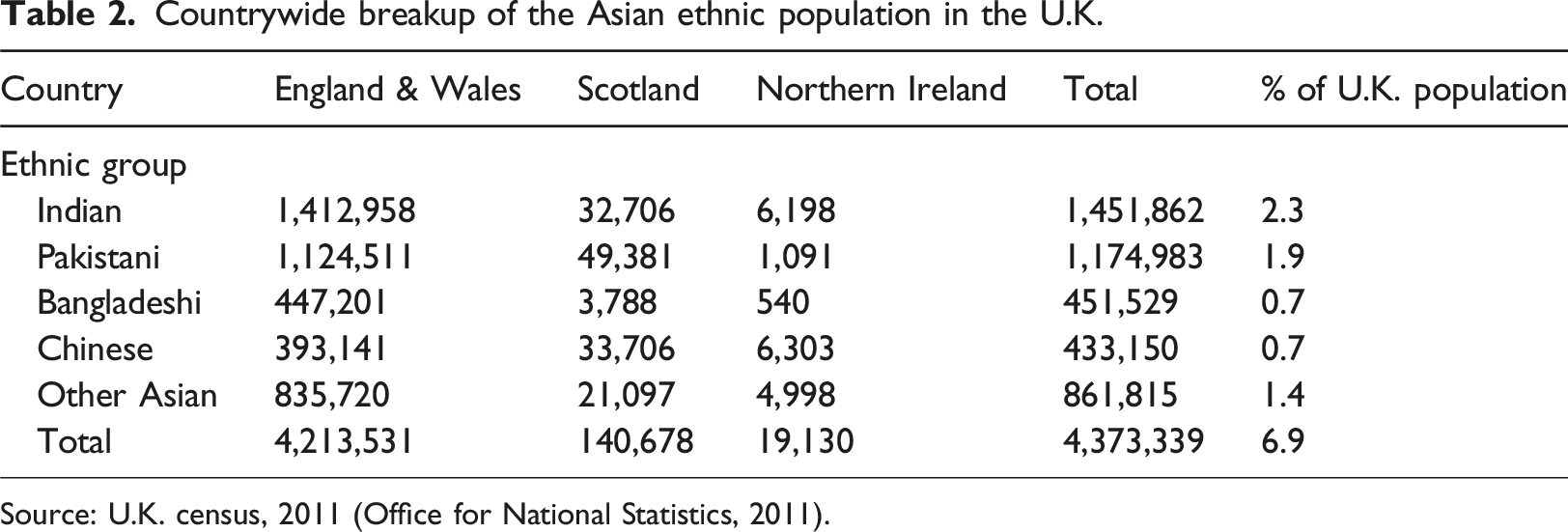
Source: U.K. census, 2011 (Office for National Statistics, 2011).
Countrywide breakup of religion in the U.K.
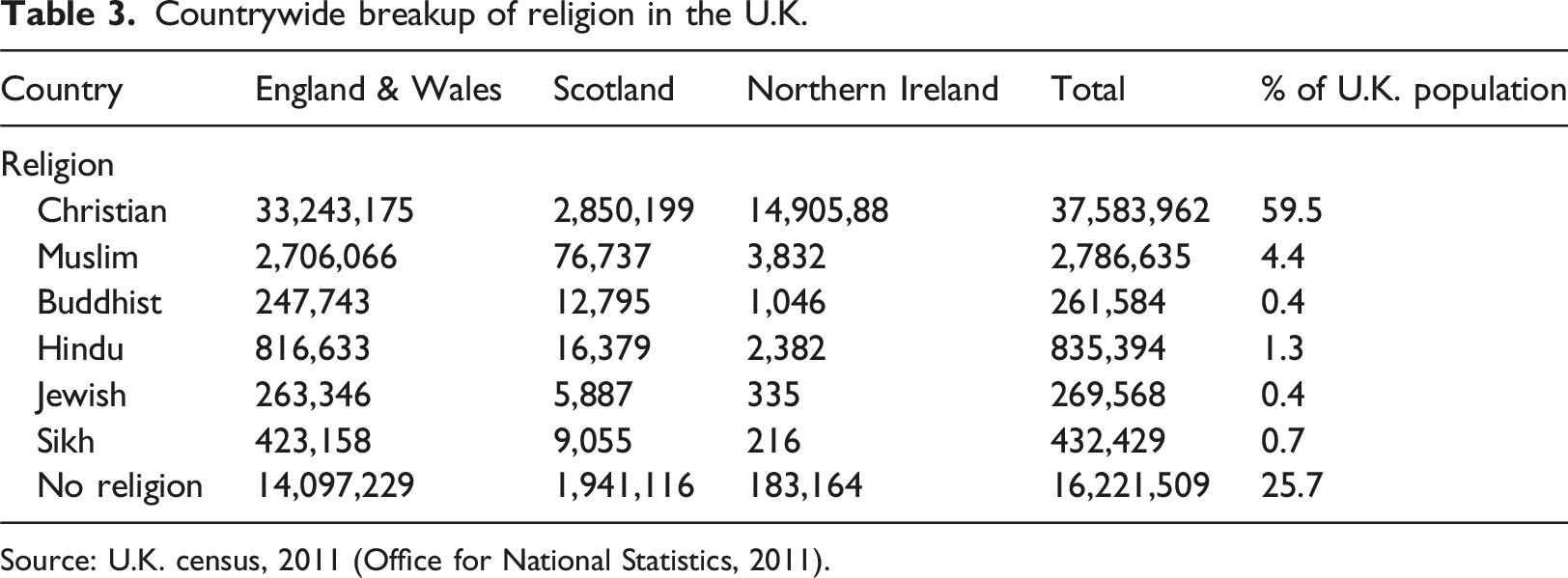
Source: U.K. census, 2011 (Office for National Statistics, 2011).
Findings and discussions
In this section, we first explore the role of critical reflexivity in the re-education of first generation Pakistani Muslims by the second and third generations. We highlight the rejection of cultural norms and the symbolic boundary work at play. Next, we move to outline the shift in religious identity to Universal Islam and the role of this shift in the ideological rejection of ritual. Following this, we highlight the framing of ethnic culture – particularly inherent Hindu practices and Indian culture – as a form of contaminate to be cleansed from ritual and/or rejected. Finally, we discuss several key rituals to explore the role of risk, reflexivity and identity work in the in/authentication of ritual.
Critical reflexivity and the influence of the second and third generation on the religiosity of the first generation
We begin the findings by outlining the influence of subsequent generation on first generation religiosity. The second and third generations, as critical reflexive consumers, have moved away from the cultural influence on their forefathers to forms of Islam which aim to be free from ethnic features. In this, they reflexively position the practice of popular collective rituals to be a matter of religion versus culture and engage in boundary work to ensure rituals are accepted as authentic or rejected as inauthentic to the proper practice of Islam. Previous studies suggest that the parental generation is perplexed by the repudiation of cultural norms and traditions by subsequent generations (Cesari, 2002; Chen and Jeung, 2012). However, our research shows that the parental generation has, in fact, embraced and conformed to the religious assertions of the second and third generation, resulting in a new, shared religious ideology spearheaded by the younger generations. Consider the journey towards religious devoutness of Rani (1st generation) who is the mother of Owais and Sikander I have simply become more religious due to my children being more religious, which for me is a good thing, you know… My children, the older boy started reading the Quran, they started reading its translations, and actually understood what life is… and because my older son got into this, through him, he has a lovely way of explaining things, I came to know Islam.
It can be seen that Rani’s eldest is the religious influencer in this family, Moore et al. (2001) term this ‘reciprocal socialization’ in which the children influence their parents particularly as they mature. These views are congruent with that of Shahid and Sadia, the parents of Hayyan, Wasiq, Qadsia and Sarah. Sadia (1st generation) talks about her religious transformation in the following way I will give all the credit to my children… They just showed me the way of Islam and that’s how I started… Before, we only had a Muslim name but then, Alhamdullilah, we started to learn through our children.
Our findings chime with those of Pinquart and Silbereisen (2004) who have challenged the notion that children are prone to passive socialization from their elders, asserting that the transference process instead of being unidirectional is transactional or bi-directional. They contend that parents are more inclined to accept the opinions of adolescents in the domains where they are more experienced and knowledgeable. We see the second and third generation return to the sacred texts to find their guide to life and to verify appropriate practices of worship. In this they educate their parents as Shahid (1st generation) highlights: ‘They know what they are doing… They have more knowledge about Islam than we, Alhamdulliah’.
The younger generations are fiercely critical of the religious understanding of the elder generations, as Sikander’s (2nd generation) opinion of the religious acumen of the earlier generations shows I think the elder generations did not really do much research into religion themselves… They will just take what their forefathers told them and they will just follow that blindly assuming that it is correct. I think the newer generations are more willing to do their own research as opposed to taking someone’s word for what is right and what’s not right… Whereas the older generations, it’s more about traditions as opposed to what’s right and what’s wrong.
Sikander draws on trusted scholars and sacred texts such as the Quran and Sunnah to authenticate and evidence what is ‘right’ and what is not, in the practice of Islam. The older generation are seen to ‘deviate’ from these texts and practice a form of cultural Islam. This ethnic element is characterized as an unwelcome, secular contaminate by the younger generations, and is rejected (Douglas, 1966). Here we can see the critical reflexivity of the younger generations, fosters critical reflection in the first generations. Rani (1st generation) reflects on how she came to know Islam and questions the authenticity of this In my generation as well as in my mother’s generation, in the case of practicing religion, we did whatever our parents did and what they told us to do. I never thought of questioning because that’s not the way we were brought up. Whereas now if I tell my son about any religious practice, they will ask me how you know that’s the right way? Which hadeeth (prophet’s saying) does it come from? Is it authentic? I don’t know (Laughing). I was told by my mother, and I am doing it and you should do it. So that’s the main difference between us and them. They question everything. Everything has to have authenticity. Everything has to have roots. I believe their way is the right way.
In Rani’s words, we see a depiction of the questioning, critical younger generation in contrast to the dutiful first generation who sought the authority of their parents to understand their religion. For Rani, the foundation of her religious practice and indeed, identity, was the example from her parents, yet her children find their religious identity in the search for authenticity in the fundamental texts of Islam. These critically reflexive, sensitized, individuals contest the normative religious confines imposed by their ethnic culture by exploring Islam outside a cultural lens. This boundary work is premised on the distinction between religion and culture (Douglas, 1966) and is key to their identity as a global Muslim and their identification with the global Islam movement, as Aneela (2nd generation) outlines I try to see beyond what the Pakistani culture is and the importance of it because I don’t think it quite represents me and who I am… I try to think there’s a Muslim culture that everybody can belong to and that should be a little bit more superior than our affiliation with just a nation or nationality and our ethnicity… I feel that if you associate yourself with Pakistani culture so much, you are just, kind of, tying yourself down to things which aren’t possibly true or real to what you really should believe in as a person….
Aneela’s narrative captures the essence of what other participants communicated about their religious identity. Her desire to be part of a cultureless Islam is to foster inclusivity and associate with other Muslims around the world. Islamic expressions that are inscribed with the ethnic culture are considered as impediments to community and sense of belonging. Hall and King (2005) point out that cultural and religious movements do not take into account territorial, political, or administrative boundaries. They are instead hybrid formations, evolving through encounter with different receiving contexts.
Religious ritual, contamination and in/authenticity
Nowadays here in the U.K. weddings are completely different from how they used to be celebrated in the past. Back then relatives, friends, acquaintances from all across the U.K. started arriving at our house days before the marriage. There were so many guests in the house that one could not find a place to sleep even on the floor. There was mehndi, singing, and dancing. Now children don’t practice these celebrations. During the wedding, men and women are segregated. Most of the time you can’t even meet the male members of the family. The festivities do not last that long. I long for the weddings of the past. (Binish, 1st generation)
Binish’s nostalgia for the weddings in the past illustrates how the elder first generation revelled in the reproduction of the symbolic systems of their homeland in the U.K. However, such rituals are repudiated by the younger generations as inauthentic to Islam I think culture is not that important for me because, in our Pakistani culture, many things are happening, which should not be. For example, they have a culture of following their parents. I think it should not be like that. You know the way we act in marriages or when a baby is born, is in contradiction to Islam. The way the marriages are arranged back home, it’s a part of the Indian culture, which is now Pakistani culture, but it’s got nothing to do with Islam, so I think if anything contradicts with Islam, we have to leave it. (Wasiq, 2nd generation)
Wasiq’s passage makes clear that there are certain rituals in Pakistani culture that are felt to be direct contradiction with the religion of Islam and should be rejected. Wasiq traces the source of the problem to Hindu practices adopted in Pakistani culture, seeing this as form of contamination of Islam. He is clear on the need to avoid these rituals to maintain a symbolic boundary between Islam and Hinduism (Douglas, 1966). His views resonate with the majority of the interviewees and are a reflection of the reconfiguration of religious attitudes in line with a universal, global Islam. To illustrate our findings we outline below rituals which are popular and sacrosanct in Pakistani culture which are viewed as inauthentic by participants.
Pre-wedding rituals, risk and reflexive doubt
Werbner (2014) noted that in Pakistan, the pre-wedding rituals are the most elaborate within a complex chain of wedding rites. The female henna ritual, known as Mehndi, is one of the most notable pre-wedding rituals in Pakistani weddings. Similar to India (Shrivastava, 2006), the Pakistani mehndi (ritual painting of hands and feet with henna) is an affair for bawdy singing, transgressive masquerade and sexual clowning. The Mehndi ceremony facilitates songs, dramas, creative inventiveness and culturally hybrid objects. During the ceremony, the groom is subjected to sexually suggestive joking and forced feeding by the female members from the bride’s side which symbolizes the power of the women over domestic affairs (Werbner, 2014). Not surprisingly the majority of the interviewees disapproved of the mehndi celebration due to the religious infractions which the ceremony entails. Rani (1st generation) in her account emphasizes the dancing that goes on in weddings to highlight the religious infringements: ‘Generally, there is dancing in the weddings in the U.K. similar to the Pakistani weddings, which in Islam they should not have…’. According to Shrivastava (2006), Indian and Pakistani marriages share common cultural patterns. Qadsia (2nd generation) pinpoints various practices that she ascribes to the Hindu culture, that are practiced in Pakistani weddings It's just crazy what is happening here… so the dude pillai ritual (the females from the bride’s sides compel the groom to drink milk. After he drinks the milk, he is supposed to present them with money and gifts) and the kind of the fighting and the fun that goes on at weddings… the flirting between boys and girls… Mehndi and things like that … even the fact that they’re together, they should be segregated… A lot of things like that came from Hinduism… All these practices are against the Sunnah and are considered innovation in religion which is not acceptable.
These Hindu traditions are seen to be a dangerous contaminate of the Islamic nikah (ceremony held to celebrate the signing of the wedding contract). The participants feel that the Mehndi ceremony should be rejected and replaced by more sober, Islamic rituals. These changing sentiments towards Pakistani weddings have also caused a change to weddings in the U.K. Hoor’s (2nd generation) observation in this regard is as follows: I think it has come to a point where people do not want to be sat next to sort of non-mehrams (people that a person is allowed to marry) … you could see they would just not attend weddings any more or they would ask for a separate room…. Yeah, they had part of the hall sectioned off with just a little sort of boards so that people that wear niqabs and scarfs can just feel at ease.
Hoor indicates how weddings in the U.K. are organized to facilitate the changing attitudes of people towards wedding customs, in particular the separation of men and women. There is a clear sense of danger and transgression in the description of pre-wedding rituals (Douglas, 1966). Participants talk of profane innovations to Islam, rooted in Hinduism and Indian culture which must be deemed inauthentic and avoided. Instead of offering community and familial cohesion (Turner, 1969; Rook, 1985), these rituals present significant risk of transgressing the bounds of Islam, of sin and possible rejection. The nature of sexual play and interaction between the sexes present in the Mehndi, the exposure to consumerism in the lavish wedding ceremonies and the lack of ritual boundaries between the sexes contravene Islamic doctrine such that participants seek to remove these profane innovations and replace them with more observant and sober Islamic ritual. Here we can see a form of reflexive doubt (Thompson et al., 2018; Thompson, 2005) where participants react to the inherent risk of the ritual by questioning its legitimacy.
Quran khawani, ritual vitality and authenticity
Khatum or Quran Khawani is a communal Quran reading ritual after which there is a commensal meal offering. It is held on various occasions such as moving into a new house, thanking God for recovery from illness or accidents, starting a new job or a difficult task and commemorating the deceased (Chatterji and Washbrook, 2014). During this ritual, the guests sit on a clean sheet that is spread on the floor and read all the 30 chapters of the Quran in one go. Since there are a number of guests, each one has to read a portion of the Quran. Most of the time people also invite a Maulvi (the person who leads prayers in a mosque), who comes with his students to read the Quran and who offers a dua (prayer) in which he supplicates to fulfil the objective for which the Khatum was being held. Sarah (2nd generation) reminiscences about how they used to celebrate this function in their grandmother’s house when they used to visit Pakistan It was in grandma’s house that we use to do it when we were kids… it's just like if something bad gets in your house or if somebody passed away… Chaliswa (Khatum for the deceased organized after passage of 40 days to seek reward for the deceased)… We don't believe in it anymore…
Sarah affirms that she, along with her family, do not celebrate this ritual anymore, they no longer believe it is an authentic Islamic ritual. Sarah’s reasoning to consider Quran Khawani as inauthentic depicts the negotiation between ‘whether one is authentic to the self’ and whether something else is authentic (Grayson and Martinec, 2004; Canavan, 2022). In this manner authenticity/inauthenticity can be seen as an emergent, subjective process of an individual’s perceptions, emotions, social, personal and, in this context, religious cues. This prevailing viewpoint amongst the younger generation is also evident in the narrative of Qadsia (2nd generation) I don't go to these things anymore, but when I used to I just thought it was very odd to like you know just quickly finish Quran so you can get the food… a lot of people were there for the food… it isn’t part of the Sunnah… Everything's always forty days… I don't know why…
Qadsia’s sarcastic remark that there is always an obsession with the number ‘40’ signifies that she rejects these rituals as cultish and cultural rather than associated with the pure teachings of the Quran or the practices of the Prophet Muhammad. Prejudice could be a play here, Hoque (2019) notes that there is a general perception among the younger generations in the UK that people in Pakistan are less developed, uneducated and rural. These misconceptions are the result of attenuating bonds with Pakistan which result in limited knowledge of Pakistani life. This perception drives the younger ethnic community to deem ritual practices that are indigenous to Pakistan restricted only for the uneducated, rural Muslims in South Asia, who do not know Islam, and should therefore be rejected.
Rook (1985) asserts that the vitality of rituals can be assessed using four structural elements, ritual artifacts, ritual scripts, ritual performance role(s) and ritual audience. Our findings demonstrate that, for this community, the vitality of rituals is contingent, above all, on alignment with their religious identity. For this group of consumers, all four elements must align with their religious beliefs and values to be deemed an authentic ritual. The scripts and performance of Quran Khawani are positioned as secular or even profane by Qadsia, who talks of participant rushing their worship to engage in the secular feast. The participants avow that the imagined ritual audience – the Prophet as well as the companions of the Prophets – would not have engaged in such rituals and therefore they are Biddahs – profane innovations to Islam. For these consumers, in order to participate in religious rituals, the roots of the ritual’s audience, as well as its practice, should be found in the traditions of the Prophet or his companions. The logic of rejecting ritual recognizes it as at once of the world of man and of the divine.
Death rituals, identity and rejection
According to Suhail et al. (2011), in Pakistani society funeral arrangements, visiting the grave of the deceased and continuing to supplicate for the deceased person’s sins to be forgiven are practiced at both individual and collective levels. People believe that death rituals, particularly the recitation of the Quran and providing food to guests, neighbours and the poor, will benefit the dead in the afterlife. The lead author participated in the funeral rites of the grandmother of Sikander, here the custom of providing food to neighbours and relatives was challenged, ‘We are not going to do that. It’s a cultural thing and it has nothing to do with Islam’, Sikander (2nd generation). The conflict between religion and rituals that are rooted in culture is apparent from Sikander’s statement, as is the distinct separation from ethnic identity.
Another death ritual, which was rejected by participants is the communal gathering after bereavement, which is believed to aid in the requital of the deceased. Early on the ritual of qul is performed, which involves the recitation of the Quran. Following a death ceremonial gathering on the third, tenth and fortieth and also on all the Thursdays before the fortieth day, are the customary bereavement rites. On these days, people pray for the departed, and the family offers a traditional rice dish (chaaval or pulao) and a sweet (halva) (Mughal, 2018). Fiza (1st generation), voices her aversion to these rituals So, people think that it’s religion telling you that you should give food to all of your thousand family members on somebody’s death, but Islam does not say that. Islam says that if some calamity befalls upon somebody’s home, then someone else should provide them with food for their ease. It’s not their responsibility to arrange for a feast for the people who are coming… It’s just that people have twisted religion. They do not know. Why are we making things hard? Celebrating every year a person’s death (Barsi)… I don't believe in it. I have a major difference with my mother on this issue.
The rejection of collective rites which enhance community bonds (Turner, 1969) allows Sikander and Fiza to symbolically remove themselves from the ethnic community while drawing closer to the global community of Universal Islam. In this case, the rejection of ritual is a critical reflexive act of boundary work, central to both their own identity work and broader social change (Turner, 1969). Here, critical reflexivity allows identity work which facilitates decoupling from ethnic norms and movement through new ideologies (Thompson et al., 2018).
As such, the findings can be understood in light of Turner’s (1969) key stages of the ritual process. Turner conceived rituals transitioning through crucial stages, specifically the disruptions of norms, crisis, corrective/counteractive measures and ultimately, stabilization and re-establishment of social peace. Turner asserts that rituals serve as a means to integrate and accommodate change and disequilibrium in a community and functions to regenerate and sustain community. In this study, the disillusionment of the younger generations with their ethnic culture resulted in weakened bonds with Pakistani culture and a resulting vacuum in terms of ethnic identity, tantamount to Turner’s disruption of norms. The imbalance caused by attenuating ethnic anchors leads to an identity crisis which was overcome by ascribing to a religious identity distinct and unadulterated from the ethnic culture of their ancestors. A significant outcome of this remedial process is the rejection of rituals that contradict the emerging religious identities of the younger generations. Ultimately, the emergent ideology of Universal Islam is incorporated into new and augmented rituals. This ideology and concomitant rituals serve to stabilize the community, as it moves away from ethnic identity to favour religious identity, and are promoted to all members, including the first generation. This study demonstrates that, just as rituals are pivotal to boundary maintenance and group cohesion, mainly when group unity is at risk, abandoning inauthentic rituals can also be a rallying point for group cohesion and stability.
Discussion: Ritual consumption, identity and in/authenticity
The contributions of this study to the marketing and consumer research literature are fourfold. Firstly, in the context of rituals we highlight that not only participation (Turner, 1969) but also rejection of rituals can be a source of collective identity, cohesion and stability. Thus, we extend understanding of religious and ethnic identities by elucidating how changes in religious identities can disrupt the ideological orthodoxy, sensitizing consumers to the erroneous ideological contingent of their ethnic identities. Data shows that ethnic rituals such as pre-wedding rituals, communal reading of the Quran and rituals associated with deaths contradict the religious beliefs of respondents and represent a disconnection from their true religious self. Participants ultimately reject the normative forces of ethnic socialization which have previously been conceived as naturalized social facts (Barnhart and Penaloza, 2013; Izberk-Bilgin, 2010). Therefore, the collective rejection of ritual offers space for a new, collective religious identity to emerge, enhancing sense community and belonging.
Secondly, by showing why and how rituals once deemed authentic become inauthentic, our research contributes to the domains of in/authenticity (Canavan, 2022; Zhou et al., 2018) and consumer reflexivity (Thompson et al., 2018). Findings elucidate how in/authenticity of ritual practices provides a potential outlet for reflexive consumers to assert a self-directed agency against the ethnic norms and ideological hailings that are at odds with their religious identities. The incongruence between rituals imposed by ethnic culture and their desired religious identities is obviated through critical reflexive engagement with scared texts. The belief that truth and the correct way to be a Muslim can be found in the individual interpretation of sacred texts pervades the findings. In the data we see the quest for authenticity and the authentication process as rooted in a form of critical reflexivity which leans on literal interpretation of religious texts and endeavours to emulate the Prophet Muhammad. This goal is operationalized through the tracing, identifying and rejecting of profane contamination, what is termed ‘innovations’ introduced to a Pure Islam through cultural beliefs and practices, notably Hinduism and ethnic Pakistani culture (Douglas, 1966). Consequently, in order to garner greater autonomous agency and to unsubscribe from the structural subordination inscribed in the origins of these ritualistic practices, the younger generations strategically deem such ideological configurations as inauthentic (Thompson et al., 2018).
Most of the second and third generations stated that cultural Islam was an integrated part of their upbringing, yet the Islam they adhere to now is free from cultural adulteration and is pure and progressive, as they see it. It is this Islam that they share with the elder generation. As the data above shows, the second and third generations perceive earlier generations as ascribing to Islamic beliefs and practices that are inauthentic and infected by cultural misconceptions. The concept of Bidahs (heretical innovations) echoed in their accounts while describing how the earlier generations of immigrants practiced Islam and, indeed, how it is currently being practiced in Pakistan. Adhering to what is believed by these generations to be an authentic model of Islamic life necessitates rejection of all inauthentic intrusions on their pure, progressive practices and beliefs. Thus, authenticity in Islam emphasizes the individual’s power as interpreter of text and meaning and their autonomous decision-making. In essence the search for authenticity in the younger generation serves as leverage to legitimize their religious identities and to free them from rituals that would otherwise anchor them to conventional ethnic cultural ideologies. To these individuals, authentic Islam is an instrumental means of identification through which they further their mobility and sense of belonging among people who share their faith, globally.
Participants described the Islam that they adhere to as being ‘Pure Islam’, ‘Global Islam’, ‘cultureless Islam’, and ‘Universal Islam’. However, this concept of ‘Pure Islam’ is operationalized amongst divergent Muslim communities jostling for ownership over Islam. Each of these communities (Sunni, Shia and Ahmadi) considers their respective interpretation and understanding of Islam as authentic and the true version of Islam. For instance, Moufahim and Lichrou (2019) outline the notion of ‘real Islam’ among the Shia Muslim pilgrims. Similarly, Sheikh (2018) noted the Ahmadis claiming to be practicing ‘Pure Islam’. Exhibiting devotion to a ‘true’ Islam is a key strategy adopted by different sects of Muslims in order to differentiate themselves from Muslim others and thus, enhance a shared and collective religious identity. It is interesting to note that the aspirations of the participants in this study are not to differentiate from other Muslim communities. On the contrary, authenticity serves as a unifying force in this instance, allowing the Pakistani ethnic community to become part of a larger Muslim community that transcends ethnic boundaries. This study vividly illustrates how the interviewees seek to authenticate or invalidate ethnic rituals based on the premise that such rituals are at odds with their religious beliefs. It is posited that when members hailing from different ethnic communities abandon their ethnic rituals, as elicited in our findings, this eschewing of ethnic identities ultimately serves as a way to bring all Muslims of various ethnicities closer together under the umbrella of Global Islam and become a part of the worldwide Ummah.
The third contribution of this study is to bring to the fore the role of boundary work and contamination in the authentication and rejection of Islamic religious rituals. Our study delineates how ethnic communities create and work with symbolic boundaries (Douglas, 1966) around rituals and how these rituals create and contest their identity (Pedersen and Rytter, 2017) and perception of authenticity. In this study, then, we can see the development and consequence of symbolic boundary work in action. Where boundaries drawn create a shared definition of sacred and profane, within this, rituals are accepted or rejected as inauthentic, ultimately imposing a system of order which rejects cultural infringement in religious matters (Douglas, 1966). This boundary work is central to the construction of the self and we see identity shifts particularly in the first generation who come to adopt the world view and ritual practices of the second and third generations as the ‘right way’. This shared compliance to authentic rituals and rejection of the inauthentic enhances individual religious identity, creates bonds within the family network, community and wider, imagined, global community. This study also spotlights reciprocal socialization and bi-directionality with respect to religion within the different generations of Muslim ethnic families. In contrast to the belief held by some scholars that there is conflict between generations within this ethnic community, our data suggests that the first generation, who are supposed to be emblems of cultural and ritual transmission, are relearning Islam, as taught by the later generations.
The fourth contribution of this study is to develop the concept of emergent authenticity in the context of religious ritual and religious identity. As Cohen (1988, p. 379) observed, emergent authenticity means that ‘a cultural trait or a phenomenon thereof, that at a certain point of time is generally considered as inauthentic or contrived may, at some point in the future, maybe judged as authentic, even by experts’. Emergent authenticity allows us to understand that what is regarded as inauthentic may become authentic over time. In this study, we make use of and extend the concept of emergent authenticity by proposing its antithesis, emergent inauthenticity. As our findings show, what is authentic may also become inauthentic through processes of reflexivity and boundary work. The rituals we outline above, once accepted by the first generation as an expression of both religion and culture, are rejected as inauthentic by the second and third generations as a poor fit with their emergent religious identity. In the light of perceived epistemological deviances rampant in the Muslim world, these individuals embrace the existential security of a back-to-basics principle of evidence and certainty and therefore repudiate all innovations or changes, as they see it, influenced by ethnic culture. As such, we see in emergent inauthenticity, rituals stripped of their religious meaning and left exposed as ethnic practices not authentic to the practice of Islam, and therefore rejected.
Conclusion and future directions
This paper has explored how individuals conceptualize religious authenticity as well as factors and contexts that facilitate or inhibit authenticity and deem ritual consumption inauthentic in the context of Islam. A key theme emanating from the participants’ accounts is their personal quest for authenticity in their religious practice and that of their families. The study finds that the search for authentic Islam provides a sense of reflexive equilibrium in an individual’s life and that the notion of religious authenticity entails liberation and emancipation from ethnic, national and cultural concerns. We advance the theoretical understanding of inauthenticity by conceptualizing emergent inauthenticity, the counter perspective of emergent authenticity put forth by Cohen (1988). We present an antithesis of emergent authenticity and contend that over time, and under appropriate conditions, widely recognized authentic ritual practices that are understood as manifestation of both religious and ethnic culture can be deemed inauthentic and rejected.
It has been shown that different generations of the ethnic communities living in the UK use hyphenated labels to showcase their hybrid identities (Modood et al., 1994). Future studies could explore other facets of the identity of British Pakistani Muslims, in addition to religious identity. Future studies could probe to what extent hybridization and compartmentalization are factor to be considered given that the Pakistani ethnic community lives in a multicultural society in the U.K. Moreover, this study has demonstrated that the younger generations have rejected rituals that are incongruent with their religious identities. Future studies could investigate what replaces these rituals. Due to the small number of participants, we must take precautions in generalizing the results of this study. We want to underscore that the study data and findings do not represent all Muslims or, indeed all Muslim immigrant populations. Future studies should conduct a more extensive study involving a larger sample of respondents to corroborate our study findings over other Muslim communities and groups.
Footnotes
Declaration of conflicting interests
The author(s) declared no potential conflicts of interest with respect to the research, authorship, and/or publication of this article.
Funding
The author(s) received no financial support for the research, authorship, and/or publication of this article.
