







Abstract
Conceptual studies explain how degrowth principles can contribute to organizing beyond the destructive forces of capitalism. But little has been given to theorizing the evolution in degrowth repertoire of contention that aims to influence public policy around production and consumption practices. Drawing on an eight-year ethnographic study of the degrowth movement in Lille, France, we explore the evolution of its repertoire of contention by identifying the goals, strategies, and actions defining each phase. This analysis illustrates how the movement adapted its repertoire to overcome challenges and advance its political agenda, shedding light on key shifts in activism and engagement with policymakers. Our findings have implications for consumer research, degrowth movements, and public policy.
Introduction
Scholars and activists often use the concept of degrowth to argue for the need to create a post-growth society (Kallis et al., 2010; Latouche, 2010). Contrary to the notion of sustainable economic growth, degrowth proposes “a socially sustainable and equitable reduction (and eventually stabilization) of society’s throughput” (Kallis et al., 2010: 874). By calling for a smaller economy with less production and consumption (Latouche, 2007), degrowth opposes the triple bottom line of the mainstream approach, which advocates for the compatibility of consumer capitalism and ecological sustainability (Fournier, 2008). In that sense, degrowth suggests the collective redefinition of economic relations “that take us away from the self-interested actions of homo economicus” (Fournier, 2008: 538).
Despite the growing literature around degrowth, there is little theorization of how degrowth movements choose and apply various strategies and actions with hopes of influencing public policy. Interestingly enough, while focusing on the politics of degrowth (Cosme et al., 2017; Fournier, 2008), existing research has not often analyzed the evolution of degrowth’s repertoire of contention. Drawing on Tilly (2008), we define repertoire of contention as the set of strategies and actions that a degrowth movement, shaped by its historical and cultural context, is both equipped to utilize and strategically chooses to deploy in response to specific opportunities and constraints at a given time. Repertoires of contention are dynamic, evolving over time through adaptation to shifting circumstances and the incorporation of innovative strategies and actions (Tilly, 2008). Thus, our goal is to analyze the evolution in degrowth’s repertoire of contention that aims to influence public policy around production and consumption practices.
To do so, we focus on a particular context (Lille, in France) within a specific type of new social movement, the Lille degrowth movement (LDM). We study the LDM because it creates strategic political actions to advocate downscaling production and consumption in order to improve human and environmental well-being. With a large repertoire of contention, the LDM aims to sensitize individuals to the consequences of economic growth, mobilize them against these practices, and put pressure on the public policymakers to transform the markets with respect to environmental and social issues.
Seeking to explore the evolution of the LDM’s repertoire of contention, we draw on resource mobilization theory. Resource mobilization theory emphasizes the ability of social movements to achieve their political goals through their repertoire of contention (McAdam et al., 2001). Building on this perspective, our research question is the following: How do LDM activists change their repertoire of contention to pursue their political agenda?
Our analysis of the LDM is based on an eight-year ethnographic study (2012 to 2020) that includes 31 interviews. We examine the evolution of the LDM’s repertoire of contention by identifying the goal, strategies, and actions that define each repertoire. This analysis highlights how the movement adapted its repertoire to address challenges and further its political agenda, reflecting key shifts in both activism and engagement with policymakers. The first repertoire consists of actions aimed at legitimizing the movement as a political force, positioning it as a viable alternative within the political landscape. This involves strategic efforts to build political identity, and gain recognition from both policymakers and consumers. A shift in the repertoire of contention occurred as the LDM struggled to mobilize larger crowds, despite efforts to raise awareness. The second repertoire involves actions focused on framing political opponents and forming strategic alliances. These actions are aimed at positioning key public policymakers as movement adversaries while building coalitions with political figures and consumers, thereby aiming to strengthen its influence and capacity to impact policy. In response to the lack of political responsiveness from policymakers and consumers, the LDM’s repertoire of contention evolves. The third repertoire focuses on participating in local and national elections, with campaigns broadcasting degrowth policies. This strategic shift aims to directly engage in the political process, seeking to influence policy and broaden the movement’s impact on mainstream political discourse.
Our research makes a threefold contribution to marketing. First, our research complements the market system dynamics literature (Giesler, 2008, 2012; Scaraboto and Fischer, 2013; Thompson and Coskuner-Balli, 2007; Weijo et al., 2018) by highlighting the evolution in the repertoire of contention that have taken place within the Lille degrowth movement with the intention of impacting public policy on production and consumption practices. Second, we contribute to the literature on political consumerism (Devinney et al., 2010; Gil De Zúniga et al., 2013) by linking political consumerism and political participation. Specifically, we show how degrowth activists use the marketplace to gain political influence and position themselves as political adversaries to existing policymakers in order to pursue their own political agenda. Third, we propose solutions to improve the relationship between degrowth movements and public policymakers.
In the following sections, we first review how activism has been studied in consumer research. We then explain research on degrowth, and resource mobilization theory as a theoretical tool. Next, we describe our context and provide the details of our methodology. We then present our findings, discuss our contributions, and conclude with implications for consumer research, degrowth movements and public policy.
Literature review
This section presents the theoretical background of the study, including a review of key literature on activism in consumer research, specifically related to market system dynamics and political consumerism. It also offers a concise discussion of research on degrowth as well as social movements and public policy.
Activism in consumer research
Previous studies have revealed the political nature of consumption and its potential in transforming the marketplace, society, and policy (Bauman, 1998; Blanchic and Foster Davis, 2009; Boström et al., 2019b; Campana et al., 2017; Chatzidakis and Lee, 2012; Dalli and Corciolani, 2008; Heldman, 2017). In most of these studies, the political nature of consumption has been conceptualized as consumer activism, which Heldman (2017: 2) describes as “citizen actions directed toward business entities to explicitly influence the distribution of social goods or social values.” In this manner, actions, whether collective or individual, organized or spontaneous, could be considered activism when they target social issues and are concerned with broader interests rather than personal benefits.
The existence of a common shared goal and value system is an important condition for the emergence of collective actions that trigger shifts in the market and society. Thus, a broad range of ideological concerns (e.g., ecological conservation, animal rights, gender equality, and LGBT rights) could trigger activism movements (Heldman, 2017). Activists’ actions are usually embedded in mundane everyday practices (Campana et al., 2017; Varman and Belk, 2009) and can manifest across a broad spectrum, including voicing and transmitting opinions via complaining or negative word-of-mouth, boycotting or buycotting brands, decreasing consumption, switching among brands, and developing consumer support organizations (Blanchic and Foster Davis, 2009; Heldman, 2017). The intensity and manifestation of activism can vary across industries, geographies, and cultures (Boström et al., 2019a). To understand the interplay between activism and public policy, two theoretical perspectives have been developed: market system dynamics and political consumerism.
Market System Dynamics (MSD) aims to understand how market structures, practices, and interactions evolve over time through the interplay of economic, cultural, and social forces (Giesler, 2012; Pedeliento et al., 2023). Research on MSD views markets as inherently political and social constructs, shaped by external environmental factors beyond the boundaries of firms or industries (Giesler, 2012). Activists can resist hegemonic forces and pursue social well-being using market resources, rather than by opposing consumption altogether (Martin and Schouten, 2014). That is, complementing and extending existing market systems could be a key motivator for activists, who may mobilize alternative market systems to fight for a shared common goal (Benmecheddal et al., 2023). In this sense, MSD highlights not just consumer behaviors but also what drives the creation, maintenance, and disruption of market systems over time (Regany et al., 2021).
The evolution of markets can also drive changes in public policy, making their relationship reciprocal and dynamic (Debenedetti et al., 2021; Maciel and Fischer, 2020). On one hand, as markets evolve, they often generate new challenges that necessitate policy interventions (Sandikci and Ger, 2010). On the other hand, public policy establishes the rules that govern market interactions, such as regulations on price (Regany et al., 2021).
Although the literature on MSD is useful to highlight actor pluralism in market changes, it does not explain the evolution of the repertoire of activists’ actions that aims to influence public policymakers around production and consumption practices.
Political consumerism frames the marketplace as a key site for political action, where individuals use purchasing power to address societal issues like environmental sustainability, labor rights, and corporate accountability (Boström et al., 2019a; Micheletti, 2003, 2004; Shaw et al., 2006). By linking consumption to activism, it transforms everyday purchases into political expression (Acik, 2013; Dickinson and Carsky, 2005). Emerging often in response to insufficient government action, it highlights gaps in regulations, using market-based activism to push for policy changes (Boström et al., 2019b).
Political consumerism is a modern form of political participation where individuals use their purchasing choices to express values and influence social change, complementing traditional methods like voting and protesting (Diani, 2019). It expands political engagement by integrating consumption with activism, allowing people to participate politically even outside formal institutions, through everyday actions like shopping (Katz, 2019; Kloppenburg and Van Vliet, 2019). However, political consumerism, as a form of political participation, has limitations as it functions within capitalism, relying on consumer choices to influence corporate behavior. Critics argue it is insufficient to tackle deep-rooted issues such as income inequality, and without institutional reforms, its impact may be superficial (Hysing, 2019; Katz, 2019).
While political consumerism emphasizes the political dimensions of consumption, it does not explain how activists adapt their repertoire of contention to influence public policy. In this research, we analyzed a specific type of activism—the degrowth movement.
Degrowth
Proposing alternative systems to growth-oriented ideologies, degrowth movements have become popular among consumers and civil society organizations which defend the idea that in addition to transforming our consumption practices, we need to start producing and consuming less to preserve natural resources. Degrowth activists pursue alternative paths to a good life and believe that individual and social well-being need not be compromised for economic growth and prosperity (Belmonte-Urena et al., 2021; Vandeventer et al., 2019). Despite being considered controversial and undertaking the challenging task of moving against the institutional logic of growth, research suggests that many social movements and alternative approaches to consumption are driven by the degrowth rationale (Campana et al., 2017; Chatzidakis et al., 2014).
Degrowth research is largely conceptual, exploring how its principles can challenge the destructive forces of capitalism by promoting alternative models like local cooperatives, the sharing economy, and non-monetary exchanges (Chertkovskaya and Paullson, 2021; Fournier, 2008). In this literature, degrowth is a multi-layered concept (D’Alisa et al., 2015): it critiques global capitalism, gender inequality, productivism, and advocates for a more just, caring, and convivial world (Dengler and Lang, 2022; D’Alisa et al., 2015; Feola, 2019; Hanacek et al., 2020; Kallis, 2019). Empirical studies highlight how degrowth activists oppose “green” capitalism (Kothari et al., 2014; Pailloux and Mège, 2013) and create sustainable, socially just spaces like community gardens and cooperative businesses (Boillat et al., 2012; Cattaneo and Gavalda, 2010; Lloveras et al., 2018), demonstrating that a degrowth society based on cooperation and solidarity is both possible and desirable (Kallis et al., 2022).
Despite growing research on degrowth, little attention has been given to theorization of the trajectory of a degrowth movement. In this research, we focus on the Lille degrowth movement’s evolution, in particular how the evolution of its repertoire of contention aims to influence public policy. To do so, we draw on social movement theory with a focus on resource mobilization theory.
Public policy, social movements, and resource mobilization theory
As conceptualized by resource mobilization theorists, social movements are strategic activities stemming from the organization of normally ordinary people who may thereby exert considerable influence on politics “as they challenge power holders” (Tarrow, 2011: 8).
In this research, we conceptualize public policy as framework of decisions and actions taken by governments or institutions to adress societal issues, promote public welfare, and guide collective behavior toward comon goals. The policymaking process is dynamic, involving formulation, implementation, and evaluation, influenced by political, social, and economic factors, as well as stakeholders like governments, interest groups, and citizens. Extensive research highlights the impact of social movements on policy, the organizational types best suited for mobilization, and the conditions that enhance their influence (Amenta et al., 2010; Baumgartner and Mahoney, 2005; Dixon 2008; Olivares and Carrasco-Hidalgo, 2020). For instance, Gollnhofer (2017) study on dumpster diving in Germany highlights how social movements can help transform food culture and create alternative food pathways by influencing existing policies. In the United States, the Civil Rights Movement not only highlighted racial discrimination but directly led to landmark policies (McAdam, 1999). Moreover, civil rights movements have effectively fought corporate discrimination through the leverage of equal employment opportunity (EEO) laws (Skrentny, 2002). That is, social movements can advocate for state regulation of industries (Schneiberg and Bartley, 2001). An increasing number of businesses are transforming their business models or repositioning their brands, and recent regulations in response to social and political debates illustrate how contemporary social movements prompt policy changes (Patsiaouras, 2022).
To analyze the degrowth movement that constitutes the context of this study, we draw on the resource mobilization perspective and especially the work of McAdam et al. (1996). We propose that the success of the LDM in pushing its political agenda depends on (1) mobilizing resources; (2) collective action frames that encompass the movement’s core tenets; and (3) the opportunities available within the institutional political structure.
The mobilizing resources are “those collective vehicles, informal as well as formal, through which people mobilize and engage in collective action” (McAdam et al., 1996: 3). Involving political or non-political organizations, mobilizing structures help the legitimization and structuration of social movements by providing them with resources such as membership, leadership, communication, and social networks. For instance, degrowth activists in France mobilize the IPCC report every year to legitimize their actions and principles.
Collective action frames are the means by which social movements construct meaning for action, a set of “conscious strategic efforts by groups of people to fashion shared understandings of the world and of themselves that legitimate and motivate collective action” (McAdam et al., 1996: 6). Collective action frames are interpretive schemas that allow social movements to make visible the immoral and unjust that they define. Activists in the degrowth movement in France worked to identify unjust practices and connect them to specific companies or institutions to gain public support.
Political opportunities refer to the possibility that social movements will gain access to the political arena and establish political allies that will help them with their agenda. When activists access the political arena, allies may become available and rifts may emerge among power holders, causing political instability (McAdam et al., 1996: 6). The combination of access to the political arena, the existence of political allies, rifts among political power holders, and the instability of political alignments gives activists a better chance to influence public policy. For the degrowth movement in France, access to political life was easier, as activists participated in both local and national elections.
Applying resource mobilization theory to analyze the LDM could deepen our understanding of how its repertoire of actions evolves to influence policymakers. In the following section, we describe our context and methodology, before describing our main findings and contributions.
The Lille degrowth movement context
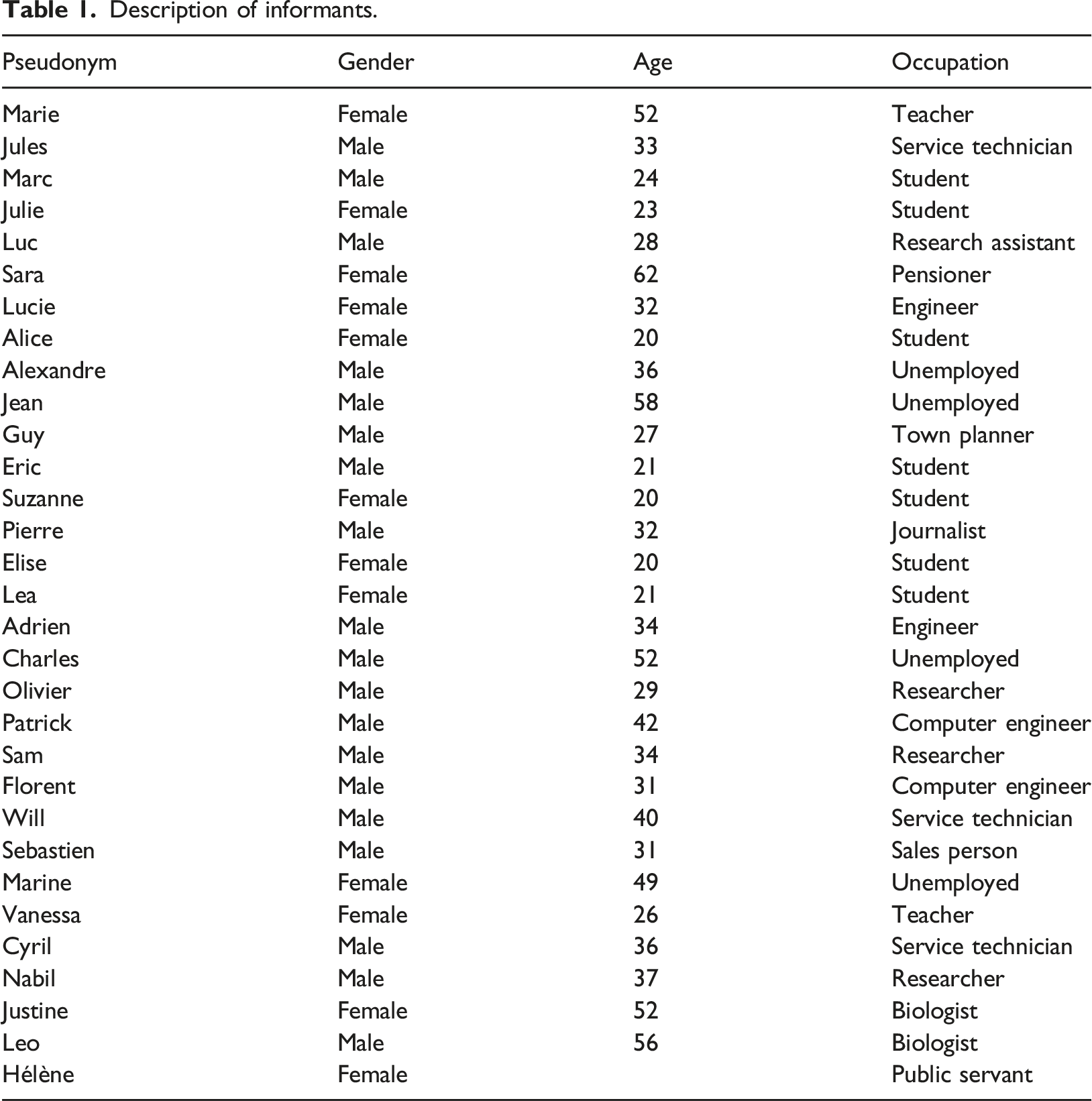
Description of informants.
The LDM movement was officially established as an association in February 2012, under the leadership of two activists—Jules and Marie. Jules had just arrived in Lille. Previously, he was an activist in the labor movement. He grew disillusioned with its primary focus on increasing purchasing power, which he felt was ultimately supported by economic growth and job creation at the expense of more sustainable solutions. Upon arriving in Lille in January 2012, he wanted to join the degrowth movement but faced with this absence, he decided to post a message, on a website shared by Lille activists about his desire to create a degrowth movement. Marie, on the other hand, was previously active in ATTAC 1 . She felt that while the organization aligned with degrowth principles and organized protest actions, it lacked a political approach, particularly using elections as a platform for protest. This is why she was also an activist in the nearby town of Lens’ degrowth movement. To establish a group in Lille, she responded to Jules’ message. At the end of January 2012, they met at café citoyen, a popular gathering spot for local activists. A week later, they posted an online update sharing the launch details and dates for upcoming meetings.
The LDM creation followed a global dynamic, advocating activism as a response to issues around democracy, economic justice, and ecological challenges. For instance, the Arab Spring uprisings inspired calls for democratic reform and solidarity with struggles against authoritarian regimes, energizing debates about the role of activism in social change. Simultaneously, the Indignados movement in Spain, fueled by Stéphane Hessel’s influential 2010 book “Indignez-vous!” echoed across France, urging citizens to “get indignant” and demand a more equitable society. These interconnected movements fostered a spirit of grassroots mobilization, with French activists drawing on these influences to address local concerns while engaging in broader, transnational struggles.
In February 2012, LDM’s first meeting brought together 12 activists who decided to establish a blog, Facebook page, and Twitter account to amplify their message. Over time, the movement grew as more activists joined, enabling the organization of various events, including anti-advertising campaigns, debate on degrowth, and street demonstrations. A turning point came in late 2014 with the LDM’s first major initiative: the Degrowth Festival and the Available Brain Festival, which attracted over 100 attendees, over 3 days. Following this success, the movement regularly mobilized about 20 active members and more than 30 occasional supporters. These supporters ranged from experienced activists in other causes to individuals new to activism, reflecting the broad appeal of the LDM’s goals.
Following the 2014 election results, enthusiasm for degrowth in Lille began to wane. Initially, the movement saw a decline in supporters, and some activists left without explanation. While the momentum slowed, the group persisted, albeit with fewer actions and participants. Despite this decrease, the LDM remained active and continued to hold meetings and events. This reflects the group’s resilience in maintaining its commitment to degrowth principles, even in the face of changing political and social dynamics.
Methodology
Data collection
The data collection includes participant observation over 8 years and in-depth interviews. The ethnographic data were collected in Northern France beginning in February 2012 and ending in March 2020. In February 2012, the lead author’s initial attempts to introduce the study and engage with activists were unsuccessful, as they were highly skeptical and reluctant to participate. The activists’ hesitance stemmed from concerns about the motives behind the research, reflecting a broader mistrust often encountered when outsiders attempted to engage with social movements. This setback prompted the lead author to undertake an extended ethnographic study, initially spending several days at the café citoyen as a quiet observer. Ethnography, as outlined by Geertz (1973), not only facilitated meetings with activists but also served as a lens to uncover the evolution of the LDM’s repertoire of contention. Over time, the lead author joined the LDM and became an active participant. This gradual immersion allowed for a more authentic understanding of the actions, strategies, and interpersonal dynamics of the LDM. Over time, the lead author gained valuable access to the “offstage” domain of the social movement’s organizational life. This behind-the-scenes setting was where crucial decisions regarding actions were debated. Such access offered a rich perspective on the movement’s internal dynamics, revealing the processes that shaped its goal, strategies, and actions. In sum, the lead author participated in meetings at the café citoyen, as well as at activists’ homes, and in actions such as demonstrations, civil disobedience actions, festivals, etc. The co-authors contributed with their extensive knowledge of the political and philosophical foundations of the degrowth movement. The lead author analyzed the field artefacts and notes that he kept during his fieldwork, discussing emerging themes with the co-authors. These discussions led to the creation of a guide for in-depth interviews.
In-depth interviews were conducted with 31 degrowth activists who had diverse life experiences (refer to Table 1). These interviews lasted between 50 minutes and 3 hours, were audio-recorded and fully transcribed. They encompass a broad spectrum of meanings and experiences associated with degrowth. The third author, a non-French researcher without any connection with the Lille degrowth movement, provided analytic distance from the fieldwork (Arnould et al., 2006).
Data analysis
The data were analyzed in two stages. In the first stage, coding was implemented following Saldana’s analysis process (2009). All qualitative data (field notes and transcripts of interviews) were separately coded to highlight the relationship between emerging thematic concepts. The first stage aimed to understand the relationship between degrowth activists, power holders, and other market actors. Contrary to prior consumer research (for a review see Handelman and Fischer, 2017), the first stage of our analysis revealed that degrowth activists sought to influence public policy around production and consumption practices. During the second stage, resource mobilization theory was applied to understand the deeper political dynamics of degrowth actions, specifically, to extract insights about how degrowth activists mobilize resources for political influence.
Findings
Our analysis reveals the evolution of the LDM’s repertoire of contention in order to influence public policymakers around production and consumption practices. The analysis combines both a chronological and a logical order. More specifically, we clarified the goal, strategies, and actions that define each repertoire of contention, and highlighted how these elements shape the movement’s approach to address social issues and influence policy changes.
Mobilizing intellectuals and social movements
Constructing a political identity was crucial for legitimizing the LDM as a viable political force in order to influence public policymakers. To do so, degrowth activists mobilized intellectuals and social movements to combine intellectual rigor with activism. Through this integration, they organized street actions aimed at disseminating their political identity and challenging dominant paradigms.
Goal: Constructing a political identity
To transition from a social movement to a political force with a distinct political identity, the LDM drew upon various intellectual sources from left-wing political ideology. As Marc highlighted, mobilization of these intellectuals helped enhance the credibility of the movement: “If we want to exist in the public sphere, we must not be seen as idiots. Degrowth is seen as a return to candlelight, while we have intellectuals who have shown the need for degrowth. We rely on these intellectuals to explain to people that we are not crazy. We are right to criticize economic growth and propose alternatives policies to save our world. Drawing on Latouche, we propose a framework to transition away from the growth-driven economic paradigm and toward a sustainable, equitable society.” (Marc)
Constructing a political identity to legitimize the LDM as a political force required bridging its ecological and social objectives with intellectual resources to enhance credibility and mobilization. By grounding its principles in rigorous academic research and interdisciplinary expertise, the LDM presents degrowth as a scientifically informed, practical alternative to growth-centric paradigms. Engaging intellectuals—economists, sociologists, environmental scientists, and philosophers provided the LDM with authoritative voices to challenge dominant narratives and advocate for systemic change. Furthermore, this mobilization fostered the development of degrowth policies (see below). That is, mobilizing intellectual resources empowered the LDM to transform degrowth abstract ideas into actionable political strategies. This synthesis of political vision and intellectual rigor aimed to attract informed citizens, enhancing the movement’s legitimacy and expanding its base of support.
Strategies and actions: Networking through street actions
To communicate their political identity to a broader audience, the degrowth activists strategically formed networks with other organizations and utilized their resources: “At the beginning, there were only two of us. We had to develop our network before thinking about taking action. The first thing I did was to go and see the movements present in Lille. I took over their mailing list and sent an email to present the LDM political project. I also presented the movement during their meetings.” (Jules)
The LDM used networking as a key strategy to disseminate its political identity, connecting with like-minded groups and movements (the occupy movement, for instance) that advocate for sustainability, social justice, and economic transformation. By mobilizing the resources of other social movements, the LDM spread its core ideas and built a broad coalition of supporters. Networking also enabled the LDM to complete their first action: “With six occupy activists, we went to turn off the lights in the shops. It’s illegal today to leave the lights on in city centers. But the shops, they don’t care. And they’re not bothered by the police. So, we wanted to remind the shops that we exist. Today, the degrowth movement in Lille exists to remind them of their illegality. We were very nice, we just turned off the lights and left a flyer to explain our action and remind them of the law.” (Marie)
The LDM employed street actions as a dynamic tool to disseminate its political identity. By mobilizing the human resources of the occupy activists, the LDM conducted symbolic street action to highlight wasteful practices and promote degrowth political ideas. These actions were typically organized as grassroots campaigns to draw public attention and media coverage. The strategy was to provoke conversations about energy use, challenge norms of overconsumption, and encourage businesses and policymakers to adopt more sustainable practices. By physically switching off lights in stores and publicly calling attention to this practice, degrowth activists created a visible statement about the LDM political identity.
Despite leveraging the human and organizational resources of other groups, the LDM struggled to garner significant support for degrowth in Lille. Attendance at meetings varied between five and fifteen participants, with only seven individuals present during their actions. This fluctuation reflects the challenges faced by the LDM in maintaining consistent engagement and mobilizing larger crowds for direct actions, despite intellectual and activist efforts to raise awareness. Recognizing the need for a more powerful political presence and a committed membership network, the LDM decided to adapt their repertoire of actions. From that point, it started to strategically frame political opponents and build new political alliances.
Framing political opponent and forming political allies
The designation of opponents and creation of political alliances are crucial for a social movement to create a change in a society, as it positions the movement as a political alternative to more established institutions (McAdam et al., 1996). In the case of the LDM, the movement framed public policymakers as their primary adversaries while strategically forging alliances with certain policymakers and consumers.
Goal: Framing public policymakers as opponent
Unlike prior research that emphasizes activists’ efforts to change corporate policies (Boström et al., 2019a; Gollnhofer, 2017), the LDM activists believed that directly asking capitalist actors to change was ineffective. The LDM therefore framed public policymakers as their main opponent for prioritizing economic growth at the expense of ecological and social well-being: “Fighting against capitalist companies is useless, their goal is not for the common good. For me, the problem is at the level of the state. It is the state that allows companies to exploit our nature, sell us useless things, etc. It is the state that advocates growth. That is why we criticize the state first. We must target the state through our actions and force politicians to change laws. After that, companies will have to change. This is what we are working towards. Besides, this is what companies do, with their lobbying.” (Alexandre).
The degrowth activists held primally public policymakers accountable for the perpetuation of harmful practices of capitalist enterprises: “When we talk to somebody, we have to show them how the state does nothing, because politicians are in cahoots with CEOs” (Lucie). As explained by Lucie, the LDM focused on drawing attention to the perceived failures of public authorities. Policymakers are criticized for perpetuating a system that relies on unsustainable resource exploitation, excessive consumerism, and inequality, often shaped by corporate lobbying and GDP-focused metrics. The LDM framed public policymakers as enablers of destructive practices, either through inaction or through policies that favor short-term economic gains over long-term sustainability. By positioning policymakers as gatekeepers of systemic change, degrowth activists highlighted the need to challenge and tried to pressure these actors to adopt degrowth policies over growth-driven paradigms.
Strategies and actions: Making political allies through culture jamming
Although the LDM targeted public policy as their main opponent, activists defined them as a critical tool to transition toward a post-growth society. Understanding the need for supportive public policymakers to change the marketplace, the LDM strategically targeted certain policymakers and aimed to ally with those who were sympathetic to their cause: “When we take action in the street, our goal is for the public authorities to take up this action and for us to be able to discuss with them. When we realize an anti-advertising action, for example, we want to denounce the manipulation of ads but above all we want politicians to change the laws. And we know that some don't care but that others are with us in this fight. The environmentalists are with us, but other politicians too, some even from the right, agree with our proposals to ban advertising in public spaces […] The last time we did an anti-advertising campaign, we left messages on each billboard, this ‘artivism’ helps to capture political attention.” (Sebastien)
As expressed by Sebastien, culture-jamming actions aim to disrupt dominant narratives and expose systemic issues, such as social manipulation, through creative and provocative means like satire or parody. However, LDM strategically engaged in this type of actions to create opportunities for collaboration with more supportive political figures. By reshaping public discourse, these actions can galvanize political awareness, creating a more favorable environment for political figures who support systemic change to engage. Through their culture jamming actions, the LDM hoped that the public visibility would provide an opportunity for these figures to build alliances with them. Thus, culture jamming not only critiques consumer culture but also paves the way for collaboration with policymakers who are willing to champion progressive reforms. Public authorities were not the only allies sought by the LDM, the culture jamming actions also made it possible to attract consumers: “During an anti-advertising action, activists engaged with passersby to discuss the ecological impact of consumer culture and the broader implications of economic growth, alongside the inaction of public authorities. Sam and I [the lead author] talked to a young couple. Sam emphasized the urgency for consumers to unite under the degrowth movement to pressure policymakers for change. He highlighted that while individual efforts matter, collective action is essential for meaningful transformation. Sam further explained degrowth practices, such as reducing consumption and production, and recommended reading Pierre Rabhi’s works on sobriety, drawing connections between these practices and the necessity of an ecological shift.” (Fieldnote, April 2012).
For LDM activists, culture jamming seeks to transform consumers into political allies by promoting degrowth lifestyles and choices, challenging the dominant growth-driven economic model. By highlighting the environmental and social costs of overconsumption, these actions encourage consumers to question consumerist norms and adopt low-impact behaviors, such as reducing waste and supporting local economies, fostering a shift toward degrowth policies (see below). Additionally, degrowth connects personal choices to systemic change, framing consumers as empowered agents who can collectively demand policies promoting degrowth. During our ethnographic study, we observed that the degrowth activists deliberately avoided criticizing individuals for their consumption behavior. Their culture jamming actions aimed to build grassroots support for the LDM’s goals by reframing consumers not just as participants in the market but also as political allies in shaping a post-growth future.
Despite attempts to connect with public authorities and consumers, these actions proved unsuccessful. The lack of response from policymakers forced the LDM to rethink its repertoire of actions. The absence of meaningful engagement or action from those in power highlighted the limitations of working within the activist sphere (mobilizing other social movements, street actions, culture jamming, etc.). In response, the movement shifted its focus toward more traditional institutional frameworks.
Participating in national elections
During our fieldwork, the LDM participated in both national and local elections. They viewed them as a political opportunity to engage more directly with public policymakers and consumers (McAdam et al., 1996). These campaigns centered on broadcasting two degrowth policies: the reduction of waste and the development of local economies.
Goal: Broadcasting degrowth policies
In entering the French political arena, the LDM chose to broadcast two degrowth policies: “As you know, we have several projects that we want to implement, such as the end of waged work and nuclear energy. But with nuclear energy, well, in France, it’s not possible to talk to people at random about phasing out nuclear energy. I mean, as a French person you want to be proud of our nuclear plants. So, instead, I talk about waste or local producers […] In France, people do not like wasting resources. It may be a legacy of the wars. I talked to people, I explained to them why we were doing this action, and they understood very well. So, it’s a great way to talk to people, to explain the goals of our group […] And the day they come to vote, they will remember our action.” (Jules)
Waste reduction, which reflects a general concern of French consumers (Lafaye and Thévenot, 1993), provided a better frame alignment for the LDM compared to highly controversial issues in French society such as nuclear energy. This framing approach can be conceptualized as an amplification of values: degrowth activists amplify values shared by the broader population to promote one of their policies. Additionally, the LDM promoted the development of local economies, as consuming local is a well-promoted and widely adopted practice in France: “The LDM decided to participate in the creation of a Community-Supported Agriculture (CSA). According to our informants, CSA corresponds to a concrete action that resonates with what French society thinks about environmental issues.” (Field note, May 2012)
According to a 2015 report released by the French CSA movement, Miramap, France boasted over 2000 CSA initiatives, involving upwards of 250,000 households participating in the local economy (Libération, 2017). Public policymakers also promote the creation of organizations like CSA that operate within local economies (Ademe, 2018). Thus, participating in the creation of a CSA allowed activists to align their policies with the practices of consumers and public policymakers. This framing can be conceptualized as an amplification of beliefs: degrowth activists amplified shared beliefs and linked them to their movement, prioritizing them in their objectives. Through these efforts, the LDM aimed to align its policies with the concerns of both public policymakers and consumers, fostering shared priorities and building broader support for its policies.
Strategies and actions: Stepping into the political arena through persuasive actions
To further promote their policies and to capture the attention of policymakers and consumers, the LDM strategically stepped into the political arena through persuasive actions such as public debates and symbolic interventions: “The LDM is campaigning for the parliamentary elections in May 2012. They formed two teams – two activists aiming to show how consumer society is drifting, while two others put forward the political organization’s solution. The first team is ironically promoting the merits of social inequality, consumption and waste. Their aim is to convince people to consume more. The second team, in contrast, advocates leaving capitalism and stopping hyper-consumption. They want public policymakers to introduce legislation to limit economic growth and thereby reduce the waste associated with consumption. The degrowth activists participating in the parliamentary elections drew a parallel between their struggle and problems in society and wanted to show both public policymakers and people that their ideas were the solution to societal problems.” (Field note observation, May 2012)
By using persuasive actions, degrowth activists drew attention to the flaws of the current economic system and advocated for alternatives centered on sustainability and equity. By creating two teams, the activists offered scenarios corresponding to what Gamson (2006: 122) calls a theme and a counter theme that “are linked so that whenever one is invoked, the other is always present in a latent form, ready to be activated with the proper cue.” Through this type of action, the LDM aimed to challenge dominant narratives, inspire public support, and pressure political leaders to prioritize policies that align with degrowth principles. The LDM won 1.35% of the votes. Although the activists knew that they “would not be elected” (Marc), participating in the election was a strategy to publicize their policies. Following the parliamentary elections, the LDM seized another political opportunity in the municipal elections of March 2014: “In the municipal elections, the degrowth activists aim to get elected and pass laws supporting their goals. To increase their chances, only one activist will stand for election. Alexandre will be the headliner in this election. At campaign meetings, Alexandre explains how many votes are needed to get a seat on the city council and how he could implement degrowth political projects by being on this council.” (Field note observation, January 2014)
The LDM began to view political elections as an opportunity to gain power rather than simply a forum for disseminating degrowth ideas. They intended to introduce legislation focusing on waste reduction and the development of local economies. Through consistent and visible engagement in the political sphere, the movement sought to position itself as a credible and influential force, capable of shaping policy debates and driving systemic change.
In the end, Alexandre was not elected, but he received 3.55% of the votes, more than that of any of the extreme leftwing parties. Despite seemingly becoming an alternative political party in 2014, the LDM survived only in the Lille activist arena and was no longer visible in the broader political sphere by 2019. In the next section, we discuss the theoretical implications of our findings.
Discussion and conclusions
This research examines the evolution of the LDM’s repertoire of contention between 2012 and 2020, highlighting goals, strategies, and actions used to push policymakers toward changing marketplace regulations. The first repertoire centered on legitimizing the movement as a political force by building political identity and gaining recognition from policymakers and consumers, enabling it to challenge power structures and advocate for change. As engagement and mobilization proved difficult, the movement’s repertoire of contention evolved. The second repertoire focused on framing political opponents and forming alliances with public policymakers and consumers, enhancing the movement’s influence. But in response to the lack of political responsiveness, the third repertoire shifted toward electoral participation, with degrowth-focused campaigns aimed at directly influencing policy and expanding the movement’s political impact. The theoretical and practical implications of our findings are discussed below.
Implications for market system dynamics
Our research advances the literature on market system dynamics by examining the evolution of the repertoire of contention within the Lille degrowth movement. The literature on MSD provides important insights into activists’ ability to change companies policies and practices (Giesler, 2008; Pedeliento et al., 2023). Yet, aside from using consumption practices, these studies say little about the political resources used by activists to influence policymakers with the intention of creating an impact on market dynamics. In our research, the LDM did not target specific brands or companies for market transformation. Instead, attributing the primary responsibility for regulating markets to public authorities, the degrowth activists assembled various actions to gain political visibility and made themselves a part of various political processes such as national and local elections to attract the direct attention of the public and the politicians.
Second, our research complements previous studies on MSD that conceptualize social movements’ goals as marginalized (Scaraboto and Fischer, 2013). The LDM framed its fight to align its values and beliefs with consumers’ concerns about waste and local economies, avoiding actions that would highlight other concerns, such as the end of paid work. This strategic alignment helped the LDM gain acceptance and be heard by public authorities and consumers during elections.
Third, studies in consumer research often draw on new social movement theory to analyze activism, focusing on the role of ideology and culture in shaping activists’ resistance and behavior regarding consumption (Chatzidakis et al., 2021; Kozinets and Handelman, 2004; Weijo et al., 2018). In our study, we supplement this literature with resource mobilization theory from political science to enhance our understanding of activism. We show that, although activists frame their actions strategically to influence public policy in line with their ideological motivations, the mobilization and success of activism depend largely on gaining and using political resources. One key implication of this perspective is the need to reassess how activists perceive consumption and consumers. Contrary to Kozinets and Handelman’s (2004) view of activists as critical of consumers, our research explains how degrowth activists engage with consumers to advance their agenda. Rather than seeing consumers as “foolish” (Kozinets and Handelman, 2004), degrowth activists view them as potential political allies whose support can be mobilized to increase participation in their movement. Drawing on resource mobilization theory, future research could explore how other social movements strategically leverage their resources to influence public policy and achieve their goals.
Implications for political consumerism
Research on political consumerism suggests that it has become the main form of political participation, as people have moved away from the traditional political sphere (Acik, 2013; Micheletti, 2003, 2004; Stolle and Hooghe, 2011). However, some researchers have criticized the link between political consumerism and political participation, arguing that political consumerists do not engage in actions directed at the state (Devinney et al., 2010; Gil De Zúniga et al., 2014). Our study contributes to this debate by making a theoretical link between political consumerism and political participation. We argue that political consumerism and political participation can be linked if activists aim to influence public policymakers rather than simply targeting capitalist organizations or pressuring global corporations to change their policies. In our research, degrowth activists directly engaged in the traditional political sphere by framing actions directed at public authorities that support capitalist organizations and by participating in political elections. They used micropolitical forms of resistance, such as switching off lighting and anti-advertising campaigns to target relevant public authorities. For degrowth activists, the marketplace becomes a resource for positioning themselves as political opponents to the current policymakers.
Implications for degrowth policy
Our research also contributes to the marketing literature on degrowth transition (Lloveras and Quinn, 2017; Vicdan et al., 2024), highlighting a key issue for the degrowth movement. Although degrowth activists have gained access to and visibility in the political sphere, our study does not address the specific changes they managed to induce in public policy. To effectively influence public authorities, several strategies could be considered.
In line with the political process theorists such as Tarrow (2011) and McAdam et al. (1996), our study hints that activists can gain and maintain political power by having allies of influence who can recover their fight. First, activists should enhance their engagement with local public policymakers on a continuous manner. Currently, degrowth activists in Lille rarely participate in public policy events organized by authorities, even when these events align with their political goals. For example, after the 2014 municipal elections, the new mayor of Roubaix introduced a Zero Déchet (zero waste) policy that aligned with the LDM’s objectives. However, the activists did not engage with the municipality or participate in this initiative, which could have helped them build political alliances to shape policies in their favor. That is, the timing and the type of political event should be strategically selected to create the right opportunity for degrowth movements to gain more visibility and power to influence policy makers. We suggest that periods of political instability or divisions among policy makers could provide the degrowth movements with opportunity to attract potential allies as conventional political parties usually seek support from social movements and civil groups.
Another possibility is to expand collaboration with national and international public policymakers. For instance, Delphine Batho, a candidate in the 2022 French presidential election, described degrowth as “the only truly alternative political project” (Reporterre, 2021). Additionally, a 2018 Brussels conference on degrowth, attended by ten MEPs from various political groups, indicated potential for forming alliances. Since consumer activism, if mobilized as a communal movement, might obtain transformative powers even when fueled by a moderate level of resistance towards consumption and markets (Dalli and Corciolani 2008), reaching out to various political figures to foster alliances would help degrowth activists to amplify their ideas on a broader scale.
A third possibility is for activists to maintain their collaboration with public policymakers by making strategic compromises on some of their political ideas. For example, during a food festival, degrowth activists chose not to criticize the global economic system but instead highlighted local production and defended the quality of local producers’ lives. This strategic choice allowed them to engage with local authorities while focusing on areas of common interest. That is, rather than positioning degrowth ideas as an alternative to the capitalist growth system (Vandeventer et al., 2019) and as running counter to the agendas of public policymakers, degrowth activists could adjust their ideas and demands to be more compatible with public policies. The challenge is to balance compromise with preserving their core political identity. To evaluate which compromises could be made to access more resources for influencing policymakers without destroying their core identity, movements could continue mobilizing intellectual resources or branding experts.
To conclude, our research traces the evolution of the repertoire of contention that has taken place within the Lille degrowth movement between 2012 and 2020. The changes in the repertoires of contention allowed the movement to access the political sphere, draw public attention to their cause and increase the number of committed members, even though the movement’s success on the elections and effect on the public policy were limited. To foster the political implementation of their demands, degrowth activists should clearly communicate their expectations and proposals to both local and national decision-makers on a continuous basis and compromise when necessary. By encouraging the discussion of their ideas, activists will have the opportunity to “re-enchant politics” and drive meaningful change.
Footnotes
Declaration of conflicting interests
The author(s) declared no potential conflicts of interest with respect to the research, authorship, and/or publication of this article.
Funding
The author(s) received no financial support for the research, authorship, and/or publication of this article.
