






Abstract
This paper investigates the relationship between place, space and the rise and settling of controversies in market agencements. While work has been done to understand how controversies shape markets, their spatiality is yet to be conceptualised. Specifically, we explore how controversies are materially and spatially (re)organised, (re)negotiated, and (temporarily) settled. Methodologically, we conducted a marketography of two tourism markets, namely, the favela tourism market in Brazil, and the Christmas tourism market in Finland. Drawing on secondary data, we make three key contributions. First, the two distinct tourism markets provide the basis for the theorisation of how space is embroiled in market agencements and controversies. Second, we conceptualise how market controversies arise through colliding treatments of Boundaries and Uses of space, and identify Resistance and Recognition as bundles of spatial frames, devices, practices and representations that reframe a market that respects local communities and temporarily settle controversies. Finally, we conceptualise the role of indigenous communities who become active actors in the marketization process as Temporary Shapeshifting. The favela and the Christmas tourism markets are exemplary of how space is embroiled in market controversies, in how they are managed and in how alternative market agencements are reconfigured.
Introduction
Marketization – the establishing of markets through the framing of goods, agencies and their encounters, and price-setting mechanisms (Çalışkan and Callon, 2010) – rarely unfolds without controversies (Kjellberg and Helgesson, 2006). Market controversies refer to critical moments and ‘dispute processes during which actors make sense of a situation by confronting their interests, beliefs, values, and opinions with those of others, and, in so doing, elaborate social facts’ (Blanchet and Depeyre, 2016: 41). In the ongoing performance of making markets, actors propose different market versions and framings, which make the organising of markets fertile ground for controversies (Callon, 2009). Controversies are often connected to wider social problems (e.g. climate change) but also to localised issues pertinent to a specific place (e.g. a group of stakeholders dissatisfied with the location of a manufacturing facility) (Blanchet and Depeyre, 2016). Controversies also often occur in the marketization of touristic places, which tend to involve concerns such as overcrowding and commodification (MacCannell, 1973; Namberger et al., 2019; Xu et al., 2013). In this paper, we are especially interested in the relationship between place, space and market controversies. To explore this, we focus on two cases that provide complementary insights into the controversies arising from the marketization of touristic places: favelas in Rio de Janeiro, Brazil, and the Christmas tourism market in Lapland, Finland. As we will show, these are markets that have been historically riddled with disputes related to place and space amongst market actors.
Cultural approaches in marketing have explored spatiality in relation to consumption and other market-related activities. This body of work has done much to expand understandings of how spaces and places are consumed, produced, used and transformed by a variety of (human) market actors, be they consumers, residents, activists, state agents or artists (e.g. Castilhos, 2024; Chatzidakis et al., 2012; Grier and Perry, 2018; Maciel and Wallendorf, 2021; Rodner et al., 2020; Skandalis et al., 2017). Scholars in this tradition have further proposed and/or employed categorisations of space as means to study their effects on market dynamics (e.g. Castilhos and Dolbec, 2018; Castilhos et al., 2017; Chatzidakis et al., 2012). However, space still tends to be largely treated as a node in a (market)network, as a symbolic and material site for social structures, or as a resource mobilised by human actors. The co-constitutive relationship between markets and space, and how spatial market elements have agency themselves in the rising and settling of market controversies are less understood. We understand, for example, that a shopping cart is not only used by consumers; it acts to shape shopping practices (Cochoy, 2007). Similarly, spatial market elements and arrangements (e.g. the distance between favelas and hotels, and the material configuration of Christmas tourism infrastructure) participate alongside human actors in the unfolding of market controversies. Further, instead of treating actors as a priori either active or passive in markets, dominating or dominated (Castilhos, 2024), there is scope to expand the shifting nature of actors and their work as they step into the fore to raise and settle market controversies. This shift in perspective reveals forms of spatial agency in market-making that remain invisible when space is treated as a passive resource or a site for human action.
Our analysis is anchored primarily in the Market Studies literature (Araujo et al., 2008, 2010; Kjellberg and Helgesson, 2006) which allows us to account for the agency of both human and non-human actors (including spatial arrangements) and their shapeshifting roles in the constitution of markets and market controversies. According to this tradition, markets are socio-material formations (Araujo, 2007; MacKenzie, 2009; Pollock and D’Adderio, 2012), or agencements (Callon, 2008; Cochoy et al., 2016), where ‘[collectively] organised devices [and actors] calculate compromises on the values of goods’ (Callon and Muniesa, 2005: 1229). Both approaches discussed here share an overall interest in markets and what constructs them, and understand reality as made of heterogeneous and distributed networks or assemblages (e.g. Canniford and Shankar, 2013), with potential to inspire each other (Nøjgaard and Bajde, 2021). This is also our aim in an effort to enrich studies of markets and spatial market controversies.
Key concepts.
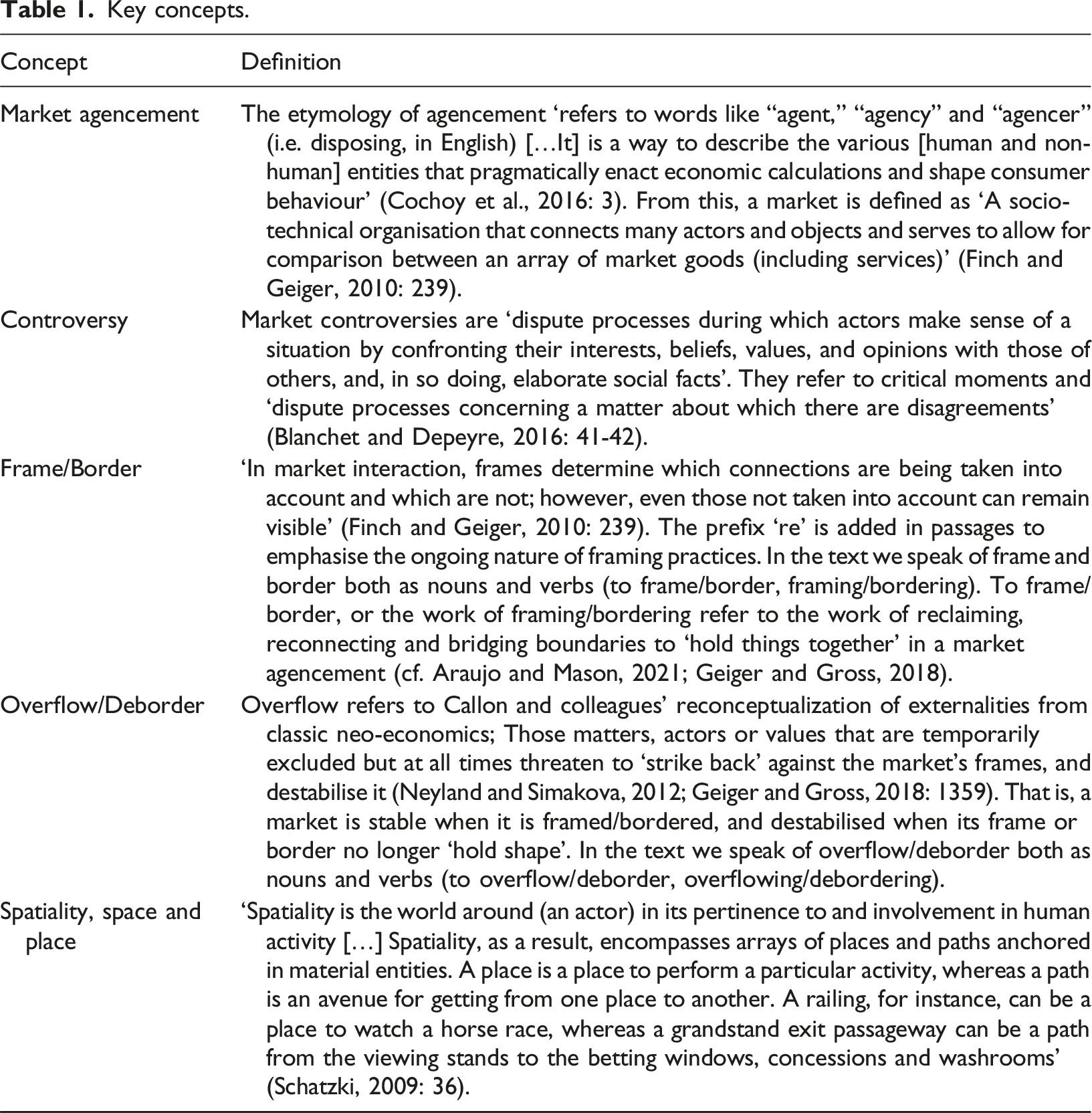
To explore this, we focus on the controversies born out of the marketization of places as different representations, practices and devices are put forward by market actors that quarrel over market (space) framings (cf. Mason et al., 2015; Pellandini-Simányi, 2016). We pay attention to how actors ‘who are concerned by the market without being market actors properly speaking’, at least in a first moment, become interweaved in the market agencements (Mallard, 2016: 63). Drawing on a range of archival and documentation data, we theorise how space is embroiled in market controversies, and how the rise and settling of controversies have a spatial dimension.
Markets beyond the human
Underpinned by the influential works of Latour and Woolgar (1986), Latour (2005), Callon (1998c) and Law (1992), the Market Studies literature (for a seminal paper in this field, see Araujo, 2007, this journal) is concerned with socio-material practices, and human and non-human actors that coalesce in agencements to engender and shape markets (Callon, 2008, 2016). Agencements ‘are arrangements endowed with the capacity to act in different ways, depending on their configuration’ (Çaliskan and Callon 2010: 9). Importantly, employing the term agencement serves to avoid the ‘reification of agency’ (Araujo and Kjellberg, 2016: 94), and to stress their heterogeneity and precarious nature which require ongoing [marketing] work to ‘hold things together’. With a commitment to ‘[reconnect] marketing to markets’, Market Studies pose marketing is about the doing of markets (Araujo et al., 2010) through devices, representations, and practices that are performative: they make and shape markets (Araujo and Mason, 2021; Mason et al., 2015; Palo et al., 2020). Hence, we understand markets as networks of people, objects and actions (Çalışkan and Callon, 2010). Markets, from this position, are not simply exchange arenas or spaces, but bear responsibility for bringing worlds into being. Making and managing markets have far reaching consequences for human and non-human life, and for society and economy at large (cf. MacIntosh et al., 2021).
This position differs from cultural approaches to marketing and markets (e.g. Caruana and Chatzidakis, 2014; Chatzidakis et al., 2012; Peñaloza, 2000). While acknowledging a diversity of market actors beyond consumers such as corporations and marketers (Zwick and Ozalp, 2011), in cultural approaches insights derive primarily from the agency of human actors (e.g. humans act, shape, change and non-humans are enrolled in these practices). Market-shaping actions, in this tradition, are often attributed to given structured social systems (e.g. institutions in Rodner et al., 2020) that condition practices (for a comparison between the fields, see Nøjgaard and Bajde, 2021). This theoretical lens conceptualises actors as a priori either actively or passively involved in markets (Castilhos, 2024). Contrastingly, we are firmly anchored in the ‘practical constructivism’ of Market Studies and its flat ontology (cf. Kjellberg and Helgesson, 2006).
A flat ontology calls for a symmetric recognition of the potential for agency of human and non-human actors (Latour, 1987). There is no static, original state of being economic/non-economic, active/passive, or marketizing/non-marketizing for actors. From this ‘flatness’ it follows that market actors are ‘[not] reified, external factors, with fixed qualities that simply act on markets, but entities whose qualities are contingent on the relations into which they enter. Qualities contingent on relations imply that they are subject to negotiation and change; and that they emerge through processes of co-construction’ (Pellandini-Simányi, 2016: 582). This lens draws attention to the agency of materiality and to human and non-human actions that temporarily, and relationally, (re)frame and (re)shape markets (Cochoy et al., 2016). Enquiries in this tradition start with questions about the process of market-making in which non-humans may take hold, rather than questions about processes within given markets done by humans. For example, Hagberg (2016) traced the evolution of the shopping bag as a market device and showed how new bag designs allowed an easier transportation of goods to the home thus reshaping shopping practices.
In our study, the precepts above set us to explore how market controversies arise and are settled, but rather than asking how human market actors (be them consumers or marketers) give rise to controversies and settle them, we focus on the processes of controversy rising and settling. We set out to trace the unfolding socio-material network enabling them, without ‘ex ante setting of boundaries’ (Bajde, 2013: 237) and how the underlying market agencement is reconfigured (Hopkinson, 2017; Mason et al., 2015). This approach allows more room for the agential powers of space to be considered. More to this in the following sections.
Markets as spatial agencements
The original meaning of the terms agencement and agencing in French are inherently spatial metaphors (e.g. the phrase of re-agencing a room) (Cochoy, 2023), but the relationship between spatiality and agencements remains largely implicit. For example, Mason et al.’s (2015) framework distils the making of market agencements into networks of: devices (e.g. price tags, shopping carts, smartphones), representations (e.g. images, texts) and practices (e.g. browsing online or in stores, selling, buying). The role of these in market-making has been widely discussed in Market Studies with allusions to their spatiality.
Callon (1998b: 22) refers to ‘spaces of calculability’, in which transactions are made calculable through ‘equipment and devices’. Cochoy’s (2007, 2020) work on supermarkets and grocery stores shows how spatial devices shape markets. The introduction of open displays, alongside grocers, shaped the space of grocery stores. Supermarket aisles, shopping carts and trolleys agence self-service environments, while ‘choice devices’ (e.g. aerial boards, lateral flags, shelves, packaging) help navigate the retail environment and the volume of choices. The supermarket itself as a space has devised the market ‘not only geographically but also in terms of built space’ (Cochoy, 2007: 111). Similarly, Bassett et al. (2024: 1) treat market spaces as market devices themselves considering they might be ‘designed to produce action’.
Representations have been conceptualised as having a co-constitutive relationship with space. Representations, such as maps, can present what is absent; while looking at a map, one cannot hear, smell or touch a place, yet a map can serve as a window into how a place is organised, understood and performed (see Latour, 1987). In this sense, market representations help make sense of abstract markets by bridging ‘temporal and spatial distances between individual exchanges and produce images of this market’ (Kjellberg and Helgesson, 2006:143). Looking at a car sharing market, Chimenti and Kjellberg (2022) show how a digital representation of a market in a map made the market visible for app users. Together with devices (website, app, cars), the digital representation qualified a market space as such and engendered market action.
Market practices have also been acknowledged to be shaped by space. Stigzelius et al. (2018: 347) conceptualised the kitchen as a ‘market-consumption junction, a space where multiple concerned actors … come to shape, and get shaped by, practices’. Studying the sharing economy, Chimenti and Geiger (2023) speak of the shaping relationship between private/public and quasi-laboratory/world outside ‘realms’ – or spaces – and market-making practices.
Despite these contributions, space is still often treated more implicitly rather than explicitly, and as a canvas or stage where markets are (per)formed. We adopt the position outlined by Holmes et al. (2021), based on the works of sociologist Henri Lefebvre and geographer David Harvey. Holmes et al. (2021) conceptualise ‘spatio-market practices’, which proposes to fold space into market practices, and the impossibility of their detachment. While some practices, such as travelling and inhabiting, more clearly relate to space than others, ‘all market practices are here understood to depend on and be shaped by the mobilisation and enactment of various conceptualisations of space’ (Holmes et al., 2021: 319). It follows that market-making is considered an always spatial endeavour.
The spatial (per-) (trans-)formation of markets and the rise of controversies
If markets can be understood as spatial agencements assembled and agenced by and in relation to human and non-human market actors (cf. Holmes et al., 2021), resolving the controversies that arise becomes a spatial affair. The notion of agencement encompasses both the assembling of markets and ‘putting them in motion’ (Cochoy et al., 2016: 6). In this ‘motion’, as agencements agence new market forms, and as multiple actors create, design, and maintain markets with different political, social, and economic interests, controversies arise (Finch and Geiger, 2011; Geiger and Gross, 2018). Put differently, ‘agencing activities’ generates unintended consequences, which the Market Studies literature often calls ‘overflows’ (Czarniawska and Löfgren 2012, 2013).
Recent works imply that market controversies can result from competing spatial qualifications, spatial competition (Chimenti and Kjellberg, 2022), and the overlap and interdependence of market with non-market spaces (Ryan and Araujo, 2024). While exploring various empirical contexts, these claims are relevant in tourism markets which often mobilise commercial and public interests in the marketization of place, where the place itself acquires exchange value (Urry, 2002). These markets are fertile ground for the rise and settling of controversies since framing a place-based market offer, such as in tourism, means delivering and consuming it are accomplished in and through the place. Moreover, because ‘a multiplicity and diversity of actors compete to participate in defining goods and valuing them’ (Çalışkan and Callon, 2010: 8), there is inevitable coalescing of a multiplicity of socio-material practices in place. In the absence of coordination, multiplicity generates controversies (Kjellberg and Helgesson, 2006). For Saatcioglu and Corus (2019: 16) ‘spatial dynamics may result in processes [of] market exclusion, spatial control or the oppression of marginalised groups’. Hence, space may be a problem and resource (Lussault and Stock, 2010), and controversies arise when space is mobilised and (per) (trans)formed in differing ways. Proofing, testing or experimenting with space and its elements (e.g. distance, territory, place, landscape, environment) can constitute controversies to be settled (ibid.).
Settling controversies involves framing: setting the boundaries around what market actors do and do not consider (Callon, 1998a) at/for a given market. ‘In market interaction, frames determine which connections are being taken into account and which are not; however, even those not taken into account can remain visible’ (Finch and Geiger, 2010: 239). The connections that remain visible constitute a threat to the market frame as they might be brought to bear in the market and lead to overflows of a market frame, which calls for reframing work (Callon, 1998a). According to Geiger and Gross (2018), the redevising of markets when public and private interests converge requires being attentive to overflows, which will require reframing for a market to persist. As such, markets require ongoing reframing effort, or boundary work (i.e. reclaiming, reconnecting and bridging boundaries) to ‘hold things together’ (cf. Araujo and Mason, 2021). For Kjellberg and Helgesson (2006: 850), ‘to ensure that conflicts do not materialize […] incompatible practices [must be separated] in time and space’. If separation is at all possible, how this is done is less clear.
The Market Studies literature has done much to understand reframing work in the (per) (trans)formation of markets. At the core of this literature is a concern with coordination and compromise between actors, with special attention to the materiality of action (Finch et al., 2017; Onyas, 2022; Soutjis et al., 2017). However, less attention has been dedicated to unpacking how the rise and settling of controversies relate to places and spaces. Like agencements, the concepts of overflow and framing allude to spatiality: overflowing is about flowing over a limit or demarcation (physical or otherwise) and framing refers to establishing a boundary to determine what gets considered as part of a market. Thus, Market Studies offer much vocabulary to explore the spatiality of market controversies. Moreover, framing can be treated as a spatial bordering process: ‘the movements of capital, goods, people, and ideas always involve an ambivalent double play of debordering (overflowing) and bordering (framing) processes’ (Berndt and Boeckler, 2011: 1062). These terms form our framework (Table 3) as they allow us a step closer to understanding how spatial market controversies arise, are negotiated and settled. Yet, we still lack insight into how these actions relate to space. For the sake of clarity, we summarise the key concepts employed in our analytical toolkit in Table 1.
Methodology
We adopt a methodology aligned with Latour’s ‘cartography of controversies’ (cf. Venturini, 2010) with a focus on market-making, or what Roscoe and Loza (2019) term marketography. ‘Controversies mapping entails no conceptual assumptions and requires no methodological protocols. There are… no premises to honor … no procedure to follow…’ (Venturini, 2010: 259). However, this position does not mean to ignore all established methodological toolboxes. By ‘not imposing any specific philosophy or procedures, the cartography of controversies invites scholars to use every observation tool at hand, as well as mixing them without restraint’ (ibid.). This is true here. Throughout the years, the authors engaged in both formal data collection and informal contact with local communities. While unsystematic and, at first look, ‘messy’ (cf. Law, 2004), the relationship forged between researchers and cases, mediated by digital tools, has yield an ongoing flow of data and learning about the cases over time (cf. Fernandes and Mason, 2025). As such, the present paper derives from larger, long-term projects of the authors. A subset from this larger dataset was employed in this analysis.
Empirical setting
Our empirical setting consists of two markets: the favela tourism market in Brazil, and the Christmas tourism market in Finland. These markets are recognised for their high financial (World Travel and Tourism Council, 2022), social and environmental impact, with their development accompanied by overcrowding and commoditisation of destinations long been claimed to destroy local cultural products and communities (MacCannell, 1973). We unpack the unravelling of controversies arising from the marketization of places.
The two cases are pertinent for the objectives of this paper first because the long-term engagement of the authors with the cases has allowed for a longitudinal ‘follow[ing of] the actors’ (Latour, 2005: 57). Second, the two cases provide complementary insights. While in Lapland, the Sámi, indigenous community, have worked to reshape the market while protecting a rural and ‘wild’ landscape; in Rio de Janeiro, favela residents are embroiled in urban dynamics, geographically placed within the city, but bounded from surrounding wealth and institutional apparatus. We aimed to gain richer complementary views on the relationship between market controversies and space through the cases rather than cross-case comparison. Third, the cases fit with Blanchet and Depeyre (2016: 44) criteria for the selection of ‘worthy’ controversies: a) they are complex problems ‘in which economics, politics, ethics, law and even science’ cannot be separated, b) they are hybrid where negotiating participants are human and non-human (e.g. the place’s topology, nature, indigenous people, businesses), and c) they have a moral dimension where the common good is discussed (e.g. who should exploit tourism, how, and to which end).
Data collection
Quanta of data.
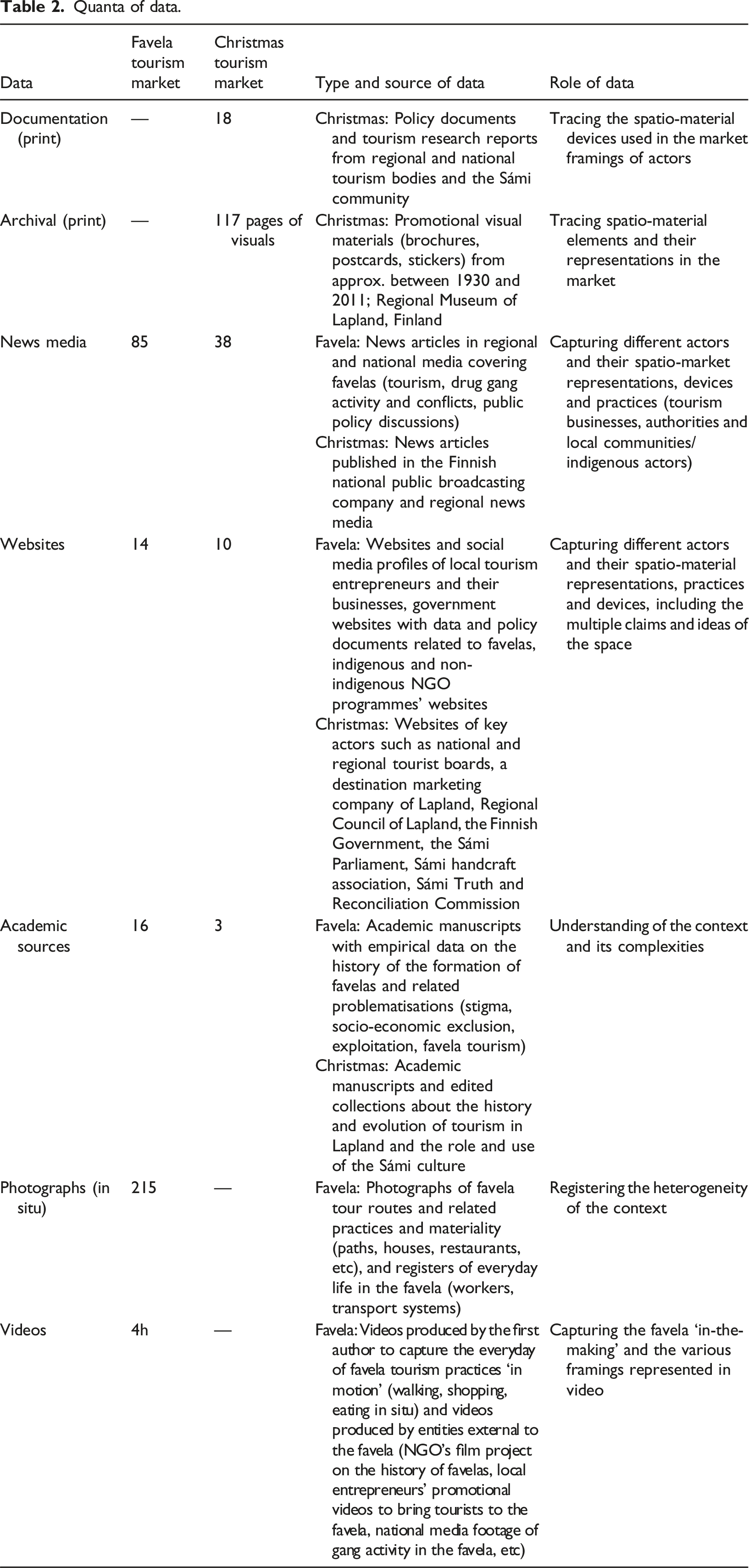
We adopted a ‘medial focalisation approach’ (cf. Cochoy, 2015: 12) which comprises juxtaposing media sources such as news outlets and specialised magazines. Each source ‘gives us access to what is certainly a particular point of view but one which cannot be reduced to that of a single body’ (ibid.). The combination of various sources of media allows the researcher to ‘identify and contrast different storylines and to observe their interaction’ (Hopkinson, 2017: 560). Media outlets and publicly available documentation can be considered ‘hybrid forums’ where heterogeneous actors (e.g. media, policy-makers, laypersons) meet, interact and clash over the organisation of markets (cf. Callon et al., 2009: 18), as each source is sharing content with its audience. For example, tourism brochures convey narratives to attract tourists for visitation, while policy documents may provide the regulatory parameters for tourism entrepreneurs. This methodology also recognises the performativity of market representations, as documents and news articles are part of and perform the world they aim to describe (cf. MacKenzie et al., 2007). They are part of agencements and thus ‘reveal the evolutions, communications and turning points of controversies across broad, multi-actor networks’ (Hopkinson, 2017: 560).
Data was selected according to Blanchet and Depeyre’s (2016) criteria of data intertextuality (connection between different types of data), diversity (documents, visuals, press articles), temporality (map the process over time), pluralism (account for actors’ views) and relevance (data is produced by actors active in the controversy and is empirically grounded). In the favela case, news articles were collected via Google searches under the ‘news’ tab using key-words related to favela tourism or due to prompts from research participants during the in-situ data collection of the broader project. For example, when a participant mentioned that 20th century newspapers portrayed favelas as ‘evil’, searches followed to find such articles and related commentary. News articles on Lapland’s Christmas tourism market were searched through the Finnish national public broadcasting company and regional news media. Websites and blogs of key market actors (e.g. national and regional tourist boards, the Sámi Parliament), and their policy documents were consulted, some of which were due to prompts by research participants, the media, or conversations with locals. Thus, in both cases, secondary data collection mimicked a snowballing process and met the practical test of relevance by asking ‘if [the] presence or absence [of something or someone] does make a difference’ (Venturini, 2010: 266). The data across the two cases are summarised in Table 2.
Data analysis
The analysis of our marketography (cf. Roscoe and Loza, 2019) consisted of tracing critical or ‘biographical’ moments for the market (cf. Glaser et al., 2021), in line with works within Market Studies (Cochoy, 2015, 2020; Jalili Tanha, 2024; Mallard, 2016; Ryan and Araujo, 2024; Stigzelius et al., 2018).
Analysis started with a chronological tracing of secondary data about the development of the market (e.g. the first commercial visits to Lapland and favelas) to map controversies. These were contrasted with the types of data included in this study (e.g. media accounts, documents, videos), for connections (Blanchet and Depeyre, 2016). We drew on intertextual analysis across the datasets, following Boje (2001) conceptualisation of ‘text’ in the broad sense, which can include conversations, archives and even physical spaces. In a way, controversies were revealed as we constructed the dataset and conducted a multi-sided search for connections.
This process allowed the iterative reconstruction of the two market narratives according to a sequel that followed a storyline of: (1) the rise of the identified controversies, and (2) how controversies were negotiated and settled in a reconfigured market agencement (see Blanchet and Depeyre, 2016; Dumez and Jeunemaitre, 2006). An important part of this narrative analysis is the combination of written and visual materials which provided a material and spatial account (Cochoy, 2020). The textual data allowed the tracing of conflicting ideas, discourse and judgements about the places (Lussault and Stock, 2010), while the visuals revealed what socio-material and spatial attributes are attached to favelas and Lapland (e.g. favela dwellings, wilderness). We paid particular attention to the multiple perspectives at play, as called for by Blanchet and Depeyre (2016), mapping the multiple actors, voices and agendas involved in the controversies, and the (re)framing (Callon, 1998a) work done.
Analytical framework.
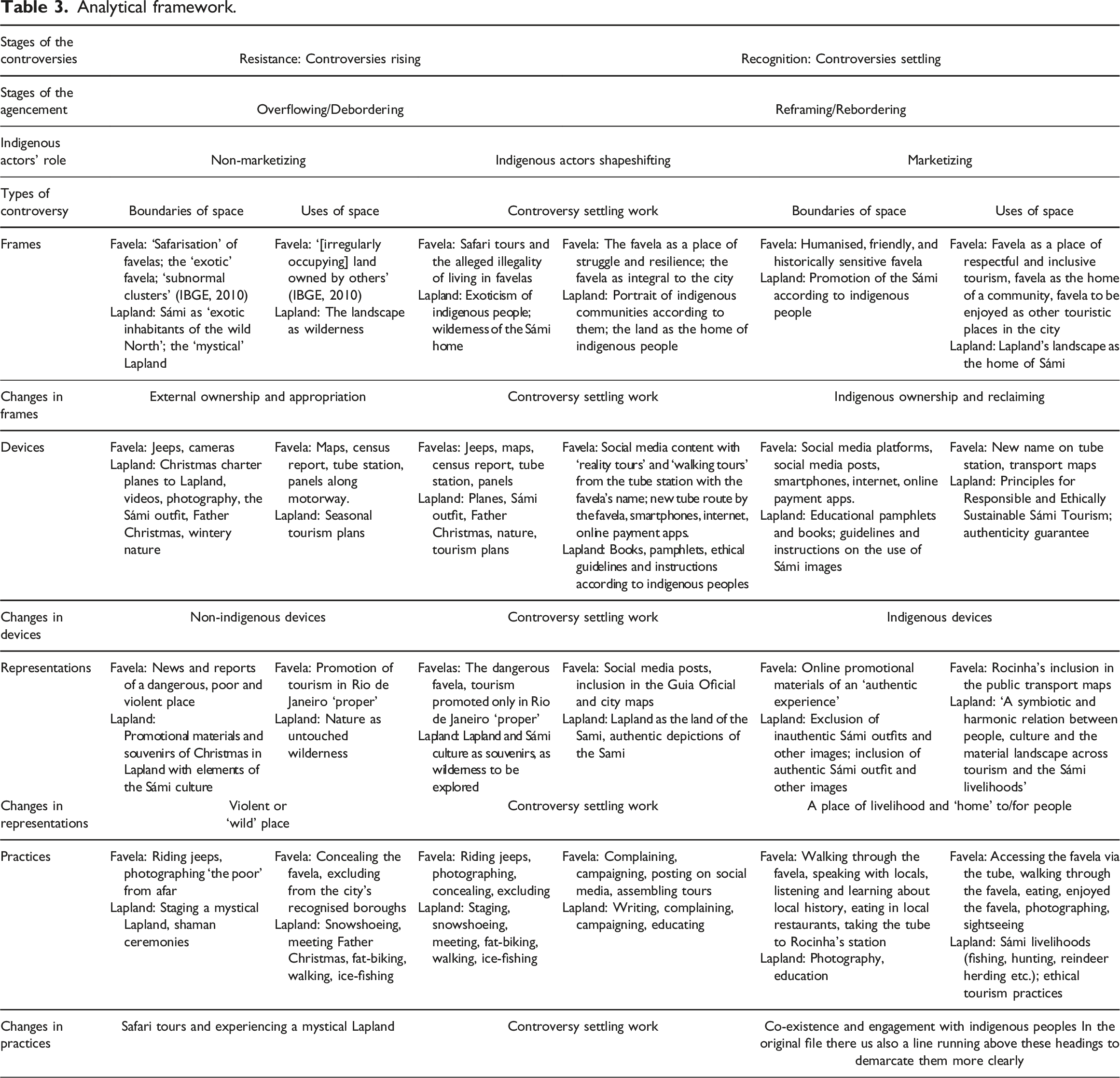
Findings
The next sections tell the tales of the Brazilian favela and Finnish Lapland tourism markets. Following from Table 3, we first present the market agencements before the rise of controversies, unpacking the specific frames, devices, representations and practices that made them. At this stage, indigenous actors mostly perform in their non-marketizing role (See Table 3). Second, we explain how the market agencements were debordered and overflowed through the Resistance work of indigenous communities. We conclude this section by detailing the process of Recognition that followed to settle controversies and reshape new market agencements with indigenous actors, frames, devices, representations and practices. Noteworthy, while the analysis is organised in a table for readability and comprehension, processes are not as clear-cut. Determining a single event or practice that triggered change is impossible (cf. Law, 2004). Likewise, the functioning of markets involves ongoing concerns and controversies (Callon, 2009), without a clear start and end points. To reflect this, we designed the table with a gradient of transitions where controversies begin to arise on the left side of the table and become settled towards the right side. Concomitantly, indigenous actors shift from non-marketizing to marketizing roles.
Non-indigenous beginnings of marketization
Favela tours
In Rio de Janeiro, several favelas have become touristic places, attracting thousands of tourists every year from all over the globe (Freire-Medeiros, 2009). While they have seen much growth in recent years, tours started in the 1990s, with tourism business from the ‘formal’ city – Rio de Janeiro ‘proper’– taking tourists up favelas (Freire-Medeiros, 2011, 2014).
Space has been key for the marketization of the favela. For example, the most touristic favelas are in the south zone of Rio de Janeiro, where most of the famous neighbourhoods and sights are (e.g. Copacabana, Ipanema, Christ the Redeemer). The architecture of favelas are also an important spatial element of the market agencement and makes them a distinguished and unmissable feature on the city’s landscape. This has historically been a device for ‘othering’ and framing favelas as ‘subnormal’ places and irregularly occupied land (IBGE, 2010), but also for exoticizing visits to favelas as tourists’ gaze was directed at the architecture. Figure 1 shows an example of the favela’s architecture being used on TripAdvisor to advertise a tour. Ad of a favela tour depicting Rocinha’s architecture (TripAdvisor, 2025).
During the tours delivered by non-indigenous tour guides, the fleeting visitors, onboard jeeps, would hear stories about the poverty and violence of drug gangs in the favela. Equipped with their cameras, tourists could observe and listen to stories of favelas that reinforced the representations sold to them in the media (see, for example, Galdos, 2014; Schipani and Harris, 2020; Sky News, 2018) about a dangerous, dispossessed, and exotic place (cf. Freire-Medeiros, 2009; The Telegraph, 2017) which they could fleetingly pass through, but with which they should not engage.
Cameras and jeeps were devices that continuously demarcated the boundaries of the spatial divide between city and hill (cf. Jovchelovitch and Priego-Hernández, 2013). Riding jeeps to ‘safeguard’ tourists from stepping into the favela and speaking to its peoples and photographing from afar were tourism practices that held frames of ‘safarisation’, ‘exoticism’ and ‘sub normality’ in place. The profits from tours left the favela with the jeeps as they made no stops in the favela, adding to the history of practices that kept favelas excluded from the economic flows of the city. The non-indigenous market agencement is framed around non-indigenous ownership and appropriation practices, and held together by devices such as cameras and jeeps, representations in media and census reports, and tourism practices of riding jeeps, photographing and storytelling that assemble the safari-style tour. Meanwhile, indigenous communities remained passive actors in the marketization of the favela. As such, we conceptualise the role of indigenous communities at this stage as non-marketizing.
Christmas in Lapland
Away from the warmth of Rio de Janeiro, wilderness, Santa, and Sámi people are some of the place-based ingredients for the marketization of Lapland: Lapland is the northern-most region of Finland and an active outdoor destination that's known for its incredible, year-round light phenomena, vast arctic nature, and Santa Claus. The land of the indigenous Sámi people, known as Sámi homeland or Sápmi, also crosses the northern part of the region. Explore Finnish Lapland, Europe’s last great wilderness! (Visit Finland, 2024)
The Sámi are the only indigenous people in the European Union. They inhabit the region of Sápmi, which encompasses large northern parts of Norway, Sweden, Finland, and Kola Peninsula, Russia, with a population of over 75,000. Around 10,000 Sámi live in Finland (Sámi Parliament, 2023). The Sámi have constitutional self-government in the Sámi Homeland since 1996 regarding their language and culture. The Sámi Parliament, elected by the Sámi, manages this self-government.
Over the past 50 years, Lapland has been marketized as the home of Santa Claus and tourism has become a key economic sector (for an overview of the marketization see Palo, 2023; Pretes, 1995). The Sámi and their homeland have always been part of the early marketization of Lapland as the Christmas tourism destination (Figure 2). Illustration of Santa’s Lapland in the Time magazine (top left), images of the visit of Mrs Roosevelt (top right); and the concorde at Rovaniemi airport (bottom) (regional museum of Lapland archives).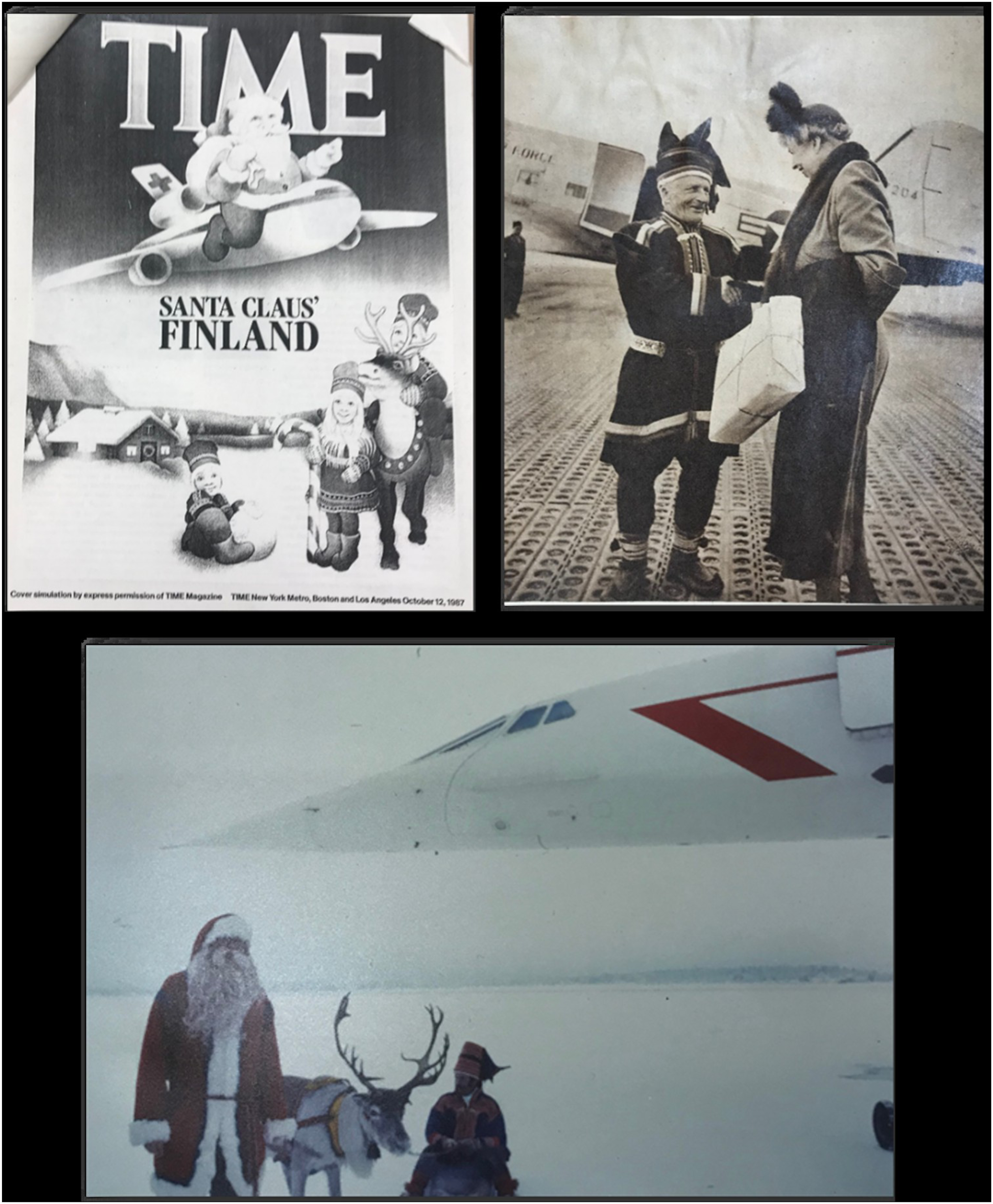
As shown in these visuals, in addition to key devices, such as the aircraft, Lapland’s spatial market agencement embodies the wintery nature (natural inhabitancy for Santa), the man himself (using either reindeer or planes to fly around), and Sámi people (welcoming guests as good hosts).
The Sámi have been key in the making of Lapland’s market agencement. Promotional representations of Lapland included material and spatial stereotypical elements of the Sámi culture, such as outfits, handcrafts, reindeers, and nature. A mixture of facts and fiction of the Sámi culture materialised in the market offer, its representations, and tourism practices, often in a disrespectful way. For example, the use of fictional ‘shamans’ performing a ‘Lappish ceremony’ in which tourists are inaugurated as part of Lapland was common in the early days of Christmas and other tourism activities. This is often mistakenly connected to Sámi culture. The Sámi have also been depicted as ‘wild forest creatures’, such as in a promotional video produced by Visit Finland in 2015. As such, Lapland and the Sámi are ‘packaged’ as a market offer (cf. Urry, 2002), adding to the ‘mystique’ of Lapland. A typical representation of Lapland has included a person dressed in a Sámi costume on snowy hills with reindeers (see Christmas postcards in Figure 3). Postcards from Lapland from 1930-40s (top left); 1960-70s (bottom left; photographer Uusi-Honko, Matti); and 1990s (right) (regional museum of Lapland archives).
From the early marketization of Lapland as Santa’s home, such representations mobilised the space (cf. Lussault and Stock, 2010). The networks of human (the Sámi, Santa) and non-human actors (reindeers, snow), repeatedly staged and visualised in the postcards, made and performed ‘Santa Claus Land’ and became what visitors expected to experience when visiting Lapland. The non-human actors and place-based elements were particularly important in this (mostly) non-indigenous market agencement; without the snow, reindeer, and landscape, ‘greetings from Santa Claus Land’ would have seemed very different.
Rising controversies of the boundaries and uses of space: Overflowing/debordering market agencements through resistance
We conceptualise Resistance as the set of frames, representations, devices and practices that gave rise to controversies. The following sections show how indigenous actors organised against the ongoing spatial market agencements that (per) (trans)formed their community according to non-indigenous frames.
Favela tours
A steadily growing dissatisfaction amongst locals towards ‘outsiders’ gave rise to a type of controversy we label ‘boundaries of space’ (Figure 10). This was fuelled by non-indigenous frames, devices, representations and practices (cf. Mason et al., 2015) detailed above, for the ‘lack of interaction’ with locals (Carvalho, 2023). In a first moment, Resistance took the shape of complaints amongst residents against spatial boundaries of: whose stories should be heard (indigenous vs. non-indigenous), where Rocinha figures in the city (part of the city vs. problematic and exotic territories) and what counts as ‘the real favela’ (culturally charged home vs. violent places). Favelas residents started to call non-indigenous tours ‘safaris’ (cf. Jaguaribe and Hetherington, 2004) that showed ‘no respect’ for the community (Froio, 2015) and reinforced the historic boundaries between favela and the city that (in)famously framed Rio de Janeiro as ‘the broken city’ (Jovchelovitch and Priego-Hernández, 2013).
To resist the non-indigenous agencement, indigenous actors started to engage in new practices, assembling their own tours through new representations, including campaigning for inclusion in printed materials such as the city’s ‘Guia Oficial’ (Official Guide, our translation) (cf. Freire-Medeiros, 2007), and later online, with the help of devices such as smartphones, payments apps, internet and social media platforms (Fernandes et al., 2019). Additionally, in partnership with the city council, indigenous actors proposed setting guidelines for ‘Community-based responsible tours’ (Van Rompu, 2017). The bill aimed at making ‘some favelas Areas of Special Tourist Interest (AEIT) meaning that, in practice, these locations would be subject to a specific urbanisation regime and tourism regulations’ (Lisboa, 2016).
Representations, devices and practices form a powerful agencement that enables specific uses of Rocinha’s space while hindering others, which gave rise to what we term controversies of ‘uses of space’. For example, despite having a few main roads recognised on the official city map for tourism (RioTur, 2023) and on important navigation tools such as Google maps (Google Maps, 2024), most of Rocinha’s territory, made of narrow alleys accessible only on foot, continues to be invisible in the representations of Rio’s landscape. Due to the lack of a recognised and ‘official’ address, residents struggle to accomplish everyday tasks such as receiving mail, or having bank accounts, (cf. Barrense, 2024), a powerful reminder of the agency of place-based devices and non-humans in performing (market)places. Moreover, while the first occupants of Rocinha date back to the late 1800s (Figure 4 shows an already packed hillside), the 2010 government census reports defined favelas as ‘subnormal clusters’ and ‘irregular occupation of land owned by others’ (IBGE, 2010). Because of their performative power, these representations that frame favelas as a problem to be solved or eliminated from the city (cf. Watts, 2016) directly impact how the favela is used, lived, and recognised. Providência, considered the first favela of Rio de Janeiro photographed in 1926 (RioOnWatch, 2026).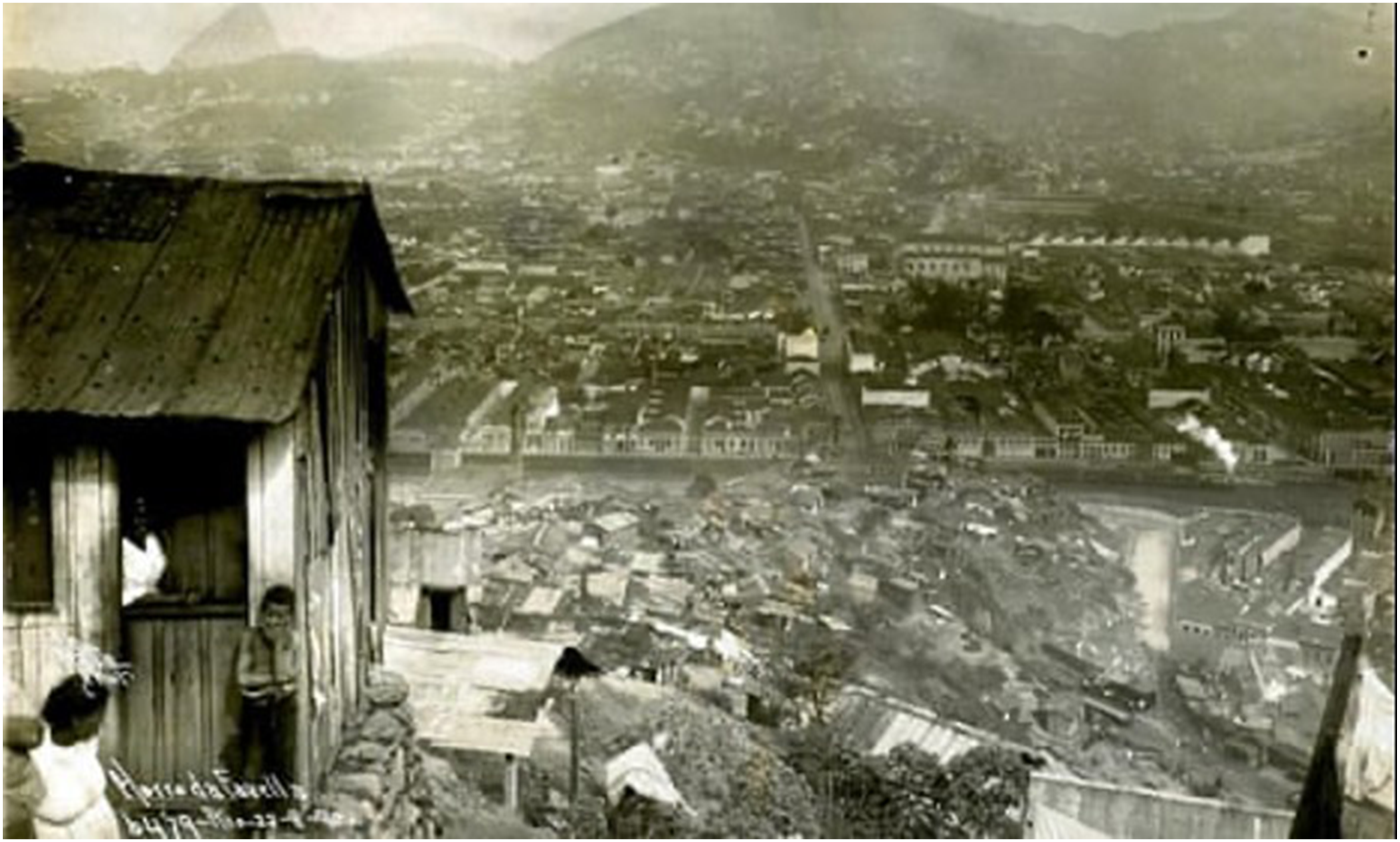
In the run up to the 2016 Olympics, a welcomed metro line passing by Rocinha towards the West Zone and various Olympic events, was built. Yet, instead of carrying the favela’s name, the station was named São Conrado, after the wealthy borough opposite Rocinha (Figure 5). This had important implication for the uses of Rocinha’s space. The sign above the station’s entrance would give Rocinha visibility and recognise the favela as part of the city and its routes (De Andrade, 2016). Moreover, favela tour guides often have the metro station as the meeting point for tourists. Naming the station after Rocinha would be a device to agence touristic flows, but instead, it is yet another device for exclusion. Resistance, in this case, was deployed through petitions to the city government (De Andrade, 2016; Gois, 2016) to change the station’s name. Tube station near Rocinha named after the wealthy São conrado (Google Maps, 2026a).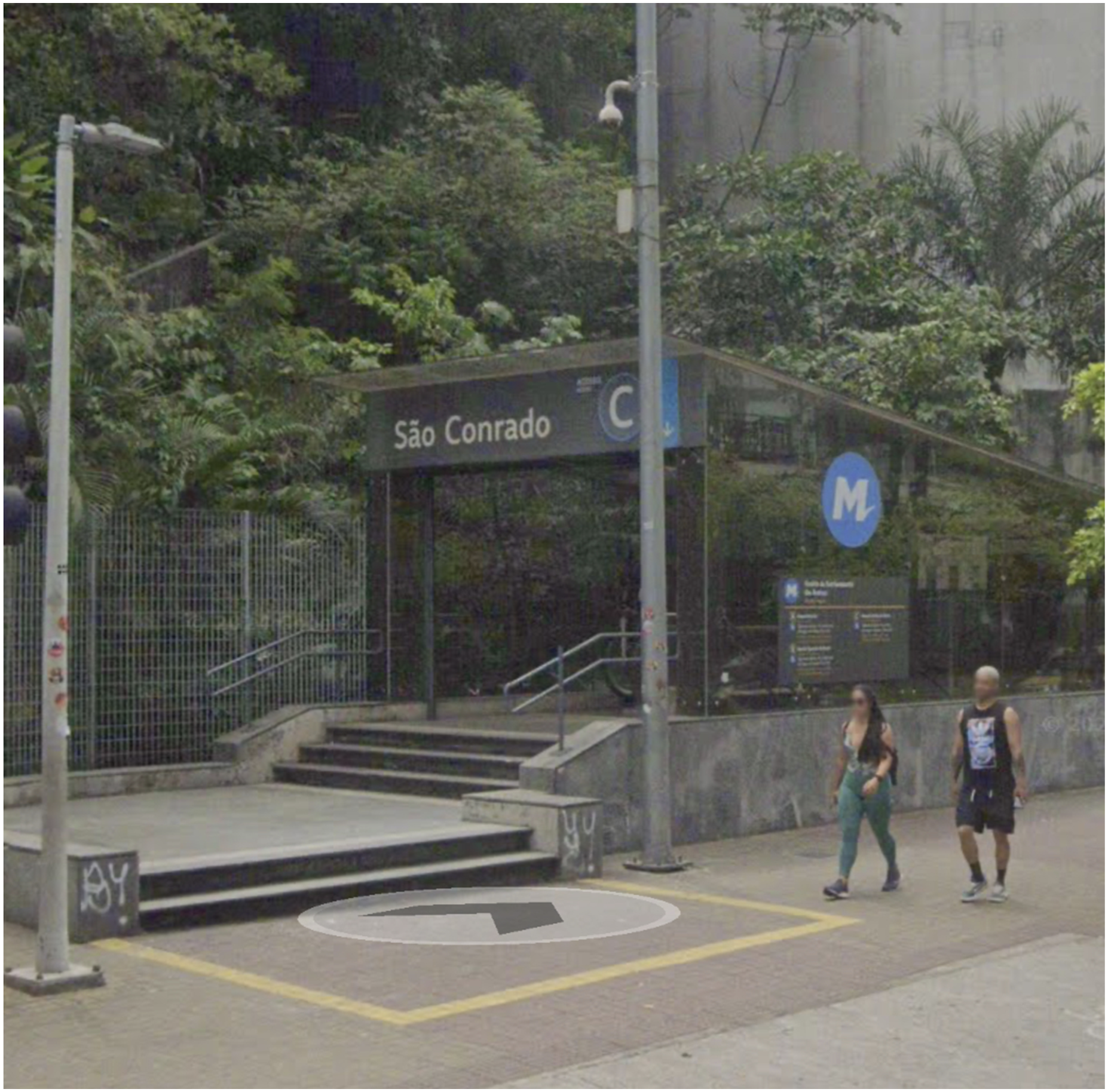
In the same year, the city government erected panels printed with Rio’s Olympics imagery alongside the motorway connecting city and international airport. The motorway has favelas on both sides, meaning tourists and athletes arriving in Rio would have panels, rather than favelas, as their first sights. Favela entrepreneurs believed this was done deliberately to hide favelas from those attending the Olympics (Ferreira, 2016) and consequently, from the tourism route. Similarly to the metro station, the panels are devices to exclude favelas from Rio; they help assemble an agencement that relegates favelas to uses related to violence, poverty, and safari tourism. However, the topography of Rio de Janeiro joined communities in resisting these exclusionary attempts. The location of most favelas on Rio’s hills makes them unmissable in the city’s landscape (Figure 6). Here, the spatiality of favelas actively resists devices, representations and practices aimed at hiding them. Favela Cantagalo-Pavão Pavãozinho overlooking copacabana (fieldwork data).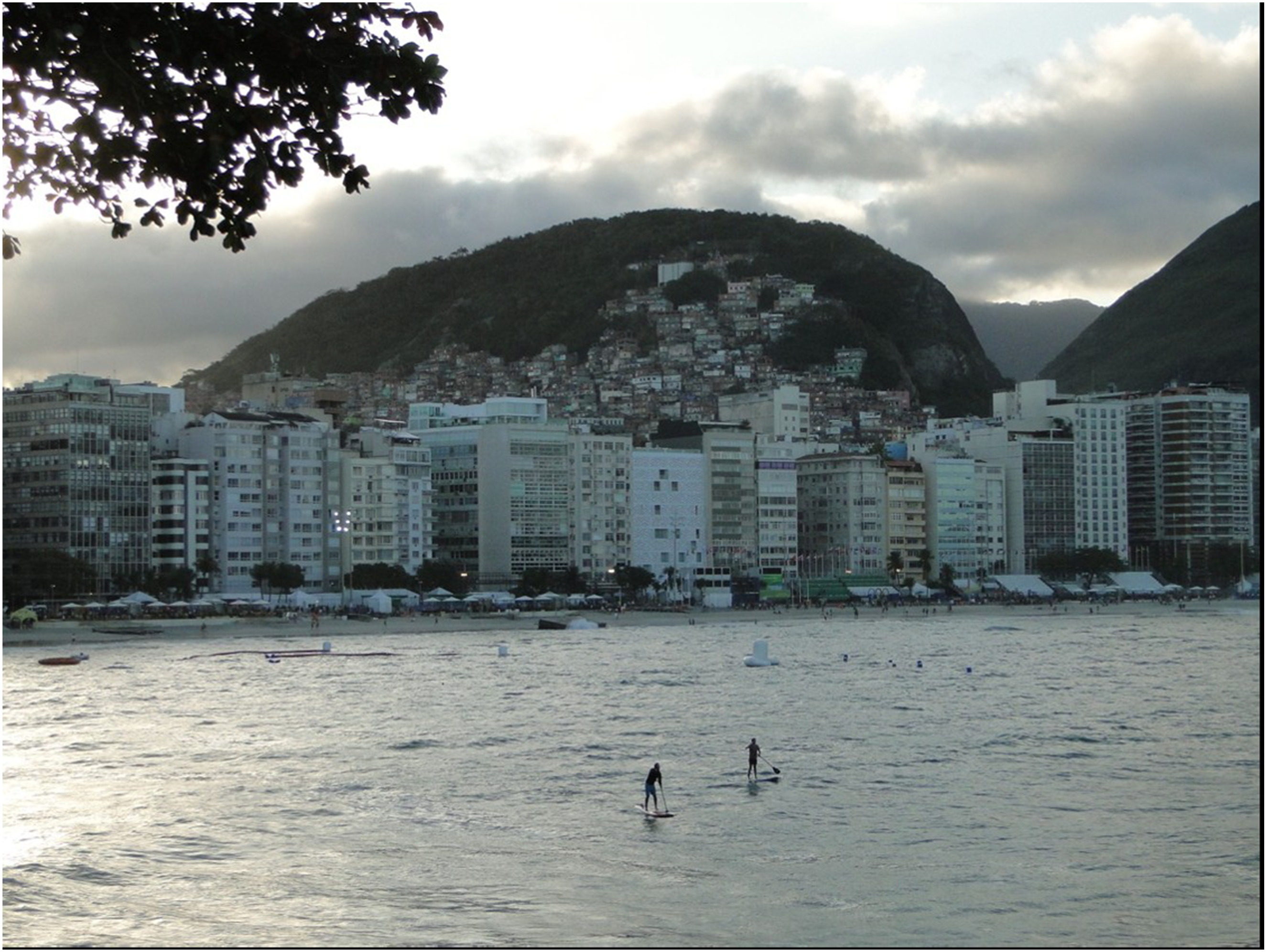
Christmas in Lapland
The frames, devices, representations and practices put forward by non-indigenous actors collided with the Sámi community and resulted in a controversy of the boundaries of the market space: what should and can be included to represent and make up Lapland and what not, and in what ways. Mazzullo (2022) explains how, from the 1950s, Sámi people were increasingly represented in Lapland tourism as ‘exotic inhabitants of the wild North’, contrasted to the ‘civilized South’. In the 1980s, this accelerated due to the rise of Christmas tourism (Jaakkola, 2022). Already then, the Sámi started creating resisting devices, such as writing pamphlets and books opposing the tourism development in Lapland they believed had a negative impact on Sámi culture, land and livelihoods (Mazzullo, 2022).
A key artifact of the Sámi culture, the gákti (outfit), has been particularly often represented and reproduced in the marketization of Lapland in promotional materials, souvenirs, and performances, serving as a device to stage a ‘mystical’ Lapland for tourists using Sámi culture. In response to this, actors more and less formalised, including the Sámi parliament and Sámi craft association, but also others such as Sámi artists, bloggers, cultural influencers and entrepreneurs, have resisted the inclusion of the Sámi and their space in the framing of the market. For the chair of the Sámi craft association, the Sámi outfit is a ‘boundary post’; it is not merchandise and ‘will not be put on the market table’ (Yle News, 2016).
More recently, the tourism authorities in Lapland have been framing a more balanced, all year-round tourism market to reduce the seasonal pressure and overreliance on Christmas. Such seasonal plans act as a device to extend the use of Lapland for tourism and create representations that build on its nature. Practices go beyond meeting Santa drawing on place-based features of Lapland and non-human actors, such as snowshoeing on the Finnish thick snow, walking the tundra and gazing at the northern lights, fat-biking across woodland, ice-fishing, and the midnight sun. For example, on TripAdvisor (2024), ‘Things to do in Lapland’ include ‘Santa Claus Village, Arktikum, Winter Sports, Nature and Wildlife Tours’. Here, the landscape is visualised without any humans, demonstrating the ‘untouched’ nature waiting to be explored through various tourism-related spatial practices.
This however poses a controversy of the colliding uses of space through the contradicting framings of the non-indigenous tourism authorities and the Sámi Parliament and community regarding the landscape and its wilderness. Magga (2022: 134) frames this controversy, writing ‘the scarcity of human-made traces – have made the Sámi homeland appear as wilderness rather than a cultural environment in the eyes of the non-Sámi’. From these spatial market representations (e.g. marketing materials from postcards to websites), it becomes a matter of what one can see and what is concealed. While the Lapland tourism market offer is explicitly framed in relation to and including the ‘wilderness’ of the land, this landscape is simultaneously the home and source of many traditional livelihoods for Sámi, such as fishing, handcrafts, hunting, and reindeer herding (Sámi Parliament, 2023), which may not be visible for tourists. The rise of controversies in Lapland further shows how resistance as a mechanism in the rise of controversies relates to spatial staging and concealment of Lapland across networks of representations, devices and practices.
Settling controversies of the boundaries and uses of space: (Re)framing/(re)bordering market agencements through recognition
We conceptualise Recognition as the set of frames, representations, devices and practices that enabled the settling, at least temporarily, of controversies. We explain how Recognition is (per)formed through the temporary ‘shapeshifting’ (Table 3 and Figure 10) of indigenous actors.
Favela tours
To reframe/reborder Rocinha from ‘safarisation’ to a humanised, friendly, and historically sensitive favela, indigenous actors focused on assembling new devices, representations and practices. Actors also shapeshifted and assumed a new role as entrepreneurs and started offering the so-called ‘reality tours’ (Jaguaribe and Salmon, 2012). Importantly, favela entrepreneurs are also Rocinha residents and as such, return to the everyday life of being a resident when they are not delivering tours, or involved in work to develop the market (e.g. campaigning, meeting with local council). Tours delivered by indigenous actors typically entailed the new practices of walking the favela, rather than passing onboard jeeps, and learning about the history of the formation of favelas in place (e.g. the occupation of hills as the only ‘empty’ land in the city), speaking to members of the community, eating in local restaurants, and listening to critiques to ‘safari’ approaches to tourism (Froio, 2015).
The growing access to devices such as internet, computers and later smartphones transformed social media into a powerful ally of favela entrepreneurs to reframe/reborder the market agencement (Berndt and Boeckler, 2011). Virtually free – no advertising agency or printing fees – platforms such as Facebook, Instagram, TripAdvisor and AirBnB allow locals to create and share representations of Rocinha that recognise the favela as an inclusive, authentic part of Rio and Brazil (see Figure 7 with tourists walking in Rocinha and riding the local moto-taxis). In turn, this is aimed at attracting the ‘right’ type of tourist, to ensure money stays in the favela (Robertson, 2012) and to act as a performative device in changing practices (cf. Finch et al., 2018). Practices change as tourists come to Rocinha, later sharing photos of and recommending such experiences, bridging the onsite and remote representations of the space. Representations of this kind mobilise space (Lussault and Stock, 2010) as they show Rocinha as a safe place to visit. Once on site, tourists and indigenous community practice the favela in a new way and help bring the ‘safe favela’ (cf. Phillips, 2013) into being. Walking tour ad on AirBnB (Jupiter Tour, 2026).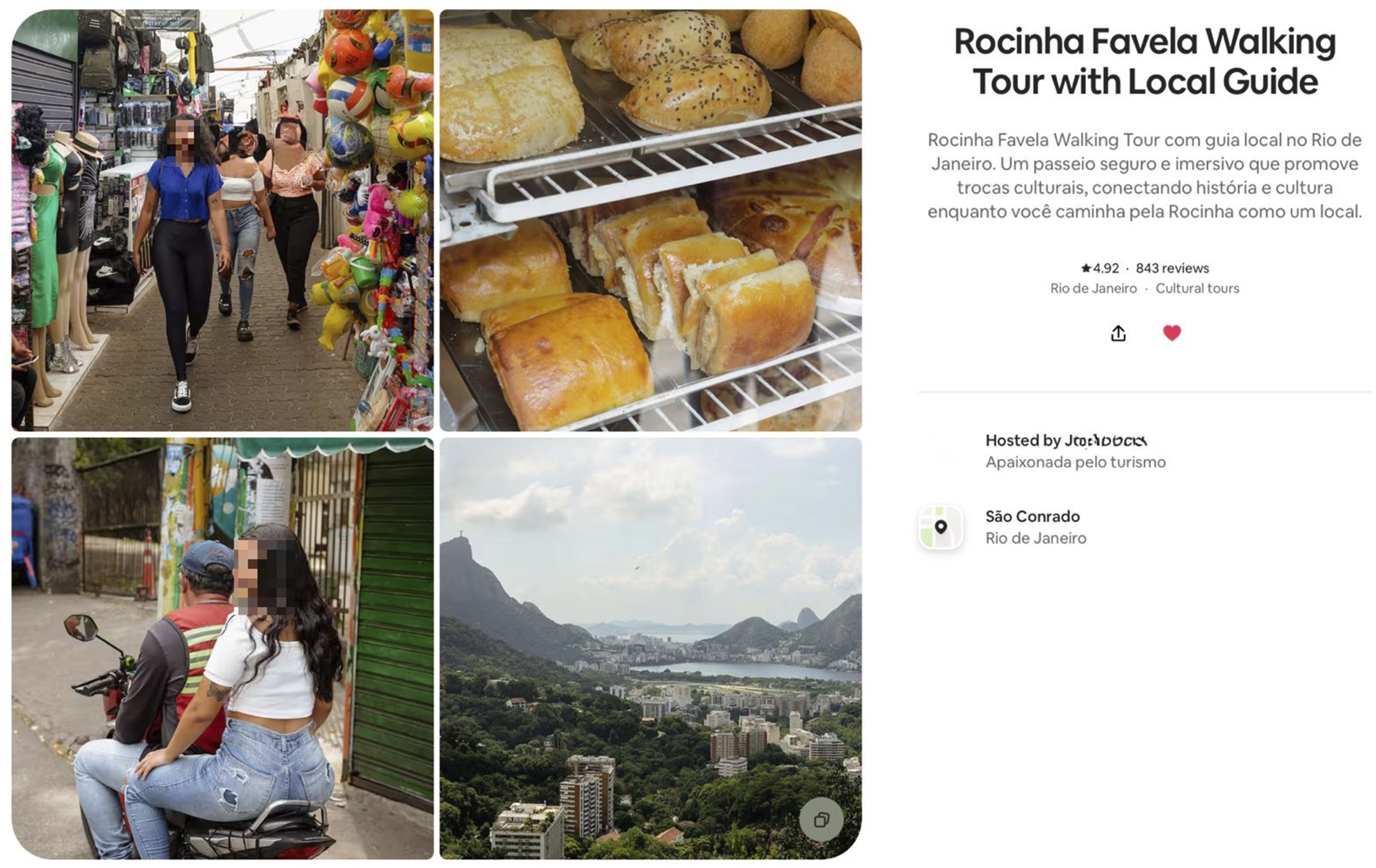
The collective tourism practices of walking, eating, chatting, and learning in place perform a frame/border of the favela that is more truthful to locals’ vision of what is ‘the real’ favela. The market agencement is reframed to recognise Rocinha’s historical struggle and resilience, as a place of community and livelihood, and as an integral part of the city. While ‘safari tours’ are still available, tourists searching for a ‘respectful tour’ are advised to hire indigenous tours (De Souza, 2015). The controversy of boundaries of space is settled through ‘authentic tours’, formed of devices, representations and practices put forward by indigenous actors. However, the settlement is precarious. Representations of favelas focused on gangs’ violence continue to exist, sometimes escalating to debates about the place of favelas and favela tourism in the city (Antunes, 2017; Brito, 2017; Stycer, 2017) which threaten to deborder the market agencement.
Aiming at settling the controversy of uses of space, the city government, responsible for naming the metro station by Rocinha after the wealthy São Conrado, defended its decision as a regular procedure of international norms of naming (De Andrade, 2016). However, Rocinha residents’ activism led to the renaming of the station (see Figure 8). The renamed São Conrado/Rocinha tube station (Google Maps, 2026b).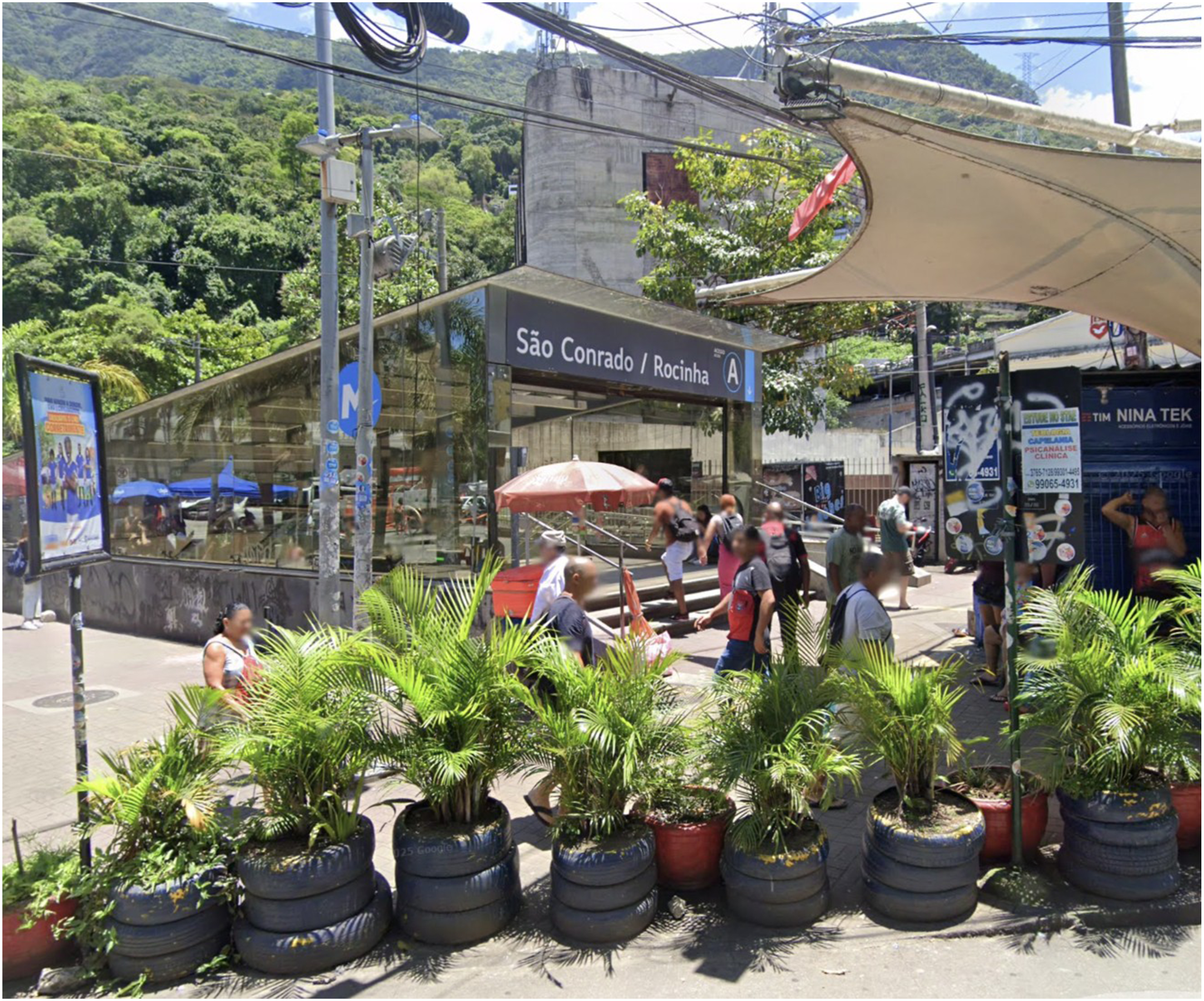
Changing the name of the station helped settle the controversy by plotting Rocinha on the city metro map (on and offline) legitimating it as a borough of the city (De Andrade, 2016). From this, tourism entrepreneurs can direct incoming visitors with the same ease they would to Ipanema, bringing Rocinha, in a practical and representational sense, closer to world-renowned touristic sites in Rio de Janeiro. For those en route to the favela, maps and station serve as devices to make calculations about transport. When tourists do so, and arrive at the favela, they deploy (per) (trans)formative tourism practices that remake it into a humanised, indigenously populated touristic place.
Christmas in Lapland
As an attempt to settle the two types of spatial market controversies in Lapland, market boundaries were reframed and protected with devices in the shape of guidelines and instructions, which resisted the staging of the Sámi. Addressing the boundary controversy, actors started to reclaim their space in the market through new material devices to frame/border (cf. Berndt and Boeckler, 2011) boundaries across the Sámi, tourism, and Lapland. The Sámi’s concern about the promotional video by Visit Finland depicting fake Sámi outfits resulted in a new edition excluding these parts (Yle News, 2015). In 2016, a marketing agency in Lapland asked for guidance on how to use images of the Sámi. House of Lapland (2016) states the following principles as guidance for the use of images of Lapland and the Sámi: 1. If a photograph depicts a Sámi, the person in the photograph should be a Sámi. 2. If a photograph depicts a person wearing a traditional Sámi gákti, the person wearing it should be a Sámi. 3. If a photograph depicts a Sámi gákti, the gákti should be an authentic Sámi gákti. 4. If a photograph depicts a person wearing a traditional Sámi gákti, the gákti should be worn in accordance with Sámi common law.
Photography of the market and the place (e.g. people and their outfits) and the list of principles act as material devices to address the controversy about the market boundaries. The photograph is a key type of representation that brings elements of the place to the fore. The list further states that ‘the easiest way to ensure that the principles detailed above are followed is to employ a Sámi photographer’. This is an example of how the Sámi shapeshifted into marketizing actors to help non-indigenous actors represent their cultural space authentically. Other devices soon appeared in attempts to further frame the market offer, the agencies and their encounters (Çalışkan and Callon, 2010).
Aiming to settle both controversies, in 2018, the Sámi Parliament released the ‘Principles for Responsible and Ethically Sustainable Sámi Tourism’. These outline ethical guidelines for the tourism market in both textual and visual formats. The visuals depict both wrongful and ethical practices in the marketization of Lapland (Figure 9), and incorporate a network of spatial representations, devices and practices according to the desired tourism market. In ‘the future we do not want’, the landscape is packed with people, buildings, and vehicles, the nature is filled with rubbish, and tourist practices are disrespectful towards the nature and culture. In the opposite scenario, the Sámi community’s role is shapeshifting, guiding the respectful relationship with non-human actors. The aim of these guidelines was to ‘to terminate tourism exploiting Sámi culture and to eliminate incorrect information about the Sámi distributed through tourism’, and the marketization of Sámi culture by ‘outsiders’ (Sámi Parliament, 2023). In their framing of the market, …there is a Sámi tourism information centre distributing accurate information on the Sámi and Sámi culture to visitors and various interest groups in tourism industry. Furthermore, the centre has information about the responsibly and ethically sustainably operating Sámi tourism entrepreneurs. In the good vision, also the everyday lives and festivities of the Sámi community as well as land use in Sámi Homeland have been successfully co-ordinated with tourism... (Sámi Parliament, 2023). Illustrations of ‘the future we do and do not want’, published as part of the ‘principles for Responsible and ethically sustainable Sámi Tourism’ (Sunna Kitti/Sámi Parliament in Finland, 2019).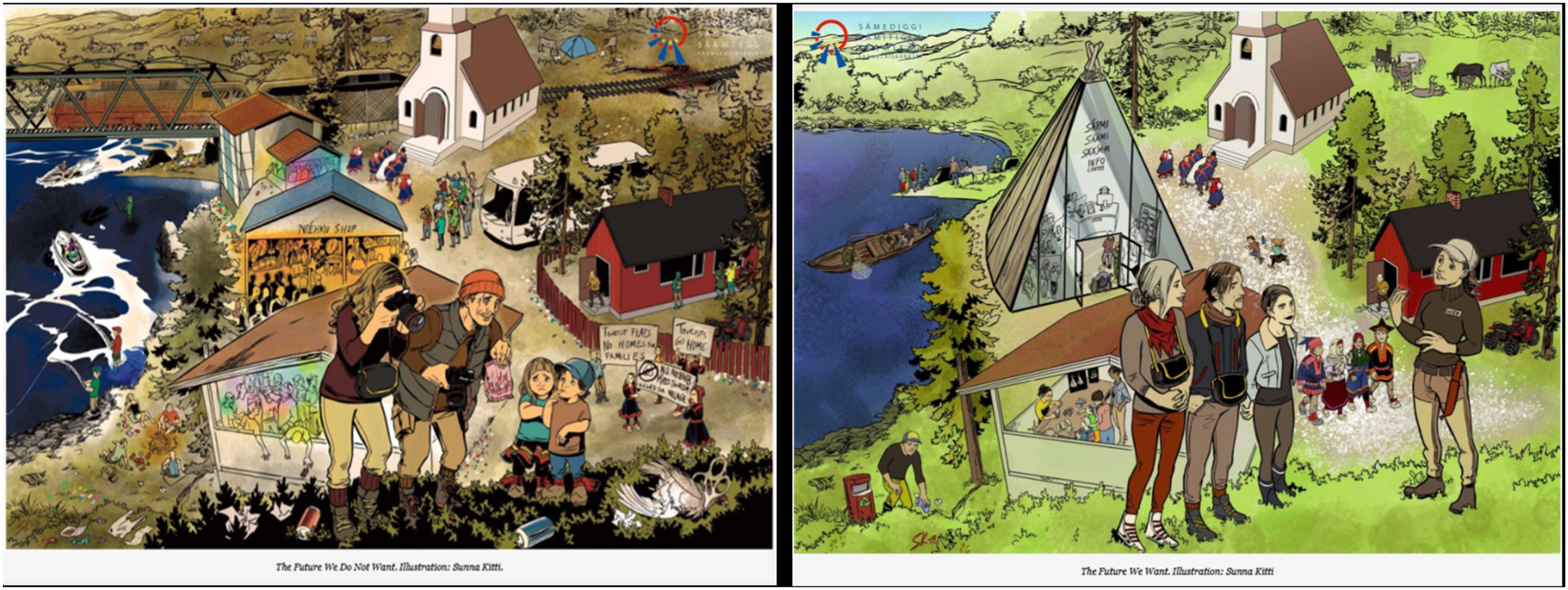
The guidelines frame the market with a multitude of actors and their spatial relations. Sámi entrepreneurs, the tourism information centre, and the Sámi community and homeland elements are agenced in this market frame as a more respectful way to organise tourism (cf. Cochoy, 2020; Holmes et al., 2021). The reconfigured market agencement tries to address the lack of coordination between traditional livelihoods and other competing forms of land use (e.g. tourism, forestry), and recognises a more symbiotic and harmonic relation between people, culture and the material landscape across tourism and Sámi livelihoods. The place itself remains as ‘unexploited’ as possible, but the space allows the inclusion of new shapeshifting actors. However, settling work is ongoing. Overflows are temporarily contained (cf. Geiger and Gross, 2018) as new questions related to the ethical use of land and exploitation of tourism arise, especially amidst climate change and conservation concerns.
Discussion
How do market controversies arise and are settled in the transformation of spatial market agencements? Rocinha’s favela tour and Lapland’s Christmas tourism markets provide the basis for theorising how space relates to market agencements, and the rise and settling of controversies. Figure 10 provides a visual conceptualisation of our findings. Conceptual framework of the rise and settling of spatial market controversies.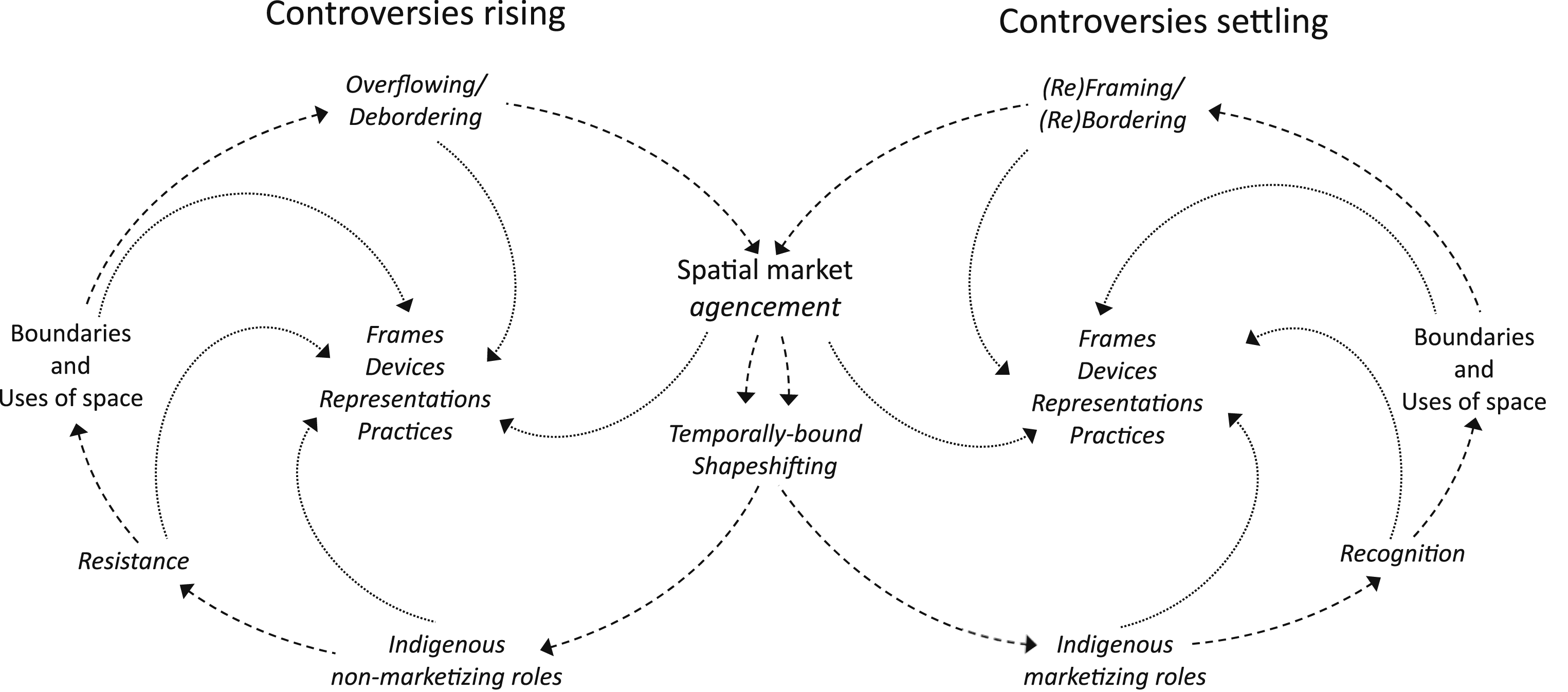
We traced how controversies arose from the colliding treatments of space by indigenous and non-indigenous actors, frames, devices, representations and practices. As our framework below shows, disagreements about the tourism markets in Lapland and Rocinha gave rise to two types of controversies we conceptualise: Boundaries and Uses, through overflowing/debordering processes. That is, the boundaries of the market, and therefore the market itself, is not ‘settled’ or agreed on and disagreements are overflowing. Indigenous actors engage in reframing/rebordering to shape the market agencement towards a format they deem more respectful and acceptable. This settling work was done through the deployment of bundles of devices, representations and practices that, inscribed with spatial conceptualisations, allow the reframing/rebordering of the market agencement. We call these bundles Resistance and Recognition. Crucially, we shed light on the role of actors indigenous to marketized places and conceptualise their work as ‘temporary shapeshifting’. These actors are both residents and, when needed, active market actors that work to ‘package’ their community and land in ‘the right way’. These insights fuel our three key contributions to the literatures on market agencements, controversies, and actor roles, which we explain below.
Spatial market agencements
Our research extends understandings of the spatiality of market agencements and the spatial nature of their (per) (trans)formation. Drawing on the premise that agency is distributed across networks of devices, representations and practices (Mason et al., 2015), and human, textual and material elements (Çalışkan and Callon, 2010), we conceptualise how the (per) (trans)formation of markets happens in and through space. We point to the role of boundaries and uses of space in the construction of markets and in enabling market exchanges to take place – they contribute to the architecture of markets.
Boundaries of space (Figure 10) temporarily determine (as markets are precarious arrangements) which devices, representations and practices are put in motion within the market frame; their placement, proximity, inclusion and exclusion, division and separation, and reconnection. Similarly, uses of space, are made (in)visible through devices, representations and practices involved in how space is experienced. These extend current understandings of the relationships between market devices, representations and practices, and space. Our findings reveal how representations work to stage and conceal market space (Table 3). In addition to making markets visible (Chimenti and Kjellberg, 2022), representations can also hide uses of the space in agencing markets (e.g. maps without favelas). We also show how devices have a spatial dimension (cf. Bassett et al., 2024), deployed through and in relation to space (e.g. textual and visual guidelines), and used to reframe the boundaries and uses of the space. For example, jeeps contributed to the ‘safarisation’ of favelas while the panels along the motorway to hide favelas prevented touristic flows. This way, practices make and shape space in relation to representations and devices. We put forward boundaries and uses of space to explain how space is embroiled in the rise and settling of controversies in market agencements (Figure 10).
Different from previous markets literature, explicitly inquiring into the spatiality of market-making can reveal new types of controversies and mechanisms of their negotiation and resolving. We also show how devices, representations and practices shape and are shaped by places and spaces. Here, place and space are considered in a more symbiotic relationship with market action: making any product, delivering to consumers, purchasing and consuming, all have a spatial dimension and are (per) (trans)formed in relation to and through space, whether that is a supermarket, an online store, or tourism. We show how place-based dimensions are important in ensuring market continuation; by shifting the boundaries of markets and their spatial uses to negotiate and reframe them, marketization and markets can move forward.
The spatial dimension of market controversies
Our research sheds light on how the (per) (trans)formation of spatial market agencements raise controversies in treatments of space (e.g. ‘empty’ wilderness, untouched nature, unclaimed territories). This is in line with prior, yet limited work that shows traces of interdependencies and competing uses of market and non-market spaces (Chimenti and Kjellberg, 2022; Ryan and Araujo, 2024). We develop these understandings by focussing on the controversial framings (Blanchet and Depeyre, 2016) of the market space, and showing how colliding framings of the boundaries of the market space and its uses can lead to colliding devices, representations and practices, giving rise to spatial market controversies.
The Market Studies literature has done much to conceptualise controversies arising in agencements and the role of market devices to settle them (Geiger and Gross, 2018) but less is known about how space is embroiled in the process and to which consequence. Our findings suggest that boundary and use controversies arise from spatial devices, representations and practices that cause the debordering/overflowing of the market, for example, when actors with non-market agendas resisted non-indigenous framings (Table 3). Settling controversies involves reframing/rebordering the agencement, that is, containing overflows by deploying devices, representations and practices of Resistance and Recognition to shift market boundaries and uses of space. The market is framed and deployed in relation to space, and the resulting controversies and settling them are a spatial affair (cf. Holmes et al., 2021).
This spatial sensitivity better positions the marketing discipline to bring to the fore the ethics and sustainability of marketization. This becomes clearer if one considers the consequential relationship between treatments of spaces as ‘empty’ (cf. Holmes et al., 2021) and the rise of controversies, such as the ‘wilderness’ of Lapland. Cronon (1996: 17) discusses how ‘wilderness embodies a dualistic vision in which the human is entirely outside the natural’. Framing wilderness this way offers little hope for discovering ‘what an ethical, sustainable, honorable human place in nature’ might look like (ibid.). The nature/culture dualism has also been recognised in relation to consumption practices to cause contradictions between the wilderness and experiences of nature (see Canniford and Shankar, 2013). Paying attention to placement, positions and relations of devices, representations and practices, and the human and non-human actors in a market can assist their sustainable functioning and the settling of controversies.
Temporary shapeshifting of indigenous communities in settling controversies
Lapland and Rocinha locals engaged in new roles to reshape the market when finding themselves enrolled in market action as their place of residence became a touristic site. We conceptualise this as temporary shapeshifting (as in Figure 10).
Tensions between market and non-market agendas (Pellandini-Simányi, 2016) give rise to controversies. In the marketization of Rocinha and Lapland, indigenous communities Resist devices, representations and practices that exploit indigenous land, culture and history, and create market change towards Recognition through new devices, representations and practices. This temporary shapeshifting of actors was essential to settle the multiple and competing versions and visions (cf. Mallard, 2016) of the markets. Previous work by Kjellberg and Helgesson (2006) posed that resolving conflicts amidst multiple versions of a market relies on separating them in time and space, yet our analysis show work to co-exist as an alternative accord for the continuation of the markets. Our cases show the existence of neither powerless communities nor all-powerful marketizing actors, but a more nuanced and temporary variety of roles. Therefore, we pose that a shared agencement is necessary to settle controversies, but more importantly, this format of handling controversies has the potential to pave the way for more ethical formats which keep lines of debate open. Rather than binary (marketizing vs. non-marketizing) and with fixed roles and qualities, actors who respond, resist, and potentially become enrolled in the marketization work, are gradient and their roles shift (shapeshifting) through reframing/rebordering work (cf. Geiger and Gross, 2018).
Conclusion
We make three key contributions. First, this paper adds to the Market Studies literature by advancing the notion of spatial agencement (Cochoy, 2020, 2023; Holmes et al., 2021). Second, we contribute to understandings of market controversies (Blanchet and Depeyre, 2016; Kjellberg and Helgesson, 2006) by elaborating on their spatial rise and settlement. Finally, we advance understandings on the marketization of places (Berndt and Boeckler, 2020; Castilhos and Dolbec, 2018) by elaborating on the temporary and shifting roles of actors in marketization work. Spatially sensitive inquiries into markets have the potential to reveal sources of controversies that might go otherwise unnoticed, and this way, move marketization forward in a way that gives a voice to the heterogeneous actors and their concerns.
The practical implications of this research refer to the work of actors with different agendas and roles. Rather than merely considering the potentially negative effects of marketization on certain actors, including the landscape, marketization should be considered as spatially sensitive negotiations, compromises, and reframing.
The insights are applicable to a variety of settings: even in a more clearly demarcated and built space of a supermarket or servicescape, heterogenous market actors and agencies collide, giving rise to controversies. Expanding the focus on the built, firm-controlled environment (Bitner, 1992), our approach has the potential to expose the distributed agency across man-made and natural surroundings, including heterogenous devices, representations and practices. In supermarkets, these can include the policies, laws, and protocols that abound on shop floors related to hygiene (how products should be stocked), health (which products are safe for humans and animals), and fair competition (who gets to be at eye level shelf for shoppers). Overflowing/debordering are not uncommon as market players struggle for a place in the fluorescent light of large retailers, and ongoing framing/bordering work is called to negotiate the co-existence of competing interests between multi-million pounds corporations, activists, consumers, policy-makers, nature and more, plotted on shelves and shop floors. Moving from supermarkets to the marketization of touristic places, paying attention to the relationship between space, markets and controversies is likewise beneficial; it can advance the design of more inclusive and respectful tourism markets. That said, future research is welcomed to continue what is still in its infancy; the spatial nature of markets and market-making work.
Supplemental Material
Supplemental Material - A tale of two markets: Exploring the spatiality of market controversies
Supplemental Material for A tale of two markets: Exploring the spatiality of market controversies by Josiane Fernandes, Teea Palo in Marketing Theory
Footnotes
Acknowledgements
This research was supported by Lancaster University Management School and the British Academy Leverhulme Small Research Grant. We would like to thank the Market Studies community at the Organization Studies Workshop 2023 for the helpful comments on the initial ideas for this paper. We would also like to thank the helpful comments of the anonymous reviewers and the editor which made the paper significantly more refined and stronger. The authors are unaware of any competing interests that may be applicable to this paper.

Funding
The authors disclosed receipt of the following financial support for the research, authorship, and/or publication of this article: This study is supported by British Academy Leverhulme Small Research Grant.
Declaration of conflicting interests
The authors declared no potential conflicts of interest with respect to the research, authorship, and/or publication of this article.
Supplemental Material
Supplemental material for this article is available online.
Author biographies
References
Supplementary Material
Please find the following supplemental material available below.
For Open Access articles published under a Creative Commons License, all supplemental material carries the same license as the article it is associated with.
For non-Open Access articles published, all supplemental material carries a non-exclusive license, and permission requests for re-use of supplemental material or any part of supplemental material shall be sent directly to the copyright owner as specified in the copyright notice associated with the article.
