







Abstract
This article adopts an Indigenous-informed perspective to understand how the energy from more-than-human entities (e.g. plants, animals, and spirits) shapes atmospheres of consumption. Drawing on ethnographic research undertaken with members of the Shipibo-Konibo Indigenous group of the Peruvian Amazon, we introduce the concept of koshi, a form of energy generated through relations between humans, plants, animals, and spirits that permeates place and space. We show that more-than-human entities produce affective energies that shape atmospheres through (1) the emanation of koshi to the environment to signal power and presence, (2) the storage of koshi within their bodies for later ritual activation, and (3) the transfer of koshi to humans in healing processes. These processes reveal atmospheres as manifestations of the relations among all beings with positive and negative effects on humans’ health and well-being. By centring Indigenous relationality, this article challenges human-centric and Western theorisations of affect and atmospheres. In doing so, our study contributes to our current understanding of how more-than-human entities, like plants, animals, and spirits, shape and experience consumption.
Keywords
Introduction
This research examines, from an Indigenous perspective, how more-than-human entities, such as plants, animals, and spirits, produce affective energy that shapes atmospheres of consumption. Early theorising of ‘atmospherics’ proposed that consumers’ responses to retail spaces could be manipulated and prescribed through design choices, like lighting, sound, and layout, and that these affective responses were expected to be uniform (Bitner, 1992; Kotler, 1973). However, a recent body of research on this topic (e.g. Biehl-Missal and Saren, 2012; Hill et al., 2022; Preece et al., 2022; Steadman et al., 2021) has attested the value of the continuous theorisation of atmospheres, particularly in light of their inherent complexity and dynamism. Indeed, more recent literature has foregrounded the heterogeneous ways in which atmospheres shape and are shaped by various human and non-human actants (Steadman and Coffin, 2024). Although the perspectives adopted and areas of contextual focus are quite divergent, research on atmospheres of consumption may be understood to focus on consumers’ experience of affects, emotions, sensations, and embodied feelings at the nexus of people, places, and things (Ahmed, 2014; Biehl-Missal and Saren, 2012; Bille et al., 2015).
The notion of atmospheres of consumption was originally associated with the physical environment of retail spaces (Bitner, 1992; Kotler, 1973). However, recent research has shown that in collective consumption contexts, such as sports stadiums, atmospheres of consumption are dynamic entities that change and flow across time and space, shaping consumers’ consumption experiences in heterogeneous ways (Hill et al., 2022; Steadman et al., 2021). Scholarship in marketing highlights the affective character of atmospheres of consumption, examining how atmospheres produce pleasurable, intense emotions, and embodied responses (Biehl-Missal and Saren, 2012; Preece et al., 2022). These studies acknowledge the active participation of consumers in feeling, shaping, and rejecting atmospheric stimuli according to their values, wants, and needs, demonstrating that affective atmospheres cannot be fully controlled, as initially theorised (Biehl-Missal and Saren, 2012).
However, less attention has been paid to the role played by more-than-human actants such as plants, animals, and spirits in atmospheres of consumption (Coffin, 2021; Grant et al., 2025; Woodward and Swartjes, 2023). More research is needed to understand whether and how these beings produce affective energy to create atmospheres in concert with humans. This paper refers to plants, animals, and spirits with the term ‘more-than-human’ as a form of critical engagement with these organic and/or immaterial beings, usually seen as ‘lesser than’ humans. The term ‘more-than-human’ incorporates non-human beings considered by Western civilisations to be ‘alive’ or ‘animated’, such as plants and animals, those ones populating the inside of humans (e.g. bacteria), spiritual entities, and landscapes and ecosystems (Bettany and Kerrane, 2011; Campbell and Deanne, 2019; Grant et al., 2025). The core idea of ‘more-than’, compared to the more divisive binary of ‘non-human’, is that these entities have sentience, emotion, intelligence, energies, and agency, features that are often assumed to be exclusive to humans, but go beyond humans (Abram, 2024; Helkkula and Arnould, 2022). ‘More-than’ challenges the anthropocentric view of the world, acknowledging that humankind is just one more entity among others, and invite humans to reconsider their positioning in the world with humility (Braidotti, 2018; Price and Chao, 2023).
The study of plants, animals, and spirits can enrich our understanding of the multi-sensory and multi-faceted nature of affective atmospheres. Scholars point to how birds, fish, and dogs can alter the emotional tone of a space, influencing how people feel and engage with it (Cheetham et al., 2018; Grant et al., 2025), and the scents of flowers can evoke emotions and memories in consumptionscapes (Xiao et al., 2017). The recognition and inclusion of these entities in the study of atmospheres can improve our understanding of how value is created relationally between human and non-human affective energies. Arnould (2022), for example, argues that more-than-human entities participate in the circulation of natural resources through gift gifting, reciprocal exchange, and predatory symbiosis. From an ethical standpoint, the inclusion of more-than-human entities challenges anthropocentric assumptions that treat nature merely as a resource for human use (Canniford and Shankar, 2013). It also invites researchers to consider how plants, animals, and spirits experience the world, and more specifically, how they experience place and space (Coffin, 2021), two key aspects in atmospheres. In addition, little attention has been paid to how atmospheres of consumption are shaped by Indigenous perspectives, which often propose a flat ontology (Valera et al., 2019). Marketing researchers have called for more socio-cultural research drawing on Indigenous ideas and the non-human perspectives of more-than-human entities to enrich our understanding of how plants and animals experience consumption in natural environments (Grant et al., 2025; Raciti, 2023). In this article, we present energy as a form of non-human agency and an element of affective atmospheres. We are interested in understanding how more-than-human entities use this energy to co-create atmospheres with humans in an Indigenous context. Consequently, this article seeks to answer the following research question: How does the energy from more-than-human entities, like plants, animals, and spirits, shape atmospheres of consumption from an Indigenous-informed perspective?
Navaro-Yashin (2009) has shown that objects, dwellings, and spaces located in post-war settings discharge affective energy independently of the meanings that humans ascribe to them, and that this energy shapes affective atmospheres. She argues that affective energy is a form of non-human agency that is historically contingent and manifests through residues of historical trauma and loss contained in material objects. Here, we draw on an Indigenous perspective on more-than-human entities and relationality through an ethnography with the Shipibo-Konibo Indigenous group of Peru (also called Shipibos). From an Indigenous perspective, place, space, diverse beings, emotions, and processes emerge relationally, through ongoing co-becoming rather than as separate entities (Bawaka et al., 2016; Larsen and Johnson, 2017; Yunkaporta, 2019). On this basis, we propose that atmospheres emerge from human and more-than-human affective energies that permeate and animate place and space. Moreover, our Indigenous perspective foregrounds that animals, plants, and spirits are alive, animated, conscious, and intelligent beings, whose affective energy is intentional, not residual. To elucidate this idea, we introduce the Shipibo concept of koshi (pronounced kushi), which is the living force or vibration that emanates from and circulates between humans, plants, animals, and spirits. We use koshi to analyse and interpret how atmospheres are shaped by the entanglement of energies from plants, animals, spirits, and humans in an Indigenous context where consumers engage with alternative modes of knowing, doing, being, and becoming (Martin, 2003; Smith, 2021). In doing so, we contribute to existing understanding of affective atmospheres and to more holistic perspectives on these consumption phenomena. Our focus on Shipibo ideas engages with decolonising conversations in marketing and contributes to highlighting the importance of Indigenous perspectives in contemporary research and scholarship (Bádéjọ et al., 2022; Kravets and Varman, 2022).
Literature review
Atmospheres of consumption and the role of atmospheric elements
Atmospheres of consumption can be understood as the mood, feeling, ambience, and tone that emerge from the interplay between human and non-human elements in different settings like shops, servicescapes, outdoor events, museums, and nature (Hill et al., 2022; Steadman and Coffin, 2024). These consumption phenomena move across space and time, flowing through and in between consumers’ bodies, senses, and minds, drawing on past atmospheric experiences and anticipations of future atmospheres (Steadman et al., 2021). Atmospheres of consumption can be difficult to resist and control, producing desired and/or unexpected multi-sensory experiences in consumers and sometimes disrupting the established social order in public spaces (Preece et al., 2022; Yakhlef, 2015).
Studies on consumption atmospheres have created different narratives about the role of non-human elements. Early theorisations on atmospheres of consumption tended to adopt an anthropocentric perspective, categorising the atmospheric elements of retail environments and servicescapes as human and non-human (Bitner, 1992; Kotler, 1973). This research recognised the role of marketers in designing atmospheres and presented non-human atmospheric elements, such as layout/design, lightning, colour, scent, sound, and furnishing, as materiality lacking agency (Bitner, 1992; Kotler, 1973). A significant body of research has emerged since then that discusses how non-human atmospheric elements can be manipulated by marketers to produce behavioural responses like, for example, staying longer in the store and subsequently, more purchases (e.g. Joy et al., 2023; Turley and Chebat, 2002).
Recent research explores consumption atmospheres from a social perspective, demonstrating that this phenomenon is uncontrollable and mutable, questioning the role of marketers as the only orchestrators of atmospheres (Steadman and Coffin, 2024). This body of work highlights that consumption atmospheres are influenced by consumers, consumers values, memories, rituals, but also interaction with non-human elements (Preece et al., 2022; Steadman et al., 2021). This research rethinks the role of non-human elements by explaining that objects, infrastructures, music, chants, smells, and other material resources shape atmospheres of consumption via their symbolic characteristics (Steadman and Coffin, 2024; Thorel et al., 2024). Experienced consumers, for example, add symbolic and emotional content to atmospheric elements which are shared with new consumers to develop atmospheres and create collective effervescence (Hill et al., 2022; Steadman et al., 2021). This research is important because it shows that non-human elements, such as objects, symbols, and infrastructures, play pragmatic, symbolic, and cultural roles in shaping atmospheres.
Another stream of research explains that atmospheres of consumption are affective and multi-sensorial, continuously shaping and being shaped by the body (Biehl-Missal and Saren, 2012; Preece et al., 2022). Work in this space draws on philosophical ideas of how affect shapes atmospheres as a kind of feeling that flows between and serves as a connective tissue for human and non-human entities (Ahmed, 2014; Brennan, 2004). Affective atmospheres can be the source of a wide range of consumers’ experiences (Biehl-Missal and Saren, 2012). For instance, non-human elements, such as interior design, lightning, and smells, generate ‘seductive’ atmospheres that permeate the body and affect the senses in ways that are difficult to resist (Biehl-Missal and Saren, 2012). This research also shows that atmospheric experiences are heterogeneous. Consumers have personalised experiences of atmospheres driven by embodied histories and memories, and as a result, two people may engage in the same affective atmosphere yet perceive it very differently (Preece et al., 2022). While these emerging streams of research are undoubtedly valuable, the focus of this research remains on consumers experiences emerging from interactions with atmospheres of consumption.
Recent studies suggested that challenging the anthropocentric view of atmospheres could further advance consumption studies. Scholars have shown that non-human elements like animals, plants, and meteorological phenomena reinforce or disrupt human-designed atmospheres through their unpredictable and difficult to control physical features and behaviours (Cheetham et al., 2018; Woodward and Swartjes, 2023). For example, Woodward and Swartjes (2023) demonstrate that nature co-creates festival consumption atmospheres with humans, not only through symbolic meaning but through the agency of natural forces interacting with established atmospheric elements (e.g. how the movement of trees intermingles with festival decorations). Our article explores non-human agency as a form of affective energy (cf. Navaro-Yashin, 2009) in the co-creation of atmosphere, drawing on Shipibo ontology, which asserts that humans, plants, animals, and spirits share profound relational bonds. Rather than using the term ‘non-human’, which frames plants, animals, and spirits as the mere negation of the human (thereby reinforcing an anthropocentric binary), we critically engage with these organic and/or immaterial beings through the term ‘more-than-human’ (Price and Chao, 2023), which is explained below.
Towards more-than-human atmospheres of consumption
The term ‘more-than-human’ originates in post-humanist thought (Abram, 1997; Braidotti, 2018; Haraway, 2003) and encompasses a wide range of non-human beings, including those acknowledged by Western civilisations as ‘alive’ or ‘animated’, such as plants and animals (Bettany and Daly, 2008; Bettany and Kerrane, 2011), spiritual entities inhabiting the world and beyond, microorganisms living on and within the human body, such as bacteria (Campbell and Deanne, 2019), and landscapes and ecosystems (Canniford and Shankar, 2013). ‘More-than’ implies that these entities have qualities, attributes, and energies that are not limited to human beings, but often surpass them, like sentience, emotion, intelligence, purpose, and agency (Abram, 1997; Barad, 2003; Campbell et al., 2010). It also reminds us that humankind is one subset within a constellation of beings. More-than-human thinking therefore carries an ethical and reflexive connotation that invites humans to reconsider their positioning in the world and approach other beings with humility and respect (Abram, 1997; Braidotti, 2018; Price and Chao, 2023). ‘More-than-human’ foregrounds the dynamic interdependencies that arise through interaction, symbiosis, and the entanglement of all beings (Bettany and Daly, 2008; Grant et al., 2025). In this article, we use ‘more-than-human’ to refer to plants, animals, and spirits, entities that populate the Shipibo world, the context of our study.
More-than-human thinking and affective energies in Indigenous contexts
Worldwide, Indigenous philosophies have long recognised the agency of more-than-human entities (Watts, 2013; Wilson, 2008; Yunkaporta, 2019). For Aboriginal Australians, for example, Country is alive, sentient, and communicative (Bawaka et al., 2016; Tynan, 2021). For Amazonian Indigenous groups, plants, animals, and spirits are persons with agency, interiority, and social roles (Canayo, 2004; Valera et al., 2019). Western research has sometimes incorporated the idea of agential more-than-human entities in different ways. In the case of animals, for example, sentiocentric arguments state that humans and animals share the capacity of experiencing pain and pleasure (Regan, 1983; Singer, 1975;). By contrast, phenomenological thinkers emphasise the radical alterity of non-human experience, posing that subjective experience cannot be fully captured because it is heterogenous and unbridgeable (Bogost, 2012; Nagel, 1974). However, Indigenous thought understands animal (and other beings) agency as relational. This idea has its basis in Indigenous relationality (Kariippanon et al., 2019; Tynan, 2021; Yunkaporta, 2019). Humans and more-than-human entities are alike owing to their relationality, which entails mutual respect, responsibility, and reciprocity (Wilson, 2008). But this relation is ontological, not cultural, symbolic, or metaphorical (George et al., 2023; Watts, 2013). This means that for Indigenous people, the idea of agential non-human beings is not a belief, but an ontological reality, grounded in thousands of years of continuous relational experience, including observation, ceremonies, and rituals. One Shipibo author reaffirms this idea by stating that ‘plants and the spirit of plants becomes familiar with me, becomes my brother, my guide, my everything, depending on the energetic connection you can have or the sensitivity towards these plants and, most importantly, the respect’.
This article is grounded in Shipibo ontologies. For the Shipibo, humans co-exist with plants, animals, spirits, and other beings within a complex network of relations. Shipibo literature refers to netebo (worlds) to explain the plurality of realities (Valera et al., 2019), although the Shipibo authors emphasise that every single species has its own world. Thus, to them, it is logical and ethical to refer to the world of the anacondas, the world of the jaguars, and the world of the otter as independent, but interconnected, worlds. This co-existence necessitates reciprocal responsibilities among all beings (Canayo and Del Aguila Rodríguez, 2019; Valera et al., 2019). For instance, plants are teachers with whom knowledge is exchanged through ongoing and enduring relations. The relation between humans and teacher plants is cultivated and maintained through the consumption of plant-based diets 1 , which begin when the Shipibo are newborns (Valera et al., 2019). These rituals are part of a subsistence market economy, in which exchange occurs through reciprocity and small-scale trade between families and communities, rather than profit (Hemais and Rodrigues, 2023). The Shipibo authors explain that consuming plant-based diets in rituals is not only purchase and ingestion in the Western sense, but it is entering into relation with teacher plants.
We are interested in how the energy from more-than-human entities, including plants, animals, and spirits, shape atmospheres from an Indigenous perspective. Western research has theorised how material things produce energy that shapes affective atmospheres. Drawing on ethnographic work in post-war Northern Cyprus, Navaro-Yashin (2009) demonstrated that objects, dwellings, and spaces discharge affective energy, independently of the meanings that humans ascribe to them. She conceptualised affective energy as a form of non-human agency produced by historical residual trauma and loss contained in materiality, yet impacting humans in profound ways and shaping affective atmospheres. Here, we rethink the notion of affective energy and the way affective atmospheres are created, drawing on an Indigenous perspective. Rather than conceptualising affective energy as historically produced and anchored in materiality, we define it as relational and spiritual. Indigenous scholars emphasise that place/space, diverse beings, emotions, and processes all emerge relationally, through ongoing co-becoming rather than existing as separate, bounded entities (Bawaka et al., 2016; Yunkaporta, 2019). We argue that human and more-than-human entities possess and generate relational energy, merging in place and space and filling the environment to shape atmospheres. From an Indigenous perspective, affective energy is connected to spirituality and has ramifications for the cosmos (Canayo, 2004; Valera et al., 2019). Whereas Navaro-Yashin (2009) centred on material objects that carry residual affect, our Indigenous perspective foregrounds that animals, plants, and spirits are alive, animated, conscious, and intelligent beings, whose affective energy is intentional, not residual. In Indigenous thought, matter and spirit are inseparable (Watts, 2013; Wilson, 2008), and this inseparability distinguishes our theoretical contribution from Western perspectives on affective energy. To explain this idea, we introduce the Shipibo concept of koshi. Koshi is the living force or energy emanated and experienced by humans, plants, animals, and spirits that shapes, intensifies, and disrupts atmospheres. But koshi is not a property of a single entity; rather, it is a relational medium that emerges through the continuous actions of all beings (Barad, 2003) in the forest or indoor spaces, like in houses where rituals are performed. Koshi is described as a ‘vibration’, ‘magnetic current’, or ‘light’ by the Shipibo authors, highlighting its multi-sensorial and affective qualities (Steadman, 2024). The idea of a form of relational energy that animates and flows through and between all things and beings in place/space is shared by other Indigenous groups worldwide, like the Māori from New Zealand (See the concept of mauri) (Antric and Reeder, 2025) and the Yolŋu Aboriginal Australians (See the concept of gurrutu) (Bawaka et al., 2016).
By introducing the Shipibo concept of koshi, we can also rethink the purpose of atmospheres beyond the aesthetic and sensory effects on humans (Steadman and Coffin, 2024). The co-created energy known as koshi serves as an indicator of the quality of humans and more-than-human relations. Seen this way, atmospheres reveal not only the affective condition of the environment, but the (relational) affective energy among all sentient beings inhabiting a specific place and space. In other words, atmospheres become an indicator of the relational balance between humans and more-than-human entities (Bawaka et al., 2016; Tynan, 2021). For Indigenous people, balance in life is fundamental, and this principle extends to atmospheres. Balance means maintaining respectful and reciprocal relations with all beings (Wilson, 2008; Yunkaporta, 2019). Living in harmony is conducive to feelings of comfort and well-being, whereas disrupting the natural balance might lead to discomfort, harm, and illness (Yamane and Helm, 2022). Translated to the context of atmospheres of consumption, atmospheres feel ‘right’ when humans and more-than-human relations are in harmony, when energies are in sync. The Shipibo authors describe this relational state as jakon koshi (good relational energy). The Shipibo people attune relational energy by living in accordance with principles of respect, reciprocity, and care to all beings and through the consumption and performance of plant-based rituals (Cateriano-Arévalo et al., 2024). Relations are broken when natural resources are over extracted or misused, when individuals are selfish and arrogant, when ritual protocols are not accomplished, and when the messages of non-human beings are not attended to and respected, creating what the Shipibo authors of this article describe as jakoma koshi (negative relational energy), producing spiritual illnesses. This means that, as a relational energy, koshi specifies certain responsibilities between human and more-than human entities, raises questions about which beings should be honoured, and provides rules for living in a specific place and space. Furthermore, koshi can tell us which beings, places, spaces, and relations deserve ritual attention. We draw on these ideas to explain how the affective energy of plants, animals, and spirits, shapes atmospheres.
Research context
In Peru, 24.9% of people self-identify as Indigenous (Instituto Nacional De Estadística e Informática, 2018). Fifty-five Indigenous groups reside in Peru, of which 51 are in the Amazon, all differentiated by culture and language (Ministerio De Cultura, 2023). The Shipibos are one of the largest Indigenous groups with more than 30,000 members across the Amazon region and Lima, the capital of Peru (Instituto Nacional De Estadística e Informática, 2018). They are known for having a complex health system that draws upon a holistic understanding of health and illness and incorporates more-than-human entities, like spirits, plants, and animals, in healing processes (Ministerio de Salud, 2002). From the Shipibo perspective, health involves (but is not limited to) physical, mental, spiritual, and emotional health, along with having good relations between humans and more-than-human entities (Canayo, 2004). Here, we refer to health because koshi lies at the heart of the Shipibo understanding of health and illness. As mentioned, balance is fundamental for Indigenous people, and this balance is a source of health and well-being. Illnesses arise when that balance is disrupted, like when plants, animals, and spirits are not honoured or respected. In this study, we refer to koshi as relational energy that can be positive (jakon koshi), but damaging when it becomes disrupted, misaligned, or blocked. Negative relational energy or jacoma koshi can manifest when plants, animals, and spirits are disrespected, leading to physical symptoms, emotional distress, or spiritual imbalance.
Methodology
In this study, we investigate how the energy of plants, animals, and spirits produces affective energy that shapes atmospheres. This study is part of a larger research program undertaken in collaboration with members of the Shipibo community between 2021 and 2024. Our research program focused on understanding how Shipibo culture and knowledge shape Shipibo COVID-19 health-related consumption practices. We worked with a grassroots organisation called the Comando Matico 2 , Shipibo traditional healers, and Shipibo teachers. These three groups of Shipibos participated in different stages of the research process as co-researchers and co-authors of articles. In this way, our research program reflected what the Shipibo wanted and needed, and the research findings could serve to inform programs, policies, and practices (Cochran et al., 2008). Ethical approval was obtained from Queensland University of Technology Human Ethics Committee (Approval number 4343).
Initial consultation was conducted remotely with the Comando Matico due to COVID-19 travel restrictions. The formative ideas of our research program were presented to one of the founders of the Comando Matico via phone calls and emails. Then, this Shipibo representative shared the ideas with other members of the Comando Matico, who discussed and agreed with the research projects’ objective, methodology, and outcomes. The Comando Matico agreed to participate in our research program 3 . We discussed and arranged benefits for both sides. The Comando Matico members were interested in carrying out a Shipibo cultural project that was going to benefit the whole Shipibo community. The first author committed to supporting the Shipibo community in designing and delivering this Shipibo cultural project to demonstrate reciprocity and create and build trust (Frisancho et al., 2015). Once the first author travelled to the research site located in Pucallpa, Peru, the Comando Matico introduced him to a family of Shipibo traditional healers, two of whom are part of the present study’s authorial team.
We engaged with reflexivity throughout the research process (Gordon et al., 2022) to address potential biases and predispositions among the Indigenous and non-Indigenous researchers. We reflected on our research positionality and how this influenced our research program and our relationship with the members of the Shipibo community (Raciti, 2022). The first and fifth authors are Peruvian mestizos 4 who, while not members of the Shipibo group, are familiar with the research context and have experience conducting qualitative research with the Amazonian Indigenous people of Peru. Two of the authors are Shipibo traditional healers known for leading various social and health projects at a community level and promoting Shipibo medicine among Indigenous and non-Indigenous people. In the Shipibo world, traditional healers orchestrate healing ceremonies that weave together rituals, plant brews, sounds, and visions, enabling affective, sensorial, and relational atmospheres. The two Shipibo authors enriched this article by deepening our understanding of animals, plants, and spirits that discharge affective energy that shapes atmospheres. Their contribution was provided in the form of deep reflections, extensive feedback, and experiences that shaped the focus of our findings. The other two authors are non-Peruvians and non-Indigenous with research experience at the intersection of culture, social class, gender, and disability.
Our Indigenous paradigm encompasses non-Western ways of understanding what counts as knowledge, how knowledge is produced, and how knowledge is evaluated (Raciti, 2022, 2023; Smith, 2021). From this epistemology, knowledge is not individually owned or discovered but co-produced relationally between humans and more-than-human entities (Wilson, 2008). Indigenous knowledge is culturally and spatially bounded, embodied, and transmitted orally from generation to generation (Wilson, 2008). Understanding Indigenous knowledge as culturally and spatially bounded enables us to study atmospheres in Indigenous contexts as a relational social phenomenon and respect Indigenous paradigms. For instance, for Western research, place and space (two key concepts in atmospheres) can be measured, designed, and owned. From an Indigenous perspective, place and space are Country, a living, relational, spiritual, sentient, and communicative entity that connects people, ancestors, histories, plants, animals, spirits, and other elements through reciprocal and enduring relationships (Tynan, 2021; Yunkaporta, 2019). Indigenous paradigms define essential aspects of Indigenous health systems, particularly notions of the body and health, disease, medicinal plants, diagnosis, and healing (Berlowitz et al., 2025). Shipibo traditional healers develop their practice through years of plant-based rituals and disciplined observation of nature, cultivating sensitiveness that enables communication with plants, animals, and spirits via dreams, visions, and chants (Belaunde, 2012, 2016). This is trained perception, not imagination. In our research, Shipibo traditional healers consistently described learning as an experiential and relational process in which plants are teachers who own the knowledge about traditional health practices and actively instruct healers in the treatment of illnesses. Plants give knowledge to Shipibo traditional healers if they fulfil plant-based rituals with rigour and want to use this knowledge for good (Cateriano-Arévalo et al., 2024). These accounts provided a portal into an Indigenous, Shipibo epistemology in which knowledge emerges through lived, reciprocal, and respectful relationships between human and more-than-human actants. Thus, although we did not collect data directly from plants, animals, and spirits, the perspectives of Shipibo traditional healers participating in this study offered a means of capturing and accessing the experiences of more-than-human entities.
On this basis, the lead researcher focused on understanding Shipibo relationality and building relationships with members of the Shipibo community. We initiated this process by engaging deeply with Shipibo literature that accounts for more-than-human entities and how they communicate with humans through dreams (e.g. Canayo and Del Aguila Rodríguez, 2019; Soria Gonzáles et al., 2006; Valera et al., 2019). Additionally, during the first months of fieldwork, the first author accompanied the Shipibo authors in their daily activities, which included community meetings, rituals, fishing, and family celebrations (See LeCompte and Schensul, 1999). This helped to develop trusted relationships and better understand Shipibo relationality with more-than-human entities in the study context. During fieldwork, the two Shipibo authors mentored the first author in the Shipibo ways of being, knowing, and doing, teaching him about the importance of nature, spirituality, more-than-human entities, rituals, and Shipibo language. This mentorship allowed the first author to understand the role of more-than-human entities in the Shipibos’ lives, including how plants, animals, and spirits discharge affective energy that shapes atmospheres.
The present study employed ethnographic methods (Goulding, 2005) to investigate in, about, and through atmospheres (Sumartojo and Pink, 2018). The first author learned about the ‘in’ of atmospheres in the Shipibo context by participating in rituals with plants and animals, taking plant baths, collecting plants in local markets and in the forest, and visiting Shipibo gardens. This multi-sensorial engagement deepened the first author’s understanding on the relations between humans, plant beings, and animals and supported sustained attention to ‘the sights, sounds, smells, tastes, and textures of consumption settings’ (Steadman, 2024: 2). To investigate the ‘about’ atmospheres, we conducted interviews and informal conversations with participant groups: Shipibo traditional healers, their Shipibo patients, and members of the Comando Matico. We explored the ‘through’ of atmospheres by re-creating rituals in which Shipibo traditional healers connect with more-than-human entities. We obtained consent to record videos of the performances after permission was granted. The videos captured recreations of the images, sounds, and textures of participants lived experiences and importantly, atmospheres in the Shipibo context (Redmon, 2019). This combination of research methods generated a rich description of atmospheres from the Shipibo perspective and supported data triangulation for validity (Farquhar et al., 2020).
Summary of data sources.
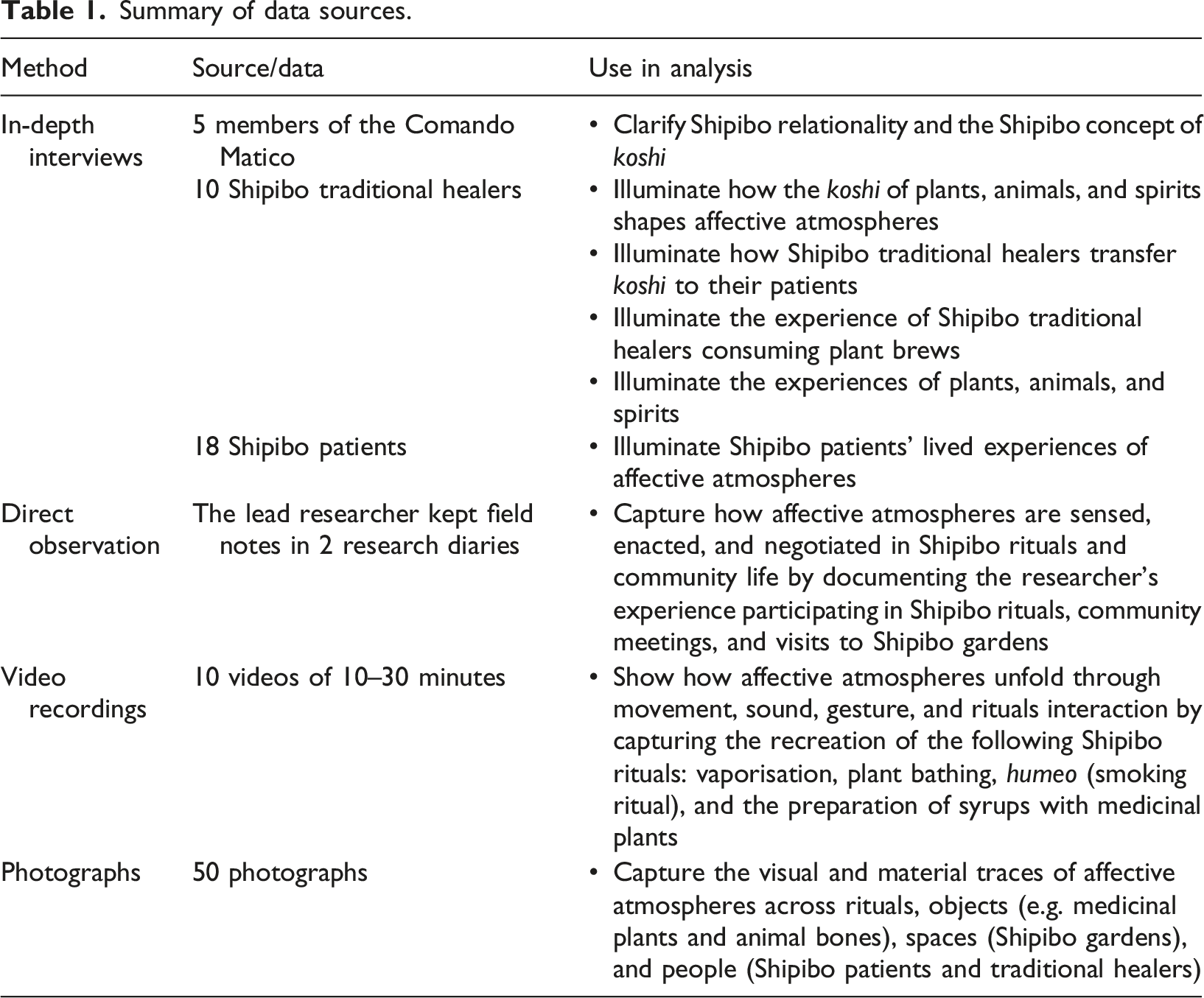
The Shipibo authors provided guidance on data analysis and interpretation. During data collection, the first author had several opportunities to present and discuss preliminary findings with the Shipibo authors, who provided input to enrich the analysis and interpretation via casual conversations, meetings, and phone calls. We used thematic analysis (Braun and Clarke, 2023), prioritising Shipibo concepts about more-than-human entities. The data were analysed using an inductive-deductive approach. The first author reviewed the transcripts several times, which helped to gain familiarity with the data and explore potential codes and themes (Braun and Clarke, 2023). Then, he created a preliminary list of codes based on the Shipibo literature and field notes and these documents were shared with the research team. The dataset was coded with the aid of the qualitative research software NVivo (version 14). The lead-author and Shipibo authors frequently engaged via online meetings, which enabled refinement and adjustments to emerging interpretation and suggested new ways to understand the data.
Findings
Our findings present three strategies through which more-than-human entities’ affective energy shapes atmospheres: (1) emanating koshi to communicate presence and power, (2) storing koshi in their bodies for future use in rituals, and (3) transferring koshi to humans. Figure 1 provides a conceptual diagram for how the findings themes are discussed. Visualising how plants, animals, and spirits shape atmospheres through their (non-human) affective energy.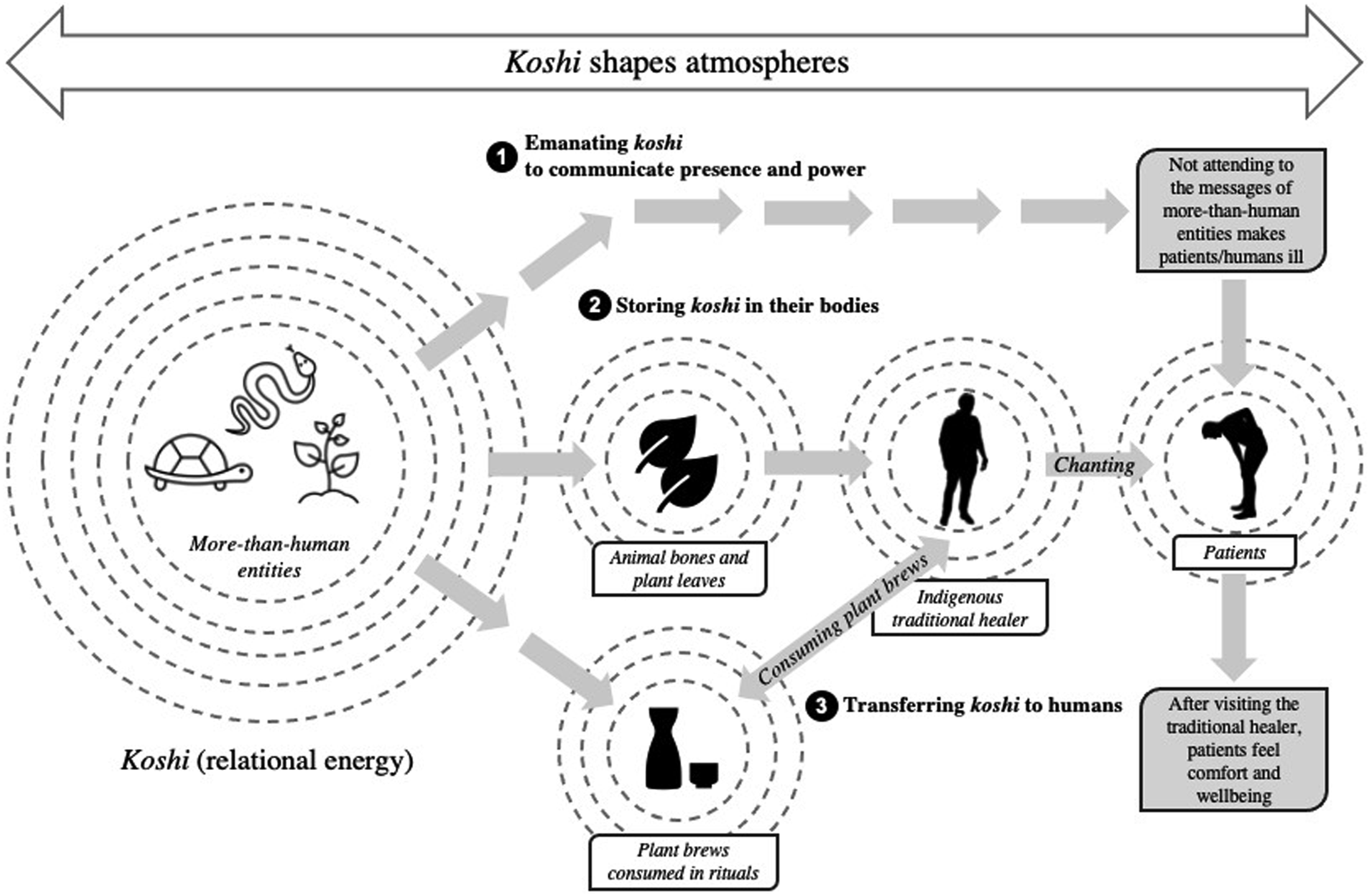
Emanating koshi to communicate presence and power
Our analysis identified that in the Shipibo context, plants, animals, and spirits shape atmospheres by emanating koshi contained within themselves. In the following example, Ricardo (Shipibo traditional healer) explains this atmospheres-making strategy: When I was in my community, illnesses caused by the environment were more common. Sometimes mal de aire
5
, sometimes the energy of the trees, the energy of anacondas or bufeos (Amazon River dolphin) or other beings of nature.
In this quote, Ricardo presents animals and plants as atmospheric elements within the Shipibo context. He describes them as energetic beings able to emanate koshi to the environment. Prior research has highlighted the capacity of objects, chants, and symbols to create atmospheres, but that humans mediate this process (Hill et al., 2022; Woodward and Swartjes, 2023). For example, plants and geographies shape atmospheres through symbolic and emotional content imbued by consumers (Canniford and Shankar, 2013; Woodward and Swartjes, 2023). Here, however, more-than-human entities release koshi contained within themselves to the environment. This release emerges not solely from their individual agency, but from relational capacity (Bawaka et al., 2016). Animals and plants release koshi to communicate their presence and power to humans or other beings in the environment. As a relational affective energy, koshi functions as a connective tissue among beings, revealing who they are and who should be honoured. The three animals mentioned in the quote are regarded as sacred by the Shipibo community and, thus, must be respected and attended to by humans. Failing to acknowledge their role or respond to their messages can disrupt this relational energy, producing what Ricardo describes as ‘illnesses’, affecting human health and well-being. This is also more evident when Teodoro (Shipibo traditional healer) refers to the otter, regarded as a sacred and powerful animal in Shipibo spirituality. Teodoro says: ‘I just came from there, from treating a patient. An otter had harmed the patient; it had cutipado her. The patient was in pain’. When Teodoro mentions ‘cutipado 6 ’, he refers to a spiritual illness produced by the otter’s koshi.
We also identified that koshi manifests with different intensities. In the following text, Braulio (Shipibo patient) describes the intensity of koshi of a group of Amazonian plants: […] but when I came in there, I felt a lot of energy. It seems to me that it was because of that medicinal plant that he had, but I have not been able to ask him what plant he is using in my treatment. I felt that strong smell. I think it was a plant that we call ininti
7
.
In this quote, Braulio explains that the koshi of medicinal plants is so intense that it fills the space and helps create an atmosphere capable of producing pleasurable experiences (Biehl-Missal and Saren, 2012; Preece et al., 2022). Atmospheric intensity is more usually understood as being shaped by humans (Hill et al., 2022; Steadman et al., 2021). Collective effervescence is developed gradually when consumers group and is achieved once consumers form large crowds and are aligned in mood, rhythm, and intention (Hill et al., 2022). Yet, here, more-than-human entities, such as a bunch of small plants, can be a source of intense relational energy. The Shipibo authors use the term ani koshi (strong relational energy) to describe the strong energy produced by plants and animals that fills place and space. In the Shipibo context, this atmospheric intensity is spiritually bounded. Not all Amazonian plants have the capacity to create intense koshi. Braulio refers specifically to tanti rao (See Figure 2), a group of plants used to address spiritual illnesses through their intense aromas. Indeed, smells play a key role in shaping atmospheres (Canniford et al., 2018; Steadman, 2024). Only plants known as rao (medicine) have the capacity to generate jakon koshi that supports well-being. From the Shipibo perspective, then, the intensity of atmospheres varies according to the type of more-than-human entity and its role in a cultural and spiritual system, not simply down to the grouping of entities. Tanti rao is a group of Amazonian plants known for their intense aromas.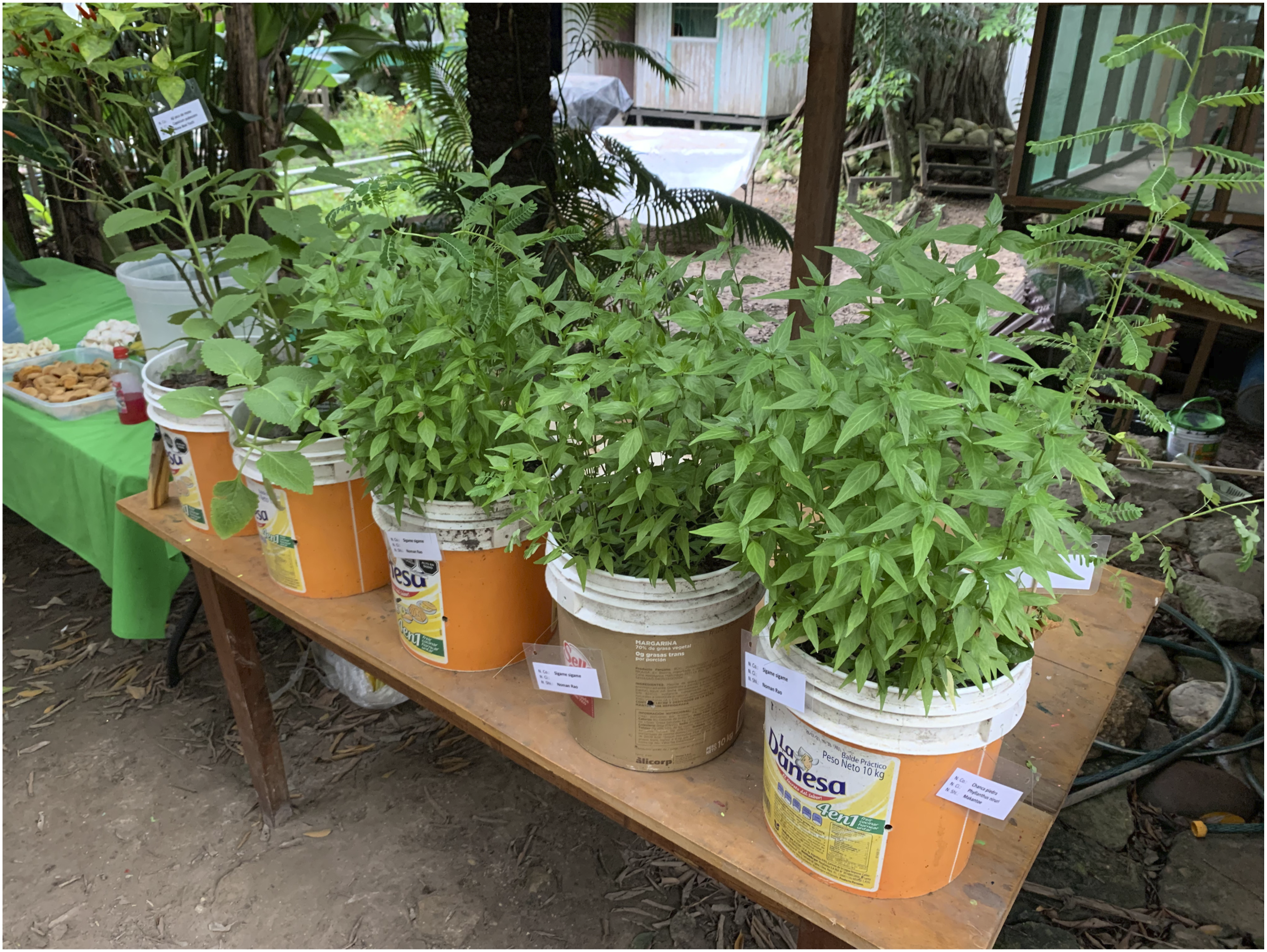
While more-than-human entities emanate koshi into the environment to communicate their presence and power, there are some instances in which they co-create atmospheres with humans more directly, as we explain later in the article.
Storing koshi in their bodies for future use in rituals
In the Shipibo context, more-than-human entities, such as plants and animals, store koshi in their bodies or part of their bodies (e.g. bones, skin, roots, barks, etc.) for future use. In the following text, Lorenzo (Shipibo traditional healer) explains how koshi stored in more-than-human bodies is activated: They say that when you burn that type of bones, its smoke spreads, and the devil and evil spirits cannot come because it is smoke from a strong animal. For example, the bones that we burned were from alligators and turtles, which are large and strong animals. We chose the bones of those animals so that the spirits feel their smoke and say, ah, this is not just any smoke. [This is the smoke of a strong animal] I’m leaving. So, the smoke is what takes care of it, the energy of those animals stays in the smoke.
In this quote, Lorenzo notes that koshi remains dormant in animals’ bodies and can be activated and released to the environment to foster an atmosphere that provides spiritual protection (Cateriano-Arévalo et al., 2024). The presence of the devil and evil spirits disrupts spatial harmony, filling the environment with jakoma koshi (negative relational energy) threatening Shipibos’ health and well-being. To restore balance, Shipibo families burn animal bones in smoking rituals to fill the environment with jakon koshi (good relational energy). Jakon koshi ‘attunes’ energy and restores balance, fostering an atmosphere with positive effects on humans (cf. Stewart, 2011). Navaro-Yashin (2009) has shown that in post-war settings, objects, dwellings, and spaces ‘store’ residual sentiments of trauma and loss that are discharged to create atmospheres. Here, we show that animals and plants discharge stored affective energy in concert with humans to protect them from the devil and evil spirits, but this process is contingent on prior permission. Such permission is obtained by addressing the plant or animal with respect, often through verbal communication, prays, or by offering a small gift, like tobacco (Cateriano-Arévalo et al., 2024). Our ethnographic video recreates how animals, plants, fire, smoke, smells, and humans come together to generate relational energy that fosters atmospheres that provide feelings of comfort and relief in patients affected by spiritual entities and can be accessed through the following link: https://youtu.be/uCVCA4UwBq0.
Lorenzo’s quote also highlights the role of koshi in mediating the communication between humans and more-than-human entities. In the Shipibo context, plants, animals, and spirits are imbued with cultural, symbolic, and spiritual meaning. Lorenzo describes alligators and turtles as large, strong animals, whose bodily features carry symbolic meaning (Hill et al., 2022). The bones of these sacred animals are burned in smoking rituals to produce smoke charged with jakon koshi, which signals to spiritual entities that Shipibo families are protected. Put simply, Shipibo families cannot communicate directly with spirits; rather communication is mediated through the meanings embedded in the koshi of alligators and turtles.
This section shows that more-than-human entities store koshi in their bodies, which can be activated by humans once permission is granted. Such activation aims to restore balance disrupted by spiritual beings and to protect Shipibo families from spiritual illnesses. The release of jakon koshi contained in the bones of alligators and turtles fosters an atmosphere with beneficial effects on humans. In the following section, we present a more direct way of co-creation, in which the koshi of more-than-human entities is intentionally transferred to humans’ bodies.
Transferring koshi between more-than-human and humans
More-than-human entities, such as plants, animals, and spirits, can also transfer koshi to humans, particularly to traditional healers. This transfer is not accidental. The Shipibo authors explain that it requires that traditional healers prepare their bodies, minds, and spirits through sustained plant-based diet rituals. Cirilo (Shipibo traditional healer) illustrates: The dieta is to purify us physically and spiritually… The energy of plants enters our body and speaks with us from the first days we take the dieta. I did the dieta for four months. After four months, you don’t have any fears, you don’t have any problems, you don’t think about anything. Then, the energy of plants enters to you.
Here, atmospheres are described as energetic flows that pass from more-than-human entities to humans. Atmospheres can be understood as affective forces passing between people and things (Bille et al., 2015), generating bodily and affective responses that consumers may find difficult to resist (Hill et al., 2014). In this regard, Navaro-Yashin (2009) explains that more-than-human entities execute agency by discharging affective energy to the environment and this energy creates atmospheres that impact humans in profound ways. We present plants and spirits as more-than-human entities that exercise their agency to transfer koshi to traditional healers with determination. The Shipibo authors explain that plants and spirits transfer their energy when they recognise that traditional healers have fulfilled plant-based rituals with respect and when they perceive their intentions as benevolent; for instance, when the energy is sought to treat spiritual illnesses in the community. In other words, more-than-human entities, specifically spirits and plants, draw on their agential capacities to determine when, how, and to whom koshi is passed.
Cirilo’s account also illustrates that koshi circulates between and through human and more-than-human bodies, a movement made possible because they form an entanglement. Scholars point out that consumers have porous boundaries (Hill et al., 2014; Thrift, 2008), allowing the affective energy of other beings (human or more-than-human) to become their own (Brennan, 2004; Navaro-Yashin, 2009). Indeed, the body plays a vital role in shaping atmospheres by affecting and being affected by the environment (Yakhlef, 2015). We present humans, plants, and spirits as beings with blurred boundaries, whose bodies form an entanglement that cannot be separated into the social or the material. Indeed, in Indigenous thought, material, social, and spiritual are inseparable (Watts, 2013). Prior research highlights how hybrid entities emerge through interaction, symbiosis, dependency, and entanglement of different beings and how such configurations shape consumption (Bettany and Daly, 2008; Helkkula and Arnould, 2022). We supplement this insight by introducing spirits, plants, and humans as a hybrid entity that enables the transfer and circulation of koshi between and through their bodies. In doing so, our study shows that more-than-human entities work alongside humans to shape atmospheres in this Indigenous context.
Traditional healers also shape atmospheres by transmitting the relational energy of plants and spirits to their patients via chants performed during healing rituals. These chants mediate the flow of affective energy and can influence patients’ well-being. Rodrigo (Shipibo traditional healer) explains this: We transmit energy to our patients. That’s the ikaro. Through this chant, we channel the energy of plants. Chants are our energetic scalpel… It is an energetic charge that we transfer to patients.
Chants are symbolic resources produced and shared by consumers in affective environments and spiritual contexts, helping to develop and sustain atmospheres (Hill et al., 2022; Rodner and Preece, 2019). In this context, chants function as affective elements of the Shipibo world, enabling the co-creation of atmospheres between humans and more-than-human entities. Rather than solely staging atmospheres by infusing emotional content in chants (Steadman and Coffin, 2024), traditional healers use chants to facilitate spirits and plants to manifest and release jakon koshi (good relational energy) to fill the environment. This process generates feelings of relief and comfort in patients. Our ethnographic video recreates the moment when Rodrigo (Shipibo traditional healer) engages with plants and spirits via chants to emanate koshi to the environment https://youtu.be/emRQ3RgxIFA. This aspect is also evident in the following text, which is an excerpt of the chant
8
sang by Rodrigo in the video: I’m going to do the protection, now I’m going to do the protection. I’m going to sing about protection. I’m going to protect you, now I'm going to protect you. With my own medicine, with my own medicine. I have several doctors, surgeons, nurses, ra, ra, rarei. Now, I'm going to protect you. I’m going to sing now for protection, I will.
Rodrigo’s chant tells us about the effects of jakon koshi produced by humans and more-than-humans on people. Atmospheres are usually associated with various consumer behavioural responses (Biehl-Missal and Saren, 2012; Bitner, 1992). Here, the relational energy emerging from the entanglement of humans, plants, animals, and spirits is used by traditional healers to address spiritual illnesses. Existing research focused on spiritual contexts accounts for how atmospheres of sacred spaces and things generate affective and healing vibes that may lead to feelings of relief and renewal in consumers (Higgins and Hamilton, 2019; Rodner and Preece, 2019). For example, Rodner and Preece (2019) explain how in Afro-Brazilian faith practice, mediums, rituals with animals, medicinal herbs, music, drumming, and chants shape atmospheres of well-being and recovery that have positive effects on consumers. Indeed, places, materials, and people generate affective atmospheres that pass in and through human bodies to produce well-being (Duff, 2016). Here, we see that koshi used for healing purposes is constructed through various atmospheric elements of the Shipibo context, including plants, spirits, traditional healers, consumption rituals, and chants.
In this section, we showed how more-than-human entities, specifically plants, animals, and spirits, actively transfer koshi to traditional healers who have prepared themselves through sustained plant-based rituals. Plants and spirits exercise their agency, passing their koshi to humans, deciding when to transfer it, to whom, and for what purpose. This passing occurs because humans, plants, and spirits form an entanglement. Traditional healers mediate and extend this relational energy through chants, which functions as atmospheric elements that channel koshi, producing an atmosphere with favourable effects on humans.
Discussion
This article contributes to our understanding of how more-than-human entities, like plants, animals, and spirits, produce affective energy that shapes atmospheres. We show that from an Indigenous perspective human and more-than-human entities produce relational and affective energy that merges across place and space, permeating the environment and fostering atmospheres. This relational and affective energy is linked to the spiritual dimension of humans and more-than-human entities, not exclusively to their physical or symbolic dimension. We develop this argument by adopting Indigenous relationality (Bawaka et al., 2016; Tynan, 2021) and, more specifically, by introducing and engaging with the Shipibo concept of koshi. Koshi is a form of relational energy co-created by humans, plants, animals, and spirits, that is grounded in spirituality and connected to the cosmos (Valera et al., 2019). This is congruent with the notion of more-than-human vitality shared by other Indigenous groups worldwide (Antric and Reeder, 2025; Bawaka et al., 2016).
Our Indigenous relational approach enabled us to present humans and more-than-human entities as ontological equivalents. Indeed, Indigenous thought proposes a flat ontology (Wilson, 2008; Yunkaporta, 2019). In this study, we show that plants, animals, and spirits participate actively in shaping atmospheres alongside with humans. In doing so, we enrich prior conversations about the agency and self-organising capacities of materiality (Braidotti, 2018; Haraway, 2003) and the need to flatten ontological hierarchies pertinent to consumption studies (Bajde, 2013). Marketing scholars have shown that more-than-human entities, like objects, chants, and symbols, shape atmospheres of consumption through their physical, cultural, and symbolic features, producing multi-sensorial experiences in consumers (Hill et al., 2022; Steadman, 2024). Navaro-Yashin (2009) theorised the agency of more-than-human entities by introducing the notion of affective energy, which is the energy autonomously discharged by these entities to the environment independent of the symbolic meanings assigned to them by humans. Our article contributes to our understanding of affective energy by arguing that plants, animals, and spirits are conscious beings, capable of emanating koshi (relational energy) with determination and purpose and through the influence/request of humans, particularly from traditional healers. Plants, animals, and spirits release koshi to communicate their power and presence to humans and store this energy in their bodies for future use, producing in both cases effects on humans. Similarly, we also show that these beings execute their agency by transferring koshi to traditional healers and this is done after recognising that they have fulfilled plant-based rituals with rigour, which is a demonstration of respect. This means that plants, animals, and spirits decide when, how, and to whom relational energy or koshi is transferred. Finally, by using Indigenous relationality, we move to a more holistic conceptualisation of atmospheric elements, typically described in terms of material and social. We emphasise that humans and more-than-human entities co-become together in place and space. We argue that humans, plants, animals, and spirits shape atmospheres as an entanglement of beings, rather than as separate entities. This is done by emanating, storing, and transfer of koshi among beings.
Our article also contributes to rethinking the purpose of atmospheres. Atmospheres are typically employed to produce aesthetic and sensory effects on humans (Steadman and Coffin, 2024). Here, however, we explain that atmospheres function as an indicator of the quality of human and more-than-human relations in place and space. That is, we point to how atmospheres feel ‘right’ when humans and more-than-human entities are in harmony, when their energies are in sync, something that the Shipibo authors call jakon koshi (good relational energy). This harmonious relation produces positive effects on humans, like feelings of relief and comfort and is experienced predominantly in healing rituals. Western research highlights that the creation of atmospheres can ‘fail’ when individuals are not entrained or when they do not share rituals (Hill et al., 2022). Here, we show that the state of harmony necessary to create atmospheres in the Shipibo context is disrupted when plants, animals, and spirits are not acknowledged and respected. This state of disruption might generate negative relational energy, something called jakoma koshi by the Shipibo authors, producing spiritual illnesses that require ritual responses. We also highlight how koshi serves as a means of communication between humans and more-than-human entities. Plants, animals, and spirits can communicate with each other and to humans through koshi emanated by their bodies. For example, we showed how in outdoor spaces, animals communicate their power and presence to other beings, including humans, by emanating koshi to the environment. Similarly, in smoking rituals, koshi emanated at burning animal bones and plant leaves is used to send a message to spiritual entities threatening humans. Western research states that humans cannot communicate directly to animals and plants and vice versa, and thus, need proxy representatives, like ecologists (Coffin, 2021). Our study highlights that the koshi of plants and animals is charged with meaning that can be interpreted by humans and more-than-human entities.
Our study and our focus on the Shipibo Indigenous group engages with decolonising conversations in marketing and showcases the importance of incorporating Indigenous perspectives (Bádéjọ et al., 2022). Rather than presenting Indigenous ideas as othered knowledge, we give primacy to Indigenous ways of being, knowing, and doing to understand consumption atmospheres (Raciti, 2023). By using non-Western theorisations and non-Cartesian modes of research grounded in Shipibo ontologies and epistemologies, we provide a plural interpretation of atmospheres that can re-dress the way we understand consumption and the role of more-than-human entities (Arnould, 2022; Coffin, 2021). For instance, instead of viewing consumption as the use of goods and services for profit, we highlight its grounding in a subsistence economy (Hemais and Rodrigues, 2023), where exchange is organised through reciprocity and small-scale trade between families. Moreover, the inclusion of Indigenous chants and rituals for studying the role of more-than-human entities in shaping atmospheres was culturally sensitive and ethical (Raciti, 2023; Smith, 2021). We focused on chants and rituals as natural methods to identify the (more-than-human) elements of the Shipibo context, namely, spirits, plants, and animals, and explain how they emanate koshi. For the Shipibo, chants and rituals represent the way more-than-human entities manifest to the physical world and connect with humans, and this embraces affective and relational perspectives according to Shipibo ontologies (Belaunde, 2016).
On a methodological level, our study contributes to non-representational marketing theory (Hill et al., 2014) by showing the potential of visual methods to capture the difficult-to-represent character of atmospheres (Steadman and Coffin, 2024). By incorporating photographs and video recordings, we captured the affective and intense character of atmospheres, showing how more-than-human entities intervene in consumers’ everyday life, affecting their bodies and minds. Our study also enriches current conversations on more-than-human phenomenology in marketing (Coffin, 2021; Grant et al., 2025) and whether animals and plants have the same interiority than humans (Gagliano, 2018; Singer, 1975). Although our data were not collected directly from plants, animals, and spirits, the insights shared by Shipibo traditional healers through interviews, conversations, and observations allowed us to access understandings of more-than-human entities experiences. This non-representational approach helped us to move from a customer-centric perspective of atmospheric research to a holistic representation of consumption in which we tried to present and interpret the experience of more-than-human entities (Coffin, 2021; Coffin and Hill, 2022).
Practically, our findings seek to inform atmospheric design (Turley and Chebat, 2002) in healthcare services for Indigenous people. Atmospheric design in service ecosystems is usually led by marketers (Biehl-Missal and Saren, 2012) and most recently the input of consumers has been considered (Hill et al., 2022). We recognise that designing atmospheres in healthcare services for Indigenous people needs to respect their holistic understanding of health and illness. For Indigenous people, health is a multi-faceted concept, comprising physical, mental, and spiritual health at an individual and community level, and where the participation of more-than-human entities is key (Yamane and Helm, 2022). This can be done by encouraging policy makers and services marketers to co-create services with Indigenous people and incorporate their ideas and endogenous initiatives with respect (Pesantes and Gianella, 2020). Such an approach would be demonstrative of how to effectively decolonise healthcare for Indigenous people and avoid tokenism and the commodification of Indigenous ideas and practices (George et al., 2023). This integration is also important because Indigenous atmospheric components are a source of health and well-being for Indigenous people and such benefits can be extended to non-Indigenous groups (Pesantes et al., 2023; Yunkaporta, 2019).
Furthermore, the integration of atmospheric elements of Indigenous contexts, such as plants, smoking ceremonies, and rites into Western healthcare services is possible and necessary (Pesantes et al., 2023). Some lessons about this integration can be learned from consumption atmospheres in other servicescapes. For example, Indigenous smoking ceremonies are common in football games in Australia and constitute a demonstration of how the values of Indigenous people can be incorporated within consumption atmospheres (Mathieson, 2024). Simultaneously, this integration is aligned with the national and international efforts for reconciliation with Indigenous communities and is a source of recognition of Indigenous ideas and practices. Marketers need to pay more attention to how the integration of atmospheric elements of Indigenous contexts shapes consumers’ experiences and creates value in consumption settings. To do so, it is important to work in partnerships with Indigenous organisations (Cateriano-Arévalo et al., 2025).
Nonetheless, our study has some limitations that are opportunities for future research. First, while we found that consumption atmospheres in Indigenous contexts are shaped by the dynamic encounters between humans and more-than-human entities, the specificities of this process and the type of more-than-human entities presented in this article correspond to the Shipibo world. Future research must investigate atmospheres in other Indigenous contexts and across other more-than-human entities to complement our findings. Second, for ethical reasons, we did not document the performance of Shipibo consumption health-related rituals in real patients, but we asked participants to re-enact consumption rituals, while we recorded videos and took photographs. We manage the impact that this method of data collection could have had on our findings by triangulating the photographic and video data with the interview data. Third, we have explained that atmospheric elements can form complex entanglements that transcend the human and more-than-human bodies. This study therefore encourages future research to examine the hybridity of humans and more-than-human entities in atmospheres of consumption through an assemblage theory lens. This article provides an Indigenous perspective of atmospheres. We invite researchers to further explore the distinctions, similarities, and overlaps between the Western concept of atmospheres and the Indigenous perspective of atmospheres presented in this article. Finally, we acknowledge that researching plants, animals, and spirits, poses methodological challenges for Western researchers. In this study, we drew on the knowledge of Shipibo traditional healers to access more-than-human experiences; this in line with our Indigenous methodological approach. In Western scholarship, research on animals’ experiences has proposed multi-species ethnographies that includes methods, such as parallel interviews, to harness and ‘speculate’ on non-human experiences (Grant et al., 2025). Relatedly, disciplines such as Geography has advanced approaches such as attunement with animals, which involves close, in situ observation of animals’ behaviours to map their umwelt; sometimes supported by tracking and sensing technologies, as long as ongoing reflexivity regarding the researcher’s standpoint (Lorimer et al., 2019). Future marketing and consumer research could consider methodologies and methods that accounts for more-than-human experiences and reflect on the ontological and epistemological challenges of this task.
Footnotes
Acknowledgements
We thank Dr Liz Foote, Dr Hayden Cahill, Dr Jorge Carlos Fiestas, and Mrs Laura Fontaine for their generous contributions in reviewing and providing feedback on our manuscript, along with the editors of the special issue and four anonymous reviewers who helped us improve the manuscript.
Funding
The authors received no financial support for the research, authorship, and/or publication of this article.
Declaration of conflicting interests
The authors declared no potential conflicts of interest with respect to the research, authorship, and/or publication of this article.
Notes
Author biographies

, X: @DrRossGordon
Shipibo chant and its translation to English
Shipibo-Konibo
English
Kano abanon, rama kano abanon
I’m going to do the protection, now I’m going to do the protection
Eara bewai, kanokira ikai
I’m going to sing about protection
Kano axonban, rama kano axonban
I’m going to protect you, now I’m going to protect you
nokon medicinabiri, nokon medicinabiri
With my own medicine, with my own medicine
Rokotorokaiya, cirujanokaiya, cirujanokaiya, enfermerokaiya, ra, ra, rarei
I have several doctors, surgeons, surgeons, nurses, ra, ra, rarei
Rama kano axonban
Now, I’m going to protect you
Kano bewai rama kano bewai, iishamani
I’m going to sing now for protection, I will
Nato medicinabiribi, nato medicinabiribi, nokon ibo diosan noa joxon menini, noa cirujia onanmani
About this medicine, about this medicine, that God gave us when he came here, he taught us to do surgery
Kano shinantananra, kano shinantananra, rama kano ixonban, miabiribi ixonban eara ikai bewai mikiiii
Thinking about protection, thinking about protection, I’m going to sing to you for protection, dedicated to you, I’m going to sing to you
Coronavirosbo, coronavirusbokaya, COVID-virusbokaya keyo-keyobainkin, soa-soabainkin, kanon keyokin, COVID-viruskeyokin, jonin yorashamanbi, jonin kayashamanbi, ea bewai, médiconin bewai, eeeshamani
The coronavirus, the coronaviruses, the COVID-virus, I’m going to finish, I’m going to cleanse, I’m going to exterminate it with the protection, I’m going to cleanse the COVID-virus from the body of the person, from the soul of the person, I’m going to sing, the doctor is going to sing, singing with a lot of feeling
Kano bewai rama kano bewai, iishamanironki
I’m going to sing now for protection, I’m doing it with a lot of feeling
Rama kano ixonban, mia sawebiribi, mia aki bobanon, mia aki bobanon iishamani, kano bewai medicina rokotorobo, medicina cirujanobo, rabe enfermerobo, ehhrare, ehhh
Now, I’m going to sing for protection, I’m going to make you use (protection), I am going to take you to protect (through the ikaro), I’m going to sing for protection there are the doctors, surgeons, two nurses, ehhrare, ehhh