







Abstract
Motivation crowding out can lead to a reduction of ‘higher’ virtues, such as altruism or public spirit, in market contexts. This article discusses the role of virtue in the moral and economic theory of Adam Smith. It argues that because Smith’s account of commercial society is based on ‘lower’ virtue, ‘higher’ virtue has a precarious place in it; this phenomenon is structurally similar to motivation crowding out. The article analyzes and systematizes the ways in which Smith builds on ‘contrivances of nature’ in order to solve the problems of limited self-command and limited knowledge. As recent research has shown, a clear separation of different social spheres can help to reduce the risk of motivation crowding out and preserve a place for ‘higher virtue’ in commercial society. The conclusion reflects on the performative power of economics, arguing that the one-sided focus on models of ‘economic man’ should be embedded in a larger context.
It is, therefore, a just political maxim, that every man must be supposed a knave: Though at the same time, it appears somewhat strange, that a maxim should be true in politics, which is false in fact. David Hume, Essays: Moral, Political and Literary.
1. Introduction
If you want people to offer more of an activity, you need to pay them more – so economists commonly assume. Human beings, after all, maximize their utility, which implies that they want to be compensated for the disutility of work. This assumption about human self-interest is often associated with Adam Smith, the ‘father’ of political economy. But there is a puzzling phenomenon which contradicts this common assumption: motivation crowding out. 1 Researchers in psychology and behavioral economics have explored the question of whether human beings sometimes have an ‘intrinsic’ motivation to do certain things, for example, to solve problems or to engage in social activities, which can be ‘crowded out’ if they are offered monetary incentives, that is, ‘extrinsic’ motivation. The subfield of motivation crowding out that is interesting for the purpose of this paper is the crowding out that can occur when a situation is turned into a market situation: virtuous, pro-social behavior can be crowded out if monetary compensation is offered. 2
This article discusses the relation between ‘higher’ and ‘lower’ virtues in the thought of Adam Smith, analyzing why he refrains from putting too much weight on ‘higher’ virtues in his social and economic theory. 3 First, it takes a fresh look at the structural relations between the different passions and the ways in which Smith uses unintended consequences in order to bring about social order. As will be shown, a clear distinction can be drawn between cases in which nature has itself provided the means for overcoming the weaknesses of human nature and cases in which institutions are needed in cooperation with nature in order to bring about positive effects.
As will become clear, however, this makes the place of higher virtue (and to a certain degree also the place of the ‘social passions’) in commercial society precarious. It is here that we find a structural similarity with motivation crowding out. Understanding the mechanisms Smith builds on can help us to understand why confusion between different social spheres can arise, and how this relates to motivation crowding out. As will be argued, however, for Smith there is nonetheless a place for ‘higher’ virtue in commercial society, although it may not lie in the full-hearted pursuit of self-interest. The article concludes by offering some reflections on the performative force of economics, and in particular economic teaching.
2. The weakness of human nature and nature’s wise contrivances
The most famous line in Smith is probably his claim that ‘[i]t is not from the benevolence of the butcher, the brewer, or the baker, that we expect our dinner, but from their regard to their own interest’ (1976b: I.II.2). But Smith is also the author of The Theory of Moral Sentiments,
4
whose first line emphasizes that there is more to human nature than self-interest: How selfish soever man may be supposed, there are evidently some principles in his nature, which interest him in the fortune of others, and render their happiness necessary to him, though he derives nothing from it except the pleasure of seeing it. (Smith, 1976a: I.I.1.1)
First, people differ in their capacity of self-command (which Smith sometimes also calls ‘reason’ or ‘principle’ (compare 1976a: III.III.4). Self-command is a virtue, even that virtue ‘from [which] all the other virtues seem to derive their principal lustre’ (Smith, 1976a: VI.III.11). Many of the human weaknesses that Smith describes in The Theory of Moral Sentiments, ranging from insufficient mastery of the passions (1976a: I.I.5.8) to the lack of moral sensitivity (1976a: III.V.1), self-delusion (1976a: III.IV.4), the tendency to vanity (1976a: III.II.4), and seduction by the ‘prejudices of the imagination’ in places where ‘reason and experience’ should reign (1976a: I.III.2.2), have to do with a lack of self-command. Only a minority of men manage to fully conquer these weaknesses. They are admired for exercising self-command where most people fall prone to the ‘temptation to do otherwise’ (Smith, 1976a: VI.III.11) and for forming their moral ideas with ‘the most acute and delicate sensibility’ (Smith, 1976a: VI.III.25).
A second dimension in which men differ concerns the epistemological abilities that are connected to moral judgment, which Smith sometimes calls ‘wisdom’ (for example, 1976a: VI.I.16). 7 Smith is not very explicit about what wisdom consists in; although Waszek (1984: 594) is right to point out that among the few morally outstanding men mentioned in The Theory of Moral Sentiments there are a number of philosophers (Socrates, Cato, and Thomas More), it is striking that Smith also discusses the example of the ‘savages in North America’ (1976a: V.II.9, VII.II.1.28). As is clear from his essay Of the External Senses, Smith’s epistemology is largely empiricist, although he also argues for the existence of some ‘instinctive perception’ which helps humans to make the right connections between what they see and what they feel (1980a: 132 ff., paras 68–9). His theory of science, which is developed in the History of Astronomy, 8 describes the human urge to ‘introduce order into this chaos of jarring and discordant appearances' by finding the ‘invisible chains which bind together all these disjointed objects' (Smith, 1980b: II.12). The human mind naturally looks for familiar patterns in what it experiences. New or unexpected experiences form gaps in the web of experience that raise a spontaneous urge to fill them. ‘[P]hilosophers or men of speculation’, ‘whose trade it is, not to do anything, but to observe every thing’ (Smith, 1976b: I.I.9), see even more gaps than the ‘bulk of mankind’ – they have ‘like the musician, acquired, if one may say so, a nicer ear’ for them (Smith, 1980b: II.11). In parallel, one can argue that for Smith morally outstanding people have a ‘nicer ear’ for all aspects that can play a role in moral evaluations: they are ‘capable of suiting, with exact justness, their sentiment and behaviour to the smallest difference of situation’ (1976a: III.V.1), which presupposes the perception of these differences. Smith does not make clear whether he thinks that this ‘nicer ear’ can be acquired by everyone or whether it has an innate component. 9 It is clear, in any case, that the ‘bulk of mankind’ cannot be supposed to possess such wisdom; they often have neither time for, nor interest in, acquiring it. 10
One aspect of wisdom might consist in extensive knowledge of natural and social phenomena, which leads to a distinction that is relevant in the present context: Haakonssen’s distinction between ‘contextual knowledge’ and ‘system knowledge’ in Smith. 11 While ‘contextual knowledge’ is limited to factors directly relevant to one’s situation, ‘system knowledge’ describes ‘the understanding of things, events, or persons in some sort of functional relationship to a greater “whole” or system – or the understanding of all the elements in such a system’ (Haakonssen, 1981: 79). It is clear that the ‘bulk of mankind’ possess contextual rather than system knowledge – the latter is acquired only by ‘men of speculation’, that is, philosophers and scientists. 12
In Smith’s picture, the ‘bulk of mankind’ are thus rather limited with regard to self-command and epistemic abilities. It is ‘but a small party’ (Smith, 1976a: I.III.3.2) who are morally outstanding and strive for higher virtue. 13
Smith’s moral philosophy reflects this observation by distinguishing between different standards of moral achievement. 14 On the one hand, there is a higher standard of ‘complete propriety and perfection’ (Smith, 1976a: I.I.5.9, compare VI.III.23), which ‘deserves to be admired and celebrated’ (Smith, 1976a: I.I.5.7). This first standard is a moral ideal which no man can ever really reach (Smith, 1976a: I.I.5.9, compare also VI.III.23). The ‘wise and virtuous man’, however, aspires to reach it, and continually works toward it. (Smith, 1976a: VI.II.25). Smith takes it to be possible to rise at least ‘considerably above the common level’ (1976a: VI.III.48).
On the other hand, there is a lower standard of ‘mere propriety’, the standard ‘the actions of the greater part of men commonly arrive at’ (Smith, 1976a: I.I.5.9). It is a kind of minimum standard for ethical behavior: Whatever goes beyond this degree, how far soever it may be removed from absolute perfection, seems to deserve applause; and whatever falls short of it, to deserve blame. (Smith, 1976a: I.I.5.9)
Smith, however, is not only a moral philosopher, but also a social theorist and economist. As such, he is interested in how there can be peaceful social life and economic progress given the fact that most men, most of the time, do not behave in morally outstanding ways. The question of how he thinks this can be achieved needs to be considered next.
For Smith, the world is the creation of a benevolent deity (compare, for example, 1976a: III.V, VII.III.3.20). The cosmos is designed such that ‘[i]n every part of the universe we observe means adjusted with the nicest artifice to the ends which they are intended to produce’ (Smith, 1976a: II.II.3.5). This is Smith’s metaphysical background assumption, but when describing and analyzing the mechanisms of the social world, his approach is strictly ‘scientific’: he describes the laws of nature, including human nature, which can be deduced from empirical observations. 15
Smith states that ‘man, who can subsist only in society, was fitted by nature to that situation for which he was made’ (1976a: II.II.3.1). To achieve this aim, nature has ‘given’ man tasks which are ‘suitable to the weakness of his powers, and to the narrowness of his comprehension’ (Smith, 1976a: VI.II.3.6). Smith’s writings abound with observations on the ‘contrivances of nature’ which help to achieve this aim.
Many Smith scholars have emphasised that for Smith man’s natural self-interest can be channeled by means of institutions (for example, secure property rights) in ways that serve the public good. As Rosenberg has famously put it, the Wealth of Nations provides ‘details of the institutional structure, which will best harmonize the individual’s pursuit of his selfish interests with the broader interest of society’ (1960: 559).
16
Smith’s emphasis on mutual beneficence and altruism within the closer circles of family, friends, and neighbors has equally been underlined.
17
As I will show, there is a systematic connection between these two dimensions of his thought, between the kinds of passions at stake, and between the question of whether nature has provided its own solution to a problem, as it were, or whether institutional support is needed. Put together, these different mechanisms allow for an arrangement that suits the limited capacities of the 'bulk of mankind'. Expressed in Smith’s theological language, these mechanisms show that every part of nature, when attentively surveyed, equally demonstrates the providential care of its Author, and we may admire the wisdom and goodness of God even in the weakness and folly of man. (1976a: II.III.3.2, emphasis added)
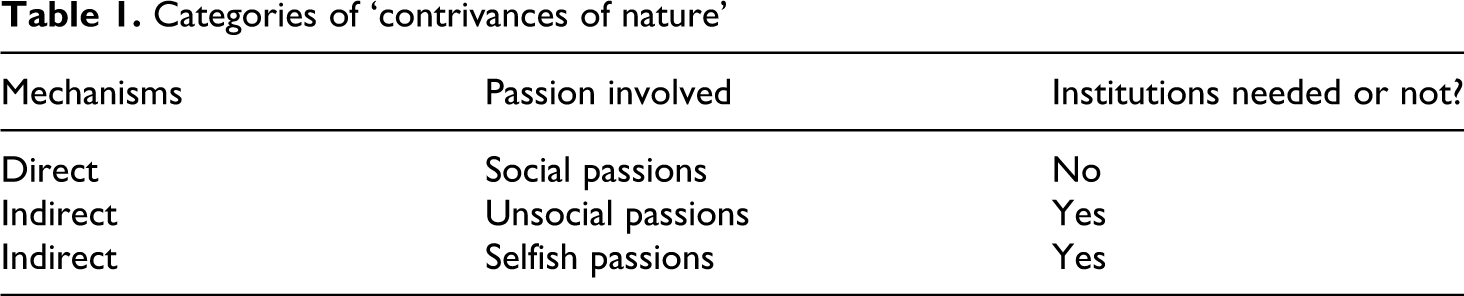
These mechanisms, some of which I will describe in what follows, all build on unintended consequences. 18 Among them a further distinction can be drawn between direct and indirect mechanisms. In direct mechanisms, humans pursue a certain goal, but the unintended consequences of their actions lead to a larger result, which is of the same kind, but has a much wider scope. In indirect mechanisms, the intentions that motivate actions point in a different direction, but the ‘wise design of nature’ brings about a beneficial result behind the agent’s back. This distinction can be connected to the three kinds of passions which Smith describes in The Theory of Moral Sentiments (1976a: I.II): unsocial passions (‘hatred and resentment, with all their different modifications' (1976a: I.II.3.1)), social passions (‘generosity, humanity, kindness, compassion, mutual friendship and esteem’ (1976a: I.II.4.1)), and selfish passions (‘grief and joy, when conceived upon account of our own private good or bad fortune’ (1976a: I.II.5.1)). Direct mechanisms use social passions, while indirect mechanisms use unsocial or selfish passions – all of them bring about socially beneficial results.
In addition, a connection can be drawn to the question whether nature is self-sufficient in solving the problems that arise from human weakness: direct mechanisms, using the social passions, work without institutional support; in indirect mechanisms, nature offers the resources which need to be channeled by institutions to bring about the common good. In a phrase coined by Brubaker, in these cases nature’s wisdom ‘needs help’ (see Table 1). 19 In what follows, I discuss one example from each category.
Categories of ‘contrivances of nature’
Example 1: the circles of sympathy
Smith thinks that although men have a ‘natural love for society’ (1976a: II.II.3.6), their ‘powers of beneficence’ are ‘very limited’ (1976a: VI.II. Introduction, para. 2). It would not make sense to waste ‘generosity, humanity, kindness, compassion, mutual friendship and esteem’ (Smith, 1976a: I.II.4.1) on people whose fortune one ‘can neither serve nor hurt’ (Smith, 1976a: III.III.9).
20
Rather, the world is designed such that the events which immediately affect that little department in which we ourselves have some little management and direction, which immediately affect ourselves, our friends, our country, are the events which interest us the most. (Smith, 1976a: VII.II.1.44)
The consequence of these natural sentiments is the development of a whole web of circles of sympathy in which people are embedded and take care of each other. It emerges as an unintended consequence: we do not think about the preservation of society when we care for our children or help our neighbors. It economizes both on self-command and on knowledge: neither high virtue nor system knowledge or wisdom are needed in order to assist those around us. Besides, this mechanism takes place without any institutional support; it naturally follows from people’s social passions. 23
Example 2: justice
Smith’s theory of justice is an indirect mechanism which builds on the unsocial passions. For Smith, justice is the absence of injury, of ‘real and positive hurt to some particular persons, from motives which are naturally disapproved of’ (1976a: II.II.1.5). As such, it is a negative virtue: the duties of justice can often be fulfilled by ‘sitting still and doing nothing’ (Smith, 1976a: II.II.1.9). Justice is ‘the main pillar that upholds the whole edifice [of society]’ (Smith, 1976a: II.II.3.4 ff.): a society without mutual love and friendship might not be very pleasant, but it could be stable if built on a sense of mutual utility. A society in which injustice prevails, however, must be ‘utterly destroy[ed]’ (Smith, 1976a: II.II.3.3).
To keep up justice, nature has given men the unsocial passions, in particular resentment, which stems from sympathy with people who have been unjustly injured and is directed against the offender (Smith, 1976a: II.II.1.4). Resentment is the ‘safeguard of justice and the security of innocence’ (Smith, 1976a: II.II.1.4). The resentment of an impartial spectator justifies the social norm that those who have injured others merit punishment. Smith takes it for granted that such punishment is necessary for the preservation of society. Nature therefore has not entrusted it to [man’s] reason to find out that a certain application of punishment is the proper means of attaining this end [the preservation of society]; but has endowed him with an immediate and instinctive approbation of that very application which is most proper to attain it. (Smith, 1976a: II.I.1.5.10)
Man’s unsocial passions thus serve a good purpose: they render it ‘dangerous to insult or injure him’ (Smith, 1976a: I.II.3.4). They have been ‘given us by nature for defence, and for defence only’ (Smith, 1976a: II.II.1.4). In contrast to other virtues, justice can be captured in rules which ‘determine with the greatest exactness every external action which it requires' (Smith, 1976a: III.VI.10), which makes them easy to follow even with limited epistemic abilities. The knowledge that a violation of justice causes resentment in others supports the motivation to obey these rules even in those whose self-command is not very well developed. This means that human beings, these ‘weak and imperfect creature[s]’, can most of the time follow the dictates of justice, which makes life in society possible.
Justice, the ‘pillar of society’, is thus the unintended consequence of an unsocial passion, brought about by indirection. In comparison to consequentialist approaches (for example, Hume’s, as Smith reads him 24 ), which would presuppose a lot of knowledge and maybe also more self-command, this account economizes on both factors. 25 But Smith is quite clear that resentment needs to be complemented by a legal system. Positive law embodies the rules of justice in ‘a more or less imperfect attempt towards a system of natural jurisprudence’ (Smith, 1976a: VII.IV.36). In a well-ordered society, the magistrate enforces the rules of justice, rather than the citizens taking revenge on each other, which would lead to ‘a scene of bloodshed and disorder’ (Smith, 1976a: VII.IV.36). This is particularly important when there is property beyond the ‘value of two or three days labour’ (Smith, 1976b: V.II.I.2), as the incentives to violate property law need to be counterbalanced by the disincentives of the risk of punishment (compare Smith, 1976b: V.II.I.2). 26 In order to build a well-ordered society from the imperfect material of human beings, human institutions thus need to ‘co-operate with the Deity’, that is, with the mechanisms provided by benevolent nature (Smith, 1976a: III.V.7).
Example 3: the economy
Cooperation between institutions and natural tendencies is a feature not only of mechanisms that build on the unsocial passions, but also of those that build on the selfish passions. The economy that Smith describes takes places within a framework of institutions, notably a system of property rights held up by an ‘exact administration of justice’ (1976b: IV.IX.51), which builds on and is supported by the natural passion of resentment. 27 Unless otherwise stated (for example, in the remarks on smuggling in Smith (1976b: V.II.II)), the agents of the Wealth of Nations act within a framework of positive law. Within such a framework, the desire to ‘better [one’s] condition’ (Smith, 1976b: II.III.28) is guided to serve the public good by the mechanisms which Smith famously calls ‘invisible hands'. If seen in this wider context of Smith’s moral and social philosophy, it becomes clear that the invisible hands are neither divine interventions, nor mere ‘ironic jokes' (Rothschild, 2001: 116), 28 but simply two further instances of the ‘contrivances of nature’ that help to deal with human weakness.
The desire of bettering one’s condition is implanted in human nature in two ways. On the one hand, people desire ‘[t]o be observed, to be attended to, to be taken notice of with sympathy, complacency, and approbation’ (Smith, 1976a: I.III.2.1); it is thus connected to the social passions. On the other hand, it is reinforced by a fascination for beauty which stems from the ‘appearance of utility’ (quite unrelated to real utility), which Smith explicitly calls a ‘deception’ by nature (1976a: IV.I.10). The combination of an institutional framework and self-interest leads a commercial society to a state of ‘opulence’ in which prices are low and wages high, so that goods are ‘easy to come at’ for the lower classes (Smith, 1976b: I.VIII.36). This happens without intervention by the state, thanks to the two invisible hands.
29
The invisible hand of the Wealth of Nations (Smith, 1976b: IV.II.9) leads to a large ‘annual produce’. It stands in the context of Smith’s discussion of the different uses of capital in agriculture, manufacturing, and trade, which have a descending order of productivity (1976b: II.V.12 ff.). It is most beneficial for a country if capital is invested in the different sectors in this order, because The most advantageous employment of any capital to the country to which it belongs, is that which maintains there the greatest quantity of productive labor, and increases the most the annual produce of the land and labor of that country. (Smith, 1976b: IV.VII.III.35)
30
He generally, indeed, neither intends to promote the publick interest, nor knows how much he is promoting it. By preferring the support of domestick to that of foreign industry, he intends only his own security; and by directing that industry in such a manner as its produce may be of the greatest value, he intends only his own gain, and he is in this, as in many other cases, led by an invisible hand to promote an end which was no part of his intention. (1976b: IV.II.9)
This ‘invisible hand’ is thus a fortuitous coincidence of private interests and common good that Smith, in his deistic framework, describes as a wise arrangement of nature, but not without providing an analysis of the underlying causal mechanisms. This is true for the invisible hand of The Theory of Moral Sentiments (Smith, 1976a: IV.I.10) as well. Whereas the invisible hand of the Wealth of Nations deals with investment and production, the invisible hand of The Theory of Moral Sentiments deals with distribution. It describes what has later been called ‘trickle down’: the transfer of wealth to the poorer parts of society. For Smith, the basic mechanism is a simple one: the rich man cannot consume all he acquires, as ‘the capacity of his stomach bears no proportion to the immensity of his desires' (1976a: IV.I.10). What a rich man owns, but cannot consume, ‘he is obliged to distribute among those, who prepare ... that little which he himself makes use of’ (Smith, 1976a: IV.I.10). The rich, in their ‘selfishness and rapacity’, therefore unintentionally serve the poor and bring about an egalitarian distribution of goods: They are led by an invisible hand to make nearly the same distribution of the necessaries of life, which would have been made, had the earth been divided into equal portions among all its inhabitants, and thus without intending it, without knowing it, advance the interest of the society, and afford means to the multiplication of the species. (Smith, 1976a: IV.I.10)
As in the case of justice, we thus have an indirect mechanism that builds on cooperation between natural human tendencies and institutions, this time building on the selfish rather than the unsocial passions. In the ‘system of natural liberty’ (Smith, 1976b: IV.IX.51) opulence is brought about if natural tendencies and institutions interact in the right way, which is why a legislator needs to understand what resources nature offers him and how he needs to use them. In this system, men with confined, local knowledge and ‘selfishness and limited generosity’ 31 can act in ways that further the public good through unintended consequences. Motivationally, it is not very challenging: no overly altruistic or heroic actions are needed under normal circumstances. Men and women have to obey the law, which is supported by the sense of justice that builds on resentment. In economic affairs, they can pursue their self-interest. In their private lives, they support their families, friends, and neighbors, which naturally flows from the mutual sympathy they feel with them. 32 Epistemologically, this arrangement is also unproblematic: people only need knowledge of their concrete situation, of how to maximize their income given their capital and abilities. They only need contextual knowledge, not system knowledge, and they have an incentive to acquire this knowledge because it serves their own purposes.
No central planning is needed; on the contrary, the legislator is ‘completely discharged from the duty’ of positive intervention in the economy (Smith, 1976b: IV.IX.51) and confined to the three tasks which Smith famously cites: external protection, an ‘exact administration of justice’, and intervention in the case of ‘certain public works and certain public institutions' (1976b: IV.IX.51). A wise legislator will thus let nature do its beneficial work. This economic liberalism 33 in Smith, however, has a further dimension: the legislator himself is also a human being, and thus likely to suffer from the same motivational and epistemological limits as others; he should therefore stick to setting general rules, rather than constantly intervene in the economy, which is likely to surmount his capacities. Smith says, in fact, that ‘no human wisdom or knowledge could ever be sufficient’ for bringing about an optimal allocation of capital and labor force through central planning (1976b: IV.IX.51). 34 Besides, positive interventions are likely to be biased by self-interested motives on part of the legislator, a danger of which Smith provides numerous examples (for example, 1976b: II.III.36, V.II.I.6, V.III.26, V.III.59 ff.).
3. The place of the higher virtues
This structure of Smith’s account (that is, building on ‘lower’ virtues and economizing on self-command and knowledge) comes at a cost, however. This concerns the question of the place of higher virtue in such a system. 35 It seems that if the social cosmos is neatly divided into these different spheres, people can live happy lives in a peaceful society, and there is no need for higher virtue, which would demand a lot of self-command or ‘wisdom’.
It was Mandeville (1924) who had famously held that virtue and economic progress are incompatible: the bees of his Fable thrive as long as ‘every Part [is] full of Vice, yet the whole Mass a Paradise’, and when they ask Jupiter for virtue, the economic life of the hive breaks down. The other famous critic of commercial society was the Rousseau of the ‘Second Discourse’ (1761), which Smith had read and reviewed in an early article (1980c: 250 ff.), in which he pointed out the similarity to Mandeville. 36 Smith discusses Mandeville in The Theory of Moral Sentiments (Smith, 1976a: VII.II.IV), and although he concedes that there are ‘some appearances in human nature’ which ‘have thrown upon his doctrines an air of truth and probability’ (Smith, 1976a: VII.II.IV.6), he clearly distances himself from him. In particular, he criticizes the reduction of all human actions to self-love, holding that there is a difference between vanity and ‘the love of virtue’ and of ‘true glory’, and points out that even self-love may ‘frequently be a virtuous motive of action’ (Smith, 1976a: VII.II.IV.8 ff.). In addition, to be virtuous does not demand an ‘entire insensibility to the objects of the passions', but only a restriction to what does not hurt the individual or society (Smith, 1976a: VII.II.IV.11); Mandeville was wrong in only admitting as virtuous what is completely free of passions (Smith, 1976a: VII.II.IV.12). So Smith’s theory of the impartial spectator, which guides, rather than suppresses, human passions, does not lead to the fundamental contradiction between morality and economic progress diagnosed in Mandeville. 37 But there is still the question of what Smith has to say about the relation between higher virtue and the activities that are best for the economic and social system of commercial society as Smith describes it.
It is clear that higher virtues are described as a possibility for human beings in The Theory of Moral Sentiments (for example, Smith, 1976a: I.III, VI). But as Dickey (1986) has noted, there are interesting differences in the evaluation of the ‘middling’ or ‘bourgeois' virtues between the first edition of 1759 and the sixth edition that was written shortly before Smith’s death in 1790. As Dickey convincingly shows, Smith’s description of the ‘prudent man’ in the 1790 edition is much less positive than that of 1759 edition. In 1790, Smith describes two kinds of prudence, and his account of the lower kind of prudence is rather condescending: Prudence, in short, when directed merely to the care of the health, of the fortune, and of the rank and reputation of the individual, though it is regarded as a most respectable and even, in some degree, as an amiable and agreeable quality, yet it never is considered as one, either of the most endearing, or of the most ennobling of the virtues. It commands a certain cold esteem, but seems not entitled to any very ardent love or admiration. (1976a: VI.I.14)
The question about the relation between higher virtue and economic activities has two aspects. On the one hand, there is the question whether one can live a life of higher virtue in commercial society at all. On the other hand, there is the question whether if one lives such a life, one serves the interest of society best.
With regard to the first question, Smith seems to have maintained a fundamentally optimistic view. As Hanley argues, Smith was well acquainted with the criticisms of commercial society which described it as shallow and inimical to true virtue (Hanley, 2009, 2008). Hanley reads chapter VI of the 1790 edition of The Theory of Moral Sentiments as an answer to the problem of ‘commercial corruption’, and emphasizes that Smith’s view of moral education allows for true virtue and moral autonomy, even if it starts from people’s attention to the judgment of others (Hanley, 2009: 104 ff.). As Smith emphasizes (especially in the 1790 edition), most men have a natural desire for virtue and not only for appearing virtuous (1976a: III.II; compare Hanley, 2009: 135 ff.). This is why true morality is always possible, even if commercial society relies mainly on lower virtue and self-interest. In contrast to Rousseau’s ‘solitary walker’ who flees society, Smith’s moral ideal is a wise and virtuous man who has active duties toward, and different kinds of ties with, others (Hanley, 2008: 148–9). He is not satisfied with lower prudence, but also develops the higher virtues of ‘magnanimity’ and ‘beneficence’ (Hanley, 2009: Chs 4–6). 38 So even if commercial society may make it more difficult, it is not impossible to become one of the ‘wise and virtuous'. One can accept that the preservation of ‘external fortune’ is necessary in order to gratify the natural appetites with ‘care and foresight’ (Smith, 1976a: VI.I.2–3), but avoid falling into purely self-interested behavior. One does not have to be insensible to the opportunities and possibilities of the commercial world, but one needs a ‘noble firmness' and ‘exalted self-command, which is founded in the sense of dignity and propriety’ (Smith, 1976a: VI.III.18).
It is less clear whether a positive answer can be given to the second question: whether the most virtuous kind of person always serves society best, or whether Mandeville is right, after all, that vice (or self-interest within the limits of lower virtue) is best for a thriving society. At least as far as the economic sphere is concerned, one can doubt that Smith’s answer would be positive. A magnanimous and beneficent person might, after all, be tempted to ‘trade for the public good’ (Smith, 1976b: IV.II.9), or abstain from some opportunities to earn money because of other motives (for example, in order to donate to charities), thus reducing overall welfare. But for Smith such a person might find other ways of acting for the good of society.
One such way might be politics, although in Smith’s times it would have been open only to a minority of men. The Wealth of Nations and the Lectures on Jurisprudence abound with examples of self-interested politicians who hurt the interests of their country (for example, Smith, 1976b: IV.I.30, V.II.I.6, V.III.26, V.III.59 ff.; 1978, LJ(A): 100–1, LJ(B): 414), but it is quite clear that for steering a country closer to the beneficial ‘system of natural liberty’, Smith needs virtuous politicians who follow the rules of the impartial spectators (see in particular 1978, LJ(A): 104) and understand Smith’s insights into economic mechanisms.
39
At this point Smith shows certain affinities to the civic humanist perspective and its fears of a corruption of the political sphere by a commercial, self-interested spirit (compare McNally, 1978: 159–60; Robertson, 1995: 222 ff.; Winch, 1978: 159–60; Young, 1997: 164). Smith’s admiration for wise and virtuous politicians is expressed in his praise of (higher!) prudence, in what can be seen as his ideal of a politician: We talk of the prudence of the great general, of the great statesman, of the great legislator. Prudence is, in all these cases, combined with many greater and more splendid virtues, with valour, with extensive and strong benevolence, with a sacred regard to the rules of justice, and all these supported by a proper degree of self-command ... It is the best head joined to the best heart. It is the most perfect wisdom combined with the most perfect virtue. (1976a: VI.I.15)
A second way in which a virtuous person might work for the public good is by providing unbiased ‘system knowledge’ which a legislator can use when making decisions and by taking part in the public discourse on policy issues: by publishing her views, by taking sides on the political issues of the day, by explaining social mechanisms, and by uncovering unjust institutional arrangements. 40 This is, in fact, a way in which the Wealth of Nations itself has often been read: as a piece of advice that explains economic and social mechanisms to the sovereign and the general public. 41 After all, Smith speaks of political economy as ‘a branch of the science of a statesman or legislator’ (1976b: IV. Introduction, para. 1). We do not know whether Smith saw himself as one of the wise and virtuous; in any case, his own activity can offer a model for those who aim for higher virtue and hesitate to throw themselves full-heartedly into the race for ‘wealth, and honours, and preferments'.
Motivation crowding out
4. Whether Smith was right in his judgment about the fate of higher virtue in commercial society is a question that leads beyond the scope of this article; it would involve delving into deep philosophical questions about the constitution of modern society, the nature of self-fulfilling social theory, and the character of the modern self. 42 In addition Smith’s well-known comments about other effects of commercial society on individuals, such as the effects of the division of labor, would also have to be taken into account for a broader judgment about the value of commercial society; 43 the systematic place of the different virtues is just one of these factors.
Instead, let me come back to the topic of motivation crowding out mentioned at the beginning, which has a structural similarity to Smith’s approach. In Smith’s system, the different passions have their place in different spheres, sometimes supported, sometimes unsupported, by institutions. But these spheres can intersect; wrong principles can be brought to bear on a situation, or a situation can be wrongly classified as belonging to a certain sphere. Motivation crowding out is structurally similar in that it describes phenomena in which intrinsic motivation, which should be the guiding principle in certain spheres, is ‘crowded out’ because the incentives (or even the description) of the situation make it appear as one in which selfish behavior is appropriate.
One finding that is of particular interest is the switch in people’s behavior between market and nonmarket situations. As mentioned above, one form of motivation crowding out is the replacement of ‘civic’, other-regarding behavior by self-interested behavior when monetary incentives are introduced. A famous study is Titmuss's book on blood donation (1970): Titmuss argues that if blood donations are voluntary, people consider it a civic duty, or a work of charity, to donate blood, and do it for altruistic reasons or because they want to ‘do their duty’. If they are paid, in contrast, they see it as a market situation in which self-interest is appropriate, and so only those who want to ‘sell’ their blood donate, which can lead to a lower overall amount of donations. A more recent study has been conducted Frey and Oberholzer-Gee (1997), who collected people’s responses to ‘not-in-my-backyard’ (NIMBY) cases, that is, projects which are socially beneficial, but locally unwanted, such as sites for incinerators, airports, or waste disposals. The authors work on the assumption that there could be a sense of civic duty to accept a NIMBY project that is vulnerable to crowding out by monetary incentives. In a survey on people’s willingness to accept a nuclear-waste repository in their vicinity, the level of acceptance was 50.8 percent without compensation, and dropped to 24.6 percent when compensation was offered; a tendency that was confirmed by similar results in a rerun of the study in a different canton. Drawing on this and other evidence, Frey and Oberholzer-Gee conclude that there really is a crowdingout effect with regard to public spirit. 44 It seems that men and women who live in a market society think that when there are monetary incentives, it is assumed that they will follow their ‘selfish passions'. To some extent, this may be a self-fulfilling prophecy: when people assume that they are expected to behave self-interestedly, this is precisely what they will do, because they assume that the institutions are designed in a way that optimizes the outcome given that everyone acts self-interestedly or because they think that others will switch to self-interested behavior and this would make their own altruism vulnerable to exploitation.
Drawing on the analysis of Smith’s ‘contrivances of nature’ and the place of virtue in commercial society, one could conceptualize these cases in two ways: one way would be to assume that ‘social passions' are crowded out by ‘selfish passion’; another would be the crowding out of higher virtue by self-interested behavior. Given the nature of the examples under discussion, and assuming that both of them do not deal with small communities, it seems more plausible to adopt the second model.
This does not mean, however, that the first type of ‘crowding out’ could not occur as well. The question in what ways and to what degree economic mechanisms interfere with the natural ‘circles of sympathy’ may not have been as urgent in Smith’s time as in ours. 45 But Smith was already aware of one problem: he was worried about the anonymity of the big cities, where people presumably moved for economic reasons. Smith argues that, the worker there falls into a condition of ‘obscurity and darkness', where ‘his conduct is observed and attended to by nobody, and he is therefore very likely to neglect it himself, and to abandon himself to every sort of low profligacy and vice’ (Smith, 1976b: V.I.III.3.12). He sees a ‘natural’ solution, however, in religion: if there were ‘two or three hundred, or perhaps ... as many thousand small sects' (1976b: V.I.III.3.8), a ‘marketplace of religions' 46 rather than large churches supported by the state, religion could not ‘disturb the public tranquillity’ (1976b: V.I.III.3.8) and the citizens would find face-to-face communities in the big cities 47 (1976b: V.I.III.3.12). 48 It goes beyond the scope of this article to discuss the adequacy of this solution; in any case; Smith’s optimism about nature being self-healing with regard to the ‘circles of sympathy’ seems rather problematic from a modern perspective.
The cases discussed above, however, are cases of higher virtue (altruism toward a larger group or ‘public spirit’) being crowded out by the norms of markets, which build on self-interest. If systems are designed under the assumption that most men will behave self-interestedly most of the time, and limit their altruism to family members and close friends, then those who are willing and able to act less self-interestedly are left in an awkward position – they cannot really play the game full-heartedly, as it were. Their higher virtues do not seem to be needed, at least not under normal circumstances – so why nurture them at all? By explicitly not building on it, institutions can make the place of higher virtue precarious, and maybe crowded it out.
5. Conclusion: What role does the science of economics play?
The science of economics as it is practiced today has, by and large, retained Smith’s strategy of building on self-interest within the limits of positive rights. ‘Economic man’, as embodied in numerous models, maximizes preference satisfaction, and the dimensions along which he chooses are usually monetary income (to be maximized) and labor time (to be minimized), or different goods between which an optimal balance has to be struck, often expressed in terms of willingness to pay. In standard textbooks, ‘public spirit’ is not an issue.
Given that human beings are self-interpreting animals, however, the question is whether this kind of theorizing remains without effect on them – or whether it can turn into a self-fulfilling prophecy. 49 In fact, there has been a considerable amount of empirical research on the question of whether the behavior of economists, or economics students, differs from that of other people. Several studies indicate that economics student have a higher probability to free ride, a lower probability to cooperate in Prisoners' Dilemmas, and a greater tendency to maximize profits at the cost of job losses, but are inconclusive as to whether this is an effect of self-selection into economics courses, or an effect of being taught economics (see for example, Carter and Irons, 1991; Marwell and Ames, 1981; Rubinstein, 2006). In an elaborate study Frank et al. (1993) found evidence not only for different behavior, but also for the influence of economic teaching on the attitudes and behavior of students. For example, they presented students with a questionnaire describing a person who finds an envelope containing US$100, and asked them about the probability of themselves or other people returning the money. After four months of being taught microeconomics with a ‘heavy emphasis on the prisoners' dilemma and related illustrations of how survival imperatives often militate against cooperation’, the estimates of both other people’s honesty and their own honesty had dropped significantly, while in another economics class without the emphasis on self-interested behavior, as well as in a control group of astronomy students, the figures did not show this drop. 50
A larger question emerges here about the wider culture in which we live, act, and practice the virtues. Different countries obviously differ in the ‘division of labor’ between market, state, and civil society with regard to tasks like, for example, health care for the poor or education, so what is perceived as public spirit, and how likely it is to be crowded out, is likely to differ from country to country. 51 Rather than pursuing this question, let me conclude by drawing attention to some of the ways in which motivation crowding out might be prevented. As Smith’s reflections show, commercial society does not make attaining higher virtue an impossible goal. Rather, what is needed is a clear separation between the spheres in which following the ‘selfish passions' is appropriate and those where it is not, be it the private realm of family and friends, or the public realm of politics, which in Smith’s view (and, indeed, in the view of many contemporary normative political theorists) should be turned toward the public good. In addition, because of the risk that the assumption of rational utility maximization turns into a self-fulfilling prophecy, economists should be careful when deciding which institutions should be designed according to the assumption that ‘every man must be supposed a knave’ (Hume, 2000: 118) – and maybe also about how this assumption is communicated. As Frey’s research has shown, the tendency to behave like a knave in places where this is inappropriate can be diminished through the wise design of institutions. For example, more possibilities for civic engagement and political participation lead to a better tax morale (Frey, 1997a: Ch. 6) – put crudely, if the state does not suppose its citizens knaves, the citizens do not (so much) behave like knaves. In addition, institutions which do not give the impression of external control, so as not to reduce self-esteem and to obscure virtuous motives where they are present, can help to reduce the risk of motivation crowding out (Frey, 1997a: 16–17; see also Pettit, 1995). One suggestion along these lines is Brennan and Petitt’s suggestion to build more on the ‘intangible hand’ of the ‘economy of esteem’ which promises to be ‘relatively virtue-compatible’ (2004: 261). 52
In modern societies spheres in which self-interest is appropriate can coexist with spheres in which ‘higher’ motives have a place – but it is important to be clear on the delineation of these spheres, and on both the design of institutions and the communications about them, in order not to ‘crowd out’ higher virtue in places where it has a role to play. Maybe teachers of economics, the science that is often said to have been founded by Smith, should make clearer to their students what the assumption of self-interested behavior really is – a useful heuristics that can help to make predictions about human behavior in many (but not all!) cases, but not a description of what highest virtue and the ideal of human life consists in. The Wealth of Nations is Smith’s economics, not his ethics. Maybe those who study the science that started with the Wealth of Nations should read The Theory of Moral Sentiments as well, and in particular Smith’s view of what a good moral life really consists in, in his descriptions of the virtues in Part VI.