







Abstract
According to limitarianism, it is morally impermissible to be too rich. We consider three main challenges to limitarianism: the redundancy objection, the inconclusiveness objection, and the commitment objection. As a distributive principle, we find that limitarianism fails to overcome the three objections—even taking recent theoretical innovations into account. Instead, we suggest that the core commitment of limitarianism can be drawn from the excess intuition. It entails that at some point, people's claims to retain wealth become qualitatively different: they become preposterous from the point of view of interpersonal morality and justification. Extreme wealth, we argue, adds a distinctive expressive reason to worry about inequality and insufficiency, compounding these other distributive injustices. In retaining or wasting excess wealth while others have too little, the wealthy send a message of complete disregard for the interests of their co-citizens. They express that their disadvantaged compatriots have a diminished moral standing.
A recently proposed view claims that we should pay special attention to great concentrations of wealth. As stated in the guiding principle of limitarianism, it is morally impermissible to be too rich. Accordingly, policies should be implemented that either prevent people from acquiring excessive wealth or redistribute their wealth once they do (Robeyns, 2022: 253). Specifically, as Ingrid Robeyns argues, being extremely wealthy is impermissible in a context of unmet urgent needs, democratic inequality, and impending climate change (Robeyns, 2017, 2019). Robeyns’ arguments do not provide intrinsic reasons for targeting the fortunes of the very wealthy, they nonetheless seek to show that there is something wrong with not just inequality in general, but with wealth concentration in particular (Malleson, 2023; Robeyns, 2022).
Forceful criticisms have been levelled against the limitarian principle (Nielsen and Axelsen, 2022). In particular, the insistence that the principle can be supported adequately through an appeal to the values of meeting urgent needs and democratic equality has been a source of scepticism. Here, we consider three main challenges to limitarianism as a distributive principle: the redundancy objection, the inconclusiveness objection, and the commitment objection. The redundancy objection holds that neither the value of meeting unmet needs nor that of ensuring democratic equality gives us reason to support limitarianism per se (Huseby, 2022). This implies that the limitarian principle is redundant as a principle of distributive justice, since limitarians do not, in fact, uncover anything that cannot be captured equally well (or better) by other distributive principles—neither in theory, nor in political practice (Halldenius, 2022; Volacu and Dumitru, 2019).
What is more, limitarianism fails to provide guidance in a number of important situations. Because of its narrow focus on extreme wealth, limitarianism is silent or inconclusive on distributive issues where no one is superrich (Huseby, 2022). Inconclusiveness is not necessarily problematic in itself—after all, limitarianism is not meant to exhaust our distributive obligations. However, in combination with the redundancy objection, inconclusiveness becomes a serious shortcoming for a distributive principle (even a partial one). Together, these two objections show that limitarianism can provide less guidance than other distributive principles (inconclusiveness), and that the guidance it can provide is indistinct from what can be provided by other distributive principles (redundancy).
More recently, limitarian theorizing has bifurcated, and now seeks to incorporate a (slightly) broader set of values and principles. According to these newer developments, the limitarian threshold is not necessarily located at a specific level of wealth, above which a person is too rich. Rather, thresholds can take different forms depending on the particular value in question: a limit to money in the context of unmet urgent needs, a limit to individual greenhouse gas emissions in the context of climate change, a limit to power in the context of political equality, etc. (Icardi, 2023; Robeyns, 2019, 2022, 2023). 1 These developments are interesting and provide new answers to limitarian critics. They are, however, rudimentary. In some ways, moreover, this bifurcation has muddied the limitarian waters, making it more difficult to get a handle on the core limitarian commitments and serving to obscure where its intuitive pull is to be found. This is the crux of the commitment objection.
In this paper, we evaluate the morality of extreme wealth, building on this debate. The discussion has, primarily, been centred around limitarianism as a distributive principle, telling us to aim for a distribution in which no one is too rich. Limitarianism was never intended as a distributive principle that exhausts our distributive obligations but meant to be complemented with other distributive principles. Even as a partial principle for determining the just distribution of benefits and burdens, we find, limitarianism fails to overcome the three objections noted above. In order to overcome the objections, we suggest, it must be clarified what makes limitarianism distinctive, what its normative core is. We suggest that the core commitment of limitarianism can be drawn from a worry with excess. This idea builds on, rather than seeking to displace, the work done by Robeyns’ and others. Our argument begins from what we call the excess intuition. It entails that at some point, people's claims to retain wealth become qualitatively different: they become preposterous from the point of view of interpersonal morality and justification.
We explain this intuition by showing how the presence of excess generates distinctive moral reasons to rectify inequalities and insufficiencies—ones that are present only in extreme wealth societies, and that cannot be deduced directly from sufficientarian or egalitarian theories. Thus, we argue that extreme wealth adds a distinctive expressive reason to worry about inequality and insufficiency and, thereby, compounds these other distributive injustices. 2 In retaining or wasting excess wealth while others have too little, the wealthy send a message of complete disregard for the interests of their co-citizens. One that entails that their disadvantaged compatriots have a diminished moral standing. This makes excess interpersonally preposterous—preposterous from the point of view of interpersonal morality and justification. Before advancing these arguments, however, we will lay their foundation by introducing limitarianism and its critics in greater detail.
Limitarianism
Limitarianism holds that it is impermissible for individuals to have too much wealth. Or, as Robeyns puts it in the article in which limitarianism was first proposed: “it is not morally permissible to have more resources than are needed to fully flourish in life” (Robeyns, 2017: 1). At its core lies the premise that there is a limit beyond which the possession of further resources—say, more money—does not contribute to a person's flourishing. Money held by wealthy people above this limit is surplus money. Given that surplus money makes no contribution to a person's flourishing, “it has zero moral weight” (Robeyns, 2017: 12). 3
According to Robeyns, it is not, in itself, morally bad to be too rich, however. Rather, the limitarian principle is justified by non-intrinsic reasons: it is because institutionalizing the principle helps us realize intrinsically important goals that it should be supported. In Robeyns’ original work, two instrumental reasons are in play—meeting urgent needs and securing democratic equality. In later work, Robeyns has added combatting climate change (Robeyns, 2019). Limiting and redistributing excess wealth enables us to realize these values. First, the wealth held by the very rich could, instead, be reallocated to those whose urgent needs are currently unmet—or, to fund collective efforts to stop and mitigate the effects of climate change. Second, extreme wealth exacerbates inequality in political influence. People who are very wealthy can influence politics by, for example, funding political campaigns, setting the agenda, influencing public opinion, and placing obstacles in the way of societally beneficial policies. 4 Given that the wealthy hold excess wealth, which does not contribute to their flourishing, it is particularly costless for them to use their resources to gain political power (Robeyns, 2017: 6–10). Being too rich—holding excess wealth—is impermissible because it hinders the pursuit of these important aims.
To help bring out the specifics of Robeyns’ argument, we will reconstruct it in the following way:
The conclusion, in effect, is the limitarian principle. It is worth noting, in particular, that P5 states a general principle to which Robeyns is (more or less explicitly) committed. The principle bears resemblance to Peter Singer's well-known argument that: “if it is in our power to prevent something bad from happening, without thereby sacrificing anything morally significant, we ought, morally, to do it” (Singer, 1972: 231). Robeyns’ principle, of course, is significantly less demanding since it only holds that individuals must sacrifice resources that do not contribute to their flourishing—which, plausibly, includes retaining resources to pursue personal projects that are morally less significant (Robeyns, 2017: 12–13). The principle, therefore, should be relatively uncontroversial.
A key component of the limitarian argument is its first premise, P1, which states that holding excess wealth has no moral weight. In Robeyns’ version, the premise is built around the concept of flourishing. It assumes that there is an upper limit, a level of satiability, to the contribution wealth can make to someone's flourishing. Flourishing is usually understood as relying on an objective criterion of wellbeing. It is not determined by whether one's preferences are satisfied or one's desires are fulfilled. 5 The moral weight of excess wealth, thus, is detached from people's own judgements about whether excess wealth improves their lives. Wealthy people may contend that excess wealth will allow them to pursue goals that they deem important. Merely wanting to retain wealth for personal projects, however, is not adequate for showing that it has moral weight or that it helps you flourish. Robeyns has since broadened the grounding of this premise, clarifying that the conception of flourishing she has in mind is political, rather than perfectionist (Robeyns, 2022: 254). 6 Even in this case, however, determining whether and when resources constitute surplus money (or excess wealth), necessarily involves a non-subjective component (Robeyns, 2017).
At first glance, the idea of “excess wealth” can seem controversial. It will seem controversial to liberals, for example, to say that, despite people's claim to the contrary, excess wealth does not increase their wellbeing. And, moreover, many will find it controversial that people's claims to retain wealth have zero moral weight when the wealth in question does not contribute to their flourishing. Note, however, that one does not need to commit to an account of flourishing (perfectionist, political, or otherwise) to accept the underlying idea that when people hold resources above a certain limit, these resources have no moral weight. Or even that they no longer make any meaningful difference to people's wellbeing. 7 For now, it is enough that one accepts the pull of the excess intuition: that, at some level of wealth, people's claims to retain resources become qualitatively different. Or, as we will argue later in this paper: they become interpersonally preposterous—preposterous from the point of view of interpersonal morality and justification. This intuition, we think, is the best way of articulating the core commitment of limitarianism and provides the most promising place to ground distinctive dimensions of extreme wealth along the lines suggested by limitarians. To appreciate this properly, however, we think that the intuition—that excess is a distinctive normative phenomenon—must be separated from limitarianism understood as a distributive principle (or class of principles) in the traditional sense—that the rich should be targeted specifically or singled out in the adjudication of distributive claims. So far, however, limitarian critics (and defenders) have mainly considered extreme wealth from this principled perspective (Robeyns, 2022: 253). Below, we will crystalize the central argumentative strands of this debate and indicate how it can be refocused.
Limitarianism as a distributive principle?
As a distributive principle, limitarianism advises that no one should hold excess wealth, broadly conceived. As Robeyns puts it: “either there should be policies that make sure people are not situated above the limitarian threshold (wages regulation, caps on the lifetime inheritance level, and so on), or there should be redistribution that takes away the resources above the limitarian threshold to reallocate it below the threshold or to use it for funding public goods” (Robeyns, 2022: 253). Society's benefits and burdens, then, are distributed unjustly if someone holds excess wealth when urgent needs are unmet, destructive climate change is impending, or society is plagued by political inequality.
When interpreted as a distributive principle, limitarianism sits on the same shelf as other distributive principles, like egalitarianism and sufficientarianism. Distributive egalitarianism requires that everyone is given an equal share of the goods and opportunities relevant to justice. Thus, egalitarians find a distribution unjust iff some people have more than others (for reasons beyond their control) (Dworkin, 2000; Lippert-Rasmussen, 2016; Temkin, 2003). In contrast, sufficientarianism is the view that what matters for justice is that everyone has enough, not necessary an equal share, of the relevant distributive currency (Axelsen and Nielsen, 2015; Casal, 2007; Crisp, 2003; Huseby, 2010, Shields, 2020).
When classified as a contender in this debate, limitarianism faces three main challenges. The first one, which we call the redundancy objection holds that the limitarian principle is redundant as it provides no distinctive distributive guidance. As Robert Huseby notes, it can seem oddly and unnecessarily indirect to aim specifically for the elimination of extreme wealth. If we want to address democratic inequalities, the most “reasonable strategy is to address the discrepancy as such” (Huseby, 2022: 234). And if we care about meeting people's needs, why not go for that directly through a distributive principle of sufficiency? Excess wealth should be redistributed from the extremely wealthy to the poor (or to the fight against climate change), not because the rich have too much, but because the poor have too little (or because the destructive impact of climate change must be mitigated) (Huseby, 2022: 237). Because of this reliance on values for which well-conceived, targeted distributive principles already exist, critics hold, there is no need for limitarianism as a (class of) distributive principle(s). Limitarianism provides no new guidance and, so, it is redundant.
The second challenge, which we might call the inconclusiveness objection points out that limitarianism does not tell us what to do in a number of distributive scenarios. Not least, situations in which there are inequalities where no one holds excess wealth or where everyone does. Egalitarians, of course, would still find such inequalities unjust (Huseby, 2022: 233; Timmer, 2021: 763). Similarly, a limitarian distributive principle gives no guidance in choosing between different distributive scenarios where there is no excess wealth—even if there are unmet urgent needs and political inequalities. 8 In such situations, the limitarian distributive principle is silent. Inconclusiveness mainly becomes a problem in combination with redundancy. Limitarianism says nothing new or distinctive about our distributive obligations (thus, it is redundant), and it provides less guidance than rival principles that are able to tell us what to do in the aforementioned situations (it is inconclusive).
To these two objections, we add a third challenge: the commitment objection. The objection begins by noting that, since limitarianism is justified through an appeal to the importance of eliminating (political) inequality and insufficiency, it seems puzzlingly non-committal that the principle remains silent in situations where such issues remain (but there is no extreme wealth). And if the principle is not fully committed to egalitarianism or sufficientarianism, the objection asks, then what exactly is it committed to—given that limitarian theorists provide no intrinsic reasons to worry about extreme wealth? 9 While the inconclusiveness objection complains that limitarianism cannot tell us what to do under certain conditions, the commitment objection holds that limitarianism does not tell us why we must target extreme wealth. Limitarianism lacks a distinctive value or commitment that specifies what makes extreme wealth normatively worrisome.
Robeyns provides two types of responses to the objections facing limitarianism. The first response is methodological. The redundancy objection targets the theoretical superfluity of limitarianism. As a matter of theory, there is no difference between the actions counselled by the limitarian principle and those counselled by egalitarianism and sufficientarianism, respectively. The inconclusiveness objection, on the other hand, targets the principle's applicability in hypothetical scenarios. However, the limitarian framework, Robeyns argues, should be understood as problem-driven rather than theory-driven philosophy (Robeyns, 2017, 2022; Timmer, 2021). To that end, limitarianism should be assessed according to its contribution to the understanding of real-world problems and how to solve them: namely, those associated with great concentrations of wealth. Hence, as a first response, Robeyns wishes to emphasise that a limitarian principle, even if theoretically redundant, contributes to our understanding of real-world problems related to extreme wealth and serves the purpose of directing policy towards democratic equality and sufficiency. Practically, therefore, it is not redundant.
Furthermore, while the principle may provide inconclusive guidance in certain hypothetical situations, this ambiguity can be a political advantage. Some co-citizens, after all, will not be moved by egalitarian arguments (even if they ought to be). But they may be moved by considerations of excessive hoarding and wasteful extravagance. The limitarian principle, thus, may help solve the political problem of extreme inequality by providing an additional, more ecumenical argument for moving towards a more egalitarian distribution—even if it remains silent in certain situations. For Robeyns, in other words, it is not a problem that the limitarian principle is redundant or inconclusive. The principle has practical relevance, so we shouldn’t worry about its ideal-theoretical redundancy and hypothetical scenario inconclusiveness.
Dick Timmer, walking a similar argumentative path, proposes limitarianism as a presumption—as a distributive principle that we should endorse in practice given the epistemic difficulties in establishing what exactly justice requires in the real world (Timmer, 2021, 2023). With reference to Cass Sunstein's (1995) incompletely theorized agreements, Timmer notes how limitarianism can be interpreted as a midlevel distributive principle that allows for disagreement on the level of abstract theory (e.g., between distributive egalitarianism and sufficientarianism) while enabling practical consensus in specific cases (Timmer, 2021: 765). While we might not know (or agree on) what precisely constitutes a just distribution of opportunities or resources, we can be very confident that the redistribution of extreme wealth would be a part of it.
But the practical relevance of limitarianism is far from obvious. Robeyns argues that limitarianism gives us yet another political argument in the struggle for equality. Instead, however, one may worry that the limitarian principle will induce complacency as people set their sights on the more easily attainable (midlevel) target of eliminating extreme wealth and allow their thirst for social justice to be quenched prematurely. 10 In the absence of further empirical evidence, it is unclear whether the limitarian principle helps solve the political problem of overcoming distributive injustice better than egalitarian or sufficientarian principles. Furthermore, several critics have questioned whether limitarianism is, in fact, the most efficient strategy for realizing the aims of sufficiency and democratic equality (Ali and Caranti, 2021; Halldenius, 2022; Volacu and Dumitru, 2019). In certain cases, it may, for example, be more efficient to leave incentives in place for the wealthy to amass some wealth to maximize tax revenue, ensuring that their additional resources can help fund communal projects or grow the public budget for development aid and poverty relief. 11 Therefore, in some cases, the limitarian principle seems to provide worse practical guidance than sufficientarianism or egalitarianism in terms of directing policy towards a just distribution. As a distributive principle, then, it remains ambiguous whether it fares better than its already existing competitors in helping us tackle significant distributive injustices in the real world.
A more general worry (which applies to both Robeyns’ problem-driven approach and Timmer's presumptive limitarianism) is that the practical role of limitarianism is heavily underspecified. Limitarianism, understood along practical and problem-driven lines, is not really a distributive principle for determining the just distribution of benefits and burdens (Huseby, 2022: 245). Instead, it is a strategic or practical rule-of-thumb for navigating and overcoming disagreement and uncertainty (Timmer, 2023: 205). The methods for assessing the theoretical role of distributive principles are relatively well-defined within political philosophy. Timmer's suggestion that limitarianism can function as a midlevel principle seems to assume that wealth limits will be able to garner greater practical consensus between otherwise opposing factions than rival principles. But would other distributive principles, like sufficientarianism, not fare even better in commanding a broad consensus? And, importantly, isn’t the proposed consensus around a limit on wealth more likely to be formed without the most wealthy and powerful groups in society than a consensus around other principles would be? We are certainly sympathetic to the limitarian aim of seeking to connect political theorizing to the achievement of actual social and political change. But determining whether backing limitarianism leads to better political consequences requires highly complex empirical analysis, involving, among other things, insights from political psychology, rhetorical strategy, and framing. In the absence of such analysis (and the absence of criteria for determining how such an analysis should be undertaken), it is not obvious that the limitarian principle provides better political or problem-driven guidance than existing distributive principles.
However, the underspecification issue is not only empirical. Understanding the political potential of limitarianism, importantly for this paper, also involves saying more about what it is about extreme wealth that makes it able to play this role: what makes excessive wealth a particularly appealing political target, and why should its redistribution be taken as presumptive—as something decision-makers should assume until they encounter “decisive opposing evidence or arguments” (Timmer, 2023: 206)? Under what common cause are opposing factions meant to unite under the midlevel banner of limitarianism? This worry that limitarianism lacks a distinctive normative core is the essence of the commitment objection.
Robeyns’ second response to the objections brackets the discussion about its practical aspirations. Even theoretically speaking, she argues, limitarianism is not redundant. The limitarian principle, in fact, tells us something novel about how to resolve injustices, which we cannot derive from sufficientarianism (Berkey, 2022; Hickey, 2023; Volacu and Dumitru, 2019). Whereas distributive principles traditionally focus on the recipients, limitarianism directs our gaze towards the duty-bearers. A set of possible societal distributions can help illustrate this point. Consider the following table, proposed by Robeyns, in which we assume a sufficiency threshold of 20 and a limit of 50, above which all resources are excess wealth (Robeyns, 2022: 262) (Table 1):
Different possible distributions.
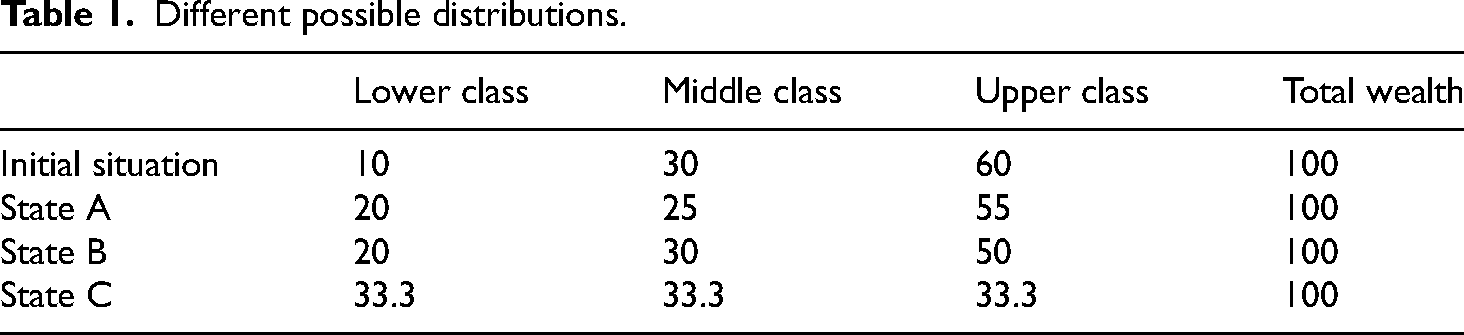
Since the initial situation contains inequality, insufficiency, and excess wealth, all three distributive principles would deem it to be unjust. Thus, they all agree that we should move to one of the other possible distributions. Sufficientarianism, in its basic form, is indifferent among moving from the initial situation to states A, B, and C, since everyone has enough in all three scenarios. Strict egalitarianism would prefer C over any of the alternative distributions. Limitarianism, on the other hand, directs us towards either state B or C because it specifies that no one should hold excess wealth and, therefore, burdens of redistributing to meet urgent needs should be placed on the upper class, rather than the middle class. It seems, therefore, that limitarianism is indeed not redundant—or, at least, that it can provide distinctive guidance. It offers a plausible response (i.e., either B or C) which overlaps with neither sufficientarianism (which also permits A), nor egalitarianism (which exclusively permits C).
The problem with this response becomes apparent when we ask why we should prefer state B or C to state A, according to limitarians. To see this, recall the reasons with which the limitarian principle is defended: avoiding democratic inequality and meeting urgent needs (setting aside climate change for the moment). But these two reasons alone lead us to the conclusion that we should aim for state B or state C. Our concern with meeting urgent needs informs us that we must move to A, B, or C. Our concern with democratic equality can be interpreted to imply that we should prefer B over A, given assumptions, which limitarians normally accept, about how money affects politics (Christiano, 2012; Robeyns, 2019). As a distributive principle, limitarianism does not seem to tell us anything that goes beyond the guidance already provided by sufficientarianism and egalitarianism. 12 It seems redundant (Huseby, 2022: 230).
It is not surprising, of course, that a pluralist distributive theory would lead to similar distributive guidance as limitarianism. After all, limitarianism is justified through an appeal to sufficiency (meeting urgent needs); egalitarianism (limiting political inequality); and a concern for destructive climate change—which usually involves a combination of principles, none of which are distinctively limitarian. 13 The fundamental issue is that, when conceived as a separate distributive principle, limitarianism simply seems to reiterate the concerns of egalitarianism, sufficientarianism, and intergenerational justice (and other reasons to worry about climate destruction). It does not tell us why we should target extreme wealth in particular.
To the inconclusiveness objection—the idea that limitarianism does not provide conclusive guidance in many important cases, in which other principles do provide guidance—Robeyns replies that limitarianism was never meant as a stand-alone principle of distributive justice. It is not meant to function as a complete theory of justice. As such, it would have to be combined with some background theory of for example egalitarianism or sufficientarianism to reach (more) conclusive distributive guidance (Robeyns, 2022: 265–266). But meeting the inconclusiveness objection in this way, strengthens the concern that limitarianism is redundant. As Lena Halldenius puts it: “compensating the inadequacies of limitarianism with the virtues of whatever principles you combine it with, is not really a point in favour of limitarianism” (Halldenius, 2022: 783). It is in combination with the redundancy objection, then, that inconclusiveness threatens limitarianism.
Finally, unlike sufficientarianism and egalitarianism, limitarianism seems to lack a distinctive reason that drives it. First, on its own, limitarianism is half-hearted in its commitment to democratic equality and fulfilling unmet needs (when compared to egalitarianism and sufficientarianism). To return to our table above, A is unjust, according to limitarians, because it holds excess wealth, while there is political inequality. However, if political equality is what guides our redistributive choices, as limitarians claim, it is bewildering why we should not prefer a fully egalitarian distribution over one in which only excess wealth (or power) is redistributed towards this end—why we should not prefer C over B, that is. Second, the table shows how a limitarian distributive principle is distinct from principles of equality or sufficiency, but we also want to know why we should accept its guidance. What is it about extreme wealth that makes it distinctively problematic? As we saw, limitarians often refer to this vagueness as a potential strategic or political advantage; as something that may unite otherwise dissenting political factions. As a distributive principle, however, it makes limitarianism seem to lack a proper normative core—it makes it strangely uncommitted to the pursuit of its grounding values. This is the point of the commitment objection.
As many limitarian scholars note, the different instrumental reasons through which the limitarian principle is justified may give rise to distinct thresholds. In other words, the limit to wealth on a background of unmet urgent needs may not coincide exactly with the limit on wealth-generated power under circumstances of political inequality or the limit on individual emissions in the face of impending climate catastrophe, respectively (Icardi, 2023; Robeyns, 2022, 2023; Timmer, 2021, 2023). This includes characterizing excess wealth in relative, rather than absolute, terms (Icardi, 2023). Being too rich in a society with high levels of political inequality, then, means having many more resources than others, rather than simply having a large amount in absolute terms (Axelsen and Nielsen, 2023). It is worth pausing to see whether such developments may help limitarians overcome the three objections.
A few limitarian thresholds of particular interest have been proposed: a limitarian threshold to ensure non-domination and one to guarantee the social bases of self-respect (Dumitru, 2020; Icardi, 2023; Neuhäuser, 2023). These proposals are particularly interesting because they propose limitarian thresholds that are concerned with relative distributive shares (Ali and Caranti, 2021; Harel Ben-Shahar, 2019). Rather than advocating that no one can be too wealthy in absolute terms (hold excess wealth), they hold that no one can be much richer than others. This is because the underlying values, domination and the social bases of self-respect, are positional—that is, whether wealth allows one to dominate others or acquire an undue level of social standing depends on how much wealth others have (Brighouse and Swift, 2006; Harel Ben-Shahar, 2017). Even in this form, as a relative threshold, however, limitarianism does not really pick out anything distinctive about extreme wealth. Indeed, since these thresholds focus on relative shares, their guidance appears even less distinguishable from what an egalitarian would suggest. 14 As a result, they seem even more vulnerable to the redundancy objection.
Another significant variation is proposed by Volacu and Dumitru (2019), who propose a responsibility-catering version of limitarianism. On this view, the limitarian principle should be sensitive to whether or not people's great wealth is a result of hard work or sheer luck, imposing greater redistributive burdens on those who are not responsible for their good fortune. Both the relative and the responsibility-sensitive variant, however, fuel the worries of the commitment objection. Making the limitarian threshold relative, rather than absolute, and responsibility-sensitive, rather than deliberately responsibility-indifferent, makes it significantly more ambiguous when, whether, and why extreme wealth is morally worrisome. This ambiguity undercuts the clarity of commitment of the principle because it dilutes the core idea of limitarianism: that we should worry about people having too much, that excess is distinctively problematic. It raises the question: what is it actually limitarians care about? In the next two sections, we turn our attention to the normative core of limitarianism in an attempt to overcome the commitment objection, meet the redundancy objection, and deflect the inconclusiveness objection.
Focusing on distinctive moral reasons
Due to the objections noted in the previous section, we agree with critics of limitarianism that there is no compelling justification for embracing a limitarian distributive principle alongside egalitarianism and sufficientarianism. As an alternative to equality or sufficiency (or, in particular, a combination of the two), limitarianism is a non-starter. However, Robeyns’ limitarian framework contains the seeds of something distinctive. Specifically, the notion of excess wealth points towards distinctive reasons to worry about extreme wealth, which have not yet been properly articulated or identified.
Sometimes, it can be helpful to draw the distinction between reasons and principles explicitly. In short, principles are guidelines for what to do—how to act, or what policies to prefer. Distributive principles set out how to adjudicate between conflicting claims on society's benefits and burdens, and, thereby, provide a set of rules for dividing these justly. Reasons, on the other hand explain why we should act charitably, prefer democratically decided policies, or aim for an egalitarian distribution. Thus, in line with the standard literature on reasons in moral philosophy, we take “moral reasons” to refer to the justification for our ethical and policy-guiding moral principles (Parfit and Broome, 1997; Raz, 1999; Scanlon, 2014). Discovering further reasons for following a particular principle may change the stringency with which we are compelled to act. It may change which contrary reasons would suffice in convincing us to act differently.
The present dispute between limitarians and their critics has focused on limitarianism as a distributive principle. And while limitarians have certainly noted reasons in favour of taxing excess wealth, these reasons are not distinctive to extreme wealth societies: meeting urgent needs, rectifying political inequality, and mitigating climate change in Robeyns’ work; and avoiding domination, preserving self-respect, and compensating bad luck in more recent variants. This focus on the limitarian principle and extra-limitarian reasons, we think, blurs the normative particularity of excess rather than bringing it out.
On another reading, however, the limitarian project may be understood as opening up a space for exploring the morality of excess. In particular, Robeyns’ notion of excess wealth as having zero moral weight provides a fruitful starting point for reflecting on our moral reasons for concern with excess. On this reading, limitarian explorations should take the three objections of redundancy, inconclusiveness, and commitment seriously, and focus on why having too much wealth is distinctively worrisome. Exploring this idea, we argue that excess provides us with distinctive reasons to back egalitarian and sufficientarian distributive principles under circumstances of excess wealth. And, unlike in existing limitarian theorizing, we point to new reasons that do not follow from egalitarianism and sufficientarianism themselves (unlike the ones that are the primary focus of Robeyns). Instead, they are reasons elicited by (what we call) the excess intuition. The excess intuition, recall, holds that at some point, people's claims to retain wealth become qualitatively different: they become interpersonally preposterous. This, we think, is where the core commitment of limitarianism is to be found.
What's distinctive about excess?
Now that we have motivated our focus on reasons, let us elaborate on the particular feature that a focus on excess helps us pick out. First, we will try to establish the force of the excess intuition through a set of examples. Afterwards, we will offer some thoughts on how this intuition may be conceptualized. Consider the following cases:
These examples contain both inequality and insufficiency. However, there is something else intuitively afoot in these examples: retaining (in Bank Account) or spending wealth (in Extravagant Spending) is qualitatively different when you have so much while others have so little or so much less. The excess intuition suggests that there is a shift in our moral reasoning at some level of wealth—a limit above which wealth retained in the face of insufficiencies and inequalities changes character. 16 This, we take it, is similar to what Robeyns means when she says that wealth above a certain limit has zero moral weight: demanding of your co-citizens that you should be allowed to retain such wealth while they suffer great difficulties is qualitatively different from when the distribution is merely unequal. Indeed, we take our point here to be an elaboration, rather than a rejection, of Robeyns’ central idea (which figures in P1 of her argument).
We agree with limitarians (and their critics) that there is nothing bad about being extremely wealthy in itself, however. Excess is distinctive, we claim, because it changes the character of already existing injustices (Axelsen and Nielsen, 2023). Holding or spending extreme wealth acts upon already existing injustices of inequality and insufficiency, adding an expressive layer of wrongness. In this way, the wealthy compound the injustices suffered by those who have too little and those who have much less. In doing so, extreme wealth adds a distinctive reason to worry about insufficiency and inequality—rather than establishing a separate distributive principle.
According to Deborah Hellman, when an agent compounds an injustice, they do two things simultaneously, corresponding to the two meanings of the word: they “compound” the injustice, as in worsen or augment it, and they turn the injustice into a new “compound”, as in a mixture or alloy (Hellman, 2018a, 2021). She provides an example of a battered woman, Amy (Hellman, 2021: 7). Because she is a victim of domestic abuse, Amy is more likely to die in the upcoming year than other women. A life insurer, noting the increased risk, charges Amy a higher premium for life insurance than women who are not abuse victims. The insurer compounds the injustice because they augment the harm of Amy's domestic abuse. They also compound the injustice in a different sense: by adding a new, distinctive layer to Amy's unjust disadvantage, by carrying it into another domain.
To say that retaining or spending excess wealth is expressively wrong (and expressively worse than mere inequality) does not entail that the superrich is motivated by malicious intent or disrespect towards the worse-off when they act. Rather, the expressive content of their actions depends on the social meaning of these acts. The social meaning, in turn, is the best interpretation of their action given the particular social context (Anderson and Pildes, 2000; Hellman, 2018b; Shin, 2009). Within this context, the wealth, opportunities, and exorbitant spending of the extremely wealthy seem unfathomable to their co-citizens. The wealthy have achieved (or could achieve) any and all socially recognized goals that can be bought with wealth: housing, education, travel, luxury goods, cars, etc. And when they retain and spend excess wealth on this background, on a background where they do not have to forgo any important, socially recognized aims in order to make their consumption choices, the social meaning of their actions is qualitatively different. The social meaning of their action (whether it is extravagant spending or overflowing bank accounts) is that they have nothing important, nothing better, to spend their resources on. In this way, the wealthy compound the existing distributive injustices, in the first sense, augmenting them because they could have been rectified so easily, but are not.
In expressing that they have nothing important to spend their resources on while their co-citizens struggle under insufficiencies (or while important collective problems like impending climate change are left underfinanced), the wealthy are sending a different, more troublesome message than what might be expressed by mere inequality. The best interpretation of retaining or wasting extreme wealth on this background, we argue, is that it sends a message of complete disinterest, or even disregard, towards the interests of one's less well-off co-citizens (Robeyns, 2017: 6). Their actions say: “your interests are of so little importance to us that we won’t even relinquish wealth, the absence of which wouldn’t prevent us from achieving anything significant, to help you get by.” What they express when acting in this manner is, in effect, that their less well-off co-citizens have diminished moral standing (Bratu, 2023; Thomsen, 2017). Their interests do not count morally (Bratu, 2023; Warren, 2000). By attaching this message to their actions, the extremely wealthy compound the existing injustices in the second sense. The enormous fortunes held needlessly and spent carelessly by the superrich while others struggle to express a particular type of disregard for the interests of their co-citizens: one that isn’t captured by pointing merely to inequality or insufficiency. 17 This is what we meant in defining the excess intuition that retaining extreme wealth when others have much less or too little is interpersonally preposterous; it is preposterous from the point of view of interpersonal morality.
This message of diminished moral standing is not present in cases where middle-class people spend resources on socially recognized goals. Imagine someone spending a significant sum of inherited money, which she could, instead, have redistributed to the poorest in her society, on a second car to improve her already good-enough career opportunities and to make her everyday life more comfortable. The expressive content of her action is shaped by the fact that she must abstain from realizing reasonable and societally recognized aims in order to act on her preference: in buying a second car, she refrains from travelling around Europe with her family or building an extension on her house. Her choice, buying a second car, will be out of reach, but not incomprehensible to society's worst-off. Furthermore, her choice comes with significant opportunity costs that are similarly recognizable. The same could be said, more generally, of the everyday ways in which most middle-class people spend resources wastefully and imprudently. Such practices may be unjustifiable in a broader sense (e.g., on the background of sufficientarianism and egalitarianism), but they do not carry the distinctive message characteristic for extreme wealth because of the recognizability and significant opportunity costs with which such everyday middle-class waste is accompanied. The extravagant spending of the extremely wealthy, on the other hand, comes with neither recognizability, nor significant opportunity costs. When the extremely wealthy waste or hoard resources, they are doing it to fulfil preferences that are far beyond what their co-citizens can recognize as reasonable aims. The extremely wealthy could buy anything that's within the scope of even the loftiest middle class daydream many times over.
To undergird this line of argument, it might be illustrative to compare it to a similarly spirited idea put forward by G. A. Cohen. 18 Cohen suggests that societal inequalities are sometimes wrong for reasons that go beyond distributive justice. Inequalities, instead, can be wrong because they cannot be justified among members of a community who care about each other's fates, a community characterized by mutual reciprocity (Cohen, 2009). Such inequalities fail the “interpersonal test” (Cohen, 2008, Ch. 1). The central point of the interpersonal test is that a policy argument that seems reasonable from a third-person perspective, might not have justificatory force when uttered by members of one societal group to members of another group. For example, it might seem reasonable to complain that I have to spend hours commuting on the bus because my car is being repaired from a third-person perspective, but I can’t plausibly make this complaint to my fellow citizens who take the bus every day because they cannot afford a car (Cohen, 2008: 36, 2009). The complaint fails the interpersonal test because it reveals a lack of community between me and my fellow citizens. For Cohen, a policy argument is comprehensively justified only when it passes the interpersonal test—that is, when it would be justifiable for members of any societal group to argue for this policy to members of any other group (Cohen, 2008: 42). By failing to pass the test in their argumentation, on the other hand, agents are “foreswearing community with the rest of us in respect of the policy issue in question” (Cohen, 2008: 43).
The case of extreme wealth is a particularly strong and clear violation of Cohen's interpersonal test. It is in failing the interpersonal test so spectacularly, we might say, that the extremely wealthy add an additional dimension of expressive wrongness to their unjust spending and retaining. For imagine an extremely wealthy individual seeking to justify retaining their wealth to the worse-off in society, saying: “I need to retain this money, withhold it from redistribution to you and the overcoming of significant hardships and obstacles you face, because I need it to gold-plate my toilets and write letters that can be seen from space into my private island.” Because the identified reasons are completely unrecognizable to the worse-off, this form of argumentation does not merely show a lack of justificatory community; it shows complete justificatory segregation. From the point of view of their worse-off co-citizens, the message sent when wasting or hoarding extreme wealth is: with my abundance, I could help you at no (socially-recognized) cost to myself, and yet I cling to it. This is how little your wellbeing means to me. This social meaning, it seems to us, persists independently of the intent of the wealthy. And whether or not the extremely wealthy hold their riches due to luck, prudence, risky investments, or inheritance. It is responsibility-insensitive. This highlights another possible aspect of the distinctive wrongness of excess. Whereas many theories of justice take the wrongness of inequality to depend on past exercise of responsibility, the expressive dimension of extreme wealth, and the social meaning of wasting it, remains the same.
At this point, you might wonder how exactly our reason-based limitarianism is to be understood. Thus, the expressive wrongs that accompany extreme wealth may be understood as a moral reason for individuals to avoid becoming or staying extremely wealthy—that is, not holding extreme wealth is an ethical imperative that forms part of what it means to live well, similar to the duty not to lie or not to cheat on one's partner. 19 Alternatively, the expressive dimensions may be understood as providing a political reason against extreme wealth. On this version, the expressive wrong of extreme wealth provides a reason to reassess the obligations one holds towards one's fellow citizens—duties that are enforceable, similar to the duty not to harm others or steal their property. Here, we agree with Robeyns that limitarianism should clearly be understood politically, as having to do with enforceable obligations to one's fellow citizens (Robeyns, 2017: 30, 2022: 254). In compounding existing injustices, in expressing a complete disregard for the interests of their fellow citizens, the extremely wealthy are not only failing to live well; they are violating obligations to their fellow citizens—or, rather, they are exacerbating the distributive injustices under which their fellow citizens toil. Subsequently, one might wonder what kind of obligations are being violated in these cases. On one prominent understanding, duties of justice only apply to societal institutions but not to the voluntary actions taken by agents within those institutions (Berkey, 2022; Rawls, 1971). In zooming in on the expressive dimensions of (voluntarily) spending and saving wealth, our analysis has, clearly, focused on obligations that go beyond the institutional level, however. One might worry that, in doing so, we have committed ourselves to a somewhat controversial non-institutional conception of justice—one that is often criticized for being unduly intrusive and overdemanding (Berkey, 2022: 725).
Properly understood, however, we think that the expressive wrongness of the actions of the extremely wealthy are both institutional and non-institutional. This is because when it fails to intervene, the state takes part in legitimizing the illegitimate claims of the superrich (Neuhäuser, 2023). In so doing, the state is not only passively failing to meet its distributive obligations, but is also taking an active part in the expressive wrongdoing against the disadvantaged. As argued by Christian Schemmel, expressive injustices (varying from different degrees of neglect to contempt or outright hostility) travel from the interpersonal to the political, when institutions fail to fulfil their obligations towards the unjustly worst-off, because in doing so, “institutions demonstrate an attitude of disregard, or disrespect, towards the unjustly disadvantaged” (Schemmel, 2021: 39). When the state fails to redistribute extreme wealth, it inherits the disregard for the interests of its most disadvantaged citizens shown by the extremely wealthy. To avoid expressing such disregard for its worst-off members, the state's obligations to alleviate insufficiency and inequality become more stringent when other members hold extreme wealth. It is more egregious, then, if the state fails to fulfil them. Because of this, even institutional accounts of justice have reasons to worry about what we have mentioned here.
We reconstructed the limitarian argument in the beginning of this article in the following way: C1) it is impermissible to hold excess wealth on a background of democratic inequality, unmet urgent needs, or impending climate change.
It should be clear that this principle does not follow from our analysis. Excess wealth, or surplus money, compounds the noted background injustices, but this is not enough to support the limitarian principle.
Instead, our analysis suggests that we should embrace the following argument, which reintegrates the excess intuition, and focuses on reasons rather than principles: P1*) wasting and retaining excess wealth compounds significant injustices. P2*) agents should avoid compounding significant injustices. C1*) agents should avoid wasting and retaining excess wealth.
In accepting this conclusion, we have not arrived at a limitarian (or any distributive) principle. It would be more accurate to say that we have reached a normative claim based on a distinctive moral reason to worry about excess. This reason is relevant for considerations of distributive justice, but it does not by itself commit us to a particular distributive principle.
As should now be clear, our argument about the distinctiveness of extreme wealth is not grounded in a conception of flourishing. For Robeyns, this grounding helps explain why there is a shift in our moral reasoning once people hold excess wealth. Danielle Zwarthoed (2018) has defended limitarianism in an even more straightforwardly perfectionist manner, arguing that extreme wealth diminishes the autonomy of the superrich. Our account of the distinctiveness of extreme wealth, on the other hand, is non-perfectionist. Rather than relying on a perfectionist criterion for what constitutes excess wealth, it appeals to the social meaning of actions of the extremely wealthy. Specifically, on the expression of disregard for the interests of one's co-citizens that is sent when hoarding or wasting excessive wealth.
Just like some people might object to the distinctiveness of excess on the grounds of perfectionism, some might object to the notion that excess is distinctive on the grounds of vagueness, using counter examples. Are you too rich if you fly first class, own a sports car, or get a live-in nanny? These questions are important. Not just for limitarianism, but for distributive justice in general. It may seem, furthermore, that if we cannot settle on a clear and uncontested limit for when wealth becomes extreme, the argument falls apart at the seams. Note, however, that such questions concern where the limit should be placed, rather than whether there is such a thing as excess (Axelsen and Nielsen, 2023). 20 The excess intuition is meant to capture the idea that there is some levels above which claims to retain wealth lose their force entirely. One can accept the force of this intuition without complete agreement about where the limit lies and what exactly constitutes excess.
Our analysis of the recent literature on extreme wealth shows a dynamic debate on the prospects of limitarianism as a distributive principle. In this debate, we have sided with and elaborated on the criticisms according to which the limitarian principle is redundant, inconclusive, and uncommitted. It is important to recall, however, that there is more to theories of justice than policy-guiding principles. Once we turn to unfolding the moral reasons distinctive to extreme wealth, as we have sought to do here, we begin to see the potential of limitarian theorizing. Thus understood, limitarianism is not redundant. On the contrary, it points us towards, and can offer, a plausible explanation for, the excess intuition and what is distinctively morally problematic about having too many resources. Nor is it inconclusive in any problematic sense. It is correct that it remains silent in a number of scenarios, to which distributive principles typically apply. But as a framework which picks out the wrongness of excess wealth, rather than a distributive principle, it should be applicable only to cases involving excess wealth. That is because excess wealth compounds injustice and, therefore, is only applicable in the presence of injustices that can be compounded.
Finally, once we acknowledge the force of the excess intuition, we understand that this re-articulation of the core commitment of limitarianism also avoids the commitment objection. The specific contribution of limitarian reasons is to help us see what is wrong with excess, which, as we have shown, comes from its interaction with existing unjust circumstances. On this understanding, we can see that it is fully committed to equality or sufficiency. The proper commitment of limitarian theory—explicated through its distinctive moral reasons—is that excess is a distinctive moral phenomenon: one that compounds and aggravates insufficiency and inequality by adding an expressive wrong. It is the concern with these injustices and the way in which excess compounds them that motivates our focus on excess. In fact, leaning on the arguments made here, limitarians might object that, in failing to recognize extreme wealth as a distinctive normative phenomenon, egalitarian and sufficientarian critics are failing in their principled commitment.
Conclusion
Limitarianism was originally proposed as a distributive principle, which instructs us to ensure that no one is too rich. It is meant as a partial, problem-driven principle to complement other principles of distributive justice in a multifaceted account of a fairer world (and how to get there). As a distributive principle, limitarianism faces three main objections. First, that it is redundant as it provides no guidance that could not be drawn from principles of equality and sufficiency. Second, that it is inconclusive, as it cannot provide guidance in important hypothetical situations. Third, that it displays a lack of commitment to its driving values. Both to equality and sufficiency, to which limitarianism seems only half-heartedly committed, and to excess, with which limitarianism has struggled to pinpoint anything distinctive. We have sought to shift the debate away from principles and towards the distinctive reasons that exist to worry about extreme wealth. These additional reasons are captured in the excess intuition, which states that at some point, people's claims to retain wealth become qualitatively different: they become interpersonally preposterous.
The excess intuition starts from similar ground as Robeyns’ central claim that above a certain limit, wealth has no moral weight. Building on this idea, we have suggested that excess wealth is distinctively problematic because retaining extreme wealth, wealth that has no moral weight, in the face of insufficiencies and inequalities, is expressively wrong. It sends a message of disregard for the interests of one's fellow citizens. Retaining wealth under such circumstances, carries an expression that the lives, projects, and interests of others are unworthy of respect. A message of inferior moral status. In doing so, the wealthy compound the injustices of insufficiency and inequality. The weighty moral reasons derived from this argument provide the foundation from which extreme wealth becomes a distinctive problem of political morality.
Footnotes
Acknowledgements
We are very grateful to Isabella Trifan, Moritz Schulz, Paul Bou-Habib, James Christensen, Juliana Bidadanure, Tim Meijers, Tom Parr, Timo Jütten, Shmulik Nili, Ingrid Robeyns, Bob Goodin, Natasha Osben, Clare Burgum, the editor, and two anonymous reviewers for excellent comments on previous versions of this paper.
Declaration of conflicting interests
The author(s) declared no potential conflicts of interest with respect to the research, authorship, and/or publication of this article.
Funding
The author(s) received no financial support for the research, authorship, and/or publication of this article.
