







Abstract
Major corporations may as part of their communication strategy present a number of core values in the form of abstract property nouns, for example, integrity. Such nouns are rich in meaning, which gives rise to a corporate discourse associated with their interpretation. Multinational companies tend to use English as a lingua franca (ELF) to formulate these values in order to reach a global workforce, which in some cases may lead to a need for explicitation as a translation strategy to capture any cultural differences. To our knowledge, there is little prior in-depth research on corporate values, taking into account the linguistic material used, nor research into the linguistic expressions designating these as instances of discourse in their own right. The same applies to research into the implications of conveying these expressions by using ELF. On this background, we discuss corporate values from a linguistic perspective, adopting a semantic–pragmatic approach, including cultural factors and the implications of using ELF to convey their meaning. To illustrate our approach, we will present a case study of a Norwegian MNC with subsidiaries in 12 different countries.
Introduction
In the last few decades, values have come to play a prominent role in corporate discourse and are widely used both as a means of promoting consistent behaviour within an organization and as a means of communicating to stakeholders what the organization stands for. It is therefore not surprising that the issue of corporate values has been thoroughly investigated in management research from a wide variety of angles. Interestingly however, little attention has been devoted to the linguistic material used to convey corporate values, notwithstanding the fact that these values can only be defined and accessed through their linguistic expressions. In a globalized world with an increasing number of MNCs, conveying common values and ensuring they are understood in the intended manner is no easy matter. More often than not, expressions used to designate corporate values (abstract property nouns) are semantically fuzzy and open to multiple interpretations. The risk of deviating understandings is particularly high in linguistically and culturally diverse organizations. Indeed, value expressions tend to be culturally bound (Wierzbicka, 2003) and are thus difficult to export to new environments. Another complicating issue is the fact that these expressions are frequently translated into English as part of the MNC’s internationalization strategy. Whilst the use of English has been found to favour a process of cultural accommodation, there may also be a risk of ethnic affirmation due to local interpretations of the concepts involved (Harzing et al., 2002). Looking at the discourse used by MNCs in this process can therefore provide useful input to management of companies that are facing mergers and aquisitions (M & As) in different national contexts. Given the status of English in global business, the use of this language in formulating corporate values should also be taken into account.
A linguistic analysis of value expressions that are commonly used in corporate discourse will therefore be a useful addition to the already existing body of research on corporate values and contribute to raising awareness of the challenges associated with the use of values as a communicative tool and cohesive device in a diverse organization. This article aims to address two language-related issues: Given the semantically fuzzy nature of value expressions, what processes can management initiate and implement to ensure a uniform understanding of corporate values in MNCs? What are the implications of using English as a lingua franca (ELF) to convey values in MNCs?
In the following, we will suggest a theoretical framework that can be used to address these questions and that can be useful as a tool for companies that wish to expand internationally. In order to illustrate our approach, we will use the example of a Norwegian MNC with units in 12 countries. Two types of data from the MNC will be presented: interviews with senior managers who played a key role with regard to the formulation of the company’s corporate values (integrity, openness/honesty, loyalty and initiative) and the company’s official verbalizations of the intended meaning of these values. This is an MNC-internal document, hereafter referred to as Guidelines. Our analysis builds on both critical discourse theory and critical genre theory. However, before we present our approach, we will attempt to describe how our research fits in with prior research on corporate values and also present briefly the concept of ELF, which is essential to our study.
Extant literature on corporate values
The concept of corporate values is multifaceted. As pointed out by Cornelissen (2011: 63), a distinction must be made between values as inherent traits of an organization, that is, enduring (core) values that are shared by people within an organization and that distinguish it from other organizations on the one hand and the outward presentation of these values on the other. This dichotomy is reflected in the distinction between tacit (implicit) values and articulated (explicit) values made by Collins and Porras (2005: 222). Furthermore, articulated values can be perceived as a communicative tool ‘to motivate, focus and lead the staff towards the objectives of the company’ (Brabet and Klemm, 1994: 84) and as a part of the picture of the organization presented to external stakeholders, that is, as an element of corporate branding (cf. Schein, 1992: 256). Given the linguistic focus of our study, we are solely interested in articulated values. Our main concern is with how these values are interpreted by employees, that is, as an element of internal communication. In our presentation of extant literature, we will therefore focus on studies with the same scope of interest.
Several scholars have highlighted the role of articulated values in the shaping of a corporate identity (cf. Agerholm Andersen, 2010; Bick et al., 2003: 839; Collins and Porras, 2005: 73–6). Other scholars have focused on specific communicative aspects such as how values are communicated in management conversations (Aggerholm et al., 2009), how they are perceived by employees (Holtzhausen and Fourie, 2009) and on the effect of internal communication and training on the internalization of corporate values (Chong, 2007). 1 As our interest lies in the use of such values in multicultural settings, research focusing on international companies is of particular relevance. The importance of harmonizing corporate cultures in connection with international M & As has been pointed out by more than one scholar (Cartwright and Cooper, 1996; Leung et al., 2005; Zupan and Kaše, 2010). All the aforementioned authors place values at the centre of their culture construct. However, little attention is given to the role of articulated values with regard to achieving an adequate cultural fit between units in different countries. Not surprisingly, the same applies to broader studies investigating the relationship between national and corporate cultures (Andolček and Štebe, 2004; Fischer, 2012; Fischer et al., 2005; Smith and Dugan, 1996). One study that does focus more specifically on articulated values is D’Iribarne’s study of a French multinational company with units across the world (D’Iribarne, 2012). The author presents empirical data demonstrating how the company strives to strike a balance between its corporate values as expressed in the company’s principles of action and local values in the United States, Jordan and China. D’Iribarne provides a detailed analysis of the different language versions of the principles of action, which reveals how seemingly minor changes in the wording can be explained as an effort to adapt the document to local cultures. This study is highly interesting as it emphasizes the role played by language in conveying values. Our study differs from D’Iribarne’s on several accounts. First of all, we are interested in how values are conveyed in different cultures using the same language. Secondly, we will consider values not as a component of one specific genre but across texts, genres, professional practices and professional cultures.
The concept of ELF
In recent years, increasing attention has been devoted to the use of English in corporate communication, for example, a mapping of factors affecting MNCs’ choice of English for communication between headquarters and subsidiaries (cf. Louhiala-Salminen et al., 2005; Luo and Shenkar, 2006; Van den Born and Peltokorpi, 2010) and studies dealing with social identity, language clustering and parallel information networks (Feely and Harzing, 2003; Lauring, 2008; Lauring and Selmer, 2010; Tange and Lauring, 2009). In these contexts, English is employed as a communication tool among speakers who do not share a first language, a usage that is commonly referred to as English as a lingua franca (ELF). This is the subject of a rapidly expanding field of research encompassing many different perspectives on language use. ELF is regarded as primarily a contact language that is used as a means of communication between non-native speakers (Jenkins, 2007), and its speakers are conceptualized as language users in their own right rather than being compared to a native speaker standard (Seidlhofer, 2011).
Less attention has been paid to ELF as a language of intercultural communication that may serve as an expression of local identities and that looks beyond cultural differences conceptualized at a national level (Baker, 2009, 2011). Concepts like transcultural flows, liminality, third culture and third places have been used to describe the dynamics of intercultural interaction in an ELF context (see Baker, 2011 for an overview). When it comes to linguistic expressions designating values, these may have been arrived at in a local setting and may thus be based on a shared local understanding and embody culture-specific folk taxonomies in the same way that their English-language equivalents would do in an Anglo context (Wierzbicka, 2003).
This raises the issue of whether using English to formulate values discourse may have an impact on the discourse itself. Research comparing questionnaire responses in the respondents’ native language to how they respond to an English language translation has found that the use of English may obscure nation-based differences, thus favouring a process of cultural accommodation (Harzing and Country Collaborators, 2005; Harzing et al., 2002). An ethnocentric approach may thus fail to capture the dynamics of a process where an MNC management aims to impose a set of values to its subsidiaries using ELF, a situation that may also be impacted by English not being the first language of the parties in question. This situation may usefully be discussed in terms of a ‘third culture’ Kramsch (1993: 238), which describes cases where there is a ‘clash between the familiar meanings of the native culture and the unexpected meanings of the target culture’. In such meetings between cultures, a process may take place where the parties negotiate and construct a shared meaning of the values conveyed by the parent company.
Drawing on insights from the research areas described above, our point of departure is the following: When using corporate values in multicultural organizations a balance must be found between creating a shared understanding and adapting to local cultures. The use of ELF does not guarantee a uniform interpretation of value statements. The interpretation of such statements will be affected by the cultural background of the reader/listener and will not necessarily be in line with the original intended meaning.
Using the example of the Norwegian MNC, we will explore how the issue of corporate values is perceived by its management and attempt to trace any developments in the direction of a third culture.
Theoretical framework
Our analysis draws on two theoretical frameworks that address different aspects of discourse. Bhatia (2012) has elaborated a multidimensional and multiperspective genre theory that will allow us to describe the status of values within an organization, whereas Koller (2008) provides a critical discourse analytical model that can be applied to the Guidelines document.
Bhatia’s theory takes into account both the text-internal and text-external semiotic resources and constraints that contribute to the construction and interpretation of meaning in professional contexts. Text-external resources and constraints include conventions that shape generic constructs, professional practices and the specific culture that shapes these practices. The various resources and constraints establish interactive patterns of interdiscursivity. Applying the theory to corporate values, we can describe the text-internal dimensions as follows: they are linguistic expressions that appear in a variety of texts, belonging to different genres (e.g. mission statements and annual reports). Indeed, value statements often have a fixed place within the macrostructure of the different genres. 2 The text we will be analysing in our case study is in other words one of several genres in which corporate values appear. Its communicative purpose is to promote a common understanding of the organization’s corporate values by verbalizing their intended meaning. This is a relatively frequent but, to our knowledge, unexplored genre that can be considered as being derived from the mission statement. With regard to text-external dimensions, the generic conventions can be related to corporate values as a specific form of professional practice: the values are communicated to employees not only through texts belonging to various genres, each having their own communicative purpose, but they are also typically discussed in meetings and are a common topic in introductory courses for new employees. This practice is shaped by corporate culture, that is, the perception of values as a cohesive device in organizations. Corporate values are interdiscursive in the sense that when they are used in a specific context, for example, presented orally in a meeting, reference may and will often be made to their use in other genres or in terms of their role as a form of professional practice.
As already mentioned, our interest lies in the use of corporate values in internal communication. An exhaustive description of corporate values would also have to take into account text-internal and text-external resources and constraints exploited in external communication, for example, how corporate values are used for marketing purposes across the various text-internal and text-external dimensions.
The discourse analytical framework suggested by Koller (2008: 161) provides a tripartite model for describing corporate discourse taking into account the text level; interaction, that is, the production, distribution and reception/interpretation of the text; and the socio-economic context it appears in. Koller’s model is designed for the description of corporate discourse in the public sphere, and the author applies it inter alia to mission statements perceived as an element of external communication. The model seems however also applicable to the description of texts for internal use. This shift of focus from external to internal communication will obviously have implications for the description of the socio-economic context, as our emphasis will be placed more on the description of the organization per se rather than external societal factors. With regard to the interactional level, it seems appropriate to include observations regarding the use of ELF as the choice of language will have strong implications for both the production and the interpretation of the text. The text level will in this particular case consist of an analysis of the Guidelines document.
Data and methodology
In this case study, two types of data have been collected: a text verbalizing the intended meaning of the company’s corporate values and semi-structured interviews with key managers who participated in the elaboration of the values, a total of three interviews lasting roughly 1 h each. As mentioned earlier, corporate values cannot be confined to one specific genre or isolated from the rest of the company’s professional practice. This particular text has been selected based on its informative value. Indeed, it is the only genre that deals exclusively with corporate values and has as its sole communicative purpose to ensure a common understanding thereof. The interviews provide us with insights into the interaction level and the socio-economic context of the text. Questions were asked regarding the use of English, the extent to which cultural factors were taken into account, the status of these values within the company and the means by which they were communicated across the various units of the MNC. The interviewees were also asked to describe the rationale behind the choice of the specific values.
The verbal descriptions of the meaning of the corporate values have been compared to the dictionary descriptions of these value expressions with a view to describing the semantic–pragmatic interface. The interviews have been transcribed and passages relating to the various interactional and contextual aspects have been classified. The interviews were conducted in Norwegian, and the citations presented in this article have been translated by the authors. Facts about the company itself have been gleaned from various documents as an additional source of information regarding the socio-economic context. We will present our analysis top down, that is, starting with the socio-economic context and the interactional level before we move on to the linguistic analysis of the text.
Analysis
Socio-economic context
MNC is a Norway-based global company headquartered in Bergen, Norway, specialized in the development, marketing and supply of material handling systems to the maritime and energy industries. The group is the result of acquisitions in Europe (Czech Republic, Finland, Germany, Greece, Italy and Sweden), Asia (China, South Korea, Singapore, Vietnam), in addition to the United States. Due to the company’s rapid pace of acquisition and sale, the configuration of the MNC is constantly changing. Using the taxonomy of country clusters (House et al., 2004), we find that the spread of cultures involves at present at least 6 of the total 10 clusters, namely Eastern Europe (Greece), Latin Europe (Italy), Germanic Europe (Germany), Nordic Europe (Finland and Sweden), Confucian Asia (Singapore, China and South Korea) and Anglo (United States). Whilst Norway, the Czech Republic and Vietnam are not included in the GLOBE database, they may arguably be included in the Nordic Europe, Eastern Europe and Confucian Asia clusters, respectively. As of 2011, the company had close to 1200 employees, 45 per cent of whom were located in Norway. The senior management team was Norwegian, with one Chinese member, whilst the Board members were all Norwegian. MNC has a policy of decentralization, which they see as the reason why they have been able to retain nearly all the companies they have acquired over the years in addition to having an extremely low turnover of local management. This has been a deliberate strategy, which they refer to as ‘small business culture’ (Interview 1).
English is used as the company’s corporate language in order to enable communication between headquarters and subsidiaries and is used in all inter-unit communication. Intranet information for use at headquarters only will be in Norwegian, and in contexts where only one nationality is represented the local language may be used, but documentation resulting from events of corporate interest is produced in English. MNC’s Norwegian employees are expected to be proficient users of the language, and using Norwegian in inter-unit emails is not accepted. Thus, an employee who insisted on emailing his China-based Norwegian colleague in his native language started receiving replies in Chinese to drive this point home. However, interpreters may be used in meetings and negotiations in some locations in China. The core values have also been translated into Chinese and German due to the fact that proficiency varies across units, but the translated versions have a different status from the official English versions, as they are only used in their respective country contexts.
Interactional level
The original motivation for establishing a set of articulated corporate values was to make explicit the shared tacit values of MNC management at a time of rapid expansion (Interview 3). This was a management-initiated process that started in 2004 and that went over 18 months. The result of this process is a mission statement entitled The spirit of MNC, which sets out corporate vision and strategy, company culture and ethical guidelines and in which corporate values play a prominent part. In the initial discussion, the values were discussed both in Norwegian and English, but the aim was from the outset to formulate the values in English. One of the managers from headquarters who was involved in the process reported that an external communications adviser had been engaged by MNC but that his input regarding the overlapping meaning of the expressions used to designate the values in Norwegian was seen as irrelevant, as English was regarded as the solution to this problem: he stated that the core values overlapped in Norwegian, that is all right, but we are not in Norway, it is not Norwegian language and we are a multicultural multinational company. (Interview 1) No [the values] are for the whole of MNC, if you change this it has no meaning … you need to have some constancy and work at it, because you do not create a culture overnight, I am convinced of that. We are still a company consisting of many different companies …. On the one hand, we want them to keep a part of their own culture and that we can work with them, whilst they at the same time realize what we are doing and become a part of the MNC family. (Interview 1) there are so many other vibrations so many other things that are being communicated not just the linguistic communication we in Norway are very simple people, we tend to mean what we say. (Interview 1) they [the Chinese] perceive us as impolite when we think we are being honest or think that we are honest’; ‘we are beginning to understand how [the Chinese managers] think and it will be clear that they have been through the same learning process as us. (Interview 1)
The verbalization of the corporate values is thus aimed at ensuring that culture-bound terms receive the same interpretation in the different units. There was a clear understanding among the managers that the linguistic expressions on their own were not sufficient to ensure a common understanding of the values across cultures, hence the need for a document describing the MNC’s pragmatic interpretation.
The text level
Guidelines is a one-page document describing the four core values, emphasizing that ‘it is important that we all have the same understanding of what Integrity – Openness/Honesty–Loyalty and Initiative mean for us as employees of [MNC]? What does it mean in daily internal work as well as communication with suppliers and customers?’ It stresses the importance of the values being discussed in all units, focusing on the question ‘What does this mean in our country and in our culture?’
The document sets out one section for each of the four values integrity, openness/honesty, loyalty and initiative. The Oxford English Dictionary (OED) dictionary entries for the four value expressions may be illustrated by means of circles, where the overlapping OED entries for integrity and openness/honesty have been set out in the interface between the two (Figure 1). It will appear that the overlap is considerable, even to the extent that the core values expressions appear as part of their respective definitions. For a complete overview of the OED definitions, see Appendix 1.
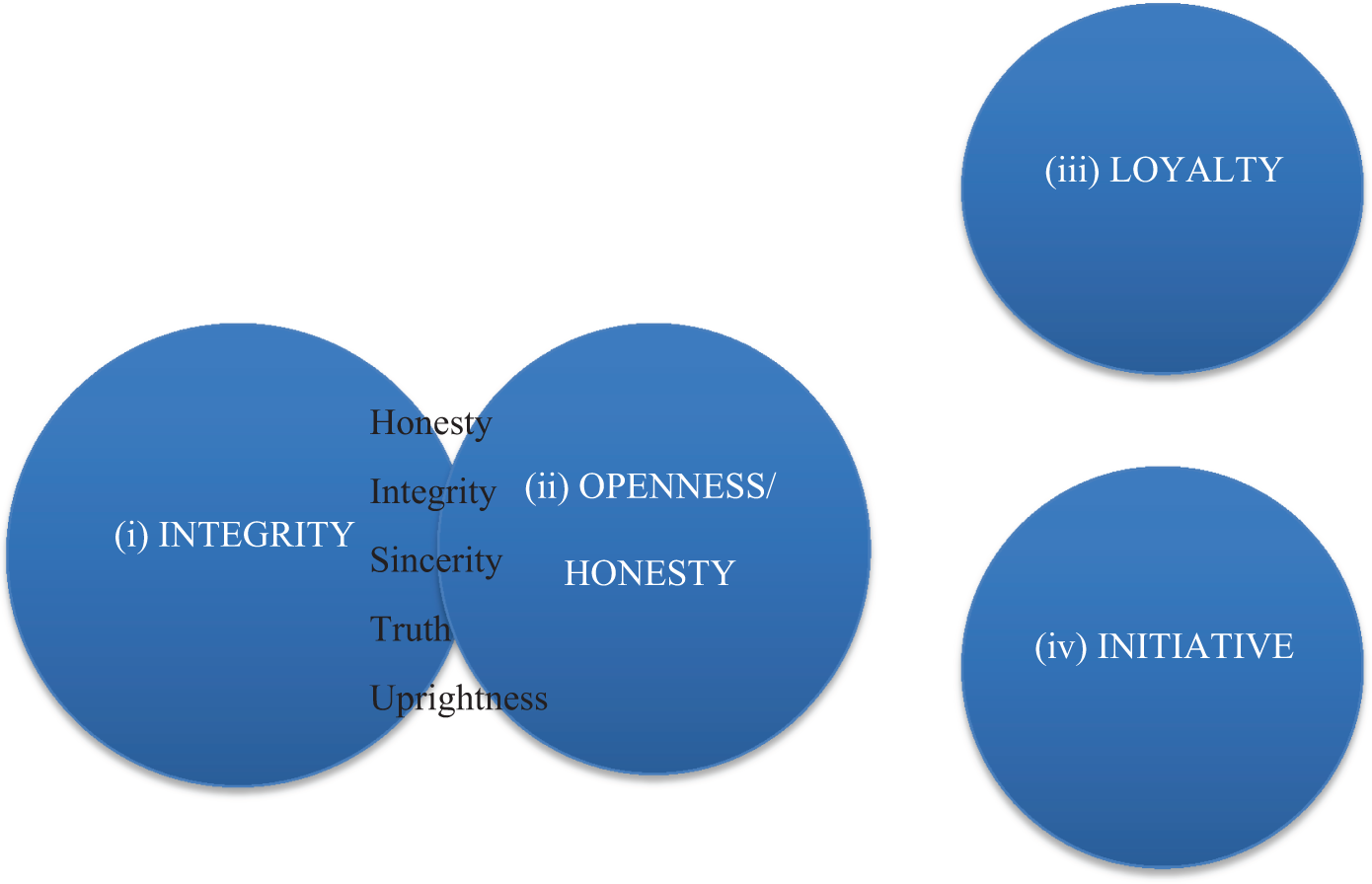
Core values relationship.
Whilst the translation process in the main reflects the dictionary definitions of the core values expressions, the process goes beyond this to capture the Norwegian cultural understanding of one of the terms, namely åpenhet. This aspect is mentioned by one of the interviewees: … this thing about openness honesty it has a totally different meaning in Norway than in China. (Interview 1)
Guidelines explicate the meaning of each value in the form of directives (Searle, 1975). The document has the explicit aim of ensuring a shared understanding and answer the question of what the values mean ‘in daily internal work as well as communication with suppliers and customers’ (Guidelines). This is an essential part of the values discourse since it introduces a fairly broad interpretation of the expressions in question. Below, the MNC definitions have been set out in tabular form for each value. Since the definition of (i) integrity and (ii) openness/honesty showed a certain amount of overlap, the two have been presented together in Table 1:
(i) Integrity/(ii) openness/honesty.
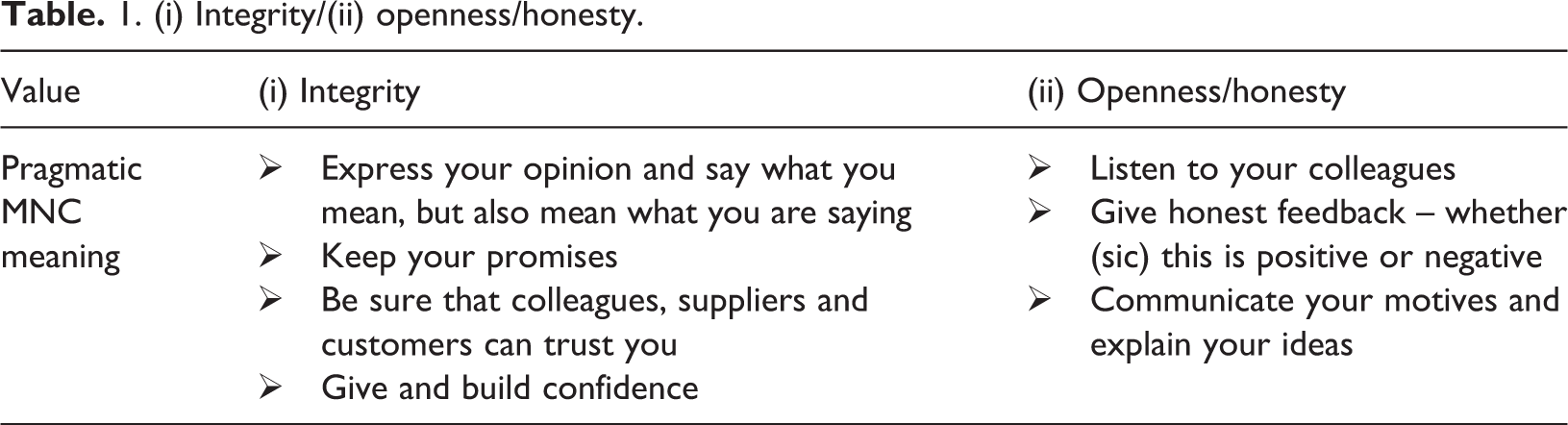
The overlap between these two values is particularly clear when it comes to the notions of clarity of expression and explicitness. We may, however, note that integrity focuses on building trust and confidence, whilst openness/honesty centres more explicitly on communicative issues, both as listener and speaker. When asked about these explicitations, the interviewees explained the rationale behind them as follows: We had a Chinese company with a Norwegian manager, but he says it took several years before it worked because in the beginning they wondered what he was hiding behind his back, what was up his sleeve when he said what he said, what kind of trick was this, so it took several years before they realized that when he said what he said he meant that they had to do this, contribute actively, and that was how he wanted it, and this created a culture. (Interview 1) We see that the Chinese have a totally different interpretation of … for example, openness and integrity, and we have discussed. This is one of the things that we have discussed that is perceived differently in different countries. (Interview 2)
As mentioned earlier, honesty is added to openness to convey an ethnocentric or even autostereotypical perception of Norwegian communication style. There is, however, an indication that we are looking at a dynamic process in this respect, as the Chinese perception of the Norwegian communication style has been subject to change and that this was perceived of as ‘creating a culture’. Whilst this appears to be a one-way process where the Norwegian style is seen to be gaining acceptance, the opposite is also the case, as one of the Norwegian interviewees criticized the national direct style for being ‘impolite’ and another pointed to Germans not understanding that a vague answer means no.
Moving on to the third values term, loyalty, we see that the need for cohesion in a global MNC is clearly in focus, as set out in Table 2:
(iii) Loyalty.
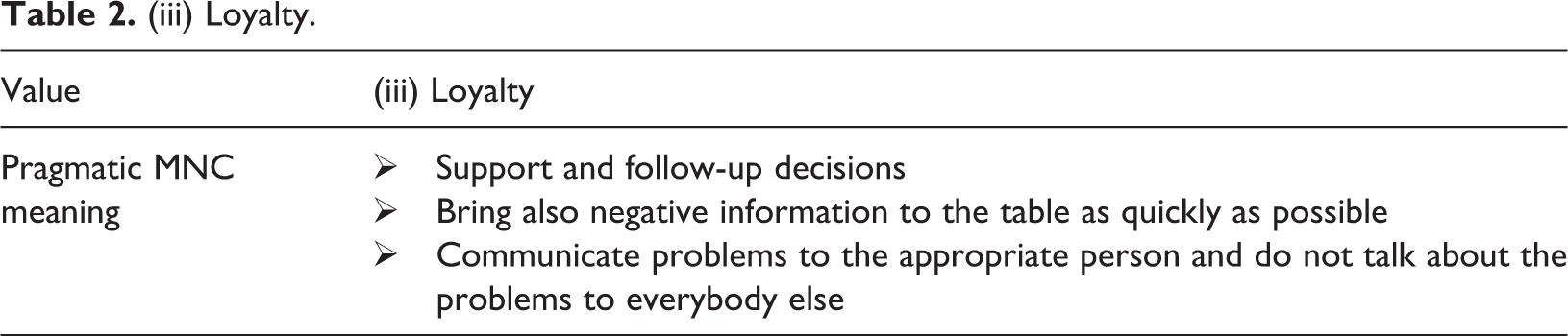
The MNC interpretation of loyalty also has a communicative aspect but is more geared to the line of communication and the implementation of decisions within the MNC. There is also a partially overlapping meaning with (i) integrity and (ii) openness/honesty discussed above, as employees are expected to report negative incidents as well, which is perceived as a problem, as these can have costly consequences.
Loyalty is said to be extremely important because a decentralized structure and local decision-making would not work if central decisions are not adhered to (Interview 1). In general, loyalty is seen as less of a problem in China than in Europe (Interview 1), but there have been cases where the loyalty was to the Chinese owners even if the ownership structure was 50/50 (Interview 2).
As for the fourth values term, initiative, this may be interpreted as the MNC’s focusing on the role of the employee in the chain of command or decision-making process, as set out in Table 3.
(iv) Initiative.
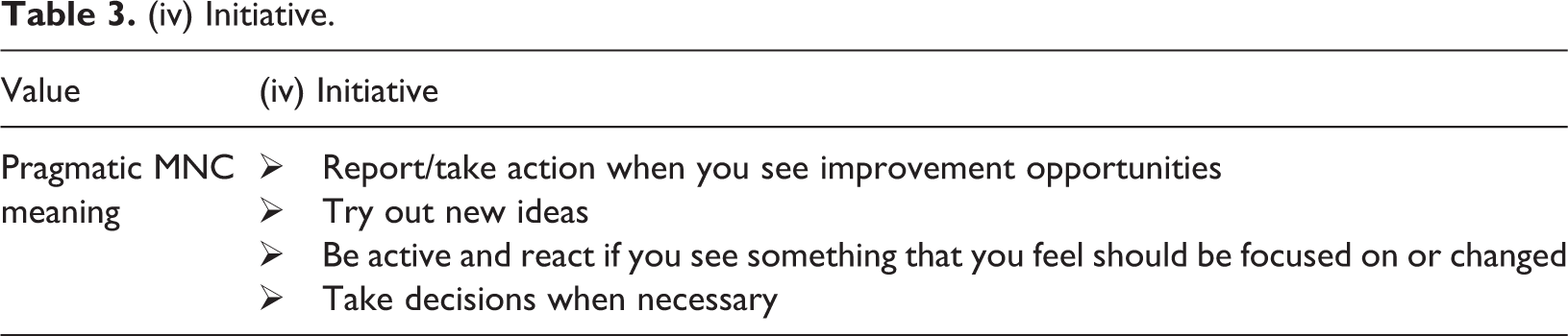
The value of initiative focuses on the active role of the individual within the organization, and can be seen to aim at empowering the employee, and downplaying the role of hierarchy. This is a subject of great focus in the organization and also a major factor when it comes to product development. Here there are differences to what extent the local management style encourages initiative, China, Korea and parts of Eastern Europe (Interview 1). And then I see that we have different associations when it comes to the meaning of initiative and what does a Chinese associate with this value. Well a Chinese is extremely careful when relating to his manager, the manager is the boss, you can hint at things, that we may do things like this, but taking the initiative like we do it here is not done in a way, managers in China have to work very actively with this. (Interview 1) In our Shanghai subsidiary, it has become sort of almost Scandinavian, the way it works there is that they all want to take responsibility there is no doubt about it, if anything needs doing they take the initiative but it took three four years. (Interview 2)
Discussion
Initially, we asked two questions relevant for a linguistic approach to corporate values and which we will attempt to answer. First, given the semantically fuzzy nature of the value expressions, what processes can management initiate and implement to ensure a uniform understanding of corporate values in MNCs? Raising awareness concerning the nature of these expressions and the likelihood of their being interpreted differently according to the cultural background (d’Iribarne, 2012; Harzing et al., 2002; Wierzbicka, 2003) is a central issue here, as is taking into account the potential for cultural accommodation (Harzing et al., 2002). If we turn to our case study, we see that one means to ensure a shared understanding is adopting a semantic–pragmatic approach explicitating the values terms, as illustrated in Guidelines. This, however, does not preclude ethnocentric views, which came to the fore in formulations like ‘things we do not need to emphasise to the same extent, because it is taken for granted in Norwegian society’, and ‘we in Norway are very simple people, we tend to mean what we say’ (Interview 1). On the other hand, we identified practices associated with accommodation, as subsidiaries are said to be encouraged to keep ‘part of their own culture’ (Interview 1).
In this process, we may identify a climate for developing a third culture (Kramsch, 1993) that may develop into a shared understanding of the values by parent companies and subsidiaries/joint ventures. As mentioned above, a case in point is the value of openness/honesty that embodies an ethnocentric perception of Norwegian directness and transparency. The Norwegians, however, realize that when they communicate with the Chinese, they are perceived as ‘impolite when we think we are being honest or think that we are honest’ (Interview 1), and they also express frustration when Germans fail to understand that a vague answer means no (Interview 3). A mutual understanding between Norwegians and Chinese is also indicated: ‘we are beginning to understand how [the Chinese managers] think and it will be clear that they have been through the same learning process as us’; a development said to be ‘creating a culture’ (Interview 1). Thus, more than one culture provide input to what appears to be an interdiscursive and dynamic process towards a desired professional practice (Koller, 2008).
In some other instances, however, the change appears to be primarily in the direction of parent company to subsidiary. When it comes to work processes, the integrity/honesty value was challenged in China, as workers were hesitant to reporting errors. However, there were indications that this was changing (Interview 3). The same appears to be the case for initiative, where the Shanghai office became ‘almost Scandinavian’ in this respect after a 3- to-4-year process (Interview 2). Whilst the interviewees did not comment on whether this led to altered perceptions of the values discourse in the parent company, this would not seem unreasonable, as the notion of initiative will differ depending on the level of hierarchy in the workplace. Another case in point is loyalty, which has been a topic of the MNC courses in China, explaining that loyalty in joint ventures is not just to the Chinese owners but also to the Norwegian ones. In our opinion, this discourse also works to strengthen a shared understanding of MNC’s core values across the different units.
Secondly, we looked into the implications of using ELF in MNC values discourse. Research indicates that cultural issues are also an issue in ELF discourse (Baker, 2011). Thus, translations may reveal ethnocentric and even autostereotypical views leading to explicitation, for example, the addition of honesty to the concept of openness. We also identified a tension between a belief that English ensures a shared understanding at the same time that native speaker variants were seen as problematic. One MNC manager referred to native English speaker input as useless because the language was too complicated, stating that ‘we use business language and this is what our sentences are like and this is understood internationally’ (Interview 1). The English used in this context is thus ELF (Jenkins, 2007), which functions as a necessary pragmatic device to ensure a shared communicative platform in MNC. Whilst these observations are not new, the metadiscourse surrounding them point to a process where ELF contributes to forming a dynamic third culture for the MNC.
We also see that value expressions require some explicitation to ensure a uniform understanding, in addition to being the subject of an interactive process within the company, where the different cultures can contribute towards creating a third culture for the MNC. If there is only a one-way process combined with an external perspective on the different cultures, values will only be imposed top down, and the process of integration may not take place.
Finally, we ask the question whether we can identify any best practices concerning values discourse in MNCs from our case study? From the above, it would appear that a carefully planned interactive process between parent company and subsidiaries that goes over a certain amount of time is positive to furthering integration and establishing a desired work culture, for example, the process surrounding initiative. Also, the explicitations of what is to be understood by the values terms themselves provide a managerial tool that can be used to work towards a desired corporate culture. A case in point is the emphasis on employees being expected to take decisions when necessary, which can be a challenge to convey to employees in hierarchical cultures. As for relevant factors mentioned in the interviews, we can pinpoint the increased shared understanding of the values and their implications for the MNC business culture, the retention of local workforces in the subsidiaries and a focus on host country staffing. It would thus seem reasonable to claim that spending time on values discourse as a strategic move is positive for MNC coherence.
Conclusion
This study discusses how the use of articulated corporate values may enhance a common corporate culture and bring out contrasting understandings among units situated in different cultures. Whilst the values are assumed to be universal, their verbalizations may reflect a tacit ethnocentric understanding of the concepts, which is explicitly conveyed to all units. In the case under discussion, the formulation of the values and their explicitations illustrate the contrast between semantic or dictionary-based meaning, which overlap to a certain extent, and their highly context-based pragmatic meaning expressed in the form of directives.
We have also argued that our study provides useful insights into issues that should be of interest for managers. Our approach, which takes the linguistic material as a starting point, allows for the study of corporate values from a different vantage point than is found in most management literature. It allows us to highlight the importance of the language dimension in the process of anchoring the values in the organization, which is a type of insight that can be useful for companies in the process of explicating their values in a cross-cultural context. Further, we claim to have identified a best practice that includes a comprehensive process involving all subsidiaries and following this up by regular meetings.
As stated above, the present study is based on three interviews with senior MNC managers together with a text verbalizing the intended meaning of the corporate values terms. Its empirical scope is thus limited, but we would claim that our approach offers something new to the field. The aim of this article is first and foremost to advocate the usefulness of a linguistic approach to corporate values and to outline a theoretical framework that incorporates a number of relevant contextual factors. The case study is also intended to serve as an illustration of best practice. It would, however, be useful to supplement this research with more empirical data from other companies, in particular comparing the perspectives of management and employees on the values discourse, which is a topic that the authors of this article are working on at present.
Footnotes
Appendix 1
MNC values, OED definitions.
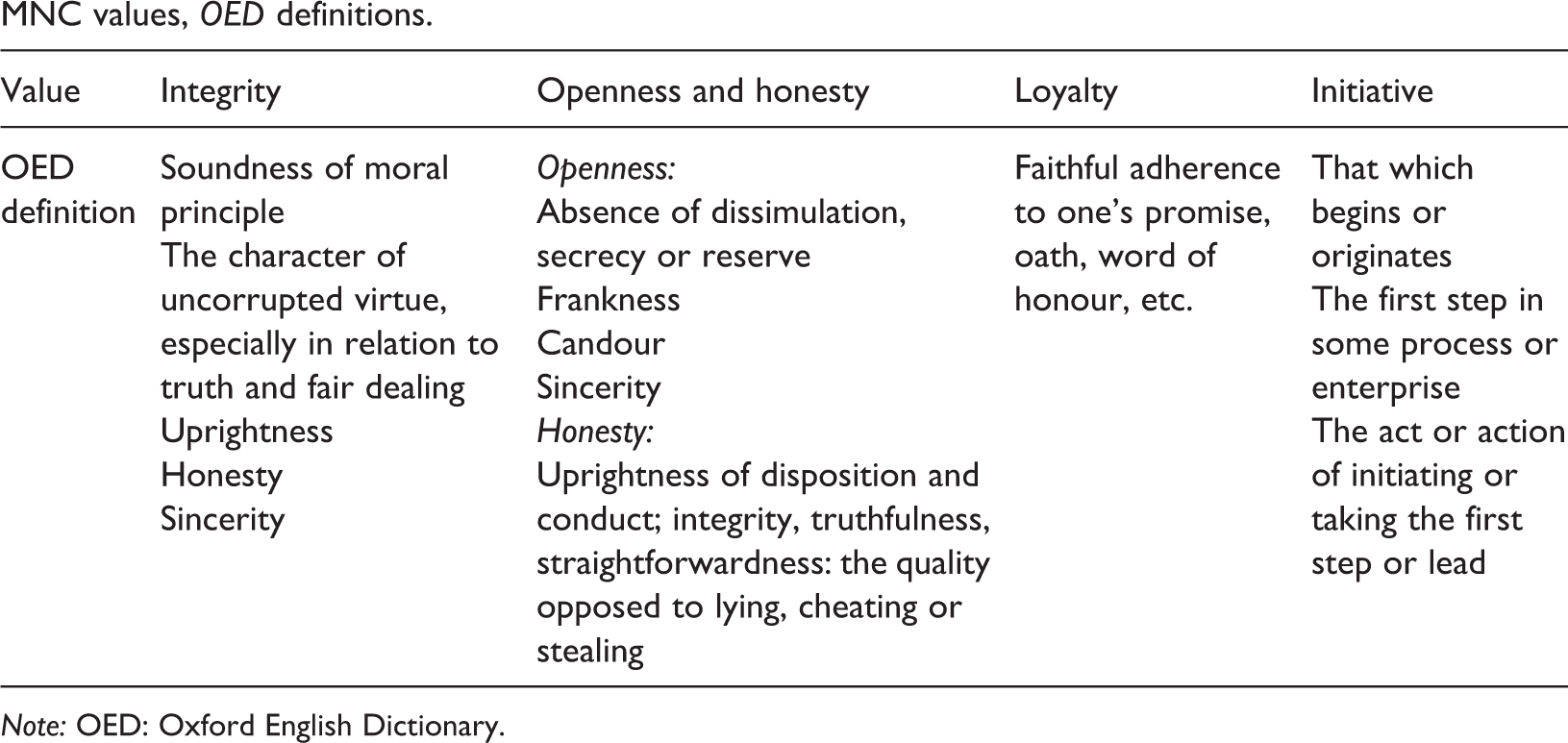
| Value | Integrity | Openness and honesty | Loyalty | Initiative |
|---|---|---|---|---|
| OED definition | Soundness of moral principle The character of uncorrupted virtue, especially in relation to truth and fair dealing Uprightness Honesty Sincerity | Openness: Absence of dissimulation, secrecy or reserve Frankness Candour Sincerity Honesty: Uprightness of disposition and conduct; integrity, truthfulness, straightforwardness: the quality opposed to lying, cheating or stealing | Faithful adherence to one’s promise, oath, word of honour, etc. | That which begins or originates The first step in some process or enterprise The act or action of initiating or taking the first step or lead |
Note: OED: Oxford English Dictionary.
Authors’ Note
Bjørge and Whittaker have contributed equally to this article and appear as authors in alphabetical order. The authors would like to thank anonymous reviewers for their valuable input to the article. Any shortcomings are of course our own.
Declaration of Conflicting Interests
The author(s) declared no potential conflicts of interest with respect to the research, authorship, and/or publication of this article.
Funding
The author(s) received no financial support for the research, authorship, and/or publication of this article.