







Abstract
The growth of Indian Information Technology (IT) sector has resulted in many Indian IT expatriates conducting projects at international client sites. Yet little is known about the sociocultural communication challenges these expatriates encounter. Adopting a qualitative, interpretive approach, semi-structured interviews were conducted with 47 Indian IT expatriates at client sites in Australia. The cultural validation and sociocultural competencies framework of the Excellence in Cultural Experiential Learning and Leadership Intercultural Skills Program was used to analyse expatriates’ workplace interactions. Respondents reported a lack of understanding of the ‘unwritten’ sociocultural communication rules in Australia. Communication differences contributed to their frustrations and dissatisfaction during expatriation. Insights into Indian IT expatriates’ experiences of negotiating communication competencies abroad can inform cross-cultural management scholarship and cross-cultural training. Making cultural norms explicit by embedding a cultural learning framework in cross-cultural training programs can contribute to productive, culturally diverse workplaces. The findings may provide fresh perspectives for organizations who prepare or receive expatriates, especially Indian professionals on assignment in Australia or other western countries.
Keywords
Introduction
To implement expatriation strategies successfully, organizations need to ensure their expatriates adjust to the new environment and are competent in a local and global context. Brookfield’s Global Survey (2012) survey identified numerous complex issues leading to expatriate failure, including the lack of cross-cultural knowledge on the part of international managers. Research has indicated the importance of providing expatriates with information about culturally appropriate norms and behaviours to reduce any uncertainty they experience within their new work environment and the host country (Bhaskar-Shrinivas et al., 2005; Westwood et al., 2000). Recent research has examined the role of social learning theory in informing pre-departure and in-country cross-cultural training for expatriates (Wurtz, 2014).
Since the early 1990s, the Indian Information Technology (IT) sector has received considerable attention around the globe (Birur and Muthiah, 2012; Mathew et al., 2012; Thite et al., 2012). Indeed, India has emerged as a major source of software exports, due to its vast pool of high quality personnel (Agrawal and Thite, 2006). This has led to a significant rise in the demand for skilled professionals who are part of a flexible, highly mobile knowledge workforce who can cater to the global information economy. While strategically important to be onsite for international assignments, if the assignment fails, the negative consequences include delays of client project completion, increased costs and risks of impacting negatively on the overall quality of work (Agrawal et al., 2012; Upadhya, 2009). Reasons for expatriate failure include adjustment difficulties (Rosenbusch and Cseh, 2012) and a lack of cross-cultural communication skills (Cole and Nesbeth, 2014; Tung, 1987). The opportunity cost of expatriates not feeling they are contributing fully to the client organization is a loss to the expatriates and their host colleagues alike.
While some expatriates may be highly proficient in the host nation’s language, challenges lie in the complex variations in sociocultural rules and norms that operate in the home and host cultures (Leung and Morris, 2015) and the manner in which language is used to communicate within a culture (Winkler et al., 2008). This is due to cultures differing in values, norms and rules that govern appropriate verbal and non-verbal behaviour in social and workplace situations. Understanding how to ‘crack the cultural code’ or the unwritten rules that govern communication and behaviour in the host culture is central to effective interaction adjustment. If an expatriate is unable to crack the code, less than optimal consequences may ensue: the individual expatriate may become withdrawn and not fully experience and contribute to their new environment. Similarly, the host organization is not enriched by the unique skills and contribution of each employee (including expatriates) in their culturally diverse workforce (Otten et. al., 2014). To address this largely unexplored area, the current study uses the sociocultural learning framework central to the Excellence in Cultural Experiential Learning and Leadership (EXCELL) Intercultural Skills Program (Mak and Buckingham, 2007; Mak et al., 1999) to understand the experiences of Indian IT expatriates in Australian workplaces. EXCELL is an evidence-based program that aims to increase intercultural social confidence and skills through comparing appropriate behaviour in the home and host countries in relation to six generic sociocultural competencies. These competencies (e.g. participating in a group or giving feedback) are considered necessary for success in social integration in work, educational, and community settings (Mak and Shaw, 2015; Westwood et al., 2000). The culture-learning and cultural validation perspective of the current study responds to the central call by Stahl and Tung’s (2015) for a more positive perspective of ‘culture as an asset’ in international business (IB) contexts.
The present study explores the experiences of IT professionals from Indian IT multinational corporations (MNCs) sent to Australia for short- and long-term international assignments (i.e. from 3 months, to more than 2 years) to work ‘onsite’ (where the customer is located). Australia relies on expatriate workers to meet the skilled labour shortages in its highly multicultural workforce, especially in the areas of IT and mining technologies. Given the increasing numbers of Indian IT expatriates sent to various western countries, understanding the issues they face holds potential economic and social benefits for three stakeholder groups: the Indian expatriates; the Indian IT MNCs, and the developed country host organizations. This study is part of a larger project on the international human resource management (IHRM) practices of Indian IT MNCs that examined the experiences of IT expatriates on international assignments.
Theoretical background
Indian IT professionals
The IT sector and in particular, the role of highly skilled professionals, has attracted increasing interest among researchers in the last two decades (Beaverstock, 2005; Birur and Muthiah, 2012; Mathew et al., 2012; Winkler et al., 2008) because these professionals represent a strategic resource for IT organizations and their main competitive advantage (Agarwal et al., 2007; Wade and Hulland, 2004). Increasingly, Indian IT MNCs are establishing facilities and expanding their employee base nationally and internationally (Upadhya, 2009). Within the IT onsite offshore model, of IT industry, international clients send their work offshore to low-cost countries like India. While a portion of the work gets done at offshore locations like India, a proportion of IT workers (referred to here as IT expatriates) are sent to international client locations or sites to define project requirements, coordinate on a regular basis with the offshore team, and also attempt to secure more business from clients (Agrawal et al., 2012; Upadhya, 2009). This model has been known to have significantly contributed to the cost effectiveness for the Indian IT MNCs. Furthermore, these IT expatriates potentially gain rich experience and enhanced competence due to continuous interaction with international clients (Agrawal et al., 2012). Although the role of expatriates is significant for Indian IT MNCs, very little is known about the cross-cultural experiences of this group of IT workers in an international context (Agrawal et al., 2012; Upadhya, 2009).
A limited number of studies have addressed the experiences of Indian IT workers in an international setting (Agrawal et al., 2012; Bassellier and Benbasat, 2004; Gupta et al., 2013; Lakha, 2005; Upadhya, 2009; van Marrewijk, 2010; Winkler et al., 2008). While some research identified ‘soft skills’ such as communication as essential for software employees, especially those in leadership positions (Agrawal and Thite 2006; Agrawal et al., 2012), the focus was on HR practices in India, rather than at the client sites. Alternatively Lakha (2005) found that communication was not such a problem in terms of accents, as it was in terms of the mode of communication for IT workers in Australia. However, Upadhya (2009) noted that accents, style of communication, and ease of social interaction were the main issues for many IT employees in an international environment. Van Marrewijk (2010) studied cross-cultural differences in collaboration between Dutch front office and Indian back office employees in IT MNCs. Interestingly, Dutch and Indian employees’ different perceptions of communication, time, and superior–subordinate relationships underpinned power struggles between project teams over direct access to clients and project control. Furthermore, Winkler and colleagues (2008) explored the cultural differences in offshore outsourcing success between German and Indian IT professionals from German managers’ perspectives. Based on the cultural interpretation of power distance, most Indian IT professionals had difficulty in saying no. While van Marrewijk’s (2010) and Winkler and colleagues (2008) research provide insights into salient cultural issues in communication, they studied Indian employees in India, as opposed to Indian expatriates. More recently, Gupta and colleagues’ (2013) study of 223 Indian expatriates found that training had a significant impact on the emotional and motivational dimensions of cultural intelligence. The present research extends the literature by exploring IT expatriate’s cultural learning experiences at client sites in Australia. The next section discusses aspects of interaction adjustment of expatriates.
Interaction adjustment of expatriates
Due to the relatively high costs of expatriate failure, much attention has focused on the predictors of expatriate adjustment (Kraimer and Wayne, 2004; Reiche et al., 2011). Researchers have identified that learning and exhibiting new behaviours that fit with the host culture helps expatriates reduce accumulative stress (Bhaskar-Shrinivas et al., 2005; Black et al., 1991; Selmer and Lauring, 2015) and enhances sociocultural adjustment (Mak and Buckingham, 2007; Mak et al., 1999). Moreover, studies have identified that interaction with host nationals helps expatriates feel more embedded in the host social network and has a positive impact on expatriates’ commitment and intention to remain on the assignment (Bhaskar-Shrinivas et al., 2005; Reiche et al., 2011). Similarly, Tung (1987) found one of the factors impacting high expatriate failure rate was lack of cross-cultural relational abilities and inadequate training for cross-cultural encounters. Maertz and colleagues (2009) proposed that positive interactions and attitudes towards host country national’s help to prevent expatriates’ psychological withdrawal and early departure from the assignment.
Black and colleagues (1991) developed a comprehensive theoretical framework of international adjustment that combined individual factors, environmental factors, and cultural differences as predictors of general, interaction, and work adjustment. The current study highlights interaction adjustment in particular, which includes psychological comfort relating to communication styles in the host culture, and interpersonal communication with host country nationals (Takeuchi, 2010). Importantly, Bhaskar-Shrinivas and colleagues’ (2005) meta-analyses found that self-efficacy, relational skills, and belief in one’s ability to communicate appropriately (Mak and Shaw, 2015) in a new culture and relational skills were positively related to interaction adjustment.
Cultural awareness and intercultural skills programs can help expatriates understand the host culture, thereby facilitating their interaction adjustment (Waxin and Panaccio, 2005). Despite the high costs of sending expatriates overseas, little is known about individual training needs and the actual training expatriates receive (Harris and Brewster, 1999; Lenartowicz et al., 2014). The present study argues that for Indian IT expatriates to perform effectively at work, they need to understand appropriate ways of interacting in the host country (Haslberger et al., 2013). The next section discusses the impact of cultural differences on communication.
The impact of cultural differences on communication
A culture-learning approach to understanding the impact of cultural differences on communication leads to an explorative methodology that encourages curiosity and moves beyond equating difference with problems. Hall (1976) suggests that in order to understand communication in different cultures, we must look beyond words alone, to understand the meaning and context of the interaction. The main challenge for expatriate managers is to anticipate and understand cultural differences, particularly business etiquette, and being able to adapt accordingly to the host country (Carte and Fox, 2008). Growing up in a particular cultural context, individuals are socialized to understand innately the cultural code that underpins competent, appropriate communication, in that specific culture. Effective expatriation involves understanding the cultural context of the host society and the culture of the client organization (Haslberger et al., 2013). In other words, the expatriate needs to learn to crack the host cultures code in social and employment contexts. Lack of knowledge and understanding of appropriate behaviour in a new culture may lead to misinterpretations and failure to consider others’ norms and worldviews. In this sense, cross-cultural training enables individuals to learn the knowledge and skills to facilitate effective cross-cultural interactions by reducing misunderstandings and inappropriate behaviours (Gupta et al., 2013).
Hall (1976) examines countries in terms of whether they employ high context or low context communication approaches. This framework can be useful when applied to exploring differences between Indian expatriates and their Australian hosts. As a low context culture, communication in Australia is heavily reliant on the literal meaning of the words used, and emphasis is placed on direct, clear communication. While it is important to carefully critique a cultural dimensions approach to cultural diversity (Stahl and Tung, 2015; Zaheer et al., 2012), knowledge of dimensions such as power distance (Hofstede, 1980; House et al., 2004), when combined with dimensions of cultural context (Hall, 1976), can be potentially informative. For example, in Australia, there is low power distance and relatively low levels of hierarchy in organizations, thus communication is usually informal, direct, and there is consultation and information-sharing between superiors and employees (Hauf and Ritcher, 2015). Further, given the individualistic nature of Australian society, it is common for individuals to interrupt others in order to obtain clarity and understanding (Hall, 1976). In contrast, for Indians, one of the primary purposes of communication is to maintain harmony and forge relationships, rather than to exchange exact information (Lewis, 1999; van Marrewijk, 2010). The use of long sentences, and ambiguous expressions with multiple meanings (which classify Indians as part of a high context culture), often leads to misunderstandings between Indians and people from low context cultures (Zaidman, 2001). Saini and Budhwar (2008) note that the communication style in India is generally top-down, decision-making is centralized, and subordinates do not speak against the supervisors for fear of damaging interpersonal relationships. Due to the hierarchical nature of Indian society differences in power distance can lead to conflicts and decreased trust between Indians and people from less hierarchical cultures (Nicholson et al., 2000; Winkler et al., 2008).
Further, in Indian society, a paternalistic approach prevails (Salminen-Karlsson, 2015), whereby employees tend to be relatively submissive and obedient to authority, while expecting security and support from their leader (Sparrow and Budhwar, 1997). Sinha (1979) referred to Indian leaders as nurturant task leaders. Similarly, van Marrewijk (2010) referred to Indian workplace supervisors acting like a ‘father’ caring for employees’ well-being as if they were family. In turn, subordinates tend to look to their supervisors for orders while they exhibit undue conformance to behavioural standards (Agarwal et al., 1999; van Marrewjik, 2010). Although Indian culture is dynamic, there is a desire to please and a fear of upsetting superiors (Savani et al., 2012). It follows then, when Indian professionals are expatriates in workplace cultures that are underpinned by values different from those of Indian culture, they may benefit from cultural awareness training that takes these differences into account (Selmer et al., 2007).
Evaluative research (Ho et al., 2004) suggests the use of evidence-based training resources such as the EXCELL Intercultural Skills Program (Mak et al., 1999) enables newcomers to a culture, including expatriates, to extend their repertoire of social interaction skills in the new culture. The next section discusses EXCELL, which is used as a framework within the current research.
Research/theoretical framework
EXCELL: An established intercultural development resource
The EXCELL program is a schematic, skills-based professional development resource. It has a strong theoretical base that draws on integrated learning paradigms including operational and classical conditioning, social cognitive learning, and role-based learning (Mak and Barker, 2004). EXCELL is centred on the teaching of six generic social competencies: seeking help, making social contact, participation in a group, refusing a request, expressing disagreement, and giving feedback (Mak and Barker, 2004; Mak et al., 1999). In practice, any intercultural social interactions may involve multiple generic social competencies. Since intercultural encounters can pose high levels of social anxiety and sometimes involve high stakes, it is important for expatriates to understand what behaviours are considered appropriate in the interaction (Haslberger et al., 2013). EXCELL’s culture learning framework is grounded in the principles of cultural validation and alliance building (Mak and Buckingham, 2007). In essence, this means the first step to working in a culturally diverse team is to understand how expatriates and others usually enact the communication competencies in their home country. In other words, how do they usually go about participating in a group or expressing disagreement within their own culture? What constitutes appropriate verbal and non-verbal behaviour, and what are the sociocultural values that underpin the behaviour (e.g. respect for authority or saving face)?
EXCELL has been used with immigrant jobseekers, for students to investigate whether providing them with a skills-based sociocultural competency yielded additional benefits (Knott et al., 2013; Mak and Buckingham, 2007; Mak and Shaw, 2015) and as part of culturally inclusive curricula in disciplines as diverse as pharmacy, business, and psychology (Barker and Mak, 2013). The current research uses EXCELL’s culture learning resource as a framework to understand how Indian IT workers perceived and experienced specific competencies (such as expressing disagreement or seeking help) when they were on an international assignment in Australia. To this end, this research serves a valuable purpose in (i) broadening the existing literature base on cross-cultural diversity that makes scant reference to Indian IT expatriates; (ii) informing MNCs about their Indian IT employees’ perceptions of their experiences in Australia; and (iii) exploring how a cultural learning framework such as EXCELL could inform approaches to expatriate and cultural diversity training that would enhance workplace effectiveness.
Methodological reflections
Due to the lack of research on Indian IT expatriates’ cross-cultural diversity training at client sites, this study adopts an exploratory approach through the use of a qualitative methodology (Eisenhardt, 1989). The research adopts a qualitative methodology with an interpretive paradigm. The study seeks to explore the nature of the phenomenon from the perspective of expatriates which is a particular advantage of a qualitative interpretive approach (Symon and Cassell, 2006). Interpretivism seeks primarily to understand subjective reality, by giving emphasis to human values and experiences, and is most common in qualitative research (Denzin and Lincoln, 2011). This paradigm addresses what positivists are assumed to ignore ‘the meanings and interpretations, the motives and intentions that people use in their everyday lives and that direct their behaviour’ (Blaikie, 2000: 115). The present study explores the experiences of Indian expatriates in Australia from the viewpoint of the unique meanings and interpretations they give of the situations they encounter. The study concentrates on the expatriates as stakeholders and does not seek the perspectives of their Australian hosts. Following prior research in similar contexts (Kulkarni et al., 2010), convenience, snowball sampling was employed, whereby the researchers contacted members within the target population of IT companies and requested them to introduce other IT expatriates (Walliman, 2006). Given the scope and objectives of the current research, the sample for the current study consisted of 47 Indian IT expatriates, whose parent company was an Indian IT MNC, working on international assignments at client sites in Australia. The IT expatriates in the study were between the ages of 25–40 years (X = 30 years) and had been on the assignment between 2 months to 2 years (X = 12 months). Of the 47 participants 6 were females, while 41 were males. All interviews were conducted in English. The data collection was conducted in the three main cities (Brisbane, Sydney, and Melbourne) in Australia. The study adds to the body of research by interviewing IT expatriates from five major Indian IT MNCs to understand their experiences in the host country. This is particularly important given the threat of turnover of IT staff, especially when they are sent to work on client projects overseas (Krishnan and Singh, 2010). The five Indian IT MNCs that were chosen were among the medium to large Indian IT consulting and IT services companies, each with a turnover ranging from over 40 million to 1.5 billion dollars (US) and employing over 10,000–50,000 employees.
Interviews ranged from 40 to 90 min in length. The average interview was one hour. Each interview was tape-recorded after gaining participant consent, and each recording was transcribed verbatim. The present study was conducted within the ethical guidelines of Griffith University’s Office of Ethics. Semi-structured interviews were carried out with the aid of a general guide that allowed for probing during each interview (Denzin and Lincoln, 2011). The interviews focused on the participants’ experiences in Australian workplaces. The expatriates were asked to identify critical incident experiences which were either helpful or had hindered them during their assignments. In particular, expatriates were asked about incidents in relation to six generic communication competencies: expressing disagreement, refusing a request, seeking help or information, giving feedback, making social contact, and participating in a group setting.
Two phases of analysis took place: a content-coding approach followed by a thematic approach (Miles and Huberman, 1994). In the content-coding phase, the data was divided into meaningful analytical units, based on the wider literature. Initially, codes were assigned to the data and were then reviewed to ensure that all appropriate responses were coded accurately (Neuman, 2005). In the second phase comprising thematic analysis, initial themes referred to IT experiences in the host location were identified. Further patterns and themes were collated using the EXCELL framework (as discussed in the next section). The transcripts were entered into NVivo (v. 8) software which helped in organization of the data and in the development of themes. It allowed the first author to work efficiently with complex coding schemes derived from a large body of transcripts and facilitated analytical depth and complexity (Bazeley and Richards, 2000). In the next section, findings will be presented. Within qualitative research, data collection and analysis may be influenced by the biases of the researchers including personal biases and stress or discomfort experienced by participants or researcher during the research process. Wolcott (1999) emphasizes that any of these factors could potentially impact on data collection and the study’s rigour. The first author maintained a reflexive journal and field notes to document assumptions and biases that could affect her interpretation of the data and to map key decision points in her thinking during data analysis. She also reviewed the themes with her co-author periodically. This practice of continually reflecting on the research process enhanced the rigour of the research methodology.
Findings
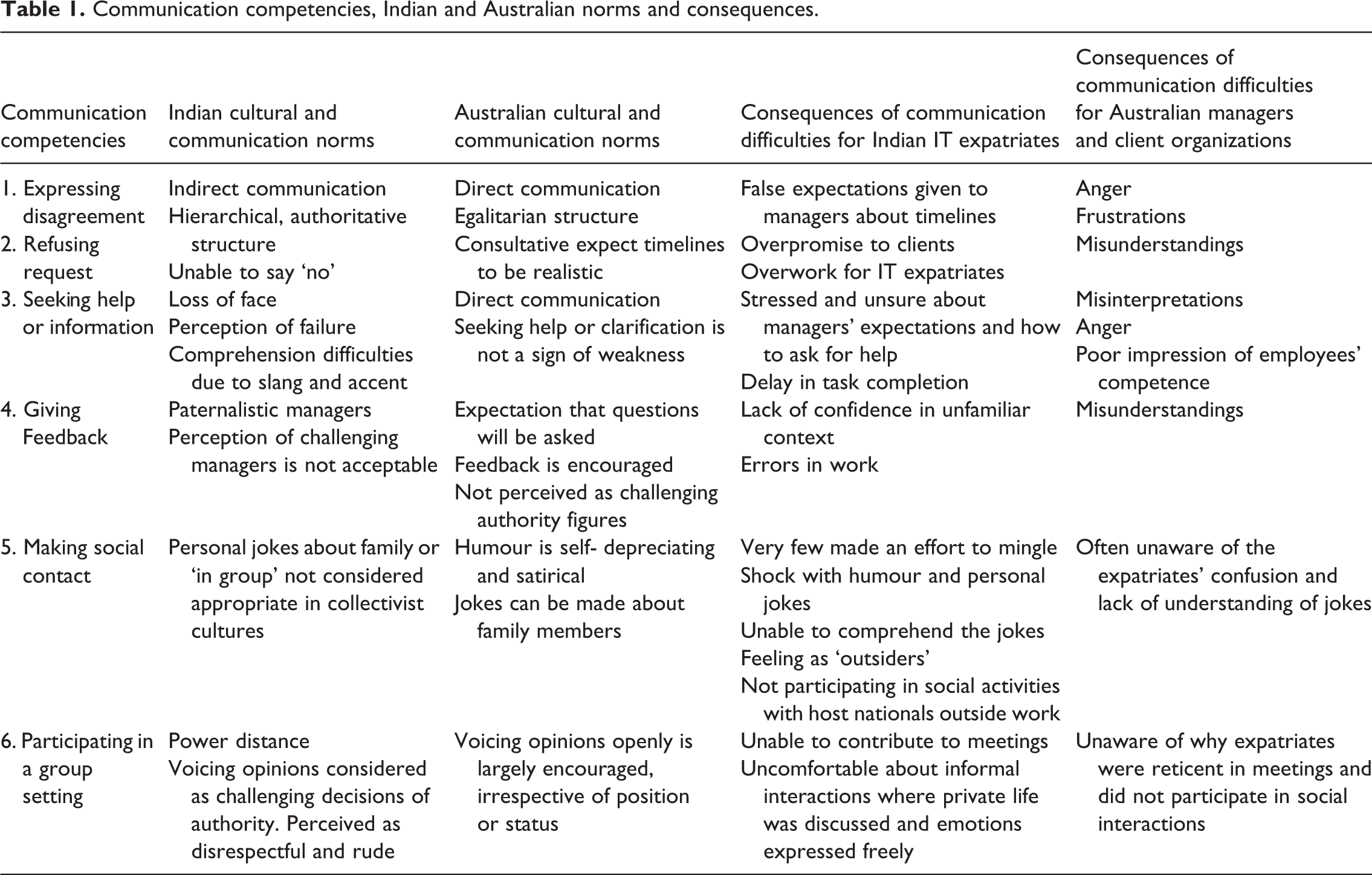
The IT expatriates are referred to by pseudonyms with the code for the MNC they were working with (i.e. A, B, C, D and E). The findings on the intercultural communication challenges experienced by Indian IT expatriates in Australia are presented in terms of the six generic communication competencies identified within the EXCELL framework, namely expressing disagreement, refusing a request, seeking help or information, giving feedback, making social contact, and participating in a group setting. Table 1 presents a summary of the expatriates’ perceptions in relation to the six generic communication competencies; Indian cultural and communication norms; Australian cultural and communication norms; consequences of communication difficulties for Indian IT expatriates; and expatriates’ perceptions of the consequences of communication difficulties for Australian managers and client organizations. The first communication competency to be discussed is a combination of two competencies from the EXCELL framework: expressing disagreement and refusing a request.
Communication competencies, Indian and Australian norms and consequences.
Expressing disagreement/refusing a request
The two competencies are usually addressed separately in the EXCELL framework, however, they were combined in the current study because it was noted repeatedly that participants spoke about the competencies in similar terms. Not being able to say ‘no’ was one of the most significant communication challenges discussed during the interviews. This is in line with previous studies on Indian IT workers that highlight the professionals’ difficulty in saying no (van Marrewijk, 2010; Winkler et al., 2008). However, in our study, we went beyond identifying that the Indian expatriates had difficulty saying no. Analysis of the participants’ experiences revealed major difficulties IT expatriates experienced with this competency and the significant negative impact on their experiences at the client sites in Australia. Many interviewees noted that in the Indian IT context, it was customary to say ‘yes’ to completing a task and nominating a deadline they knew was unrealistic to meet. This was due to the value of power distance and paternalistic/nurturant management styles of their managers. Many respondents explained that their Indian managers usually understood the complexities of their work situation and took that into consideration when advising clients of delivery deadlines. For example, Indian IT managers knew that although the employee nominated ‘Friday’ as the day the task would be completed, the manager would tell the client delivery would be on ‘Tuesday’ of the following week. However, in Australia, the expatriates discovered to their dismay that their Australian managers expected the employee to ‘come clean’ with them about what was realistic. Consequently, if they set a deadline, then the IT professionals needed to work extra hours to meet the specified (unrealistic) deadline. One respondent explained: There is a difference: in India, we do not say no, we just say we will do, and that increases our work pressure (in Australia). (Prashant/A) Here they are very strict on timing and also completion of task and once you give a proposed date you are expected to complete on time. The client doesn’t force you on completing on a certain date but if you give a time and don’t do it then they get frustrated. Here they just want people to say it will take this much time and I will take my time and do my analysis and come back. (Shiv/A) For the expatriates coming here, Indian people are more concerned about their work and always want client (to be) happy, (because) if they are unhappy, their manager will get angry - but we ignore the cultural aspect. People are ingrained into their culture so it is important for us to understand the culture and the differences (Ankit/B)
Further, Radha, who had been on the assignment for almost a year, explained the differences between the cultures realistically when she said: The work culture is very different from India as here it is a very open culture if there is something you don’t agree with than you can say it and justify it. But in India it is not possible…(Radha/B)
Seeking help or information
Differences in work culture, and differences in methods of seeking help from host nationals, were both noted by the interviewees as contributing to their difficulties in Australia. A significant issue identified by IT expatriates was a lack of understanding of the expectations of their Australian managers. For example, in India, employees were accustomed to the power distance between managers and employees and they had come to expect a paternalistic management approach from their managers. Because many were not provided pre-assignment cultural orientation, they expected a similar type of power distance in Australia. As a result, many respondents explained that they had felt concerned when asking for assistance from their colleagues and managers at client sites in Australia. Some noted that they had felt stressed and unsure about how to ask someone for help, as they had expected the managers to understand their needs without them having to express them. One respondent, who took a few months to understand the implicit differences between the sociocultural rules underpinning help-seeking behaviour, described how stressed he was when he had a problem and had to ask someone for help. As an Indian who was accustomed to more nurturant, paternalistic managers, he perceived needing to ask for help from his manager as a personal loss of face. Thankfully, over a period of time, he realized the differences between expectations in the two workplace cultures and began to appreciate the openness in Australia to address problems directly. Vishwas stated: If something goes wrong mentally you get so stressed but here it’s good that they say if you have a problem then let’s work on it don’t get so stressed. (Vishwas/B) Personally, initially I felt I tended not to ask them, as professionally we are all in the same field so what they may think of us but it’s ok as the days go by it is ok now. (Ramesh/C) The communication does make a difference: the work culture needs to be trained before you start. People cannot follow here what the locals are saying and the other way around, the slang is different, so for the first two weeks, people suffer…. (Mehul/A) We had a team lead sitting between us and client and so whenever we come across an issue we go through the lead only so when we do meetings with clients for updating on any issues we have when testing so we may have to communicate to person sitting in Singapore and a person sitting here in business so it’s like we are indirectly interacting. (Rishi/A)
Giving feedback
Giving feedback to another person was another extremely difficult competency for many respondents at the client sites in Australia. Many noted that in India when their managers gave them information or instructions about a project, they would not give any feedback related to it unless it was asked for specifically. Instead, most of the respondents noted that their Indian managers were more paternalistic and would keep a close eye on the progress of the project and push for deadlines as appropriate. In contrast, in Australia, they found everything was discussed upfront and their host managers expected them to ask questions and provide feedback. The respondents expressed, they often had great difficulty adapting to the implicit, unwritten norm in the workplace that dialogue with managers was expected. Interestingly, one respondent, Rajbeer explained how over a period of time he found that the Australian norm about low power distance and open communication made it easier for him to work. He highlighted the transparency in procedures and a lack of hierarchy or power distance. He explained: Anybody can walk over to the boss here no matter how big he is and what his position is. Things are pretty transparent here, not like in India you can talk to only the person you report to. Here people are equal they don’t feel that much difference. Initially it was difficult how to speak to a person and to whom we are speaking but after a period of time we got used to. (Rajbeer/A) Communication - I did face some problem initially. I did take some time to understand what the client was really meaning. Sometimes I still do have difficulties…. (Rahul/E) Here you have to think so much before you say something even though it’s a very valid point you have to phrase your sentence in such a way that you have put your meaning forward and it is not hampering client offers so it is very difficult. Sometimes I feel I don’t have freedom to talk as I think what they will think if I say this because it is client, so those areas I have found very difficult how to handle the situation. (Sonali/B)
Respondents explained an assumption within Indian IT companies in relation to the need for cross-cultural training. It was believed that as the IT professionals were expatriating to an English-speaking country, they did not need any training related to communication or behavioural norms. However, in reality, the interviewees indicated that it was difficult for them in their Australian workplaces to understand what people were saying and what they meant. van Marrewijk (2010) refers to this experience as a language paradox. Sid explained: It’s about vocabulary the meanings, the slang language they use. The first few months were pretty difficult in terms of understanding what they actually meant with words. Actually they have told me this – (and I think) do I have to do it, or are they just joking and you kind of (don’t understand), but after 2 or 3 months you pick it up and learn (Sid/A)
Making social contact
Respondents spoke candidly about their experiences when making social contact with Australians. An interesting finding is that very few respondents made an effort to mingle with the fellow employees outside of work. Many commented on the humour, personal jokes, and comments made by their Australian colleagues. The expatriates considered it rude and inappropriate when Australian colleagues made a joke about their own families or the Indian expatriate’s families. Some could not comprehend the meaning of the jokes because of their lack of understanding of the culture. One respondent reported: Here, jokes are too personal and if you take it too seriously, it could probably hurt you…jokes about your wife and stuff like that are very commonplace here and it’s not very common in India, so sometimes, you can get a little offended…So that hits you initially a bit, too, as sometimes, the comments are not very soft on you. (Raman/B) There are lot of cultural differences (between India and Australia) people here are very sarcastic you might not understand that and you may feel bad. Those things you come to know as and when you stay here. The communication was a bit tough to pick up…(Sanjay/E)
Unfortunately, many respondents commented about not feeling accepted into the Australian community. They found it hard to integrate, even though they spoke English fluently. Confusing accents, cultural and communication differences between Indian and Australian norms made it difficult for them to socialize and integrate in the host community. One manager observed that he had noted many of his team members ‘going overboard’ when trying to communicate with Australians, which he felt made matters worse. Rajeev explained: But there are so many occasions where you have to interact with your clients so I have observed that some of the colleagues go overboard when they are trying to crack jokes. So that sensitisation which is difficult to impart but that sometimes a bit lacking and there is sometimes a disconnect when there are informal conversation and we have observed that Indians sometimes take longer to understand their jokes and they invariably never understand your jokes. These informal situations do get sometimes embarrassing…. (Rajeev/B) Outside work, basically, difference was the acceptability of you. It felt very awkward when you go outside and when you talk to people around, then you feel that you are not fitting in. (Rajesh/D)
Participating in a group setting
In line with Winkler and colleagues’ research (2008), power distance was noted to be the most common factor preventing many Indians being able to participate within a group setting. Some noted that even though they had some good ideas to contribute in meetings, they tended not to voice them. They used to wait for their manager to come so that he/she could convey their message to the client. Most of the junior level respondents stated that they were uncomfortable in meetings to express their opinions, due to cultural differences. One respondent, who initially faced many issues in team meetings where he had witnessed host nationals voicing their opinions openly and talking over each other, explained that she had now come to appreciate the Australian workplace culture a little more: I like the way team meetings happen here…and also working with multicultural people which was my first experience with working with them…(Shraddha/A) People are more outgoing here and lack of hierarchy and exhibit more feelings which was very different in India. Here they talk about their private life more freely and also value their private time more than work and equal importance to both compared to Indians who are more into work. And I am not used to being outgoing I am an introvert and so it’s different and it’s a learning curve for me to understand people and here they expect you to behave in a certain way. (Vishwas/A) I would count two parts, one is professional and the other is personal. When you are here and you can gel (shape) yourself here that is personal success. Other is professional success is when we never get feedback from the client that ‘this guy is speaking in vernacular or he does not understand how we work’…. success is not getting feedback like ‘he is culturally insensitive’, and ‘we do not understand him’ or ‘he does not understand it’. (Aditya/B) It did impact on me a bit when I first came. It was there and I think basically we were guided by our managers and when we wanted to speak we always consulted our manager. (Dhiraj/B)
Discussion
The current study has confirmed that in order for expatriates to feel more integrated and comfortable in the host environment, it is important for them to learn how to communicate competently (Bhaskar-Shrinivas et al., 2005; Black et al., 1991). Intercultural communication competence goes beyond the mere translation of words. It is the unwritten, taken-for-granted ways of doing things in a culture that are usually not explained to newcomers and inevitably impact negatively on interactions in the workplace between expatriates and hosts (Leung and Morris, 2014).
The expatriates in the current study reported numerous misunderstandings at work due to a lack of understanding of differences in cultural norms between Indian and Australian cultures in relation to power distance (Hofstede, 1980), communication styles (Saini and Budhwar, 2008), and a paternalistic approach (Sparrow and Budhwar, 1997) or nurturant task leadership (Aycan et al., 2013; Sinha, 1979). The study applied the sociocultural learning framework central to the EXCELL Intercultural Skills Program (Mak et al., 1999) to understand the experiences of Indian IT expatriates in client workplaces in Australia. Table 1 provided insights into the Indian and Australian cultural and communication norms in relation to each competency as well as the consequences of communication difficulties for the Indian expatriates and the Australian managers and client organizations. Interestingly, the framework provided a context in which to analyse the cross-cultural communication challenges of the Indian IT workers in terms of the six sociocultural competencies, namely, expressing disagreement or refusing a request, seeking help or information, giving feedback, making social contact, and participating in a group setting. It was identified that in line with Winkler and colleagues’ (2008) findings on high power distance within Indian society, respondents in the current study did not express disagreement or refuse a request of their managers because they considered saying ‘no’ would disrupt their relationships. Thus, Indian IT expatriates tended to set unrealistic deadlines, which if they were unable to meet led to misunderstandings with the clients. This supports Lewis’s (1999) and Bhasin’s (2007) assertion that the underpinning values behind that behaviour were that Indians’ primary driver in terms of communication is to maintain harmony and build relationships, rather than to exchange exact information.
In contrast, Australian cultural norms were characterized by the Indian IT expatriates as low power distance, and informal, yet direct communication. Within the third and fourth competencies about clarifying or seeking information, and giving feedback it was found that with the values and expectations of obeying authority figures and not challenging them, most of our participants looked to their managers to provide information and security (Sinha, 1979; Sparrow and Budhwar, 1997; van Marrewijk, 2010). Thus, respondents spoke about how they had felt stressed about giving feedback to an Australian manager even when it was important to do so. Recognizing where the other culture lies in the high–low context continuum can provide expatriates with valuable insights when choosing appropriate methods of communicating with host nationals (Balsemier and Heck, 1994). Although most Indians speak English, differences between the expatriates and their hosts in terms of directness of communication, language skills (van Marrewijk, 2010), and in this study understanding accents and the use of slang by Australians can lead to conflicts and misunderstandings. Understanding the cultural values underpinning a person’s behaviour through a social learning type approach to intercultural skills training, such as EXCELL, can enhance intercultural adjustment.
Moreover, the study has confirmed Hofstede’s (1980) finding that in India due to power distance and hierarchy, IT expatriates tended not to challenge or clarify issues with their client managers in group settings (Nicholson et al., 2000; Winkler et al., 2008). This created many misunderstandings with the client managers. The respondent expatriates tended not to voice criticisms during meetings or in face-to-face encounters, rather, they would agree with the client, in deference to authority. Lastly with regard to the competency of making social contact, respondents spoke about not understanding local humour, which contributed to them feeling they did not belong to the local community, and as a consequence, they felt isolated. Rehg and colleagues’ research (2012) highlighted how that cross-cultural training has a positive, significant effect on the cultural intelligence of a person in a new country. Thus, the importance of pre-departure and in-country cross-cultural training is reiterated (Wurtz, 2014), as well as the importance of organizations developing policies and practices in relation to diversity management training in the workplace. Linked to cross-cultural training is the importance of workplace mentoring in facilitating the integration of newcomers such as Indian IT expatriates at client sites. As noted by Lee and colleagues (2010), formal mechanisms such as mentors can facilitate newcomers social capital building and integration. Recent research (Pekerti et al., 2015) has highlighted how multicultural mentor modelling programs (MMM) can ‘help multicultural individuals to actively balance frameworks and salience of multiple cultures by influencing their cognitive processes and subsequent behavioural choices’ (p. 20). Future research could fruitfully examine how the MMM Program could build on the EXCELL Program framework, especially given the congruence between the culture learning theories that underpin both programs.
The principles of cultural validation that underpin the EXCELL Program provide a rationale for asking expatriates and other newcomers to a workplace about how they have ‘typically’ enacted competencies such as seeking help or giving feedback. This information provides important baseline data (similar to a training needs assessment) that can then guide a manager’s or trainer’s approaches to how to help that employee make the best possible contribution to the workplace. In addition, managers and employees in the host organization could benefit from cultural diversity training. This can only be achieved through sharing information about what each party assumes is appropriate behaviour in a situation, clarifying the implicit sociocultural rules and norms that operate in the culture and the workplace, and negotiation of any differences (Mak and Buckingham, 2007). Analysis of the findings of the current study indicates that expatriates would have benefited from having the sociocultural norms made explicit in relation to competencies such as participating in a group or expressing disagreement. Future research could examine the effectiveness of a pilot EXCELL training program for Indian IT expatriates in Australia or diversity training for the client site workplaces in which the expatriates worked. Learning about Indian and Australian norms could potentially enrich all participants and enable each person’s creativity and contribution to be fostered.
Limitations of the study
Given the exploratory nature of the research, no claims are made in relation to being a representative sample. The primary limitation of the study is that data was collected only through interviews with IT expatriates from one emerging economy, India. Future research may conduct mixed method research to gather more extensive data (surveys) as well as more in-depth data (interviews) and extend to samples from other Asian and emerging-economy MNCs and their expatriates. Several limitations influenced the extent to which the findings of the study could be generalized. For example, while an interpretivist perspective to culture was adopted (Stahl and Tung, 2015) which produced a rich understanding of the Indian expatriates’ experiences, it would also be enlightening to explore the perspectives of their Australian counterparts. For example, the sociocultural competency approach of EXCELL could be used to seek Australian managers’ and colleagues’ perspectives of their interactions with the Indian IT expatriates. Take, for instance, the competency of participating in a group. What did the Australian workplace colleagues understand about the behaviour of the Indian expatriates? How did they make sense of their behaviour? How would they explain to Indians the norms or cultural code underpinning what constituted appropriate behaviour in a group or team setting in Australia? Based on the reports of the expatriates, an area that warrants further research is exploration of the values that provide the basis for communicative behaviour in each culture. In line with the assumptions underlying the EXCELL Program, a culture-learning and cultural validation approach to training tries to understand the ‘why’ and not just the ‘how’ of behaviour.
Another potential limitation of an in-depth interview study such as this is the influence of social desirability as a bias in respondents’ self-reports. It is acknowledged that this potential bias needs to be considered, while not losing the depth of insights that individual self-reports offer. As noted in the section on ‘Methodological reflections’, the first author tried to mitigate social desirability and personal biases through maintaining a reflexive journal, the use of field notes taken during and after the interviews and memorandums that were discussed with her co-researcher.
Conclusion
Few studies have investigated the experiences of non-managerial contractors from an emerging economy MNC (India) on an international assignment to a client site in a developed country (Australia). Previous research has concentrated on Western expatriate managers’ experiences and more recently, on expatriates from emerging economies (e.g. Abdul-Malek and Budhwar, 2013). While research is growing about IT professionals from India, the significant cross-cultural experiences of Indian IT expatriates at client sites have largely been ignored. The present study has tried to bridge this gap by examining the cross-cultural experiences of Indian IT expatriates working at Australian client sites using a novel communication competency framework from the EXCELL intercultural skills program. The framework identifies generic communication competencies that have been tested in numerous intercultural communication studies (Barker and Mak 2013; Mak and Barker 2004; Mak and Buckingham 2007). Having an understanding of the sociocultural values that underpin behaviours in different cultures is important for effective intercultural communication and expatriate adjustment (Liu et al., 2014). Due to the differences in cultures between India and Australia, it is evident that not only is there a need for Indian IT expatriates to understand appropriate communicative behaviour in Australia but also that Australian managers and colleagues need to understand the ways that Indian employees typically communicate and why.
As part of a stakeholder analysis and informed by values of cultural validation, the expatriates were asked to reflect on critical incidents related to the six generic communication competencies used in the EXCELL Intercultural Skills model. The major contribution of this research is to provide an understanding of the many cultural issues related to communication competencies that Indian IT expatriates face in Australian workplaces, and how these impacted on the IT workforce’s experience. The EXCELL framework helped to provide a philosophy and structure to understand the experiences of these expatriates who represent important stakeholders. This understanding provides a first step to informing practices in relation to cross-cultural training in culturally diverse workplaces. The research findings are of considerable pragmatic importance for the IHRM literature. Indian IT expatriates experience logistical and cultural challenges as they not only adjust to Australia but also to working under Indian companies’ HR practices as contractors at a client organization. As a result, the adjustment problems they face have consequences for not only the individual expatriate, but also for the host organization, and in turn the Indian MNC.
Footnotes
Declaration of Conflicting Interests
The author(s) declared no potential conflicts of interest with respect to the research, authorship, and/or publication of this article.
Funding
The author(s) received no financial support for the research, authorship, and/or publication of this article.