






Abstract
This article explores and analyzes Islamic principles that govern conflict management within the Islamic human resource management (HRM) context and provides new insight into the theoretical development of conflict management from an Islamic HRM perspective. Current models are analyzed through Islamic principles and integrated into a comprehensive Islamic framework that can function as a guide for HRM toward developing a proactive nonlinear conflict management strategy. This study shifts the dialogue of Islamic conflict management from intervention to organizational culture. The premise of this study is to develop a model for HRM practitioners among a Muslim workforce. The proposed model suggests that conflict is referred back to Quran and Sunnah, the two primary sources of Islam. Islam mandates selection of Shura (council) and appointment of a Muslih (mediator) whose function is (1) al-tathabbut (verification) and (2) nasīhah (advice). HRM must consider proactive organizational traits based on Islamic principles: (1) ta’awun (cooperation), (2) sabr (patience), (3) al-ta’akhi (brotherhood), and (4) husn al-dhann (good assumptions).
Introduction
Increasing diversity in the workforce brings numerous advantages to organizations. However, this change also raises the probability of conflicts. Researchers have started to investigate values, culture, and religion in discussions on conflict management. The Muslim community accounts for 23.2 percent of the world population (Pew Research Center, 2015). Regrettably, few researchers have developed models of Islamic conflict management in a human resource management (HRM) context. Muslims, regardless of sectarian divisions, believe that Islam provides a holistic guide for managing one’s life, even in the work environment (Aba Al-Khail, 2004; Ahmad and Ogunsola, 2011). Considering the high-regard Muslims hold for Islamic principles (Aba Al-Khail, 2004), implementing an Islamic model of conflict management could be more effective for HRM among a Muslim workforce. Due to the adaptability of these principles, an Islamic model can also translate among non-Muslims expatriates in a Muslim environment. A few studies on Islamic conflict management models have been conducted in the HRM context and have shown promise for application in a majority-Muslim workplace. However, such models lack integration and a holistic Islamic approach. This study seeks to fill this gap by integrating existing models to provide an Islamic framework for conflict management.
Conflict management principles have been discussed in the Quran in general and specific contexts that account for religious and cultural differences and promote conflict resolution (49:9-13, 5:8, 2:213, 10:19, 43:65, 3:105, 45:17, 16:64, 8:55). Likewise, the Prophet Muhammad taught his followers through his example how to manage conflict between each other in various contexts (Al-Bukharī, 2001: 2691, 2692, 2693, 3245, 4987, 2242, 7370). Conflict management and rectification is found throughout the life of the Prophet Muhammad (Abu-Nimer, 2001; Monjur, 2011; Sarif et al., 2004). The purpose of this article is to explore Islamic principles of conflict management in the HRM context and present an Islamic model that caters to international organizations that employ a majority-Muslim workforce.
Rahim (2010) defined conflict as a disagreement or incompatibility that occurs between individuals or within organizations or teams. Trudel and Reio (2011) explained conflict as negative perception of an individual’s actions or behavior that causes harm. Definitions of conflict have four commonalities: (1) incompatibility, (2) negative perceptions, (3) interdependence, and (4) scarcity of resources (Aritzeta et al., 2005; Rahim, 2010; Randeree and El Faramawy, 2011). Conflict is an inevitable, yet integral, aspect of human existence (Zakari et al., 2010), especially in interdependent tasks (Bradley et al., 2015). Rahim (2010) opined that conflict occurs due to six causes: (1) in the course of incompatibility with one’s beliefs or interests; (2) incompatibility with personal preferences; (3) in a low supply and high demand situation; (4) when one’s behavior is driven by beliefs, values, and skills that are perceived by others to be exclusive; (5) in the case of partially exclusive behaviors; and (6) task interdependence. Numerous factors affect the intensity of conflict; Williams (2011) and Anwar et al. (2012) suggested that conflict itself may yield a positive or negative outcome depending on the resolution.
The costs of conflict in organizations are well-documented among researchers. This includes loss of productivity, absenteeism, stress-related leave, mediation, and health care (Nixon et al., 2011; Patterson, 2010). In any given organization, a leader may spend between 13 percent and 25 percent of their time resolving and mitigating conflict (Eshraghi and Salehi, 2010; Pavlakis et al., 2011). In some severe cases, senior management may spend up to 80 percent of their time involved in conflict (Davis and Franks, 2011).
Tjosvold (2008) argued that conflict is essential for HRM. In fact, conflict management is a cornerstone of leadership. He argued that complacency and uniformity in teamwork is ineffective, whereas conflict fosters efficiency if managed appropriately. Tjosvold’s (2008) argument is based on management as a conditional factor to conflict. When conflict within a work group is not appropriately managed, it often leads to negative outcomes (Bradley et al., 2015; Rahim, 2010; Tjosvold, 2008). Naturally, researchers in a variety of fields have explored different means of managing conflict and leading to effective resolution. Some researchers have labeled the positive outcomes as a result of “functional conflict” (Anwar et al., 2012). Studies on conflict resolution continue to gain interest due to technological and demographical changes in the workplace. Diversity plays a major role in fueling conflict in workgroups (O’Reilly et al., 1998; Smelser and Alexander, 1999; Tekleab and Quigley, 2014; Todorova et al., 2011). However, diversity can strengthen performance if one manipulates factors that lead to conflict (Ayub and Jehn, 2014).
HRM and researchers levy theoretical studies on conflict to create strategies that can encourage positive outcomes. For instance, Jordan and Troth (2002) demonstrated that implementation of high emotional intelligence in an organization is conducive to resolving conflict through collaboration. Utilizing knowledge management to create an environment conducive to a higher level of emotional intelligence can foster positive outcomes from conflict (Farh et al., 2012; Goleman et al., 2013; Schlaerth et al., 2013). However, there are few studies that investigate the Islamic view of conflict and provide an integrated Islamic model. This creates a gap for organizational development within a majority-Muslim workforce.
There are limitations to exploring an Islamic approach in the international environment. A robust model should be applicable to non-Muslims working in a majority Muslim environment. Many Islamic management models, whether in leadership, marketing, or conflict management, are flexible in application toward non-Muslims (Ahmad, 2007; Jamal and Badawi, 1993). This study accounts for applicability with sectarian and regional differences by investigating generally accepted Islamic principles common in the majority of Islamic interpretations and extrapolation within a non-Muslim context for international organizations that employ non-Muslim workers alongside a majority-Muslim workforce. This notion is expressed in the Quranic injunction for mankind, regardless of religion or culture, to interact with each other in a way that encourages conflict management (Quran, 49:13). The regional labor markets exhibit unique challenges, such as nepotism, that are addressed through the use of principles accepted by all Muslim in the Quran and Sunnah. Researchers in Islamic management theory have noted that the use of general Islamic principles that are universally accepted in Muslim markets can offset negative behavioral traits found in regional markets (Ahmad, 2007). This is due to veneration of Islamic texts in all aspects of Muslim life (Al-Abbad, 2009). This research contributes a theoretical model to the body of literature that develops our understanding of the Muslim workforce and can be tested in further studies in specific HRM contexts.
The key function of this article is to contribute to the theoretical development of research in Islamic conflict management from an HRM context by transforming existing theoretical models based on Islamic principles. Therefore, this study provides a synthesized proactive framework for researchers in conflict management in a majority-Muslim workforce. The resulting model views conflict from a proactive, constructivist, collaborative perspective. This revelatory model shifts the paradigm in research on the Islamic perspective of conflict management in the HRM context from intervention to integration within the organizational culture. HRM can leverage this knowledge to manage conflict among a majority-Muslim staff by implementing the proposed model within the organization. Elements of this model can be extrapolated for use in the international environment that incorporates non-Muslims in the workforce, particularly the proactive element of the organizational culture. In fact, the core feature of Islamic conflict resolution research is centered on peace building between Muslims and non-Muslims (Abu-Nimer, 2001). Subsequently, this model can also function in multireligious and multicultural business environments.
Current research environment
While influence of religiosity among the Muslim workface has been on the rise, the little research conducted on the Islamic conventions that can regulate conflict in this diverse environment (Jamal and Badawi, 1993) has generally kept with the same paradigms. Much of the research in conflict resolution in the Muslim world has focused on the political and economic fields (Hjarpe, 2013), utilized Western principles (Irani and Lebanon, 1999), or applied Islamic principles of conflict management as a process management rather than strategic development (Randeree and El Faramawy, 2011). Studies on the subject are often aligned toward peace building within Muslim societies or between Muslims and others (Irani and Lebanon, 1999). Therefore, the theoretical application of these types of studies is predominately reactive to conflict in the form of reconcilement. On the other hand, fewer models focus on a proactive nature of conflict management. For example, the proactive model (Noor, 2002) actively seeks resolution before escalation based on a leadership behavior derived from Prophet Muhammad. However, such models focus on avoidance rather than functional management.
Several studies focus on building Islamic conflict resolution models through Western theoretical models of conflict management (Abdalla, 2001; Rahim, 2002, 2015). Abdalla (2001) asserted that current Islamic conflict management research operates in a dysfunctional environment and must return to Islamic principles. In order to accomplish this goal, researchers must return to fundamental Islamic behavior to develop conflict resolution models. Abdalla (2001) emphasized a lack of appropriate resources for a conflict intervener, or mediator. Some studies have been conducted on the comparison of Western values in conflict management and Islamic principles (Abu-Nimer, 2001), while a few have focused on validating Western models through Islamic principles.
Current Islamic conflict resolution models lack a comprehensive Islamic theological approach to mitigating conflict from a management context. Research in conflict resolution in the Islamic perspective focuses mainly on societal-level arbitration, either through usage of council or mediation (Ahmad, 2007). Organizations in the current market state rely on isolated elements in existing models, specifically arbitration. The result of the lack of an integrated Islamic framework can be seen in the increase of avoidance paradigm and distancing in Islamic management practice within Muslim organizations (Alfalih, 2016). There has been increasing research efforts in expanding the body of knowledge in Islamic management to codify framework for use in Muslim organizations to offset this behavior. In addition, the lack of reliable information in the English language poses a difficulty for non-Arabic speaking practitioners and researchers. Much of the discussion on council and mediation in Islamic theology appears in juristic texts in Arabic. These factors have led numerous researchers to developing linear models of Islamic conflict management. However, Islamic principles encourage proactive nonlinear organizational behavior. When applying these principles to the HRM context, existing models need to be transformed with additional factors of Islamic conflict management.
Literature review
HRM and conflict management
A core function of HRM is implementing strategies to manage conflict in the workplace. Trudel and Reio (2011) suggested that HRM professionals must competently apply effective techniques to manage the process and outcomes of interpersonal conflicts. Conflict management approaches take numerous variables into account. While many of these styles are reliant upon personality type and leadership styles, knowledge of culture and religious foundations contribute to creating an effective conflict management strategy (Busch, 2012). Some researchers have suggested that HRM should develop their negotiation, communication, persuasion, and interpersonal skills in order to resolve conflict (Robbins and Hunsaker, 2006; Trudel and Reio, 2011). Trudel and Reio (2011) posited that research since the late 70s has developed conflict management styles based on five variables: (1) problem-solving, collaboration, and integration; (2) compulsion; (3) accommodation; (4) avoidance; and (5) compromise.
Tjosvold (2014) postulated that conflict management research should be applied by HRM in order to facilitate positive outcomes. However, Tjosvold (2008) had previously argued that conflict research had a negative impact on HRM due to reinforcing misleading theories on conflict. The reason, he argued, was due to researchers’ categorization of conflict, its sources, and outcomes. Managers and HRM are taking conflict management more seriously, Tjosvold (2008) argued. His argument is based on the necessity of conflict resolution in a global environment. Some researchers differentiated between conflict resolution and conflict management. Rahim (2002) explained that conflict resolution views the conflict as fundamentally negative. Therefore, conflict has to be reduced or eliminated completely, whereas conflict management views conflict as an opportunity to develop strategies that can lead to positive results (Randeree and El Faramawy, 2011).
The cost reduction and productivity increase alone should be a motivator for organizations to apply research in their HRM practice. Tiffan (2009) proclaimed that organizations and individuals are still afraid to resolve conflict from fear of negative outcomes. Tjosvold (2008) noted that even though the most popular strategy is to avoid conflict altogether, it is not the appropriate strategy for HRM. Poor management is often to blame for conflict escalation, according to Tjosvold (2008). The involvement of HRM is imperative to the organization’s success in managing conflict. Kolb (2013) stated that the first step is to understand the nature of conflict and its cyclical process. While this is assuredly the case, many researchers are starting to study religiosity as a component to managing conflict (Abu-Nimer, 1996; Busch, 2012; Randeree and El Faramawy, 2011; Rehman, 2011). Tjosvold (2008) postulated that the nature of conflict research is changing and headed in a positive direction. With a growing influence of religiosity in the workplace (Manaf et al., 2014; Schaeffer and Mattis, 2012), conflict resolution research and religious values must be explored in more detail.
Organizational culture and conflict management
Organizational culture is a pattern of shared assumptions learned within a group as it resolves external adaptation and internal integration (Schein, 2010). These patterns are formulated through observable traits, beliefs, norms, and underlying assumptions. A key factor in managing conflict is found in the organization’s culture (Guerra et al., 2005; Rahim, 2002). Holt and DeVore (2005) demonstrated that organizational culture plays a moderating role in managing conflict. For instance, organizations that promote collectivism yield more problem-solving traits in conflict resolution than individualistic cultures. These organizations may experience collaboration in their approach to conflict management as opposed to competition. In addition, various paradigms of conflict management correlate with organizational culture. For instance, the constructivist paradigm considers an organization’s ability to manage multiple perceptions based on intrapersonal mechanisms that are dependent on behavioral values (Rahim, 2002). Unfortunately, many studies on conflict management neglect the moderating role of organizational culture in resolving disputes (Jung, 2003).
Emerging research on conflict management directs the focus from processes to proactive or positive environments, which is a function of organizational culture (Tjosvold, 2008). Alvesson and Sveningsson (2015) argued that conflict is a fundamental challenge in developing a positive organizational culture. The norms and behaviors of an organization influence the way conflicts at various levels are resolved. Scholars argue that conflict and culture is a critical area for organizational improvement (Alvensoon and Sveningsson, 2015; Jung, 2003; Rahim, 2002).
Negative elements of organizational culture, such as nepotism or discrimination, can damage the ability to resolve conflicts (Ahmed, 2015). Some of these behaviors are prevalent across organizational cultures in the Muslim world (Budhwar and Mellahi, 2016). These behaviors can be offset by implementing Islamic principles as part of the organization’s culture (Abdalla, 2001; Abu-Nimer, 2001). Sidani and Thornberry (2013) argued that applying Islamic principles in management have significant impact on a group that views Islam as a universal source of guidance.
Islam, HRM, and conflict management
Religion and religiosity in the workplace cannot be ignored when developing management strategies in conflict resolution. Islam, while recognized as a religion, is considered a holistic way of life for its adherents (Aba Al-Khail, 2004). Religion, Dīn, implies an integrated approach to life through Islamic theology and faith (Imān). The nature of religiosity is a strong moderator of actions and behavior (Ali, 2010). Growing religiosity among Muslims in the workplace (Sangari and Mirzaian, 2012) requires HRM to explore strategies on managing this type of diversity within their organization. Abu-Nimer (1996) stated that conflict resolution theory exists within every society. Unfortunately, studies on conflict resolution have historically focused on the causes, types, nature, and strategies related to conflict (Tjosvold, 2008) rather than theological moderators of conflict.
Irani and Lebanon (1999) opined that it is often thought that conflict resolution is a Western concept. The reason why many Muslims may have this perception, Irani and Lebanon (1999) argue, is based on the impression that practitioners have imported conflict resolution theory and knowledge from the West. Rehman (2011) suggested that the reason may actually be due to cultural and religious framework that is not found in Western research on conflict resolution. She argued that Western theorists view conflict as a negative issue that has to be “resolved,” while in Islam, conflict is viewed as inherent and positive. Randeree and El Faramawy (2011) posited that Islamic theology notes that conflict is a part of human nature and can be managed to achieve positive results. Tjosvold (2008, 2014) explained that conflict itself is neither negative nor positive but a natural state of human interaction. Citing the danger of relying solely on Western literature on conflict resolution, some researchers emphasized the need to investigate Islamic principles in this field (Abdalla, 2001; Abu-Nimer, 2001; Irani and Lebanon, 1999; Olayiwola, 1993; Randeree and El Faramawy, 2011; Rehman, 2011). This notion is corroborated by studies on the involvement of religion and conflict resolution (Little, 2007; Omer et al., 2015; Seul, 1999; Shore, 2009). Some Islamic principles can be applied broadly and not restrictively to a Muslim workforce. For example, Rehman (2011) studied the Islamic involvement in conflict resolution and found that Islamic theology can lay a framework for resolution application in cases outside of an indigenous Muslim environment.
The research conducted on religion, specifically Islam, and conflict is often on a larger scale that encompasses regional conflicts as opposed to conflict within organizations and between individuals. Studies in this field that are conducted on political and ethnic conflicts could be applied to the organizational level. There are even fewer studies that are solely conducted on conflict resolution in HRM. While Irani and Lebanon’s (1999) and Rehman’s (2011) assessments regarding Western literature were regarding political conflicts, the same notion is also be applied toward HRM-related studies. Abdalla (2001) argued that Western literature on conflict resolution cannot be applied to an Islamic setting without consideration of Islamic principles. Considering the importance of Islam in the daily work life of a Muslim, few studies have explored theological factors that can be leveraged to create effective strategies in HRM.
Moussalli (1997) proposed the Islamic concept of Tahkīm (arbitration) as a model of political conflict resolution. In this model, a third-party arbitrator is chosen to mitigate conflict between parties. Arbitration occurs after the conflict takes place, in many instances during escalation. The arbitrator must have attributes of justice, fairness, knowledge, and wisdom. Moussalli (1997) asserted that arbitration in the Islamic context is based on the Quran. Irani and Lebanon (1999) discussed the ritualistic nature of conflict management in Islam. He postulated that the principles of sulh (settlement) and musalaha (reconcilement) are institutionalized forms of conflict management within Islam. He argued that some Islamic judicial systems revolve around these control processes. In Irani and Lebanon’s (1999) study, he found that sulh is considered a contractual agreement in Islamic law, thereby binding the stakeholders to resolving any disputes. Although Irani and Lebanon’s (1999) assertion was made regarding societal conflicts, these two principles can also be applied to HRM. Irani and Lebanon’s (1999) and Moussalli’s (1997) discussions are reactive to conflict.
Noor (2002) proposed a linear-progression model based on the leadership style of Prophet Muhammad. Noor’s (2002) model can be subdivided into three sections: (1) preliminary investigation, (2) response, and (3) maintain. According to Noor (2002), the first steps involve surveying the environment and approaching the concerned stakeholders to gain further understanding of the cause of the conflict. Using this information, the manager can diagnose the cause of the conflict and plan the steps toward resolution. It is imperative for the manager to create a plan of action and a contingency plan in this stage. The manager should carry out the plan with the knowledge that variables may change and require arbitration. If the resolution is appraised, then the plan is institutionalized as an organizational norm. Else, the manager has to re-diagnose the issue. Noor’s (2002) framework, according to Randeree and El Faramawy (2011), is essentially an avoidance model.
Noor’s (2002) model (see Figure 1), while derived from leadership style of Prophet Muhammad, is not pivotal in developing a strategy from an Islamic standpoint to manage functional conflict as it focuses on avoidance. The model also lacks Shura, a core concept of Islamic conflict management.
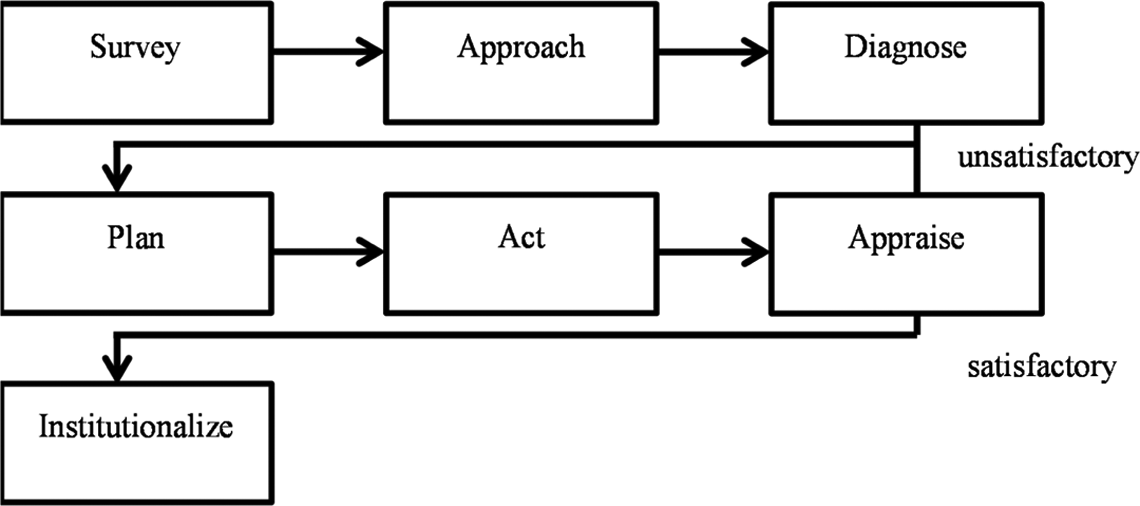
Proactive Islamic model of conflict resolution (Noor, 2002).
The SALAM model of Islamic conflict resolution similarly follows a linear progression through mediation (Ahmad, 2007; Randeree and El Faramawy, 2011; Sarif et al., 2004). It begins with clearly stating the existence and nature of the conflict (S). Subsequently, the stakeholders within the conflict will agree that there is a conflict (A). Mediation begins with clear communication with both parties listening and learning from each other regarding the variables involved in the conflict (L). The result of this communication is advising each other (A). Finally, the resolution involves minimizing disagreement to prevent further escalation of conflict (M). Similar to Noor’s (2002) framework, the SALAM model focuses on avoidance. However, if there is greater emphasis on the advice section that is strongly based on communication (L and A), there would be a greater probability toward a positive outcome (see Figure 2).
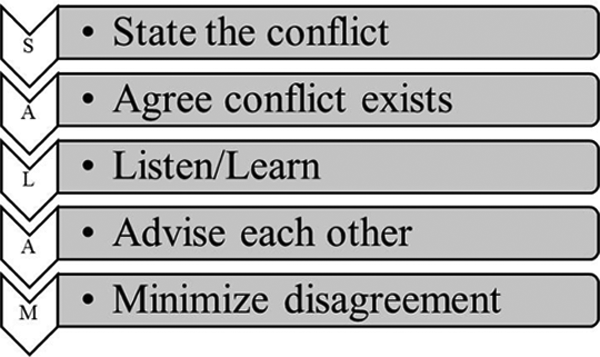
SALAM model (Ahmed, 2007).
The SALAM model focuses on reaction to conflict rather than a proactive environment. Randeree and El Faramawy (2011) suggested that the SALAM model should be used in conjunction with Noor’s (2002) proactive model. This notion observes conflict through the Western conflict management strategy of avoidance, accommodating, forcing, collaborating, and compromising (Rahim, 2002). Irani and Lebanon (1999) stated that this has traditionally been the paradigm for conflict resolution research from the Islamic context.
One of the most popular Islamic models of conflict management is the Shura (council), Nasīha (advice), and Ta’awun (mutual cooperation) or SNT model (Ahmad, 2007; Low, 2008; Noufal and Thacharupadikkal, 2012; Randeree and El Faramawy, 2011). Unlike the SALAM and proactive model, SNT is not a linear-progression avoidance-based theory. The SNT model shifts away from the traditional paradigm of conflict management research in Islam. This shift is found in the integration of the Islamic principles of Nasīha and Ta’awun. However, the SNT model narrows the principles to a conflict management process as opposed to an organizational strategy. Randeree and El Faramawy (2011) noted that the SNT model is proactive and conducive to positive outcomes of conflict. This is due to the existence of Shura, a consultative council of experts on relevant subject matter. The nature of Shura is to consult with nonpartisan individuals alongside the stakeholders and parties involved in the conflict. Nasīhah, or advice, in this model is similar to the SALAM concept. Involved parties are given advice or feedback toward corrective action, thereby increasing the probability of a favorable outcome (Noufal and Thacharupadikkal, 2012; Randeree and El Faramawy, 2011). Based on consultation and advice, concerned parties are encouraged to cooperate with other upon good (Ta’awun). The purpose of cooperation is to create a positive atmosphere and reduce possible tension resulting from conflict (Ahmad, 2007). The relationships between the variables in the SNT model are not discussed in much of the current literature. However, these factors are interdependent in Islamic theology and jurisprudence (Al-Abbad, 2009). The proposed model will provide a new insight by utilizing Islamic scripture to develop a theoretical framework for Islamic conflict management in an organization.
Synthesized Islamic framework
The Quran and Hadīth are the two fundamental sources of the Islamic religion (Aba Al-Khail, 2004). In order to develop a functional framework toward conflict management, it is imperative to research these two fundamental sources of Islamic theology (Abbasi et al., 2010). As several scholars have mentioned, conflict in Islamic theology is viewed as an inevitable and intentional state that can yield positive or negative results. And if your Lord had willed, He could have made mankind one community; but they will not cease to differ, except whom your Lord has given mercy, and for that He created them. (Quran, 11:118–199) O you who have believed, obey Allah and obey the Messenger and those in authority among you. And if you disagree over anything, refer it to Allah and the Messenger, if you should believe in Allah and the Last Day. That is the best [way] and best in result. (Quran, 4:59) But no, by your Lord! (O Muhammad) They cannot be believers until they make you judge in all disputes between them, and find in their souls no resistance against your decisions, but accept them with the fullest submission. (Quran, 4:65)
The second principle to conflict management in Islam is the establishment of Shura (council of experts). The concept of expert council, or Shura, in Islamic history is well established in politics and government. However, Shura is encouraged as a means for dispute management in all facets of a Muslim’s life, including within the home (Al-Humaid, 2003). In fact, it is described as an attribute of a believer, described in a chapter of the Quran entitled Al-Shura: And those who have responded to their lord and established prayer and whose affair is [determined by] consultation among themselves [.]. (Quran, 42:38) By Allāh, no group gathers to consult (Shura), except they are guided to the best outcome because of their consultation. (Al-Bukharī, 1989)
However, it is imperative to establish conditions for establishing Shura and recruiting members. In their discussions of Shura, researchers have not delved into the methodology of setting up Shura. The importance of establishing conditions for Shura can be seen in the action of the second Caliph in Islam, Umar bin Al-Khattāb at the end of his life. Ibn Al-Athīr (1997) reported that he barred his son from being among the potential leaders and selected five individuals to succeed him based on their leadership among the people and their closeness to the Prophet Muhammad during his life. When they began to dispute, Umar had given 4 days to consult and added Talha and Abdullah bin Umar to mediate the discussion based on their knowledge, experience, and virtue. The basic attributes of Shura members can be adapted from this narrative and the discussion of Hadīth scholars on establishing reliability of an individual with some additions suited to the HRM context (Quran, 2:282; Ibn Al-Salah, 1986; Ibn Hajar, 1997). The adapted attributes for use by HRM to establish Shura are (1) knowledge (Quran, 58:11); (2) justice in decision-making (Quran, 5:8); (3) reliability in reporting events and passing information (Quran, 49:6); (4) truthfulness (Quran, 9:119), (5) wisdom (Quran, 2:269); (6) expertise (Al-Hakim, 1990); and (7) sincerity (Quran, 4:35).
Knowledge, expertise, and wisdom are key elements in the attributes of Shura. Members of Shura must be knowledgeable of the issues, organization, and corporate environment in order to understand the issues that are raised in conflict. Professing a statement or deciding on a course of action without appropriate and relevant knowledge is reprehensible in Islam (Quran, 17:36). The 10th-century Islamic scholar, Al-Bayhaqi (2003) reported that Prophet Muhammad said: Whoever is issued a ruling that is not based upon knowledge, the person who issued that ruling bears his sin.
Muslims are commanded to seek justice and act justly when reconciling between two conflicting parties: And if it returns (the dispute), then make settlement between them in justice and act justly. Indeed, Allāh loves those who act justly. (Quran, 49:9)
Finally, truthfulness, reliability, and sincerity are important characteristics of Shura. Individuals or groups involved in conflict must be able to trust in the character of Shura members in order to assist in accepting their involvement in reconciliation. A person’s reliability is judged based on their ability to accurately narrate events or report incidents (Ibn Al-Salah, 1986). The Quran provides an explicit admonishment toward accepting narrative related to conflict from unreliable individuals: O you who have believed, if there comes to you a disobedient one with information, investigate, lest you harm a people out of ignorance and become, over what you have done, regretful. (Quran, 49:6) Beware of lying, for indeed lying leads to corruption, and indeed corruption leads to the Fire. Surely a man will lie and persistently lies such that it written with Allaah that he is a liar. Upon you is truthfulness, for surely truthfulness is piety, and piety leads to Heaven. Surely a man tells the truth and is persistently truthful such that it written with Allaah that he is a truthful person.
In addition to the establishment of Shura, Irani and Lebanon’s (1999) proposition of sulh and musalaha is a cornerstone in Islamic literature for conflict intervention. The Muslih, or individual who facilitates reconciliation and mediation, is highly regarded in Islam with promises of great reward (Quran, 4:114; 4:128). The Prophetic tradition regards sulh as an act of charity and social responsibility. In the business realm, the practice of sulh from HRM is linked to corporate social responsibility. The function of a Muslih is to facilitate mediation and discussion to achieve reconciliation between conflicting groups or individuals: And if two factions among the believers should fight, then make settlement between the two. (Quran, 49:9)
Islamic texts provide additional direction to managing conflict through behavioral practice and guidelines given to Muslims through the Quran and Sunnah. The SNT and SALAM models reflect only three principles of Islamic behavior that guide the conflict management in Islam. These models are viewed through the lens of intervention rather than organizational culture. It is necessary for HRM to incorporate these behavioral attributes into the organizational culture to effectively manage conflict. Islam encourages certain behavioral factors as a norm among Muslims in order to minimize the need for arbitration and conflict resolution. Muslims are encouraged in the Quran and Sunnah to perfect the mannerisms that prevent conflict through shared goals (Ibn Abi Shaybah, 1988). The Muslih and Shura should implement these behaviors as an element of the conflict management strategy. Nasīhah (sincere advice) and Ta’awun (mutual cooperation) are established within discussion of Islamic conflict management (Ahmad, 2007; Low, 2008; Noufal and Thacharupadikkal, 2012; Randeree and El Faramawy, 2011; Sarif et al., 2004). A Muslim is highly encouraged to give sincere advice to his compatriots in the event of mistakes or disputes: The religion is sincere advice. (Al-Bukharī, 2001)
Similarly, Ta’awun (mutual cooperation) is a proactive behavior mandated by Islam in all aspects of an individual’s life. Sarif et al. (2004) explained that Ta’awun is required to foster a positive environment that prevents negative conflict. Ahmed (2007) stated that Ta’awun is a communication tool that reduces aggression in the workplace; however, his discussion was in the context of intervention. Mutual cooperation upon righteousness and good is a behavioral norm in Islamic theology. Islamic texts specify Ta’awun to cooperation that leads to piety and good and forbids cooperation that leads to evils and negative outcomes: And cooperate in righteousness and piety, but do not cooperate in sin and aggression. (Quran, 5:2)
The disputants should be encouraged to practice Husn Al-Dhann (having good opinions of the other). In an effort to reduce or nullify the negative effect of conflict, stakeholders should assume the best intentions of their counterparts and avoid suspicion: O you who believe, avoid negative assumption. Indeed, some assumption is sin. And do not spy or backbite each other. Would one of you like to eat the flesh of his brother when dead? You would detest it. And fear Allāh; indeed, Allāh is accepting of repentance and Merciful. (Quran, 49:12)
Finally, the attribute of Al-Ta’akhi (brotherhood) is instrumental in proactive conflict management (Ishak and Osman, 2016). The organization can be viewed as a singular body that weakens whenever there is internal conflict. The Prophet Muhammad exemplified this organizational framework of brotherhood: The similitude of believers in regard to mutual love, affection, and sympathy is that of one body; when any limb of it aches, the whole body aches, because of sleeplessness and fever. (Muslim, 1996) The believers are but brothers, reconcile between your brothers. (Quran, 49:10)
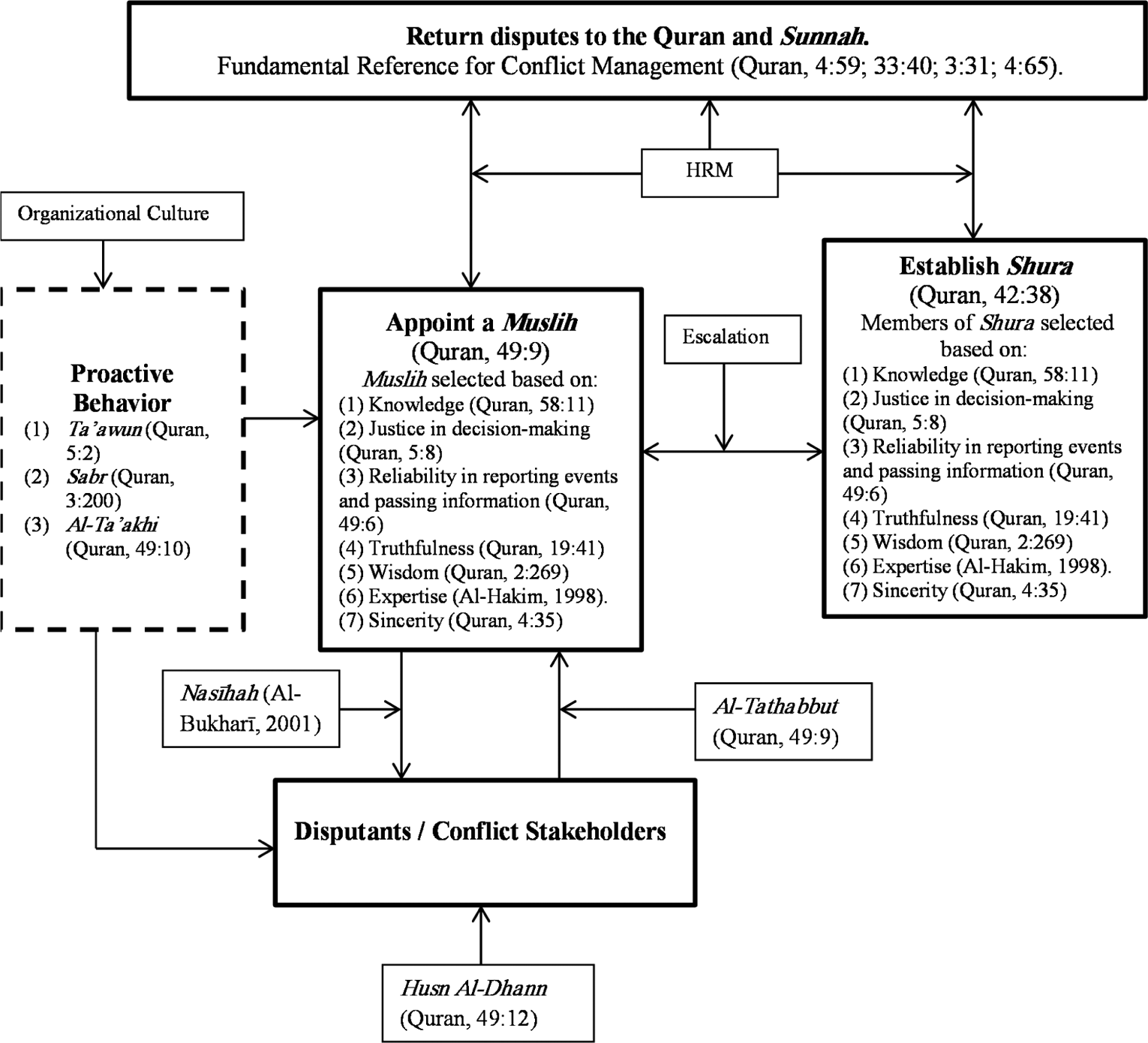
Islamic framework of conflict management.
Application of Islamic framework in HRM
Randeree and El Faramawy (2011) concluded that Islamic models have an impact in the Muslim world. Their findings suggested that Islamic conflict management styles have a significant relationship to constructive conflict management methods. This model would achieve efficient conflict management in a majority-Muslim workforce context by integrating religious principles to a proactive, collaborative, and collectivist model for HRM. Based on similar theoretical models explored and applied in Islamic leadership, marketing, and ethics, this model is expected to leverage Islamic values and concepts in HRM practice. This synthesized model can be classified as a constructive–proactive conflict model and applied to practice in the same method as SNT and the proactive model of Islamic conflict management.
However, applying Islamic models in an international environment can be considered for non-Muslim employees within a majority Muslim workforce. The most uniquely Islamic attribute of this proposed model is the reference to the Qur’an and Sunnah in the event of disputes. Therefore, the general command in Islam for Muslims to refer disagreements back to Islamic sources is more likely to yield compliance from disputants as found in numerous examples in Islamic history and business practice (Monjur, 2011). This referral to generally accepted Islamic sources may offset local market issues, such as nepotism, discrimination, and corruption (Monjur, 2011; Randeree and El Faramawy, 2011; Wahab et al., 2016). However, in the event of managing conflict between non-Muslim employees, this element may not apply as it is specific to the Muslim workforce.
A key element to establish the Islamic framework is developing a proactive organizational culture that promotes Ta’awun, Sabr, and Al-Ta’akhi. HRM can achieve this proactive and collaborative culture through establishing three key elements: (1) orienting new employees during onboarding, (2) educating current employees through training, and (3) integrating these traits into performance appraisal as a form of accountability (Alvesson and Sveningsson, 2015). Wahab et al. (2016) validated the application of these organizational values in the Malaysian context. In their study, Muslim-majority organizations that were not specifically Islamic organizations were investigated. Their results illustrate the applicability of these values in non-Islamic organizations. A study on Moroccan businesses yielded similar results (Forster and Fenwick, 2015).
In the SNT and SALAM models, the intensive use of Nasīhah is applied in the same method in the integrated Islamic framework. In the event of conflict, sincere advice must be administered from HRD in order to resolve the conflicts. This function must reflect the best interests of all parties involved in the conflict and must be in adherence to Islamic ethical framework. In the HRM context, advice operates as constructive feedback given to stakeholders in the conflict. This is essentially a means to foster collaboration through providing constructive advice with good intent.
The remaining elements of Islah and Shura have a strong role in conflict management. The role Muslih is not set on a fixed position, and it should change based on the disputants or departments. The appointment of a Muslih and Shura based on knowledge, justice, reliability, truthfulness, expertise, and wisdom is a core aspect of Islamic conflict management. The appointed Muslih and Shura should base decisions on the Quran and Sunnah. The function of the Muslih is to facilitate and verify (at-tathabbut) communication during mediation and resolution. The disputants must always maintain husn al-dhann (good assumptions) of each other in order to minimize disagreement. Helmy et al. (2014) tested the application of a Muslih and Shura in applied research of Egyptian firms. They found that Islah and Shura have a significant effect on employees in conflict resolution, particularly on interpersonal relationships. In its implementation, prior to escalation of conflict to the Shura, a Muslih within the department should be appointed by HRM. Due to the fast-paced nature of conflict and decision-making, HRM should be proactive in identifying potential arbitrators in departments before conflict arises. The Shura council remains a fixture of HRM based on the attributes discussed earlier. Implementing these concepts can assist HRM in Muslim-majority organizations to resolve conflicts in a way closest to Islamic principles, thereby decreasing the likelihood of dysfunctional conflicts in the organization.
Conclusion
The Islamic injunction against extending conflict is a motivator for HRM to develop strategies to manage conflict. The Islamic view of conflict management is a holistic approach that encompasses the beliefs and behavior of Muslims. HRM can utilize this approach to foster positive outcomes through application of Islamic principles with a Muslim workforce. It is imperative for HRM to cultivate an organizational environment that is conducive to the proactive variables discussed in the study. The facets of Islamic principles discussed in this study provide a framework that can flexibly be applied by HRM to an organization for optimal conflict management. This study contributes to the body of literature by presenting a theoretical framework of conflict management for researchers. It also provides suggestions for HRM to practically implement the Islamic framework in Muslim-majority organizations.
Therefore, this article provides direction to HRM in managing conflict among Muslim employees. This framework will assist organizations in developing their conflict management program to achieve positive outcomes and minimize negative results of conflict by collaborative and constructive conflict management through a positive culture of proactive culture management. Finally, there is a need for further discussion and testing of the framework in empirical studies on HRM. Literature on conflict management creates an opportunity for HRM practitioners to integrate theory to organizational development. With the understanding that Islamic conflict management is a holistic approach, it is imperative to develop effective strategies for HRM in Muslim-majority organizations. Although many of the existing models in this topic are viable for conflict resolution, the proposed model in this article expands and synthesizes the SNT, Sulh, and SALAM models found in existing literature and provides a robust framework based on Islamic literature through a collaborative and constructivist approach for effective conflict management.
Footnotes
Declaration of Conflicting Interests
The author(s) declared no potential conflicts of interest with respect to the research, authorship, and/or publication of this article.
Funding
The author(s) received no financial support for the research, authorship, and/or publication of this article.