







Abstract
This study compared relations between work demands and support, work-to-family conflict (WFC) and job outcomes in Ghana and the United Kingdom. Data were obtained from 217 Ghanaian employees and 198 British employees using structured questionnaires. Results from multigroup structural equation modelling analyses showed that job pressure was positively related to WFC in Ghana and the United Kingdom, whereas supervisor support was negatively related to WFC in Ghana only. WFC was negatively related to job satisfaction and positively related to turnover intentions in both countries. More importantly, the relationship between job pressure and WFC was stronger for British employees than for Ghanaian employees. Finally, job pressure was indirectly related to job satisfaction and turnover intentions via WFC in both countries, whereas supervisor support was indirectly related to job satisfaction and turnover intentions in Ghana only. The implications of these findings for cross-cultural research on the work–family interface and managerial practice are discussed.
Introduction
Changes in the demographic make-up of the workforce and family structures have created a situation where a significant number of employees have difficulties in juggling work and family responsibilities. Work–family conflict occurs when role pressures in the work and family domains are incompatible such that participation in one role makes it difficult to meet demands in the other (Greenhaus and Beutell, 1985). Work–family conflict constitutes a major source of stress with adverse effects on employee well-being and attitudes (e.g. Matthews et al., 2014; Nohe and Sonntag, 2014) as well as on families and organizations in terms of diminished family and organizational performance (e.g. Nohe and Sonntag, 2014; van Steenbergen and Ellemers, 2009).
In spite of the vast literature on the work–family interface, much of the extant research on antecedents and outcomes of work–family conflict is based predominantly on Western countries. Most of the studies on work–family conflict from non-Western contexts have been done in Asian countries (e.g. Aryee et al., 1999; Karimi and Nouri, 2009; Lu and Kao, 2013). While these studies suggest considerable similarities in the sources of work–family conflict across cultures, there is recognition of the contextual forces that shape individuals’ experiences of the work–family interface (e.g. Annor, 2016a; Ollier-Malaterre et al., 2013; Powell et al., 2009). To date, however, relatively few studies have compared work–family conflict in different cultural contexts.
The purpose of the present study is to examine correlates of work–family conflict in Ghana and the United Kingdom. Drawing on the conservation of resources (COR) theory (Hobfoll, 1989, 2002) and Hofstede’s cultural framework (Hofstede, 2001; Hofstede et al., 2010), the study investigates cross-national differences and similarities in the extent to which work demands and support are related to work–family conflict. The study also examines cross-national differences and similarities in the extent to which work–family conflict is related to job satisfaction and turnover intentions. Although work–family conflict is conceptualized as a bidirectional construct (Michel et al., 2011), the present study focuses on only work-to-family conflict (WFC), as this direction of conflict is more prevalent than family-to-work conflict (FWC). Moreover, the antecedents and outcomes of WFC are not necessarily the same as those of FWC (Michel et al., 2011).
This study contributes to the work and family literature in two significant ways. First, by comparing work–family conflict in Ghana and the United Kingdom, the study enhances our understanding of the extent to which work–family experiences in Western and industrialized societies can be generalized to sub-Saharan African contexts. Previous cross-national studies on work–family conflict involved comparisons of Western countries with Asian and Latin American countries (e.g. Lu et al., 2009, 2010; Spector et al., 2007). The African context is conspicuously absent in cross-national research on work–family conflict. While work and family issues are beginning to gain attention in these contexts (e.g., Annor, 2014, 2016b; Gamor et al., 2014; Mokomane, 2014), no empirical study has directly compared correlates of work–family conflict in a sub-Saharan African country to a Western industrialized nation. The study thus has practical implications for organizations in the African context in terms of helping employees integrate work and family life. Second, the study explores possible indirect influences of work demands and support on job outcomes (job satisfaction and turnover intentions) through work–family conflict. Although work–family conflict has been examined as a linking mechanism between work demands/resources and job outcomes in prior research (e.g. Dixon and Sagas, 2007; Judge and Colquitt, 2004), no attempt has been made to examine the possible mediating role of work–family conflict from a cross-cultural perspective.
Study context
The cultural, institutional and economic contexts within which the work and family role systems are embedded have significant influences on individuals’ ability to juggle demands in these life domains (Annor, 2016a). The two countries in this study not only differ in terms of economic development but also represent different labour market, family and cultural contexts. While Ghana’s economy has recorded steady and significant growth over the past two decades, there has been a lack of corresponding structural transformation and improvement in labour market outcomes in the country (Aryeetey and Kanbur, 2017). A significant feature of Ghana’s labour market has been the decline in the share of the formal sector in paid employment, alongside increasing unemployment and low levels of wages (Otoo et al., 2011). Consequently, a significant proportion of the working class is trapped in income poverty. While it is difficult to compare income levels in two different countries because of differences in other economic circumstances, available economic indicators suggest that standards of living are significantly better in the United Kingdom than in Ghana. 1
The household contexts in both countries may appear similar in terms of division of labour, which remains gendered, with women bearing a larger proportion of domestic work despite their increased participation in paid employment. However, a nuanced analysis suggests considerable differences between the two countries. In particular, the household context in Ghana largely reflects the dual-earner model where both couples are engaged in income generating activities, although women’s participation tend to be restricted to the informal sector (Annor and Amponsah-Tawiah, 2017). In contrast, women’s increased involvement in paid employment in the United Kingdom has been predominantly part-time (Burchell et al., 2007; Crompton and Lyonette, 2006); thus, the family context in the United Kingdom largely reflects the one-and-half-earner model (Lewis, 2009). Moreover, the average family size in Ghana is comparably larger than in the United Kingdom due to the high cultural premium on procreation coupled with the high incidence of fosterage and informal adoption in Ghana 2 (Ardayfio-Schandorf, 2006). In relation to the work–family interface, large family sizes may have an impact on meeting family demands in terms of time and attention.
Statutory interventions to facilitate the integration of work and family responsibilities are limited in Ghana, while existing provisions largely perpetuate gender inequalities in division of labour. 3 Similarly, reconciliation of work and family demands was historically considered a private responsibility in the United Kingdom (Crompton and Lyonette, 2006), resulting in minimal state intervention and low level of public childcare provisions (Beham et al., 2014). However, recent policy packages aimed at furthering child development and employment of mothers in the United Kingdom (Lewis, 2009) suggest that state interventions in work–family balance may be better in the United Kingdom than in Ghana. State interventions in work and family integration have been found to enhance individuals’ sense of entitlement for support (Lewis and Smithson, 2001), which may in turn increase institutional pressure on employers to be more family supportive (Lewis and Haas, 2005).
Finally, with regard to cultural differences, Ghana is largely collectivistic, whereas the United Kingdom is considered individualistic. The collectivistic nature of the Ghanaian society is reflected in the strong emphasis on identification with one’s extended family, with familial relationships characterized by a high sense of reciprocity (Ardayfio-Schandorf, 2006). This form of social relationship also finds expression in the organizational context in what Aryee (2005) termed as organizational familism, in which employees consider the organization as an extension of the family. Consequently, there is ‘the expectation on the part of employees that the organization will take care of their socioemotional and material needs in exchange for promoting the interests of the organization’ (Aryee, 2005: 271). In contrast, Hofstede’s (2001) study on cultural differences identified the United Kingdom as among the countries with the highest levels of individualism.
Theoretical foundations and hypotheses
As stated earlier, the COR theory (Hobfoll, 1989, 2002) provides the theoretical underpinnings for this study. The COR theory postulates that individuals strive to acquire, maintain and protect resources and that stress occurs when there is a threat of resource loss or an actual loss of resources (Hobfoll, 1989). Resources refer to objects, conditions, energies or personal characteristics ‘that either are centrally valued in their own right or act as a means to acquire centrally valued resources’ (Hobfoll, 2002: 307). The COR theory posits that chronic exposure to resource loss may result in a loss spiral in which an initial loss of resources increases the likelihood of further resource loss, thereby leaving fewer resources to deal with stressors (ten Brummelhuis and Bakker, 2012). Conversely, acquisition of resources may facilitate the accumulation of additional resources, a concept described as a gain spiral. Drawing on the tenets of COR theory, we suggest that work demands and support may be associated with WFC, which may in turn influence job outcomes.
In addition, we draw on Hofstede’s cultural framework in analysing cultural differences in proposed conceptual relationships in the study. Cultural values and beliefs have provided an important perspective through which researchers examine macro-level influences on the work–family interface (Annor, 2016a; Powell et al., 2009), and Hofstede’s model remains the most influential framework in organizational behaviour and cross-cultural management literature (Ayentimi et al., 2016). A key cultural dimension that is considered relevant in explaining variations in work–family experiences across countries is individualism–collectivism (Powell et al., 2009). Individualism–collectivism describes the extent to which individuals in a society are socially connected and the level of priority they assign to individual goals relative to group goals (Hofstede et al., 2010). According to Hofstede (2001), individualists tend to be less interconnected and are expected to be self-reliant and emphasize personal goals, achievements and preferences over that of the larger group. In contrast, collectivists tend to be more interconnected and emphasize group goals and achievements over personal ones. Collectivists also tend to define themselves in terms of their in-group, which usually includes the extended family (Hofstede et al., 2010). Although an analysis based on cultural dimensions risks oversimplifying cultural diversity within different countries, as each country may have distinct subcultures (Triandis and Gelfand, 1998), Ghana and the United Kingdom could largely be considered as prototypes of collectivistic and individualistic societies, respectively.
Work demands and WFC across contexts
Stressors associated with the work role are considered important precursors to WFC. From the perspective of COR theory, physical and psychological exertions associated with the job may cause stress, as more personal resources are expended in coping with those stressors (ten Brummelhuis and Bakker, 2012). Consequently, fewer resources are left for performing family-related tasks. Accordingly, work demands in the form of job pressure are expected to be associated with higher levels of WFC. Prior research has indeed shown a positive link between job pressure and WFC (e.g. Annor, 2016b; Lu and Kao, 2013; Matthews et al., 2014).
From a cross-cultural perspective, however, there is evidence that the strength of the relationship between job demands and WFC varies across contexts. In particular, individualism–collectivism can influence how employees appraise work and respond to work demands. In individualistic cultures, greater value is placed on spending quality time with one’s family and work is seen as a means to personal achievement (Hofstede, 2001). Consequently, increased commitment to work may be perceived in individualistic societies as neglect of the family in pursuit of personal achievements (Spector et al., 2007). In contrast, in collectivistic cultures, work is regarded as a means to support the family and less value is placed on personal and family time; hence, excessive efforts in work pursuits may be considered a short-term cost for the long-term benefit of the family (Yang et al. 2012). Thus, employees in collectivistic societies appraise job demands less negatively than employees in individualistic societies. Consistent with these arguments, Spector and his colleagues (Spector et al., 2004, 2007) found that work demands (work hours and perceived workload) had stronger positive relationship with WFC among individualists than collectivists. Therefore, it is hypothesized that:
Work support and WFC across contexts
Social support describes ‘social interactions or relationships that provide individuals with actual assistance or with a feeling of attachment to a person or group that is perceived as caring or loving’ (Hobfoll and Stokes, 1988: 499). In the work context, supervisors constitute an important source of informal social support (Kossek et al., 2011). Supervisor support represents employees’ perception that their supervisors are accommodating of their work and family needs or empathic towards their desire to integrate work and family responsibilities (Thomas and Ganster, 1995). From the perspective of COR theory, family-supportive supervisor behaviours can enhance employees’ ability to deal with work-related problems, making it possible to invest more resources in other life domains. Accordingly, a number of studies have associated supervisor support with lower levels of WFC (e.g. Karimi and Nouri, 2009; Kossek et al., 2011; Paustian-Underdahl and Halbesleben, 2014).
From a cross-cultural perspective, however, it is argued that individuals appraise support resources in the work domain differently in different national contexts. Lu et al. (2009) suggested that informal support resources such as supervisory support may be more useful for employees in collectivistic societies because of the acceptance of employees’ family responsibilities outside work. This assertion is consistent with the view that the relationship between employers and employees in collectivistic cultures is often conceived in moral terms ‘with mutual obligations for protection in exchange for loyalty’ (Hofstede et al., 2010: 120). This contrasts with individualistic cultures, where the relationship between employers and employees is typically conceived in transactional terms (Hofstede et al., 2010). Thus, access to and use of informal support resources may be influenced by how individuals construe the employer–employee relationship. In a study comparing Taiwanese and British employees, Lu et al. (2009) reported a stronger negative relationship between supervisor support and WFC for Taiwanese employees than for British employees. Therefore, it is hypothesized that:
WFC, job satisfaction and turnover intentions across contexts
The COR theory suggests that the experience of resource loss associated with work–family conflict may result in consequences such as decreased performance and distress in major life domains (Grandey and Cropanzano, 1999). Since WFC occurs when demands in the work domain result in insufficient resources for participation in the family domain, the experience of WFC is likely to affect satisfaction in the work domain as individuals attribute blame to the source of the conflict (Shockley and Singla, 2011). The COR theory also suggests that when faced with resource loss, the need to protect resources instigates processes that might help prevent further resource loss (Hobfoll, 1989). It follows that employees who experience WFC would attempt to reduce the stress by withdrawing from their job. Empirically, WFC has been associated with lower levels of job satisfaction (e.g. Cho and Tay, 2016; Shockley and Singla, 2011) and higher levels of turnover intentions (e.g. Nohe and Sonntag, 2014; Steinmetz et al., 2008).
However, prior research has shown that outcomes of work–family conflict are more pronounced for employees in some cultural contexts than in others (Lu et al., 2010; Spector et al., 2004, 2007; Wang et al., 2004). In terms of individualism–collectivism, it has been argued that because individualists tend to prioritize their personal needs, they would be more likely to respond negatively when work responsibilities interfere with personal needs (Spector et al., 2007; Wang et al., 2004). Conversely, collectivists tend to focus on social connections with their employer and would more likely self-sacrifice when work interferes with personal needs. Consistent with this argument, Spector et al. (2007) found that the relationship between WFC and job satisfaction was stronger in individualistic cultures (Anglo) than collectivistic cultures (Asia, Latin America and East Europe). Lu et al. (2010) also reported stronger negative relationship between WFC and job satisfaction among employees in Britain than those in Taiwan. Similarly, Wang et al. (2004) found that WFC had a positive relationship with turnover intentions among American employees but was not related to turnover intentions among the Chinese. Therefore, it is hypothesized that:
The mediating role of work–family conflict across contexts
Although previous cross-cultural studies on correlates of work–family conflict mainly examined direct relationships, there are reasons to expect cultural differences in indirect relationships between antecedents and outcomes. The notion that work–family conflict serves as a mechanism through which work stressors and resources are linked to job outcomes is well established in existing monocultural studies (e.g. Dixon and Sagas, 2007; Judge and Colquitt, 2004). These studies demonstrate that work stressors are negatively associated with job satisfaction and positively related to turnover intentions; that work support is positively related to job satisfaction and negatively related to turnover intentions; and that these relationships are mediated by WFC.
Based on the preceding discussions on how work demands and resources are construed across cultures, we anticipate that job pressure and supervisor support would have differential relationships with job satisfaction and turnover intentions across cultures. The extant literature reports significant differences in the relationships of work stressors and support with job outcomes. For example, Stock et al. (2016) reported in a recent cross-cultural study that supportive work–family culture had stronger positive relationship with job satisfaction for employees in India and China than in the United States. Similarly, Yang et al. (2012) reported that perceived workload and organizational constraints had stronger influences on job satisfaction and turnover intentions in individualistic countries than in collectivistic countries. The present study extends this line of research by examining cultural differences in the indirect relationships of job pressure and supervisor support with job satisfaction and turnover intentions through WFC. Therefore, it is hypothesized that:
Methods
Participants
Participants were non-teaching university employees in Ghana and the United Kingdom. The Ghanaian sample was composed of 217 employees of whom 54% were females and were aged 20 to 64 with an average age of 38.6 (SD = 10.0). In terms of job functions, 59.3% worked in administrative and clerical positions, 29.9% in professional jobs, 9.8% in technical positions and 1% in management positions. About 80% of the participants were married or lived with a partner, and over 70% had children. The British sample consisted of 198 participants of whom 67.6% were females and were aged 25 to 73 with an average age of 45.1 (SD = 10.7). More than a third of the participants (41.9%) were in administrative and clerical jobs, 22.2% were in managerial jobs, 16.2% were in each of professional and technical jobs and 3.5% were in ‘other’ jobs. About 94% of the British sample were married or lived with a partner, and 52.5% had children.
Data collection procedure
In both countries, data were collected using self-administered questionnaires. For cross-national studies, it has been recommended that researchers maintain consistency in data gathering procedures (Schaffer and Riordan, 2003). However, maintaining the same mode of data collection is not often feasible in cross-cultural research, as a mode that is optimal for one country may be considered a poor option for another (de Leeuw, 2005). In the present study, different modes of survey administration were employed in both countries. Paper-based surveys were used in Ghana, while online surveys were used in the United Kingdom. On the one hand, the paper-based surveys were considered a more viable option in Ghana, given the relatively low levels of computer usage and Internet access within the target population, which makes online surveys unpopular. On the other hand, online surveys were considered a more viable option in the United Kingdom, given the relatively higher level of Internet usage in the target population. The practice of combining different modes of data collection for different samples in the same study is not new, and there is evidence that this approach does not significantly affect response quality (Revilla, 2010).
In Ghana, data were collected from employees in three public universities. Questionnaire packages were distributed to employees across various departments in the selected universities. Attached to each questionnaire package was a covering letter that explained the objectives of the study, assured participants of confidentiality of their responses and informed them of the voluntary nature of participation in the study. All the questionnaires were administered in English. In all, 341 questionnaires were distributed, of which 246 were returned, representing a response rate of 72.1%. Of the 246 respondents, 234 (95%) met the study’s inclusion criteria, which required that participants be either married or living with a dependant at home. Data from 17 respondents were deleted due to extremely high missing values, leaving the final sample of 217 reported earlier.
Participants in the United Kingdom were recruited from online departmental staff lists of five universities. Personalized emails containing a link to the survey website were sent to 840 non-teaching employees in these universities requesting their participation in the Web-based survey. The emails explained the purpose of the survey and gave assurance about confidentiality and anonymity in the study. The online survey was designed and administered using the Qualtrics survey software with the same question formats, ordering and response categories as the paper-based survey. Personalized email follow-up reminders were sent to all participants a week after the initial requests. A total of 293 individuals responded to the request of which 10 declined participation. Of the 283 participants who started the survey, 232 completed it, representing a completion rate of 82% and response rate of 27.6%. Of the 232 respondents, 198 met the study’s inclusion criteria.
Measures
WFC was measured with five items adapted from Carlson et al.’s (2000) work–family conflict scale. The items reflect the time-based and strain-based dimensions of work–family conflict. Each item was followed by response categories that showed how often instances depicting work–family conflict had been experienced in the past 3 months – ‘never’, ‘almost never’, ‘sometimes’, ‘often’ and ‘always’. A sample item is ‘I have come home from work too tired to do the chores that need to be done’. Scores on each item ranged from 1 to 5, with high scores reflecting higher levels of WFC. The α coefficients for the measure were 0.73 and 0.85 for Ghana and the United Kingdom, respectively.
Job satisfaction was measured with four items adapted from Pond and Geyer’s (1991) job satisfaction scale, which assesses employees’ overall reactions to the job without reference to any specific aspect of the job (e.g. pay, promotion, supervisors). A sample item on the scale is ‘If you had to decide all over again whether to take the job you have at present with your current employer, what would you decide?’ (1 = definitely not take the job; 5 = definitely take the job). As shown in the sample item, each item was followed by two extreme responses separated by five response ratings. Scores on this scale consisted of the mean for all the items with values ranging from 1 to 5; high scores reflect greater satisfaction with the job. The α coefficients for this measure were 0.83 and 0.88 for Ghana and the United Kingdom, respectively.
Job pressure was measured with three items that asked respondents to rate how often they experienced specific job conditions related to pace and emotional demands of the job (see Aryee et al., 1999). A sample item is ‘In your current job, how often do you work to tight deadlines’. Each item was rated on a seven-point Likert-type scale ranging from ‘never’ to ‘all of the time’. The α coefficients for the instrument were 0.72 and 0.85 for Ghana and the United Kingdom, respectively.
Supervisor support was measured with six items that asked respondents how accommodating and understanding their supervisors were in dealing with work and family issues (Behson, 2005). A sample item is ‘My supervisor/boss understands me when I need to take time off work to take care of family issues’. The items were rated on a five-point scale ranging from 1 (strongly disagree) to 5 (strongly agree); high scores indicate high levels of supervisor support. The α coefficients for this scale in the present study were 0.86 and 0.89 for Ghana and the United Kingdom, respectively.
Turnover intentions: Employees’ intentions to quit their present job was measured with two items: ‘I often think of quitting my job’ and ‘I will actively look for a job by the next year’. Responses to the items were made on a five-point scale (1 = strongly disagree; 5 = strongly agree). The α coefficients for the scale were 0.82 and 0.84 for Ghana and the United Kingdom, respectively.
Control variables: Age and gender were included as control variables in the study. Age was measured as a continuous variable, while gender was coded as 0 (male) and 1 (female).
Measurement equivalence
To allow for cross-national comparisons, it was important to establish that the measurement instruments were invariant across the two samples (Schaffer and Riordan, 2003). Following procedures suggested by Byrne (2010), we tested for configural and metric invariance. Configural invariance entails whether a measurement instrument has the same configuration of factor loadings across subsamples (Byrne, 2010). To establish configural invariance, we first estimated a five-factor measurement model for each country separately. Next, we performed multigroup confirmatory factor analysis with factor loadings in the five-factor model freely estimated across the two groups. As shown in Table 1, the resulting configural model (M3) showed a good fit to the data, (χ 2 (318) = 593.99, p < 0.01; CFI = 0.928; SRMR = 0.057; RMSEA = 0.046), confirming the assumption of configural invariance.
Results of confirmatory factor analyses showing measurement invariance.
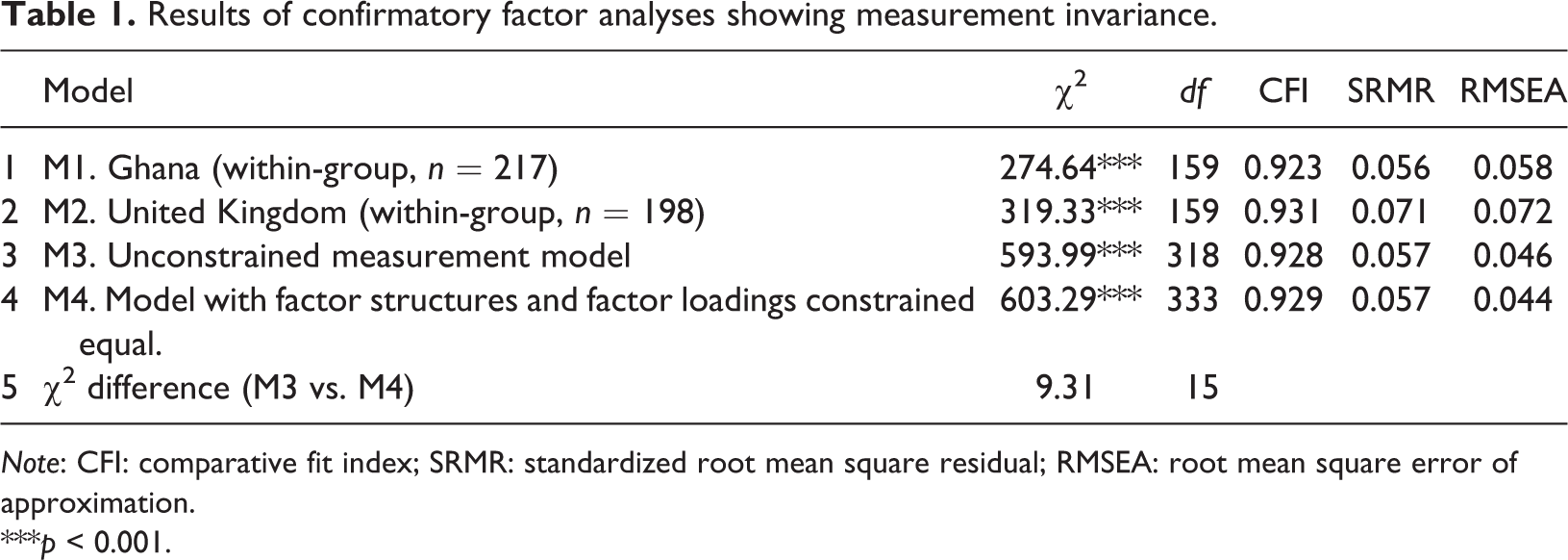
Note: CFI: comparative fit index; SRMR: standardized root mean square residual; RMSEA: root mean square error of approximation.
***p < 0.001.
Metric invariance entails whether participants respond to the ‘items in the same way, in the sense that obtained ratings can be meaningfully compared across countries’ (Steenkamp and Baumgartner, 1998: 80). We tested for metric invariance by imposing equality on all factor loadings across the two groups (M4). The χ 2 difference showed that the model with equality constraints on factor loadings did not differ significantly from the configural model (Δχ 2 (15) = 9.31, p > 0.05). These results indicate that the factor loadings were invariant across the two subsamples, and that the assumption of metric invariance was tenable.
Results
Descriptive statistics and correlations
Means, standard deviations, reliability estimates and correlations among the study variables for each country are presented in Table 2. For both samples, supervisor support was negatively correlated with WFC and turnover intentions and positively correlated with job satisfaction; job pressure was positively correlated with WFC and turnover intentions and negatively correlated with job satisfaction; and WFC was positively correlated with turnover intentions and negatively correlated with job satisfaction.
Bivariate correlations, descriptive statistics and reliability estimates of study variables for Ghana and the United Kingdom.
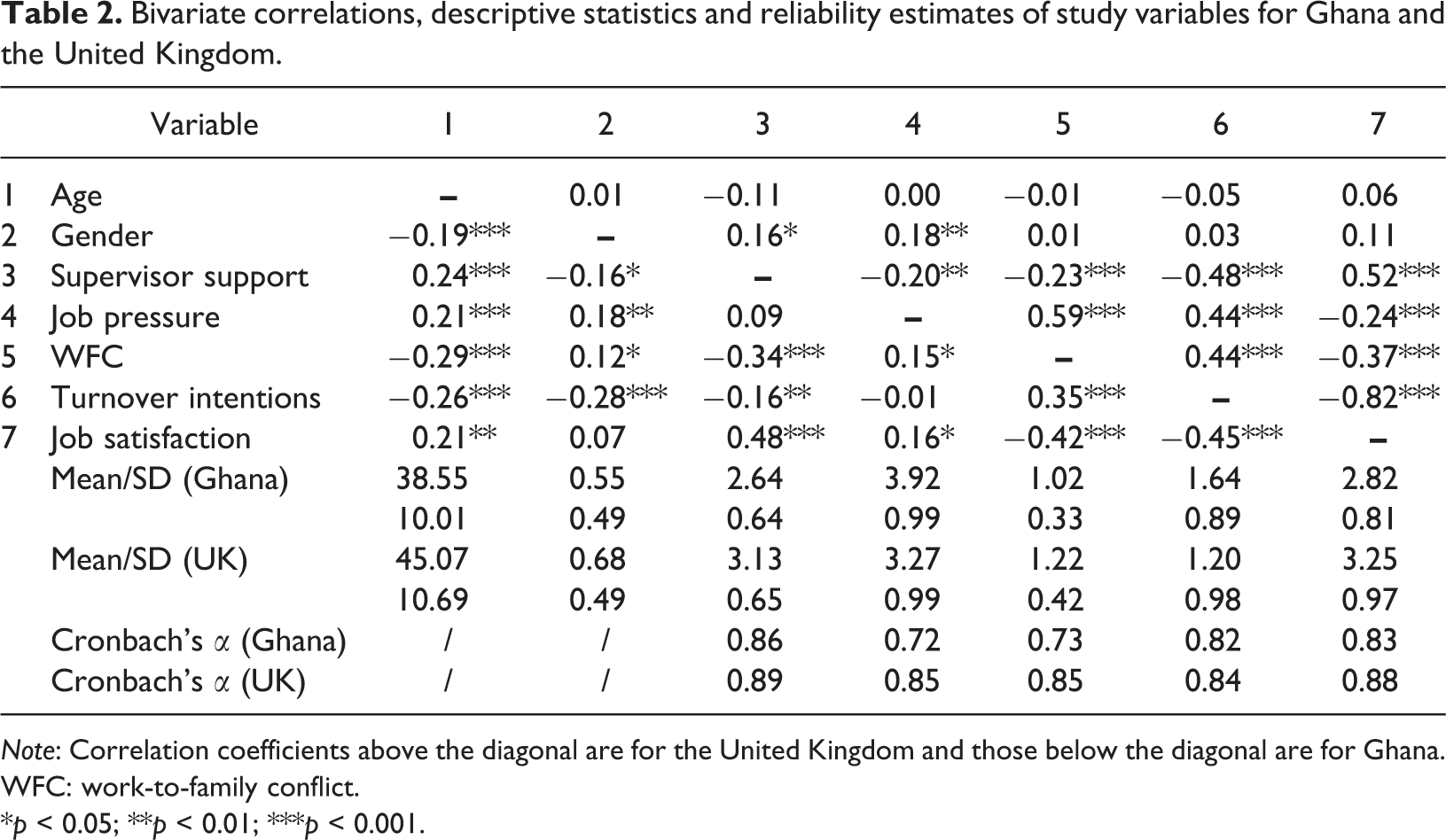
Note: Correlation coefficients above the diagonal are for the United Kingdom and those below the diagonal are for Ghana. WFC: work-to-family conflict.
*p < 0.05; **p < 0.01; ***p < 0.001.
Tests of hypotheses
The study’s hypotheses were tested using structural equation modelling (SEM) with AMOS 21.0. We first tested the structural relationships among the latent variables for each country separately to ascertain whether the model was a good fit to the data for the respective countries. The control variables of age and gender were also included. The results, as shown in Table 3, revealed that the hypothesized model fitted the data well for Ghana, χ 2(189) = 304.76, p < 0.01; CFI = 0.926; SRMR = 0.054; RMSEA = 0.053, and the United Kingdom, χ 2(189) = 373.19, p < 0.01; CFI = 0.922; SRMR = 0.068; RMSEA = 0.072.
Fit indices for multigroup SEM.
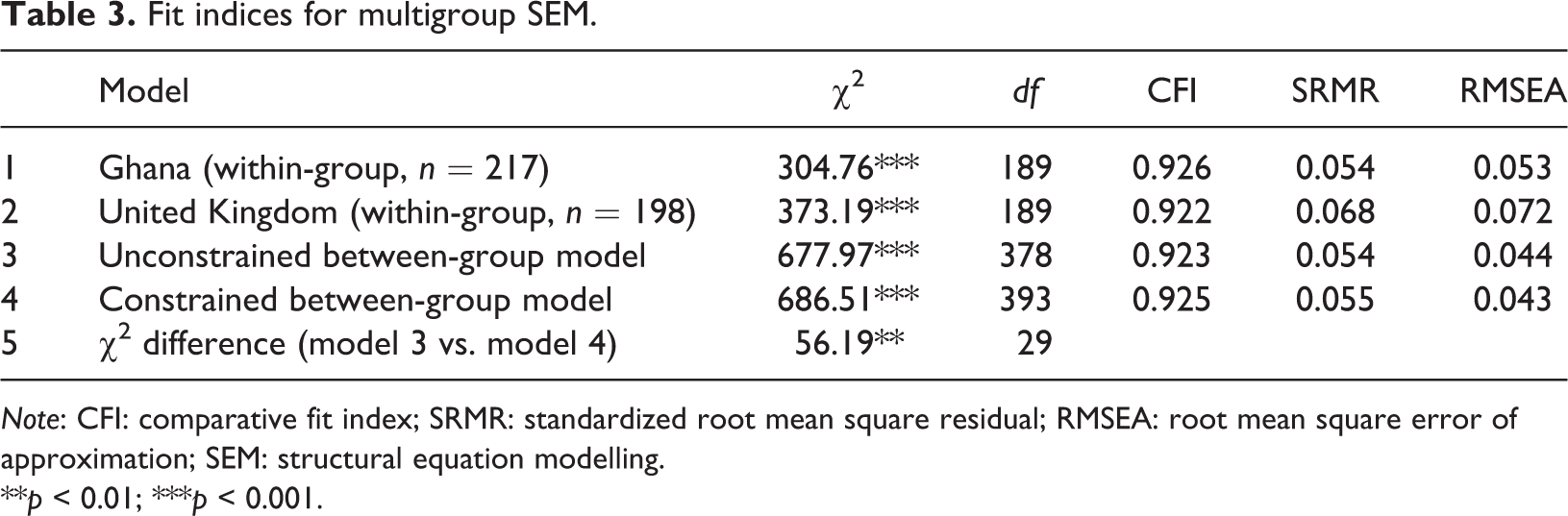
Note: CFI: comparative fit index; SRMR: standardized root mean square residual; RMSEA: root mean square error of approximation; SEM: structural equation modelling.
**p < 0.01; ***p < 0.001.
Next, to ascertain whether the structural relationships among the latent variables were invariant across countries, we conducted multigroup SEM in which two between-group models were specified. In one between-group model, all the parameters were freely estimated within each country. In the second model, the hypothesized parameters were constrained to be equal across countries. As shown in Table 3, the unconstrained model fitted the data significantly better than the constrained model, Δχ 2 (29), p < 0.05. This indicates significant between-country difference in path coefficients. To determine specific between-country differences in the hypothesized paths, we examined the critical ratio for the difference between the respective parameters estimates.
Standardized coefficients for the hypothesized paths are shown in Figure 1 for both countries. The results showed that job pressure was positively related to WFC in both countries (β GH = 0.19, p < 0.05; β UK = 0.53, p < 0.001) but the relationship was stronger in the United Kingdom than in Ghana (z = 3.39, p < 0.001). Thus, hypothesis 1, which suggested that the negative relationship between job pressure and WFC would be stronger in the United Kingdom than in Ghana, was supported. Job pressure was also positively related to turnover intentions in the United Kingdom (β UK = 0.22, p < 0.01) but was not significantly related to turnover intentions in Ghana. Supervisor support had a significant negative relationship with WFC in Ghana (β GH = −0.25, p < 0.01) but was not significantly related to WFC in the United Kingdom (β UK = −0.11, n.s.); however, the between-country difference in the magnitude of the relationship was not significant. Thus, hypothesis 2, which suggested that the relationship between supervisor support and WFC would be stronger in Ghana than in the United Kingdom, was not supported. In addition, WFC was negatively related to job satisfaction in both countries (β GH = −0.27, p < 0.01; β UK = −0.23, p < 0.01), but no significant between-country difference was found in the strength of the relationship. Likewise, WFC was positively related to turnover intentions in Ghana (β GH = 0.23, p < 0.01) and in the United Kingdom (β UK = 0.19, p < 0.05), but the between-country difference in the strength of the relationship was not significant. Supervisor support had a positive relationship with job satisfaction in both countries (β GH = 0.34, p < 0.001; β UK = 0.43, p < 0.001), but its relationship with turnover intentions was significant in the United Kingdom only (β UK = −0.38, p < 0.001).
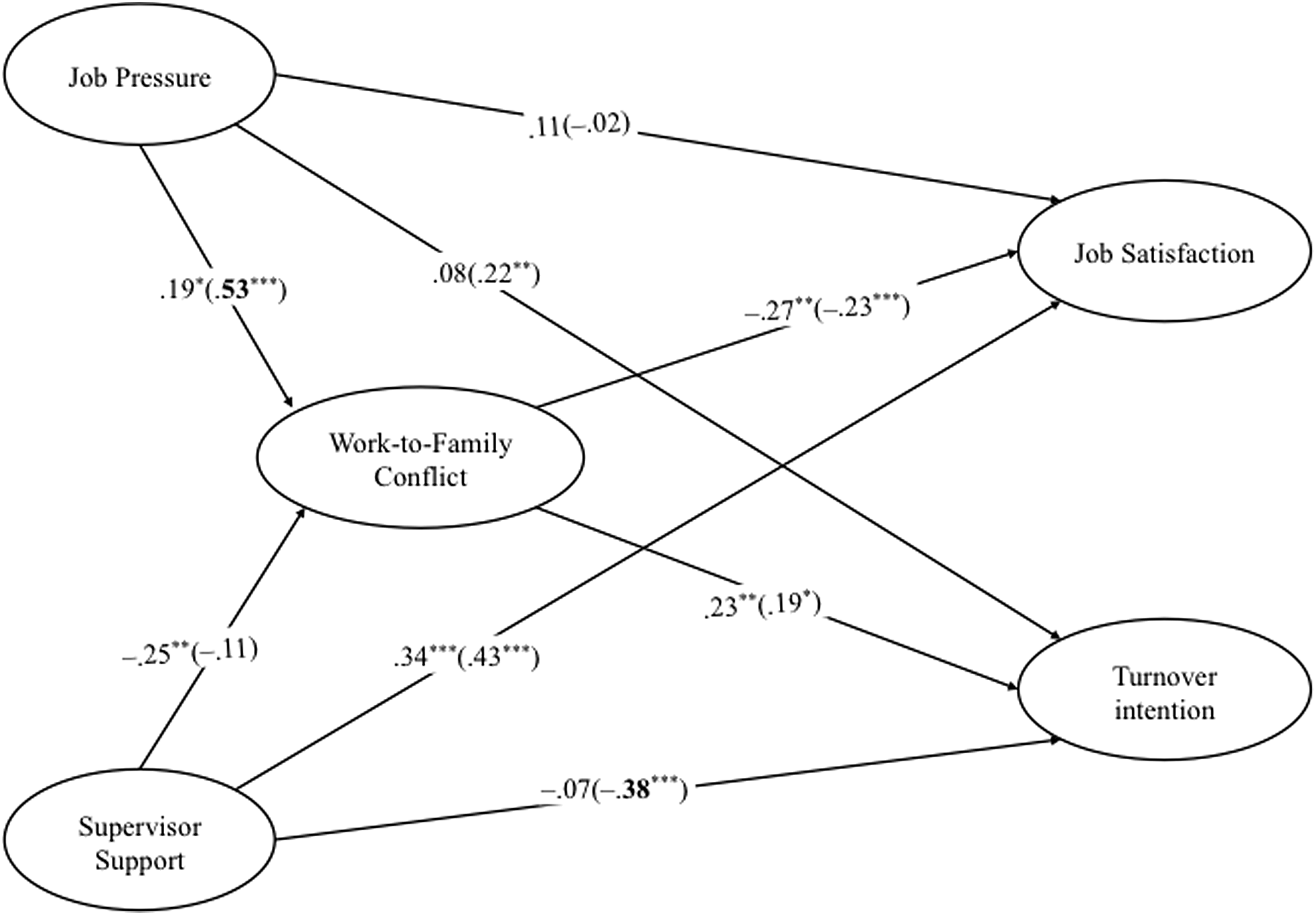
Standardized path estimates for Ghana and the United Kingdom (in parenthesis). Paths showing significant between-country difference are in bold face. Estimates for the control variables (age and gender) are not shown. *p < 0.05; **p < 0.01; ***p < 0.001
To test hypothesis 4, we first examined the significance of the indirect effects of job pressure and supervisor support on job satisfaction and turnover intentions in the multigroup SEM analysis. Following procedures suggested by Shrout and Bolger (2002), we created 2000 bootstrap samples to examine the confidence intervals of the indirect effects for each country with the bias-corrected percentile method. Indirect effects are considered to be significant when the corresponding confidence intervals do not include zero. As presented in Table 4, results of the bootstrapped samples showed that the indirect effects of job pressure on job satisfaction and turnover intentions via WFC for the Ghanaian sample were −0.05 and 0.05 with bootstrapped 95% confidence intervals ranging from −0.17 to −0.01 and 0.01 to 0.14, respectively. Likewise, the indirect effects of job pressure on job satisfaction and turnover intentions via WFC for the British sample were −0.12 and 0.10 with bootstrapped 95% confidence intervals ranging from −0.27 to −0.03 and 0.01 to 0.21, respectively. These results showed that WFC significantly mediated the relationships of job pressure with job satisfaction and turnover intentions in both countries. Following the same procedures, the indirect effects of supervisor support on job satisfaction and turnover intentions via WFC for the Ghanaian sample were found to be 0.07 and −0.06 with 95% confidence intervals ranging from 0.01 to 0.17 and −0.16 to −0.01, respectively. Conversely, the indirect effects of supervisor support on job satisfaction and turnover intentions via WFC for the British sample were found to be 0.03 and −0.02 with 95% confidence intervals ranging from −0.01 to 0.09 and −0.09 to −0.01, respectively. Thus, WFC significantly mediated the relationships of supervisor support with job satisfaction and turnover intentions in Ghana but not in the United Kingdom. Taken together, the results partially support hypothesis 4, which suggested cross-national differences in the indirect effects of job pressure and supervisor support on job satisfaction and turnover intentions via WFC.
Estimates of indirect effects and bootstrap CIs.
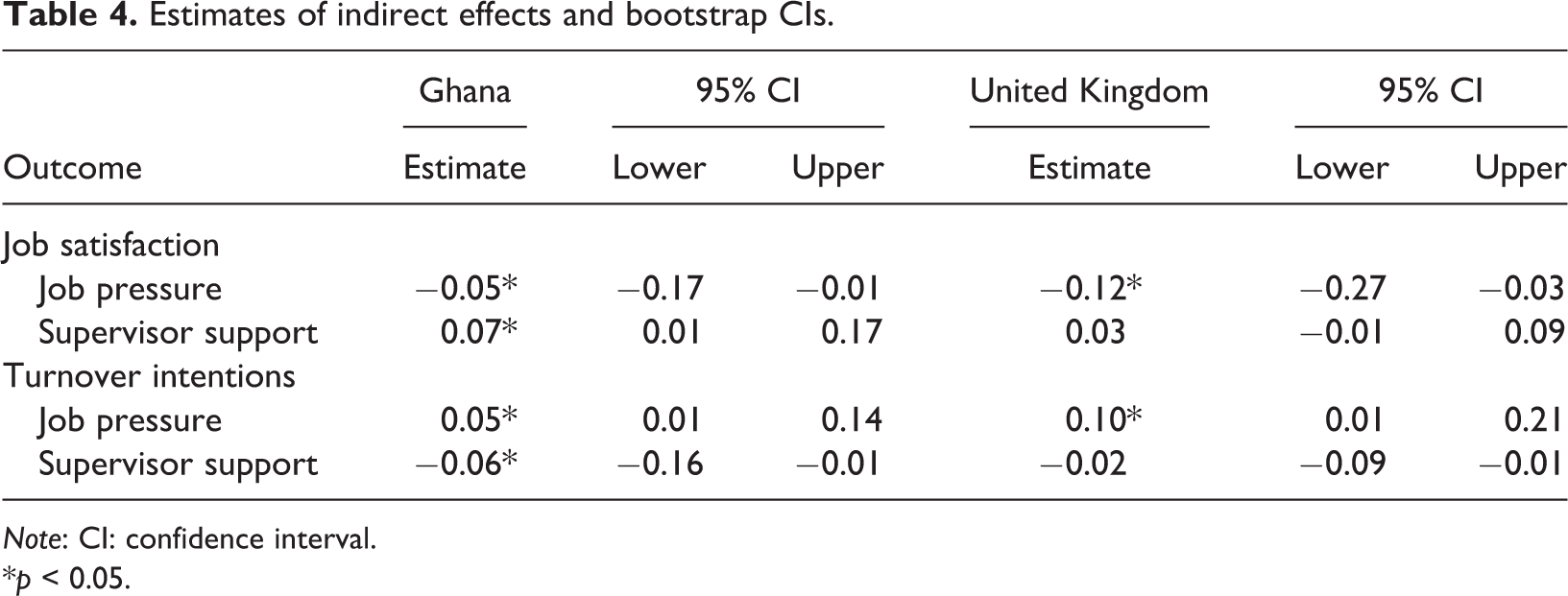
Note: CI: confidence interval.
*p < 0.05.
Discussion
The present study examined cross-national differences in relationships among work demands and support, WFC and job outcomes in Ghana and the United Kingdom. The study revealed that job pressure had stronger positive relationships with WFC and turnover intentions in the United Kingdom than in Ghana. Thus, excessive job-related demands were associated with more conflict from the work domain and greater intentions to quit the job for employees in the United Kingdom compared to their counterparts in Ghana. These findings are consistent with the notion that employees in individualistic cultures interpret job demands more negatively than employees in collectivistic cultures (Yang et al., 2012). Hofstede (2001) noted that individualists tend to attach greater importance to having adequate time for personal and family life compared to collectivists. As shown in previous research (e.g. Matthews et al., 2014), job pressure may be associated with increased time commitment to work and feelings of fatigue, making it more difficult to spend quality time with the family. Consequently, employees who experience job pressure in individualistic contexts would be more likely to perceive their work as interfering with their family role and react more negatively to the source of the interference. In contrast, employees in collectivistic countries appraise job pressure less negatively, as increased involvement in work is viewed as sacrificing personal resources for the benefit of the family (Yang et al., 2012).
These findings from the present study, thus, corroborate those of Lu et al. (2010) who found that work demands had stronger positive relationship with WFC for British employees than for Taiwanese employees. The results also corroborate Spector et al.’s (2007) findings that workload exacerbated time-based and strain-based WFC for individualists more than for collectivists. From a theoretical perspective, the study suggests that contextual factors such as employees’ cultural background (e.g. individualism–collectivism) influence their interpretations of work-related demands, resulting in differential loss of resources associated with these demands (Hobfoll, 1989; Hofstede, 2001). Thus, resource loss associated with excessive work demands appears to be stronger in individualistic contexts than in collectivistic contexts due to the relative importance attached to spending time with the family. Perhaps, within the context of the work–family interface, the thresholds at which individuals respond to resource loss or at which loss spirals occur following exposure to work stressors differ for individualists and collectivists.
The finding that job pressure had stronger influences on WFC and job outcomes in the United Kingdom than in Ghana may also be explained by dissimilar economic conditions and working time regulations prevailing in the two countries. For example, higher average household income in the United Kingdom suggests that British employees may have less need to take heavy workload and overtime work for family survival (Lyness et al., 2012). In contrast, in developing countries such as Ghana with relatively high unemployment rates, employees would be more likely to tolerate adverse working conditions such as heavy workload and overtime work due to excess supply of labour over demand (McGinnity and Russell, 2013). An alternative explanation may be derived from human resource practices such as performance appraisal in the Ghanaian work system. Performance appraisals in Ghana, particularly in the public sector, are often poorly carried out and in most cases not applied for employee promotion and wages/salary determination (Debra, 2001). Consequently, employees in Ghanaian public service may be less likely to interpret inability to meet excessive job demands as having adverse impact on their job outcomes. These conditions could limit the influence of excessive job demands on employees’ family life in the Ghanaian context.
Contrary to expectation, the present study did not find cross-national differences in magnitude of the relationship between supervisor support and WFC. This finding seems to corroborate a previous study (Lu et al., 2009), which found consistent relationship between work resources (supervisory support and organizational family values) and WFC among Taiwanese and British employees. To the extent that supervisor support is considered integral to a friendly work–family culture (Kossek et al., 2011), this finding suggests that employees across cultures may be similar in their needs for family-friendly work environment. It is important to note, however, that in the present study, supervisor support was associated with less WFC in Ghana but was not significantly related to WFC in the United Kingdom. Perhaps, the relatively stronger emphasis on interpersonal relationships in collectivistic societies (Hofstede et al., 2010), coupled with the relative lack of formal family-friendly initiatives in Ghana makes informal resources such as family-supportive supervision more important in this context than in the United Kingdom.
Furthermore, we found that WFC was negatively related to job satisfaction and positively related to turnover intentions in both countries. These findings corroborate previous studies suggesting that higher levels of work–family conflict are associated with negative job attitudes, and extend past cross-cultural research that linked WFC to job satisfaction across contexts (e.g. Lu et al., 2009; Spector et al., 2007). Drawing on the cultural dimension of individualism–collectivism, we proposed that the influence of WFC on job satisfaction and turnover intentions would be stronger in the United Kingdom. Contrary to our prediction, however, we found no cross-national differences in the relationships of WFC with job outcomes. The absence of cross-national differences in outcomes of work–family conflict suggests that employees respond in similar ways to stress associated with work–family conflict across different cultural contexts. Thus, work–family conflict has consistent deleterious influences on employee outcomes across cultures. In this regard, our results fail to support previous studies (Lu et al., 2010; Spector et al., 2007; Wang et al., 2004), which suggest that the relationship between work–family conflict and employees’ well-being are different across cultures.
Our findings also suggest that the notion of work–family conflict serving as a linking mechanism in the relationships of work stressors and resources with job outcomes may not be entirely applicable across national contexts. We noted that, across countries, job pressure was indirectly related to job satisfaction and turnover intentions via WFC. This finding extends previous monocultural studies that found a mediating role of work–family conflict between stressors and employee outcomes (e.g. Dixon and Sagas, 2007; Judge and Colquitt, 2004). Thus, across contexts, excessive job demands may negatively impact on employee well-being through their influences on work–family conflict. However, supervisor support was found to be indirectly related to job satisfaction and turnover intentions via WFC only in the Ghanaian sample. This finding, together with the finding on the direct relationship between supervisor support and WFC, underscore the view that supervisor support may be more beneficial among collectivists than individualists. Thus, among collectivists, supervisor support may enhance employee well-being by minimizing the experience of work–family conflict. To our knowledge, there has been no previous cross-cultural study examining the indirect effects of work demands and support on employee outcomes in the context of the work–family interface; hence, further research is needed to examine the extent to which our findings can be replicated.
Limitations
Our study is not without limitations. First, despite its emphasis on individualism–collectivism, the study included no measures of this cultural dimension. It is recognized that cultural values differ among individuals in the same country (Triandis and Gelfand, 1998), and thus countries do not necessarily proxy such cultural dimensions. Therefore, the inclusion of direct measures of such cultural constructs in future research could enhance our understanding of how specific cultural dimensions relate to experiences of work–family conflict. A useful approach in this regard would be to move beyond the two-country comparison adopted in the present study. While the between-country comparisons helped to ascertain similarities and differences in the operations of the work–family interface in the two cultural contexts, it was difficult to isolate the effects of culture from other contextual effects (e.g. institutional and economic). In this regard, studies conducted across multiple countries could make it possible to better ascertain which effects are attributable to differences in cultural orientations or differences in institutional and economic circumstances.
In addition, although the use of university employees enhanced comparability of the samples, they may not be representative of workers in the respective countries. Consequently, results obtained from these samples may not necessarily generalize to other groups of workers in both countries. It is suggested that future cross-national studies examine whether the dynamics of the work–family interface vary across different industries or occupational settings. Such studies in the Ghanaian context should also consider workers in the informal sector. As revealed in a study by Annor (2014), Ghanaian employees in formal employment sometimes engage in income generating activities in the informal sector. Thus, it would be interesting to understand whether and how the nature of work in the informal sector impinges on or facilitates employees’ ability to combine work and family life.
Practical implications
This study’s findings have potential practical implications especially for both multinational and local firms in sub-Saharan Africa that rely on employees as a source of competitive advantage. The study suggests that the impact of WFC on job outcomes of employees cuts across national contexts, underscoring the importance of addressing employees’ work–family issues regardless of national context. However, the cross-national differences found in the study points to the need to consider contextual factors when transferring human resources management (HRM) practices across national contexts. In the case of multinational organizations in particular, Ayentimi et al. (2016: 1) have pointed out that institutional dissimilarities between host and home countries ‘may create opportunities or constraints in HRM practice transfers’. Policies such as flexible working arrangements, job sharing and compressed workweek have been popularized in Western and developed countries as a means to helping employees integrate work and family responsibilities (Allen et al., 2013). The present study suggests that caution should be exercised in decisions regarding application of such policies in non-Western contexts. In particular, the finding that job pressure had less influence on WFC in Ghana compared to the United Kingdom suggests that policies targeted primarily at reducing work demands may be less effective in non-Western contexts.
The present study has also underscored the important role of supervisors in facilitating employees’ ability to integrate work and family life. The study has shown that the positive influences of family-supportive supervisors on employees’ ability to integrate work and family roles and on job outcomes may be less culturally dependent. To the extent supervisor support constitutes an integral component of informal work–family culture (Thompson et al., 1999), the study suggests the need for supervisors to be more sensitive to employees’ family needs. Thus, providing training to supervisors on how to handle employees’ work–family issues would be a worthwhile investment for organizations in any country, as supervisors not only influence the implementation of formal work–family policies but also serve as role models for other employees. Beyond providing emotional and instrumental support, supervisors may be trained to be more proactive by initiating actions that ‘simultaneously balances sensitivity to employees’ work-family responsibilities with company, customer, and co-worker needs’ (Hammer et al., 2009: 842). Training of supervisors to exhibit family-supportive behaviours would be a particularly useful strategy for organizations in the Ghanaian context, where formal work–family programmes are limited or maybe less effective.
Conclusion
Although the interconnection between work and family roles remains an important area of research and policy, research on work–family conflict is largely Western-focused with only few studies examining correlates of work–family conflict across different cultural contexts while the African context remains missing from this line of research. To the best of our knowledge, the present study constitutes the first attempt at empirically examining the differences and similarities in antecedents and outcomes of work–family conflict between a Western industrialized nation and a developing country in sub-Saharan Africa. The study’s findings underscore the relevance of addressing contextual issues in antecedents and outcomes of work–family conflict. The results of the study suggest that some aspects of the relationships of stressors and resources with work–family conflict and job outcomes can be generalized across contexts, while others may be context-dependent. Specifically, the study suggests that the impact of work–family conflict on employees’ attitudes and withdrawal intentions may be similar across contexts; however, the experience of work–family conflict may be underpinned by factors that appear to be context-dependent. In general, the findings underscore the need for organizations to be mindful of contextual peculiarities when transporting established work–family policies and practices across different countries.
Footnotes
Acknowledgement
The authors wish to acknowledge the Cambridge Commonwealth Trust and St John’s College at the University of Cambridge, for providing funding for this research.
Declaration of Conflicting Interests
The author(s) declared no potential conflicts of interest with respect to the research, authorship, and/or publication of this article.
Funding
The author(s) disclosed the receipt of the following financial support for the research, authorship, and/or publication of this article: received from the Cambridge Commonwealth Trust and St John’s College at the University of Cambridge.