







Abstract
Despite decades of research establishing that trust is critical to successful collaboration, the experience of trust violation is poorly understood independent of trust repair. Furthermore, despite increasing globalization, most organizational research on trust violation is heavily Westernized. This semi-structured interview study explored subjective experiences of trust violation at work across 23 individuals from the United States, India, and China to better understand similarities and differences in the unfolding reactions to trust violations across cultures. Our inductive thematic analysis identifies some trust violation triggers common to all three nationalities (i.e., psychological contract breach, professional attack, lack of work ethic) and some triggers unique to certain nationalities (i.e., lack of acknowledgment for Indian workers; excessive monitoring and injustice perceptions for Chinese workers). Regarding reactions to trust violations, American workers emphasized a central reaction of anger, Indian workers described more varied emotional and behavioral reactions possibly reflecting cultural complexity, and Chinese workers described reactions of emotion suppression and behavioral avoidance that align with theories of face. For American and Indian workers, violations damaged both interpersonal relationships and attitudes towards one’s job, whereas for Chinese workers, violations damaged only the focal interpersonal relationship. We discuss the implications of our descriptive, nationality-specific unfolding models of trust violation for advancing cross-cultural research on trust violations at work.
Keywords
‘Trust is like blood pressure. It’s silent, vital to good health, and if abused, it can be deadly.’ --Frank Sonnenberg, Twitter, 21 March 2015
Collaboration, or “the evolving process whereby two or more social entities actively and reciprocally engage in joint activities aimed at achieving at least one shared goal” (Bedwell et al., 2012: 130), is fundamental in today’s organizations, and trust is a key element to successful collaboration (Costa et al., 2018). Decades of research on trust in the workplace has explored what contributes to it (e.g., Javidan and Zaheer, 2020), what derails it (e.g., Bies and Tripp, 1996; Elangovan et al., 2007), and what restores it (e.g., Lewicki and Brinsfield, 2017). However, according to prominent trust researchers, “Of all the difficulties that have plagued organizational life, perhaps the most conspicuous in recent years has been the violation of trust” (Kim et al., 2006: 49).
There exists more theorizing (e.g., Andiappan and Treviño, 2011; Oliver and Montgomery, 2001) than empirical research focused on trust violation in organizational contexts. Additionally, research tends to focus on how trust is repaired after a violation event and has even subsumed trust violation as a part of the trust repair process (e.g., Lewicki and Brinsfield, 2017) without fully exploring the experience of trust violation independently (e.g., Tomlinson et al., 2004; Kim et al., 2006; Dirks et al., 2011; Haselhuhn et al., 2015). We argue that trust repair is a distinguishable process from trust violation which can take place long after the violation experience has had meaningful impacts on the collaborative relationship, or not even occur at all.
Furthermore, notwithstanding a few exceptions (e.g., King and Wei, 2018; Kriz and Keating, 2010; Labarca, 2014; Saunders et al., 2010; Tan and Chee, 2005; Wasti et al., 2011), most trust research “…has tended to ignore cross-cultural differences” (Lewicki and Brinsfield, 2017: 309). As King and Wei (2018: 155) state, “Western approaches to trust research often fail to recognize non-Western perspectives.” To our knowledge, trust violation as a standalone process has yet to be the focus of any cross-cultural research. This is problematic given that trust is likely to be more important, yet more easily violated, in culturally diverse contexts (Mach and Baruch, 2015; Zakaria and Yusof, 2015). In fact, research on globally distributed teams comprised of members from the United States, India, and Ireland found that current approaches to global collaboration were insufficient for avoiding problems driven by intergroup bias (Newell et al., 2007).
The current study examining workplace trust violation experiences across individuals from the United States, India, and China fills several gaps in the literature. First, this study responds to calls for more qualitative research that describes trust in real-world working relationships (Lewicki et al., 2006). Second, in line with the goals of qualitative research to uncover new relationships and connections (Barmeyer et al., 2019), this study extends prior qualitative research (e.g., Bies and Tripp, 1996) by connecting trust violation triggers and reactions within persons over time to more richly describe the unfolding subjective process surrounding trust violation, or as defined in the Merriam-Webster dictionary, the “series of changes that happen naturally” in response to a perceived trust violation. Third, and perhaps most importantly, this study responds directly to calls for research that examines “whether differences in culture—primarily international culture—affect the dynamics of a trust violation” (Lewicki and Brinsfield, 2017: 289).
Interpersonal trust at work
Exemplar published definitions of trust.
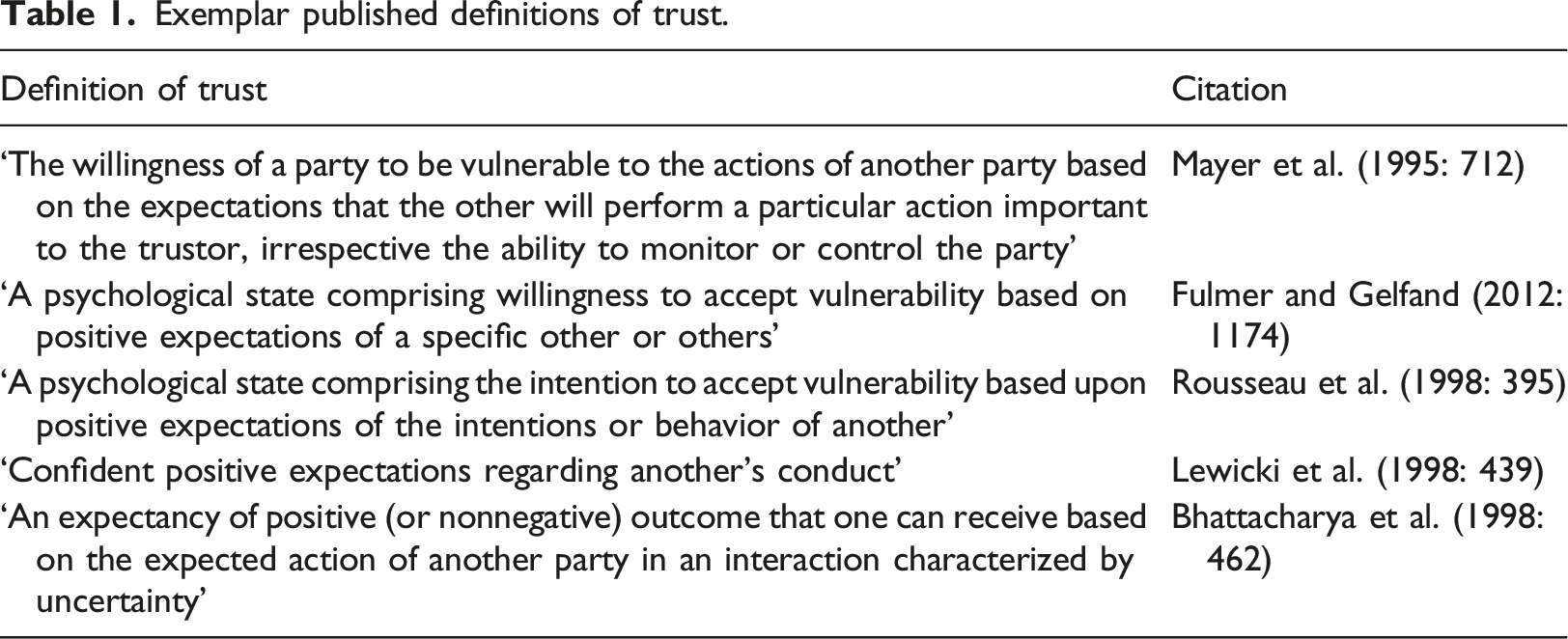
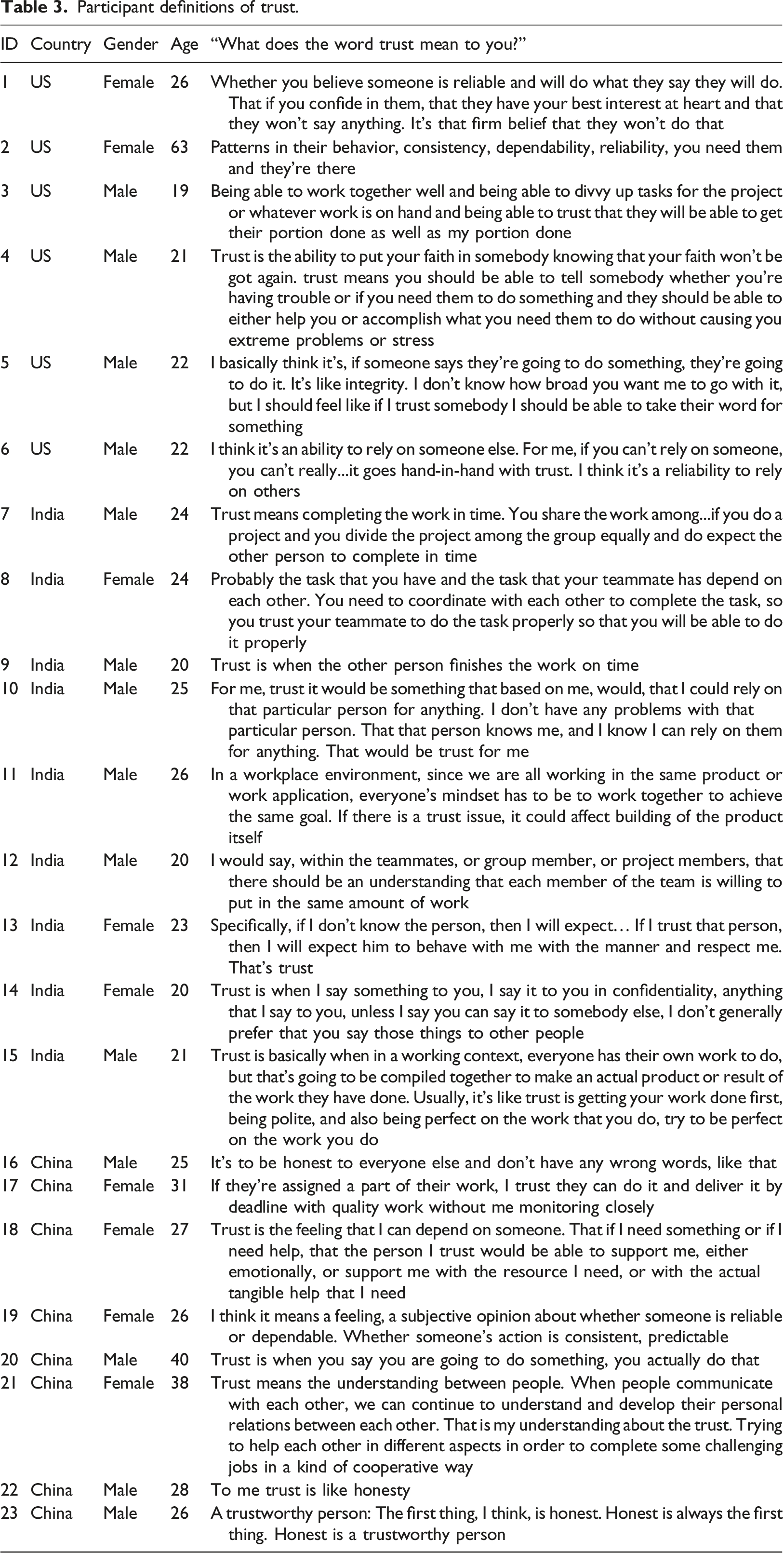
Much research has also explored multidimensional models of trust. Some research distinguishes between affect-based trust, or trust based on the emotional bonds between individuals, and cognition-based trust, or trust based on what a trustor thinks of the trustee in terms of reliability and dependability (e.g., McAllister, 1995; Carter and Mossholder, 2015). Other work has distinguished between calculus-based trust (i.e., trust based on weighing the costs and benefits of engaging with another), knowledge-based trust (i.e., trust grounded in knowing another well enough to anticipate their behavior), and identification-based trust (i.e., trust based on identification with the other’s desires and intentions; Lewicki and Bunker, 1996). Given the current study is focused on describing subjective experiences of trust from a cross cultural perspective, we do not adopt any Western definition or dimensional perspective of trust.
Trust violations have been defined as acts on behalf of the trusted party that violate the trustor’s expectations (Chen et al., 2011). Other terms used include betrayal (Elangovan and Shaprio, 1998), breach of contract (Robinson and Rousseau, 1994), transgressions (Shapiro et al., 2011), and perceived injustice (Andiappan and Treviño, 2011). A common theme across the limited past research on trust violation is the heavy reliance on Weiners’ (1991) attribution theory as an explanation of the sensemaking process that occurs in reaction to trust violations (e.g., Bansal and Zahedi, 2015; Elangovan et al., 2007; Tomlinson and Mayer, 2009). According to attribution theory, a trust violation event causes an emotional disturbance in the trustor such as anger, confusion, or outrage (Bies and Tripp, 1996; Elangovan et al., 2007; Morrison and Robinson, 1997). This state of emotional displeasure leads to a perception that a trust violation has occurred and then prompts the trustor to search for the cause of the displeasure through a cognitive sensemaking process (Bansal and Zahedi, 2015). Throughout the sensemaking process, causal ascriptions are made in terms of whether the violation occurred due to a lack of ability, benevolence, or integrity (Mayer et al., 1995; Schoorman et al., 2007). Personal attributions of blame are most common for events seen as controllable and stable on the part of the trustee; in other words, for violations of integrity or benevolence. Violations of ability can still evoke negative reactions but are expected to be milder than violations of integrity and benevolence because the violation is seen as unintentional or outside of the trustee’s control. Because integrity violations are attributed to a flaw in the trustee’s character, they may result in the most irreparable trust relations resulting in withdrawal behavior (Grover et al., 2014).
What is largely absent in previous attribution theory-based trust violation research is a more subjective description of experiences and reactions over time. Bies and Tripp’s (1996) early qualitative work was instrumental in describing a range of trust violation triggers and reactions, but it was also limited in that it focused on events that resulted in a desire for revenge, these events were not connected to reactions over time, and the study was not cross-cultural in nature. The current study aims to describe the subjective experience of the broader trust violation process across three distinguishable cultural groups, including the initial trigger events causing the subjective perception of trust violation, the resulting unfolding affective and cognitive reactions, and eventual workplace-relevant outcomes.
Cross-cultural perspectives on trust
Most cross-cultural trust research has taken a quantitative comparative approach that identifies differing levels of trust and cooperation (e.g., Bornhorst et al., 2010; Branzei et al., 2007; Buchan et al., 2002; Jamison, 2011; Kuwabara et al., 2007) or unique antecedents of quantified trust (e.g., Loh et al., 2010; Yuki et al., 2005) across cultural groups and dimensions. Some research has also qualitatively explored the trust development process within and across cultures. Kriz and Keating (2010) used grounded theory to suggest that deep trust (i.e., xinren) is driven by emotional bonding in Chinese business exchange settings. Additionally, Tan and Chee (2005) highlighted heavy reliance on affective factors of trustworthiness in China. Wasti et al., (2011) explored trust-building in Turkey and China and suggested that ability, benevolence, and integrity were antecedents of trust reported in both countries, but that there were also culture-specific manifestations of those concepts. Research has also found that the factionalized context of India, in which two main religious communities co-exist, has an impact on trust relationships due to intergroup bias and differing expectations of others (Chuah et al., 2013).
Research has also explored culturally-driven differences in the experience of trust repair, with most of this work focusing on elements of apology (e.g., Guan et al., 2009; Han and Cai, 2010; Park and Guan, 2009; Takaku et al., 2001). In general, research has demonstrated that cultures have different tendencies and approaches for apologizing (e.g., Bataineh and Bataineh, 2008; Eaton et al., 2007; Ferrin et al., 2007; Kim et al., 2006; Nureddeen, 2008) and that effective apologies must include specific components that match with the violated party’s cultural self-construal (i.e., independent, relational, or collective; Fehr and Gelfand, 2010). Maddux and colleagues (2011) examined apologies across America and Japan and found that Americans were more likely to equate apologizing with personal blame, whereas Japanese tended to apologize more often but equated apologies with remorse rather than blame.
Beyond the research examining cross-cultural trust development and trust repair, to our current knowledge, there is minimal research examining trust violation across cultures. One qualitative study identified situations that violated psychological contracts, or the unwritten and implicit set of expectations that are exchanged between parties in an employment relationship (Rousseau, 1989), within four high-tech Israeli companies (Zaidman and Elisha, 2016). Another study examined differences in reactions to hypothetical workplace offenses for graduate students from the U.S. and South Korea (Kim et al., 2008). Kuwabara et al. (2014) found that early trust violations were more harmful than late trust violations for Americans, while the opposite was found for Japanese.
Culture and trust in the United States, India, and China
The current study compares trust violation experiences in the workplace across individuals from the United States, India, and China for four main reasons: (1) India and China are included in the top three emerging markets in the world (Kwatra & Sneha, 2020) and, therefore, global business professionals are increasingly likely to have interactions with individuals from these cultures (Williams, 2018), (2) the authors had access to a convenience sample with the largest subgroups representing those three nations, (3) no prior research on trust violation has directly compared these countries, and (4) these countries differ meaningfully from one another across cultural dimensions that are likely to influence the trust violation experience.
One dimension that differs across the United States, India, and China is cultural tightness and looseness (Gelfand et al., 2006). The United States is described as a loose culture in which behaviors are not as tightly sanctioned and deviations from norms are more acceptable compared to tighter cultures such as India and China, with India being slightly tighter than China, in which behaviors are strictly sanctioned and deviations from the norm are socially unacceptable (Mrazek et al., 2013). Cultural tightness-looseness is likely to impact the trust violation process by influencing the range of behaviors that are considered acceptable and by influencing reactions to deviations from behavioral norms.
The United States, India, and China also differ on honor, dignity, and face culture logics (Leung and Cohen, 2011). The United States is considered a dignity culture (Aslani et al., 2016; Leung and Cohen, 2011) in that self-worth is primarily derived internally, rather than conferred by others such as in face and honor cultures. India is considered an honor culture that falls between face and dignity cultures by emphasizing both external and internal valuations of self-worth (Yao et al., 2017). Honor cultures have strong reciprocity norms and tend to respond to violations of self-worth with direct retribution. China is generally described as a face culture in which self-worth is based on others’ assessments of the self and dutifully fulfilling one’s expected social role obligations (Aslani et al., 2016). King and Wei (2018) highlight the importance of face in relation to trust in the Chinese context and emphasize that face is assigned by others. In other words, individuals in face cultures are concerned with preserving social harmony and stability.
These three countries also represent a range of Hofstede’s (1984) cultural values. For example, these countries differ in long-term orientation, with China being high, India being moderate, and the United States being low (Hofstede Insights, n.d.). Long-term orientation has been demonstrated to be fundamental to the trust relationship in Chinese businesses with the mechanism of ‘renqing’, which demonstrates the belief that it is one’s obligation to repay favors and show empathy within their professional network (Wang et al., 2008). As another example, these countries range in individualism and collectivism, with the United States high on individualism, India moderate on individualism and collectivism, and China high on collectivism. Prior research has demonstrated that individualism-collectivism has implications for interpersonal trust relationships (Glanville and Shi, 2020; Van Hoorn, 2015). Taken together, research suggests that cultural differences can impact the dynamics of interpersonal trust violation and that meaningful cultural differences exist between the United States, India, and China, but essentially no research has explored the trust violation process across these cultures.
Present study
Given very little is known regarding the trust violation process in non-Western settings, and in India and China in particular, the present study adopts a big Q inductive approach in order to “learn what could be, to unravel what has been and to imagine the unimaginable” (p. 50) rather than building deductive hypotheses based on a primarily Western body of theory and evidence (Kidder and Fine, 1997). This inductive approach allows us to explore and compare the subjective experiences of trust violation for individuals of culturally distinct nationalities. We also adopt a mixed theoretical approach and find themes that reflect aspects of both cultural universalism and cultural relativism (Kozlowsky et al., 2002).
Our qualitative research does make several theoretical assumptions. In order to effectively structure our interviews to ensure information was comparable across individuals and in relation to existing literature, we adopt a basic event-based framework. In other words, we assume that the basic human process of perceiving and reacting to interpersonal interactions with collaborators at work will be universally shared, whereas the exact trigger events experienced, the exact perception and interpretation of those experiences, and the exact reactions to those experiences will differ across individuals and nationalities. As such, we pose two overarching research questions:
Research Question 1. What interpersonal events initiate the trust violation process in collaborative workplace relationships, and to what extent are those events shared or unique for employees identifying as American, Indian, and Chinese?
Research Question 2. How does the process of reacting to a trust violation unfold over time, and what aspects of that process are shared or unique for employees identifying as American, Indian, and Chinese?
Methods
Reflexivity
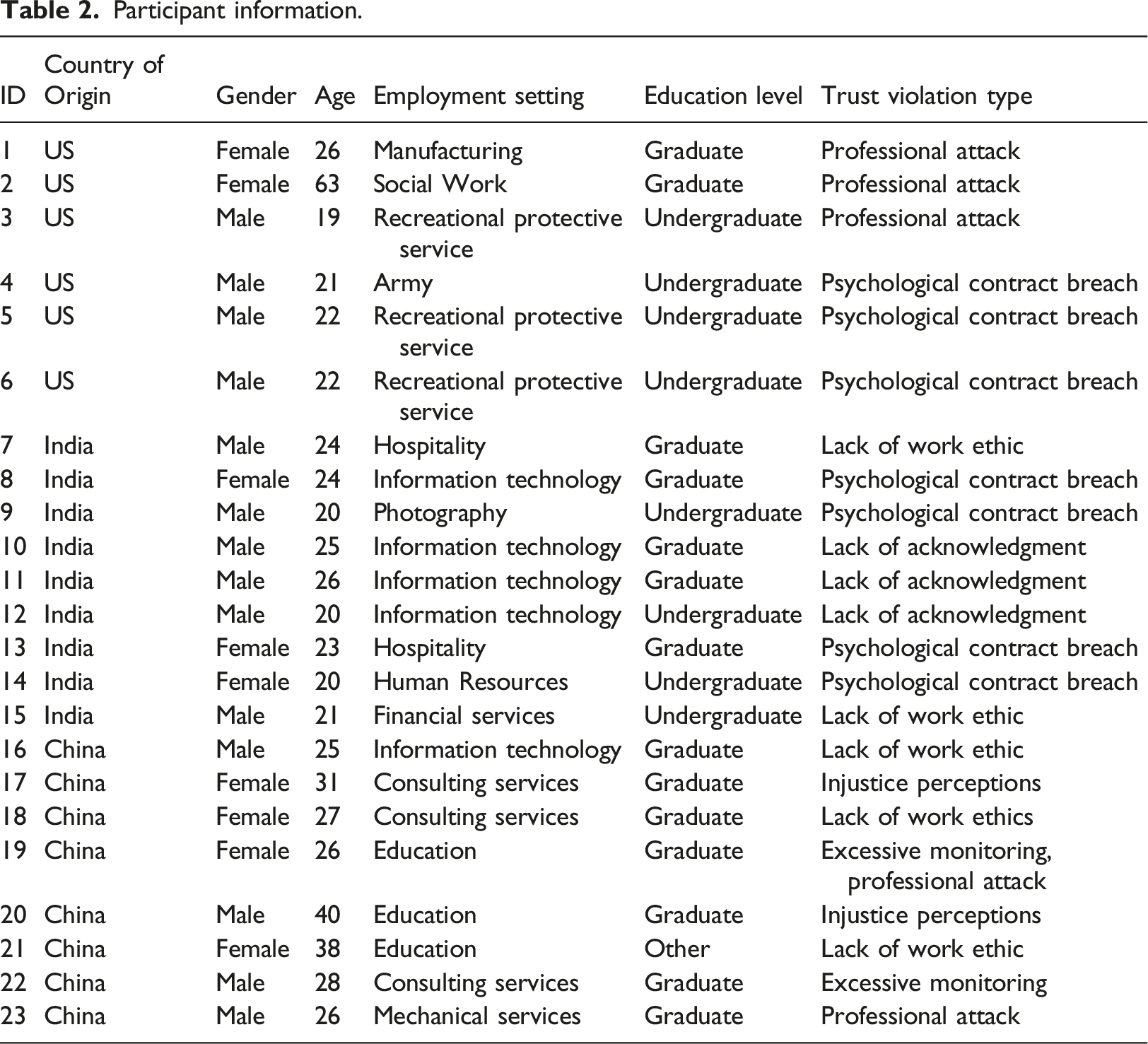
The authors are aware their positionality contributed to and impacted the analysis and interpretation of the data at all levels. Credentials of the researchers included master’s and doctoral-level graduate education in organizational and cultural research. Additionally, the research team represented diversity in ethnic and racial backgrounds (i.e., White, Hispanic, Indian, and Chinese), and both male and female authors (i.e., one male and five female). The research team diversity assisted in the thematic analysis and interpretation of results to ensure cultural meanings were not misconstrued. Although we understand our identities shaped the co-construction of the dialogue and our interpretations remain biased based on our limited perspectives, we believe our diverse composition, as well as our research backgrounds, offer unique strengths to the interpretation of the data.
Sample and context
Participant information.
Data collection procedure
A semi-structured interview protocol (Appendix A) was used to elicit narrative descriptions of trust violation experiences in one-on-one interview sessions that ranged in duration from 14 to 70 minutes, and no repeat interviews were conducted. All interviews were conducted in English. While some bias may be introduced by interviewing in a non-primary language, interviewing in English was deemed appropriate in order to improve comparability and because all interviewees were fluent enough in English to function in their expatriated setting. Additionally, we were most interested in generalizing to collaborative workplace settings, and many global business settings utilize English as a business language. However, we acknowledge that this choice limits the generalizability of our findings to non-English native language settings.
Interviewees were asked to describe past experiences in workplace settings that damaged or broke their trust in another person at work and describe in chronological order all thoughts and feelings that followed that experience. We collected as many examples as participants could recall and were willing to share. The interviewers did not provide trust definitions to gather participants' subjective interpretation of what they considered to be trust violations and related experiences. The interview protocol was designed following interviewing best practices, including simple, open-ended questions designed not to lead participants, pairing of primary and secondary questions aimed at elaboration of responses, and concluding with a clearing question to ensure all issues of interest to the interviewee were discussed (Eriksson and Kovalainen, 2016). Interviewers were trained to adapt wording and focus of questions, reframe and restate questions, and probe for further elaboration or clarification. All interviews were conducted in-person in designated research spaces by trained graduate student research assistants, were audio-recorded, and then professionally transcribed.
Thematic analysis
Full verbatim transcripts of the interviews were analyzed following the thematic analysis guidelines proposed by Braun and Clarke (2006, 2012). We began with the development of the research questions, which guided the analysis and interpretation of the data. We opted for an inductive approach to ensure that the interpretations were data-driven based on the research questions. Furthermore, we chose to focus on the latent meanings of the dialogue, primarily due to the diverse cultural backgrounds of the sample, which made it likely that the semantic meaning of the dialogue would not fully capture the meaning the participants were communicating (e.g., underlying ideas, assumptions, and conceptualizations). Regarding epistemology, we opted to take a constructivist approach. We understand that the cultural perspective and themes regarding trust violations are socially produced and reproduced.
Although thematic analysis is not a linear process (i.e., steps were repeated), we summarize the six phases engaged in as established by Braun and Clarke (2006, 2012). In phase one, two of the authors familiarized themselves with the data by reading through full transcripts multiple times. In phase two, the researchers independently engaged in generating initial codes. The researchers developed as many codes as possible to ensure comprehensibility and jointly resolved any discrepancies. For instance, situations arose where the researchers had to decide when an emotion, as labeled by the participant, was not the underlying felt emotion (e.g., whether upset was used to indicate sad or angry). The researchers discussed the surrounding context and cues provided by the participants to settle any discrepancies. The researchers repeated this process for interviews within each nationality group separately.
In phase three, the researchers discussed how codes could be combined to create themes. These themes were oriented around event triggers, resulting reactions, and eventual outcomes, as determined by the research questions. In phase four, the researchers reviewed, collapsed, separated, and eliminated themes to ensure that each theme had enough support and was distinct from other themes. The researchers utilized Patton’s (1990) criteria for judging themes, which recommends that themes have internal homogeneity as well as external heterogeneity. For instance, the theme of betrayal was combined with the theme of psychological contract breach. Furthermore, themes were reviewed at the data extract level, and the theme’s relation to the entire dataset within the respective culture. In phase five, the researchers defined and labeled themes in such a way as to ensure that each theme was meaningful in relation to the other themes and the entire dataset. Throughout all steps, the two primary coders met weekly with the other co-authors to gather input and feedback and improve interpretability. In phase six, we documented the findings following standards outlined by Braun and Clarke (2006) and the COREQ checklist for qualitative reporting (Tong et al., 2007).
Results
Participant definitions of trust.
Results suggest both culturally unique and shared trust violation triggers, reactions, and outcomes across the three nationalities (Figure 1). Trust violation triggers were identified as themes that were described by the participants as specific events that occurred in a workplace setting and initiated perceptions of subsequent trust loss or damage. We also identified a series of reactions (i.e., cognitive, affective, and behavioral) that followed each trust violation trigger. The reactions were further broken down into primary, secondary, and tertiary reactions in order to capture the subjective chronological unfolding of reactions to that specific trust violation event. Initial reactions described were often, but not always, affective reactions (e.g., negative affect or sadness). Secondary reactions described were often, but not always, cognitive in nature (e.g., emotion suppression and introspection). Tertiary reactions described included distal and ongoing behaviors that continued long after the violation event had occurred (e.g., avoidance and keeping a professional face). Finally, outcomes were themes reflecting the ultimate consequences of the violation and included both work-related and interpersonal long-term impacts of the trust violation event (e.g., change in job attitudes or strained relationships). Holistically, this series of responses to trust violation triggers makes up what we refer to as the trust violation process. Unfolding models of trust violation reactions for American, Indian, and Chinese employees.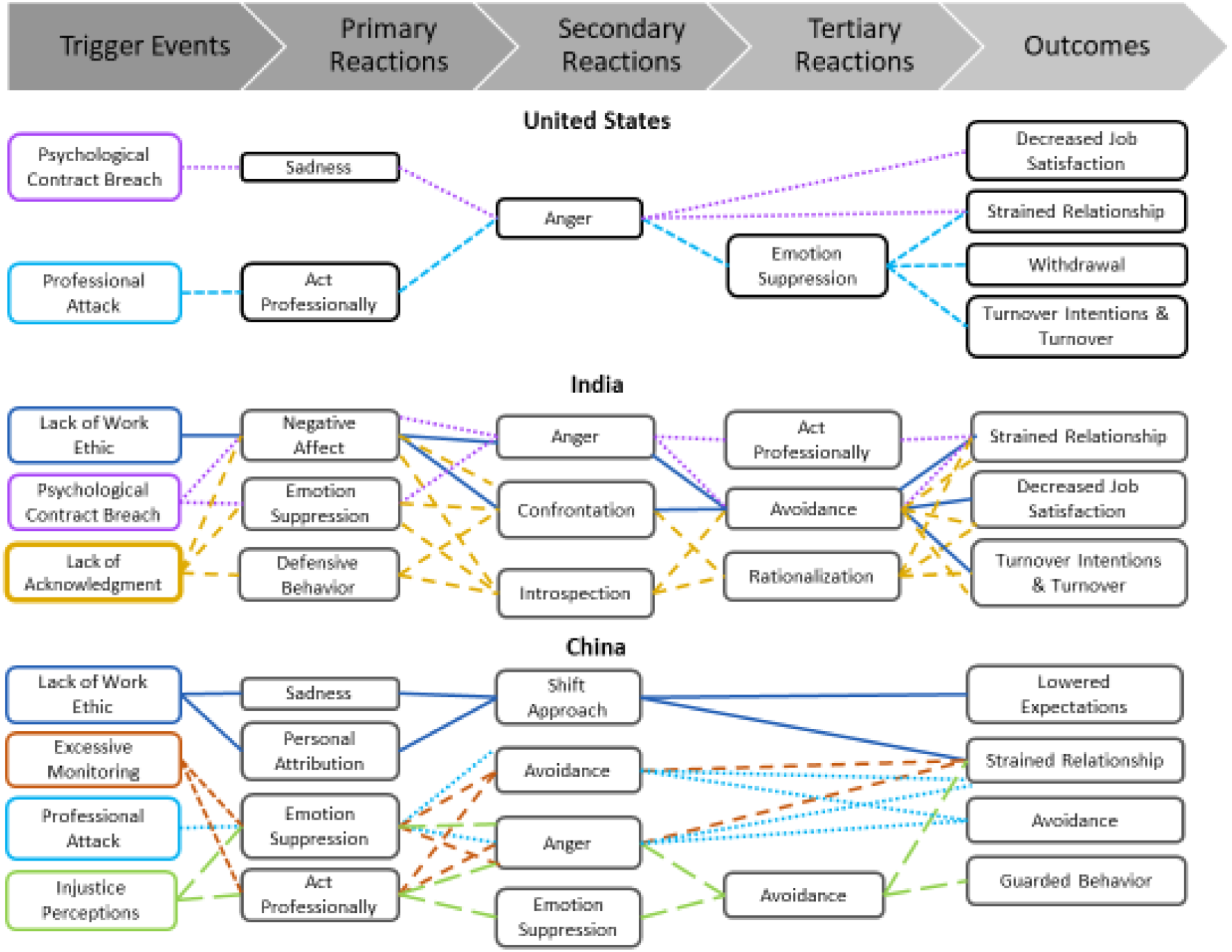
It is important to reiterate that these categories were not predetermined but were developed inductively. Additionally, it was not required for each trust violation trigger to have each phase of reaction (i.e., primary, secondary, and tertiary). In other words, participants described at most three distinct chronological phases of reactions, and some participants only described two phases of reactions followed by an outcome. In a few cases, the same reaction was described in two subsequent phases. This means that the participant described a clear chronological distinction (e.g., first… then) in terms of the experiences; however, the same reaction was present in both phases. It is important to note that the emphasis of our results is describing and comparing the reaction process across cultural groups and not simply identifying types of triggers. Therefore, we organize our findings around the three chronological phases of the trust violation process: trigger events, reactions, and outcomes.
American trust violation experiences
Trigger events
American employees described two trigger events that led to trust violation experiences in the workplace: psychological contract breaches and professional attacks. Psychological contract breaches were defined as events in which the violator unintentionally broke a verbal or non-verbal agreement with the trustor. Example initial codes for this theme included betrayal, violation of the presumptive agreement, and let down. These breaches occurred when the trustor felt the violator made an informal promise (i.e., not a formal contract or agreement) and that promise was not kept. Furthermore, the violator’s action did not have to be intentional for the trustor to identify it as a trust violation. For example, one participant perceived his trust was violated when his coworker accidentally forgot to cover the participant’s shift: “It’s like we were nothing. We were together for that many years as the same head coach. I figured, we set it, it was taken care of. He’s like, ‘Nobody showed up, I had a lot of angry parents at me.’”
Professional attacks occurred when the violator intentionally attacked the professional reputation of the trustor. This trust violation trigger was identified from example codes such as attack to reputation, public violation, sabotaging work reputation, and belittling ability. In all described cases, the professional attack was intentional with the purpose of harming the professional reputation of the trustor. Most of the violations took place in public settings or involved a superior of the trustor. For example, one participant discussed a time in which she scheduled a last-minute team meeting, and her coworker who was not able to make the meeting reported the incident directly to the boss: “Instead of talking to me directly about it and hashing out that way, she was so emotional that she talked to my boss and tried to make me look bad with things that weren’t honestly even true.”
Reactions
Reactions reported by American participants were more straightforward than those reported by the other cultural groups, with primary (i.e., initial) reactions of either sadness or acting professionally. Psychological contract breaches led to a primary reaction of sadness. For instance, one participant recalled being sad after a coworker shared the participant’s personal information with their boss: “I was really upset with that. I felt like it put me in a bad light. That’s where I was coming from, it hurt me a lot.”
Professional attack led to the primary reaction of acting professionally. This reaction was often described as an attempt to mitigate the damage to reputation caused by a professional attack. For example, a participant stated that immediately after the event, her main objective was to maintain a professional identity: “Professionally, as much as possible… I’d like the damage repaired, but I also made it known that I’ll be professional with you.”
Both trigger events eventually led to a secondary, but shared, reaction of anger. Continuing from the professional attack trigger example, the participant recalled experiencing extreme anger over the violator’s behavior: “Furious. I was really upset. I probably dwelled on it for a day or two until I personally could fix the situation.”
Professional attack also led to a tertiary reaction of emotional suppression, likely because recovering from an intentional attack on one’s reputation requires the trustor to maintain a professional demeanor and carry on workplace responsibilities in the face of the violation. For instance, in one case, the participant’s trust was violated by a coworker who tried to sabotage the participant’s professional workplace reputation. The participant recounted experiencing negative emotions but also suppressing those emotions in view of the job responsibilities that required a positive demeanor: “I was very disheartened. Although I tried not to appear to be, my job was to really wear a very energetic and brave face, positive face, to the young teens that I was working with, to their families.”
Outcomes
Both psychological contract breach and professional attack led to strained relationships with the trust violator. For example, the participant whose shift was not covered as described above mentioned that this violation strained his relationship with the trust violator going forward: “Yeah. I was civil with her, but it was different from that point on.”
Psychological contract breach led to the outcome of decreased job satisfaction. In one example, the trustor was assigned to a weight-loss correction program as part of a military requirement and was not removed from the program by their supervisor once the weight requirements were met. The participant perceived this event as a breach of agreement and, as a result, lost faith in the organization. Eventually, the participant reported feeling hatred toward the job: “I was just thinking how much I hated my job, and it was just disappointing.”
Professional attacks led to several job-related outcomes, including withdrawal and turnover intention. For example, a participant reported after the professional attack incident, she started a search for other job opportunities: “How did it make me feel? It made me feel like I was in an unsafe environment that I had to find a way to get out of. I began my process of leaving.”
Indian Trust Violation Experiences
Trigger events
Indian employees reported experiencing three trigger events that led to trust violation: lack of work ethic, psychological contract breach, and lack of acknowledgment. Both Indian and American employees reported psychological contract breach, whereas both Indian and Chinese employees reported lack of work ethic. Lack of work ethic had similar content compared to the same theme identified for Chinese participants. Psychological contract breach reflected a similar theme identified for American participants, with a slight difference in that for all experiences described by Indian participants, psychological contract breach referred to incidents where the violator intentionally broke a verbal commitment.
Lack of acknowledgment was a unique trust violation trigger only described by Indian participants. This theme referred to incidents in which the violator either stole credit for the trustors’ work or failed to adequately acknowledge the trustors’ contributions to shared work. Example initial codes used to define this category include stealing ideas, not giving credit, and let down. For example, a participant reported his trust to be violated when his coworker took all credit for the work that was jointly completed: “After the project was done, she took all the credit for my work and that was a complete breach of my trust with her.”
Reactions
Indian employees reported the highest number of tertiary reactions, with each trigger event ultimately leading to primary, secondary, and tertiary reactions. All three of the trigger events led to primary reactions of negative affect. For example, in reaction to a lack of work ethic, one participant reported experiencing negative feelings ranging from ruminating about reasons for the incident to losing confidence in the violator. Negative affect was primarily attributed to the feelings of the participants, but it also affected the overall cognition process of the participants: “The thought process was really negative… After this incident, it created a negative impact, so which is where I lost confidence in him.”
Lack of acknowledgment and psychological contract breach both led to the primary reaction of emotion suppression. Following the trigger event of psychological contract breach, emotion suppression was seen when the violator was in a higher power position than the participant. For example, one participant recalled being angry and frustrated but not externally displaying these emotions as the violator was senior to her: “I didn’t want to disrespect, because, clearly, she is older than me. It was just an internship, so I let it go. It’s not like I worked there. If I did work then, I would go and speak to her and tell her that she should not have done that.”
Lack of acknowledgment was the only trigger event that led to defensive behavior. In one incident, a coworker intentionally did not give due acknowledgment to the participant’s work and gave misleading reports to the supervisor. The participant, in turn, engaged in a self-defensive behavior: “I told my supervisor, “Hey, I was working, I have proof.” I even asked him, “If you want, ask this particular person that I was asking him constant doubts about this particular thing.”
All three trigger events led to a secondary reaction of anger. For example, the participant from the earlier psychological contract breach example reflected feeling extremely angry with the violator’s action: “I was just angry. I was really, really angry. That’s it. I tried to avoid her and tried to limit my conversation with her so that my anger or my feelings of course don’t get projected towards her.”
Lack of acknowledgment and lack of work ethic both led to a secondary reaction of confrontation, which is a reaction not described in either of the other cultural groups. For example, in response to a perceived lack of work ethic, one participant suffered financial loss because of the inefficiency of the trustee to deliver the contracted project on time, which resulted in the participant confronting the violator: “First, I was really pissed at him for not giving me back the money, I went down his house, yelled at him for a while.”
Lack of acknowledgment was the only trigger that led to the secondary reaction of introspection, another theme not described by the other cultural groups, and defined as a cognitive rumination process aimed at finding an explanation for the violator’s action. In one incident, the participant recounted getting into a cycle of self-rumination after initially feeling distraught: “I was not communicating with anyone that time. I was just trying to be with myself trying to understand what happened. Why did this happen? How do I improve my situation in the future?”
All three trigger events led to the tertiary reaction of avoidance. In one example, the trust violation caused extreme distress to the participant as the participant had to work harder to make up for the lack of effort of the violator. As a result, the participant started avoiding the violator altogether even though they were working in the same space and were formerly friends: “I felt bad. Before, we were really good friends, that guy and I, but the way he treated me during the work was really bad, which created a negative impact on our friendship. I stopped talking to him.”
Lack of acknowledgment was the only trigger event that led to the tertiary reaction of rationalization. An example of rationalization involved a participant who tried to justify his perception of being treated unfairly. The participant was asked to work for long hours and was not given due credit for working those hours: “On Saturday I would reach home late, and then I just have Sunday. Then I want at least one day to relax. I can do work. Don’t get me wrong. When all of this combines, I don’t think it’s fair at all. When it comes to that, I would just say that I just rationalized and analyzed the fact that, all of this combined plus the fact that I would be there or…Sorry, I would be outside of my house for around 12 hours a day. I didn’t think that was really fair.”
Psychological contract breach was the only trigger that led to a tertiary reaction of acting professionally. As in one participant’s case, the trust violation was a result of the violator not turning up for a work commitment, and the trustor was left without resources to complete the work. Even though the participant reported being angry and disappointed, he maintained professionalism: “First couple of minutes I was shocked, and then I was a little angry. Then I was like, we have to deal with this. I don’t have time for anger right now, because I was on the spot then. I had to do something about it.”
Outcomes
Indian employees reported experiencing three different outcomes from trust violations in the workplace: strained relationships, decreased job satisfaction, and turnover intentions. All three of the trigger events led to the outcome of strained relationships. For example, one participant was in a close relationship with the violator and previously sought professional guidance from the violator; however, after the trust violation incident, the participant stopped asking for guidance altogether: “I just stopped working with her, and I just went directly to my boss and I showed her the certificates instead of going through her. I just limited my conversations and interactions with her because I don’t want something like that to happen again.”
Lack of acknowledgment and lack of work ethic both led to decreased job satisfaction. For example, a participant who experienced lack of work ethic recalled that as a result of the trust violation, he did not want to go back to his job as he did not want to work in the same workplace as the trust violator: “I stopped going to that place. I’m going to a different place. Not now, before coming to this country, we used to be best friends, and after the situation we stopped talking, and I moved away from him, because he was much more negative than I thought. So why not move away and not create more complications.”
Lack of acknowledgment and lack of work ethic also led to turnover intentions. For example, when one participant was asked how the trust violation was resolved, the response suggested that there was no solution to the problem except to leave the job: “The situation resolved itself because I decided all of it wasn’t worth it, and I quit.”
Chinese trust violation experiences
Trigger events
Chinese employees reported four distinguishable trigger events: lack of work ethic, excessive monitoring, professional attack, and injustice perceptions. Interestingly, professional attack was a trigger shared by both Chinese and American participants, whereas lack of work ethic was a trigger shared by both Chinese and Indian participants.
Lack of work ethic was defined as situations in which the violator did not meet the trustor’s expectations of quality or effort on workplace tasks. Example codes used for this trigger included lack of work quality, not accountable, and lack of reliability. When a coworker did not put forth the expected effort to do their best to complete a quality project, the participants felt that their trust was violated. One participant expressed this frustration when she delegated tasks to a member of her work team: “When I checked everyone’s work, trying to integrate it, his work was wrong. He didn’t do what we’re expecting him to do. . . . That’s when I was, OK I don’t think I will depend on him for any other key pieces of work for that project.”
Excessive monitoring included situations where the participant felt the violator did not trust the participant to complete workplace tasks, and the violator made emphasized attempts to oversee their work. Example codes used to identify this theme were micromanaging, overbearing, professional interference, and bossing around. One participant recalled this form of trust violation when she found her coworker always overseeing her work and trying to monitor her work behavior: “I feel like she’s watching me every minute, just trying to find something that I did wrong and point it out.”
Professional attack was defined as incidents where the participants perceived their workplace reputation was attacked, parallel to the professional attack theme identified for American participants. For Chinese participants, this theme shared some commonalities across all cases. First, the trust violation was intentional, targeted towards the participant, and was intended to gain an advantage in front of the participant’s supervisor. Second, the participant and the violator had good interpersonal relations prior to the trigger event.
Injustice perceptions were defined as events in which the participant perceived they were treated unfairly. Example initial codes used to identify this theme include let down, unfair practices, and unfair treatment. Injustice perceptions were related to the participant’s distributive justice perspective in which rewards were perceived as not based on merit. Violations did not involve formal rules or promises, but instead involved violations of implicit expectations of fairness. For example, a participant recounted an incident in which her supervisor had implicitly promised a promotion, but the position was not offered anymore: “I’ve been working with that person for about four months. Before that, I didn’t know the person. He’s at a higher management level, so he promised me something, and then we were in the process of getting it sorted out. One day, he was just like, ‘No, it’s not offered anymore.’ He just totally went back on what he’d said.”
Reactions
Reactions reported by Chinese participants were more numerous and complex than reactions reported by American participants, with most trigger events leading to multiple primary and secondary reactions. Professional attack, excessive monitoring, and injustice perceptions all led to the primary reaction of emotion suppression, suggesting this may be a core reaction to trust violations for Chinese participants. For example, participants who experienced professional attack wanted to avoid conflict at work and thought it best to suppress their emotions: “I basically didn’t say anything back to her cause I don’t want to cause any conflict. I basically probably just said OK. I just walked away or something. I continued to do things my way instead of hers.”
Excessive monitoring and injustice perceptions both also led to primary reactions of acting professionally. For instance, a participant who experienced excessive monitoring lamented that he still acted professionally despite feeling upset over the violator’s repeated behavior of overseeing his work: “I do what I’ve got to do. I’m not necessarily involved for those communications, but she’s supposed to copy me, to let me know what is going on in case she needs some help. But since she doesn’t copy me, that means she can handle it by her own. I don’t mind. Let’s talk about work. I still do what I have to do.”
Lack of work ethic led to primary reactions of sadness and personal attribution. For example, one participant felt sad to discover that the violators were not as committed to the projects as they were. The participant described above went on to recount: “I’m more unhappy for that, since I know he wouldn’t be completely devoted to the project as the rest of the team. It’s unfair for myself or for other people to redo his work.”
Excessive monitoring, professional attack, and injustice perceptions led to the secondary reactions of anger. Participants who experienced the trigger event of professional attack reported feeling angry with the action of the violator; however, they continued to suppress their emotions publicly, and the only external reaction displayed by the participants was avoidance: “She made me feel really uncomfortable. Made me a little bit pissed but I didn’t show anything to her cause I just tried to avoid her.”
Excessive monitoring and professional attack both led to secondary reactions of avoidance. One participant who experienced the trigger event of excessive monitoring reported that even though he initially suppressed his emotion and acted professionally, he started avoiding the violator. The participant further elaborated that the action of avoidance was more of a self-protection strategy as he no longer trusted the violator with any information and started thinking of how the violator can use information to hurt the participant: “I feel like she’s not trustworthy so I will think, do I have to be completely 100 percent open up to you? I have to think about, if this thing I tell you, what are you going to do to me?”
Lack of work ethic was the only trigger event that led to the secondary reaction of shift approach. For instance, a participant reported taking a different approach to deal with the violator who was repeatedly failing on matters of work punctuality: “They will change if you really try to communicate in your own ways, sometimes in their ways.”
Injustice perceptions was the only trigger event that led to the secondary reaction of emotion suppression. For example, a participant stated that internally she went through the emotions of anger and betrayal, but she suppressed her emotions and did not show external emotions: “I felt betrayed, felt it’s not fair. I felt a little bit sad because that decision had something to do with my career development—a little sad and then slightly angry. Not slightly, very angry, but I need to control my emotion, display on the face. I didn’t appear to be angry, but deep inside, I’m super mad.”
The only tertiary reaction reported was avoidance in response to injustice perceptions. For example, one participant stated that going forward, she started restricting communication to work only: “Me and the person who broke my trust, moving forward, we don’t have a friendship now. We just have a work relationship with me being very alert all the time when I was working with that person.”
Outcomes
Overall, there were four outcomes of trust violation for the Chinese participants, including lowered expectations, strained relationships, avoidance, and guarded behaviors.
All triggers led to strained relationships. For example, in the excessive monitoring trigger event, the relationship between the participant and the violator was strained: “My relation changed to not that friendly. Before, I think we can become friends but it’s not going to happen. Since, I still be nice to her but I know she’s. . . not trustworthy.”
Lack of work ethic was the only trigger that led to the outcome of lowered expectations. For example, a participant described having lowered expectations for a violator for any future project work: “If we were to ever work together, I think I’ll still be a little bit more conservative in his capabilities and skill set to test it out a little bit before I put in trust again.”
Similarly, professional attack was the only trigger that led to the outcome of avoidance. Participants never described engaging in a confrontation, nor did they engage in any observable reaction that would have communicated the need to repair trust to the violator. As a result, participants saw avoidance as the only long-term solution: “Cause I’m never going to confront her and bring up to say, ‘Hey, you’re too rude and I don’t like the way you act around here.’ I don’t think that issue will ever be resolved. I try to schedule my shifts where she’s not working at the same time.”
Injustice perceptions was the only trigger that led to the outcome of guarded behavior. More specifically, injustice perceptions impacted the interpersonal relationship between the participant and the violator. For example, one participant described taking extra caution while working with a person, including documenting everything as a formal record: “I need to monitor the progress very closely if we ever have a project with him. If we have a phone call about a decision, I will follow-up with an email just to recap everything. Even if he didn’t respond, if something happens in the future, I can use that email as a reference. It’s really emotionally draining because of all the extra work that we’re doing about documentation with this person, but it’s worth it.”
Discussion
When comparing patterns across nationalities, American workers generally described simpler affective and cognitive processing in response to trust violation triggers. Psychological contract breaches led to sadness, anger, and eventually negative outcomes, and suppression of emotion was not present in this path. Professional attacks also led to anger, suggesting anger is a core reaction for Americans across violation triggers, but they also led to what could be viewed as impression management in terms of acting professionally and suppressing emotion. Trust violations impacted both the focal interpersonal relationship and the overall job experience. There are several cultural constructs that could provide possible theoretical explanations for these overarching patterns. Preference for a more direct communication style (Singhal and Nagao, 1993) could explain why Americans are more likely to express emotions rather than suppress or internally process those emotions. The cultural looseness (Gelfand et al., 2006) associated with the United States may explain why there were only two trigger types described and more straightforward reactions to those triggers, in that employees from the United States may be more tolerant of various deviant behaviors than other cultures may perceive as a violation (e.g., excessive monitoring), but also more direct in addressing these violations when they do occur. Dignity logic (Leung and Cohen, 2011) associated with the United States may also explain why there are fewer violation triggers and less varied responses to those triggers, in that unmet expectations in workplace relationships are simply seen as less damaging to self-worth because they are external to the self.
The responses from Indian participants reflected more complex and varied processing. Some reaction paths included emotion suppression, but others did not. There were several reactions reflected in Indian participant experiences that were not present in other groups, such as defensive behavior, introspection, rationalization, and confrontation. This may be reflective of the fact that India is considered an honor culture that emphasizes both external and internal valuations of self-worth (Yao et al., 2017). Strong reciprocity norms and tendencies to respond to violations with retribution may explain defensive behavior and confrontation as a response to trust violations, while emotion suppression and professional face may reflect the focus on external valuations of self-worth and maintaining an honorable outward reputation. There was also more variation in the emotions experienced, the cognitive processing of those emotions, and the outcomes of the event, which may be related to the fact that India is a complex culture that combines ancient history with increasing industrialization.
The reactions and experiences of Chinese participants reflected a strong theme of emotion suppression, which corresponds theoretically with face culture. In response to trust violation, participants openly described feeling anger and betrayal internally, but also stated that they never showed those emotions outwardly. Some even explicitly mentioned the concepts of maintaining harmony and avoiding conflict. In fact, the only violation trigger that did not immediately lead to emotion suppression and avoidance was lack of work ethic, and even that trigger resulted in reactions in which the participants found ways to work around the poor performance of the violator without any direct confrontation (e.g., shifting approach and lowering expectations). Additionally, none of the Chinese participants described outcomes regarding turnover or job satisfaction, unlike American and Indian participants. This may reflect a stronger sense of collectivism (Hofstede and Bond, 1984), in that despite having a negative experience with specific individuals at work, Chinese employees remained committed to their organizations.
Chinese and Indian participants described playing a more active role in the trust violation process as reflected in more self-oriented reactions and behaviors (e.g., shifting approach, lowering expectations, rationalization, getting defensive). These self-oriented reactions may reflect aspects of face and honor cultures in that these individuals feel a stronger need to engage in active impression and relationship management in response to trust violations, whereas the United States responses reflect a more dignity-based perspective.
There are several shared, or potentially universal, trust violation reactions that were reflected in the data for all three nationalities (e.g., anger, emotion suppression, negative affect), but it is noteworthy that these reactions occurred at different chronological points in time across nationalities. For example, emotion suppression occurred later for participants from the United States, whereas it was a more immediate reaction for Indian and Chinese participants. This may reflect differences not just in face concerns but also in the role of emotions and emotional display rules across these cultures, which aligns with previous research suggesting that Eastern cultures have a tendency toward dialectical thinking (i.e., a preference to balance positive and negative emotions and to find a middle way; Miyamoto and Ma, 2011) that may make emotional regulation in face of interpersonal tension a more automatic response for these groups.
Differences in the experience of trust violation across cultural groups also have theoretical implications for trust repair. In particular, the Indian and Chinese participants engaged in emotion suppression more quickly, more often, and for longer than participants from the United States. This suggests that, especially in the case of unintentional trust violations, it may be difficult for a violator to be made aware of the violation and engage in trust repair, given that the trustor is not providing any clear outward signals or communications that trust has been violated. Furthermore, given the tendency to avoid direct confrontation, the trust repair strategies most commonly studied in Western research, such as apologies, compensation, or denial (Lewicki and Brinsfield, 2017) may not be received as positively in these cultural contexts. Involving a third party (e.g., asking a mutual friend or a respected elder for help) may be a more useful strategy for initiating trust repair for individuals, or cultures, that tend toward strong emotion suppression and avoidance in response to trust violations because it could allow the relationship to be repaired without direct confrontation. Future research should explore uncommon and novel trust repair strategies that more clearly align with the trust violation experience across different cultures.
Our cross-cultural findings are both aligned and misaligned with certain assertions from causal attribution theories (e.g., Elangovan et al., 2007; Tomlinson and Mayer, 2009). Many of the experiences described began with emotional reactions, including negative affect, sadness, and anger, before moving into more cognitive reasoning reactions, as is implied by causal attribution theory. However, some trigger events resulted in paths that began with behavioral reactions (e.g., acting professionally) necessary to combat the damage from the violation before the emotional reaction was acknowledged or experienced. Future research should explore what cultural or contextual factors determine when trust violations result in immediate versus delayed emotional reactions. A cognitive attribution process was also not described in all paths. Some participants described cognitions related to the causality of the violation (e.g., personal attribution, rationalization), but many paths only included emotions and behavioral reactions meant to address those emotions (e.g., emotion suppression, avoidance) without mentioning a sensemaking process aimed at determining causality of the violation. Future research should also explore cultural and contextual conditions under which a discernable and conscious cognitive sensemaking process is likely to occur.
Limitations and future research
The explanations provided regarding the cultural concepts underlying the differences observed in our descriptive qualitative research are purely theoretical. It is possible that other cultural concepts beyond those mentioned may also play a role in shaping the experience of trust violation at work. For example, the GLOBE dimensions of in-group collectivism and institutional collectivism could be relevant to the patterns observed (House et al., 2004). Specifically, compared to India and China, the United States is lowest on the dimension of in-group collectivism, meaning that they generally have lower pride, loyalty, and cohesiveness within their organizations. In other words, this means that trust violations may not have as intense of an impact in the United States as they might for individuals from other countries higher in in-group collectivistic values. Additionally, China is the highest of the three cultures on the institutional collectivism dimension, or the degree to which organizations encourage and reward collective behaviors. This may explain the lack of expression despite intense internal emotional reactions to trust violations, as a means to preserve the professional relationships that are needed to pursue collective goals. Although we believe that honor, face, and dignity logics seem to be the most theoretically aligned with trust violation in terms of the differences identified, future research is needed to explore the extent to which similarities and differences in the trust violation experience can be empirically linked back to honor, dignity, and face (Leung and Cohen, 2011), GLOBE dimensions (House et al., 2004), tightness-looseness (Gelfand et al., 2006), value dimensions (Hofstede and Bond, 1984), and other theoretically aligned cultural concepts.
We asked expatriated employees about collaboration at work broadly defined to prioritize recall of highly memorable, rich descriptions of previous trust violation experiences. This resulted in a wide variety of employment experiences, each surrounded by unique contextual factors. However, it is likely that contextual factors such as individual differences (e.g., amount of time expatriated, age, gender, other demographics), the nature of the setting (e.g., host versus home country), and characteristics of the collaborative relationship (e.g., peer versus supervisor versus subordinate; newly formed versus long-term relationship) influence the experience of trust violation. For example, research suggests that violations in longer-term, established relationships are more damaging than violations in newer relationships (Lewicki and Brinsfield, 2017). Research also suggests that there are many regional differences in values within nations (e.g., Schlevogt, 2001), and that cultural values change over time (e.g., Hwang, Ang, & Francesco, 2002) especially if individuals are embedded in other cultural settings (e.g., Abubaker, 2008), such as is the case in our study in which all respondents were working in the United States. In other words, our results may not capture the nuance of within-nation regional differences and may reflect values of individuals embedded in Western settings. Future research is needed to fully explore how contextual factors may interact with self-identified nationality to impact the subjective experience of trust violation.
Conclusion
The results of the current thematic analysis addressed calls in the literature for more qualitative research on trust violation (e.g., Lewicki et al., 2006) and calls to explore the intersection of national culture and trust violation (e.g., Lewicki & Brinsfield, 2017). We moved beyond simple enumeration of themes to describe unfolding reaction processes over time and give voice to our participants’ culturally shared and unique lived experiences of trust violations in workplace settings. Themes suggested both shared and unique trust violation triggers, and many emotional, cognitive, and behavioral reactions that may reflect aspects of dignity culture for Americans (e.g., anger), honor culture for Indians (e.g., confrontation), and face culture (e.g., emotion suppression) for Chinese. Our hope is that the unfolding trust violation experiences described and compared here will spur further novel research exploring the nuances of trust violation at work across cultures.
Footnotes
Declaration of conflicting interests
The author(s) declared no potential conflicts of interest with respect to the research, authorship, and/or publication of this article.
Funding
The author(s) disclosed receipt of the following financial support for the research, authorship, and/or publication of this article: Army Research Institute for the Behavioral and Social Sciences, W911NF-16-1-0106. The views expressed are those of the authors and do not necessarily reflect the opinion of the organizations with which they are affiliated or their sponsoring agencies.

Appendix
(Portion analyzed in the current study in bold)
Thank you for agreeing to participate in this research! We really appreciate your help. We’ll start your interview with just a few questions about the concept of trust. There are no right or wrong answers, so please just answer as honestly as you can.
2. What does trust mean to you within a work (or class project) environment?
3. How do you know when someone at work (or in a project) is trustworthy?
4. When you trust someone at work (or in a project), how do you treat (act toward) them?
Now we’ll ask you some questions about specific past experiences you’ve had, ideally at a job, or perhaps during a class project if you have not had a job before. Try and think of experiences that you can remember well because it is more helpful to us if we can get a lot of details about it.
5. Think of a person you trusted a lot when working with them. a. Can you describe the situation in which you were working with this person? b. Why did you trust them so much? c. How would you describe that person? d. What did the person do or say that made you trust them? e. How long did it take for you to trust them? Why? f. Is there anything else relevant to us understanding why you trusted this person? g. Can you provide some basic information about the person you trusted, like their gender, age, ethnicity, religion, relationship to you, and anything else you think might be relevant? h. Do you have other examples of a person you trusted a lot at work? (If so, repeat a-g)
a. b. c. d. e. f. g. h. i. j. k.
7. Can you think of a time when someone you were working with, either at a job or during a class project, lost your trust, but that person eventually regained your trust? a. Can you describe the situation in which you were working with this person? b. What did the person do to regain your trust? c. How long did it take to regain your trust? d. How did you react? e. How did it make you feel? f. What did it make you think? g. How did the situation resolve itself (what was the outcome)? h. How did this experience change the way you interacted with that person? i. What would have been the best way that person could have regained your trust? j. On a scale of 1 (no trust) to 5 (full trust), how much do you trust that person now? k. Can you provide some basic information about the person you trusted, like their gender, age, ethnicity, religion, relationship to you, and anything else you think might be relevant? l. Do you have other examples of a person that regained your trust? (If so, repeat a-j)
8. Do you have any other thoughts on the experience of trust in work settings that you would like to share?