







Abstract
How can global team leaders effectively span boundaries between highly diverse and distant team members, manage cross-cultural conflict, and foster team performance? Global team leadership continues to face persistent challenges, and while the boundary spanning literature has identified relevant characteristics, traits, competencies, and skills of effective boundary spanners, it says little about boundary spanning activities. This paper proposes new contributions to this question through an ethnographic case study of a highly successful global R&D project team. Over the course of the 2-year project, three conflict situations were resolved through cross-cultural boundary spanning activities. From an ethnographic perspective, the dynamics at work are described in detail. To better understand these dynamics, the paper draws on loosely coupled systems theory by asking how structural and cultural coupling can facilitate boundary spanning activities. In doing so, the paper extends the theory of boundary spanning and global team leadership and connects boundary spanning with loosely coupled systems theory. The contributions relate to four main propositions: effective global team leaders span intra-team boundaries through coupling activities; task-related “structural coupling” and relationship-related “cultural coupling” are interdependent; effective boundary spanning combines tight structural and loose cultural coupling; and boundary spanning objects and agents enhance coupling activities.
Keywords
Introduction
The ability of global and culturally diverse team leaders to successfully achieve their goals and missions in organizations depends on three major factors, in addition to the profiles and competencies of team members: the context in which their teams operate (d’Iribarne et al., 2020), the team leader’s ability to facilitate collaboration in an effective and productive manner (Backmann et al., 2020; Stahl et al., 2010a; Zander et al., 2012), and the leader’s ability to manage and resolve conflict (Gunkel et al., 2016; Schotter and Beamish, 2011).
Unfortunately, many global teams still fail to achieve their goals. In a survey of 70 global business teams, Gupta et al. (2008: 192) found that only 18% of the teams rated their performance as “highly successful.” Yet over the past 20 years, digital communication technologies have enabled global teams to accomplish tasks more efficiently and quickly than ever before, and have facilitated access to the best human resources around the globe (Zander et al., 2012). However, leading global teams continues to present several challenges, such as creating a context in which the team can overcome divisive social categorization processes (Chuapetcharasopon et al., 2018). Communication barriers related to language or behavior, conflicts between headquarters and foreign subsidiaries, and misunderstandings among team members (Stahl et al., 2010b) are all cited in the literature as persistent challenges that require further research (Backmann et al., 2020; Jimenez et al., 2017).
The concept of boundary spanning has been widely advanced over the past decade as a means of overcoming cultural differences, whether in the context of interorganizational collaboration (Søderberg and Romani, 2017), across units of multinational corporations (Schotter et al., 2017), or within global teams (Zander et al., 2012). The literature has identified organizational contexts and individual characteristics and skills that facilitate boundary spanning (Schotter et al., 2017). However, we still know little about the boundary spanning activities that leaders can invoke and implement, especially at the team level, which remains understudied. In other words, this study aims to address the issue of how global team leaders can effectively span boundaries among the culturally diverse members of their teams in order to manage conflict and promote team performance.
Research in cross-cultural management has relied heavily on quantitative methods within a positivist research paradigm, and calls for a paradigm shift toward interpretive contributions remain largely unheard by the research community (Barmeyer et al., 2019). There have been calls for studies of culture in international business to more fully explore the situational nature of culture and intercultural dynamics by paying more attention to process and context through emic approaches and qualitative methods (Tung and Stahl, 2018). Through interpretive, qualitative studies, scholars could also better address the opportunities offered by culturally diverse teams, rather than continuing to focus on barriers and difficulties (Stahl and Tung, 2015). In line with these calls, this paper presents an ethnographic case study of a successful but highly complex global team tasked with designing and developing an innovative product. Composed of up to 50 members across three continents, the team faced and successfully navigated intra-team boundaries that emerged in challenging situations. Using an interpretive ethnographic methodology, we analyze the boundary spanning activities implemented by the team leader that enabled the culturally diverse team to overcome three critical events. The case data analysis, following the method of Gioia et al. (2013), led to loosely coupled systems theory as a relevant framework to better understand the boundary spanning activities within the team. Consequently, this paper poses the following research question: how can structural and cultural coupling facilitate boundary spanning activities?
In the first section, we review the literature on global multicultural teams and leadership, boundary spanning, and loosely coupled systems. In the second section, we explain our interpretive ethnographic methodology, introduce the longitudinal case study of a global team, and describe the data analysis process. The third section presents the findings: we describe three teamwork situations in which the global team faced team or project-related conflicts or difficulties that challenged the team leader to develop and implement effective structural and cultural coupling among team members to overcome intra-team boundaries. The fourth section further discusses the contributions of our findings to the literature by linking boundary spanning activities to cultural and structural coupling.
Literature review: intra-team boundary spanning in global teams
The literature on the management and leadership of global teams reviewed in the first subsection below has increasingly emphasized boundary spanning between team members as a key success factor. Therefore, the second subsection is devoted to the ever-expanding boundary spanning research field. Additionally, the literature analyzing global teams as loosely coupled systems is reviewed in the third subsection, as it seemed relevant to gain a better understanding of boundary spanning activities in our case study.
Global team management and leadership
Teams are often formed to address multifaceted issues, solve complex problems, and generate creative solutions because members are typically selected based on their specific skills and competencies (Zander and Butler, 2010). Team effectiveness has three components (Hackmann, 1987): a productive outcome (“objective fulfillment”), the extent to which a team develops as a well-functioning, performing unit, and the learning of team members. Factors contributing to team effectiveness are related to team composition and more importantly, to team processes (Mathieu et al., 2008). These include transition processes (e.g., collective leadership enactment, planning, and organizing), action processes (e.g., communication and coordination), and interpersonal processes (e.g., conflict, motivation, trust, and affect; see Marks et al., 2001). In addition, global team effectiveness depends on the combined influence of two factors (Kozlowski and Bell, 2003): the organizational context (characterized by structure, technology, and leadership style), which influences team processes and individual responses; and the characteristics of team members (e.g., traits, attitudes), which in turn can influence team-level outcomes through the development of shared perceptions and knowledge.
When innovation is expected as a team outcome, the creativity process and related tasks become more complex, and managers tend to diversify their team configuration. Complex tasks require much more interaction and collaboration than repetitive tasks, yet more interaction can lead to more counterproductive dynamics and conflict (Pelled et al., 1999). Research and development teams often use divergent processes, both cognitively and socially. Divergent processes are those that bring different values and ideas into the team and juxtapose them (Canney Davison and Ekelund, 2004). After divergent phases have produced novel outcomes, the effectiveness of creative workgroups lies in their ability to converge ideas toward consensual outcomes in support of their common goal (Norman, 1988).
Multicultural, internationally dispersed teams have become the norm for global team operations (Badrinarayanan, 2008). Prior to the COVID pandemic, the rate and intensity of cross-cultural interaction in the world had been steadily increasing, due in large part to the explosion of internet-based connectivity and the increased ease and frequency of international travel (Zellmer-Bruhn and Gibson, 2014). Global teams provide organizations with a diversification of member profiles, which comes with the managerial challenges of cross-cultural interactions and communication stemming from cultural diversity and cultural differences. Cultural diversity is most often approached in terms of variety, that is, differences in the type, source, or category of relevant knowledge or experience among unit members (Harrison and Klein, 2007). Cultural differences have often been approached quantitatively in terms of cultural distance between team members (Romani et al., 2018). However, the concept of cultural distance does a poor job of capturing the diversity of global teams (Harzing and Pudelko, 2016). Perceived diversity may also differ significantly from objectively measured diversity (Chuapetcharasopon et al., 2018), and perceived differences in national culture and language barriers may negatively affect team identification in virtual teams (Au and Marks, 2012).
Cultural diversity implies cognitive diversity, which is known to potentially enhance creativity, innovation, and problem solving in teams and thus leads to higher performance (Hajro et al., 2017; Horwitz and Horwitz, 2007; Tadmor et al., 2012). The more diverse the experiences of team members and the greater the variety of perspectives they use to evaluate problems, the broader the reference base of potential action-outcome linkages that the team can draw upon to inform its actions (Stahl et al., 2010b). Yet greater diversity comes with greater challenges and higher risks of negative outcomes. For example, the interplay of multiple (including cultural) distances, different locations (home and overseas assignments), and working in asynchronous time exacerbates challenges in global virtual teams (Jimenez et al., 2017). To leverage and effectively use cultural differences, global team leaders and team members must first accurately recognize deep-level cultural diversity, which is the diversity of values, beliefs, and practices (Chuapetcharasopon et al., 2018). Shared identity, shared context, and spontaneous communication also moderate the effects of distribution on both task and affective conflict (Hinds and Mortensen, 2005). Despite an ever-growing body of knowledge about global team dynamics, effectively managing collaboration and conflict among culturally diverse team members remains a poorly understood, yet critical challenge.
The literature treats leadership in global virtual teams primarily through the behaviors and traits of leaders (Gilson et al., 2015). Research on global team leadership has produced lists, and models of leadership competencies (Mendenhall and Osland, 2002), in which the most effective global team leaders appear to be those who act as mentors, are communicative, can manage multiple leadership roles (Kayworth and Leidner, 2000), and possess both task-focused and relational skills. They must be able to “bridge cultural gaps” between team members (Hundschell et al., 2022) and instill a sense of community or personal connection in the team to develop trust (Zander et al., 2012). Conflict needs to be managed appropriately to minimize relational conflict and maximize open-minded discussion to allow for the benefits of disagreement (Jehn et al., 1999). Assuming some leaders possess such traits, not all the traits and characteristics found in successful global leaders are sufficient or universally effective in addressing diversity challenges. Lisak and Erez (2015) identified three characteristics that may contribute, when combined, to the likelihood for a multicultural team member to be identified as a leader by other team members: cultural intelligence, global identity, and openness to diverse cultural identities. Leaders with a global identity convey a sense of inclusion to multicultural teams, are empathetic, embrace cultural diversity as means to advance multicultural team goals, and recognize innovation as one of the most valued attributes in the global context (Lisak et al., 2016). However, a knowledge gap remains regarding the activities that such leaders should implement to successfully manage collaboration within their highly diverse and complex teams.
Global team leaders as boundary spanners
Multicultural teamwork, especially in global virtual teams, means crossing the boundaries of space, time zones, languages, and cultures, which often remain implicit boundaries (Schotter et al., 2017). Boundaries also exist within an organization and may be delineated by explicit lines that define subsidiaries, outposts, or subunits, or by implicit lines that demarcate subcultures or represent sets of shared values, professional skills, or capabilities. Because boundaries serve two simultaneous functions, division and identification (Schotter et al., 2017), global teams face the dual challenge of understanding and crossing both internal and external boundaries. These occur in multiple dimensions: the virtual dimension in terms of time zones and technology compatibility, the economic dimension in terms of business models and ownership, and the socio-cultural dimension in terms of cultural diversity and meaning making. In addition to language issues such as accent and language fluency, global team members have described major challenges related to direct versus indirect communication, different expectations of hierarchy and authority, and conflicting decision-making norms (Brett et al., 2006). These categories clearly illustrate cultural differences that may be conscious or unconscious. Some of their effects may not be fully recognized (Stahl et al., 2010b), but can be reduced by building trust or regular communication among team members (Connaughton and Shuffler, 2007). In their study of demographic diversity, Lau and Murnighan (1998) describe such boundaries as fault lines when one or more attributes divide group members. Overall, from a network theory perspective, boundary spanning research has focused primarily on the nodes, the different organizations or groups separated by boundaries (Schotter et al., 2017), but less on the spokes—or edges—where spanning activities actually occur.
For members of multicultural teams, crossing cultural boundaries means adapting to the culture of other team members. In their analysis of a multinational dataset with over a thousand individuals from 10 different cultural clusters, Gunkel et al. (2016) show the direct influence of cultural value dimensions on leaders’ preferences in their conflict management style; their research also shows a positive relationship between emotional intelligence and the different conflict management styles. Crossing boundaries becomes possible thanks to the elasticity of team members towards multicultural situations, which is better understood since the application of cognitive science to cross-cultural research has led to a shift from a static to a dynamic understanding of cultures (Adler and Aycan, 2018). The Cultural Frame Shifting paradigm asserts that individuals can dynamically integrate or dissociate from elements of their own culture (Benet-Martinez et al., 2002), and in doing so, cross cultural boundaries. As multicultural experiences accumulate in a supportive organizational context, global team members become more astute in intercultural interaction and develop intercultural competence (Bartel-Radic, 2006).
Literature has highlighted how some individuals act as boundary spanners thanks to specific characteristics, motivations, and competencies (Barner-Rasmussen et al., 2014; Mäkelä et al., 2019; Schotter and Beamish, 2011). Building bridges between different groups and leveraging the diversity inherent within each group (Schotter et al., 2017) seems to be an important competence for any leader responsible for managing a project team in a global organization. The personality and competencies of a global team leader are recognized as equally essential to transcending not only geographic but also identity-based boundaries and creating a third space in which members of different groups can interact (Ernst and Yip, 2009). Boundary spanners act as “brokers” between different perspectives (Mattarelli et al., 2017) and “bridge builders” to manage the “power paradox” (Maznevski and Zander, 2001) by recognizing that some cultures prefer a directive style, while others prefer a participative style. The power paradox refers to situations in which some multicultural team members question the legitimacy of their leader’s authority when delegating decision making to their team members, while other team members, for the same reasons, give their leader, and only their leader, the authority to lead (Maznevski and Zander, 2001). Others refer to boundary spanners as “cultural blenders,” describing their ability to focus simultaneously on satisfying each team member’s particular need to belong to the team. Such boundary spanners manage to recognize everyone’s need for uniqueness while cultivating the ability to be with the team as a whole and with each team member as an individual (Butler et al., 2012).
Boundary spanning can be facilitated by organizational capabilities (systems, processes, and culture) and individual characteristics (identity, sense-making, experience; Schotter et al., 2017). Carlile (2002) has explored the role of boundary objects (repositories, drawings, prototypes, process maps) in knowledge sharing across boundaries. In new product development, such boundary objects help to establish a “boundary process” that individuals can use to manage knowledge across a given boundary. More broadly, when leaders and members of virtual multicultural teams operate in a global cultural context where values and norms are likely to be different from those of their respective local cultures (Shokef and Erez, 2006), they may succeed in building norms and values in their multicultural teams that can be shared by all—culturally diverse—team members to facilitate their adoption in the global work context (Schotter et al., 2017). In some cases, leaders may decide to create a shared agreement within their teams, where a common team culture blends differences and emerges as a collective identity (Karjalainen, 2020).
The literature has only recently operationalized boundary spanning as an activity. Yagi and Kleinberg (2011) point to the need for more nuanced conceptual frameworks that both accommodate the complexity of the boundary spanning process and provide insight into the lived experience of individuals as they engage in boundary spanning behaviors. Boundary spanning is often the result of improvised action, on-the-job reflection that is not engaged at the request of a supervisor because leaders do what they feel is necessary to get the job done. Barner-Rasmussen et al. (2014) identify four categories of boundary spanning functions: exchanging, linking, facilitating, and intervening. “Facilitating” is also identified by Birkinshaw et al. (2017) who cites three additional boundary spanning activities: “spearheading” which -like facilitating- focuses on making connections across boundaries, “reconciling” and “lubricating”, which help overcome differences in worldviews across boundaries. Collective, repeated, and iterative actions and interactions have been identified as key activities for knowledge transfer and transformation across boundaries (Tippmann et al., 2017). Backmann et al. (2020) refer to such activities as “cultural gap bridging” and outline five ways to build such bridges to enhance intercultural interactions: facilitating, translating, integrating, mediating, and empathetic comforting. These recent contributions to boundary spanning as an activity present positive overlapping, yet remain quite general, and the literature lacks more specific descriptions and examples of what global team leaders can do to foster team collaboration and performance.
Boundary spanning as “coupling” activities in loosely coupled systems
Decades earlier, systems theory addressed similar issues in different terms, approaching global teams as “loosely coupled systems.” These are systems in which the elements show responsiveness as integrated parts of the overall system while retaining their distinctiveness as individual elements (Orton and Weick, 1990; Weick, 1976). The term “coupling” implies that the elements of the system (e.g., the members of a team) are connected. Three dimensions characterize the nature of the interaction between the elements: strength, directness, and interdependence of the interactions, or couplings. Strong (or tight) coupling implies frequent, direct, and significant interactions, often with predictable outcomes (Weick, 1982). Strong interdependence between elements also means tight coupling, which produces stability. The term “loosely” describes the opposite nature of this connectedness. It implies a weak connection, or one in which the elements are connected with only minimal interdependence. Loose coupling leads to flexibility. As a result, interaction outcomes are less predictable, leaving room for creative or innovative events to occur.
The concept of loose coupling has been widely used in organizational studies (Luhmann et al., 2013; Orton and Weick, 1990). The research stream closest to our topic is the “voice of direct effects” (Orton and Weick, 1990). This stream questions the effects of loose coupling on organizations. Contributors to this stream are “the strongest advocates of loose coupling as a management theory” (Orton and Weick, 1990: 210). More rarely, the concept of loosely coupled systems is applied to global teams (Gibbs, 2006). These are then seen as systems whose elements (members, sub-groups) must be accurately “coupled” to achieve expected outcomes (Bachmann, 2006). Loose coupling is enhanced by four characteristics of global teams (Gibbs, 2006): geographic dispersion, electronic interdependence, cultural diversity, and a dynamic structure.
Some contributions on loose coupling in global teams distinguish two different domains of coupling mechanisms, the “structural” and the “cultural” domain (Bachmann, 2006; Beekun and Glick, 2001). The structural domain includes formal and task-related aspects, such as workflow-related or structuring activities. In the structural domain, coupling mechanisms refer to the formal arrangements within which systems can only be modified by formal decisions, such as rules, decisions, and formal interaction norms (Weick, 1976). Vigier and Spencer-Oatey (2018) describe the development of such rules in culturally diverse teams and the effects of the ways they are implemented on team dynamics and processes. In contrast, the cultural domain includes informal and social activities, such as shared social activities or non-task-related communication between group members, which shape the social processes and interactions in the group (Bachmann, 2006). Cultural coupling mechanisms concern the more subjective side of a system and are modified by symbolic interactions such as rituals and ceremonies or non-task-related metaphors and values (Beekun and Glick, 2001). In virtual, remote teams, activities related to the cultural domain take different forms and are less frequent and less intense than in co-located teams. However, while these conceptualizations of global teams are theoretically compelling, they have rarely been applied empirically, and we lack precise examples of coupling activities, such as shared social activities or non-task-related communication between group members, and how to implement them in practice.
In conclusion, despite many important contributions, none of the three literatures (on global team leadership, boundary spanning, and loosely coupled systems) provides sufficient insights to guide global team leaders in effectively spanning boundaries between highly diverse and distant team members. We still have a poor understanding of how to plan and execute cross-cultural boundary spanning activities in practice: What are the early signals that require special intervention by the leader? And what do these activities or process changes look like? A major challenge in studying such activities is that they are not easily observable (Schotter et al., 2017). Furthermore, the literature on boundary spanning and loosely coupled systems appears to be disconnected from each other. As a result, and as noted above, this paper raises the question of how a leader can leverage structural and cultural coupling to facilitate boundary spanning activities. To do this, we examine the case of a global team in which geographic, structural, and cultural boundaries were recognized, assessed, and bridged to support the development of an innovative product line.
Method: the ethnographic case study of a global R&D project team
This research is based on an ethnographic field study of a global team that one of the authors observed over a 2-year period. The global team studied was a research and development team responsible for designing and launching a global product within a multinational corporation.
An interpretive ethnographic field study
Cross-cultural management research is still dominated by the positivist paradigm, which often addresses national cultural differences through the concept of cultural distance, seeing the latter as a barrier to intercultural teamwork (Romani et al., 2018). Tung and Stahl (2018) found that all but two papers on culture in international business published in top journals adopted an etic approach, studying culture “from the outside” and mostly using quantitative methods. The International Journal of Cross-Cultural Management is no exception to this trend, with 76% of its publications between 2001 and 2018 being positivist (Barmeyer et al., 2019). As an exception, Vigier and Spencer-Oatey’s (2017) publication in this journal is an example of an “ethnographic-like” study of multinational project teams.
However, prominent scholars have increasingly called for different research approaches in cross-cultural management, specifically in interpretive, postmodern, or critical paradigms (Romani et al., 2018) and further exploration of the processes and contexts of intercultural dynamics using emic approaches and qualitative methods (Birkinshaw et al., 2011; Tung and Stahl, 2018). The interpretive paradigm rejects the role of the researcher as an “observer” and focuses on the perspectives of specific individuals involved in the phenomena under study (Barmeyer et al., 2019). This study is based on the interpretive paradigm, which argues that boundary spanning research cannot be achieved without a deep dive into the inherently tacit and complex nature of a phenomenon. It requires researchers to engage with the real world beyond the examination of patterns in large sample data sets (Delios, 2017).
The interpretive paradigm is strongly aligned with ethnographic methods. Beyond the primary contribution of generating “thick data,” interpretive ethnography is a perspective that highly emphasizes the value of participant observation, where researchers immerse themselves in a situation to observe the lived experiences of people in their context (Moore and Mahadevan, 2020). Ethnographers are understood as people who “walk in the shoes of the studied” and make visible to others how they did so through plausible “stories from the field” (Van Maanen, 1988). Ethnography can uncover symbolic meaning that is emic, that is, it takes an “insider’s perspective” and is specific to that group of people. Ethnographic methods fit well with inductive and abductive research designs that aim to discover new understandings and theories that emerge from fieldwork (Moore, 2011; Van Maanen, 2011). Interpretive ethnographic studies correspond to the “interpretive sensemaking approach” to theorizing from case studies (Welch et al., 2011), where the search for meaning aims at understanding the subjective experiences of the actor. Interpretive case studies do not aim at generalizing findings, but rather to provide a “thick description” of the context. Similarly, interpretive sensemaking does not aim at causal explanations, but at answering “how” questions, through a strong emphasis on contextualization (Welch et al., 2011).
Even though scholars have demonstrated the value of the interpretive ethnocentric methodology for the study of international management (Moore, 2011; Yagi and Kleinberg, 2011), ethnographic research remains rare in the field of IB, while it is somewhat more common in organizational studies. This is a bit paradoxical in relation to cross-cultural management because ethnography is “first and foremost a social practice concerned with the study and representation of culture” (Van Maanen, 2011: 219) - in particular, what (how and why) “culture does” rather than what “culture is” (Van Maanen, 2011: 221). Ethnography is helpful in uncovering tacit interpretations that would not be directly discussed in formal interviews (Moore, 2011). Data collection in an ethnographic study relies greatly on the researcher: the researcher’s subjective experiences as an observer and participant form the core of the methodology. More than a method, an ethnographic methodology may include different types of data (qualitative and quantitative) and approaches to data collection. The ethnographer’s narrative of “lived experience” constitutes the research data, and through the process of data analysis, the ethnographic researcher relates subjective experiences to broader concepts and theories (Moore, 2011).
One possible form of the ethnographer’s intervention in the field is action research, “a research process that collaboratively involves the subjects under study with an objective of using the research results to influence organizational outcomes” (Zhang et al., 2015: 157). Action research provides an opportunity to gain access to context-rich and longitudinal case studies and to bridge the gap between management research and the usefulness of that research to organizations (Zhang et al., 2015).
The empirical data for this research comes from a longitudinal ethnographic case study of a global research and development (R&D) project team working for a North American multinational corporation. The case studied here is an “extreme case” with unusual characteristics. Untypical cases reveal more information and activate more actors and mechanisms than average cases and can therefore be particularly good cases for answering a research question (Flyvbjerg, 2006) and making “discoveries.” Two main aspects make this case untypical and a “good story” in the sense of Dyer and Wilkins (1991). The first is that design-driven teams provide a particularly revealing context for the study of multicultural teams in general. Design processes are inherently unpredictable because they consist of alternating sequences of divergent and convergent thinking (Norman, 1988). The phases that stimulate divergence arise from the diversity of insights, personalities, and experiences involved. Cultural differences contribute to this diversity. The convergent phases require rigor in the decision-making process, but conflicting views are seen as opening doors or stimulating the emergence of new paths. Therefore, design-driven processes welcome cultural diversity for the richness of its contributions. The second aspect that makes the global team studied here an “extreme case” is that it was extremely successful, as detailed below.
The case studied
The case studied here is a large, twenty-million-dollar R&D project conducted at a large multinational corporation in the goods manufacturing industry. This publicly traded company is led by a CEO and 12 Executive Vice Presidents (EVPs) who are part of the Executive Leadership Team representing regional business units and operating units. Built on a strong corporate culture, the organization has a long history of delivering high-quality, durable products through its design and engineering expertise. Its R&D capabilities are critical to the company’s innovation agenda. All employees strongly identify with the company’s “design culture”, in which design is not an ideological or esthetic concept, but a needs-based, solution-oriented process to address societal issues.
In this multinational company, every new product development initiative, especially on a global scale, requires the formation of an interdisciplinary team that operates under a project leadership structure. Each time a new project is initiated, the 12 EVPs designate members from their own units to form a core team, led by a core team leader based in the United States. Monthly reviews with the Executive Leadership Team allow the Core Team leader to formally present project progress and serve as an opportunity to request additional support if needed. The Core Team has overall decision-making responsibility for budget spending, planning, marketing and operational resource management. However, each Core Team member’s reporting structure remains within their own unit; however, they are accountable to the Core Team Leader for providing resources and skills and are committed to the Core Team’s goals and expected deliverables. In support of the Core Team, a number of Sub-Teams (geographic or disciplinary) provide ad hoc resources and knowledge to Core Team members. The case studied here is one of these Core Teams. It consisted of 18 members and was supported by 5 subteams, each representing a discipline or region, as shown in Figure 1. Composition of the team studied: Core Team and Sub-Teams.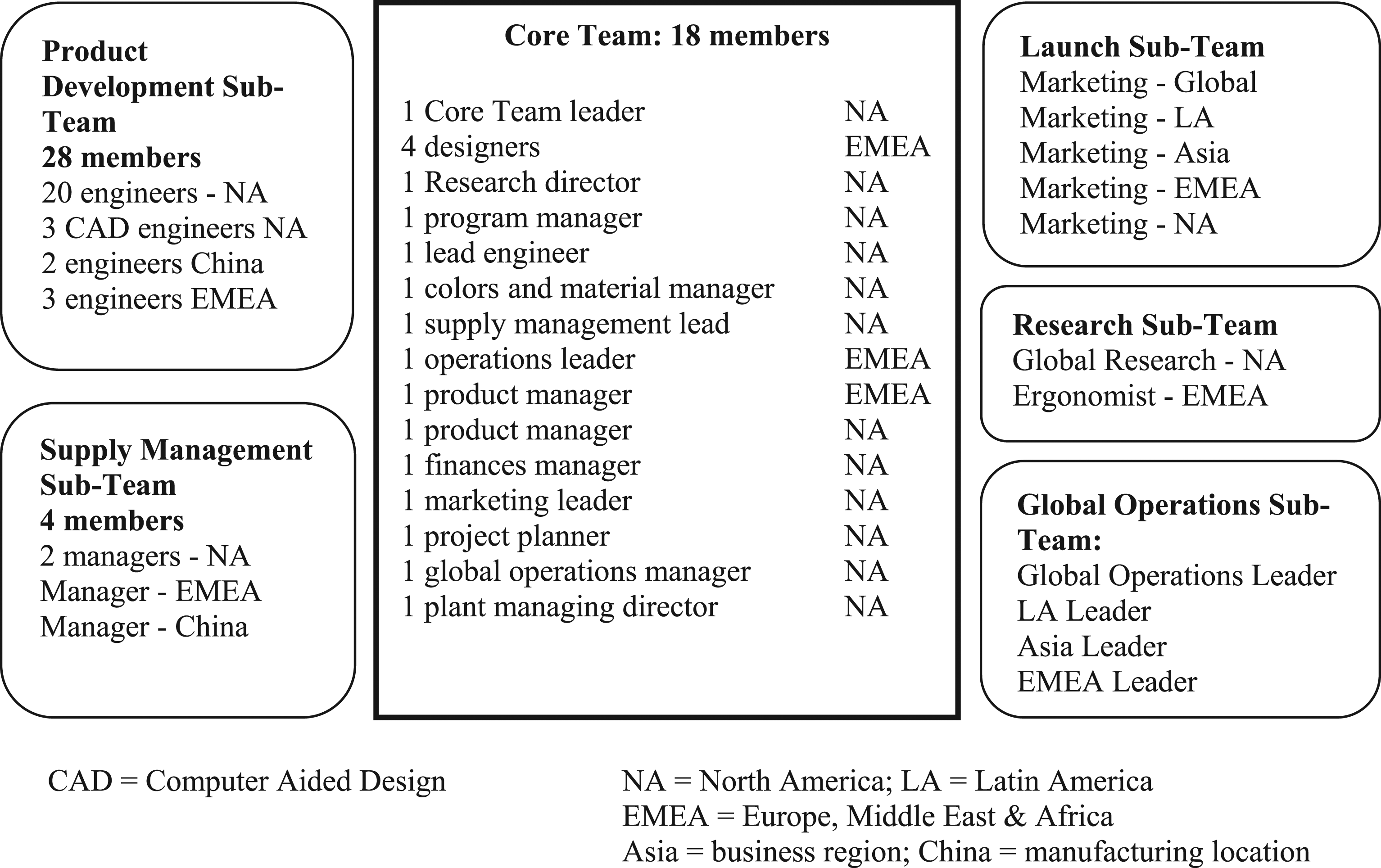
This multidisciplinary and multicultural Core Team was tasked with developing a new global product made entirely from redesigned components, with the intention of launching it in every country where the brand was present in 2 years. The Core Team was diverse with six different national cultures, native languages, and functional skills spread across the United States, United Kingdom, Germany, and China; in addition to members based at the North American headquarters, the Core Team originally included two British managers—one in product marketing, the other in operations—and four German designers. As the project moved closer to launch, regional managers from China, Brazil, and the UK were added to the Core Team. The team was also diverse in terms of age and gender.
To deliver a new product in such a short timeframe, the Executive Leadership Team staffed the Core Team with senior members who were expected to bring knowledge and experience from previous projects. The Core Team leader was selected based on prior experience in multicultural projects and corporate innovation leadership. However, most of the members representing the local markets and the Sub-teams were recently hired. In accordance with company practice, none of the Core Team members reported directly to the Core Team leader. However, they were accountable to the Core Team leader for the project. A “Development Proposal” was created to outline the goals of the Core Team in terms of financial, operational, marketing, sales, and sustainability priorities, as well as the roles and responsibilities of all team members.
All of the tasks involved a high degree of interdependency, and some of the key success factors lay in the Core Team’s ability to keep the project moving forward while controlling an unsettled, iterative process mode that was consistent with the company’s “design culture.” This work process is full of loopbacks and requires comfort with ambiguity, as it is based on a large amount of interdependent data and a long timeframe between the start of an initiative and its final validation. The Core Team leader, who was responsible for meeting deadlines and deliverables, was constantly looking for the right balance between allowing some wiggle room in the development process and making the trade-offs required by the Executive Leadership Team. The project schedule is shown in Figure 2. Project development timeline. 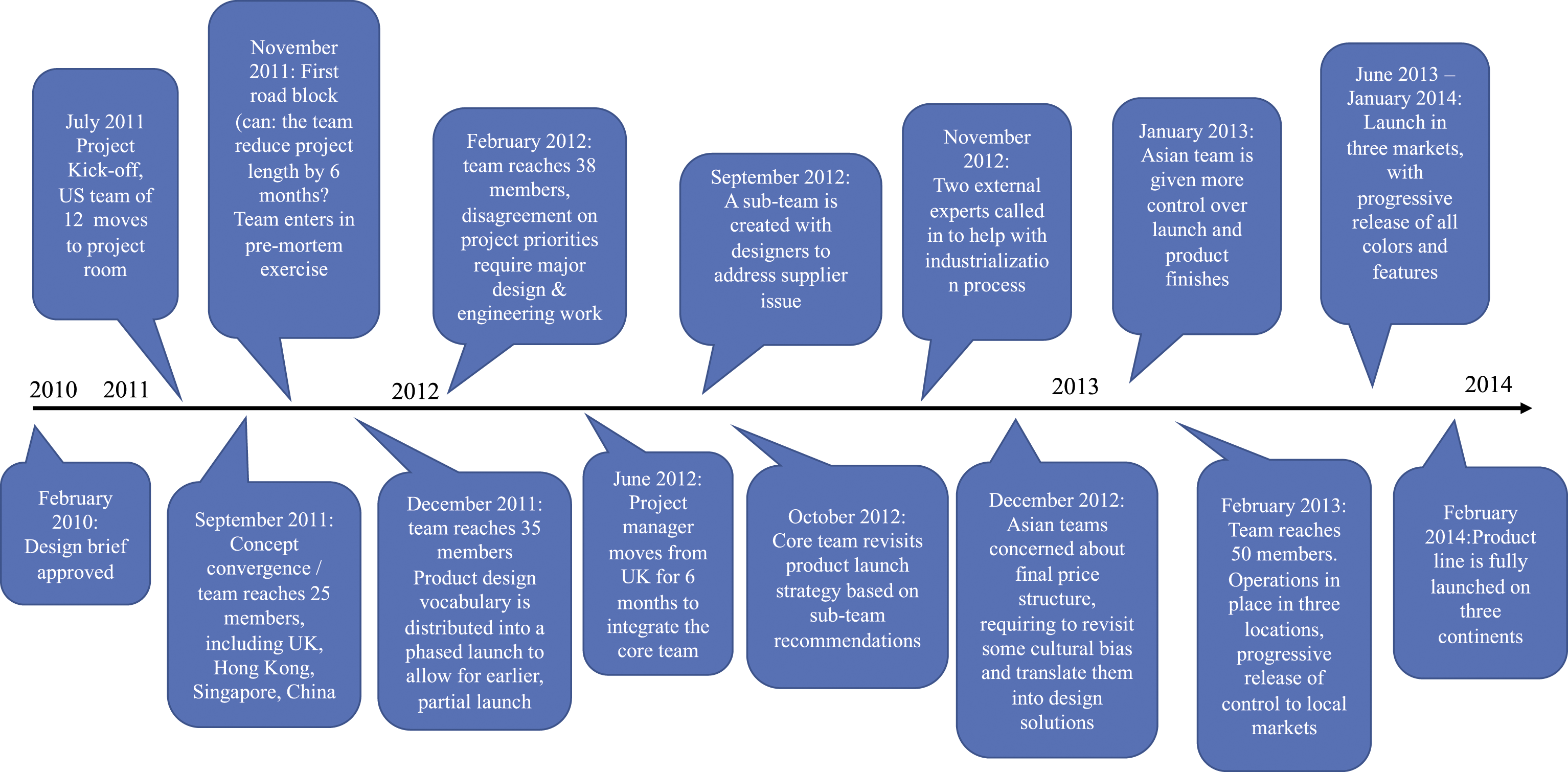
Despite several hurdles, the product was successfully launched between June 2013 and February 2014. The assessment of success was both qualitative and quantitative. Qualitatively, the product passed hundreds of required engineering tests, was manufactured in three different locations, and was well received in various international markets. Quantitatively, the team met the “simultaneous global launch” date of June 2013 and stayed within budget. Today, this product is still available worldwide and is considered one of the company’s top sellers. As the global team investigated was extremely successful, it can be considered an “extreme case,” making a single case study pertinent for obtaining relevant insights.
Data collection and analysis
Access to the case was possible because one of the authors was part of the Core Team and led participatory action research (Zhang et al., 2015) during the project. This provided a large and diverse set of qualitative data. In addition to immersion and participation in teamwork, including informal interviews and discussions with the Core Team, the author documented teamwork throughout the duration of the project in 40 Core Team video conference notes and 80 biweekly team meeting notes. Twenty-five monthly reports (including progress to date, top five team hurdles, rolling 5-year financial forecasts, marketing initiatives, engineering and operations plans, product vocabulary description, and costs of key components), and five project management visualizations were also included in the data.
Consistent with an ethnographic approach aimed at discovery, the data from the case study were coded in three steps according to Gioia et al.’s (2013) methodology, which is dedicated to structuring data from different qualitative sources. The ethnographic researcher naturally had a deeper understanding of the team and the situation than the other author, who did not participate in the teamwork. Taking advantage of both the feelings and impressions of the participating researcher and the outside and distant perspective of the non-participating researcher, we carried out the coding process together during regular meetings. As a first step, the ethnographic researcher reread and commented the field notes and documents to the non-participating author in order to gain a thorough understanding of the data. This resulted in a temporal ordering of the data as well as first-order codes related to teamwork and boundary spanning within the team. Open-ended first-order coding was based on questioning the nature of the field notes and related teamwork features and events in field-specific terms, asking, “What is this about? Where interpretations differed, we discussed the coding until agreement was reached. Second-order categories are theory-centered and group various first-order codes under a theoretical concept (Gioia et al., 2013). Therefore, the second-order coding was still done jointly by both authors, through intense discussions and in an iterative process of going back and forth between the data and the literature on boundary spanning and global teams.
Data structure.
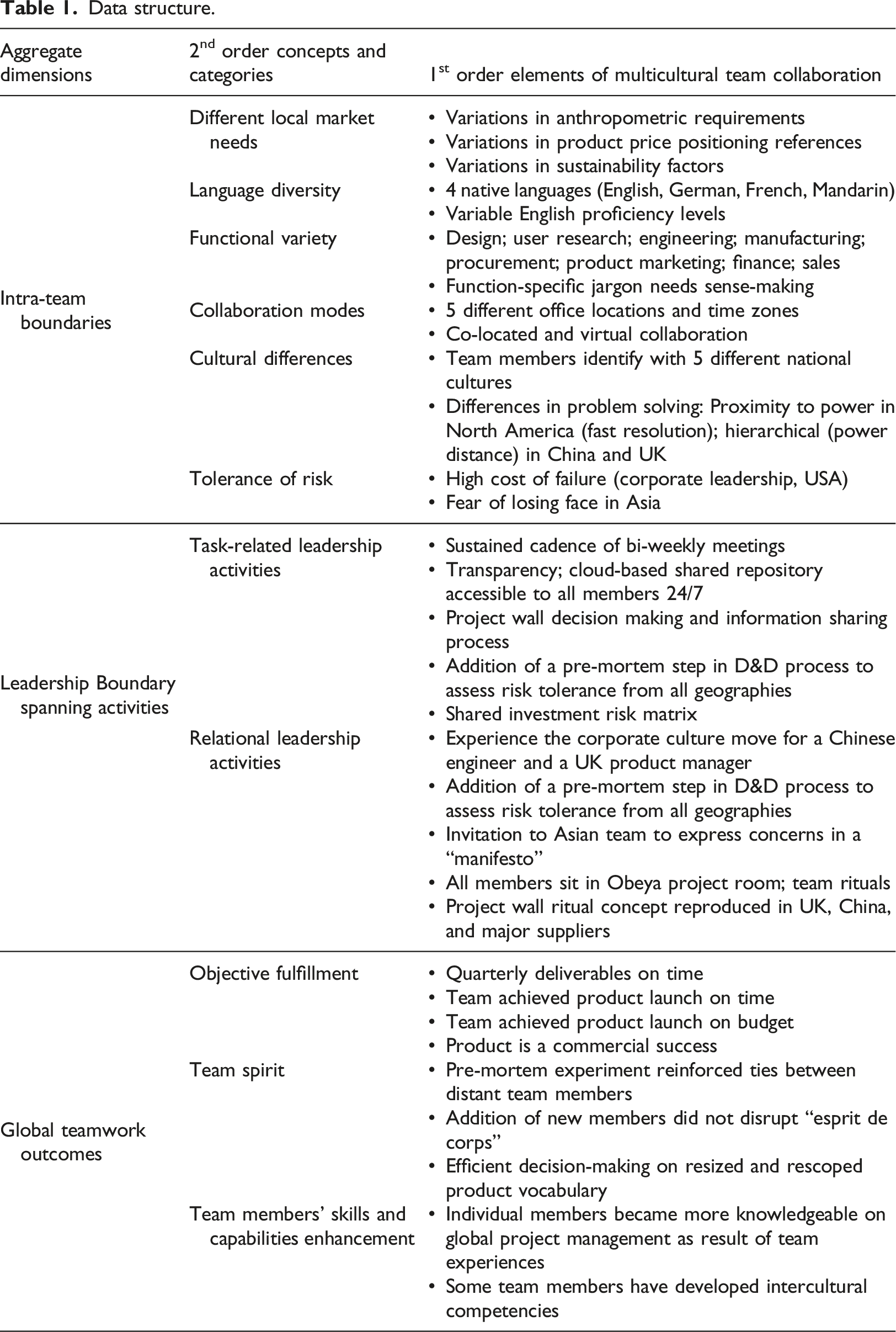
The coding process and data structure helped to identify boundary spanning activities and to sort them into the structural and cultural domains and dimensions of team effectiveness. However, the first round of coding did not sufficiently link boundary spanning activities to teamwork outcomes. Therefore, in a subsequent phase of data analysis, we went back through the coded data of the entire project process to identify particularly relevant teamwork events. We asked when the various first-order codes occurred during the teamwork process and how the team leader’s activities led to intermediate teamwork outcomes. We looked for moments when strong boundaries within the team led to tense situations and conflicts with a critical risk to the team’s effectiveness but were successfully overcome. We identified three key events, which are described in the third section of the paper. In line with our ethnographic methodology, these narratives are part of the contributions of this study. A more detailed analysis of the three situations through the lens of the data structure (Table 1), looking at what boundary spanning activities had been carried out and how they influenced the structural and cultural coupling in the further course of the teamwork, led to a deeper understanding of these dynamics.
The process of data analysis led to three main findings: (1) the identification of three examples of effective boundary spanning events within the global team, which are described in the next section, (2) the value of linking the concept of boundary spanning to loosely coupled systems theory, and (3) the description of successful simultaneous cultural and structural coupling activities. This last point is discussed in the fourth section of the paper, which leads to three additional propositions.
“Tales from the field”: boundary spanning in three critical teamwork situations
The entire project team studied here faced several challenges rooted in intra-team boundaries, but the team members converged around a common desire to achieve the goal, and new competencies were acquired that contributed to building a strong sense of belonging. In particular, three critical teamwork events were successfully overcome by implementing specific boundary spanning activities. In line with our ethnographic approach, after describing the overall boundary spanning team communication processes, we will narrate the three events by relying heavily on the second-order categories, i.e., intra-team boundaries, task-related and relationship-related “coupling” activities implemented by the team leader, and team outcomes.
Team communication and collaboration across boundaries
As shown in Figure 1, the project team consisted of an 18-member core team and five additional Sub-Teams located at the company’s North American headquarters, in Europe, and in Asia. Intra-team boundaries were geographic (four locations on three different continents; widely separated time zones), cultural (North America, UK, Germany, and China), and structural (in terms of headquarters, subsidiaries, and service providers). With experience from previous global projects, the Core Team leader established efficient communication protocols and decision-making norms early on. The project team used a shared virtual space that quickly became the “hub” of the project team. The seamless compatibility of the intranet-based information systems contributed greatly to the efficiency of the R&D process. By posting their work in progress at the end of the workday, engineers in North America would hand it off to engineers in China, who would take it from there. Technical challenges would then be evaluated within 24–48 h and shared with designers based in Germany. This rapid feedback loop also allowed teams outside of North America that were not in direct contact with Core Team leadership to be involved in the decision-making process: often, teams based in China or the United Kingdom could send back specific comments or solutions to be discussed at the next Core Team meeting. By encouraging this rapid exchange of information about challenges, rather than trying to hide them from remote team members, the Core Team leader created a culture of fluid communication and openness that supported a collaborative decision-making process.
The Core Team met with the German designers twice a week, on Tuesdays and Thursdays. On Tuesday mornings, Core Team members would review and discuss the previous week’s events and share any new findings or challenges. Each Core Team member was invited to report on his or her team’s activities from the previous week and to share a proposed plan for achieving their next goals. If delays or uncertainties were anticipated, the presenting team member had two choices: either propose a mitigating action or get all team members to accept the consequences of the delay. If accepted, the information was shared with the Sub-Teams via the online shared space. On the other hand, if some team members rejected a foreseeable delay due to a technical challenge, the Sub-Team Leader had to discuss the issue with their own hierarchy and present alternative solutions by the next Tuesday meeting. The following Thursday, the designers were briefed on Tuesday’s review via video conference, and the issues were discussed further.
As is common in global project management, communication tools were chosen based on levels of urgency; in this case, the Core Team chose based on cultural preferences. The supply management and product marketing teams in Asia and Europe preferred to interact via video conference, posting large files to a shared online drive and using email and phone calls for quick exchanges. Communication with Germany was always via video conference. Core Team meetings in North America were always held in person at the headquarters team workspace. Each quarter, all project team members met in North America. 18 months into the project, 6 months before the product launch, when the local manufacturing operations were showing strong signs of alignment, the Core Team leader gradually gave more autonomy to the regional Sub-Teams and let them organize their own product launch.
These processes of communication and collaboration across intra-team boundaries proved to be very effective overall as part of an infrastructure that contributed significantly to bridging these boundaries. However, the analysis of the case data revealed three situations in which additional boundary spanning activities were necessary to overcome difficulties.
Event #1: pre-mortem exercise
The main risks and challenges of the project were recognized early on as (1) the product’s relevance to new users and markets worldwide and (2) the team’s ability to assemble exactly the same product in three different locations on three continents. The complexity of the project was also due to the major technological innovation required and the fact that it was co-developed with a North American supplier who was also willing to transfer its know-how to local manufacturers in Europe and Asia.
Six months into the project, the project team grew from 8 to 25 members, significantly increasing the diversity of functions and cultures. This challenged communication within the Core Team itself, and overall stress levels began to rise. New team members were added from the UK and China, as well as from engineering and procurement, and meetings became less productive: more unresolved issues were carried over from week to week. The product consisted of more than 300 parts, and the cost viability and technical feasibility of innovative materials were far from the plan: team members’ tolerance for financial and technical risk was all over the board. Product managers were increasingly concerned about the ability of the final product to meet their market expectations. At such an early stage in the R&D process and with such uncertainty, the engineering team’s rough prototypes could not provide much reassurance about the final product’s appearance. Some team members began to send signals up their own chain of command that the project was becoming a high-risk endeavor.
The Core Team leader interpreted these signals as early signs of intra-team boundaries that needed to be addressed before they became too difficult to overcome. Within a few days, all team members from the North American Core Team, the Asian and UK Sub-Teams, and all disciplines, that is, design, user research, engineering, manufacturing, procurement, product marketing, finance, and sales, were invited to pause and reflect during a “pre-mortem exercise” designed to “identify problems before they happen.” Remote members participated virtually via videoconference. Participants were divided into culturally diverse groups of three and asked to identify “what could go wrong 12 months after product launch?” Team members were asked to share their concerns in their small “safe to say” groups by projecting themselves into the future and putting themselves in the shoes of their group colleagues. At the end of a 2-week period, each group was asked to create a poster that highlighted a description of the problems identified and their fears, along with possible mitigations. The final posters were taped to the walls of the project room and shared at a team event attended by all team members, both remotely and in person. Each team presented their list, and each presentation was followed by open conversation and debate, particularly about what failure meant in each team member’s culture. The team eventually agreed on a list of common concerns. All team members received a copy of this list, and the “shared concerns” remained in the project room throughout the project.
This pre-mortem exercise was based on collective problem solving through intentional social and intercultural interactions. It empowered the team to recognize and cross three boundaries: geographic and functional separation, the meaning of failure, and risk acceptance levels within each cultural group. Team members were not required to agree on common values or behaviors; rather, they were asked to adopt an empathetic perspective of other team members’ views. This exercise increased project team members’ understanding of each other’s fears or concerns, and ultimately created shared memories and stronger bonds within the team.
Event #2: temporary integration of a UK product manager into the US team
Faced with longer-than-expected lead times for product parts, the Core Team leader asked the project team to get agreement from all markets on a reduced list of product references for the initial global product launch. At the time, the regional markets had significant overlapping needs but were not fully aligned. An initial written request from the Core Team leader to all markets did not produce a satisfactory reduced list of references. The European markets were particularly difficult to align due to the different national preferences of the target users, which would make the final pan-European list still not sufficiently reduced. Adding this pan-European list to the North American restricted list was far from the leadership’s expectations for reference reduction. A couple of Core Team meetings aimed at finalizing a common list did not produce the expected result either. The Core Team leader was not in favor of one market overriding the others, as this could have led to cultural conflicts down the road. It was agreed that the final list would come from further cost and market analysis and comparison. Since the needs of the European markets were the most complex to address, the European leadership and the core team leader explored various options and agreed to temporarily transfer the UK-based product manager to the Core Team in the United States for a period of 6 months. Shortly after the decision was made, the product manager moved to the US at the end of December and was able to join the first Core Team meetings in January. Within a few weeks, new relationships were formed among the team members. Now physically located at the heart of the NA team, the UK product manager gained a great deal of credibility with the North American-based team members. Living in the US allowed her to drop the “us (Europe)” and “them (USA)” mindset and shift into a collaborative problem-solving mode. She became the “gateway” between the different markets, allowing each side to understand the culturally based needs of the other. This product manager became a “bridge builder,” a boundary spanner between the two cultures. She was still structurally tied to the UK team, but this “impatriation” brought to the NA team a new body of knowledge rich in facts and data about the needs of European customers. The product manager worked, shared meals, and participated in off-site recreational activities such as sports and team outings with the American team members. The Core Team leader understood that the best way to bridge the gap was not to do it personally: a knowledgeable UK team member would be in a more credible position to gain the trust of other team members while explaining why one component should be chosen over another. A systematic review of the cultural pros and cons became possible thanks to the European market knowledge that the product manager had brought to the US headquarters. In addition, the American team members developed new intercultural skills through daily interactions with the UK product manager. This temporary change in structure helped rebalance pressure points from European market needs and provided new opportunities for global alignment within the reduced product offering.
Event #3: enabling the Asian team to defend their market requirements
As production costs became more reliable, the Core Team financial manager made recommendations for market price positioning in all regions. At the next team meeting, the Asian marketing team expressed great concern about a widening price gap between the North American and Asian markets: targeted Asian prices needed to be lower than the maximum acceptable difference of 30%. This situation led to the Asian Regional Manager refusing to commit to the latest version of her projected volumes. The lack of commitment to sales volumes from Asia was a showstopper for the entire project. The Core Team leader attempted to resolve the pricing gap issue with the Executive Leadership CFO and the Asian Regional Manager, arguing that local production of the product would reduce manufacturing costs in the future. Unfortunately, this conversation lacked the data to influence either the CFO or the regional manager. To overcome price-related regional boundaries, the Core Team leader decided to interrupt the usual teamwork process and loosen the functional reporting pattern by asking the Asian subteam to justify in writing their divergent vision of product positioning for the Asian markets. Preparing a market-driven document explaining the situation would give the Asian Sub-Team the opportunity to present data and facts to support their preferences. In addition, a fact-based written document would alleviate cultural and linguistic issues, namely, power distance concerns, accent issues, and direct communication challenges, from the shoulders of the Asian marketing team.
The Asian marketing head went back to the market managers in China, Japan, Southeast Asia, and Australia and prepared a 10-page response. The document was well written and documented. Some sections were expected, such as a lower price point positioning for most Asian markets, as well as a limited range of user options and a strong preference for a saturated color palette. However, other requirements surprised the core team: a requirement for a high percentage of locally manufactured components to meet sustainability goals, and a very aggressive launch schedule in most Asian markets.
The document raised many concerns among the Core Team, the biggest being the impact on the overall global margin. However, the Core Team leader understood that the credibility of the Asian team was at stake and that they did not want to lose face by asking for only a very low price. Initially, the Core Team rejected the low-price request, confirming that the company’s rules did not allow for the aggressive pricing required to stay within the 30% gap. However, other items were open for discussion, such as a local color palette and a higher percentage of locally sourced components. A few days after this information was emailed back to the Asian team, the Asian regional manager requested a direct phone call with the Core Team leader. This conversation triggered a request for an “all-regions” cost review with Executive Leadership. The result of this review led to the creation of an investment risk matrix based on a global sourcing strategy that ultimately resulted in significantly lower local production costs.
This change in collaborative processes and the request for a written document enabled the discovery of underlying market needs that had not been expressed during regular team meetings. At the time of the product launch, marketing efforts focused heavily on environmental factors, a specific and well-suited color palette, and an appropriate range of options. Such locally driven factors helped justify a slightly higher market price compared to local competition.
In addition to regular collaboration and communication processes, three different boundary spanning initiatives were implemented within the three events: gathering all team members in a seminar with a particular format based on small and highly diverse subgroups (event #1), transferring a team member from the UK to the US for a period of 6 months (event #2), and temporarily changing teamwork processes by inviting the Asian Sub-Team to present their point of view in a written document (event #3). The “thick” description of the three events and related boundary spanning activities are part of the intended contributions of this paper. In addition, we will further analyze these boundary spanning activities as structural and cultural coupling in the next section.
Expanding the concept of boundary spanning through loosely coupled systems theory
In the global team studied, boundary spanning activities were aimed at implementing novel and effective ways to increase the team’s ability to achieve its goals. The boundary spanning activities related to two main aspects: the task to be accomplished, and the relationships among team members. The process of data analysis helped to identify loosely coupled systems as a relevant theoretical framework for further conceptualizing boundary spanning activities. We discuss the contributions of our study to the literature in three steps, leading to the following propositions: • Task-related “structural coupling” and relationship-related “cultural coupling” are interdependent, • Effective boundary spanning combines tight structural and loose cultural coupling, • Boundary spanning objects and brokers enhance coupling activities.
Boundary spanning activities in global teams as interdependent structural and cultural coupling
In the case study, we found that the boundary spanning activities that multicultural team leaders can activate fall into two domains: those related to tasks, and those related to relationships. As described earlier, the literature that analyzes global teams as loosely coupled systems refers to the “structural” and “cultural” domains of coupling mechanisms (Bachmann, 2006; Beekun and Glick, 2001). The structural domain includes task-related aspects, formal arrangements that are modified by formal decisions (Weick, 1976). The cultural domain includes informal, social, and non-task-related communication between group members that shapes interactions in the group (Bachmann, 2006). Cultural coupling mechanisms are modified by symbolic interactions, such as rituals and ceremonies, or non-task-related metaphors and values (Beekun and Glick, 2001).
In the case studied here, global product development completion required delicate management of the differences between divergent cultural contributions, as outlined in events #1 and #3, and the need to conceive of a product solution capable of (1) integrating a range of culturally driven options and (2) being produced simultaneously in different geographic locations. Several structural and cultural coupling mechanisms contributed to the effective bridging of these boundaries in the case studied.
The “Development Proposal”, that is, the comprehensive template document that served as a guideline for all teams worldwide, clearly played the function of structural coupling (in terms of defining the team’s tasks, the roles of the team members, and the organization of the workflow). The ritual of “Tuesday morning team reviews” tightened the interdependencies of the various disciplines, thus reinforcing their structural coupling. Any change in product design had an immediate impact on an engineering solution, cost, sourcing and tooling, perceived value or aesthetics of the product, and vice versa; therefore, all functions had to discuss and agree on any change. As a result, the repetitive nature of this ritual allowed all team members, whether local or remote, to become familiar with the vocabulary of the other disciplines.
Event #2 describes a change in team structure in the form of the temporary transfer and integration of a UK team member into the US-based team, which strengthened overall team cohesion by reducing the decision-making process involving input from the European markets, as well as increasing the level of trust within the product management discipline. Event #3 also illustrates a change in workflow that created stronger structural bonds: moving from verbal exchanges at team meetings to formal, data-driven written input on appropriate pricing for each Asian market allowed senior management to refine their understanding of the cost-benefit equation and base their final financial decision on facts based on market reality. It also allowed the Asia-based teams to gain credibility in their perception of the strategic competitive advantages of the company’s brand.
At the cultural level, coupling refers to the relational and social aspects of teamwork. In the case study, quarterly face-to-face meetings at the North American headquarters contributed to tighter cultural coupling than would have been the case if teamwork had relied solely on virtual communication. Each visit included non-work activities ranging from sharing meals to fun team outings. The modus operandi between the Core Team and the Sub-Teams was designed to maintain cultural diversity and a degree of “separation of identities,” which implies loose coupling. By listening to the voices of the market and refraining from imposing user needs arising from the local culture of headquarters, this separation was the best possible way for designers and engineers to grasp the deep nature of local user preferences. Considering these examples, the cultural and structural coupling activities were conducted separately, but showed some interdependencies.
Effective boundary spanning through a combination of structurally tight and culturally loose coupling
Bachmann (2006) suggests that effective global team management requires a combination of simultaneous tight coupling in the structural domain and loose coupling in the cultural domain. All three events presented here involved changes in both structural and cultural coupling. Event #1 supports Bachmann’s (2006) proposition that cultural coupling, which involves informal communication, socialization, and symbolic interactions such as rituals and ceremonies or non-task-related metaphors and values, should be loose: team members organized themselves into small groups and agreed on their meeting time and frequency to identify their list of concerns. This means that the (cultural) values, understandings, and behaviors of the team members should not be forced into a rationale of similarity. However, we observed that the move of the UK product manager in Event #2, which effectively helped to overcome hurdles and boundaries, tightened both the structural and cultural coupling. In Event #3, the temporary loosening of the team’s structural coupling helped the leader overcome a difficult culturally embedded situation. From a contextual perspective, the “design culture” of the organization was certainly conducive to loosening the structural coupling by opening up a period of “divergent thinking.” The participatory design process at play required cultural insights to be freely expressed, and the contributions of local teams were debated before being either included or deliberately ignored. In other words, our results show that boundary spanning in the structural domain may imply tight coupling, but it may also be necessary to temporarily loosen this coupling so that different visions of team members and work processes can be shared and discussed. The case also illustrates that an authentic and strong commitment to shared goals (including the notion of risk) emerged only after all team members had exchanged different viewpoints and discussed them in depth beyond their cultural filters (Event #1 and Event #3).
Research in cross-cultural management has relied heavily on the positivist paradigm, studying cultural differences through the concept of distance, which has been increasingly criticized (Romani et al., 2018). In line with the difficulties associated with measuring cultural distance (Harzing and Pudelko, 2016), it seems difficult to define what should be interpreted as close or loose coupling in the cultural domain. Considering the degree of diversity (variety) among team members, cultural coupling loosens when new, culturally diverse members join the team. This happened as the team grew from 8 to 25 members and as it approached the launch phase. As the team worked together and during Event #1, cultural coupling tightened as team members learned to better understand each other’s cultures. In Event #2, thanks to the presence of the UK product manager in the US, the team members learned to know each other better and to understand each other’s worldviews; they also learned the cultural interpretations of the expressed marketing needs. During these phases, intercultural learning progressed and, as reported in the literature (Bartel-Radic, 2006), it positively influenced global teamwork. This means that the tighter, bottom-up cultural coupling that emerged from the team and the mutual learning positively influenced the teamwork outcomes—contradicting, or at least adding nuance to, Bachmann’s (2006) proposition.
However, some hurdles were successfully overcome by intentionally loosening the cultural coupling: during Event #3, the team leader invited the Asian team to submit their “book of needs” in which they could clearly document cultural norms and values from different Asian markets. The document provided the American Core Team with a better understanding of the norms and behaviors of Asian cultures, which enabled the Core Team leader to play an active role in mediating between all team members and company leadership by explaining and communicating the legitimacy of their request. The Asian team members were the least experienced in global product design and development compared to their US and UK colleagues who had been part of previous global teams. Tight structural coupling combined with loosening cultural coupling (by making the Asian team’s full-time members of the Core Team instead of market consultants) fostered team members’ sense of inclusion, project ownership, shared goals (Lisak et al., 2016), and accountability for results.
The three events examined here show that the most impactful cultural insights occurred when team members were given room to use their own work styles or reporting models to communicate back to the Core Team (cultural loose coupling), as opposed to following those of the “dominant cultural group,” that is, the American headquarters. The fact that these events occurred during problematic phases of teamwork, and that their resolution had a positive impact on the project, highlights the use of coupling activities as a leadership tool.
The literature treats the cultural and structural coupling domains as distinct domains (Beekun and Glick, 2001) and recommends achieving loose cultural coupling and tight structural coupling simultaneously (Bachmann, 2006). In the present case study, however, the cultural and structural domains appear to have been interrelated. The three events show that both structural and cultural coupling increased as the team matured. New team and external members were brought in at several stages, following the evolution and needs of the project. In the three events, changes in one coupling domain led to subsequent changes in the other coupling domain. By geographically bringing in a loosely coupled team member (the UK product manager, event #2), the team dynamics benefited on two levels: (1) structural coupling was tightened, and the loosely coupled member’s tacit knowledge immediately became more easily accessible and integrated into the daily decision-making process and (2) exchanges with the culture of origin (the UK) were made easier and more frequent, and mutual understanding and shared identity increased (i.e., tighter cultural coupling) due to the nature of the strong ties between the team member and her team in the UK office. Similarly, the Asian team, which was loosely structurally coupled to the US core team, saw a window of opportunity triggered by an emergency situation (Event #3) that they couldn’t afford to miss in order to gain a strong competitive market advantage. When asked to provide a high-level report on market needs, they structurally strengthened their connection to the core team by positioning themselves as the knowledgeable “extended arm” of the Core Team in Asia, while at the same time justifying some unique cultural needs and thus culturally distancing themselves.
Actors and objects in boundary spanning activities
This research provides further evidence of the important role of global leaders as bridge makers (Butler et al., 2012). Team leaders can intentionally loosen or tighten structural and cultural linkages, but doing either requires strong managerial capabilities and intercultural competencies (Lisak and Erez, 2015). Managing the complexity of this project required the integration of different types of expertise, knowledge, and skills from multiple perspectives (Stahl et al., 2010b). The Core Team leader exhibited personal behaviors consistent with Lisak et al.’s (2016) description of leaders with high levels of global identity, who know the global context and recognize innovation as a key value affecting their organization’s competitive advantage. Such leaders convey a sense of inclusion to their teams, which positively influences culturally diverse teams and unites them around the shared innovation goals fostered by their leader (Lisak et al., 2016). Here, the Core Team leader established a variety of activities aimed at sharing the team’s goals and fostered routines of in-person and virtual exchange very early in the process, under the premise of transparent information sharing—executing thereby “spearheading” and “facilitating” boundary spanning activities as per Birkinshaw et al. (2017). She also facilitated the appropriation of the workspace by the diverse core team, thereby instilling a strong esprit de corps, even though she had no hierarchical power over any of the team members, as none of them reported directly to her.
However, even if such a global identity profile positively contributes to fostering communicative inclusion and maintaining diverse team motivation, it does not guarantee that the leader and the team will navigate project faultlines, which have previously been found to negatively influence team processes and performance outcomes (Van der Kamp et al., 2015). The boundary spanning skills demonstrated by the team leader in this case reduced the severity or “deactivated” the impact of such faultlines on the team, facilitating the sharing of expertise by connecting groups from different hierarchical levels or functions (Cross and Parker, 2004). Such activities took shape under the auspices of diligent team meeting rituals, a clear project vision, and goal statements that were shared at all levels of the organization and in all regions. In the face of major disruptions, such as the three events, the team leader initiated boundary spanning activities to deactivate various fears of failure and reunite all team members—“reconciling” and “lubricating” across within-team boundaries as described by Birkinshaw et al. (2017).
The Core Team leader implemented a combination of bridging cultural boundaries by empowering each team member without imposing a dominant norm (loose coupling), while maintaining a constant focus on project performance (structural coupling), but also paying close attention to emerging signs of struggle with the structure and offering alternative modes of interaction and power balance (as illustrated in Event #3). It appears that the design-driven management process, by its very nature of alternating phases of convergence and divergence, is conducive to a tight team structure (with process rigor and clarity of multidisciplinary roles) and a loose cultural component (openness to multiple solutions to problems).
Research on global team leadership has led to the study of leadership competency models, leadership styles, and contextual factors that influence the effectiveness of a multicultural team leader. The empirical findings from this case study confirm the effectiveness of some of the global leadership competencies identified in the literature, such as the ability to share a vision, establish common goals and outcomes early on, promote effective communication (Marks et al., 2001), and implement decision-making processes capable of achieving consensus from diverse perspectives and resolve conflict (Gunkel et al., 2016; Schotter and Beamish, 2011). Kayworth and Leidner (2000) found that the most effective global team leaders appear to be those who mentor, are communicative, can manage multiple leadership roles, and have both task-focused and relational skills. Such characteristics, particularly task-focus and relational skills, appear to apply to the Core Team leader in the case study.
Beyond the traits of global team leaders, this research aims to contribute to the understanding of boundary spanning activities. Bridging between different groups and leveraging the diversity inherent in each group (Schotter et al., 2017) seems to be confirmed as an important skill and competence for leading global multicultural and multidisciplinary project teams. However, while team leadership played a central role in boundary spanning in the case studied, the activities were mainly indirect, and in the workplace, responsive actions triggered boundary spanning. In the three cases, the team leader was not the “bridge” that brought distant team members together through communication or “translation” activities. Instead, the leader implemented activities that served as a bridge across boundaries: In Event #1, the leader decided to organize the pre-mortem exercise, and its format clearly facilitated boundary spanning. In Event #2, the team leader proposed to transfer the UK product manager to the US, and it was then the product manager who became an effective boundary spanner or “broker”, helping to disseminate knowledge and bridge different perspectives (Mattarelli et al., 2017). In Event #3, the team leader asked the Asian team to put their vision in writing, and the document they produced enabled the boundaries between the Asian Sub-Team and the headquarters to be bridged. The document can thus be seen as a “boundary object” in the sense of Carlile (2002: 442): “a means of representing, learning, and transforming knowledge to resolve the consequences that exist at a given boundary.” In all three events, the indirect, “decentralized” activities of the team leader enabled boundary spanning without the team leader being at the center of it or personally spanning the boundary. However, recognizing the need for boundary spanning and identifying possible ways to achieve it certainly required the team leader to exhibit the traits and characteristics of a boundary spanner. Our findings are consistent with Hundschell et al. (2022), who also found an indirect influence of team leader boundary spanning activities on teamwork outcomes: the perception of global virtual team leaders' cultural gap bridging behaviors increased subordinates' team identification and work engagement. Our research details additional possibilities of such indirect boundary spanning activities.
Conclusion
To develop a better understanding of boundary spanning in a highly successful global team, we analyzed in detail how the team crossed intra-team boundaries, especially when facing critical hurdles. We described three teamwork events in which boundary spanning was enabled by coupling activities in the structural, task-related domain and the cultural, relational domain.
This study contributes to the boundary spanning literature in three ways. First, it provides a distinction between boundary spanning activities in the structural and cultural domains, and a description of how coupling in both domains contributes to boundary spanning. Second, it illustrates how both domains are related to and influence each other, and how the combination of structurally tight and culturally loose coupling contributes to effective boundary spanning and positive team outcomes in adverse situations. Third, it highlights the role of the team leader in boundary spanning by actively recognizing the need for boundary spanning but implementing boundary spanning activities through coupling mechanisms in an indirect manner by relying on boundary spanning objects and brokers. Overall, the main contribution of this research is to describe what structural and cultural coupling in multicultural R&D teams might consist of and how it can help the team leader to effectively span boundaries between team members and subgroups. The findings from the case study support the value of an ethnographic and interpretive, that is, contextual and perceptual, approach to leadership and boundary spanning in a multicultural team.
In terms of managerial relevance, our study points to the importance of selecting leaders who possess the traits and characteristics of successful global leaders, such as a global identity and a sense of belonging to a single, shared world. Beyond that, our study leads to recommendations primarily for team leaders themselves. Design-driven project management processes, including alternating phases of divergent and convergent thinking (Noman, 1988), appear not only to enhance innovation, but also to identify intra-team boundaries and ways to cross them. Similarly, team leaders must not be afraid to add activities that may seem time-consuming early in the process, such as a pre-mortem exercise (Event #1), but that will help overcome hurdles and thereby save time and increase performance later on.
To accurately identify relevant boundaries, global team leaders must accurately analyze the intensity of intra-team boundaries: some cultural issues may lead to overemphasizing a hurdle, while others may underestimate the seriousness of a problem. Top management should only be brought into the project when an executive decision is critical to the overall success of the project. Delegating responsibility and allowing autonomy and initiative to team members will help the team find its own boundary objects, act as a “broker,” and arrive at shared goals and values.
The limitations of this research lie in the exploratory nature of the single case study. The findings should be further explored in the future with more teams in different contexts. Other avenues of research lie in further exploring the insights that emerged from this study, such as the nature of cultural coupling, the mutual influence of structural coupling and cultural coupling, and the appropriateness of coupling issues to changing teamwork circumstances when obstacles are encountered. We hope that these studies, like ours, will contribute to international business research that adopts a positive view of culture in the sense of Stahl and Tung (2015), where cultural differences are seen as opportunities rather than obstacles for global teams.
Footnotes
Declaration of conflicting interests
The author(s) declared no potential conflicts of interest with respect to the research, authorship, and/or publication of this article.
Funding
The author(s) received no financial support for the research, authorship, and/or publication of this article.
