







Abstract
Adopting a cross-cultural perspective, this study provides insights into how Chinese multinational corporations (MNCs) with a focus on Confucian values, builds trust and contributes to the globalization process in African settings, specifically Guinea. Using a mixed-methods methodology, we explore the dynamics of trust relationships within and across cultures. In Study 1, semi-structured interviews were conducted with 19 Chinese supervisors, 20 Guinean supervisors and 19 Guinean workers. We found Chinese expatriates to emphasize ability and integrity in trust building while Guinean workers care more about benevolence. Drawing on the insights of study 1, we proposed a model of interpersonal trust within and across cultures. In this Study 2, data was collected from 182 Guinean workers and their direct Chinese/Guinean supervisors. We found Guinean subordinates’ trust in the organization to mediate between their trust in Guinean supervisors and their performance. In addition, Guinean supervisor’s trust in Chinese supervisor positively affects Guinean subordinate’s trust in organization and also moderates the positive relationship between Guinean subordinates’ trust in the organization and their performance. We draw implications for management relationships between two cultures that are seemingly different from both studies.
The global economy is looking to Africa because of its rich natural resources, young population, and emerging market opportunities. Africa holds approximately 30% of the world’s mineral reserves, including significant deposits of precious metals, cobalt, lithium, and other minerals critical for the transition to low-carbon technologies and high-tech industries (UNCTAD, 2024). Guinea, for instance, has abundant natural resources including 25% or more of the world’s known bauxite reserves, among other metals (World Population Review, 2024). Thus, Africa is a key player in the global economy, not only for its natural resources but also as a significant market for cultural exchange and globalization. Although countries such as Guinea have been attracting investments from multi-national companies (MNCs) decades ago, operating business in Africa continues to be a challenge. According to George et al. (2016), the most frequently documented challenge is institutional voids, for example, volatile and uncertain environments, corruption, and institutional plurality as Africa is of extreme ethnic and linguistic variety. There is also uneven performance across different African economies due to colonial legacies as well. Compared to West Africa, Eastern and Southern Africa have better climatic conditions. Studies have shown that regions with favourable climatic conditions attracted more European settlers, leading to the establishment of better institutions and infrastructure, which in turn contributed to better economic performance (Acemoglu et al., 2001). The uneven economic development in Africa also impacts the amount of academic interest. The number of managerial studies in Africa varied significantly across regions and are focused on the countries with the highest GDP such as South Africa, Ghana, Nigeria, and Kenya. Among the 552 peer-reviewed articles on Africa published between 1990 and 2015, 38 out of 54 African countries were not studied (George et al., 2016).
Among the foreign direct investment (FDI) in Africa, there is increasing outward FDI (OFDI) from emerging markets into Africa, for instance, from China and India. Ado and Su (2016) noted that with increasing investment through joint ventures with African local companies, China has become Africa’s leading economic partner. In reviewing the China-Africa relationship, Shinn (2023) proposed that China’s aid to Africa is a form of soft power. Clearly, there are positive and negative impact of the China presence in Africa (Abodohoui et al., 2018). This is echoed by Blair et al.’s (2021) work on the effect of aid from China versus the United States on the recipient states. The expanding influence of these Chinese MNCs not only changes the economic dynamics of the continent but also introduces distinctive aspects of Confucian cultural values and management practices, marking a significant shift away from the traditional Western influence in the region. It is this introduction of the new cultural dynamics by Chinese MNCs that presents a contrast to the established Western approaches, particularly in the realm of management, skills development, and HRM practices (Abodohoui and Su. 2020; Cooke, 2014).
It was reported that more than one million Chinese moved to Africa between 2005-2015, consisting of mostly labourers and semi-skilled workers (The Economist, 2015: p. 49). The number of expatriates to Africa has also increased. This poses challenges of integration and mutual understanding between Chinese expatriates and local host country nationals (HCNs). While differences in values, communication styles, and work ethics inherent in Chinese and African cultures can create barriers to mutual understanding and cooperation, it can also offer a rich ground for cross-cultural learning and synergy (Jackson and Horwitz, 2018). The Chinese society promotes diligence and altruism as these are key elements of the Confucian values. Thus, one is expected to put work first, even above their family’s interest. While African societies value family life, they also value enjoyment (Ramose, 2002). However, there is also synergy between Chinese and African culture as pointed out by Jackson and Horwitz (2018). There is commonality between the Chinese value of ren (Ip, 2009) and the African value of ubuntu (Mbigi, 1997), as both refer to humanity. The collectivistic culture of China appears close to community cultures in Africa.
Other than value differences, business operations are also likely to be affected by informal rules, local cultural norms, and non-institutional demands from the local context. Ado et al. (2017) found that host country nationals (HCNs) in Africa made use of informal network to build trust and gain knowledge from Chinese expatriates. Jackson and Horwitz (2018) compared Chinese MNCs with Western MNCs in Africa and advocated that the Chinese policy of “friendship and mutual learning” could help reduce the motives of pure resource seeking. Among the cross-culture management and expatriate management issues, one important indicator of adjustment effectiveness of expatriates is the ability to build and sustain trust in cross-cultural contexts (Chua et al., 2009). In the past, Chinese employees are often HCNs in Western MNCs in China and work has been done on trust building between Chinese HCNs and Western expatriates. For example, Ang and Tan (2016) found that cognitive-based trust and affect-based trust take turns to dominate the trust building process during different stages of the relationship. With increasing Chinese expatriates placed in less developed countries along with significant Chinese OFDI, more attention should be given to the trust building dynamics between Chinese expatriates and those countries’ HCNs.
This reversal of roles for the Chinese in Africa provides a much-needed context in understanding the link between trust in supervisor and trust in organization. When it comes to the trust relationship between supervisors and subordinates, extensive literature documents that trust in the supervisors plays an important role in several outcomes, e.g., increasing job satisfaction, raising organizational commitment, increasing employees’ job performance. (e.g., Colquitt et al., 2007). How then, do trust relationships play out in a cross-cultural context between supervisors of the local and foreign nationality? What are the dynamics involved and are there spill-over effects, from the local supervisors to the expatriate supervisors, with respect to local employees?
In this paper, we adopt a mixed-method approach in understanding the trust relationship in the context of Chinese expatriates in Guinea, a cross-cultural context. Using the qualitative approach, we attempt to understand trust as defined by the different cultures and how trust is built between cultures and within cultures in the context of expatriation. With insights derived from the qualitative study, we then examine how the across-culture and within culture trust relationships translate to workers’ performance using a quantitative study. This study contributes to the extant literature by focusing on the trust formation process between Chinese expatriates and Guinean HCNs. Taking perspectives from all parties to the relationship enables an understanding of the dynamics involved, especially in the link between Guinean worker’s trust in Chinese/Guinean supervisors, their trust in the organization, and how it translates to work performance.
By examining the trust-building processes between Chinese expatriates and African HCNs in the unique setting of a Chinese MNC in Africa, our research provides valuable insights into how Eastern and Western cultural influences converge and diverge in modern business practices. The findings of this study not only illuminate the complexities of cross-cultural dynamics within multinational corporations but also offer practical guidance for effectively managing diverse workforces in a globalized business environment. Ultimately, our work adds a crucial dimension to the discourse on cultural globalization by spotlighting the growing influence of Chinese entities in shaping cross-cultural management practices in African contexts.
Literature review
The GLOBE study is one of the major studies in cross-cultural leadership (House et al., 2004). Ten clusters of countries were found in the GLOBE study and the only African cluster, labelled ‘Sub-Saharan Africa’ consists of Namibia, Nigeria, South Africa, Zambia, and Zimbabwe. The cluster was found to be high on the cultural practices of in-group collectivism and power distance alluding to the importance of family ties and pride and loyalty in organizations and family. Although Guinea is not part of this cluster, we assert that the values of Guinea are likely to gravitate towards that of high in-group collectivism and power distance as well. In comparison, China also trends towards being high in-group collectivism and power distance in the GLOBE study. Thus, at the meta-level, China and Guinea are similar in values (House et al., 2004). Cooke (2014) also proposed cultural synergies between China and Africa in terms of the “guanxi” of China and the “communalism” of Africa, which are distinct from Western individualistic cultures. This corroborates with Muriithi (2017)’s findings that both cultures value group work, social responsibilities, and harmonious relationships and both prefer non-confrontational methods of conflict management.
In terms of differences, for example, Schwartz (1992) identified three Chinese values that are unique – societal harmony, virtuous interpersonal behaviours and personal and interpersonal harmony linked to religious influences such as Taoism, Confucianism and Buddhism. On the other hand, Guineans are predominantly Muslim, with approximately 85% of the population being Muslim (U.S. Department of State, 2021), hence their value system is likely shaped by the teachings of Islam.
Cooke et al. (2015) found that MNCs operating in the African context need to collaborate with tribal chiefs and local communities are powerful institutional actors. Thus, while Chinese MNCs operating in African countries may not be subjected to the constraints from the formal institutions and ethical pressures as they would in developed countries, they are more “likely to be restricted by informal rules, local cultural norms, and non-institutional demands from local stakeholders” (Cooke et al., 2015: p. 2748). Bhamidipati (2021) offered insights on the important roles played by local African agency in Sino-African relations in solar power development projects in Kenya. This alludes to the need for strong interpersonal relationships locally. In the trust building process, it was found that the Chinese has a lower tendency to trust the out-group and stronger preference for affect-based trust (Jiang et al., 2011; Wang and Fulop, 2007; Wasti et al., 2011). It was also found that Chinese subordinates respond better to affect-based trust relationship with leaders, which was supported by behavioural outcomes such as perceived contribution, respect, loyalty, personal rapport, and emotional investment (Wang and Fulop, 2007). Zhang et al. (2014) also found that Chinese leaders are expected to be moral models; and to take care of their employees, even beyond the work context, in other aspects of life. In return, employees are to obey and be loyal to their leaders. This stream of work shed light on the trust building expectations among the Chinese.
According to Rui et al. (2017), there are many expatriates from Chinese MNCs at both the operational and managerial levels because of their low cost and high productivity. The employment of Chinese expatriates takes up more than 50% of the total workforce and this ratio is significantly higher than that of MNCs from other countries. Rui et al. (2017) further explained that the ratio is driven by the large number of operational expatriates, both skilled and semi-skilled. In addition, Chinese expatriates are diligent; have the capability of knowledge reconfigurations; and the expatriate management system is collective and centralized. Wegenast et al. (2019) also studied the impact of Chinese mining operations in sub-Saharan Africa on local employment. According to the authors, because of the competitive advantage of Chinese expatriates and the lower readiness to invest in local skill formation, Chinese companies fail to promote positive spill-over effects and local employment, compared with non-Chinese companies.
Of concern in the expatriate literature is the level of performance and adjustment of expatriates (Liu and Shaffer, 2005; Shaffer et al., 2006). Liu and Shaffer (2005) found that among expatriates from China, the number of HCNs in an expatriate’s network is significantly related with performance. While the expatriates’ effectiveness is affected by informal ties, HCNs also take advantage of social capital, informalities to manage cultural difference and build trust with their Chinese co-workers to gain knowledge in Africa (Ado et al., 2017), at both the individual and at the organizational levels.
In terms of trust building, the seminar work of Mayer et al. (1995) proposed that trust is built via three factors of trustworthiness: ability, benevolence, and integrity. Further, Doney et al. (1998) proposed that benevolence is a more important variable than ability in trust building in collectivist cultures, as the maintenance of harmony is emphasized, and teamwork is promoted more than individual capability. They also suggested that masculine cultures (action-oriented, competitive, performance-oriented) tend to put more emphasis on ability while feminine cultures focus more on benevolence (Schoorman et al., 2007). While culture can act as a moderator of the antecedent and trust relationship, in some cultural contexts, the characteristics of trustworthiness consist of different elements. For instance, Tan and Chee (2005) found that among the Chinese in Confucian influenced Singapore, besides the universal aspects of trust, important antecedents also include humbleness, filial piety, and magnanimity. Wasti et al. (2011)’s study of Turkey and China also found that while the three general antecedents of ability, benevolence and integrity hold, the manifestations vary.
In addition, culture affects trust through propensity (Schoorman et al., 2007). There is evidence that initial trust varies across cultures. For example, task-oriented cultures tend to have a higher initial trust of strangers, thus higher propensity, versus relationship-oriented cultures where a longer time is needed as they need to build up relationship first. Tan and Chee (2005) found that strong affective foundations and personal relationships are necessary to form initial trust in Singapore. Chua et al. (2009) proposed that the Chinese build trust from an affective foundation while Americans tend to build trust from a cognitive foundation in work context.
There is a limited stream of work on trust building between cultures. For example, Jiang et al. (2011) studied the trust relationship between Chinese executives and their oversea partners and found that similarity in terms of cultural ethnicity is positively related to affect-based trust. However, the negative relationship between cognition-based trust and relative firm size was positively affected by cultural ethnicity. Ang and Tan (2016) examined the dyadic trust relationship between Chinese HCNs and their Western expatriate managers and found that trust is built via ability at first, and then strengthened with the development of affect-based trust through the expatriate managers’ cultural intelligence.
In sum, while the impact of culture on the trust relationships have been studied, situating it in cross-cultural relationships in an expatriate environment may well provide insights that may be well suited for researchers and practitioners in view of the growth of Chinese expatriates into Africa. Given that this is a relatively nascent area of work, we designed a mixed method study starting with an exploratory qualitative Study 1 followed by a quantitative Study 2 that tests relationships found in the first study.
Study 1
Methods
SMB-Winning consortium, the chosen site for the study, was founded in 2014 and is strategic alliance of four global partners. This alliance is in the business of extraction, production, and transportation of bauxite. The Republic of Guinea is a 10% shareholder. Since its inception, SMB-Winning has invested more than US$1 billion in the Boké region of Guinea. The consortium directly employs more than 9,000 Guineans. SMB-Winning consortium is currently the largest exporter of bauxite in Guinea, and because of the consortium, Guinea has become the world’s largest bauxite exporter.
Sample
Semi-structured interviews were conducted on site with 58 employees in two sectors from SMB-Winning consortium: the mining sector SMB (sector 1) and the port sector WAP (sector 2). As WAP has two ports in different locations, there are two subsectors within WAP: WAP1 (sector 2.1) and WAP2 (sector 2.2). Specifically, the questions are: 1) What is the definition of trust according to the Chinese expatriates in Guinea, Guinean supervisors and workers? 2) How do the Chinese perceive the Guineans and vice versa, in terms of their propensity to trust? 3) What are the antecedents of trust among Chinese supervisors, Guinean supervisors, and Guinean workers? 4) How is trust in organization (TIO) perceived by the Guineans and the Chinese?
In SMB-Winning consortium, Guinean workers report to Guinean supervisors and Chinese supervisors while Guinean supervisors report to Chinese supervisors. Interviews were conducted in Chinese for the Chinese supervisors. A total of 19 male Chinese supervisors participated in the study, with nine from Sector 1 and 10 from Sector 2.1.
The Guinean employees, both supervisors and workers, speak Susu, which is one of the national languages of Guinea and spoken mainly in the coastal region of the country. More than half of the local employees can speak and understand pidgin French, and a small portion of them can speak and understand English. We only select Guinean supervisors and workers who can speak and understand French or English for the interview. This is because interviews conducted in Susu cannot be easily transcribed to texts, as according to the locals, Susu has limited literacy documentation. The proportion of those who can speak and understand French is about 60% among Guinean employees.
A total of 20 Guinean supervisors participated in the study, 19 males and one female, 18 of them were interviewed in French and two in English. Ten were from Sector 1 and 10 from Sector 2.19 Guinean workers also participated in the study, and were interviewed in French, with one female respondent. Nine are from Sector 1 and 10 from Sector 2.1. As this is a mining and transport consortium, most of the employees are male, hence the male/female ratio in our sample is representative of the population as only 2.4% of the Guinean workers employed by the Consortium is female. Two female Guinean workers were interviewed to represent the population, one from each sector. One is a supervisor, and the other is a worker.
Each interview lasted about 41 min on average. Interview lengths are 26 mins, 50 mins and 45 mins with Chinese supervisors, Guinean supervisors, and Guinean workers, respectively. Interviews with Guineans took longer because of the translations from Chinese and French to explain, clarify and to reach an understanding with the Guineans. All the interviews were audio-taped and manually transcribed by the researchers. Two research assistants blind to the research questions coded the transcriptions manually with an iterative coding scheme drawn from the data and inter-rater agreements range from 93.3% to 97.3%. In instances of divergence in coding, coders discuss and clarify to come to an agreement.
Results
Chinese and Guineans’ general perceptions of each other
General perceptions of Chinese and Guineans of each other, especially from the perspective of propensity of trust provided valuable insights into trust building across the two cultures as well. We compared four perceptions: Chinese’s perception of Guineans, Chinese’s perception of other Chinese, Guineans’ perception of Chinese and Guineans’ perception of Guineans.
The results showed two different and seemingly contradictory views regarding Guineans. Some Chinese observed that Guinean’s propensity of trust is higher than Chinese as they are innocent, others observed that Guineans are not so easy to trust others as they are cautious as they do not know the intentions. Some Chinese also commented that Guineans tend to take others’ goodwill for granted and are not easily satisfied. This perception was not related to the Chinese expatriates’ time spent in Guinea as we compared the five Chinese supervisors who think Guineans do not easily trust others and the four Chinese supervisors who think Guineans easily trust others and found the average current work experience to be similar.
Some Guineans found themselves easy to trust others as they can observe and trust someone from work; others did not think the propensity of trust is high as some Guineans are not well educated so they could not understand others and could be suspicious of others’ intentions. The reason could be that Guinean’s trust propensity could be examined from two different levels: at the first sight and the “real” trust. At the first sight, it seemed that Guineans trust others easily as they tend to be hospitable and outgoing, and as the Guineans themselves said: “If they are willing to talk to you and hospitable to you, it means they trust you.” However, when further probed, one realized that the trust mentioned earlier is quite fragile, can be easily subverted, and does not lead to observable trust behaviors. To build a strong trust relationship, it may take a much longer time and much more effort with Guineans.
On the other hand, the perceptions of the Chinese are quite consistent. Both Chinese and Guineans observed that Chinese people do not easily trust others. The Chinese tend to observe others’ behaviors and decide whether someone is trustworthy. Guineans found that Chinese focus on punctuality and doing one’s work well as important factors in building trust with the Chinese. Some Guineans found that the Chinese people do not trust Guineans because some Guineans are lazy and careless, while others think there is lack of mutual understanding. Some Chinese pointed out that Guineans are hierarchical as they listen to their managers and follow their guidance, while some others found Guineans not easy to satisfy and take goodwill as granted.
Trust definitions
We compared the Chinese’s definition of trust with the Guinean’s. We observed that their trust definitions focus on both trust antecedents and trust behaviors. For example, many of them mentioned keeping promises, having high ability, is loyal, is good at work, as factors of trustworthiness. Some mentioned that trust is built on reciprocity, long term mutual understanding and communication.
When asked to define trust, the Chinese and Guineans take different approaches. In general, the descriptions focus on trust process, trust antecedents, and trust outcomes. 17 out of 19 Chinese participants mentioned the trust building process with most of them believing that trust is built through long-term communication and interaction and is based on reciprocity. On the contrary, only two Guineans use trust building processes to define trust.
On trust antecedents, three Chinese and eight Guineans focused on integrity related characteristics. Three Chinese also mentioned benevolence but not ability while five Guineans mentioned ability not benevolence. Interestingly, when the trust foci changed from the general idea of Chinese to the specific Chinese supervisors, Guineans focused more on the relationship antecedent of trust, benevolence.
For trust antecedents, Guineans also brought up some unique antecedents. A few Guineans mentioned that following the supervisors’ guidance, obeying their orders, or conforming to the rules can also lead to trust. This set of observations highlighted the saliency of hierarchy and power distance inherent in the Guinea culture. Some attitudinal factors such as being polite, positive, and serious about work, were also mentioned as trust antecedents. A few Guineans stated that they trust people who give them work and whom they work with, which shows that work relationship helps with their trust building.
Communication was mentioned as both a trust antecedent and a trust outcome by the Guineans. In addition, Guineans would talk with the person he trusts about everything.
Antecedents of trust across culture and within culture
Comparison of trust antecedents across and within cultures.
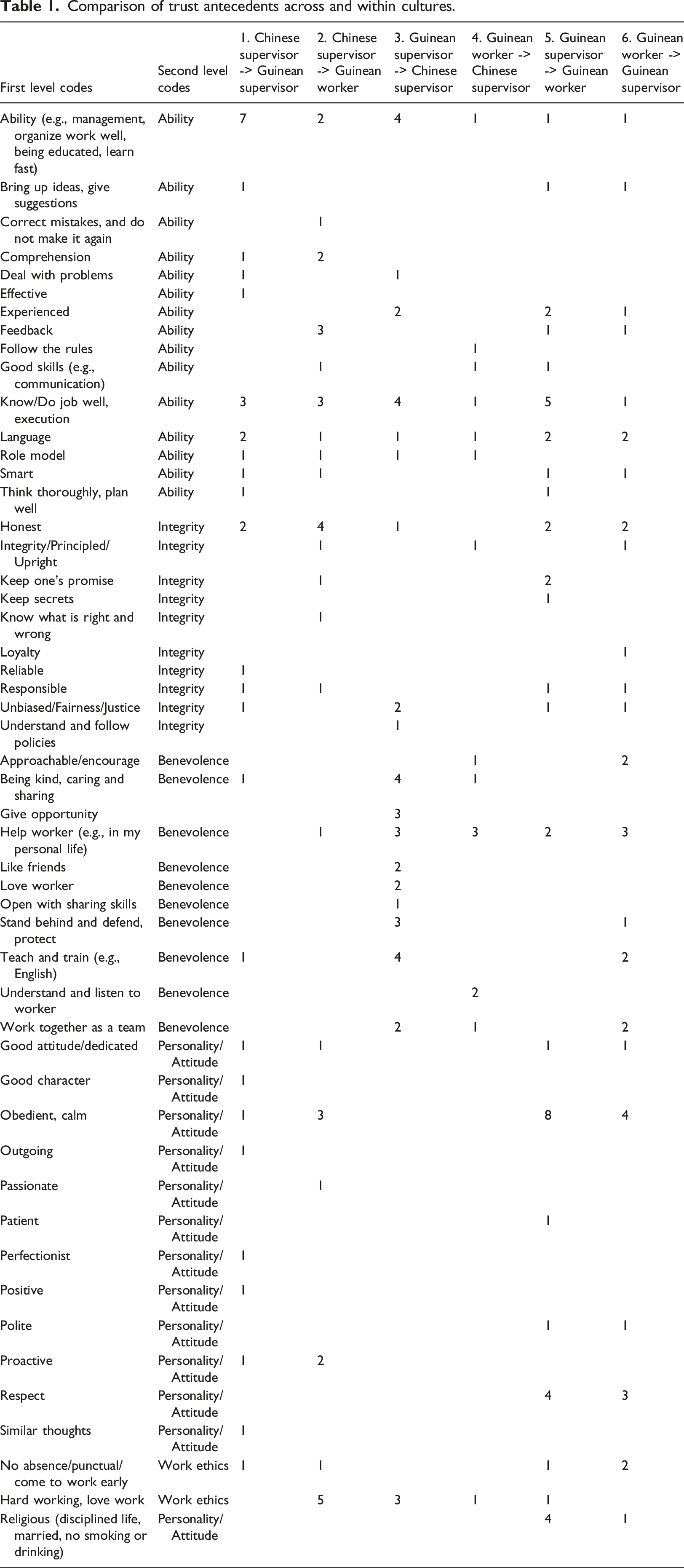
In terms of Guinean supervisor’s trust towards Chinese supervisor and Guinean worker’s trust towards Chinese supervisor, benevolence was most salient, followed by ability as the second most important factor. Integrity was the least important among the three categories. In addition, reciprocity, transference, and personal characteristics also played a role in the trust building from Guinean to Chinese supervisors. The data of Guinean supervisor’s trust antecedents was much richer than Guinean workers as the interaction with Chinese supervisors was more for Guinean supervisors than for Guinean workers.
In comparing Chinese supervisors’ trust in Guineans and Guineans’ trust of Chinese supervisors, we found that benevolence was mentioned much more by Guinean supervisors, which suggested that the trust building from lower power to higher power foci relies more on benevolence compared with from higher power to lower power foci. Besides the three main categories of trust antecedents (i.e., ability, benevolence, and integrity), personal characteristics, attitude towards work and obedience were mentioned in both conditions.
Hence, it appeared that for Chinese supervisors to build trust with Guineans, ability and/or integrity are important factors. However, when Guineans build trust with Chinese supervisors, benevolence is the most important, followed by ability.
A few key factors were quite unique in the trust relationship between them: devotion to the religion, whether they lead a disciplined life, and whether they respect/obey leaders and rules. It was also interesting that punctuality was mentioned in both conditions. It may be because their perception of Chinese supervisors played a role here: they believed that Chinese supervisors cared a lot about punctuality or even enforce it. To follow the rules and Chinese supervisors’ orders, so that the Guineans also took punctuality as a key antecedent to trust. The difference between the two cases in the within culture context was that the benevolence played a more important role in the trust generation from Guinean workers to Guinean supervisors than the other way around. In general, benevolence’s weight was heavier in the lower position’s trust generation towards the higher position in the power ranking.
Comparisons of trust in organization (TIO)
We also examined if there were differences across Chinese and Guineans in their TIO. Almost all the participants trust the organization and they provided various reasons why. The reasons for trust were not very different among the Guineans. For example, the organization changed their lives and living condition, helped them to solve problems, provided good salary, developed Guinea, had a good future development are the most mentioned reasons. The results echoed the finding of Jaskeviciute et al. (2021), which also found that ensuring employee well-being led to increased organizational trust.
However, the reasons for TIO for the Chinese differ across sectors, perhaps due to different composition of employees. Employees from Sector 1 are from different parts of China, and they did not know each other before the current assignment. For this group of Chinese employees, the organization culture played a key role here in generating TIO, as many of the Chinese employees mentioned how the company takes care of them and makes them feel like home. On the other hand, most of the employees from Sector 2.1 already knew each other for a long time before coming to Guinea, so they have different rationale towards TIO, focusing on the existing relationship in China before they came to Guinea, and the advantages of the current organization compared with the previous organization in China. Also, the organization culture of the two sectors may differ from each other as Sector 1 was originally set up as a private enterprise whereas Sector 2.1 is a joint venture between a private enterprise and a state-owned enterprise.
In terms of trust outcomes, Guineans mentioned they would work hard, be loyal to the organization, be cautious at work and do what was required to do when they trust the organization.
Discussion
Study 1 laid the foundation in understanding the trust building process, trust antecedents between and across cultures in the Chinese MNC operating in Guinea. From the insights derived from the results and the literature review, we developed the theoretical model in Study 2.
Tan and Tan (2000) found that trust in supervisor is more strongly associated with proximal variable of the supervisors while trust in organization is more strongly associated with organizational variables such as perceived organizational support. Kaasa and Andriani (2022) suggested that individuals trust institutions less in the cultural context with large power distance. In Study 1, we found similar results. We found that Guinean subordinate’s trust in supervisor is mainly because of their personal characteristics like ability, integrity and benevolence as shown in Table 1, while their trust in organization is mainly because of the organization’s development and support. On the other hand, supervisors are part of the organization and are one of the important representatives of the organization. Hence with the spill-over effects, we believe that Guinean subordinate’s trust in supervisor, both Guinean and Chinese, can increase their trust in organization. Although there is limited research on the relationship between interpersonal trust and institutional trust, based on our observation in Study 1 and the small stream of work, we propose: Hypothesis 1: Guinean subordinate’s trust in (a) Guinean supervisor, and (b) Chinese supervisor is positively related to Guinean subordinate’s trust in organization.
Second, as established in the literature, trust in supervisor can lead to positive outcomes such as better performance. For example, Goris et al. (2003) found that trust in superiors is associated with improved job performance and satisfaction. Yu (2022) found that organizational justice affects organizational citizenship behaviour through supervisor-subordinate guanxi, which leads to trust, and organizational citizenship behaviours as a result. When Guinean workers were asked what happens when they trust the organization, many answered they would work hard, do what is required to do well, be loyal and cautious. In addition, when they were asked what they will do if they trust the supervisors, many answered they would be more willing to talk with them. By comparing the outcomes of trust in supervisor and trust in organization in our context in Study 1, trust in organization is a more direct antecedent of better performance. Thus, we propose that: Hypothesis 2: Guinean subordinate’s trust in organization mediates the relationship between Guinean subordinate’s trust in supervisor and Guinean subordinate’s performance.
Third, as Guinean workers’ communication with Chinese supervisors are mostly through Guinean supervisors it is likely that the team’s communication and work efficiency is affected by Guinean supervisor’s trust in Chinese supervisor. Guinean supervisor’s trust in Chinese supervisor may not affect Guinean subordinate’s performance directly, but it can moderate the relationship between Guinean subordinate’s trust in organization and their performance. Thus: Hypothesis 3: Guinean supervisor’s trust in Chinese supervisor is positively related to Guinean subordinate’s trust in organization.
We also found in Study 1 that the antecedents of Guinean supervisor’s trust towards Chinese supervisors include an interesting construct: reciprocity, meaning when they felt they are trusted by Chinese supervisors, they are more likely to trust the Chinese supervisors. So, we include the following hypothesis: Hypothesis 4: Guineas supervisor’s trust in Chinese supervisor moderates the positive relationship between Guinean subordinate’s trust in organization and Guinean subordinate’s performance such that the positive relationship between Guinean subordinate’s trust in organization and the performance will be stronger when the trust in Chinese supervisor is high.
Study 2
Methods
Sample and procedure
The survey was conducted within the same sectors as Study 1; SMB (mining) sector (Sector 1) and WAP1 (port) sector (Sector 2.1). In addition, we also added participants from WAP2 sector (Sector 2.2). Further, mong the 10 Guinean workers from WAP1 who were interviewed in study 1, only one also completed the survey in study 2. We selected two hundred Guinean workers out of 2613 Guinean employees from all three sectors to conduct the study, with a final sample of 182 employees.
To facilitate the survey procedure, the selection criteria are that these employees should have received basic education and understand French. We were also restricted by the COVID-19 pandemic situation and work arrangement so that we only focused on employees who were on the site at the time when we conducted the survey. Based on the sample of Guinean workers, we located the corresponding supervisors of each Guinean subordinate to complete the trust survey. The supervisors included both Chinese supervisors and Guinean supervisors. Depending on which sector the employees were from, they could have two (1 Chinese supervisor and 1 Guinean supervisor) to six supervisors (4 Chinese supervisors and 2 Guinean supervisors). In sum, in Sector 1, a total of 81 Guinean workers participated in the study together with 12 Chinese supervisors and 16 Guinean supervisors. In Sector 2.1, there are 31 Guinean workers, 3 Chinese supervisors and 8 Guinean supervisor, and in Sector 2.2., 70 Guinean workers, 4 Chinese supervisors and 7 Guinean supervisors. In addition, each supervisor evaluated the performance of the Guinean workers under them. All instruments evaluated by the Chinese supervisors are administered in Chinese and followed the back-translation procedure by Brislin (1970) while the other instruments are back-translated into French, again, following Brislin (1970).
Measures
Because each Guinean worker has more than one direct supervisor, there are multiple pairs of trust relationships between the Guinean workers and their supervisors, and multiple trust relationships between the Guinean supervisors and Chinese supervisors from the same team. For the measure of Guinean worker’s trust to supervisors, we selected the Guinean worker’s trust towards the main Chinese supervisor and the main Guinean supervisor. This is because the main supervisor, be it Chinese or Guinean, has the most oversight over the performance of the workers. The Cronbach’s alpha for Guinean worker trust in Guinean supervisor is 0.78.
The selection of the Chinese supervisor in the measurement of Guinean supervisor trust in Chinese supervisor is more complex as it involves multiple Chinese supervisors. In Sector 1, we chose the main Chinese supervisor as the referent as there are specific Chinese supervisors and Guinean supervisors working in pairs dedicated to each team. In Sector 2, Chinese supervisors oversee the operation across all the teams. While the Guinean supervisors are assigned to each specific team, we are unable to observe the daily operation details of how the workload is assigned to each Chinese supervisor. For Sector 2.1 and Sector 2.2, instead of choosing the chief Chinese supervisors, we chose the second Chinese supervisor in Sector 2.1 and Sector 2.2. Further, item 4 (I would be comfortable having my supervisor have access to information that could adversely affect my reputation) did not load onto the trust scale with the other three items. We believe that the question is inherently challenging and hence it was deleted. The Cronbach’s alpha was 0.73 for Guinean supervisor trust in Chinese supervisor overall.
As each Guinean subordinate has 2 to 6 direct supervisors. We asked every supervisor on site to provide ratings. We then group the ratings into the ones given by Chinese supervisors versus those given by Guinean supervisors. To make sure there is consistency among different raters when they rate different employees so that we can take average of the different supervisors’ ratings, ICC1 score was calculated for each sector, and for each group of Chinese and Guinean supervisors. According to James (1982), 0.12 is a reasonable cutoff and all the ICC1 scores are acceptable, except for the Chinese raters in Sector 2.1, all the other ICC1 scores are acceptable. The very low ICC1 score for Chinese raters from Sector 2.1 might be that although Chinese supervisors are the direct supervisors of the Guinea subordinates, because of the language barrier and culture gap, communications are mostly done through Guinea supervisors. Hence Chinese supervisors may not be the best raters for Guinea subordinate’s performance, compared with Guinea supervisors. Thus, we chose the group of Guinea supervisors’ ratings from each sector, take the average of the Guinea supervisors’ ratings, and combine the sectors as the measure of Guinea subordinate’s performance.
Lastly, to ensure the reliability of the 4-item performance scale so that we can take the average of the four items, we check the Cronbach’s alpha for the combined performance ratings. The score is 0.85 which shows sufficient reliability.
Results
Zero-order correlations and descriptive statistics of Study 2 variables (N = 182).

* p < .05. ** p < .01.
Confirmatory factor analysis and structural model fit of study 2 variables a .
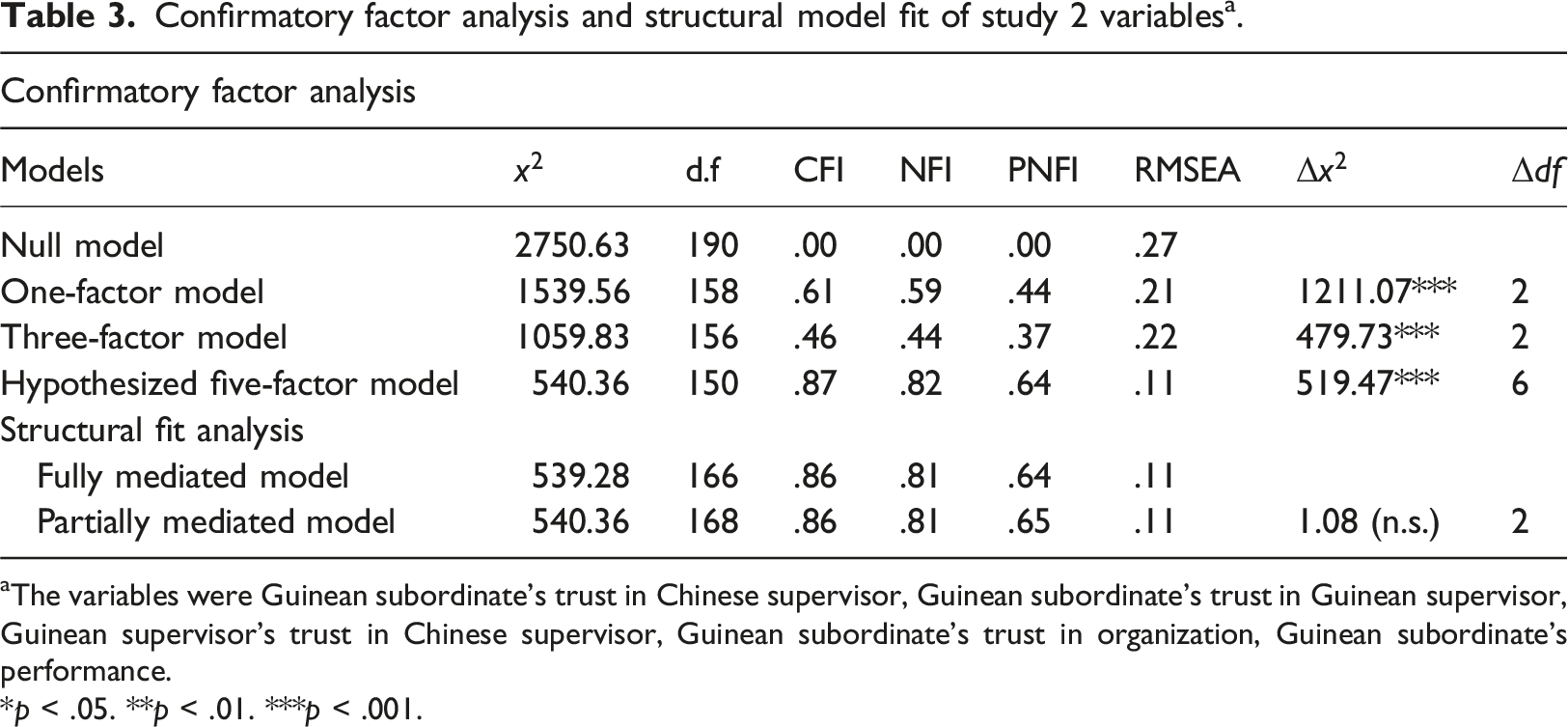
aThe variables were Guinean subordinate’s trust in Chinese supervisor, Guinean subordinate’s trust in Guinean supervisor, Guinean supervisor’s trust in Chinese supervisor, Guinean subordinate’s trust in organization, Guinean subordinate’s performance.
*p < .05. **p < .01. ***p < .001.
Figure 1 presents the final results. Hypothesis 1 asserts that Guinean subordinate’s trust in (a) Guinean supervisor, and (b) Chinese supervisor, is positively related to Guinean subordinate’s trust in organization. Both the zero-order correlation for Guinean subordinate’s trust in Guinean supervisor with Guinean’s trust in organization is positive and significant (r = 0.66, p < .05) and that of Guinean subordinate’s trust in Chinese supervisor and their trust in organization is also positive and significant (r = 0.46, p < .05). However, in the structural model, Guinean subordinate’s trust in Chinese supervisor became non-significant. Thus, Hypothesis 1 is partially supported.
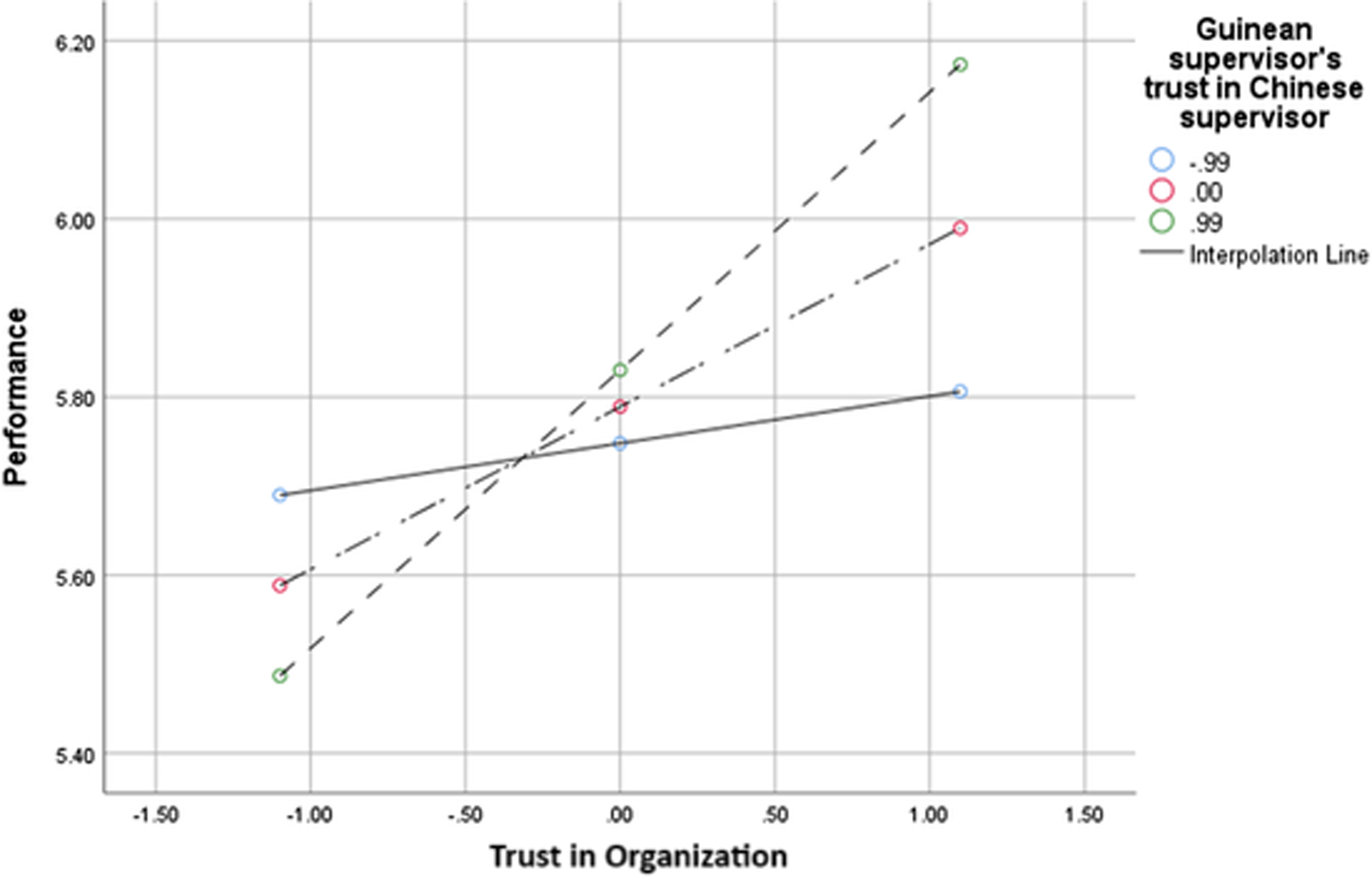
Hypothesis 2 is supported with the fully mediated model where Guinean subordinate’s trust in organization fully mediated the path from Guinean subordinate’s trust in Guinean supervisor to their performance. Hypothesis 3 is supported as we found a positive and significant path estimate (b = 0.30, p < .05) between Guinean supervisor’s trust in Chinese supervisor and Guinean subordinate’s trust in organization. For Hypothesis 4, we regressed the independent variable (Guinean subordinate’s trust in organization), the moderator (Guinean supervisor’s trust in Chinese supervisor) and the interaction term on the dependent variable (Guinean subordinate’s performance). We found the interaction term to be significantly related with Guinean subordinate’s performance (β = 0.23, p < 0.5), and that Guinean subordinate’s trust in organization is also significantly related with Guinean subordinate’s performance (β = 0.29, p < .05). We plotted the moderation effect at plus and minus one standard deviation and found the slope to be positive, which means the higher Guinean subordinate’s trust in organization, the higher Guinean subordinate’s performance. The simple slopes analysis shows that at the low value of the moderator (−0.99), the effect of the DV on IV (0.05) is smaller than the effect (0.31) at the high value of the moderator (0.99), All the effects are significant. The results indicate that Guinean supervisor's trust in Chinese supervisor positively moderates the relationship between Guinean subordinate’s trust in organization and Guinean subordinate’s performance, as shown in Figure 2. Structural model coefficients for hypothesized model in study 2. Moderating effect of Guinea Supervisor’s trust in Chinese supervisor on the relationship between guinean trust in organization and guinean performance.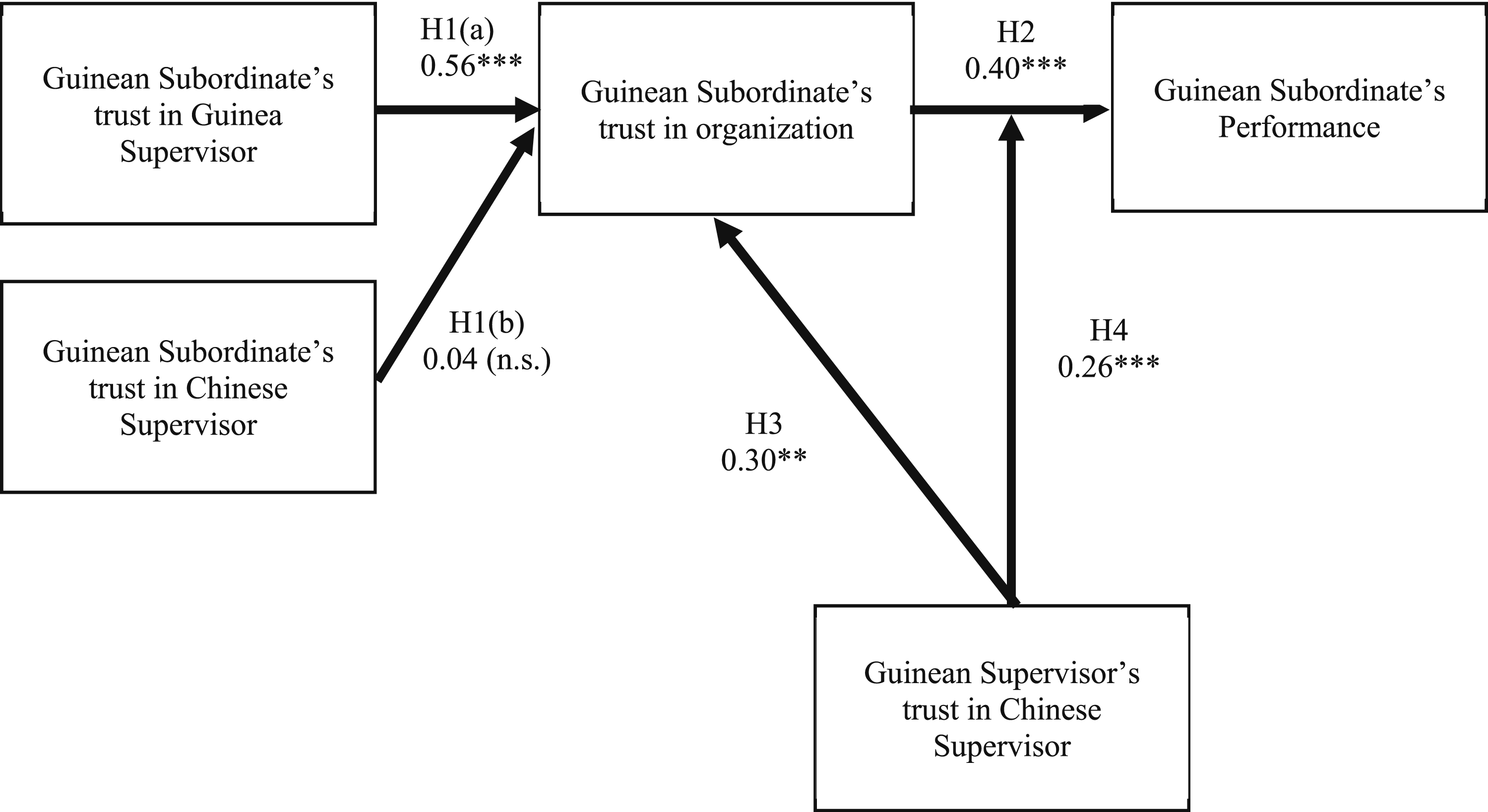
Discussion and conclusion
In Study 1, we find that Chinese people value long-term relationships, and their trust is built on their long-term observations. On the other hand, Guineans mentioned largely integrity and obedience, which may be due to hierarchy and high-power distance in the local context, both in the society or in the organization. Guinean workers are influenced by both the societal culture and the organizational culture. The organization is Chinese-dominated and Chinese culture is high power distance and hierarchical. There was no previous literature documenting the Guinea societal culture, but according to Chinese interviewees, their observation of Guineans is also quite hierarchical. We also find that there is a mixed view of Guineans with both high and low propensity to trust others; while the perception of Chinese is quite consistent: strict, not easy to trust, value punctuality. When it comes to trust antecedents, the Chinese trust Guinean supervisor and Guinean workers because of factors of integrity and ability but not so much of benevolence. And depending on the role (Guinean supervisor or worker/subordinate), the Chinese people put more weight on either ability or integrity. Guinean supervisors trust Chinese supervisors because of reciprocity, ability, role model and some benevolence. On the other hand, the within culture trust antecedents between Guinean supervisor and Guinean worker consist of understanding of religion, disciplined life, respect, obedience, and punctuality. These observations are particularly relevant in the context of Chinese MNCs expanding in Africa, offering a new perspective on cultural integration and management styles.
The results in Study 2 confirmed our proposed model, that both the cross-culture and within-culture trust relationships play important roles in Guinean subordinate’s performance. To be specific, Guinean subordinate’s trust in Guinean supervisor is positively related with Guinean subordinate’s trust in organization. Guinean subordinate’s trust in organization fully mediates the relationship between Guinean subordinate’s trust in organization and Guinean subordinate’s performance. Guinean supervisor’s trust in Chinese supervisor positively moderates the relationship between Guinean subordinate’s trust in organization and their performance, and it also directly impacts Guinean subordinate’s trust in organization positively. These findings contribute to a deeper understanding of how trust-building across and within cultures can enhance employee performance in multinational environments.
Implications for theory and practice
There are a number of takeaways that contribute to the theory and that would benefit management practice. First, in terms of contributions to the trust literature, we found unique trust antecedents besides ability, integrity, and benevolence, for example, obedience, respect, devotion to religion, reciprocity, etc. In the study. Interestingly, obedience only appears in the trust building between Guineans, but not in the trust building between Chinese and Guinean. We also found benevolence to be the key factor in fostering trust of lower rank employees in higher rank employees, but not the other way around. Ability is quite salient in trust formation in both directions, from lower rank to higher rank and vice versa, and it is also salient in the trust relationship within and across cultures. In addition, theoretically, our study showed that in the context of expatriation, the ability, benevolence, and integrity (ABI) model of trust is applicable although the emphasis are different. Second, Guinean trust in Chinese supervisor plays both a direct role in affecting Guinean subordinate trust in organization and a moderating role in the Guinean subordinate trust in organization and performance relationship. Theoretically, trust therefore can be transmitted directly, while enhancing relationships at the same time. Trust therefore plays a transference role and to build trust in organization, supervisors, particularly expatriate supervisors can and do play a significant role even though they may not directly supervise the HCNs, and in this instance, the Guinean subordinates. Third, in the context of Africa and the expatriation of Chinese nationals, the present study showed that enabling a better life for the locals in Africa (and in Guinea in this context) enable the development of soft power for China in shaping friendly relations. The fact that participants in the study allude to trusting the organization because the organization enabled a better life for them and for Guinea clearly points to the good organizations can do in investing in developing countries such as Guinea in Africa. We have therefore contributed to the expatriation literature by illustrating a different way to wield power and to influence.
When it comes to the implications for practice, the study offers valuable strategies for MNCs, particularly Chinese companies in Africa, to foster trust through culturally sensitive approaches. For example, to foster the trust from Guineans to Chinese supervisors, benevolence is the key, followed by ability, and reciprocity also plays a role. Thus, to build up a strong trust relationship with Guineans, besides demonstrating their abilities in doing the job and management, Chinese supervisors should show their care for Guineans’ well-being and their kindness. In addition, they should show Guineans their trust in them. These can be incorporated into the expatriates’ training program. Last, the empirical test of the trust-performance relationship provides a unique observation of how the cross-culture and within-culture trust in supervisor, no matter Chinese supervisors or Guinean supervisors, eventually translates to a better individual performance through different underlying mechanism. Interestingly, both the trust in supervisor and trust in organization are examined. We demonstrate that they are highly related, and trust organization acts as the mediator between Guinean subordinate’s trust in their direct supervisors. As the antecedents and outcomes of trust in supervisors and trust in organization are different, and the two types of trust both play important roles in enhancing employees’ performance, organizations should try to foster trust at different levels. Guinean supervisor’s trust in Chinese supervisor moderates the positive relationship between Guinean subordinate’s trust in organization. The results further emphasize the importance of both cross-culture and within-culture trust building in cross-cultural context.
Limitations of the current study
There are a few limitations of the current study. First, the samples in both studies do not include the Guinean workers who only speak the local Susu language. Although we statistically demonstrated that the sample is representative of the population in terms of the demographics, there is still concern that the language barrier may cause differences in our findings with respect to the trust building process. One way to verify this is to randomly select a few more Guineans who can only speak Susu and conduct the interviews with them to compare with the current study in future studies.
Second, as research on the Guinea culture is still nascent, there is a lack of in-depth understanding of the Guinean societal culture to explain some of the phenomena we observed. To better understand how the local culture plays the role in the trust building process, we may need to examine the Guinea culture in depth, with secondary data.
Third, the complexity of the organizational structure, for example, each Guinean subordinate has multiple supervisors, created challenges in the data analysis. In addition, onsite contextual information needs to be considered. For example, Chinese supervisors may not be familiar with all the Guinean workers to give a valid performance rating because of the language barrier and the fact that the communication is usually through Guinean supervisors.
Last, but not least, because of Guineans’ lack of familiarity with survey questions and language barrier, the answers could be biased, which may cause lower reliabilities in some of the scales used, despite back-translation.
Footnotes
Declaration of conflicting interests
The author(s) declared no potential conflicts of interest with respect to the research, authorship, and/or publication of this article.
Funding
The author(s) received no financial support for the research, authorship, and/or publication of this article.
