







Abstract
The objective of this article is to show the effects of the use of Free Association Technique on the elicitation of brand emotions and functional associations across a Western and an East Asian culture as well as to identify and test underlying mechanisms. The use of Western techniques for eliciting brand emotions may prove challenging for marketers in East Asian markets because of the different styles of thinking and feeling of consumers in the West versus East Asia. This investigation focuses on the role of visual context (individual vs social), in which brands are presented when eliciting brand associations in the West and in East Asia. The study shows that elicitation context significantly influences the type of brand emotions and functional associations across two distinct cultures: Norway and Thailand. Consumers’ self-construal and thinking style mediate the effects of culture, as interdependent self-construal and holistic thinking explain more context-dependent brand emotions generated by Thai than Norwegian consumers. This research has important implications for studying and managing brand associations and emotions across markets. The traditional view of brands as possessing abstract, stable associations, and emotions should be reconsidered in the East Asian cultural context. Marketing managers should adapt established Western elicitation techniques to the characteristics of East Asian consumers to increase their validity.
Brand associations create expectations of brand performance, which in turn influence the acceptance and rejection of brands. Thus, the accurate measurement and monitoring of brand associations is imperative to brand managers (e.g., Keller, 1993). The measurement of brand associations is often divided into two phases: (1) elicitation of brand associations and (2) measurement of various dimensions of elicited associations (e.g., strength, favorability, uniqueness) (Keller, 1993). The purpose of the first (qualitative) phase is to gain insight into the nature of a brand’s set of association, while the purpose of the second is to ascertain key dimensions producing differential consumer responses (Keller, 1993). The strongest brand associations tend to be more accessible in memory. According to Fishbein and Ajzen (1972), three to five most salient associations or beliefs typically dominate the formation of attitudes and purchase intentions.
More recent research has directed attention to the study of emotions and emotional constructs (e.g., brand love) (Bagozzi, Batra, & Ahuvia, 2017; Batra, Ahuvia, & Bagozzi, 2012; Carroll & Ahuvia, 2006) in judgment and decision-making. Extant studies have shown that, rather than relying on cognitive beliefs, consumers often make fast decisions based on salient emotions triggered by marketing stimuli (Brakus, Joško Schmitt, & Zarantonello, 2009; Kwortnik & Ross, 2007). When consumers engage in more elaborate evaluations, the salient emotions triggered initially often influence subsequent cognitive processing (Kwortnik & Ross, 2007). Thus, marketers should be particularly aware of the most salient emotions triggered by a brand name or logo. Previous research has presented and tested several techniques for eliciting salient cognitive brand associations, with Free Association Technique (FAT) being one of the most commonly used (e.g., Keller, 1993; Supphellen, 2000). However, less is known about elicitation of brand emotions and how to elicit valid emotions across cultures. East Asian markets have become extremely important for international brands. Despite growing research on various aspects of brands in East Asia (Chang & Lii, 2008; Eisingerich & Rubera, 2010; Shukla, Singh, & Banerjee, 2015), our understanding of how to manage brand emotions in this region is also limited. Also, while existing studies have examined cross-cultural equivalence of such methodological factors as survey response styles and self-reports (Beuthner, Friedrich, Herbes, & Ramme, 2018; Schwarz, 2003), cross-cultural validity of elicitation techniques is not well understood. Indeed, we have reasons to believe that common approaches to elicitation, such as FAT, that work well in Western markets may not necessarily work well in East Asian markets. This is because these approaches normally do not incorporate the context in which consumers may experience brands. Specifically, according to Western theories core brands associations form the basis for brand positioning (Keller, 1993). These are defined as 5–10 abstract associations that capture points of parity and points of difference of the brand. To elicit top-of-mind core brand associations and create a mental map of the brand, the extant literature, for example, suggests asking consumers: “when you think of this brand, what comes to mind?” (Keller, 2008). Notably, neither the definition of brand associations nor one of the most common elicitation techniques includes the context in which the brand is presented.
East Asians attend to the brand context to a greater extent than Westerners (Masuda & Nisbett, 2001). Also, they integrate brand with contextual information when forming brand evaluations (Riemer, Shavitt, Koo, & Markus, 2014). Therefore, not including context in elicitation of core brand associations may result in failing to identify valid points of parity and points of difference that drive consumer outcomes. To address this limitation, we test the effectiveness of an established Western elicitation technique and examine the role of context in eliciting brand emotions in East Asia. We develop a set of hypotheses on the effects of elicitation context in Western versus East Asian markets and test the hypotheses on matched samples of consumers from Norway and Thailand. The results show that elicitation context is highly important in Thailand but has no effect in Norway. In East Asia, context cues stimulate elicitation of certain types of brand emotions but hamper elicitation of functional brand benefits. Moreover, we find that higher levels of interdependent self-construal and holistic thinking style in Thailand partly explain the different effects of context for Thai and Scandinavian consumers. Finally, we offer practical guidelines for eliciting salient brand emotions in the two regions.
Theory and hypotheses development
Brand benefits and brand emotions
Keller (1993) developed a typology of brand associations with three broad categories: attributes, benefits, and attitudes. Furthermore, based on the work of Park, Jaworski, and MacInnis (1986), the typology distinguishes among three types of benefits: (1) functional, (2) symbolic, and (3) experiential. Functional benefits refer to the problem-solving capacities of a brand and usually pertain to the core functions of a product and the category to which it belongs. For example, a major functional benefit for Colgate is to prevent cavities, which is also the basic function of the toothpaste category. Symbolic benefits are the traits or user characteristics associated with a brand. Choosing and using a specific brand may send signals to others about the user’s own self-concept, such as being sophisticated, up to date, sporty, or intellectual. Symbolic benefits relate to consumers’ needs for self-enhancement, group membership, or ego-identification (Keller, 1993; Park et al., 1986). Finally, experiential brand benefits entail the sensory pleasure or cognitive stimulation of using the brand (e.g., taste of a coffee brand) and usually stem from experiences of product-related attributes (e.g., Kenyan quality beans).
Brand emotions are different from brand benefits, though the two are typically linked in associative memory. Brand usage and experience may trigger emotional reactions, such as pleasure, pride, peace of mind, and so on, that become linked to the brand name in memory. When exposed to the brand name on later occasions, people’s emotions are activated spontaneously and influence choice and further cognitive processing of information (Brakus et al., 2009; Kwortnik & Ross, 2007). Furthermore, brand emotions may be triggered when consumers evoke cognitive brand associations.
Because salient emotions influence brand decisions and cognition, brand managers need accurate information about the emotions most strongly linked to brand elements (e.g., name, logo, and jingle) in memory. Prior studies have primarily examined the effects of culture on the role of various types of brands without specifically focusing on brand emotions (Christodoulides, Cadogan, & Veloutsou, 2015; Hsieh, 2002; Schmitt & Pan, 1994). As such, research on international brand management is largely silent on the issue of how to elicit brand emotions across cultures. Given cultural differences, applying the same methods across cultures may not generate valid results. More specifically, extant conceptualizations of brand emotions (Keller, 2008) reflect abstract meanings related to the brand and are independent of the surrounding context in which consumers encounter a brand at a certain time. Western methods do not account for differences in the role of context between East Asian and Western consumers.
Differences between Western and East Asian cultures
Culture represents a set of attitudes, beliefs, norms, roles, and values that distinguish members of one society from another (Triandis, 1996). As culture structures the social world of consumers (Triandis, 1996), brand emotions are likely to be subject to cultural influences. Previous research on cross-cultural psychology suggests that systematic differences in the social orientation of emotional responses are associated with differences in self-construal between East Asians and Westerners (Mesquita, 2001).
Self-construal is the definition and knowledge of the self (Sirgy, 1982). Culture influences the type of chronic self-construal (definition of self that is stable across situations) (Sirgy, 1982) of its members. Independent self-construal is common in Western cultures, which define individuals in terms of the attributes that make them unique and separate one person from another (Wang, Bristol, Mowen, & Chakraborty, 2000). Interdependent self-construal is common for members of East Asian cultures, which define individuals in terms of their relationships and group memberships and thus embed them within a larger social whole.
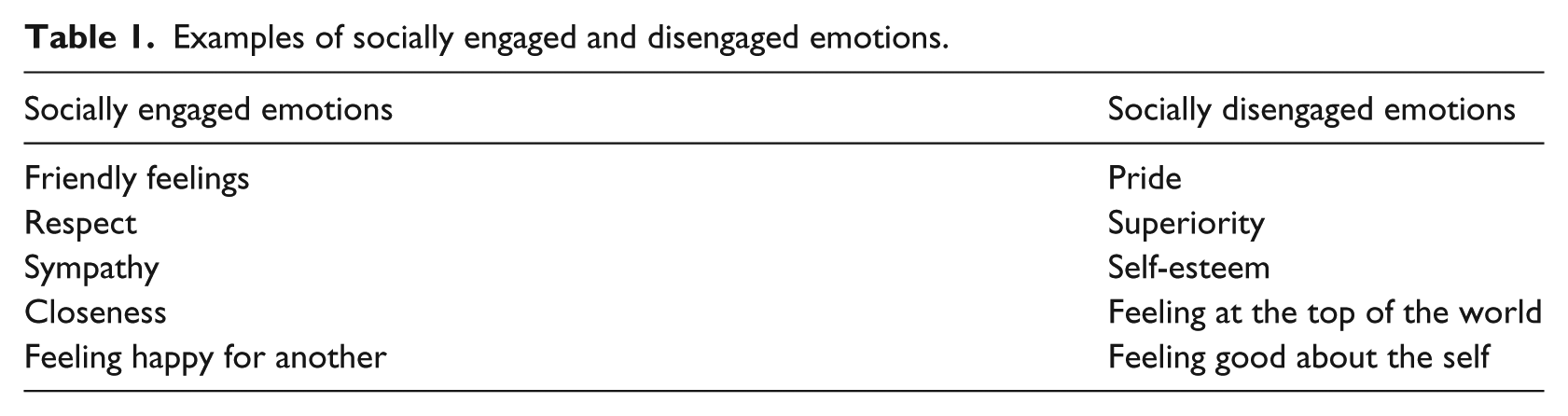
Individuals in interdependent cultures (East Asia) are likely to experience more socially engaged emotions than Westerners because of a closer connectedness with others (Mesquita, 2001). Socially engaged emotions promote harmony and embed the self in a close relationship. Conversely, socially disengaged emotions should dominate in Western cultures because of individuals’ loose connectedness with others in these societies (see Table 1). Such emotions promote consumers’ positive internal attributes, individual identity, and disengage from others. In support of this proposition, in Kitayama, Mesquita, and Karasawa’s (2006) study, Japanese (interdependents) reported more socially engaged emotions than Americans (independents) when asked to describe real emotional experiences. In contrast, Americans’ descriptions of emotional experiences contained more socially disengaged emotions.
Examples of socially engaged and disengaged emotions.
This difference in self-concept between Westerners and East Asians affects the nature and scope of cognition and information processing in the two regions (Ng & Houston, 2006; Nisbett, Peng, Choi, & Norenzayan, 2001). Prior research has classified East Asians as holistic/relational thinkers and Westerners as analytic/categorical thinkers (Masuda & Nisbett, 2001). The former thinking style implies attention to background elements and relationships between background elements and focal objects (“The logo of the brand is located on the glass wall of a store”) and latter to focal objects (“The logo of this brand looks like a propeller”). Hence, we expect that thinking style will also play an important role in brand emotions elicitation.
Effects of culture and context on elicitation outcomes
Recent research has advanced a normative-contextual model that may better explain the process of attitude formation in non-Western cultural contexts compared with a Western-focused, person-centric model (Riemer et al., 2014). The normative-contextual model suggests that attitudes in non-Western contexts are highly malleable, reflecting normative or contextual influences, and may not be cultivated at all. By contrast, traditional person-centric attitude models argue that judgment is primarily influenced by consumers’ internal states (e.g., preferences are stable across contexts and usage situations) (Fishbein & Ajzen, 1972). In the context of brand association research, this would imply that consumers in East Asia are less likely than Western consumers to develop abstract brand associations that are stable across contexts. Accordingly, emotions in non-Western contexts may largely be influenced by norms or context. This is because non-Western consumers’ integration of normative or contextual influences into judgment is likely to trigger emotions that reflect these influences. In the West, emotions would be internal states that are stable across contexts.
This is consistent with Nisbett et al.’s (2001) characterization of East Asians by field-dependent information processing and Westerners by field-independent information processing.
From this discussion, we expect common approaches for eliciting brand associations to have different results in East Asia than in the West. In particular, we expect that responses in East Asia will be highly dependent on the context of elicitation interviews while context will have less impact for Western consumers.
Rather than attending exclusively to objects (e.g., brands) in a given situation, East Asians tend to explore the context in which the object is present and the relationships between the object and contextual elements. Consequently, memories of objects (e.g., brand associations) and emotional responses contain more context information and more exemplars—that is, specific remembered instances, such as specific usage situations or experiences of a brand (Nisbett et al., 2001). According to the normative-contextual model (Riemer et al., 2014), brand associations in East Asia may reflect both meanings internal to consumer and meanings originating from the surrounding environment. The same rationale is likely to apply to brand emotions. Thus, brand emotions may be highly malleable across different environments in which a brand is exposed.
Formation of brand associations and emotions in the West follows the person-centric model (Riemer et al., 2014) in which associations reflect meanings internal to consumers that are stable across contexts and not influenced by the surrounding environment. Current practice in Western markets is consistent with this reasoning. For example, brand researchers often use the FAT to elicit brand associations (Keller, 1993). With FAT, researchers ask participants to “free-wheel” their mind and to report any thoughts or impressions that come to mind when exposed to a stimulus cue (e.g., brand name). No context is provided, as no context is required. In this investigation, we propose applying FAT to elicit brand emotions. Direct elicitation of emotions may be vulnerable to demand effects (Supphellen, 2000). Therefore, asking participants to “free-wheel” their mind and then identifying emotions in the responses may be a more valid approach. However, for East Asian consumers, this approach is probably not as appropriate as for Western consumers without adaptation.
First, we expect that to evoke brand emotions in East Asia, context-free elicitation is less suitable than stimuli in which context is provided, such as a picture of a person. This is because brand emotions are fairly closely intertwined with the surrounding environment. Therefore, for East Asians (vs Westerners), brand emotions are likely to reflect meanings from the surrounding context, and different types of contexts (individual vs social) for brand exposure may trigger different types of brand emotions. Specifically, individual context would feature a brand in an environment with a single individual. Conversely, social context would portray a brand in an environment with at least two individuals. Thus:
H1: An individual elicitation context will create more socially disengaged brand emotions (SDBE) than no elicitation context in East Asia, but not in the West.
H2: A social elicitation context will create more socially engaged brand emotions (SEBE) in East Asia, but not in the West.
Second, while context cues may improve the validity of elicitation of brand emotions in East Asia, we expect that such cues may actually hamper the elicitation of functional brand associations. This is because the latter are strongly related to objects (Colgate) and object categories (e.g., toothpaste). The first thing people learn about objects, regardless of culture, is their basic functions (Barsalou, 1983; Keller, 1993). For example, they learn that toothpaste helps avoid cavities and then learn about additional benefits, such as fresh breath and white teeth, but the defining benefit is the basic functional capacity of the object, which is likely to be invariant across cultures. Functional associations are less connected to the self (vs object). Therefore, context is less likely to be the source of functional associations in context-dependent cultures. However, when individual or social context cues are used in elicitation sessions in East Asia, consumers may expend significant effort to integrate internal and contextual information when forming integrated brand associations (Riemer et al., 2014). Therefore, the integrated associations become more accessible at the expense of object-related information. Thus, context information may reduce the probability of evoking functional brand associations in East Asia. Hence, we predict:
H3: Using an individual context or social context (vs no context) has a negative effect on the number of functional brand associations elicited in East Asia, but not in the West.
Third, our reasoning behind the differences in elicitation of brand emotions between Western and East Asian consumers rests partly on the different concepts of self and thinking styles in the two regions. As East Asians possess interdependent self-construal, they likely experience more SEBEs and are more attuned to these emotions in their environment than Westerners. We particularly expect East Asians to experience these emotions in social contexts because connectedness with others is most salient in East Asian countries in these contexts. Therefore, we propose self-construal as a mediator of the effects of culture on the SEBEs elicited in a social context:
H4: Self-construal will mediate the effects of culture on the number of elicited SEBEs when brands are presented in a social context.
In an individual context, connectedness with others is less salient for East Asians than in a social context. Therefore, self-construal is less likely to explain the experience of brand emotions in this case. However, given their higher context sensitivity, East Asians are more likely to integrate contextual information with brand-related information than Westerners (Nisbett et al., 2001) in an individual context. From this reasoning, we predict that holistic thinking will mediate the experience of SDBEs across East Asian and Western cultures in an individual context (Figure 1):
H5: Holistic thinking will mediate the effects of culture on the number of elicited SDBEs when brands are presented in an individual context.
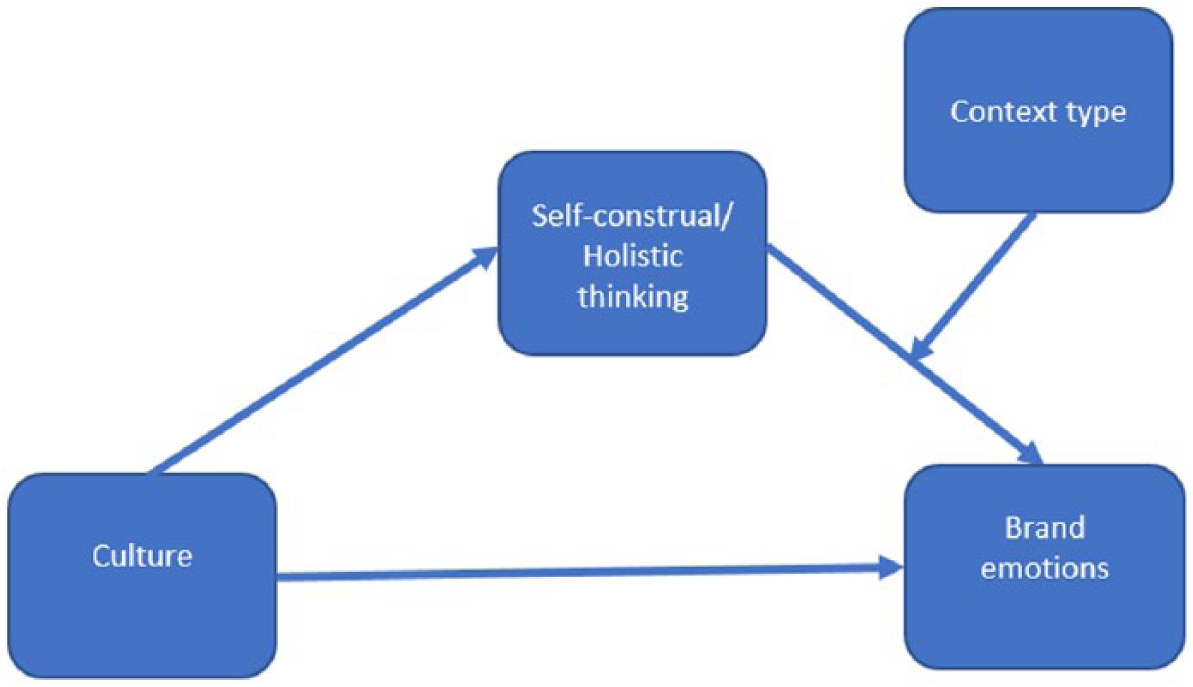
Conceptual model.
Method
Extant research has shown that Thai consumers predominantly possess interdependent self-construal (Polyorat & Alden, 2005) while Norwegians possess independent self-construal (Silvera & Seger, 2004). These studies are further supported by the research showing that Norway scores higher on individualism (index - 69) vs Thailand (index–20) (Hofstede, 2001). Therefore, we selected the two countries as proxies for East Asian and Western cultures, respectively. We investigated elicitation of brand associations and emotions using a 2 (culture: Norway vs Thailand) × 3 (context type: individual vs social vs no context) between-subjects design with free brand associations as the dependent measure. The study included 121 consumers in Norway (mean age = 48 years, 50% female) and 133 in Thailand (mean age = 39 years, 59% female). For both countries, the questionnaires were translated from English into Norwegian and Thai using back-translation.
We conducted a pretest on representative samples of the population in Norway (N = 45, mean age = 33 years, 60% female) and Thailand (N = 57, mean age = 30 years, 49% female). Participants indicated their knowledge of and evaluated a range of both global and local brands. The pretest confirmed cross-cultural equivalence of attitudes toward and knowledge of four brands: Samsung and Colgate in both countries, Telenor in Norway, and Dtac in Thailand (the last two are local mobile operators). We included these in the main study. Thus, we incorporate both global and local brands in three different categories to minimize the confounding influence of individual categories and brand origin. We ran both the pretest and the main study on the Internet using panels of an international research provider.
Procedure and stimuli
We manipulated individual versus social context by presenting simple print ads with either a single person or a couple against a sunset background, together with brand logos. The no-context condition included only the presentation of the brand logos. Thus, the number of people in the ad served as a proxy for the two context types. A separate pretest (Norway: N = 73, mean age = 26 years, 55% female; Thailand: N = 112, mean age = 26 years, 28% female) conducted in Norway and Thailand confirmed the manipulation of the type of context. We checked the manipulation using a one-item seven-point scale across the Norwegian and Thai samples: “Would you say that the pictures featuring the brands . . . ” “focused on one individual (anchored by 1)/focused on two people (anchored by 7),” Msocial = 5.74 vs Mindividual = 3.70; F(1, 183) = 58.17, p < .001. The two context types did not differ in the valence of the elicited affect as measured by a one-item seven-point scale: “Would you say that the pictures featuring the brands . . . ” “conveyed negative mood (anchored by 1)/conveyed positive mood (anchored by 7),” Msocial = 5.17 vs Mindividual = 4.96; F(1, 183) = .87, p > .1.
In the main study, after an initial brief, participants in each experimental group were exposed to one of the ads (individual or social context) or no ad. Each participant was asked to generate free associations about the brands—Samsung and Colgate in both countries, Telenor in Norway, and Dtac in Thailand (see Appendix 1). We randomized the order of the presentation of the brands in the study. Next, participants proceeded to answer questions on cultural variables. We concluded with demographic questions.
Measures
We measured self-construal with a 14-item scale (Wang et al., 2000) (α = .88) and holistic thinking (causality) with a 6-item scale (Choi, Koo, & Choi, 2007) (α = .92). We used the FAT for the measurements of brand associations and emotions. More specifically, the respondents were given the following instructions: Please look at the picture above. Below we ask you to write down all the thoughts you associate with the brand X. There are no right or wrong answers. Think freely and write down any ideas that come to your mind. List each thought in a separate column.
Results
Holistic thinking and self-construal
The holistic thinking construct measures the degree to which people attend to the surrounding context. In line with extant research (Nisbett et al., 2001), Thai participants scored higher on holistic thinking than Norwegian participants as measured by causality, MThailand = 5.36 vs MNorway = 4.65; F(1, 252) = 20.54, p < .01, and interdependent self-construal, MThailand = 4.42 vs MNorway = 4.08; F(1, 252) = 18.23, p < .01.
Free associations were classified and coded by two subject experts into functional (e.g., powerful, durable, good quality), SDBEs—emotions that promote disengagement from others, self-enhancement and stimulation (Mesquita, 2001) (e.g., “freedom,” “cheerful,” “confident”) and SEBEs—emotions that embed the self in a relationship and promote harmony (e.g., “love,” “close,” “bonding”). We averaged frequencies of emotions and functional brand associations across the brands.
Effects of culture and context on SDBEs
A 2 × 3 between-subjects analysis of variance (ANOVA) yielded significant main effects of context type, F(1, 248) = 28.75, p < .01, culture, F(1, 248) = 78.25, p < .01, and type of context × culture interaction, F(1, 248) = 25.00, p < .01, on SDBEs. There was no significant effect of the covariate of age (p = .69). Thai participants generated more SDBEs in the individual-context condition than in either the no-context condition (Mindividual = .89 vs Mno context = .02, p < .01) or the social-context condition (Mindividual = .89 vs Msocial = .43, p < .01). In the individual-context condition, Thai participants generated more SDBEs than Norwegian participants (MThailand = .89 vs MNorway = .04, p < .01). In the no-context condition, the difference between the two cultures was not significant. For Norwegians, the differences among the individual-, social-, and no-context conditions were not significant for SDBEs. Thus, we find support for H1. Table 2 reports the means and standard deviations for the groups.
SDBEs and functional associations (standard deviations) as a function of country (Norway vs Thailand) and context (individual vs social vs no context).
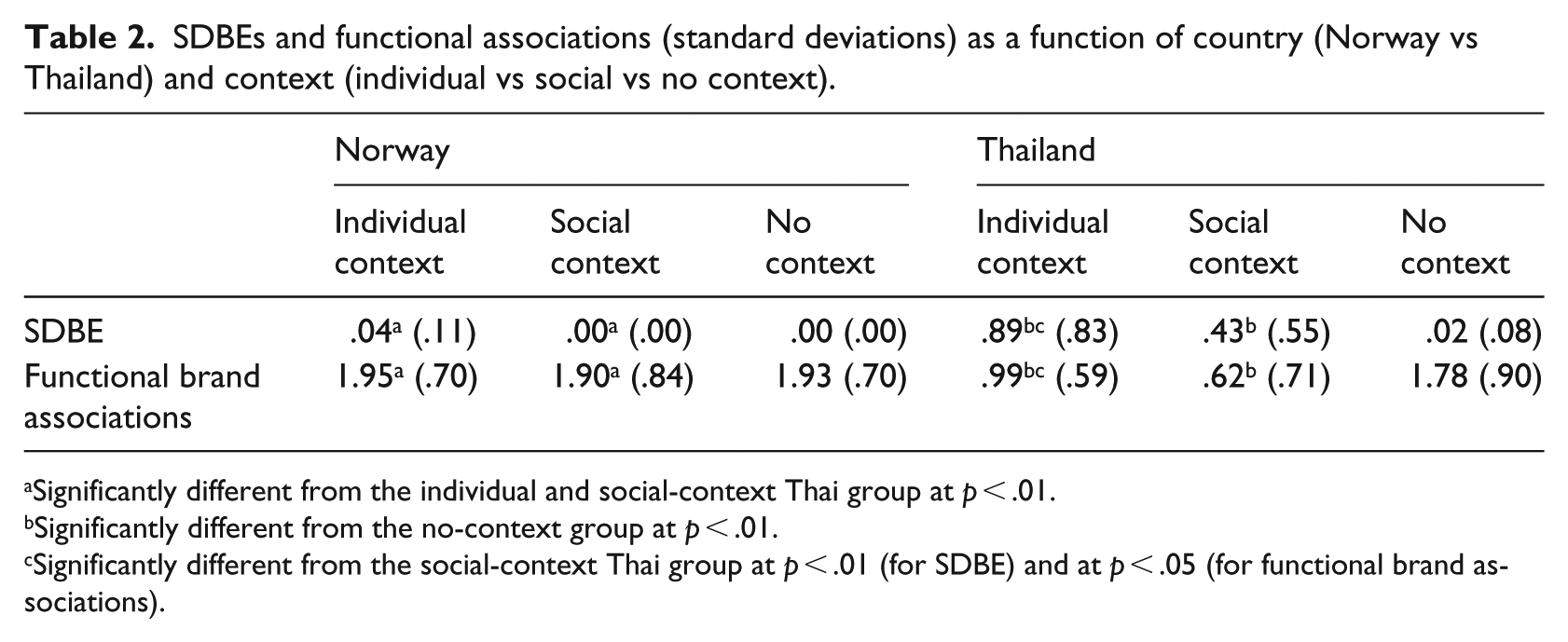
Significantly different from the individual and social-context Thai group at p < .01.
Significantly different from the no-context group at p < .01.
Significantly different from the social-context Thai group at p < .01 (for SDBE) and at p < .05 (for functional brand associations).
Effects of culture and context on SEBEs
A 2 × 3 between-subjects ANOVA yielded significant main effects of context type, F(1, 248) = 41.33, p < .01, culture, F(1, 248) = 45.80, p < .01, and type of context × culture interaction, F(1, 248) = 26.39, p < .01, on SEBEs. There was no significant effect of the covariate of age (p = .80). Thai participants reported more SEBEs in the social-context condition than in either the no-context condition (Msocial = .78 vs Mno context = .10, p < .01) or the individual-context condition (Msocial = .78 vs Mindividual = .05, p < .01). In the social-context condition, Thai consumers generated more emotions than Norwegians (MThailand = .78 vs MNorway = .08, p < .01). In the no-context condition, the difference between Thailand and Norway in the number of SEBEs was not significant. For Norwegians, the differences among the social-, individual-, and no-context conditions were not significant for the number of SEBEs elicited. Thus, we also find support for H2. Table 3 reports the group means and standard deviations.
SEBEs (standard deviations) as a function of country (Norway vs Thailand) and context (social vs individual vs no context).
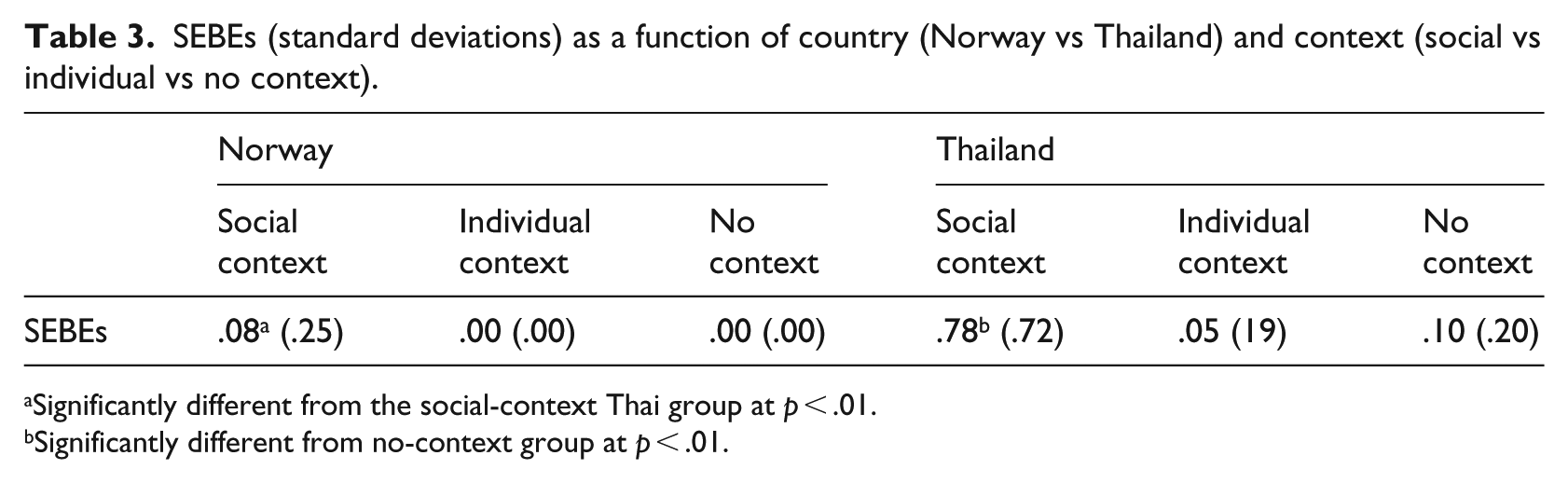
Significantly different from the social-context Thai group at p < .01.
Significantly different from no-context group at p < .01.
Effects of culture and context on functional brand associations
A 2 × 3 between-subjects ANOVA yielded significant main effects of context type, F(1, 248) = 14.72, p < .01, culture, F(1, 248) = 57.08, p < .01, and type of context × culture interaction, F(1, 248) = 13.83, p < .01, on functional brand associations. Again, the effect of the covariate of age was nonsignificant (p = .91). Thai participants generated fewer functional brand associations in the individual-context than in the no-context condition (Mindividual = .99 vs Mno context = 1.78, p < .01) and in the social-context than in the individual-context condition (Msocial = .62 vs Mindividual = .99, p < .05). Furthermore, in the individual-context condition, Thai participants generated fewer associations than Norwegians (MThailand = .99 vs MNorway = 1.95, p < .01). In the no-context condition, the difference between the two cultures was not significant. For Norwegian participants, the differences among the individual-, social-, and no-context conditions were not significant for functional brand associations.
Similar to the individual-context condition, Thai participants reported fewer functional brand associations in the social-context than in the no-context condition (Msocial = .62 vs Mno context = 1.78, p < .01). In the social-context condition, Thai participants generated fewer functional associations than Norwegian participants (MThailand = .62 vs MNorway = 1.90, p < .01). In sum, the results from the individual- and social-context conditions provide support for H3 (see Table 2).
Moderated mediation analysis
SEBEs
We ran a second-stage moderated mediation model using Process macro (model 14) (Hayes, 2015). We expected context type (social vs no context) to moderate the indirect effects of culture on SEBEs through self-construal (H4). We operationalized culture with a dummy variable (Norway = –1, Thailand = 1). The analysis yielded a significant indirect effect of culture through self-construal in the social-context condition (β = .03, 95% confidence interval [CI] excluding zero: .001 to .07) and a nonsignificant effect in the no-context condition (β = –.01, 95% CI including zero: –.03 to .001); index of moderated mediation = .04, 95% CI excluding zero: .01 to .10). Thus, in the social-context condition, the Thai culture has a positive effect on the number of SEBEs through self-construal. This provides support for H4.
SDBE
We expected context type (individual vs no context) to moderate the indirect effects of culture on SDBEs through holistic thinking (H5). Indeed, for SDBEs, a second-stage moderated mediation model yielded a significant positive indirect effect of culture through holistic thinking in the individual-context condition (β = .06, 95% CI excluding zero: .008 to .16) and a nonsignificant effect in the no-context condition (β = –.004, 95% CI including zero: –.01 to .001); index of moderated mediation = .07, 95% CI excluding zero: .01 to .16). Thus, the Thai culture has a positive effect on the number of SDBEs through holistic thinking in the individual-context condition. This provides support for H5.
Discussion
We find support for H1–H5. Our findings verify the validity of the normative-contextual model (Riemer et al., 2014) when studying brand emotions across cultures. Furthermore, we identify and confirm self-construal and holistic thinking as factors underlying the differential effects of the FAT on the elicited brand emotions in a Western and an East Asian culture. While the traditional FAT works well for eliciting brand associations and emotions among Western consumers, it may be suboptimal when applied in an East Asian culture. Indeed, brand emotions in a non-Western culture such as Thailand appear to be highly malleable across contexts in which consumers encounter brands. The results suggest that abstract, stable brand meanings are unlikely to be salient for East Asian consumers in real-life consumption situations. Instead, top-of-mind brand emotions may be determined to a large degree by the consumption or usage context.
Theoretical implications
In addition to the implications for validity of Western brand research techniques, our study questions the validity of some elements of brand management strategies in non-Western cultures. A central emphasis of these strategies is on building strong, cohesive, congruent, and consistent brand images and associations (Keller, 1993). As we have shown, such strategies may work against dominant cultural thinking styles in East Asia and thus be counterproductive. East Asian consumers may connect inconsistent and perhaps even contradictory emotions with a brand in different situations, for example, seeing or using the brand on their own or with family, and still comfortably process such inconsistencies (Peng & Nisbett, 1999). Furthermore, these cross-cultural differences may have implications for what is considered a strong brand in East Asia versus the West. While a brand with strong, positive, and unique associations qualifies as such in the West, in East Asia a strong brand is one with strong and positive associations that are in accordance with social norms in every relevant consumption context. Therefore, malleability of brand associations and emotions across contexts may serve as an additional indicator of brand equity in non-Western cultures. Moreover, it is uncertain to what extent brand images in East Asia may reflect unique brand associations and emotions in line with the positioning strategy because of the malleability of emotions.
The traditional context-free FAT works equally well in East Asia as in the West when eliciting functional brand associations. However, it is likely that salience of functional brand associations is significantly reduced in actual consumption or usage situations in East Asia. Furthermore, social contexts, which are a more natural environment for East Asian consumers, suppress the elicitation of functional brand associations to a greater extent than individual contexts.
Consequently, a range of techniques should be applied in the East Asian region depending on the type of brand associations targeted. Furthermore, in consumption situations in which contextual or normative influences are particularly strong (e.g., social contexts involving close members of in-groups), East Asian consumers may experience greater depletion of cognitive resources from the considerable effort expended when integrating personal and contextual information. Thus, in such situations, participant fatigue may present a greater threat to research validity in this region than in the West. Overall, elicitation of brand associations and emotions in non-Western cultures requires a more elaborate, context-specific, and norm-specific application of the established research tools.
Furthermore, our findings have implications for advertising of brands in East Asia as the processing of ads in these cultures is significantly different compared with the West. When it comes to media advertising, radio advertising may be less optimal for building brand equity in East Asian cultures relative to TV or print media, due to the lack of visual context. However, consumers may still be able to form emotional brand associations if radio ads are processed in the presence of consumer relevant in-groups.
Brand recall is highly important in the cluttered digital channels. Digital clutter may create additional challenges in East Asian markets, particularly when consumers find themselves in contexts or channels not usually associated with the brand. At the same time, digital advertising allows for a high degree of customization and therefore advertisers should tailor the context in which the brand is presented to each target consumer segment. Another challenge for digital advertising for East Asian consumers is that normative influence is weaker in digital channels. Therefore, brands should try to incorporate references to important members of in-groups into digital ads to promote formation of relevant emotional brand associations.
Finally, place-, e.g., billboards, movies, and point-of-purchase advertising may work well in East Asian cultures. This is because these channels allow for visual processing and high degree of integration of brand into consumer-relevant contexts, as well as for presence and normative influence of relevant in-groups.
Managerial implications
Having detailed knowledge about consumers’ brand associations and emotions is important for understanding what distinguishes a brand from competitors’ brands and why consumers buy the brand. Brand management decisions about positioning, brand extensions, and marketing communications could be misguided without insights into what consumers associate with the brand.
Research and business practice provide well proven and useful tools on how to elicit brand emotions. However, these tools are standardized techniques developed from a Western perspective. We suggest that techniques for elicitation of brand emotions need to take cultural differences into account and also be tailored to what types of emotions managers want to detect. We find that compared with Westerners, East Asians tend to experience brand emotions that incorporate meanings from the context in which they encounter the brands. A person-focused context generates SDBEs, while a social-focused context generates SEBEs.
Brands are unlikely to be associated with abstract brand emotions in East Asia in real-life situations, as brand emotions will always reflect the consumption context or social norms. Therefore, to detect brand emotions research should evaluate all relevant contexts in which the targeted population encounters a brand. When using the FAT for elicitation of brand emotions, managers should combine this with questions not only about personal brand associations (e.g., “What do you associate with the brand?”) but also about perceptions of normative brand associations (e.g., “What do you think most members of your close in-group associate with the brand”?). Furthermore, in East Asia the brand’s associative network should be constructed for all the contexts relevant to the brand’s target groups.
The opposite is the case when the goal is to elicit associations related to functional benefits, such as the basic functions of a product. For East Asian consumers, providing a usage context will actually result in fewer associations related to functional benefits. This is particularly a threat to validity when brands are presented in a social usage context. Furthermore, traditional context-free research techniques such as the FAT may be standardized across Western and East Asian markets when targeting functional benefits.
In sum, our findings imply that companies in East Asia should decide what types of associations and emotions they want to detect, as different techniques stimulate the elicitation of different associations and emotions. Thus, they must tie the choice of elicitation technique to the geographic region. For East Asian consumers, providing all relevant normative-contextual cues is of utmost importance when targeting nonfunctional brand associations and emotions, while similar cues do not have any effect on Western consumers.
We also acknowledge several limitations of this research. First, we employed one type of manipulation of individual and social brand contexts. Further research could verify the robustness of our findings with other context types. Second, as we included only two cultures, additional research is necessary to test the validity of our findings for other Western and East Asian cultures. Representatives of Western and East Asian cultures can differ along other dimensions of culture than independence—interdependence and thinking styles—analytic—holistic, for example, power distance, masculinity-femininity, uncertainty avoidance, and long-term orientation (Hofstede, 2001). Future research should study the potential effect of these differences on emotions elicitation across Western and East Asian cultures.
Another fruitful direction would be to examine whether the effects of our study would hold on a within-culture level of analysis, such as individual consumers high on independent versus interdependent self-construal and holistic thinking (Briley, Wyer, & Li, 2014) or between bilinguals and recent immigrants. Research could examine the process underlying the effects of culture on elicitation of functional associations. For example, such mechanism might involve the effort that consumers expend when integrating contextual with object-related information in East Asian versus Western cultures.
Footnotes
Appendix 1
Ads with individual and social context with elicitation instructions in the original languages for Norway and Thailand (the same ads were presented for Colgate and Telenor/Dtac)
Please look at the picture above. Below we ask you to write down all the thoughts you associate with the brand of Samsung. There are no right or wrong answers. Think freely and write down any ideas that come to your mind. List each thought in a separate column.
Vennligst se på bildet ovenfor. Nedenfor ber vi deg skrive ned alle tanker du forbinder med merket Samsung. Det er ingen riktige eller feil svar. Tenk fritt og skriv ned alt du kommer på. Skriv hver tanke i egne kolonner.
กรุณาดูภาพด้านบน เราขอให้ท่านเขียนความคิดทุกอย่างของท่านที่เชื่อมโยงกับผลิตภัณฑ์แบรนด์ซัมซุงลงพื้นที่ด้านล่างนี้ ไม่มีคำตอบที่ถูกหรือผิด เพียงแต่คิดอย่างเป็นอิสระและเขียนทุกความคิดที่ผุดขึ้นมา กรุณาเขียนแต่ละความคิดแยกกันลงในแต่ละช่อง
Funding
The author(s) disclosed receipt of the following financial support for the research, authorship, and/or publication of this article: The authors are grateful to Telenor Research for funding.
