







Abstract
This study explored the generation gap in American consumers’ green perceptions and purchase intentions across four generations (Gen Z, Y, X, and Baby Boomers) from the perspectives of consumer socialization and social intelligence. Analyzing a nationally representative sample of adults in the United States (N = 19,450), the survey results revealed that the American consumer’s green norms and beliefs varied by generation. A series of multiple regression analyses showed that each generation had similar but idiosyncratic beliefs in purchasing products from green companies. Theoretical and practical implications are discussed.
Keywords
Introduction
The climate change generation is a term to describe the generation of young people who were born in a warming world and will be alive to witness how climate change plays out (Babb, 2020). According to recent research, over 80% of US youth between 14 and 24 worry about the health of the planet (Gilbert, 2021), whereas 41% of young adults selected climate change as the most threatening issue (Rowling, 2019). Gen Z, in particular, has been considered to be the most eco-conscious and green-friendly generation and has been dubbed “Generation Green” (Ad Age, 2020). Greg Petro, CEO of First Insight, has argued that Gen Z is willing to pay more for eco-friendly products than any other generation (Ad Age, 2020). Marketers and advertisers are cashing in on this market opportunity, manufacturing more eco-friendly products, increasing their green marketing efforts, and promoting a green image for their brands, particularly targeting Gen Z (Nielson, 2019).
This trend, however, does not necessarily mean that other generations including Baby Boomers and Generations X and Y lack interest in being either eco-conscious or green friendly (Coughlin, 2018). For instance, Baby Boomers are the ones who bought the greatest mix of all green vehicles, including electric, hybrid, and plug-in hybrid vehicles, whereas Gen X bought the most of electric vehicles (EVs), showing 39.8% of entire sales, which is different from general expectation that Millennials would be the top EV consumers (Truecar Adviser, 2020). In fact, research has reported inconsistent results, making it difficult to see whether one generation is more or less environmentally conscious than the others. Young (2018) demonstrated that Generation Y, also referred to as Millennials, is indeed the “Green Generation,” willing to pay extra for sustainable products, while Joshua (2016) found Baby Boomers to be at the heart of green consumption due to their buying capability. Coughlin (2018) reported that those in Gen X considered themselves to be much more environmentally minded than when they were in their twenties. Lai (2019) reported that Baby Boomers are becoming the core generations in green marketing because they are becoming more environmentally conscious and proactively looking to purchase green products. Ad Age (2020) recently reported that sustainability is becoming the default consideration across all generations, gaining broad public attention and changing green consumption behavior. From a marketing viewpoint, any biases or misperception, such as that Gen Z is the only generation that is concerned about the environment, should be seriously reconsidered in order to appropriately adjust and reallocate marketing resources (see Lai, 2019); however, such inconsistent reports make it difficult for marketers to determine in which generation(s) to invest marketing resources.
In this regard, this research attempts to explore the diverse personal and social lenses through which various generations form green perceptions and purchase intentions. To do so, this study examines the two perspectives of consumer socialization and social intelligence to define beliefs, knowledge, and experiences learned, developed, or reinforced by consumers in a given generation resulting in homogeneous in-group characteristics, perceptions, and behaviors. In the consumer marketing context, in particular, the generation a person belongs to is considered to be one of the main socialization factors that shapes lifetime perceptions and behaviors, and the process of consumer socialization may influence the way in which consumers identify themselves within a specific social group. Consumers in each cohort generation share similar psychological perceptions and responses to a certain marketplace phenomenon (Markert, 2004). Based on these ideas, this study proposes to segment consumers in the United States into four generational groups, namely, Gen Z, Gen Y, Gen X, and Baby Boomers, exploring how each generation differs in their perception of and purchase intention within green marketing.
This study will contribute to the body of green marketing literature in three ways. First, this study aims to look at how US consumer green perceptions vary among the four different generations from the lenses of consumer socialization and social intelligence. To our knowledge, this is the first attempt to apply the consumer socialization and social intelligence frames in the green marketing context. Second, the findings of this study can be generalized to look at the broader population because this study analyzed nationally representative data. The generalizable data collected by probability sampling is essential particularly when examining a generation’s perceptions. Third, this study compares the personal and social norms and beliefs of four generational groups, employing a series of regression models to identify what drives each generation to purchase products from green companies. By doing so, this study expects to contribute to broadening the scope of green marketing research.
Literature review
Generational consumer socialization in green marketing
During the last few decades, with the fact that human consumption is one of the main contributors to environmental issues, it becomes very important to focus on how to decelerate environmental problems. With this concern about nature, a few concepts have received much attention in the world such as sustainability, green consumption, and green marketing, which are closely interconnected with each other.
The concept of sustainability has undergone a remarkable development and has become popular; thus, it has been used in various areas ranging from the environmental policy to green marketing (Clark & Munn, 1986; Jones et al., 2008). Although there has been little consensus on how to explain it, some previous studies have consistently defined it as the ability to reproduce, survive, and meet human needs without damaging the future generation in nature (Conway, 1985; Kates et al., 2001; Lien, Hardaker, & Flaten 2007). With the popularity of it, the concept of green consumption has naturally received much attention from consumers who are willing to contribute to conserving the environment. According to Pieters (1991), the concept of green consumption was defined as a type of consumption activity, which meets human needs with minimal negative impact on the eco-system. As a result of increasing consumers motivated to purchase green products, a number of companies has been trying to design a new marketing strategy to satisfy such eco-friendly needs or wants called green marketing.
Generally, the concept of green marketing indicates all kinds of marketing strategies to design, advertise, promote, price, and distribute products in a way of promoting environmentalism (Charter & Polonsky, 1999). Patagonia, for instance, works on discovering sustainable ways to produce their clothing products. Starbucks, in another instance, will eliminate all plastic straws and plans to open over 10,000 environmentally friendly shops by 2025. IKEA, a giant furniture manufacturer in Sweden, developed the People & Planet strategy, by which they produce their products through eco-friendly practices, relieving consumers from the necessity to choose between fashionable design and sustainability (Vos 2019).
This study aims to look at the green consumption and marketing through the lens of generation and consumer socialization. Consumer socialization refers to the process by which consumers learn skills and knowledge, shape and reshape their cognition, attitudes, norms, and values in adapting to their society and to the marketplace (Hota & Bartsch, 2019; Mishra et al., 2018). Throughout the life-long socialization process, consumers consistently develop, modify, and reinforce their beliefs, knowledge, and behaviors about various marketplace events (Hota & Bartsch, 2019; Mishra et al., 2018). Scholars have employed various theories to explain consumer socialization such as the cognitive development model and social learning theory. The former focuses primarily on internal cognitive psychological development in childhood (Thaichon, 2017), while the latter focuses mainly on the role of the external environment in shaping communal beliefs and knowledge in one’s lifetime (Hota & Bartsch, 2019).
Even though the cognitive developmental model and social learning theory are not mutually exclusive, and adults do experience cognitive development to some extent, the social learning theory has primarily been employed in the context of consumer marketing, particularly when targeting adult consumers (Chen et al., 2017). According to social learning theory, adults modify existing consumption beliefs and behaviors to adapt themselves to new or changing roles in the marketplace, interacting with external sources in their environments that transmit social norms regarding beliefs, attitudes, and behaviors. Such norms, shaped and reinforced by the social learning process, play a significant role in assessing and responding to various marketplace events (Abramowitz et al., 2017).
Previous studies have described the general socialization process as including three components: social structural variables, socialization agents, and socialization outcomes (Kamaruddin & Mokhlis, 2003). Social structural variables include age, gender, education, and income, which locate consumers in a socially identifiable group in which the members are likely to have homogeneous perceptions and characteristics (Barnes et al., 2017). In addition, social structural variables affect how consumers collectively interact with diverse socialization players and how they respond to a company’s marketing activities (Pooler, 2018). The authors of this study are interested in how a social structural variable, particularly age or generation, facilitates consumer socialization outcomes, shaping and reshaping their green perceptions and purchase intentions.
Age and generation are typical social structural variables that are frequently investigated in the context of environmental issues and green consumption research (Majhi, 2020). A line of research demonstrated that compared to older generations, younger generations exhibited more favorable opinions, attitudes, purchase intentions, or other behaviors related to green consumption. Using a large sample of British consumers, Diamantopoulos et al. (2003) found that young consumers were concerned about environmental quality, which led them to purchase green products. Liere and Dunlap (1980) analyzed and reviewed 20 studies and identified that younger consumers tended to be more concerned about environmental quality than older people. They also reported that younger people usually preferred eco-friendly products than the elderly because they more readily support environmental reform and pro-environmental ideologies than their elders. Kristensen & Grunert, 1994 showed that younger generations featured higher environmental knowledge and concerns for future environmental problems. With the assumption that environmental knowledge and concerns are likely to motivate consumers to purchase green products and brands (Li et al., 2020), it would be expected that the younger the consumers are, the more favorable their attitudes and consumption intentions. Straughan and Roberts (1999) surveyed a convenience sample of 235 students and demonstrated that young consumers were more concerned about the environment and therefore were potential green product consumers. Kanchanapibul et al. (2014) conducted an online survey for young people (18–30 years) and confirmed that younger generations tended to be largely involved in environmental problems and thus exhibited greater intentions to purchase green products than older generations. The responses of 582 adult consumers to a survey supported the general belief that younger individuals are likely to be more sensitive to environmental problems and try to take more preventive action than older people (Roberts, 1996). This is because the younger generation has grown up in a situation where the advancement of technology and modern civilization has degraded the environment while also receiving more education and information about the importance of the environment than older generations.
Study findings, however, are not consistent. Other studies have indicated that consumer segmentation by age or generation for green consumption was not significant and have even rejected the previous belief that young people are more inclined to consume green products. Diamantopoulos et al. (2003) analyzed the 33 studies delving into the linkage between age and environmental consciousness and found that majority of the studies, 31 out of 33, did not show a significant correlation between age and environmental consciousness (Kristensen & Grunert, 1994). Similarly, Hume (2010) reported that neither age nor generation significantly influenced green consumption and even that younger consumers were not actually interested in purchasing eco-friendly products any more than older generations. In addition, although younger generations have even more concerns or knowledge about environmental sustainability and have favorable attitudes toward green products, these favorable attitudes did not lead them to engage in actual behaviors or consumption because their financial ability to support environmental causes was insufficient (Cheung & To, 2019). Despite the fact that younger generations are more aware of environmental problems and issues, they were least likely to take any preventive action concerning those issues (Naderi & Van Steenburg, 2018). The rationale behind this finding is that young generations feature an independent self and are more involved in pleasure-seeking for their own enjoyment (Davis et al., 2020).
In sum, although the relationship between age and green consumption has long been explored in many previous studies, the findings are contradictory and equivocal. There are several reasons for such inconsistent results. The majority of studies used non-probability sampling methods with a relatively small number of samples, such as a student group in one institution (e.g., Kanchanapibul et al., 2014). This non-representative sampling approach presumably limited the implications of the studies. In addition, some studies looked at young generations only, without statistically comparing them with other age groups, yet explained their results in terms of a comparison to other age groups (e.g., Kanchanapibul et al., 2014). Further, many studies used generation as a naïve and loosely defined term rather than using accurate age ranges to categorize each particular generation. In many studies, the term young or old generations were not defined in terms of particular ages (e.g., Kanchanapibul et al., 2014).
Therefore, this study attempts to categorize US consumers into four generation groups (Gen X, Y, Z, and Baby Boomers), using nationally generalizable data with accurate age distributions for each generation. The authors of the present study aim to examine how consumers’ green perceptions and purchase intentions vary by generation in the US market, from the lens of consumer socialization and social intelligence. Therefore, we propose the first research question: RQ1. How do green perceptions and purchase intentions of US consumers vary by generation (Gen Z, Y, X, and Baby Boomers)?
Consumer socialization: Personal norms and social norms
An interesting point in the consumer socialization process involves shaping of norms in the given society, helping consumers learn about socially relevant and desirable behaviors (Moschis & Churchill, 1978; Zigler & Child, 1969). During the consumer socialization process, consumers gather information about shared perceptions and behaviors that can help them develop norms regarding specific marketplace events (Fornara et al., 2016; Mishra et al., 2018).
More specifically, consumers first are able to construct their own personal norms throughout the socialization process (Schwartz & Howard, 1981). Personal norms refer to self-expectations shaped based on internalized values (Harland et al., 1999). The context personal norm of green consumption is defined as considering it to be a moral obligation to behave pro-environmentally (López-Mosquera & Sánchez, 2012). Many Americans perceive that behaving pro-environmentally is socially desirable (Desilver, 2019). Such socially desirable atmospheres not only apply social pressure for consumers to behave greenly but also shape moral obligations or a sense of responsibility regarding pro-environmental behavior.
Previous studies have revealed that personal norms regarding pro-environmental behaviors are significantly related to green consumption. Studies have employed the value–belief–norm theory (VBN theory) to find that the role of personal norms is significant in predicting pro-environmental behaviors (e.g., Hwang et al., 2020; Kim & Seok, 2019; Kiatkawsin &Han, 2017; López-Mosquera & Sánchez, 2012). VBN posits that when personal values, norms, or beliefs about particular topics are threatened, people engage in behaviors designed to alleviate the threat (Stern et al., 1999). Among the factors articulated in VBN theory, personal norms are the most closely related to behavioral reactions (Doran & Larsen, 2016; Jansson et al., 2011) and constitute direct and strong antecedents to pro-environmental behaviors (Han et al., 2018; Stern et al., 1999; Thøgersen, 2002). Indeed, several empirical studies showed that personal norms about environment, one’s experienced feeling or moral obligation to act pro-environmentally (Jansson et al., 2011), created a positive impact on pro-environmental behaviors (e.g., Fornara et al., 2016; Kaiser et al., 2005; Kim & Seok, 2019; van Riper & Kyle, 2014). For instance, personal norms about pro-environmental behavior significantly and positively influenced people’s intentions for energy-conservative behavior, such as using recycling papers or refillable packages when shopping (Kaiser et al., 2005). van Riper and Kyle (2014) revealed that personal norms about the environment were significantly related to pro-environmental behaviors such as national park preservation. Fornara et al. (2016) also showed that personal norms were positively and significantly related to intention to use green energy. As such, personal norms play a significant role in driving pro-environmental behaviors. Also, Kim and Seock (2019) demonstrated that personal norms were significantly associated with purchase intention of eco-friendly clothes. Individuals who felt a higher level of moral obligation to purchase eco-friendly clothing reported a higher intention to buy environmentally friendly clothing.
Second, consumers construct social norms throughout the socialization process. In the context of green consumption, social norms refer to one’s perception of how other people in the society view environmental issues as important and how many people are actually behaving pro-environmentally (Farrow et al., 2017; López-Mosquera & Sánchez, 2012; Thomas & Sharp, 2013). Studies employing the theory of planned behavior (TPB) have found that the role of social norms is significant in predicting pro-environmental behaviors and inducing changes in green behaviors (Chang et al., 2016; Farrow et al., 2017; Goldstein et al., 2008; Hansmann et al., 2020). For instance, people were willing to reuse their towels in a hotel when they were told that other customers were also reusing their towels (Chang et al., 2016; Goldstein et al., 2008). Also, Hansmann et al. (2020) found that social norms about pro-environmental behavior were positively associated with pro-environmental behavior intention, such as willingness to purchase second-hand electronic devices, sort waste for recycling, or use public transportation. This implies that people are significantly influenced by what others do and also by what others perceive to be normal in the pro-environmental behavior context. Since many people in the United States are changing their everyday behaviors to protect their environment (Desilver, 2019) and recognizing the importance of protection of the environment, social norms regarding pro-environmental behaviors may very well be impacting green consumption.
Despite the fact that social norms explain much about green behavior (Farrow et al., 2017; Kaiser et al., 2005), considering only social norms and neglecting the power of moral considerations, that is, personal norms, is problematic especially when studying morally relevant behaviors, such as green behavior (Kaiser et al., 2005; Manstead, 1999). Moreover, social norms reflect future willingness to change behavior whereas personal norms reflect current behavior (López-Mosquera & Sánchez, 2012). Hence, several studies regarding pro-environmental behaviors have investigated the impact of personal norms and of social norms at any given point in time (e.g., Han et al., 2018; López-Mosquera & Sánchez, 2012; Oreg & Katz-Gerro, 2006). In the green marketing context, therefore, the current study aims to look at how each generation’s personal and social norms are associated with their purchase intention from green companies. Thus, this study asks: RQ2a. How are each generation’s green personal norms associated with the intention to purchase from green companies? RQ2b. How are each generation’s green social norms associated with the intention to purchase from green companies?
Consumer social intelligence: Personal and company benefit beliefs
Consumer socialization improves the consumer’s marketplace social intelligence (Ham, Park, & Park 2017). Marketplace social intelligence refers to a consumer’s cognitive routines that enable marketplace efficacy and allow the consumer to effectively cope with various marketplace events (Wright, 2002). Consumers develop marketplace social intelligence throughout their life span by interacting with other marketplace players and experiencing diverse marketplace events. A psychological concept behind this social intelligence is marketplace metacognition. Metacognition means cognition about cognition and knowing about knowing (Metcalfe & Shimamura, 1994), and marketplace metacognition refers to lay people’s “everyday thinking about market-related thinking” (Wright, 2002; p. 677).
Marketplace metacognition and social intelligence are basic or naïve theories involving lay people’s beliefs about how people (they and others) think in everyday life in the marketplace (Jost, Kruglanski & Nelson 1998; Wright, 2002). As it is a loosely defined term, marketplace social intelligence has been employed to explore basic concepts in a given context, such as naïve theories about the sources of bias in persuasion (Wegener & Petty, 1997), folk theories about intentional behavior (Malle & Knobe, 1997), skepticism (Obermiller & Spangenberg, 1998), consumer knowledge calibration (Alba & Hutchinson, 2000), and persuasion resistance on attitude certainty (Tormala & Petty, 2004).
In line with this idea, Friestad and Wright (1994) proposed the persuasion knowledge model that suggests that consumers develop their own intuitive theory about how persuasion works over the course of their lives. As a subdomain of marketplace social intelligence, persuasion knowledge enables consumers to proactively infer and interpret underlying motives of persuasion intention, leading the consumer to accept or resist such strategies of persuasion. Persuasion knowledge is dispositional, being formed throughout an individual’s lifetime, and is associated with diverse psychological aspects of persuasion, including attention, cognition, memory, beliefs, attitudes, and intent (Boush et al., 1994; Ham & Nelson, 2019). All of these significantly affect consumer reactions to persuasion. The persuasion knowledge model includes three sub-constructs: persuasion knowledge, topic knowledge, and target/agent knowledge (Friestad & Wright 1994). Persuasion knowledge refers to consumer knowledge about persuasion tactics, topic knowledge represents their knowledge of persuasion context, and target/agent knowledge is defined as knowledge about the persuasion target/agent (e.g., target: consumers; agents: marketer, company). For example, Lim et al. (2020) showed that persuasion knowledge moderates the effect of color in a consumer’s environmental friendliness perception of advertising. Their study showed that while consumers associate green color with environmental friendliness and gray color as the opposite, the effect of color diminishes as consumers have high persuasion knowledge. While a majority of studies have only employed the persuasion knowledge construct (Ham & Nelson, 2019), Campbell (1995) employed target and agent knowledge, examining how knowledge of both influences the changes in consumer attitudes in response to advertising. In their study, target knowledge was conceptualized as knowledge about the consumer’s perception of personal benefit inferred from particular advertising, whereas agent knowledge was knowledge inferred about the consumer’s perception of benefit to a company gained from the format and appeal of the advertising.
Applying these ideas in the green marketing context, the present study first conceptualizes target knowledge as the consumer’s belief about how green products or services benefit them, focusing primarily on the belief in the quality of green products. With a handful of exceptions, studies have addressed ethical and social factors motivating green consumption; but recent studies have found that consumers purchased green products due to utilitarian and functional advantages (D’Souza, Taghian, & Khosla, 2007). Bei and Simpson (1995) argued that consumers consider product quality when purchasing recycled products. When the quality was low, they avoided buying the product. Lin and Huang (2012) indicated that functional value perceived by consumers positively influenced the purchase of green products above and beyond the social value of purchasing green products. Therefore, this study asks the extent to which consumer’s beliefs about the superiority of green products is associated with the intention to purchase those products.
Second, the current study conceptualizes agent knowledge as consumers’ belief about how much benefit companies will gain from their green efforts and investments. An increasing number of companies are devoting their resources to sustainability in the name of corporate social responsibility (CSR), assuming that their green activities contribute to society’s well-being and to their business success. Both theoretical and empirical studies have proposed and examined the relationship between green corporate social responsibility (CSR) and business benefit, although the results have been inconsistent (see Salzman Ionescu-Somers, & Steger, 2005; Parguel, Benoit-Moreau, & Larceneux, 2011). Studies in sustainability identified the relationship between companies’ green activities and the economic benefit of those activities, showing an inverse U-shaped curve (Schaltegger & Synnestvedt, 2002; Steger, 2006). This showed that green CSR could have positive as well as negative effects on the business benefit to companies, depending on the diverse positions of the companies on the curve (see Salzmann et al., 2005). Wagner and Schaltegger (2004) identified a more positive relationship with stakeholders when companies pursued an environmentally friendly strategy oriented toward shareholder value than when companies did not pursue such value. This implies that the impact of a company’s green practices on benefit to the company seems to depend on the value that consumers inferred from the green activities, such as inferences about a company’s strategic goals and intrinsic motives for engaging in the activities (see Foreh & Grier, 2003; Kim & Lee, 2012; Skarmeas & Leonidou, 2013; Wagner & Schaltegger, 2004). If consumers believe that a company’s green activities are sound and genuine, they will expect the companies to gain business benefits from the green activities.
According to Xie, Cavallero, and Cheng (2014), consumers develop their own subjective knowledge about green marketing, which will influence their perception, intention, and behavior regarding green consumption. While their research did not mention target or agent knowledge, we consider the basic conceptual definition of target and agent knowledge to propose that consumers will infer their own personal benefit (i.e., target knowledge) and benefit to the company (i.e., agent knowledge) when they perceive and evaluate a company’s green marketing efforts and their responses to them. Indeed, knowledge inferred by the consumer, including target and agent knowledge, is not necessarily negatively associated with their attitudinal changes but rather depend upon matching consumer marketplace goals (Ham & Nelson, 2019; Kirmani & Campbell, 2004).
Taken together, this study asks how a consumer’s target knowledge (belief that the consumer will benefit from good quality) and agent knowledge (belief that the company will benefit) are associated with their purchase intentions from companies following environmentally sound practices. Thus, we ask: RQ2c. How is each generation’s green belief of personal benefit associated with the intention to purchase from green companies? RQ2d. How is each generation’s green belief of company benefit associated with the intention to purchase from green companies?
Based upon the discussed literature, this study proposes a conceptual model that explains how each generation’s green perceptions are associated with the intention to purchase from green companies. The model is demonstrated in Figure 1 (see Figure 1). Proposed model.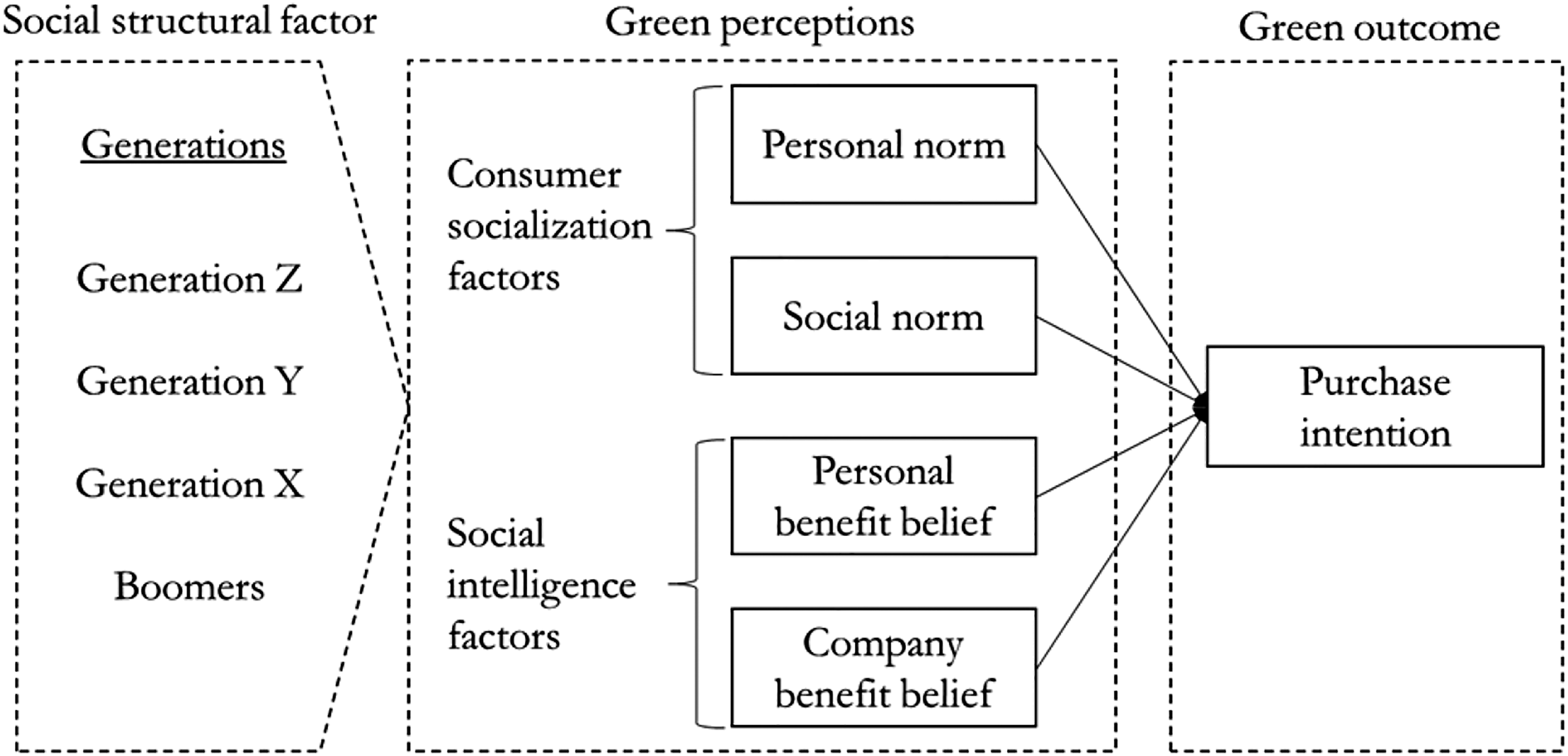
Method
Data
To test the proposed research questions, data were extracted from the Experian Simmons National Consumer Survey (NCS). The NCS data were collected based on a probability sample of 26,019 US adults (18 or older) in 2017 using a list frame of the US households excluding addresses in Alaska and Hawaii. NCS data adopted a stratification sampling method that utilized ethnicity, income, geography, and presence of a landline as its stratification variables. Stratified sampling divides the population into separate groups called strata and then draws a probability sample from each stratum, which yields generalizable estimates of the target population as well as sociodemographic group differences (Bornstein, Jager, & Putnick, 2013). From this dataset, restructuring technique macro functions were performed to make the data analyzable (Park & Hoy 2015). Along with this process, missing values were cleaned, and the final data set yielded a total of 19,450 (N = 19,450) samples.
We categorized US consumers into four generation groups adopted from (Reeves & Oh 2008). Their categorization has been widely adopted in diverse fields of research including management (Desai & Lele, 2017), education (DiLullo, McGee, & Kriebel, 2011), online behavioral studies (Pereira & Maciel, 2013), and marketing (Atkins & Hyun, 2016). Generation Z was defined as those who were born after 1995. Although there is no exact year that separates Generation Z from Generation Y, multiple studies have considered that it began in 1995 (Bassiouni & Hackley, 2014; Priporas, Stylos, & Fotiadis, 2017; Seemiller & Grace, 2016). The four generation groups used in this study are Generation Z (Gen Z: born from 1995 to 1998), Generation Y (Gen Y: born from 1982 to 1994), Generation X (Gen X: born from 1976 to 1981), and Baby Boomers (BBs: born from 1947 to 1966).
Measures
This study used several single-item scales that measured consumers’ perceptions about green consumption using a 5-point Likert scale (1 = disagree a lot, 2 = disagree, 3 = neither agree nor disagree, 4 = agree, and 5 = agree a lot). The items measured include “I am more likely to purchase a product or service from a company that is environmentally friendly (Purchase intention),” “Each of us has a personal obligation to do what we can do to be environmentally responsible (Personal norm),” “It is important to me that others see me as environmentally conscious (Social norm),” “I believe eco-friendly products are higher quality products (Personal benefit belief),” and “I believe that companies following environmentally sound practices find that it is good for business (Company benefit belief).”
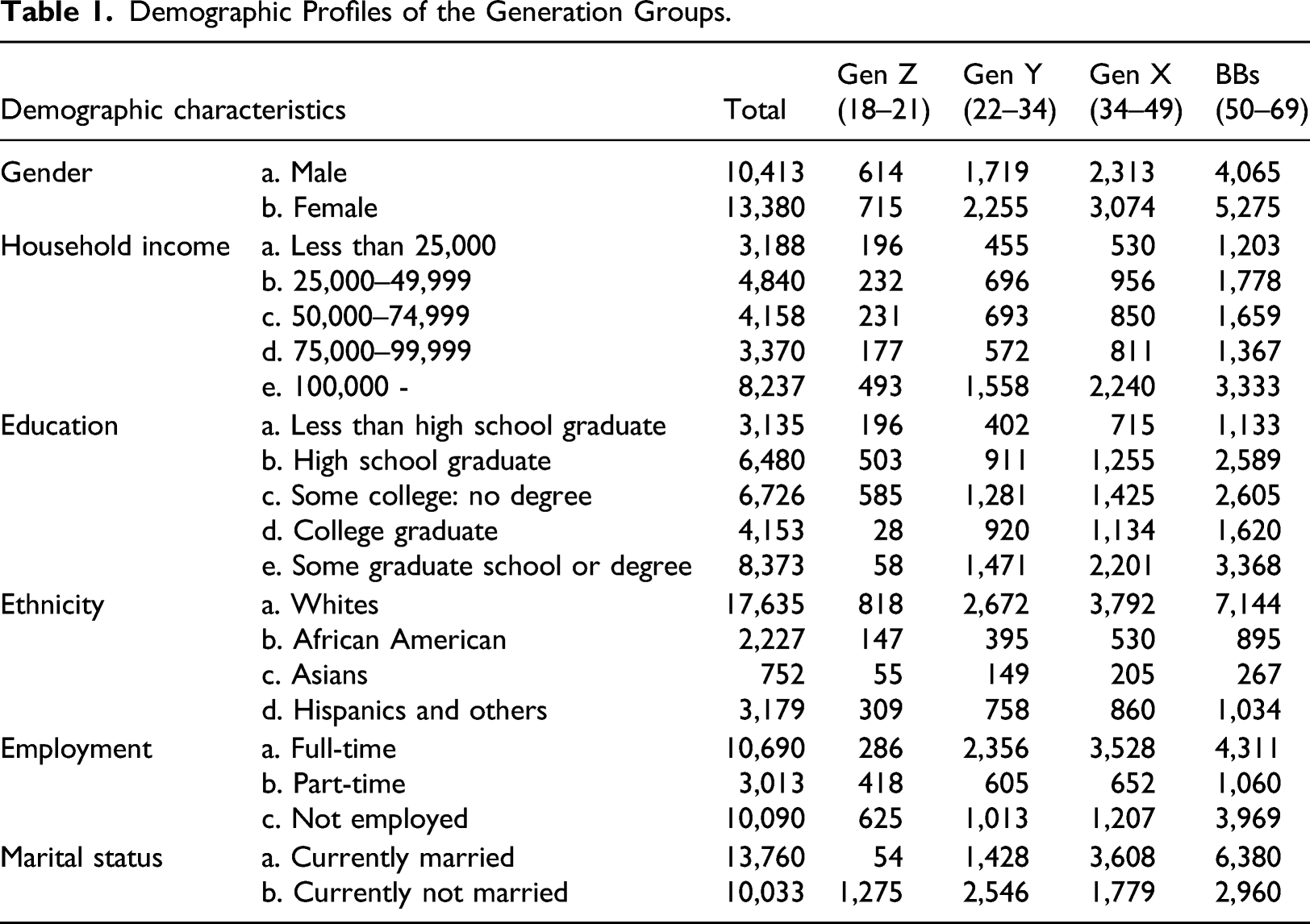
Demographic Profiles of the Generation Groups.
Results
Test of mean difference in green perceptions across generations (RQ1)
Descriptive statistics (RQ1).
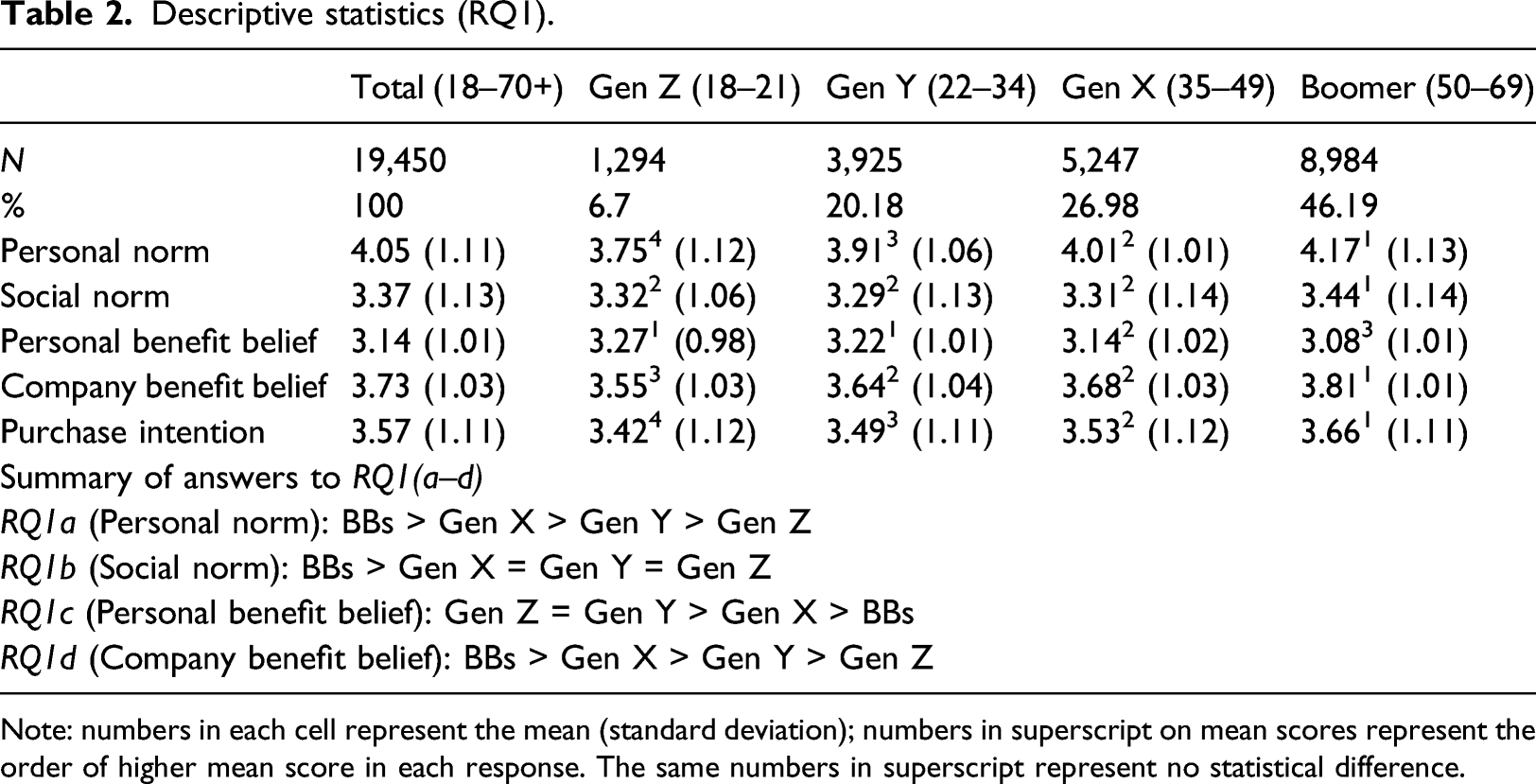
Note: numbers in each cell represent the mean (standard deviation); numbers in superscript on mean scores represent the order of higher mean score in each response. The same numbers in superscript represent no statistical difference.
The first ANOVA was run on personal norms (RQ1a). The results revealed that mean differences were statistically significant [F = 116.77; df = 3; p <.001], with the highest personal norm score for BBs (M = 4.17; SD = 1.13) followed by Gen X (M = 4.01; SD = 1.01), Gen Y (M = 3.91; D = 1.06), and Gen Z (M = 3.75; SD = 1.12). Subsequent post–hoc analyses revealed that all between-group differences were statistically significant. Hence, as to personal norms, BBs showed the highest score, followed by Gen X, Y, and Z. Descriptive statistics are demonstrated in Table 2 (see Table 2).
The second ANOVA was run on social norms (RQ1b). The results showed that mean differences were statistically significant [F = 22.77; df = 3; p < .001] with the highest social norm score for BBs (M = 3.44; SD = 1.14), followed by Gen Z (M = 3.32; SD = 1.06), Gen X (M = 3.31; D = 1.14), and Gen Y (M = 3.29; SD = 1.13). Subsequent post-hoc analyses revealed that the difference between Baby Boomers and other generation groups was statistically significant but that there were no statistically significant differences among the other three groups (see Table 2 for details). Hence, as to social norms, Baby Boomers showed the highest score, followed equally by the other three generations.
The third ANOVA was run on personal benefit belief (RQ1c). The results showed a statistically significant mean difference [F = 24.83; df = 3; p < .001], revealing the highest personal belief score for Gen Z (M = 3.27; SD = 0.98) followed by Gen Y (M = 3.22; SD = 1.01), Gen X (M = 3.14; SD = 1.02), and BBs (M = 3.08; SD = 1.01). Subsequent post-hoc analyses revealed that the mean difference between Gen Z and Gen Y was not statistically significant, although it was higher than Gen X and BBs (see Table 2). Hence, as to personal benefit belief, Gen Z and Gen Y showed equal scores with lower scores for Gen X and then for BBs.
The fourth ANOVA was run on company benefit belief (RQ1d). The results revealed that the mean difference between scores was statistically significant [F = 51.37; df = 3; p < .001] with the highest score for BBs (M = 3.81; SD = 1.01) followed by Gen X (M = 3.68; SD = 1.03), Gen Y (M = 3.64; SD = 1.04), and Gen Z (M = 3.55; SD = 1.03). Post-hoc analyses showed that BBs’ scores were significantly higher than those of the other generations. Gen X and Y were higher than Gen Z, but not to a statistically significant degree. In sum, BBs showed the highest score with respect to company benefit belief. Gen X and Gen Y ranked next, and Gen Z received the lowest score (see Table 2 for details).
The fifth ANOVA was run on green purchase intention (RQ1e). The results revealed that the mean difference between generations was statistically significant [F = 34.71; df = 3; p < .001], showing the highest score for purchase intentions for BBs (M = 3.66; SD = 1.11) followed by Gen X (M = 3.53; SD = 1.12), Gen Y (M = 3.49; D = 1.11), and Gen Z (M = 3.42; SD = 1.12). Post-hoc analyses showed that BBs scored significantly higher than all other generations, followed by Gen X, Gen Y, and Gen Z in that order (see Table 2). In sum, Baby Boomers showed the highest intention to purchase green products, followed by Gen X, Y, and Z.
Test of predictions on purchase intention in each generation (RQ2)
A series of multiple linear regressions was run to answer research question 2, which asked how personal norms, social norms, personal benefit beliefs, and company benefit beliefs are associated with green purchase intentions in each generation.
Results of multiple regression analyses on purchase intention (RQ2).
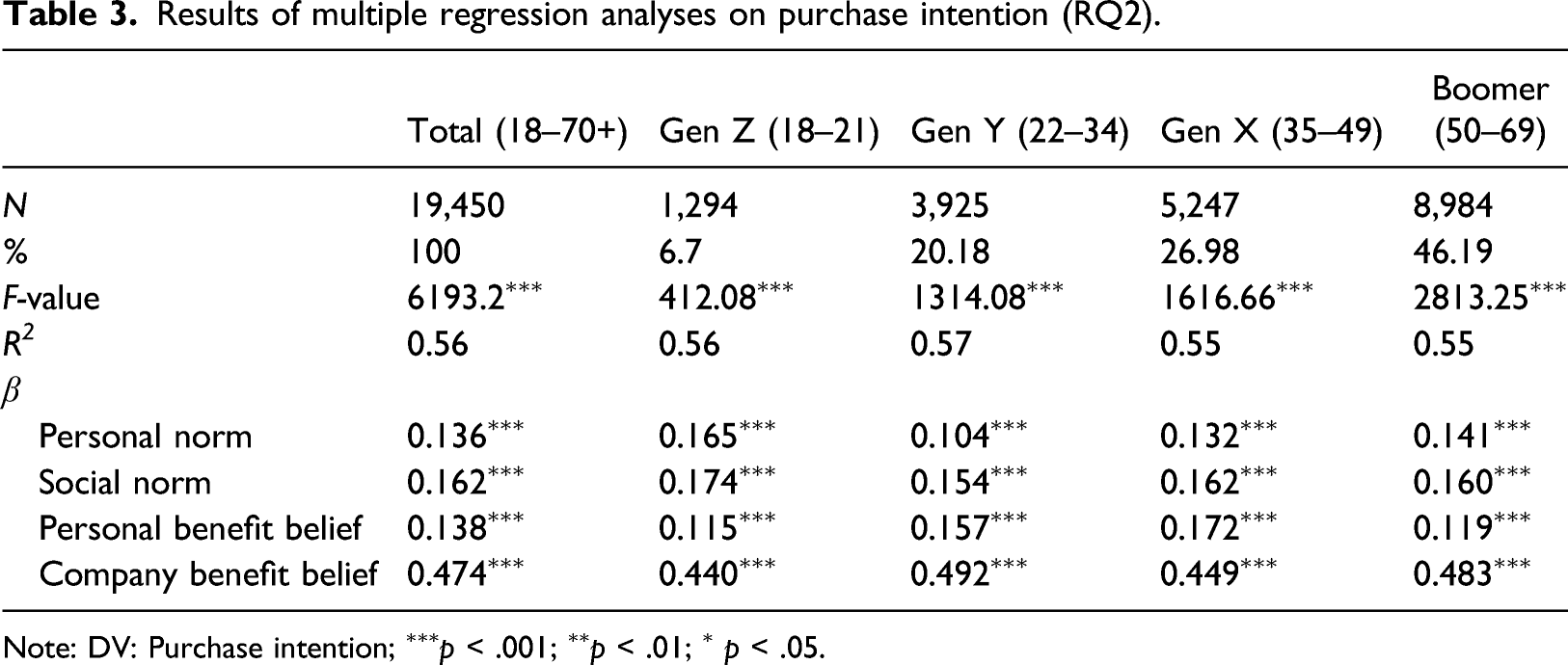
Note: DV: Purchase intention; ∗∗∗p < .001; ∗∗p < .01; ∗ p < .05.
Subsequent regression analyses revealed that regression equations were all significant for Gen Z [F(4, 1289) = 412.08, p < .001); R2 = .56]; Gen Y [F(4, 3920) = 1314.08, p < .001; R2 = .57]; Gen X, [F(4, 5242) = 1616.66, p < .001); R2 = .55]; and BBs [F(4, 8979) = 2813.25, p < .001; R2 = .55]. Across the four generations, all four variables (personal and social norms, personal and company benefit beliefs) significantly predicted purchase intentions. First, in Gen Z (N = 1294), company benefit belief was the best predictor of purchase intentions (β = .440), followed by social norms (β = .174), personal norms (β = .165), and personal benefit beliefs (β = .115). Second, in Gen Y (N = 3925), company benefit beliefs offered the greatest prediction of purchase intentions (β = .492) followed by personal benefit beliefs (β = .157), social norms (β = .154), and personal norms (β = .104). Third, in Gen X (N = 5247), company benefit belief offered the best prediction of purchase intention (β = .449) followed by personal benefit beliefs (β = .172), social norms (β = .162), and personal norms (β = .132). Fourth, among BBs (N = 8984), company benefit belief was also found to hold the greatest predictive value (β = .483) followed by social norms (β = .160), personal norms (β = .141), and personal benefit beliefs (β = .141).
Discussion
Theories of consumer socialization and social intelligence propose that consumers in the same generation have similar learned, shared, and reinforced beliefs, knowledge, and values; accordingly, they are likely to be a homogeneous group with similar cognition, attitudes, and norms regarding marketplace phenomena. Applying this idea to the green marketing context, this study explored generational gaps in US consumers’ green perceptions and purchase intentions using nationally representative survey data.
First, this study investigated how the US consumer’s green perceptions and purchase intentions varied by generation based on personal norms, social norms, personal benefit beliefs, and company benefit beliefs. Most interestingly, Baby Boomers (50–69 years) exhibited the highest purchase intentions toward green companies, followed by Gen X, Y, and Z. The older the consumer, the more likely they were to purchase products from companies that are environmentally friendly.
This is intriguing because these results are somewhat contradictory or even directly opposed to the previous belief that young people would be more inclined to consume green products (Diamantopoulos et al., 2003; Kristensen & Grunert, 1994; Straughan & Roberts, 1999). Previous research studies have reported inconsistent results in generational perceptions and behaviors with respect to sustainability and green consumption. Our findings, however, revealed that older generations are more inclined to purchase products from green companies than younger generations. In theory, Baby Boomers are more interdependent than younger generations, and interdependent people are more likely to show higher ethical standards and more concern for community issues, which leads them to feel guiltier about ethical problems and to then take action (Johnson & Chang, 2006; Vetlesen, 199). According to Miles (2000), younger generations feature the independent self and are more involved in pleasure-seeking for their own enjoyment, but older people focus more on benefits to the community and symbiosis with others. Thus, older people would be expected to be more responsible in addressing environmental problems and to take more preventive actions than the younger generation. Dawson’s (2002) data analysis supported our interpretation as well. Through the pooled dataset consisting of 996 estimable cases, the researcher concluded that there was a positive correlation between age and moral judgment. That is, older people were found to be more likely to evaluate the same issues more strictly and harshly than younger generations, which in turn would lead to them to hold more favorable attitudes toward and more willingness to purchase green products.
The results of our data analysis showed that Baby Boomers have the highest level of personal and social norms regarding pro-environmental behavior. As articulated, personal and social norms are formulated via the consumer socialization process. The concept of green consumption has been around since the 1970s (Elliott, 2013), suggesting that the older generation has been socialized to act pro-environmentally for a longer period of time. With prolonged socialization, Baby Boomers could experience a stronger sense of moral obligation to behave in an environmentally sound manner. In addition, these days many in younger generations blame Baby Boomers for failing to stop climate change, which in turn has led to environmental degradation (McGinn, 2019). This social atmosphere may have made Baby Boomers feel more pressure to engage in green behaviors, which could in turn have helped Baby Boomers establish proactive social norms regarding green consumption (Coughlin, 2018).
Interestingly, younger generations showed a significantly higher belief in the personal benefits of green products, meaning that they are more likely than other generations to believe that eco-friendly products are higher quality than non–eco-friendly products. This finding implies that younger generations may be driven to purchase green products based not only on social norms but also based on utilitarian considerations. There is evidence that green consumers are sensitive to product quality and price (Mandese, 1991), which is supported by the theory of consumer value, such that a consumer’s green product choice was influenced by multiple values including utilitarian and functional values (Lin & Huang, 2012; Sheth et al., 1991). The current research revealed that such utilitarian value is more significantly perceived by younger generations than by older generations.
Second, this study examined what drives each generation in its green purchase intentions. This study was particularly interested in whether personal or social values better predicted consumer green purchase intentions. Interestingly enough, company benefit belief was the strongest predictor of purchase intentions across all four generations: the more consumers think a company follows environmentally sound practices, the more willing they are to buy the product from the company. Consistent with the existing body of research in CSR and green marketing (e.g., Wagner & Schaltegger, 2004), this finding implies that consumers are willing to support companies that genuinely follow environmentally responsible practices, and we identified that this willingness strongly drove their intention to buy products from the eco-friendly companies.
The second strong predictor, however, varied by generation. In Gen Z, social norm was the second strongest predictor of purchase intentions, followed by personal norms and personal benefit belief. To Gen Z, whether others see them as environmentally conscious drives their purchase of products from green companies. To Gen Y and Gen X, the second strongest predictor was the personal benefit belief. Different from Gen Z, a majority of Gen Y and Gen X have jobs, buying power, and diverse experiences purchasing and using green products, which would make them consider utilitarian and functional values of the green product more than other generations (Lin & Huang, 2012). To Baby Boomers, however, the personal benefit belief was the least important predictor of their green purchase intentions, while social and personal norms better predicted Baby Boomers’ green purchase intentions. This finding supports the idea that Baby Boomers are more interdependent people who are more likely to have higher ethical standards and more concern over social causes than over green product utilitarian value. They are also more motivated by personal responsibility than younger generations and more willing to support environmental causes.
Between personal and social norms, the results of the present study reveal that green purchase intentions are driven more by social norms than by personal norms. This pattern held true for all generations. This finding is contrary to other empirical studies that have shown that personal norms exerted more power than social norms in explaining green behavior, such as staying at green hotels, conserving energy, or paying for environmental conservation programs (e.g., Han et al., 2018; Kaiser et al., 2005; López-Mosquera & Sánchez, 2012). This might be due to differences in various studies in survey respondents and context. For instance, participants in the López-Mosquera and Sánchez (2012) study were recruited among national park visitors who would be expected to be more concerned and enthusiastic about environmental issues; accordingly, they might have had a greater sense of moral obligation to behave pro-environmentally, which might have led personal norms to be a stronger predictor of willingness to pay for environmental conservation programs. Similarly, the samples in the Kaiser et al.’s (2005) study were university students. Considering people with higher education tend to be more aware of green behaviors (Vicente-Molina et al., 2013), the university student’s sense of moral obligation to be environmentally responsible could be higher than others. This might explain why personal norms had the most influence in the Kaiser et al. (2005) study. By contrast, the current study utilized nationally representative samples. Thus, the different patterns found in different research could be due to sample variance.
Theoretical implications
This study provides some theoretical implications. Consumer socialization and social intelligence literatures propose that consumers in the same generation are likely to share similar perceptions that are in fact different from the beliefs and knowledge of other generations. The findings in this study are consistent with the conceptual argument in the consumer socialization literature that each generation shows a different extent and pattern of predictions across personal and social norms, and personal and company benefit beliefs. The results of the proposed conceptual model test, based on ideas about consumer socialization, provide evidence that the generation of which one is a member is an important social structural factor resulting in significant variation by generation in green perception and purchase intentions. This study also reveals that consumer beliefs about company benefit, a type of social intelligence, is the factor most strongly associated with green purchase intentions. Little research has investigated the impact of consumer social intelligence, particularly beliefs that consumers infer about a company’s business benefit. While consumers engage in green behaviors that are largely driven by ethical values, social pressure, or perceived quality of green products, the results of the present study suggest that the beliefs that an individual consumer infers about green company benefit strongly motivates them to buy the company’s products or services.
Managerial implications
This study also provides some managerial implications. Many research reports have demonstrated that younger generations, particularly Gen Z and Y, are more eco-conscious and environmentally friendly groups. This study found the opposite to be true, though it is based on self-reported survey data. Our results point to older generations as more concerned about personal and social norms of green consumption and more willing to buy products from green companies. In addition, previous studies argued that the generation to which one belongs is not a significant factor in market segmentation in green marketing because of the complicated decision-making process in green consumption. Our findings argue instead that the construct of generation is in fact a basic but significant segmentation factor accounting for consumer behavior in the green marketing context, particularly rooted in concepts of consumer socialization and social intelligence. The results also demonstrate that consumers in each generation have significant within-group homogeneity while at the same time having considerable between-group heterogeneity across the generations. Consistent with consumer socialization literature, this finding demonstrates that consumers have shared norms and beliefs across and within each generation, which however is distinctive across the generations with regard to green consumption.
The proposed model encompasses important personal and social factors from the consumer socialization and social intelligence perspective. The author of this study believes that the four variables in the present proposed model provide a practical framework that allows marketers to easily identify points that are appealing to a given targeted generation. For instance, if a certain green brand targets Baby Boomers, the marketer should emphasize social norms in their advertising message rather than personal obligations or product quality.
In addition, our results demonstrated that regardless of the generation, the belief in company benefit was the strongest predictor of green product purchase intention. These results insinuate that companies need to brand themselves as eco-friendly organizations. Even though one company introduces green products to the market, if individuals do not perceive the company as an “eco-friendly” company, their intention to purchase products may not be as high as expected. As our results showed, if people perceive that a company’s green activities are sincere, they are more willing to support the company. Thus, companies need to engage in corporate social responsibility activities regarding green consumption and ensure that people recognize them as eco-friendly companies.
Limitations and future study
The data used in this study have some limitations. First, NCS data are from self-reported surveys, in which the validity of the data depends on the survey respondents’ ability to recall their past behavior and give accurate self-assessments of the ways they are influenced by marketing attempts. This is a limitation inherent in any survey-based research, but this limitation should be considered in future studies. Second, NCS data use single-item measures, which lack reliability. Park and Hoy (2015), however, noted that the limitation of a single-item measure can be counterbalanced by a large sample size and its generalizability. Even so, future studies should address such limitations using multiple-item measures to increase reliability. Third, this study categorized four generational groups by approximating age ranges according to 2017 NCS data, which are the most recent data available for academic research purposes. Future studies can use more currently collected data. Finally, besides the generational factor that this study analyzed, future studies can examine other social structural criteria, such as gender and income, together with the generation factor. Such crosstab analysis may reveal diverse and interesting perceptions about green marketing and consumption.
Footnotes
Declaration of Conflicting Interests
The author(s) declared no potential conflicts of interest with respect to the research, authorship, and/or publication of this article.
Funding
The author(s) received no financial support for the research, authorship, and/or publication of this article.
