







Abstract
The customer effort score has become one of the indicators most monitored by companies in recent years. The idea is that the less effort customers exert when interacting with a brand, the more satisfied they will be, the more likely they will recommend and continue interacting with the brand. In this article, we explore the actual relationship between the client’s effort to solve the problem that led them to contact the brand and the satisfaction derived from this interaction. We present a weekly survey conducted over 2 years, covering 314 194 interactions with 96 brands from 2016 to 2017. The results show a negative effect of client effort intensity on satisfaction, except in some situations where effort intensity increases satisfaction, with an interaction effect of the interaction channel, and the business sector.
Introduction
Every customer interaction with the brand, whether at the point of sale, by telephone or on the internet, before or after purchase, to solve a problem, or obtain information, puts their satisfaction to test. The way the brand addresses interactions with consumers contributes to the overall assessment of brand quality.
Customer-brand relationship is a central concept in marketing and management research and practice (e.g., Krishna & Kim, 2021). The investment that customers make in their relationships with brands is a determining factor of their relational satisfaction (Sung & Campbell, 2009; Zainol et al., 2014, p. 319). The concept of effort has emerged as the main driver of brands-customers relationships with the article by Dixon et al. (2010). Dixon et al. (2010), whose article dramatically impacted practices, highlight the importance of minimising customer effort. They state that customers are satisfied when their effort to obtain a response to their request is minimal. Following this principle of least effort, many companies try to satisfy customers by identifying and removing elements that require customer effort that dominates managers’ practices. The measurement of customer effort score (CES) has been established as a central indicator of the quality of relationships satisfaction in many companies (Agag & Eid, 2020)
Although the idea of minimising customer effort is widespread in research and practices, it deserves to be questioned. Some studies qualify the predictive effectiveness of CES (De Haan et al., 2015) by showing that customer effort is not always synonymous with customer retention (Cutright & Samper, 2014; Kivetz & Simonson, 2003). Some advocate the logic of commitment, where customers who feel committed to the brand (Hollebeek, 2011) appreciate striving for the brand. In their view, the customers’ effort can be a source of satisfaction when they see their effort to co-create value alongside the brand. This article aims at reconciling these two contradictory approaches to the relational satisfaction of customers (Krishna & Kim, 2021). Their loyalty, trust, and satisfaction are proportional to the effort they put into the relationship with the brand (Morgan & Hunt, 1994).
Recent work has demonstrated that customers’ perception of their investment in the relationship with brands depends on the perception of the brand’s investment (De Wulf et al., 2001; Morais et al., 2004). This new conceptualisation of the link between effort and satisfaction suggests that, depending on the nature and context of the interaction, the effort invested by the customer can have a positive effect on satisfaction. The objective of this research is therefore to deepen the understanding of the impact of the context of the interaction, and to identify specific contexts in which brands can (or should) solicit customer effort as it will be perceived as a satisfying engagement with the brand and not an unsatisfying constraint for the customers. Two contextual elements are studied: the channel of interaction and the sector of activity. Indeed, following the Expectancy–Disconfirmation model (Churchill & Surprenant, 1982), and the distinction between utilitarian and hedonic customers’ expectations (Babin et al., 1995), we show that perceived customer’s effort varies depending on the sectors of activities. Moreover, building on the mediated and virtual nature of the relationships, and the limited perceived accountability of brands’ employees on the phone and on the internet, we demonstrate that customers’ willingness to make some intense effort is more likely at the points of sales that on the phone and the internet.
To test the hypotheses, a two-year weekly survey has been conducted in 2016 and 2017. The database included 314,194 customers’ interactions with 96 brands, covering nine business sectors. The analysis shows that, in general, increasing customer effort decreases customer satisfaction. However, for very high levels of effort, in hedonic industries, and most significantly at the point of sale (rather than on the phone and on the internet), asking the customer to invest intense effort in interacting with the brand can have a positive effect on satisfaction (vs asking to invest a moderate effort). The principle of least effort is verified on a large scale in this study, but not in a systematic way. The link between effort and satisfaction depends on the brand (hedonic vs. utilitarian), the communication channel (point of sale, telephone, internet) and the level of effort required from the customer (low, moderate, intense).
First, we present a conceptual framework. Then, we detail the methodology of the empirical study and its results, and finally, the implications of this study are discussed.
Literature review
The principle of least effort in client relationship management
The literature on the relationship between brands and customers studies the investment the customers have to make in the relationship with the brand to get what they want (e.g., Krishna & Kim, 2021). This investment can be defined as “the customer’s perception of the magnitude and importance of resources that are directly put into the relationship with the brand” (Zainol et al., 2014, p. 324), which, in the context of customer-brand relationships, can include time, money, and the effort required to satisfy a request.
The concept of effort has emerged as the main driver of brands-customers relationships with the article by Dixon et al. (2010). Customer effort reflects the customer’s willingness to mobilise his strength to overcome resistance when interacting with the brand. All customer actions can be defined by the effort, ranging from low when the action is easy to high when the action is difficult because there is strong resistance. The vectors of effort vary according to the context of the interaction. In the case of contact with a brand by phone, some clients may believe that having to wait a long time may be the main driver of their perceived effort intensity, while for others, providing documents may be costlier than waiting.
Dixon et al. (2010) showed that customers are rarely loyal to brands that delight their shopping experience, but they systematically punish brands that complicate their journey. The authors demonstrated that the more effort customers make (i.e., obtaining information, an appointment, help, an answer to their complaint), the less satisfied they are, the less they will recommend the brand.
A customer can be considered satisfied when the interaction with the brand meets his expectations. As literature tends to show that most customers ask for “effortless experiences” when interacting with the brands (Dixon et al., 2013), customers can be considered as more satisfied when brands reduce the level of effort needed to interact with them.
Building on the article of Dixon et al. (2010), Customer Effort Score 1 has gain much attention in the literature on customer feedback metrics (De Haan et al., 2015; Morgan & Rego, 2006). Dixon et al. (2010) suggest that the CES is a good predictor of repurchase intentions and increased spending. Recent literature shows that consumer satisfaction and consumer effort score (CES) are the best performing consumer feedback metrics in the tourism and hospitality industry (Agag & Eid, 2020). The level of the CES score is considered as a good indicator of the perceived quality of a process or a service, therefore being closely linked to customer satisfaction.
According to the thesis by Dixon et al. (2010), our first proposition is that customer effort reduces customer satisfaction. The empirical verification of this proposition will determine whether the principle of least effort in customer relationship management proves to be a winning strategy for maximising satisfaction.
The less effort the customers have to make to get what they want when interacting with the brand, the more satisfied they are with the brand interaction.
Disparities between hedonic and utilitarian business sectors
Research supports the notion that shopping can provide both hedonic and utilitarian value (Babin et al., 1995). Utilitarian motives for shopping are more instrumental and concerned with practical usefulness of benefits derived from a brand. Oppositely, hedonic motives are more experiential and related to how much pleasure a customer derives from a brand (Babin et al., 1995; Batra & Olli, 1991; Jones et al., 2006). Some business sectors concentrate on brands with high hedonic values, while others concentrate on utilitarian value brands. Empirical studies show that emotional motives have become particularly important in retail (DIY, fashion, toys, beauty, and food), where good performance on functional criteria (price, choice, service, quality, etc.) is essential but no longer sufficient to satisfy the customer. Conversely, sectors such as banking and insurance, energy or ISPs are rather perceived as more functional sectors, corresponding to planned and utilitarian purchases, and are more often devoid of emotion. 2
The hedonic or functional distinction is a determining factor in the effort-satisfaction relationship. Following the Expectancy–Disconfirmation model (Churchill & Surprenant, 1982; Oliver, 1980; Oliver & Swan, 1989), customers form expectations about the brand by comparing their actual experience of the brand to their expectations. A positive or negative confirmation or disconfirmation impacts upon their satisfaction (for a meta-analysis, see Szymanski & Henard, 2001).
Building on the premise that customers’ expectations are rather utilitarian or hedonic, and the satisfaction being a consequence of a congruence between expectancies and actual delivery (Aurier & Guintcheva, 2014; N’Goala and Cases, 2012), one can assume that satisfaction tends to come from least effort when the customer is interacting with utilitarian brands (than with hedonic brands). In the utilitarian sectors, consumers may expect that the interaction with brands will allow them to access their request as quickly and simply as possible, without putting too much effort into their interaction with the brand. Previous studies have demonstrated that utilitarian brands are rather perceived as pursuing their own interest (N’Goala and Cases, 2012). They do not benefit from the feeling of goodwill that hedonic brands create. In return, customers may be reluctant to make any effort for utilitarian brands. This is the logic of the least effort.
In utilitarian sectors, customer effort negatively affects satisfaction. Conversely, in hedonic sectors, consumers may expect to have a particular emotional experience when they interact with the brand. They may appreciate striving for the brand if they feel committed to the brand (Hollebeek, 2011). Although the principle of least effort seems to dominate service and customer relationship management literature, some studies show that customer effort does not always entail customer dissatisfaction (Cutright & Samper, 2014; Kivetz & Simonson, 2003). Some research highlights the logic of commitment, where customers’ effort is a source of satisfaction. The theory of engagement (Hollebeek, 2011) indicates that investing effort in brand interaction can be seen by the customer as a contribution to the business development process. Instead of seeing his own efforts as evidence of an imbalance and inequity in the relationship with the brand, the customer considers that he works together with the brand, co-creating value with the brand (Dellaert & Stremersch, 2005). Loyalty, trust, and satisfaction are then proportional to the effort invested in the interaction with the brand (Morgan & Hunt, 1994), and the value placed on the resulting solution is directly and positively related to the effort required to achieve it (Cutright & Samper, 2014; Kivetz & Simonson, 2003). Therefore, for hedonic brands, we posit that the link between effort and satisfaction is governed by two opposing slope curves: a positive one (the logic of commitment) when customer accept to invest intense or very intense effort in the relationship with hedonic brands, and a negative one (the principle of least effort) when the customer invests little or very little effort in the relationship with the brand. The inflexion point of the curve corresponds to an average situation where the client’s investment in the relationship is not sufficient to be perceived as a true form of commitment and too consequential not to be a source of dissatisfaction. Thus, customer effort has a curvilinear effect on customer satisfaction. Customer satisfaction is highest when customer effort is low or intense and minimum when customer effort is average.
In hedonic sectors, the effort has a curvilinear effect on customer satisfaction: customer satisfaction is maximum when the effort is low or intense; it is minimum when the customer effort is average.
The impact of the interaction channel on the effort/satisfaction link
The interaction channels of customer relations with brands have multiplied over the last 20 years. There are three main ways to interact with customers now: (1) remote contact on the Internet (on a computer, tablet, or telephone: via a website, applications, chats, social networks, SMS), (2) a telephone call on a fixed or mobile phone, and (3) at the point of sale (advisor, automatic kiosk).
At the point of sales, customers have a physical and direct interaction with a brands’ employee. They are allowed to speak, to exchange orally, directly, and live, with a representative of the brand. They therefore have some control over the interaction. Oppositely, on the Internet and on the phone, the interaction is mediated. Even if the customer can exchange with a brand representative on the phone and on the internet (on the internet this representative can be virtual through an avatar, chat bot sometimes), the mediated interaction imposes a distance between the customer and the brand.
In general, the mediated and virtual nature of the interactions, and the associated lack of physical clues, heighten the challenges of intangibility and uncertainty of the interaction (Kollmann & Suckow, 2008; Morgan-Thomas & Veloutsou, 2013). The distance with the interlocutor reduces its perceived accountability, which refers to the idea that one’s actions need to be justified to others, and in particular to customers (Frink et al., 2004; Johnson, 2005; Stout et al., 2014). On the internet and on the phone, brands’ employees are not as much accountable to customers that they are at the point of sales. Indeed, when the interaction is mediated by the computer or the phone, the behaviors of the brands’ employees are less controlled by customers than during a face-to-face interaction. Customers therefore have the impression that, on the internet and on the phone, brands’ representatives are less likely to put extent effort in their relationship with customers than during a face-to-face interaction at the points of sales (Tetlock, 1992).
As the perception of the brand accountability may be higher at the point of sales than on the phone or internet (because customers have a direct physical interaction with brands’ representatives rather than a virtual one), we assume that customers are more likely to engage intense efforts in the relationship with the brand at the point of sales than on the internet and on the phone. This effect may be nuanced for sectors with few points of sale, with brands that rely almost exclusively on internet or telephone interactions, such as in the mobile phone or online banking sectors.
Therefore, we posit that, at the point of sale, the customer effort is linked by a curvilinear effect with satisfaction. As soon as the effort demanded from the customer is large enough to be seen as a form of commitment, customer satisfaction will increase proportionally to the intensity of the effort required (Cutright & Samper, 2014; Kivetz & Simonson, 2003). However, when the effort required remains moderate, the principle of least effort is imposed on the client, who prefers the interaction to provide a solution without making any effort.
When the interaction occurs at the point of sale, customer effort has a curvilinear effect on satisfaction. Customer satisfaction is highest when the effort is low or intense; it is minimum when the customer effort is average. When the interaction with the brand occurs on the phone or on the internet, the reduced perceived accountability of the customer service decreases the consumer’s willingness to put effort into the relationship for fear that the reciprocal logic of engagement will not be respected by the brand. On the internet, the new intuitive and easy-to-use features (i.e., dynamic FAQs, chatbots, virtual assistants) have generated high expectations in terms of less effort. A 2019 Salesforce survey indicated that 52% of customers and 63% of professionals expect to find what they need from a company in less than three clicks. It is therefore the logic of the least effort that is put in place, with satisfaction decreasing in proportion to the level of effort required of the consumer. The logic of least effort is stronger on the telephone than on the Internet. Indeed, the quality of customer service is generally judged to be poorer on the telephone than on the internet, which encourages customers to react very negatively when brands ask for a significant effort on their part. The 2020 Customer Relationship Awards confirms that the telephone channel has a lower satisfaction rate than the Internet, down 53.23% over 10 years. On the internet, the negative attitude towards the customer service of brands is lighter, which reduces the negative impact of the customer effort on satisfaction. The logic of least effort on the phone and on the internet must also be qualified in the hedonic sectors compared to the utilitarian sectors. Indeed, in these sectors where customers are above all looking for an emotional experience with the brand, customers are more inclined to adopt the logic of engagement, even if their interaction with the brand representative is not physical and direct as at the point of sale. Thus, we assume that, for hedonic sectors, the logic of engagement can be implemented on the phone and on the internet.
In hedonic sectors, when the interaction occurs on the phone or on the internet, customer effort has a curvilinear effect on satisfaction. Customer satisfaction is highest when the effort is low or intense; it is minimum when the customer effort is average.
In utilitarian sectors, when the interaction occurs on the phone or on the internet, customer effort negatively affects satisfaction.
A multisectoral and longitudinal study on 1500 clients
Research methodology
Thanks to a partnership BVA polling institute, the researchers were able to exploit a database (BVA Cx Machine 3 ) resulting from a two-year weekly survey of 1500 French customers, men and women over 15 years old. The respondents were statistically representative of the French population, using the quota method (gender, age, income level, socio-economic position).
Every week, for 102 weeks, 1500 individuals described an interaction they had with a brand over the last 7 days. The exercise was repeated on a maximum of 4 brands. If a member of the consumer panel stopped participating in the study, he or she was immediately replaced by a respondent with the same profile. The panel institute thus guarantees that, for each weekly study, the sample is representative of the French population. Every week, for 102 weeks, 1500 customers were questioned about their interaction with several brands. If a respondent left the panel, he was immediately replaced by a respondent with the same profile as him.
The survey was administered weekly by the polling company between 2016 and 2017. After 2 years, the institute had collected 102 perfectly comparable databases (one study per week). The databases were offered to the researchers once the collection was completed. After compiling the databases, the researchers had a database of 314,194 customer interactions with 96 brands, all initiated by the customers, covering nine business sectors: ISP, utility, mobile, banking, insurance, retail food, DIY Furniture, e-retail, automotive. Four of these business sectors are hedonic sectors of activity: retail e-commerce (e.g., Amazon, Sarenza, Zalando), automotive (e.g., Toyota, Renault, Citroen), retail food (e.g., Carrefour, Auchan...), and DIY and home decoration (Ikea, Hema, Leroy Merlin). Five of them are rather utilitarian sectors: banking (e.g., HSBC, BNP), insurance (e.g., Allianz, Axa), mobile (SFR, Sosh), utility (EDF, direct energy) or ISPs (e.g., Free, SFR, Orange). 4
Motives of the interaction with the brand.
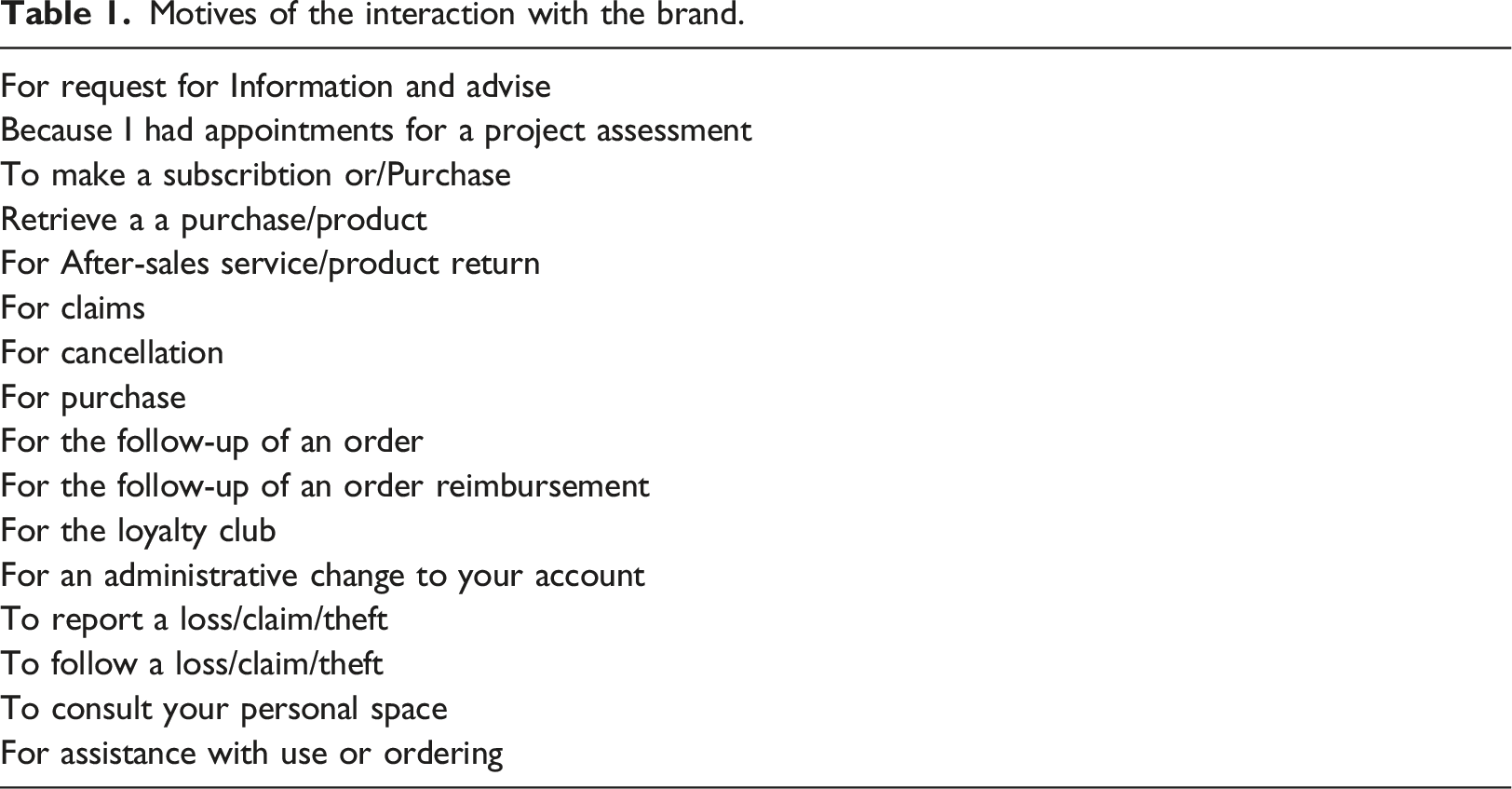
The data analysis method is based on the analysis of variance and the associated linear model. A Type III test mode was used. When examining the results, less attention is paid to the F test and the p-value than to the test’s power, but above all to the effect’s size. The multitudes of observations (314 194 observations) make us certain that the p-values will be highly significant, even if the differences in averages are very small.
Therefore, the main indicator, Cohen’s f (1988), is formulated as follows:
The values of .10, .25, and .40 represent low, medium, and high effects. The brand, the motives and the time factor (survey wave, 102 weeks of observations) were used systematically as control variables (hierarchical linear model). Indeed, interactions for product return, refund, claim and cancellation trigger a significant decrease in customers’ satisfaction, unlike the other reasons. However, the effects remain the same whether the motives variable is integrated in the full model or not.
Results
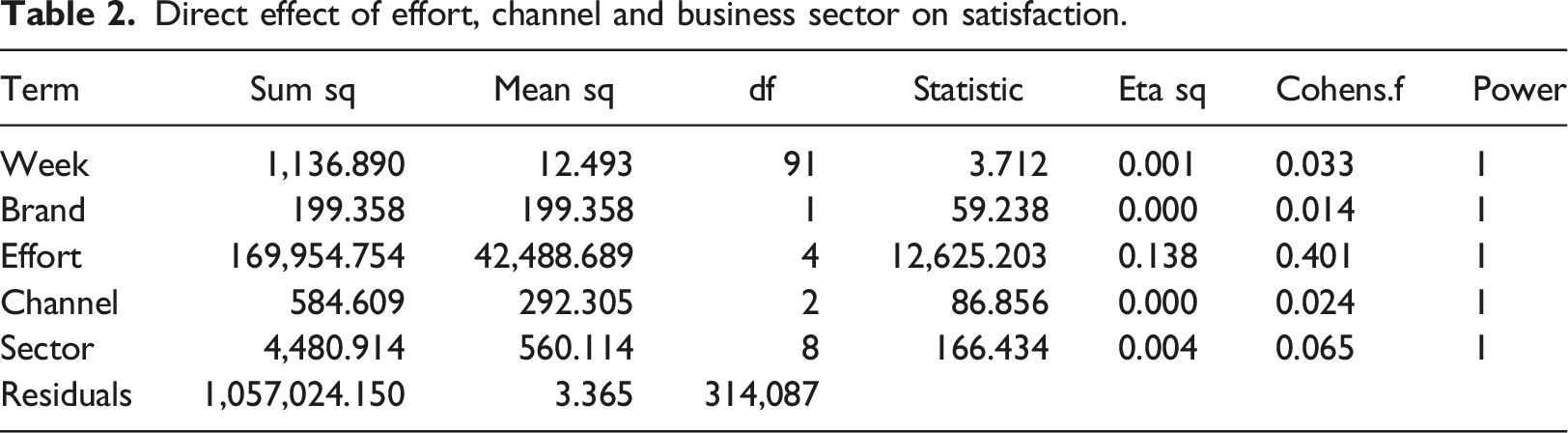
The principle of least effort dominates
Direct effect of effort, channel and business sector on satisfaction.
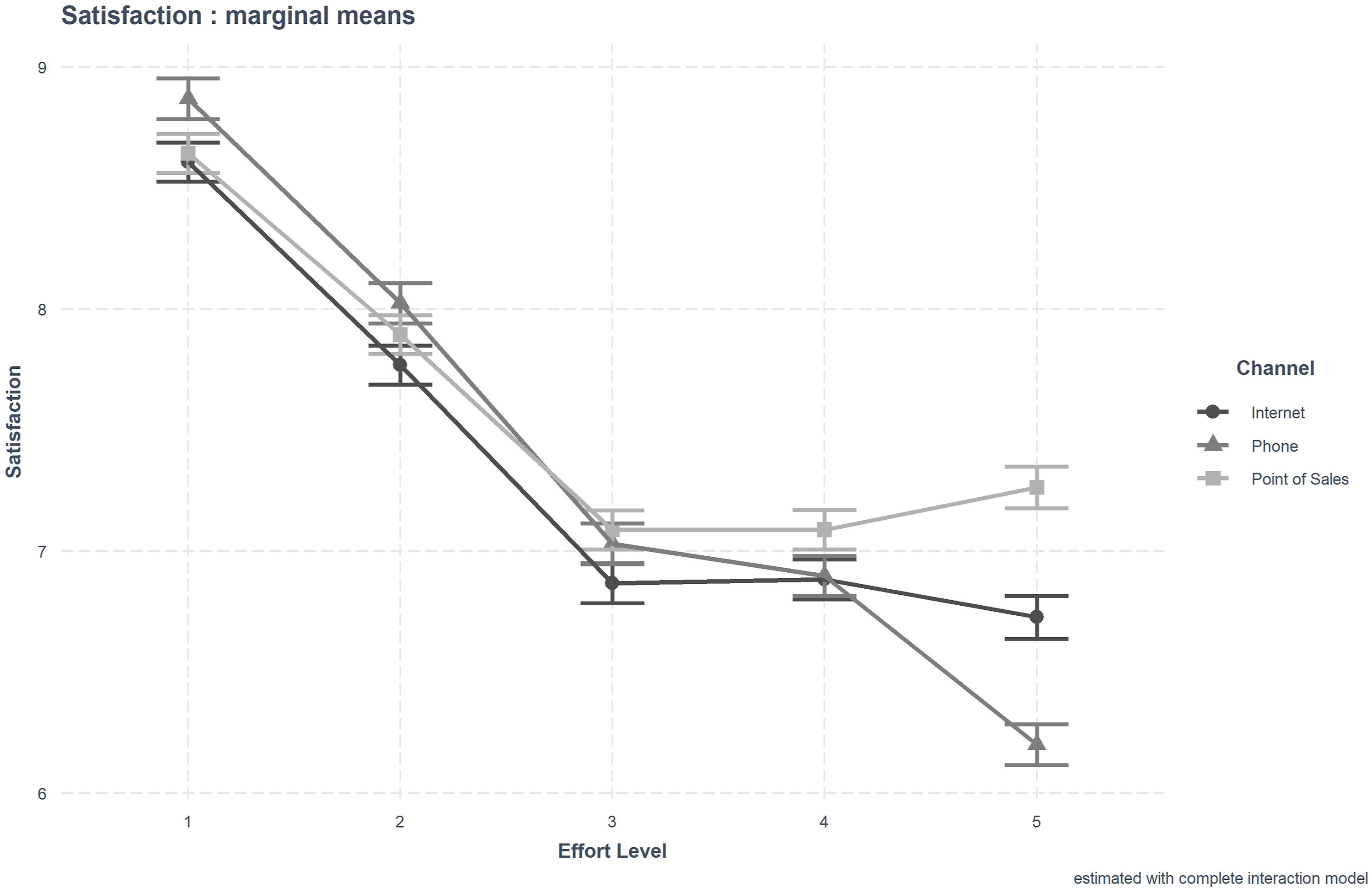
Satisfaction according to the level of effort and the interaction channel.
In certain contexts, intense effort is a source of satisfaction
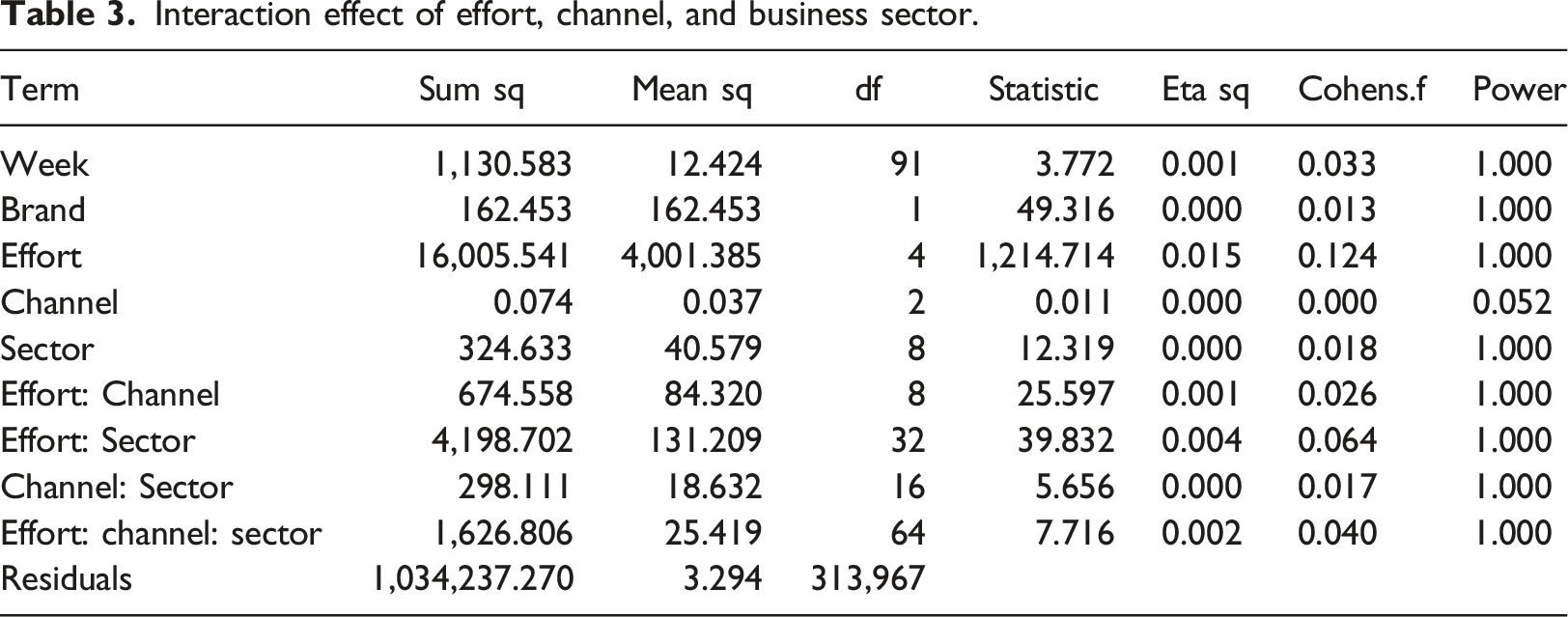
Interaction effect of effort, channel, and business sector.
For hedonic sectors, the possibility of engaging the customer on all channels
Table 3 indicates that the activity sector strongly affects satisfaction (F = 86.856, Eta2 = .004, f = .065), higher for retail (food, e-commerce, and DIY), banking, and insurance, lower for mobile utilities and ISPs. But the impact of the activity sector strongly depends on the customer’s effort intensity (F = 39.832, Eta2 = .004, f = .064). For all sectors, clients are more satisfied when the effort is low rather than moderate. In this case, satisfaction is a least-effort logic, and the more intense the effort the customer must make, the lower his satisfaction. The interaction between the sector of activity and customer effort is observed at high levels of effort. As announced in proposition 2a and 2b, interactions with brands for hedonic sectors (retail DIY Furniture, E-com, Food, automobile) lead to a curvilinear relationship between effort and satisfaction. Oppositely, interaction with brands from utilitarian sectors lead to a linear relationship (Internet Service Provider, utility, mobile, bank) (Figure 2). Therefore, interactions implying strong effort from customer will trigger more satisfaction in hedonic sectors than in utilitarian sectors. Satisfaction according to the level of effort, business sector, and the interaction channel.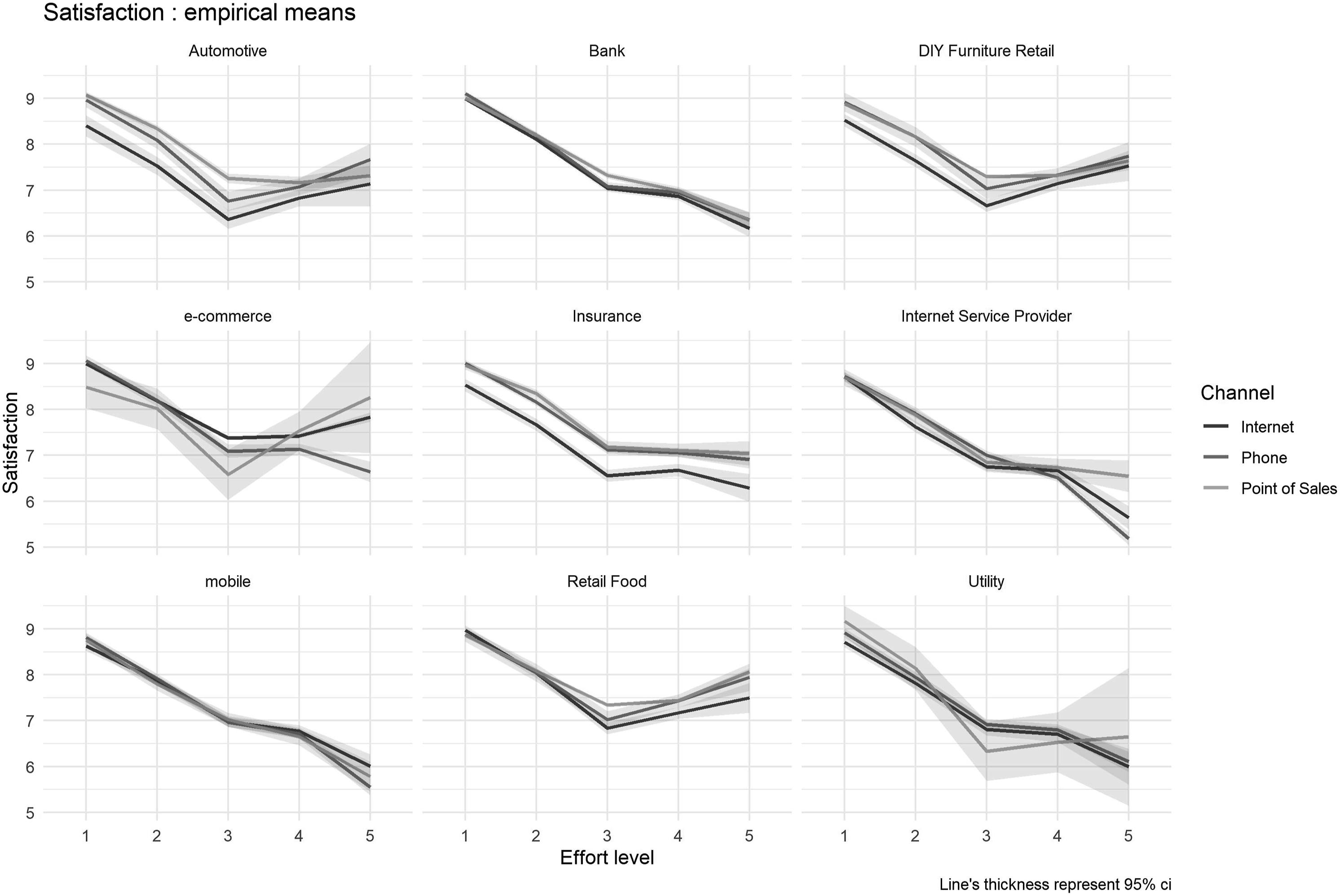
At the point of sales: The logic of commitment coexists with that of least effort
Table 3 show that the channel of interaction has a small direct impact on customer’s satisfaction (F = 86.856, Eta2 = .138, f = .401). This effect hides discrepancies depending on the intensity of the customer’s effort. Indeed, Table 3 indicates that the impact of the interaction channel on satisfaction significantly depends on the customer’s effort intensity (F = 25.597, Eta2 = .001, f = .026). Figure 1 shows that, at low and moderate levels of effort, satisfaction is quite similar between the three channels of interaction. However, at highest level of effort (rated 5), the satisfaction is higher at the point-of-sale, average on the Internet, and low on the phone (Figure 1). As shown in Figure 1, in general, whatever the channel of interaction, the more the effort is intense, the less the customer is satisfied. But this negative impact of effort intensity on satisfaction tends to decrease for higher levels of effort (rated 5), rather than moderate levels of effort (rated 3). On the internet and at the point of sales, asking a strong (rather than moderate) effort to customer does not significantly decrease satisfaction. Figure 1 shows that, as announced in proposition 3a, customer effort has a curvilinear effect on satisfaction at the point of sales. Customers that are asked a very intense effort at the point of sales are more satisfied than those who are asked a moderate effort. Therefore, at the point of sales, and to a lesser extent on the internet, the principle of least effort and commitment coexist. Oppositely, on the phone, increased customer’ effort always triggers dissatisfaction: the principle of the least effort prevails.
In the interaction model (Table 3), the effect of the interaction channel is mainly observed at the interaction level with the business sector (F = 7.716, Eta2 = .002, f = .040). The logic of least effort, which can be observed on the phone and to a lesser extent on the internet, is more likely to appear in utilitarian sectors (Internet Service providers, mobile, bank, insurance) than in hedonic ones (retail food, retail DIY Furniture, retail e-com, automotive sector). In utilitarian sectors, customer effort negatively affects satisfaction, whatever the interaction channel (Figure 2). The logic of the least effort prevails when customers interact with banks (e.g., HSBC, BNP), insurances (e.g., Allianz, Axa), mobile phones companies (SFR, Sosh), utility companies (EDF, direct energy) or ISPs (e.g., Free, SFR, Orange). However, we note that, in the utility sector (EDF, direct energy), and at the point of sales, high level of effort tiggers slightly higher customer satisfaction rates than moderate effort. Indeed, the utility sectors is composed of historical players who have had agencies to welcome the public for decades, which creates a preference for face-to-face interactions on this sector. When customers interact with retail e-commerce brands (e.g., Amazon, Sarenza, Zalando), automotive brands (e.g., Toyota, Renault, Citroen), retail food brands (e.g., Carrefour, Auchan...), DIY and home decoration brands (Ikea, Hema, Leroy Merlin), customers are less satisfied when asked to provide a moderate level of effort. Indeed, if they are asked intense effort, they feel engaged, and if they are asked little effort, they are happy to benefit from simple and easy solutions to their requests. As announced in proposition 3b and 3c, in hedonic sectors, whatever the interaction channel, customer effort has a curvilinear effect on satisfaction. However, we note that, in the retail e-commerce sector (e.g., Amazon, Sarenza, Zalando), interactions on the phone follow the logic of least effort, such as the higher the customer effort, the lower the customer satisfaction. Traditionally, the players in this market are pure players who have established themselves on the Internet. Telephone interactions are not their core business, which penalises satisfaction in this medium.
Conclusion
Brands are deeply concerned with managing customer interactions. Two opposing logics tend to clash. Some advocate the least effort principle, arguing that the customer’s effort when interacting with the brand must be systematically minimised. However, others advocate the logic of commitment. The customers’ effort can be a source of satisfaction when they see their effort to co-create value alongside the brand. Since the seminal article by Dixon et al. (2010), it is the principle of least effort that dominates in research and practices, with the measurement of customer effort score (CES) having established itself as a central indicator of the quality of customer relations in many companies.
This article proposes to empirically verify the widely held assertion that “the more effort the client makes, the less satisfied he is” (principle of least effort) with a large-scale data collection (314 194 observations). Based on its panel structure, which allows 1500 people to be interviewed every week for 102 weeks, the study covers 96 brands in nine business sectors (ISP, Utility, Mobile, Retail food, E-retail, Automotive, Banking, and Insurance). It encompasses various interaction patterns across all interaction channels. Although the data source is unique, the scale of this data collection allows the results to be generalised, as in Bass (1995) or Uncles and Wrigh (2004), and to make concrete recommendations for practitioners.
The results show that customer satisfaction is generally much higher when interactions with brands do not require any effort on the part of the customer (intensity of effort rated 1 on a 5-point scale), regardless of the channel (telephone, internet, point of sale) and the sector of activity. Generally, customers are less satisfied when making a moderate or high level of effort to obtain an answer to their request. The proposal of Dixon et al. (2010) is widely verified on a large scale.
However, this study’s results argue for a contingent theory of the effect of effort on customer satisfaction. When we distinguish interactions according to channel (point of sale, internet, telephone), according to the sector of activity, the main effect of effort on satisfaction collapses in the explanatory capacity. Therefore, the effort’s effects are quite contingent: they depend on the context of the interaction with the brand. For very high levels of effort, in hedonic sectors, and most significantly at the point of sale (rather than on the phone and on the internet), asking the customer to invest significant effort in interacting with the brand can have a positive effect on satisfaction (vs asking to invest a moderate effort). The link between effort and satisfaction depends on the brand (hedonic vs. utilitarian), on the interaction channel (point of sale, telephone, internet) and on the level of effort required from the customer (low, moderate, intense).
Contributions for theory
This research complements the literature on the effectiveness of Customer Feedback Metrics, which seeks to understand which metrics are most predictive of customer behaviour (De Haan et al., 2015). Previous research has examined the effectiveness of the Customer Effort Score (De Haan et al., 2015; Mintz et al., 2021; Morgan & Rego, 2006). Some authors have praised the predictive power of CES on consumer retention (Agag & Eid, 2020; Dixon et al., 2010; 2013), but others show that this predictive power is very weak (de Haan et al., 2015). Thanks to the analysis of a very large customer database (314 194 observations customer-brand interactions collected on a sample of 1500 respondents who were representative of the French population), this research sheds new light on the effectiveness of the Customer Effort Score by showing that consumer satisfaction is decreased when the effort required from the consumer goes from a low to a moderate level, but that it can be increased when it becomes intense, but only in hedonic sectors, such as ecommerce (i. e.g., Amazon, Sarenza, Zalando), automotive (e.g., Toyota, Renault, Citroen), retail food (e.g., Carrefour, Auchan...), or DIY and home decoration (Ikea, Hema, Leroy Merlin), and more at the point of sale than on the phone or on the internet. On the contrary, in utilitarian sectors such as banking (i.e., HSBC, BNP), insurance (i.e., Allianz, Axa), mobile (SFR, Sosh) or ISPs (i.e., Free, SFR, Orange), the link between customer effort and satisfaction is always negative, i.e., the more effort is required from the customer, the less satisfied he is. By proposing a contingent theory of customer effort, this research makes it possible to nuance the results of previous studies on CES, and to reconcile the apparent paradoxes of the literature, by showing that the predictive power of CES on consumer approach behaviours depends on the sector of activity, the channel of interaction, and the level of effort requested from the consumer (low, moderate, intense).
This research also contributes to a better articulation of the concepts of customer effort, customer engagement and customer satisfaction. In the literature, following Dixon et al.’s (2010) conceptualisation of the Customer Effort Score, the concept of effort is often associated with a painful and negative emotion. Service quality is supposed to be at its highest when the customer does not make an effort to get what he wants. Customer effort is thus opposed to Customer engagement (Hollebeek, 2011), which is defined as a positive emotion, an immersion, a passion, a connection with the product or service (Vivek et al., 2014). While both concepts refer to the idea that consumers invest energy (time, money, cognitive investment...) in the relationship with the brand, the concept of customer effort refers, in the literature, to the pain that the brand inflicts on the customer, while engagement is seen as a way for the brand to co-create value with the customer.
However, this research suggests that the two concepts are not opposed: depending on the context in which the interaction takes place, consumer solicitation can be seen as a demand for effort (and have a negative effect on customer satisfaction) or for engagement (and have a positive effect on customer satisfaction). Indeed, this article indicates that an investment of low or moderate strength in interaction with brands is generally perceived as an effort (and therefore a source of dissatisfaction), whereas a more intense investment can be associated with a commitment on the part of the customer (a source of satisfaction), especially on the points of sales, and for interactions with brands of the hedonic sector. Therefore, this research suggests that effort and customer engagement refer to two facets of the same concept, which we could describe as the customer’s investment of their physical or mental strengths in a service or product (Krishna et al., 2021). Customer effort refers to the negative side of customer investment (which contributes to customer dissatisfaction) while commitment is the positive side (which contributes to customer satisfaction). Moving away from opposing the concepts of effort and commitment, this research suggests that the capacity of the customer to experience satisfaction when he invests his physical and mental forces in a product or service depends on the nature of the experience (hedonic or utilitarian, on the Internet, on the telephone, or at the point of sale) but also on the intensity of the investment required. Therefore, increasing customer satisfaction does not always imply simplifying customer-brand interactions (Dixon et al., 2010), but rather adjusting the level of effort required to the context, in this study to the interaction channel (telephone, internet, point of sale) and the industry (hedonic, utilitarian).
Contributions for practice
This article offers managerial contributions to compagnies operating on utilitarian business sectors, such utility, ISP, mobile, insurance, bank etc. It confirms that they should propose a frictionless customer experience, at the point of sales, on the telephone and on the internet, as the least-effort logic applies to every interaction with customers. It also offers recommendations for compagnies operating on hedonic sectors, such as retail, automotive, e-commerce. They may consider that the logic of customer engagement coexists with that of the least effort. The link between effort and satisfaction is curvilinear, meaning that customers who invest intense effort in the relationship (e.g., by committing their reputation to recommend a brand or by investing time to publish positive content about the brand) are satisfied to become actors committed to the brand (the logic of commitment). They must pay attention to the way customer’s engagement is perceived, as the logic of commitment suppose that the level of customer’s effort is intense. Moderate customer’s effort will be considered as painful and trigger dissatisfaction.
This research offers interesting insights for companies that want to define their service process, i.e., the way the customer journey should unfold. Many service companies need to collect information about the customer to offer him a product that matches his profile. However, the prevailing paradigm is that it is better to avoid overloading the customer in the customer journey, so that the customer experience remains frictionless and seamless. For example, cosmetics and skincare brands often make the trade-off between the need to have accurate information about skin and cleansing habits, and the desire to offer a simple and fast customer journey where the customer engages the minimum effort possible. This research offers an interesting insight by showing that intense customer effort is not always synonymous with dissatisfaction, and that hedonic brands (such as fashion and beauty) can solicit efforts from customers, especially if the interaction proposes a physical human exchange with a brand representative at the point of sales. This research suggests that, if an organization proposes a hedonic service through a face-to-face interaction with a brand’s representative, it should not limit customer’s effort to maximize its satisfaction. Following the logic of commitment, satisfaction would be maximized if the customer would be offered the opportunity to put some effort into the relationship to create a specific emotional bond with the brand. Therefore, the validity of the CES to predict satisfaction would be improved if the organization could distinguish the means with which the customer and the organization interact (phone, internet, physically at the counter). For example, when supermarkets and hypermarkets customer services use the CES, they should distinguish in their analyses whether the customer interacted physically with a delivery person or whether the customer interacted with customer service over the phone or on the Internet.
Limitations and research avenues
This research is not free of limitations which constitute avenues for future research. This study could not distinguish the impact of the motives for the interaction between the brand and the customers. However, customers’ willingness to engage with the brand could be higher when the customer wants to make a purchase rather than making a complaint. Indeed, positive emotions associated with the purchase could facilitate the customer’s engagement, while the negative emotions associated with the complaint may increase the desire for the brand request to be met quickly and easily. Other contextual elements could also have moderated the link between effort’s intensity and satisfaction. In particular, research has noted the importance of customers’ perceived brand investment, i.e., the extent to which customers believe a brand to invest effort into the customer-brand relationship, as a key determinant of relationship quality (e.g., Krishna & Kim, 2021). Therefore, further research should investigate the moderating effect of the brand’s effort intensity. The impact of individual variables, such as age, should also be the subject of additional research to understand under what conditions customer effort is transformed into commitment.
Future research may also distinguish interactions with brands selling services from those selling products. The methodology of the study was to ask each respondent to describe the latter interactions with brands, leaving them free to mention all kinds of brands. The aggregated data did not allow for the separation of brands according to a product/service distinction in the data analysis. However, it can be assumed that expectations in terms of effort may vary depending on the nature of the offer. The customer experience paradigm may be more evident in the context of service than product offerings, and customers may be more reluctant to put effort into getting their query answered when dealing with a service rather than product brand.
Lastly, future research could examine if, at the point of sales and in hedonic business sectors, intense customer effort may increase purchases. Indeed, Szymanski and Henard’s (2001) meta-analysis shows that satisfaction has a positive impact on self-reported customer loyalty, but some other research indicates a nonlinear relationship between satisfaction and actual customer behavior (e.g., Anderson & Mittal, 2000). The dynamics during the relationship may affect the link between satisfaction and actual purchases (Verhoef, 2003). Future research could investigate if, at the point of sales, the positive impact of intense customer effort on customer satisfaction would result in higher actual consumption behaviours, and if this effect would be the same on other channels of interaction with brand (telephone, internet).
Footnotes
Acknowledgements
The authors want to thank BVA and Webhelp for their help in the data collection.
Declaration of conflicting interests
The author(s) declared no potential conflicts of interest with respect to the research, authorship, and/or publication of this article.
Funding
The author(s) received no financial support for the research, authorship, and/or publication of this article.
