







Abstract
This interdisciplinary study aims to explore the lived experiences and engagement of young voters from a customer journey perspective. To achieve this, the present study investigates voter engagement journey with various political events (2015 UK General Election, 2016 UK-EU Referendum, 2017 UK General Election and future elections). The authors collected data via phenomenological in-depth interviews with young voters 18–24 years. The results show different engagement journeys and touchpoints. In particular, the findings reveal that (1) young voters were not apathetic of politics as long as they could identify the personal impact of political issues-policies (i.e., sticky customer journey); (2) the ‘voter journey’ is dynamic resulting in stronger engagement yet limited long-term party loyalty; and (3) voters used multiple touchpoints to engage with the political process combining media, voter-led research and interactions with personal networks and political stakeholders (online and off-line). This study puts forward the voter engagement and journey mapping framework which represents a mechanism for researchers and practitioners to gain access into the hidden world of the voter journey and periodically explore levels of engagement across political events. To our knowledge, this is the first study examining customer journeys in a political context and provides insights for political campaign managers to effectively improve voters’ engagement.
Keywords
Introduction
Despite it being emphasised that voters’ experience is a key factor for political parties to win the elections (Pickard, 2019; Sloam & Henn, 2017), voter customer journeys, as an important pillar of this approach, has received little attention from scholars. Moving toward the strategic marketing era, scholars need to use customer journeys to understand a variety of contexts (Becker et al., 2020), including political marketing. Due to the high volatility of voters (Simons, 2016), the need to grasp how they engage with political events (e.g., Lees-Mashment, 2019) and their (dis)engagement with the political process (Pickart, 2019), exploring their voting customer journeys is of paramount importance for political stakeholders. As online marketing expenditures continue to grow, understanding how to allocate resources across various touchpoints requires an in-depth account of how customers interact with these resources throughout their customer journey (Li et al., 2020) to create a strong customer experience (Lemon & Verhoef, 2016).
Responding to the identified gaps, we adopt an interdisciplinary approach combining theory from political marketing, customer journeys and consumer engagement to highlight the need to understand young voters’ engagement experience. Particularly, this study seeks to (1) understand voter engagement journeys across political events and future voting intentions, (2) identify touchpoints in voters’ engagement journey, (3) develop a systematic framework to explore voter engagement journeys and identify changes overtime. This study also responds to calls for research on customer journeys to explore customer experiences in different contexts from commercial products and services (Becker et al., 2020). In the first section, we critically discuss the theoretical background for this study. The second part presents our research objectives offers an overview of the research context of political uncertainty and puts forward an appropriate and justified methodology, while the third section presents and discusses our empirical findings structured via three theoretical constructs-themes emergent from our observations linked with previous research. The final part outlines the implications of our research for marketers and academics and conclude with the identification of areas for future research.
Theoretical background
The theoretical background of this work is organised around political marketing, to follow with the literature on voter engagement. The fourth sub-chapter focuses on customer journeys and how they can help to enhance individuals’ experiences. The final sub-section brings together the three abovementioned areas to indicate the need to investigate young voter’s engagement journey through different political events.
Political marketing
There is a general agreement among scholars that both political marketing and marketing share similar theoretical concepts and application. Political marketing has developed over the last 20 years as a recognised sub-discipline of marketing which focuses on the application of marketing strategy, research practices, management and communication tactics-tools to the political environment (Lees-Marshment, 2019). Political marketing aims “to create, communicate, deliver and exchange promises of value with voter-consumers, political party stakeholders and society at large” (Hughes & Dann, 2009, p. 244). Politicians, advisors, parties, movements, governments and nations use marketing strategy to help them achieve a wide range of goals, from winning elections to achieving policy change (Billard, 2018; Harris & Lock, 2010; Kornum & Muhlbacher, 2013; Lees-Marshment, 2019; Parackal et al., 2018). The application of marketing strategies, techniques, concepts and tools in politics is also known as a ‘marketisation’ of politics and the way in which these approaches have been used shows the orientation of a political party.
Existing research in political marketing recognises that political stakeholders such as political parties or politicians, periodically conduct market research to understand the wants and needs of the electorate. This helps them to develop appropriate messages (Johnston et al., 2018; Lin, 2017; Parackal et al., 2018; Wilson & Paleologos, 2018), and further engage with voters, who are part of the co-creation of the election process. In “recent years there has been an increased level of voter volatility which has been matched by an interest in understanding electoral behaviour” (Simons, 2016, p. 4). Understanding how people behave in political events, how they engage with political tactics and capturing their experiences of the political process is an area that requires further discussion (Johnston et al., 2018; Lees-Marshment, 2019; Lees-Marshment et al., 2019; Lin, 2017; Nunan & Domenico, 2019; Parackal et al., 2018; Walker et al., 2019; Wilson & Paleologos, 2018).
Voter engagement and disengagement
Voter engagement is a complex, paradoxical phenomenon (Barrett & Brunton-Smith, 2014; Dermody et al., 2010; Górecki, 2013; Pickard, 2019; Uberoi & Johnston, 2021). The notion of voter engagement can trace its origins to the 1960s where researchers focused on the political ‘activity’ of citizens in elections and political events (Russell et al., 2002). Since then, voter engagement has expanded across disciplines including politics, education, sociology and marketing (Pickard, 2019). Further, research on voter engagement has become specialised and sophisticated in terms of conceptualisation, measurement and exploration. For example, an engaged voter can be defined as an individual or group and “can be considered democratically [politically] engaged to the extent that he/she (it) is positively engaged behaviourally and psychologically with the political system and associated democratic norms” (Uberoi & Johnston, 2021, p. 6). In contrast, a voter can be disengaged “if they do not know, value or participate in the democratic process” (Uberoi & Johnston, 2021, p. 4). This suggests that engagement and disengagement are related yet distinct concepts. Nevertheless, investigating whether citizens are engaged or disengaged remains a key concern for political parties, institutions, and governments across national and international contexts as engagement and disengagement has an impact on the democratic process (Johnson & Marshall, 2004; Pickard, 2019).
Indeed, engagement and disengagement of young people and politics has been well documented in the past (Johnson & Marshall, 2004; Russell et al., 2002; Sloam & Henn, 2017; Uberoi and Johnston, 2021). Of all voter groups, young people are often portrayed as “highly distrusting”, “cynical”, “alienated” of the political process (Dermody et al., 2010, p. 421). Further, young people are less likely to turn out and take part in the political process compared with the general population (Johnson & Marshall, 2004; Russell et al., 2002; Sloam & Henn, 2017). For example, 54% of 18–24-year-olds turned out to vote in the 2019 UK General Election compared to 77% of over 65-year-olds. In addition, young people with fewer qualifications are less likely to register than those educated to a degree level (Electoral commission Study 2016) and young people are most likely of all groups to complain that limited information is disseminated about political events, campaigns, candidates and policies (Russell et al., 2002). Nevertheless, research suggests that young people continue to call for clearer and detailed information prior elections and political events (Harrison, 2020; Johnson & Marshall, 2004; Russell et al., 2002), which in turn could strengthen engagement and improve the voter experience. Therefore, young people appear to be interested in political issues (Kyroglou, 2020), however feel ignored and perceive that politicians and establishment have little interest and regard in the wants and needs of young people.
According to The Electoral Commission and researchers, ‘apathy’ is not the problem and cynicism relate to the political process, institutions, and political parties rather than personal interest in political issues (Johnson & Marshall, 2004; Sloam & Henn, 2017). Indeed, studies carried out over the last 20 years continue to argue that to strengthen engagement, researchers need to investigate the experiences and behaviours of young people in more detail and ensure young people understand the relevance and impact of politics (Johnson & Marshall, 2004; Sloam & Henn, 2017). However, despite that young people are often portrayed as apathetic with politics, young people are becoming increasingly ‘active’ in elections and political events (Kyroglou, 2020). Further, “young people’s political participation is increasing and diversifying” (Pickard, 2019, p. 50). Understanding the engagement [or disengagement] of young people is important as research suggests that “a person’s first electoral experience might colour their entire career as a voter (or non-voter)” (Russell et al., 2002, p. 7). This is consistent with Harrison (2020, p. 259) who maintains that ‘turnout in one of the first two elections when a citizen is eligible to vote will shape their political participation for years to come’. In addition, young people aged 18–24 years are “mostly voting in their first national election…and, since young people are most open change at this point in their lives and electoral participation is known to be habit-forming, we consider this to be the most significant stage in an individual’s formal political development. It is at which an individual’s decision to vote and to support a particular political party are most likely to have a lasting impact” (Sloam & Henn, 2017, p. 9). Therefore, exploring how young people engage in elections and politic events is crucial as this could have an impact on future engagement by improving voter turnout and identifying strategies and tactics to strengthen the democratic process. This in turn addresses explicit calls for further research on the complex and paradoxical phenomenon of voter engagement (Barrett & Brunton-Smith, 2014; Dermody & Hanmer-Lloyd, 2004; Dermody et al., 2010; Górecki, 2013; Harrison, 2020; Russell et al., 2002).
Voter engagement: A multi-dimensional construct
The concept of engagement, as a multi-dimensional construct (Bowden et al., 2017) comprising three key dimensions: cognitive (a set of enduring and active mental states experienced by the consumer), emotional (summative and enduring level of emotions experienced by a consumer with respect to his or her engagement focus) and behavioural (behavioural manifestation toward a brand or firm, beyond purchase, resulting from motivational drivers) (Hollebeek & Macky, 2019). While some studies considered both conventional and non-conventional actions, they focused only on the behavioural aspect of engagement (Barrett & Brunton-Smith, 2014), measured as ‘voter turnout’ (i.e., ‘the portion of voting-eligible citizen who vote’). This measure is an important factor for the government future decisions as it acts like a reinforce assessment from a citizen’s perspective (Lang & Witts, 2018; Shawky et al., 2022). However, the major shortcoming of this measure is to be too simple. It does not tell the whole story of citizen’s participation with a political event such as elections.
Recently political marketing research explored the cognitive, emotional and behavioural dimensions of voter engagement; defined as “an individual voter’s degree of political event-related thought processing and elaboration, emotions and actual devotion of energy, effort, and time to a political event” (Pich et al. 2018, p. 6). This study suggests a new voters’ typology comprising seven prototypical engagement personas (i.e., responsive, latent, cynical, disaffected, instinctive, reluctant and floating), each of them capturing a different type of political engagement. See Figure 1 for a summary of the organisation and characteristics of each engagement level. Overlapping engagement characteristics and prototypical engagement persona – adapted from Pich et al. (2018, p. 605).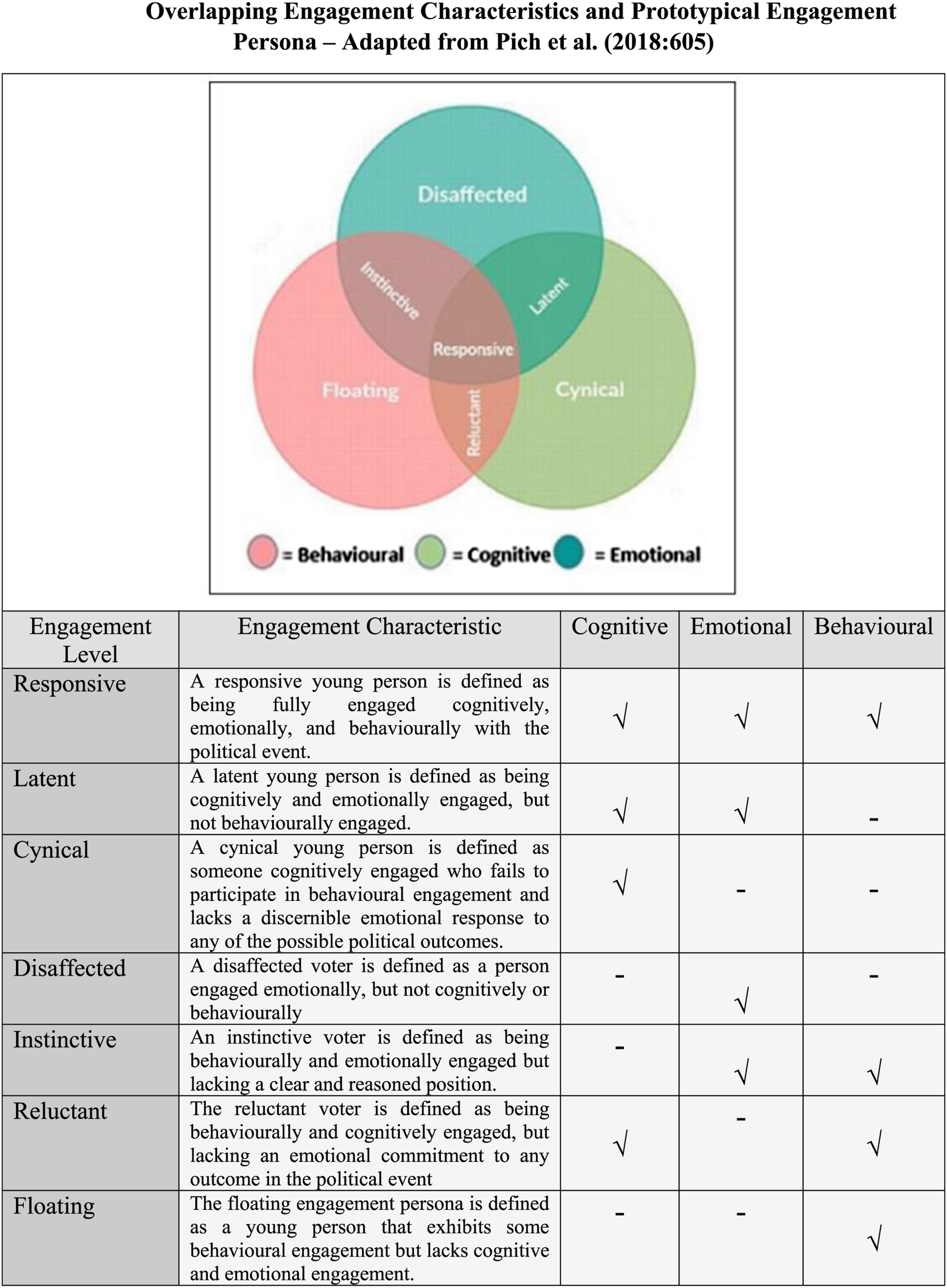
This typology provides a strategic tool for voter classification and suggests that “voter engagement [is] a dynamic process which changes through time as voters change their level-degree of engagement from election to election” (Pich et al., 2018, p. 19). However, Pich et al. (2018) focused on a single political event and neglected the exploration of the voter journey overtime. Further, the typology seems to ignore a relatively large group of citizens who do not express any types of engagement and can be classified as ‘disengaged’. Disengaged individuals are an important group of people who might presently show no engagement in political events, but they might become interested or show some degree of engagement in the future. Voters might exhibit different degree of engagement in various political events. Extant research shows that citizens do not maintain the same persona in different elections (Lang & Witts, 2018; Shawky et al., 2022). By adopting the engagement typology and study of several political events, the changes and underlying motivations for the changes can be investigated. This specifically responds to the call by Pich et al. (2018, P. 19) that there is a need to explore the changes in the degree of engagement and the reason behind these changes. Recent research suggests that “engagement becomes a part of the overall customer experience and, in its specific manifestations, constitutes specific touchpoints along the customer journey” (Lemon & Verhoef, 2016, p. 74). At the same time, the concept of engagement (Brodie et al., 2011) is the best way to study prior brand relationships and predict touchpoints (Baxendale et al., 2015).
Customer journeys
Due to recent technological advancements, the concepts of ‘consumer journeys’ and ‘consumer experiences’ have both gained the great attention of scholars and practitioners in the marketing discipline (e.g., Kuehnl et al., 2019). Consumers have access to a number of online and offline touchpoints to interact with providers of products and services and individualise their journey (Barwitz & Maas, 2018) contributing to their overall experience. In a customer journey analysis, firms focus on how customers interact with multiple touch points, moving from consideration, search, and purchase to post-purchase, consumption, and future engagement (Lemon & Verhoef, 2016).
Research in this area has looked at a range of online actions to show the effect on the Internet use on political engagement as well as measuring attempting to measure online and offline engagement (Gibson & Cantijoch, 2013; Hollenbeck & Kaikati, 2012). However, these studies have focused on single campaigns. In addition, little research traces how young voters behave with the political process and engage with political tactics-activities particularly through time (Akaka & Schau, 2019; Peter & Honea, 2012), especially as the voter embarks on a personal ‘journey’ across different political events.
Recent research highlights that when customers travel from one decision to another, they rarely do so alone, thus ‘social others’ or ‘travelling companions’ should be considered in this journey because individually or in agreement they can influence and individual’s decision journey, for example indicating how satisfaction in a journey can change how they see companions in the next journey, and how individuals cope with social information impacting their decisions (Hamilton et al., 2021). Customer journeys involve multiple service cycles (e.g. visiting the same restaurant regularly) and much of this research assumes that consumers follow ‘smooth journeys’, reflecting customers wanting a task to be completed in the most effective and predictable way to drive loyalty (Siebert et al., 2020). Other consumers follow “sticky journeys” which “are exciting journeys that customer yearn to continue” and more associated with adventure and entertainment (Siebert et al., 2020, p. 46). This alternative journey highlights the need to conduct research showing a less linear and more complex approach that addresses new possible journey expansion pathways, for example by identifying new ways in which consumers conduct research, or a holistic understanding on how consumer experiences (Mele & Russo-Spena, 2021). The political context of young voters’ engagement lends itself to explore new customer journey pathways. Understanding customer experience and the customer journey over time is critical for firms to capture the complexity of individuals’ behaviour and create a strong customer experience (Lemon & Verhoef, 2016). In the same way organisations risk losing customers unless they ensure a seamless interaction throughout the customer journey (Singh et al., 2021), political stakeholders need to understand the complexity of the voter behaviour towards political events (Peng & Hackley, 2009).
Young voters’ engagement journey through different political events
This study draws on the concept of consumer journeys to explore young voters’ journey through various political events. Three observations from review of marketing literature are underpinning this study: (a) ‘Voter journey’ should be investigated from a holistic approach in which voters’ interactions with both online and offline politics related touchpoints are considered. From a political campaign management perspective, understanding of the ‘voter journey’ will give the better picture of voters’ interaction with multiple political touchpoints and how these touchpoints might contribute to their voting behaviour. Advances in information and communications technologies have altered relationships among political candidates, media, voters and citizens (Lin & Himelboim, 2018). Acquiring support online by having people liking, sharing their political affiliation visible to their network is important for political parties and politicians; (b) ‘Young voters’ are not using the advanced technologies only to fulfil their personal needs but also to communicate with other voters to create greater value for them. From a political marketing perspective, it emphasises the need for appropriate marketing actions to create value for young voters who are co-producers of political activities. And (c) There is a need to study how young voters might change their type of engagement due to changes in their goals. “The customer journey can be both looping and nonlinear in nature and involves cognitive, emotional, and behavioural responses” (Grewal & Roggeveen, 2020, p. 3). The investigation of voters’ goals through their journey will provide important insights for political parties to build a stronger relationship with them.
This represents an under-developed area of study on how young voters might change their type of engagement due to changes in their goals. The investigation of voters’ goals through their journey and touchpoints will provide important insights for political parties to build a stronger relationship with them. Research in this area has looked at a range of online actions to show the effect on the Internet use on political engagement as well as measuring attempting to measure online and offline engagement (Gibson & Cantijoch, 2013; Hollenbeck & Kaikati, 2012). However, these studies have focused on single campaigns. In addition, little research traces how young voters behave with the political process and engage with political tactics-activities particularly through time (Akaka & Schau, 2019; Peter & Honea, 2012), especially as the voter embarks on a personal ‘journey’ across different political events. The aforementioned observations regarding voters’ behaviour-engagement are important for political campaign managers to effectively implement political communication strategies and optimising budget allocation (Abdennadher et al., 2019). Marketers need to know which parts of the customer journey have most impact on attitudes and behaviours, and which of these crucial encounters are not working well (Baxendale et al., 2015). In summary, this study adopts the engagement typology (Pich et al., 2018) and employs phenomenological in-depth interviews to explore young voters’ engagement journey and touchpoints through multiple political events.
Research design
The present research examines young voters’ journeys focusing on their engagement with political events and aiming to address three key research objectives: (1) To understand young voter engagement journeys across political events and future voting intentions. (2) To identify key touchpoints in voter engagement journey. (3) To develop a systematic framework to explore voter engagement journeys and identify changes overtime
We focus on the volatile political context the UK and adopt a qualitative interpretive approach based on phenomenological in-depth interviews with young voters to inquire about their engagement journey overtime with the major political events in the UK and their future voting intentions.
Research context
Researchers in the area of marketing encourage research in this time of uncertainty for many current governments due to lack of trust and political division (Wiener et al., 2018). The uncertainty in the current political context in the UK and variability in voters’ engagement after the 2016 Referendum (Pich et al., 2018) suggests that this is a fertile context to inquire about the engagement journey of young voters over different political elections. An examination of current political events from a consumer research perspective can uncover new insights to explain “seemingly senseless outcomes” of behavior such as the unexpected outcome of Brexit, which people perceived to be against people’s self-interests (Dahl et al., 2017, p. 722).
We use the under-research area of consumption journeys, which evolve overtime, have an element of progression and “explore extended engagement with a particular practice” (Akaka & Schau, 2019, p. 499). Specifically, our study explores how young voters’ engagement journey unfolds throughout the major political events in the UK by exploring young voter’s stories.
Research approach
We use a qualitative interpretive approach “particularly well-suited for research that aims to discover new and complex phenomena within a social context, capturing informants’ emic perspectives” (Miles & Hubermann, 1994; Vredeveld & Coulter, 2019, p. 276). Phenomenological in-depth interviews were deemed suitable methods to explore voters’ experiences with specific political events (e.g., 2016 EU Referendum, 2017 General Election), as they investigate topic areas “described from a first-person view” and emergent from the context where they were embedded (Bardey et al., 2022; Kenyon, 2004; Thomson et al., 1989, p. 137). Recent research adopted a phenomenological perspective to the study consumer journeys (Vredeveld & Coulter, 2019) and emphasized the relevance of this approach to expand existing research (Akaka & Schau, 2019). We used interviews as one of the most powerful ways to gather an in-depth understanding of individuals’ experiences (Arsel, 2017).
Interviews began by explaining participants the research process and inquired about their general views on politics and background information such as their constituency. This approach helped to know participants, build rapport and get to “understand how and why they do things” (Arsel, 2017, p. 942). Following this, interviewees were encouraged to reflect on their experiences around the most recent political events in the UK, including the 2015 General Election, 2016 EU Referendum and 2017 General Election to capture their engagement voting journey. We adopted this approach for two main reasons. First, reflexivity drives practice continuity and provides opportunities for enhanced consumption experiences overtime (Akaka & Schau, 2019; Bardey et al., 2022), for example voting. By focusing on specific (political) events, the interviewer provided informants with a context that enabled them to describe the experience in detail (Thomson et al., 1989). Second, engagement “is based on the existence of focal interactive customer experiences with specific engagement objects (e.g., a brand)” (Brodie et al. 2011, p. 257) and in this case the object of engagement was a concrete political event (e.g., 2017 General Election). Consistently, in our interview guideline we embedded questions to capture elements of cognitive, emotional and behavioral engagement with the abovementioned incidents (Bardey et al., 2022; Brodie et al. 2011). Interview protocols need to think about the concepts that the researchers are trying to elicit in each question and “then speculate on different scenarios to predict what kind of opportunities might arise” (Arsel, 2017, p. 942). Therefore, in the final section of the interview, we asked participants about their plans for future political events (e.g. possible second EU referendum) in order to have a notion of future engagement intentions. The interview concluded by summarizing the key aspects discussed during the interview in order to allow clarifications and to refute inferences on the data collection before its formulation (Barnham, 2015; Spiggle, 1994).
Sampling and data collection
A purposive sampling approach was adopted for this study. Purposive sampling is an approach often adopted by qualitative researchers designed to recruit individuals from a specific group of the population best placed in addressing the study’s research objectives (Alston & Bowles, 2007; Daymon & Holloway, 2011). Therefore, purposive sampling was considered an appropriate sampling technique as this research aimed to explore political engagement-disengagement of young people 18–24 years. However, the term young people is often contested and interchangeably conceptualized. According to Pickard (2019, p. 27), there is “no clear-cut definition of young people…defining young people is varied” across different academic fields and practitioner research (Kyroglou, 2020; Pickard, 2019). For example, disciplines such as Youth Studies, Education Studies, Sociology, Biology, Psychology and Health Studies and Political Science young people are often categorized as 18–24 years (Pickard, 2019). Further, research carried out by bodies such as The Electoral Commission and polling analysts regularly group young people aged 18–24 years as part of their sampling approach (Johnson & Marshall, 2004; Harrison, 2020; Russell et al., 2002; Sloam & Henn, 2017; Uberoi & Johnston, 2021). Academic disciplines and polling analysts have also used the term young people interchangeably representing individuals aged 18–29 year and 18–24 years (Rekker, 2022; Smith, 2018). Finally, the term young people will vary across settings and contexts under study (Pickard, 2019). For example, studies contextualized in jurisdictions where the voting age starts at the age of 16, young people are categorized as individuals 16–24 years (Kyroglou, 2020; Pickard, 2019). For clarity and consistency, in this study we defined young people as British citizens aged 18–24 years. British citizens were selected as the United Kingdom served to contextualize this study and the eligibility for voting in national elections in the United Kingdom starts at the age of 18 (www.electoralcommission.org.uk).
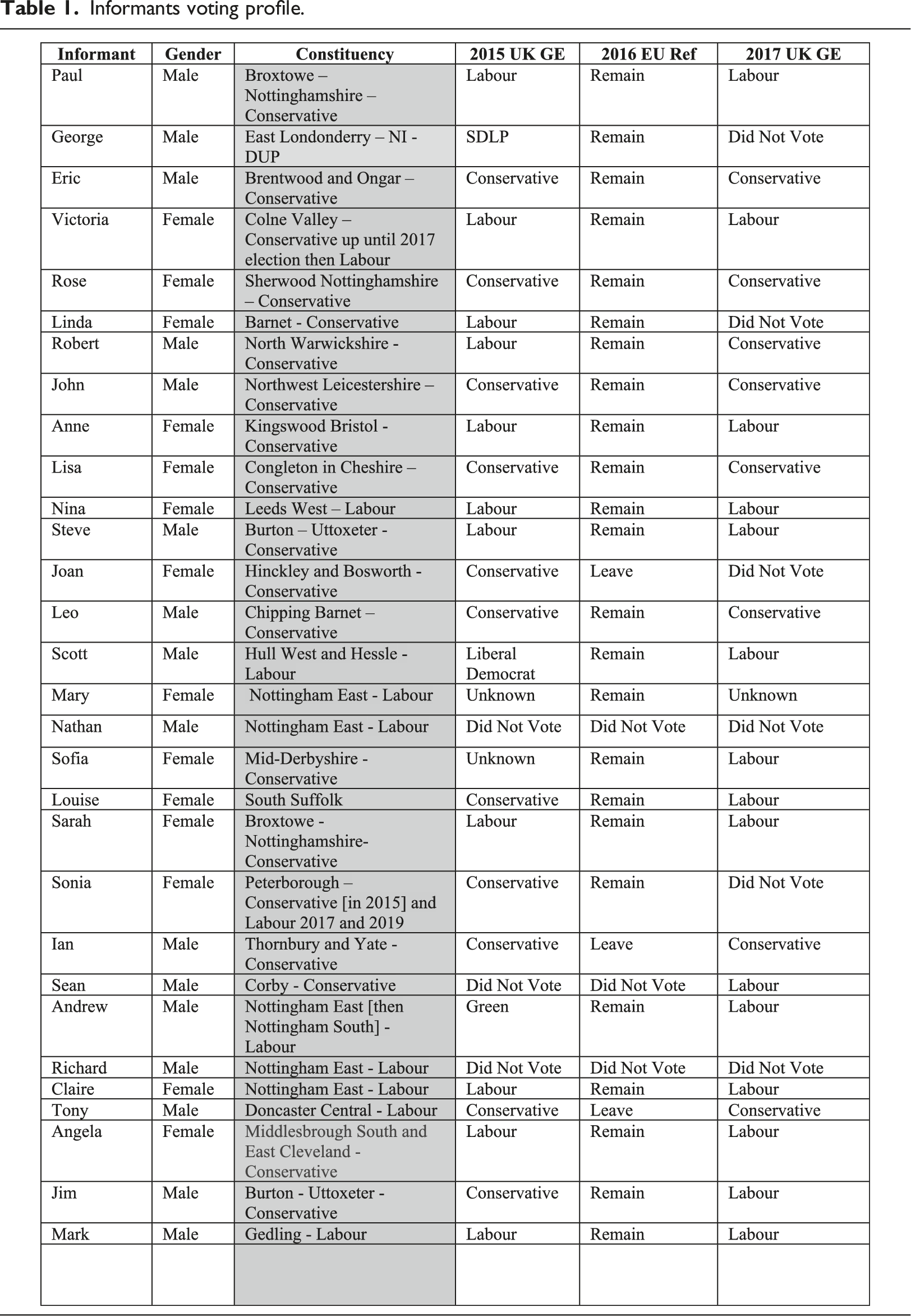
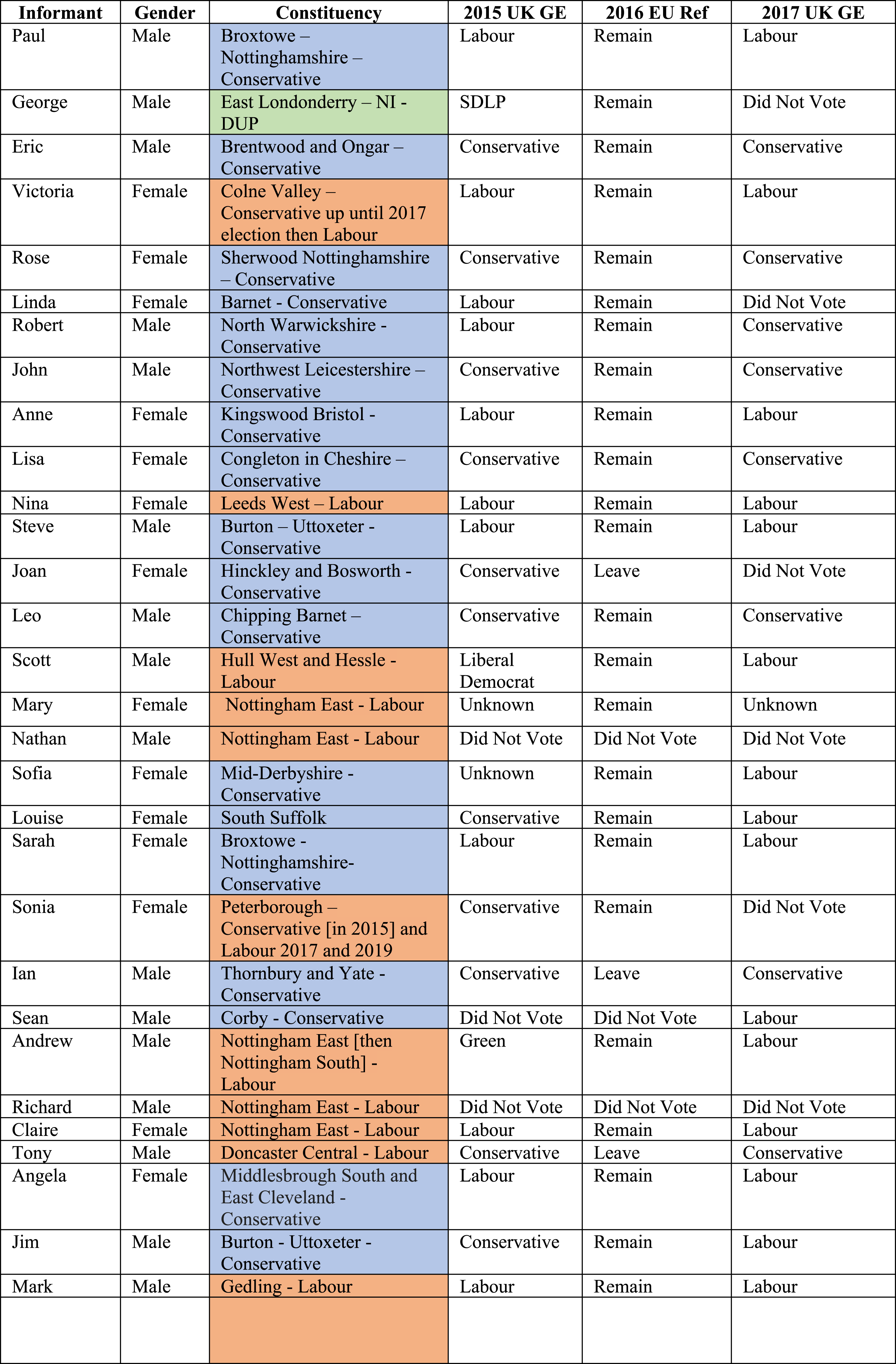
Informants voting profile.
Data analysis
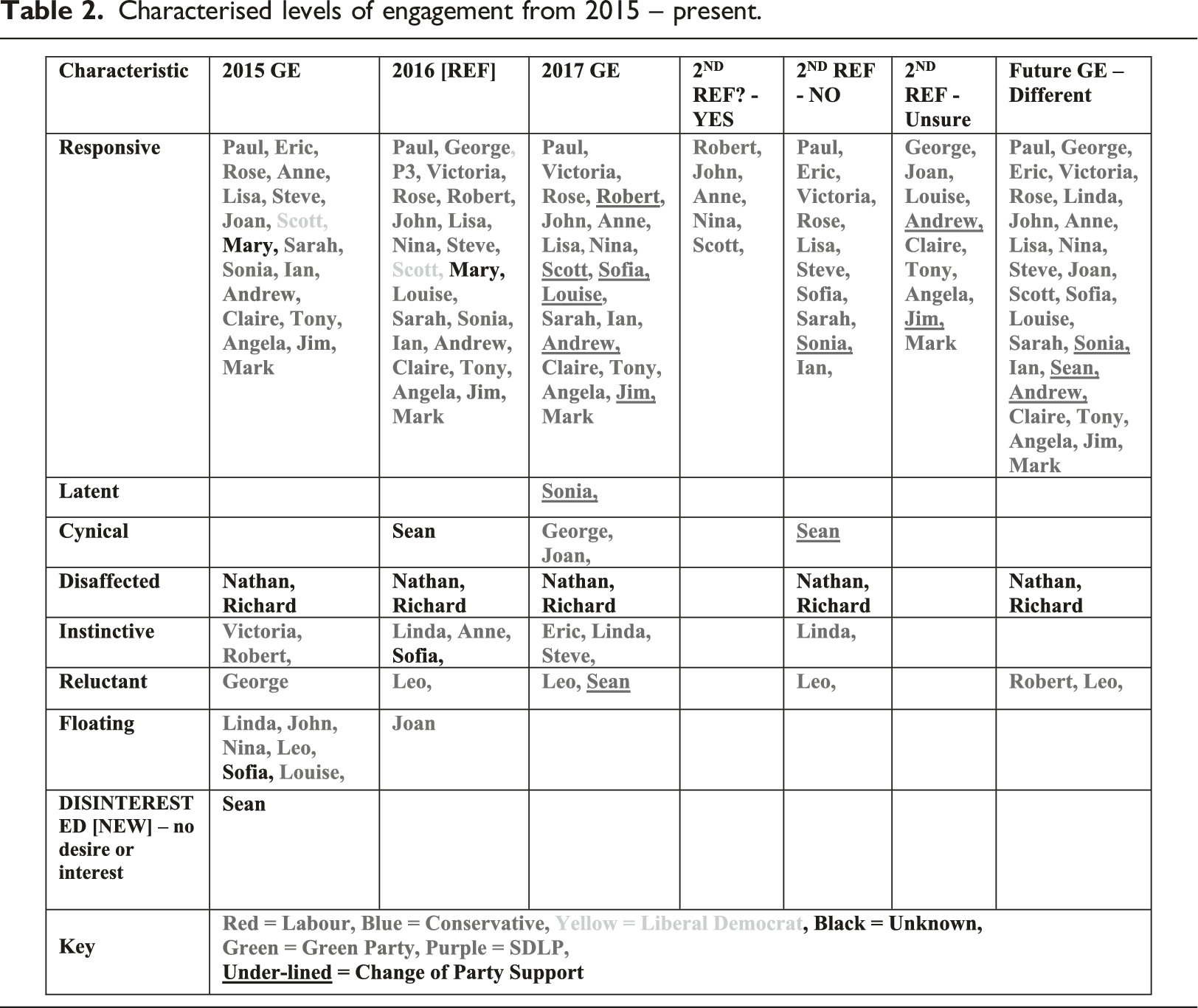
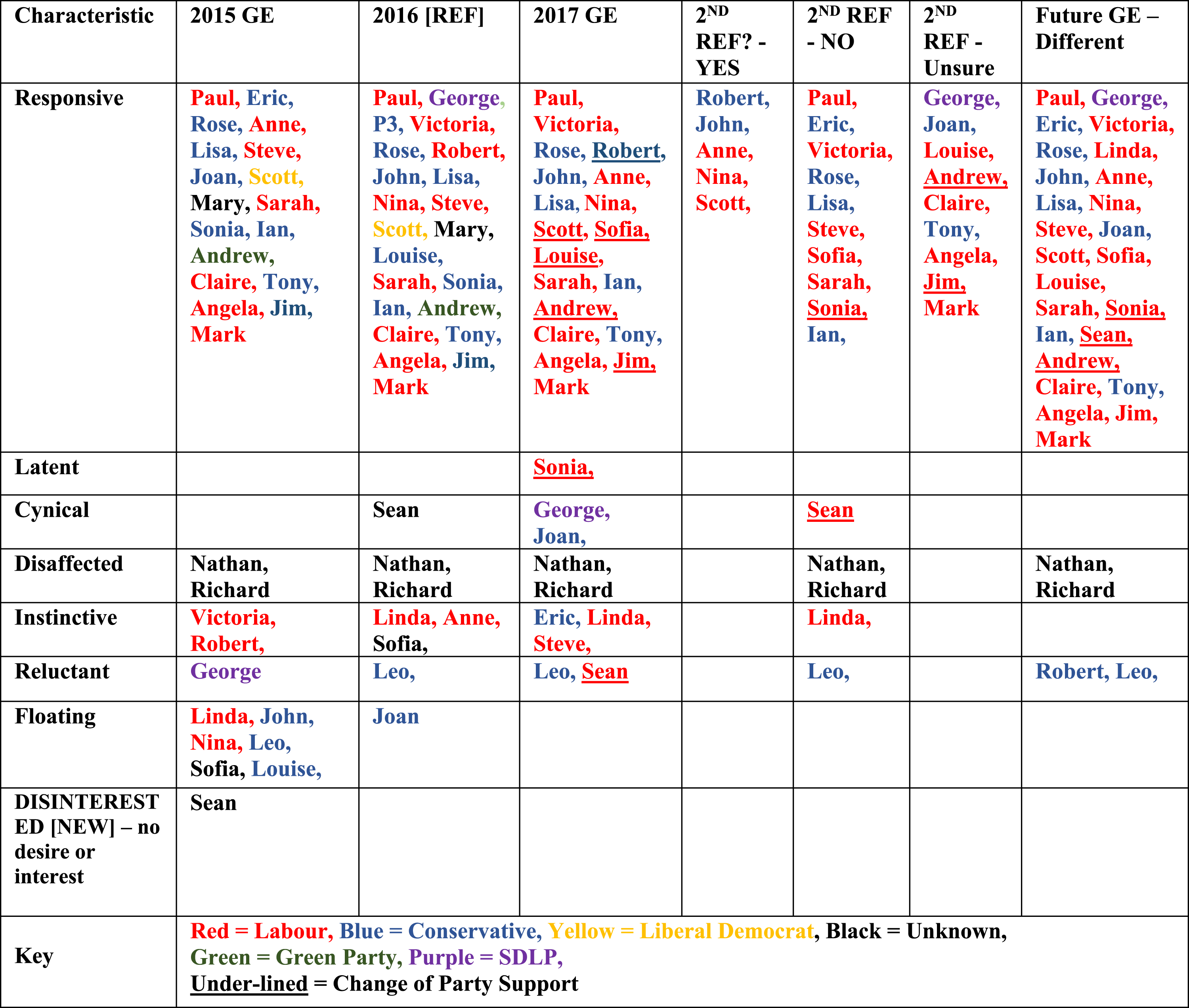
Characterised levels of engagement from 2015 – present.
Stage 1. We familiarized ourselves with the data collected through transcription, reading, re-reading and writing initial notes (Braun & Clarke, 2006) about different ways in which informants engaged with politics and particularly with each political event. This brought to our knowledge that we had not captured the constituencies of some informants and we inquired about them at a later stage, once we concluded the data analysis process. Stage 2. We generated initial codes across the entire data set and organized the data into meaningful “text segments” (Greenwood et al., 2002, p. 66). We coded the data inclusively, thus we included in those text segments part of the surrounding context in order to avoid a common criticism of coding around the loss of the context in which the phenomenon is embedded (Braun & Clarke, 2006). Stage 3. We integrated codes into categories, which include groups of coded data that can be compared and consolidated in different ways (Saldaña, 2016). For example, the codes around ‘how voting affected individuals personally’, ‘their need to see policies relevant to them’ and ‘implications to the participant’s life’ informed the higher order category of ‘personal impact and relevance’ affecting their engagement with political events.
Stage 4. We integrated categories into themes. Themes are the outcome of coding as they comprise different categories, result from analytical reflection (Saldaña, 2016) and capture key aspects related to the research questions (Braun & Clarke, 2006). We achieved this through abstraction, which “collapses empirically grounded categories into higher –order conceptual constructs” (Spiggle, 1994, p. 493) and allows the “particular reality” of coding to progress towards the “thematic, conceptual and theoretical” (Saldaña, 2016, p. 14). For instance, the categories of ‘personal impact and relevance’ and ‘reluctant respect’ characterize the theme of ‘limited apathy’ that informs the second research objective to understand voter journeys across political events and future voting intentions, thus capturing an essential dimension informing the engagement journey of young voters. In order to ensure that our themes were an “accurate representation” of the meanings of our data, we reviewed the extracts for each theme until we found a coherent pattern (Braun & Clarke, 2006, p. 91). Themes were also discussed with other researchers who assisted us in the refinement process through face validity, leading to some adjustments in the naming and definition of themes. Figure 2 outlines the structure of our data from the coding of raw data, categorization and consolidation into key themes and the outcome of our refinement process. Data structure.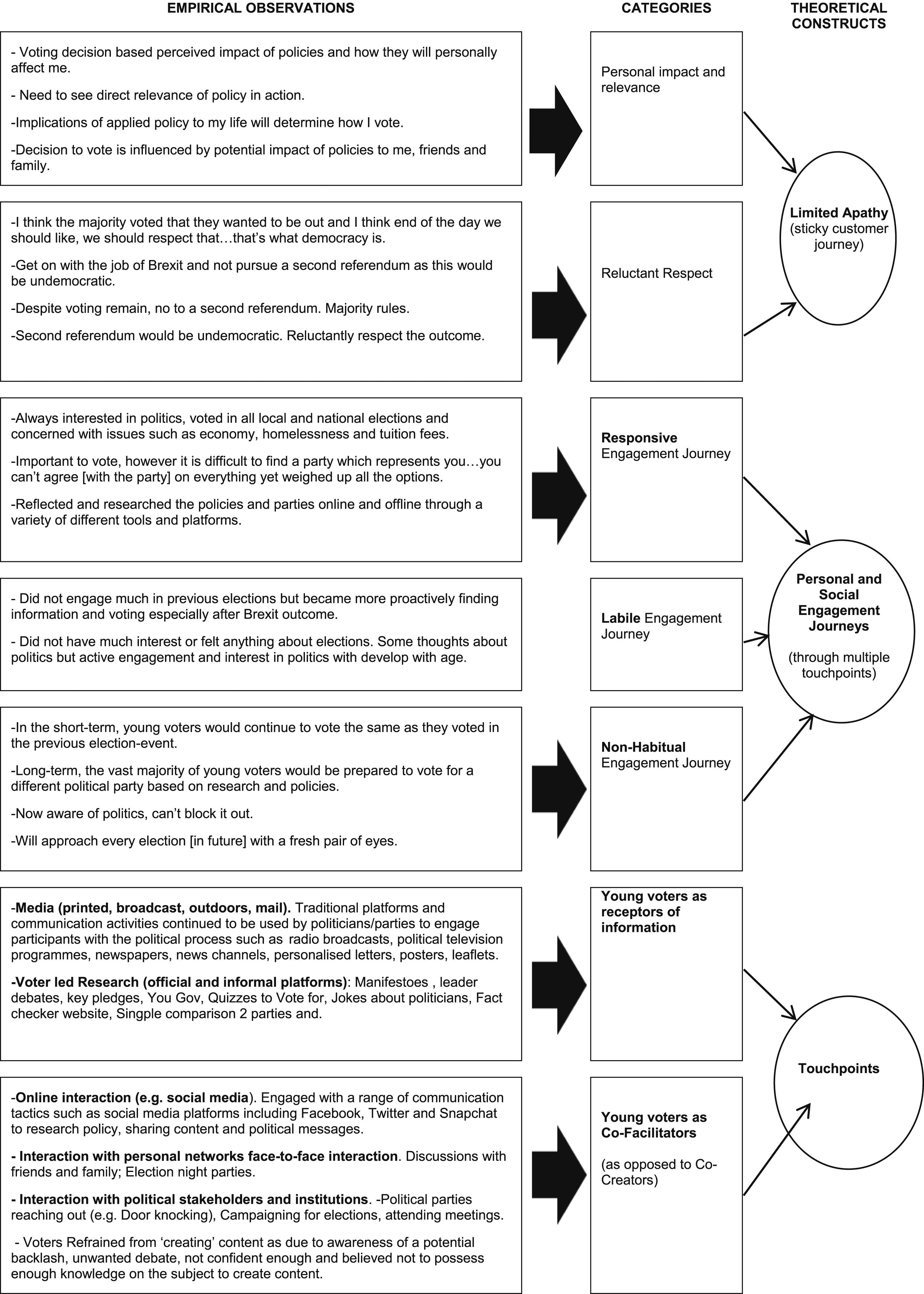
Figure 2 offers an overall representation of the empirical, theoretical observations and relationships that configure an emergent theoretical framework to capture 3 pivotal dimensions of the young voters’ engagement journey. The following section presents our findings followed by a discussion emphasizing the implications to theory and practice.
Findings
This section presents the key themes identified from the in-depth interviews (i.e. limited apathy, engagement tactics and personal-social journey transition through multiple political events) which are discussed in light of existing literature on political marketing, customer engagement and customer journeys.
Young voters’ engagement shows limited apathy and a ‘sticky customer journey’
The first theme that emerged from the in-depth interviews was limited apathy with politics. More specifically, our findings revealed that young voters were far from indifferent to politics, and this was reflected around two aspects: (1) personal impact and relevance of politics and (2) reluctant respect.
Personal impact and relevance
Participants emphasised the personal impact and relevance of politics, policies and political issues associated with their levels of engagement with the political process (i.e. UK-EU Referendum and General Elections 2015 and 2017). Specifically, their levels of engagement were a result of (1) how policies and political decisions were put forward by political parties and (2) how politicians personally connected with young voters (Victoria; John; Steve). For example, interest and perceived relevance of political issues, policies and events developed from ‘how it affects me and how it affects people all around me in terms of what they [political parties and politicians] would plan to implement’ (Anne). Similarly, it was believed voting in elections was based on personal ‘impact on family, my career and money’ for my area (George) and influenced by perceived outcome on their day-to-day lives (Nina).
This perceived personal impact and relevance appears to develop overtime and strengthened because of the UK-EU Referendum. Many young people argued that up until the 2016 referendum, they failed to fully engage with political process as ‘young people do not see the relevance or direct impact’ of politics (John) and politicians and political parties failed to reach out and communicate the significance of politics and policies to young people (Scott). Many young citizens highlighted it was the 2016 UK-EU Referendum, which amplified the ‘importance’ of politics in terms of relevance and personal impact as it was ‘a big thing’(Sofia), ‘a big gamble’ (Scott), ‘a huge deal’ (Sarah), and ‘a major long-term decision unlike general elections’ (Leo). Therefore, the 2016 UK-EU Referendum was considered ‘a big decision for the country’(Victoria) and served as a benchmark for future elections/political events as the political event highlighted how politics and policies had a ‘direct impact on our everyday lives’ (Linda). This highlights the existence of a ‘sticky customer journey’ where involvement over time increased due to unpredictable experiences (Siebert et al., 2020), in this case the novelty of the EU Referendum. Indeed, it was recognised that ‘everyone was talking about it…unlike normal elections’ (Victoria) such as family, friends, work colleagues, the media, celebrities. Further, this ‘once in a lifetime’ political event was such a topical issue. Therefore, the outcome of the UK-EU Referendum was considered a significant event not only as most participants voted in favour of remaining in the European Union, but it allowed participants to reflect and strengthen their recognition of the significance of politics and policies (Anne; Lisa; Nina; Sofia; Louise). This in turn impacted how young voters were predisposed to embrace the next journey/political event.
In addition, several young citizens reflected that ‘as life changes, impact will grow, and politics become more important’ (John). Thus, as young citizen’s progress through life from leaving university, starting a career, family or buying a house the importance of politics and implementation of policy becomes more apparent (Louise; Lisa; Nina). This suggests that, while young voters need politics to propose creative policies and political decisions reflecting their changing interests in a sticky customer journey that “continually shifts customer attention to the many possible connections between the service experience and one’s own life goals”, young voters also expect to follow a more predictable experience reflected in a “smooth journey” (Siebert et al., 2020) when they get older.
Reluctant respect
Our findings revealed that the outcomes of the elections were not in line with how participants voted. However, they still showed respect for the voting result, and this was a reason for them to become more active in future events, which challenges the idea of apathy characterising young voters. This sheds light on how political views and the nature of social information impacted their social customer journey (Hamilton et al., 2021) around the concept of voter engagement at behavioural, cognitive, and emotional level.
At a behavioural level, our findings confirm that most of our informants voted to ‘remain’ and were opposed to the collective outcome to ‘leave’ the European Union [EU]. A small number of participants voted based on instinct with no single reason or research (Linda) as they ‘knew all along which way to vote’ (Anne). However, most participants conducted research and provided a rationale for their decision to vote ‘remain’ including to maintain EU funding (George; Eric), valued freedom of movement (Nina; Leo; Sofia), respected free-trade (Leo), condemn racism and discrimination (Lisa; Louise), supporter of globalisation (Robert) and as there was ‘no clear Brexit plan’ (Eric). This illuminates how social drivers inform customer journeys in a political context, thus adds to Hamilton et al. (2021, p. 86), who emphasised the need for brands to take a position in “hot-button issues” such as social or global concerns.
At a cognitive level, one participant argued that they ‘didn’t see any real benefit leaving [the EU]. Leaving would mean uncertainty, no plan, restrictions of trade, freedom of movement and travel’ (Louise). However, despite that most participants provided justification for their choice at the ballot box, many participants were unsure of the justification for a referendum (Victoria). Indeed, several participants argued they ‘did not want a referendum’ (Paul; Nina; Steve), ‘did not recognise any problems with the European Union’ (Linda; Steve) and ‘questioned the value of a referendum’ as Members of Parliament are elected to make important decisions rather than citizens (Robert).
At an emotional level, our findings revealed the vast majority of ‘remain’ participants were ‘annoyed’ (Anne), ‘sad and disappointed’ (Rose), “disappointed but that’s democracy’ (Steve), ‘the worst thing in the world’ (Nina), ‘surprised’ (Sofia), ‘frustrated’ (Louise), ‘shocked and scared’ (Scott) by the outcome of the referendum. In addition, the only ‘leave’ supporting participant revealed the UK-EU Referendum was ‘confusing with different political stances and views’ communicated by political groups, parties, politicians, the media, family and friends (Joan). However, on reflection the ‘leave’ supporting participant highlighted to ‘completely regret my decision’ for voting to leave the European Union (Joan), yet continued to discuss political issues such as the ‘NHS, the ‘economy’ and ‘Brexit’ and the ‘importance’ of voting in future election. The impact of other citizens’ reactions and views highlights the impact of other voters in the journey of young voters on future voting intentions. This addresses the question proposed by Hamilton et al. (2021) on the research calls to understand how customer satisfaction can change the way in which individuals relate to their travelling companions in the next social journey.
The majority of participants believed the prospect of a second EU referendum would be ‘undemocratic’ and argued that despite the fact the UK would be leaving the EU they ‘reluctantly respected’ (Anne) the outcome of the referendum. Indeed, a remain supporting participant argued ‘I think the majority voted that they wanted to be out and I think end of the day we should like, we should respect that…that’s what democracy is’ (Sonia). This notion of reluctantly respecting the outcome of the referendum led to most participants believing the Government should ‘get on with the job of Brexit’ and not pursue a second referendum as this was ‘undemocratic’ even though the majority of participants voted remain and were not all supporters of the governing Conservative Party. This highlighted a degree of criticality and deep insight into the minds of young citizens and reveals that voter engagement continues to be a complex phenomenon. In addition, our research suggested that the majority of respondents continued to engage cognitively, affectively and behaviourally with politics and were not apathetic with the electoral process following the UK-EU Referendum in June 2016.
Personal and social engagement journey through multiple touchpoints
The personal journey was reinforced with the acknowledgment that voting in elections was a civic duty and a vital part of the political process within a democratic society. Thus the journey incorporated a social dimension by considering the influence of ‘social others’ (Hamilton et al., 2021). Many participants recognised the importance of voting (Scott) as it was their ‘civic duty to vote’ due to the ‘suffragettes’ (Louise), ‘votes for women’ (Sofia) and the fact ‘voting is a privilege’ (George) and a way to voice your opinion as illustrated by John: “As I turned old enough to vote, I’d always had it in mind that I was going to vote because it’s kind of I now have that power to have a voice and have a say and I almost think if you don’t vote, then you can’t complain about the country being run because you had your chance and saying you chose not to do it […] if you have the power to actually voice your opinion, you should do it in the ballot box and I think you need to make the most of it” (John).
As John shows, the act of voting in elections provided citizens with the opportunity to verbally, behaviourally and symbolically communicate support or protest for policies, campaigns or political positioning. For example, ‘if I don’t vote, I don’t really have any grounds to complain about what happens because I haven’t made any effort to check what is going to happen for the next few years’ (Sarah). Thus, the act of voting provides citizens a mandate or right to comment on political issues and the political process. Indeed, this is supported in the sample profile outlined earlier in Table 1, which highlights that almost all participants voted in all three political events (2015 General Election, 2016 UK-EU Referendum and 2017 General Election) apart from two participants in 2015 and 2016 and five participants in 2017. For our informants, the desire to vote was motivated by a variety of social influences, including the sacrifice of past generations to gain voting rights (e.g., suffragettes), their compromise with society and the impact on future generations. These new social influences emerging from political events as a new context extend the understanding of “travelling companions” in the social customer journey by addressing the need to understand conscious and unconscious influences in the journey (Hamilton et al., 2021).
In order to assist the understanding our inductive approach to explore voters’ engagement journey, we used insights from the ‘Prototypical Engagement Persona’ (PEP) categorisation proposed by Pich et al. (2018). The application of the PEP throughout political events showed that, whilst the majority of participants voted in 2015, 2016 and 2017, the characteristics of engagement (i.e., responsive, latent, cynical, disaffected, instinctive, reluctant, floating and disinterested) varied within and across each election as outlined in Table 2.
More specifically, Table 2 illustrates the engagement characteristic of each participant for each election/political event, future elections, and highlights political affiliation and attitude towards a second UK-EU Referendum. Further, Table 2 identifies that some participants [underlined codes] changed political affiliation throughout their political journey between political events. For example, Robert voted for the Labour Party in the 2015 General Election and voted Conservative in the 2017 General Election. Indeed, this was also the case for Scott who voted for the Liberal Democrats in 2015 and Labour in 2017 and also the case with Sonia who voted Conservative in 2015 and Labour in 2017. The variety of engagement and scarce loyalty with specific political parties seems to be motivated by political parties having little understanding of the social others and specific touchpoints in young voters’ journey.
The application of the PEP also allowed us to identify three distinctive journeys across different political events: (1) responsive, (2) labile and (3) habitual (non-loyal) engagement journeys. This led to the identification of new voter touchpoints and the proposal of a framework to assess voter engagement and journey mapping in political events.
Responsive engagement journey
Our findings revealed that most participants consistently showed a responsive engagement journey with politics and the political process in 2015, 2016 and 2017, meaning that they were fully engaged cognitively, emotionally and behaviourally with the political elections-referendum (Pich et al., 2018). Eric, a young voter from the Brentwood and Ongar constituency (Essex) illustrates this when he self-proclaimed to have been ‘always interested in politics’, voted in all local and national elections and revealed the rise of ‘homelessness’, the importance of a ‘strong economy’ and ‘cap on university tuition fees’ as key issues of interest (Eric). Eric’s responsive engagement journey is illustrated in Figure 3. Eric’s responsive engagement journey.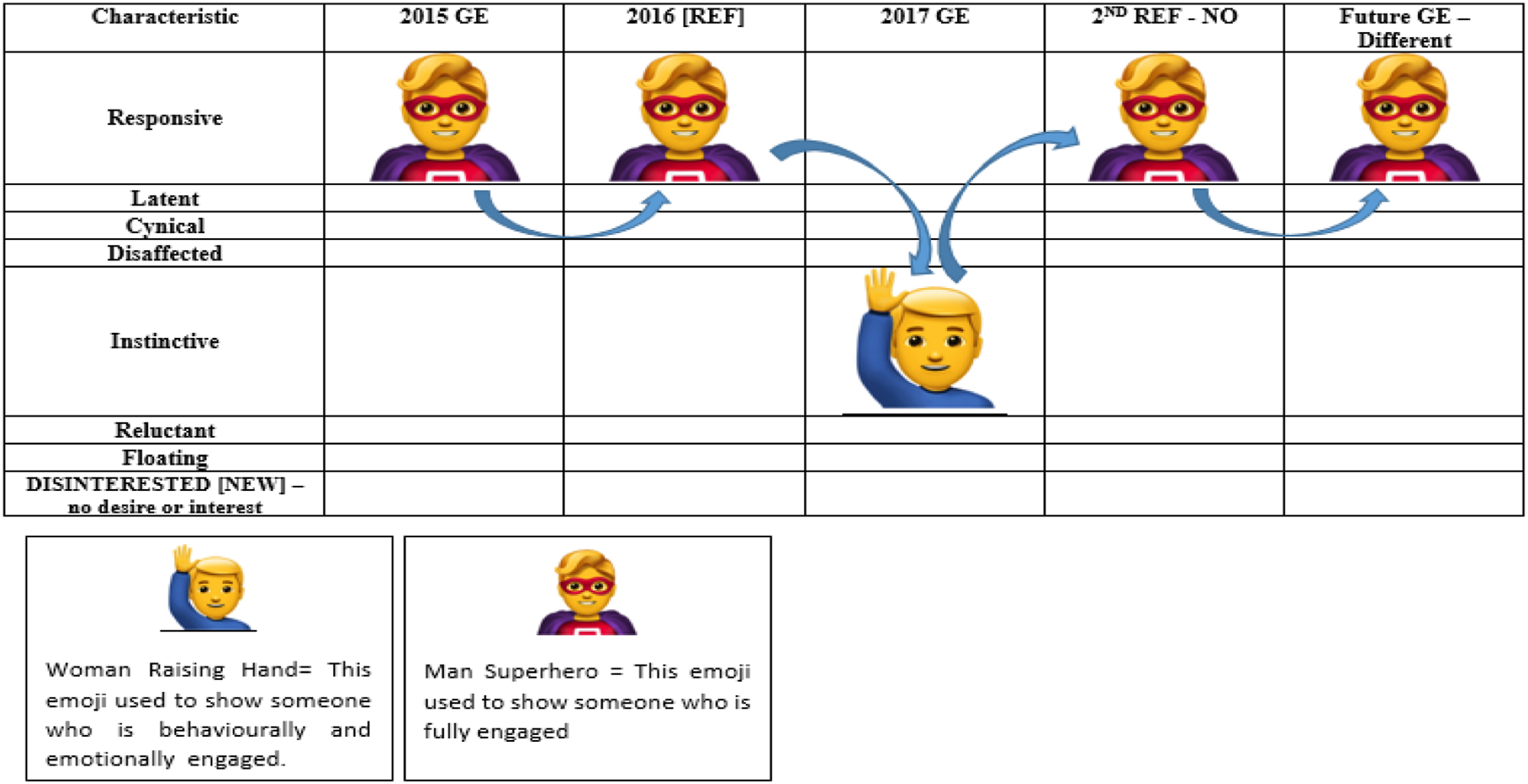
Indeed, Eric ‘shared’ videos and news stories via social media platforms however did not ‘create’ or ‘comment’ to online political content as politics is a ‘private matter’. Further, Eric approached ‘each election with a fresh pair of eyes’, disliked negative and hyperbolic campaigning and ascribed to an ‘optimistic…keep calm and carry on’ mentality (Eric).
Labile engagement journey
An unexpected finding was the identification of a labile engagement journey, reflecting the changing nature of voters’ interactions with politics across different political events. This engagement journey could be classified as (1) floating engagement or (2) disengagement to responsive engagement.
Floating engagement
The second most common engagement journey included floating voters. Floating individuals could be categorised as exhibiting some behavioural engagement tendencies such as registering to vote and the act of voting, however lacked cognitive and emotional engagement (Pich et al., 2018). This engagement journey was most prominent for young voters in the 2015 GE compared to 2016 Referendum and 2017 GE. As Figure 4 illustrates, in 2015 Linda, in the Conservative constituency of Barnet [London], paid very little attention to the election, conducted no research and was ‘direct by my parents’ to vote for Labour and recognised that ‘I didn’t pay attention. Too young…didn’t see the impact’ (Linda). Linda’s labile engagement journey (floating engagement).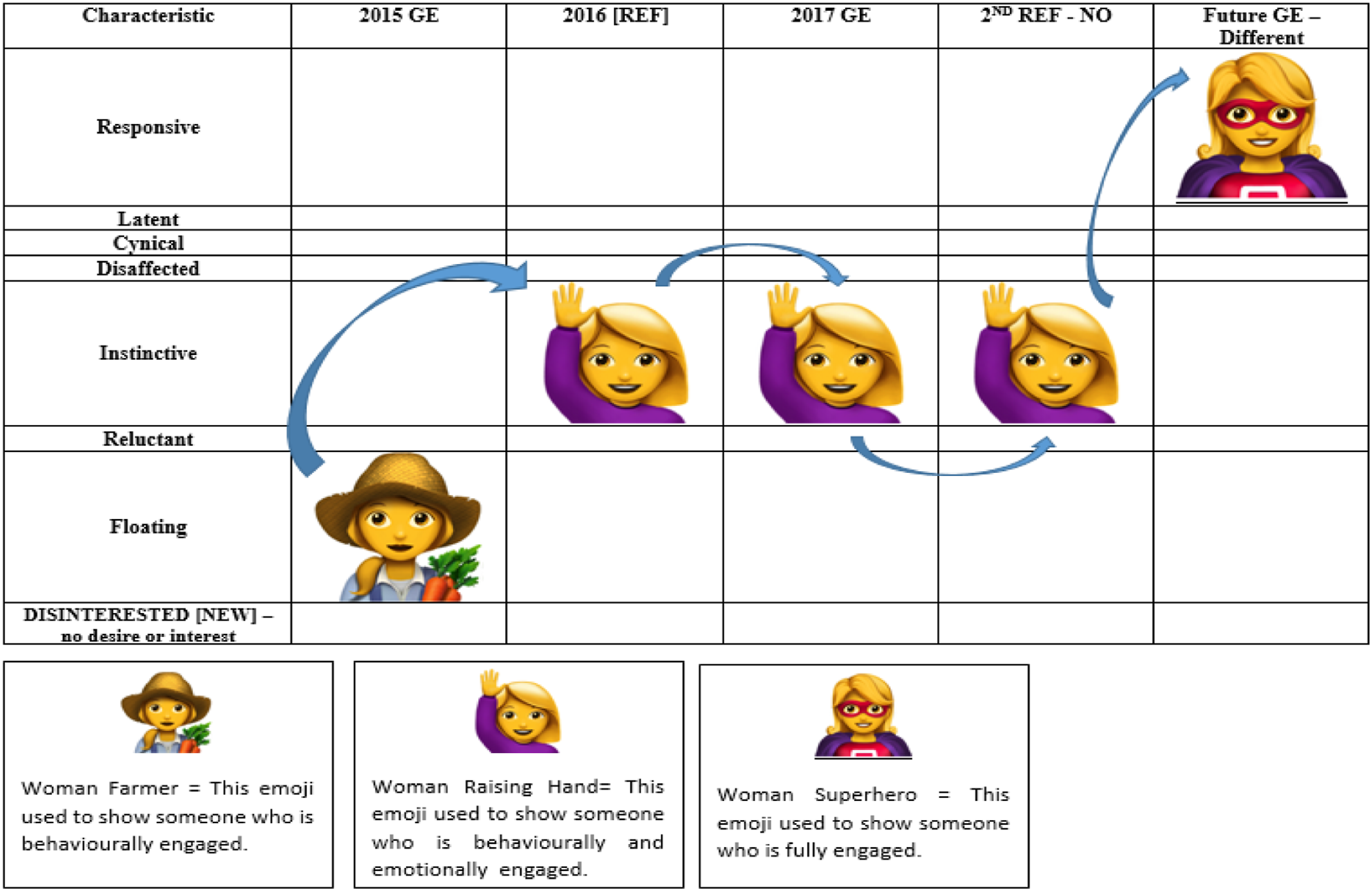
As part of this journey, in 2016 and 2017, Linda progressed to become an instinctively engaged voter defined as being behaviourally and emotionally involved yet lacked a reasoned position. Linda was ‘confused’ about the justification and rationale for a referendum and perceived the European Union to be a force for good ‘what was wrong with the EU…stay with the status quo’. Despite reviewing political posts and reading news articles on political content on social media platforms such as Twitter, she felt ‘immigration seemed a big issue’ but failed to expand on this or reveal specific policy which underpinned their vote. In addition, Linda did not ‘create or share’ content as they did not feel ‘confident and do not have that knowledge yet’ and as they lacked a reasoned position they were ‘influenced’ by the party they voted for in 2015 – Labour (Linda). Further, she did not view the televised leader’s debates or take part in political discussions with family and friends. Likewise, Linda adopted the same approach for the 2017 GE however also viewed a comparison platform on social media which compared-contrasted the policies of the main parties and this ‘simple comparison helped’ (Linda). Nevertheless, she believed that the ‘referendum woke people up’ and as they ‘progress in life will become engaged and engagement will grow. Voting is important and now can see the direct impact’ and now they are aware of this impact they ‘can’t block politics out’. Therefore, this example illustrates the voter journey is complex and reveals the transition from political event to political event originally categorised as floating engagement moving to instinctive engagement and potentially responsively engaged for future elections-referendums.
Disengaged to responsive engagement
By contrast with floating engagement, our findings also reveal that several participants were instinctively engaged for example: (1) behaviourally and emotionally engaged but lacked cognitive engagement (Victoria, Robert, Linda); (2) disaffected in terms of emotionally engaged but cognitively and behaviourally disengaged (Nathan, Richard); (3) or reluctant for example behaviourally and cognitively engaged but lacking emotional engagement (George, Leo, Sean). Furthermore, very few participants were characterised as latent (cognitively and emotionally engaged but lacking behavioural engagement) or cynically engaged (cognitively engaged but lacking emotional and behavioural engagement). Therefore, regardless of their categorisation to the PEP typology (Pich et al., 2018), the findings reveal that the majority of participants took part in the political process and engaged with the political activities and tactics throughout all the elections/political events.
Nevertheless, it was difficult to categorise the journey embraced by Sean, one participant who failed to cognitively, emotionally or behaviourally engage with the political activities. Sean did not vote in the 2015 UK General Election and reflected that he had ‘no interest in politics’ in 2015. Figure 5 shows Sean’s disengagement to engagement journey. Sean’s labile engagement journey (Disengagement to engagement).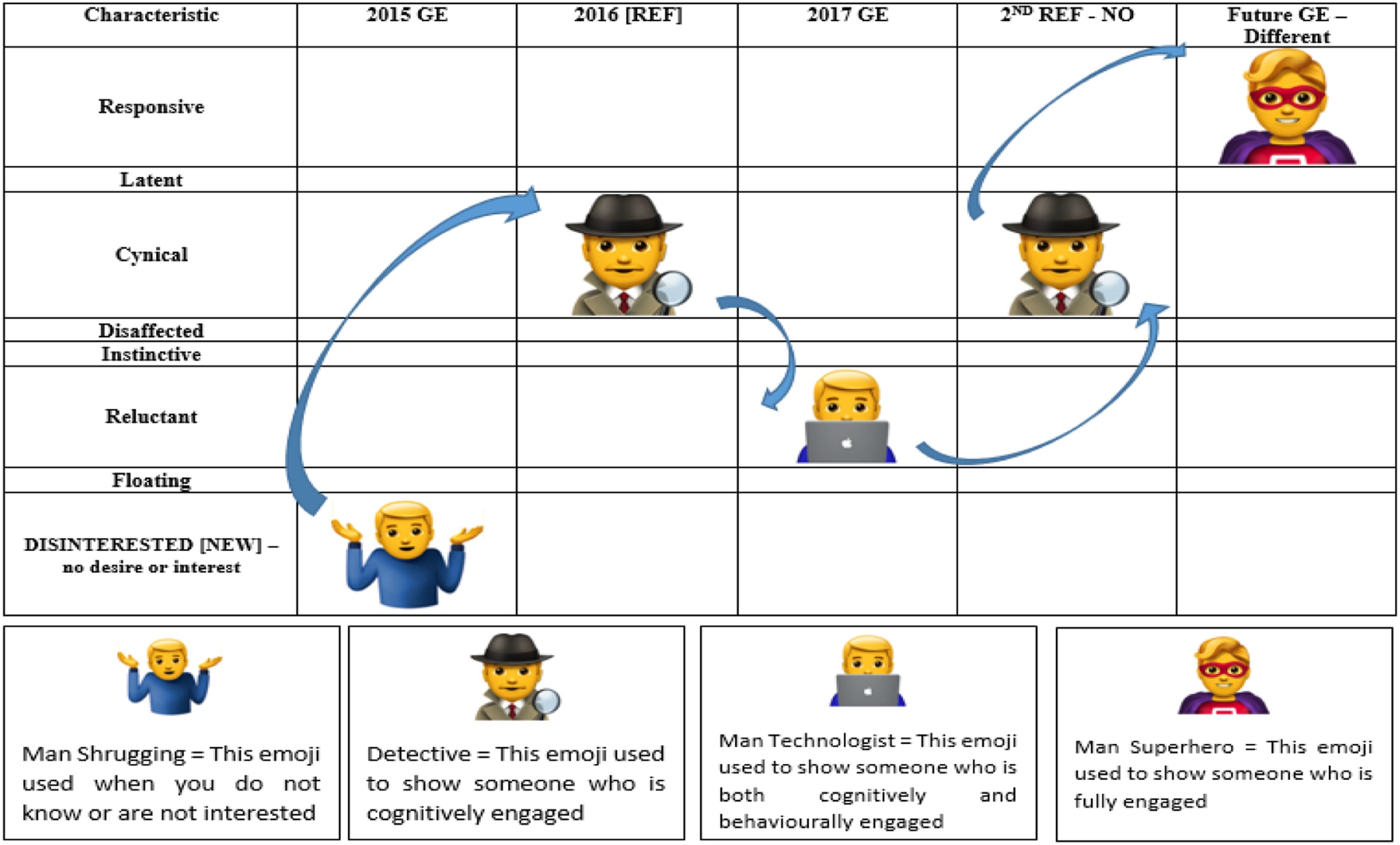
Similarly, Sean did not vote in the 2016 UK-EU Referendum as ‘I didn’t have enough knowledge on to be able to make a good judgement or decision…no emotion…happy with decision not to vote’ (Sean). We could argue that he made a transition from 2015 to 2016, from little-to-no cognition, emotion or demonstration of behaviour to a cynical characteristic demonstrating cognition but absence of emotion and behaviour. Following on from 2016 Referendum to the 2017 General Election, we witness another transition from cynical to reluctant engagement (behaviourally and cognitively engaged but lacking emotional engagement). In the last stage of his journey, Sean voted Labour in 2017 as he was inspired by the online communication tools used by the Labour Party. The use of social media ‘captures imagination, creates interest and is a catalyst…this election showed the power of social media’ and social media platforms such as Snapchat, Facebook and online sponsored political advertisements encouraged the individual to ‘share information posted by friends’ (Sean). Further, the engagement with social media platforms encouraged him to review the manifestoes in order to research the ‘truth’. Labour was seen as ‘for the many not the few and Conservatives for the rich and privatising the NHS. Labour manifesto costed in comparison with the Tories’ (Sean). In addition, ‘at the minute I don’t really have any emotions. Can’t see the personal impact at this moment in time’ (Sean). This shows that Sean was ‘still unsure direct impact as all parties say the same’ yet would engage in future elections ‘will vote next time. Shows the power of relevant and reliable informed content. More engaged in the future’ (Sean). Therefore, this section highlights the potential presence of an eight characteristic, which could be classified as ‘total disengagement’ and also the transition from ‘total disengagement to cynical, reluctant and potentially responsive in the future.
Habitual not loyal engagement journey
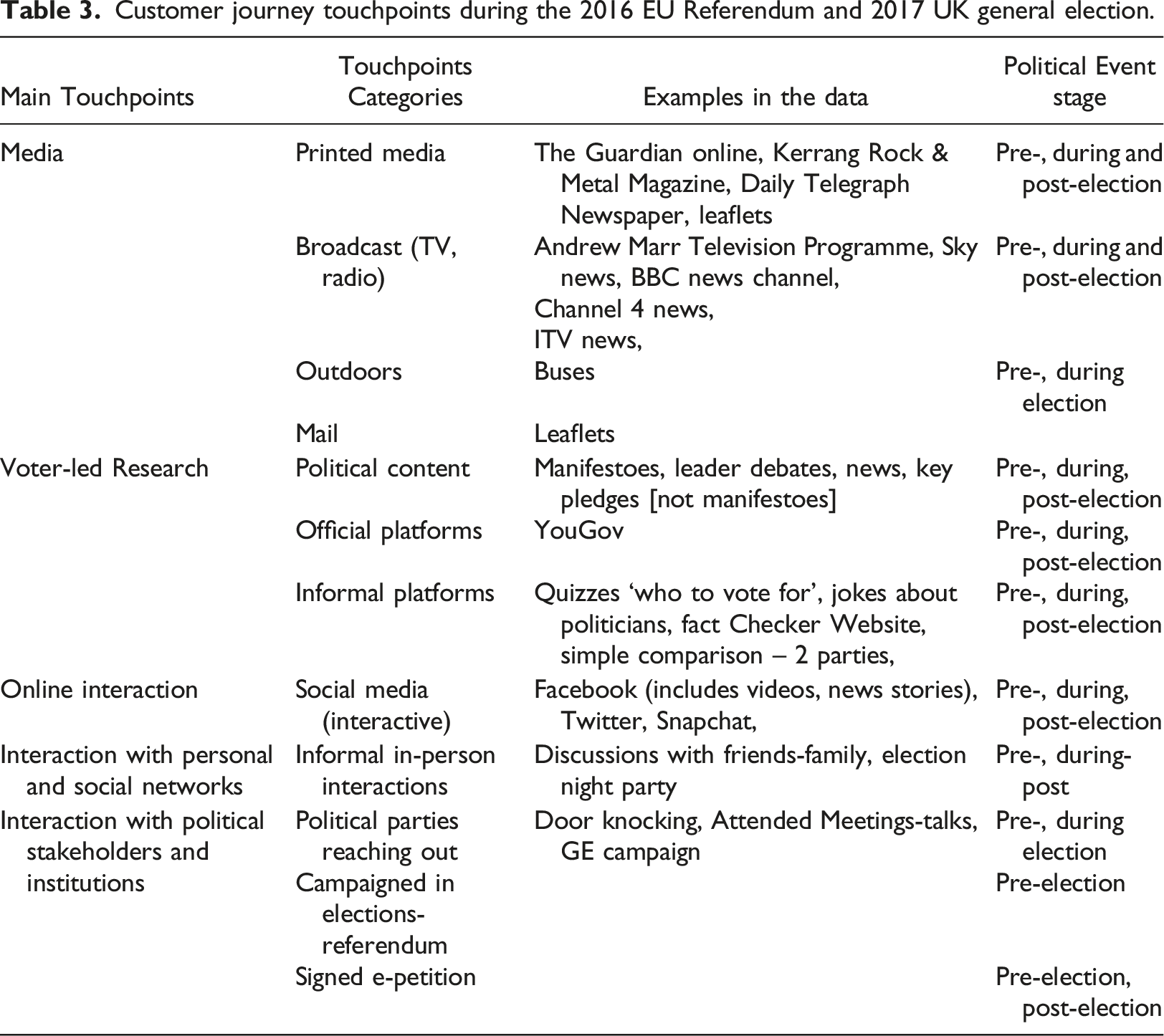
Customer journey touchpoints during the 2016 EU Referendum and 2017 UK general election.
Rationale for not voting in 2017 was put down to ‘disillusion’ (Joan) following the outcome of the 2016 Referendum, ‘cynical’ of an unnecessary election (George), ‘lack of belief’ in party leaders and manifestoes (Nathan) and continued to be ‘unsure’ who to vote for out of the two main parties (Sonia). Furthermore, fewer Conservative supporting voters ‘reluctantly’ voted for Theresa May’s Conservative Party in 2017 (Rose, Robert, John, Lisa, Victoria, Eric, Ian) compared with 2015 as they did not ‘trust’ a Jeremy Corbyn Labour Government. Paradoxically, participants including Conservative supporters reflected on the Labour Party’s ‘attractive’ (Rose) and ‘appealing’ policies (Robert) and ‘liked the sound of Labour’s values’ (Lisa) but ‘disliked’ the Conservative ‘right-wing’ (Rose) manifesto in terms of the ‘dementia tax and removing free school meals’ (Robert) and generally ‘trivial’ policies (Rose).
Nevertheless, when participants were asked their voting intention if there was an impending General Election, many participants argued that would support the same party they supported at the last election. However, if there was a General Election in the long-term future [12 months and beyond], almost all participants would consider voting for a ‘different’ political party (George, Rose, Nina, Scott for example). Furthermore, voting for a ‘different’ political party in the long-term future opposed to imminent short-term election was a common theme and future decisions on which party to support would ‘depend on policy’ (John, Anne, Lisa) but also ‘policies and leader’ (Scott, Joan, Sofia, Sarah, Sonia, Andrew). Therefore, the prospect of supporting different political parties different from previous elections represents an opportunity for political stakeholders particularly as young voters acknowledged that their decisions would be aided by policy and leader rather than party. In addition, the majority of participants believed they their engagement would strengthen as they progress in life, particularly due to the increased awareness of the personal impact of politics in practice and they would continue to actively research politics and policies in future elections. Therefore, political stakeholders should never abandon voters based on demographics as they have an opportunity to design policy to appeal to the wants and needs of voters and ensure policies and political messages are made ‘relevant’ and communicated to emphasise the implications of policies in practice (John).
Touchpoints in the customer engagement journey of young voters
Through the examination of the previous journeys, we identified five key touchpoints including (1) media, (2) voter-led research, (3) online interaction, (4) personal networks, and (5) face-to face events. Table 3 outlines examples of the tactics used to engage voters.
First, our exploration of customer engagement journeys shows that young voters engaged with political events through a variety of media touchpoints, including printed and broadcast media, outdoors advertising (e.g., buses and posters), or letters and leaflets posted on the mail. These were used throughout the voters’ journey using different types of information, although placing a greater emphasis in the pre-election stage where. The use of advertising and engagement with a variety of media confirms existing scholarship on touchpoints (Baxendale et al., 2015) and extends it by showing its impact on a political context.
Second, from our analysis voter-led research emerged as a new theme, involving (1) access to political content such as news, manifestoes, leader debates or key pledges; (2) Official platforms (e.g., YouGov) and (3) Informal platforms such as online quizzes to assess who to vote for or jokes about politicians. Different types of content and platforms contribute to the elaboration of the sticky customer journey and excitement (Siebert et al., 2020) by identifying touchpoints where political parties have less control (e.g., jokes about politicians). This responds to calls for research to identify new ways in which consumers conduct research. Third, online interactions through social media show an important touchpoint how social others influence the motivation to initiate a journey, share information and impact future stages (Hamilton et al., 2021). Our informants used social media platforms to gather information, share videos, new stories. However, they refrained from creating content because they were concerned about getting into an unwanted debate, being criticised and thought they did not know enough to post their own content. This shows how voters navigate conflicts between their own political views and those of the network, which extends Hamilton et al. (2021), who suggest that disclosing political views can help brands and influencers to get closer to other people in the network.
Fourth, personal and social networks represent another major touchpoint. Young voters highlighted discussions with family and friends and recognised that their parents had a big influence in their decisions, especially during the first few elections. This sheds light on the ways in which younger consumers use word of mouth from family and friends to raise curiosity engage in an exciting ‘sticky journey’ (Siebert et al., 2020). Election night parties were a new touchpoint emerging from the data highlighting young voters’ the desire to experience the elections while they are happening as well as the after-outcome. Interactions in specific touchpoints inform the rest of the journey (Becker et al., 2020), thus impact voters’ views on future elections.
Finally, voters reported interaction with political stakeholders and institutions including those where (1) political parties were reaching out (e.g., door knocking, organising meetings/talks), (2) campaigning in elections or (3) signing e-petitions. These were more typical in the pre- and during election stages of the voters’ journey. The unique nature of the political context allows the identification of this new touchpoint representing a way for political stake holders to get positive and negative feedback. This understanding extends Voorhees et al. (2017), who emphasises the lack of understanding (un)solicited feedback to understand customer journeys.
In this section, we show how touchpoints are used by political stakeholders to facilitate engagement with political events and create interactions with voters. While media engagement and voter-led research show a more unidirectional way of accessing information, voters used other interactive means that made them co-facilitators of political engagement for other people. By uncovering the abovementioned touchpoints in a political context, we respond to Siebert et al. (2020), who suggested the need to know how virtual and physical touchpoints are connected and Singh et al. (2021) by showing how individual and collective touchpoints enhance customer engagement.
Discussion and Implications
This study reveals insight into the ‘voter journey’ by highlighting levels of engagement across multiple political events and identifies engagement with touchpoints. This understanding extends existing research on voters’ engagement restricted to a single election campaign (Pich et al., 2018; Pickard, 2019) or a single engagement dimension (Barrett & Brunton-Smith, 2014) and addresses explicit calls for further research on young voter engagement (Dermody & Hanmer-Lloyd, 2004; Dermody et al., 2010; Dermody et al., 2010; Harrison, 2020; Pickard, 2019; Russell et al., 2002; Sloam & Henn, 2017). In addition, this study contributes to the literature on customer journeys by uncovering novel insights emerging in this political context (Johnston et al., 2018; Lees-Marshment, 2019; Lees-Marshment et al., 2019; Lin, 2017; Nunan & Domenico, 2019; Parackal et al., 2018; Walker et al., 2019; Wilson & Paleologos, 2018).
This interdisciplinary study addresses explicit calls for further research on young voter engagement (Chakravorti, 2010; Henn et al. 2005; Johnston et al., 2018; Nunan & Domenico, 2019; Parackal et al., 2018; Pich et al., 2018; Sloam & Henn, 2019; Wilson & Paleologos, 2018. In addition, this study aimed to identify effective communication tactics as touchpoints in the young voter’s journey to inform future political stakeholders’ decisions. Our research tracked the engagement levels, reflections and experiences of the political process of the same generational cohort from the 2015 UK General Election, 2016 UK-EU Referendum, 2017 UK General Election and hypothetical future elections. Understanding the constructs of engagement including behaviour, cognition and emotion and capturing how young voters embark on a journey of engagement, we revealed a fuller account, which up until now remained under-researched and under-developed (Dermody et al., 2014; Hollebeek & Macky, 2019; Shawky et al., 2022). For example, young voters continue to call for persuasive campaigns tailored to their wants and needs, political issues made relevant (Johnson & Marshall, 2004; Sloam & Henn, 2017) and for political actors to develop genuine long-term relational connections with them (Islam et al., 2019; Lees-Marshment, 2019; Simons, 2016). Furthermore, we found that young voters are less apathetic of politics and the political process as previous research suggests (Barrett & Brunton-Smith, 2014; Dermody & Hanmer-Lloyd, 2004; Dermody et al., 2010; Górecki, 2013) and political participation continues to increase and diversify (Kyroglou, 2020; Pickard, 2019). Young people continue to call for clearer, detailed and engaging information prior elections and political events (Harrison, 2020; Johnson & Marshall, 2004; Russell et al., 2002), which in turn would support strengthening the long-term voter journey.
In addition, this study highlighted voters develop their political attitudes, feelings and behaviour through time and embarked on a reflective journey often transitioning from different levels of engagement, which impacts future political events (Harrison, 2020; Russell et al., 2002; Sloam & Henn, 2017). Indeed, our young voters ‘reluctantly respected’ the outcome of elections irrespective of how they voted and that engaging with the political process was a responsibility (Dermody et al., 2010; Pich et al., 2018; Spierings & Zaslove, 2017). Further, we revealed that our young voters engaged more with the political process on the realisation of the personal impact and individual relevance of political issues and policies (Johnson & Marshall, 2004; Sloam & Henn, 2017). The perceived personal impact and relevance of politics and policies in action also had an impact on engaging and voting in future elections (Harrison, 2020; O’Cass, 2001; Russell et al., 2002; Sloam & Henn, 2017). In addition, it was uncovered that young voters self-categorised themselves as less habitual in terms of voting for the same party/politician compared with voting characteristics of parents and more likely to switch allegiances from election to election (Barrett & Brunton-Smith, 2014; Dermody & Hanmer-Lloyd, 2004; Dermody et al., 2010; Górecki, 2013; Pich et al., 2018). This presents a unique opportunity to practitioners with the prospect of appealing to voters beyond their traditional support base and enhancing long-term engagement.
The voter engagement and journey mapping framework
Based on our inductive themes and building on existing research (Johnston et al., 2018; Lin, 2017; Parackal et al., 2018; Pich et al., 2018; Wilson & Paleologos, 2018), we put forward a systematic model, which deconstructs the voter journey across previous, current, and future political events. This model assesses characteristics of engagement, to understand the touchpoints used by politicians within elections to engage with voters. The first-hand experiences will reveal whether voters are apathetic and highlight opportunities to strengthen engagement in future elections. With this in mind, we put forward a 6 staged model entitled the ‘voter engagement and journey mapping framework’ visualised in Figure 6 and outlined in Table 4. The voter engagement and journey mapping framework. Overview of the voter engagement and journey mapping framework.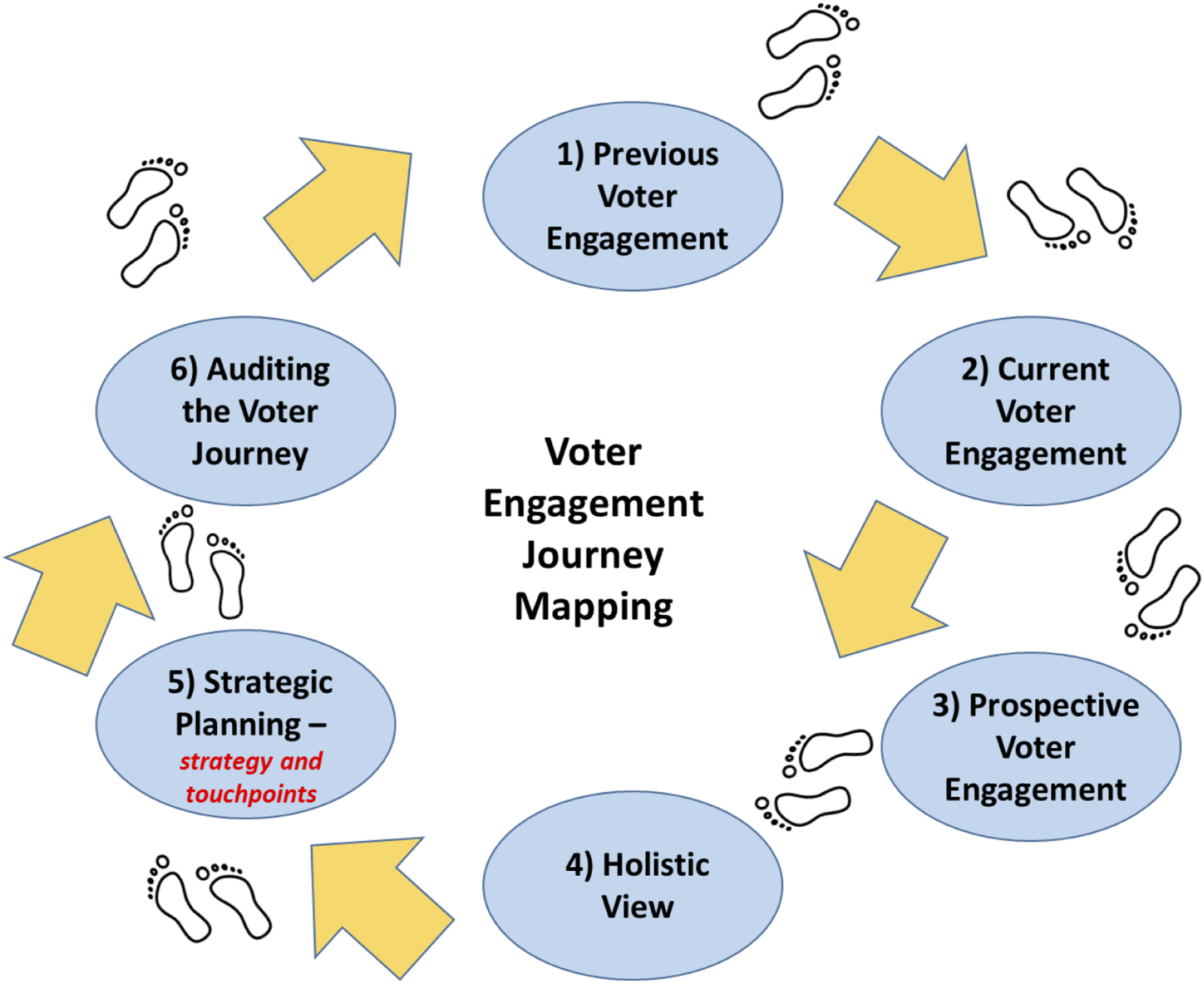
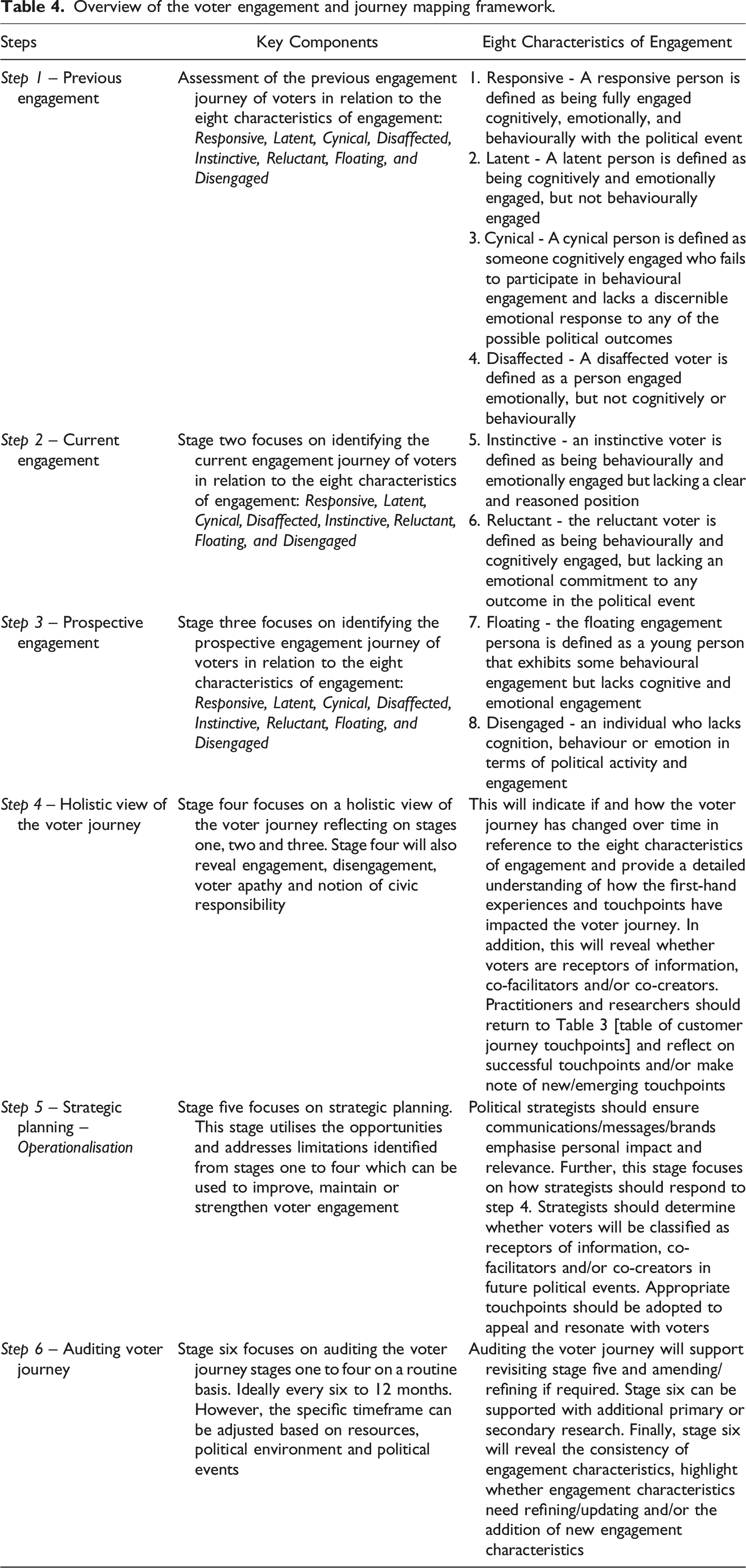
Stage one involves instructing voters to reflect on their previous engagement in elections/political events. Experiences are categorised via the eight characteristics of engagement linked to their personal journey and online and offline touchpoints associated with the previous election/political event are catalogued. Based on our study, we incorporated ‘disengagement’ as a new characteristic missing in the original conceptualisation (Pich et al., 2018). The disengagement characteristic would apply to an individual who lacks cognition, behaviour or emotion in terms of political activity and engagement. The eight characteristics include: Responsive, Latent, Cynical, Disaffected, Instinctive, Reluctant, Floating, and Disengaged. Once voters have reflected on their engagement and experiences in relation to previous elections/political events, this will reveal the first stage of the voter journey. Stage two focuses on exploring voter engagement and experiences in the current election/political event. Like stage one, experiences are categorised via the eight characteristics of engagement linked to their personal journey and online and offline touchpoints associated with the previous election/political event are recorded. This in turn will reveal if and how the voter journey has developed compared with previous engagement and experiences and highlight new, preferential, or undesirable touchpoints. Stage three involves identifying the prospective engagement journey of voters in relation to future elections/political events. This will highlight potential opportunities in terms of positioning political messages, policy development or adopting touchpoints to strengthen engagement. Stage four focuses on a holistic view of the voter journey reflecting on stages one, two and three. This will indicate if and how the voter journey has changed over time and provide a detailed understanding of how the first-hand experiences and touchpoints have impacted the voter journey. Successful and engaging touchpoints can be maintained whereas unsuccessful and unappealing touchpoints can be retired or redesigned to ensure touchpoints continue to resonate and engage voters. Stage four will also reveal engagement, disengagement, voter apathy and notion of civic responsibility. Finally, stage 4 will reveal whether voters are receptors of information, co-facilitators and/or co-creators. Practitioners and researchers should return to Table 3 [table of customer journey touchpoints] and reflect on successful touchpoints and/or make note of new/emerging touchpoints. This is followed by stage five, which focuses on the operationalisation of findings captured from stages one to four.
Stage five focuses on strategic planning and utilises the opportunities and limitations identified from stages one to four which can be used to improve, maintain or strengthen voter engagement. Political strategists should ensure communications/messages/brands emphasise personal impact and relevance across all touchpoints and remain consistent and non-contradictory. Further, stage five focuses on how strategists should respond to step 4. Strategists should determine whether voters will be classified as receptors of information, co-facilitators and/or co-creators in future political events. Appropriate touchpoints should be adopted to appeal and resonate with voters. Finally, stage six focuses on routinely mapping and updating insight into the voter journey. This includes revisiting the voter journey [stages one to four] on a routine basis and appraising the appeal and engagement of touchpoints. This could be carried out every six to 12 months. However, the specific timeframe can be adjusted based on resources of the political strategists, political environment and political events. Auditing the voter journey will also involve revisiting stage five and amending/refining the strategic plan and touchpoints if required. In addition, stage six can be supported with additional primary or secondary research to strengthen understanding of the voter journey. Therefore, stages one to six will uncover past, current and potential characteristics of engagement and outline whether individuals have transitioned from election to election. In line with recent customer journeys research, in some contexts consumers only continue their adventure if it is exciting, so firms must invest in variation mechanisms (Siebert et al., 2020). Our cyclical systematic framework can be used as an auditing tool to understand the voter engagement-journey and a mechanism to develop voter engagement in future elections. This represents a series of opportunities for academics and practitioners (Andreasen, 2002; Caywood et al., 1989; Chakravorti, 2010; Claudy & Peterson, 2014; Nunan & Domenico, 2019; Walker et al., 2019). We specifically detail these opportunities in the following section.
Implications for theory and practice
This study has implications for theory and practice. In terms of theory, this study addresses the identified theoretical gaps that existing research does not address the complexity of voter’s engagement including all dimensions of engagement [behavioural, cognitive and emotive] towards political events (Barrett & Brunton-Smith, 2014; Bowden et al., 2017; Heath et al., 1985; Lang & Witts, 2018; Peng & Hackley, 2009; Reynolds, 2006). Therefore, given the limited understanding of the ‘voter’ journey opposed to abundant research dedicated to the ‘consumer’ journey (Barwitz & Maas, 2018; Novak & Hoffman, 2019; Dellaert, 2019; Kranzbühler et al., 2019), researchers should acknowledge that voter engagement involves not only behavioural but also emotional and cognitive dimensions and different levels of engagement. More specifically, researchers should adopt a holistic approach of voter engagement and periodically investigate the experiences of young voters and consider how they interact with online and offline touchpoints as their appeal and relevance may change over time.
First, the changes observed in voter’s customer journeys suggest that to be engaged, younger voters need an element of excitement that is relevant to their lives and keeps them interested. The present study further challenges the dominance of a “smooth customer journey” and extends the understanding “sticky customer journeys” by identifying young voters’ engagement as a new area where this type of journey is more effective. As Siebert et al. (2020) emphasise “whereas the smooth journey model is ideal for instrumental services that facilitate jobs to be done, the sticky journey model is ideal for recreational services that facilitate never-ending adventures” (Siebert et al., 2020). Thus, the smooth journey model might be more effective for older voters who tend to be more loyal to a particular party, while younger voters tend to follow a stickly and adventurous journey.
Second, the developed voter engagement and journey mapping framework makes a contribution to theory as there are limited models designed to understand the three dimensions of political engagement (cognitive, behavioural and emotive) (Bowden et al., 2017; Hollebeek & Macky, 2019; Jaakkola & Alexander, 2014; Van Doorn et al., 2010). In addition, this supports the explicit calls to explore the changes in political engagement and the reason behind these changes (Pich et al., 2018). The developed framework recognises that individuals can make transitions from characteristic to characteristic and considers that citizens can be classified as ‘disengaged’. Disengaged individuals are an important group of people who might presently show no engagement in political events, but they might become interested or show some degree of engagement in the future. Therefore, the comprehensive framework in which the voter’s journey and ‘disengaged’ voters are considered goes someway in addressing calls for more models in political marketing research, which in turn will advance the development of theory and challenge existing propositions (Scammell, 2015).
Practitioners should study our research and recognise the potential for young voters to co-produce or co-facilitate political content or communication tactics, which can strengthen interaction, engagement and believability content (Dellaert, 2019; Voorhees et al., 2017). More specifically, as young citizens co-facilitated rather than shared [co-created] political content particularly online, this presents another opportunity for practitioners to be creative when designing messages and communicating policies as young citizens could become ambassadors and key influencers when it comes to recommunicating political content (Dellaert, 2019; Lin & Himelboim, 2018). As online marketing expenses continue growing, practitioners need to understand the best way of allocating resources across various touchpoints showing an understanding of how consumers interact and leverage multiple information channels during the customer journey (Li et al., 2020). Therefore, practitioners should ensure political issues and policies are relevant, emphasise the personal impact and communicated via multiple tools-tactics appropriate to the target market.
The voter engagement and journey mapping framework has implications for practice. Practitioners can use the systematic framework as a guide of how to gain access into the hidden world of the voter journey and periodically explore levels of engagement and audit the success [or not] of political messages, marketing activities and policies across different political events. By investigating the voter journey across political events and exploring the experiences of voters in the political process, this in turn will provide practitioners with a greater understanding into the complexity of young voter engagement and allow practitioners to maintain/strengthen engagement with citizens (Dermody et al., 2010; Macnamara et al., 2012; Nickerson, 2006). In addition, practitioners will be able to adopt and apply the voter engagement and journey mapping framework to map out the degree of engagement-disengagement during past and present political events but also consider future political events/elections. This in turn will allow practitioners to use the framework strategically to understand and monitor the voter transition/journey and consider how they can strategically utilise political activities and tactics to improve engagement and build long-term relationships with citizens-voters (Lees-Marshment, 2019; Lees- Marshment et al., 2019).
Limitations and areas for further research
This study has several limitations that future studies could address. The first limitation of this study focuses on the sample. This research adopted an exploratory, interpretivist approach aimed at understanding voters’ engagement journey with the electoral process after the 2016 UK-EU Referendum. Considering the dearth for research in this area, a qualitative approach was deemed as the most appropriate method to address the research objectives. Although we reached ‘theoretical saturation’ within our sample of 30 participants, a larger sample might offer more depth of insights. Future studies could adopt a quantitative approach to measure the characteristics of voter engagement and audit the voter journey and test the effectiveness of marketing tools on the voter decision-making process. Another area that deserves further research attention is the exploration of the touchpoints identified (e.g., voter’s led research) and assess its operationalisation across different settings and contexts. Likewise, new studies could replicate this research and develop a comparative study to generate deeper insight and understanding of young voter engagement and the voter journey across jurisdictions. Alternatively, scholars could continue to explore the impact of marketing tools and activities within elections and political events for different types of engagement. This will provide political campaign managers with a pragmatic understanding of engagement tools and select appropriate tools-activities for different target markets. Another area that would benefit from research effort includes the integration local, national and international political events as part of an investigation into young voter engagement and the voter journey. Finally, future research could adopt more non-traditional and creative research methodologies to investigate young voter engagement, voting experiences and the voter journey such as utilising qualitative projective techniques, or an ethnographic-netnographic approach as this may provide a greater insight than standalone interviews or focus group discussions.
Footnotes
Declaration of Conflicting Interests
The author(s) declared no potential conflicts of interest with respect to the research, authorship, and/or publication of this article.
Funding
The author(s) received no financial support for the research, authorship, and/or publication of this article.
