







Abstract
The ‘lipstick effect’ has been referred to as increased sales of beauty products post-crisis. The phenomenon happened after the Great Recession of 2007–2009 and even after the Great Depression of the 1930s. To date, no research focused on studying the post-Covid lipstick effect. Our study aimed to explore and quantify the post-Covid lipstick effect, with three studies exploring the long impact of the pandemic on clothing and beauty practices. Using qualitative analysis, Study 1 showed an impact of the first two lockdowns on fashion and beauty practices in women but not in men. Female students spent considerable time exploring their relationship with fashion and beauty products with a link to self-identity, while male students did not change their fashion and beauty practices. Our Study 2 showed that female participants chose a more vivid and wider range of colours since the Covid pandemic. Our Study 3 highlighted that female participants used a lower quantity with less frequent makeup since Covid. Our report highlighted, for the first time, a specific lipstick effect post-Covid, namely the ‘self-centred lipstick effect’.
Introduction
The global coronavirus pandemic (Covid) has substantially negatively impacted the whole fashion industry, shifting consumer behaviour, disrupting supply chains, and affecting the leading companies in the field (Business of Fashion, 2019, 2020, 2021). The Covid pandemic-related crisis, however, has enhanced the beauty industry sales. Indeed, we have seen a 100–800% rise in skin-care, hair-care, body, nail, and DIY self-care product sales in 2020 compared to the same periods in 2019 for e-commerce (Business of Fashion, 2020). This increased sales of cosmetics and make-up have already been witnessed in crises such as the Great Recession of 2007–2009 and tracing back to the Great Depression of the 1930s (Elliott, 2008; Martinez & Allison, 2010; Statista, 2021). This phenomenon has been named ‘the lipstick effect’. MacDonald and Dildar (2020) proposed three hypotheses to explain the lipstick effect: (1) the psychological hypothesis, i.e., women purchased more makeup because they want to treat themselves, (2) an anthropological hypothesis, i.e., women purchased more makeup in order to better attract mates, (3) an employment-based hypothesis, i.e., women purchased more makeup in order to increase their chance to be (better) employed.
Some research has highlighted a change in consumer behaviour patterns during the Covid crisis, e.g., panic buying, hedonic purchase, in-store shopping rejection, changing discretionary spending, or gaining interest in how brands treat their employees (Kirk & Rifkin, 2020; Knowles et al., 2020; Koch et al., 2020; Loxton et al., 2020; Naeem, 2021). However, those studies did not focus on clothing and beauty consumption per se. To our knowledge, only one study explored the clothing consumer pattern change in light of the Covid pandemic. Using content analysis, Liu et al. (2021) studied 68,511 relevant tweets collected from January 2020 to September 2020. Their outcomes revealed several interesting themes: safety concerns (shipment from China, virus on clothing, protective clothing, sanitising clothing), consumption disruption (concerns over resale and rental services, concerns over buying special clothing, concerns over in-store shopping, concerns over shipping), pent-up demand (stop or put off purchases, longing for “corona sales”), consumption transition (putting on weight and ‘shrinking clothes’, shift in clothing style, decluttering and donation, ethics awareness), and consumption change (adapting to new clothing style, digitalisation).
The aim of this research note is to explore the potential existence of the post-Covid lipstick effect, by assessing the impact of the Covid crisis on clothing and beauty practices.
Study 1
To collect rich data to investigate participants’ subjective experiences in depth, fashion practices have already been investigated using qualitative methods (Buentello et al., 2022; Masuch & Hefferon, 2014; Nessim & Bardey, 2022). To our knowledge, there is no research evaluating the impact of life crises on fashion practices. The novel nature of the subject matter warrants a qualitative approach for collecting rich data to investigate participants’ subjective experiences in depth (Braun & Clarke, 2006). Using qualitative research, this study will explore fashion and beauty practices throughout the first (from 17th March to 11th May 2020) and second (from the 30th October to 15th December 2020) lockdowns. Data were collected from March 2022 to February 2023.
Method
Participants were recruited using convenience and snowball sampling. Our institution’s ethics panel has approved this study. 17 participants (9 women and 8 men) aged 22.47 years old (±2.12) volunteered to participate in this study. All participants were students living in France by the time of the first and second lockdowns and at the time of the interviews. We choose to exclusively recruit students without any care or professional responsibilities in order to isolate their fashion (i.e., clothing and beauty) practice during the lockdown from any parental or managerial pressure. Data saturation was reached with this sample.
After providing informed consent, participants took part in a 1:1 semi-structured interview lasting around 30–35 minutes. We aimed to understand participants’ clothing and beauty practices before, during and after the first and second lockdowns. Open-ended questions such as “Can you tell me about your clothing/beauty routine during the lockdown?” and “Did you change anything in your clothing/beauty routine since the start of the Covid pandemic?” were used in order to elicit rich, exploratory data (Smith et al., 2009), and questions were constructed to probe the lived experience involved in clothing and beauty practices before, during and after the first lockdown, participants were verbally debriefed following the interview.
In order to highlight common practices among our participants, thematic analysis was used to analyse the data following Braun and Clarke (2006)’s approach. All interviews were transcribed verbatim. All transcripts were read multiple times, highlighting descriptive words and phrases. Then, the second stage was a more systematic and critical reading of the transcripts to identify and codify interesting features in the text. The third stage was grouping these codes into themes. The fourth stage consisted of summarising participants’ themes, keywords, and quotes into a thematic map. The fifth and final step was refining and naming themes and subthemes. The first author was in charge of the data analysis.
Findings
Our thematic analysis showed different fashion practices (i.e., clothing and beauty) between men and women. While our female participants took the opportunity to “find themselves” during the first lockdown, men didn’t change their clothing or cosmetic practice.
All our male participants mentioned they kept the same clothing practice, i.e., either wearing sporty, comfortable clothes or wearing jeans, elegant polo shirts, or even shirts. Whatever their clothing style was, male participants did change it since the first lockdown. While a few male participants kept their existing (and minimalist) cosmetic routine, most of our male participants did not start a new cosmetic routine with the lockdown and kept a minimal interest towards cosmetic and beauty practices.
Study 1 themes and most relevant quotes.
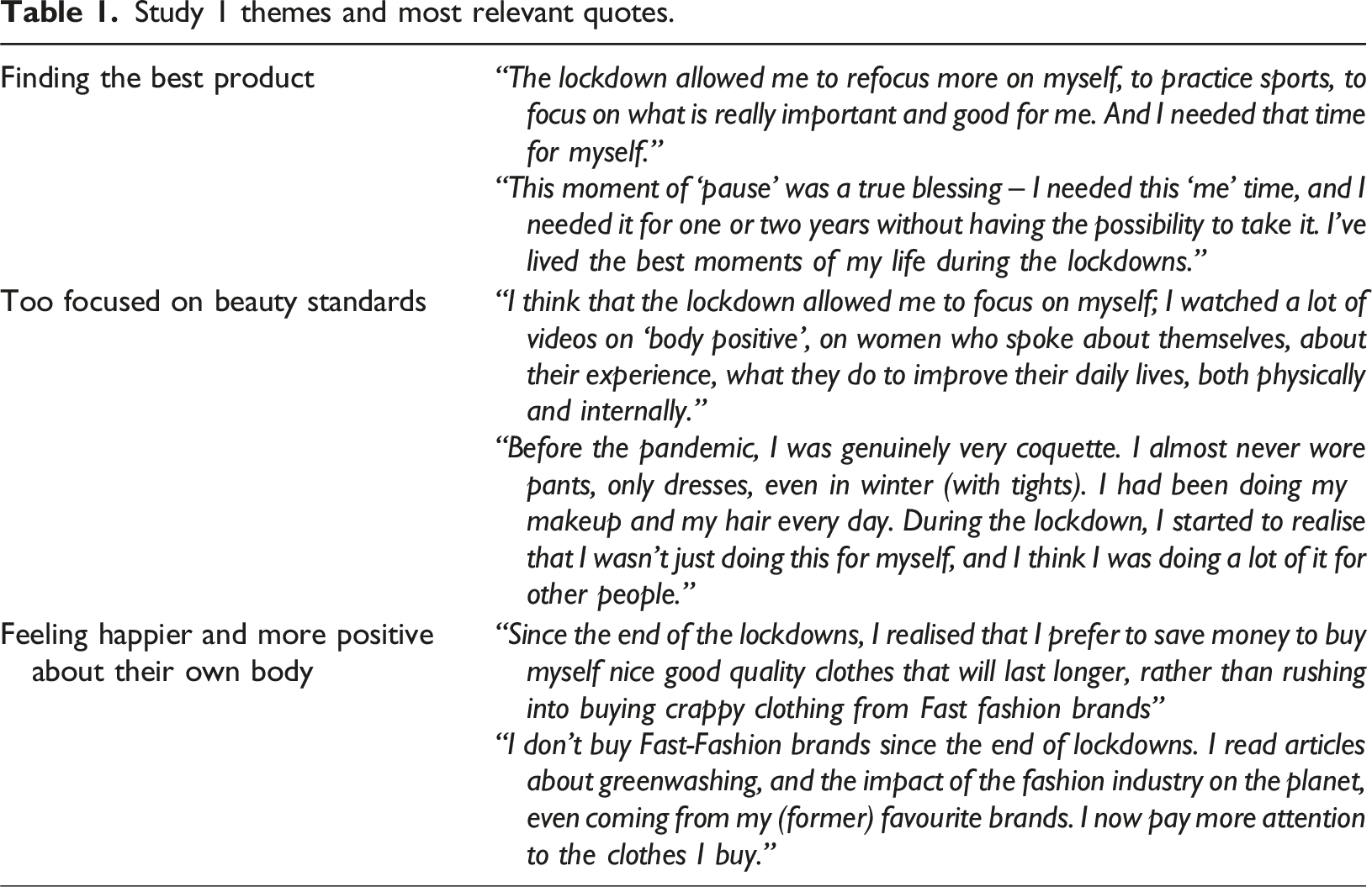
This ‘time for me’ also led all our female participants to reflect on their own fashion and beauty practices realizing that they were too focused on beauty standards and what other people could think about them, as underlined in Table 1. Our female participants aimed to move away from social pressure in order to find their authentic self.
Since the lockdown, all our female participants mentioned having changed their clothing and beauty practices. Their beauty (cosmetics and make-up) practice during and post-lockdown has been much more focused on ‘looking after your skin’ cosmetics (e.g., serum, high-quality and/or organic face cream, face mask) and fewer amounts of make-up (except one female participant who mentioned that she has been wearing similar amount of make-up). Regarding their clothing practice, all our female participants mentioned having changed their clothing style compared to the pre-lockdown period, but they described different styles, from comfortable clothes to feminine clothes. The common point of these new clothing styles is that it better reflects the inner self of our participants, as one participant nicely summarized by claiming, “I had the feeling that I had found myself”. Two out of our female participants had to dress up with their ‘pre-Covid fashion style’, and they both had the feeling that they were “putting their social mask from my former life – and it doesn’t belong to me anymore”.
Our participants’ reflections on their fashion practice led them to question themselves about sustainability in fashion. From non-organic ingredients in cosmetics and make-up to the issues related to fast fashion, our participants all mentioned paying more attention to sustainability since the first lockdown and trying to translate this increased attention to consumer behaviour, i.e., purchasing fewer clothes, purchasing better quality clothes, avoiding buying fast-fashion clothes, and finding more information about cosmetics products. All our female participants mentioned feeling happier and more positive about their own body since their new fashion practice, as underlined in Table 1.
While our first study didn’t underline any change in our male participants' fashion practices, our analysis highlighted an impact of Covid on female participants’ clothing and beauty practices. Indeed, our female participants have changed their clothing style to better fit with their inner identity, i.e., their authentic self, and have modified their make-up and cosmetic use routines accordingly.
Study 2
Study 2 aimed to quantitatively examine the impact of the Covid crisis on clothing practice, self-esteem and well-being. Our hypothesis was: H1-The Covid crisis had an impact on consumers’ clothing practice.
Methods
Participants were recruited using convenience and snowball sampling. Students and young working-age adults participated in our study. A total of 111 female participants aged 22.18 years old (±5.95) volunteered to participate in this study. Data were collected from March 2022 to February 2023. Our institution’s ethics panel has approved this study.
Clothing Practice Inventory (FPI) - The scale was from 1 (strongly disagree) to 7 (strongly agree).
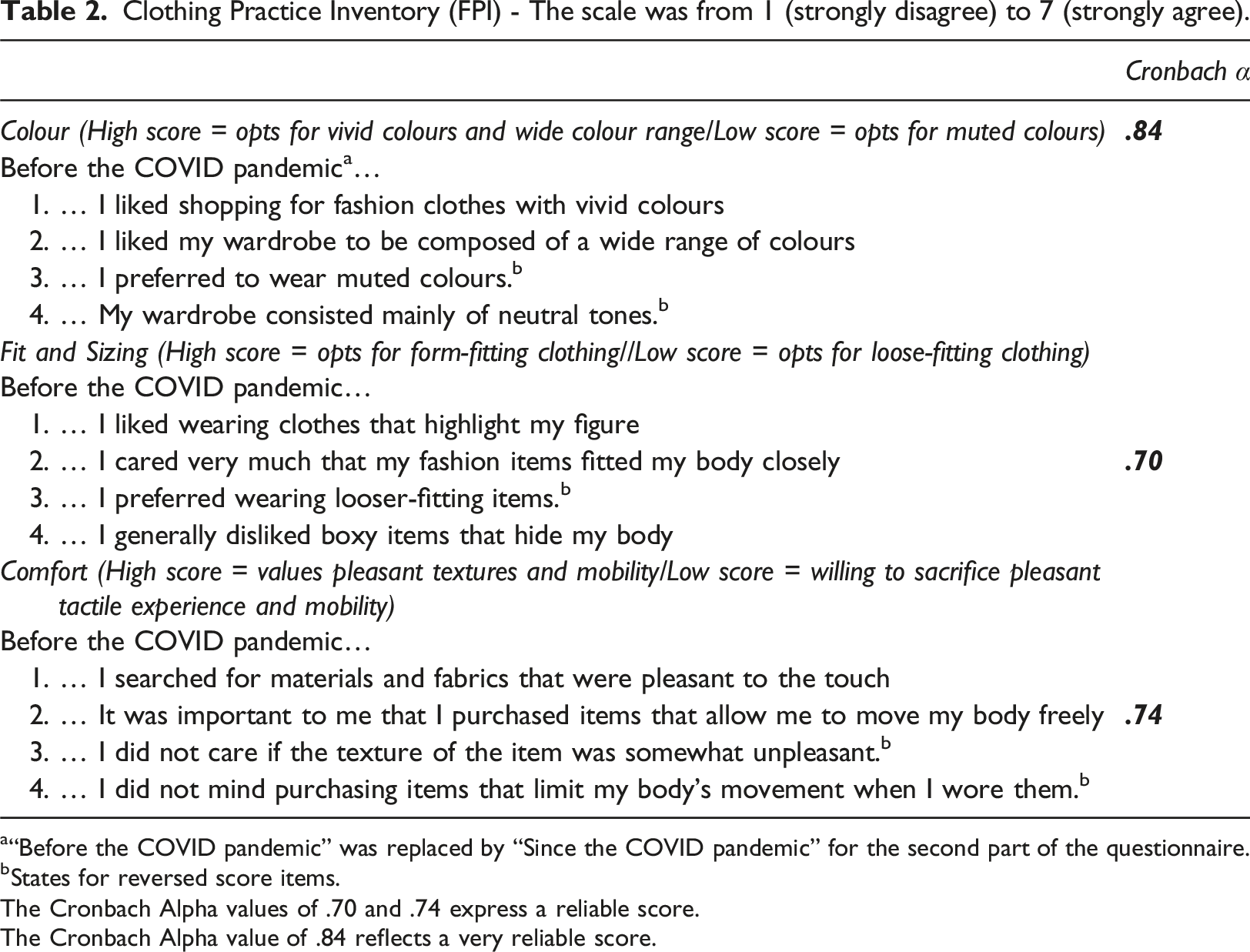
a“Before the COVID pandemic” was replaced by “Since the COVID pandemic” for the second part of the questionnaire.
bStates for reversed score items.
The Cronbach Alpha values of .70 and .74 express a reliable score.
The Cronbach Alpha value of .84 reflects a very reliable score.
Findings
Mean (±standard-deviation) of the Clothing Practice Inventory (CPI) scores (colour, fit/sizing, comfort) and the Make-up frequency and quantity scores before the Covid pandemic (‘Before Covid’) and since the start of the Covid pandemic (‘Since Covid’).
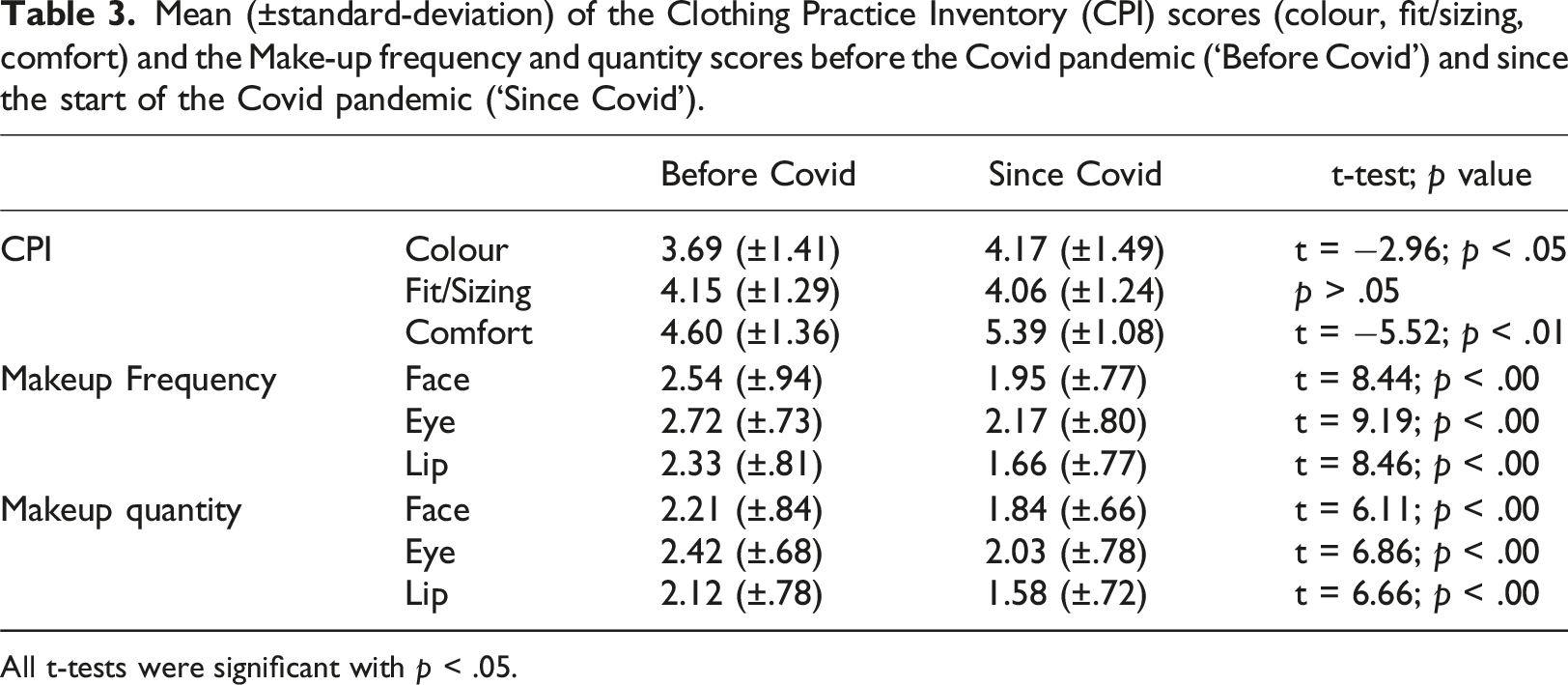
All t-tests were significant with p < .05.
The results of a paired-sample t-test (see Table 3) did not show any difference for the Fit/Sizing variable before versus since the beginning of the Covid crisis (p > .05), meaning participants continued shopping for and using the same fit/size clothes. Our analysis showed a significant change in the score for Colour (p < .5) and Comfort (p < .01). Thus, female consumers have been looking for more vivid colours and a wider range of colours since and after the first lockdown. Furthermore, they have been looking for more pleasant textures and mobility clothes since and after the first lockdown. Thus, H1 was fully supported.
Study 3
Study 3 aimed to quantitatively examine the impact of the Covid crisis on make-up practice. The following hypotheses were posited:
The Covid crisis had an impact on consumers’ makeup practice (i.e., frequency);
The Covid crisis had an impact on consumers’ makeup practice (i.e., quantity).
Method
Participants were recruited using convenience and snowball sampling. Students and young working-age adults participated in our study. A total of 100 female participants aged 30.40 years old (±10.25) volunteered to participate in this study. Data were collected from March 2022 to February 2023. Our institution’s ethics panel has approved this study.
Our participants were invited to complete two questionnaires: (1) Frequency make-up questionnaire and (2) Quantity make-up questionnaire. Each Frequency and Quantity questionnaire has three makeup sub-scores: (1) Face (with seven items: foundation, concealer/correctors, contour, powder, highlighter, primer, blusher), (2) Eyes (with five items: mascara, eye shadow, eyeliner, false eyelashes, brow pencil), (3) Lip (with three items: lipstick, gloss, lip contour). Using a 5-point scale (from ‘never’ to ‘all the time’), participants are required to quantify how frequently they used the makeup items before the Covid pandemic (‘pre-Covid’ score) and since the start of the Covid pandemic (‘since Covid’ score). Using a 5-point scale from 1 (none) to 5 (a lot), participants are required to quantify how much they used the makeup items before the Covid pandemic (‘pre-Covid’ score) and since the start of the Covid pandemic (‘since Covid’ score) to assess the retrospective subjective opinion on the change in the use of makeup. The Frequency score was calculated by averaging all the items in the frequency scale (15 items) ranging from 1 (low makeup frequency) to 5 (high makeup frequency). The Quantity score was calculated by averaging all the items in the quality scale (15 items) ranging from 1 (low makeup quantity) to 5 (high makeup quantity). The sub-scores for Face, Eye and Lip makeup amount were calculated by averaging frequency and quantity for each part.
Findings
Table 3 shows the average (± standard deviation) and t-tests values for Make-up frequency and quantity scores before the Covid pandemic (‘pre-Covid’ score) and since the start of the Covid pandemic (‘since Covid’ score).
As can be seen from the table, there was a significant decrease in both frequency and quantity of makeup use since the start of the Covid pandemic. Thus, participants showed an overall preference for a more natural/authentic look. Thus, H2 and H3 were fully supported.
Discussion
Our research project aimed to explore and quantify the post-Covid lipstick effect. Using qualitative analysis, Study 1 suggested a potential impact of the first two lockdowns on fashion and beauty practices in women but not in men. Female participants spent considerable time exploring their relationship with clothes and beauty products to better align their practices with their authentic self, while male students did not change their fashion practices. While Study 2 showed that female participants chose more vivid colours and a wider range of colours as well as more pleasant textures and mobility clothes, Study 3 highlighted that female participants used a lower quantity with less frequent makeup since the beginning of the Covid pandemic.
Overall, our results suggested a ‘self-centred lipstick effect’. In fact, while market research showed increased sales of beauty products (Business of Fashion, 2020) – which is defined as a ‘lipstick effect’ following the economic crisis, our results underlined that participants used fewer makeup products and different clothes to better reflect their authentic selves – which we define a ‘self-centred lipstick effect’, i.e., focusing on one’s self following life crisis.
Our report confirms the relationship clothing can be used to enhance selfhood (Masuch & Hefferon, 2014; Moody et al., 2010; Nessim & Bardey, 2022). Our outcomes also confirm the use of make-up as a way of managing facial appearance anxiety, conforming to social norms and appearing more sociable and assertive to others (Korich et al., 2008; Robertson et al., 2008). In fact, our participants mentioned using less make-up with the idea of moving away from social pressure and finding their authentic self.
Since before the Covid pandemic, the fashion and beauty industries began reconsidering marketing strategies due to changes in consumer values and behaviour – re-evaluating social media platforms for promotion or the cosmetics industry partnering with bio-medical research firms, to name two examples (Business of Fashion, 2019). This research found that after the lockdowns and economic repercussions of the pandemic, women, in particular, reported changes in their habits and understanding of themselves through fashion and beauty products, which is consistent with what could be expected according to both theory and trend forecasting reports (Business of Fashion, 2020).
While this report is the first research suggesting a post-Covid lipstick effect, namely the ‘self-centred lipstick effect’, further studies and observations are needed to asses any longitudinal effects consequent to the Covid lockdowns and economic fallout or even if the results of these behavioural trends were driven by the economy or by social distancing. Also, data collection was done several months after the first and second lockdowns to allow an establishment of fashion practice changes and a longer reflection on those potential changes, but this two-time recall data collection is not as robust as an immediate recall. Further reflection on the post-crisis study methodology should be undertaken.
Footnotes
Acknowledgements
The authors truly thank all the participants for their time and enthusiasm.
Author contributions
All the authors have contributed to the literature review, methods and results section. The first and second author have written the discussion.
Declaration of conflicting interests
The author(s) declared no potential conflicts of interest with respect to the research, authorship, and/or publication of this article.
Funding
The author(s) received no financial support for the research, authorship, and/or publication of this article.
