







Abstract
The last decade has seen shock election victories, from Brexit, the return of President Trump, the emergence of political movements and communities, the spread of misinformation and ‘fake news’, and the rise of voter disengagement. Many of these political events, historic occasions and campaigns have been investigated and documented within the sub-discipline of political marketing. Political marketing aims “to create, communicate, deliver and exchange promises of value with voter-consumers, political party stakeholders and society at large” (Hughes & Dann, 2009, p. 244).
Over the last thirty years political marketing has advanced as an international area of study and generated a buoyant consultancy industry (Newman, 2024). Political marketing has moved “beyond the black arts of propaganda” (Harris & Lock, 2010:297) and developed into a sophisticated field bringing together theories, concepts, tools and frameworks from disciplines including marketing and political science (Newman, 2024; Scammell, 2024; Speed, Butler, & Collins, 2015). However, the application of marketing concepts, theories, and frameworks to the political environment is nothing new (Needham & Smith, 2015; Poorrezaei, Pich, Armannsdottir, Branco-Illodo, & Harvey, 2023). Indeed, marketing concepts, techniques and frameworks have been adopted in politics for centuries to achieve various objectives (Henneberg & O’shaughnessy, 2007; Poorrezaei et al., 2023). For example, marketing principles are routinely used by aspiring and elected policymakers to raise awareness of policies, ideologies and their desired position on important issues facing society. Marketing techniques have been transferred to the political arena with little difficulty and have generated deep insight into the wants, needs and engagement of different stakeholder groups (Baines, Harris, Hejlova, Panagopoulos, & Refstyled, 2025; Ormrod & Henneberg, 2011; Pich, 2023). This provides political stakeholders with opportunities to develop targeted strategies, tactics, and programmes that build long-term, meaningful relationships with a diverse range of stakeholder groups. In this editorial, we introduce research featured in this special issue of the International Journal of Market Research entitled Global Political Marketing – The Future and Aspirations of Political Marketing.
Global Political Marketing – Specialisation, Interdisciplinary and Diversified
The first paper by Newman (2024), entitled ‘The future of political marketing: new bridges and faster, more dangerous roads’, provides a reflective and critical debate on the development of political marketing theory and practice, and discusses how technology is reshaping the field of sub-discipline. This is followed by the work of Lees-Marshment, Bendle, and van der Linden (2024) entitled ‘From landslide to mudslide: The strategic marketing mistakes of the 2020–2023 New Zealand Labour Government’ which explores the rise and misfortunes of Prime Minister Jacinda Ardern New Zealand Labour Party. The third paper by Koliastasis and Lilleker (2024), entitled ‘Measuring prime ministerial brands: Exploring Needham’s framework for assessing the UK’s Boris Johnson and the Greek Kyriakos Mitsotakis’ investigates the communication of two prime ministerial brands by analysing their speeches and critically applies and challenges Needham’s (2005, 2006) brand schematic framework.
We then turn to the work by Khan, Armannsdottir, and Pich (2024). Their paper entitled ‘Political brand culture of Pakistan Tehreek-e-Insaf: An internal perspective’ critically examines the political brand identity of Pakistan Tehreek-i-Insaf [PTI] party with a distinct focus on the concept of brand culture. Khan, Armannsdottir, and Pich (2024) conclude by proposing a new systematic framework which can be used by practitioners, policymakers and researchers to examine and manage the political brand culture of political brands. This is followed by the work of Van Steenburg and Guzmán (2025). Their paper entitled ‘Politician as brands in parliamentary versus presidential systems: A cross-national comparison’ examines the brand image of candidates in different political settings including the Parliamentary systems of Canada and the United Kingdom, and the Presidential systems of the United States and Mexico. The sixth paper of this special issue by Scammell (2024), entitled ‘Populism and political marketing: Is the discipline still relevant?’ critical reviews and challenges the literature on populism within the sub-discipline of political marketing from 2013 to 2023.
Cwalina, Drzewiecka, and Newman (2024) then take up the gauntlet and introduce their paper entitled ‘Who versus what? Consistency of a politician’s brand in shaping voters’ preferences’ where they investigate how a political brand image is developed and interpreted in the mind of the voter set within the context of Poland. The eighth paper of the special issue by Shavit and Konrádová (2025), entitled ‘The challenge for political personal branding - The democratic leader paradox’ adopt a theoretical perspective and focus on personal branding of political leaders. This is followed by Jain and Sharma (2024) who investgiate ‘Discovering AI-driven purposeful political brand content to influence the voters’ attitude’. Their study explores how AI- generated content can influence voters attiudes from the perspective of Indian voters. Next we see the work by Harrison, Thelen, and Yoo (2024). Their paper entitled ‘How political ideology relates to political branding in the United States: A longitudinal analysis of the 2016, 2018, and 2020 elections’ examines political ideology aspects over a period of three election cycles in the United States to study the ideological connections with republican and democrat voters. The special issue concludes with the work of Jain, Gupta, and Sharma (2025). Jain et al. (2025) present their paper entitled ‘Political Branding of Parties and Leaders: A Bibliometric Clustered Analysis of Four Decades’ which systemically investigates the literature on political branding using bibliometric clustered analysis.
Global Political Marketing – Multiple Streams, and Multiple Stakeholders
This special issue highlights two key points. First, the sub-discipline of political marketing is made up of multiple research streams. More specifically, the eleven research papers provide a snapshot into the sub-discipline of political marketing as they illustrate a diverse range of topics and perspectives (conceptual and empirical), present a range of theoretical lenses, and grounded within a variety of dynamic global contexts. These research streams are visualised in Figure 1: the Political Marketing Research Map. Political Marketing Research Map – developed by the authors.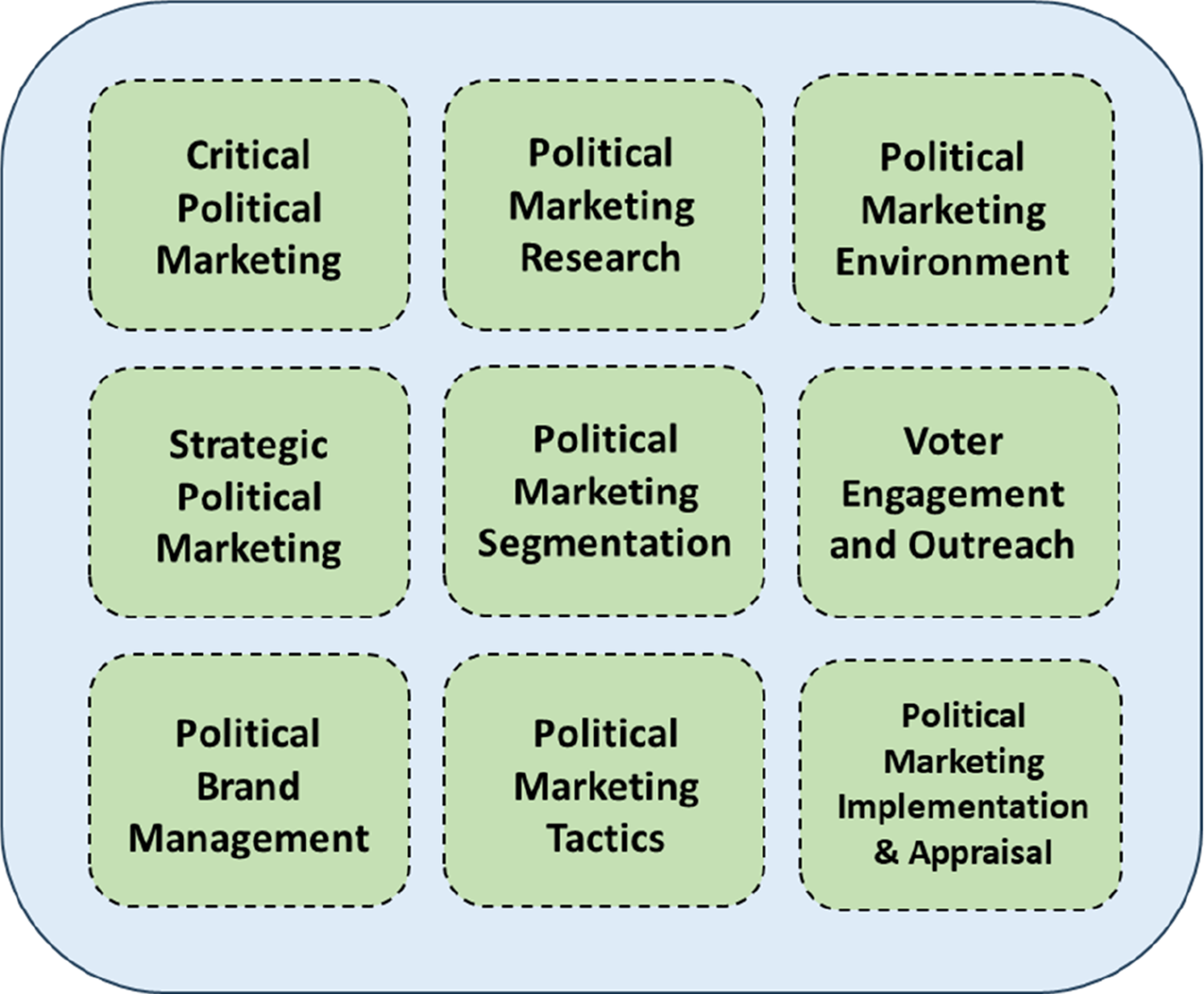
The ‘Political Marketing Research Map’ (Figure 1) is a visual representation of nine related yet distinct research streams within the sub-discipline of political marketing. Further ‘Political Marketing Research Map’ was developed from reflecting on previous research published within the field of political marketing and appraising the eleven papers that make up the special issue. Therefore, the ‘Political Marketing Research Map’ serves as a simple framework to guide and inspire researchers, practitioners and policymakers as they engage with future research within political marketing.
Second, the sub-discipline of political marketing focuses on a broad range of stakeholder groups, and perspectives as part of the investigatory process. For example, political marketing studies are often investigated from the perspective of citizens (voters and non-voters), candidates-politicians, political strategists, academics and policymakers. However, there has been limited progress in mapping the different stakeholder groups, which form part of the political marketing ecosystem (Poorrezaei et al., 2023). The political marketing ecosystem can be defined as an interrelated network of people, organisations or groups that are affected by or have an interest in political marketing research, strategies, tactics and programmes. Further, the political marketing ecosystem is under-researched as a concept within the discipline, and this represents an area for further research. In order to move, forward we have visualised an ecosystem within political marketing illustrated in Figure 2 and entitled ‘the political marketing stakeholder hive’. Political Marketing Stakeholder Hive – developed by the authors.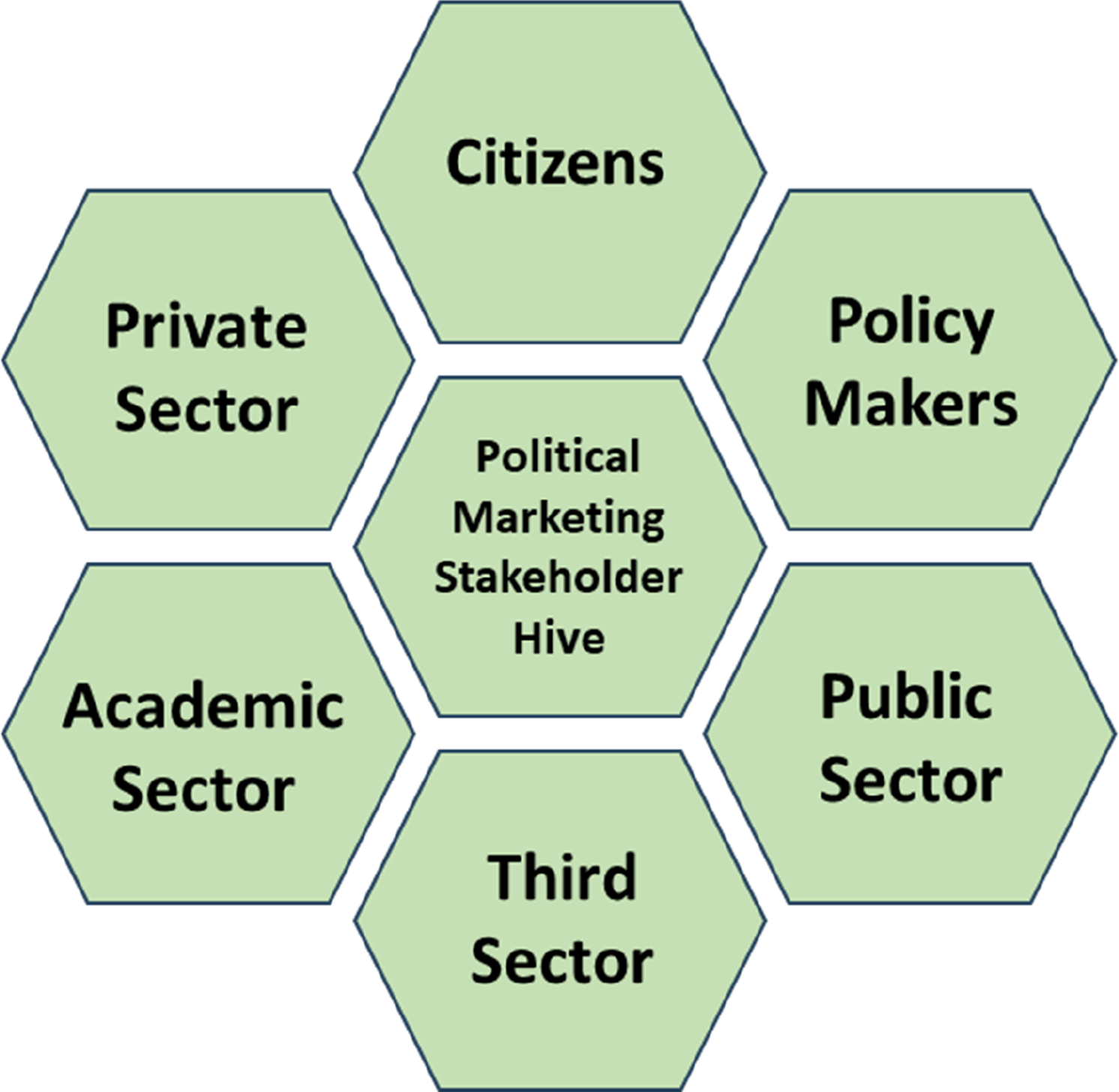
The ‘Political Marketing Stakeholder Hive’ (Figure 2) puts forward six interrelated stakeholder groups are affected by or have an interest in political marketing research, strategies, tactics and programmes. As each stakeholder group is potentially affected or have an interest in political marketing related studies, future studies should adopt a proactive, multisectoral and collaborative approach. This could lead to a range of mutually agreeable opportunities for all parties including shared resources, knowledge, expertise, experiences, and provide new insight on a variety of topic areas and perspectives to address societal issue.
Global Political Marketing – The Future’s bright
Priority Issues for Future Research on Global Political Marketing.
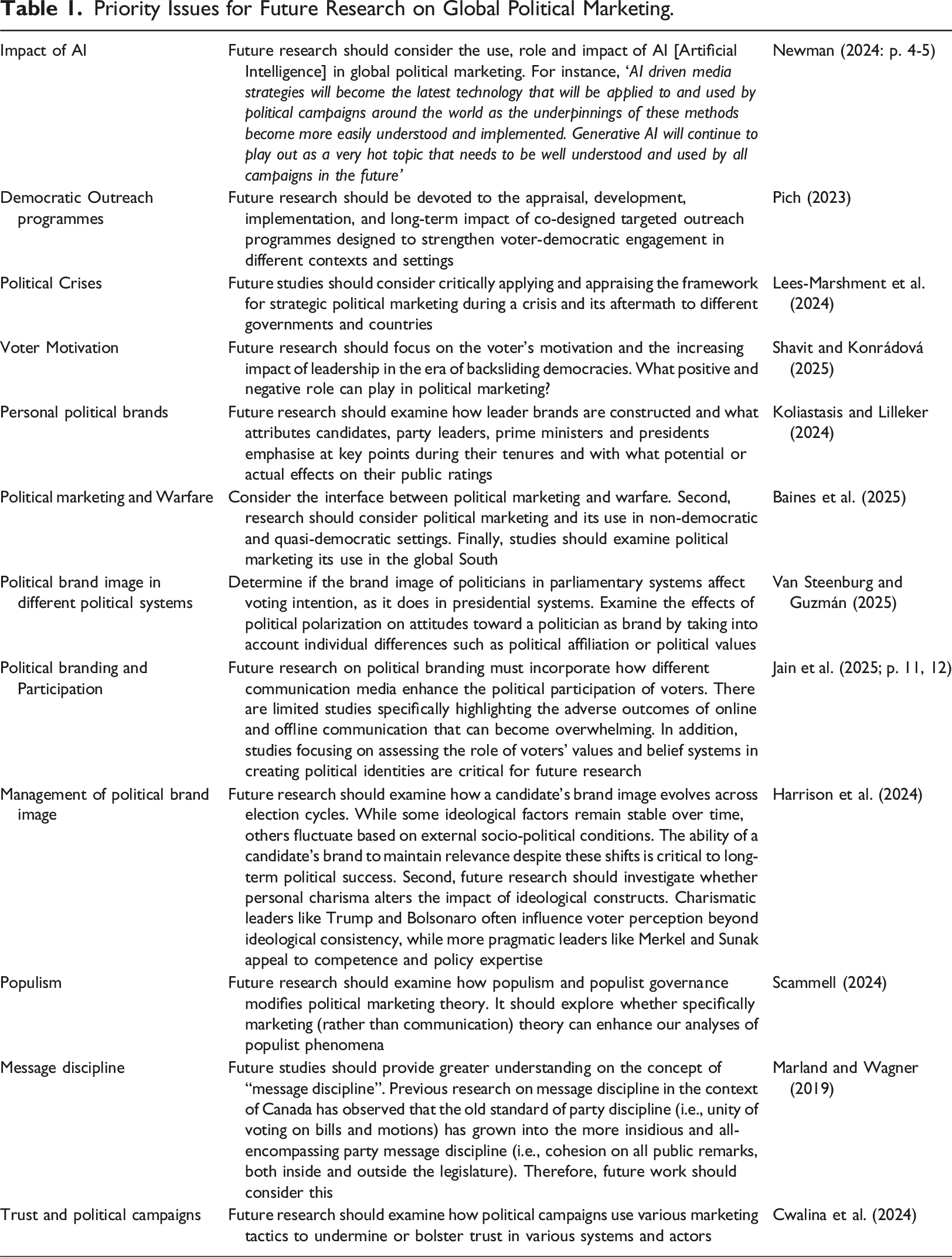
The table above (Table 1) sets out an agenda for further research within political marketing on a global scale. The priority issues align with the nine research streams illustrated in the ‘Political Marketing Research Map’ (Figure 1). Therefore, the agenda provides a snapshot of key topics, which should inspire and guide researchers, practitioners and policymakers to unite and address deep-seated and emerging societal issues. Future studies should consider longitudinal research, which continues to be under-researched within political marketing. Further, future studies should continue be more proactive, interdisciplinary, multisectoral and consider the perspectives of multiple stakeholders. This in turn will advance the sub-discipline and promote inclusivity, diversity and inclusion within political marketing.
Footnotes
Declaration of Conflicting Interests
The author(s) declared no potential conflicts of interest with respect to the research, authorship, and/or publication of this article.
Funding
The author(s) received no financial support for the research, authorship, and/or publication of this article.