







Abstract
This study investigates how Black consumers perceive their representation in fashion advertising, exploring whether current portrayals reflect authentic inclusion or diversity-washing. Based on semi-structured interviews with 19 Black participants, thematic analysis revealed widespread perceptions of tokenism, conditional visibility, and aesthetic stereotyping. While increased representation was acknowledged, participants stressed that only authentic, culturally resonant portrayals fostered identity affirmation and brand trust. The study advances theory by extending racial congruence theory through the concept of conditional congruence, showing that representation’s impact depends on authenticity and respect. It also refines Social Dominance Theory, illustrating how symbolic inclusion can perpetuate rather than challenge racial hierarchies. Introducing diversity-washing as a distinct construct, the research reframes representation as a moral and relational act, asserting that genuine inclusion requires narrative agency, structural diversity, and cultural respect.
Keywords
Introduction
In an increasingly globalised and multicultural marketplace, diversity and inclusion 1 have become central to brand communication. Fashion advertising, in particular, is undergoing a paradigm shift as brands are expected to reflect the pluralism of contemporary societies. This emphasis on inclusive representation is not merely symbolic but reflects broader societal demands for equity, fairness, and ethical accountability. In response, many brands have integrated more diverse individuals into their campaigns, driven by both ethical imperatives and evolving consumer expectations (Forbes, 2024).
Fashion advertising plays a critical role in shaping societal norms and consumer identities. Beyond selling products, it conveys implicit messages about belonging, aspiration, and cultural legitimacy. Prior research highlights the psychological and social consequences of exclusionary advertising: inclusive portrayals can affirm viewers’ identities, whereas stereotypical or absent representations may reinforce marginalisation and harm self-esteem (Rößner & Eisend, 2023). Crucially, the effect of inclusion depends not only on visibility but on whether representations are perceived as authentic and aligned with a brand’s identity and practices (Beverland and Farrely, 2010Beverland & Farrelly, 2010; Morhart et al., 2015).
In recent years, brands have faced increasing criticism for “woke-washing” or “diversity-washing,” whereby progressive values are signalled in marketing communications without substantive organisational change (Campbell et al., 2025). Such performative strategies often rely on tokenistic inclusion, particularly of people of colour, which may simultaneously increase visibility while flattening or erasing structural inequalities (Sobande, 2020). As a result, consumers may perceive a disconnect between inclusive messaging and brand reality, undermining trust and credibility (Campbell et al., 2025). This is especially problematic given that advertising not only reflects but actively shapes public understandings of race and inclusion (Saleem et al., 2025).
Within this context, the representation of Black individuals in fashion advertising remains a pressing concern. Despite their growing demographic presence and purchasing power in the US and UK (Office for National Statistics, 2022; Pew Research Centre, 2023) 2 , Black consumers continue to encounter reductive portrayals, tokenism, or racial insensitivity in media and advertising (Grier et al., 2024). High-profile controversies, such as H&M’s “Coolest Monkey” campaign (The Guardian, 2018), illustrate how cultural misrecognition can damage brand legitimacy, while initiatives such as Savage X Fenty demonstrate how meaningful inclusion can resonate with audiences and redefine industry norms (Bardey Mehdiratta., 2021).
Acknowledging that perceptions of racial representation are culturally situated, this study is informed by contrasting national approaches to ethnicity in France (colour-blind universalism) and the UK (multicultural recognition). Building on prior work on racial congruence in fashion advertising (Forbes-Bell et al., 2019; Sirgy, 1986), this research moves beyond visibility to examine whether Black consumers experience representation as authentic inclusion or symbolic acknowledgement, and how this shapes their attitudes and engagement with fashion brands.
Theoretical Background
The Construction of Beauty Ideals
Beauty ideals are socially constructed through a dynamic interplay of cultural norms, historical contexts, and socio-political values. In contemporary Western societies, thinness remains a dominant marker of attractiveness (Tiggemann & Slater, 2015), but beauty norms extend beyond body shape to encompass facial features, skin tones, and hairstyles. These standards do not emerge organically; they are actively produced and reinforced by media, particularly fashion media, which disseminates normative beauty scripts. Critically, this media-driven ideal privileges a narrow, exclusionary aesthetic that marginalises large segments of the population, thereby reinforcing hierarchies of ethnicity, class, and gender under the guise of taste and aesthetics (Tiggemann & Slater, 2015).
The internalisation of such narrow beauty ideals carries high psychological costs. Exposure to idealised and digitally manipulated imagery has been linked to negative body image, low self-esteem, anxiety, and disordered eating (Hawkins et al., 2004), effects intensified by social media’s constant comparison and visibility (Perloff, 2014). While beauty pressures affect many individuals, their impact is uneven: those structurally excluded from dominant beauty standards, particularly ethnic minorities, are disproportionately affected, as their bodies and identities are rendered less legitimate within prevailing visual cultures.
Underrepresentation and Tokenism in Fashion Adverts
Research on racial representation in advertising highlights that perceptions of inclusion are culturally situated and shaped by national ideologies and institutional frameworks. In this respect, the UK’s multicultural model and France’s colour-blind approach differently condition how diversity is enacted by brands and interpreted by audiences. Across contexts, racism in fashion advertising manifests through the persistent underrepresentation and misrepresentation of ethnic minorities, particularly Black consumers (Rößner & Eisend, 2023). Despite incremental gains, content analyses reveal enduring imbalances: Frith et al. (2005) found that Black models accounted for only 4% of US fashion advertisements, with tokenistic inclusion remaining the dominant mode.
From an authenticity perspective, such tokenism represents a symbolic rather than substantive form of diversity, signalling compliance with social expectations without challenging underlying power structures. This practice, often described as diversity-washing, creates an illusion of inclusion while preserving the centrality of whiteness. Western beauty ideals continue to privilege pale skin, straight hair, and slender bodies (Chen et al., 2020; Jackson-Lowman, 2013), systematically excluding features associated with Black women, such as melanated skin and textured hair (Boutté et al., 2025). For Black women, this produces a double bind: conformity often requires harmful aesthetic practices, while resistance risks social marginalisation (Keigan et al., 2024).
The persistence of diversity-washing can be interpreted through Social Dominance Theory (SDT), which explains how social hierarchies are maintained not only through overt discrimination but also through internalised beliefs and normative practices (Sidanius & Pratto, 2012). Within advertising, symbolic inclusion may resonate precisely because both dominant and subordinate groups have been socialised to accept minoritised visibility as the status quo (Jost & Hunyady, 2003).
Psychological and Social Impacts on Ethnic Minorities
The psychological consequences of exclusion from mainstream beauty standards are well documented. When ethnic minorities are invisible or stereotyped in advertising, they may internalise messages of inferiority, leading to lower self-esteem and body dissatisfaction (Grabe & Hyde, 2006; Schooler et al., 2004). Tuchman’s (1978) notion of symbolic annihilation captures this process of cultural erasure, whereby marginalised groups are denied recognition and belonging. Recent work further shows that Eurocentric beauty norms contribute to racialised body dissatisfaction and environmental injustice, as marginalised women disproportionately bear the health costs of conforming to dominant standards (Boutté et al., 2025; Keigan et al., 2024).
At the same time, representation can be empowering. Positive and culturally resonant portrayals can affirm racial identity, enhance self-esteem, and foster engagement (Adams-Bass et al., 2014). Empirical evidence shows that ethnically congruent advertising increases purchase intent and emotional engagement among Black consumers (Forbes-Bell et al., 2019). Representation, therefore, is not merely symbolic; it shapes both psychological outcomes and consumer behaviour.
Aim and Objectives
The exclusion of Black individuals from fashion advertising is not only ethically problematic but also commercially short-sighted. Inclusive advertising has been shown to enhance recall and positive consumer responses (Whittler, 1991), while diversity increasingly functions as a signal of brand ethics and desirability (Burgess et al., 2023). Despite this, existing research has paid limited attention to how Black consumers themselves evaluate the authenticity of their representation, particularly whether inclusion is experienced as meaningful or performative.
This study addresses this gap by examining Black consumers’ perceptions of fashion advertising, focusing on authenticity, symbolic exclusion, and their implications for trust, identification, and brand engagement. By foregrounding consumer voices, the research contributes to a more ethical and culturally responsive marketing discourse, critically interrogating whether contemporary diversity efforts reflect genuine inclusion or diversity-washing. Adopting an inductive qualitative approach, established theories such as Social Dominance Theory and racial congruence theory are used as interpretive lenses rather than a priori frameworks, contributing to debates on marketing ethics, identity-based responses, and meaningful inclusion in fashion advertising.
Methods
To ensure an in-depth exploration of participants’ subjective experiences, a qualitative research approach was employed, in line with established rigorous and systematic methodological frameworks (Bailey, 2014; Barnham, 2015; Chandler, 2013). Qualitative methods were particularly appropriate for capturing nuanced perceptions of representation, identity, and visibility among members of a minoritised group (Wood et al., 2024).
Participants
Participants’ Demographic (n = 19)
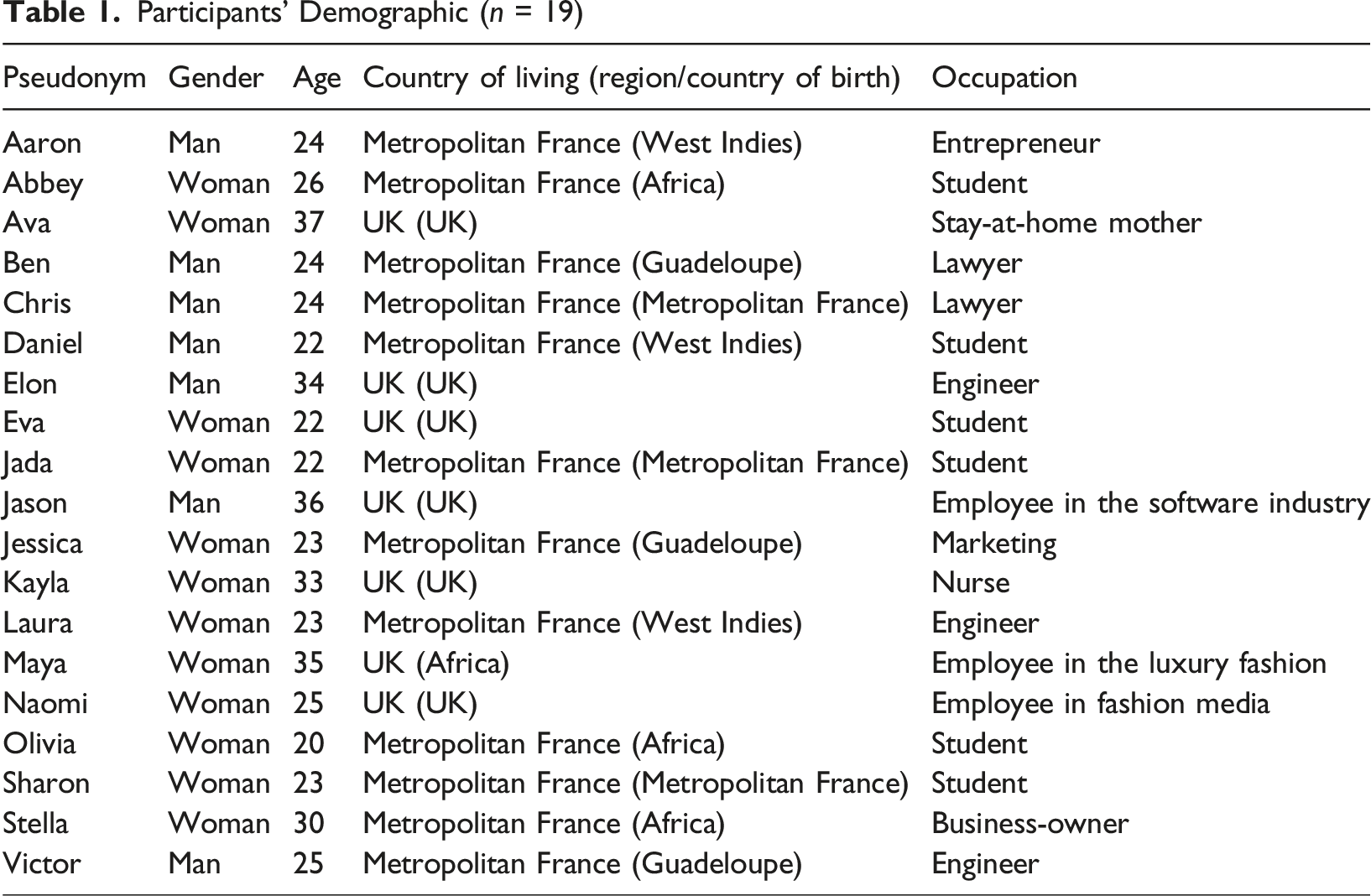
All participants lived in Europe (France and the UK) and belonged to the Gen Z/Millennial cohort (aged from 20 to 37). These generational cohorts were deliberately chosen because they seem to be the “voices of change” in shaping diversity debates in brands (Blanchflower et al., 2025). France and the UK were deliberately selected as research sites because they represent two major European contexts with distinct cultural approaches to ethnicity and diversity: France adopts a colour-blind model that restricts the collection of ethnic data, whereas the UK follows a more multicultural framework that explicitly recognises ethnic categories. Ethical approval for this study was granted by the Ethics Committee of the first author’s institution.
Materials & Procedure
Interview Schedule
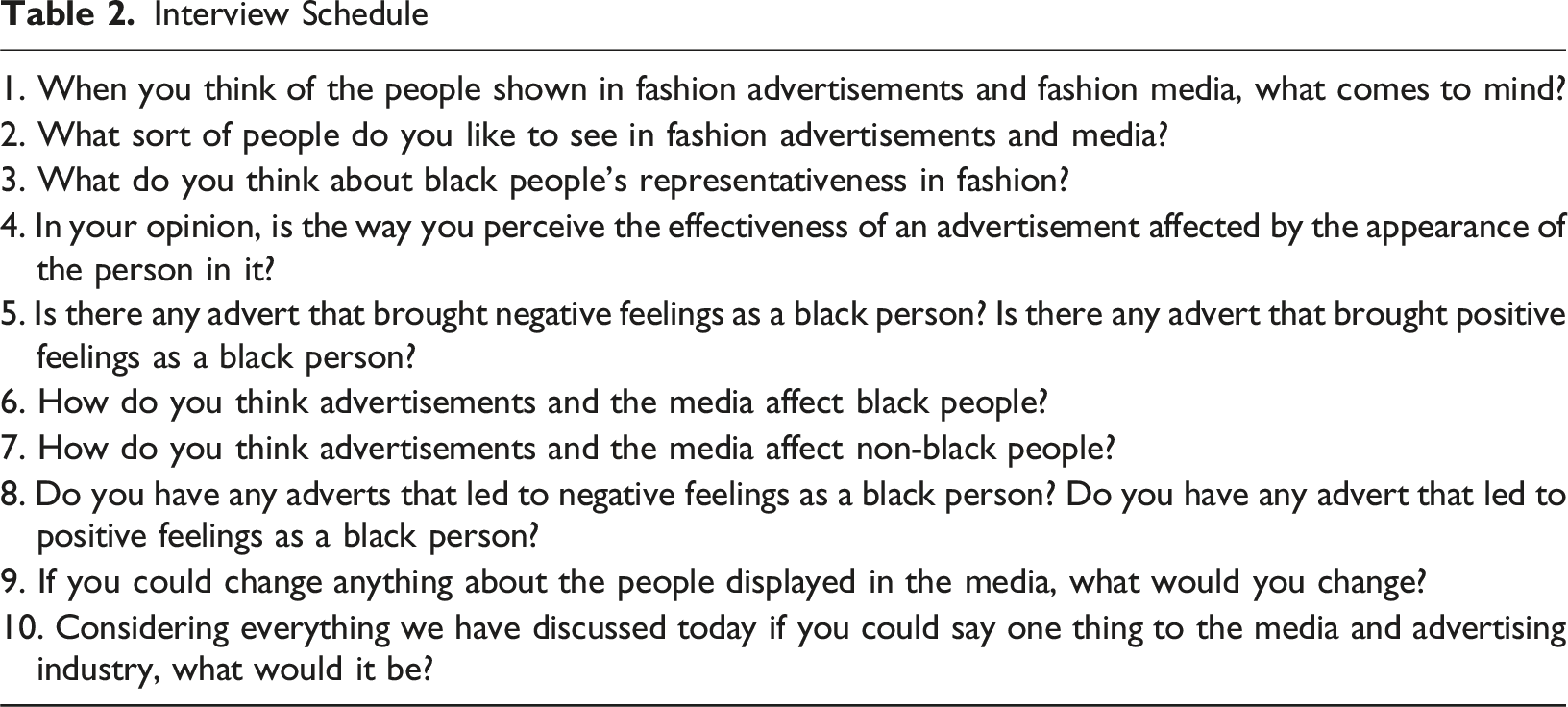
For participants’ comfort, all the interviews were carried out online. Beyond standard ethical procedures, the methodological design was specifically adapted to ensure participants, as members of a minoritised community, could participate meaningfully. Interviews were conducted by a Black-ethnicity researcher to enhance cultural trust and reduce power imbalances. Interviews in France were conducted in French by a Black French research assistant; those in the UK were conducted in English by a Black British research assistant. In order to reduce any bias and to enhance participants’ comfort, a black-ethnicity researcher carried out the 1:1 interview and was the point of contact for further questions. Online interviews allowed flexibility and privacy, minimising barriers to participation. Participants were able to withdraw their participation at any moment during their interview. At the end of the interview, each participant was briefed about the aim and objectives of the study as well as the current literature outcomes.
Data Analysis
In order to highlight common attitudes and practices among our participants, thematic analysis was used to analyse the data following Braun and Clarke’s (2006) approach. All interviews were transcribed verbatim. All transcripts were read multiple times, highlighting descriptive words and phrases. Then, the second stage was a more systematic and critical reading of the transcripts to identify and codify interesting features in the text. The third stage was grouping these codes into themes. The fourth stage summarised participants’ themes, keywords, and quotes into a thematic map. The fifth and final step was refining and naming themes. Data saturation was reached for our sample.
To enhance trustworthiness, the study followed Guba and Lincoln’s (1982) criteria of credibility, transferability, dependability, and confirmability. While two black research assistants carried out the interviews, a third researcher, fluent in both languages, transcribed and analysed the data. This third researcher, who was Caucasian, undertook diversity self-education and training as well as reflexive journaling to mitigate unconscious bias during analysis. Credibility was reinforced through prolonged engagement with the data, peer debriefing among the authorship team, and cross-national triangulation between France and the UK. Dependability was supported by a transparent and well-documented analytic process, including systematic coding procedures, iterative theme development, and clear audit trails of analytical decisions. Confirmability was addressed through reflexive practices and regular team discussions to ensure interpretations remained grounded in participants’ accounts rather than researchers’ assumptions. Transferability was facilitated through thick description of the research context, participant characteristics and the inclusion of verbatim quotations.
Although France and the UK were selected for their contrasting institutional and cultural approaches to race and ethnicity, comparative analysis did not reveal any substantive differences in participants’ perceptions, experiences, or interpretations of Black representation in advertising and media across the two countries. As a result, findings are presented collectively, highlighting shared patterns that cut across national contexts rather than country-specific effects.
Results & Discussion
First and Second-Order Themes as Well as the Aggregate Dimension
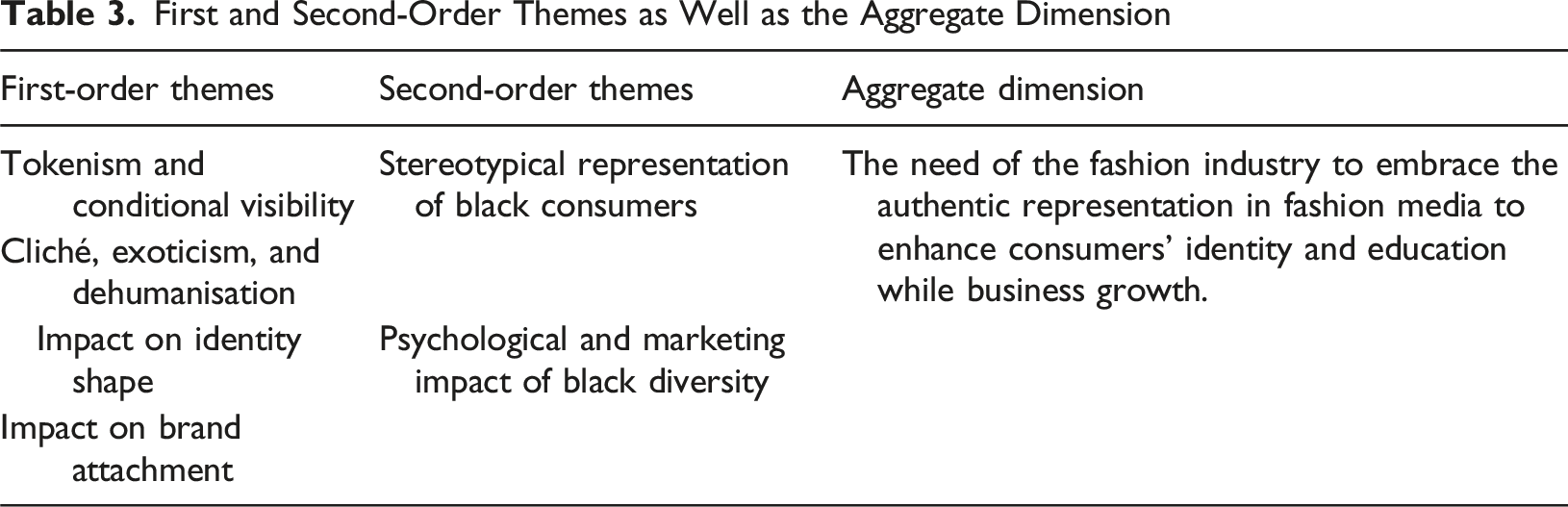
Stereotypical Representation of Black Consumers
Tokenism and Conditional Visibility
Participants consistently acknowledged that the visibility of Black individuals in fashion advertising has increased in recent years. Ben noted that “the representation of Black people has grown in recent years… I have the impression that there is a change,” while Aaron observed that “Black people are present in advertising, especially in fashion ads and increasingly so.” Jada similarly stated that “Black people in fashion ads have grown over the past decade.” Collectively, these accounts suggest that the industry has responded, at least on the surface, to calls for greater inclusion.
Yet this progress was widely viewed with scepticism. Participants frequently described increased visibility as strategic and superficial, aligning more closely with tokenism than genuine inclusion (Campbell et al., 2025; Sobande, 2020). Olivia summarised this view succinctly: “the fashion industry only uses well-known Black people in their ads.” Stella echoed this conditionality, remarking that “a beautiful Black person in a perfume ad is inevitably someone well-known… not just an ordinary Black person,” a pattern Daniel also confirmed: “in clothing ads, especially streetwear, it is often well-known Black people.” Visibility was therefore perceived as contingent on celebrity status, signalling a reluctance to normalise everyday Black identity and reinforcing the idea that Black individuals must first achieve exceptional status to be deemed marketable.
Participants further framed such practices as symbolic “box-ticking exercises.” Elon warned that “if not, it looks like tokenism, it looks like a weak gesture. The Black representation since 2020 has been much more of a wave,” while Kayla expressed a desire for “a more genuine Black representation, a little bit more inclusive rather than just being a tick-box exercise.” These reflections underscore that Black presence in advertising is not inherently progressive; its value depends on intent, context, and depth, echoing critiques of diversity-washing (Campbell et al., 2025; Sobande, 2020).
This scepticism extended to narrative positioning. Ben argued that “it’s important to put a Black person at the forefront; otherwise, it feels like they’re just including a Black person for the sake of it.” Olivia criticised the “false utopia” projected by brands, stating that “most companies manipulate this image of diversity.” Ava similarly described a minimised form of inclusion: “There’s a little bit of diversity in fashion ads but it’s always a Black (or Black-ish) person that represents this drop of diversity.” Jada reinforced this view, noting that “Black people appear as extras; it is simply aesthetic… Because it adds value,” a practice Naomi labelled “the ‘token black’.” Across accounts, Black bodies were perceived as instrumentalised to signal legitimacy or “coolness,” rather than integrated as central narrative subjects.
Participants also highlighted how tokenism flattens Black identity. Maya observed that “ads often use mixed-race individuals to represent the entire Black community,” while Stella lamented that “they show very few ‘real’ Black people (i.e., ebony-skinned) like me.” Such selective representation reinforces colourism and Eurocentric beauty standards (Craddock et al., 2023; Hunter, 2007). Sharon’s remark that Black people are “always in the secondary roles, subordinate roles” further illustrates how symbolic inclusion preserves existing hierarchies, consistent with Social Dominance Theory (Sidanius & Pratto, 2012).
Despite these critiques, participants identified rare examples of more meaningful representation. Chris described Fenty Beauty as a benchmark: “a perfect ad would be a Fenty runway show, an ad that represents every aspect of society.” Yet even such examples heightened awareness of broader structural gaps. Sharon noted that “The brand J* employs a lot of Black models but has very few or no Black people in strategic positions,” exposing a disconnect between front-stage diversity and organisational power. Participants repeatedly linked tokenism to the underrepresentation of Black individuals in leadership and creative authority. Olivia argued that brands “should highlight how they draw from Black culture,” Victor called to “break the norms and bring diversity not just among representatives but also among decision-makers,” and Eva emphasised that “There’s not enough representation back-of-house… there’s a gateway in terms of career profession.”
The consequences of this exclusion were illustrated through high-profile failures. Ben stressed that “There should be more Black people in decision-making committees and fashion media teams… to eliminate signs that reinforce Black people’s condition.” The H&M advertisement featuring a Black child in a hoodie labelled ‘Coolest monkey in the jungle’ was repeatedly cited as emblematic of unchecked bias. Chris reacted strongly: “The H&M campaign with the Black boy made me extremely angry; how could such a big company let this happen?” Ben added that “The issue wasn’t noticed at any stage of the decision-making process; this is not normal.” Aaron described such portrayals as “a form of hidden contempt,” while Daniel offered a metaphor for sanitised misrepresentation: “It’s like period commercials where they represent blood in blue instead of red.”
In contrast, authenticity was associated with Black leadership and creative agency. Rachel noted that “Off-White has good diversity, but that’s expected since the designer/CEO, Virgil Abloh, is Black.” Eva praised designers like Christopher John Rogers who “just happens to be Black,” arguing that diversity should emerge organically from talent rather than quotas. Jada summarised this distinction clearly, asserting that what matters is “representation of Black values, not just Black individuals within a white corporate structure.”
Overall, participants agreed that increased visibility has not translated into meaningful inclusion. Representation was not rejected outright but critically evaluated: it is not who appears in advertising that matters most, but how and why. Tokenism emerged as a form of conditional, commodified inclusion that sustains existing power dynamics. Participants articulated a clear demand for representation that extends beyond surface aesthetics to include narrative agency, structural diversity, and decision-making power, i.e., positioning diversity as a structural imperative rather than a branding strategy.
Cliché, Exoticism, and Dehumanisation
Despite the growing visibility of Black individuals in advertising, participants consistently stressed that such representations remain constrained by stereotypes, aestheticisation, and historical prejudice. This sub-theme highlights how Black identity is commodified and shaped through advertising narratives that draw on colonial imagery, dehumanising comparisons, and visual clichés.
One of the most striking forms of dehumanisation was illustrated through references to racially offensive content. Ben cited the infamous H&M advertisement in which a Black child wore a hoodie reading ‘Coolest monkey in the jungle’, describing it as “a colonialist, racist, and stereotyped vision.” Jessica similarly lamented that “the Black person is often compared to sub-humans, animals,” a point reinforced by Olivia, who noted that “Black people are often represented with exaggerated features, often compared to animals.” These accounts evoke a legacy of racial caricature in which Blackness is systematically othered and diminished.
Participants emphasised that such portrayals actively reproduce racial inequality. Stella stated that “we are always confined to clichés,” while Victor added that “Black people always have the bad role in advertisements.” Aaron recalled an advert where “a Black couple was parading in front of white people… Frail, alone, and poor,” illustrating how Black figures are framed through pity rather than normalcy. Eva similarly observed that “the only kid who was crying was the Black kid,” reinforcing the racial coding of suffering and deficiency.
Alongside overt dehumanisation, participants identified a more insidious form of stereotyping: exoticism. Maya summarised this dynamic by stating that “ads often seem intent on… Diminishing us.” Rather than normalising Black presence, advertising often heightens difference, presenting Blackness as something to be displayed rather than integrated. Eva criticised this visual coding: “Black models always have colourful and extravagant clothes,” contrasted with minimalist aesthetics reserved for white models. Aaron further noted that Black people are “portrayed either with ‘Negroid’ features or as mixed-race, with ads using clichés to sell products,” reducing Blackness to narrow, marketable extremes.
Beauty norms were also described as tightly policed. Daniel criticised pressures toward Eurocentric aesthetics, stating that “they try to fit Black people into boxes where hair must resemble the European type.” Jada echoed this concern, observing that “often, the Afro hairstyle is presented as an uncivilised haircut,” highlighting the continued marginalisation of natural Black features.
Participants further stressed how Blackness is commodified as a visual strategy. Stella criticised portrayals in which “Black people are always portrayed in a stereotypical, raw manner,” while Eva described how “We use Black models for the really colourful outfits, it just looks amazing on their skin… The industry uses Blackness as a commodity in fashion… to enhance the clothes.” Jada cautioned against this instrumentalisation, stating that “Black people should be chosen for their talent, not their skin colour.”
While some participants acknowledged incremental progress, they viewed it as limited. Naomi highlighted the broader social stakes of authentic representation, noting that “it reduces the stigma and ignorance… It enriches society.” Ava concluded that “it’s not just ‘it’s unfair that we are not being represented,’ it’s actually more layers to it,” pointing to the emotional and psychological costs of reductive visibility.
Overall, this theme demonstrates that increased visibility does not equate to progress when representation continues to rely on clichés, exoticism, and dehumanisation. Participants’ accounts reveal deep disillusionment with how Blackness is stylised, contextualised, and narrated in fashion advertising. Consistent with prior research (Grier et al., 2024; Rößner & Eisend, 2023), visibility often remains conditional, selectively favouring light-skinned or celebrity Black individuals who conform to Eurocentric ideals (Boutté et al., 2025; Keigan et al., 2024). Rather than dismantling racial hierarchies, such representations risk reproducing them under the guise of diversity.
The Positive Psychological and Marketing Impact of the Genuine Representation of Black Consumers
Impact on Identity Shape
This theme highlights the powerful influence of fashion advertising and media representation on the self-concept, self-esteem, and identity formation of Black individuals. Participants’ accounts show how embedded messages in fashion media shape insecurities and aspirations while reinforcing broader social dynamics related to race, beauty, and belonging.
Participants unanimously emphasised the early and pervasive nature of media influence, particularly during childhood. Aaron observed that “advertisements influence individuals from a very young age, as well as children today, who see ads and unconsciously register them,” adding that “these ads provide, or even impose, images of the world on them.” Advertising thus operates as a primary transmitter of cultural norms, shaping what is perceived as desirable and legitimate.
Ben echoed this concern, explaining that “fashion advertising can convey stereotypes and caricatures, which affect children and lead to mockery.” This process fosters a cycle in which racialised standards are internalised and reproduced through exclusion. Jada reinforced this dynamic, stating that “the messages conveyed are racist, which influences and creates a pervasive racism in society.” Victor further noted how advertising elevates whiteness not only aesthetically but morally: “White people are portrayed as saviours, as liberators.”
The emotional toll of misrepresentation was evident across narratives. Participants described internal conflict and self-modification in response to unattainable ideals. Stella explained: “We are forced to transform ourselves, to change in order to become someone we are not… To achieve an ideal body, an ideal look, an ideal skin colour.” She added that “This lack of ‘real’ Black representation leads some women to bleach their skin… the fashion and cosmetics industries try to make us believe that our skin colour is not beautiful, that we need to get rid of it.” Jessica illustrated this internalisation: “Advertising has influenced me. I have naturally curly hair, and I used to dream of having straight hair like the people on TV, so I would straighten my hair.” Sharon captured the impact on self-worth, stating: “Afros are always portrayed as messy… you start thinking you are worth less than white people, which can lead to an inferiority complex.”
Despite these harms, participants articulated a strong desire for change grounded in authenticity and dignity. Olivia linked representation to well-being, stating that “Advertisements and the representation of Black people in fashion have an impact on mental health and parents,” and stressed that “it is crucial to educate and highlight Black skin.” Maya similarly reflected that “These stereotypical representations made me insecure about my physical appearance, especially my skin colour… I want to see everyday things, people and situations that we can relate to.” These accounts emphasise the importance of ordinary, non-spectacular visibility.
A recurring theme was the role of media in shaping intergenerational identity. Kayla emphasised that “It is important for our children to be secure and know their heritage, we need good role model,” while Stella asserted that “We (Black people) need role models, a reference for representation.” Naomi articulated the broader social implications of inclusion: “I would love to see a Black person on the front… It can make society more inclusive… not only second-class citizen, that we have an equal role to play within society.”
Participants also envisioned representations that celebrate complexity rather than stereotypes. Jessica called for breaking clichés: “We need to break stereotypes, show everyday habits, and revalue Black culture. I would like to see a man with dreadlocks in a suit, a woman with an afro in professional attire, resilient, strong, and smiling Black people.” Victor echoed this aspiration: “I would like to see more Black people who have succeeded - real, actual Black people who exist and have made it.” Abbey’s reflection “You do still question yourself about whether you appear as your most authentic self… even my own father told me he preferred my hair straight” captured the intimate tension between authenticity and social acceptance.
Overall, this sub-theme demonstrates that representation is never neutral: it is pedagogical, ideological, and deeply affective. Participants described internalised racism, diminished self-worth, and pressure to conform to Eurocentric beauty standards, often originating in childhood, consistent with prior research (Boutté et al., 2025; Grabe & Hyde, 2006; Hawkins et al., 2004). These findings reinforce that calls for inclusion are not about visibility alone, but about transforming aesthetic norms, power relations, and cultural hierarchies. Fashion advertising must therefore move beyond optics toward representation grounded in dignity, authenticity, and human complexity.
Impact on Advert Relatability
The influence of racial representation in advertising on brand relatability emerged as a deeply felt theme. Participants made clear that representation is not simply about visibility, but about cultural affirmation, emotional resonance, and relational trust. Authentic portrayals of Black people were seen as capable of strengthening consumer–brand relationships, while superficial or stereotypical representations generated distrust and disengagement.
Participants consistently emphasised identification as central to engagement. Ben noted, “If an ad represents me, I will naturally identify with it, even subconsciously,” while Daniel added, “If the person is Caribbean or Black, I relate more because they resemble me.” Sharon highlighted the particular salience of beauty advertising: “I will feel more engaged if the person in the ad looks like me, especially in the cosmetics and makeup industry.” Seeing oneself reflected was thus closely tied to emotional connection and perceived relevance.
Cultural specificity further shaped brand appeal. Jessica stated, “If an ad highlights something culturally significant to Black people, I would prefer to see Black individuals featured,” underscoring that racial inclusion alone is insufficient without cultural alignment. Aaron similarly stressed the importance of both aesthetics and character: “I need to see charismatic people - Black people… I want to see the product enhancing the character. I like aesthetics and beauty.” These accounts suggest that representation influences not only recognition, but the quality of the emotional relationship consumers form with brands.
Participants were highly sensitive to whether representation felt genuine or merely decorative. Victor called for “greater normalisation of cultural elements from Black culture,” while Elon asserted that “authentic well-informed representation can actually encourage me to become a consumer.” Eva shifted the focus from appearance to meaning, explaining: “I don’t think that the appearance of the models in ads affects me. It would be the story behind the model.” Olivia echoed this emphasis on sincerity: “Brands need to be 100% transparent with consumers, allowing people to relate through simple and authentic stories.” These reflections reveal a critically engaged audience that actively rejects performative diversity in favour of meaningful storytelling.
When authenticity was perceived to be lacking, trust eroded quickly. Stella explained, “I spend more time criticising the ad than trying to understand the message,” while Olivia cited a specific misalignment: “the brand E* used a Black woman in their shampoo ads while promoting results that did not match Black hair types.” Abbey linked such misrepresentation directly to behaviour, stating: “If the person has been portrayed unfairly or incorrectly, I’m more likely to probably not follow with the purchase.” Olivia similarly observed that “They use Black models for products that are not suited to the Black community,” reinforcing the view that symbolic inclusion without practical relevance damages credibility.
Representation was also tied to recognition of Black consumers as a legitimate market segment. Kayla noted, “When I see a Black person, I take more notice in the ad,” and added, “I do pay attention when it’s a Black-owned company.” Ava reflected on the impact of absence in luxury advertising: “There was no Black representation in luxury ads,” recalling how this shaped assumptions about belonging. Her assertion, “We do a consistent part of the market,” emphasises both economic presence and the demand for acknowledegment. Yet Abbey pointed out that “beauty standards reinforced by adverts [are] geared towards European standards,” highlighting an enduring disconnect that undermines long-term relatability.
Participants also acknowledged a degree of detachment in their viewing practices. Aaron admitted, “Often, I focus more on the product than on the person in the ad,” while Daniel similarly stated, “I completely detach from the person in the ad and focus on the product.” These comments suggest that representation is not always consciously decisive, but Aaron’s further reflection that “minorities are more sensitive to advertising than white people” and Daniel’s observation that “white people can identify with a wider range of representations” point to the unequal emotional labour involved in interpretation. Daniel’s call for ads that “mix social classes and diversity” reflects a desire for broader, more inclusive representation.
Overall, this analysis shows that for Black consumers, representation functions as a symbolic and emotional signal rather than a purely visual element. Affirming portrayals enhance brand relatability by validating identity and conveying respect, whereas superficial or culturally inaccurate depictions erode trust and credibility. These findings refine racial congruence theory (Adams-Bass et al., 2014; Forbes-Bell et al., 2019; Sirgy, 1986) by demonstrating that identification effects are conditional upon perceived authenticity, cultural accuracy, and narrative sincerity. Black consumers do not simply notice who appears in advertising; they interrogate how and why. Representation thus becomes both a mirror and a message, reflecting identity while signalling brand values. For it to foster, rather than hinder, brand relatability, representation must be intentional, informed, and authentically grounded.
Implications and Future Research
Theoretical Implications
The present study advances theoretical debates on race, representation, and consumer identity in marketing by developing the construct of diversity-washing, defined as a form of performative inclusion in which racialised bodies are mobilised as symbolic capital without a corresponding redistribution of cultural or decision-making power. While prior research has largely conceptualised diversity in advertising through racial congruence theory (Forbes-Bell et al., 2019; Sirgy, 1986) or visibility-based frameworks (Rößner & Eisend, 2023), our findings demonstrate that visual congruence alone is insufficient to generate identification or trust among Black consumers. We show that the effects of racial congruence are conditional upon perceived authenticity, respect, and cultural accuracy, introducing the notion of conditional congruence, whereby consumers evaluate not only whether they are represented, but how and why such representation occurs.
The concept of diversity-washing also refines Social Dominance Theory (Sidanius & Pratto, 2012) by illustrating how racial hierarchies can be reproduced through symbolic inclusion and aesthetic assimilation rather than overt exclusion. In fashion advertising, Black visibility frequently functions as a legitimising device that sustains existing power asymmetries, demonstrating that inclusion can reproduce dominance when detached from structural change. In this way, the study connects psychological processes of internalisation with broader structural dynamics in consumer culture.
Additionally, the study contributes to work on symbolic and narrative representation (Hall, 1995; Tuchman, 1978) by framing fashion advertising as an affective site of recognition. Representation is shown to be not merely visual but relational, shaping identity, belonging, and brand trust. By foregrounding Black consumers’ interpretations, we advance a consumer-centred understanding of authenticity, positioning perceived sincerity as a key mediator between representation and engagement.
Methodologically, the study illustrates how qualitative market research can meaningfully include minoritised voices through culturally congruent interviewing, online accessibility, and reflexive practice. Beyond fashion, the findings highlight how authentic representation influences brand trust and consumer engagement, offering actionable insights for market researchers and practitioners seeking to build credibility with diverse audiences. Representation thus emerges not only as an ethical concern, but as a critical driver of market relationships.
Practical Implications
An Authentic Inclusive Adverts Guideline
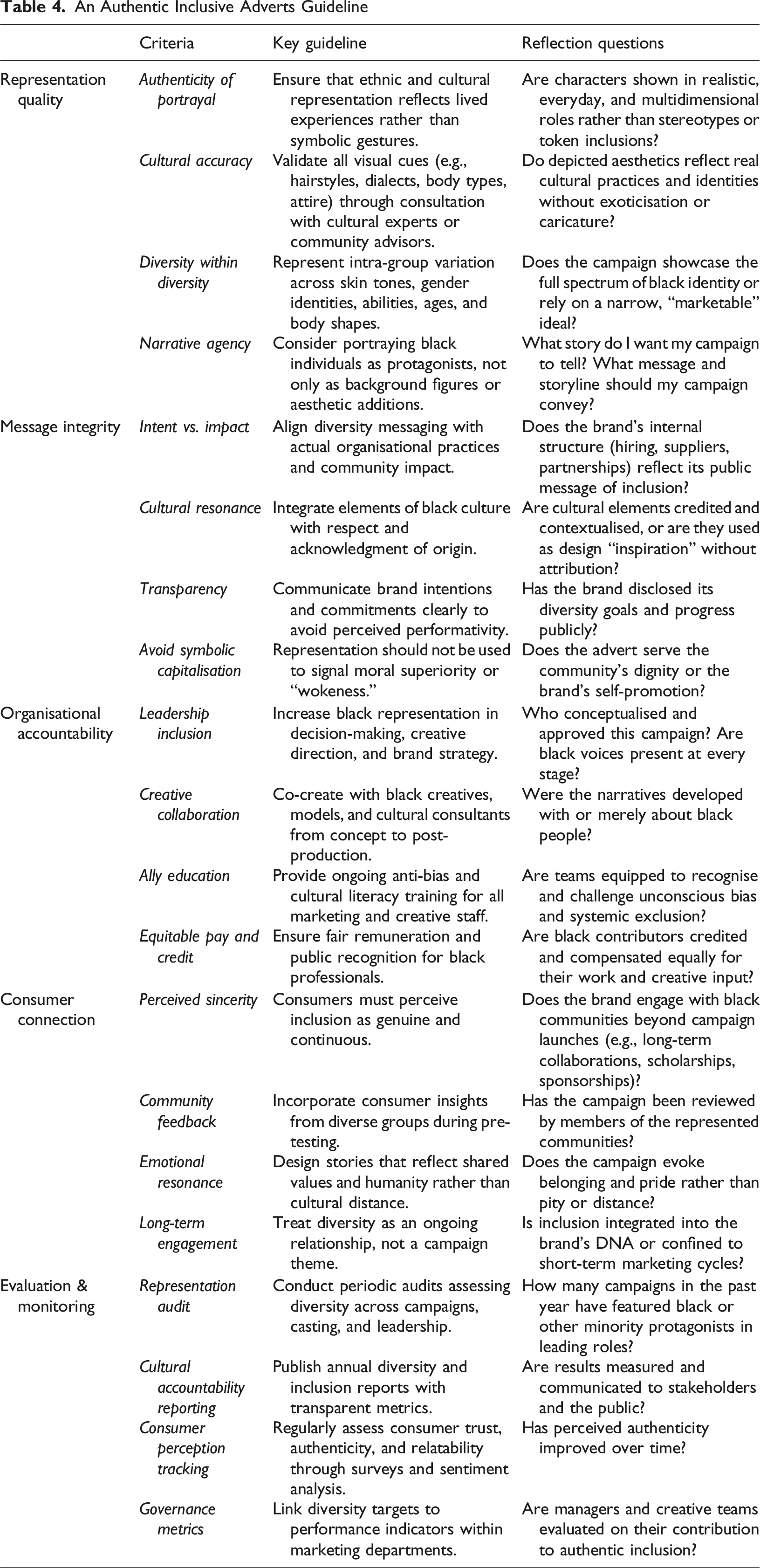
Public and commercial organizations relying on market research to inform inclusive strategies must also interrogate the structural biases embedded in research design and interpretation. Approaches based solely on demographic segmentation or numerical representation risk obscuring lived realities and cultural meaning. By contrast, interpretive and mixed-methods approaches can generate deeper insight into how marginalized groups relate to brands, media, and market structures.
Overall, this study calls for a shift from diversity as optics to diversity as ongoing practice and accountability. Performative inclusion is increasingly scrutinised by Gen Z and Millennial consumers who are digitally literate and highly attuned to brand ethics. Strategic investment in inclusive storytelling, organisational diversity, and culturally grounded research practices is therefore not only an ethical necessity but a market imperative. To support this shift, the study proposes an applied guideline for authentic inclusive advertising, offering a practical framework for insight teams and creative agencies to commission, test, and monitor campaigns in ways that prioritise representational quality and organisational integrity.
Limitations and Future Research
While this study provides valuable insight into Black consumers’ perceptions of representation in fashion advertising, several limitations should be acknowledged. First, the qualitative design, while well-suited to capturing lived experiences, limits the generalisability of the findings. Future research could extend this work through mixed-method approaches that combine interpretive depth with larger-scale surveys or experimental designs to assess the prevalence and effects of perceived diversity-washing across broader consumer populations.
Second, the sample focused on Gen Z and Millennial consumers in France and the UK. Although these cohorts are central to contemporary fashion markets, perspectives from older consumers and Black communities in other cultural contexts may reveal different dynamics of representation, brand trust, and consumer activism. Cross-cultural and intergenerational comparisons would therefore strengthen understanding of how racialised representation operates across global markets.
Third, the analysis centres exclusively on consumers’ perspectives. Incorporating the views of fashion industry professionals (such as creative directors, marketers, and advertising executives) could offer a more holistic assessment of whether diversity initiatives reflect substantive organisational change or remain largely symbolic.
These limitations also open avenues for future research. Theoretically, while this study introduces the concept of diversity-washing, further work is needed to refine and extend the construct, including its intersections with related phenomena such as greenwashing, pink-washing, or virtue signalling in marketing. Methodologically, future studies should continue to develop inclusive and reflexive research designs that foreground marginalised voices. Practically, research should examine how authentic representation can be translated into measurable organisational practices, including inclusive hiring, product development, and sustained stakeholder engagement. Linking consumer perceptions to organisational strategies would help bridge the gap between representational optics and structural inclusion.
Conclusion
This study examined how Black consumers perceive their representation in fashion advertising, revealing a critical stance toward contemporary inclusion efforts. Although participants acknowledged increased visibility, they consistently described representations as superficial, stereotypical, and disconnected from genuine structural commitment to diversity. Representation was not experienced as neutral or celebratory, but as conditional and commodified, i.e., an expression of diversity-washing that undermines trust and sustains existing power hierarchies. Importantly, Black consumers emerged as active and critical interpreters of advertising, closely scrutinising the intentions, narratives, and values behind brand strategies. Visibility alone was insufficient; what mattered was whether representation was authentic, culturally respectful, and supported by real agency within brands. By foregrounding Black perspectives and exposing the gap between visibility and power, this study challenges fashion advertising to move beyond performative inclusion. Diversity, it argues, must shift from an aesthetic gesture to a structural and ethical commitment if identities are to be not only seen, but genuinely valued.
Footnotes
Acknowledgments
We would like to express our sincere gratitude to all the participants who generously shared their time, experiences, and insights for this study. This research would not have been possible without their meaningful contributions.

Ethical Considerations
This study was approved by the institutional ethics committee and conducted in accordance with the ethical principles of the American Psychological Association.
Consent to Participate
All participants were fully informed about the aims and procedures of the study and gave their written informed consent prior to participation. Participation was voluntary, and data were collected anonymously to ensure confidentiality.
Funding
The authors received no financial support for the research, authorship, and/or publication of this article.
Declaration of conflicting interests
The authors declared no potential conflicts of interest with respect to the research, authorship, and/or publication of this article.
Data Availability Statement
The interview data generated and analysed during this study are not publicly available in order to preserve participant anonymity, as all interviews were conducted on a confidential basis. However, anonymised transcripts can be made available to journal editors or reviewers upon request, provided that all confidentiality and ethical standards are strictly maintained.