We propose a flexible class of regression models for continuous bounded data based on second-moment assumptions. The mean structure is modelled by means of a link function and a linear predictor, while the mean and variance relationship has the form , where , and are the mean, dispersion and power parameters respectively. The models are fitted by using an estimating function approach where the quasi-score and Pearson estimating functions are employed for the estimation of the regression and dispersion parameters respectively. The flexible quasi-beta regression model can automatically adapt to the underlying bounded data distribution by the estimation of the power parameter. Furthermore, the model can easily handle data with exact zeroes and ones in a unified way and has the Bernoulli mean and variance relationship as a limiting case. The computational implementation of the proposed model is fast, relying on a simple Newton scoring algorithm. Simulation studies, using datasets generated from simplex and beta regression models show that the estimating function estimators are unbiased and consistent for the regression coefficients. We illustrate the flexibility of the quasi-beta regression model to deal with bounded data with two examples. We provide an R implementation and the datasets as supplementary materials.
For the analysis of longitudinal and repeated measures data, Bonat et al. (2015a); Figueroa-Zúñiga et al. (2013) presented beta mixed models within the Bayesian paradigm. Bonat et al. (2015b) proposed a similar model class, in a pure likelihood framework. Similarly, Qiu et al. (2008) discussed the specification of simplex mixed models for longitudinal data, while a marginal version of the simplex model for modelling longitudinal data was proposed in Song and Tan (2000). Time series models for continuous bounded data were presented in Rocha and Cribari-Neto (2008), Grunwald et al. (1993) and McKenzie (1985). Influence and residuals analysis for beta regression models were discussed in Rocha and Simas (2011), Espinheira et al. (2008b) and (Espinheira et al. (2008a). Dynamic beta regression models were proposed by (da Silva et al. (2011). For further discussions and references on beta regression models see Smithson and Verkuilen (2006) and Verkuilen and Smithson (2012).
Additionally, new classes of probability density functions have been proposed for modelling continuous bounded data. Lemonte and Bazàn (2016) proposed a new class of Johnson distribution and associated regression models. Abdel-Fattah et al. (2016) presented a gamma regression model for bounded continuous response variables. Regression models based on the Kumaraswamy distribution has been proposed as an alternative to the beta regression model (Mitnik and Baek, 2013). Meanwhile, Kotz and van Dorp (2004) present many alternative probability density functions with bounded support.
Estimation and inference for regression models are generally done based on the standard method of maximum likelihood, which in turn provides efficient estimation for both regression and dispersion parameters. Although of broad use and efficient, the method of maximum likelihood requires a full model specification, that is, we need to specify a probability density function as the data generator. Given the plethora of available approaches to model continuous bounded data in the literature, it is difficult to decide, with conviction, which is the best choice for a particular dataset. The standard approach seems to take a small set of models, such as the beta, simplex, Kumaraswamy, etc. fit all of them and then choose the best fit by using some measures of goodness-of-fit, such as the Akaike or Bayesian information criteria. A typical example of this approach can be found in Bonat et al. (2012), where the authors compared the fit of four different distributions for the analysis of four datasets.
Although reasonable, such an approach is challenging to implement in practical data analysis. First, we should define the set of models to be fitted. Second, each bounded model can require specific fitting algorithms and give its own set of fitting problems, in general due to difficult aspects of the likelihood function. Third, the choice of the best fit may not be obvious, with different information criteria leading to different selected models. Finally, the uncertainty around the choice of the distribution is not taken into account when choosing the best fit. Thus, we claim that it is very useful and attractive to have a unified model that can automatically adapt to the underlying bounded data distribution and that can be easily implemented in practice.
The main goal of this article is to propose a new class of regression models for continuous bounded data. The proposed flexible quasi-beta regression model is based on second-moment assumptions, only. The expectation is modelled in the orthodox way by means of a link function and a linear predictor. The variance is specified by , where is the mean and is the dispersion parameter. Finally, the extra power parameter is introduced to give more flexibility in the modelling of the mean and variance relationship. As we shall show in Section 2, such a mean and variance relationship is often found in bounded distributions, which implies that the proposed model can easily mimic many well-known regression models, such as the beta and simplex regression models. Our approach for model specification resembles Wedderburn's quasi-likelihood (Wedderburn, 1974) method and has been recently used in the context of continuous and count data by Bonat and Kokonendji (2017) and Bonat et al. (2017), respectively. In this framework, we do not specify a full probability distribution for the bounded response variable and consequently a likelihood function is not available. Thus, the models are fitted by an estimating function approach as in in Bonat and Jørgensen (2016); Jørgensen and Knudsen (2004) obtained by combining the quasi-score and Pearson estimating functions for the estimation of the regression and dispersion parameters, respectively.
In the next section, we provide some background on regression models for continuous bounded data and present the flexible quasi-beta regression models. We focus on simplex and beta regression models because they are easily available in R. Section 3 discusses the estimating function approach employed for estimation and inference. Section 4 presents the main results from our simulation study. In Section 5 we illustrate the application of the flexible quasi-beta regression model through the analysis of two datasets. Finally, Section 6 gives some final remarks. Datasets and R code are available in the supplementary material.
Regression models for continuous bounded data
In this section, we shall explore the mean and variance relationship induced by the simplex and beta distributions. Furthermore, we use it as motivation to propose a new class of regression models to deal with continuous bounded data based on second-moment assumptions.
Let denote a simplex distributed random variable with probability density function given by
where and is a dispersion parameter.
J∅rgensen (1997) showed that and
We note in passing that , that is, the simplex mean and variance relationship corresponds to the Bernoulli mean and variance relationship.
Similarly, let denote a beta distributed random variable with probability density function as follows
where and is now a precision parameter (inverse of dispersion). Ferrari and Cribari-Neto (2004) showed that and . Thus, it is easy to see that when , the , which in turn also corresponds to the mean and variance relationship of the Bernoulli distribution. Furthermore, for both simplex and beta distributions, the largest possible variance is , and it is reached when for extreme values of .
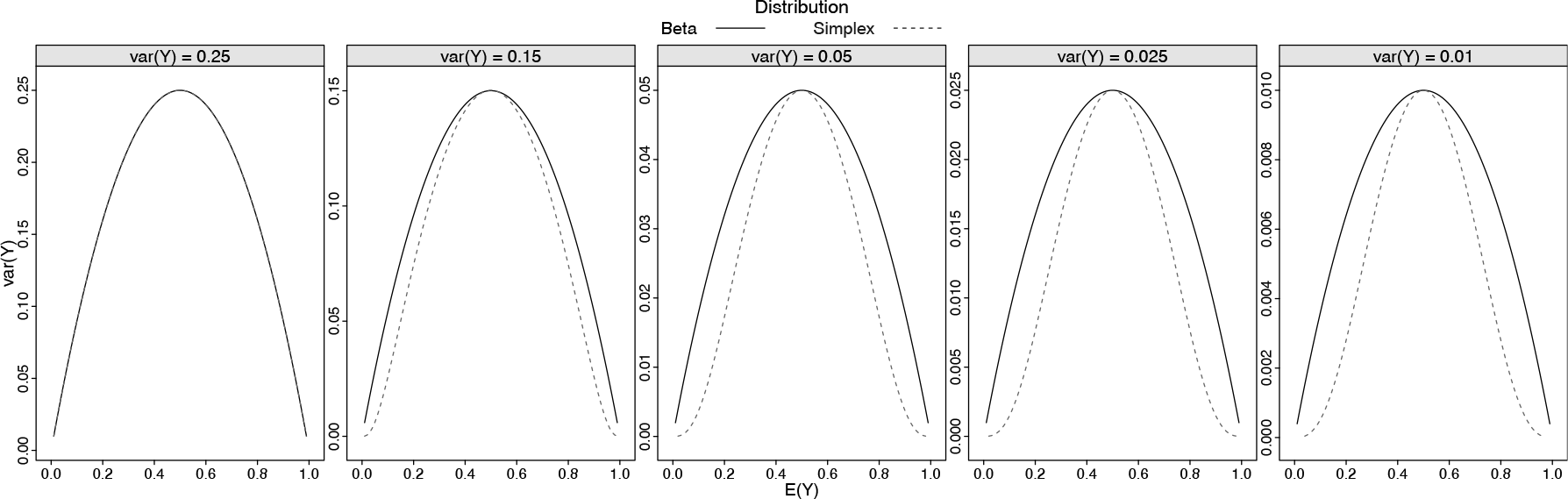
Figure 1 shows the mean and variance relationship of the simplex and beta distributions for different values of . We fixed the values of to have different levels of variance when . Thus, for and , the values of the simplex dispersion parameter were 10 00 000, 9.1500, 2.4067, 1.4651, 0.8487, while for the beta distribution the precision parameter .
Mean and variance relationship beta and simplex distributions
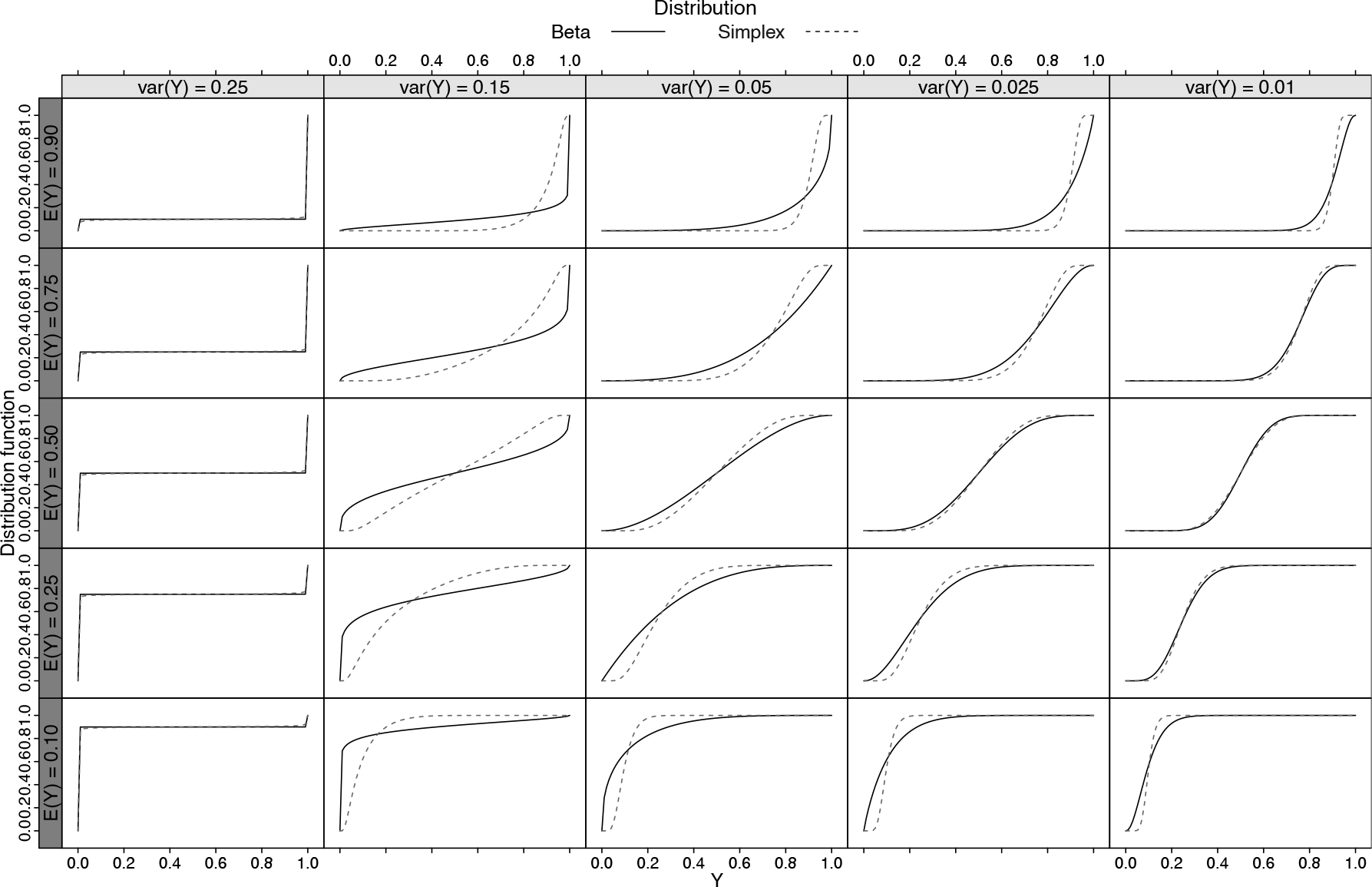
The mean and variance relationship shows that the main differences between the distribution shapes appear as moves away from . In general, the beta tails are heavier than the simplex tails. To better illustrate these differences, Figure 2 presents the cumulative probability function of the simplex and beta distributions for different values of the expectation and variance of .
Beta and simplex cumulative probability function by values of the variance (fixed for ) and expectation
The cumulative probability functions presented in Figure 2 highlight the flexibility of both distributions to deal with continuous bounded data. In the extreme case of , both distributions present virtually the same mean and variance relationship and consequently very similar cumulative probability function (i.e., Bernoulli). For smaller variances the distributions are really similar for values of the mean around , while quite different in the tails. Such results emphasize that in practice one distribution can fit better than the other for an observed dataset. Thus, a data analysis should consider both of these, or even other alternative distributions.
In spite of the differences in the mean and variance relationship between the simplex and beta distributions, such a relationship can be well modelled by a simple function of the expected values . This fact motivates us to specify a regression model by using only second-moment assumptions. Thus, consider a cross-sectional dataset, , where s are independent and identically distributed realizations of according to an unspecified distribution, whose expectation and variance are given by
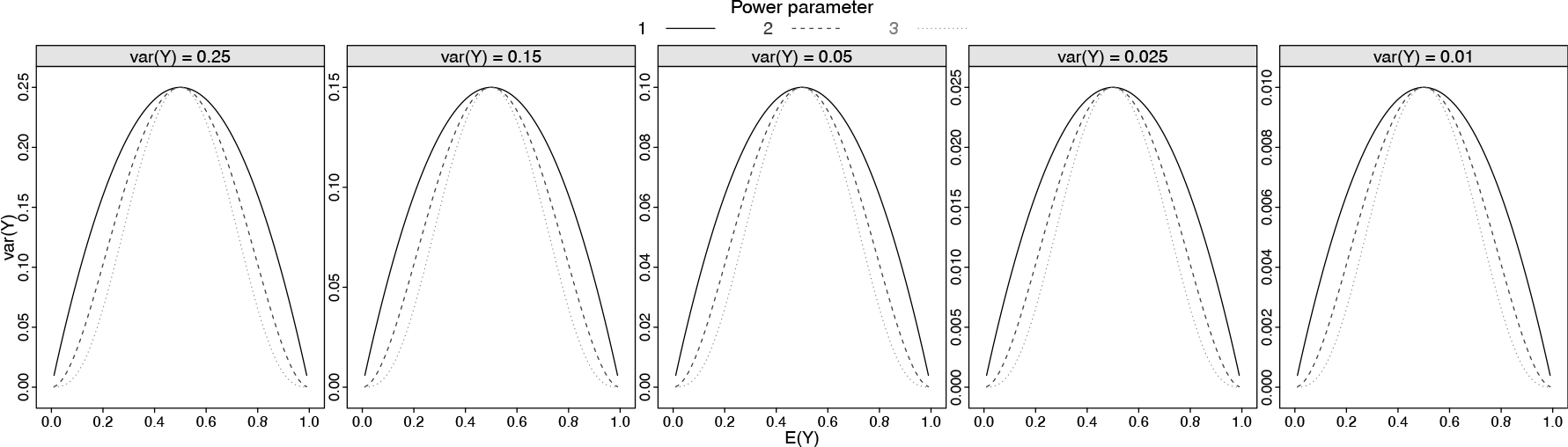
where and are () vectors of known covariates and unknown regression parameters, respectively. Moreover, is a standard link function, for which here we adopt the logit link function to give mean values in the interval , but potentially any other suitable link function could be adopted. The regression model specified in (2.3) is parametrized by , where with the usual parameter space and can mimic the mean and variance relationship of both simplex and beta models as shown in Figure 3.
Mean and variance relationship modelled by the function by values of the and power parameter
As expected for , our model corresponds to the beta regression model in a slightly different parametrization. The plots in Figure 3 show that the simplex mean and variance relationship is well approximated by using when , although there is no direct equivalence with the simplex distribution. However, in practice, any simplex or beta distributions can be the best choice for a particular dataset. Thus, the algorithm we shall present in Section 3 allows us to estimate the power parameter, which in turn works as an automatic model selection. In this sense, the model proposed in (2.3) unifies the simplex and beta regression models and provides a broader class of regression models for continuous bounded data.
Estimation and inference
In this section, we present the estimating function approach used for fitting the flexible quasi-beta regression models using terminologies and results from Jørgensen and Knudsen (2004) and Bonat and Jørgensen (2016). We adopt the quasi-score and Pearson estimating functions for estimation of the regression and dispersion parameters, respectively. The quasi-score function for is given by,
where for .
The entry of the sensitivity matrix for is given by
In a similar way, the entry of the variability matrix for is given by
The Pearson estimating functions for the dispersion parameters have the following form,
It is important to highlight that the Pearson estimating functions are unbiased estimating functions for based on the squared residuals with expected value .
The entry of the sensitivity matrix for the dispersion parameters is given by
where and denote either or . The cross entries of the sensitivity matrices and are given by
and
Finally, the joint sensitivity matrix for the parameter vector is given by
whose entries are defined by equations (3.1), (3.2), (3.3) and (3.4).
The asymptotic variance of the estimating function estimators denoted by is obtained from the inverse Godambe information matrix, whose general form for a vector parameter is , where denotes inverse transpose. The variability matrix for has the form
where and depend on the third and fourth moments of , respectively. In order to avoid this dependence on higher-order moments, we adopt the approach proposed in Bonat and Jørgensen (2016) that consists of using the empirical versions of and as given by
To solve the system of equations and , we adopted the modified chaser algorithm proposed by Jørgensen and Knudsen (2004) and implemented in a very general form in the package mcglm (Bonat, 2018) for the statistical software R. The modified chaser algorithm uses the insensitivity property (3.3), which allows us to use two separate equations to update and as follows
where is a tuning constant used to control the step-length. This algorithm was used by Bonat and Kokonendji (2017); and Bonat et al. (2017) for estimation and inference in the context of Tweedie and Poisson–Tweedie regression models, respectively. Furthermore, this algorithm is a special case of the flexible algorithm presented by Bonat and Jørgensen (2016) in the context of multivariate covariance generalized linear models.
Simulation study
In this section, we present a simulation study conducted to verify the properties of the estimating function estimators. We designed five simulation scenarios to explore the flexibility of the proposed regression model to deal with bounded data, as generated from the simplex and beta distributions. For each setting, we considered five different sample sizes, , , , and , generating datasets in each case. The dispersion parameter of the simplex distribution was fixed at the values and the corresponding precision parameter for the beta distribution at . These values correspond to when . Thus, we can explore the behaviour of the fitting algorithm as well as the properties of the estimators from an extreme and challenging () to an easy ) scenario.
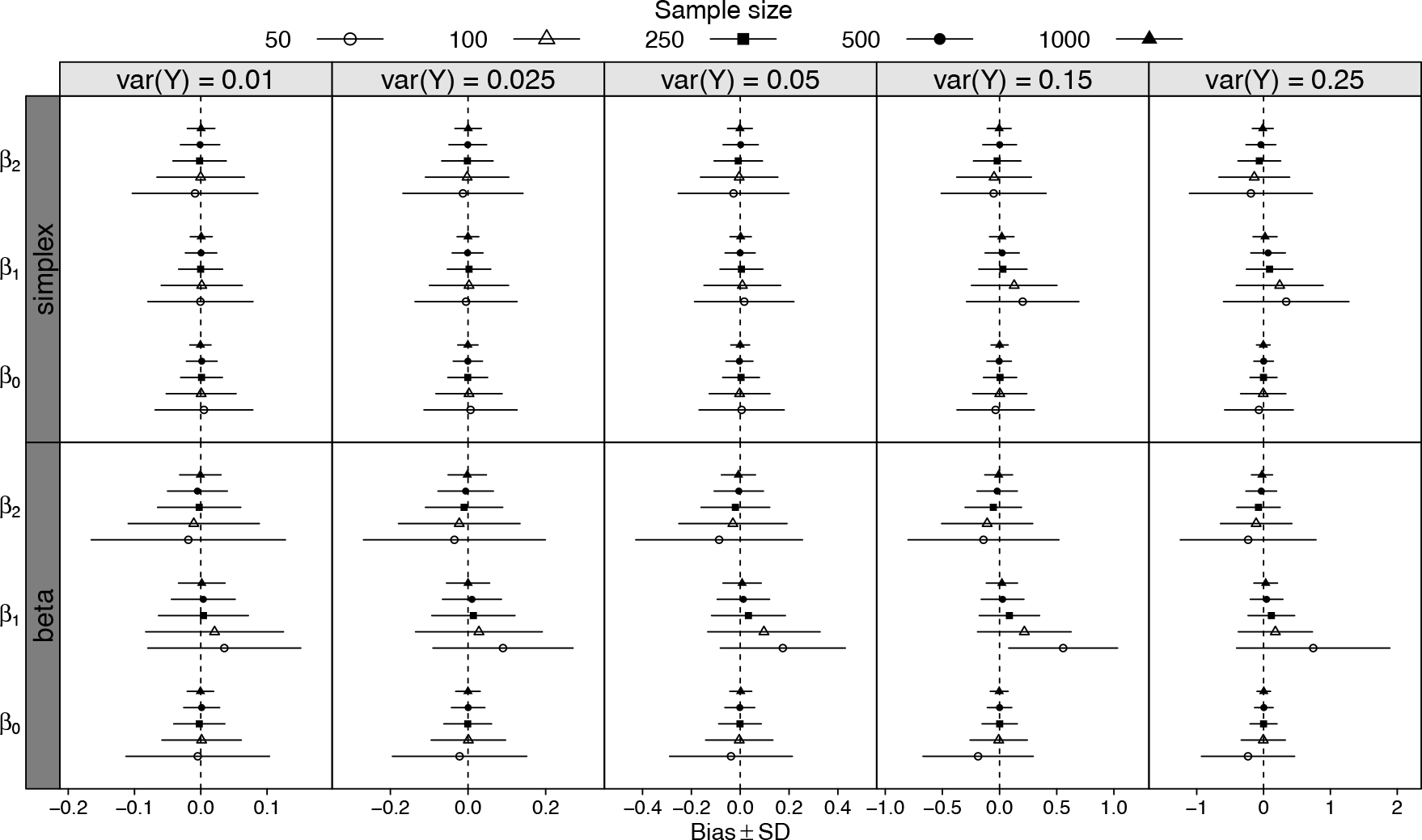
For all scenarios, we consider a standard regression model where the linear predictor is composed of a continuous and a categorical covariate. The continuous covariate was generated from a standard Gaussian distribution and the categorical covariate from a Bernoulli distribution with probability fixed at . The regression coefficients were fixed at , for the continuous covariate, and for the categorical indicator variable. Such values were chosen in order to cover the whole range of values for the expectation of the random variable, that is, the unit interval. Figure 4 shows the average bias plus and minus the average standard error for the regression parameter estimators under each scenario.
Average bias and confidence intervals by sample size and simulation scenario
The results in Figure 4 show clearly that the bias and standard error (SE) of the estimating function estimators tend to zero as the sample size increases. Thus, we can conclude that the estimating function estimators are unbiased and consistent for large samples, as expected. For small sample sizes, the results in Figure 4 show that the bias tends to increase from the easy to the challenging scenario, again as expected. In general, the biases are larger when using the beta distribution than the simplex distribution as the data generator, mainly for the parameter . Figure 5 presents the coverage rate for the individual parameter confidence intervals by sample size and simulation scenario.
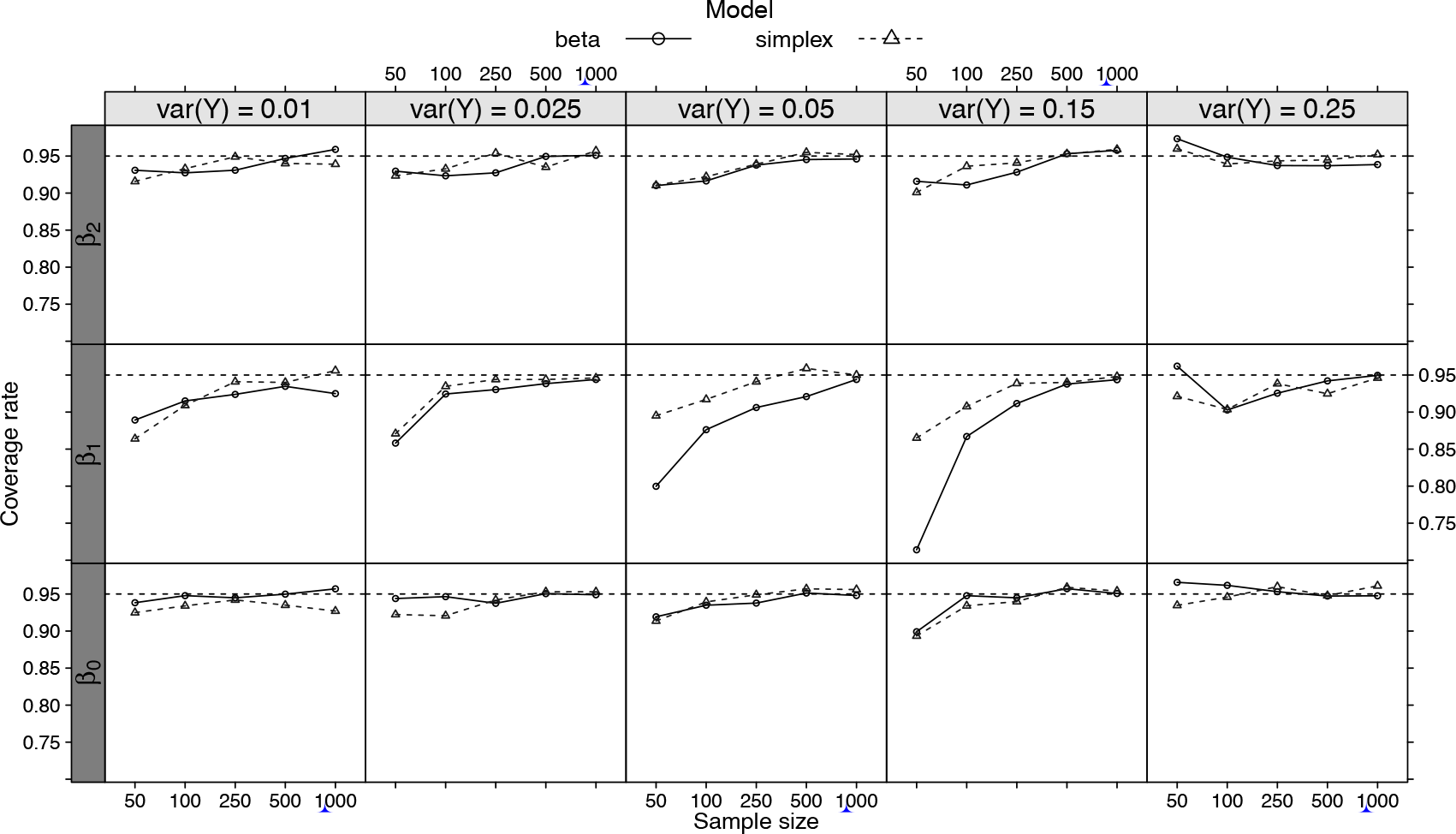
The results in Figure 5 show that the empirical coverage rates are close to the nominal level of for large samples. On the other hand, for small sample sizes and large variance scenarios the empirical coverage rate for the continuous covariate regression coefficient presented values around . This result shows that for these scenarios, the estimation of the standard errors associated with the regression coefficients is challenging and thus requires large samples for their correct estimation.
Data analyses
In this section, we illustrate the application of the flexible quasi-beta regression through the analysis of two datasets. The first dataset concerns measures of the water quality index collected at hydroelectric power plants in Paraná State, Brazil. This dataset was analysed in Bonat et al. (2015a,b, 2018) using beta and simplex mixed models. Bonat et al. (2018) showed that the simplex distribution fits better than the beta distribution to this dataset. The second dataset corresponds to observations of the stress and anxiety indices among non-clinical women in Townsville, Queensland, Australia. This dataset is part of the betaregCribari-Neto and Zeileis (2010) package and the beta distribution clearly fits better than the simplex distribution to this dataset. Thus, we have a case where the simplex fits better and another for which the beta distribution provides the better fit. Our goal is to show that the proposed model fits well for both cases. The datasets and the R scripts used for their analysis can be obtained http://www.leg.ufpr.br/doku.php/ publications:papercompanions:quasibeta.
Coverage rate for each regression parameter confidence interval by sample size and simulation scenario
Dataset 1: Water quality on power plant reservoirs
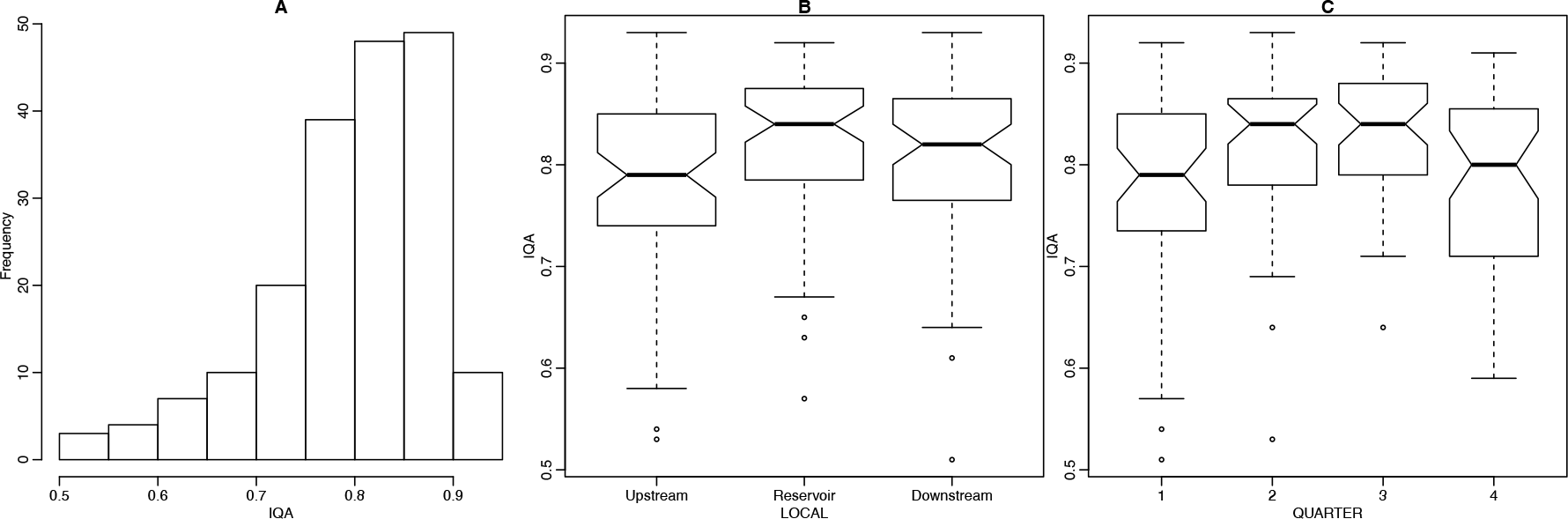
The water quality dataset corresponds to observations of the water quality index measured quarterly during at operating hydroelectric power plants in Paraná State, Brazil. The main goal of this study was to detect changes in water quality, possibly due to the presence of the dams. The water quality index was measured at locations considered affected and unaffected by the reservoir and then compared, that is, measurements taken upstream in the main river are considered unaffected reference values, whereas measurements taken at the reservoir and downstream are considered potentially affected. Thus, the main goal is to assess the effect of the covariate LOCAL, with levels upstream, reservoir and downstream, controlled for the effects of the QUARTER of data collection. In this article, for simplicity, we do not consider the possible effect of the individual power plants. The dataset has observations with measurements ( quarters locations) for each of the power plants with only two missing values. Figure 6 presents a histogram and boxplots relating the response variable to the potential covariates.
Histrogram (A) and boxplots for the LOCAL(B) and QUARTER(C) for the water quality index (IQA)
Figure 6(A) shows a left asymmetry in the marginal distribution, while Figure 6(B) suggests that upstream observations present smaller values than reservoir and downstream. Furthermore, Figure 6(C) indicates that the water quality index presents smaller values on the first and fourth quarters (warmer periods).
We fitted the flexible quasi-beta regression model to the water quality dataset using a logit link function. The linear predictor is composed of the LOCAL and QUARTER covariates, that is,
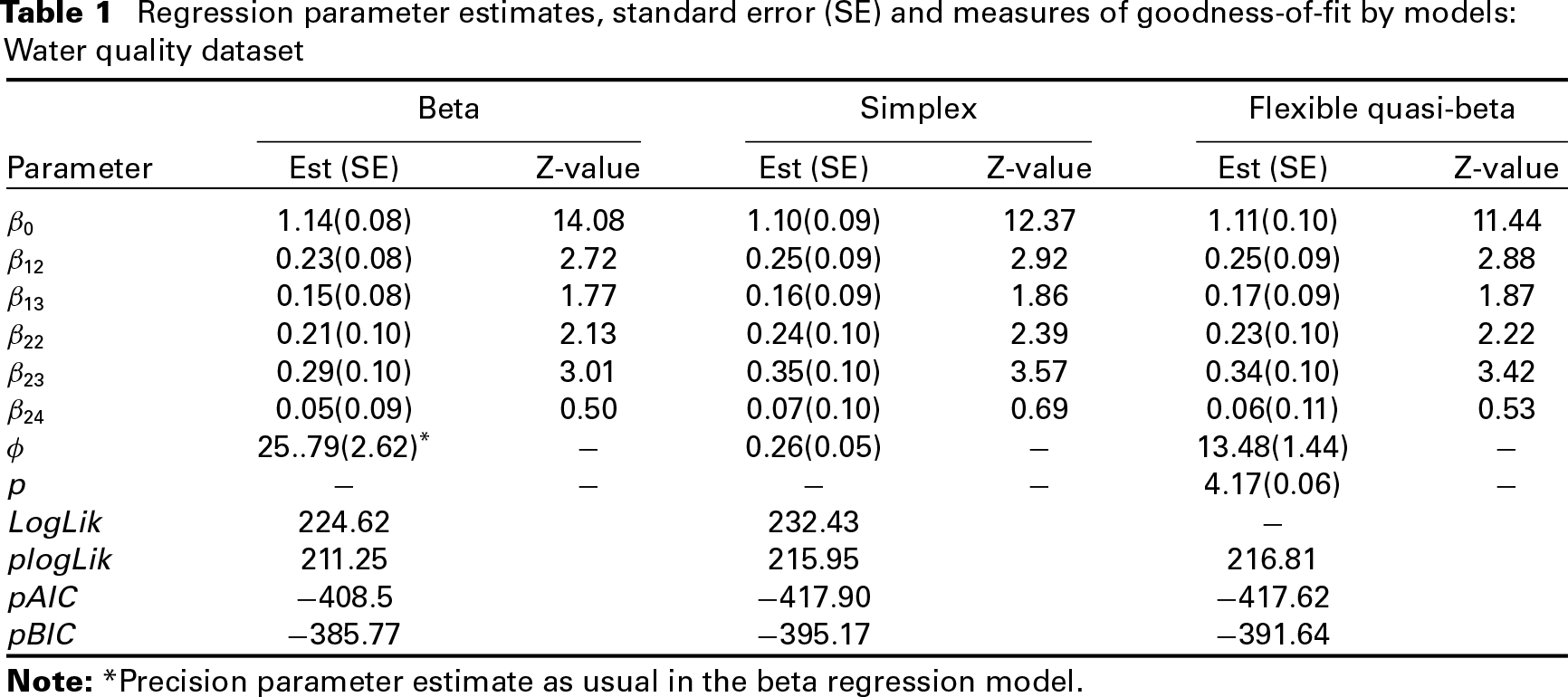
where is the usual intercept, and , for , measures the changes from upstream to reservoir and downstream, respectively. Similarly, , for and , quantifies the changes from quarter to up to , respectively. Table 1 shows the parameter estimates for the beta, simplex and the flexible quasi-beta regression models along with the maximized log-likelihood (beta and simplex) and pseudo-Gaussian log-likelihood values Bonat et al. (2018) and the associated pseudo Akaike and Bayesian information criteria.
Regression parameter estimates, standard error (SE) and measures of goodness-of-fit by models: Water quality dataset
Beta
Simplex
Flexible quasi-beta
Parameter
Est (SE)
Z-value
Est (SE)
Z-value
Est (SE)
Z-value
*
Note: *Precision parameter estimate as usual in the beta regression model.
The results presented in Table 1 show a large difference in terms of log-likelihood values in favour of the simplex regression model. In spite of such a large difference, both models provide very similar regression estimates and standard errors, leading to identical interpretations. Similarly, the pseudo log-likelihood, Akaike and Bayesian information criterion indicates that the simplex model provides a better fit than the beta model. The flexible quasi-beta model presents regression estimates and standard errors similar to both simplex and beta regression models. The power parameter estimate was showing that probably the beta distribution () is not the best choice for this water quality dataset. This result agrees with the log-likelihood criterion. Furthermore, the pseudo log-likelihood criterion indicates that the flexible quasi-beta model provides an even better fit than the simplex model. Such a result is expected, since the proposed model has a more flexible mean and variance relationship than the beta and simplex regression models and consequently can mimic the fit of the other two models. Note that, the use of information criterion to compare the quasi-beta with the beta and simplex models can be misleading because we have one more parameter in the flexible quasi-beta that is fixed when fitting the beta and simplex regression models.
Dataset 2: Stress anxiety dataset
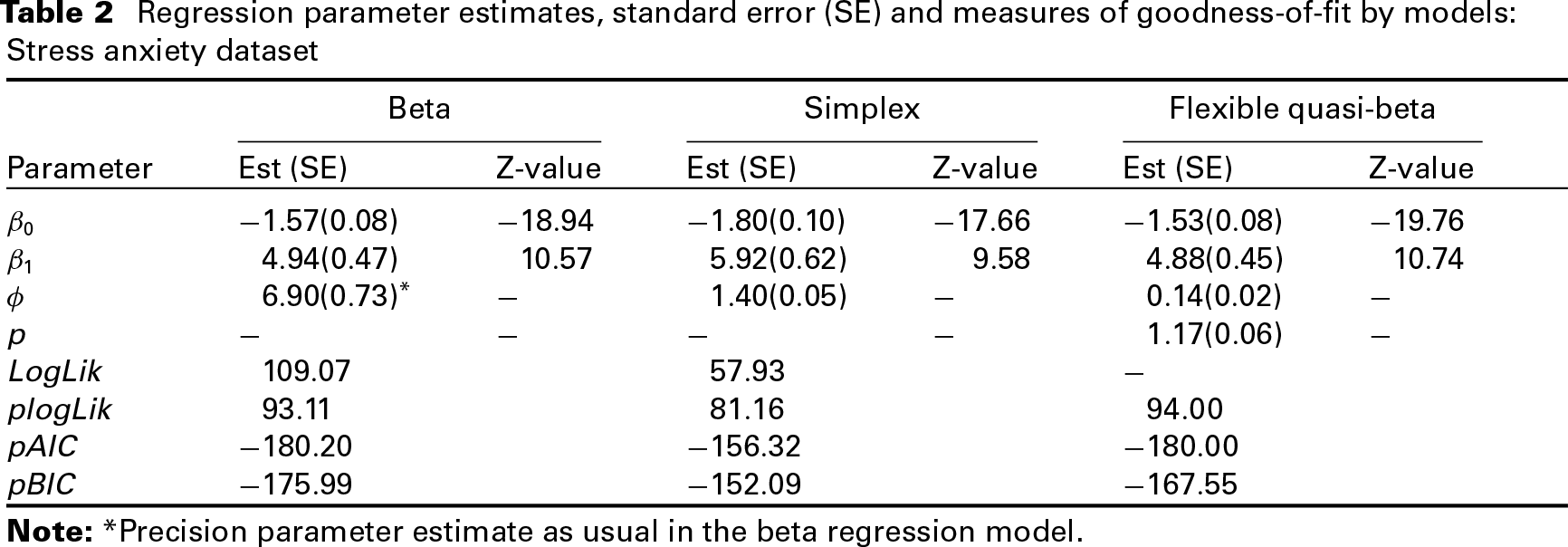
The second dataset concerns an experiment conducted to assess the relationship between stress and anxiety. Both variables were assessed through the Depression Anxiety Stress Scales, with scores ranging from to . Subsequently, they were linearly transformed to the open unit interval, for details see Smithson and Verkuilen (2006). The main goal of the analysis is to assess the effect of the anxiety score on the response variable stress score. We fitted the beta, simplex and flexible quasi-beta regression models, where the linear predictor is composed of an intercept and the effect of the covariate anxiety score , again using the standard logit link function. Table 2 shows the parameter estimates for the beta, simplex and the flexible quasi-beta regression models along with the maximized log-likelihood (beta and simplex) and pseudo-Gaussian log-likelihood values and the associated pseudo Akaike and Bayesian information criteria.
Regression parameter estimates, standard error (SE) and measures of goodness-of-fit by models: Stress anxiety dataset
Beta
Simplex
Flexible quasi-beta
Parameter
Est (SE)
Z-value
Est (SE)
Z-value
Est (SE)
Z-value
*
Note: *Precision parameter estimate as usual in the beta regression model.
Based on the log-likelihood criterion, the beta regression model provides a better fit than the simplex model for this stress anxiety dataset. The regression coefficient associated with the covariate anxiety score is approximately larger when fitting the simplex model. The pseudo log-likelihood criterion agrees with the log-likelihood criterion showing the better fit of the beta model. The fit of the flexible quasi-beta regression model also suggests that the beta regression is a suitable choice for this dataset. The estimated value of the power parameter indicates a mean and variance relationship close to that of the beta distribution. The regression coefficient obtained based on the beta and flexible quasi-beta regression models are quite similar. Finally, the pseudo log-likelihood criterion also indicates that the beta and the flexible quasi-beta regression models provide a very similar fit.
Discussion
We described a new class of regression models to deal with continuous bounded data. Our approach is based on second-moment assumptions, where we extend the beta mean and variance relationship by the inclusion of an additional power parameter. Thus, the flexible quasi-beta regression model can automatically adapt to the unknown underlying bounded data distribution by the estimation of this power parameter. Furthermore, the second-moment assumptions allow us to use an estimating functions approach for parameter estimation and inference. The main technical advantage of the proposed models is the simplicity of the fitting algorithm, which amounts to finding the root of a set of non-linear equations.
We designed five simulation scenarios to explore and show the performance of our fitting algorithm. The simulation scenarios range from very easy to extreme and challenging scenarios. It is important to highlight that in the last scenario, the simulated values are numerically s and s only. Thus, standard implementations of the beta and simplex regression models fail for fitting the model in this case. On the other hand, the flexible quasi-beta regression model and the associated estimating function approach proposed for model fitting delivered approximately unbiased and consistent estimates for all simulation scenarios even for small sample sizes. Furthermore, the coverage rate of the obtained confidence intervals presented values close to the nominal level of for large samples.
We illustrated the application of the flexible quasi-beta regression models through the analysis of two datasets. The datasets were chosen to show a situation where the simplex regression model is better than the beta regression model and vice-versa. In the data analyses, the pseudo log-likelihood criterion assists us to indicate that the flexible quasi-beta regression model, proposed in this article, automatically adapted to the underlying data distribution, and in turn provides more reliable results even when the data distribution is unknown.
The basic model discussed in this article can be extended in many ways, including incorporating penalized splines and the use of regularization for high dimensional data, with important applications in covariate selection. We plan to develop improved methods for model checking, such as residual analysis, leverage and outlier detection. Finally, we can extend the model to deal with multiple bounded response variables, with important applications for the analysis of longitudinal and spatial data. These extensions will form the basis of future work.
Declaration of conflicting interests
The authors declared no potential conflicts of interest with respect to the research, authorship and/or publication of this article.
Funding
The last author was partially supported by CNPq, a Brazilian science funding agency.
Supplementary material
Supplementary material is available at: http://www.leg.ufpr.br/doku.php/publications:papercompanions:quasibeta
References
1.
Abdel-FattahMAEl-SheikhAAMousaAM (2016) A gamma regression for bounded continuous variables.Advances and Applications in Statistics,49,305–26.
2.
BonatWH (2018) Multiple response regression models in R: The mcglm package.Journal of Statistical Software,85,1–30.
3.
BonatWHJrgensenB (2016) Multivariate covariance generalized linear models. Journal of the Royal Statistical Society: Series C (Applied Statistics), 65, 649–75.
4.
BonatWHJrgensenBKokonendjiCCHindeJDemtrioCGB (2017) Extended Poisson-Tweedie: Properties and regression models for count data.Statistical Modelling,87,2138–52.
5.
BonatWHKokonendjiCC (2017) Flexible Tweedie regression models for continuous data.Journal of Statistical Computation and Simulation,87,2138–52.
6.
BonatWHLopesJERibeiroJr PJShimakuraSE (2018) Likelihood analysis for a class of simplex mixed models.Chilean Journal of Statistics. Accepted.
7.
BonatWHRibeiroJr PJShimakuraSE (2015a) Bayesian analysis for a class of beta mixed models.Chilean Journal of Statistics,6,3–13.
8.
BonatWHRibeiroJr PJZevianiWM (2012) Regression models with response on the unit interval: Specification, estimation and comparison. Biometric Brazilian Journal,30,415–31.
9.
BonatW. H.Ribeiro JrP. J.ZevianiW. M.(2015b) Likelihood analysis for a class of beta mixed models.Journal of Applied Statistics42,252–66.
10.
CepedaE (2001) Variability modeling in generalized linear models.PhD thesis, Mathematics Institute, Universidade Federal do Rio de Janeiro, Rio de Janeiro.
11.
CepedaEGamermanD (2005) Bayesian methodology for modeling parameters in the two parameter exponential family.Estadstica,57,93–105.
12.
Cribari-NetoFZeileisA (2010) Beta regression in R.Journal of Statistical Software,34,1–24.
13.
da SilvaCQMigonHSCorreiaL (2011) Dynamic Bayesian beta models. Computational Statistics and Data Analysis,55,2074–89.
14.
EspinheiraPLFerrariSLPCribari-NetoF (2008a) On beta regression residuals.Journal of Applied Statistics,35,407–19.
15.
EspinheiraP.L.FerrariS. L. P.Cribari-NetoF. (2008b) Influence diagnostics in beta regression.Computational Statistics and Data Analysis,52,4417–31.
16.
FerrariSCribari-NetoF (2004) Beta regression for modelling rates and proportions.Journal of Applied Statistics,31,799–815.
17.
Figueroa-ZigaJIArellano-ValleRBFerrariSLP (2013) Mixed beta regression: A Bayesian perspective.Computational Statistics and Data Analysis,61,137–47.
18.
GodambeVPThompsonM (1978) Some aspects of the theory of estimating equations.Journal of Statistical Planning and Inference,2,95–104.
19.
GrunwaldGKRafteryAEGuttorpP (1993) Time series of continuous proportions.Journal of the Royal Statistical Society, Series B,55,103–16.
20.
JørgensenB (1997) The Theory of Dispersion Models. London:Chapman and Hall.
21.
JørgensenBKnudsenSJ (2004) Parameter orthogonality and bias adjustment for estimating functions.Scandinavian Journal of Statistics,31,93–114.
22.
KieschnickRMcCulloughBD (2003) Regression analysis of variates observed on (0; 1): Percentages, proportions and fractions.Statistical Modelling,3,193–213.
23.
KotzSvan DorpJR (2004).Beyond Beta: Other Continuous Families of Distributions with Bounded Support and Applications. Singapore:World Scientific Press.
24.
LemonteAJBaznJL (2016) New class of Johnson SB distributions and its associated regression model for rates and proportions.Biometrical Journal,58,727–46.
25.
McKenzieE (1985) An autoregressive process for beta random variables.Management Science,31,988–97.
26.
MitnikPABaekS (2013) The Kumaraswamy distribution: Median-dispersion re-parameterizations for regression modeling and simulation-based estimation.Statistical Papers,54,177–92.
27.
NelderJAWedderburnRWM (1972) Generalized linear models. Journal of the Royal Statistical Society, Series A,135,370–84.
28.
PaolinoP (2001) Maximum likelihood estimation of models with beta-distributed dependent variables.Political Analysis, 9,325–46.
29.
QiuZSongPX-KTanM (2008) Simplex mixed-effects models for longitudinal proportional data.Scandinavian Journal of Statistics,35,577–96.
30.
R Development Core Team (2017)]: A Language and Environment for Statistical Computing.Vienna: R Foundation for Statistical Computing.
31.
RochaAVCribari-NetoF (2008) Beta autoregressive moving average models. Test,18,529–45.
32.
RochaASimasA (2011) Influence diagnostics in a general class of beta regression models.Test,20,95–119.
33.
SimasAB,Barreto-SouzaWRochaAV (2010) Improved estimators for a general class of beta regression models.Computational Statistics and Data Analysis,54,348–66.
34.
SmithsonMVerkuilenJ (2006) A better lemon squeezer? Maximum-likelihood regression with beta-distributed dependent variables.Psychological Methods,11,54–71.
35.
SongPX-KQiuZTanM (2004) Modelling heterogeneous dispersion in marginal models for longitudinal proportional data.Biometrical Journal,46,540–53.
36.
SongPX-KTanM (2000) Marginal models for longitudinal continuous proportional data. Biometrics,56,496–502.
37.
VerkuilenJSmithsonM (2012) Mixed and mixture regression models for continuous bounded responses using the beta distribution.Journal of Educational and Behavioral Statistics,37,82–113.
38.
WedderburnRWM (1974) Quasi-likelihood functions, generalized linear models, and the Gauss-Newton method. Biometrika,61,439–47.
39.
ZhangPQiuZShiC (2016) simplexreg: An R package for regression analysis of proportional data using the simplex distribution. Journal of Statistical Software,71,1–21.