






Abstract
Introduction
In 1873 Sir James Paget described the development of the pressure sore remarkably well, this description still being quite accurate today (Paget, 1873). Pressure sores have probably existed since the dawn of our infirm species. Thompson Rowling described pressure sores in exhumed Egyptian mummies in 1961 (Thompson, 1961), and scientific writings have addressed this issue since the early 1800s. Pressure sores continue to be a ubiquitous problem within our society. Bedsores are an inseparable aspect of the process of severe, prolonged diseases in almost all hospital departments, nursing homes and home care. Pressure ulcers are well known to all individuals who deal with bedridden patients suffering from protracted illnesses, and they appear to be a natural progression of acute diseases, e.g. advanced stage of Alzheimer's disease and life's end (Aminoff, 2007a).
Some older persons develop high-grade decubitus ulcers, whereas others with comparable risk factors do not (Pueschel, Heinemann, Krause, Anders, & von Renteln-Kruse, 2005). Annually in the United Kingdom, approximately 412,000 individuals develop a new pressure ulcer (Bennett, Dealey, & Posnett, 2004). Sixty percent of pressure ulcers occur in patients admitted to hospital. In United States acute care facilities alone, an estimated 2.5 million pressure ulcers are treated each year (Staas & Cioschi, 1991).
The prevalence of pressure sores in hospitalized patients has increased from 14% to 21% over the last decade. The cost of healing a single full-thickness pressure sore may be as high as US$ 70,000 (Gallagher, 1997). The overall annual expenditure has recently been estimated to be between US$ 5 billion and 8.5 billion (Fogerty et al., 2008), with the cost of hospital-acquired pressure ulcers between US$ 2.2 and 3.6 billion (Whittington & Briones, 2004).
Decubitus ulcers are invariably secondary to an underlying medical condition. They cause suffering in patients and overtax nursing time (Andersen & Kyorning, 2008). Decubitus ulcers are slow healing: in many cases they stagnate and cannot be cured (Anthony, 2008). There is a disparity between the high prevalence and costs associated with pressure ulcers and the quantity of good-quality research focused on their prevention (Reddy, Gill, & Rochon, 2006).
Decubitus ulcers are one of the items of the Mini-Suffering State Examination (MSSE), which was developed for the assessment of suffering level in end-stage Alzheimer's disease (Aminoff, Purits, Noy, & Adunsky, 2004). The purpose of this study was to evaluate the influence of decubitus ulcers on the development of Aminoff suffering syndrome (ASS) in end-stage dementia (ESD).
The correlation of high MSSE scores with shorter survival periods (Aminoff & Adunsky, 2006) and irreversible and intractable aggravation of suffering and medical condition until demise (Aminoff & Adunsky, 2004) has been defined as a new pathological entity in ESD, that is, ASS (Aminoff, 2006, 2008a).
As a result of research and clinical experience, it is possible that measurement of patient suffering by way of the MSSE scale and diagnosis of ASS could serve as a key criterion for screening in general hospital wards, nursing homes and the community, for those ESD patients with high levels of suffering, existing pressure ulcers and shorter survival time (Aminoff, 2008b).
Mini-Suffering State Examination
The recently developed MSSE scale (Aminoff et al., 2004) is the first objective clinical tool for evaluation of suffering level in ESD. The MSSE scale is available in English, Hebrew and Dutch, and the translation and validation of a Spanish version is in progress.
The MSSE scale comprises 10 items relating to the patients’ characteristics, as well as the perception of their condition by medical staff and families. Each item scores 0 (no) or 1 (yes). The total score ranges between 0 and 10, with higher scores reflecting elevated degrees of suffering levels. Based on clinical experience, the following items were included in the MSSE: not calm, screams, pain, decubitus ulcers, malnutrition, eating disorders, invasive action, unstable medical condition, suffering according to medical opinion and suffering according to family opinion.
The MSSE is brief and it takes the physician or nurse less than 10 minutes to evaluate the suffering level of a patient. The significant reliability of the MSSE scale was demonstrated by the Cronbach-α model (0.798). Concurrent validity of the MSSE scale was proven by Pearson correlation with the Symptom Management with End-of-Life in Dementia (SM–EOLD) scale (r = 0.574, P < 0.0001), and the Comfort Assessment in Dying with Dementia (CAD–EOLD) scale (Volicer, Hurley, & Blasi, 2001) (r = –0.796, P < 0.0001).
Materials and methods
All ESD patients admitted to our centre over a 36-month period were studied. Diagnosis was based upon the Diagnostic and Statistical Manual of Mental Disorder (DSM)-4 revised criteria for dementia (American Psychiatric Association, 1994). The inclusion criteria were severe dementia, interference in verbal communication (Mini-Mental State Examination Score 0/30) (Folstein, Folstein, & McHugh, 1975) and complete dependency in activities of daily living and functional movement (Functional Independence Measure 18/126) (Granger & Hamilton, 1992).
General characteristics of the study population upon admission

PEG: percutaneous endoscopic gastrostomy, NGT: nasogastric tube, WBC: white blood cells, TLC: total lymphocyte count, BMI: body mass index.
The MSSE scores have been previously divided into three categories: low (0–3), intermediate (4–6) and high (7–10) (Aminoff et al., 2004). This classification has been shown to represent distinct subgroups, with significant differences among them, which have been tested for validity and reliability.
Upon admission to the department, all study participants were evaluated by the MSSE scale. Decubitus ulcers were reported on the day of admission to the Geriatric Department (stages 1–4). In addition, data relevant to the medical condition were recorded, that is, vital blood laboratory results (total protein, albumin, cholesterol, haemoglobin, white leukocyte cells count [WBC], total lymphocyte count [TLC]), body mass index (BMI) and use of dementia-related medications, such as narcotics, antipsychotic (Risperidone, Haloperidol, Trioridazine, Sulpiride and others), antidepressants and analgesics. The study protocol was approved by the local Institutional Review Board.
Statistical analysis
Comparison between the two groups of patients (with versus without decubitus ulcers) regarding demographic parameters (age, gender), clinical parameters (fever, haemoglobin, WBC, TLC, cholesterol, use of antibiotics and infusions, among others) and each of the MSSE scale items (not calm, screams and so forth) was performed using the t-test for independent samples and chi-square or Fisher's exact test.
Survival functions for the six-month follow-up were evaluated by the Kaplan–Meier method. The Log-Rank, Breslow and Tarone–Ware tests were used to compare survival functions between the two groups. The SPSS for Windows software, version 13.0, was used for the analysis.
Results
Correlation between items (%) of the Mini-Suffering State Examination (MSSE) of end-stage dementia (ESD) patients with and without decubitus ulcers on the day of admission to the Geriatric Department
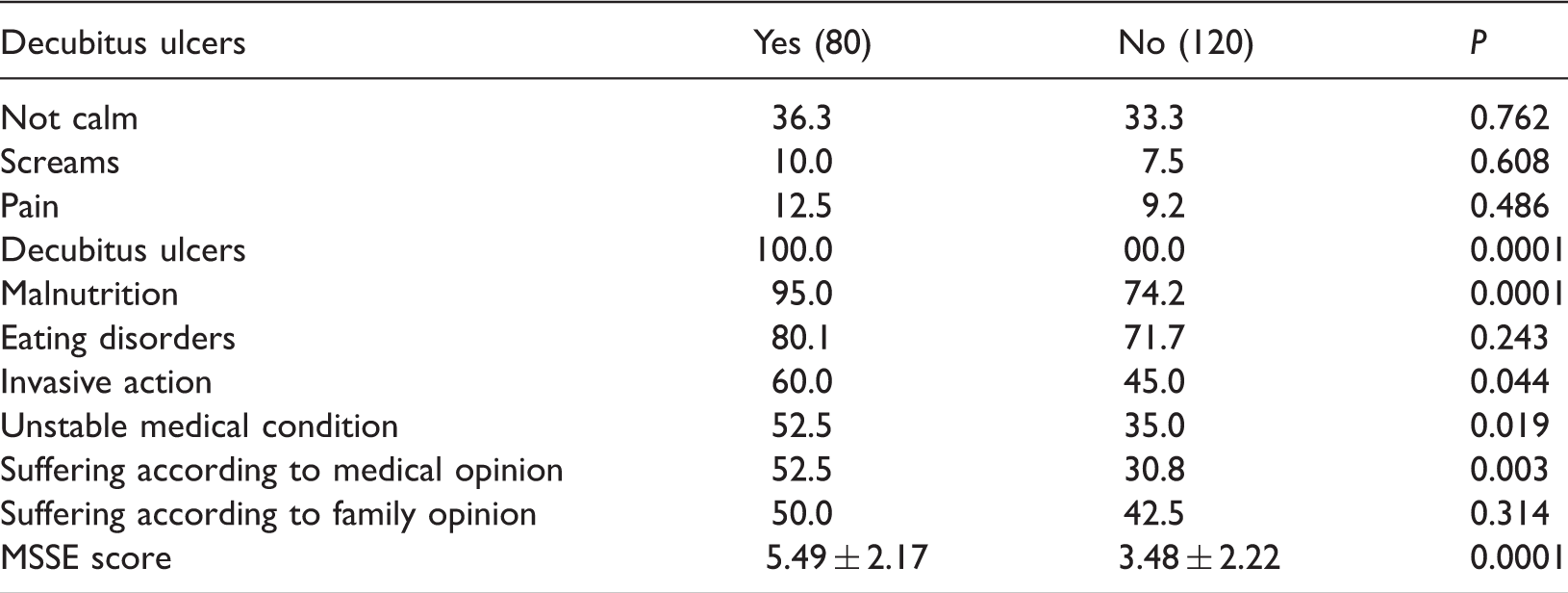
More ESD patients with decubitus ulcers suffered from malnutrition, with lower levels of albumin (P < 0.0001), cholesterol (P < 0.0001) and haemoglobin (P < 0.0001). These patients underwent additional invasive actions (P < 0.044) and more percutaneous endoscopic gastrostomies (P < 0.017), and their medical condition was more unstable (P < 0.019) than those without decubitus ulcers.
Decubitus ulcers were more prevalent among males than females (P < 0.009). ESD patients with decubitus ulcers received more analgesics (P < 0.032) and infusions (P < 0.049). A greater number of these patients had a fever (P < 0.002) and were recorded to be suffering according to medical opinion (P < 0.003).
No significant differences were found between the two groups of patients, as evaluated by some items of the MSSE: not calm screams, pain, eating disorders and family opinion regarding patient's suffering on day of admission to the Geriatric Department.
In addition, no statistically significant differences were recorded on the day of admission between the two groups regarding age, laboratory analysis (WBC, TLC, total protein), BMI, existence of nasogastric tube, use of narcotics, antipsychotic, hypnotics, antibiotics and those who had had their hands tied.
The difference between a six-month survival function analysis of ESD patients with and without decubitus ulcers was statistically significant (Kaplan–Meier Analysis, Log Rank (Mantel–Cox) P = 0.0001; Breslow (Generalized Wilcoxon) P = 0.0001; Tarone–Ware P = 0.0001 (Figure 1).
Kaplan–Meier curves: six-month survival of end-stage dementia (ESD) patients with and without decubitus ulcers.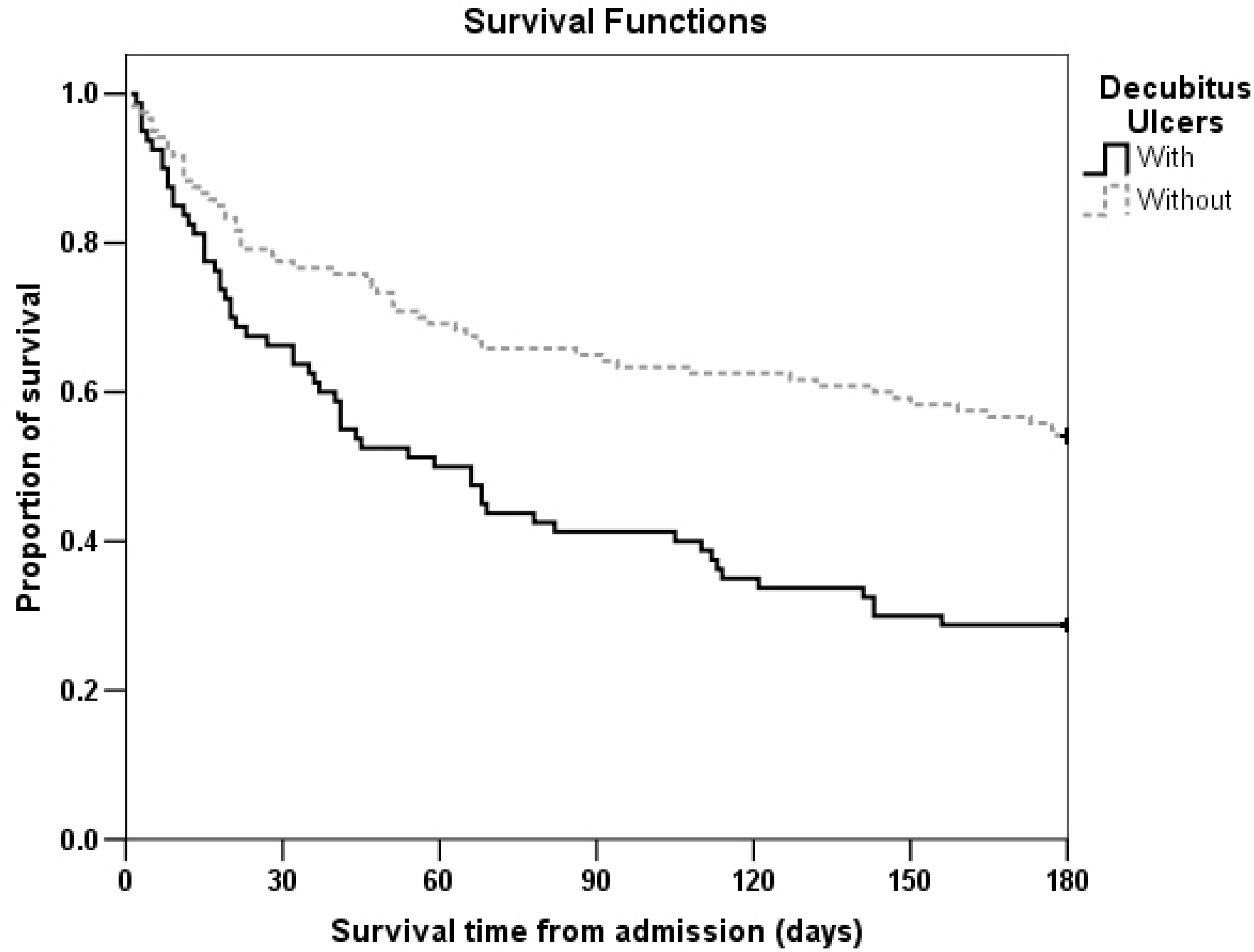
Six months’ mortality of ESD patients suffering from decubitus ulcers was 71.2% (57/80) versus 45.8% (55/120) ESD patients who had not bedsores (P < 0.0001).
Discussion
Dementia is an age-related, progressive, neurodegenerative disorder affecting about 5% of the world's population and this figure is expected to increase gradually in the future, keeping in view our ageing society.
Alzheimer's disease is the seventh leading cause of all deaths in the United States and the fifth leading cause of death in Americans older than 65 years of age. More than five million Americans are estimated to have Alzheimer's disease (Alzheimer's Association, 2008).
ESD patients are in a state of complete helplessness, confined to wheelchairs and bedridden, with bowel and bladder incontinence, feeding tubes, malnutrition, dreadful decubitus ulcers and immeasurable suffering that may persist for months or years. At this stage the illness is defined as terminal, despite an extended life expectancy. Thus, the life of end-stage patients with dementia is filled with grief, secretion and stench, suppuration and wounds, crying, screaming or silent pain.
Results of our study showed the irreversible aggravation of the medical condition of ESD patients with decubitus ulcers who had a high MSSE score on admission to the Geriatric Department. The six-month mortality rate is high and accounts for more than 70%. The example of existence of unstable medical conditions, invasive procedures, severe malnutrition, eating disorders, decubitus ulcers and high suffering level has been defined as a new pathological entity in ESD, that is, ASS.
Decubitus ulcers have been shown to cause pain (Dallam, L., Smyth, C., Jackson, B. C., Krinsky, R., O’Dell, C., Rooney, J., Badillo, C., Amelia, E., Ferrara, L., Freeman, K., 1995). Of the 417 articles reviewed, six specifically identified pain prevalence among dementia patients with bedsores (ranging from 37% to 100%) (Girouard, Harrison, & VanDenKerkof, 2008). Eight of the nine patients with advanced dementia, videotaped during dressing changes of similar decubitus ulcers, consistently demonstrated facial expressions that were identified by observers as indicative of pain. During a videotape segment showing a dressing change, 14/18 viewer did not easily recognize the presence of pain in the only patient receiving opioids (Manfredi, Breuer, Meier, & Libow, 2003).
The debridement and local care of wounds are a direct cause of pain. Indirect suffering and misery as a result of deterioration in state of health, laboratory tests, liquid infusions, recurring sepsis, osteomyelitis and prolonged antibiotic treatments may eventuate in a slow and cruel death (Aminoff, 2007a).
When a decubitus ulcer develops, the defence is that the patients' problems are multiple: they require special nursing, are unable to function, lack lucidity, suffer from malnutrition, anaemia, are either under- or overweight, their condition is serious, they are too old and are in a state of dementia. All these tribulations are realistic. Because of high-risk factors for bedsores, every ESD patient should be examined daily to establish whether there is any danger of development of a pressure ulcer.
High risk does not necessarily mean that bedsores will, in fact, develop. This implies that the attitude towards the patient should be changed, to prevent these decubitus ulcers.
Irrespective of caregiver pretexts, certain preventive measures can be taken to avoid decubitus ulcers. The question then arises as to who is responsible for patients in this condition, a state in which any complication can endanger their lives. Is it the nurses who tend the patient with a bedsore?
It is important that physicians recognize that patients with complicated medical conditions may be at higher risk for pressure ulcers (Margolis, Knauss, Bilker, & Baumgarten, 2003). The treatment of a bedsore should be the responsibility of a physician. This implies that the physician should provide a written report, treat and be responsible for exacerbation of every bedsore.
An additional question arises – are the horrific cases frequently perceived in hospitals, such as giant necrotic bed sores exacerbated by gangrene, abscesses, excretions, osteomyelitis, infections and sepsis and intractable suffering, considered to be the result of medical negligence? In our opinion, the answer is in the affirmative, despite the fact that there is no real proof that medical and professional nursing can prevent each individual patient from deteriorating to such a poor state of health.
Clinical experience in the department, where efforts are constantly being made to prevent bedsores, has shown that the staff could be successful. A bedsore can develop within a few hours and this should be a warning signal to all attending staff and families. The manifestation of the first bedsore means that there has been a fluctuation in the patient's medical condition. The status of such a patient should immediately be changed from that of a regular, to an emergency case.
At this point it is still uncertain whether the patient needs to be in a Relief of Suffering Unit, which includes intensive medical and nursing care (Aminoff, 2007b, 2009). For example, adequate nutritional support is a strong predictor of pressure ulcer healing (Bergstrom, N., Horn, D. S., Smout, J.R., Bender, A.S., Ferguson, L.M., Taler, G., Sauer, S.A., Sharkey, S.S., Voss, A.C., 2005).
Anyone who has seen a living, naked patient with several bedsores, who is also mortified with gangrene, excretions, perspiration, stench and pus, will concur that no medical conditions exist that affect self-respect and humiliation of a human being more than such a form of degradation.
Patients, of course, are not aware of their poor state of health. The medical and nursing staff considers this to be a natural process of an end-stage illness and advanced age. Due to lack of an alternative, some family members also accept this situation. Other members conduct an obstinate justifiable struggle, but unfortunately to no avail, as there is no definite official forum to which their struggles can be addressed.
The attitude of the world beyond the confines of the hospital, educated individuals, the media and society as a whole, that is, all who are aware of the horrors of wars, violence, road accidents and disasters, pay no heed to the real and horrific suffering of ESD patients with decubitus ulcers.
The fight against bedsores and suffering of patients should be an active one, not only by medical and nursing staff, but also by the families and the entire community. All should be involved in striving to improve the overall situation and approach to patients suffering from decubitus ulcers, and be made aware of current practices in hospitals and the community at large.
It is remarkable how physicians invest energy, effort and knowledge in cardiac surgery, orthopaedics, urology, expensive equipment, increased staff and expensive drugs. Complications, such as the development of decubitus ulcers, occur due to inadequate diagnostic skills, lack of timely prevention and treatment. This is such an unnecessary waste of time, energy and money, and more importantly, leads to the suffering of the patient.
There are many physicians who lose sleep because of an unsuccessful operation. Our question is: how many physicians lose sleep because the operation was successful, but the patient developed bedsores and consequently died?