







Abstract
The paper explores the important role of relatives in designing assistive technologies in collaboration with practitioners. A brief case study reports the collaborative design of a 24-hour clock to reduce the impact of visual–spatial impairment on a family member's ability to read time and prevent temporal disorientation.
Introduction
Cognitive impairment secondary to neurological illness or injury is one of the factors very often associated with persons’ reduced ability to engage in everyday functional activities. One of the most common non-pharmacological approaches used in dementia care to try and reduce the impact of cognitive impairment on everyday life, is compensatory strategies or technologies. However, using some of these ‘off the shelf’ approaches may in some individual situations have limited ecological validity or sometimes even acceptability for the person with dementia and their family. Furthermore, often limited information is available to families and care agencies regarding these technologies, including provision and cost (Gibson et al., 2016).
Assistive technologies function to reduce the impact of impairment, thereby reducing disability. An example of an assistive technology used in dementia care was described by Jentoft, Holthe, and Arntzen (2014). These authors reported the findings from a qualitative study with eight participants, where a simplified remote control for television appeared to have high acceptability and good ecological validity (Jentoft et al., 2014). Other technologies available to persons with dementia include adapted telephones, voice recorders, large face clocks, simple pill dispensers, room signage, boil alerts for kettles and basin plugs to automatically drain overflowing sinks, among many others (Gibson et al., 2016).
Engaging and supporting family members who care for persons with dementia is of considerable importance (Moriarty, 2012). A recent review of the effectiveness of pharmacologic and non-pharmacologic interventions for persons with dementia living in the community, found that the non-pharmacologic approach with the best evidence base was providing input to family members, including education and training, for example strategies for reducing demands on perceptual processing by simplifying the environment (Kales, Gitlin, & Lyketsos, 2015).
For cognitive rehabilitation or compensatory strategies to have a realistic chance of generalising outside of the clinic environment, it would generally be seen as good practice in neuropsychological rehabilitation to closely involve patients, relatives or carers. Perhaps, one strategy to further improve clinical practice as regards the selection and implementation of compensatory strategies and technologies may be to consider more creative ways to engage patients and relatives much more centrally in this process, rather than default to what is already available. Below follows a brief case report to illustrate the role of relatives in designing a modified 24-hour clock to specifically compensate for severe temporal disorientation in a family member with dementia.
Case report
Mrs V was in her early 50s when she was referred for neuropsychological input following a stroke a year earlier. A magnetic resonance imaging (MRI) study of the brain was reported to have shown a right central periventricular ischaemic lesion, suggesting that Mrs V was likely to experience problems with processing and/or working memory for visual-spatial stimuli. Furthermore, other white matter changes possibly related to hypertension were also visible. Mrs V was employed and fully independent prior to her stroke. There was no family history of note. She was right handed. Bedside cognitive assessment revealed impairment in a few areas of cognitive function, but of most concern to her was an inability to process visual-spatial information, and in particular reading the time. This problem severely hampered her independence, for example, she could not use the bus, being unable to know the time of day prior to leaving home. This difficulty also made her feel very anxious.
During follow-up consultations, collaborating with Mrs V and her family, various strategies and technologies were discussed to see if these might reduce the effect of her impairment in clock reading. For example, changing the perceptual input from visual to auditory was considered, and a talking wristwatch was purchased by her family. Unfortunately, Mrs V did not find it helpful, and she never wore it as an alternative device to tell the time. During later consultations, we covered strategies that could possibly eliminate her need to be able to read numbers and the position of the arms of a clock, respectively. It was suggested to the family that a clock without letters or numbers, but simple visual (as opposed to auditory) indicators of time might be worth considering. Unfortunately, no clock meeting the specific requirements of Mrs V and her family was available.
At a follow-up consultation, Mrs V’s family reported finding their own novel solution to the unavailability of an ‘off the shelf’ clock to help orientate Mrs V. They realised that a standard 12-hour clock would not be of much use and purchased a 24-hour wall clock instead. They then modified the clock, to display different colours to indicate changes in daylight, as well as icons representing daily epochs Mrs V was known to be aware of, but unable to identify temporally. In particular, ensuring that Mrs V was aware of the three meal times of the day was of great importance to her and her family, and therefore appropriate icons representing these were included. Figure 1 displays the clock Mrs V’s family designed and tailored to address her specific needs.
Modified 24-hour clock.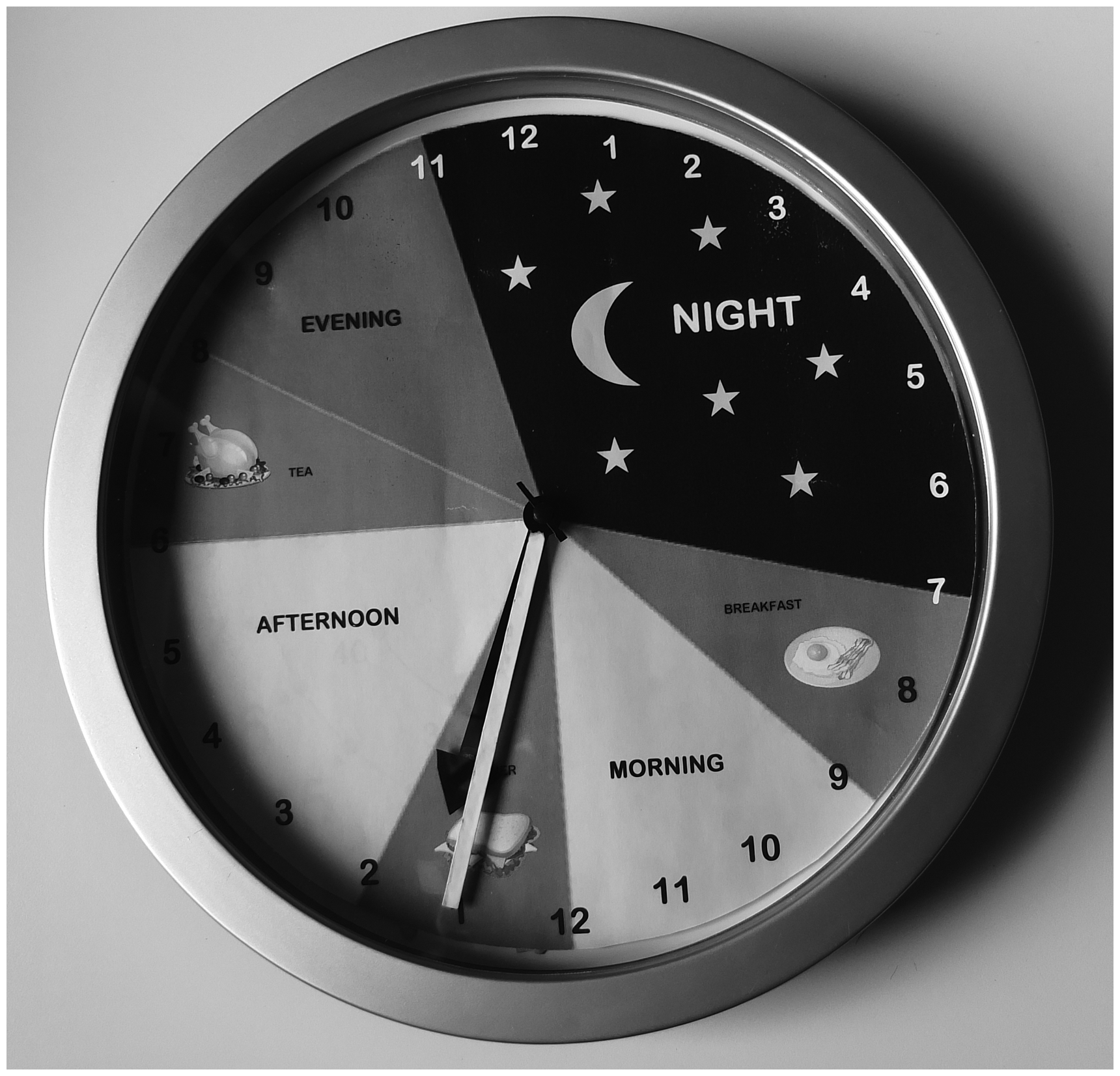
During the earlier stages of Mrs V’s presentation, the modified clock was reported by her relatives to have a beneficial effect and preserved important aspects of her daily independence. However, it became clear over time that she was presenting with gradual cognitive decline. As her cognitive impairment became progressively more pronounced, for example as reflected by serial Mini Mental State Examination (Folstein, Folstein, & McHugh, 1975) scores of 28/30 after 1 year, 24/30 after 2 years and varying between 17 and 14 out of 30 at 5½ years in her clinical notes, the earlier effectiveness of the modified clock significantly reduced. Berry (2014) described three stages of carer support when providing strategies intended to reduce confusion in persons with dementia. These were an initial collaboration between the person and his or her family, followed by unilateral carer input, and finally carers having to face the loss of efficacy of the strategies or technology as the person’s condition progresses (Berry, 2014).
Implications for practice
This paper describes how it may be possible in some cases to involve the relatives of persons with dementia in the actual design or modification of assistive technologies. While in many situations this approach to the use of assistive technology may not be indicated or helpful, there may for some persons be potential benefits to considering this approach in clinical practice. For example, a collaborative approach may be more successful when attempting to address specific cognitive impairments that are associated with a reduction in functional independence or ability to participate in daily activities. Furthermore, this approach could help identify personally relevant areas for both the person and their family. Tailored assistive technologies to which they have contributed may have better acceptance or ‘buy in’ for families, and may offer solutions where there are no existing technologies. Innovations that fill gaps in current provision of assistive technologies may possibly be useful to other persons with cognitive impairment also. As regards the latter, Mrs V and her family were keen for the modified 24-hour clock they designed to be written up and reported in the literature, in case other persons in a similar situation might benefit from its use. Future studies looking at family members’ involvement and preferences regarding assistive technologies could further inform clinical practice.
Footnotes
Declaration of Conflicting Interests
The author(s) declared no potential conflicts of interest with respect to the research, authorship, and/or publication of this article.
Funding
The author(s) received no financial support for the research, authorship, and/or publication of this article.