






Abstract
Studies highlight that shame can be problematic for people with early-stage dementia. However, no published research has specifically explored experiences of shame in dementia from the perspective of the individual. This study uses Interpretative Phenomenological Analysis to gain an understanding of how shame is experienced and made sense of by six people with early-stage dementia. Individual, semi-structured interviews took place in participants’ homes. An in-depth analysis of the data revealed four superordinate themes implicated in shame experiences: Avoidance explains the participants’ efforts to distance themselves from shaming experiences; participants reported Negative self-perceptions including a weakening self, loss of value and meaninglessness; Relationship matters involved issues around trust, burden and past relationships and Uncertainty and loss of control highlights participants’ anxiety about losing clarity and control. Ideas are contributed for promoting non-shaming experiences for people with dementia, particularly through communication during assessment and diagnosis, and psychological therapies.
Introduction
Qualitative studies with people with early-stage dementia have found that emotional and cognitive experiences such as embarrassment (Cheston, 2015; Imhof, Wallhagen, Mahrer-Imhof, & Monsch, 2006), self-criticism, self-blame (Preston, Marshall, & Bucks, 2007) and shame (Cheston, 2005, 2015; Holst & Hallberg, 2003; Imhof et al., 2006) are everyday struggles. In Mitchell, McCollum, and Monaghan’s (2013) systematic review exploring the impact of a dementia diagnosis, four studies identified shame as a central experience (Aminzadeh, Byszewski, Molnar, & Eisner, 2007; Frank et al., 2006; Langdon, Eagle, & Warner, 2007; Moniz-Cook, Manthorpe, Carr, Gibson, & Vernooij-Dassen, 2006) and anxiety about stigma was identified in all 12 studies. Shame is a painful ‘self-conscious emotion’ (Lewis, 2000; Tangney, Stuewig, & Mashek, 2007) associated with cognitions about self-blame and inferiority (Isenberg, 1940), emotions such as anxiety and disgust, and behaviours such as secrecy (Gilbert & Andrews, 1998), impacting upon the person’s global self-image and relationships (Tangney & Dearing, 2002). Stigma is related to shame whereby the stigmatised person is perceived as possessing a negative characteristic which evokes a negative self-image and shame (Goffman, 1963). Despite the appearance of shame-related concepts within dementia research, no prior studies have specifically explored feelings of shame for people with early-stage dementia from the perspective of the person.
According to Dementia: a public health priority (World Health Organization & Alzheimer’s Disease International (WHO & ADI), 2012), 24% of people with dementia reported hiding their diagnosis due to fears about stigma, 40% reported feeling excluded and many reported feeling marginalised by society. Developing ideas for targeting stigma, the WHO and ADI emphasise the importance of early diagnosis so that people are more involved in planning their care and supported to live well with dementia. However, it is estimated that rates of non-disclosure of a diagnosis to the individual is 40%, due to fears about the emotional impact on the person (Bamford, 2010 in Mitchell et al., 2013). This demonstrates how professionals can reinforce the experience of exclusion.
Qualitative studies have investigated key social and emotional challenges in early-stage dementia such as changes in identity (Caddell & Clare, 2013) and social roles (Langdon et al., 2007), and how these are coped with (Van Dijkhuizen, Clare, & Pearce, 2006). Caddell and Clare (2013) found the majority of their participants maintained some aspects of their identities, such as attitudes and values. However, changes in their social abilities, such as word finding difficulties, could lead to embarrassment, self-directed anger and worry about upsetting others. Langdon et al.’s (2007) Interpretative Phenomenological Analysis (IPA) found that people with early-stage dementia were aware of their changing social roles, commonly feeling left out. This could impact negatively upon their self-esteem, seeing themselves as ‘poor’ and ‘daft’ (p. 996). Participants reported feeling that others were inauthentic and withholding towards them, and that it was unsafe to disclose their diagnosis due to fears of being stereotyped. Preston et al. (2007) found that decreased abilities evoked self-perceptions of being substandard in relation to others or their former selves. Participants used self-critical self-descriptions, such as ‘weak’, ‘daft’ and ‘stupid’ (p. 133). Some participants coped by talking about their difficulties to educate others as a way to overcome stereotypes. However, other participants hid their problems. Similarly, Van Dijkhuizen et al.’s (2006) study found that women in early-stage dementia reported feeling socially disconnected, humiliated, embarrassed and anxious about stigma, which they managed through either minimising and avoiding dementia experiences, or accepting difficulties and problem solving. Clare (2003) suggests that, because efforts to mask problems become more difficult as dementia progresses, the most adaptive way to cope with dementia is through the development of an adjusted identity that integrates the changes of dementia with a person’s valued attributes.
Cheston (2013) suggests that shame presents an obstacle to the person’s ability to admit to the changes, thus preventing adaptive coping. Cheston (2005) writes about ‘shame inducing spirals’: Individuals are likely to avoid revealing symptoms, avoid articulating their difficulties, and create accounts that position themselves as competent. People close to the individual may attempt to protect them by taking control of matters. Attempts to avoid shame therefore interfere with adaptive social coping, cause problems within relationships, and become mislabelled by professionals as lack of insight, all of which reinforces shame (Cheston, 2015).
The recognition of the social challenges involved in dementia led to the development of peer support groups (e.g. The National Dementia Strategy for England, Department of Health, 2009). Interviews with peer support group participants revealed that they found value in the groups’ shared experience, reciprocity of support, and sharing of advice, and felt a positive impact of such experiences for example on their confidence (Keyes et al., 2016). Clare, Rowlands, and Quinn’s (2008) IPA explored the use of an internet-based dementia support group and found that the network helped participants to feel understood and develop a sense of pride and value in helping others. However, these studies only present the perspectives of people who engaged with peer support groups, whereas shame may discourage others from accessing such groups (e.g. Preston et al., 2007).
Although very few researchers have investigated shame in dementia, some comment on elements of the experience. Cheston (2015) suggests that fears of losing control or losing one’s self are central to the experience of shame in dementia. Extracts from interviews and therapeutic groups (Snow, Cheston, & Smart, 2015; Watkins, Cheston, Jones, & Gilliard, 2006) provide examples of participants’ fears of ‘going mad’, ‘ceasing to be’, and becoming ‘just a function’ (Cheston, 2015, p. 13). Lishman, Cheston, and Smithson (2014) illustrate how symptoms of dementia can cause shame, making people feel different, afraid of being judged and influencing withdrawal: ‘I forget something silly, that I should have known, it’s embarrassing…’ (p. 55); ‘That’s quite upsetting when you’re trying to think of something and it’s not there anymore… because you can’t think of the words to say so you withdraw’ (p. 64). Similarly, Genoe and Dupuis’s (2012) phenomenological study of the meaning of leisure for people with early-stage dementia highlighted that experiences of muddled thinking, forgetting and lost skills led to feelings of embarrassment, guilt and shame, resulting in discontinued activities. Thus, the current literature begins to shed light on some processes involved in dementia-related shame, in particular how shame is linked to fears about a changing self (Cheston, 2015), fears of judgement (Lishman et al., 2014), and how shame can foster avoidance which prevents people from being able to adapt (Cheston, 2015). This study aimed to expand on this limited understanding and gain a deeper insight as to how shame is experienced and made sense of by people with early-stage dementia by exploring this topic directly with the people themselves. By placing the findings of this study within the context of the existing literature, we can use an improved understanding to promote awareness amongst services, carers and the general public, and support clinicians working with this population to respond helpfully to people with dementia who are experiencing shame to enable adaptive coping that overcomes shame.
Method
Design
IPA aims to assist the understanding of how individuals make sense of their personal ‘lived’ experiences, specifically their social emotions and cognitions. It is concerned with exploring people's accounts of their phenomenology, which is their significant life experiences, and their interpretations of these experiences. IPA allows individuals with dementia to voice their unique experiences, and, with its focus on interpretation and hermeneutics (Smith, Flowers, & Larkin, 2009), is particularly useful for the exploration of shame, due to shame being a complex and often partly hidden experience. Epistemologically IPA adopts a position between realism and social constructionism and it is recognised that the data analysis and results, whilst grounded in the participants’ accounts reflect the interpretation and context of the authors.
Participants
Given the study’s focus on a particular lived experience, a small, homogenous sample was appropriate (Smith et al., 2009). Participants needed to have received a diagnosis of a common form of dementia (Alzheimer’s Disease, Vascular dementia or mixed) at least one month before interview. They needed to be aged 65 or above, due to the likelihood that young-onset dementia would significantly impact upon typical experiences of shame in dementia. They needed to be under the care of a National Health Service (NHS) Older Adult Mental Health Team and judged by their health professional to have ‘insight’ into their difficulties and the capacity to consent to participate. Those experiencing other significant life events or major mental/physical health difficulties were excluded from participating.
Participants were asked by their health professional if they would be interested in taking part and those interested consented to be contacted by the researcher. Between four and 10 participants is appropriate for an IPA study, to suit the ideographic nature (Hefferon & Gil-Rodriguez, 2011). Nine potential participants came forward with three excluded due to not meeting criteria. Six participants consented to take part in the study and are represented with pseudonyms (Table 1).
All participants were White British and had received a diagnosis of dementia between two to six months prior to interview. Thomas and George had no offspring; all others had at least one son or daughter whom they received support from.
Procedures
Ethical approval was obtained from the Research Ethics Committee of the NHS Research Authority. Participants read and understood an information sheet. After signing consent forms participants took part in a semi-structured interview in their own home. The interview was designed to explore the participant’s experience of dementia, shame and how this impacted on their sense of self, although it was open and led by the participant.
The interviews’ focus was clearly sensitive and it was recognised that participants might become distressed. At the start of interviews, participants were reminded that some questions would be sensitive and they could pause or terminate the interview at any point. The researcher had adequate training and experience of containing emotional distress and assessing and responding to risk issues. Time was provided at the end of interviews for the participants to reflect upon their feelings. No participants were observed to be in significant levels of distress at the end of the interview; all reported having found it a positive process. Participants’ clinicians were available if they needed to access support.
Interview length varied between 50 and 75 minutes. Interviews were audio-recorded and the researcher noted observations (e.g. body language, vocal intonation). Interviews were transcribed verbatim by the first author.
Data analysis and quality assurance
Analysis of interviews was based upon the IPA procedure outlined by Smith et al. (2009). Firstly, the process involved working individually with each transcript. This involved reading and initial noting, coding, searching for emergent themes and then developing a list of themes for each transcript. Secondly, a cross-case analysis involved finding connections across transcripts, finally producing a hierarchy of themes that captured the shared experiences of the sample.
The quality of the analysis was considered throughout and numerous steps were taken to ensure the analysis was grounded in the participants’ accounts. Guidelines from Smith (2011) and Yardley (2008) were used to shape the analysis and subsequently determine its quality.
The first author, who led the interviews, transcription and analysis, regularly reflected on her experiences and consulted with the second and third authors to ensure the approach was addressing the research questions throughout. The analysis was intensive and systematic and reviewed at each stage by the second and third authors. Given the systematic approach, how the themes developed is demonstrable. The source material was referred to during all stages of the analysis and once themes had been determined the original transcripts were reviewed in light of the themes. The themes were present across all participants and verbatim extracts were chosen across participants to represent them.
Results and analysis
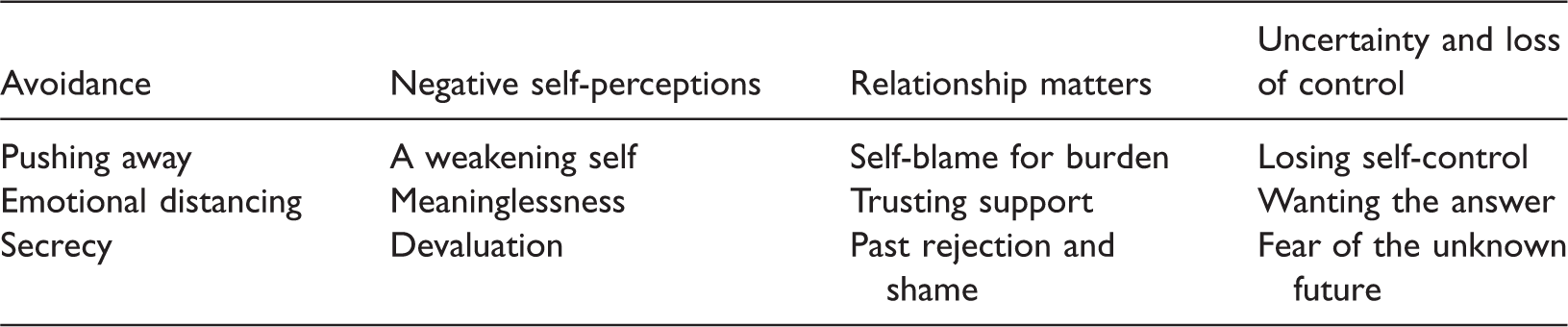
The analysis revealed four superordinate themes: Avoidance, Negative self-perceptions, Relationship matters, and Uncertainty and loss of control. Each superordinate theme contains three sub-themes (Table 2).
Participant details.

Four superordinate themes, overarching 12 sub-themes.
Avoidance
All participants engage in attempts to avoid experiences of dementia: through pushing away experiences, distancing themselves emotionally, or keeping difficulties secret.
Participants appear to push away experiences of dementia to protect themselves from feeling vulnerable and to maintain a ‘normal’ or ‘strong’ identity. This is noticeable in Thomas’ interview, who suggests that he can fight dementia: you've got to be a bit strong in your constitution and more or less say get thee hence, get away from me memory problems, yeah. And face it, glaring eyes on … I don’t think it’s troubling me very much at all … I think it’s because I trained myself to have a strong mind. I’ve been trying to say as a matter of fact I’ve got this problem, and use that as a whipping block and attack it as best as I can. It’s not because of any illness or anything like that, it’s the fact that it’s age. I've realised now I must never go out in the dark again, never ever, no I can’t work it out, because I can’t see can’t see where to go. I just know that I can’t rely on [laughs] – yes, I – just know that she’s going to be right every time [laughing]. In the way of it, she’s got a whole brain … and I've got half a brain [laughing]. (Joe) so when I do something like that I say “all right I know what I am I know I'm a silly cow” and we laugh at it, to cover it up so to speak. (Betty) I let her down and say something really stupid and she’s embarrassed. It doesn't happen very often [laughs]. She uh, she’s an absolute treasure. (Joe) I just you know, [quietly] feel just absolutely fed up, and I get to the stage where “ah can I die?” you know, uh, but uh, it’s uh comes and goes, that it’s not continuous. You know I sometimes think, oh you know Jill might say something … “oh God uh, do I have to put up with this?” sort of thing and [laughs] you think oh, but I… she reads a hell of a lot. (Brian) I mean sitting here I can be quite lonely on my own … you know and … people looking at you when you go out, and that … I suppose the word is slightly ashamed again, going out. (Betty) I wouldn't want my husband to take me out, if I got like that, that’s what I think. I wouldn't want people to pity me so much … I don’t want to be like that, I’d rather not go out. (Gwen)
Negative self-perceptions
All participants discuss how dementia impacts upon their self-perceptions, meaning that they feel inferior, less meaningful, and less valued.
The participants describe feeling substandard compared to others, or noticing a weakening of competencies. For example, Joe talks about becoming less confident in his decisions and adopting a less powerful position in comparison to his wife: I'm learning not so strong willed and um a little bit more flexible [laughs] … I probably have to say “you win love”, um because generally if there is a – any difference in the present circumstances, um it’s [lower voice] guaranteed that she’s right … yes eat humble pie. I’m making a cake, and I thought “did I make did I put the baking powder in?” I thought “don’t be daft just tick it off just help yourself don’t just, you throw the flour in throw the fat in get on with it”. (Gwen) you can feel an idiot then really, supposing somebody asked me, umm, is such and such a shopping, and I would find myself completely at a loss, and [laughs] completely useless. (Joe) I’d miss my reading and the TV and everything you know, talking to people and all that, I’d miss out on life wouldn’t I? (George) I guess I don’t feel that I am … playing a part … in my life … I haven’t been well enough for a time … to live by, living really … (Brian) I feel like … a body … I might say something, or not say something … not take part (Brian) I don’t want to just be gormless … that you haven’t got, any idea of things, you just shrug, sort of shrug your shoulders you don’t know this and you don’t know that, and you don’t care really. (Gwen) she’d (whispering) lost it she just (stutter) s stood there and smiled, and um, and this man kept talking and talking … and she just like, something hanging on his arm, I don’t want to be like that. you’re not as good as you used to be. (Gwen) sometimes there’s a little smirk come on their face. You know, or else you get a strange sort of, lopsided sort of look … they laugh at me, and they say “what are you?” and I say “I know what I am you don’t have to tell me”… you know but, and I'm getting it off my grandsons now.
Relationship matters
All participants talk about relationships issues within their experiences of dementia. Some participants express shame about burdening others; some discuss difficulties with trust.
Some participants express shame regarding the way their dementia impacts on their families: I just worry about the sort of burden I'm going to be on my husband … I couldn't live with my daughters, because it’s not fair on them. (Gwen) I was worried about them splitting up … You know it seemed to me that he, my son, was taking some priority for me. Yeah, and that was his wife and his wife was… being left on her own. (Brian) I let her down and say something really stupid and she’s embarrassed. (Joe) I could say something that upsets others. (Brian) I should have remembered I should have known. Yeah, and I feel awful then because I’ve opened up a wound probably for the other person, which is the last thing I’d want to do [tearful]. (Betty) she won't do anything that’s going to be a distress to me … I know that our love for each other is absolutely rock solid. (Joe) my second daughter would be more sympathetic than the eldest daughter. (Gwen) the nearest one who could send me around the bend could be my sister, if she came down here to stay and help, that would certainly drive me straight up the wall. (Betty) I'm all right with him, but if I was outside with someone I didn't know, I’d probably, have some sort of effect… Yeah embarrassment I think really. (Betty) I trust him driving, and I’d be lost without him because nobody else would have the patience with me. (Gwen) I don’t know if I can – I want to trust myself, like yesterday … I say to my husband “I’ll just pop over the shops” and I thought … what if he suddenly starts thinking “I better not let her go on her own” … (Gwen) well some are really … well they don’t – can’t go out on their own or nothing, someone’s with them all the time because you don’t know what they’re going to come out with or nothing else. (Betty)
Uncertainty and loss of control
All of the participants demonstrate concerns about losing control, not understanding their experiences, and uncertainty about the future.
The participants discuss losing control over their cognitions and actions; this could be socially difficult, increasing the risk of exposing difficulties, or limiting their choice over daily activities: ‘not everyone knows, and … sometimes I have to end up telling them because I’ve said something I know is not right’. (Betty) when you’re looking for a word to describe what you want to say … and you can’t for the life of you find out what that word is um … and so I I can I can be stopped end [laughs] um end of story because you don’t know what to say … (Joe) and my son … just couldn't realise there were certain things that I could do, and I wouldn't do. So, he goes “let’s go and have a meal”, well you know, I didn't want a meal, “oh come on let’s have a meal”… (Brian) I'm determined to make sure it doesn't get a grips at me [laughs]. (Thomas) it’s keeping the brain active isn't it, is the main thing for me. Like I do the um, I do always do the the, not the crossword, but I always do the poly wheel … (George) I’m quite satisfied with myself if I’ve got everything on my list. Oh, I admit I have to write it all down, but as long as I get it all I don’t mind. (Betty) I'm quite prepared to accept the fact that I probably haven’t got as much of the upper hand as I think that I have … (Thomas) there’s nothing I can really do about it except try to stop it happening, you know as much as I can to to delay it as much as possible. (George) it’s your own little world, your own little cosiness. But out there you don’t know who you’re going to see and who’s going to – if anyone speaks to you. That’s the … lot of strangers … (Betty) I don’t want a lot of complications. (Gwen) having no control over something that I that I can’t think of why or how, that I find, this is not – I've got no practical answer … (Joe) I sometimes wonder if if when I fell over and bumped my head, and knocked my shoulder, if that’s anything to do with it. (Gwen) I just didn't know what it was about. No, no. Uh, you know, my doctor did what he could as far as telling me what I’d got. Then … that was it sort of thing … “You, you've got dementia”… end of story. (Brian) knowing it’s coming or on its way, and perhaps I'm praying that I won’t get as bad as some people … (Betty) I don't know how I how they how they feel … I don’t know if you realise that you’re like that. (Gwen)
Discussion
This study reports four superordinate themes which capture the participants’ key experiences of dementia-related shame. These themes fit within the context of existing literature and contain concepts relevant to dementia care. Particular themes and findings that are highlighted by this study are discussed; the superordinate themes Avoidance and Loss of Control, and the sub-themes Meaninglessness and Trust. Then, clinical implications, limitations of the study and suggestions for future research are identified.
Avoidance
Participants explicitly discussed strategies to avoid shame, such as withdrawal from social situations. Implicit forms of avoiding shame are also prevalent in the data, involving linguistic strategies, such as minimising painful experiences, using humour or laughter, changing the subject, and presenting idealistic information about one’s life, e.g. ‘I let her down and say something really stupid and she’s embarrassed. It doesn't happen very often [laughs]. She uh, she’s an absolute treasure’ (Joe). Previous research has noted the use of positive expression as a mechanism to avoid embarrassment (Preston et al., 2007; Van Dijkhuizen et al., 2006) and shame (Cheston, 2005). Avoidance strategies appear to occur with varying levels of conscious awareness. For example, some participants acknowledge the use of humour ‘to cover up’ emotional distress, or discuss how they would stay at home to avoid judgement, e.g. ‘I wouldn’t want people to pity me so much … I’d rather not go out’ (Gwen). However, others appear to oscillate between states of acknowledging that they have ‘got this problem’ and a desire to reject that dementia is a problem for them, e.g. ‘I don’t think it’s troubling me’ (Thomas). This can be viewed in the context of Clare’s (2003) model of the construction of awareness, which describes awareness as a fluctuating process of emotion regulation.
Avoidance has several functions for the participants; to create emotional distance from their experiences, maintain qualities of their identities, protect others from distress, and protect them from exposure and judgement. Cheston’s (2005) ‘shame inducing spirals’ are observable in the data: The participants avoid situations; they conceal their difficulties and the emotional impact they have; they attempt to portray themselves as strong, and they describe ways in which their relatives take control. These strategies inadvertently reinforce shame; for example, humour is commonly used when describing painful experiences, yet that humour is self-deprecating, e.g. ‘I'm a silly cow’ (Betty). Some participants discuss the dilemmas involved in coping with shame and dementia, whereby deciding to either confront or avoid their experiences leaves them feeling vulnerable to shame. For example, Betty describes how continuing with daily activities evokes anxiety of ‘people looking at you’, however staying in her ‘own little cosiness’ compromises social support and leaves her feeling isolated. In contrast, when participants demonstrate ways of coping that do not involve avoidance, for example, encouraging oneself to complete activities, they can also notice self-acceptance; e.g. ‘I’m quite satisfied with myself if I’ve got everything on my list’ (Betty).
Meaninglessness
Alongside previous IPA studies (Preston et al., 2007; Clare et al., 2008), this study demonstrates that people with dementia can see themselves negatively, such as ‘daft’ or ‘useless’. Additionally, the participants discuss a sense of self-meaningless. Some express shame at feeling like ‘a body’ linked to fears of being unable to manage thoughts and feelings, e.g. ‘you haven’t got, any idea of things, you just shrug your shoulders you don’t know this and you don’t know that’ (Gwen). They describe how feeling unable to contribute within social situations leaves them feeling ashamed, e.g. ‘I don’t feel that I am … playing a part … in my life’ (Brian). Similarly, Mitchell et al. (2013) note that fears about stigma were attached to ‘loss of the self’, meaning that participants experienced their illness taking precedence over their self. Theories explain that an individual feels shame when they evaluate themselves as failing to live up to social standards, thus perceiving themselves as inferior and at risk of rejection (Ellis, 1977; Gilbert, 2009; Isenberg, 1940). These findings therefore suggest that the ability to live meaningfully is considered a social norm, and opportunities to demonstrate one’s ideas and sociability could offer individuals living with dementia self-acceptance.
Trust
Similar to Langdon et al.’s (2007) findings, the current study demonstrates that as dementia hinders the participants’ abilities to trust themselves, trusting others becomes more important but also challenging, e.g. ‘I trust him driving, and I’d be lost without him because nobody else would have the patience with me’ (Gwen). Participants report feeling able to trust someone to accept them with dementia, and this appears to reduce shame, e.g. ‘I know that our love for each other is absolutely rock solid’ (Joe). Where participants discuss a mistrust of others, they explain that they fear an uncompassionate response, e.g. ‘my second daughter would be more sympathetic than the eldest daughter’. (Gwen). Trust is important for how comfortable the participants feel in sharing their experiences and receiving care. Theoretically, fears of judgement and rejection are considered a fundamental part of shame (Gilbert, 2009; Isenberg, 1940), and experiences of social disconnection and criticism are believed to leave people vulnerable to shame (Gilbert, 2009; Kohut, 1984). Alongside the current findings, it appears that difficulty trusting others to respond compassionately exacerbates feelings of shame, whereas being with people they trust helps people with dementia manage shame.
Loss of control
Participants struggled with concerns about losing control of themselves and their lives. The participants report experiencing a loss of independence and power, such as others making choices for them, e.g. ‘he goes “let’s go and have a meal”, well you know, I didn't want a meal’ (Brian); and a sense of losing the fight against dementia, e.g. ‘I probably haven’t got as much of the upper hand as I think that I have’ (Thomas). Other experiences of losing control include losing control over social interactions and self-presentation, and unintentionally upsetting someone, e.g. ‘not everyone knows, and … sometimes I have to end up telling them because I’ve said something I know is not right’. (Betty). These findings complement Cheston’s (2015) suggestion that experiences of loss of control in dementia trigger shame through fears of losing the self and becoming substandard in comparison to one’s former self. Particularly for those who previously perceived themselves as in control dementia may leave them feeling at odds with their idealised self-representation, thus evoking shame (Tracy & Robins, 2004). Also, experiences of losing control over social interactions may trigger shame through fears of breaching social norms (Martens, 2005).
Clinical implications
Clinicians need to promote non-shaming experiences for people with concerns about dementia. From the moment individuals access services, clinicians can help to identify shame, for example by recognising avoidance or changes in self-perception. Services may support staff in recognising and responding to shame by offering training about how shame is experienced by people with dementia. It is important that an individual’s sense of control is protected by involving the person in decisions regarding their care. Clinicians should help people with dementia to address fears about the future by providing information about dementia, with hopeful examples of how people cope. Shame should be addressed within interventions and support groups for people with dementia. For example, sharing experiences may normalise difficulties as well as help people develop and share coping strategies, enabling a sense of control.
Given the importance of relationship issues to participants, individuals should be supported within the context of their support systems, for example, by helping them to discuss care with their families, and providing support for family members. These steps may help to reduce feelings of burdening others.
Limitations
The sample criteria excluded people experiencing significant mood difficulties, resulting in a sample that reported relative psychological wellbeing. The study may have accessed more experiences of shame if people with significant mood difficulties were included. Although all participants reflected upon memory problems, the degree to which they demonstrated awareness of their dementia varied. This demonstrates that ‘insight’ is difficult to assess and define: Some participants can be seen as pushing away experiences of dementia, rather than lacking insight. The interview method involved specific challenges. Some participants demonstrated difficulty in discussing their experiences of dementia and shame, creating a challenge for the researcher in exploring these experiences directly, particularly as it was essential that the researcher maintain respect towards the participant, and follow the participant’s lead. This meant that the interview content was not always focussed on shame. However, within the participants’ accounts were examples of shame that the researcher identified through varying degrees of interpretation. The findings are not generalisable but offer insight into a sensitive and less explored subject, revealing some experiences that can provoke shame for people with dementia.
All participants were of White British ethnic origin. Although the group included a range of life-backgrounds, no particular findings around the impact of diversity factors such as gender, socio-economic status, or religion were reported. Participants were aged between 74 and 90, reflecting the increasing prevalence of dementia with age and excluding those with young-onset dementia. Although these homogeneous demographics suited the ideographic nature of the study, future studies could explore the impact of dimensions of diversity on experiences of shame.
Implications for future research
Future qualitative research could explore experiences of shame for other dementia populations, such as those with young-onset dementia, or other ethnic groups. Studies could specifically explore the themes developed through this research, such as avoidance of shame, issues in relationships, perceptions of meaninglessness, or loss of control in early-stage dementia. Quantitative research could measure the prevalence of the study’s themes, such as experiences of losing control, for larger samples. Findings of prevalent experiences could be used to develop a scale of shame in dementia that could then be validated and used for research and clinical work.
Conclusion
The findings from this study provide insight into some key experiences of shame for people with early-stage dementia: These involve negative self-perceptions, such as perceptions of inferiority and meaninglessness; uncertainty and loss of control; issues within relationships, such as trust, and explicit and implicit avoidance strategies. The current findings are based upon real-life accounts of relevant participants, which can be added to what was previously suggested by existing research and models of shame. The promotion of non-shaming experiences for people with dementia can be facilitated through creating better communication from health professionals, greater awareness of shame in dementia within services, the development of psychological interventions to address the difficulties found in this study, and work with families and wider systems.
Footnotes
Declaration of Conflicting Interests
The author(s) declared no potential conflicts of interest with respect to the research, authorship, and/or publication of this article.
Funding
The author(s) received no financial support for the research, authorship, and/or publication of this article.