






Abstract
Music-based therapies have been widely evaluated for individuals with dementia. Music Mirrors (MM) is a new music-based reminiscence tool that looks to improve person-centred care, encourage conversation and stimulate reminiscence. Since MM is designed for persons with mild dementia, this project looked to determine the feasibility, acceptability and efficacy of the tool with three individuals with moderate to severe dementia. Over 6 weeks, 12 sessions were conducted, assessing for mood and behavioural changes during and after each session. Despite limitations to the project, overall results suggest that MM can be beneficial to people with moderate to severe dementia.
It has been postulated that music-based reminiscence therapies are particularly helpful for individuals with dementia as the brain areas associated with ‘music memory’ are among the last to atrophy, allowing receptivity to music to be maintained until advanced dementia (Fusar-Poli et al., 2017).
The efficacy of music-based therapies has been widely evaluated, particularly for individuals with behavioural and psychological symptoms of dementia. Successful individual and group music-based interventions have demonstrated some positive effects on depressive symptoms, anxiety and disruptive behaviour in patients with varying severities of dementia (Ueda et al., 2013; Zhang et al., 2017). Further, a study suggested that music activities could also improve self-esteem and belonging (Cooke et al., 2010). Nevertheless, evidence of the effect of music therapy on behavioural and psychological symptoms of dementia is limited as studies rarely measure the impact on cognitive, emotional and social aspects of well-being (Fusar-Poli et al., 2017; Istvandity, 2017).
In 2017, Norfolk and Suffolk NHS Foundation Mental Health Trust and the ‘Come Singing’ Organisation developed a new digital reminiscence tool linking personal life stories with specific music or sounds, called ‘Music Mirrors’ (MM) (Music Mirrors, 2018). This tool uses significant music from the individual’s life to stimulate memories, emotions, conversation and engagement, in order to spark reminiscence and foster familiarity and understanding with others (Edwards, 2018).
Consistent with the finding that the autobiographical salience and familiarity of musical cues influence the strength of nostalgia evoked and emotional valence of the memory (Barrett et al., 2010; Ford et al., 2016), MM was developed to consist short descriptions of a specific autobiographical memory with the song or sound that the patient associates with it. For example a specific memory for the identified song Nymphs and Shepherds could be: ‘I used to go to a choir and we sang things like Nymphs and Shepherds’. (See musicmirrors.co.uk for full example)
This song could then be played to help stimulate the memory for the individual. MM typically consists of up to five autobiographical memories linked to five pieces of music accessed via a digital platform; it can be uploaded online or made into a PDF so that it can be easily accessible to family members across locations. Furthermore, MM can follow the individual throughout their journey as the illness progresses, possibly as they move care facilities, providing an easily accessible way of getting to know the individual and providing person-centred care (Edwards, 2018).
Given the novelty of MM, studies evaluating its efficacy are still in progress. For example the University of Zurich began a 4 -year study in 2017 (Edwards, 2018). The Health Innovation Network completed a project looking at disseminating awareness of MM and training people to make the materials and conduct sessions (Health Innovation Network, 2016). The project was successful in raising awareness about the tool and delivering a training course that was highly rated for both content and quality (Health Innovation Network, 2016).
MM is designed with persons with mild dementia in mind. In this project, we looked to pilot MM with a small number of individuals with advanced dementia to assess its feasibility and acceptability, as well as determine if there were initial indications of clinical effectiveness. This project is important, as it is often difficult to get to know the person living with advanced dementia through direct conversation with the individual; thus, family members are often relied upon. Should MM be beneficial in this specific population, it could be used as an effective and easy-to-use tool to improve mood, stimulate engagement and improve quality of life.
Method
Project
Resident demographics.
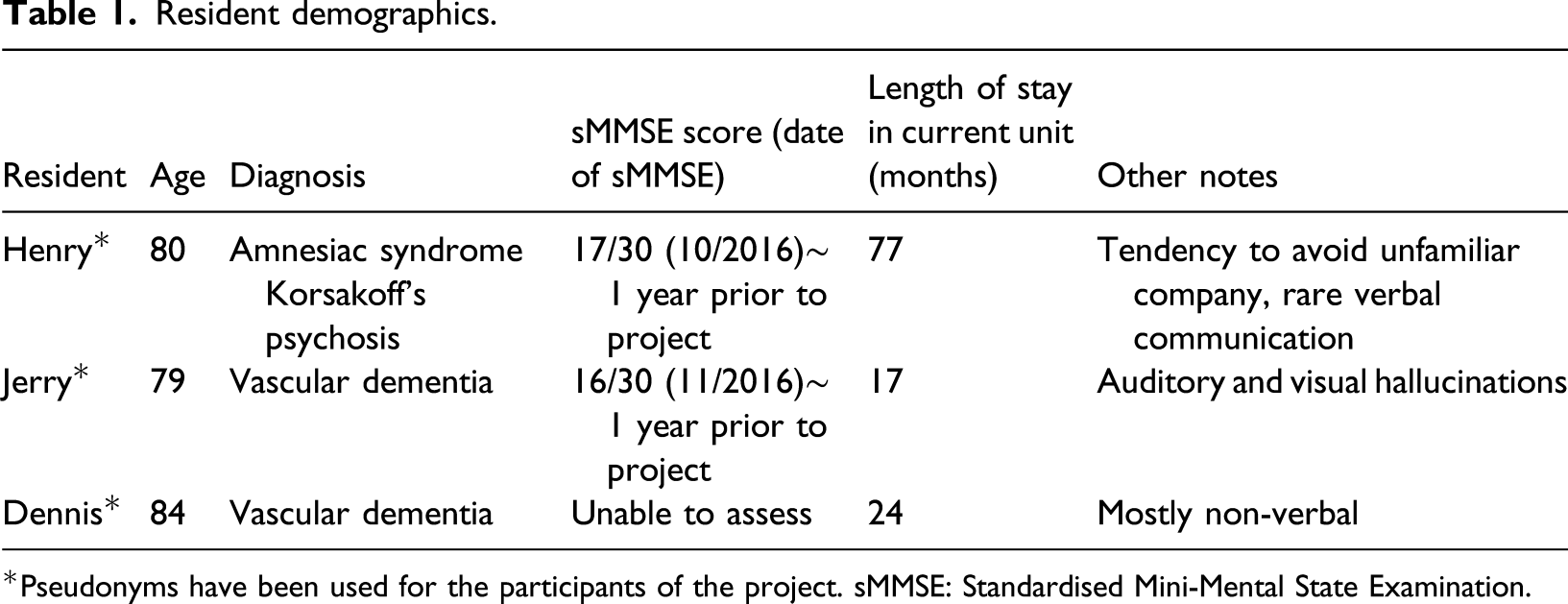
*Pseudonyms have been used for the participants of the project. sMMSE: Standardised Mini-Mental State Examination.
These three residents were selected on the basis that, in comparison to other residents of the unit, each had family members able to assist, were known to enjoy music and were not participating in other interventions.
Procedure
Where residents lacked capacity to consent to participate, families were contacted to obtain consent on their behalf. Residents who were able to communicate their memories and preferences were interviewed to begin to create the MM; interviews with their family members also occurred. Although usually the MM is created online as a digital resource, in this instance, due to inconsistent Wi-Fi access, it was printed out as a hard copy and the music loaded on a CD and as a playlist on a tablet computer (see example in Supplementary Appendix 3).
Residents attended two sessions per week over a 6-week period, facilitated by an Assistant Psychologist and took place in the resident’s bedroom or the communal area. Each memory was read aloud and then the respective track was played. Visual aids in the form of printed out pictures and the video clip of the music were used as material supplementary to that of the original MM to increase communication, promote engagement in the session, as well as stimulate reminiscence. After each song, an attempt was made to engage the resident in conversation about the song and the memories elicited from it.
The Assistant Psychologist rated each resident for mood, activity, engagement and enjoyment before, during and within an hour after each session using an assessment form developed specifically for the project (Supplementary Appendix 2). As a secondary qualitative measure, independent ratings were sought from staff members who were asked to comment on the resident’s mood before and approximately 30 minutes after the session.
Results
Feasibility
Feasibility data for music mirror intervention.

As shown in Table 2, the majority of the time, Henry and Jerry were both able to have a conversation (i.e. reciprocal or verbal responses to questions). Furthermore, they were both able to reminisce, meaning that, in at least one session, they both responded to and/or talked about memories evoked by the music/memory, either spontaneously or when prompted with questions.
Due to Dennis’s impaired verbal communication, ability to converse, indicate song recognition and reminisce was judged using non-verbal cues. In eight of 10 sessions the resident gave non-verbal responses to questions, for example nodding and/or giving thumbs up to indicate yes, or taking off the headphones indicating no. No responses occurred in two sessions. In some instances, Dennis indicated that he did remember the song or the memory by nodding his head, when prompted with questions, which could indicate reminiscing.
In terms of practicalities of running the session, although resident’s bedrooms were available, mobility issues and resident preference meant the communal area was the most appropriate space for some sessions. Henry and Jerry utilised both locations, while Dennis only used the communal area. The use of headphones and tablet made this a feasible option.
Acceptability
Acceptability data for music mirror intervention.

Residents were approached to participate in the sessions up to four times to allow for fluctuations in their presentation and competing environmental demands. Overall, the clients accepted the majority of sessions.
See Table 3 for mean length of sessions. The modal length of engagement per session, measured in 5-minute blocks (e.g. 0–5 minutes, 5–10 minutes, 25–30 minutes etc.), was 15–20 minutes, 25–30 minutes and 15–20 minutes for Henry, Jerry and Dennis, respectively. It is important to note that length of engagement varied significantly between residents and sessions. Jerry was able to sustain engagement for the entirety of the session, whereas Henry and Dennis were unable to do so. Engagement for Henry and Dennis was intermittent throughout the sessions, with length of engagement ranging from 0–5 minutes to 25–30 minutes.
An observer-rated measure was taken to get some indication of how much the resident appeared to not only accept but also enjoy the sessions. This was judged on a Likert scale with 5 = strongly agree and 1 = strongly disagree with the statement; ‘the resident enjoyed the session’, where possible residents were asked if they enjoyed the session. When responses were given, these were combined with the rater’s observations allowing for more accurate ratings. All three residents had average ratings of agree to strongly agree, suggesting an overall enjoyment of the sessions.
Efficacy
Changes in resident mood from T1 to T2 as a result of music mirror intervention.

Changes in resident mood from T2 to T3 as a result of music mirror intervention.

On occasions, T3 ratings were not possible due to residents’ schedules.
A positive change was a move from ‘neutral/negative’ to ‘positive’ or ‘negative’ to ‘neutral’. A negative change was a move from ‘neutral/positive’ to ‘negative’ or ‘positive’ to ‘neutral’ (see Figure 1). No change was when the mood of the resident remained positive, negative or neutral. Figure illustrating positive and negative changes in mood.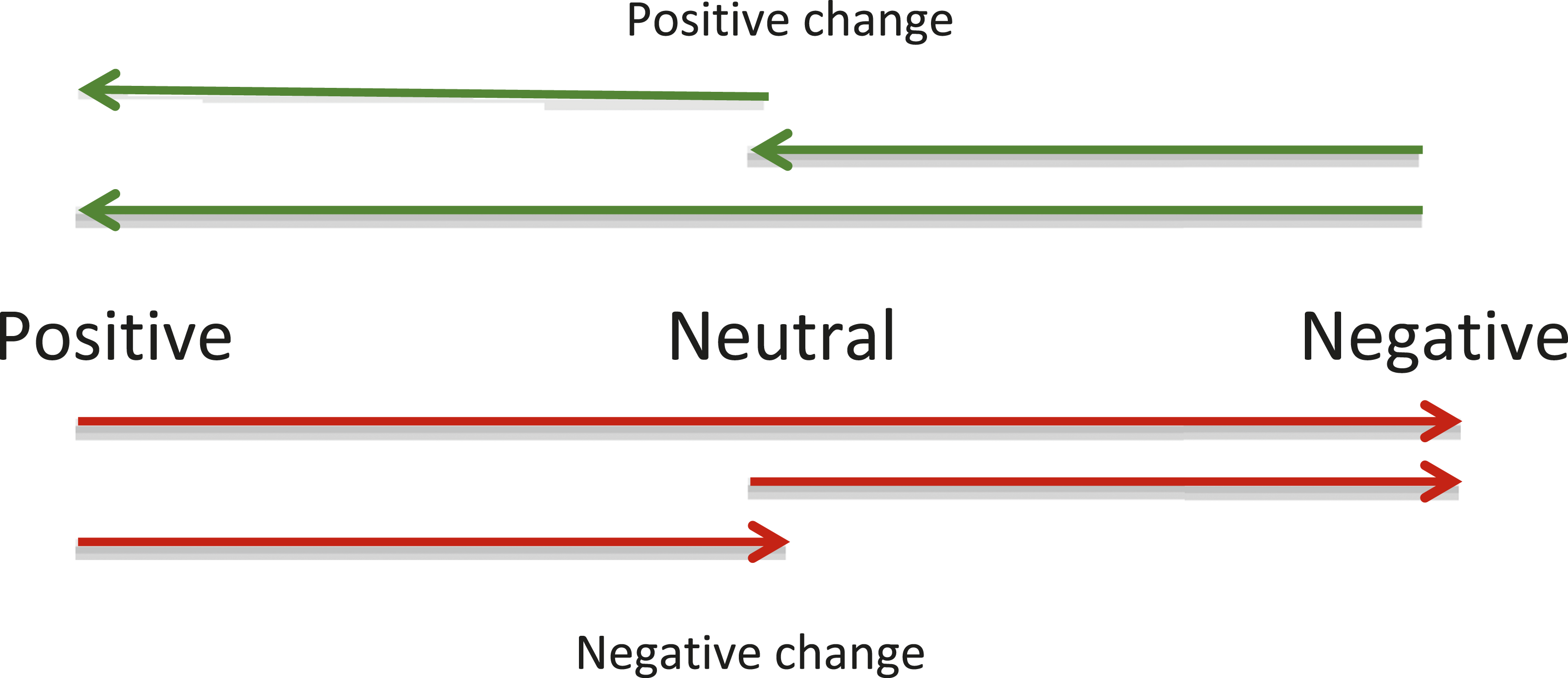
Overall, for Henry and Jerry, the majority of mood changes from T1 to T2 were positive (Table 4). Furthermore, when there was no change, the majority of times this was continued positive mood. This cannot be said for Dennis who had fairly evenly distribution of positive, negative and no changes.
For T2–T3 (Table 5), there was mostly a negative mood change from positive to neutral mood.
Qualitative observations
In addition, significant behavioural observations by the Assistant Psychologist and staff were provided as qualitative outcomes.
Henry
Overall, staff reported no significant behavioural or mood changes in Henry following MM sessions. However, on a couple of occasions, Henry was reported as being in a ‘good mood’, identified through behaviours of ‘smiling’ and speaking to staff, the latter being a rare occurrence. Interpersonal and verbal communication also occurred within sessions; Henry spoke intermittently and seemed comfortable and familiar (e.g. holding hand, kissing/touching cheek and approaching the Assistant Psychologist in the communal area). On a couple of occasions, Henry displayed a strong emotional reaction to the songs, for example becoming tearful and overwhelmed by the sentiment and needing to stop. Engagement with the Assistant Psychologist was noted to be significant as Henry typically presents with an aversion to, and a tendency to avoid, unfamiliar company, often taking up to 6 months to develop familiarity before being able to tolerate any interaction, yet he engaged with the Assistant Psychologist from the outset.
Jerry
Overall, staff members mostly reported that Jerry was ‘fine’, ‘good’ or ‘usual’ after the MM sessions. However, behavioural changes were noted by others; for example requesting that the music be played when meeting with the unit psychologist. Jerry engaged well during the sessions – singing along to the music, tapping along to the beat, dancing (on one occasion) and reminiscing. Jerry would often give more information and details about the memories associated with the songs and on occasion asked the Assistant Psychologist questions.
Dennis
Overall, staff members described Dennis as ‘drowsy’ before and after the MM sessions. The one or two occasions when Dennis was described as being more alert were considered to be positive observations. Considering this, during sessions, when Dennis became more alert and focused for certain songs, particularly for one that also had a visual aid, it was considered a positive behavioural/mood observation. On a particular occasion, he appeared to be in a good mood as inferred from his alertness, smiling and nodding. Nevertheless, Dennis did remain predominantly neutral and often required re-engaging throughout the session.
Discussion
Overall, the findings from this project suggest that MM can be successfully applied to individuals with moderate to advanced dementia living in a care home. Application was deemed to be feasible, acceptable and efficacious. Nevertheless, when considering efficacy, results which are clinically meaningful rather than quantitatively meaningful take precedence. Efficacy of the sessions was very sensitive and specific to the resident and so might not be reflected in the results tables.
Taking this into consideration, MM appears to have an overall positive impact, with predominantly positive changes in mood during the session. Furthermore, as found by Evans et al. (2017) in their study of music-based reminisce programme, MM appeared to foster engagement, interaction and familiarity with a new staff member (the Assistant Psychologist). Sessions also stimulated reminiscence and communication (either verbal or non-verbal). After the session, there was chiefly negative change or no change in mood. These negative changes were mostly a return to ‘neutral’ mood, which is not necessarily a sign that the session was not beneficial but more likely that the positive mood change that resulted from the direct engagement and stimulation of the session is not sustained once the session ends. Furthermore, negative mood change is not an unwanted finding. Songs could bring up sad/nostalgic feelings that change mood negatively, which in itself is significant; the sessions are still evoking an emotion or reaction that the residents are expressing, providing evidence that MM was indeed effective for this population. Indeed, a study by Barrett et al. (2010) did find that music can evoke strong feelings of nostalgia, particularly familiar songs.
Nevertheless, qualitative reports suggest that there were some enduring positive effects; residents continued to accept the intervention; engagement was considerable and some residents even sought out MM between sessions. Ultimately, positive impacts were observed during the sessions, and with the presence of some enduring positive impact, this could indicate that MM is a promising reminisce tool that could improve quality of life for people with moderate to severe dementia.
One of the key strengths of the project was the regularity of the sessions with residents having dedicated one-to-one engagement each week. For residents Henry and Jerry in particular, the regular interaction with the Assistant Psychologist appeared to aid the development of familiarity with the Assistant Psychologist thereby increasing ease of interaction and, in some cases, engagement. Furthermore, even if engagement is not possible due to the severity of the residents’ diagnosis, increased familiarity of the Assistant Psychologist with staff could allow modelling of trusted interactions which the resident may have then responded to. Overall the fact that the MM sessions did successfully increase familiarity with the new staff member is a significant benefit of the tool.
Of note, the project was additionally well received by other staff members. Staff were willing to assist with mood assessments before and after, provide any important information about behaviour that day and be at hand should there be any need for further assistance. Furthermore, at follow-up, family members of the residents expressed their desire for MM sessions to continue, given the positive reports they had heard.
Overall the residents accepted the sessions, seemed to enjoy the sessions and remained engaged for a considerable period of time. It is important to note that the manner in which the sessions are presented and conducted should take into account the resident and how their symptoms present.
Limitations
There are several limitations that warrant comment. Firstly, self-report mood ratings were unable to be effectively ascertained from residents; thus, it was necessary to rely solely on observer-rated measures. There are several difficulties with judging mood purely on observations and behaviours and so the accuracy of the mood reports is attenuated. Furthermore, supplementary reports on mood from staff often came in the form of behavioural observations, such as ‘alert’ or ‘calm’, which then had to be interpreted into moods. This is consistent with research by Fusar-Poli et al., (2017) and Istvandity (2017) who note the difficulty associated with mood/emotion assessment with this population. Some of the data for T3 ratings were missing either due to scheduling, such as unknown doctor appointments or the need for uninterrupted mealtimes meaning that ratings could not be done within the hour. Furthermore, no explicit cognitive or quality of life measures were included.
Secondly, given the advanced dementia of the residents who participated in this project, explaining what it was and the process was not possible, as initial attempts of detailed explanations, or reading the memories in the first person (as they are written) resulted in more confusion or loss of attention.
Thirdly, there were often distractions during the sessions, especially for those that took place in the communal area, for example noise from the TV/someone shouting/singing/talking loudly/alarms. This could impact on both engagement and conversation if the session was interrupted, increasing the likelihood of the resident switching attention. Nonetheless, the use of the tablet and headphones did limit these interruptions significantly.
It is also important to note that having access to a tablet computer and a lot of time within the day to complete the sessions was possible; however, this may not be generalisable to others who attempt to replicate. Therefore, considerations such as scheduling time for sessions (including time to reapproach residents on several occasions), access to headphones and access to Internet and/or portable music players are essential.
Fourthly, the small sample size and lack of variety within the sample (e.g. two out of three residents have vascular dementia and all were male) limits the generalizability of results.
Finally, there is no definitive way of knowing if the positive change seen across sessions is due to the music or due to the regular one-on-one engagement with the Assistant Psychologist.
Future directions
Further controlled studies with more varied participants (e.g. including females and other types of dementia) are needed to determine the efficacy amongst more advanced dementia populations. Nevertheless, in the context of the care unit, findings support the continued use of MM with the residents in this project and others residing at the care unit.
Conclusion
MM is a music-based reminiscence tool that has the potential to be beneficial to people with moderate to severe dementia, with some adaptations to both the development and delivery. In terms of feasibility and acceptability, the results of this project were predominantly positive. In terms of efficacy, though harder to interpret, findings were mostly clinically meaningful for each resident and suggest that the sessions had a positive impact on their mood (if only for the length of the session itself).
Supplemental Material
Supplemental_material – Supplemental Material for Innovative practice: Can music reminiscence approaches be used in moderate–severe dementia? A pilot of music mirrors
Supplemental Material, Supplemental_material for Innovative practice: Can music reminiscence approaches be used in moderate–severe dementia? A pilot of music mirrors by Marie-Frederique Camerlynck, Ottilie Sedgwick and Helen Lister in Dementia
Footnotes
Declaration of Conflicting Interests
The author(s) declared no potential conflicts of interest with respect to the research, authorship, and/or publication of this article.
Funding
The author(s) received no financial support for the research, authorship, and/or publication of this article.

Supplemental Material
Supplemental material for this article is available online.
References
Supplementary Material
Please find the following supplemental material available below.
For Open Access articles published under a Creative Commons License, all supplemental material carries the same license as the article it is associated with.
For non-Open Access articles published, all supplemental material carries a non-exclusive license, and permission requests for re-use of supplemental material or any part of supplemental material shall be sent directly to the copyright owner as specified in the copyright notice associated with the article.
