







Abstract
Foreign trade talents play a crucial role in China’s foreign trade business. It’s no doubt that the high-quality foreign trade talent will step on the new step for our country foreign trade to provide more powerful support. This paper, based on the perspective of New Liberal Arts, initially constructs a framework for the competency model of new foreign trade talents. This model underwent expert consultation using the Delphi method. Subsequently, the competency model was further refined based on the Onion Model, resulting in a new foreign trade talent competency model comprising three characteristics—knowledge, ability, and literacy—and 16 indicators. On this basis, considering the current limitations in foreign trade talent training, this paper proposes effective ways to cultivate new foreign trade talents’ competencies from the perspective of New Liberal Arts’ construction and reform.
Introduction
The concept of “new liberal arts” was first proposed by Hiram College in 2017, and its core proposition is to reorganize the traditional liberal arts; advocate the intersection of liberal arts and science; integrate new technologies into humanities and social science courses such as philosophy, literature, and language; and provide students with comprehensive interdisciplinary learning.
In 2019, 13 departments including China’s Ministry of Education, the Ministry of Science and Technology, and the Ministry of Industry and Information Technology officially launched the “Six Excellence and One Top-Notch” Plan 2.0, which requires the comprehensive promotion of the construction of new engineering, new medical, new agricultural and new liberal arts, and fully realizing the connotative development of higher education.
In 2020, the New Liberal Arts Construction Work Conference hosted by the Working Group of the Ministry of Education issued the Declaration on the Construction of the New Liberal Arts, making comprehensive arrangements for the construction of new liberal arts to cultivate diversified and innovative outstanding talents. 1
The construction of New Liberal Arts is a strategic deployment made by China under the new historical conditions and the mission of the times. Speeding up the construction of new liberal arts is an inherent requirement for building a powerful education country and promoting Chinese-style modernization. Guided by the construction of “new liberal arts,” and following the needs of national and local development, the iterative upgrading of the talent training system can be effectively promoted.
Development of the concept of foreign trade talent
According to data released by the World Trade Organization (WTO), in 2023, China’s exports accounted for 14.2% of the international market share, while imports accounted for 10.6%, reflecting China’s absolute dominance in global trade in goods. China’s General Administration of Customs reported that the total value of imports and exports of China’s trade in goods in the first three quarters of 2024 was 22.28 trillion yuan, an increase of 9.9% compared to the same period in 2023. Foreign trade has become a key driver of China’s economic growth.
In the early stages of China’s reform and opening up, China’s import and export scale was less than 100 billion yuan, with only a few dozen trading partners (countries/regions). At that time, foreign trade talents were only limited to the level of knowing foreign languages and being able to communicate.
After China’s accession to the WTO in 2001, with the continuous expansion of the depth and breadth of China’s participation in the international economy, foreign trade has grown rapidly, and the demand for foreign trade talents has surged. Various regulatory bodies, including the Ministry of Commerce, introduced certification exams such as International Business Qualifications (Foreign Trade Salesperson), International Freight Forwarder, International Business Documentation Specialist, Foreign Trade Follow-up Specialist, and Foreign Trade Business Specialist. Obtaining these certifications through systematic study became the basic standard for assessing the professional level, operational processes, management capabilities, and professional qualities of foreign trade talents.
The construction concept of “New Liberal Arts” proposed by the Ministry of Education in 2019 further highlights the necessity of expanding the depth and breadth of foreign trade professional studies. Emphasize the cross-integration of value, knowledge, academic rationality and academicity, and the continuity of the same line. Foreign trade professionals should break through disciplinary and professional boundaries, and be characterized by broad academic perspectives, keen problem awareness, substantial academic accumulation, high professional quality, strong academic ability, comprehensive strength, and innovative vision, which are more in line with the needs of modern society.
Methods
Building the framework of competency model for foreign trade talents
The term competency, first coined by Harvard professor David McClelland in 1973, refers to the deep personal characteristics that distinguish high achievers from average ones at a given job. It can be motivation, traits, self-image, attitudes or values, domain knowledge, cognitive or behavioral skills, and any of the individual characteristics that can be reliably measured or counted and that significantly distinguish between excellent and average performance.
Through analyzing job responsibilities and recruitment needs of 50 randomly selected current foreign trade companies and the “Vocational Skill Level Standards for Foreign Trade Professionals,” and by conducting in-depth interviews with industry experts, referring to the “New Liberal Arts Construction Declaration,” and combining the existing scholarly research, this paper initially constructs the index system of the new foreign trade talent competency framework. Among them, there are three second-level indicator systems, namely, knowledge characteristics, ability characteristics, and behavior characteristics. Based on the AHP (Analytic Hierarchy Process) analysis method, the secondary indicator system of the new foreign trade talent competency framework (as shown in Figure 1) is constructed, with each secondary indicator containing 3–8 influencing factors, resulting in 17 influencing factors at the tertiary indicator level. Competency framework construction of new foreign trade talents.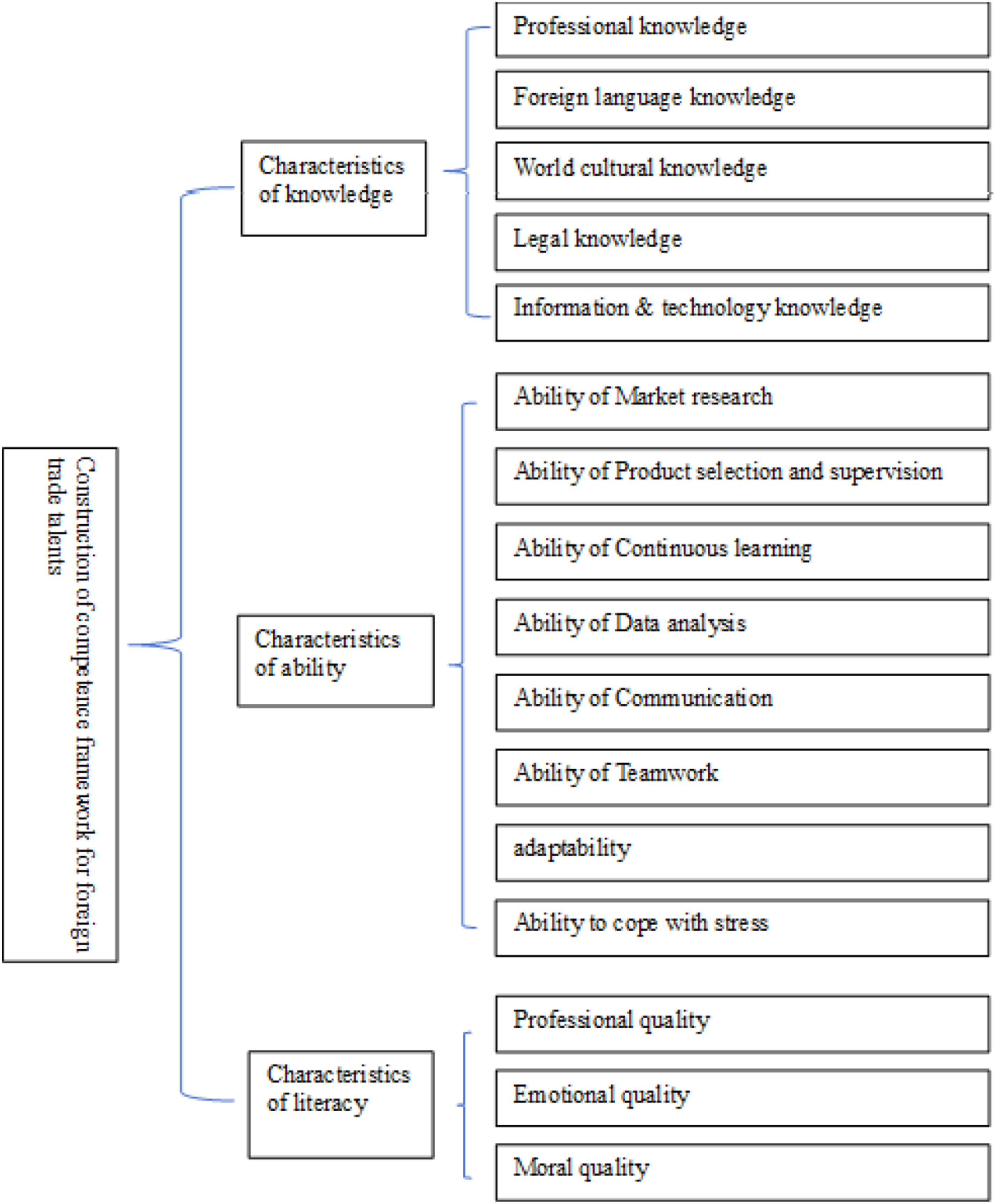
Building competency model for foreign trade talents
Competency model and weights for foreign trade talent.

Based on the importance scores of each competency, and after thorough analysis and discussion by the experts, it was unanimously decided to remove “Adaptability” from the competency indicators due to its importance score of 3.81, which was below 4.0. The remaining 16 competency indicators had an average importance score of 4.86 and were retained, which reflected a high level of consensus among the experts.
According to the suggestions put forward by experts, the “communication ability” in the original three-level indicator was revised to “international communication ability,” which is intended to improve the ability of deep-seated thinking and understand and respect the core and values of diverse cultures. In the original three-level index, “market research ability” was revised to “market development ability,” which aims to fully understand the demand, competition pattern, and trend of the target market through market research, so as to achieve the effect of promoting product marketing and market development.
Findings
American scholars Richard Boyatzis and Spencer proposed the “Onion Model,” which highlights the hierarchical relationship between latent and explicit competencies. The surface layer of the onion includes knowledge and skills, which are relatively easy to develop. The middle layer encompasses social roles or values and self-concept. 2 The inner layer consists of traits and motivations, which are quite difficult to develop and hard to acquire through learning and experience.
In this study, the proposed characteristics of knowledge, ability, and literacy are defined as the three layers of the Onion Model from the outside to the inside. The outermost layer, characteristics of knowledge, is the easiest to enhance through learning and training. The middle layer, characteristics of ability, includes various capabilities that are harder to develop than knowledge and influence the application of knowledge. The core layer, characteristics of literacy, is the most stable and hardest to evaluate, representing the core qualities of competency that are difficult to enhance through postnatal training; these characteristics also influence the formation and development of knowledge and ability.
This competency model reflects the mutually promotional, complementary, and synergistic development relationship among the three characteristics of knowledge, ability, and literacy. Knowledge forms the foundation of abilities and literacy. New foreign trade talents must have enough basic knowledge and professional knowledge reserves in order to give full play to their abilities and literacy. Abilities are the realization of applying knowledge in practice; they are formed on the basis of knowledge, and only with sufficient knowledge reserves, continuous training, and practice can knowledge be transformed into abilities, thereby realizing the value of knowledge. Literacy is the implicit characteristic of new foreign trade talents; its improvement requires long-term accumulation and continuous refinement. The improvement of ability and literacy will, in turn, promote the accumulation and application of knowledge. Therefore, new foreign trade talents not only need to master rich theories and knowledge but also need to have a variety of skilled abilities, and more importantly, they must have the right attitude and values, in order to better meet the needs of the work and cope with the development and challenges of modern society.
Discussions
Pathways to enhance the competency of new foreign trade talents under the new liberal arts context
There are certain limitations in the cultivation of new liberal arts talents in China. The goals of cultivation are not clearly defined, and there is a lack of effective integration and balance between general education and professional education. Talent cultivation lacks individualism and creativity, and there is a gap between course teaching and the realities of the industry and enterprises, with insufficient practical teaching. Additionally, there is a lack of guidance and cultivation of students’ core qualities such as intrinsic value literacy and international vision.
The new liberal arts are not opposed to or separate from traditional liberal arts but are rather a relationship of inheritance and innovation. The cultivation of new liberal arts talents is a complex system engineering, requiring a continuously improved and optimized training model.
The path to improve the competency of new trade talents in the context of New Liberal Arts. There are still certain limitations in the cultivation of new liberal arts talents in China. The goals of cultivation are not clearly defined, and there is a lack of effective integration and balance between general education and professional education. There is a lack of personality and creativity in cultivating talents, and there is also a gap between curriculum teaching and the reality of industry enterprises, and there is a lack of effective practical teaching. There is a lack of cultivation and guidance for students’ core literacy such as intrinsic value and international vision. 3
The new liberal arts and the traditional liberal arts are not antagonistic and separated, but the relationship between inheritance and innovation, and the cultivation of new liberal arts talents is a complicated system engineering, so it must be based on a continuous improvement and optimization of the training model. 4
“General education + professional education” to strengthen literacy characteristics
China’s higher education has entered the stage of popularization, with the gross enrollment rate reaching 60.2% in 2023. Compared to the average level of the top 15 countries (over 86.9%), the gap has narrowed further. Among the 1308 undergraduate colleges nationwide, 713 offer a major in international trade, accounting for 55%, the number of students and graduates is huge. Foreign trade work has characteristics of cross-nationality, diversity, intense competition, and high risk, demanding higher core literacy from students. Characteristics of literacy are based on students’ lifelong development and basic literacy to adapt to the future society, rather than based on the subject knowledge system.
Students’ work ethic, dedication, innovative spirit, and sense of social responsibility cannot be cultivated by a single discipline but need to rely on the joint action of multiple disciplines, multiple knowledge, and multiple abilities. It is essential to build high-quality general education courses, making them classic, modern, and sinicized, and to explore general education elements in professional courses deeply. Emphasis should be placed not only on course learning but also on practical links, enabling students to comprehensively absorb and reflect on what they have learned, fostering a well-rounded personality.
Updating educational concepts and actively integrating into the development of the times
In 2010, China’s Ministry of Education clearly defined innovation and entrepreneurship education as “a teaching idea and model that meets the needs of the economic & social development and national strategy.” Implementing this educational idea and model helps cultivate high-quality talents with innovative spirit and practical ability. Updating educational ideas, focusing on cultivating students’ innovative awareness, innovative spirit, innovation and entrepreneurship ability, and striving to enhance students’ viability and competitiveness can better serve the strategy of innovation-driven development.
Currently, the world is experiencing continuous turbulence and intertwined changes. In such a complex environment, actively embracing and integrating into the world is an inevitable trend. In the international business chain, the cross-national and cross-disciplinary integration of more new industries and emerging sectors is inevitable. Cultivating new foreign trade talents requires a global perspective and a broad vision. It is crucial to inspire them to become excellent new foreign trade talents with an international perspective, global strategic thinking, and the ability to grasp trends, adapt to, and participate in global competition and governance.5,6
Breaking down disciplinary barriers and promoting cross-disciplinary integration
In modern society, the boundaries of knowledge are increasingly blurred, requiring students to possess strong comprehensive abilities to adapt to the complex and ever-changing social environment. Breaking down traditional disciplinary teaching barriers and organically combining the economics discipline of foreign trade with knowledge of other disciplines can create a new knowledge system and problem-solving methods through integration and cross-application.
Through task-driven, project-based collaboration, collaborative learning, and interdisciplinary curriculum design, students can move out of a single and narrow vision of economics, which can not only help students broaden the breadth of knowledge but also cultivate innovative thinking and the ability to solve complex problems.
Innovate practical teaching
Pure theoretical knowledge is not enough to support the work needs of students entering the society, and practical teaching is the fundamental way to achieve the goal of cultivating applied and innovative talents in foreign trade.
Relying on practical teaching modules at foundational, periodical, and comprehensive levels, a complete “practical teaching chain” that integrates education, industry, research, and creation can be built. 7 This chain connects professional cognitive training, on-site training, course practice, professional practice in society, and graduation practice, ensuring a progressive deepening of practical content, self-directed practice levels, practical skill levels, and applied technical levels. This approach meets the needs of students at different levels, in various practical stages, and with different design schemes. 8
Actively promoting multi-dimensional cooperative training
Technologically, science and technology promote social progress, information civilization is becoming the mainstream of the times, and informatization technologies such as big data, cloud computing, artificial intelligence, and blockchain have challenged and impacted the traditional foreign trade talent training model. 9 The biggest feature of the new liberal arts is cross-boundary, interdisciplinary integration. Students majoring in economics and management must adapt, learning modern information technology, algorithms, and programming to calmly cope with the opportunities and challenges brought by new technologies when they change or even subvert traditional industries.
In terms of the training objectives, the competency of foreign trade talents emphasizes the cultivation of open ability. Colleges and universities should change from discipline-oriented to industry-oriented, deepen the mechanism of “school-enterprise cooperation, industry-university-research-innovation, and collaborative education,” to achieve the goal of “resource sharing, complementary advantages, collaborative innovation, and common development,” thereby enhancing students’ job competency.
Conclusion
Based on the “Declaration on the Construction of New Liberal Arts” issued by the Ministry of Education in 2020, this paper constructs an index system for the competency framework of new foreign trade talents by analyzing the job responsibilities and recruitment needs of 50 existing foreign trade enterprises randomly selected according to the characteristics of the current demand for foreign trade talents and by combining with the “Standard for the vocational skill level of foreign trade Professionals.” Based on this, the author uses Delphi method to determine and improve the competency model of foreign trade talents. Furthermore, it puts forward the way to enhance the competence of new foreign trade talents under the background of new liberal arts, which provides a practical and effective reference for colleges and universities to train foreign trade talents to adapt to the development of The Times.
Footnotes

Funding
The author disclosed receipt of the following financial support for the research, authorship, and/or publication of this article: This paper is supported by the “Found Project of Hunan Provincial Department of Education: Practice Project of New Liberal Arts Reform and Research-Research on the innovation path of talent training of High-quality foreign-related economic and trade in the context of new liberal arts” (xiang jiao tong (2021)-94-61).
Declaration of conflicting interests
The author declared no potential conflicts of interest with respect to the research, authorship, and/or publication of this article.