







Abstract
As AI technology continues to advance, the integration of AI and arts has become increasingly significant for countries aiming to become cultural powerhouses and develop robust digital strategies. Modern AI enhances artistic creation, personalized experiences, and accessibility. Therefore, it is necessary to study how AI and arts are currently being integrated. Utilizing text mining techniques, we analyze research papers on AI and art integration in China and Korea using ROST CM 6.0, identifying key trends and differences. Our findings reveal that China focuses on the digital inheritance and transformation of traditional culture in the context of modern AI technology, striving to establish cultural power. In contrast, Korea emphasizes legal rights and standardization in the integration of AI and art, with a strong focus on copyright protection. Future research should prioritize interdisciplinary approaches, examine AI art applications from a macroscopic perspective, and develop strategies for AI to inherit traditional art based on successful global examples. Additionally, ongoing discussions and research on copyright issues arising from AI art integration are essential.
Keywords
Introduction
The rapid advancement of machine learning technologies has garnered significant attention within the field of artificial intelligence (AI), highlighting not only the potential applications of AI across various domains but also generating critical discussions regarding its explanatory limitations, the constraints of machine intelligence, and associated societal risks. Among the diverse explorations of the human-AI relationship, the intersection of AI and art stands out as particularly complex and multifaceted. While numerous innovative ideas have emerged in this sphere, the deep understanding and appreciation of art remain quintessentially human traits. 1
In the current era of the integration of art and AI technology, we believe it is necessary to understand the current status of research on the integration of art and artificial intelligence. Therefore, this article first discusses the current research status of the integration of art and artificial intelligence in China and South Korea, and based on this, proposes insights on the research direction of the integration of art and artificial intelligence.
According to existing research, there are mainly two types of studies on various artistic activities and the integration of art and AI. One is to use AI to analyze existing art, collect data on the art creation process through AI, and connect artists and their works for research. It can be said that this is an auxiliary field that applies AI to the creation and promotion of art works. Another type is the participation of AI in the creation of new art activities and research fields. This involves the field of AI autonomous painting and sculpture activities and is also a very valuable research topic. 2
The proliferation of advanced AI technologies, including Reinforcement Learning from Human Feedback (RLHF) and Large Language Models (LLMs), has accelerated AI’s applicability in artistic endeavors. The expansion of AI into supplementary fields such as music, drama, dance, and copyright law reflect a growing trend toward embracing AI in creative processes.3,4
More artists are starting to use artificial intelligence technology, and galleries and auction houses are increasingly interested in art created by artificial intelligence. In this context, scholars are constantly discussing various practical and theoretical aspects of artificial intelligence and art. At the same time, as the online availability of digital art collections increases, scholars are beginning to attempt to use AI technology to analyze art history. Especially with the use of Convolutional Neural Networks (CNNs), advanced automated classification, sorting, registration, and visualization of large-scale art image datasets can be achieved. 5
AI technology is not only an advanced tool for building efficient search platforms, intelligent recommendation systems, and exploring digital art collections but also an important tool for scholars to analyze specific works of art or their relationships. Therefore, with the increasing number of artistic creations, research, and applications in the intersection of art and AI, it is necessary for us to discuss the creative and exploratory potential of AI technology from the perspective of historical, modern, and future understanding of art. 6
The integration of artificial intelligence (AI) and art in South Korea has gained significant momentum. Current trends highlight the utilization of machine learning to enhance creative processes and foster interdisciplinary collaboration among artists. This synergy has resulted in innovative projects across visual arts, music, and performance, showcasing a dynamic cultural landscape. Notably, research indicates a growing collaboration between human artists and AI, emphasizing the importance of innovative exhibitions and educational initiatives that promote inclusivity and challenge artistic boundaries. Additionally, this convergence raises critical ethical considerations regarding ownership and creativity in the digital age. 7
Furthermore, the integration of AI in art presents distinct variations globally, influenced by differing cultural perceptions and levels of adoption of AI technologies in artistic creation. Comparative analyses of art-AI integration across countries can further enrich the dialogue on art research. Accordingly, this article seeks to analyze the current status of art and AI integration research in China and South Korea while proposing future research trajectories informed by these findings.
Art and AI technology integration
Artificial intelligence is a technology that utilizes computers to achieve human intellectual abilities such as thinking and learning. The official application of artificial intelligence in the field of art began in 2010. This period is exactly the time for the development of deep learning and artificial intelligence technology. In 2014, with the development of General Artificial Intelligence (AGI), AI began to be more widely applied in the field of art. 8
AI technology is used to generate various artistic works such as images, music, and text. For example, previous studies have utilized deep learning techniques to generate new images that are similar to real photos. In the late 2010, artificial intelligence was also applied to the analysis and interpretation of artistic works. Researchers have been using image analysis and natural language processing techniques to analyze and interpret the style, themes, and emotions of artworks. 9
With the development of Artificial Intelligence (AI) technology related to LLM, artworks can be expressed more accurately by inputting sentences, and not only artists, but also ordinary people can use AI to create various artworks. 10 Most importantly, through RLHF, AI is able to create more original artworks on its own. For example, if you show a person who doesn’t know much about animals a set of photos of cats and giraffes, even if you don’t tell them which one is a cat and which one is a giraffe, he will be able to differentiate them by looking at the colors, spots, and length of the neck. This technique of categorizing similar pictures by data features in the absence of a correct answer is called clustering. Through this clustering, the AI is able to learn the features of the data without giving the right answer, and thus is able to recognize patterns and generate artworks on its own.
Since 2020, the application of artificial intelligence in the art market has become more extensive. AI technology has been used to assess the value of art works, analyze market trends, and so on. In addition, AI has also been applied to the field of art education. AI is able to develop students' artistic skills by providing a personalized art learning process, on which scholars have conducted many in-depth studies. 11
The AI widely used in the art field currently includes the following: DeepDream was originally a research project by Google, which used neural networks for image recognition, generating fantasy and surreal images. Especially, AI itself can autonomously recognize patterns in images and exaggerate them, thereby creating unique visual effects. Artists can use DeepDream to transform existing images and create new works of art.
OpenAI-ChatGPT, which has attracted global attention, is an AI with strong natural language processing capabilities. It is applied in multiple fields such as literary creation, script writing, and dialogue generation. Its characteristic is the ability to generate text-based works of art and generate creative sentences based on user input, which is very useful for literary creation activities such as creating poetry, novels, and scripts.
DALL·E is an AI developed by OpenAI that can generate images based on text descriptions. In addition, it can generate unique and creative images based on user input text, making it widely used in various fields such as advertising, illustration, and conceptual art. These platforms effectively help artists expand their creativity and innovation abilities. AI is gradually becoming an innovative tool in the field of art, enabling artists to express themselves in more diverse ways. Therefore, this study utilized the ROST text mining analysis method to analyze the current research status of the integration of art and AI in China and South Korea, and based on this, discussed future research topics.
Research methodology and data processing
Data sources
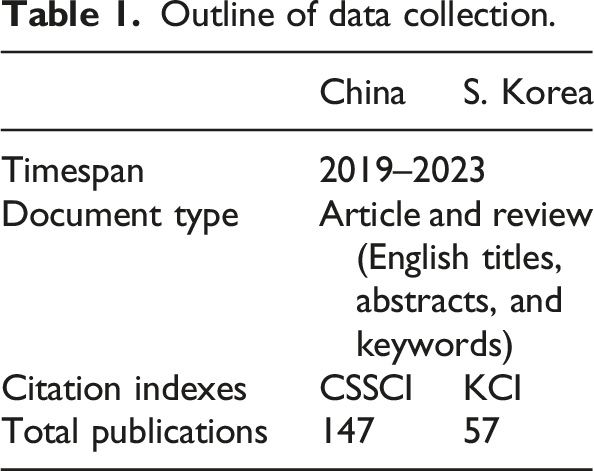
This study collected data from papers published between 2019 and 2023, utilizing the KCI (Korea Citation Index) for South Korea and the CSSCI (Chinese Social Sciences Citation Index) for China as citation indexes. From the collected data, keywords for text mining were extracted, focusing on English titles, abstracts, and keywords.
We used keywords such as “AI,” “artificial intelligence,” and “art” to collect high-level literature data from China National Knowledge Infrastructure (CKNI) over the past 3 years. Invalid literature such as conference notices and guides were removed, and a total of 147 Chinese literature were selected as the sample data for this study.
Outline of data collection.
Data processing
Text analysis is a research method that objectively, systematically, and quantitatively describes communication content. It was first established by American scholar Berelson in the 1950s and is a technique for quantitatively analyzing various data contents based on qualitative research.
12
It transforms content described in language into data represented by quantities and interprets the results through statistical figures, thereby addressing the subjectivity and uncertainty issues inherent in qualitative research. The steps of content analysis are illustrated in Figure 1. Step-by-step diagram of the text analysis method.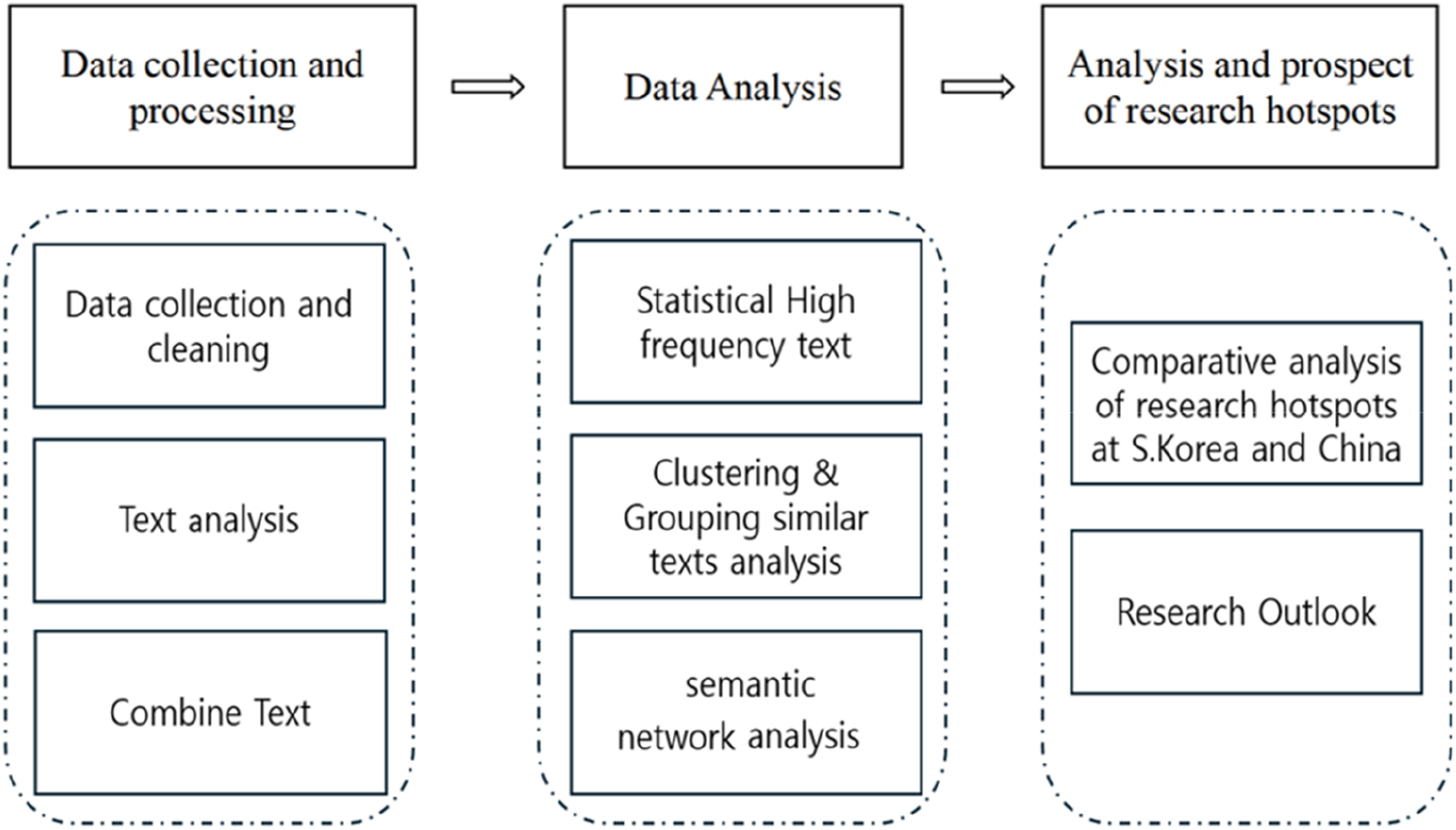
This study used ROST CM6 software to conduct content analysis, and the main steps of the study are as follows: First, build a database for analysis based on research publications on AI and art integration research in China and Korea. Second, conduct word segmentation, high-frequency analysis, and semantic network analysis. Finally, conduct a comparative analysis of the dynamics of AI and art integration research in China and Korea, clarify the current research hotspots under the AI and art integration mechanism, and predict the future research direction.
Analysis results
Analysis of research hotspots in China
Statistical table of high-frequency words of Chinese AI and art fusion research.
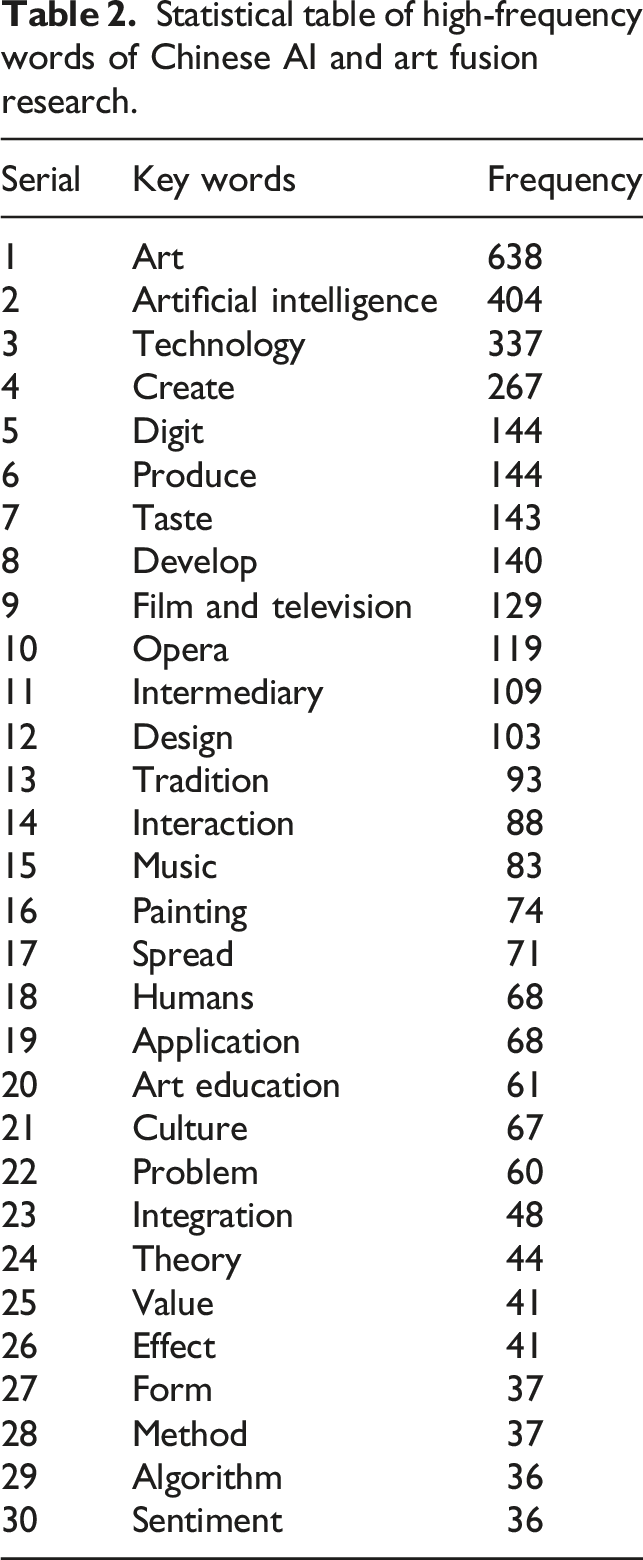
Combined with the socio-semantic network of related research in Figure 2, it is easy to see that the current research related to the integration of AI and art in China has formed a decentralized research volume with multiple core patterns. The core level consists of “artificial intelligence,” “art,” “technology,” “technique,” “development,” etc., which are related to the topic of this research “development” and other central words related to the theme of this research, and from these central words to the outward dispersion can be seen “creation,” “field,” “application,” “opera,” “development,” and so on. From these central words, we can see that the words such as “creation,” “application,” and so on make up the sub-core circle; while the outer circle can also be seen as “challenge,” “change,” “human-machine,” “human-computer,” and other related research keywords can also be seen in the outer circle. Through the above analysis, it can be seen that the hot research topics related to the integration of AI and art in China are divided into the following aspects. Research on the integration of Chinese AI and Art: A social semantic network diagram.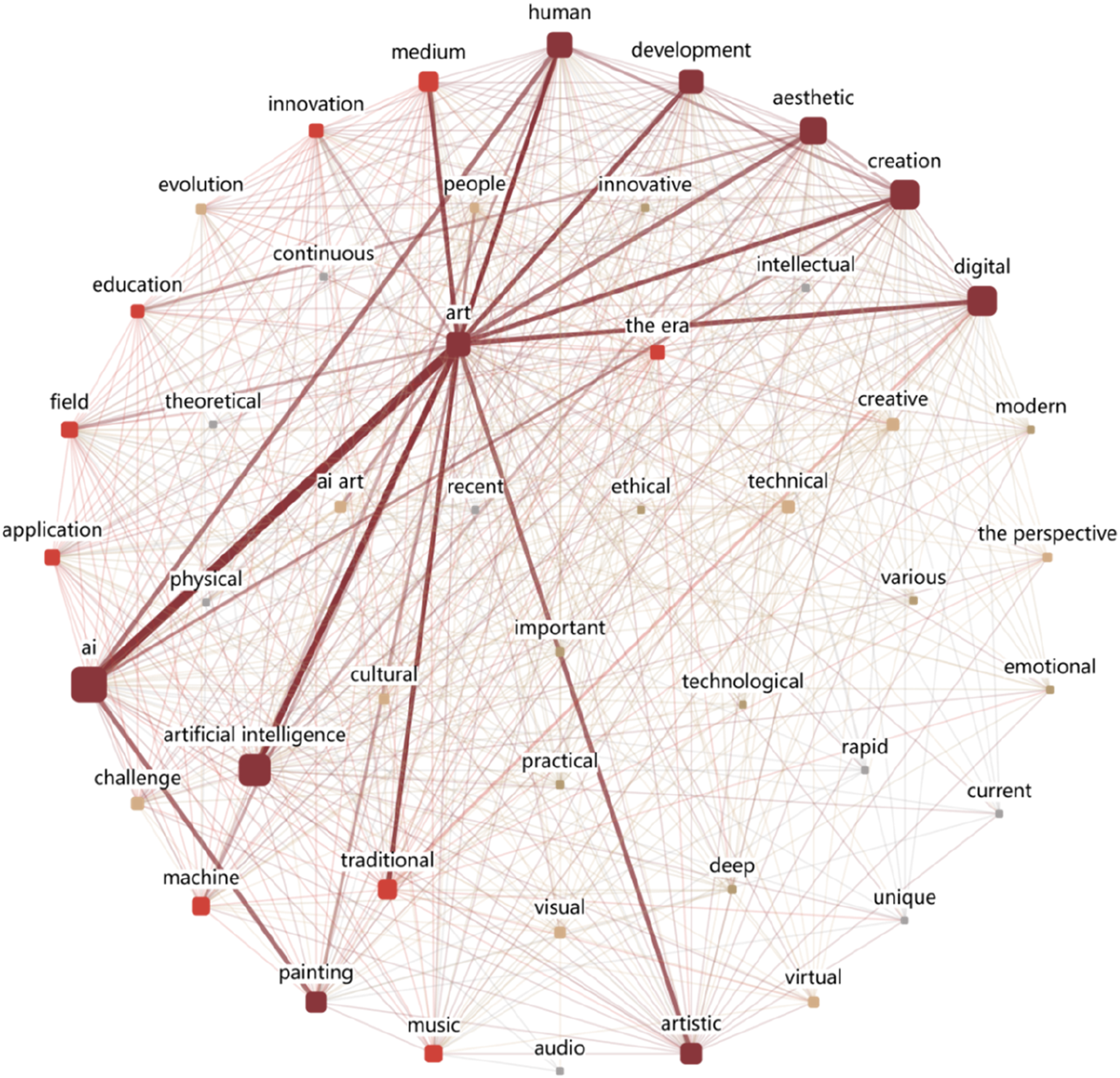
Research on the integration of AI with art fields
In the research on the integration of AI across various subfields of art, scholars have conducted in-depth studies on the convergence of AI with disciplines such as visual arts, music, film and television, and opera. One study examined the integration of AI with painting, discussing the developmental trajectory of AI-generated art and its impact on traditional painting and society. 13
Another research focused on traditional Chinese opera, exploring the dissemination of its culture in the context of AI advancements. Additionally, there has been an exploration of AI’s role in television drama creation, aiming to establish a script creation and evaluation paradigm within intelligent media, thereby enriching the intersection of art and technology. 14
Research on AI and human interaction
In Chinese studies, research on human-computer interaction has emerged as a controversial topic within the convergence of AI and art, with significant discussions regarding the challenges facing this field in recent years. One study analyzed the difficulties associated with human-machine co-creation in the film industry, highlighting new modes of knowledge production and creation that arise from this collaboration. 15
Furthermore, various approaches to human-machine interaction have been explored, including the introduction of the theory of “morphic resonance” to investigate the impact of AI-generated art, such as ChatGPT, on human-centrism. This underscores the necessity of harmonizing human and machine consciousness to develop a new model of human-machine co-evolution. Additionally, the dynamics of human-machine relations continue to be a vital area of academic inquiry within the integration of AI and art. Research has focused on interpreting the dynamics of human-computer relationships in AI art design, emphasizing the need for rational operations among designers, consumers, and artificial intelligence. 16
A comparative study of traditional and modern change
The impact of the integration of AI and art on the art field is significant, making the comparison between traditional art and modern changes a compelling topic for study. Some research explores the evolution of traditional art alongside modern changes within specific subfields of art. Additionally, the relationship between traditional art and the technological advancements brought about by AI has been analyzed through a review of the progress in integrating AI into art creation. 17
Moreover, there is an interest in the future development of traditional skills in the context of artificial intelligence and modern change. This includes an examination of the value of traditional art and design, as well as a forward-looking perspective on talent cultivation and the creative transformation of Chinese traditional culture. Innovation in the field of art creation is highlighted, particularly regarding the contributions made by GPT-like AI and large-scale language model technologies, which enhance interdisciplinary cooperation, personalized experiences, and innovative experimentation. 18
A study of the integration of AI in the field of art education
AI-based art education is emerging as a new trend in the future development of art innovation, providing a broader platform and development opportunities for integrating AI and art. Research has been conducted on the educational aspects of existing AI art education courses, and an AI-based youth esthetic education system based on cognitive development theory and sociocultural theory has been established. In addition, the opportunities and challenges faced by art esthetic education in the era of AI have been analyzed, highlighting the potential future path for integrating AI and art esthetic education. 19
In the current case of China, it highlights how the integration of AI and art education can create an innovative education model and provide important insights into the future direction of art education.
Analysis of research hotspots in South Korea
Statistical table of high-frequency words of Korea AI and art fusion research.
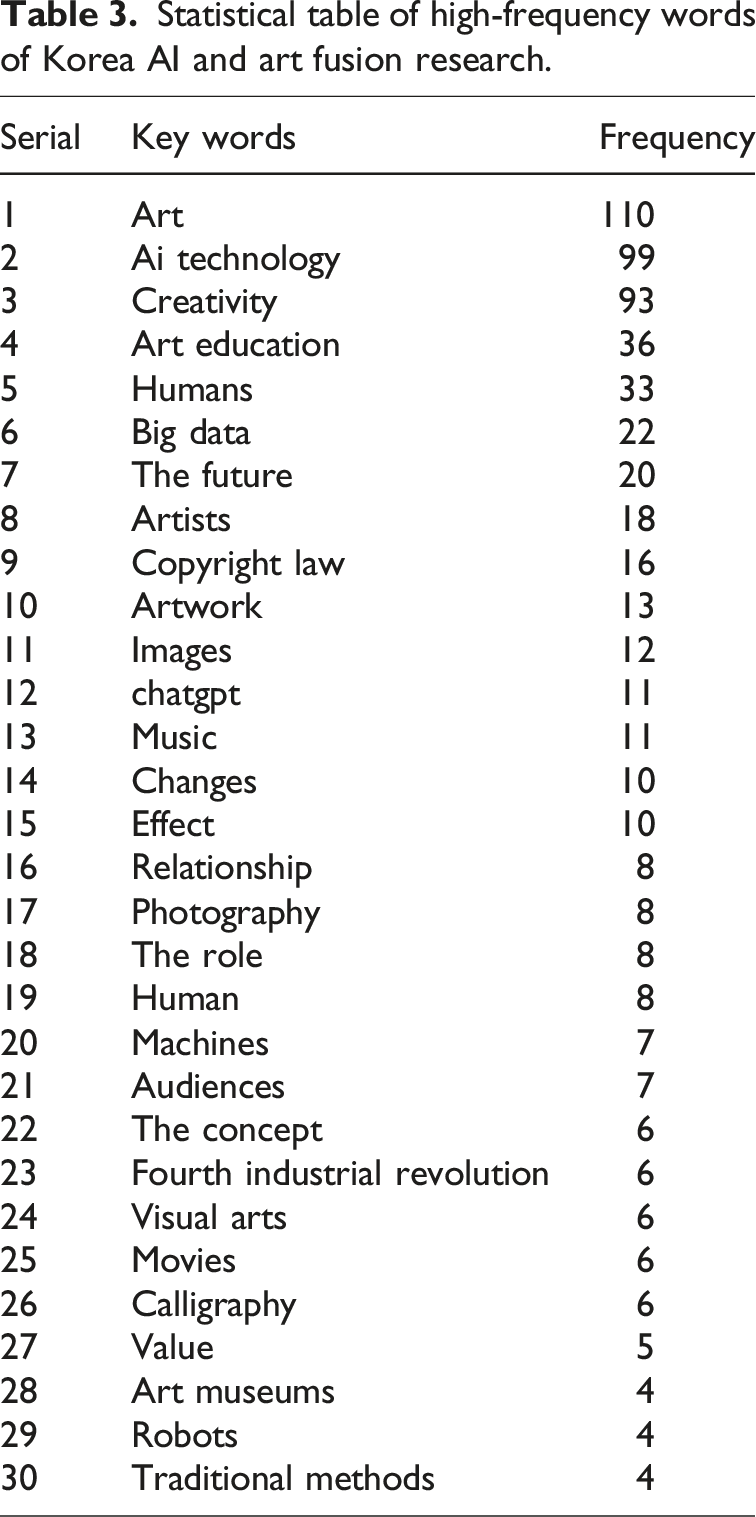
As shown in Table 2, in addition to the core words art and AI technology, the words that appear more frequently in the related studies are humans, ChatGPT, art education, etc. This reflects to a certain extent the hotspots of the related studies in the field of the fusion of AI and art in Korea. The Korean research focuses on the mechanism of the fusion medium of AI and art, the path and technology of the fusion of AI and art, the publicization of the fusion of AI and art, and the education program of the fusion of AI and art, with a balance between theoretical value and social application.
As shown in Figure 3, the current research related to the fusion of AI and art in Korea has formed a multi-core decentralized research network centered on art. With art as the center, five sub-cores are formed, namely, artificial intelligence, creation, creativity, machine, and humans, and from these sub-cores, industry, ChatGPT, audience, and education are formed. The keywords of related research are in the periphery. In summary, it can be seen that the hot research topics related to the integration of AI and art in Korea are categorized into the following directions. Research on the integration of Korea AI and Art: A social semantic network diagram.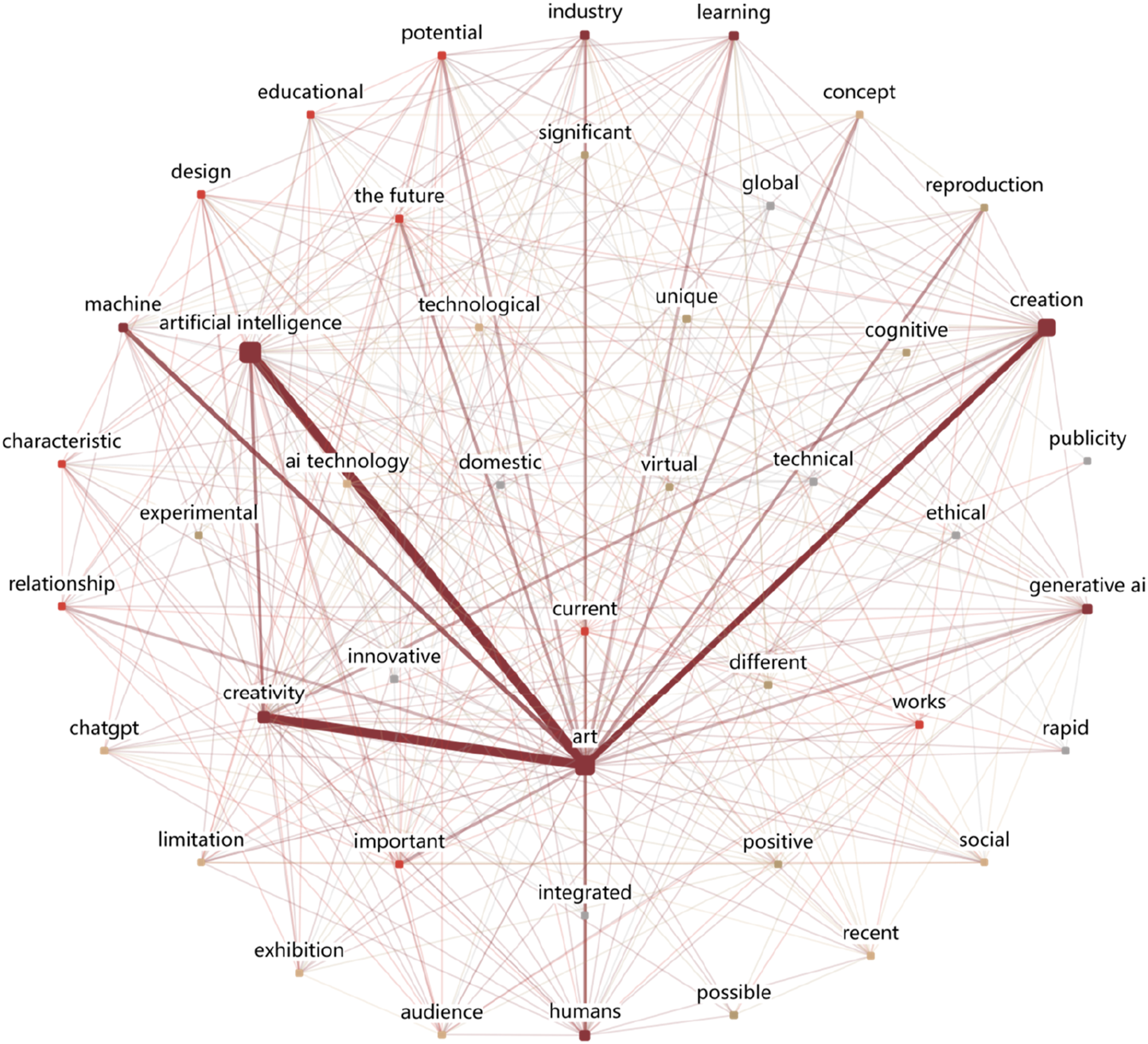
Research on ChatGPT and AI platforms
ChatGPT, as one of the most representative natural language processing tools driven by artificial intelligence technology, has made rapid technological progress. At present, ChatGPT technology has evolved from simple language models to the ability to generate natural language texts and automatically generate common types of artistic works such as images, audio, and videos. Art work activities based on artificial intelligence (AI) have become more active, and research on AI case studies or applications such as ChatGPT, Midjurny, and DALL-E2 is increasing. 20 Some scholars have explored the factors that affect the standardized use of AI media such as ChatGPT by constructing models, and further proposed requirements for the standardized use of AI media such as ChatGPT. 21 Some scholars have conducted research and exploration on the role of AI media. Park takes the field of visual arts as a starting point to conduct a case study on the application of AI media DALL·E, and based on this, explores the functions and roles of DALL·E in the field of visual arts. 22
Research on the universalization of AI art
At present, research on the popularization of AI art industry mainly includes three aspects: public experience improvement, application scenario expansion, and market popularization. Some scholars evaluate the immersion of AI art works from the perspective of public perception, and explore effective strategies to enhance the immersion of AI art works based on four different media by investigating the evaluation and behavioral characteristics of the public when appreciating AI art works. 23
Kim has studied the possibility of AI art industrialization from both the aspects of AI art and film, and believes that AI + film can achieve visual imagination by using technology to produce and implement works. This advantage is needed by the public in the art market and also has the potential for the development of AI + film industrialization. 24 Liu conducted an in-depth study on the unique experiences provided by the integration of AI and art through the analysis of four artificial intelligence demonstration cases, and proposed optimization strategies to enhance the audience’s experience of viewing AI art. This provides a reference for the popularization of the integration of AI and the exhibition industry. 25
Research on the integration path and technology of AI and art
The research and application of key technologies such as deep learning algorithms, personalized recommendation techniques, real-time feedback and prediction, and creative inspiration provide strong technical support for the integration of AI and art. In the future, as scholars continue to deepen their research on technology, the integration of AI and art will show broader prospects and potential. 26 It is important for Lee to study the design convergence of the artificial intelligence industry. By analyzing the characteristics of the integration of the artificial intelligence industry and the design industry, discussing the important problems faced by the integration of AI and design, and proposing feasible solutions, the development direction of the next generation of artificial intelligence and design integration is explored. 27
Research on the integration of AI into art education
The integration of AI into art education research is a multi-level and comprehensive issue, and current research mainly involves the expansion of teaching content, innovation of educational methods, and the impact on students' art curriculum learning. 28 Li and Kim utilized gamification concepts and artificial intelligence generated art programs to construct a virtual artist game course model. Through four stages of character creation, creative writing, text visualization, and virtual exhibition, it helped students develop creative thinking and problem-solving skills, while increasing their participation and interest. 29 Lee developed an AI art integration education project from the perspective of integrating different disciplines and analyzed the impact of applying AI art education programs in the classroom on improving the creativity of primary school students. 30
Research on copyright of AI art in the field of art
In recent years, there has been a growing interest in the intersection of artificial intelligence (AI) and copyright law, particularly in the realm of AI-generated art in South Korea. Researchers have been exploring various aspects of this topic, including the legal status of AI-created works, the implications for traditional copyright frameworks, and the challenges posed by AI’s ability to generate original content. 31
One significant trend is the analysis of existing copyright laws and their applicability to AI-generated art. Scholars are examining whether current regulations adequately protect the rights of creators and how they can be adapted to address the unique characteristics of AI technologies. Additionally, discussions around authorship and ownership of AI-generated works have gained traction, raising questions about whether the AI itself, its developers, or users should hold copyright. 32 Furthermore, there is an increasing focus on the ethical implications of AI in art creation, including concerns about plagiarism and the potential for AI to replicate existing styles without proper attribution. Researchers are advocating for new frameworks that consider both the technological advancements and the artistic value of AI-generated works.
Discussion and conclusion
Comparison of characteristics of AI and art integration research in China and South Korea
In addition, this study found that both China and South Korea have focused their research on two major topics: human-computer interaction and AI + ART education. In terms of human-computer interaction, Chinese research focuses on exploring the human-computer relationship, with scholars trying to clarify the relationship between creators, consumers, and AI from different perspectives, while Korean scholars' research focuses on the study of the popularization of the fusion of AI and art, exploring how to enhance the public experience in the fusion of AI and art from the perspectives of the industry such as museums, exhibition halls, and the film industry, and promoting the AI art marketization.
In terms of AI + ATR education, both China and South Korea have conducted cross-disciplinary research, exploring the construction of the curriculum system and its impact on the audience. It can be seen that with the wide application of AI in the field of art, art education will also become one of the important beneficiaries, and the impact of AI on the field of art education should not be underestimated, and art education will also become an important platform for the development of AI and art mass.
Simultaneously, research on the integration of AI and art has demonstrated distinct characteristics. In this context, the South Korean government has introduced a strategy to establish a robust copyright framework, alongside the development of AI copyright standards. Consequently, South Korean scholars in the field of law have engaged in numerous interdisciplinary studies addressing the intersection of AI and art. These studies have facilitated in-depth discussions regarding the identity of creators and the normative boundaries surrounding AI-generated artistic works, as well as issues related to copyright, intellectual property rights, and usage regulations. In the case of Korea, emerging interdisciplinary research has focused on the normative boundaries and their implications in the realm of AI art fusion, exploring legal rights such as copyright, intellectual property rights, and usage rights. Additionally, these discussions have prompted critical reflections on the identity of creators and the normative dimensions of AI-generated artworks (see Figure 4). Keyword differences in AI and art research in S. Korea and China.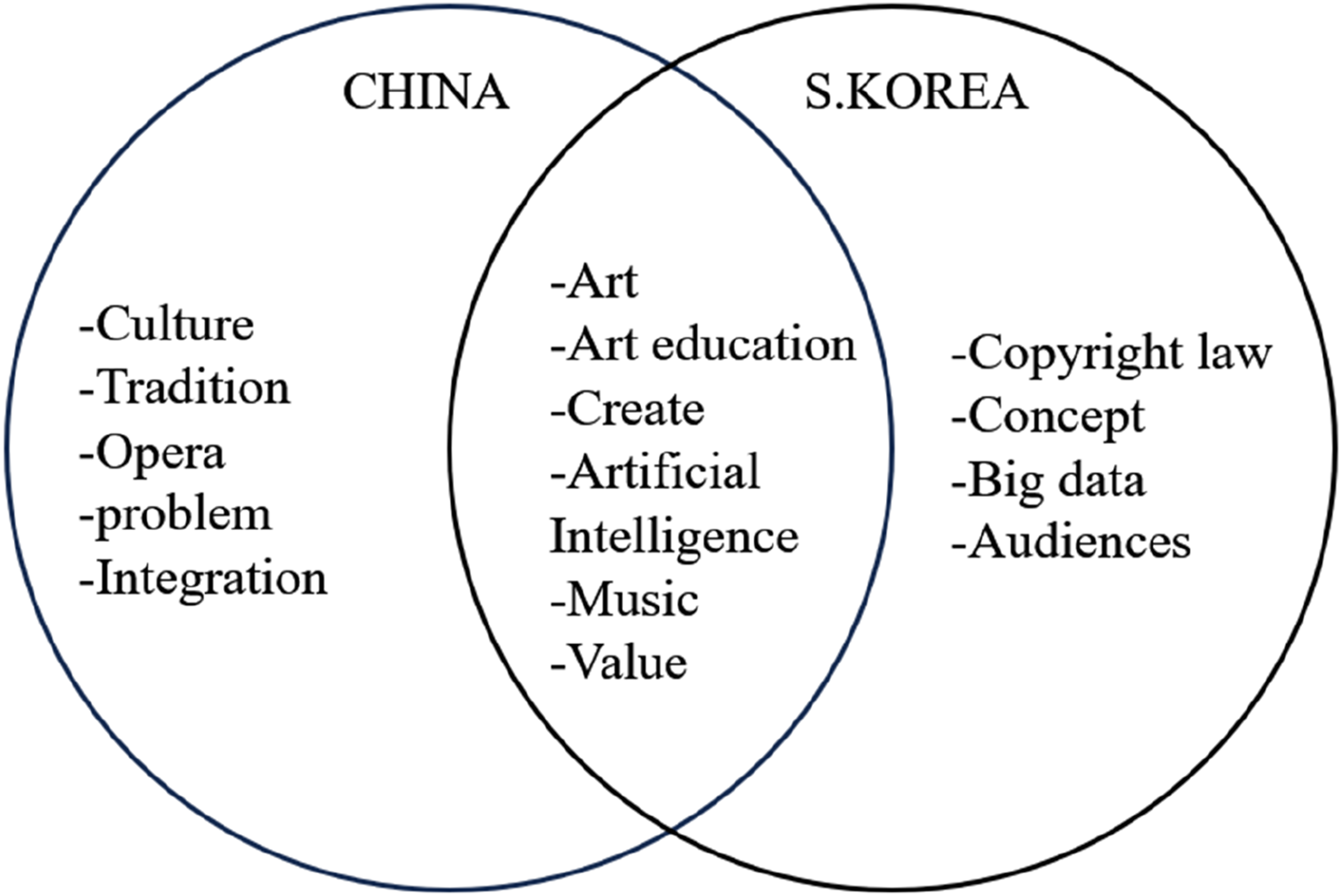
The localized research in China, on the other hand, reflects the thoughts of scholars in the field of culture on how traditional culture can be inherited and transformed in the context of the development of modern AI technology. In the context of cultural power, Chinese scholars' research on traditional culture is polarized. On the one hand, Chinese scholars have deeply explored the changes brought by the integration of AI and art, focusing on the path system and market-oriented development of the integration of AI and art; on the other hand, Chinese scholars have also noticed the impact of AI on the value of traditional art, and they have deeply reflected on how to maintain the unique value of traditional art in the process of the integration of AI, pass down the essence, and adapt to the times. In addition to this, it can be seen in the semantic network diagram that words with Chinese characteristics such as “China” and “opera” also appear in the dispersed peripheral network, which means that China, in addition to keeping pace with the world’s development in the context of the AI era, has also turned its research vision to some words with Chinese characteristics. This means that in addition to keeping up with the pace of world development in the context of the AI era, China has also shifted its research vision to some research topics with Chinese characteristics.
In the context of China’s vigorous promotion of cultural digitization, research on the digitization of traditional Chinese culture, including “tradition culture” and opera, holds significant importance. An analysis of the relevant literature from the past 3 years reveals the emergence of semantic network nodes such as “China” and “opera,” highlighting the trend of localized research among Chinese scholars on topics related to the fusion of AI and art. As Chinese scholars continue to extensively explore the topic of AI art integration, it is anticipated that research focused on AI art fusion with Chinese characteristics will become a major research hotspot, contributing to the advancement of cultural digitization strategies and the establishment of a strong cultural nation.
Conclusion
A comparison of the research hotspots in China and Korea shows that China and Korea share a common focus on the integration of AI and art, but at the same time, they are also conducting localized research based on their own policy contexts. Both Chinese and Korean researchers have noticed the importance of human-computer interaction (HCI) as a core concept in the integration of AI and art, and have conducted in-depth research from the perspectives of creators, consumers, and AI, respectively, with the ultimate goal of maximizing the interests of audiences through the integration of AI and art under the premise of abiding by scientific ethics.
At the same time, scholars from both countries realize the potential of art education in the field of interdisciplinary research on AI and art, and have conducted in-depth research on it as an important platform for applied research on the integration of AI and art. In terms of localized research, Korean scholars have focused on in-depth discussions of copyright and intellectual property rights involved in the fusion of AI and art in order to promote their country’s strategy of being a strong copyright nation. Chinese scholars, on the other hand, under the dual influence of the strategy of cultural power and the strategy of cultural digitization, have conducted research with Chinese characteristics on the inheritance and transformation of traditional culture such as opera and calligraphy.
To summarize, scholars in China and South Korea have already conducted in-depth research on the integration of AI and art from multidisciplinary fields. However, with the rapid development of AI technology and the great progress in the field of national art and culture, there are still many research topics to be explored in the future research of scholars from different countries.
First, expand the research horizon and strengthen the research in interdisciplinary fields. The integration of AI and art is not only a matter of science and technology field and art field, but also its application research in the whole world, which can try to combine pedagogy, sociology, anthropology, economics and other disciplines to conduct research. In the field of pedagogy, scholars in various countries can combine their national education mechanisms to construct the discourse system and evaluation system of AI + ART education.
In the field of sociology, scholars can try to explore the possible social problems and impacts of the integration of AI and art from the perspective of the general public, and analyze them from the perspective of audience stakeholders. In short, the overall principle is to explore the development of the integration of AI and art from a macro perspective through interdisciplinary research.
Second, it is essential to actively participate in national policy priorities, address social needs, and strengthen localized research. Countries around the world have various perspectives and policy support for the integration of AI and art. Scholars from different countries should not only consider their own contexts, but also leverage the strengths of other countries to learn from and summarize successful experiences from other countries. Furthermore, art scholars who focus on localized research should prioritize the protection of traditional culture and emphasize the acquisition of advanced Western technologies. Studying effective ways in which AI can contribute to the preservation of traditional art can effectively convey China’s cultural narrative to the world, thereby promoting the value of Chinese culture. The expansion of the art field using AI can be further linked to smart tourism in the tourism field, so policies that include culture and tourism seem necessary.
Footnotes

Statements and declarations
Funding
The authors disclosed receipt of the following financial support for the research, authorship, and/or publication of this article: This study was funded by 2024 Research Project of Sichuan Normal University Japan Korea Research Institute, National and Regional Research Filing Center of the Ministry of Education (Project Number: 2024RHZC004), Research Program of Qilu Institute of Technology-China (Foundation No. QIT23TP030).
Conflicting interests
The authors declared no potential conflicts of interest with respect to the research, authorship, and/or publication of this article.