







Abstract
As the main representative of ancient Shu culture and one of the precious Chinese cultural heritages, Sanxingdui Ruins has gradually been favored by Chinese and foreign tourists in recent years. Due to the influence of time factors such as festival and weekends, the daily passenger flow of Sanxingdui shows a large fluctuation characteristic. The sudden increase in the number of tourists on festival compared with ordinary days has brought challenges to the daily management of the scenic spot. At the same time, the development of new generation information technology makes network search become one of the main behaviors of tourists before travel. Therefore, this paper analyzes the correlation between Baidu Index and Sanxingdui festival daily passenger flow, and establish prediction model by using SVR prediction method combined with Baidu Index and Sanxingdui festival daily passenger flow, the model has an accurate prediction of Sanxingdui holiday passenger flow. The prediction can provide a scientific reference for the management decision-making of scenic spots on festival.
Introduction
With the rapid development of the social economy and the increasing demand for spiritual enjoyment, tourism has become an indispensable component of people’s daily life. At the same time, the role and contribution of tourism in the tertiary industry and the national economy are also increasing. At the beginning of 2019, the Ministry of Culture and Tourism announced the basic situation of the tourism industry in 2018 (Ministry of Culture and Tourism of the People’s Republic of China. https://www.mct.gov.cn/), showing that the number of domestic tourists in China reached 5.539 billion in 2018, an increase of 10.8% compared to the same period in 2017. The total number of inbound and outbound tourists reached 291 million, a year-on-year increase of 7.8%. The total tourism revenue for the year was 5.97 trillion yuan, a year-on-year increase of 10.5%. After preliminary calculations, the comprehensive contribution of the tourism industry to GDP in 2018 was 9.94 trillion yuan, with a contribution rate of 11.04%. Affected by the COVID-19 in 2020–2022, China’s tourism industry suffered a heavy blow. However, with the lifting of epidemic prevention and control, the tourism industry will quickly recover to the state before the epidemic. Sichuan is rich in tourism resources and has developed a large number of famous representative tourism resources such as Jiuzhaigou Valley Scenic and Historic Interest Area, Mount Emei, and giant pandas. The Sanxingdui Ruins is known as one of the greatest archaeological discoveries of the last century and is a representative of the brilliant ancient Shu civilization. Like the Yangtze River and Yellow River basins, it belongs to the mother body of Chinese civilization and has historical, scientific, cultural, and artistic value, as well as the most ornamental cultural relic group. It is known as the “source of the Yangtze River civilization.” In recent years, with the further development and improvement of Sanxingdui and people’s increasing love for cultural tourism, the number of tourists in Sanxingdui has also shown a trend of increasing year by year.
On the one hand, the increasing flow of tourists to Sanxingdui indicates that Sanxingdui culture is increasingly popular among tourists, playing a positive role in promoting the Sanxingdui Ruins and ancient Shu civilization, thereby promoting the further development and protection of the Sanxingdui Ruins. On the other hand, the rapid growth of tourist flow in Sanxingdui and the fluctuating daily passenger flow, especially during holidays, not only pose obstacles to the daily management of the scenic area, but more importantly, the resulting inadequate management can easily cause destructive damage to the “fragile” Ruins tourism resources. Meanwhile, through relevant literature search and sorting, it has been found that there are currently few scholars analyzing and predicting the daily passenger flow of Sanxingdui. Therefore, it is necessary to use relevant data combined with prediction methods to analyze and predict the passenger flow of the Sanxingdui Festival, providing scientific reference for scenic area management.
Literature review
At present, there is not only limited research on the analysis and prediction of passenger flow in Sanxingdui, but most of it reflects the development, promotion, and protection of the Sanxingdui Ruins. At the same time, there is also little research on passenger flow prediction related to historical and cultural tourism, and a large amount of research is focused on predicting the demand for other types of tourism. Wu et al. proposed a new hybrid prediction method, SARIMA + LSTM, which combines Seasonal Autoregressive Integrated Moving Average (SARIMA) and Long Short-Term Memory (LSTM), to predict the daily tourist volume of the Macau Special Administrative Region in China, and the results show that the prediction performance of this mixed method is superior to other methods. 1 Eugenio-Martin and Cazorla-Artiles used the random parameter logit model to predict the potential tourism demand of 28 European Union countries and proposed the design strategy of targeted marketing activities. 2 An adaptive multi-scale ensemble (AME) learning method is proposed to predict the season and trend of the number of tourists. ARIMA used to predict the trend component, and SARIMA is used to predict the seasonal component. The empirical results show that AME method can achieve higher prediction accuracy. 3 Vergori et al. used the Gini coefficient as a seasonal indicator and combined it with a beta regression model to confirm that the increase in the proportion of tourists arriving by plane determines the overall seasonal decrease in international tourism demand in Italy. 4 At present, in addition to econometric models, there are also time series methods, 5 neural networks, 6 and support vector machine regression (SVR) 7 for predicting tourism demand. The SVR prediction method is widely used in tourism demand prediction research due to its advantages in solving small samples and strong nonlinear feature data, and it is not easy to fall into local optima during the solving process. Hong et al. proposed combining chaotic genetic algorithm (CGA) with SVR. Through empirical results, it was found that the SVRCGA model has better prediction accuracy in tourism demand prediction compared to traditional genetic algorithm optimized SVR models. 8 On the other hand, search engine data are of considerable interest to researchers for their utility in predicting human behavior, and research has shown that the rapid development of information technology and the Internet has led to people becoming increasingly loyal to conducting online searches, which in turn can affect people’s choices and specific behaviors towards tourism destinations. 9 Dergiades et al. think that search engines are the main tool for planning vacations, and they correct the overall search engine index by defining language bias and platform bias, which helps predict international tourist numbers. 10 Chen et al. 11 also think that using search engine data (SED) to predict tourist traffic is crucial for the management and safety warning of tourist attractions, and the CNN BiLSTM model is used to denoise SED, resulting in a significant reduction in RMSE and MAPE. Sun found through research that the KELM model, which combines the Baidu index and Google index, can significantly improve the predictive performance of the tourism demand model, outperforming other benchmark models in terms of prediction accuracy. 12
It can be seen that there is currently limited research on the analysis and prediction of Samsung’s passenger flow both domestically and internationally, and the network search index is beneficial for improving the prediction accuracy of the prediction model. Based on this, this paper intends to analyze the correlation between the Baidu search index with the word “Sanxingdui” as the root and the passenger flow data of Samsung holiday days. Based on this, combined with two types of data and other related data, support vector machine regression is used to establish a holiday day passenger flow prediction model and ultimately achieve accurate prediction of holiday day passenger flow.
The research in this paper has the following two research significance: (1) In practical application, it can provide a reference basis for the holiday management of Sanxingdui Scenic Area. By predicting the passenger flow in advance, the management department can make plans for the opening hours and travel routes of the tourist area in advance, and can scientifically dispatch and coordinate the transportation of materials and personnel in the tourist area in advance. (2) In terms of theoretical innovation, there is currently almost no research on predicting the passenger flow of Sanxingdui, and this study can slightly fill the gap in this regard.
Prediction method SVR
Support Vector Machine (SVM) was proposed by Vapnik and his collaborators and gained comprehensive development in the mid-1990s. As a regression application of SVM, SVR is widely used in system modeling and time series prediction due to its strong nonlinear data processing ability. The principle is, for a given set of training sample data,



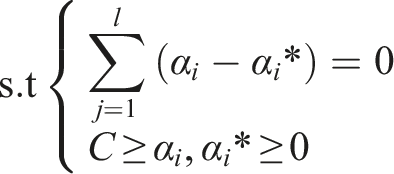
The characteristic of

It enhances the nonlinear prediction ability of SVR. This paper will use it to construct SVR, and the final support vector machine regression function is

Empirical analysis
Data analysis
Passenger flow
The data source of this paper mainly consists of two parts. One part is the actual number of tourists per day in Sanxingdui Scenic Area from 2016 to 2018, which is calculated by the scenic area’s ticketing system. Therefore, it is very objective and accurate, as shown in Figure 1. It should be noted that due to the data security requirements of Sanxingdui Scenic Area, all data has been normalized to [0.15, 0.85], and this processing method will not change the fluctuation characteristics of the data. From the graph, it can be seen that the daily passenger flow fluctuations and jumps of Sanxingdui are particularly prominent, indicating that the data has strong nonlinear characteristics. The major peaks are all holiday passenger flow, indicating that holidays have a higher contribution rate to passenger flow. The circular marked area belongs to the peak of all passenger flow during the Spring Festival and is the peak of all passenger flow. Through research, it is found that the main passenger flow comes from Guanghan and its surrounding areas, with relatively few from other places. At the same time, it is found that the passenger flow on New Year’s Eve is very small, almost belonging to the day with the lowest annual passenger flow. This is influenced by the traditional Chinese New Year tradition of enjoying family reunions at home. The elliptical area represents the passenger flow during the National Day holiday, which is at the second peak of the current year, but it is also significantly higher than other times except for the Spring Festival. In the rectangular area, there are four festivals: New Year’s Day, Tomb sweeping Day, May Day, and Dragon Boat Festival. In addition, the peak of Mid-Autumn Festival before the National Day is the third level of peak passenger flow. In addition, most of the small peaks in the figure are on weekends, and although the passenger flow is significantly higher than on weekdays, it is much lower than on holidays. Through statistics, it has been found that the contribution rate of holiday passenger flow in these 3 years has reached 25%, while the proportion of time is only 8%. Therefore, predicting holiday passenger flow has important practical significance. Daily passenger flow of Sanxingdui from 2016 to 2018.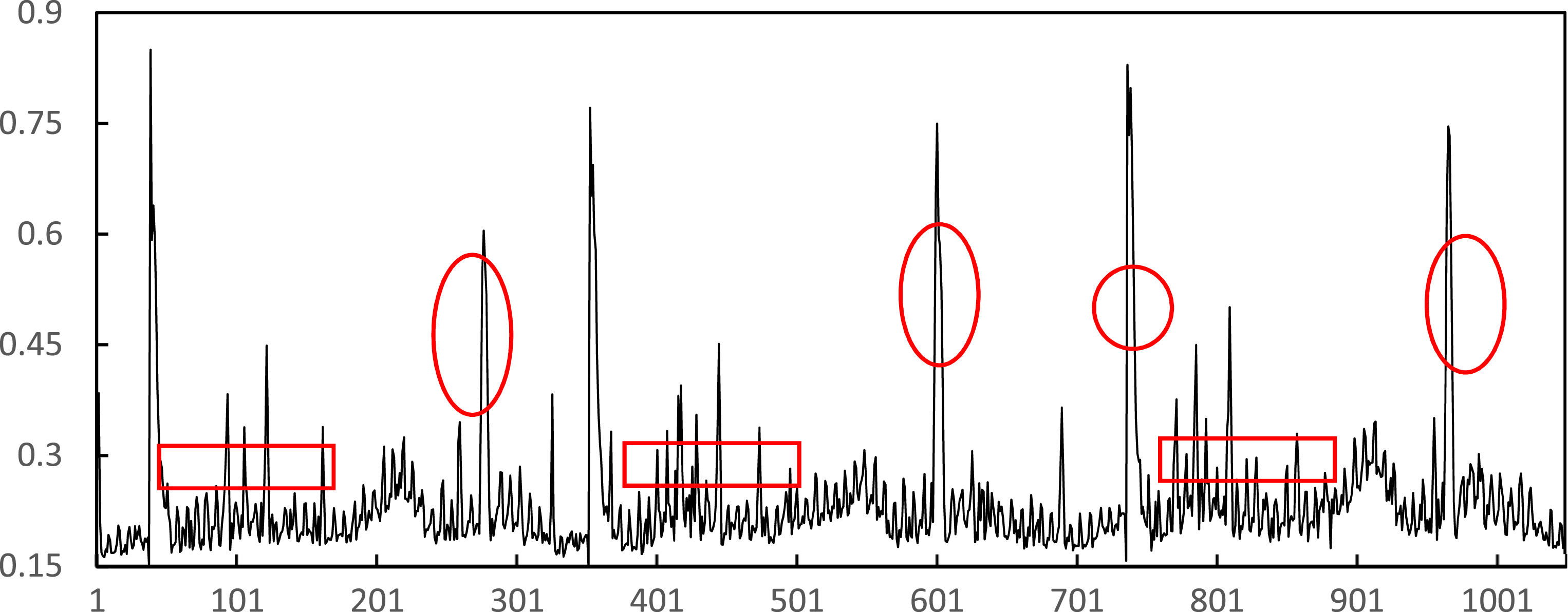
Baidu Index
Another source of data for the article is the Baidu index related to the keyword “Sanxingdui.” As the world’s largest Chinese search engine, Baidu Search has an absolute advantage in the entire Chinese search engine market, and it is the best-loved of public. The Baidu Index is open to the public in China, so many scholars use it for predictive research.
13
Therefore, using the Baidu search index instead of the online search index has strong representativeness, and keywords are the main search method of the Baidu index. This article mainly selects three types of keywords: “Sanxingdui.” “Sanxingdui Museum,”, and “Sanxingdui Ruins” to calculate the Baidu index related to Sanxingdui, which largely reflects the overall trend of online search. Due to the fact that online search behavior is more time-consuming than tourism behavior, and considering the relatively short timeliness of online search, we mainly consider the Baidu index for the first 3 days, 2 days, and 1 day before the holiday. Figure 2 shows the Baidu index for the three types of keywords on the day before the holiday. From Figure 2, it can be observed that the annual trend of Baidu Index is similar, and the changing trends of the three types of Baidu Index are also quite similar. On the other hand, more importantly, through careful comparison, it can also be found that the trend of changes in the three types of Baidu indices is roughly the same as that of actual passenger flow. Next, we will conduct a correlation analysis between the Baidu index and passenger flow to ensure that we can use the Baidu index to assist in predicting holiday passenger flow. Baidu Index of three kinds of keywords on the day before holidays.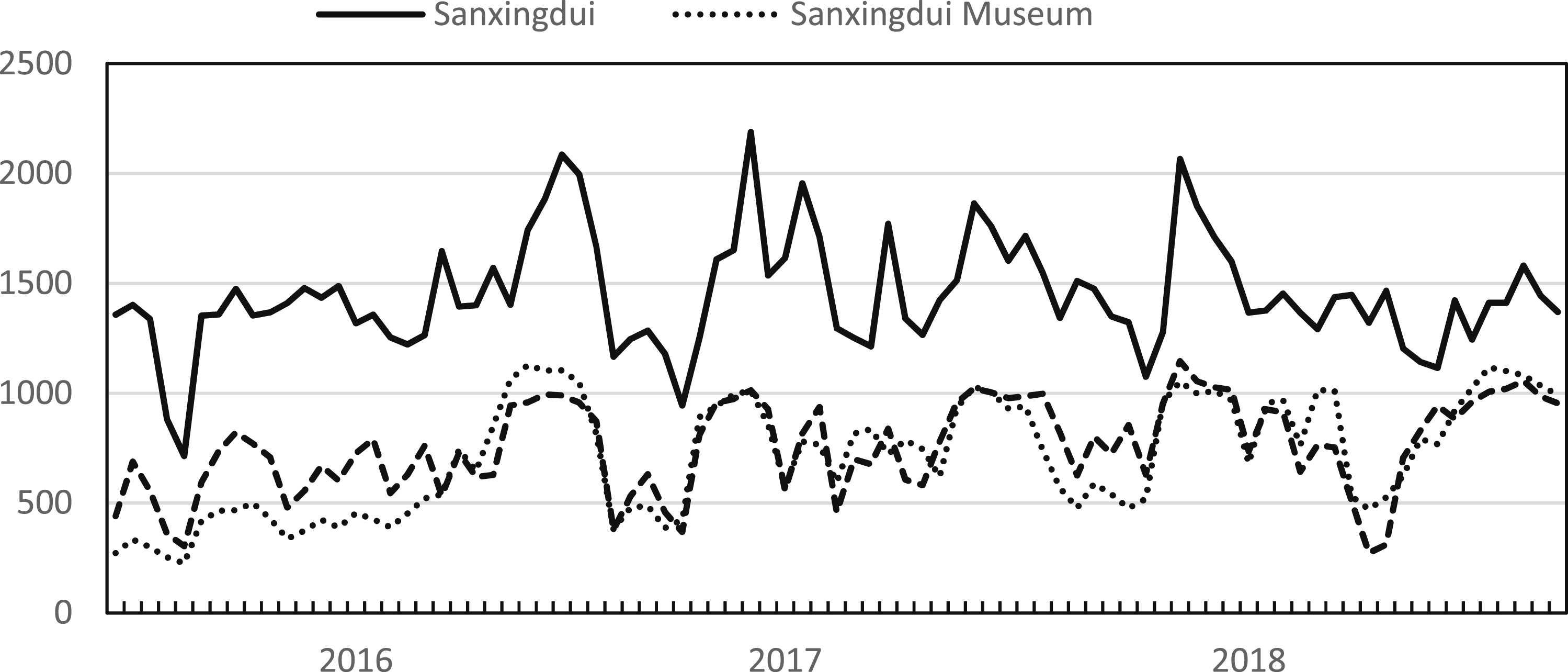
Correlation analysis
Correlation between Baidu Index and daily passenger flow of scenic spots.
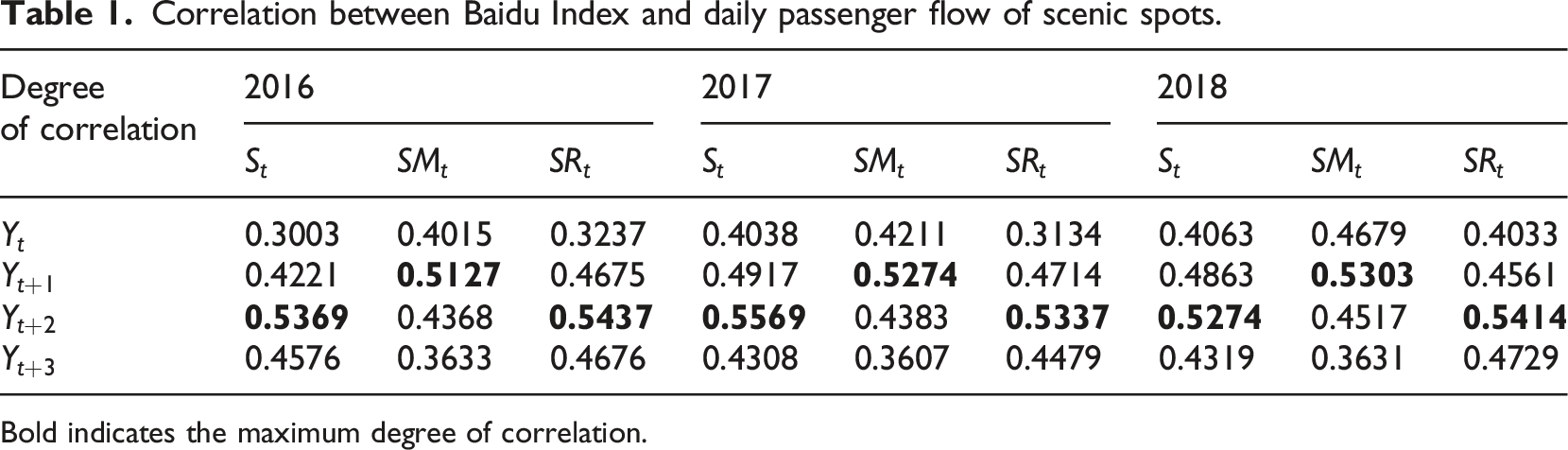
Bold indicates the maximum degree of correlation.
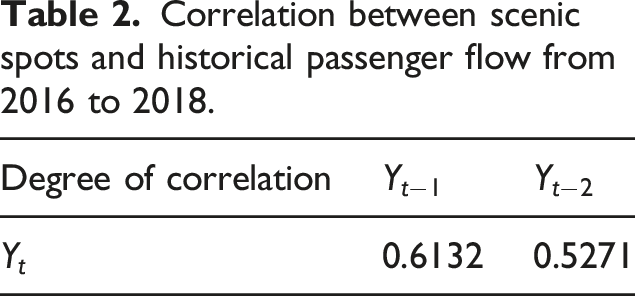
Correlation between scenic spots and historical passenger flow from 2016 to 2018.
SVR model training prediction
Data input variable determination
Through the previous correlation analysis, the final input variables are determined to include five input variable, Baidu Index 
Model prediction
The training and learning process of the SVR model was completed on the MATLAB experimental platform. Among the 85 data samples, the first 56 were used as the training set, and the last 29 were used as the testing set. The training set mainly included passenger flow from 2016 to 2017, while the testing set mainly consisted of passenger flow from 2018.
During the model training process, genetic algorithm was used to select the optimal loss function, penalty coefficient, width coefficient, threshold, and other parameters for the SVR model, in order to obtain the optimal prediction model for SVR. According to the GA process steps, before inputting data, normalize all types of data in the sample to the range of [0.15, 0.85]. Set the relevant parameters of the initial population: population size is 100, maximum evolution generation is 300, crossover probability, and mutation probability are 0.5 and 0.005, respectively, and cross validation fold is set to 10. Cross validation method divides the sample data into K subsets, where K-1 subsets are trained to obtain decision criteria, and the obtained decision criteria are used to validate the remaining subsets. Repeat the process until all subsets are used as validation sets, and the convergence criterion is Root Mean Square Error (RMSE), which is the fitness function. The fitness function is better when the RMSE value in the training set is smaller, and it is more likely to be retained in the next iteration. RMSE is defined in equation (5), 
After training, the optimal parameters for the SVR model are loss function parameter
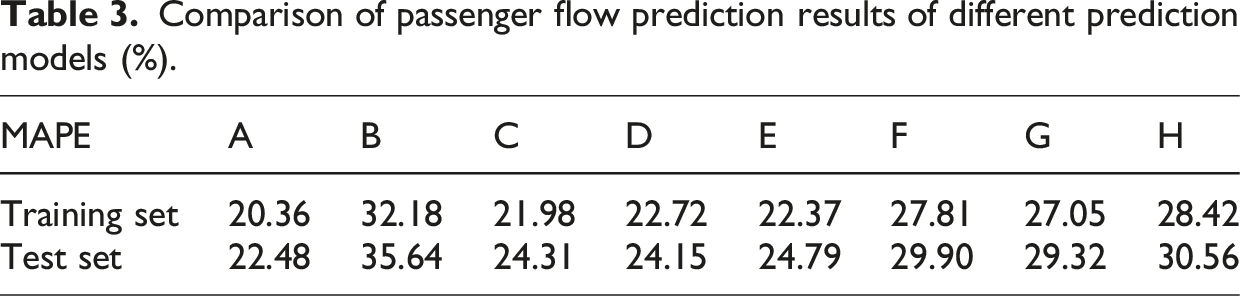
Comparative analysis of prediction results

Comparison of passenger flow prediction results of different prediction models (%).
Conclusion
The tourism industry has become one of the pillar industries of the national economy and has important economic significance for regional development. Good tourism demand prediction models play an increasingly important role in the development of the tourism industry. Accurate prediction of short-term passenger flow, especially holiday passenger flow, is of great significance to the management decision-making of scenic spot tourism management departments, prevent the occurrence of unsafe events in the scenic area, and promote the safe construction of the scenic area. This article takes the representative of the ancient Shu civilization, Sanxingdui, as the research background, explores the current trend of tourism development, sorts out the research status at home and abroad, and based on this, uses the holiday passenger flow data of Sanxingdui Festival from 2016 to 2018 and Baidu search index as data samples, and uses SVR prediction method to establish a holiday day passenger flow prediction model. The empirical results indicate that the Baidu index, as a predictive variable, can effectively improve the predictive performance of the model. At the same time, this study can provide scientific suggestions for management decision-making and operation promotion for scenic spot tourism management departments and tourism-related enterprises, which is of great significance for improving the quality of scenic spot services, rational allocation of tourism resources, and increasing tourism revenue.
Of course, due to the limitation of limited data samples, the prediction error is still relatively large. Future research can further enrich the prediction variables of the prediction model by collecting relevant data on transportation, hotel accommodation, weather, and mobile communication in scenic areas. At the same time, the prediction method can be improved and the data processing methods optimized, which can greatly improve the prediction effect and provide more scientific reference basis for scenic areas and relevant departments.
Development strategy suggestions
On July 26, 2023, President Xi Jinping visited the Sanxingdui Museum to learn about the excavation process of the Sanxingdui site and the achievements of ancient Shu civilization, and provided important instructions for Chinese archaeological work. In November 2018, Peng Qinghua, Secretary of the Sichuan Provincial Party Committee, attended the “Sichuan Hong Kong Macao Cooperation Week - Entering Hong Kong” Economic and Trade Cooperation Forum held in Hong Kong. He first proposed the concept of the “San Jiu Da (Chinese Pinyin)” and promoted Sichuan’s tourism business card to the world. “San” refers to the representative of ancient Shu civilization—Sanxingdui, and “Three” also expresses the historical civilization of Tianfu. However, the current tourism development in Sanxingdui needs to be vigorously promoted, with huge potential for development. Attracting and increasing passenger flow is one of the most crucial steps. Therefore, suggestions for promoting Sanxingdui culture and attracting customer traffic are proposed in two aspects.
Deep integration of information technology and scenic area development
On the one hand, the application of information technology can enhance the tourism experience of tourists. For example, virtual cultural relics developed using information technology such as virtual reality and augmented reality can present the collection of cultural relics in a close, real, and all-round manner in front of tourists, providing an interactive visiting mode that real cultural relics cannot provide. On the other hand, the new generation of information technology represented by big data can fully explore and analyze tourist information, explore their consumption and tourism behaviors, attract more potential tourists, and develop personalized tourism products. This not only effectively improves tourist satisfaction but is also very conducive to the management and operation of scenic spots. More importantly, the application of information technology, especially the new generation of information technology, is the main content and key technology in the construction of smart scenic spots.
Organic integration of rural tourism and cultural tourism
Due to the geographical limitations of Sanxingdui, the development of Sanxingdui scenic area should be organically integrated with the development of surrounding rural tourism, forming a coordinated regional tourism. By establishing theme cultural parks with Sanxingdui characteristics in relevant rural areas, developing a number of tourism performance programs on ancient Shu culture, and carrying out rich and colorful ancient Shu culture tourism festivals on this basis, we will change the traditional single tour explanation style tourism method. Through rural tourism as a medium, we will vigorously promote and promote ancient Shu culture, thereby attracting more tourists to join the regional tourism model of “rural tourism + ancient Shu culture tourism” or “ancient Shu culture tourism + rural tourism,” and improving the regional tourism economy.
Footnotes
Acknowledgments
Author would like to express the sincere appreciation to the editor and the three independent referees in making valuable comments and suggestions to this paper. Their comments and suggestions have improved the quality of the paper immensely.
Funding
The author disclosed receipt of the following financial support for the research, authorship, and/or publication of this article: This research was supported by the project of The Research Center of Sichuan Province on Preventing and Controling Crime, China (Project No. FZFK24-10).
Declaration of conflicting interests
The author declared no potential conflicts of interest with respect to the research, authorship, and/or publication of this article.