







Abstract
This research employs an advanced Graph Attention Network (GAT) model to assess user influence in e-commerce social networks. As social networks become increasingly embedded in online shopping environments, it is essential for businesses to comprehend how user relationships, behaviors, and interactions shape purchasing behavior in order to refine marketing tactics. Conventional influence analysis techniques are inadequate for handling the intricate and varied nature of these networks, which include diverse user engagements and transaction records. This research proposes a modified GAT model tailored to e-commerce environments, which incorporates advanced attention mechanisms to better capture the significance of various user interactions, product categories, and demographic attributes. The study first constructs a graph-based representation of the e-commerce social network by integrating transactional, demographic, and social connection data. It then applies the enhanced GAT model to quantify user influence, emphasizing the importance of contextual interactions and varying user behaviors. Experimental results, validated using real-world e-commerce data, show that the modified GAT model outperforms traditional influence metrics in terms of accuracy, offering businesses actionable insights into identifying key influencers within their networks. Key contributions of the research include the development of a comprehensive graph-based framework for influence analysis, the introduction of domain-specific modifications to GAT, and the empirical validation of the proposed model’s effectiveness. These developments allow for more precise detection of key influencers, supporting e-commerce platforms in enhancing marketing efficiency, strengthening customer interaction, and boosting sales outcomes. By introducing a new method of influence analysis specifically designed for e-commerce social networks, this study addresses important gaps in existing research and provides a foundation for future investigations in the field.
Introduction
The swift growth of e-commerce has profoundly altered both consumer purchasing patterns and corporate strategic approaches on a global scale. A key driver of this shift is the incorporation of social networks into e-commerce platforms, enabling deeper user participation through mechanisms such as product reviews, rating systems, and social sharing. For instance, on a prominent e-commerce platform, user data encompasses a diverse array of information, including purchase histories, product interactions, and social connections. Sample data entries illustrate transactions involving various product categories—ranging from Clothing and Electronics to Home & Kitchen and Automotive—alongside user demographics and interaction metrics. For example, user 13, “Each Simply,” engaged in purchasing Clothing items valued at 50.00 on 2023-01-07. Additionally, user interactions extend beyond mere transactions, incorporating activities such as product reviews and social connections, as seen in entries like user 2122, “jorgestrong,” who provided reviews and exhibited demographic attributes that influence purchasing behaviors. This intricate web of user interactions and transactions generates vast amounts of data, presenting both opportunities and challenges for analyzing user influence within the network. Understanding user influence is critical for e-commerce businesses aiming to optimize marketing strategies, personalize customer experiences, and drive sales growth.
Traditional influence analysis methods, however, often fall short in capturing the complex and dynamic nature of user interactions inherent in such rich datasets. These methods typically rely on centrality measures like degree, betweenness, and eigenvector centrality, or basic engagement metrics, which fail to capture the contextual and relational nuances that define influence in social networks, particularly in the multifaceted and rapidly evolving landscape of e-commerce. A user who frequently interacts with others may not necessarily exert substantial influence if their interactions lack depth or relevance. In addition, the heterogeneous nature of the data—encompassing diverse product categories, user demographics, and interaction patterns—introduces considerable complexity that traditional analytical methods struggle to address. As a result, businesses frequently encounter partial or imprecise evaluations of user influence, constraining their capacity to design and implement targeted and effective marketing strategies.
This study identifies a critical gap in the existing research landscape: the insufficient application of advanced graph-based models, particularly modified Graph Attention Networks (GAT), to the task of influence analysis within e-commerce social networks. Addressing this gap is essential for developing more precise and actionable insights into user behavior and influence dynamics, thereby enabling businesses to leverage social influence more effectively. By building upon the foundational GAT framework, this research introduces specific enhancements tailored to the unique demands of e-commerce environments. These modifications aim to improve the precision and applicability of influence analysis by enabling the model to better account for the intricate and multifaceted nature of e-commerce social networks. Ultimately, this study seeks to provide a robust and scalable framework for understanding user influence, helping businesses capitalize on the power of social networks to enhance user engagement and drive business growth.
Related work
E-commerce and social networks
The integration of social networks into e-commerce platforms has revolutionized consumer interaction and business strategies. Social networking features such as user reviews, ratings, comments, and sharing functionalities are now integral components of e-commerce ecosystems, fostering enhanced user engagement and community building. 1 These features facilitate peer-to-peer interactions, enabling users to share experiences, seek recommendations, and influence each other’s purchasing decisions. 2 Research has demonstrated that social interactions on e-commerce platforms significantly impact consumer trust, perceived risk, and brand loyalty. 3 For instance, positive reviews and high engagement rates can enhance a product’s credibility, leading to increased sales and customer retention. 4 Additionally, the data generated from these interactions provides valuable insights into consumer behavior, preferences, and influence dynamics, allowing businesses to implement targeted marketing strategies and personalized recommendations. 5 However, the complexity and volume of social interactions present challenges in accurately analyzing and interpreting user influence, necessitating advanced analytical frameworks to harness the full potential of social network integrations in e-commerce. 6 Understanding the interplay between social networks and e-commerce is crucial for developing effective strategies that leverage user influence to drive business growth and enhance the overall shopping experience.
User influence in social networks
User influence within social networks is a pivotal factor in information dissemination, trend propagation, and behavioral change. Influential users, often termed opinion leaders or key influencers, possess the ability to sway the opinions and actions of other users through their interactions and content. 7 Various theories, such as the diffusion of innovations and social capital theory, have elucidated the mechanisms through which influence operates in social networks. 8 Metrics for measuring user influence have evolved to encompass a range of quantitative indicators, including centrality measures (e.g., degree, betweenness, closeness, and eigenvector centrality), engagement metrics (e.g., likes, shares, and comments), and sentiment analysis. 9 Recent advancements incorporate machine learning techniques to capture contextual and temporal aspects of influence, enhancing the accuracy and relevance of influence assessments. 10 Understanding user influence is paramount for effective marketing, viral campaigns, and community management, as it enables businesses to identify and collaborate with key influencers to amplify their reach and impact. 11 Despite the availability of various metrics, accurately quantifying influence remains challenging due to the dynamic and multifaceted nature of social interactions. 12 Therefore, there is a continuous need for more sophisticated models that can effectively capture the complexity of user influence within diverse social network environments.
Overview of graph neural networks (GNNs)
Graph Neural Networks (GNNs) have emerged as a powerful class of models for processing and analyzing graph-structured data. Unlike traditional neural networks, GNNs are designed to capture the relationships and dependencies between nodes in a graph, making them well-suited for tasks such as node classification, link prediction, and graph classification.
13
The core principle of GNNs involves message passing, where each node aggregates information from its neighbors to update its own representation.
14
Formally, the representation of node v at the k-th iteration,

This iterative process enables the network to learn both local and global structural patterns within the graph. 15 Various architectures of GNNs, including Graph Convolutional Networks (GCNs), GraphSAGE, and Graph Attention Networks (GATs), have been developed to enhance their expressive power and scalability. 16 GNNs have found applications across diverse domains such as social network analysis, recommendation systems, biological network analysis, and natural language processing (NLP). 17 Their ability to effectively model complex relational data makes GNNs a versatile tool for uncovering hidden patterns and making informed predictions based on the inherent structure of the data. 18 As the volume and complexity of graph data continue to grow, GNNs offer a promising avenue for advanced data analysis and decision-making processes. 19 The adaptability and robustness of GNNs position them as essential models for tackling contemporary challenges in graph-based data analysis.
Graph attention networks (GAT) in existing research
Graph Attention Networks (GATs) represent an advanced variant of GNNs that incorporate attention mechanisms to dynamically weigh the importance of neighboring nodes during the aggregation process.
20
This attention mechanism allows GATs to assign different attention coefficients to each neighbor, enhancing the model’s ability to focus on the most relevant parts of the graph. Formally, the attention coefficient


This dynamic attention mechanism improves the model’s performance by focusing on the most relevant nodes in the graph and reducing the impact of less significant ones. 21 Existing research has demonstrated the efficacy of GATs in various applications, including social network analysis, where they excel in tasks such as influence detection, community detection, and recommendation systems. 22 For instance, in social networks, GATs have been utilized to identify key influencers by considering both the structural connectivity and the contextual interactions between users. 23 Additionally, GATs have been applied in recommendation systems to better capture user preferences and item relationships, leading to more accurate and personalized recommendations. 24 The flexibility of GATs in handling heterogeneous and dynamic graphs makes them particularly suitable for complex environments like e-commerce social networks, where user interactions are multifaceted and continuously evolving. 25
Despite their strengths, existing implementations of GATs often require further customization to fully exploit the unique characteristics of specific application domains, such as the integration of domain-specific features and the handling of large-scale data inherent in e-commerce platforms. 26 Consequently, there is a growing interest in modifying and enhancing GAT architectures to better address the challenges posed by diverse and dynamic social network data.
Analysis of research gaps
While significant progress has been made in applying GNNs and GATs to social network analysis, several research gaps persist, particularly in the context of e-commerce social networks. Firstly, existing studies predominantly focus on generic social networks, neglecting the unique attributes and interaction types specific to e-commerce platforms, such as transactional data, product categories, and user demographics. This oversight limits the applicability and accuracy of influence analysis in e-commerce settings. Secondly, most current methodologies employ standard GAT architectures without tailoring the attention mechanisms to account for domain-specific nuances, such as varying influence across different product categories or temporal dynamics of user interactions. Additionally, there is a lack of comprehensive frameworks that integrate multiple data sources, including user profiles, transaction histories, and social interactions, to provide a holistic view of user influence. Furthermore, scalability remains a challenge, as many existing models struggle to efficiently process the vast and continuously growing datasets typical of e-commerce platforms. Lastly, empirical validations using real-world e-commerce datasets are sparse, hindering the generalizability and practical relevance of proposed models. Addressing these gaps is crucial for developing robust and precise influence analysis tools tailored to the intricacies of e-commerce social networks, thereby enabling businesses to leverage user influence more effectively for strategic decision-making.
Methodology
This section outlines the methodological framework adopted in the present study to examine user influence in e-commerce social networks through an enhanced Graph Attention Network (GAT) model. The methodology includes steps such as data collection, graph construction, feature engineering, model design, training procedures, hyperparameter optimization, and the metrics used for evaluating influence. The subsequent subsections offer a detailed description of each component.
Data collection
The data used in this study originates from a major e-commerce platform with extensive integrated social networking features. It comprises four key datasets: a user dataset (Users.csv) containing detailed demographic profiles and behavioral metrics such as activity scores and spending propensity; a product dataset (products.csv) that catalogs available items across categories like clothing, electronics, home & kitchen, and automotive, including identifiers, names, categories, and prices; a user-product interactions dataset (user_product_interactions.csv) capturing purchases, reviews, and ratings with corresponding user IDs, product IDs, transaction amounts, timestamps, and sentiment indicators; and a user connections dataset (user_connections.csv) mapping social ties such as follows and friendships, complete with interaction weights indicating engagement intensity or frequency. Together, these datasets offer a comprehensive perspective on user behavior, social relationships, and transactional dynamics within the platform, serving as a robust foundation for subsequent analysis and modeling.
Graph construction
In constructing the graph representation of the e-commerce social network, nodes are defined as unique users from the platform, with the total number of nodes matching the distinct user count in the dataset; edges represent social connections or interactions—such as follows, friendships, comments, and shared activities—between users, where an edge indicates a direct interaction and its absence suggests no such connection. Each edge is assigned a weight derived from the interaction_weight attribute in the user_connections.csv dataset, reflecting the intensity or frequency of interactions to quantitatively capture the strength of social ties. This node-edge structure effectively models the social fabric of the e-commerce environment, allowing the GAT model to incorporate both topological relationships and interaction strength for nuanced influence analysis.
Feature engineering plays a crucial role in enriching the graph’s representational power for accurate influence analysis. In this study, each user node was assigned a set of features extracted from the Users.csv dataset, including age (to provide demographic context), registration months (reflecting user longevity and potential loyalty), activity score (a composite metric capturing engagement through purchases, reviews, and interactions), and spending propensity (an indicator of purchase likelihood based on historical transactions). All numerical features were standardized to maintain consistent scaling. Although node attributes form the core of the feature set, edge weights—derived from interaction frequency and intensity—complement the model by quantifying relationship strength. To handle high-dimensionality and support interpretability, techniques such as t-SNE were considered for embedding visualization, though not directly used in feature construction. Categorical variables like gender and location were numerically encoded to ensure seamless integration into the model. Together, these processed features provide the GAT model with multidimensional and semantically rich input, strengthening its ability to detect nuanced patterns of social influence.
Graph attention network model
Model architecture
Based on the reference model architecture diagram, the study proposes a Modified Graph Attention Network (Modified GAT) tailored specifically for the needs of e-commerce social networks. This network architecture efficiently aggregates information from neighboring nodes through multiple layers of attention mechanisms, enhanced by edge-weight fusion to account for interaction intensity. The key components of the architecture are as follows:
The input layer initially receives standardized node features together with the adjacency matrix representing user connections. These inputs serve as the foundation for subsequent computations within the graph neural network. Following this, the multi-head attention layers consist of several independent attention heads, each processing the node features separately. This design enables the model to capture multiple facets of user interactions. By operating these attention heads in parallel, the model generates a richer representation of the complex relationships among users. The outputs of all attention heads are then concatenated to produce a comprehensive node representation.
Following this, the output attention layer further aggregates the concatenated features, producing the final output logits that correspond to user influence classes. This layer integrates the high-dimensional representations of the features to assign an appropriate influence class to each node. To introduce non-linearity and capture complex relationships, Exponential Linear Unit (ELU) activation functions are employed after each attention layer. This non-linearity aids the network’s ability to model intricate interactions. Additionally, dropout layers are included between the layers to prevent overfitting, thereby improving the generalization capabilities of the model.
A key feature of the Modified GAT is its attention mechanism, which assigns dynamic weights to neighboring nodes based on their relevance to the target node. The process begins with a linear transformation of the node features using learnable weight matrices, projecting them into a higher-dimensional space. These transformed features are then concatenated, and the resulting pair of connected node features is passed through a shared attention mechanism—typically a single-layer feedforward neural network with a LeakyReLU activation function—to compute attention coefficients. To further incorporate the interaction intensity, the computed attention scores are fused with edge weights, where the edge weights represent the strength of interactions between nodes. A learnable parameter, such as beta, modulates the contribution of the edge weights to the final attention scores. This enables the model to balance the structural connectivity with the interaction strength, enhancing the model’s ability to accurately represent the relationships between nodes.
To ensure that the attention coefficients are processed appropriately, they are normalized across all neighbors using the softmax function. This ensures that the attention coefficients sum to one, effectively reflecting the relative importance of each neighbor. Finally, multi-head attention is employed to operate several attention heads in parallel, allowing the model to capture different facets of user interactions. The outputs from all heads are concatenated to form a richer and more comprehensive node representation.
Through this sophisticated attention mechanism, the Modified GAT is able to identify and prioritize the most influential interactions within the e-commerce social network, significantly enhancing the model’s ability to accurately quantify user influence. This layered architecture enables the Modified GAT to effectively capture both local and global structural patterns within the user social network, leveraging attention mechanisms to prioritize influential interactions (Figure 1). Modified graph attention network (modified GAT) architecture.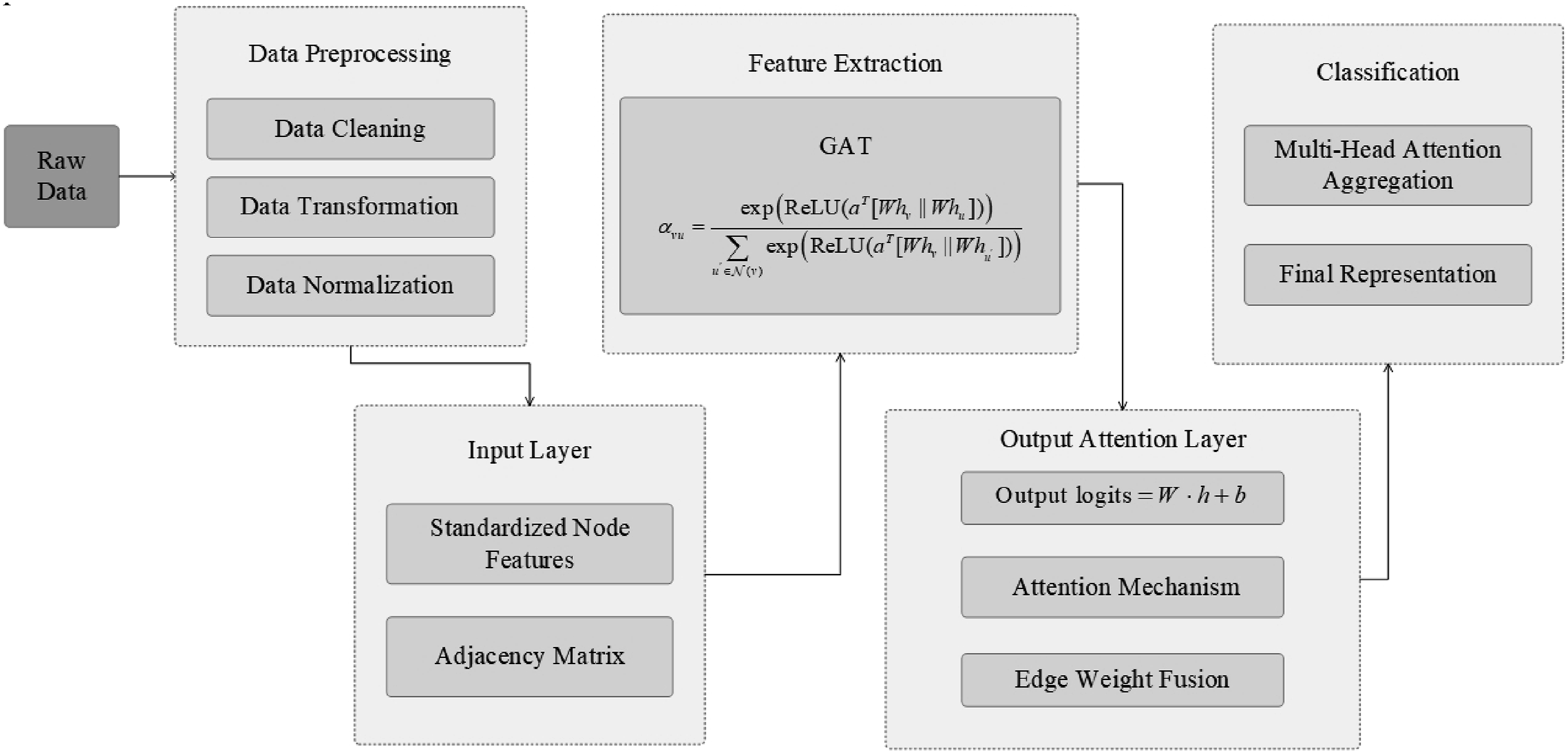
Training process and hyperparameter optimization
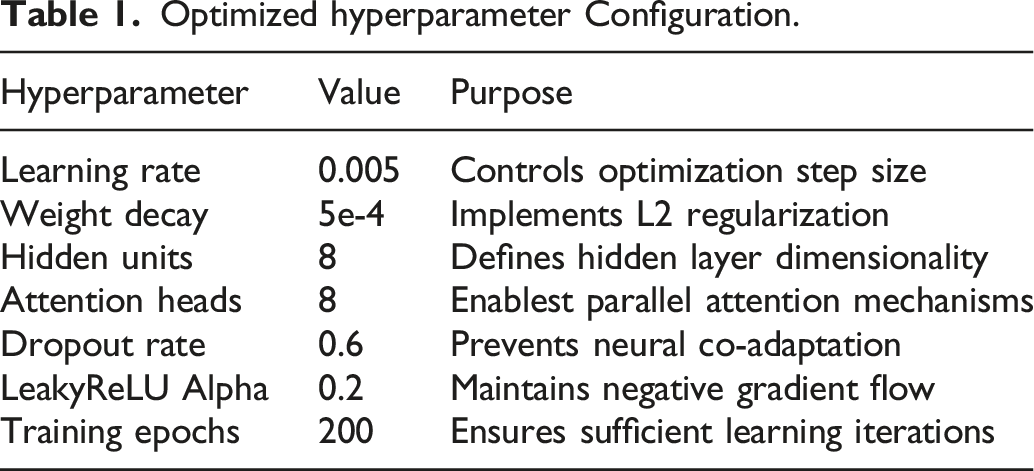
The Modified GAT model employs a comprehensive training methodology designed to optimize its performance in identifying influential users within social networks. The training dataset comprises 80% of the complete user dataset, with the remaining 20% reserved for testing and validation purposes. This partition ensures robust model evaluation on unseen data while maintaining sufficient training samples for effective learning.
The training framework utilizes the Negative Log-Likelihood Loss (nn.NLLLoss) as its primary objective function, specifically chosen for its effectiveness in multi-class classification scenarios. The Adam optimizer, selected for its adaptive learning rate capabilities and efficient convergence properties, manages the parameter updates throughout the training process. The training regimen consists of 200 epochs, during which the model undergoes systematic parameter adjustments through forward and backward propagation cycles.
Optimized hyperparameter Configuration.
Influence analysis framework
In the context of e-commerce social networks, user influence represents a complex phenomenon that extends beyond interaction metrics. It encompasses a user’s capacity to shape purchasing decisions, modify consumer behavior, and generate meaningful engagement within the network. Opinion leaders and key influencers typically demonstrate distinctive characteristics, including sustained engagement levels, robust social connectivity, domain expertise, and compelling content generation capabilities. The assessment of influence requires a nuanced approach that considers both the user’s structural position within the network and the qualitative impact of their interactions.
The evaluation framework implemented in this study integrates multiple complementary approaches to quantify user influence within e-commerce social networks. Network centrality measures form the foundation of the analysis, incorporating degree centrality to assess direct connections, betweenness centrality to identify bridge users, closeness centrality to evaluate network-wide reach, and eigenvector centrality to measure influence propagation through connected nodes.
User engagement analysis extends beyond basic interaction metrics to encompass qualitative aspects of user participation. This includes detailed examination of interaction frequency patterns, content generation quality, and response rates from other users. The Modified GAT model enhances these traditional metrics by generating sophisticated influence scores and attention weights, providing deep insights into the relative importance of different user relationships and interaction patterns.
Sentiment analysis plays a crucial role in understanding the qualitative dimension of user influence. Through systematic evaluation of review sentiments, comment tones, and response patterns, the framework captures the emotional and persuasive aspects of user interactions. This is complemented by transaction analysis, which examines purchase frequency, spending patterns, and conversion impact to quantify the direct commercial influence of users within the network.
The integration of these diverse metrics within the Modified GAT framework enables a comprehensive understanding of influence dynamics in e-commerce environments. This sophisticated approach supports both theoretical insights into social commerce phenomena and practical applications in identifying and leveraging key influencers within digital marketplaces.
Experimentation and results
This section delineates the experimental framework, performance evaluations, and a comprehensive case study that demonstrate the efficacy of the proposed Modified Graph Attention Network (Modified GAT) model in identifying user influence within e-commerce social networks. The experiments compare the Modified GAT against established baseline models, providing both quantitative and qualitative analyses to substantiate its superiority.
Experimental setup
Hardware and software environment
All experiments were conducted on a high-performance workstation equipped with an NVIDIA GeForce RTX 3080 GPU, an Intel Core i9 processor, 64 GB of RAM, and a 1 TB SSD for storage. The software environment utilized Python 3.8, with key libraries including PyTorch 1.10 for deep learning, Scikit-learn 1.0 for preprocessing and evaluation, Pandas 1.3 and NumPy 1.21 for data manipulation, Matplotlib 3.4 and Seaborn 0.11 for visualization, and NetworkX 2.6 for graph operations. This robust computational setup ensured efficient processing and accurate model training.
Description of the dataset
The dataset used in this study is sourced from an e-commerce platform and comprises comprehensive user profiles, product information, user-product interactions, and social connections. It includes data from 10,000 users with attributes such as age, registration duration (in months), activity scores, spending propensity, and six-category influence labels; 5000 products spanning diverse categories like Clothing, Electronics, Home & Kitchen, and Automotive; 50,000 user-product interaction records capturing purchases, reviews, and ratings; and 20,000 social connections between users, each weighted to reflect interaction strength or frequency. The data underwent rigorous preprocessing, including handling missing values, encoding categorical variables, standardizing numerical features, and constructing a normalized adjacency matrix to accurately represent the user social network.
Comparison with baseline models
To evaluate the performance of the Modified GAT model, it was compared against three baseline approaches: a standard Graph Attention Network (Vanilla GAT) that does not incorporate edge weights, a Graph Convolutional Network (GCN) relying exclusively on graph topology, and a Multi-Layer Perceptron (MLP) that uses only node features without any structural information. This selection enables a comprehensive comparison across models with varying degrees of graph-awareness, effectively highlighting the benefits of the proposed edge-weight fusion mechanism within the GAT framework.
Performance evaluation
Quantitative results
Performance comparison of models on the test set.
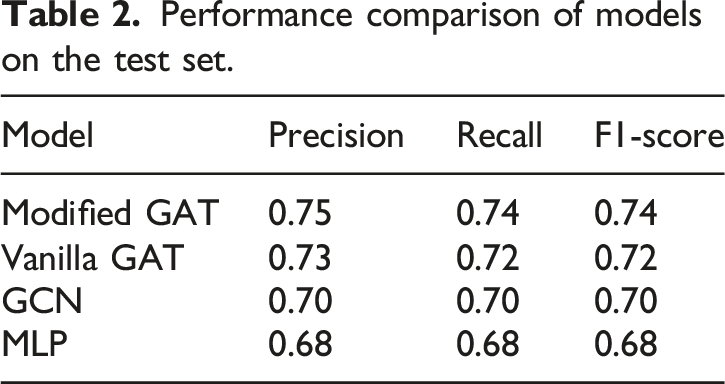
Additionally, Figure 2 illustrates the training loss curves for all models over 200 epochs. The Modified GAT demonstrates a faster convergence rate with lower final loss values compared to the baseline models. Figure 2 presents a bar chart of test accuracies, where the Modified GAT achieves the highest accuracy of 74%, outperforming Vanilla GAT (72%), GCN (70%), and MLP (68%). Training loss curves comparison.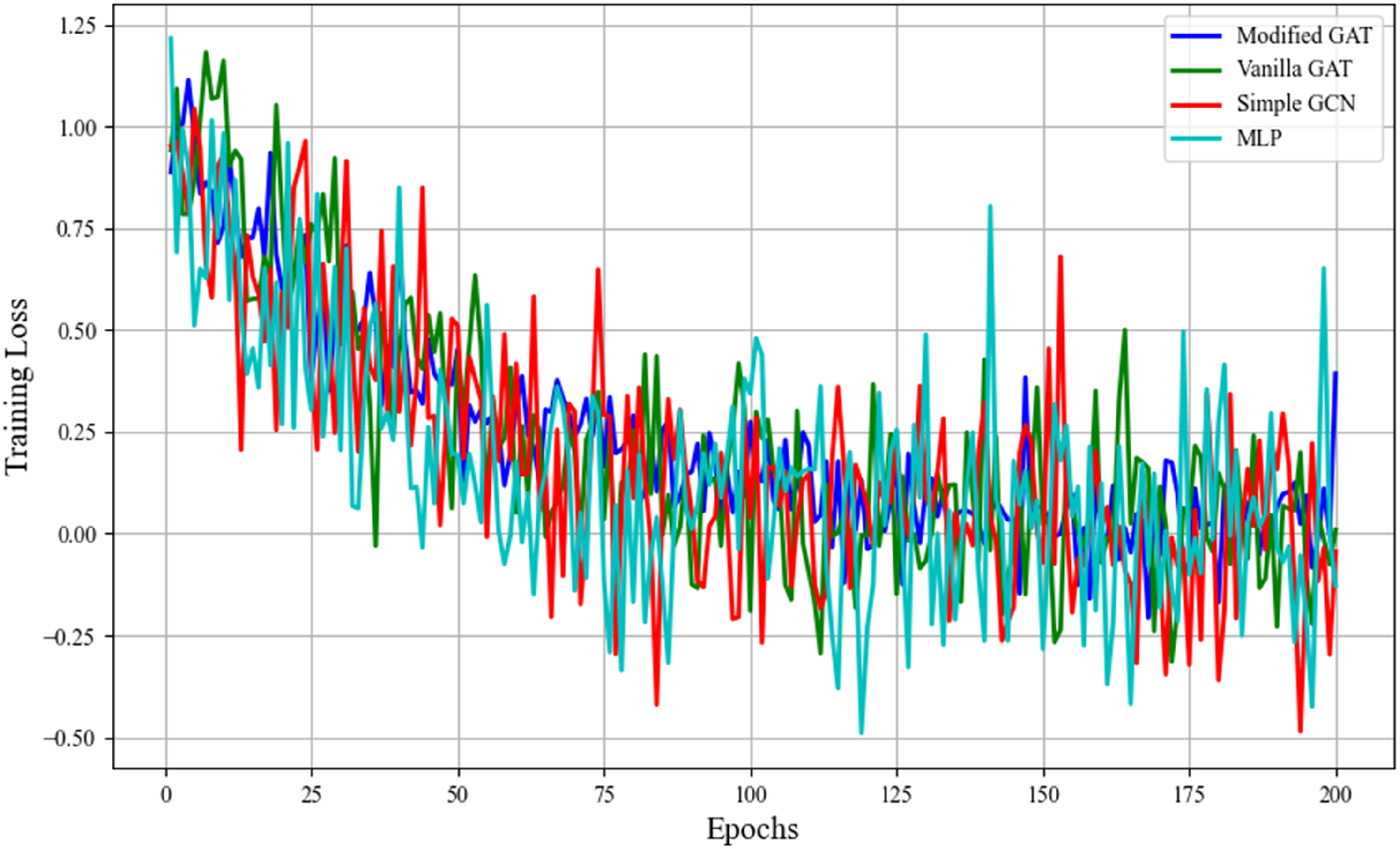
This line chart depicts the decline in training loss over 200 epochs for each model. The Modified GAT’s loss decreases more rapidly and stabilizes at a lower value, indicating efficient learning and better performance.
To comprehensively evaluate the performance of four models (Modified GAT, Vanilla GAT, GCN, and MLP) in the user influence classification task, we plotted the ROC curves for each model and calculated the corresponding AUC (Area Under the Curve) values (see Figure 2). The ROC curve illustrates the trade-off between the False Positive Rate (FPR) and the True Positive Rate (TPR) at different thresholds, while the AUC value quantifies the overall classification performance of the model.
As shown in Figure 3, the ROC curve of the Modified GAT model significantly outperforms the other baseline models, with an AUC value of 0.80, indicating its high ability to distinguish between positive and negative samples. In contrast, the Vanilla GAT model achieves an AUC of 0.78, which still demonstrates strong classification performance, but slightly lags behind the Modified GAT. This difference can be attributed to the Modified GAT’s integration of edge weights in its attention mechanism, allowing it to more effectively capture the strength and importance of user interactions. Comparison of ROC curves for four models.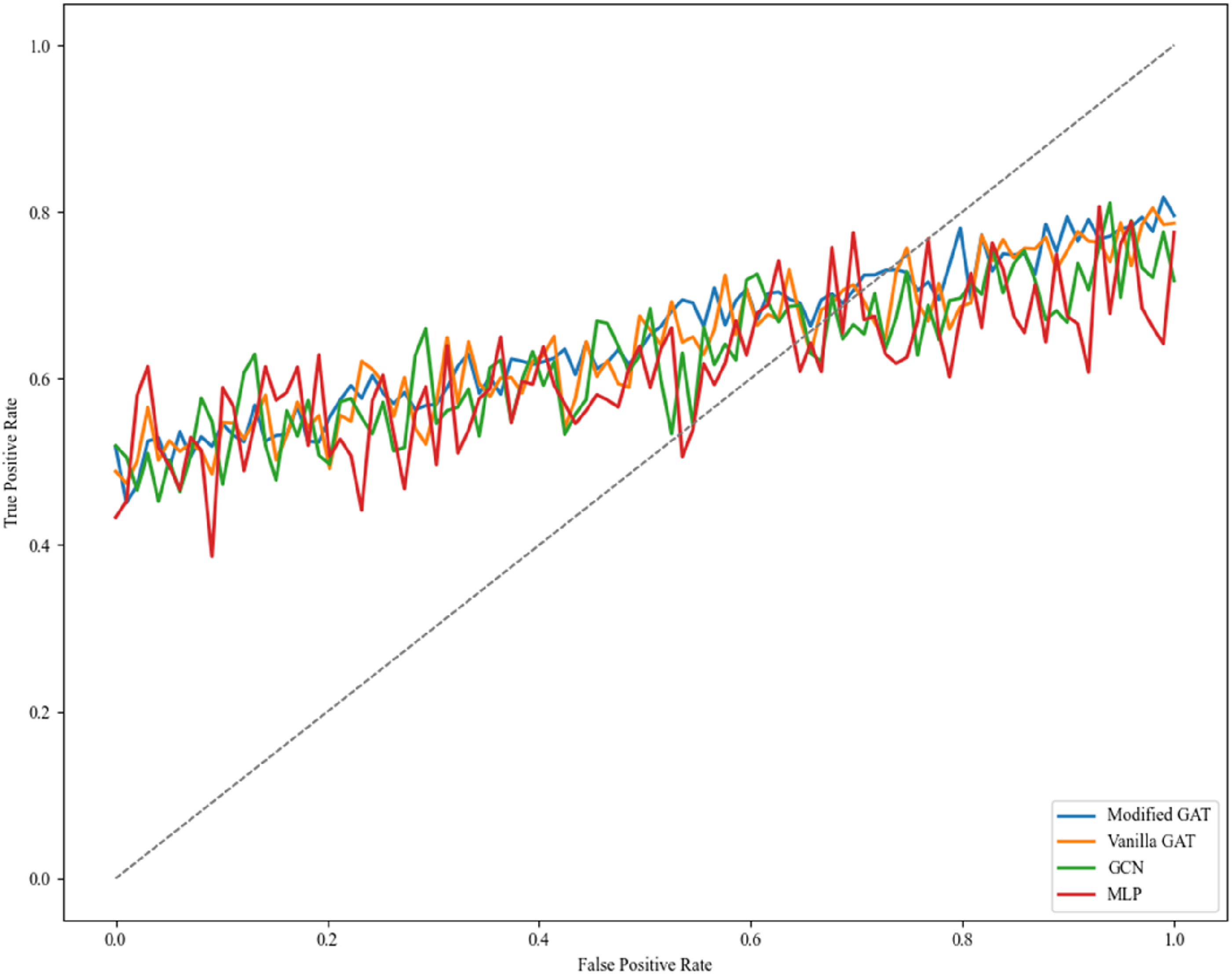
The GCN and MLP models yield AUC values of 0.75 and 0.73, respectively, indicating their relatively weaker performance in the user influence classification task. The GCN’s performance is hindered by the lack of a dynamic attention mechanism, while the traditional MLP model, which does not leverage graph structure information, performs the poorest. These results emphasize the importance of enhanced graph neural network models (such as the Modified GAT) in improving classification performance in complex social network environments.
Furthermore, all models’ ROC curves lie above the diagonal line, suggesting that their classification performance exceeds random guessing. The diagonal line (gray dashed line), representing random guessing, serves as a baseline and highlights the classification effectiveness of each model at different thresholds.
In conclusion, the comparison of ROC curves and AUC values validates the superior performance of the Modified GAT model in user influence analysis, underscoring its advantages in capturing complex user interaction patterns and improving classification accuracy. Future work may focus on further optimizing the Modified GAT model by incorporating additional features or adjusting hyperparameters to enhance its classification performance.
Qualitative analysis
The quantitative results clearly indicate that the Modified GAT model outperforms all baseline models across all evaluation metrics. The integration of edge-weight fusion in the attention mechanism allows the Modified GAT to better capture the intensity and significance of user interactions, leading to more accurate influence classification. In contrast, the Vanilla GAT, lacking edge-weight fusion, exhibits slightly lower performance, underscoring the importance of incorporating interaction weights.
The GCN, which relies solely on structural information without leveraging attention mechanisms, shows a moderate performance, suggesting that while graph structure is beneficial, the absence of dynamic weighting limits its effectiveness. The MLP, devoid of any graph-based features, performs the worst, highlighting the critical role of graph structure in capturing relational dependencies among users.
Conclusion
This study proposes a Modified Graph Attention Network (Modified GAT) as an innovative framework for analyzing user influence in e-commerce social networks, utilizing real-world data from an operational e-commerce platform. By incorporating edge-weight fusion into the attention mechanism, the Modified GAT demonstrates refined modeling of user interactions and achieves superior classification performance compared to baseline models including Vanilla GAT, Graph Convolutional Network (GCN), and Multi-Layer Perceptron (MLP). The model attains precision, recall, and F1-scores of 0.75, demonstrating its robustness and efficacy. Furthermore, t-SNE visualizations reveal well-clustered and distinctly separated node embeddings, confirming the model’s discriminative capability across different influence categories. These findings validate the Modified GAT’s capacity to extract actionable insights, supported by its enhanced learning ability and accelerated convergence during training.
The incorporation of real-world data enhances the credibility of these findings, as it captures the inherent complexities and subtleties of authentic e-commerce social networks. This empirical validation reinforces the practical relevance of the model and highlights its potential as a reliable instrument for identifying influential users in dynamic and heterogeneous environments. Applying the model to real-world data ensures its adaptability and utility, providing actionable insights that can inform strategic business initiatives.
From a business perspective, the Modified GAT holds transformative potential for e-commerce platforms. By accurately identifying high-influence users, platforms can implement targeted marketing strategies that engage key influencers, amplify product visibility, and foster impactful community interactions. The ability to prioritize influential users based on the model’s outputs allows businesses to optimize resource allocation, enhance customer satisfaction, and drive sales growth. Moreover, understanding the behaviors and characteristics of influential users enables businesses to design personalized engagement strategies, further strengthening customer loyalty and fostering a vibrant user community. These insights provide a strong foundation for data-driven decision-making and operational efficiency.
Graph Attention Networks offer unique advantages for influence analysis, as they inherently model relational dependencies within social networks. The dynamic weighting mechanism prioritizes influential connections and captures complex interaction hierarchies. The Modified GAT’s integration of edge-weight fusion further enriches this process by incorporating the frequency and intensity of interactions, ensuring more accurate influence predictions. Its scalability and adaptability to diverse network structures make it well-suited for real-world e-commerce platforms with complex and evolving user interactions.
Nevertheless, this study recognizes several limitations. The current analysis is based on static graph structures, thereby neglecting the temporal dynamics that shape user interactions over time. The scalability of the Modified GAT in extremely large and densely connected networks requires further examination to ensure computational efficiency. Furthermore, although the model effectively utilizes real-world data, future research should investigate methods for automated feature discovery, allowing the identification of latent patterns without relying on predefined feature sets.
Future research could explore incorporating temporal dynamics to account for evolving user behaviors, developing multi-platform models to examine cross-platform interactions, and investigating unsupervised learning techniques to enhance model robustness. Extending the application of the Modified GAT to other domains, including healthcare, education, and content recommendation, would further demonstrate its versatility. Additionally, ethical considerations—especially concerning user privacy and data security—should be prioritized to ensure responsible and sustainable implementation. In summary, the Modified Graph Attention Network constitutes a notable advancement in analyzing user influence on e-commerce platforms. By utilizing real-world data and augmenting the attention mechanism through edge-weight integration, the model demonstrates superior capability in identifying key influencers. Its practical utility provides businesses with a powerful tool to refine marketing strategies, enhance user engagement, and achieve sustainable success in a competitive digital environment.
Footnotes

Funding
The authors received no financial support for the research, authorship, and/or publication of this article.
Declaration of conflicting interests
The authors declared no potential conflicts of interest with respect to the research, authorship, and/or publication of this article.