







Abstract
Planning has struggled with its identity as a profession. This has made planning systems vulnerable in the face of attacks on their utility. Sue Hendler was a passionate advocate of planning and its claims to professional status. Building on her writing, I argue that planning’s claims to professional status and expertise have validity. Judged against other professions, planners’ claims are of equal status, grounded as they are in the generation and melding of knowledge and knowledge claims and in the exercising of non-routinised judgement in issues pertaining to place and space. Planning practice and education needs to recognise this reality more explicitly.
Introduction
Much of Sue Hendler’s work focused on planning’s claims to professional status, what this meant in terms of its knowledge base, and the autonomy it may or may not have over a definable set of expertise. She promoted the use of professional codes to help debate, and to some degree determine, a moral mandate for planning dependent on the roles that planners adopt. This paper takes its cues from these concerns. It will not deal so much with the question of codes, which have themselves lost favour in part due to the wider critique of professions (see Laffin and Entwistle, 2000). But the underlying concerns remain and were central to Hendler’s work (e.g. 1991, 1995, 2005):
Do the activities associated with planning correspond to meanings of what constitute a profession?
And, what then do, and might, planners and the profession profess?
The notions of knowledge, expertise and judgment are explored to revisit the core concerns about planning’s claims to professionalism, whether it matters and what planning might be about in the future.
Methodologically, this paper brings together literature in conversation with 11 interviews with English planning practitioners to test some of the theoretical arguments circulating in relation to these areas. 1 Semi-structured interviews were conducted with planners, mostly senior professionals of over 20 years’ experience, typically encompassing a career in both private and public sectors (see Gunn and Vigar, 2012 for more on method). Interviewees were known to the interviewer personally to utilise established bonds of trust and thus to facilitate a deep exploration of their everyday practices. They responded for themselves as planners rather than as representatives of their organisations. Interviews were longer than is common: often 2–3 hours (the longest being 3 hours 20 minutes). Interviews were taped, transcribed and analysed. In this paper I use quotations from two interviewees in particular. ‘Interviewee A’ was employed in the public sector but had a history of practice in the private sector. ‘Interviewee B’ was employed in the private sector and had a history of working in the public sector and academia. Interviews were believed to be broadly representative of trends in English planning practice, although no representativeness is claimed. Rather, their stories are told to illuminate themes from the literature.
The first part of the paper explores the debate on planning’s claims to professionalism. The paper then examines notions of knowledge, expertise and judgement as three interlinked ideas that help to give meaning to what the activity of planning might be about. The diversity of what planners, planning and planning systems do and attempt to do worldwide implies that some context-specificity is important here. While some theorists have attempted to distil planning concerns into universal ideas, I acknowledge that this paper is rooted in the English experience of planning and its recent trajectory.
Professionalism and planning
The idea of planning as a profession came under particular attack from the 1960s onward (e.g. Johnson, 1972) and this can be seen as part of a general critique of the ‘state bureau-professions’ that consolidated in the welfare state post World War II (Clarke and Newman, 1997). The critique of planning’s professional status lay particularly in its claims to act in the public interest and to do so with a unique body of knowledge (e.g. Evans, 1993). Sue Hendler’s work of the 1990s is positioned in this context. She attempts to reconstruct a case for planning as a profession in some of her writing, positing the idea that planning as a profession has validity, but only when one recognises the falsity of techno-rational neutrality, and begins to open up the terrain of planning’s underlying moral mandate (e.g. Bickenbach and Hendler, 1994). Such ideas were posited at a time when post-modern approaches were also arguing the impossibility of positivist conceptions, but where finding a way forward in conditions of seemingly infinite diversity proved conceptually difficult. The theoretical foundations to do this have more recently emerged, sometimes through re-engaging with the notion of the public interest (e.g. Campbell, 2006).
Whose line is it anyway? Conceptualising professionalism
The critique of planning’s claims to professionalism rest on a series of propositions rooted in particular theoretical perspectives. Such perspectives and this broader critique of professions have themselves been revisited (e.g. Laffin and Entwistle, 2000). My argument here is that planning has paid little attention to the development of this literature and thus has failed to reassess planners’ claims to professional status.
The more recent literature on professions suggests that they need to be seen in the context of increasing specialisations within domains of practice; increases in the flow of available information that challenges notions of exclusivity to areas of knowledge; and a displacement of the power of bureau-professions by managerialist, and arguably de-professionalising tendencies in government through the imposition of performance management techniques (e.g. Clarke and Newman, 1997). The rise of governance as a normative idea and empirical phenomenon also potentially undermines the idea of the expert acting alone on a given issue in the bureau-state professions; as does the related emphasis on policy integration (Laffin and Entwistle, 2000; RTPI, 2007).
Bickenbach and Hendler (1994) identify three main criteria that occupations must meet to qualify as professions. First, there must be a knowledge base. Where recent theoretical developments depart from Hendler’s analysis is in the idea of an exclusive body of knowledge. The critique of planning’s claims to professionalism does indeed often rest on the proposition that planning does not possess this. 2 The conclusion arising from more recent studies is that the knowledge core of an activity that comes to be seen as a profession is often shared with other professions and disciplines and that the boundaries of what counts as knowledge within domains are subject to change over time (e.g. Squires, 2005). Amin and Roberts (2008) define a professional activity as having specialised expert knowledge. But for them, professional knowledge is only one type of knowing and professionals can never be said to have unique claims to particular bodies of codified knowledge. Rather, the definition of a profession tends to come to rest on claims to putting knowledge into action in certain contexts and the exercise of non-routinised judgement in doing so.
A second characteristic sees professions in terms of identity, the cohering of individuals performing similar work and thus in part almost self-defining. Indeed, Bickenbach and Hendler (1994) identify planners as a community of ‘like-learned individuals’. We can thus see professional communities as a type of community of practice (Amin and Roberts, 2008) made up of various communities of practitioners within organisations (Gherardi, 2006), while being linked to wider epistemic communities (Haas, 1992). Planning exhibits a stable epistemic community and so can lay claim to professional status on this criterion: professional association is thus seen from the practitioner outward, rather than top-down from the point of view of a set of outside criteria; a profession is phenomenological – it exists if it is experienced by a group of practitioners.
A third characteristic of a profession is that it performs a beneficial role in society. Few dispute the potential for planning to do this in theory, but in practice planning’s role is often questioned, especially its position in relation to development markets (e.g. Reade, 1987). The potential for the English planning system to perform this function in practice is discussed later in this paper.
Bickenbach and Hendler (1994) also highlight the importance of control mechanisms on entry as essential to define a profession. The value of such mechanisms has been much criticised; for example Healey (1985: 493) sees professionalisation of a given area of expertise valuable only if control over professional practice can ‘act as a guarantor of the quality and principles governing the delivery of the expertise’. Such critics tend to favour the idea of a profession as a learned society and many professions appear to be heading in this direction with looser controls on entry and more emphasis on providing arenas for professional discussion and networking (Laffin and Entwistle, 2000).
Squires (2005) has identified three further features that define professional work, which planning practice resonates with. First, planning can be seen as professional work in the sense that it is concerned with acting as much as knowing, working towards outcome. While many occupations can claim this, according to Squires there is also an irreversibility identifiable in professional action. Thus in planning, work such as a community consultation will irreversibly change the perceptions and possibly activities of many people in the short and long term. Second, professional work also tends to involve ‘repetition with variation’ (Squires, 2005: 134). Expertise is thus garnered through the learning of foundational knowledge but also more critically in the ‘accumulation of variation’ (of regeneration project development; of looking at householder planning applications etc.) and through this being able to see in the morass of information the salient features of a situation (Squires, 2005). This idea of seeing what is significant, or exercising judgement, is developed later in this paper. And finally, professional work is also time-dependent or time-critical. Closure, often necessitated by the need for action, is a feature of planning work, the practicalities of which is attracting more attention in the planning literature (Rydin, 2007). In addition to Squires’ three features, planners also lay claim to professional status through the formal or routinised trusting of them to perform and be held to account by clients (Koehn, 1994; Kitchen, 2007).
Knowledge in and for planning
Regardless of the arguments above, planning’s claims to professional status continue to reside in part in its knowledge base. In society generally what constitutes knowledge is now seen as deeply contested. And, as noted earlier, the readier availability of information also renders obsolete the ‘exclusivity’ claim on which many see professionalism residing. Given these changes in the broader contours of professionalism, which is evidenced in discussions in older professions such as medicine as well as newer ones, the critique of planning which rests in part on its failure to identify a singular body of knowledge by which to define itself is worth revisiting. In effect, broad shifts towards a constructivist epistemology of knowledge have rendered much of the critique of the ‘emptiness’ of planning in knowledge terms redundant. Alongside this, the traditional critique of planners’ claims to knowledge rest on ideas of propositional knowledge. In planning, as in professions more generally, a growth in the availability of propositional knowledge to others undermines claims to professional status on these grounds. But other forms, such as knowledge of how to act ‘moral-practical’ knowledge, have always been central to planning activity (Healey, 1992).
How then might we begin to think about the knowledge embedded in planning work? Knowledge can be considered as being an outcome of situated social practice (Amin and Roberts, 2008) and often, as in planning, engagement with material reality (Rydin, 2007). Knowledge has kinaesthetic qualities, again garnered through practice, through engaging with the built environment or for a surgeon the capacity for touch gained through the wielding of a scalpel (Amin and Roberts, 2008). Amin and Roberts (2008) suggest that professional knowing includes both tacit and codified knowledge; the latter gained through academic study and the former through ‘learning by doing’, which includes social interactions in a variety of settings. Knowledge thus becomes mobilised as expertise, as discernment or connoisseurship wherein the expert can differentiate variables that are meaningless to novices (Heylighen, 2011 after Gibson and Gibson, 1955; Gibson, 2000). Expertise then develops through ‘perceptual learning, i.e. discovering the distinctive features and invariant properties of things and events’ (Heylighen, 2011: 2).
Knowledge is therefore gained in action within communities, which may be small task-oriented work groups as in the original idea of communities of practice (Wenger, 1998), or in larger networks of practice (Amin and Roberts, 2008). Thus the knowledge that planners might profess to have lies in an epistemology of action, centred as planning is on knowledge generation in the context of action or intervention (e.g. Forester, 1991; Healey, 1992; Davoudi and Pendlebury, 2010).
Planning’s knowledge base
For Sue Hendler, planning had ‘an identifiable ethically centred and process-focused knowledge base’ (Bickenbach and Hendler, 1994: 165). That only planners have access to this base is clearly untrue, but as we have seen exclusivity does not matter. But it is useful to identify what knowledge might be used. Practitioners often struggle to identify what ‘they know’, frequently reporting that their work is ‘common sense’ (Healey and Thomas, 1991; Campbell and Marshall, 2005). In common with these authors, private sector interviews conducted for this research were more likely to cite technical-rational knowledge than public sector planners, but there are commonalities. In response to the question, ‘can you identify a specialism’ a private sector planner responded: ‘Yes, reluctantly 3 . . . on the strategic side, population projections, economic projections, old fashioned strategic planning . . . in particular how should we accommodate growth’ (Interviewee B).
This of course involves the synthesising of a range of knowledge types and an awareness of the wider issues at stake, of housing need etc. When pressed, Interviewee B highlighted the importance of communication skills, particularly in explaining the planning system to clients. But he also stated that ‘a colleague sees one of his skills as ‘gutter fighting’, I don’t see it like this, more, ‘successful resolution’, but councillors are short-termist, politically motivated 4 and can’t read plans so a certain amount of combat is necessary’.
This quote also highlights awareness of the political context and its uneasy settlement with ‘good’ planning outcomes at times, an issue returned to later in the paper (see also Hillier, 2002). Highlighting the similarities of planning work between public and private sectors Interviewee A stated, ‘I don’t really have a specialism, I get things done, housing issues if anything, and I bring a developer perspective from previous employment’ (Interviewee A).
These findings are supported by other empirical accounts of knowledge gathering in UK planning practice, which are very much situated in modernist conceptions (Davoudi, 2006; Davoudi and Strange, 2009; although see Harris and Thomas, 2009). Davoudi and Strange (2009) report from a series of high-level case studies that a variety of knowledge forms are deployed by planners and the mix of technocratic, positivist concepts and practices alongside more discursive ways of organising can be seen variably in play. What is clear from their analysis is the importance of the institutional context in determining the blend of knowledges and the vital and difficult judgements performed by planners in knowing this context, providing knowledge that will have political capital in such contexts. This reflects Forester’s observation that every move a planner makes takes place on an institutional stage (1991: 192).
This represents well the idea of action as a form of knowledge rather than as the application of knowledge. In the melding of the two knowledge forms can be found real skill and expertise that is at the heart of planner’s work reported by interviewees for this project. The uniqueness of this particular knowledge form is not claimed: in this they act as civil servants typically would in the British context. But when combined with the object of attention – place and space – then we have as close as we might get to the nature of what planning work is about.
In other academic studies, blocks of knowledge have been identified. Healey and Thomas (1991) suggest three knowledge areas: the capacity to deal with information; the ability to understand organisations, networks and power relations; and the ability to assess, expose and deliberate consequences. Healey’s (1992) study showed five main areas of knowledge (although some may more accurately be described as ‘skills’):
Procedures: knowing and working the institutional apparatus of the planning system;
Design: assessing design from different points of view;
Politics and institutions: what plays well and badly in the formal political machinery;
People: relating to diverse peoples, empathy;
Norms: expectations of behaviour, boundaries.
Healey synthesises these areas into three knowledge types, noting that while some ‘rational-technical’ and ‘aesthetic-expressive’ knowledge was visible, the ‘moral-practical’ realm was dominant. Her study was of a single senior planner and we might expect the balance to change a little at junior levels (see Durning et al., 2010) but this provides support for Hendler’s conclusions. We might also argue that the rise of ecological issues in planning since the early 1990s has also ushered in a range of additional rational-technical issues that most planners would lay some claim to know about (see Rydin, 2007).
Rydin herself suggests four knowledge types:
Empirical: can be lay or expert knowledge with the planner as commissioner, mediator, and/ or analyst;
Process: the use of models, action research;
Predictive: mostly expert theoretically framed investigation of future trends;
Normative: outlining possible goals for the future.
These closely relate to Healey’s (2009: 452) more recent assessment derived from practice examples of strategy-making, namely the capacity to know a place; the imaginative capacity to see opportunities; synthetic thinking; and capacity for judgement. The latter of these I argue is critical in thinking of planners as experts and indeed professionals, and is discussed further below.
Critical in all of these analyses of planning knowledge is the idea of knowledge for action: the planner as (social) scientist-practitioner (to paraphrase a term from psychology) who advises clients, but who knows the likely range of things to look for in relation to built environment matters. This view confirms planning as knowledge in action, in use, as a form of knowledge, not as the site of a unique set of knowledge and skills. It is reflected in calls for evidence-based or evidence-informed practice (Davoudi, 2006). It also demands a degree of reflection, or deliberation in action (Schon, 1983; Forester, 1999). Friedmann (1987) is clear that this is the central feature of planning activity, the connecting of various knowledge forms to action in the public domain. In later writing, Friedmann (1998) calls for critical thinking about what knowledge is to be acquired and how it should be interpreted. While this seems self-evident, the inculcation of this in planning education and practice isn’t always clear. Connell (2009) suggests that the key questions this view gives rise to are knowledge of what, and action for what purpose?
So we can concur with March (2007: 386) that ‘planning can be understood as a process of developing shared knowledge and translating that knowledge into collective action’. But what is critical according to Rydin (2007) is the integration of different knowledges. Planners are engaged in the co-generation of knowledge through testing, recognising and eliciting knowledge claims. Planners have one set of knowledge resources among many in ‘the distributed intelligence of urban life’ (Davoudi and Strange, 2009: 39). But planners’ role in testing knowledge claims should be acknowledged. This is often not done explicitly but intuitively; planners test, for example, lay experience, to determine whether it meets the demands of being knowledge in itself, there being a key difference between beliefs, information and knowledge (Rydin, 2007). There has thus been too much attention on seeking to define a universal knowledge set for planning and not enough attention given to the nature of knowledge and methods to validate knowledge claims (Davoudi and Pendlebury, 2010).
If a core feature of planning expertise is the bringing together of knowledge claims, then the issue of multidisciplinarity becomes important. Planners are far from unique in having to meld knowledge claims from various disciplinary traditions. Whether this is done in an inter- or multi-disciplinary way is an empirical question. Davoudi and Pendlebury (2010) argue that practice is mostly multidisciplinarity. However, it could be that knowledge forms are being integrated in genuine interdisciplinary ways in practice but the empirical evidence is weak. Certainly there is skill in dealing with diverse knowledge, and Bickenbach and Hendler felt that recognition of planning as a multidisciplinary venture bolstered its claim to expertise (1994: 169). This relates principally to the fact that integration processes cannot be conceived as a blueprint but will be unique and specific to context. Certain principles of openness can be expected to apply but there is no checklist; this is a learnt skill developed through a knowledge gained in education and subsequently in practice (see Healey, 2010: 205 for a practice example; Durning et al., 2010). Such issues are explored further in the section that that follows.
Judgement and discretion
If we expect that planners have to evaluate the strengths of knowledge claims in particular circumstances and arrive at recommendations about place futures then we accept that there is a need for expert judgment. ‘Deciding what is critical’ (Owens, 1994) on the ‘facts that matter’ (Forester, 1991) will depend at least in part on expert judgement. That the planner might be the bringer of some expertise, such as design knowledge, as well as acting as a mediator raises issues as to how knowledge claims are melded in such circumstances. And we know in practice that judgements can equally be made on communicative or calculative means and within this power plays a vital role (Flyvbjerg, 1998). Judgement thus emerges and rests in planning work. This focuses attention on the post-education world of apprenticeship and the transition from novice to expert (Amin and Roberts, 2008; Durning et al., 2010).
Indeed, for an occupation to be a profession it must have a relatively high level of degree of indeterminacy in relation to technical abstract knowledge (Friedson, 1994; Jamous and Peloille, 1970 cited in MacDonald, 1995). So it is here that professionalism lies, as it is inherently linked to judgement and discretion. If knowledge can be extensively standardised then claims to professionalism are diminished as anyone can do such work (MacDonald, 1995). Professional knowledge is then conditional and expertise rests in judgement, on ‘fine-tuning what one does to meet the particularities of the situation’ (Squires, 2005: 131). Standardised knowledge is not of itself expertise; there is an element of situatedness about it with expertise grounded in participation (Sunley et al., 2011). Indeed, Forester has argued for many years that planning is centrally engaged with ‘ongoing practical judgement’ in often unique situations where ‘general directions but not specific instructions’ may be inferred (Forester, 1991: 180).
In making judgements planners take moral positions: given the power of a developer here should I speak up as to who wins and loses or not? Hendler had in mind the idea that codes would help with such determination but individual values are clearly of great significance. Judgement can be highly calculative, teleological (Tewdwr-Jones and Allmendinger, 1998), but it can also be altruistic, recognising wider public goals, however difficult to define, at the heart of planning (Hillier, 2002). If a planner believes in the force of market to decide what should happen in an area then she may not speak as to the effects of a decision on an unheard group, but others might. Forester (1991) summarises this as ‘the need to learn about value’.
Planning expertise is thus gained in a commitment to attain knowledge from a variety of sources, to synthesise this and add value to it through the addition of a ‘creative leap’. Judgements are needed at each step and clearly past experience of similar situations, the learning of craft, or ‘artistry’ in Schon’s (1987) terms, is a vital process. The next section explores these issues of judgement through two interviews to shed light empirically on what might be happening in English planning practice in relation to the theoretical discussions concerning professionalism, expertise and judgement.
Finding room for expertise: A shrinking ‘judgement space’?
The forces of consumerism and managerialism have been thought to lessen the space in which professionals can exercise judgement. Managerialism can act perversely in setting incentives, such as speed, that run counter to ideas of professional acting (see O’Neill, 2002). In contrast, however, Newman (2004) argues that professionals can actually find interpretive space, identity and space for judgement, in the gaps created by overlapping regimes of managerialism and network governance. This has echoes of Lipsky’s (1980) street-level bureaucrats. But March (2007) notes the effects of highly centralising tendencies in planning in Victoria. For the public sector planners in his study, success was seen as ‘compliance’ with state-level ordinances. This suggests a ‘hollow’ planning, narrowly constrained by institutional context.
Interviews for this paper confirmed that the English planning system under the Labour government (1997–2010) led to a similar centralising situation. For example, the production of local development frameworks (local plans in essence) was undertaken in a conservative manner, with hoped-for innovation stifled by such action being seen as risky given the need for central government approval: ‘policy was all about creative thinking, now generic core strategy plops out of a central requirement’ (Interviewee A). The power of local politics also appears to be affecting the judgement space: ‘Ten years ago planning was a technical process led by recognised professionals. Now citizens are more active and hassle politicians to question the experts’ (Interviewee A).
Local politicians are thus more demanding clients than once they were in relation to development issues and there is more of a corporate steer than there was in the past. While for the public sector planner the local authority was always the primary client (Kitchen, 2007), this position seems to have increased in prominence. Interviews suggested that in economically less-favoured areas the strength of pressure to allow development restricted judgement space a great deal, although there seems little new in this. In wealthier areas a NIMBY politics was significant in acting the other way, in limiting judgement space through demands to refuse planning permission, frequently expressed through and by local politicians.
Managerialist tendencies also took time away from doing ‘proper’ planning work, although it should be noted that these things in themselves require skill and often judgement: Management practices, targets and monitoring have entered planning like a life threatening cancer, it’s now all about meeting targets in policy and development control . . . Its not deskilled, this becomes a skill in its own right, playing the target game, it sits alongside your professional skills while it has made life difficult by demanding more while not providing anything extra, and planning’s emphasis changes from technical stuff to process stuff. This may make planners more employable in terms of skills set, but most go into planning to do something else (Interviewee A).
The prominence of planners at senior management levels in local government has indeed long been a feature and the more formal upskilling of them in this regard was also noted: [my employer] is very good on training, [they] treat you like little drones . . . but they have a positive attitude to this in some ways, if you leave [here] they are happy that you leave to be part of a better skilled community as a result of the training, they have helped up skill the local economy. From this perspective they are much better than the private sector (Interviewee A).
When questioned on how much time managerial practices actually take the interviewee suggested that ‘50% [of my time] isn’t really much [about] planning, I am superfluous(!). Most of the team are professional enough to get on with it, but we have a lot of reporting to do which falls to me’ (Interviewee A).
By contrast a private sector planner noted, ‘[my] average working week is 80–90% fee-payable planning work, 10–20% is admin’ (Interviewee B). But there is no denying the effects of targets on practices 5 : ‘the target system is a classic law of unintended consequences: it’s meant the system has got worse, you get quick, poorly thought out refusals. This has led to more frustrated clients and professionally is very frustrating’ (Interviewee B).
The frustration provoked by institutional environments on the mental state of planners and other professionals has been under-researched (cf. Abram, 2004). But are there consolations in the time spent on ‘real planning work’? In the remaining 50% of his work the public sector planner found time to pursue projects beyond what was demanded by managerial regimes and the statutory system. 6 He highlighted studies undertaken by his team into the demand for water, on green infrastructure, on employment land, and the execution of research of the effects of ageing on housing demand, all of which ‘we do because we can, not because we have to’. Cuts to local government funding after these interviews may have curtailed some of this work, but the broad point is that space remains to pursue fairly blue-sky research into issues of short and long-term concern for which immediate uses were not apparent. That this space exists is worth noting and to some degree challenges the idea that the planner is merely the agent of the (neo-liberal) state, in other words shaping development (e.g. Lovering, 2010).
Interviews revealed no such changes in private sector practice, where delivering the clients wishes remained paramount. However, the extent of this constraint varied and many planners worked hard to get ‘better’ planning outcomes at the expense of profit within developments. Sometimes this involved convincing clients that quality was worth pursuing for its own sake, but often arguing that more expense spent on the public realm, for example, could be recouped through an increase in yields.
One further trend in planning practice that is relevant to this discussion is the proliferation of toolkits and best practice guidance within planning. This is well intentioned but has sometimes been an attempt to standardise issues that could in the final analysis be left to the realm of judgement. In providing such things to planners there is a danger that a dependency culture is created where the answer is seen to lie ‘out there somewhere’ in a pre-existing model or manual. This association with a highly centralised planning system under constant reform and change, as has occurred in England in the 2000s, directs the attention of planners upwards to central government and various intermediaries that produce ‘best practice’ (Gunn and Hillier, 2010). Thus, even where judgement space may exist, cultures have developed which prevent use being made of it beyond looking for a standard answer.
In general terms, the extent of such judgement space will vary from individual planner to individual planner. Interviews suggested that where such space was minimised, typically by disagreement with employer philosophies, then in Hirschman’s (1970) terms ‘exit’ was frequently the chosen strategy by public sector planners, who might leave for an employer more sympathetic to their own moral framework. But sometimes choices are rather forced; Hirschman’s three-choice framework of ‘exit, voice and loyalty’ is accurate but there is a great deal of forced choice going on: In another planning authority I know if you stand up to the Chief Executive you are out, a good development control manager left as a result, [here] you toe the line, partly as you couldn’t get anything radical through all the processes, you are their servant, your professional opinion counts for nothing, it is frustrating and demoralising, you walk around on eggshells all the time . . . you can see how people get it beaten out of them, they end up toeing the line, ground down by the process of doing things. So you can’t make a positive difference any more as your say is overridden by a political view driven by a minority [public] view and the bigger picture is set aside for local political gain (Interviewee A).
The use of planning to play strategic political games and the strength of the NIMBY voice was further acknowledged by Interviewee B: Planning is more political now, influenced by a very strong anti-development lobby, lots of planners sit and say nothing in meetings, the attitude is ‘if we say no to a development we won’t get blamed’, it’s seen as green, the right thing. It’s brave to stand up and say, ‘actually this is great’.
Such findings concur with others who while noting the inevitable moral underpinnings of practice, also note that planners will act in a variety of ways in any given situation (Tewdwr-Jones and Allmendinger, 1998; Hillier, 2002).
To conclude this section we note the similarities and differences associated with thinking through what professionalism means for planners employed in the public and private sectors. Most discussions of this kind fail to address private sector planning. Given the increasing hybridity of roles and the rise in the proportion of planners working in the private sector in many places, this seems an increasingly major deficit (Steele, 2009). The number of planners in the private sector in the UK achieved parity with those in the public sector in 2008 (Fyson, 2008), although this has since fallen. Indeed, it returns us to the departure point for our discussion of professionalism wherein planning is seen as perhaps now falsely part of the state-bureau apparatus. One interesting view arose from an interview for this study, which confirms the findings of Steele (2009) as to the closer, hybrid roles occupied by public and private sector planners: ‘Public and private sector planners have much more in common now, its planners versus local politics and an adversarial system doesn’t help in this, but its less public versus private’(Interviewee A).
By contrast, March (2007) suggests that the influence of money and profit generation in particular on private sector planners renders their claims to any moral authority meaningless and so their claims to professionalism by most common standards. In contrast, some private sector interviewees for this paper thought more broadly than the needs of the client: ‘If we don’t think there’s a case we will turn it away’ (Interviewee B and see Healy, 2009). Interviewee B continued: I would argue that the challenges I put forward are about the public interest, asking the right questions about what we need now. Private sector work is an important check on local democracy, challenging the correctness of the evidence base and without it lots of people would see the system as unfair.
This confirms the hybridity thesis; and that ethical motivations can be strong among some planners occupying positions in a variety of employment areas, confirming the presence of those who champion particular values and agendas, ‘missionary’ planners in Hillier’s terms (2002).
Rethinking planners’ roles
Throughout planning’s history attempts have been made to capture what planners’ roles are or should be through metaphor (see Figure 1 for a partial attempt). Much recent writing on English planning has tended to see planners as mediators and ringmasters, emphasising the coordinative, integrating role planners play in the negotiation of place futures (e.g. Goodstadt, 2007) that was especially prominent in England in an era of ‘spatial planning’ in the second half of Labour’s three terms in office (2004–10).
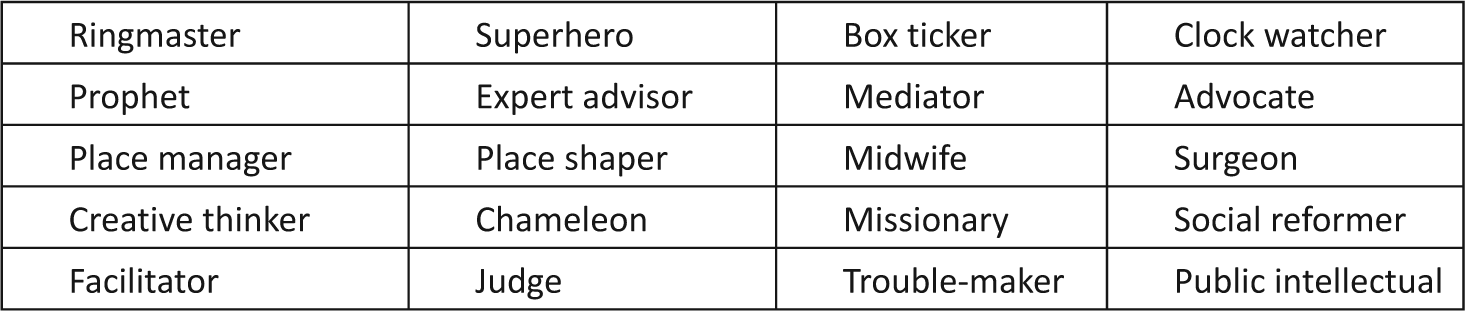
Twenty metaphors for planners’ roles.
The idea of planning’s dominant role being mediation has wider currency, too, but that doesn’t preclude planners playing other roles such as ‘public intellectuals’, some of the dimensions of which have been outlined in this paper. And mediation itself does not imply mere brokerage and negotiation, but can include opening up debates to new issues, framing issues in particular ways, and weighing up different knowledge claims. In Healey’s terms, planners can be the carriers and adapters of knowledge and debate but also the developers of ‘imaginative capacity’ (2009: 452). The interviews conducted for this paper suggest that public sector planners in England are often heavily constrained in these wider roles and the profession may be inflected with a nervousness about taking them on, for valid reasons associated with the wider polity: The private sector is a better place to campaign for things: good people in local authorities are choosing the exit because they find themselves saying ‘no’ rather than doing planning work. Planning has lost its directing role – it’s more bureaucratic (Interviewee B).
But as others have found (e.g. Campbell and Marshall, 2005), planners’ ethical motivations are often significant even if they are sometimes hard to articulate: I’m doing it because it’s worthwhile and society and the environment would be worse, if I lost sight of this it would be a sad state of affairs, we can’t have no development and so we need to plan and to do it well (Interviewee A).
And such positions are not confined to the public sector. Interviewee B highlighted that his private sector employment allowed him to pursue ‘good’ planning objectives: I like to do a good job; this is common in the private sector – much of what you promote you believe in. I believe in housing the nation, and not many are there to make this case. Sustainable development is meeting the needs of the present and we never define the needs of the present . . . we are always reducing the problem to the answer.
Seen in this way planners can be agents for change and proponents of empowerment, both in revealing and promoting particular issues and community interests. Mediation and negotiation are the principal ways through which such change might be achieved, but a normative agenda is at work. The placing and keeping in play of a variety of agendas that can be lost in local planning debate, such as climate change and public health, is central. This is not to suggest that the profession in England is geared up for radical change, and many would argue that the informal contract between state and profession prevents it from promoting a more radical agenda regarding, for example, property rights. But on a more everyday level, through setting up and/or managing participative democratic channels for those marginalised from traditional representative democracy and public life, planners can empower. They can also act to counter ‘extreme’ demands from various groups in the flow of policy work. That is not to say that they will and the organisational contexts will shape the extent to which they do, as much as their own value systems and sense of what their role is (Tewdwr-Jones and Allmendinger, 1998; Hillier, 2002).
Others will more fundamentally question planners’ right to engage in such normative work and whether social change should be managed. Liberal thinkers will mobilise Hayekian views as to the role of state-employed planners in such work in particular, and perhaps draw on critiques of past planning interventions. There is indeed a tightrope to be walked here in theoretically defending the right, indeed necessity, of planning to have a normative underpinning, but the idea of neutral planning has long since proved to be untenable. What the above empirical evidence does confirm, however, are lingering ideas of planning as a techno-rational exercise, as neutral, and of acting in the ‘public interest’. The stubbornness of these ideas (see Campbell and Marshall, 2005) reflects the fact that they are partial truths. Indeed shaping this ‘disposition’, in Bourdieu’s terminology, appears to be a key task for planning education as these are ultimately flawed ideas of what planning can be. While the skills and knowledge acquired in education and practice have changed, planners’ ‘self-image and approach’ have not, as has been noted in other very different contexts (Chettiparamb, 2006: 188). The UK Coalition government’s support from 2010 onward for community-led ‘neighbourhood planning’ and a dismantling of the technocratic approach on which much planning practice has been centred in recent years might accelerate this change and counter some of the tendencies noted above, but there are worrying elements embedded in it (Cowell, forthcoming) and we should be aware of the outcomes of similar reforms elsewhere (March, 2007; Miller, 2011; Steele, 2009).
Conclusion: Planning as profession, planners as experts
To conclude we return to Bickenbach and Hendler’s criteria for defining professional status: of knowledge base; community of practitioners; and societal role. Claims of planners to exclusive knowledge are rightly contested. But this argument has been challenged in relation to professions generally. Planning shares with professions such as accountancy a basis in an ‘esoteric collection of areas of knowledge, rather than a basis in esoteric knowledge’ (MacDonald, 1995: 201). It is thus inherently multidisciplinary (Bickenbach and Hendler, 1994). Information has never been so ubiquitous but with that comes a role in turning information into usable knowledge, rebutting some claims and foregrounding others. But planning clearly exists as a self-identifying, epistemic community with an associated set of discourses; and its societal role in theoretical terms is not in question by all except the extreme neo-liberal right of political discourse. Whether the planning community has the power to achieve structural societal change is unlikely at the level of everyday practice described here. But improving the built environment and living conditions in specific places and territories is very much possible.
The claim of all disciplines to professional status is further threatened by the forces of managerialism and the power of citizen-consumer voices (see above and Hendler, 1995). But from such context a more sympathetic approach to the idea of professions has emerged, which identifies through the work and voices of professionals themselves an identifiable ‘something’ that stands at odds with managerial and consumerist discourses (Hoggett et al., 2009). In the case of planning these are bolstered by evidence from the interviews cited above as well as evidence elsewhere (e.g. Campbell and Marshall, 2005; Inch, 2010).
Without recognition of the value of planning expertise, capitalist and managerialist processes have the potential to crowd out consideration of wider consequences (Friedson, 2001). Planners of all types but especially those in the public sector can lay claim to an awareness of what these externalities might be and how they might be tackled within a prevailing set of institutional conditions. But as we have seen that is not to say that private sector planners do not share part of this ‘project’. Indeed, a greater fluidity and hybridity of the professional experience between the two sectors is acknowledged (Steele, 2009). However, there remain differences in what is done, in associated claims to knowledge and expertise, and in terms of the duty private and public sector workers have beyond that of their profession in terms of ‘customer clusters’ (Kitchen, 2007). The private sector side of this is under-explored, at least in England, and needs a stronger empirical research base with a more thorough assessment of the many niches of private sector practice. 7
Bickenbach and Hendler concluded that ‘dealing with the ambiguity of moral dimensions of planning can actually be the moral mandate of planning’ (1994: 175). This view addresses Wildvasky’s ‘everything and nothing’ concern regarding planning, but this can be a hard message to sell to sceptics, especially those keen to make political capital out of popular perceptions of planning. In England the last decade is characterised by attempts to speed up decision-making and ‘front-load’ public engagement in abstract strategic discussions that militate against arenas such as public inquiries being used to deal with such ambiguities (Owens and Cowell, 2011). A more clearly articulated agenda around these concerns would help stave off attacks from those who hold that planning is an outmoded ‘Stalinist project’ in which planners stand as the ‘enemies of entrepreneurship’. 8
Above all, acknowledging the presence of discretion and moral ambiguity, the significance of reflection in action (Schon, 1983), and therefore the need and capacity for judgement in planning, seems a message worth rescuing and promoting to counter some of the negative tendencies trending in the public sector. Indeed, academics close to planning have been deeply critical in the past, largely using theory which now looks dated, but planning academia itself has failed to build much that is positive in its place (Healey, 1985), or indeed built its own epistemological foundations that might justify its existence beyond its institutional and social position (Davoudi and Pendlebury, 2010). These are not easy projects but failure to pursue them will make environments more prone to being less sustainable and less just.
Footnotes
Notes
Author Biography
Geoff Vigar is Director of Newcastle University’s Global Urban Research Unit. His work focuses on urban planning and transport policy, with an emphasis on questions of environmental and social justice. Current research centres on the implications of governance reform for professional identity; innovation and transformation in and of planning; and the relationship between mass media and urban policy and planning.