







Abstract
Practices of insurgent or bottom-up planning, of community-based organisations, networks and social movements are understood to be peripheral to the dominant paradigm of planning in southern contexts. Yet there is a lot of knowledge collectively held and coproduced within and through these practices, which are also sites of knowledge production. This paper reflects on the process of coproduction of knowledge within a campaign for equitable urban planning in Delhi – Main Bhi Dilli Campaign. The campaign brings together urban actors with diverse positionalities – informal worker’s and resident’s collectives, researchers and academic actors, social movements, and civil society organisations, across sectors and lived experiences. In this paper we ask: how does co-production of knowledge take place at the scale of the city, and within a campaign with diverse membership and priorities? We reflect on the role of academic actors in such coproduction of knowledge. We draw from the archival material of the campaign produced through prolonged dialogue and practice-based research. We focus on one particular knowledge product that the campaign has produced called the Factsheets. Factsheets are 4-page documents that simply provide an overview of the theme (such as informal livelihood, housing, gender), and what the Master Plan can do to address the gaps in planning that exist. We use the ‘factsheets’ produced through the campaign, as an artefact of co-production, as a site that holds the processes of coproducing knowledge together. We reflect upon the processes of holding, contesting and channeling multiple knowledges within the campaign, highlighting the value of these internal processes for coproduction of knowledge. While the exact format and material may not be translatable in contexts with different social and political realities, we argue that the processes of coproducing knowledge for action while in a diverse coalition are useful across contexts for more equitable urban planning.
Introduction
This paper reflects from an experience of knowledge co-production in planning at the scale of the city, through the experience of the Main Bhi Dilli Campaign 1 in Delhi, India. Main Bhi Dilli (MBD) is a people's campaign to make planning in Delhi more representative and inclusive by engaging citizens in the process of the drafting of the 2041 Master Plan. The campaign’s aim is to draw attention to the lived realities and planning needs of informal workers and residents of informal settlements in the city, who have historically been left out of the state’s planning imagination and processes. The Campaign began in 2018 to propositionally counter the top-down and technocratic approach of master planning. It has since then relied on the co-production of knowledge between resident activists from informal communities, informal workers’ unions, urban planners, architects, civil society organisations, researchers and academics, to put forward a set of alternative proposals, in parallel with and to engage with the official drafting process of the new Master Plan for Delhi MPD 2041. Over the last few years, the campaign has co-produced a body of knowledge and a practice that is collectively held, offering an alternative way of knowledge translation, which differs from the conventional gatekeeping of knowledge by dominant sites of knowledge production (Narayan, et al., forthcoming).
In this paper we ask: how does this co-production of knowledge take place at the scale of the city, and within a campaign with diverse membership and priorities? As members of the campaign also situated at academic institutions, we reflect on the role of academic actors in such knowledge co-production. We draw from the archival material of the campaign produced through prolonged dialogue and practice-based research. We focus on one particular knowledge product that the campaign has produced called the Factsheets. Factsheets are 4-page documents that simply provide an overview of the theme (informal livelihood & housing, gender, etc.) and what the Master Plan can do to address the gaps in planning that exist. In this paper, we use the ‘factsheets’ produced through the campaign, as an artefact of co-production, as a site that holds the processes of co-producing knowledge together. We reflect upon the processes of holding, contesting and channelling multiple knowledges within the campaign, highlighting the value of these processes for co-production of knowledge that are internal to the campaign.
The rest of the paper is laid out as follows: In the first section, we discuss the relationship of knowledge and planning in the Global South, and the multiple sites of production of knowledge. We draw attention to efforts of co-producing knowledge that occur internally within social movements for efforts of co-production. We highlight our aim to reflect on the role of academic actors within a constellation of urban actors for knowledge co-production, and our method of doing so while positioning the MBD campaign as a site of knowledge co-production. We then discuss what we mean by knowledge co-production in the MBD campaign and illustrate using a few factsheets on what emerged from these processes. Lastly, we use the factsheet, itself only one of several valuable outcomes of the campaign, as an artefact of knowledge co-production for planning to discuss the processes of holding, contesting and channelling multiple positionalities towards a common outcome, aim and vocabulary that is technical, timely and strategic. Through this, we hope to reflect on the role of academic actors and their engagement in processes of co-production of knowledge for equitable urban planning.
Academic actors within a constellation of actors in knowledge co-production and planning
How we understand knowledge and how it shapes the city, is critical to reinventing planning for urban equality and just cities, as the production of knowledge is centrally a question of power. Over the last few decades, theory from the South has continued to expand an understanding of planning to recognise the knowledge of people in city-building through every day and insurgent practices of planning, as well as through collective action (Miraftab, 2009) (Miraftab, 2004). This expanded framing of planning (Frediani & Cociña, 2019) unsettles the clean categorisations that the profession of planning often longs for, which continue from colonial and top-down legacies of governance, and ways to express and articulate this knowledge through planning theory remain valuable.
Experiences of co-production in the Global South through ‘state-society engagements’ initiated through social movements, non-government organisations, community-based organisations and federations “expand the scope of planning thought” (Watson, 2014). Practices such as self-enumeration, self-mapping, strategizing or developing government partnerships for upgrading, mobilising communities through saving schemes and cross-learning through horizontal exchanges recognise the knowledge of people as valuable inputs required for better planning processes. These examples, while often piloted or sited projects, hold aspirations for city-wide scale by setting precedents, opening relations between state-society actors, or expanding reach of advocacy across federations. While the ambitions of such co-production in planning is to influence outcomes on the ground, there is also an aim to influence a change in the nature of planning and governance itself through state-society engagement.
However, neither the state nor society are homogenous or monolithic, and are in fact constituted by multiple individuals, alliances and partnerships. In order for any intended transformation, whether as immediate or tangible outcomes on the ground, or longer-term shifts in state-society relationships, a lot of co-production of knowledge takes place internally within these. Social movements, collectives, Non-Governmental Organisations, and Community Based Organisations consist of many different individuals. Different urban practitioners, citizens, communities, academics, come together with different worldviews, lived experiences, practices and approaches. So, in order to build ‘social movement-initiated co-production’ (Watson, 2014), a lot of co-producing knowledge for collective action takes place within these practices themselves. While often tacit and not articulated, these processes constitute the plural knowledges and practices that shape Southern cities – indicative of what Santos (2018) calls “epistemologies of the South concern(ed with) the production and validation of knowledges anchored in experiences of resistance”. These practices-insurgent or bottom up, of community-based organisations, networks and social movements are most often understood to be peripheral to the dominant imagination and paradigm of planning in Southern contexts. Yet there is a lot of knowledge collectively held and co-produced within and through these practices, and an examination of and reflection from internal experiences of co-producing knowledge is critical to learn from. Given the heterogeneity of association within such social movements, alliances or people’s organisations it is important to reflect on the power dynamics within these. It is not just that there are different knowledges, but that such a plurality of knowledges is also a site of power dynamics. Differently positioned actors work together to influence outcomes in governance, planning, research and knowledge co-production, through various partnerships and alliances with other actors in the city, including academia, universities along-side civil society. These experiences can hold tensions of ‘epistemic justice’ (Fricker, 2007), as there are differences in whose testimony is listened to or not, and how certain experiences do or don’t find a language for expression. As such, knowledge is often valorised – dismissed, recognised, adopted and translated differentially.
Scholarship on co-production draws attention to the experience of communities to engage outwardly with the state (Boonyabancha & Kerr, 2018) and even academic research (Mitlin, et al., 2019). Examples of universities or academia in co-production of knowledge often include studios and experiential learning out of the classroom along with communities in the city, many of which focus at a local or neighbourhood scale. Such cases of knowledge co-production with the university as a key actor may be understood to be mutual and reciprocal spaces of ‘co-learning’ (Allen, et al., 2017). These cases offer opportunities for knowledge translation and the building of urban pedagogies across and back into the university and spaces of urban activism (Anand, et al., 2021). There are power dynamics within these experiences that also influence outcomes of co-production for differently positioned actors. There is a need to understand the different theories of change of academics and social movements, the nuance in various actor’s motivations and positionalities, and the significance for marginalised groups and communities to be able to wield this power. (Mitlin & Bartlett, 2018) (Mitlin, et al., 2019). Such discussions also imply a tension of recognising multiple sites of knowledge production. Understanding “the city as a machine of learning” (McFarlane, 2011) reiterates that the university is not the only site of knowledge production and that there are many sites of knowledge production and co-production. While the university is also a site with power and holds possibilities for change for urban planning (Sami, et al., 2022), social movements are themselves sites of knowledge production. The ways in which knowledge may be expressed and articulated in social movements is often tacitly and collectively held. This often differs from knowledge recognised by academia with respect to accreditation due to authorship, distinctions on who gets to use what is articulated, as well as what is recognised as knowledge (Mitlin, et al., 2019).
There are also many ways to unpack how the university or academia is located within experiences of urban pedagogies and knowledge co-production, as there are many imaginations of higher education and academia (Santos, 2018) (Anand, et al., 2021). The university or academia exists in many forms, is not the only site of knowledge co-production, and is part of processes of co-producing knowledge in different ways – explicitly and implicitly. In several cases of the former, academia may partner through formal institutional partnerships with degrees of flexibility that allow for mutually reciprocal objectives. At other times, actors from university spaces with certain positionalities or professional trajectories, with an access to ways of training and pedagogies occupy or participate in spaces of knowledge co-production, wearing multiple hats with and without institutional affiliations. These latter experiences of co-producing knowledge are less discussed, yet are also relevant.
We reflect ahead in this paper on this kind of academic engagement, through the experience of the MBD campaign, where the academy may not be an official partner, but where practitioners having travelled through academic trajectories, participate in processes of knowledge co-production – carrying with them their institutional affiliations, positionalities and ways of understanding the city, both reinforcing and unsettling disciplinary hierarchies, biases, strengths and methodologies. We look at the campaign as a site of knowledge production that has academics associated with other sites of knowledge production. To clarify, our examination is not of the university as a site of knowledge co-production. Our reflections here position the MBD campaign as a site of knowledge co-production, within which individuals wearing academic hats or having institutional affiliations have a role to play. It is important to point out that within the MBD campaign, there is no university that has directly input funds or resources. Activities of the campaign are funded through voluntary contributions at different moments and through need-based fundraising for tasks from within its internal membership 2 . Any academic affiliation of the campaign is through voluntary associations of individuals within the campaign. Individuals affiliated to institutions may bring with them institutional access, privileges and resources, and often not. Our interest in this paper is in unpacking processes of co-producing knowledge within the campaign, and within these, the role that academic actors play, along with a constellation of urban actors.
Our aim in the paper ahead is to look at an effort of knowledge co-production in the Main Bhi Dilli Campaign, wherein academic actors came together along with a range of other actors, and to reflect on the processes of co-producing knowledge for action. We attempt to think through the role academic actors can play, in processes of co-producing knowledge and what academia can in turn learn from the ‘many sites of urban pedagogies’ (Anand, et al., 2021). Given that planning has been conceptualised as a technical discipline, the distinction between academic and professionals is often hard to make in the Global South. Albeit the theory-practice divide in the discipline is stark, this divide has arguably more to do with the post-colonial legacies of theory inherited from Northern contexts that do not capture the realities of urbanisation for Southern contexts, and has less to do with difference in positionality of academic versus practitioner. Often professionals move through university spaces and practice quite fluidly and practitioners may be wearing multiple hats at the same time. Given this context, in this paper, we broadly refer to academic actors in the campaign as those holding certain planning or allied urban disciplinary training through higher education, many of whom may also be occupied in endeavours of research or teaching.
Two of the authors of this paper are coordinators 3 of the campaign, which involves taking on multiple roles across all the activities undertaken, which includes research, mobilisation, communication and the myriad daily tasks which are involved in sustaining a hybrid campaign over time towards an agreed upon set of goals. All three authors, through their individual capacities and as part of institutions, engage in practice-based research that seeks to inform academic discourses and teaching on urban and labour issues. All authors have also been affiliated with university spaces for higher education, bringing with them different disciplinary trainings framed by their academic trajectories. Our attempt in this paper is to critically reflect on the role that ‘academic actors’, a rubric under which we also place ourselves, engaged within the MBD campaign. We reflect on the ways in which this engagement resulted in a mediation between theory and practice, to co-produce knowledge 4 to inform urban planning.
In this paper, we draw from scholarship that positions the object of planning theory as one that enables practice to work across technical knowledge and informed political action (Friedmann, 1987). We recognise planning as a political practice within the “practice movement” 5 in planning theory that can generate learning for planning practitioners and learners, and extend this to include insurgent practices of planning and efforts of knowledge co-production. We also draw from Watson’s (2002) writing on how methodological approaches of case studies, histories, articulating situational knowledge, the use of narrative approaches with attention to actors and practitioners, as well as self-reflexivity of authors is useful for theory to translate into practice and across contexts with different socio-economic and political realities.
We use the archival material of the campaign produced through prolonged dialogue and practice-based research to reflect back on the experience of the campaign. This includes a range of material produced through and for different kinds of meetings held by the campaign from the years 2018 to 2022 6 . The minutes of meetings have dates, agenda and action points of the meetings. The minutes of meetings do not directly quote individuals, as the campaign’s intention of documenting at the time was to use these to reference the nature of discussions, debates and positions taken by the campaign at particular moments of time, as these have evolved over time. For this paper, we corroborate details from the minutes of meeting notes by referring to internal photographs of discussions, internal presentations, posters or flip sheets of the campaign, WhatsApp group of the campaign, email trail of the campaign and also across our own memory as all three authors are also members of the campaign. Over the past 5 years, the campaign has produced several knowledge products 7 at different moments: Factsheets, technical reports, academic articles, toolkits, posters, websites, suggestions and objections and news articles. We discuss how these came to be in different moments of the campaign in other writing (Narayan et al., forthcoming). In this paper, we focus on one particular knowledge product called the ‘Factsheets’, which we discuss in more detail in the sections ahead, using it as an artefact of co-producing knowledge within the campaign.
Knowledge co-production in the Main Bhi Dilli campaign
Delhi’s Master Plan is a statutory instrument and a spatial plan that guides the planned development of the National Capital Territory of Delhi. As with several other postcolonial cities of the South, planning in Delhi carries with it its colonial legacies and perspective of planning. Planning across Indian cities remains technocratic, top-down and centralised. This is particularly so in the context of Delhi’s governance, where the central government has a statutory influence on the city’s spatial planning. The Delhi Development Authority (DDA) is mandated 8 to prepare and revise Delhi’s Master Plan every 20 years. The official process of planning in Delhi is detached from local level electoral politics, with no mandated role for the city-state government or local urban bodies – unlike for example the preparation of the Development Plan in Mumbai 9 . In addition to the challenges of governance arrangements for planning in Delhi, the process also remains ‘expert’ led. While there is a window for citizen submission of suggestions and objections in the official process of the preparation of the Master Plan, the language of planning is ‘technical’, in English and there are barriers to participation. The experiences and knowledge of most of the citizens of Delhi, who are part of the informal workforce or live in informal housing arrangements do not find themselves considered by the plan. Yet the plan does impact people’s lives, as it influences the geography of urban contestations of land in the city.
In 2017, the DDA signed a Memorandum of Understanding with the National Institute of Urban Affairs (NIUA), to conduct background studies in preparation to draft the next Delhi Master Plan 2041. 10 It was in this context, and at this time, that a group working on housing and livelihood rights in Delhi such as activists, researchers and civil society organisations met to discuss the repercussions of the Master Plan on their work on informal housing in the city. Their initial role was crucial in giving shape and momentum to this work. They decided to meet regularly to brainstorm the potential of some collective action around the upcoming Master Plan re-visioning process. The group expanded with more organisations and individuals, recurrently meeting on various urban issues such as housing, livelihood, gender and transport in Delhi. This thus expanded into a diverse group of over 40 civil society organisations, activists, architects, urban planners and researchers. The work of these organisations and individuals focuses on informal housing (bastis, unauthorised colonies, resettlement colonies, homelessness, etc.), informal livelihoods (street vendors, waste workers, home based workers, domestic workers, construction workers, etc.), gender (women’s safety in public spaces), transport, urban planning, and architecture. The organisations and institutional affiliations that individual members hold also have diverse forms such as worker unions, community-based organisations, Non-Governmental Organisations, activist collectives, research and teaching institutes, and urban design labs. By 2019, the efforts of this group coalesced into a public campaign called ‘Main Bhi Dilli: Ab Sheher Saath Banayenge’ (MBD), translating to ‘I too am Delhi: We will now make the city together’.
The shared thinking for the effort was that as planning processes reproduce inequalities and have extensive power as a statutory tool of spatial governance in Delhi, it was imperative to engage with the Master Plan. There was a felt need among community activist groups, practitioners and academics 11 associated with MBD that master planning was typically unable to capture the ground realities and tended to invisibilise and thereby perpetuate inequalities. It was recognised that the state’s (planners) reliance on certain types of ‘data’, which was lacking on the dominant conditions of housing and work that is informal, must be complemented by the lived knowledge of communities and the grounded research and practice knowledge of activists and organisations. This bridging function is what the campaign understood to be its primary task, which would also build the capacity of civil society to engage in what was understood to be a highly technical terrain of planning. Thinking of what knowledge is recognised in planning was one of the foundational concerns for the campaign.
In the first year of the campaign, the group held several meetings and workshops on intersectional themes such as housing, livelihoods, gender and urban planning, especially in understanding the intricacies of the Master Plan. Meeting in sectoral and thematic groups
12
over several months, the group deliberated on how the Master Plan impacts each of these different groups in the city and some potential ways in which the power of the plan could be used in an affirmative manner for them. These meetings were the first effort to combine lived and experiential knowledges with the technical skills of researchers and urban designers through continued dialogue to establish a base set of priorities for advocacy. A key challenge these meetings pointed to was the lack of city-level data on many of the sectors or the presence of inaccurate data in government baselines. On 2 November 2018, the campaign members discussed the principles of Add, Challenge and Reframe, which would guide the campaign’s approach to knowledge generation. The minutes of the meeting state:
“Following this, a basic framework was proposed to understand the Coalition’s engagement with data which can be summarised as:
Add to: There are big gaps in information about informal sector livelihoods as well as many other indicators, and the connections between different sectors. There is a need to add categories that are completely missing, fill in gaps in information about existing categories and add information bringing out inter-sectoral linkages.
Challenge: There are also some instances where official data is contrary to that which is seen on ground or is recognised by people’s groups. Such data that is mis-represented needs to be corrected. This also holds true for popular conceptions about the city which are not reflective of real conditions on ground.
Reframe: The way in which official data and sources like the Master Plan looks at categories such as ‘home’ and ‘work’ are unable to take cognisance of the realities seen on ground, and it can be seen that many such categories need to be re-conceptualised in a way that is more reflective of the needs experienced by people.” (From Main Bhi Dilli Campaign meeting minutes, 2 November 2018, New Delhi)
At the end of the first year, the campaign had coalesced sufficiently and identified a substantive set of issues for engagement in order to be ready to launched as a campaign. Each of the sectoral and thematic meetings itself had diverse actors from within the coalition including community members, worker leaders, activists, practitioners and academics. The campaign also held around 100 public meetings in 2019 where issues identified vis-a-vis the Master Plan in the closed-door meetings were brought before wider sections of the people. 13 These meetings included neighbourhood meetings in informal settlements, informal worker collectives and several other forums which helped the campaign to expand its public base.
The campaign also took important lessons from prior efforts of collective action to engage with master planning exercises in Delhi and other cities in India such as Mumbai, Bengaluru, Indore and Jamshedpur. The campaign hosted a meeting on 8 March 2019 and invited academics from the Tata Institute of Social Sciences, Mumbai, activists from Mumbai, Indore, Jamshedpur who had worked on Master Plans in their cities, to share their experiences and brainstorm with the members of Main Bhi Dilli Campaign to strategise a way forward with attention to considerations around timing, different kinds of approaches and the need for translating research for advocacy. For example, the Mumbai experience of campaigning for the DP 2014-34 had begun as Humara Shehar Vikas Niyojan Abhiyan Mumbai, as the preparation of the Development Plan was announced in 2011. It was seen that the drafting time offered opportunities for preparation and intervention that could be taken advantage to propositionally engage with the planning process, unlike mobilisations which happened in response to the previous Master Plan of the city for MPD 2021, which came together only after the draft plan was put out in public domain. For the MBD campaign, it was important to bring together a campaign that would speak with a unified voice, and for these efforts to begin nearly three years before the plan would be in the public domain. Further, like the Mumbai Campaign’s strategies of using both confrontational and collaborative modes of action at different points, MBD also changed modalities depending on the spheres of engagement that either opened up or were negotiated for in the official master planning process. Lastly, MBD took cognisance of previously produced research and other public materials created by other efforts of collective mobilisation. MBD’s learning from this was the need to produce simple, succinct, and translatable documents so that research can effectively be understood and used for advocacy by people who are neither academics nor technical ‘experts’ such as urban planners.
The campaign’s strategies have evolved in the context of the particular framework of planning in Delhi that is extremely centralised and top-down. In contrast, the campaign has insisted on the recognition of tacit and locally held knowledges in creating the city and re-evaluating the visions and vocabularies of planning to make a more equitable and just city. Over the last few years, the campaign has co-produced a body of knowledge and a practice that is collectively held, offering an alternative way of knowledge translation, which differs from the conventional gatekeeping of knowledge by dominant sites of knowledge production. These efforts of knowledge co-production in the campaign have led to some important outcomes – the participation of previously excluded groups in meetings with the drafting authorities while the plan was yet to be drafted, a set of clear recommendations for the plan, which the campaign has put forward and contributed to public discourse, and finally the filing of over 25,000 objections and suggestions from a total of 33,000 objections filed by the people of Delhi when the draft 2041 plan was released for comment in 2021.
An in-depth look into factsheets
With the two-fold aims of informing public discourse and directly engaging with planners at NIUA and DDA involved in the official process of drafting the plan, the campaign next embarked on consolidating the research and knowledge shared during its meetings. The campaign had archived each of its meetings and had continuously built its collective understanding on the issue of the Master Plan. Further, the campaign had a repository on how many of these overall concerns came in the ambit of the Master Plan and ways in which these could be addressed by the next Master Plan of the city. The campaign members decided that any written output of MBD must have a format that is easy to understand and would not take too long to read. Thus, making it accessible to many people, and not just urban planners and researchers, which is one of the cardinal goals of the Main Bhi Dilli Campaign). 4 page format of the factsheet: factsheet on housing: JJ Bastis, (Source:MBD) https://www.mainbhidilli.com/_files/ugd/9be98c_3b2738f4d5e641ff9568e6e996351139.pdf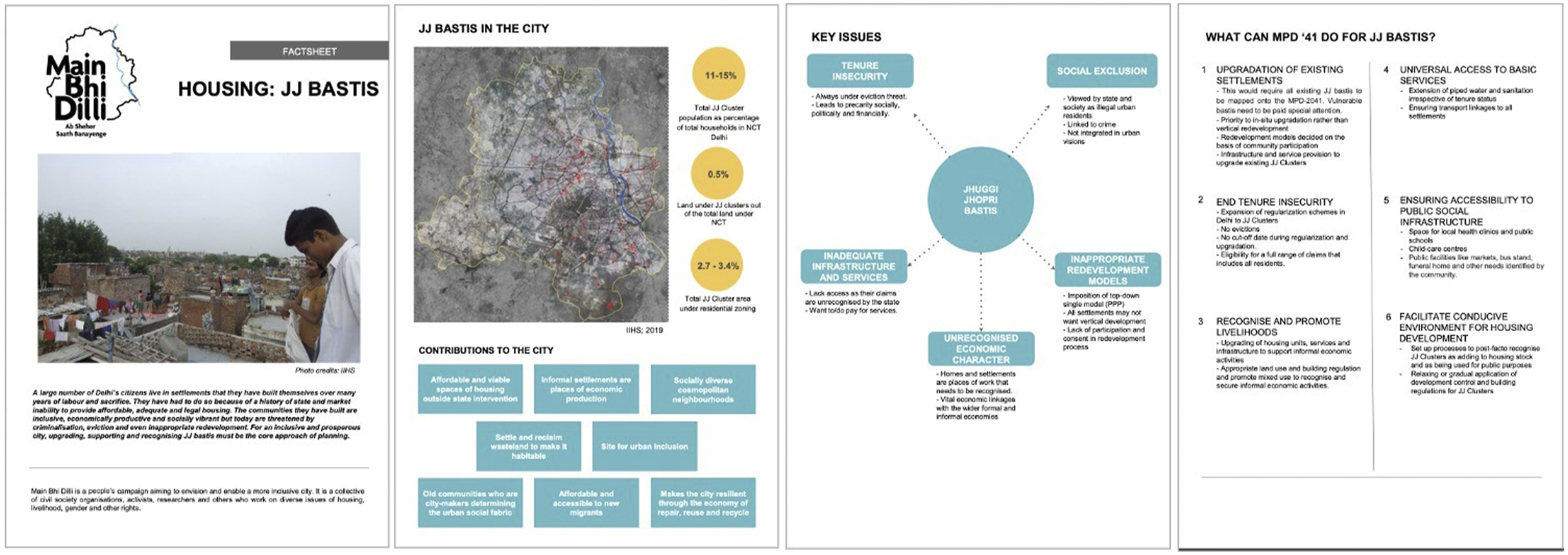
Keeping these aims as guidelines the format of the ‘Factsheet’ emerged – a four-page succinct document (Figure 1) that introduces an issue or theme at an urban scale, contributions or key characteristics of various livelihoods and housing to the production of the city (Example: waste workers, domestic workers, jj bastis etc), the challenges faced by each and finally what the plan can do to address the specific needs of each of these issues. Bringing together the large patchwork of ideas and debates from within the campaign into a written form that can be used for advocacy with various stakeholders such as the NIUA and the DDA as well as the media was the key function. The factsheets were also imagined as a tool to share with communities that were the core interest group of the campaign in a quick visual and accessible format that could capture key issues, and where the plan could intervene. The Factsheets were the first research based advocacy products created by the Main Bhi Dilli Campaign. 14
After a year-long process of interdisciplinary and intersectional meetings on themes such as informal housing, informal livelihoods and intersectional themes such as gender, transportation and sustainability, a research group was formed within the campaign, which began the work of analysing the archive of the campaign, which housed the participatory research that the campaign had produced. The research group of the campaign was composed of academic actors, but was open to and was also joined by non-academics including community activists. This mixed composition was important for the campaign to adequately represent the kinds of intersectional and interdisciplinary discussions that had taken place in meetings. This group began the work of building on the previous discussions into the format of a factsheet, to challenge and reframe the conventional planning language of the Master Plan and add data and perspectives that are missing in previous master plans, presenting these back to the larger campaign for feedback.
The process of creating the factsheets was not an easy one. The challenge within the campaign was three-fold. The first was to keep the focus of the factsheets on the key issues faced by each sector and then focus on articulating demands that fall under the ambit of the Master Plan only to create a stronger advocacy position. This was difficult since the campaign’s archive of the meetings had material that spoke of the larger urban condition of these sectors as well as intersectional connections between different themes. The second challenge was to keep the language of the factsheets simple enough so that all campaign members from diverse backgrounds could understand them, but in doing so, not lose any of the complexity of the issues being raised within the factsheets. The third challenge was to add missing data on informal settlements, livelihoods and gender and present it to the state actors so that it is included in the drafting stage of the Master Plan.
The research group within the campaign addressed these challenges in multiple ways. The first challenge of keeping the focus of various sectors and themes under the ambit of the Master Plan was responded to by analysing how some of the demands could be addressed through spatial planning. For example, one of the demands in the Factsheet 15 on street vendors was “Widening of pavements under urban design norms – Gainda Ram judgement –- 4 ft of 9 ft wide pavement for vendors, open space reduced from 5 ft to 3ft where not possible.” In others, intersectionalities were stated. For example, the linkage of work with housing was recognised in the Factsheet 16 on Home-Based Workers by demands for housing to be viewed as a “productive asset through better design and infrastructure” and to accommodate livelihood needs such as storage facilities and lighting. Another example of engaging with intersectionalities is of the consistent gender lens that exists in all factsheets that highlights the ways in which gender representation in Delhi’s Master Plans can move beyond tokenistic and narrow representations of gender in urban planning. This was done in a few ways. As an example, demands for provision of childcare centres, and universal access to basic services are included in factsheets after discussions on the labour of women towards childcare and accessing water. Some factsheets on livelihood, for example, on Domestic Work and Home Based Work, have specifically looked at gendered livelihoods. A thematic factsheet on “gender in the MPD 2041” maps intersections for gender across housing, livelihood, social infrastructure, transport and public space.
The second challenge was to keep the format and the language of the factsheets simple and to the point and yet not lose the complex realities of the sectors. This was done by keeping each factsheet to a maximum of 4 pages only. The research team also used maps, flow charts, etc. to make the evidence easier to understand. The campaign also worked to translate each factsheet from English (in which they were originally written) into Hindi and Urdu. This was done to bridge the language barriers that exist in conventional planning paradigms which use English as a default language.
The third challenge was to add data on informality which the state actors either do not have or will not be motivated to collect and recognise unless prompted by pressure from citizens and activist groups. The research group collected existing research on informality that existed in Delhi from within and outside the campaign. For example, the Factsheet on Home-Based workers begins by stating “It is estimated that there are around 3-4 lakh home-based workers in Delhi, a majority of them being women'' and “(Home-based workers) Estimated to constitute around 7% of non-agricultural workforce in Delhi: 13% for women and 6% for men”. Here, the data points and maps spatialising home-based work in Delhi use the research of campaign members such as WIEGO (Women in Informal Employment Globalising and Organising), an INGO and SEWA (Self Employed Women’s Association), a women’s worker union. Another such example is from the Factsheet on JJ Bastis 17 which used research from Indian Institute for Human Settlements to highlight housing inequalities in Delhi where 11-15% of the population of the NCT (National Capital Territory) lives in JJ Clusters on only 0.5% of the city’s land (Bhan, et al., 2020).
The factsheets were developed at a time in the campaign when the members felt they had reached a particular moment during a period of intensive co-production of knowledge, and a common ground had been readied. This co-producing of knowledge had been internal to the campaign, between members with diverse positionalities and expertise, between researchers, planners, community activists, worker union members, and citizens – a way to strengthen civil society to engage with the state. The form of the factsheet itself was chosen as a way to feed into a specific moment in the official planning process, which was that of background studies and data gathering by the NIUA. The campaign thus was able to position itself as a source of data and knowledge about the city, in particular on informality, that would be useful for planners.
In the first day-long meeting with the Master Plan drafting team at the National Institute of Urban Affairs in November 2019, an appointment that was made possible through efforts over several months by campaign members using their individual and institutional connections, the factsheets were front-ended as to what the campaign was bringing to the table. The presentation of these by community activists and leaders of informal worker groups themselves in the meeting was an unexpected move that helped establish the campaign as having done an immense amount of background work. The planning team explicitly acknowledged the gaps they had faced when studying the sectors and issues on which the campaign presented. Also, the ability to put forward substantive proposals rather than just the issues and ‘demands’ was significant as the planners could not easily counter them as impractical or not being under the purview of the Master Plan.
The factsheet, can be seen an artefact of the knowledge co-production of the campaign, and there are two dimensions to this. The first, was its internal facing role, as an artefact that enabled the campaign to articulate the common ground that had been reached within the campaign. This was important for the campaign itself as it aimed to collectively address issues of certain themes such as livelihoods, housing that had been conventionally left out of previous plans, with a set of spatial demands and principles articulated for the draft Master Plan. The second dimension is the role of the factsheet as an instrument for outward engagement or advocacy. The simple language and concise nature of the factsheets allowed all campaign members to understand and present the perspectives of the campaign to the NIUA and the DDA. Their immediate traction could be seen with the NIUA asking the campaign to further produce longer research pieces for presentations to them, which academic actors within the campaign produced in the form of longer technical reports. In the long term, the factsheets were also instrumental in community mobilisation and the official filling of suggestions and objections to the DDA in June 2021. In order for such an outward engagement of co-production, an internal process of co-producing knowledge was critical within the campaign, while keeping in focus its aim for outward engagement. In the sections ahead, we unpack the processes of co-producing knowledge of holding, contesting and channelling multiple knowledges that were internal to the campaign.
MBD Factsheets as an artefact of co-producing knowledge: holding, contesting and channelling
With an intention to propositionally engage with the planning process, the campaign has co-produced several knowledge outputs at different moments of time, such as the factsheets, technical reports presented to the NIUA, objections and suggestions to the DDA, and a range of media outputs for wider engagement with public discourse. This is a body of knowledge that is collectively held in the campaign but is shared publicly and accessible to all – beyond ways in which the academia conventionally valorises knowledge. Importantly, through the experience of working together, the campaign has also contributed to a collective practice of working together for a common outcome in the city – a tacit knowledge of how to work together across multiple perspectives in the city. We discuss ahead these processes of co-producing knowledge for action and how these unfold in a campaign with diverse actors debating complex urban issues. To do so, we use the ‘factsheet’ in the Main Bhi Dilli campaign as an artefact of co-production Through the factsheet, one of several valuable outcomes of the campaign, we discuss how the processes of holding, contesting and channelling multiple positionalities towards a common outcome and vocabulary that is technical, timely and strategic has potential for planning and knowledge co-production.
Holding
As detailed earlier, the campaign had met regularly over the course of its initial year and had several rounds of deliberations to arrive at its core areas of concern. One of the primary roles that the campaign saw for itself was the consolidation of these shared insights into a format that would allow for their translation into planning discourse and priorities. The factsheets evolved as part of the campaign’s process to hold together the different knowledges which its deliberations had brought to the front. Experiential and activist knowledges, which were not conventionally considered as rigorous or useful by planners and would not be accounted for in any background studies or surveys conducted by them, were couched in the language of ‘facts’ backed by and at par with different types of data such as numbers, maps and citations in academic research. In the factsheets, this evidence, built painstakingly by workers’ organisations, the histories and felt needs of communities, are presented alongside information from government and academic sources, as equally valid and verifiable knowledge. The choice to hold multiple knowledges together was a position taken by the campaign, given how expert-led, technical planning renders the tacit knowledge of communities and activists invisible. This position influenced both the way the internal meetings of the campaigns were conducted across sectors, themes, disciplines and life experiences, and also how these diverse knowledges were represented on the factsheet itself, alongside each other. For instance, in the campaign’s factsheets on ‘home-based work’ and ‘JJ slum clusters’, the invisibility of the sector and settlements in government statistics and policy is countered by the mapping of the same by activists and civil society organisations in partnership with researchers. By spatialising them on the map of Delhi alongside key information on their contributions to the city, the factsheets are able to hold the validity of claims made by these groups and argue for their consideration in city planning. The campaign also ensured the translation of the factsheets from English to Hindi and Urdu (all three official languages of Delhi), to politically assert the point that planning discourses have to be carried out in languages that allow all citizens to understand and engage with it.
Contesting
The process of creating the factsheet allowed the diverse coalition to articulate claims and arguments which were contested as a way to move towards establishing a common ground. While there was no basic manifesto that had been laid down, by virtue of the nature of membership, the focus of the campaign from the beginning was to advocate for groups which are excluded from planning, such as informal workers, residents of informal settlements, women and gender minorities, the homeless etc. However, even within this group, which largely agreed on many key issues, there were many differences arising from the positionality of individuals, organisations’ theories of change, disciplinary training, and everyday experience of mobilising communities on the ground. For instance, in the sectoral meetings on street vending and the housing thematic meetings on unrecognised informal settlements, there were differences between the views of worker unions or community activists and those of urban professionals. While the unions or activists made their claims to urban space as a matter of right and opposed eviction from any existing spaces, urban designers and planners in the group proposed solutions which might lead to some displacement of workers but had the potential to improve working conditions in the long run or brought up the issues of tenability of certain settlements. These internal processes of ‘holding’ and ‘contesting’ were parallel, back and forth or non-linear. Prolonged engagement on these topics were held where both sides built trust and understanding about the other’s positions to arrive at a negotiated consensus. So while the campaign’s factsheets establish recognition of existing places of work and residence as the basic foundation, and eviction to be considered only as a last resort when no other solution is possible, it also articulates innovations in spatial design and planning that can potentially navigate the conflicts which urban planners and designers might view therein. For example, the consensus that emerged for vending was that rather than having designated vending zones, the push should be for clear norms for specific places where vending cannot happen leaving the rest of the city open for vending to emerge. For informal settlements, the push should be for no eviction and in-situ upgradation with tenure rights, with strict norms for where resettlement or vertical redevelopment 18 could be considered only as a last resort and with community engagement and participation. Thus, the co-production of knowledge in a diverse group happened through the airing of contesting claims by community activists, unions of informal workers, researchers, academics, planners and professionals working across sectors, with diverse positionalities, and this is reflected in the language and arguments articulated in the factsheets.
Channelling
The third aspect of the processes of co-producing knowledge in the campaign was the channelling of the deliberated points into a common vocabulary that can travel to multiple audiences and is propositional in approach. The factsheets are succinct documents which worked for internal clarification of positions among campaign members and became the way in which the knowledge co-produced in the campaign was to be shared. While the sectoral and thematic meetings had been expansive in the range of issues that were discussed, the public meetings held in communities and with worker groups had sharpened the focus of the campaign. These discussions had most often been expansive and captured a range of issues shared by individuals that may not directly be input into the plan, yet were important to frame the context of these issues and what the role of the plan could be to address parts of these. The factsheets were used to further sieve out points which were not directly relevant to the Master Plan, while synthesising these discussions into “key issues” and to nuance the issues and recommendations to be spatial in nature such that it was directly relevant to master planning, which was essentially a land use and development planning exercise. For example, while conversations on housing finance did come up in housing meetings, the plan does not have a financial mandate, and so issues of housing affordability were framed in relation to strategies for land – for example through the creation of affordable housing zones. This focus on the spatiality of the plan was tactical and in accordance to the outward use of the knowledge products to propositionally engage with the planning process at that point of time – while acknowledging the limitations of what the plan as an instrument could also shape, to also aim to accelerate the possibility of adoption of the demands into the draft plan. At the same time, given the aim for the factsheets to have an outward facing role for advocacy, care was taken that while being data-based and rigorously researched, the language of factsheets is non-technical and devoid of academic jargon. The language of the factsheets was kept deliberately simple and visual with key takeaways that are bulleted points. This was of importance to ensure that the factsheet is also usable for non-planners, both the general audience external to the campaign but also internally for campaign members to have a quick primer to understand the issues and proposals of other groups and have a common ground when opening up for advocacy.
Conclusion
As a campaign of city-wide actors – citizens and organisations, researchers, planners, community activists and informal worker union members, the campaign brings together different knowledges and forms of practice. The campaign began collectivising with the intention of bringing together this diverse group of actors to impact and change the process of exclusionary urban planning in Delhi. The aim was to engage with and fill existing gaps in the conventional urban planning process by sharing alternate propositions with government bodies such as the NIUA and DDA, to propositionally influence the next Master Plan of Delhi. The experience of knowledge co-production within the campaign, and also outward for media, state, citizens and communities has been built and sustained over time, through recurrent meetings and deliberations. Over time, working together has built a network at the scale of the city, and co-produced a body of knowledge of the city that is collectively held. Importantly, we argue that the campaign has sustained a way of working together for co-production of knowledge for planning, where its own internal processes of co-producing knowledge are valuable.
In this paper, we use the factsheets of the campaign as an artefact of a rigorous process of coproducing knowledge for action. The factsheets were one of several critical knowledge outputs from the campaign, with value for planning processes and pedagogies of the South. Excluded groups such as informal workers and residents of informal settlements were represented as key stakeholders that should be consulted during the stage of background studies of the official draft Master Plan for the first time. The factsheets were used as a way to engage with the state, and thereby influence plan making even before the official stage for public participation. The factsheets hold a dual role in co-production, where the aim to engage with the state for outward co-production in planning, also influences the way the internal processes of co-producing knowledge come together towards a common outcome, aim and vocabulary that is technical, timely and strategic.
There are a few factors contextual to the particular form of the factsheet. The momentum built within the campaign, the moment where the official planning process was, the particular context of centralised and technocratic planning in Delhi, and the internal capacity of the campaign were a few factors contextual to the emergence of the factsheet. For example, the choice of framing knowledge within the campaign through the factsheets under the vocabulary of ‘facts’ with data and a set of spatial demands, as compared to a ‘manifesto’ for planning, was strategic and was shaped by the particular context of planning in Delhi. The exact format and material of the factsheets may not be directly translatable in different contexts which would have different social and political realities, different moments to strategise for in accordance to their particular planning and governance landscape. Yet, the processes of co-producing knowledge within the campaign offer learnings across contexts. The processes of holding, contesting and channelling multiple knowledges were spaces of learning within the campaign, to move beyond the disciplinary or sectoral siloes of thinking, and be able to capture the complexity of everyday life into spatial demands in accessible and strategic language for planning. These experiences also argue for a methodological approach that allows to hold, contest and channel multiple knowledges for co-producing knowledge for planning.
Within these processes, academic actors have a role to play alongside several other actors in the city. The campaign collectively found ways to not to view the diverse members' roles as their only ‘expertise’ and allow for crossovers to occur. The mediating role which the academic actors had to navigate within the campaign was to find ways to retain the intersectionality across thematic sectors which were present in discussions with community groups and the campaign’s diverse membership, and frame these insights in a propositional way which can inform the Master Plan. Academic actors had to understand what language to use so that it held the same complexity when moved from oral discussions in neighbourhood meetings to a written format and vice versa when the vocabulary moved from written formats to public advocacy. This also meant having to at times suspend disciplinary proclivities, and to recognise and reinforce that the knowledge held by community activists and workers groups was crucial to listen to and learn from, for better planning. At other times it meant sharing disciplinary vocabularies of planning, and planning perspectives with the group. The effort here was two-fold – one to open up the technical language so that it was accessible, but secondly to also share this language, so that not only could the campaign be strategic in its engagement with the NIUA or DDA – to add, challenge and reframe planning from grounded experiences, but also so that community activists and informal workers collectives could wield this language themselves during this external engagement. Since the processes of holding, contesting and channelling the multiple forms of knowledge in the campaign were non-linear, the role of academic actors to bring the dialogue back to the plan helped the group to navigate differences for a shared outcome. Here, this focus on the plan and vocabulary was strategic due to the current process of planning. Importantly, during moments of outward engagement, while the propositions of the campaign were framed to speak to processes of planning, the campaign encouraged all members – including community activists and workers unions, to present key issues and propositions during these meetings. The role of academic actors in ensuring principles of accessibility, legibility, holding diverse streams of knowledge and contestations and synthesising them in a propositional mode while in a diverse coalition could be useful for allies in other contexts.
In the long run, academic actors also have the opportunity to carry reflections from such experiences of co-producing knowledge, back into spaces of planning research, pedagogy and practice. In the campaign’s case, several members have shared from the experience of the campaign in the form of writing for both advocacy and theory building (Janu & Shahdadpuri, 2021) (Mehra & Loknath, 2022) (Sinha, et al., 2022) (Unni, 2023). Several academic actors including the authors of this paper have taught in higher education institutions from the experience of the campaign. It is important to note that this translation is also possible due to the way in which knowledge is collectively held within the campaign, different from, for example, the conventional ways in which authorship is conceived of at the university and in academic publishing. Various knowledge products by the campaign are shared and members from diverse spaces of practice take different outcomes or reflections from the campaign into their spheres of practice. This translation is also shaped by the institutional frameworks within which various members engage with, or are positioned within, which may have different ways in which knowledge is conventionally accredited or valorised. For example, while civil society organisations may use the factsheets in efforts of advocacy with and without the campaign, academic actors have also used these as case studies in their own efforts of teaching in higher education, as well as reflected from these through academic writing. These efforts have the potential to shift the conversation on planning for just cities within institutions which have a certain power and agency, that continue to have an influence in framing the discipline, planning practices and the sensibilities of practitioners of the future. In that sense, academic actors can mediate across the many sites of knowledge production, with attention to intersectionalities and the diversity of experiences and knowledges that make our cities. Their role can bridge learnings from efforts of co-producing knowledge in both existing technical processes for better planning at the time, as well as mediate across practice and theory for a reimagination of a different kind of planning for urban equality for the future.
Footnotes
Author’s Note
All authors are a part of the Main Bhi Dilli campaign.
Acknowledgements
We would like to thank all members of the Main Bhi Dilli Campaign for their sustained efforts of working collectively over the past few years. The campaign and discussions with campaign members have been a site of immense reflection and learning. Thankyou to the editorial team and to the reviewers for encouragement and generous feedback.
Funding
The author(s) disclosed receipt of the following financial support for the research, authorship, and/or publication of this article: A part of this work was supported by the Urban-KNOW project, funded by UK Research and Innovation ES/P011225/1.
This article is part of the Special Issue “Coproducing the Just City: Interrogating the Civil Society/Academy Interface” curated and edited by Barbara Lipietz and Agnès Deboulet.
