






Abstract
The UK Government plans to enable construction of 1.5 million homes in the next five years in one of the most nature-depleted countries in the world, enabled by a Planning and Infrastructure Bill. Ministers assert this will be a ‘win-win’ for housing and nature, but major wildlife organisations reject this claim based on the prospect of weaker nature protections. To test if better ‘win-wins’ were available, we held a workshop in June 2025 with academics (ecology, law, planning and the built environment), national and local government representatives, architects, designers and consultants to explore visions for nature-centric housing. We identified various interventions, some currently implemented, others in germinal phases, and assessed their potential to advance a nature-centric housing vision versus reinforcing the status quo. These interventions span financial mechanisms, regulation, novel polycentric governance approaches and local community initiatives. In this essay we discuss how careful fostering of promising interventions can help unlock the housing crisis in a way that does not compromise the integrity of nature on which national prosperity depends.
Introduction: whose home is it anyway?
The UK is one of the most nature-depleted countries in the world (Burns et al., 2023), with the cascading impacts poorly understood. This nature loss drives the loss of benefits to humans, leading to increased risks of flooding, food insecurity, disease and pollution (UK Government, 2025). Nature loss is already a significant contributor to the declining physical and mental health of the UK population, with nature poverty varying markedly between postcodes (UK Environment Agency, 2023). Many of these losses are due to land use choices, including urbanisation, in an international context in which the anticipated 2.5 billion increase in urban populations by 2050 is projected to destroy the habitats of numerous species already under threat (Simkin et al., 2022).
In that context, the UK Government has pledged to enable the building of 1.5 million new homes in the next five years. In order to expedite planning consent, the Planning and Infrastructure Bill will weaken current environmental legislation and consultation processes, introducing a counter-balancing requirement for developers to contribute to a new nature Restoration Fund. 1 This is seen as a more strategic, streamlined approach to both development and nature protection. The Government claims the new approach will be a ‘win-win’ for nature and development, but sometimes accompanies this with divisive narratives and polarising rhetoric around nature as a barrier to young people’s home ownership aspirations, infrastructure for sectors like travel and energy, or indeed a broader, unexamined notion of ‘progress.’ 2 Major UK wildlife organisations reject the claim of a win-win due to the weakening of environmental protections in the proposed legislation (e.g. CIEEM, 2025). Some of those organisations have cautiously welcomed more recent amendments while identifying that substantial risks remain. 3 However, at a more strategic, mindset level, the Government’s posture perpetuates ‘net gain’ or ‘offsetting’ approaches that frame the living world as at best a stock of biodiversity (Apostolopoulou and Adams, 2019), and at worst a lifeless asset.
The UK has enshrined in the Environment Act 2021 ambitious environmental targets for air and water quality, biodiversity, and waste management, but the majority are not on track to be met. The Office for Environmental Protection’s (OEP’s) assessment of the prospects of meeting 43 environmental targets and commitments found that the Government is largely on track to achieve 9, partially on track to achieve 12 and largely off track to achieve 20 (OEP, 2025). Building 1.5 million homes using current, failing environmental regulation frameworks - or through new frameworks opposed by the country’s leading nature organisations - will not lead to nature recovery.
To appropriately address the nature crisis, the need for a substantive shift in mindsets and values is now recognised by many of the main international policy organisations, including the Intergovernmental Science-Policy Platform on Biodiversity and Ecosystem Services (IPBES). In its Transformational Change Assessment (IPBES, 2024: 11), which has been ratified by 147 governments including the UK, IPBES concluded that “transformative change is urgent because there is a closing window of opportunity to avoid further biodiversity loss and prevent triggering the potentially irreversible decline and projected collapse of key ecosystem functions,” stating the need for fundamental system-wide shifts in views, structures and practices. It recognises ‘disconnection from and domination over nature and people’ as one of the three underlying causes of biodiversity loss. To achieve transformational change, IPBES (2024) argues for shifting dominant societal views and values to prioritise and strengthen nature connectedness. There is now a consensus beyond the IPBES, with the IPCC (2023), United Nations Environment Programme (UNEP, 2021), United Nations Development Programme (UNDP, 2020), and the European Environment Agency (Strand et al., 2022) all acknowledging the need for deeper cultural change.
The crucial effect of values and worldviews change is amply supported by systems theory. Donella Meadows, a seminal systems thinker, ranked changing paradigms - the assumptions and patterns of thought that ground our worldview - as the most powerful leverage point for intervening in a system (Meadows, 1999). Currently, however, disproportionate energy is being invested at the least effective end of systems change - on measures of system features (witness the focus on trying to measure biodiversity) or on compliance reporting - rather than on the system interactions and worldviews that inform these (e.g. Abson et al., 2017). Many current approaches to protect nature in the face of development are therefore ineffective, reinforcing system changes geared to measurable outcomes alone and thereby embedding a status quo of continual nature decline (OEP, 2025; Pineda-Pinto et al., 2024).
We argue here that the UK urgently needs an ambitious vision and credible implementation plan for housing that will protect and indeed restore nature, and that we should test the hypothesis that there is a better kind of ‘win-win’ available. This essay begins that journey. It reports on a workshop that described the status quo for UK housing, explored visions for the future and examined how to bridge the gap between the two. It then captures many interventions with the potential to lead us towards those visions, highlighting some examples with additional analysis. It concludes by acknowledging several limitations in the work we have done to date and proposes areas for future research.
Three horizons: a multi-disciplinary workshop
The workshop was held in Reading, UK, in June 2025. It brought together academics (ecology, law, planning and the built environment), national and local government representatives, architects, designers and consultants to explore visions for ‘nature-centric’ housing. We understand ‘nature’ to include human beings, as per recent campaigns on dictionary definitions, 4 and we use ‘nature-centric’ to denote a philosophical position informed by deep ecology (e.g. Naess, 1989) that moves beyond anthropocentrism to see human beings as an equal part within the web of life, and which grants all species inherent rather than merely instrumental value (Strand et al., 2022). As such, nature-centrism expands the stakeholders considered in housing-related decisions to include other species, ecosystems and/or other natural phenomena. We acknowledge that there are numerous philosophical complexities in definitions of ‘nature,’ forms of nature-oriented philosophy and models of human-nonhuman relations, and towards the end of the essay we will suggest related questions that might form the basis of future planning and housing research.
We selected workshop participants on the basis of their technical expertise and practical involvement in a range of housing-related subjects such as law, urban planning, architecture, garden design, and housing policy implementation. Some, but not all, were already aware of - or sympathetic towards - nature-centrism as a philosophy and associated forms of governance. Twenty participated, along with two facilitators from an independent community interest consultancy. 5
In preparation for the workshop, participants were sent a familiarisation document (see Appendix) containing summary information on the following subjects: • An explainer on ‘nature-centric governance’ • Why current regulatory approaches to housing are ineffective from a nature-centric perspective • An example of a nature-centric vision for housing • The Three Horizons framework that would be used at the workshop (see Figure 1).
We used the ‘Three Horizons’ framework in order to embed different housing-crisis ‘solutions’ in a system transformation context. Developed in different forms by several authors (e.g. Baghai et al., 1999; Curry and Hodgson, 2008; Sharpe et al., 2016), the framework links the present with preferred futures and helps to identify different scenarios which may develop due to conflict between what is embedded in the present and the desired future state (see Figure 1). The three horizons are defined as follows: • Horizon 1 (H1): The dominant patterns we see today, i.e. the current system • Horizon 2 (H2): Interventions that anyone makes while trying to reconfigure the patterns towards a different system • Horizon 3 (H3): The desired future system
Using this framework can help to structure and bring clarity to the entire landscape around a potential transformation, thereby leading to better choices. The Three Horizons of Transformation Approach: The y-axis (‘pattern’) refers to the dominance of the ways things are done, i.e. how established and influential a particular way of operating is, while the x-axis refers to how this evolves over time. As the world changes, business as usual (H1) is increasingly unfit for purpose. Its long term successor (H3) grows from current fringe activities that are better suited to the emerging world. In the meantime (H2), experimental innovations are either adopted by business as usual systems to prolong themselves or lay the ground for new, very different systems. Source: Leading Through Storms, in turn drawing on materials supplied to them by Future Stewards and the International Futures Forum.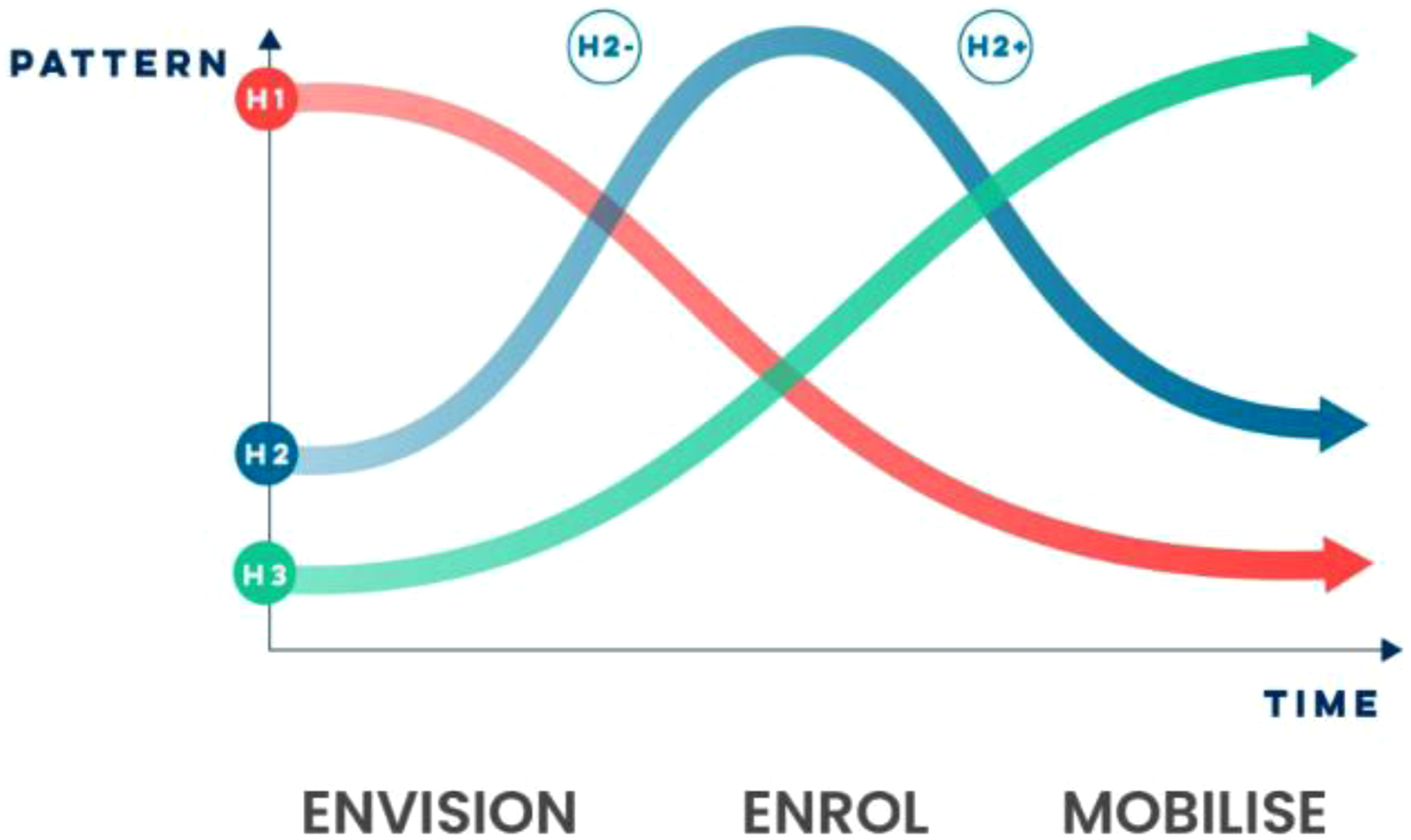
After introductions and a briefing on the Three Horizons approach, the workshop undertook three different activities applying the approach to the UK housing context, and in the following order: 1. Exploring potential characteristics of a nature-centric vision for housing in the UK (H3). 2. Identifying aspects of the existing housing or nature zeitgeist, and existing interventions, that characterise the current system (H1) 3. Critically assessing the potential extent to which interventions (H2) might carry us towards a nature-centric vision. These interventions spanned financial mechanisms, regulation, novel polycentric governance approaches and local community initiatives
Each activity involved brainstorming with groups of four or five participants before gathering in plenary to discuss and categorise responses.
The post-workshop phase involved considerable retrospective analysis. We analysed and synthesised the workshop responses, undertook research into the details of interventions where needed, and positioned the whole within relevant literature. Of note was that we decided during the post-workshop phase to depart from the Three Horizons framework as we could not adhere to its definition of H2 while carrying out our desired analysis. Specifically, we wanted our examination to encompass not just new interventions, but those which have already been implemented in the UK. Many of the interventions mentioned by workshop participants were of this more established kind, and some of them may still be moving us towards H3, or have the potential to do so with certain adjustments and assistance. However, this falls outside the formal definition of H2, which is limited to new interventions and does not include this important time dimension. For the remainder of the essay, we will therefore refer to the ‘current system’ (or ‘status quo’), ‘interventions’ and ‘visions,’ rather than to H1, H2 and H3 respectively.
Workshop participants considered whether interventions, both implemented and new, might genuinely carry us towards the vision (see below) or risk being false pathways that lock us into a status quo of ineffective action on nature loss unless mitigating measures are taken. However, due to time constraints, these questions were not explored in detail during the workshop. Subsequent analysis took this further by identifying where interventions were constrained by lack of scale or impact, by a high risk of capture or dilution by status quo forces, or by a more fundamental misalignment with nature-centric philosophy. This analysis expanded the reasons behind the assessment of whether or not a particular intervention could be a genuine step towards nature-centric housing.
Genuine win-wins: visions for nature-centric housing
Workshop participants provided a wealth of information on the current context and prevailing perspectives relating to nature and housing, whether separately or together. In post-workshop analysis we summarised these themes as Box 1. ➤ Spatial and other needs of non-humans are not recognised in decision-making. ➤ Nature can be seen as a burden - an impediment to ‘progress’ defined in terms of economic growth and expedited planning processes. Individual species of bats, newts and snails are assumed to have no inherent value and blamed for costs and delays. ➤ Many people are afraid of nature, based on culturally-embedded stereotypes rather than an understanding of actual risk. ➤ Rigid legislation reduces the freedom to pursue nature-positive solutions. ➤ There is a lack of joined up planning and holistic design, but local authorities lack capacity and skills in areas including planning, ecological expertise, and enforcement. ➤ Private luxury is cherished above public luxury. ➤ Scarcity mindsets and profit-based success measures dominate (in relation to housing and more generally) ➤ Extraction and over-consumption are celebrated and treated as economically indispensable. ➤ The aspiration to own housing and land is normal and often seen to be positive. ➤ Any property is subject to several views that are often in tension: those of the landlord, the tenant (where the landlord is not owner-occupier), the community, the planning authority/state, the neighbours, nature, and so on. ➤ Profit motives not only mean that builders neglect to create spaces for distributed governance (e.g. village halls) but can obscure why we build in the first place. ➤ The idea of a housing shortage is promoted despite the number of habitable properties that lie empty, many occupied properties containing large amounts of unused space, and the prevalence of second homes. ➤ Powerful vested interests maintain the status quo, as do builders’ knowledge and training, and the only way of delivering housing is through developers. ➤ There is gross inequality in access to housing and nature, with ‘green gentrification’ involving high prices for nature-rich places. ➤ A collective imaginative aesthetic prefers manicured beauty and neat lines. ➤ A disempowered, unhealthy population has its attention captured by virtual worlds and is less connected to the surrounding world despite the ostensible benefits of the technologies. ➤ Ancestors and the future are discounted or ignored.BOX 1. Context and prevailing perspectives relating to nature and housing
This contrasts starkly with what the workshop generated for characteristics of a nature-centric vision for housing. Guided by the recommendations of IPBES (2024) and other international policy organisations that only a change in values and mindsets will be sufficient for the transformation required, the workshop contributions were abundant: participants produced numerous ideas for how housing developments might appear and be governed. However, there was a high degree of commonality, especially at the level of values, attitudes and principles. After the workshop, we assigned categories to the recommendations. These were values and mindsets; housing principles; housing features; and frameworks and policies. This is represented in Figure 2. It shows how the visible housing features and accompanying frameworks and policies are built on a foundation of housing principles which in turn grow out of nature-centric values and mindsets. Visions for nature-centric housing. The visible housing characteristics and accompanying frameworks and policies are built on a foundation of housing principles which in turn grow out of nature-centric values and mindsets.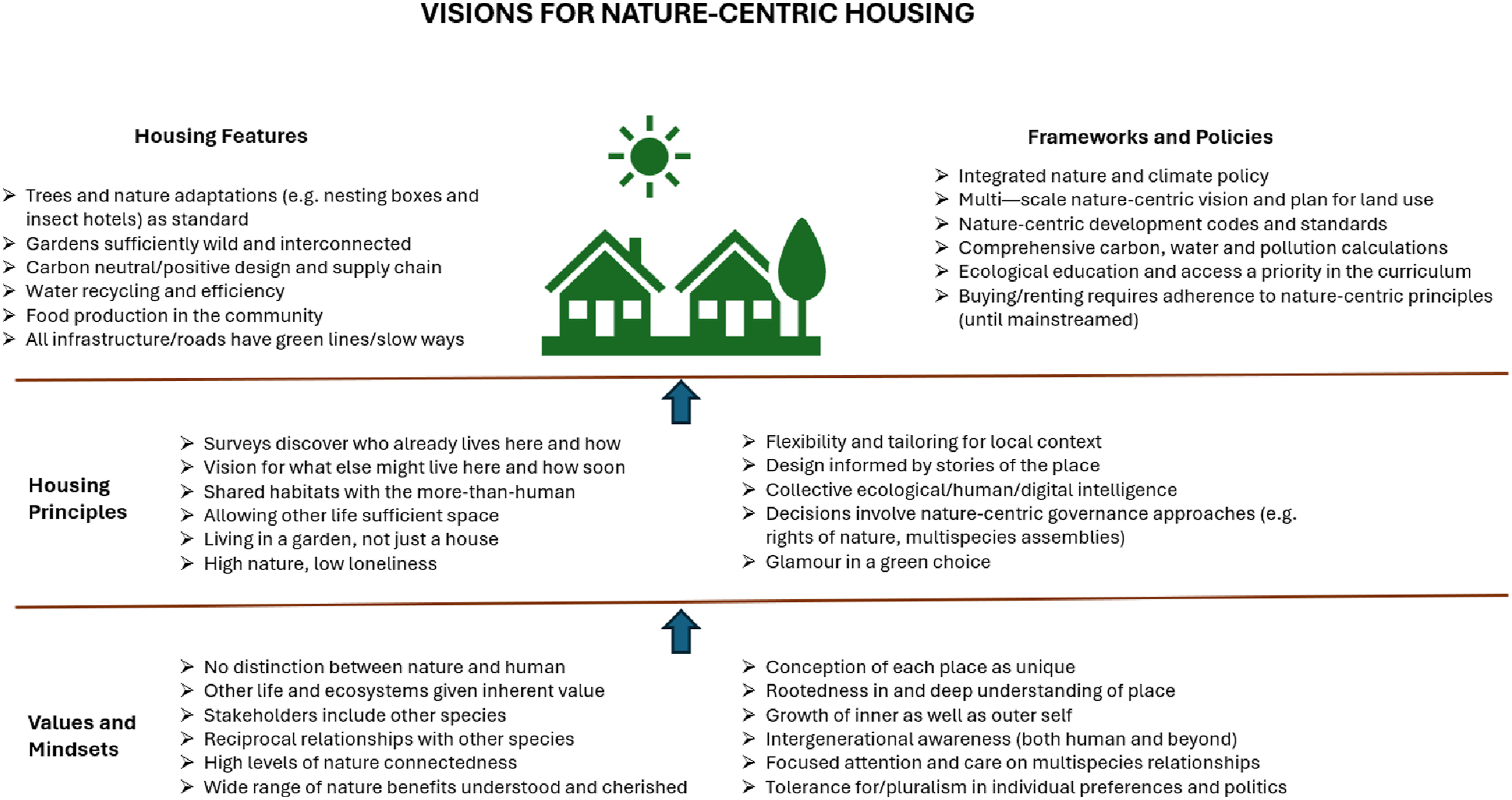
Following systems theory around effective levers for change (cf. Meadows 1999, and subsequent authors such as Richardson et al., 2020; Riechers et al., 2021; Abson et al., 2017; Dorninger et al., 2020; Fischer and Riechers, 2019), changes in values and mindsets should have the biggest impact because they flow through to the principles, housing features, and governance/structures, often making the best choices for these largely self-evident. This can be seen in Figure 3, a housing-specific version of the abstract leverage points diagram which is in turn based on Meadows (1999). Leverage points for systems changes in housing, adapted for housing development from the original list of interventions formulated by Meadows (1999) and its diagrammatic representation here: https://medium.com/adam.d.groves/from-service-design-to-systems-change-72fa62b1714c).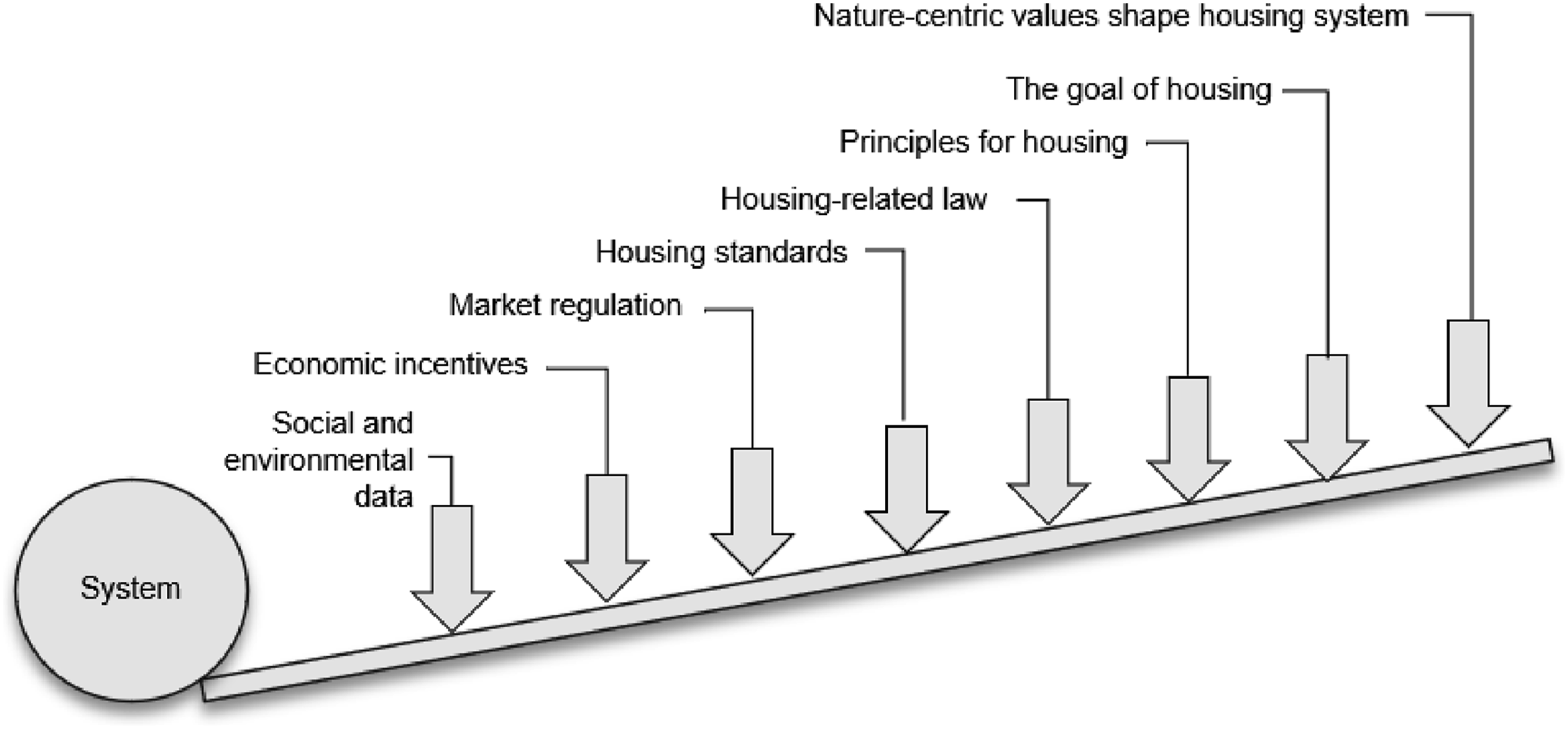
Unlike values and mindset change, the visible changes at the top of Figure 2 should in theory be relatively easy to implement, but in reality may be difficult to achieve in combination and at scale without the enabling values and mindsets underpinning them. This resonates with the IPBES (2024) finding that, despite the various actions taken to date, the current dominance of other values, attitudes and principles is driving the destruction of nature and that transforming these is the necessary foundation for recovering and sustaining a healthy, functioning biosphere. Hence, we suspect that change at the level of values and mindsets is essential, but acknowledge that the dynamics between different levels need further investigation, perhaps using the approach to identifying and enacting “chains of leverage” proposed by Riechers et al. (2025: 2731).
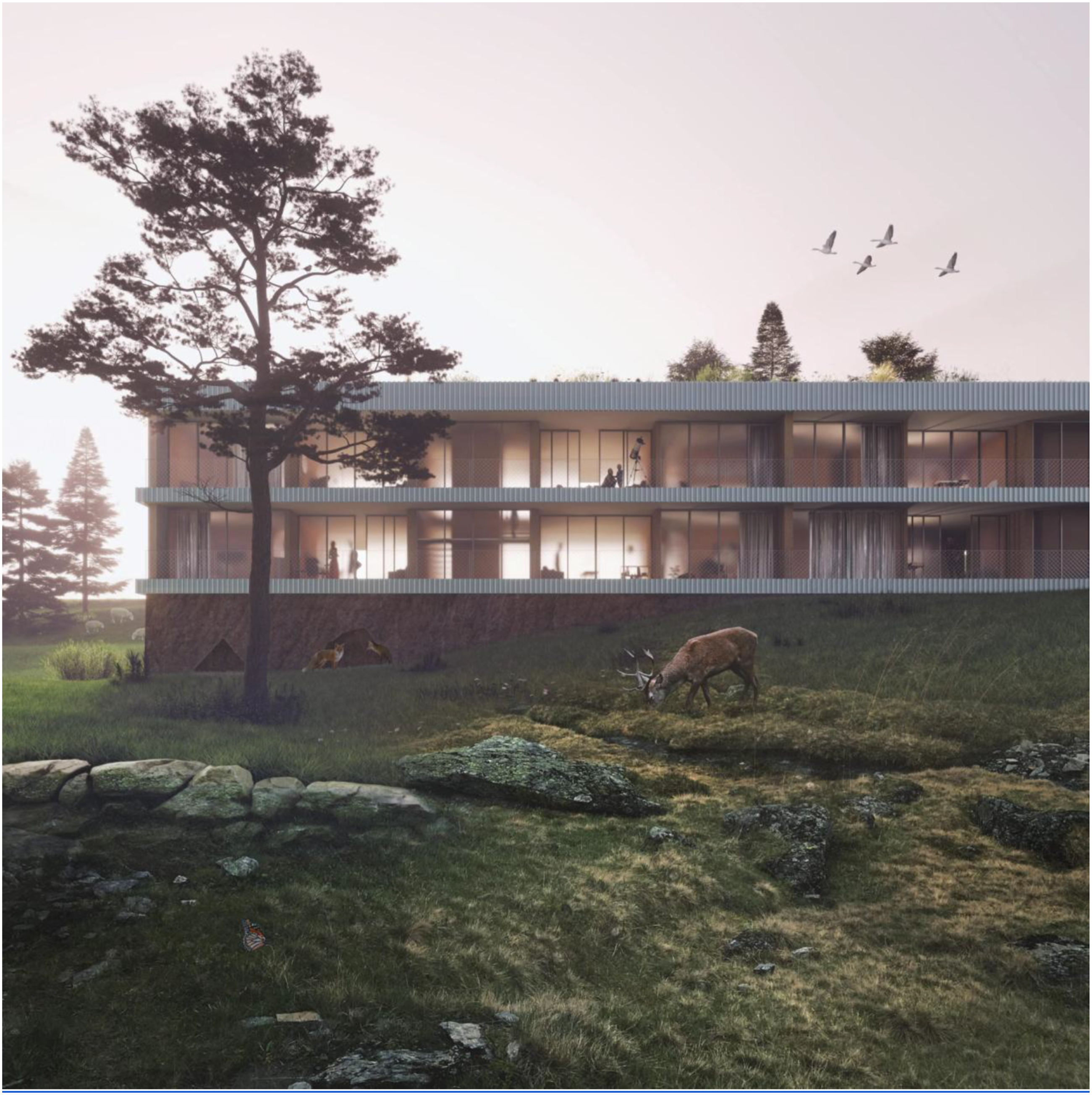
To develop visions for nature-centric housing, we can begin from principles of multi-species justice. This views “humans as part of larger ecological systems, which in the context of planning processes would require the prioritisation of the well-being of all species within urban areas” (Raymond et al., 2025: 2; see also Houston et al., 2017). Specifically, humans and other species (including individual organisms) have inherent value as manifestations of life, or as members of the Earth community, and both humans and other species should have access to a high-quality habitat in which to live. As opposed to an assumption whereby humans can eject other species from their habitats in order to create our own, we might begin with the assumption that humans are almost always seeking to occupy the habitats of others, and so should integrate within them as far as possible (see Image 1). Image from a competition entry entitled ‘More than human neighborhood’ for the site of Hjertelia, Norway. Andrew Tabocchini Architecture (2021).
15
Nature-centric housing should not, then, be confused with existing ‘green’ housing movements. For example, the garden cities of Ebenezer Howard feature a central park with public buildings and a surrounding area that seeks to balance residential, industrial and agricultural zones in the service of humans. Nature-centric housing does not begin with a plan but with a principle: Homo sapiens should co-habit with – rather than displace - other species to the greatest possible extent. One could, by contrast, have beautiful parks and gardens in a garden city, yet it can still be ecologically denuded. Nor is nature-centric housing akin to Frank Lloyd Wright’s broadacre cities, which envisaged self-sufficient families, each with its own acre of land, which though relatively more inclusive of nature were still inherently anthropocentric. Nature-centric approaches do not mandate any particular social system, with the caveat that there is an ongoing commitment from residents and service providers not to compromise the multispecies principle.
The legal basis for this view of multispecies consideration is extant within the UK, with the Environment Act 2021 defining the ‘natural environment’, as (a) plants, wild animals and other living organisms; (b) their habitats; (c) land, air and water and the natural systems, cycles and processes through which they interact (Environment Act, 2021., Section 44, a-c). One exception relating to (c) is that land, air and water excludes ‘buildings and other structures’. This suggests that, as the preventative and precautionary principles enshrined in the Act should highlight, nature-centric housing designs need to be embedded before construction. However, this exception illustrates that the legal framework in the UK provides both opportunities and barriers to nature-centric housing: the exclusion of the built environment as ‘nature’ undermines any more-than-human ethic within developed landscapes.
The environmental impacts of modern housing methods are globalised (Buyle et al., 2013), meaning that full cradle-to-grave assessments need to be fully considered, and likely adapted for nature-centric innovations (Deng et al., 2025; Hueppe, 2025) to better account for biodiversity measures in particular (Winter et al., 2017). Again, taking a multispecies view of housing encourages, and directs, us to expand our boundaries to include the non-localised and highly interconnected dependencies of species, such as swallows, which, migrating to the UK from South Africa (Burman et al., 2018), seek breeding sites in houses where humans are present (Kim et al., 2023). This highlights the need, as Wood et al. (2022: 2, emphasis in the original) have proposed, for a “methodology for identifying a network of habitats and movement pathways that supports the long-term persistence of multiple species in a landscape”, but expanding this to include humans as a coexistent species.
Construction of modern housing will inevitably displace nonhuman species and disrupt nature cycles, especially as compliance with existing measures is extremely low (Chapman et al., 2024). However, where habitats are degraded as part of a development, humans should seek to restore them at the same location to an agreed condition, thereby contributing to nature’s recovery and establishing coexistence (Canepa et al., 2022; Cotsaftis et al., 2023; Selvan et al., 2023). New regulations would begin by requiring a proper, and critical, understanding of place (Ives and Bekessy, 2015; Robertson, 2018), with environmental surveys becoming integral to the design process itself, rather than being seen as a hurdle to be overcome after designing in a pre-established manner (e.g., Raymond et al., 2025). These surveys may be prohibitively costly and time-consuming for very small developments, in which case it should be part of a wider spatial strategy requirement, but whatever the approach, designing with an understanding of the local environmental context is crucial. Beyond the quantitative questions of ‘which nonhumans and where’ in current environmental surveys, a critical approach shifts the “the focus of attention…towards the animal ‘condition,’” as White (2021: 185) says, drawing on Pedersen and Stănescu’s description, that “[the] actual life situation of most nonhuman animals in human society and culture, [are] physically and emotionally experiences [of] a routine repertoire of violence, deprivation, desperation, agony, apathy, suffering, and death.” (Pedersen and Stănescu, 2012: ix). It is also important to ‘(re-)story place’ (e.g. Kimmerer, 2013) to uncover the deeper ecological, socio-cultural and mythological patterns that shape it, a process that can illuminate its potential – ecological and beyond - and its resilience for the future. This not only helps determine whether housing is appropriate but also shapes an integrated approach that brings all stakeholders into a shared process.
Consents would go far beyond just mandating accessible greenspace, green roofs and provisions for individual species such as swifts and hedgehogs, but a more thorough integration with those beings for whom the site is already home, or whose reintroduction is desired. This could be complemented by giving nature a voice in development processes through nature-centric governance approaches such as multispecies assemblies 6 or nature on the Board, 7 and reestablishing the deep centrality of nature in our cultural understanding of our urbanised society. For example, to return to swallows, Green (2019) suggests that it was the design of Greek and Roman houses - where swallows would perch on wooden beams in open windows - that accounts for why “the Roman author Aelian (175–235 CE) [said] that the birds share a house with men, and why men in turn were expected to extend Homer’s laws of hospitality to the swallow - that is, befriend the guest who shares your table and send him on his way when he wants to go” (Green, 2019: 92). The resulting housing developments would be differentiated by their bioregional characterisations (BC architects & studies, 2024; Wearne et al., 2023) and by their desirability for homeowners: these would be pioneering multispecies habitats offering healthy, high-quality living environments, meeting uniquely high ethical standards and building structural reciprocity (cf. Rodgers and O’Neill, 2012 notion of infrastructural violence across species divides (Enns and Sneyd, 2020)).
Stepping stones or false pathway? Navigating interventions
The workshop assessed the extent to which both existing and new interventions that may appear to carry us towards the nature-centric vision represent genuine steps in that direction, or risk being false paths unless mitigating measures are taken (Figure 4). In the post-workshop phase, in order to capture the character of the limitations for each intervention, we considered assigning each a principal limitation factor (i.e. why it might fail to deliver a genuinely nature-centric vision). These factors were: philosophical misalignment with nature-centrism, high risk of capture/dilution to the status quo (e.g. becomes misused for greenwashing), or shortfall in scale/impact.
8
We found that the context around each intervention often did not allow a binary assessment of these three limitation factors, so that, for example, an intervention might not be easily assigned to ‘philosophically aligned’ or ‘philosophically misaligned’ due to the complexities involved. Moreover, the importance of each limitation factor relative to the other two was hard to gauge. A more detailed investigation might assign interventions a place on these different spectra and assess their relative weights. Illustrations of new and implemented interventions identified in the workshop. Detailed analysis might indicate where these could contribute to the realisation of a nature-centric vision, and where they would be more likely to perpetuate the status quo.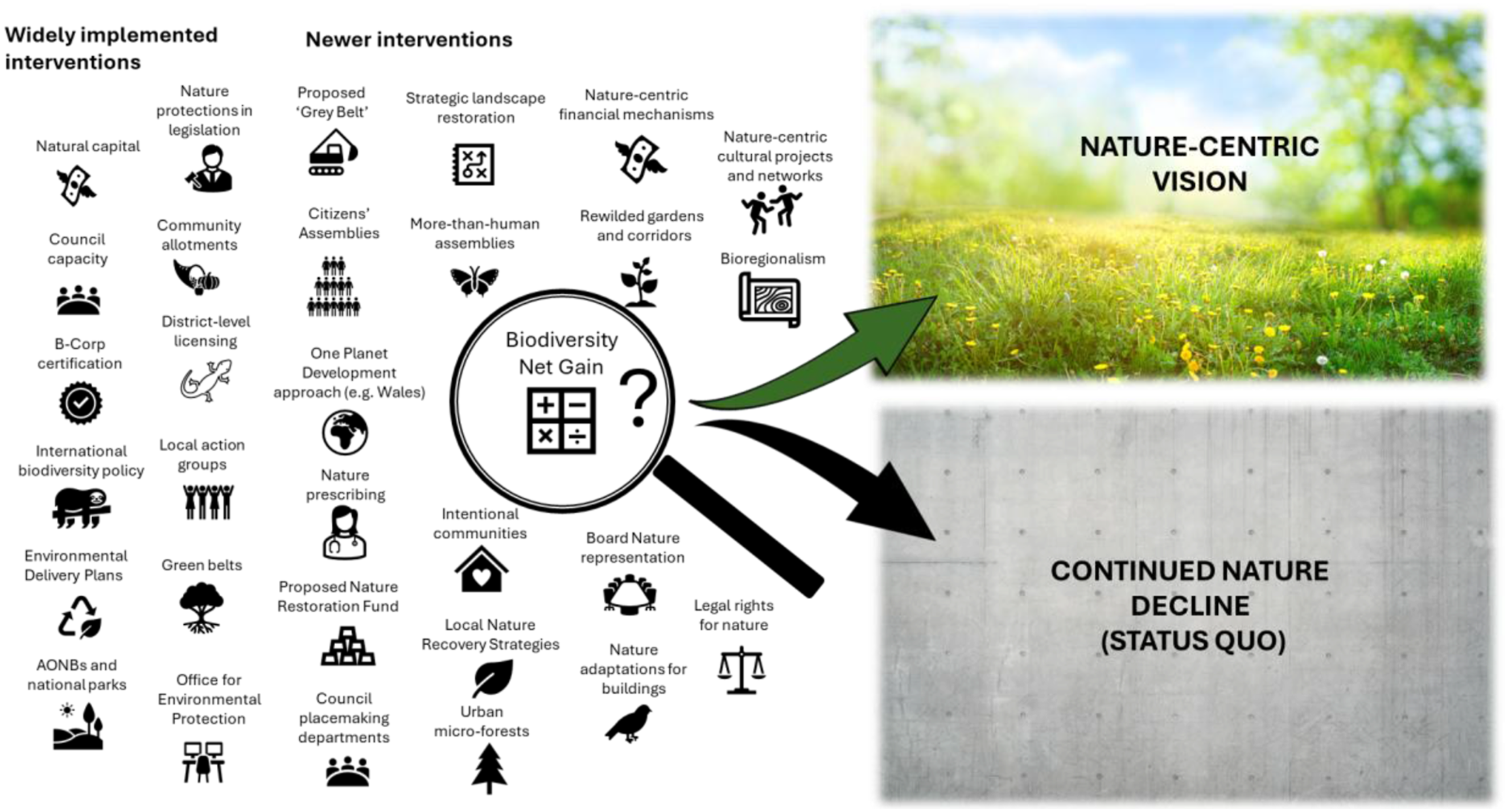
For now, a few examples will illustrate what we mean by limitation factors, and specifically highlight the point that whether or not an intervention contributes to or detracts from the realisation of the vision is often context-dependent. Biodiversity Net Gain (BNG) is an approach to development intended to ensure that wildlife habitats are left in a measurably better state than they were before the development, whether onsite or offsite, and entails measuring biodiversity value through standardised biodiversity units. The proposed Nature Restoration Fund (NRF) that would support BNG under new legislation is founded on a similar philosophy: it will reduce the need for individual site-level assessments in favour of developers pooling contributions for more ‘strategic’ nature interventions elsewhere. BNG thereby supports a position where the species, ecosystems or habitats in one area are equivalent to those in another (if they can be meaningfully measured at all). This asserts that destruction in one area can be offset by restoration of something similar elsewhere, a mathematical and reductionist logic that does not recognise the uniqueness of individual places (as those who have experienced certain kinds of developments in a cherished area will feel keenly) and assumes that species and ecosystems are the levels that matter, not the level of individual creatures. At their worst, they represent a form of zonal ecocide where entire ecosystems are destroyed on the basis that there is a meaningful and viable ‘substitute’ elsewhere. As such, philosophical misalignment is an important limiting factor for BNG. Despite the UK being a signatory of IPBES (2024), anthropocentric values continue to underpin the proposed legislation, as evidenced by the persistence of these ideas and frameworks.
The proposed UK planning system changes are also likely to be ineffective in practice. First, they “would give Government leeway to allow developers to disregard a huge body of environmental law— the Habitats Regulations 2017 and the Wildlife and Countryside Act 1981—in return for paying a nature Restoration Levy” (WCL, 2025). The changes mean that one need not “worry about a single site or specimen if the overall habitat or species population benefits” (WCL, 2025). Rather than avoiding harm as a priority, a developer can move straight to offsetting it. Setting aside the philosophical problems cited above, the promised future benefits may not materialise. A recent study by the Royal Town Planning Institute found that only half (53%) of the ecological features required in planning permissions had been introduced, and when newly planted trees were excluded, this fell to 34% (Chapman et al., 2025). This suggests major weaknesses in post-planning processes and enforcement such that, even if BNG and offsets are acceptable mechanisms, there can be little confidence that commitments to them will be honoured. BNG therefore also suffers from the limitation factor of dilution, where commitments do not materialise, and that of a shortfall in scale, especially in terms of enforcement capacity.
It need not necessarily be this way. BNG could potentially contribute to the foundation of new towns and villages surrounded by biodiversity and with better access and hence increasing nature connectedness, creating a virtuous circle. But that is unlikely to happen without sufficient capacity and resistance to dilution, which in turn are likely to require mindsets and values closer to a nature-centric philosophy in order that the interests of other forms of life are granted a higher priority at each stage in the process.
Two further examples to illustrate limitation factors and context-dependency are B-Corp certification and nature representation. B-Corp certification involves organisations receiving an accreditation for meeting certain environmental and social standards. B-Corp is often regarded as progressive - and it has made substantial gains - but it is not nature-centric. This is because B-Corp’s ‘triple bottom line’ of People-Planet-Profit (drawn from Elkington, 1994) perpetuates the separation between humans and nature, and assumes the ‘balance’ across the three can be sought within an ineffective status quo. It does not acknowledge that the natural environment creates the enabling conditions for society to actually exist, and society in turn provides laws and rules within which economies act. In other words, the three are not equal, but nested concentric circles with economy wholly within (i.e. a subset of) society, and society wholly within the environment. By contrast, a nature-centric vision seeks to harmonise - rather than balance - the needs of all life in relation to land and what is constructed upon it. B-Corp certification is highly context-dependent: it is potentially a valuable stepping stone for incorporating pro-nature values into the standard operating protocols of companies, but can be recaptured by the status quo and competing principles like shareholder primacy that supports profit as the overriding basis for significant decisions.
More clearly facilitating the nature-centric vision are forms of nature representation. Assigning legal rights to nature, giving nature a voice on an organisation’s board, and multispecies assemblies (where human proxies represent the needs of a range of other creatures) are generally consistent with a nature-centric philosophy and could energise the realisation of a nature-centric vision for housing. They are also context-dependent in that they can potentially be captured or diluted. Indeed, those risks may increase as and when they scale. One type of multispecies assembly - the Interspecies Council 9 - has been used for both Defra future river policy development and to create a multispecies response to the Defra Land Use Framework consultation (Foodrise, 2025). However, such assemblies and councils need to be used more widely and to have more influence in decision-making if they are to achieve strategic impact, simultaneously navigating the risk that adopters may not use them effectively or in good faith.
Can it be done? costs, conflicts and the price of inaction
Is nature-centric housing realistic? If we accept that there is a chronic shortage of affordable housing (and set aside, for a moment, whether we should address the causes of that shortage rather than attempt to build our way out of them), how would a change to nature-centric housing influence cost and supply? And how would the conflicts between different stakeholders be managed?
The first response to the question of whether nature-centric housing is realistic is to ask whether it is also realistic to expect societies to flourish under conditions of ecological breakdown. Either way, any increases in building costs are likely to pale in comparison to the mounting costs (not least to physical and mental health) of living in dead landscapes (e.g. Reyes-García et al., 2025), alongside the savings from energy-efficient homes built in settings with natural protections against flooding and other escalating climate change-related impacts. It is also important to note that house prices are affected by a range of factors (e.g. land banking, second homes), so there are other interventions in concert that might keep prices manageable.
These points aside, it is certainly the case that a nature-centric approach has the potential to add up-front costs. While the UK Government might be weakening the requirements for ecological surveys, nature-centric housing requires them as an integral part of the design process, in order that the uniqueness of a place can be understood and can endure. Likewise, construction adaptations that avoid harm to other species, or design modifications incorporating wildlife corridors and native planting, might be more expensive initially (Sijtsma et al., 2020; White et al., 2024). It is also likely that some features, like green roofs, would involve ongoing maintenance, but this must be set against the maintenance of the alternatives in addition to – again – the strategic costs of environmental inaction.
There are several ways by which costs could be managed. Regulation in support of the change could be phased (to make implementation easier) and standards could be introduced that would advance nature-centric approaches and prevent greenwashing without being so prescriptive that they stifled innovation. This could be complemented by common financial incentives such as tax credits, reduced levies, subsidies, grants and low-interest loans, coupled with market support mechanisms like ‘green mortgages’ and lower insurance premiums. It might also be possible to allow developers to monetise benefits like flood mitigation or carbon sequestration to offset costs. Finally, partnerships and shared learning across sectors could, for example, reduce friction in transactions or provide design toolkits where these were consistent with the flexibility needed for place-specific development.
The impact on supply is harder to anticipate. It might be expected that planning approvals for nature-centric housing would take longer, but if more species were to be protected as part of the initial design rather than through complex offsetting arrangements - and if the design itself had wide appeal – then that would not necessarily be the case. It might also be expected that selecting contractors would take longer and there would be skills shortages for the types of construction and habitat curation needed for nature-centric approaches (given the shortage of extant demand), but processes would be streamlined over time while capacities would increase to meet rising demand. There would also be less need to retrofit where new housing was designed to be nature-centric. In the public sector context, supply could be boosted if the Government prioritised nature-centric targets in ways that spurred action, such as introducing related incentives and/or disincentives (Humphrey et al., 2025).
There would doubtless be a number of stakeholder conflicts to navigate. Developers, investors and affordable housing advocates tend to resist changes that might impact the potential to realise higher density or that incur higher costs. However, as discussed above, while there is the potential for increased upfront costs, this is partly driven by a lack of current competition in the market, which itself is due to insufficient demand for nature-centric housing. Moreover, nature-centric housing need not be low-density (Ehab et al., 2025; Ip, 2024). And while ‘NIMBYs’ and local communities often object to developments, their concerns – which may be based on increasing density, traffic or pressure on services, or because they would change the character of a neighbourhood – may apply in many cases to ‘normal’ anthropocentric developments more than they do to nature-centric ones. Optimal regulations and subsidies would both enable nature-centric housing and assist with affordability.
There is also the potential for conflict – both before and after a development has been built - between conceptions of individualised private property rights versus a sense of collective obligations to not just humans but nature in the broader sense that we adopt. There are the design and behavioural requirements for a settlement to remain nature-centric, where some residents might want greater freedom and hold particular ideas about convenience or private space. There might also be disagreements between centralising forces (e.g. utilities, transport, governance) versus those favouring local autonomy, and what this means for who is responsible in matters of safety, liability and maintenance. Finally, we note the risk of investors and developers co-opting the label or symbolism of nature-centric housing, such as by redefining the concept so that it is easier to build in the green belt or other protected areas.
Who would adjudicate these conflicts, and how? If nature-centric housing is to scale, such a programme would need to be facilitated by central government actors, or involve further devolution of planning and regulatory systems to local authorities. A staged approach would increase the chances of managing tensions (Plüschke-Altof et al., 2025). The process might begin by building trust and increasing the familiarity of the change through, for example, encouraging prefigurative initiatives; ensuring initiatives are visible, testable and reversible; involving people in decisions; and making the benefits evident. Nature-centric projects could be framed as improvements or upgrades or approaches to building resilience, rather than as radical change or overhaul. They could also be combined with local landscape planning, i.e. making local nature recovery strategies more participatory to engage local communities, while also integrating with nature-centric housing planning. Prefigurative projects could be piloted on a limited scale, and co-created with a range of stakeholders wherever possible. Further measures would be likely to ease the transition: incentives should be attempted prior to regulation; knowledge-sharing mechanisms and lessons-learned processes should be introduced; and independent monitoring with help from informed local communities should be in place.
Limitations and lacunae: opportunities for future research
Our purpose was not to undertake a scientific study, but it is still worth acknowledging a number of limitations in our approach. In terms of our selection of workshop participants, we did not have any voices strongly opposed to nature-centrism as a philosophy (i.e. everyone agreed on the need to protect nature in synergy with human needs, rather than solely as a basis for fulfilling those needs). This was intentional: the focus of the one-day workshop was to understand the potential for nature-centric housing rather than to have a broader debate on the need for values change (see IPBES 2024 for substantive review of this topic), so we placed the merits of nature-centrism itself out of scope.
Nevertheless, there was a wide range of opinion and interest in the group. While no voices were particularly hostile to nature-centric philosophies, participants varied in their degree of knowledge and commitment. This led to some discussion over the assumptions and scope of such philosophies, as well as whether other paradigms or practices had greater implications for nature’s protection or decline, but that discussion was not a focus. For example, we did not invest time examining assumptions regarding the ‘friendliness’ of nature, balanced ecological systems or the complexities of growing food in multispecies contexts. We did not delve into the fact that ‘nature-centric housing’ is not a unified phenomenon but a multiplicity of projects and innovations that inevitably come with complexities, ironies and contradictions, including issues such as potential conflicts with agendas around population density and compact cities or the risks to biodiversity from regenerating derelict land. And we did not engage with more fundamental philosophical arguments that conceptions of ‘nature’ are always political, such that, in the words of Erik Swyngedouw, nature is inescapably “a matrix of heterogeneous and fluid meanings” and “is always already social” (Swyngedouw, 2015: 134). These numerous, important questions offer avenues for further work for both proponents and sceptics of nature-centric housing.
Workshop participants sometimes ventured into the wide range of social issues surrounding housing. These inevitably intersect with nature-related issues, but to control the scope for this essay we focused on the latter. Among other deep layers beyond our scope were capitalist land ownership, ‘green affluence’ issues and the multitude of home-related but upstream factors damaging nature such as the supply chains for food and household products. We also acknowledge that, while the workshop was attended by some local representatives, it shared a common, inherent weakness in the ‘expert elicitation’ approach whereby voices of local communities and many marginalised groups were not comprehensively integrated. Finally, there is some debate over the Three Horizons framework itself based on the extent to which it carries risks (not exclusive to that framework) of group think and of paying insufficient attention to areas of conflict and synergy, or whether it does in fact embrace diverse voices, practices and perspectives effectively. These issues could be addressed in future research.
Participants generated large numbers of issues and interventions; doubtless a comprehensive survey would elicit more, but even so, we have necessarily needed to summarise the workshop contributions here. Time constraints for the workshop, and the space available in this essay, meant we were unable to conduct an extensive analysis of the origins, evolution and effectiveness of each intervention, which would have raised many points of complexity and debate. Nor was it possible to adopt quantitative approaches. For example, it was not justifiable to quantify neatly the number of interventions identified as moving towards the vision or reinforcing the current system, given the need to group some of the original individual contributions under a common theme, and the fact that their relevance to realising the vision lies on a spectrum with positioning dependent on multiple factors. We were also unable to quantify the relative importance of the limitation factors (scale, capture and philosophical alignment) because each intervention involves some complex combination of the three. Again, we recommend detailed research on these issues.
As well as analysing individual interventions in more detail, it would be valuable for future research to probe combinations of interventions. Combinations could extend to those between nature-centric housing objectives and wider land use, food, energy and other salient objectives. There are legitimate questions as to how individual interventions and combinations can be supported in practice without raising fears that the government is overreaching by ‘picking winners,’ but those questions must be seen in the context not just of the risk the ecological crisis presents, but of active media narratives and lobbying maintaining the status quo. Research should explore how the struggle between status quo and transformational forces operates in practice. That struggle is set against a backdrop where current dominant philosophical paradigms shape the housing system, so where alternative, nature-centric philosophies are concerned, research might investigate where they risk unintended or otherwise negative consequences and how these should be mitigated; the implications for housing of different forms of human-nonhuman relationship deemed nature-friendly by their supporters; and indeed where nature recovery might be enabled by the overturning of other dominant paradigms and processes beyond anthropocentrism.
One specific direction for further research under a different - if related - paradigm would be a systematic integration of regenerative principles throughout all the levels in Figure 2. A regenerative approach adopts a living systems perspective and involves ‘storying place’ as mentioned above. However, it also entails shifting mindsets so that housing projects are seen not in isolation but as parts of a nested system, and cultivates the capacity in projects and people for ongoing evolution in order that a community can continue to grow, adapt and thrive over time. 10 This approach has the potential to enhance the health and vitality of both people and ecosystems while adding long-term value by reducing risks and future costs.
Are the kind of nature-centric visions and interventions we have been discussing actually that radical? A further potential limitation of our work is how far the visions and interventions really diverge from the status quo. Recent studies have assessed the extent to which imagined futures genuinely diverge from the current system (e.g. Juri et al., 2025), and in line with their findings, our material still largely assumes the ‘…logic of global capitalism and of the Westphalian state-based governance system will not change radically during the 21st century and [c]onsequently…suffer from a continuity bias preventing them from imagining and preparing for discontinuous environmental and social futures’ (Lauer et al., 2024: 1, 13; see also Raskin and Swart, 2020). For example, neither our thesis nor the interventions explicitly address critical issues of an internal colonialism that legitimises the oppression of animal bodies within domestic borders of an imperial nation (e.g., Belcourt, 2015; Ramcilovic-Suominen et al., 2024), nor do they trouble the notion of housing as settlements, despite the migratory, nomadic and adaptive housing strategies of nonhumans, and provocative arguments that “[h]umanist constructions of home as a ‘bounded place’ [have been] thoroughly refuted by scholarship” (Fair, 2024: 335). Our investigation thus largely assumed humans to be “Homo indoorus” (a term referring to modern humans who spend an increasing amount of time indoors, often within artificial environments; see Dunn, 2018: 1) and made little provision for thinking of more-than-human collaboration in aspects of design, construction, repair or deconstruction (cf. Clarke et al., 2019), or addressing legacy imaginaries influencing possible futures (e.g., Feola et al., 2023). If we are to break into new imaginaries we need to invest more effort exploring the more powerful levers of systems change, as illustrated above in Figure 3.
Conclusion: the prospect of multispecies planning and design
Despite the limitations, the workshop and subsequent analysis have real value for probing whether a genuine ‘win-win’ for housing and nature exists. As a headline, there was a consensus from participants from a range of professional backgrounds, including planning and architecture, that the achievement of visions for nature-centric developments are technically feasible; it is the political will that is lacking. The popular will is harder to estimate, but recent polling shows a consensus across the electorate when it comes to nature’s place within the housebuilding agenda and the role of green spaces for building pride of place (Annous and Fowler, 2025; Buckley and Hodgson, 2025). An approach to building consensus more widely could be integrating more participatory democracy into the landscape planning process. For example, citizens’ assemblies can potentially be integrated with expert-led evidence about landscape scenarios in an iterative way (Oliver et al., 2021).
A second headline is that our analysis of the current system and of interventions can be used to identify and develop stable stepping stones towards such visions, and also to critically and fundamentally assess and mitigate risks for particular interventions. It can be used to explore how unsteady stepping stones can be stabilised as well as how to protect those that are currently secure.
An exhaustive assessment of each intervention was beyond our scope, but a higher level principle emerging from our analysis is the need for a strategic approach in government and across sectors that identifies particular qualities to inform which innovations should be fostered. The academic domain of critical technology studies (CTS) can help here: CTS critically examines the social, political, cultural and other contexts that shape the creation, deployment and implications of technologies, but can be applied to innovations more broadly (e.g. Feenberg, 1991). There may also be insights from post-growth and de-growth advocacies and from the search for pre-figurative models. We should actively support what the Three Horizons framework calls ‘pockets of the future in the present’ (Sharpe et al., 2016) - the innovations that propel us towards the vision. But where interventions (new or already implemented) support the status quo, we should act to refine them so that they advance the visions, or be prepared to drop those that are ineffective in order to support those that are genuinely transformational.
Governments and developers might bemoan being asked not only to include climate mitigation and adaptation measures such as solar panels, insulation and heat pumps but also to plant trees and create provisions for individual species like ‘hedgehog highways’ or a hollow brick for cavity-nesting bids. As the Secretary of State for Defra told one campaigner, “the government would never mandate swift bricks because it would open up the ‘floodgates’ for other accessories like bee bricks, hedgehog holes and solar panels” (Bourne-Taylor, 2025: 122). Governments and developers are loath to increase complexity and short-term expense (though, as mentioned above, the costs of ecological breakdown in the longer-term would be far greater), but their critique of nature interventions as endlessly additive carries the assumptions of anthropocentric values and mindsets. Once nature-centric values and mindsets are in place, however, the problem largely evaporates: instead of being a process of anthropocentric design followed by nature additions, the creation of individual dwellings and communities becomes a multispecies design process from the outset. We acknowledge that as humans we are humble and talented parts of - not deludedly, hubristically separate from - nature.
This suggests that, as a signatory of the IPBES Transformational Change Assessment (IPBES, 2024), the UK Government might place greater emphasis and effort on achieving values and mindset change as the most powerful lever for change during the ecological crisis. In parallel, carefully fostering promising combinations of nature-centric interventions in long-term strategic planning and design could help unlock the housing crisis in a way that does not compromise the integrity of nature on which national prosperity depends. Regrettably, there is no indication that the current UK Government intends to do either, but we hope to have laid the foundations to illustrate that there can be an authentic path to mutual flourishing involving a genuine ‘win-win’ for housing and nature.
Footnotes
Funding
The authors received no financial support for the research, authorship, and/or publication of this article.
Declaration of conflicting interests
The authors declared no potential conflicts of interest with respect to the research, authorship, and/or publication of this article.