







Abstract

Any progressive criminal justice system will face the dilemma of determining how watertight its procedures should be in ensuring a separate court arena with a distinctive specialist approach geared to the needs and sensibilities of juvenile defendants, in resolving when prosecution in an ‘adult’ court may be justified and in deciding how exceptional any departure from the norm or use of jurisdictional transfer should be. Should power of transfer be determined by statutory policy categorization or on the basis of case-by-case selective judicial discretion? And to what extent should blending of jurisdictional style be promoted so that juvenile justice reflects justice-centred hallmarks of the adult criminal court while the latter buys into some at least of the welfare-centred ethos and safeguards of its junior counterpart, thus minimizing any apparent mismatch or lack-of-fit between children and the adult arena?
The patchwork landscape of juvenile justice in the United States illustrates the extraordinary disparity of approach across state jurisdictions, with transfer yardsticks grounded variously in age of juvenile, gravity of offence, repeat offending or poor responsivity to past rehabilitative intervention. This in turn has posed questions or assumptions regarding, for example, the potential for discrimination in determining discretionary transfer, more ready resort to custodial disposals by adult courts and the aggravating impact of adult justice on the extent and nature of juvenile recidivism (see, for example, Johnson, Lanza-Kaduce and Woolard, 2011; Tonry, 2007).
In a sequence of recent judgments 1 the higher courts in England and Wales have reiterated that the clear general policy of the legislature is that young defendants aged under 18 years of age and in particular children of under 15 years of age should, wherever possible, be tried in the youth court, the venue best designed to meet their specific needs. An obvious exception arises where a young person is charged with a grave crime that may well merit a sentence beyond the powers of a youth court, a complex issue explored in previous Commentaries (most recently, Stone, 2010a). 2 Departure from principle may also be posed in the not uncommon but less extensively debated context of a child or young person who is jointly charged with an adult, irrespective of offence seriousness or defendant characteristics, thus raising a competing presumption in favour of joint trial conducted at an adult venue. This Commentary seeks to sketch the relevant statutory provisions, buttressed by a thin scattering of judicial interpretation, throwing more light on the legal niceties, somewhat tortuous pathways and less-than-ideal resulting compromises. Given that adolescents, whether juveniles or young adults, will often pursue offending episodes together, it is perhaps surprising that this feature of youth justice has attracted relatively muted attention.
The Legislative Framework
Section 46 of the Children and Young Persons Act (CYPA) 1933 provides a convenient starting point. Contrary to the general rule that ‘no charge against a child or young person … shall be heard by a magistrates’ court which is not a youth court’, s.46(1)(a) specifies that:
… a charge made jointly against a child or young person and a person who has attained the age of 18 years shall be heard by a magistrates’ court other than a youth court.
3
As the Divisional Court in R v Tottenham Youth Court, ex parte Fawzy [1999] 1 WLR 1350 put it, ‘in cases involving both youths and adults it was thought appropriate that the adult regime should prevail over the youth court regime’, in the interests of the adult co-accused. That judgment also clarified that ‘a charge made jointly’ ‘refers to the present rather than the past’ and that phrase:
… is not wide enough to embrace a situation where, although historically both an adult and a youth were jointly charged, the adult has dropped out of the case by reason of his death, or the prosecution withdrawing the charge against the adult or the court directing a discharge or an acquittal.
Adult co-defendant: summary trial
If the charge relates to a summary or either-way offence and, in the latter instance, the case against the adult proceeds summarily, pleas will be entered. 4 The route forward can best be summarized in Table 1.
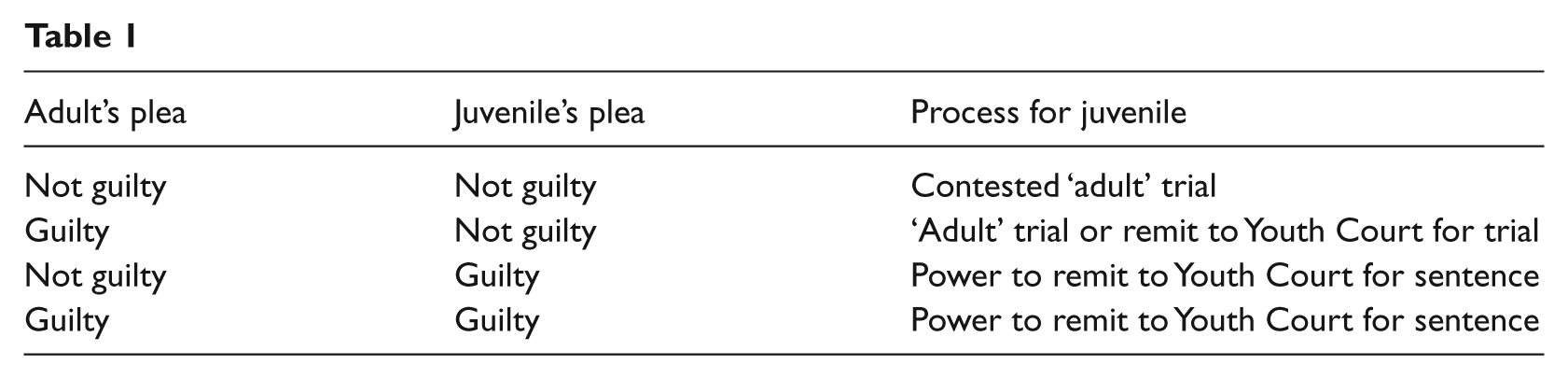
It will be noted that where both adult and juvenile plead not guilty contested trial necessarily proceeds before the adult court. Where the adult pleads guilty but the juvenile pleads not guilty, the magistrates have discretion whether to retain jurisdiction and conduct his trial or to remit him to the appropriate youth court under the provisions of the Magistrates’ Courts Act (MCA) 1980 s.29:
(2) If— (a) the court proceeds to the summary trial … in the case of both or all of the accused, and the older accused or each of the older accused pleads guilty; or (b) [not material in this context] then, if … the juvenile pleads not guilty, the court may before any evidence is called in his case remit him for trial to a youth court acting for the same place as the remitting court or for the place where he habitually resides; (3) A person remitted to a youth court under subsection (2) above shall be brought before and tried by a youth court accordingly.
A remitted juvenile has no right of appeal against that order (s.29(4)(a)).
If the juvenile pleads or is found guilty the ‘adult’ court has restricted powers of disposal, being subject to the Powers of Criminal Courts (Sentencing) Act (PCC(S)A) 2000 s.8 which requires any adult court convicting a juvenile to remit the case to the relevant youth court 5 ‘unless satisfied that it would be undesirable to do so’ (s.8(2)). However, in respect of an adult magistrates court that requirement is qualified by s.8(6)-(8) which specify that remittal is not required if the court ‘is of the opinion that the case is one which can properly be dealt with’ by means of:
(a) an order discharging the offender absolutely or conditionally (with or without any other order that the court has power to make when absolutely or conditionally discharging an offender); or (b) an order for the payment of a fine; or (c) an order (under PCC(S)A 2000 section 150) requiring the offender’s parent or guardian to enter into a recognizance to take proper care of him and exercise proper control over him.
Alternatively, the court may, but is not obliged to, remit if it would otherwise be required (by PCC(S)A 2000 s.16(2)) to refer the young offender to a youth offender panel; in other words the defendant fits the criteria for a compulsory referral order whereby determination of the appropriate intervention is delegated to an extra-judicial arena in the interests of restorative justice and seeking to avoid re-offending. This step may thus proceed directly without need of a youth court as intermediary. 6
Adult co-defendant: The Crown Court
If a juvenile is jointly charged with an adult in respect of either (i) an indictable-only offence or (ii) an either-way offence where an ‘adult’ magistrates’ court has determined at a mode-of-trial hearing that the case should proceed on indictment, MCA 1980 s.24(1)(b) provides an exception to the presumption in favour of the juvenile’s case being subject to summary proceedings, namely a discretion to send the juvenile’s case to the Crown Court where ‘the court considers it necessary in the interests of justice to commit them both for trial’.7,8,9 It may be noted that the juvenile does not have a right to trial at the Crown Court, should he consider this the preferable course, but in exercising its discretion under these provisions a magistrates’ court will hear representations from the prosecution and defence on ‘interests of justice’ considerations.
Though there has been strikingly little case law throwing light on the appropriate use of this discretionary power, in Crown Prosecution Service v East Surrey Youth Court (Ghanbari as interested party) [2006] 1 WLR 2543 the Divisional Court observed that ‘factors relevant to that judgment will include the age and maturity of the youth, the comparative culpability in relation to the offence and the previous convictions of the two and whether the trial can be severed without either injustice or undue inconvenience to witnesses’. Building upon that steer the Sentencing Council (2011) in a recent Consultation Paper, in anticipation of issuing overarching guidelines on issues including allocation according to venue, has identified the following examples of factors to be considered 10 when deciding whether to separate the trials of youths and adult co-defendants:
whether separate trials can take place without causing undue inconvenience to witnesses or injustice to the case as a whole;
the young age of the defendant, particularly where the age gap between the adult and the youth offender is substantial;
the immaturity of the youth;
the relative culpability of the youth compared with the adult and whether or not the role played by the youth was minor;
lack of previous convictions on the part of the youth.
In the meantime current Crown Prosecution Service guidance (undated (a)) indicates that in assisting a court in its exercise of discretion a prosecutor should have regard to factors that include:
the respective ages of the adult and youth;
the respective roles of the youth and adult in the commission of the offence;
the likely plea;
whether there are existing charges against the youth before the youth court;
the need to deal with the youth as expeditiously as possible consistent with the interests of justice; and
the likely sentence upon conviction.
If an adult magistrates’ court determines that it is not necessary in the interests of justice for the juvenile to accompany the adult to the Crown Court for trial, that court will take the young defendant’s plea. If he pleads guilty, the court has to consider its powers in accord with the limited ambit of disposal outlined above, with scope to remit to the relevant youth court. In face of a not guilty plea, MCA 1980 s. 29(2)(b) provides that before any evidence is called the court may remit him for trial to a youth court, either acting for the same area as the remitting court or for the place where he habitually resides.
As suggested earlier, the situation may arise where an adult magistrates’ court, dealing with adult and juvenile co-accused, determines that there is no case for the adult to answer at the Crown Court and so discharges that defendant, leaving the juvenile as remaining sole accused. This arose in Fawzy (see above), involving a charge of robbery where the magistrates purported to remit the case against the juvenile without further consideration to the youth court. Clarifying that the adult court in these circumstances can no longer consider it necessary in the interests of justice to send the juvenile to the Crown Court for trial, the Divisional Court confirmed that s.24(1)(b) thus has no further relevance and dispatch to that court will be appropriate only where s.24(1)(a) applies, i.e. where the youth is charged with a qualifying serious crime and there is a real prospect that, if convicted, he will incur a custodial sentence exceeding the powers available to a youth court. Noting that there is no express statutory provision giving the adult magistrates’ court power to refer that s.24(1)(a) determination to a youth court, the Divisional Court concluded that ‘it was Parliament’s intention that, in a mixed age case where the adult court has discharged the adult, the adult court must ….consider the question whether the case is a severe punishment case’. The mode of trial question is one to be resolved by the adult court and, if the case is deemed appropriate for summary proceedings, the court should proceed as outlined above in respect of summary trial, taking plea and having discretion to send the case to the youth court either for contested trial under s.29(2) or for sentence under s.8.
General scope for severance
Where a case involving adult and juvenile co-defendants proceeds to trial before an adult court, whether an adult magistrates’ court or the Crown Court, scope remains for the court to direct severance, either (i) in exceptional instances in accordance with general principles governing the merits and demerits of severance, irrespective of the ages of the co-accused, having regard to any risk of prejudice arising from joint trial and other arguments for overcoming the broad presumption against that step (see Thornton, 2003); or (ii) as a reflection of a young defendant’s vulnerability. As expressed in the Consolidated Criminal Practice Direction (CCPD) (2011) Part III para. 30.4 the latter amounts to a presumption against joint trial:
If a vulnerable defendant, especially one who is young, is to be tried jointly with one who is not, the court should consider at the plea and case management hearing, or at a case management hearing in a magistrates’ court, whether the vulnerable defendant should be tried on his own and should so order unless of the opinion that a joint trial would be in accordance with Part 1 of the Criminal Procedure Rules (the overriding objective) and in the interests of justice. If a vulnerable defendant is tried jointly with one who is not, the court should consider whether any of the modifications set out in this direction should apply in the circumstances of the joint trial and so far as practicable make orders to give effect to any such modifications.
The ‘modifications’ mentioned in this paragraph comprise the safeguards, precautions and facilitation methods found in CCPD Part III paras. 30.3 to 30.18 (see Stone, 2010b). 11 In the event that severance is ordered on vulnerability grounds this raises the question, outwith instances of ‘grave charge’ trial at the Crown Court, whether there remains any continuing justification for the juvenile’s trial before the adult court. However, this eventuality does not fall within the scope of MCA 1980 s.29(2) for adult magistrates’ court purposes nor is there any power for the Crown Court to remit such a case to a youth court.
Adult’s guilty plea at Crown Court
In instances where a juvenile is sent to the Crown Court in accordance with s.24(1)(b)) as an adult’s co-accused, what should follow if the adult pleads guilty at the Crown Court? The basis upon which the juvenile has come before that court has ceased to be a live consideration. In principle it should follow that there should be some procedural means by which his case should revert to the youth court for resolution. This issue has recently been posed in R. (on the application of W.) v Leeds Crown Court [2011] EWHC 2326 (Admin) involving a boy W. aged 14 with no previous convictions who was jointly charged with domestic burglary, his co-accused being aged 20. W. also faced alone a separate allegation of witness intimidation. He denied both matters. When the two came before an adult magistrates’ court the 20 year-old indicated no plea and the magistrates declined jurisdiction, thus triggering W.’s committal to Crown Court in respect of charges that would otherwise have been proceeded with at youth court. His co-defendant pleaded guilty at his initial plea and case management hearing at the Crown Court. It was now arguable that the ‘interests of justice’ considerations that had thus far tied W. to his co-defendant had largely dissipated. In an unrelated but parallel case, a boy called G., also coming before the Crown Court at the same court centre via s.24(2)(b), was faced with the same development. In both instances there was wide sympathy for the argument that both boys would now be better dealt with at youth court but the Crown Court judges dealing with them were in disagreement whether they had any power to facilitate their despatch to that venue. Given two contrasting interpretations of the legislation, judicial review was pursued before the Divisional Court to secure a more definitive ruling.
It was immediately apparent that power to remit under PCC(S)A 2000 s.8 did not apply since neither boy had been convicted and so could not be remitted for sentence. That left two lines of argument in support of a power to remit the boys, both grounded in the provision contained in the Courts Act 2003 s.66 giving judges sitting in the Crown Court the powers of district judges at magistrates’ court level. It was argued that this enabled a Crown Court judge either (i) to revisit the mode-of-trial issue, considering afresh the applicability of MCA 1980 s.24, or (ii) to deploy MCA 1980 s.29(2) powers to remit for trial. Failing that, it was suggested that s.29, though expressly intended for application by magistrates’ courts, can nevertheless be interpreted to provide the Crown Court with an equivalent power.
The President of the Queen’s Bench Division had little trouble in rejecting the s.66 devise in respect of s.24, primarily on the basis that the matter was no longer before a magistrates’ court to be revisited, with the consequence that any scope to adopt the powers of a district judge did not apply. Additionally, numerous past judgments had established conclusively that s.24 decisions regarding mode-of-trial are irrevocable, save in exceptional instances (of no applicability in this context) where MCA 1980 s.25 applies (see Stone, 2010a). Similarly, s.66 could not enable a Crown Court judge to purport to exercise s.29 powers as a magistrate since the judge would not be acting in that capacity. As regards the residual statutory interpretation argument, the Divisional Court considered first whether s.29 needed to be read in a way that made it fully compatible with the European Convention on Human Rights Article 6, in line with the Human Rights Act 1998 s.3. Though it was strongly preferable as a matter of policy that a juvenile should be dealt with by a youth court, he would nevertheless have the benefit of a fair trial in the Crown Court and hence it could not be argued that his Article 6 rights would be compromised if he were obliged to remain under the Crown Court’s jurisdiction.
Moving on to the possible scope for interpreting s.29 to apply to the Crown Court on the basis that the overall intention of the legislature must have been to provide such a power generally, despite being worded in a way limited to magistrates’ courts, and thus creating a lacuna through inadvertence or sheer oversight that was open to judicial interpretative correction, the Divisional Court observed that s.29 was part of a dedicated ‘Magistrates’ Courts’ Act and had been revisited by Parliament twice since enactment without the apparent oversight being corrected. Further, the legislature had also enacted other criminal justice legislation of general relevance to the trial of juveniles without seeking to address the apparent lacuna. Accordingly, it was not open to the Court to engage in judicial legislation to correct the shortfall.
Sentencing s.24(1)(b) Juveniles at the Crown Court
In the event that a juvenile is convicted at the Crown Court it is open to the court to deploy power under PCC(S)A 2000 s.8 to remit him to a youth court for sentence. In this instance the adult court is not subject to the disposal restrictions under s.8 that apply in respect of adult magistrates’ courts. However, having regard to the judgment in R v Gaskell [2006] EWCA Crim 2938 (discussed in Stone, 2007), the Court of Appeal is not likely to view unfavourably a judge’s preference for retaining jurisdiction for sentencing purposes, having regard to the advantages in the interests of justice identified by the Appeal Court of having the adult and juvenile co-offenders sentenced by the same judge on the same day. Even if the adult in Gaskell had not been convicted, the Appeal Court might nevertheless have favoured the Crown Court remaining seized of the juvenile’s case in the interests of avoiding delay and ‘fruitless expense’ and the complications arising in the event of challenge following s.8 remittal, appeal against the juvenile’s conviction resting with the Court of Appeal while appeal against sentence would have to be pursued at the Crown Court.
The juvenile appellant in Gaskell sought to argue that her case should have been remitted to the youth court where she would have been made subject to a referral order, a dedicated youth court disposal and the mandatory outcome at youth court given her absence of prior convictions, in accordance with the proposal in the pre-sentence report. In guidance on referral orders the Ministry of Justice (2009) has asserted that the Crown Court has power to make a referral order if it deems fit, using the devise of the Courts Act 2003 s.66 (see above). In other words the judge has scope to remit a juvenile under s.8 and then proceed immediately to act as a district judge sitting as a youth court. 12 Perhaps surprisingly, this devise as a means of ensuring speed and saving of expense was not aired in the Gaskell judgment. 13
Concluding Comment
Where juveniles face prosecution with adults the youth justice system is faced with obvious tensions between competing priorities – principally: fidelity to a clear policy commitment favouring the youth court as the preferred jurisdictional arena; fairness to co-defendants pursuing contested trial; consistency of judicial approach in respect of trial evidence; the interests and convenience of witnesses; judicial continuity and the avoidance of disparity in sentencing; avoidance of delay; parsimony in respect of criminal justice resources and the public purse. Notwithstanding the firm presumption in England and Wales that young people should be dealt with in a youth court, the applicable legislation resolves the tensions by specifying that at magisterial level the juvenile must face an adult venue, subject to avenues for realigning the case against the child away from an adult magistrates’ court by remitting to a youth court when the core originating trigger for the child’s case being dealt with at an adult court has been resolved or has ceased to count.
Where it is not possible to progress an adult-juvenile prosecution summarily, because the case against the adult needs to proceed to the Crown Court, statute does not continue to require mandatory shared proceedings. In effect the co-accused will be uncoupled unless the magistrates exercise discretion in favour of continuing in tandem on grounds of ‘the interests of justice’. Though that criterion will apply principally where there are contested trial issues to be pursued, it will be noted that guidance asks courts to take account of various child-minded considerations, such as the child’s developmental immaturity, culpability or criminal inexperience as well as the importance of speedy resolution so that the child is not subjected to unnecessarily prolonged pressure or loss of impact or learning potential through administrative delay. It is not easy to gauge how courts routinely apply this discretion in practice but there is some basis for concern that keeping the juvenile coupled to the adult may be regarded as the default position. It is noteworthy that the Sentencing Guidelines Council (SGC) (2009: para. 12.18) has indicated that ‘in most circumstances a single trial of all issues is likely to be most in the interests of justice’.
As regards the scope for safeguards, allowing realignment of the case against a child away from an adult-centred venue when considerations favouring joint trial have ceased to apply, this is significantly less straightforward or achievable at the Crown Court, as the judgment in Leeds Crown Court illustrates. 14 On the evidence of Gaskell the current ethos in respect of remittal to a dedicated youth justice arena for sentencing purposes is also not necessarily accommodating, notwithstanding that there is a statutory obligation to remit unless this is judged ‘undesirable’ and despite the SGC’s steer (2009: para. 12.20) that ‘particular attention’ should be given to that presumption where a juvenile appears at the Crown Court only through being jointly charged with an adult. Crown Court sentencers would doubtless argue that they adopt what Kupchik (2006) calls a ‘sequential model of justice’ in this respect – adhering to a criminal justice model during the initial phases of case processing but moving towards a juvenile justice model during sentencing, being required to have regard to the welfare of the juvenile offender (CYPA 1933 s.44(1)) and to give priority to seeking the prevention of the juvenile’s re-offending (CDA 1998 s.37). However, this is not as reassuring as it may sound and Kupchik cautioned that ‘the particular ways in which criminal courts resemble juvenile courts during sentencing are unlikely to ameliorate the apparent negative effects of prosecuting adolescents in criminal courts’. 15