







Abstract
This article evaluates the ‘Scaled Approach’ to youth justice adopted in England and Wales, compared with the ‘Children First’ approach adopted in Swansea. Using Youth Justice Board reconviction data, comparisons are made between the performance of the Scaled Approach pilot areas, Children First and all other Youth Offending Teams in England and Wales. Data indicates wide variability and inconsistency of practice across Youth Offending Teams, including the pilot areas. The Children First model emerges as a promising method of reducing reconviction rates, whereas the Scaled Approach (applied assiduously) has unintended negative consequences. Implications for youth justice assessment policy and practice are discussed.
Youth justice policy and practice in England and Wales has been shaped over time by ongoing tensions between the welfare and justice agendas, interspersed with occasional calls to diversionary and anti-custody objectives. However, a ‘new youth justice’ (Goldson, 2000) emerged following the Crime and Disorder Act 1998 that emphasized managerialism − measuring, monitoring and informing youth justice processes and practices in a systematic and performance indicator-driven manner. Central to this managerialist movement was the establishment of the Youth Justice Board for England and Wales to oversee and prescribe the work of multi-agency Youth Offending Teams in every local authority area. The YJB assigned Youth Offending Teams (YOTs) performance targets (e.g. annual reductions in the proportions of young people entering the Youth Justice System, reoffending and entering custody) and YOT staff were assigned National Standards for their work (Stephenson et al., 2007).
The over-arching goal of the Youth Justice System (YJS) became the prevention of offending. Prevention was to be pursued via the ‘Assessment Planning Interventions and Supervision’ model – which grounded interventions in the results of risk assessments conducted on young people in trouble with the law. A specially-commissioned risk assessment tool known as ‘Asset’ purported to identify the factors in young people’s lives that are most predictive of their future reoffending and thus the most promising targets for intervention (see Baker, 2005). On 30 November 2009, the emphasis on risk culminated in the introduction of the ‘Scaled Approach’ to YOT practice across England and Wales − an approach which explicitly and directly linked a young person’s asset risk assessment score to the nature, frequency, intensity and duration of subsequent intervention (Youth Justice Board, 2009; see also Criminal Justice and Immigration Act, 2008; Sutherland 2009).
Prior to national introduction, the Youth Justice Board (YJB) evaluated a pilot of the Scaled Approach. The evaluation identified similarities between the pilot YOTs in how ‘scaled’ risk-focused assessment and intervention processes were implemented. Pilot YOTs (when compared with the four non-pilot YOTs) demonstrated a higher likelihood of providing risk information to the courts related to a young person’s risk of reoffending (more accurately, the risk of reconviction), serious harm and vulnerability and a higher likelihood of having recommendations followed by the courts. However, a fundamental attribute of the Scaled Approach (arguably its central justification) is the claim that structured risk-based assessments lead to structured risk-focused programmes of intervention, which, in turn, lead to reductions in offending behaviour. Whilst the YJB’s evaluation identified a ‘broad and clearly defined consensus among the practitioners in the four pilot YOTs that the risk-based approach results in better outcomes for young people’ (YJB, 2010: 15), their evaluation (due to restrictions on timing) did not consider the direct impact of the Scaled Approach on reconviction.
The impact of the implementation of the Scaled Approach on the future (non) offending behaviour of young people is of critical importance. The Scaled Approach and its reliance on risk factor research has been much criticized (see Bateman, 2011; Paylor, 2010) and its efficacy in reducing offending has been brought into question. Accordingly, this article utilizes YJB data generated over the pilot period to evaluate its effectiveness primarily in terms of its impact on reoffending (measured as reconviction). To broaden this analysis beyond the reconviction rates of Scaled Approach pilot YOTs, comparisons are made with all other YOTs in England and Wales. We also take this opportunity to provide comparisons with a YOT in Wales which has sought to implement a ‘dragonized’ or ‘children first’ approach to youth justice (see Haines, 2010), which is more closely aligned with Welsh social policy for children and young people, and which offers a distinctively different approach to that promulgated in the Scaled Approach.
The Developing Context of Youth Justice in Wales
Although a number of policy areas relevant to children and young people have been devolved to the Welsh Assembly Government since devolution in 1999 (e.g. education, social services, community safety, health and housing), youth justice remains a non-devolved area that is centrally managed from Westminster. Whilst ‘English’ youth justice policy has been much promulgated and the focus of considerable critical academic attention (see, for example, Goldson and Muncie 2006; Smith, 2008; Pitts, 2003; Taylor et al., 2009; ), ‘Welsh’ youth justice has been less publicized and received comparatively little attention (although see Drakeford, 2010; Morgan, 2009).
Central to the devolution debate is the potential for future youth justice policy and practice in Wales to have an ethos and focus divergent from the dominant risk-led system. It has been argued that the social policy context for children and young people in Wales has created the conceptual and practical space for a ‘dragonized’ form 1 of youth justice (Haines 2010; see also Drakeford, 2010; Edwards and Hughes, 2009). Post-devolution social policies have been distinctive from those in England due to their focus on enhancing young people’s ability to exercise their universal entitlements/rights to access to support, services, information and guidance and by placing the responsibility on adult stakeholders to facilitate this access (Haines, 2010). For example, the ‘Extending Entitlement’ youth inclusion strategy (National Assembly Policy Unit, 2002) outlines a series of universal and unconditional entitlements 2 for young people aged 11−25 years, which apply equally to young people in trouble with the law, whilst the ‘Getting it Right’ response to the UN Convention on the Rights of the Child sets out seven core aims 3 for national social policy. A children’s rights ethos underpins the All Wales Youth Offending Strategy, a joint Welsh Assembly Government and Youth Justice Board document (WAG and YJB 2004) articulating the tensions between Welsh social policy for children and young people (see Haines, 2010) and the more risk-led and responsibilizing priorities of the English-based Government (see Muncie, 2004) and its Every Child Matters policy framework (Department for Education and Skills, 2004; see also Case et al., 2005. 4 Whilst the All Wales Youth Offending Strategy reflects the Crime and Disorder Act’s preventative goal for youth justice, it coalesces with the more rights-led WAG social policy by asserting that ‘promoting the welfare of children and young people reduces the risk of offending and reoffending’ and clearly states that young people who break the law should be ‘treated as children first and offenders second’ (WAG and YJB, 2004: 3).
The Children First, children’s rights and entitlements-based ethos of Welsh social policy is indicative of a divergence, at least in policy terms, with the risks and responsibilities foci of English youth justice. The Children First philosophy for youth justice espoused in the All Wales Youth Offending Strategy was first articulated by Welsh academics, who maintained that: The philosophy for youth justice must be to treat all young offenders as children first… differently from adults and in a separate manner which recognises the special status accorded to them because of their youth. (Haines and Drakeford, 1998: 89)
In December 2009, the Report to the Welsh Assembly Government on the Question of Devolution of Youth Justice Responsibilities by Professor Rod Morgan (former chair of the YJB) was published. Morgan concluded that a distinctive Welsh youth justice was emerging and that ’the youth justice service is already the most devolved part of the criminal justice system’ (Morgan, 2009: 7). Of particular importance to the analysis of the distinctiveness of Welsh youth justice is Morgan’s conclusion that: Almost everyone favours the rights-based doctrine of Extending Entitlement, with children being treated in a more welfare-oriented manner as children first and offenders second. (Morgan, 2009: 8)
The subsequent ‘Devolution of Youth Justice’ Cabinet Briefing report recommended that youth justice objectives in Wales be pursued using a rights-based approach to supporting children and young people, grounded in the United Nations Convention on the Rights of the Child. Beyond policy statements, however, the degree to which a Children First approach has been evidenced in practice across Wales is moot. Morgan’s devolution report concluded that Wales, under the extant partially-devolved constitutional settlement, is not providing a better service for children and young people in trouble with the law than in England: Wales, with its existing responsibility for most child-related services, has not capitalised on the opportunities already held to pursue distinctively different policies from England to protect the rights of children and young people in trouble, to meet their welfare needs and prevent offending, reoffending, criminalisation and penal incarceration. (Morgan, 2009: 26)
Morgan’s report strongly indicated both inconsistency/variability of practice between YOTs in Wales and disparities between the rhetoric of national social policy for children and young people (prioritizing ‘children first’, rights-based approaches) and the delivery of youth justice in individual local YOTs in Wales (see also Hoffman and MacDonald, 2011). 5
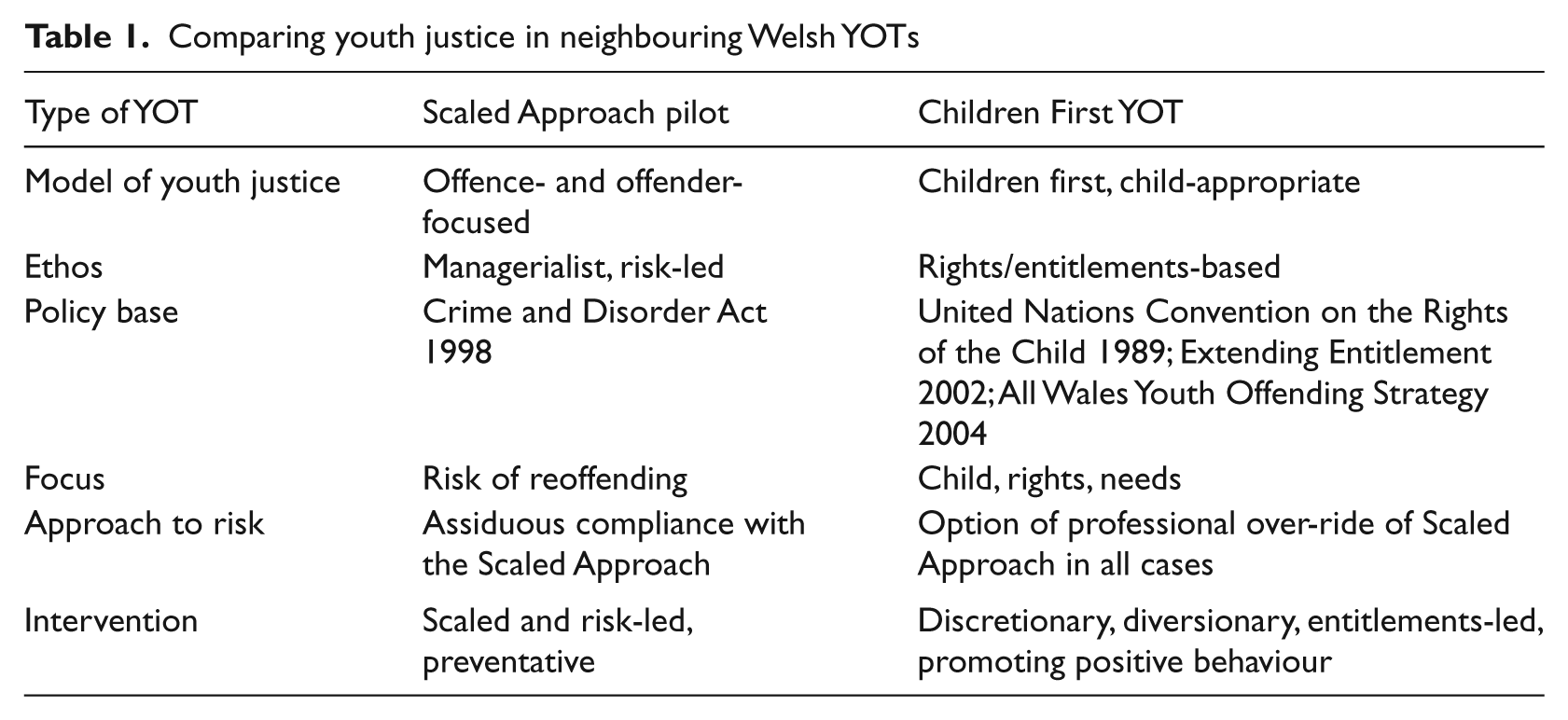
However, one YOT area in Wales that has made claims to have articulated and delivered youth justice underpinned by national Children First principles is Swansea. The City and County of Swansea local authority and Swansea YOT (henceforth known as the Children First YOT) have espoused an approach to youth justice within policy and practice documents that is Children First, child-appropriate, consultative, underpinned by the rights- and entitlements-focus of national policies in promoting the best interests of, and positive views of, young people. The ‘Safer Swansea’ Crime and Disorder Reduction Strategy 2008−2011 commits to ‘promoting positive images of children and young people’ and ‘working within the Extending Entitlement agenda (Safer Swansea Partnership, 2008: 14). Similarly, successive publications of Swansea’s Strategic Plan for Children and Young People have adopted a rights-based focus in line with Extending Entitlement (2002−2008 and 2008−2011 plans) and the United Nations Convention on the Rights of the Child (2011−2014 plan). The delivery of youth justice at the local level eschews the offence and offender focus inherent to the Scaled Approach. Instead, it seeks to animate practice along a continuum of universal and rights-based preventative interventions (see Haines and Case, 2011) to promoting positive behaviour (see Haines and Case, 2005), through diversionary approaches to anti-social behaviour and minor offending (see Hoffman and MacDonald, 2011), to tiered targeted interventions focused on achieving positive outcomes for young people. Consequently, outcomes from youth justice practice in Swansea serve as valuable comparators with those from other YOT areas, particularly those YOTs piloting the contrasting Scaled Approach to youth justice.
It is particularly informative to compare the Children First YOT with the Scaled Approach pilot YOT in Wales. Despite their geographical proximity as neighbouring local authority areas, these YOTs have adopted distinctively different approaches to the implementation of youth justice policy in their areas, in both philosophical and practical terms. Thus, the Welsh Scaled Approach pilot YOT has been commended by the YJB for the most assiduous application of the Scaled Approach amongst the pilot areas. The Manager of the Welsh Scaled Approach pilot YOT has been quoted in YJB promotional material as stating that ‘the approach the Youth Justice Board (YJB) finally adopted was very similar to ours’ (YJB and Children and Young People Now, 2009: 5).
Table 1 illustrates key points of comparison between the ethos and practice of the Children First and Welsh Scaled Approach pilot YOTs: The contrasting approaches of the neighbouring Welsh YOTs enable comparisons between broadly-framed archetypes of English (predominantly risk-based) and Welsh youth justice (predominantly rights-based), to complement broader comparisons between the Scaled Approach pilot YOTs, the so-called Children First YOT and other YOTs in England and Wales.
Comparing youth justice in neighbouring Welsh YOTs
Analysing Reconviction Rates to Evaluate the Scaled Approach
YOT Data Summary statistics detail performance at the individual, regional and national levels as part of the overarching England and Wales Youth Justice Performance Improvement Framework process (Rooney, 2010). The YJB gathers these standardized performance statistics from every YOT on a quarterly and annual basis from the Youth Offending Information System. Taking account of the post-devolution settlement in Wales and the different policy priorities of the English and Welsh administrations, separate YOT Data Summary statistics are produced for each country, consisting of six Key Performance Indicators, called National Indicators in England and Youth Justice Indicators in Wales. The ‘big three’ Key Performance Indicators for youth justice in England and Wales are first time entrants into the YJS, reoffending rates and custody rates (YJB and Ministry of Justice 2010). 6 For present purposes, analyses will focus on reoffending (as officially measured in the YJB data by reconviction) as a critical measure in the effectiveness of the Scaled Approach, as the Scaled Approach is explicitly-intended as a risk-based assessment and intervention process designed to reduce reoffending by young people (see YJB, 2009; see also Criminal Justice and Immigration Act, 2008).
Key performance indicator data for ‘reoffending’ is available for all YOTs in England and Wales on an annual basis (April−March), which allows comparisons to be made between English and Welsh YOTs, between Scaled Approach pilot YOTs and non-Scaled Approach YOTs (prior to 30 November 2009) and between the Welsh Scaled Approach and Children First YOTs across the piloting period. The pilot Scaled Approach process offers early and tentative points of comparison with youth justice outcomes across English and Welsh YOTs who did not implement the Scaled Approach at that time and also enables similarly early and tentative evaluation of the effectiveness of the Scaled Approach itself. In order to aid an evaluation of the Scaled Approach pilot exercise, the YJB benchmarked YOT performance on all Key Performance Indicators for the period April 2009–March 2010 against a baseline measure (typically for the period 2007/08). The reoffending Key Performance Indicator measures percentage change in reoffending after nine months within the January–March 2009 cohort of young people in each area in the YJS – when compared to a 2008 baseline figure.
The Complexities and Limitations of the Key Performance Indicator ‘Reoffending’ Data
There are complexities and limitations inherent in using YJB performance indicator data in assessing/evaluating YOT outcomes and further complexities in the pattern of outcomes across YOTs. Whilst these complexities and limitations do not permit us to reach definitive conclusions, they provide an interesting springboard for discussion and debate.
Firstly, it is crucial to identify that the Key Performance Indicator statistics do not measure reoffending per se (a behaviour that may go unreported and unrecorded), but rather reconviction that is officially-recorded and results in a young person re-entering the YJS, receiving a substantive outcome and returning to the attention of a YOT. Although there is evidence to suggest that (self-reported) reoffending and (officially-recorded) reconviction can be highly-correlated measures (see, for example, Farrington et al., 2003; Hindelang et al., 1979), they are not synonymous measures and should not be strictly read as such. Therefore, any conclusions as to the efficacy of the ‘Scaled’ or any approach to youth justice for reducing ‘reoffending’ should be made cautiously as the YDS statistics only address a proxy for reoffending. 7 Secondly, the Youth Data Summary statistics and the specific measures utilized within it remain arbitrary, for example, measuring percentage changes from an arbitrary baseline statistic chosen primarily to assess the impact of the introduction of the Scaled Approach in pilot YOTs. The arbitrary nature of this data means that the performance of YOTs prior to this date cannot be accounted for; thus it is possible that a high performing YOT prior to the census point will not have this level of performance reflected in the 2010 data and the relative performance of the YOT during the census period (which reports on percentage change between two fixed dates) may be ‘artificially’ low. This problem is endemic to performance indicators (and, indeed, to some research) and resistant to quantitative amelioration, which deprives the data/measure of an element of internal validity.
Nevertheless, at a national level, the YJB reconviction Key Performance Indicator statistics provide the most appropriate and reliable available proxy data for evaluating the impact of the Scaled Approach on future offending by young people and for comparing outcomes between YOTs – not least because these statistics constitute the official dataset collected, recorded and utilized by the YJB to evaluate YOT performance.
Analysing the Impact of the Scaled Approach
We have identified the highest and lowest performing YOT areas (after removing outliers) 8 in terms of reductions/increases in reconviction rates, across six comparator groups:
English versus Welsh YOTs;
Scaled Approach pilot YOTs versus Non-Scaled Approach YOTs;
Welsh Scaled Approach YOT versus English and Welsh YOTs;
Welsh Scaled Approach YOT versus English Scaled Approach YOTs;
Children First YOT versus English and Welsh YOTs;
Children First YOT versus Welsh Scaled Approach YOT.
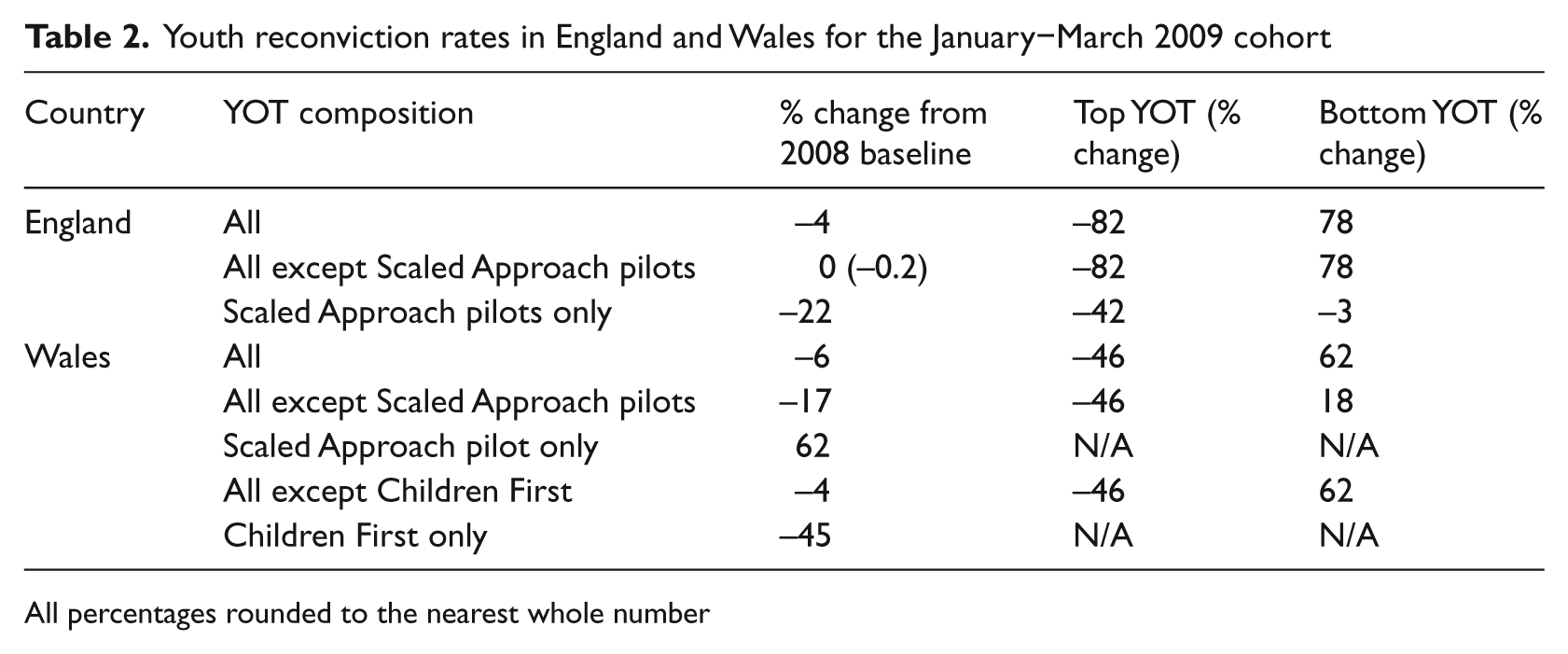
This analysis (see Table 2) provides provisional data on which to compare YOT performance and demonstrates the broad range and inconsistency of reconviction outcomes across YOT areas.
Youth reconviction rates in England and Wales for the January−March 2009 cohort
All percentages rounded to the nearest whole number
Following the exclusion of outlier data, the context of youth reconviction in England and Wales is one of general reductions in mean reconviction levels aggregated across YOT areas, with reductions in 86/142 YOT areas in England (61% of YOTs) and 10/18 YOT areas in Wales (56% of YOTs). Table 2 illustrates that the aggregated mean reduction in reconviction rates was slightly higher in Wales (−6%) than in England (−4%). However, these aggregate comparator group rates mask local variations. For example, the largest reduction in reoffending over the measurement period was 82% (in a cohort of 138 young people), whilst the poorest performing YOT recorded a 78% increase in reconviction (in a cohort of 90 young people).
The national mean reduction in reconviction in England was surpassed by the English Scaled Approach pilot YOTs combined (−4% vs −22%), but not in every pilot YOT individually. There were large differences across the pilot areas, with reductions ranging from −42% (in a cohort of 122 young people) to −3% (in a cohort of 488 young people) – evidencing considerable inconsistency in the performance of Scaled Approach pilot areas.
The notable exception to the general trend in decreasing levels of reconviction is the Scaled Approach pilot YOT in Wales, which evidenced a 62 per cent increase in reconviction rates (amongst a cohort of 74 young people) over the measurement period. This performance is significantly below the national averages for England and Wales (in the bottom three performing YOTs in the measurement period) and places this YOT as the lowest performing YOT in Wales and the lowest performing Scaled Approach pilot YOT. In contrast, the Children First YOT recorded a reduction in reconviction (−45% in a cohort of 128 young people) that outperformed the national mean reductions across England (−4%), Wales (−6%) and the Scaled Approach pilot YOTs in England (−22%), placing it within the top 5% of YOTs across England and Wales.
These findings highlight four key issues requiring further exploration:
The overall variability in YOT reconviction outcomes;
The inconsistent performances across the English Scaled Approach pilot YOTs;
The strong performance of the Children First YOT relative to the Scaled Approach pilots and other YOTs in England and Wales;
The poor performance of the Welsh Scaled Approach pilot YOT relative to other YOTs across England and Wales, including the other (English) Scaled Approach pilot YOTs.
1. Variability in YOT Outcomes
Variable reconviction outcomes across YOT areas in England and Wales require explanation. It is well known that YOT practice locally is influenced by a range of factors/issues some of which may have positive consequences for young people and reconviction outcomes, others negative (Bottoms et al., 1990; Richardson, 1987). Inconsistencies in practice and outcomes for young people could be attributable to, for example, the spatially-specific interpretation and implementation of youth justice policies, following mediation by local policy makers and practitioners (Kemshall, 2008; see also Fergusson, 2007). Over time, YOT practice can differ both between and within jurisdictions as a result of these internal, localized mediation processes (Goldson and Hughes, 2010; see also Hughes and Follett, 2006). It is also possible that external factors have influenced the behaviour of, and outcomes for, young people in different YOT area, either independently of YOT practice (e.g. macro-level socio-economic change, population shifts) or through a mutually-reinforcing relationship with it (e.g. changes in policing practice, fluctuations in funding for the criminal justice system).
It may also be that some of the inconsistency/variability in Table 2 could be explained by the arbitrary ‘snap-shot’ nature of the reconviction data collected to evaluate the Scaled Approach − although it is not possible to say precisely how much on the basis of limited available data. However, the extent of the variability in performance between YOTs (e.g. a 160% difference between the top and bottom performing YOTs in England) appears to go beyond sampling issues and factors related to arbitrary data collection periods, and so requires further exploration and explanation. It is possible that the variability in performance across YOTs is, in part, the product of poor and inconsistent practice engendered by adherence to hegemonic (but ineffective) risk-based practice prescriptions at the expense of alternative (more effective) practice. In this respect, however, YOTs are not wholly blameworthy. It is crucial to remember that over the last 10 years youth offending practice has been dominated by the Risk Factor Prevention Paradigm (Stephenson et al., 2007). Not only has this paradigm dominated YJB prescriptions of effective practice (see YJB, 2003), but it is the only professional paradigm to which and within which many youth justice practitioners have been exposed and educated. In this respect, the Scaled Approach was the logical outcome of a trajectory of professional practice in youth justice in England and Wales based on the widespread adoption of a paradigm that is fundamentally flawed (see Bateman, 2010; O’Mahony, 2009; Paylor, 2010).
Explaining variability in performance and outcomes must, however, go beyond exposing weaknesses in the research underpinning the Scaled Approach to reveal a fundamental problem with the nature of the Scaled Approach itself. Notably, there is the lack of clarity as to the goal or purpose of the YJS and the work of YOT practitioners – beyond the fairly bland prevention of (re)offending – inherent within the Scaled Approach. Whilst previous notions of welfare or justice were often contested, they arguably provided a rationale for practice. Managers and practitioners drew purpose from these aims to animate their practice with young people (see, Haines and Drakeford, 1998). In contrast Asset is an instrument/technique without a clear purpose or agreed objectives. Variously championed as a tool for preventing offending, reducing reoffending, reducing reconviction and reducing risk, Asset is an actuarial box-ticking exercise that is internally driven (to complete the form) and without external reference. The result of this ambiguity/lack of purpose is, almost inevitably, diversity in practice and diversity in outcomes. This process, as we argue below, was clearly evident in the implementation of the Scaled Approach in the pilot areas.
2. Inconsistencies Across Scaled Approach Pilot YOTs
A prime example of the mediation of policy through practice emerged through the YJB’s evaluation of the Scaled Approach, which identified ‘variations in implementation and the different elements of risk-based approaches in the four pilot YOTs’ (YJB, 2010: 23). The evaluation discovered broad differences in the risk-based practices across the pilot areas in terms of risk-level allocation (plotting the risk of reoffending against offence seriousness), pre-sentence reports (the use of risk profiles to guide and recommended interventions to the courts) and intervention planning (e.g. the extent to which Asset forms were reviewed, the links between assessed risk and intervention). It was found that ‘each [pilot area] had the agreement of the YJB to implement the risk-based approach in a way that suited their local circumstances or existing practices’ (YJB, 2010: 19). This mediation of risk-based practice in line with local context and circumstances appears to have produced localized variations in the methods of risk assessment utilized, the decision-making regarding levels of contact with the YOT and the general application of the Scaled Approach, as well as potentially accounting for the disparity in outcomes achieved across the pilot YOTs. It is clear, therefore, that the practices across the YOT pilots do not necessarily relate to the same (risk-based) processes in each area, rendering a valid and reliable analysis of the utility of the Scaled Approach infeasible. Crucially, detailed, transparent and reliably monitored information on the risk-based practices employed in pilot YOTs was not collected, prompting the evaluators to conclude that this ‘lack of information is a constraint in making objective assessments of the variety of practices that were adopted by the YOTs’ (YJB, 2010: 14).
It is apparent that a scaled-informed approach to youth justice was mitigated and moderated by local factors − as opposed to a standardized, consistent, rigorous and thorough implementation of the Scaled Approach. Whilst the nuances of these local factors remain unknown, they have clearly resulted in variability between the English Scaled Approach pilot YOTs in terms of reconviction – further emphasizing the potential impact and importance of the lack of a clear, comprehensive and coherent philosophy or approach to youth offending. However, despite this and although the English Scaled Approach pilots did not outperform the Children First YOT during the pilot period, the English pilots generally outperformed other YOTs in England and Wales. Does this finding undermine our assertion that the Scaled Approach is a failed approach and that Scaled Approach-Lite is better than no Scaled Approach at all? We argue not.
The variability in performance and outcomes of the English pilots, viewed in conjunction with the discretion they were given to depart from the Scaled Approach and the enhanced salience of local factors in their respective developing practice, may explain the relatively strong overall reconviction results for some of the YOTs during the pilot period (although other English pilot YOTs performed below national averages). Whilst we cannot fully explain these results on the basis of the currently available evidence, it seems likely that some English pilot YOTs were galvanized by being under the spotlight as a pilot area and thus underwent a more rapid and general sharpening of the quality of their practice under local management (while others did not) − reflected in their KPI data for the pilot period. What is clear from the data, however, is the potential for unprincipled local variation to produce markedly different outcomes, as demonstrated across the pilot YOTs.
The variable performance of the pilot YOTs is a significant cause for concern, particularly as all selected YOTs were expected to achieve positive outcomes (e.g. reductions in reconvictions) through application of the Scaled Approach. The inconsistent outcomes imply that pilot YOTs departed so far from the Scaled Approach that the claim to have actually piloted the approach is hollow. The inconsistencies in application also contradict the objective of the Scaled Approach to improve the quality and consistency of YOT practice. Therefore, the approach appears to be failing on both counts – in terms of reducing reconvictions and improving the quality and consistency of practice across all YOTs. Consequently, it can be concluded that the Scaled Approach has, thus far, presented as a model/paradigm for youth justice practice that is flawed in its conception, implementation and impact.
3. Children First: Positive Youth Justice?
The performance of the Children First YOT, with its rights/entitlements-based approach to youth justice, demonstrated a greater reduction in reconviction rates than any pilot Scaled Approach YOT and a reduction substantially higher than the national average in both England and Wales. These reconviction statistics reflected continued improvements on pre-existing reconviction rates and the positive outcome trajectories established in evaluations of preventative and diversionary youth justice-related programmes in the Children First local authority area. For example, YDS statistics illustrate that reconviction have fallen in Swansea in successive cohorts from 2005 to 2008, 2008 to 2009 and 2009 to 2010 (Swansea YOS, 2012). Similarly, the total number of youth ‘reoffenders’ recorded in Swansea on the Police National Computer has fallen year-on-year from 2007 to 2010 (Swansea YOS 2012).
The relative success of the Children First YOT in comparison to other Welsh YOTs (particularly compared to the Welsh Scaled Approach pilot), we argue, is a product of the differential mediation and implementation of policy across Wales cited in Rod Morgan’s devolution report (2009). It is in Swansea, we assert, that a distinctive ‘children first, offenders second’ model of youth justice has been implemented – a model characterized by a rights/entitlements ethos and focus, rather than managerialist, risk-based concerns. The Children First model in Swansea has been grounded in both policy and practice terms in the UNCRC and WAG policies for children and young people (e.g. Extending Entitlement and the AWYOS), resulting in a rejection of dominant risk-focused responses privileged by Westminster and the Swansea YOT Manager prescribing professional over-ride of the Scaled Approach. Instead, YOT practitioners in Swansea have embodied a discretionary, diversionary and promotional (of positive behaviour) approach to intervention. It is our contention that the implementation of a Children First model of youth justice in Swansea has resulted in practice that is more coherent and consistent, and has resulted in the long-term achievement of better outcomes for children.
4. The Scaled Approach in Wales: Strict Application and Poor Results
A central purpose of this article has been to compare the performance of the Children First YOT with the Welsh Scaled Approach pilot YOT as these YOTs exemplify contrasting approaches to youth justice. We have addressed the evidence for the strong performance and positive impact on reconviction in the Children First approach and contextualized our analysis and assertions with reference to YOTs in England and Wales. We must now turn to an evaluation of the performance of the Welsh Scaled Approach pilot YOT.
The Welsh pilot YOT diligently implemented the Scaled Approach and was heralded in YJB promotional material (perhaps prematurely) as the exemplar of how the Scaled Approach can enable a YOT to achieve ‘a positive result’ and ‘improve their outcomes’ (YJB, 2009: 7). The Welsh pilot YOT was spotlighted by the YJB as an exemplar of good practice precisely because of the assiduous manner in which it sought to apply the Scaled Approach (YJB and CYP Now, 2009) and because the manner of implementation in the English YOT pilots was more akin to a Scaled Approach-lite in which other local factors and priorities were salient. Indeed, the Welsh pilot YOT is to be congratulated and applauded for the alacrity with which it applied the Scaled Approach to its practice – it certainly achieved this to a level in excess of the other pilot YOTs and as such it has taken the Scaled Approach to its most literal application within youth justice practice.
It is in this context that the reconviction rate achieved by the Welsh Scaled Approach Pilot YOT during the Youth Data Summary census period (an increase of 62%) is a damning indictment of the Scaled Approach when strictly applied. In this respect it is critically important to remember that the Scaled Approach, is an avowedly evidence-based strategy, explicitly designed on the findings and assertions of risk factor research to achieve standardized assessments and structured interventions that reduce reoffending by young people. However, despite claims from the Manager of the Scaled Approach pilot YOT in Wales that ‘the model has improved the way we work with young people’ (YJB, 2009: 7), the pilot period actually produced results which demonstrate a significant increase in youth reconviction. Notwithstanding the poor reconviction rates of other YOTs in England and Wales (who were operating variously and inconsistently within the parameters of a scaled-informed approach to assessment and intervention), the reconviction results of the Welsh Scaled Approach pilot YOT strongly suggest that the Scaled Approach (when applied assiduously) produces contrary and counter-intuitive outcomes to those anticipated by the YJB. In the absence of contrary information and on the basis of the available evidence, the only conclusion that can be drawn is that the Scaled Approach is a Failed Approach.
This, however, is not the end of the story.
Moving Forwards: Revising or Replacing the Scaled Approach?
Soon after the roll out to all YOTs in England and Wales on 30 November 2009, the YJB began to review the evidential basis for the Scaled Approach. Within and beyond academia, there is an increasingly widespread belief that adherence to risk and the Scaled Approach to intervention is not sustainable (Bateman, 2011), particularly in the light of arguments that the risk factor prevention paradigm that underpins Asset and the Scaled Approach is so deeply flawed that it is positively dangerous as an evidential base (see O’Mahony, 2009; Paylor, 2010; Sutherland, 2009). Consequently, in 2010, the YJB began a consultation exercise to review the Scaled Approach and to explore alternatives to risk-based approaches to assessment and intervention (YJB, 2010).
In March 2011, the YJB published a framework document entitled Assessment and Planning Interventions: Review and Redesign Project. Statement of Intent – Proposed Framework, which set out proposals to replace the Scaled Approach with a Scaled Approach model (YJB, 2011). This terminology, however, masks the extent to which the YJB’s proposed approach represents a radical departure from the risk dominated Scaled Approach. Eschewing the risk-based foundations of Asset and the existing Scaled Approach, with their negative (offence and offender) foci and retrospective orientation, the YJB’s new proposed approach is more positive and forward looking, with an increased focus on:
enhancing young people’s strengths rather than prioritizing risks/deficits;
addressing needs rather than risks;
promoting desistance from offending rather than simply targeting risk factors predicting reoffending or protective factors purportedly reducing risk;
accessing young people’s voices rather than privileging adult prescriptions and understandings of ‘risk’ and young people’s lives;
enabling more practitioner discretion in assessment and intervention planning rather than adhering uncritically to YJB prescriptions for standardized (risk) assessment.
The YJB has proposed that these foci and the associated move away from hegemonic risk-based understandings and assessments of youth offending are to be pursued via multiple assessment measures and ratings, rather than the existing and traditional over-reliance on the Asset tool. The revised and re-orientated assessment framework is intended to be dynamic/iterative and reflective of the complexity of local contexts and young people’s personal circumstances. The proposed framework, therefore, represents a 180-degree change in orientation from the Scaled Approach, with the focus of assessment and intervention moving from a crude, simplistic and one-dimensional assessment of risk linked to offence- and offender-focused interventions, towards a more holistic focus on the young person, their current circumstances, views and aspirations, and a focus on achieving a range of positive outcomes for young people in addition to reductions in reoffending.
There are, however, two critical factors that could undermine the successful implementation of this new approach. The first of these concerns the knowledge and skills base of much of the current youth justice workforce, who have been exposed primarily to a risk factor dominated education (see Case and Hester 2010; see also Nellis, 2003; Souhami 2007). The YJB’s modernizing discourse has prioritized practical, context-specific, procedural knowledge and the vocationalist acquisition of skills and competencies over academic, theoretical, critical, contextualized knowledge of the sort acquired by traditional university undergraduates (Case and Hester, 2010; see also McCormick, 2005). As a consequence, the student learning experience for trainee and existing youth justice practitioners has been standardized and artificially-restricted. With this in mind, to what extent are less-experienced and early career practitioners willing and able to exercise the breadth and depth of professional assessments and interventions necessary to engage with young people in the prevention and reduction of offending based not on risk or offence and offender focused programmes, but in responding to the real lives of young people, the challenges they face and in providing the support they need to lead more positive and pro-social lives.
The second challenge, which is exacerbated by the first, concerns the extent to which the YJB’s proposed new model is a process without a purpose, a set of techniques without a clearly articulated goal or philosophy. 9 We potentially face the situation, therefore, where de-skilled practitioners are faced with carrying out complex assessments and developing intervention plans with no clear idea of why they are doing it and what they are doing it for. As we saw in the experience of the Scaled Approach pilots (and in the extent of the variability of reconviction results across England and Wales), poor practice and variable outcomes are (at least partly) the product of a lack of a clear and consistent philosophy of practice. A technique without a clear goal is a dangerously loose cannon. It is essential that youth justice professionals have a guiding philosophy of practice that ‘gives purpose to action … [and]… shapes the way in which we use knowledge and skills to achieve certain outcomes’ (Haines and Drakeford, 1998: 69). A philosophy of practice gives youth justice professionals a sense of objective and purpose with which to frame and animate their knowledge and skills bases. Without a coherent and explicit philosophy, youth justice policies and practitioner knowledge are simply information and understanding and practitioner skills are simply abilities, expertise and techniques; both lacking in foundation and application. The consequence of the YJB’s new Scaled Approach, with its ostensible lack of an explicit goal or philosophy, could be greater variations and inconsistencies in practice. Indeed, this lack of philosophy could enhance the scope for poor practice, resulting in worse treatment and outcomes for young people. This result would seem more likely in the absence of a clear and coherent touchstone against which to evaluate (and improve) professional practice.
Conclusion
An analysis of YJB reconviction data has indicated wide variability in outcomes across YOTs in England and Wales and between Scaled Approach pilot YOTs. This variability was attributed to the potential influence of, inter alia, local mediation of youth justice policy, the arbitrary nature of the YDS data collection period, ambiguities in the objectives of the Asset risk assessment tool, the inconsistent application of the Scaled Approach in pilot areas and the absence of a philosophy of practice for youth justice. Data analysis also highlighted the particularly disappointing performance of the Welsh pilot YOT, which most assiduously applied the Scaled Approach. These conclusions raise serious issues as to the validity and reliability of the Scaled Approach pilot exercise and the practicality and effectiveness of the Scaled Approach as a model of youth justice delivery. When viewed in conjunction with the relatively successful performance of the Children First YOT in reducing reconviction, our analysis suggests that the failure of the Scaled Approach to produce consistent reductions in reconviction are attributable to the inherent flaws in the risk factor paradigm and the absence of an overarching central guiding philosophy that gives meaning and purpose to the work of youth justice professionals.
A Children First model for youth justice can be demonstrated as highly promising in its own right and preferable when compared with assiduous application of the Scaled Approach. In making this assertion, we are not suggesting that the Scaled Approach pilot YOTs (including the pilot YOT in Wales) are failing to do good work or that they are not building on positive trajectories. We are suggesting, however, that practice in areas of England and Wales has not benefited from the consistent and coherent philosophy of, and approach to, youth justice that Children First represents. Consequently, good practice is difficult to explain, often patchy and inconsistent within and between YOT areas (Scaled Approach pilots or otherwise), occasionally accidental and largely dependent on locally-specific mediation of policy and the vision and abilities of YOT managers and their staff. In other words, we do assert that where good practice does occur (within and between YOTs) this is not necessarily the product of a coherent and structured approach to youth offending – and that this applies specifically to the English Scaled Approach pilots and more generally to YOTs across England and Wales. Returning, therefore, to a central purpose in this article, we argue that a central philosophy is essential if the YJB’s new approach is to work. We believe that Children First provides such a principled, clear, coherent and evidence-based rationale and philosophy that is capable of animating youth justice practice in the context of the YJB’s new approach and its proposed assessment and intervention planning tool.
Footnotes
Notes
Dr Stephen Case is Senior Lecturer in Criminal Justice and Criminology at the CCJC, Swansea University, UK.
Kevin Haines is Professor of Criminology and Youth Justice and Director of the Centre for Criminal Justice and Criminology (CCJC) at Swansea University, UK.