







Abstract
A national Swedish project was followed in 12 municipalities aimed at youth aged 15–20 years. Neither police nor social services systematically used the indicators based on criminological research and proposed by national authorities. The police and social services thought they had more contemporary and holistic intuitive knowledge than any systematic indicators could provide. Despite implementation difficulties, the project was described as a success at the political level and widely dispersed. The specific and systematic image of early indicators provided momentum at the policy level. The local authorities welcomed the opportunity to reach a group considered difficult to manage.
Introduction
Research as well as experience shows that early and direct efforts against youth crimes counteract serious future criminality. (Swedish National Police Commissioner and Knape, 2012)
In a Swedish national pilot project, Social Intervention Teams (SITs), social services and community police cooperated to identify young persons at risk of lifestyle criminality and change their negative trajectory:
The social intervention teams should not replace interventions that are given to the majority of youth crime offenders today. The intervention teams should focus on the limited group of youth at risk for getting involved in criminal gangs in particular. (SOU, 2010: 91)
The idea was to use criminological theories on early prevention to successfully identify a limited group of presumptive serious offenders. The expectations were high, and the Ministry of Justice described the project as the ‘largest project against youth crime made by the government in later years’ (Ask, 2011). At a subsequent press conference, the national police commissioner used statistics, later revealed to be heavily biased, showing considerable reductions in criminal activity among the young participants (Helgesson, 2013). At that time, the method had spread to 53 of Sweden’s 290 municipalities. The rapid diffusion of and political enthusiasm for the project could be considered signs of success. According to the national police commissioner, the reason seems obvious: if both research and experience say early prevention counters serious future criminality, why not go all in?
Goal and Research Questions
Hypothetically, criminological theories of criminal careers and early indicators of anti-social behaviour could be used to promote preventive work. However, although these theories may appear to be useful for developing effective and evidence-based practices, the theories often originate from basic research with less consideration of the practical circumstances and professional contexts where they may be implemented. The theoretical knowledge must be confronted with empirical studies of the use of these theories in different preventive contexts to improve their practical usefulness. The goal of this article is to analyse the use of criminological theories on criminal careers and early prevention in the policy process as guidance for preventive cooperation between social services and the police. Our analysis can contribute to the development of better informed policies and a discussion of the limits of the practical use of these criminological theories in early, individual prevention. The research questions are the following:
How was criminological theory on criminal careers and early prevention used in the policy process and the national guidelines for the SITs?
How was the selection of young participants commissioned in the local contexts and in relation to the national guidelines?
Governing Prevention in a High Crime Society
Since the Second World War, criminality has been increasingly considered a normal part of society (Garland, 2001). Regardless of the ‘crime drop’ discussed in later years (Tseloni et al., 2010), crime experiences are so common in high crime societies that crime policy appears high on the political agenda. Garland analysed the situation in the United Kingdom and the United States, and although the crime rates differ, the trend has been similar in most parts of Europe (Westfelt and Estrada, 2005). Sweden has also experienced many of the structural changes discussed by Garland; it is a high crime culture where public safety and a victim’s perspective have been emphasised. At the same time, youth crimes and criminal careers are examples of the so-called wicked problems characterised by their vague definitions and involving many competing stakeholders with conflicting interpretations and political agendas (Rittel and Webber, 1973). Therefore, crime must be analysed in its specific social contexts. Here, the late modern welfare state, the family and the individual have intertwined histories, and their development interrelates. At the same time, the family, the state and the market have different functions in different welfare regimes that contribute to the structuration of our life courses (Leisering and Walker, 1998). Research in governance, the policy process and implementation of public policies have developed complex theories emphasising the interactivity among different actors. These actors contribute in different ways to the agenda-setting, policy formulation, implementation and performance of public policies (Hill and Hupe, 2009; Sabatier, 2007).
In this context, criminological research has an important role to tame or transform wicked problems to more technical or political problems that seem less complicated to combat. For example, knowledge can improve certainty regarding risk factors and intervention effects and therefore establish a better basis for political and technical solutions (Koppenjan and Klijn, 2004). Social problems that seem to lack apparent solutions may attract empathy but may be ignored on the political agenda (Kingdon, 2011). Criminological theories might also be used to balance processes of organisational decoupling. Institutionalised organisations, such as the police and social services, tend to decouple activities and structural demands (Meyer and Rowan, 1977). Decoupling could be a strategic solution in heterogeneous organisational fields with contradictory pressures (Boxenbaum and Jonsson, 2008). The motivations and conditions at the local level will therefore be the empirical focus for this study.
Hill and Hupe (2009) separated three different modes of operational governance in their framework for implementation studies: enforcement, performance and co-production. In the enforcement mode, central management mainly governs through inputs and rules. In the performance mode, central management governs through outputs and contracts, and in the co-production mode, it governs through consensus and trust. The co-production mode is more commonly found in more complex policy areas, such as the subject of this article where services require higher levels of creativity and flexibility at the street level. However, there are also policy settings where actors have inconsistent demands for methods of governance. For example, actors at the street level can request a service orientation while inter-organisational relations are governed by rules. In some cases, this type of incongruence among different modes of governance can be highly functional for the implementation process because it provides more room for different actors to manoeuvre. However, in cases where the actors involved determine the incongruent situation to be dysfunctional, demands may be raised to enhance congruence.
SITs in the Swedish Context
Even for a cooperation project, the SITs have an unusual background. The project was initiated by the Swedish government and the Justice Department. These authorities appointed the National Police Board to implement the project, but at the street level, the social welfare agencies should be in charge. The pilot project which we study in this article lasted from June 2011 to October 2012 in 12 municipalities, including large and medium city areas and small rural towns. The local SITs should contain police, social services and schools, and optionally other authorities and civil society organisations. The project was directed at young people aged between 15 and 25 years. Two objectives were formulated for the project: to develop local forms of cooperation and to increase the ability to identify at-risk youth.
The Swedish juvenile justice system has been long characterised by collaboration and rehabilitation (Edvall-Malm, 2012). Youth up to 20 years old who commit crimes should be diverted as much as possible to social services for care. Although Sweden has experienced the same shift as many other countries towards stronger emphasis on just deserts and a focus on punishment for the criminal act (Falck et al., 2003; Wacquant, 2001), in sanctions actually given, the rehabilitative ideal still remains strong (Edvall-Malm, 2012; Granath, 2007). Despite the long tradition of cooperation among authorities, the possibility to cooperate in individual cases is limited by strict confidentiality laws, and the cooperation thus far has been mostly general. In the SITs, the confidentiality among the authorities is sidestepped by written consent from the young participants and if under 18 years old, from his or her parents (SOU, 2010).
Theories on Criminal Behaviour and Early Individual Prevention
To identify preventive efforts in the right direction, an indicator should maximise true positive predictions and minimise false positives (Farrington, 2005). A prediction instrument’s sensitivity indicates the degree to which it detects the state you are interested in; its specificity is the degree to which it is also able to separate the state you are interested in from other conditions. Thus far, research in predicting future criminal careers has developed a better sensitivity but not a good specificity (Tham and von Hofer, 2009). Considering research on early predictors during the last decades, we can distinguish three perspectives that are presented below.
Psychologists looking for early predictors
One influential psychologist, Terrie Moffitt (1993, 1997), tried to develop a dual taxonomic theory with different explanations for anti-social behaviour among two distinct groups of youth. Moffitt’s idea was that there is a small group of persistent anti-social persons and another much larger group where antisocial behaviour is strongly concentrated in adolescence (Moffitt, 1993). The larger group with adolescence-limited antisocial behaviour was, according to Moffitt, so large that their behaviour should be considered a stage in the normal life course. Moffitt also theorised that because the small group of persisters was so abnormal with a bleak future and consistent and diverging anti-social behaviour, they should be more visible among the rest both before and after adolescence. Because the development process among the persisters begins early and continues as a negative spiral, preventive efforts should be activated as soon as possible in the early days of their anti-social life.
According to more recent proponents of early prevention, such as Loeber and Farrington (Loeber and Farrington, 2000), child delinquents have a two- to threefold increased risk of becoming tomorrow’s serious violent and chronic offenders. To prevent this development, it is better to look for different risk factors predating the delinquent behaviour. Following psychologist Urie Bronfenbrenner’s ecological model of child development, these scholars hypothesised that the initial risk factors lie in the individual child, second in the family, and after that, the array expands to peers, schools and the community. These researchers and others also concluded that there are certain promoting domains that can counterbalance the risk factors. Recently, Farrington stated that prevention should be directed towards youth under the age of 12 years (Farrington, 2012).
Social scientists defending free will
Moffitt’s dual taxonomy and the attempts to discover early indicators to be used for early individual prevention have been refined and criticised from different perspectives (Sampson and Laub, 2005; Skardhamar, 2009; Tham and von Hofer, 2009; Thornberry, 2005). Thornberry (2005) asserted eight groups with different trajectories, one with a much later onset than previously found. Tham and von Hofer (2009) argued that more serious offences are more difficult to predict, and the same applies to persistent criminal careers. Despite many efforts, no one has been able to produce predictors with sufficient specificity to identify a small enough group that will explain a significant proportion of the convictions in the way theorised by Moffitt and others. According to Tham and von Hofer, all studies showing these groups are conducted retrospectively.
Sampson and Laub (2005) analysed unique longitudinal data following 500 delinquent boys from the age of 7 until they turned 70. These authors’ conclusion was that when following people over their entire life course, it is obvious that there are no life-long persisters. Moffitt’s dual taxonomy is therefore misleading. Different crime trajectories can be better understood with the same age-graded theory of informal social control. Sampson and Laub were also pessimistic regarding finding sufficient sensible and specific predictors of different trajectories that can inform preventive work. Instead, these researchers found it more productive to analyse the desistance process. Sampson and Laub mean that certain turning points are important in the process, such as new situations separating the past from the future, new forms of social control, new routine activities and new opportunities for identity transformation. Sampson and Laub concluded that the prediction of a complete life course is impossible no matter how much information we have because people with the same background can always make different choices.
A widened scope
More recent research of risk factors, early individual prevention and criminal careers seems to have widened the scope of prevention, but what the results mean theoretically is not really discussed. Early individual intervention is still recommended, but the scope of the preventive goal is widened. Research shows that risks experienced early in life are connected to more general problems later in life, called multifinality. Adolescent risk factors, as opposed to risks in early childhood, are often stronger predictors of adult criminality. In a study of Canadian youth, Day et al. (2012) noticed involvement in alternative care as one significant risk factor. These authors interpret this result as an indication that adolescents worse off in the beginning, especially those with problems in several domains, such as family and school, called the dose effect, also run higher risks during the rest of their lives. However, according to Day et al., criminality should be considered one among many social problems following a certain minority group during their complete life course. Criminality should be treated in the same way as other social problems and if possible, be similarly prevented. In this line of research, there appears to be no clear differentiation among independent, dependent and intervening variables considering the use of alternative care as a risk factor among many others.
Critique against the policing of youth
Especially in the United Kingdom, there has been an increasing critique of the practical implementation of early individual prevention. The centre of the critique is that the early individual prevention approach directs attention to certain types of more visible anti-social behaviour and most often leaves society’s structural deficits intact. Critics argue that there is a risk of net-widening and neglecting the most harmful types of criminality, such as sexual assaults on children, corruption, fraud and other white collar crimes (O’Mahony, 2009). The risk is that multifaceted problems facing disadvantaged families are met with simplistic measures and targeted prevention at the individual level. Where welfare support once was the answer, instead, the same families currently must prove themselves as failing in their parental role to obtain targeted intervention. The welfare needs among disadvantaged families are reinterpreted as risk factors for criminal behaviour instead of welfare deficits (Muncie, 2006). In an empirical self-declaration study of the labelling process among youth in Scotland, the results showed that beat officers discriminated against certain categories of youth, in particular boys from disadvantaged families and poor areas. The strongest predictor of being charged by the police was having previous charges, which was independent of current involvement in serious offences. The discrimination continued throughout the youth justice process (McAra and McVie, 2007). Brame et al. (2012) warned of a statistical fallacy. Even if a small group with high criminality is possible to statistically detect, this does not mean that the group exists in reality; actual individuals do not need to have much more in common than their criminal behaviour. For the SITs to follow Moffitt’s taxonomy, they should be directed towards a strictly limited group of very young persons. If specific predictors could be found, a performance or even enforcement mode of governance seems proper. Considering more recent critics, the implementation process seems more complicated, demanding a co-production or even incongruent modes of governance.
Methods
Using a mixed methods approach (Tashakkori and Teddlie, 2003), the empirical material for this article was collected as part of an evaluation of the national SIT pilot project (Wollter et al., 2013). Initially, based on documents from The National Police Board (2011, 2012) and the National Board of Health and Welfare (2012), a programme theory was constructed describing the intended process of SITs from the two authorities’ perspectives (Hansen and Vedung, 2010). This process begins by establishing teams and selecting youth; then advances through different steps in a collaboration among police, social services and other partners; and proceeds to the expected outcomes. In this article, considering the goal and research questions, we examine the selection process and how it was understood and conducted in the local contexts of the pilot project.
The local projects began during the second half of 2011, and at the end of each month from September 2011 to May 2012, a survey was sent to the 12 participating local social services involved. The survey included descriptive data concerning participants’ gender, age, individual action plans, criminality, the efforts made by government agencies and civil society organisations involved in the SIT, collaborating agencies and so on. The survey had an answer rate of 94 per cent. Interviews with key persons, such as social workers and police officers working in the local SIT projects, were also conducted in all 12 municipalities in the beginning of the project period and 9 months later at the end of the pilot project. The interviews were partially structured and examined the following themes: contextual knowledge, implementation, cooperation, selection process and outcome. A total of 13 group interviews, 13 telephone interviews and 8 individual interviews were conducted, recorded and transcribed verbatim. The text was then analysed using deductive qualitative content analysis (Hsieh and Shannon, 2005).
Results
The monthly surveys of the 12 SITs show that the cooperation at the street level mainly involved police and social services. Schools participated in seven municipalities. Other authorities, such as employment services, psychiatric clinics and correctional treatment for children and adolescents, participated in four SITs each. In two SITs, contact persons, laymen contracted to provide personal guidance and support, and homes for institutional care were involved. On average, 10–12 new participants were received in the project each month, but very few successfully concluded because they were excluded or dropped out. At the end of the study period in May 2012, there were a total of 84 participants in all 12 SITs. Some of the SITs only had 2–3 participants, and the largest had approximately 13 on average per month during the period. The majority were boys (94%) between 15 and 17 years old (68%). In proportion to the total population in the 12 municipalities (approximately 700,000 inhabitants), the SITs only reached a very restricted sample. For 9 out of the 12 SITs, the collaboration when selecting youth for participation occurred between the police and social services. Other authorities or civil society organisations were not involved in the process. This collaboration, however, did not mean that suggestions from both the police and social services were included in every case. In one intervention team, social services excluded all police suggestions, and in another, social services accepted every suggestion from the police without adding any of their own. Three municipalities had no collaboration at all in the selection process where the selection instead was conducted by only social services. In one of these municipalities, the list from the police ‘did not reach’ social services. In the other two municipalities, social services, without interference from police, selected the participants they already had contact with instead of beginning with an unbiased inventory of potential participants.
National Guidelines for the Selection of Youth
To guide the local projects in identifying individual at-risk youth, the National Police Board created a ‘commitment’, a written agreement to be signed by top local leaders of the police and social services (National Police Board, 2011). The commitment included explicit guidelines on how the selection should be conducted and the indicators to be used in the process. The commitment indicated that the selection should be accomplished in collaboration with the main actors from the public sector and that it should be based on theories of indicated prevention, such as age of criminal debut/early starter, nature of crime and frequency of crime. The police should create a list of suggested participants based on intelligence material and then provide it to social services, which could exclude or include individuals, creating a revised version of the list. The indicators formulated at the policy level and how they were used in the local context are presented in Table 1.
Indicators recommended by the National Police Board and indicators actually used in the selection process (N = 12).
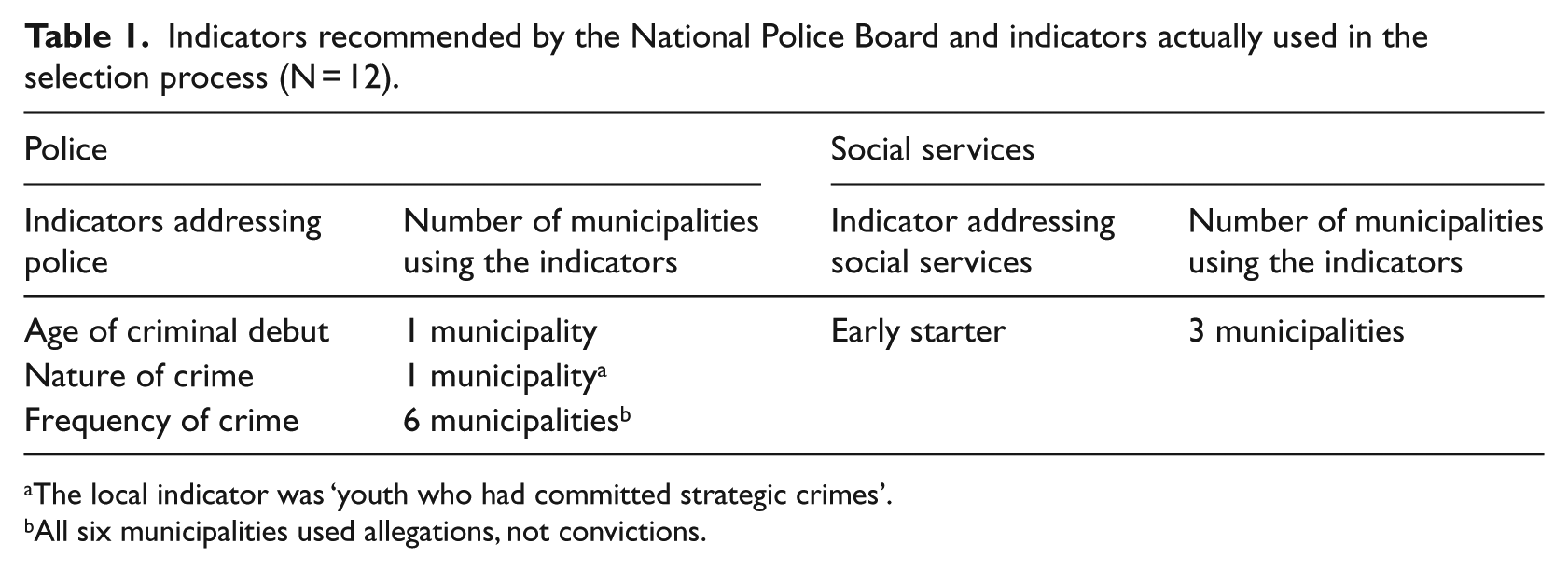
The local indicator was ‘youth who had committed strategic crimes’.
All six municipalities used allegations, not convictions.
As shown, only a small minority of the SITs used the recommended indicators. The only indicator that was used often was ‘crime frequency’, which was used by the police in six municipalities. However, a closer look reveals that all the SITs actually used ‘crime suspicions’ and not actual convictions, which could mean something completely different. The indicator ‘early starter’ was also used by social services in three municipalities.
The Local Selection Strategies
What selection strategies were actually used in the local context? In Table 2, local selection strategies are presented.
Indicators used by the SITs in addition to the recommendations in the authority guidelines: if not specified, each indicator was used by one SIT only.
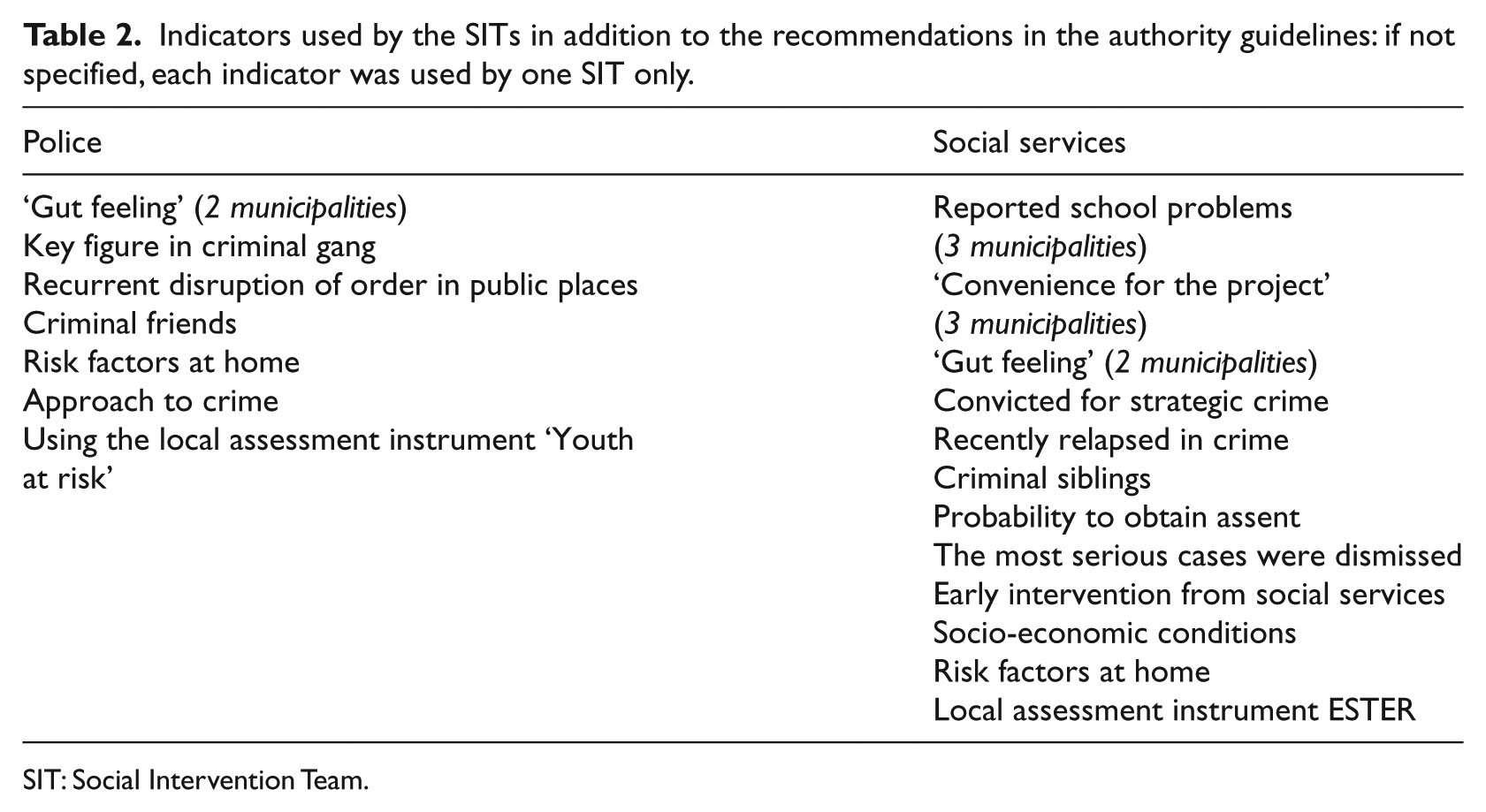
SIT: Social Intervention Team.
Table 2 illustrates a heterogenic picture of the selection strategies at the local level. We can see that the police used fewer indicators than social services and that the police were almost exclusively focused on criminality. Social services used a somewhat wider array of indicators with a predilection for early onset and family problems. One municipality differed from the rest, where a systematic risk-assessment instrument was used by both police and social services. The overall clearest result was that both the police and social services referred to ‘gut feeling’ and ‘convenience for the project’ as guiding their selection process. In two SITs, the local police was selected by ‘gut feeling’. Two social services used ‘gut feeling’ and three used ‘convenience for the project’. It is difficult to know exactly what is meant by ‘gut feeling’ and ‘convenience for the project’, but ‘gut feeling’ seems to refer to the authorities’ own professional expertise, reflecting the idea that with good knowledge of the local community follows an ability to identify who is on a negative trajectory. ‘Convenience for the project’ appears to refer to more practical and organisational circumstances surrounding the project.
There is a wide gap between policy and higher management on one hand and the street level on the other hand regarding systematic use of indicators based on criminological theories. The local selection process was unsystematic and based more on intuitive and locally developed strategies. In the next section, we analyse these findings from the street-level perspective.
How Can Early Prevention Be Understood in the Local Context?
Contextual knowledge was highly regarded at the local level in the selection process. According to our interviews, the most important deficits with a systematic use of the nationally proposed indicators were the following: (1) the indicated persons did not fit into the local existing rehabilitation context, (2) no detection of hidden agendas for motivation to participate, (3) criminality is not always the main problem among the presumptive participants and (4) a lack of contemporary and holistic knowledge.
Fit into the local existing prevention context
Street-level (Lipsky, 2010) professionals are supposed to perform the actual rehabilitation work with the selected youth at the local level. Interviews with key professionals from the local police and social services in the SITs showed that they selected the youth they found cooperative. In some initial attempts, a young person was chosen solely based on the proposed indicators but was excluded from the project because he could not fully benefit from rehabilitation. One local police officer explains how disorders in the rehabilitation context and humility towards the professionals grew in importance for the selection process during the pilot project:
We tried with some youth we know are on their way into serious crime, and who are known for bad behaviour against the adult world. However, that didn’t work at all. It is no point in having a meeting with someone just answering with four-letter words. That’s when we knew we had to select the ones we know, at least can behave fairly ok in a meeting. This is a cooperation project, and we invoke a lot of professionals to the meeting, that’s a lot of resources on someone just looking at the floor cursing. (Local police, Spånga-Tensta, 2012)
We found that 10 out of 12 SITs considered the youth’s motivation critical in the selection process. This result can be contrasted with the central idea of the project: choosing the core among young people who are the worst. Several SITs testify that the young people who are the worst often have too severe problems to be able to participate in the form of rehabilitation offered. Networking events that simultaneously include multiple agencies and adults seem to be particularly troublesome:
If there is no motivation to change lifestyle then it’s hard to work as comprehensive and intensive as in the SIT. The comprehensiveness of the support given in the SIT can lead to a feeling of persecution among these youth. They need support, but maybe not as comprehensive as in the SIT. The SIT demands cooperation from all parties, otherwise it may feel like an intrusion into privacy when a dozen local officials interfere in one’s behavior. My experience says that this rather could lead to counterproductive consequences that enable young people to develop even worse attitudes towards authorities. (Social worker, Hyllie, 2011)
The motivation factor is addressed only briefly at the policy level (SOU, 2010). Because participation in an SIT requires the young person’s voluntary consent, the motivation to change lifestyle is assumed. However, this perspective is nuanced by local social workers who instead argue that young people often can choose to participate as an alternative to a mandatory institutional placement. It appears a highly delicate matter to find participants that show indications of a negative trajectory and, at the same time, are motivated to change their lifestyle.
Hidden agendas in motivation to participate
Another aspect in the selection process was to avoid youth with hidden agendas wanting to participate for other reasons than trying to change his or her lifestyle. One local police officer disclosed that it had become known to her that several participants in the project were bragging about their involvement. These youth thought that the interest from the authorities provided status in the neighbourhood:
It came to our attention that some of our participants in the SIT were bragging about their participation on the streets. They made it clear for other youth that they were selected for a program directed at the worst criminals in the area and that they were supervised by the police. (Community-police, Spånga-Tensta, 2012)
This SIT had to re-evaluate their criteria for inclusion to avoid youth motivated by increased status among peers rather than a change of lifestyle. As a local police officer reflected, this signalled an opposite motivation than the one sought:
We interpret this to mean that these youth would gladly have participated in the SIT but for the exact opposite reasons than intended. These youth were rather keen on getting deeper involved in criminality and rise in the hierarchy of the gang. Too much attention is of course not appreciated by gangs, but these are young people at the start of their criminal career, and they are attention seekers. (Community-police, Spånga-Tensta, 2012)
Another SIT reported that youth actively contacted them wanting to participate for similarly misdirected reasons. The SITs were quite particular when choosing participants they themselves thought possible to work with.
Crime is not always the main problem
Several SITs described that they initially selected youth according to the proposed indicators, but when they got to know them better, it became obvious that their main problem was often related to something other than criminality. According to the proposed indicators, several young persons were predicted to be on a negative trajectory, but their criminality, according to the interviewees, should be seen rather as an effect of other, often psychiatric, problems:
We noticed some youth who at first sight seemed to fit the target group for the SIT very well. However, then, later on in the selection process, it appeared that they really had an altogether different main problem. These youth shouldn’t participate in the SIT where criminality is the main target. Other types of treatment are therefore preferred for these youth. (Social worker, Karlskrona, 2011)
This situation was described in six SITs. In four of these, the main difficulty was described as psychiatric problems and in the other two, drug abuse. In one SIT, all police suggestions were rejected by social services on these grounds. Because of their cognitive deficiencies, these youth were considered exploited for criminal purposes by their peers rather than having a criminal agenda of their own:
We found out that the youth proposed by the police had problems of a different kind than the ones the SIT was shaped for. These youth should be dealt with in other ways, and in some of these cases, I am convinced that their criminal behavior then would decrease. (Coordinator, Borlänge, 2011)
Lack of holistic knowledge
The police and social services mentioned ‘gut feeling’ or ‘convenience for the project’ as their main selection strategies. The interview results show that this can be a way for local professionals to include a holistic perspective towards the young person and his or her current situation. When describing their selection strategies, three SITs used the concept ‘holistic’, seven ‘the social context’ and eight ‘context around the youth’. The following citations are illustrative:
I don’t think you can select people based on a certain number of suspicions, a certain type of crime or a single risk factor. You must analyse the complete situation. (Local police chief, Linköping, 2012) If you know a person, you can feel by the attitudes towards for example crime, society and police that this person is going deep into a criminal lifestyle or criminal gangs. However, whether this person gets caught a lot or not is something else, maybe he is skilled or lucky and is not getting caught. This kind of person you may not find in the registers, but the people working on the streets know it’s going to evolve badly. (Social worker, Karlskrona, 2011)
The following quote illustrates how the holistic perspective is also tightly connected to a focus on the current situation. The type of knowledge preferred is the most recent information:
There are so many factors contributing to the future of a young person. The family is central in regard to predicting who is going to quit crime and leave it as something connected to youth or who is going to develop into serious criminality. However, it’s more complicated than that. We have youth from wealthy families who develop criminality. It’s about coincidences, networks and how general life is organised. It can go both ways, and we must be alert and updated on the development. This demands that you’re out on the streets meeting youth and creating good knowledge about the actual situation here and now and what this might mean for the future. (Local police, Lund, 2012)
The holistic approach seems to demand current and local information regarding many interacting factors in a young person’s life. When the local police officer above discusses the complexity of the situation, he also exhibits an optimistic view of the dynamics in this situation: everything seems to be in a constant state of change and can accordingly evolve for better or worse. The holistic approach put high demands on the discriminative power at the street level but seems well spread among the SITs. The focus is criminal behaviour, but the social context is considered important to find the individual persons most at risk.
Discussion
The national pilot project was described as a success by the Minister of Justice and the National Police Commissioner. The dispersal in 1 year from 12 to 53 SITs may also signal widespread local acceptance of the project. The executive and political stakeholders involved in the implementation process appear to be content with this distribution and regard the SITs a success. However, comparing the national authority guidelines with our results, the question is whether the executives and politicians are discussing the same project as the local professionals in other than nominal terms. To secure political attention and credibility, the project was described as innovative, systematic and efficient in reducing criminality. However, when confronted with the day-to-day practicalities at the local level, the systematic indicators proposed by the National Police Board were translated and adjusted in a process of decoupling (Meyer and Rowan, 1977). The professionals at the street level stated concrete and strategic motivations for the decoupling; for example, the participants must be receptive for treatment and they must have honest intentions to participate. Without decoupling, they would end up with participants fitting the indicators, but not the local context. Another possible reason for the change could be that the indicators were not sufficiently specific in the social context where they were to be used. Research has not yet been able to specify individuals who will become chronic offenders. However, our results indicate that this inability is not the main problem. In our study, the local police and social services thought they had better and more updated knowledge concerning who to include. The SITs did not consider that the systematic indicators improved their more intuitive contextual knowledge. In this regard, the local professionals’ reasoning seems to be more consistent with recent research emphasising complex interconnections between criminality and other social problems, where it should be considered as neither cause nor effect (see, for example, Day et al., 2012).
Policy-makers and street-level bureaucrats are working under an action imperative (Hill and Hupe, 2009). At the policy level, this could mean looking for, designing, coordinating and evaluating social policies; at the street level, the action imperative signifies working directly with clients, families and youth in the communities. Prevention of criminality is more likely to find a place on the political agenda in a high crime society than prevention of social problems in general. Consistent with an international trend ‘constituting a shift from social policy to crime policy’ over the past three decades (Estrada, 2004: 419), criminal behaviour among individual youth seems more tangible than more dispersed social problems, such as segregation and community- and family-related problems. The specific and systematic nature of early indicators given by criminological research therefore provided momentum at the policy level. The systematic indicators gave credibility and strengthened the proposition that something actually could be done. The estimations indicating an actual number of youth at risk appear to suggest that this number could be possible to reduce. Considering the capital of Sweden, an example, the estimation that there were approximately 1200 at-risk youth in the Stockholm county area (SOU, 2010) could seem manageable compared with a population of over 2 million people. The problem was to implement this objective to feasible social work. At the policy level, indicators inspired by criminological research were used to guide the project in a direction towards the worst youth, indicating a way to make the wicked problem of youth criminality possible to tame.
The commitment signed by local police and social service executives indicates a case where the performance mode of governance was preferred (Hill and Hupe, 2009). However, because there was no anticipated major conflicting interests among stakeholders, less attention was given to actually enforcing compliance with local contracts and attempting to fulfil the objectives. The lack of these central managing activities indicates a co-production mode of governance. In a complex project such as this, stakeholders at different levels can have different needs and incentives to act according to different modes of operational governance (Hill and Hupe, 2009). Politicians and executives may want to show initiative, decisiveness and at least some control over a highlighted social problem, something that could promote enforcement or performance modes. In the case of youth crime at the local level, police and social services share a common target group and may realise that they cannot successfully counteract the problem without cooperating, which may promote a co-production mode of governance. Acceptance of a project or method of working such as an SIT may also be facilitated by allowing room for incongruent interests. The police could focus on and try to stop the target groups’ criminal activities; social services could first examine the entire social situation of the individual and in a second step, act accordingly, which may include, for example, the whole family. This could be understood as a variant of organisational decoupling depending on its local interpretation; in practice, an SIT may allow room for both police and social services to concentrate on their traditional objectives and ways of working. This type of incongruent governance can create an opportunity for individuals closest to the problems to try solving them. The rational for this is the closer a person is to the problem, the more capability that person has to solve it (Peters and Pierre, 2010).
The local actors appear to have regarded the project from the beginning as demanding a co-production mode of governance. In many cases, these actors dismissed the contract with systematic indicators written at the policy level. Rather, these actors seem to have regarded the proposed indicators as rules of thumb giving a general direction or vision for the project. Several professionals said they tried to include participants with an early onset of criminality, repeated offences, early interventions and family-related problems, but the indicators were never used in a systematic way. The indicators appear neither to have narrowed nor widened the target population but instead contributed to an increased awareness of criminal behaviour among youth already in contact with social services.
Our results show that both the police and social services considered themselves being in a good position to locate the worst youth, but they did not have the knowledge and tools to work with them. Therefore, they changed the target group to the youth they determined more adaptive to change and who fit better in the existing practice. To actually reach the youth most at risk, much more motivational work must be done, and the incentives to participate must be considerably enhanced. In social services, the project seems to have given a renewed interest in working with criminality, but a reminder could be in order. If the SITs are to prevent criminal careers, the countermeasures must be much more comprehensive and adjusted to the needs and incentives of individual young people. The criminological theories behind the indicators have been lost in the translation process. Moffitt’s, Farrington’s and Loeber’s central idea of early prevention is effectively ruled out by the project’s age limits (15–25 years), and Sampson and Laub’s more structural approach is precluded by the focus on individual young people.
At the street level, there is a need for better working methods to address youth at risk of developing criminal careers, and at the policy level, a more balanced and sensible approach is necessary. Criminological research may have been useful to provide political attention and credibility when the project was launched. However, nothing is gained by reducing complex social problems to simplified statistics, and offering false impressions of successes never won. This exaggeration, if noticed by the actors involved at the street level, signals that what these actors actually do is less important than what they appear to do. In dealing with wicked problems and complex processes, the policy level should not only restrict itself to articulating general visions but also actively create incentives for cooperation. When dealing with independent authorities with different distinguishing characteristics such as the police and social services, actors should direct more attention to stimulate the development of organisational and professional conditions and tools for working with the current problem. More could be learned from the theories behind the indicators used in this project. Our interpretation is that the policy process led to a decoupling of the indicators and the theory behind them. The indicators were considered useful when the project was launched, but they were not used to change the working methods at the street level. The criminological perspective nearest at hand for guiding the kind of social work studied here seems to be the recognition of the close connections between criminality and other social problems here exemplified by Day et al. (2012).
Footnotes
Funding
The author(s) received no financial support for the research, authorship and/or publication of this article.