






Abstract

United Nations Committee on the Rights of the Child Recommends That the UK should ensure that Children in Conflict With the Law are Always Processed Through a Justice System Distinct From That for Adults
The United Nations (UN) Committee on the Rights of Child monitors the compliance of states who are signatories to the UN Convention on the Rights of the Child with the Convention’s provisions. In June 2016, the Committee published the results of its fourth examination of the performance of the UK government: the ‘concluding observations’ not only noted some areas of improvement in the period since the last report in 2008 but also highlighted a variety of concerns including in the treatment of children who are alleged to have broken the law.
Among the general reservations raised by the Committee was the fact that anti-discrimination legislation exempts children from the protections of those statutory provisions. Children in particular groups, including ‘Roma, Gypsy and Traveller children, children of other ethnic minorities, children with disabilities, children in care, migrant, asylum-seeking and refugee children, as well as lesbian, gay, bisexual, transgender and intersex children’, continue to experience discrimination and stigmatisation. The Committee noted with regret that ‘recent fiscal policies and allocation of resources’ have impacted negatively on the enjoyment of children’s rights with particularly adverse consequences for children from disadvantaged backgrounds. Under Article 3 of the Convention, the best interests of the child must be a primary consideration in all actions that concern children, but the Committee found that this principle ‘is still not reflected in all legislative and policy matters and judicial decisions affecting children’.
Despite Article 12 of the Convention requiring respect for children’s views, the Committee determined that children’s voices were not systematically heard in policy making and that many feel that they are not listened to by their social workers, reviewing officers, paid carers, judges, personnel working with children in conflict with the law, or other professionals, in matters affecting them.
From a youth justice perspective, the Committee noted that children frequently appear in adult courts and are not always kept separate from adults in detention, issues which the government has failed to address despite a clear recommendation in the 2008 Concluding Observations. The Committee reiterated its view that measures should be taken to ensure that arrangements for children in trouble with the law should be distinct from those from adult offenders. The Committee also recommended that diversionary interventions should not appear on a child’s criminal record.
The Committee noted that in each of the jurisdictions within the United Kingdom, life imprisonment was mandatory for children convicted of murder and recommended the abolition of these mandatory penalties. It also urged that all children should be removed immediately from solitary confinement, and that segregation and isolation of children in detention settings should be closely monitored.
The Concluding Observations drew attention to the UK government’s continued failure to raise the minimum age of criminal responsibility in spite of previous recommendations that it should do so to meet acceptable international standards. The Committee noted that the age for criminal liability ‘remains 8 years of age in Scotland and Turks and Caicos Islands and 10 years for the rest of the State party’. While acknowledging that the Scottish government had appointed an advisory group to develop proposals on this issue for consultation, and Montserrat’s Criminal Justice Bill, due to be enacted in 2016, will raise the minimum age from 10 to 12, the Committee reiterated its previous call for a higher age of criminal responsibility across the United Kingdom. Developments in Scotland are detailed in the following news item, but the UK government as a whole has shown no inclination to respond positively to amending the age of criminal liability. In its report to the Committee, it maintained that children aged ten are able to differentiate between bad behaviour and serious wrongdoing and it is right that they should be held accountable for their actions.
Edward Timpson, the Minister of State for Vulnerable Children and Families in England, welcomed the Concluding Observations on behalf of the government, averring that the United Kingdom is a ‘proud signatory’ of the UN Convention. His statement fell well short however of making any commitment in relation to the Committee’s recommendations, indicating instead that the document would be circulated across Whitehall with an encouragement that ‘Departments … read these recommendations and take them into account’: Concluding observations on the fifth periodic report of the United Kingdom of Great Britain and Northern Ireland by the UN Committee on the Rights of the Child is available at: http://www.crae.org.uk/media/93148/UK-concluding-observations-2016.pdf The UK Government’s comment on the minimum age of criminal responsibility is contained in The fifth periodic report to the UN Committee on the Rights of the Child, published in 2014, and available at: https://documents-dds-ny.un.org/doc/UNDOC/GEN/G15/044/91/PDF/G1504491.pdf?OpenElement The Minister’s written statement Commitment to UNCRC was issued on 17 October 2016, and appears in Hansard, House of Commons, WS194.
Scottish Government Announces That It Will Legislate to Raise the Minimum Age of Criminal Responsibility to 12 Years
The minimum age of criminal responsibility in Scotland is currently 8 years, the lowest in Europe. In 2010, the minimum age of prosecution was raised to 12 years, but this did not prevent children below that age being processed for offending through the Children’s hearing system which, in any event, deals with most offending committed by persons below the age of 16 years. Where offence grounds are accepted or established, they are treated as convictions which may, depending on the nature of the crime, be disclosed indefinitely. As a consequence, a referral on offence grounds can have life-long implications for children below the age at which prosecution is permitted.
As reported in an earlier Youth Justice news (16.2), the Scottish government established an Advisory Group on the Minimum Age of Criminal Responsibility in November 2015 whose deliberations were informed by research, published in March 2016, showing that most offences resulting in offence referrals for children aged 8–11 years were relatively minor, and that the large majority of such children had previously been referred to the reporter on non-offence grounds. The Advisory Group reported in March 2016 and concluded that having fully considered the policy, legislative and procedural implications … the age of criminal responsibility in Scotland can, and should be raised, to 12 years old and that any change should happen at the earliest opportunity.
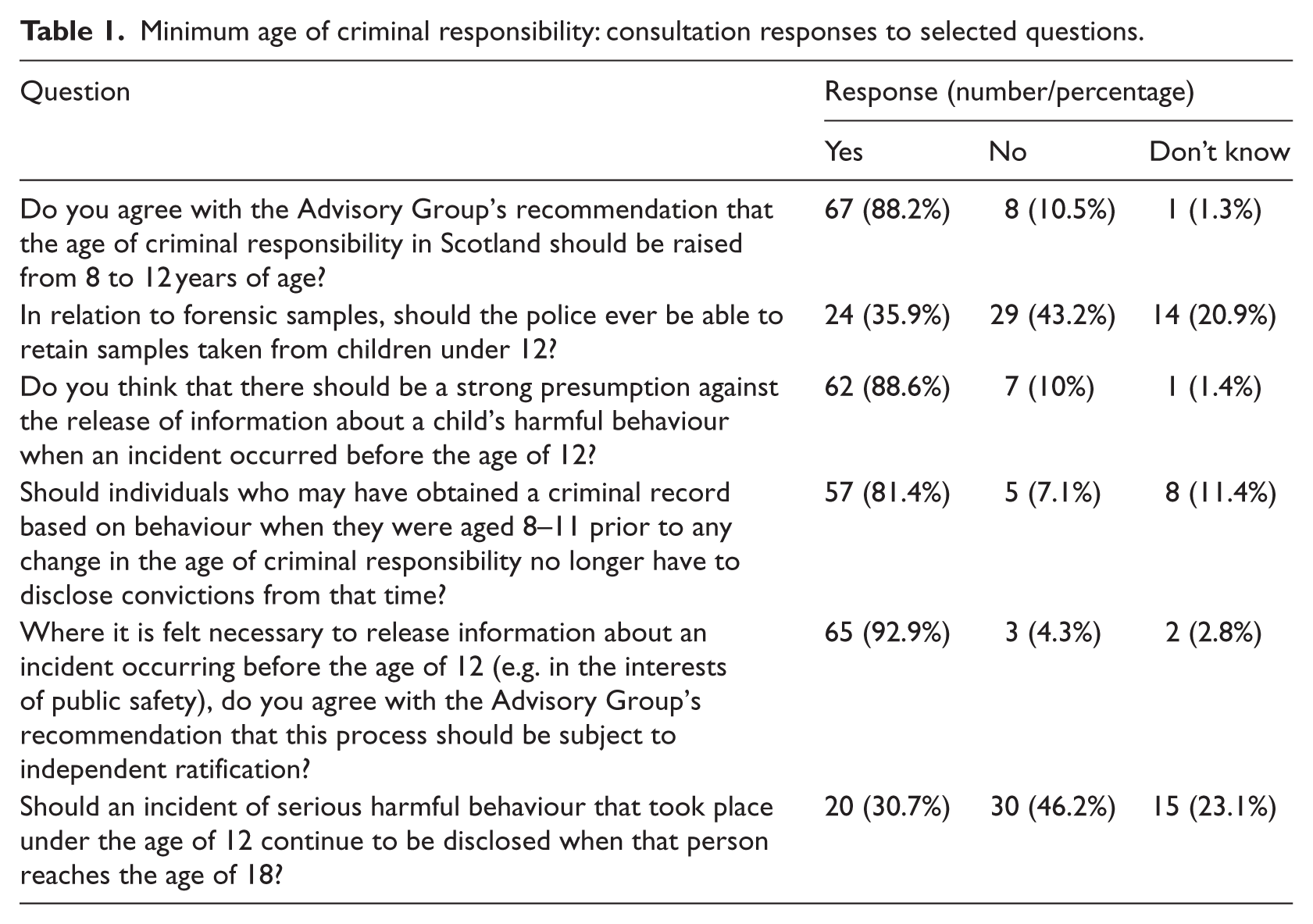
The Scottish government responded to the Advisory Group’s report by launching a public consultation on the issue, asking for views on the principle of change and the key implications in relation to care and protection, risk and disclosure. The process included consultation events with more than 200 children and young people aged between 8 and 22 years. The analysis of responses was published in December 2016. As shown in Table 1, there was overwhelming support for raising the age of criminal responsibility. Eighty-eight per cent endorsed an increase to 12 years, but an additional seven per cent who did not support such a rise took that view because they were in favour of setting a higher age. One respondent argued that Pointers indicate that children in areas of high deprivation are more likely to be at risk of offending and criminalisation, and there is also no shortage of research linking criminal behaviour by young people with poverty, mental ill health, being in care or experience of neglect/abuse, misuse of drugs or alcohol, and having learning and behavioural difficulties. Those children in greatest social need are those swept up by the youth justice system.
Minimum age of criminal responsibility: consultation responses to selected questions.
Another made reference to the stated position of the UN Convention on the Child’s that ‘setting the MACR at age 12 should be an “absolute minimum” and that state parties should “continue to increase it to a higher age level”’.
A large majority of respondents also backed a presumption that children below the age of 12 years with a criminal conviction acquired prior to any legislative change should not be required to disclose it. Moreover, there was majority support for the proposition that the police should not be able to retain forensic samples from children under 12.
Children and young people consulted on the issue also widely supported the proposal that the minimum age of criminal responsibility should be raised. For instance, representatives of the Children’s Parliament, aged 8–13 years, voted 37 to 3 to increase the age to 12 years. One supported this position with the following comment: Because I think 8 is too young. If you do something bad it is because of who is around you, what your family is like, your health and what your school is like.
Another said, ‘Eight is ridiculous because you haven’t fully matured yet and twelve is a much more suitable age’.
On 1 December 2016, in a statement to the Scottish Parliament, Mark McDonald, Minister for Childcare and Early Years, noted that the case for change is clear and compelling. Having the lowest minimum age of criminal responsibility in Europe does not match with our progressive approach to youth justice and ambitions to give children the best start in life.
He confirmed that the government intended to bring forward a Bill to raise the age of criminal responsibility from 8 to 12 years, with the change implemented in time for Scotland’s Year of Young People in 2018: The Report of the Advisory Group on the Minimum Age of Criminal Responsibility, published by the Scottish Government, is available at: www.gov.scot/Resource/0049/00497071.pdf Minimum age of criminal responsibility: analysis of consultation responses, and engagement with children and young people, published by the Scottish government, is available at: www.gov.scot/Resource/0051/00510795.pdf The Minister’s statement on the Minimum age of criminal responsibility is available at: http://news.gov.scot/news/minimum-age-criminal-responsibility
Black Children in England and Wales are Almost 60 Per cent More Likely Than Their White Counterparts To Be Tried in the Crown Court
The overrepresentation of Black, Asian and Minority Ethnic (BAME) communities is a well-documented and long-standing concern in England and Wales. In January 2016, David Cameron, then prime minister, asked David Lammy, Member of Parliament, to conduct ‘an independent review of the treatment of, and outcomes for’ BAME individuals in the criminal justice system. Emerging findings from that review were published on 16 November 2016, including some that relate to the experience of children in the youth justice system. Indeed, in an open letter to the Prime Minister, describing the findings, Lammy notes that, particularly as regards the use of custody, the problem of minority ethnic overrepresentation is ‘worse for under 18s’.
The emerging findings are based largely on a statistical analysis commissioned to support the enquiry, but the review has also initiated an open call for evidence, conducted visits to criminal justice settings and engaged with a range of stakeholders. These other sources will inform the ongoing work of the review which aims to consider:
The use and misuse of data;
Forms of oversight and accountability;
Promoting trust among minority ethnic communities;
A focus on vulnerable groups, including children in care;
The role of non-governmental agencies and individual helping to address the issue of disproportionality.
The statistical analysis conducted to inform the work of the review adopts a ‘relative rate index model’, which measures the extent of representation of ethnic groups at various stages of the criminal justice process. Disproportionality is accordingly assessed against the ethnic composition of the population at that particular decision point rather than against the make-up of the wider population at large. The report author argues that this methodology has advantages over other approaches since ‘the index is calculated for the specific people “at risk” for particular outcomes at the system juncture rather than the general population as a whole’. It also provides a clear indication of whether disproportionality increases or decreases at each decision-making stage, allowing a better understanding of where interventions to reduce BAME overrepresentation might have the greatest effect.
Using this approach, the analysis found that BAME children were almost three times as likely to be arrested as their white counterparts, even though self-report studies suggest that the former are less likely to commit crime. This broad level analysis disguised differences between different ethnic groups however: Asian boys were significantly less likely than their white peers to be arrested.
There were considerable differences too in the nature of the offences for which different ethnic groups of children were arrested. Accordingly, black boys were 10.5 times more likely, and mixed heritage boys 4.2 times more likely, than white young males to be arrested for robbery. Similarly, black girls were more than five times more likely to be detained by the police for offences of robbery than their white peers.
Disproportionality at this ‘gateway’ to the youth justice system is particularly important since it ‘influences the raw number of defendants proceeding through the courts system and ultimately into prison if convicted and sentenced’. Consequently, BAME children would be overrepresented in custody even if no disproportionality occurred at other decision-making points. Indeed, while the analysis did find subsequent evidence of disproportionate outcomes, these were not generally as marked as those at the stage of arrest.
Crown Prosecution Service (CPS) decisions to charge BAME girls, for instance, were at a level equivalent to or lower than those for young white females; conversely black and mixed heritage boys were more likely to be charged than white male children. Once cases proceeded to prosecution, the overrepresentation of BAME boys among those sent to crown court – where custodial sentences equivalent to the adult maxima are available – was particularly marked: black young males were almost 60 per cent more likely than white boys to be committed to the crown court; Asian boys were nearly 2.5 times more likely to be tried in that venue compared with white young males.
Black boys proceeded against in the youth court were less likely to be convicted but significantly more likely to be sentenced to custody. For every white boy sentenced to custody, ‘1.2 black and about 1.4 mixed ethnic young males’ were given a detention and training order. Those tried in the crown court were significantly more likely to plead not guilty but more likely to receive a term of imprisonment, although this latter difference was not statistically significant. The author of the report acknowledges however that A more nuanced understanding of custodial sentencing might be warranted that controls for offence, its level of violence, prior offending, the content and recommendations of pre-sentencing reports and plea.
Following sentence, the chance of black boys reoffending within 2 years was 15 per cent higher and that of black girls almost 8 per cent higher than for their white equivalents.
The analysis concludes by reflecting that higher levels of disproportionality may appear at those stages of the criminal justice system where there is greater discretion in, and less oversight of, decision making: One overarching hypothesis worth investigating may be that established principles of oversight, guidance and collective decision-making reduce the effects of any unconscious racial bias that play out in areas of the system where decision-makers exercise a higher degree of individual discretion.
Figures published elsewhere, giving a breakdown of the child custodial population by ethnicity, indicate that overrepresentation of black children in the secure estate has worsened considerably in the recent period. In September 2005, 26 per cent of children in custody were from a BAME background, by September 2016 that figure had risen to 44 per cent: Review of Racial Bias and BAME representation in the Criminal Justice System, an open letter to the Prime Minister from David Lammy, outlining the emerging findings of the review was published on 16 November 2016 and is available at: www.gov.uk/government/uploads/system/uploads/attachment_data/file/569218/open-letter-to-prime-minister.pdf Black, Asian and Minority Ethnic disproportionality in the Criminal Justice System in England and Wales, by Noah Uhrig, is published by the Ministry of Justice and is available at: www.gov.uk/government/uploads/system/uploads/attachment_data/file/568680/bame-disproportionality-in-the-cjs.pdf Figures for the ethnic composition of the child custodial population are derived from Monthly youth custody report: September 2016 England and Wales, published by the Youth Justice Board, and available at: www.gov.uk/government/statistics/youth-custody-data
‘Independent Expert’ Appointed to Lead a Global Study on Children Deprived of Their Liberty
In December 2014, the UN General Assembly adopted a child’s rights resolution which committed it to commissioning a global study of children deprived of their liberty following a campaign, launched in March 2014, by a non-governmental organisation (NGO) panel co-ordinated by Defence for Children International and Human Rights Watch.
On 26 October 2016, Manfred Nowak, professor of international law and human rights and former UN Special Rapporteur on torture, was appointed to lead the study. An Advisory Board was also established to inform the direction of the work. The study is intended to be broad in scope and will focus around the following themes:
‘Criminal justice/juvenile justice/administrative detention;
Migration/asylum seeking;
Children in detention with their parents;
Protection/associated with disability, health or substance abuse;
Association with armed groups and/or national security’.
The methodology will encompass a range of different elements: including an analysis of different legal frameworks; a literature review; engagement with children; and collection and analysis of new data from member states and consultation with regional experts.
Confirmation on the appointment of Manfred Nowak and details of the study are available on the website of the NGO Panel for the Global Study on Children Deprived of their Liberty at: https://childrendeprivedofliberty.info/
Almost Half of Boys in YOIs in England and Wales Report Not Feeling Safe at Some Point During Their Detention According to Research Conducted By Her Majesty’s Inspectorate of Prisons
Children in England and Wales who are remanded or sentenced to custody are detained in one of three types of establishment according to age, gender, assessed vulnerability and placement availability. Young offender institutions (YOIs) are by some margin the largest of the custodial settings, and have the lowest staffing ratios, resembling adult prisons in many respects. They accommodate boys aged 15–17 years and, at September 2016, held three quarters of the child custodial population. Secure training centres (STCs) are somewhat smaller and have higher levels of staff to children. They were originally developed to hold children aged 12–14 years but their remit has since expanded to encompass girls up to the age of 17 years and 15- to 17-year-old boys considered too vulnerable to be placed in YOIs. Secure children’s homes (SCHs) are significantly smaller than other detention settings and have considerably higher levels of staffing. They accommodate boys and girls aged 10–12 years and other vulnerable children up to the age of 17 years. SCHs have a child care ethos, are inspected as children’s homes and can provide accommodation for children secured on grounds of welfare as well as those detained through the youth justice route.
Research published by Her Majesty’s Inspectorate of Prisons in November 2016 considers the experiences of children in STCs and YOIs (but not SCHs). In many respects, conditions of children in these forms of custody had deteriorated compared with the previous year.
For instance, the proportion of boys in YOIs who felt safe on the journey to the establishment had fallen from 82 per cent in 2014–2015 to 76 per cent in 2015–2016. Just 21 per cent in the more recent survey reported that their cell call bell was answered within 5 minutes compared with 39 per cent a year earlier. The proportion who said that they could speak to an advocate had fallen from almost half to just over a third. Fifteen per cent of boys compared with 10 per cent in the previous survey indicated that they were too scared or intimidated to make a complaint. There had also been a significant reduction in the proportion of children having daily association from 67 to 54 per cent.
The survey revealed significant differences in the custodial experience according to the ethnic background of those incarcerated. Black and minority ethnic boys (BME) were less likely to think that staff treated them with respect than their white peers (58% against 68%), much more likely to report having an adjudication (77% against 59%) and more likely to consider that they had been victimised by staff (39% compared with 26%). Fifty five per cent of BME children indicated that they had been physically restrained compared with 36 per cent of white boys.
One of the most concerning findings was that approaching half (46%) of all boys in YOIs reported that they had felt unsafe within the establishment, the highest recorded level since the survey began in 2006–2008.
Within STCs, the deterioration in children’s experiences over the previous year was much less marked, although there were reductions in the proportion who said that staff had explained why they were being searched or who felt that they were treated with respect by staff during the search process (from 86% to 74% and 95% to 85%, respectively). BME children’s experiences were again significantly different in some respects to those of white children: fewer of the former considered that staff treated them with respect (78% against 96%), and just 56 per cent of BME children knew where they would live on release compared with more than three quarters (78%) of their white counterparts. While just one in a hundred white children indicated that they had experienced problems from other young people in the centre on the basis of gang-related issues, the equivalent figure for BME children was one in five.
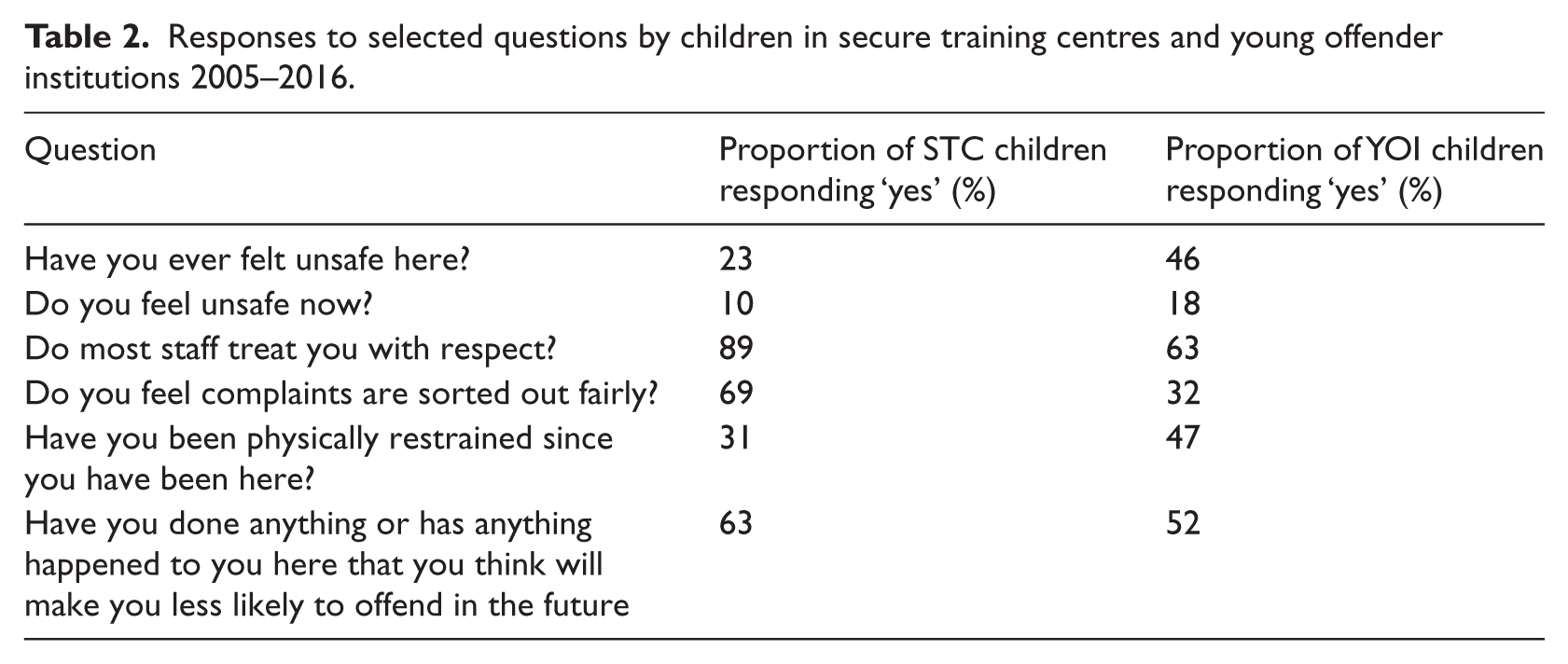
The questionnaire used in each of the two types of setting is different but it is nonetheless possible to compare children’s experiences on some issues. As shown in Table 2, the survey elicited more positive responses across a range of important indicators within the smaller, higher staffed, STCs than in the YOIs. Whereas, as noted above, 46 per cent of boys in the latter type of establishment had felt unsafe, the equivalent proportion in STCs was less than a quarter (23%). Similarly, while 89 per cent of children in the latter setting said that most staff treated them with respect, just 63 per cent of those in YOIs did so.
Responses to selected questions by children in secure training centres and young offender institutions 2005–2016.
As noted above, the survey does not include children in SCHs. To the extent that the marked differences between YOIs and STCs are explicable in terms of the relative size and staffing levels of the different types of institution, one might reasonably anticipate that results from a similar exercise conducted in SCHs would generate results at least as positive as those from STCs: Figures on the proportions of the child custodial population in different settings is given in Monthly youth custody report: September 2016 England and Wales, published by the Youth Justice Board, and available at: www.gov.uk/government/statistics/youth-custody-data Children in Custody 2015–16: an analysis of 12–18-year-olds’ perceptions of their experiences in secure training centres and young offender institutions, by Joe Simmonds, is published by HM Inspectorate of Prisons and is available at: www.justiceinspectorates.gov.uk/hmiprisons/inspections/children-in-custody-2015-16/
Report Recommends an ‘Urgent Review’ of Educational Contracts in Young Offender Institutions in England and Wales
Children in custody typically have needs and previous experiences that impact negatively on their ability to engage constructively with education. A report by the Prisoners’ Educational Trust, for instance, highlights that
Rates of attention-deficit/hyperactivity disorder (ADHD) among imprisoned children are estimated as being five times that for the general population.
Rates of identified learning disabilities are up to 10 times higher.
The prevalence of dyslexia is four to five times as high.
Sixty per cent of children in custody are estimated to have speech, language and communication needs (SLCN) compared with between 5 and 14 per cent in a typical sample of adolescents.
Almost nine out of ten boys in YOIs have been excluded from school.
In August 2015, new educational contracts were developed in YOIs holding children in England and Wales that increased the extent of educational provision from 15 hours a week to 27 plus 3 hours physical exercise. The report notes that while ‘the increase in hours spent in education is to be welcomed … this does not tell us, about the quality, appropriateness or learning outcomes of that time spent “in education”’.
Findings suggest that children are, on average, only receiving 17 hours per week of the required 30 hours, and a lack of flexibility in the curriculum to meet the specification of the contracts limits the scope of providers to offer children necessary forms of support, such as psychological or mental health interventions, which may be a prerequisite of effective learning. The report accordingly recommends an ‘urgent review’ of the contracts with a view to having less of a focus on outputs and allowing increased flexibility for providers to respond appropriately to young people’s learning needs in a broad sense: Great Expectations: towards better learning outcomes for young people and young adults in custody, by Clare Taylor, is published by the Prisoners’ Educational Trust and is available at: www.prisonerseducation.org.uk/resources/great-expectations
One in Three ‘Homeless’ 16- to 17-Year-Olds Known to Youth Offending Teams in England and Wales are Placed in ‘Unsuitable or Unsafe Accommodation’
In 2009, the House of Lords held, in what is now known as the Southwark judgement, that the primary responsibility for provision of accommodation for homeless children aged 16–17 years resides with children’s social care rather than housing departments. The relevant statute governing such provision of accommodation is thus the Children Act 1989 rather than homelessness legislation. The judgement was important since, in many local authorities, children’s social care had not previously recognised provision of accommodation for this age group as being their responsibility.
An inspection of 49 cases of children aged 16–17 years across six local authority areas, who were known to youth offending teams and unable to live with their parents, found that all of them had experienced significant difficulties in their lives. Two-thirds of them had been looked after at some point and many had experienced ‘neglect, parental loss, physical and sexual abuse and family relationship breakdown’. Unsurprisingly, many of them presented challenging behaviour and 15 of the children had spent some time in custody.
Each of the six local authorities had, in compliance with the legislation, designed pathways and established protocols and guidance for the delivery of accommodation and support services to 16- and 17-year-olds. However, outcomes did not always reflect the underlying intention of the legislation. While there were examples of good practice, four out of the six authorities were opposed to offering looked after status to this age group even if they requested it, meaning that social care support was typically dropped at age 18; conversely acquiring looked after status was not in itself a guarantee of appropriate accommodation being provided.
All local authorities inspected had some good residential options available including, in some cases, children’s homes or units that offered 24-hour support or supported lodgings. Conversely, while all the areas had a policy of using bed and breakfast accommodation only in emergency circumstances, there was a relatively low threshold for what constituted an emergency and placement on this basis sometimes became routine. Children could remain in such bed and breakfast for weeks at a time, and in one case it had been accepted as a permanent placement. In one local authority, all the children represented in the cases reviewed had spent some time in bed and breakfast.
Children were not infrequently placed in hostels that accommodated adults, including those with criminal records, none of which had waking night staff. In some cases, the background of the adult residents was not known. Girls were particularly vulnerable where they were placed in settings alongside adult males with little provision to ensure that they were safeguarded. Overall, one in three of the children were housed in accommodation that was considered by inspectors to be unsuitable or unsafe. Such accommodation did not meet the statutory duty to promote children’s welfare and safety. The report concludes that This was particularly so in the case of emergency accommodation. We found no systems in place anywhere to make sure that other residents in bed and breakfast accommodation were not considered a danger to children. As such, and in line with government guidance we judged the use of such accommodation to be unacceptable. Accommodation of homeless 16 and 17 Year old children working with youth offending teams is published by HM Inspectorate of Probation and is available at: www.justiceinspectorates.gov.uk/hmiprobation/wp-content/uploads/sites/5/2016/09/Thematic-Report-Accommodation-of-Homeless-16-and-17-Year-Old-Children.pdf