







Abstract
More Than 60,000 Criminal Records Acquired under the Age of 18 Years Disclosed to Potential Employers and Other Agencies in England and Wales Each Year
The system for disclosure of criminal records in England and Wales is extremely complex. The Rehabilitation of Offences Act 1974 provides that offences become ‘spent’ once a specified period, determined by the nature of the disposal imposed, has elapsed. Where an offence is spent there is no requirement on the individual to disclose it to potential employers or other relevant agencies in most circumstances. There are, however, exceptions: work with children or vulnerable adults and certain other professions – such as accountancy or law – are exempted from the general provisions and disclosure is required indefinitely unless the record has been ‘filtered’. Consequently, while spent convictions will not appear in basic criminal record checks, all offences, whether spent or not, will feature in standard and enhanced criminal record checks which are used in the exempted circumstances.
In 2013, the Court of Appeal held that the existing blanket arrangements under the Rehabilitation of Offenders Act were incompatible with the right to a private life, under Article 8 of the European Convention on Human Rights, since they mandated automatic lifelong disclose irrespective of how old or how minor the offences were. In response, the Government introduced a system of ‘filtering’ that allowed non-disclosure of some records for less serious offending once a certain period had elapsed. The extent of permissible filtering is, however, quite limited. Offences cannot be filtered if they resulted in a custodial sentence or if they appear on the list of more than 100 exemptions. Moreover, no more than one offence per individual can ever be filtered. A further legal challenge against the restrictive nature of the filtering scheme was successfully mounted in 2015 (and upheld on appeal in 2017), with the Court determining that restrictions on filtering more than one record ensured that some very minor offences continued to be disclosed indefinitely. This outcome was judged to be arbitrary rather than based on assessed risk. The Government has appealed the judgement and, at the time of writing, that appeal is pending.
The above framework applies in much the same manner irrespective of whether the criminal record was acquired as an adult or as a child. The principal difference is that the rehabilitation periods for offences committed below the age of 18 years are shorter – in most cases half of that which pertains in the case of an adult (although custodial sentences in excess of 30 months never become spent whatever the age at conviction). The qualifying period before an offence may be filtered is also halved for offences committed by children.
Following an inquiry during which 40 written submissions from a range of sources were received, the House of Commons Justice Committee published a report on the Disclosure of Youth Criminal Records on 17 October 2017. The report was highly critical of existing arrangements, noting that the evidence presented to the Inquiry ‘strongly supported the case’ for change and concluding that the ‘current system undermines the laudable principles of the youth justice system and may well fall well short of the UK’s obligations under the UN Convention on the Rights of the Child’.
The report highlighted how the continued disclosure of criminal records acquired as a child could impact negatively on individuals in later life. In terms of the world of work, there was significant evidence that employers tend to adopt a risk-based approach that leads them to prefer candidates with no record over those with a previous history of offending however minor the nature of the lawbreaking and the period that has subsequently ensured. Eight individuals who agreed to participate in a private seminar, hosted by the Committee, each provided examples of how ‘their employment prospects were adversely affected by childhood criminal records’. One individual who had been a deputy head for 20 years, but had more recently commenced work as a supply teacher, reported how he had to explain two minor convictions acquired 38 years ago every time he obtained a position at a new school as if he was currently a criminal.
The Association of Youth Offending Team Managers provided instances of where a prior record had hindered young people pursuing educational courses, including one example of a young woman who was refused access to a nursery nurses course because of anticipated difficulties in finding her a placement. The Committee also found that some local authorities continue ‘to frame their housing allocation schemes in a way that denies access to applicants with spent criminal records … of childhood offences that are low-level or irrelevant to their suitability as tenants’. Difficulties with obtaining insurance where a previous criminal record was disclosed were additionally highlighted.
The Committee concluded that such practices, which were permitted by the current disclosure arrangements, presented considerable obstacles to individuals who wished to leave their offending behind them as they progressed to adulthood. They thus had the potential to undermine the statutory principal aim of the youth justice system to prevent offending and reoffending by children and young people. The report expressed the view that present rehabilitation periods are unnecessary lengthy and have no transparent rationale. Similar arguments were deployed as regards the qualifying period for filtering. As the Children’s Commissioner for England pointed out in evidence to the Committee, the relevant period for filtering childhood convictions at five and a half years – represented a greater proportion of a child’s life than the qualifying period of 11 years that applies to adult offenders. For example, a child convicted while aged ten would have to wait for a period equivalent to more than half their life before their record would be eligible for filtering.
The Committee made a series of recommendations to amend the existing statutory framework. In particular, the report endorses proposals to substantially reduce rehabilitation periods for childhood offending and calls for an urgent review of the filtering system to consider, among other issues, removing the rule that presently precludes the filtering of multiple convictions, reducing, considerably, the qualifying period for filtering childhood cautions and convictions and the introduction of the potential for review of whether childhood criminal records should be disclosed as currently exists in Northern Ireland and Scotland.
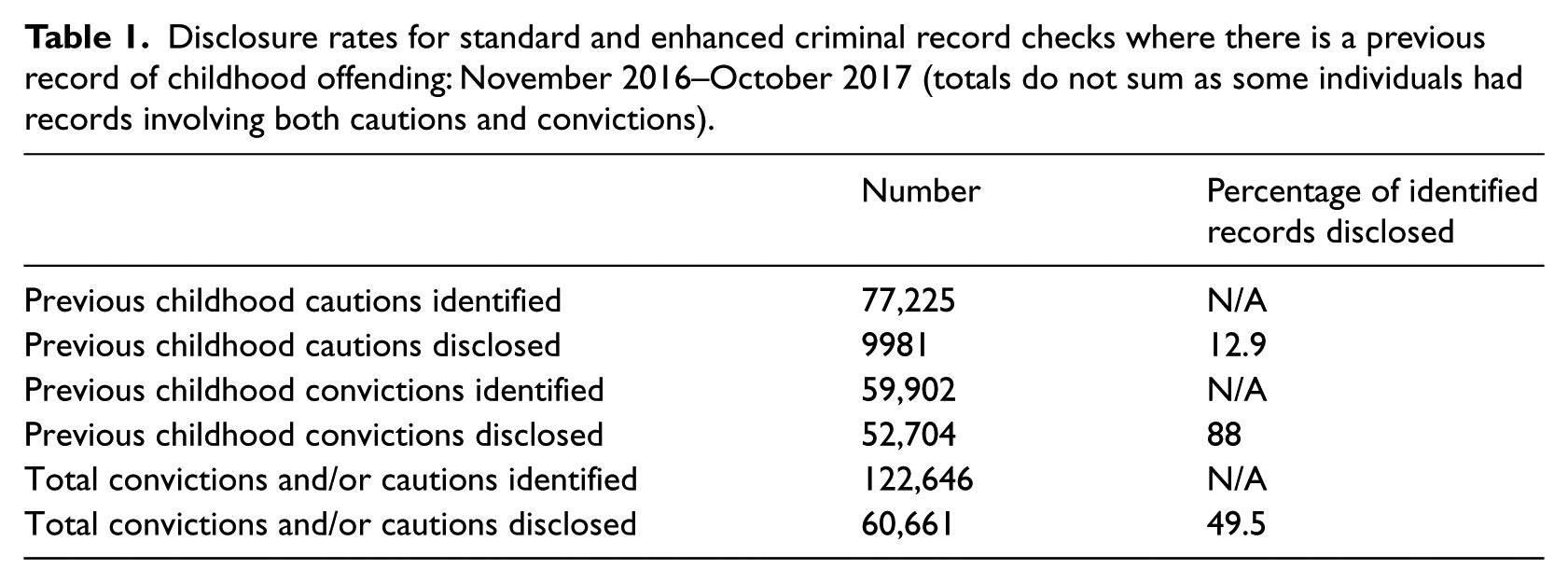
In January 2018, the Government published its response to the Justice Committee’s proposals which, for the most part, maintains that the current arrangements strike an appropriate balance between protection of the public and the right of children to leave their criminal past behind them. The response provides data showing that where a previous childhood record was identified following an application for a standard or enhanced criminal record check (and the Rehabilitation of Offenders Act does not therefore apply) filtering resulted in half of the records not being disclosed. However, as shown in Table 1, the net effect was, nevertheless, that previous offending was disclosed in more than 60,000 cases, including the large majority of convictions.
Disclosure rates for standard and enhanced criminal record checks where there is a previous record of childhood offending: November 2016–October 2017 (totals do not sum as some individuals had records involving both cautions and convictions).
In relation to specific recommendations made by the Committee, the Government disputed the finding that rehabilitation periods under the Rehabilitation of Offenders Act had no rationale (while failing to indicate what the relevant rationale might be) but nonetheless agreed to consider the proposal to reduce further the period before which a record becomes spend alongside other recommendations. In relation to the filtering system, the Government noted that it is currently defending the existing regime through the legal process and that it would accordingly not be appropriate to consider specific recommendations for change at the present time: The Court of Appeal’s decision in 2013 that triggered the Government to introduce the filtering system, in R (T) v Chief Constable of Greater Manchester and Others [2013] EWCA Civ 25, is available at: www.judiciary.gov.uk/judgments/r-t-chief-constable-greater-manchester-judgment-29012013/
The Court of Appeal’s 2017 decision on the extent to which the filtering system is compliant with the European Convention on Human Rights, in P and Others v SSHD and SSJ, currently being challenged by the Government is available at: www.matrixlaw.co.uk/wp-content/uploads/2017/05/P-ors-v-SSHD-SSJ-ors-approved.pdf Disclosure of youth criminal records, published by the Justice Committee of the House of Commons, and the Government’s response to the report are both available at: www.parliament.uk/business/committees/committees-a-z/commons-select/justice-committee/inquiries/parliament-2015/disclosure-of-youth-criminal-records-16-17/
Data Confirm That Custodial Establishments for Children in England and Wales Are Becoming More Violent
The number of children in custody in England and Wales has declined sharply over the past decade, although latest figures suggest that the fall has stalled over the past 12 months. While the population of the children’s secure estate was 2846 in January 2008, this had reduced to 878 by the same month in 2018, a reduction of 69 per cent. However, data for each of the last 10 months show a rise over the equivalent period for the previous year, suggesting that the long-standing downwards trajectory may have come to an end.
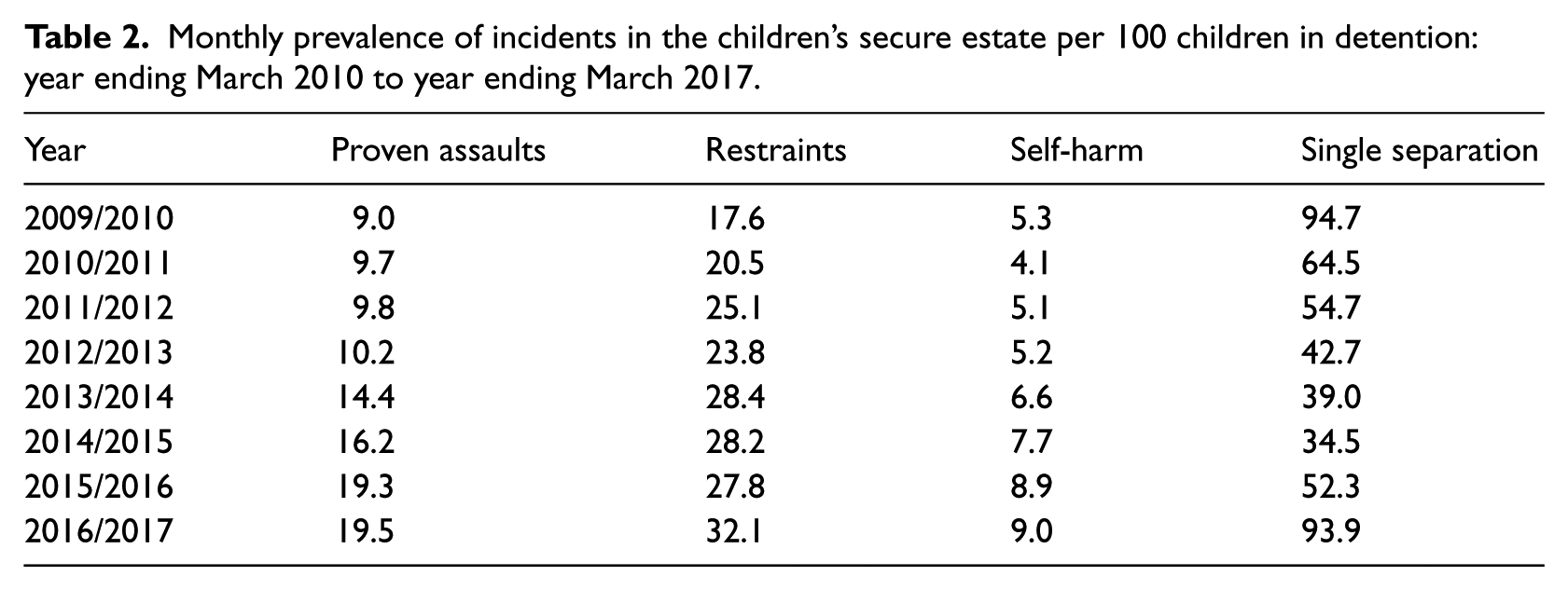
Information released by the Youth Justice Board and the Ministry of Justice, in January 2018, confirms that while fewer children are incarcerated, those who continue to be deprived of their liberty are more likely to experience assaults, restraints and self-harm than their counterparts in 2010. As Table 2 demonstrates, the number of what are termed ‘behaviour management’ incidents has climbed, as a proportion of the number of children detained, consistently over that period. Thus while in the year ending March 2010, there were nine assaults, across all establishment types per month, for every 100 children detained, the equivalent figure for 2017 was 19.5. The increases in other negative indicators have been comparable with the exception of segregation, which fell until 2015 before growing sharply in the most recent 2 years. Given that the data reflect official recording, it seems likely that the figures may, in any event, understate the extent of the problem.
Monthly prevalence of incidents in the children’s secure estate per 100 children in detention: year ending March 2010 to year ending March 2017.
Inspections of individual establishments confirm this marked deterioration. For example, an inspection report on Cookham Wood young offender institution, published in January 2018, recorded that 51 per cent of boys surveyed had felt unsafe at some point during their stay. There had been a substantial rise since the last inspection – from 10 per cent to one quarter – in the proportion of children indicating that they felt unsafe at the time of the inspection, and an expansion in the proportion who reported being victimised by other boys, from 21 to 35 per cent.
Information that allows some contextualisation of such quantitative data is provided by a recent thematic inspection of behaviour management in young offender institutions and secure training centres (but excluding secure children’s homes), undertaken by Her Majesty’s Inspectorate of Prisons and published in March 2018. The review found that a falling population, leading to a rising proportion of children convicted of more serious or prevalent offending, was not the ‘the sole or main driver of increasing poor behaviour and violence’. Institutions frequently accepted poor behaviour as inevitable rather than developing strategies for dealing with it and for promoting positive behaviour.
Despite evidence pointing to the greater effectiveness of rewards over sanctions, many establishments tended to prioritise punitive measures rather than ‘encouraging and celebrating positive behaviour’. Children reported that the timescales on which sanctions and rewards schemes tended to operate, frequently over a number of weeks, made it difficult for them to work towards rewards and that maintaining motivation over such sustained periods was accordingly less likely; conversely, punishment for a single infraction could also have effects that lasted for a significant duration. Such difficulties were frequently exacerbated by evidence of inconsistent application of the schemes in any event. Children who reported that staff treated them with respect were more likely to indicate that they had confidence in way that behaviour was managed; but almost half of those spoken to did not consider that staff were respectful to them and many young people evinced a lack of trust in staff.
As a consequence of such issues, children on the lowest levels of the scheme came to feel that they had little to lose by poor behaviour and the potential moderating impact of rewards or sanctions was thereby limited. In many establishments, inspectors witnessed poor behaviour or bullying that went unchallenged; where a response was forthcoming, too frequently it led to children spending less time out of their cells.
It should not be thought, however, that violence within children’s custodial institutions is a recent phenomenon. According to an article published in the Independent newspaper on 4 January 2018, ‘hundreds of boys [were] “tortured” at youth detention centres in 1970s and 1980s’. The regimes in such centres were introduced by the Conservative administration elected in 1979, under Margaret Thatcher’s premiership, to provide a ‘short, sharp shock’ to children in conflict with the law, based on a philosophy of deterrence which assumed that a harsh custodial experience would reduce subsequent offending. Detention centre orders were abolished in 1988.
David Greenwood, the head of child abuse at Switalskis Solicitors, told the newspaper that he was currently representing more than 400 men who alleged that they were subject to what amounted to physical systematic abuse; he anticipated that many more claimants would be forthcoming.
A spokesperson for Her Majesty’s Prison and Probation Service indicated that such allegations are already being investigated by the Independent Inquiry into Child Sexual Abuse, but Mr Greenwood pointed out that the limited focus of the inquiry means that it will not consider allegations of physical violence: Figures for the reduction in the child custodial population are derived from Monthly youth custody report – January 2018, published by the Youth Justice Board and available at: www.gov.uk/government/statistics/youth-custody-data Data on the prevalence of assault, self-harm, restraint and segregation are given in the supplementary tables of Youth Justice Statistics: 2016/17, published by the Ministry of Justice and the Youth Justice Board, and available at: www.gov.uk/government/statistics/youth-justice-annual-statistics-2016-to-2017 Figures on safety at Cookham Wood young offender institution are given in Report on an unannounced inspection of HMYOI Cookham Wood – 14–25 August 2017, published by Her Majesty’s Inspectorate of Prisons and available at: www.justiceinspectorates.gov.uk/hmiprisons/wp-content/uploads/sites/4/2018/01/Cookham-Wood-Web-2017.pdf Incentivising and promoting good behaviour: a thematic review, by Her Majesty’s Inspectorate of Prisons, is available at: www.justiceinspectorates.gov.uk/hmiprisons/wp-content/uploads/sites/4/2018/03/Incentivising-and-promoting-good-behaviour-Web-2018.pdf Hundreds of boys ‘tortured’ at youth detention centres in 1970s and 1980s by Lizzie Dearden appears in the Independent Newspaper on 4 January 2018 and is available at: www.independent.co.uk/news/uk/crime/detention-centre-torture-boys-youth-sexual-physical-abuse-inquiry-kirklevington-medomsley-a8142456.html
Government in England and Wales Confirms That Deterrent Programmes Based on Showing Children the Realities of Prison ‘Should No Longer Be Facilitated’
In his Government commissioned review of the youth justice system in England and Wales, published in December 2016, Charlie Taylor – who was subsequently appointed Chair of the Youth Justice Board – expressed concern that versions of the ‘Scared Straight’ programme, in which prison officers or serving prisoners themselves attempt to deter children from crime by ‘showing or explaining the realities of life in prison’ continued to operate in some areas, in spite of ‘international evidence’ that such interventions can be counterproductive and may serve to increase offending.
One such initiative, the KeepOut – The Crime Diversion Scheme, was delivered in a number of adult prisons by trained serving prisoners. The programme aimed to change the attitudes of 13- to 17-year old children considered to be at risk of offending or who were already involved in the youth justice system. Workshops were developed to demonstrate to participants the ‘harsh realities of prison life’ and to show children ‘the real consequences for them, their families and the victims’ of continued offending.
A Parliamentary question posed on 22 February 2018 inquired of the Government what guidance had been issued to Her Majesty’s Prison and Probation Service in relation to the KeepOut scheme and other similar programmes. In response, Dr Philip Lee, Parliamentary Under-Secretary of State with responsibility for youth justice, confirmed that in the light of the comments in the Taylor review in relation to such interventions, it had been determined that they would no longer be facilitated: Review of the Youth Justice System in England and Wales, by Charlie Taylor, is published by HM Stationery Office and is available at: https://assets.publishing.service.gov.uk/government/uploads/system/uploads/attachment_data/file/577103/youth-justice-review-final-report.pdf Information on KeepOut – The Crime Diversion Scheme is given at: https://localgiving.org/charity/keepout/https://localgiving.org/charity/keepout/ Dr Lee’s answer is given in Crime Prevention: Young People: Written question – 129050, on 22 February 2018, available at: www.parliament.uk/business/publications/written-questions-answers-statements/written-question/Commons/2018-02-22/129050/
Children in Prison in Estonia Are ‘Much More Isolated Than Their Peers’ in Other Parts of Europe
In line with many other Western jurisdictions, Estonia has seen a rapid decline in the level of detected youth offending in recent years. The number of children receiving a criminal justice disposal has fallen from 2056 in 2006 to 541 a decade later, a reduction of almost 74 per cent. Some – but by no means all – of this pattern can be explained by demographic factors since the fall in the number of children coming to the attention of the justice system, considered as a proportion of the general population in the relevant age band, while substantial has been a little more muted. This indicator registered a decline from 263 per 10,000 members of general youth population to 114 over the same period. The number of children in prison has also fallen in line with the broader trend from 89 in 2006 to 29 in 2016, a 67 per cent reduction. Children are also placed in closed ‘special schools’ and the population of these institutions has similarly shrunk, from 143 pupils in 2005 to 67 in 2012. However, according to an article published in Juridica International, despite the contraction in the system, the treatment of those children who continue to come in contact with criminal justice interventions falls short on occasion of what is required by international standards and conventions on children’s human rights in a number of respects.
The approach taken to youth crime in Estonia is what has been called, in other contexts, a process of ‘bifurcation’ whereby children who engage in less serious offending receive a relatively ‘soft’ response, whereas those whose offending is considered to be more serious are subject to ‘adult-like punishment’. The former is exemplified by the establishment in 1998 of multi-agency Juvenile Committees composed of professionals from education, social care, health, police and probation. The Committees function as ‘non-juridical’ organs whose role is to divert children from criminal proceedings for as long as possible; courts may also refer a child to the Juvenile Committee in appropriate cases. The success of this form of intervention has, however, been questioned and the youth justice framework, including the functioning of the Juvenile Committees, is currently under review.
Harsher responses are reserved for children who are not diverted from proceedings. There are no specific juvenile, youth or family courts in Estonia and children who are prosecuted for offending appear in the same court system as that which deals with adults. Children removed from the home environment may be placed in six distinct forms of setting:
Closed special schools for those with behavioural problems;
Special shelters for children with alcohol or drug addiction;
Closed-access departments of psychiatric hospitals;
Welfare institutions for ‘mentally disabled’ children;
‘Arrest houses’;
Youth sections of adult prisons (one each for boys and girls).
The nature of the provision in arrest houses and prisons causes difficulties for the obligation in international children’s rights standards that children be kept separate from adults. The principle is followed in formal terms in that children in arrest houses are detained in separate cells from those from adults, but on occasion there may be only one detainee under 18 years in an institution otherwise full of adults; where this occurs, children are kept in effective isolation.
At Viru prison, boys are accommodated in a separate unit from adults, but the authors argue, Being placed in the same prison where adult criminals are serving their punishment creates a self-image of being one of the prisoners. Such a ‘prisoner’ identity stigmatises children and has an important negative effect on their personal development.
Material conditions in the prison are adequate to ensure that children’s physical needs can be catered for and classrooms, sports facilities, the library and other facilities are well equipped. However, while education in prison is compulsory, participation in leisure activities is used as a motivational tool and access to them is, as a result, not an everyday occurrence. Indeed, boys are frequently locked in their cells for days at a time, tending towards a vicious circle in which confinement leads to increasing levels of poor behaviour and a, consequently, decreased time out of cell.
Moreover, given that there is a single unit each for boys and girls in prison across the whole of Estonia, communication with families and communities is inevitably problematic and the use of non-governmental organisations to facilitate family contact is less developed than, for example, in Italy, Belgium or Spain. As a result, the authors consider that ‘young prisoners in Estonia are much more isolated than their peers in other EU countries’.
Interviews with children across a variety of closed settings confirmed that many of them had some knowledge of human rights, but this understanding was largely at an abstract level that had little perceived relevance to their day-to-day life. In particular, children were often not told of their right to complain, and where they did understand the possibility of making a complaint, this right was rarely exercised either because the levels of literacy required to complete the relevant documentation made it a daunting exercise or because they were concerned about potential repercussions from staff. The authors accordingly conclude that the right to participation is still highly limited for children in detention in Estonia: Children’s Rights and the Juvenile Justice System in Estonia, by Judit Strömpl and Anna Markina, is available at: www.researchgate.net/publication/320904526_Children%27s_Rights_and_the_Juvenile_Justice_System_in_Estonia
Black Children in the United States Are Disproportionately Transferred to Adult Courts
In the United States, children who are processed for offending may be subject to ‘waiver’ with the effect that their case is transferred to an adult court and any subsequent custodial sentence imposed is served in an adult custodial institution.
In 2012, the Attorney General’s National Task Force on Children Exposed to Violence recommended that prosecutors ensure that wherever possible children should be processed in the juvenile justice system. A report published by the Campaign for Youth Justice, in March 2018, argues that this recommendation is consistent with the evidence that transfer to the adult system has negative consequences both for the young people concerned and for public safety.
In 2014, the suicide rate for children aged 10–17 years across the United States was 4.04 per 100,000 – a rate that was similar to that found in respect of children held in juvenile detention facilities. By contrast, the suicide rate for children incarcerated in adult jails was 36 per 100,000, almost nine times that experienced by those who were not transferred. Children in adult custodial provision were also five times more likely to be victimised than their peers in juvenile detention.
Public safety is undermined to the extent that incarceration fails to provide rehabilitation, and on this measure, transfer to the adult system is found wanting since it makes increased victimisation more likely. Adult custodial facilities are not designed to accommodate children, and as a consequence, few are able to offer developmentally appropriate support or other rehabilitative services; staffing ratios are significantly lower and visitation policies reflect a focus on security and punishment rather than the reintegration of young people back into their communities. Given this context, it is, the report argues, unsurprising that the proven reoffending rate for those transferred to adult establishments is more than one-third higher than for those who are consigned to juvenile detention.
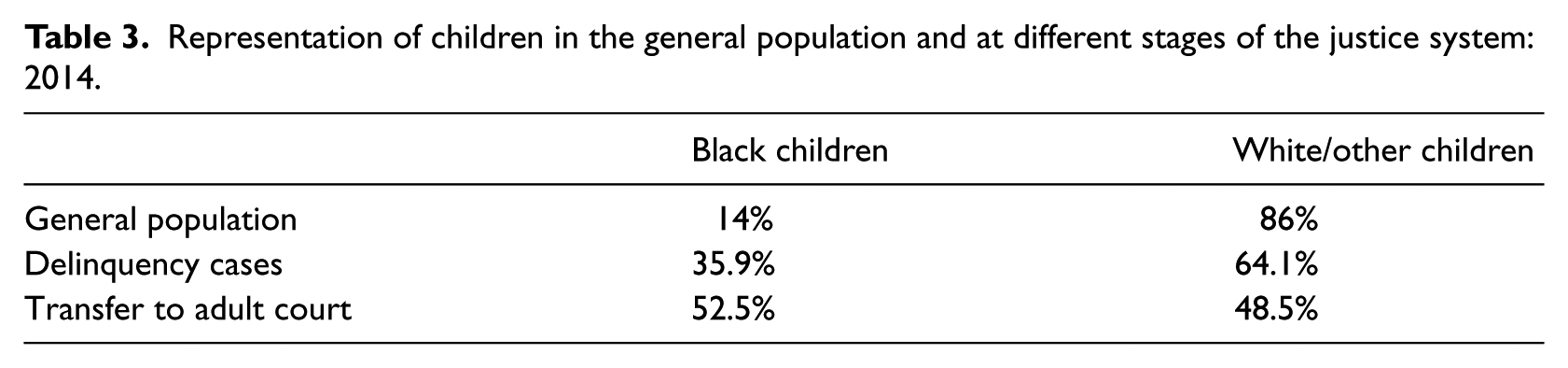
It is also apparent that the decision-making process that determines whether or not a child’s case is retained within the youth justice system operates to the significant disadvantage of Black children. As indicated in Table 3, Black children are almost four times as likely to be transferred to the adult justice system as their make up in the general population would lead one to anticipate: while in 2014, Black children accounted for 14 per cent of the general population of the relevant age, they represented well over half of those subject to transfer.
Representation of children in the general population and at different stages of the justice system: 2014.
Even in States where policy requires juvenile court judges to consider racial disproportionality when deciding on transfer, such disparities continued to be apparent. Missouri is one of the few States to have such a policy, but in 2016, 72 per cent of children transferred by the juvenile court were Black despite the fact that their composition in the general population was only around 15 per cent.
The author of the report concludes that prosecutors and juvenile court judges have considerable discretion to ‘shape the course of a young person’s life and promote the safety of their community’. Guidance to US Attorneys indicates that they should provide a memorandum to support any motion to transfer a child to an adult court. In preparing the documentation, they are required to consider ‘age, developmental and psychological maturity, and the availability of treatment programming’ as well as the nature and seriousness of the alleged offence. The report suggests that if such individual factors were routinely considered, more children would be deemed suitable for juvenile court trial.
Youth transfer: the importance of individualized factor review, by Jeree Thomas, is published by Campaign for Youth Justice. The report is available at: http://campaignforyouthjustice.org/images/20180314_CFYJ_Youth_Transfer_Brief.pdf
The Impact of Mandatory Penalties for Knife Crime in England and Wales is Discernible in Increases in the Use of Custody for Children
Section 28 of Criminal Justice and Courts Act 2015 introduced a minimum custodial sentence of 4 months for children aged 16 and 17 years convicted of a second or subsequent offence of possession of a knife or offensive weapon. The sentence is mandatory unless the court determines that there are exceptional circumstances. Figures released by the Ministry of Justice in March 2018 appear to confirm that the legislative provision has been reflected in changes in decision making by criminal justice agencies.
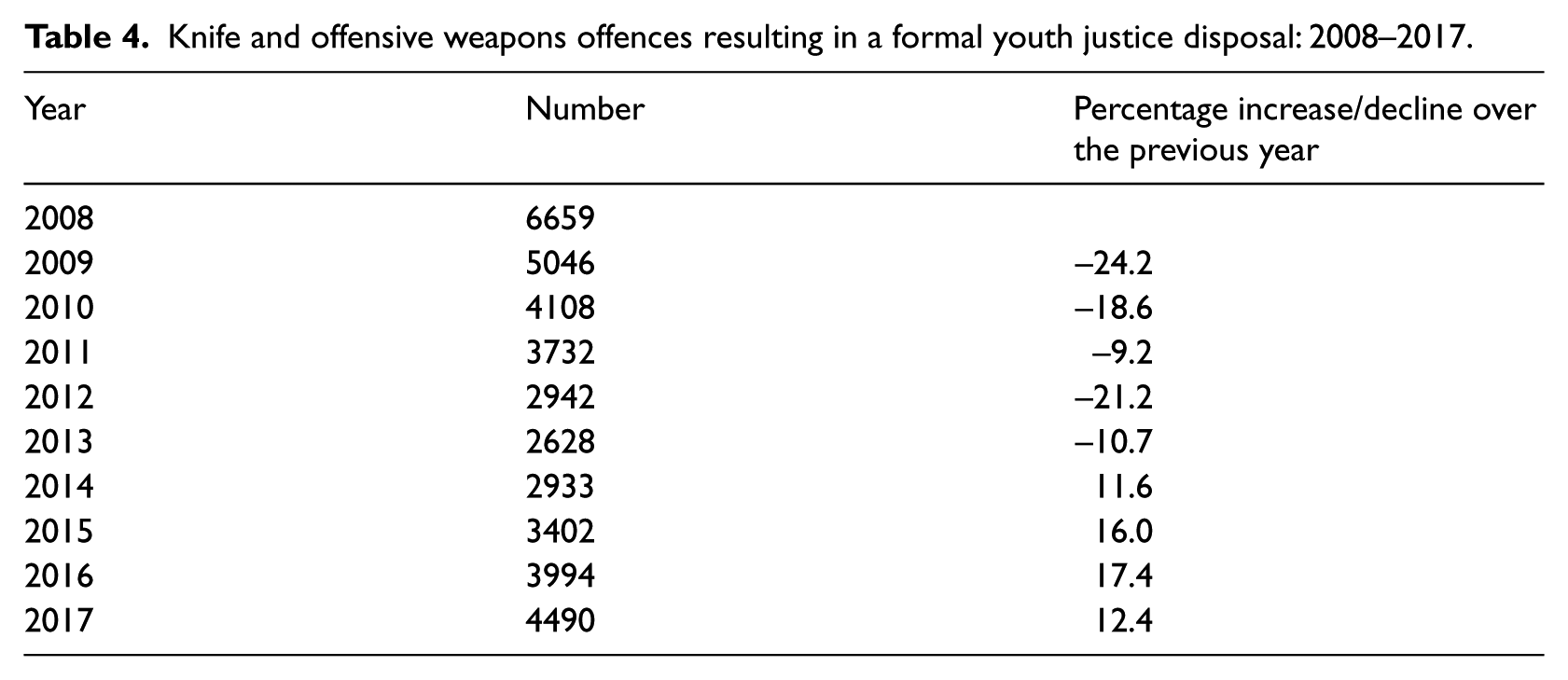
As demonstrated in Table 4, the number of knife and weapons offences committed by children, which results in a formal youth justice outcome, has declined sharply in recent years. However, while the total number of such disposals in 2017 was a third lower than in 2008, the period since 2015, when the new statutory provisions were introduced, has seen a sharp increase. It seems likely that at least part of the recent rise is a consequence of an increased profile given to weapons offences. Also relevant as an explanation is an agreement between the National Chief Police Council and the Crown Prosecution Service that children aged 16 and 17 years will always be charged unless there are exceptional circumstances, thereby limiting the potential for dealing with such incidents informally.
Knife and offensive weapons offences resulting in a formal youth justice disposal: 2008–2017.
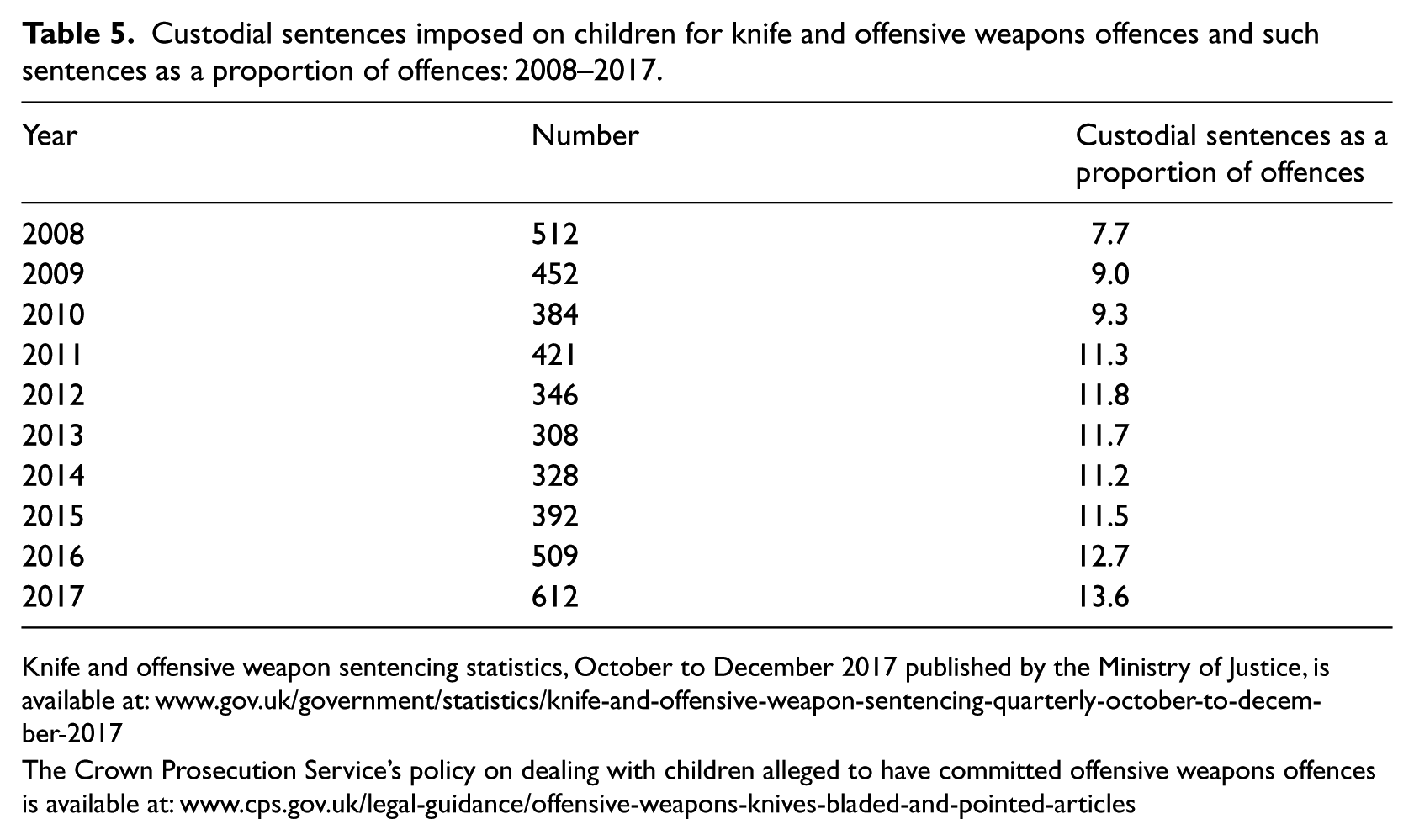
The data are not broken down in a manner that allows the disaggregation of 16- and 17-year-olds, but the figures as a whole also demonstrate a clear rise in the use of custody for offensive weapons offending. As shown in Table 5, the trend from 2008 onwards for a reduced use of custody in such cases also reversed in 2015. Moreover, the rise in the most recent period is not simply a factor of the increase in the number of incidents leading to a formal disposal since the proportion of offences resulting in a custodial sentence has also grown. Using this measure, it is moreover apparent that the expansion in the proportionate use of imprisonment for such offending actually pre-dates the change in legislation.
Custodial sentences imposed on children for knife and offensive weapons offences and such sentences as a proportion of offences: 2008–2017.
Knife and offensive weapon sentencing statistics, October to December 2017 published by the Ministry of Justice, is available at: www.gov.uk/government/statistics/knife-and-offensive-weapon-sentencing-quarterly-october-to-december-2017
The Crown Prosecution Service’s policy on dealing with children alleged to have committed offensive weapons offences is available at: www.cps.gov.uk/legal-guidance/offensive-weapons-knives-bladed-and-pointed-articles