







Abstract
This article draws on original, empirical research that focused on the use of an experimental mobile application developed by the authors and used in the domain of youth justice in England. Against a backdrop of the theory of the paradox of technology with ideas of the networked self and child rights, the article explores the use of social technology with vulnerable/marginalised young people. Given the dearth in knowledge and understanding, in this area of social technology and young people in conflict with the law, the article focuses on an important, original and fast-developing issue in contemporary youth justice. Principally, the article explores the experiences and views of practitioners to promote a better understanding of the opportunities and challenges in the adoption of social technology in working with marginalised young people. Practitioner perceptions on the use of social technology in their own practice and its associated risks and benefits are also revealed. Study findings indicate that digital opportunities and challenges are embedded in organisational and cultural structures and practices. The article discusses implications for youth justice and ultimately for young people in conflict with the law who are caught up in the system. The article raises important issues about the likely increasing use of technology as a tool in rehabilitation and desistance; and its key messages will be of considerable interest to practitioners, managers and policy-makers who will have little option, as time goes on, to enter this controversial field.
Keywords
Introduction
Young people are prolific technology users as well as being dominant users and owners of smart mobile phones (Statista, 2019). Given this development, there is a chronic paucity of the use of apps in youth justice to help reduce re-offending behaviours. This article focuses on the experiences and views of practitioners, namely, case workers in youth offending teams, to promote a better understanding of the opportunities and challenges in the adoption of social technology in working with vulnerable and marginalised young people. A key responsibility of case workers is to help ensure that young people comply with their court orders and meet the court’s supervisory requirements around key goals and outcomes. Non-compliance can result in case workers breaching a young person and a possible eventual court appearance (generally after a total of three breaches) that may lead to a custodial sentence. Examples of non-compliance can include lack of attendance at a scheduled meeting or specified activity, and not adhering to a curfew or exclusion zone order (Grandi and Adler, 2016). The use of social technology, that can be a tool in preventive practice, may help in rehabilitation and lead to a possible reduction in the need for custody.
The article is structured in six segments. First, to help the reader engage with the article, we begin with a description of the bespoke social technology developed by the research team, for use in youth offending teams. Second, we sketch out the background context in which we document how technology is currently conceptualised in contemporary society. Following this, we provide the reader with a sense of the domain of youth justice to help make sense of study findings. The article then moves on to discuss the study aims and objectives. This is followed by study findings, principally the qualitative accounts of case workers in their use of new technology. Discussion/analysis and conclusions identify some key issues and concerns in the adoption of technology with marginalised groups in society.
The Mobile Apps in Youth Offending Teams App
Below, we introduce our Mobile Apps in Youth Offending Teams (MAYOT) and its functionality.
Given the context of increasing use of digital technology in our lives and a lack of relevant apps in the youth justice sector, an interdisciplinary research study, instigated in 2014, set out to explore how social technology could be developed and adopted for the purposes of reducing re-offending and promoting better engagement between young people and their case workers. Our MAYOT app project developed a personalised mobile app for use by young people and their case workers in youth offending teams. In line with Bovaird (2007), the design of the app adopted a co-production/co-design approach. The app offered a range of features elaborated through a process of co-design with inputs from young people, case workers and managers. Features implemented in the app included automated reminders of key appointments/scheduled activities, visual displays of personalised goals/objectives and progress, nudging around curfew times and exclusion zones, and access to relevant contacts, and useful information on health, drugs and alcohol, stop and search and knife crime.
The research findings described in this article are within the broader context of the overall research undertaken as part of the design and deployment of the MAYOT app as a force for positive engagement with young people in the youth justice sector. In this article, we report on the qualitative dimensions involving front-line case workers’ perceptions on technology in their direct practice with young people. Notably, the larger study adopted a mixed-methods approach in the collection of data in the co-design of the app.
Through a process of co-design, the research team produced the MAYOT App which was subsequently deployed in three youth offending services (YOSs) across England. Main features of the app included:
automated texts for reminders of key appointments and other scheduled events/activities;
visual reminders regarding goals/objectives and progress;
personalised information about key activities around group work, one-to-one meetings;
easy access to case history, relevant contacts such as professional networks, peer networks and their family networks;
nudging capabilities to help manage restriction orders such as curfews and exclusion zones;
information resources such as help on knife crime, drugs and alcohol.
A fundamental premise of the app is the provision of personalised information that enabled case workers to reflect and respond to the needs of the young people in appropriately tailored interventions within the regulatory framework of UK youth justice. Some of the functionality is shown in Figure 1.
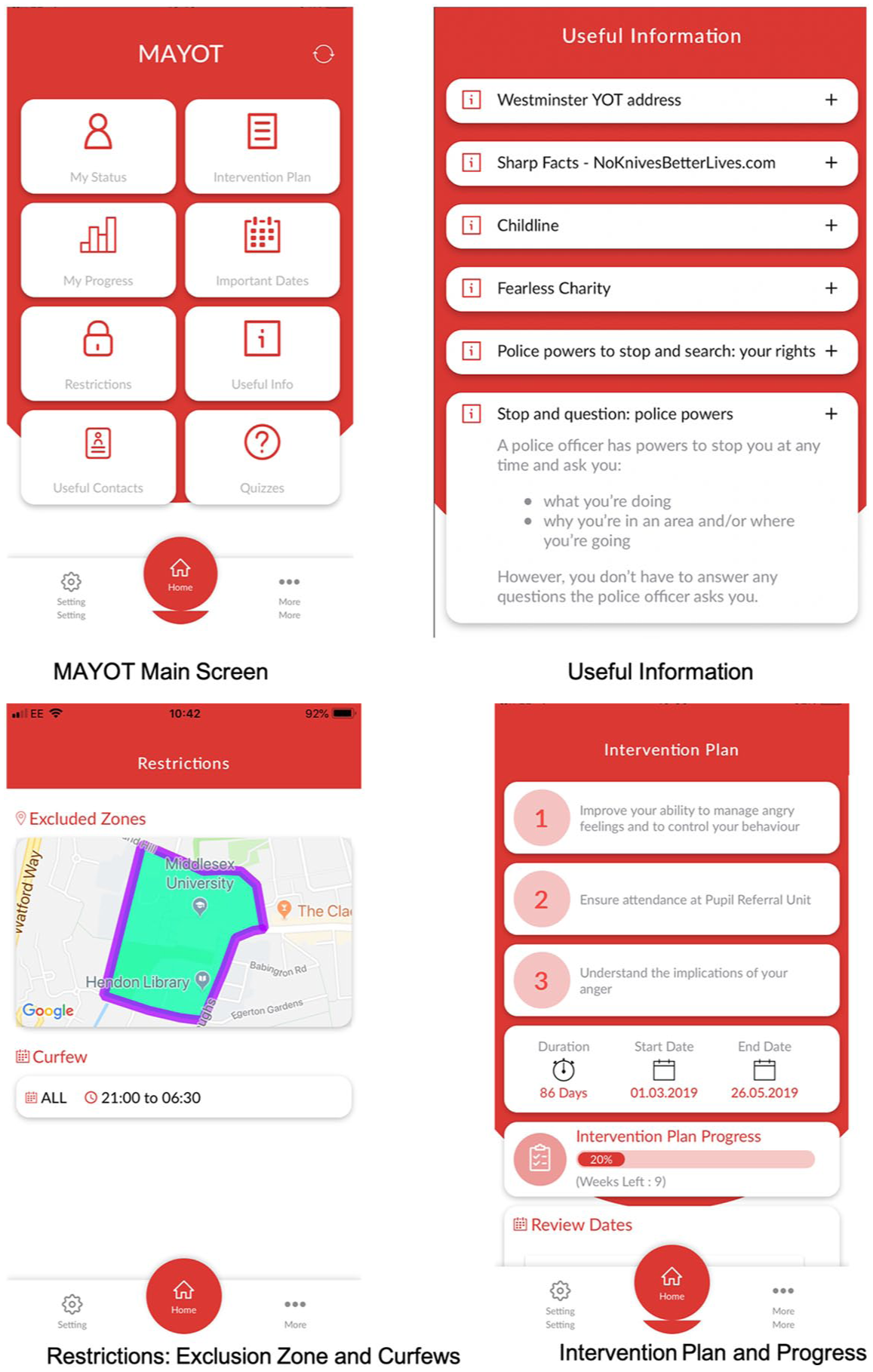
MAYOT app features.
The various app features are closely aligned with the functions and role of YOSs with respect to the young people under their jurisdiction. A key function of the practitioners is to devise an intervention plan for a young person as part of the process for completing an Asset risk assessment form. The practitioner, as part of the Asset process, defines and sets up a range of meetings with service providers and other regulatory meetings. Young people are expected to attend these meetings as part of their completion of an order. MAYOT app, as a technological tool, seeks to support this professional activity through timely SMS text reminders and notifications to help the young person meet these requirements. Some young people will be subject to restrictions such as an imposition of a curfew time and/or restrictions from certain geographical locations. The latter, called an exclusion zone, is currently operated through the provision of a physical copy of a map location that the practitioner makes available during an intervention meeting. In the app, exclusion zones are uploaded and made available on the app. In other meetings, a practitioner may make available to the young person a range of information usually through the provision of leaflets. This and other personalised information can be readily uploaded to the app through a practitioner web-based portal.
Frequently, a practitioner may need to provide the same information to more than one young person creating additional workload due to duplication of actions. The web-based portal enables information to be made available to multiple young people easily thereby adding value to the functions and roles of the practitioner. Similar added value is possible through the provision of exclusion zones delivered through the app.
The app afforded considerable flexibility in how the case worker could automate the provision of useful and timely information to the young person. All case workers were provided training to utilise the technology. This included hands-on computer-based activity with case scenarios on how to navigate one’s way around the technology. For example, exercises included a focus on how to set up young people profiles, how to organise sending of automated weekly reminders of supervisory meetings, key goals and activities and creation of useful maps (using google maps) to indicate a relevant exclusion zone. The latter was used in cases where young people had been excluded from certain spaces, for example, a particular neighbourhood, a building and so on. The app afforded not only the creation of a map indicating the excluded zone but also the opportunity to be alerted when in that zone. Case workers made use of the technology directly from their desktop computers, and the information was received by the young people on their mobile phones.
Background
In sociological research, the relationship between technology and the individual has been given considerable attention. Generally speaking, models of thinking vary from the emancipatory/transformational power of technology (Berzin et al., 2015; Castells, 1996; Habermas, 1989; Sassen, 2002) to viewing it as a process of communication that leads to ritualization and routinization that can be socially cohesive and liberating or a tool for management and control (Kirkpatrick, 2017; Luhmann, 2000; Schroeder and Ling, 2014). Arguably, the debate is far more nuanced where technology and the digital space it affords is ‘embedded in the larger societal, cultural, subjective, economic, imaginary structurations of lived experience and the systems within which we exist and operate’ (Sassen, 2002: 368–369). Thus, it is too simplistic to adhere to the assumption that technology is either distributive, democratising and emancipatory or inherently dystopian in nature. Scholars have also commented on the way in which the digital and the material are imbricated, that is, the ways in which they overlap and are inter-related and intersectional rather than disparate entities (Kirkpatrick, 2017; Sassen, 2002). Arguably, it is crucial to acknowledge these imbrications to explore how the use of technology could influence direct practice to achieve positive outcomes in youth justice. Thus, while technology has the potential to be liberating and empowering, how its development and use is negatively impacted by social conditions and prevailing power structures is of the utmost concern (Kirkpatrick, 2017). Active interventions to enhance digital skills and counter digital exclusion remains an important goal (Eynon and Geniets, 2016).
Scholarly work into technology and young people has largely focused on education but it has raised key questions about technological determinism and social constructivism (Davies et al., 2013). In other words, how should we attempt to understand technology? Should we view digital technology as a tool, or as a feature of the social and cultural environment with its own inherent qualities? Within such a framework, social cognition, agency and identity are arguably crucial mediators in the use of technology among young people.
Research into technology and marginalised youth points to its potential for civic engagement and participation (Eynon and Geniets, 2016). For example, in a study of young people’s use of Information and Communications Technology (ICT), Blanchard et al. (2008) found that although the quality of access is a concern, ICT may be an important resource for the engagement of young people, particularly in the promotion of positive mental health. In a more recent study, Walsh et al. (2016) have suggested positive impact of interactive digital technology among young people, particularly around emotional regulation, self-control and problem solving. The researchers argue that this cognitive behaviour programme supports children and young people with disruptive behaviour problems and their families to make more informed and better choices which can help reduce further contact with the law. Another study has pointed to the efficacy of a text intervention package that was piloted with 21 youth (12–24 years) with mild to moderate anxiety and/or depression (Anstiss and Davies, 2015).
While the positive benefits of technology have been stated by some studies, there are also infrastructural concerns including service providers’ own digital skills and knowledge, their conceptualisation of young people’s use of ICT, and organisational technological capacity (Metcalf et al., 2008). Furthermore, ethics and risk management concerns have been raised by others, particularly in the use of social networking sites, such as Facebook, by social work practitioners (Mukherjee and Clark, 2012; Tunick et al., 2011). Reamer (2013: 171) advocates a clear and carefully constructed social media policy that ‘can prevent confusion and minimize the likelihood of ethics-related problems concerning boundaries, dual relationships, informed consent, confidentiality, privacy, termination and interruption of services, and documentation’. While advising caution, Reamer (2013) is clear that in this digital age, and in their quest to help the vulnerable and marginalised, social work practitioners must move beyond the traditional and engage in a critical and evaluatory fashion in new and innovative digital interventions. Indeed, concerns have been expressed about new social exclusions in our emerging digital society (Steyaert and Gould, 2009; Wong et al., 2009). The potential for opportunities and challenges is also clear (Rafferty and Steyaert, 2009).
A recent review of ICT-supported social work interventions has concluded that while there is some indication that ICT has enhanced the effectiveness of youth and social work in specific aspects, further research is needed into the opportunities and challenges of different types of ICT (Chan, 2016). Similarly, in an article on the digital age and its implications for social work practice, Mishna et al. (2012) argue that the ubiquity and pervasiveness of cyber technology cannot be halted or kept out of social work practice. They conclude that ‘the responsible position is to examine and understand the consequences and implications in order to inform practitioner behaviour’ (Mishna et al., 2012: 285).
It has been argued that the digitalisation of the criminal justice system (CJS) agenda is either reinforcing existing punitive values such as the electronic monitoring of the movements of offenders in the community (Ministry of Justice, 2013; Nellis, 2004, 2006, 2013a) or it is employed as a tool for data management for social care (Hill, 2012). Crucially, the power of technology in rehabilitation and desistance remains untapped. Arguably, rehabilitation requires active strategies in the form of education to ‘change an offender’s attitudes and a readiness to equip them with skills that enable sustained desistance from crime’ (Nellis, 2006: 103). More recently, in the broader CJS, specifically in probation, mobile app technology has been developed but currently evaluation results have not been reported. An offender management app released by the Probation Board for Northern Ireland claims to be the first app designed to support offenders to desist from crime (McGreevy, 2017). Key features of the app include a journal for users to fill with their own thoughts, appointments and information resources on probation and mental health. Notably, co-production of the features is limited to an initial survey of users with the working group comprising communications staff, learning and development staff and psychology staff. An app developed by New Zealand Corrections Department targeted practitioners to support case management work and has met with some success by reducing workload through increased efficiency (Fagan, 2017). Elsewhere, the MyNeON app rooted in seven community-based locations called Neighborhood Opportunity Networks (NeONs) aimed to encourage positive behaviour change in service users through participation in community goals (Mossler and Blank, 2014).
Given the crucial importance of the practitioner–client relationship in reducing re-offending in youth justice, and given that ICT in direct practice will be inherently embedded in this relationship, this article seeks to make a novel contribution to help address this gap (Drake et al., 2014). By placing a focus on practitioners’ views and experiences about the challenges and opportunities presented in their use of bespoke technology, hereafter referred to as the App, this article contributes towards the literature in the growing area of ICT and public services Nellis (2013a).
Young People and Youth Justice
The discipline of criminology has a long tradition of studying youth crime to identify risk factors that predispose young people to become involved in criminal activity (Rogowski, 2010). Such factors are generally located within a socio-economic context, and psycho-social behaviours and practices. Some writers have classified such knowledge to make actuarial predictions of would-be young offenders (Farrington et al., 2013). A critique of such work points to its confusion about cause and effect, the high visibility of some groups, policing strategies and risk of stigma (Barn et al., 2018; Gunter, 2010; Pitts, 2001; Rogowski, 2010).
The influence of risk predictive studies is evident in the technologies of government that are operational within youth justice. Arguably, these include the use of the actuarial Asset risk assessment form in youth offending teams in England and Wales, and the strategies of responsibilization. Data collected from such instruments and further coupled with data from other information systems deployed within the sector allow comparisons and consolidation across time and space. Ultimately, this can then support an ‘economic’ rationality – the increasing reliance upon an ‘analytical language’ of risks and rewards of objectives/targets (Garland, 1997). Concerns about the risk management strategies in the governmentality of youth justice have led some writers to argue that young offenders and youth crime have been decontextualised and dematerialised leading to an erasure of their socio-economic and political conditions (Goldson and Muncie, 2006). Moreover, it has been suggested that with the transformation in the social workers’ techno-habitat, a critical examination of this domain is required, within a framework of ethics and risk management, to understand the negative impact of ICT on service users and practitioners (Garrett, 2005). Indeed, there are serious concerns that risk management technologies may lead to negative outcomes of surveillance and control for young people in the context of increasing datafication (Lupton and Williamson, 2017).
Recent research suggests that engagement with young offenders to help them towards desistance, prevent recidivism and promote social inclusion remains a key challenge for public policy and youth justice service providers (Cavanagh and Cauffman, 2017; Haines et al., 2015; Humayun et al., 2017). Associated problems include poor levels of engagement in education, training or employment. The outcome is high rates of recidivism both among young people leaving custody and those on community orders (Lobley and Smith, 2016). In line with other innovative research initiatives, the rationale for the design and introduction of our social technology study was to engage young people to help reduce risk-taking behaviours and re-offending rates by providing timely, appropriate and personalised information via digital technology, as a way of enhancing young people’s agency and autonomy. The purpose of this article is to provide an understanding on how practitioners in youth justice make use of this social technology to better engage with young people.
Arguably, the use of technology in the field of youth justice is not a new phenomenon; it is important to note however that the current use of technology is embedded at an organisational level in two ways. First, in its attempt to manage risk, the neo-liberal approach of a market economy can be evidenced in the use of technology whereby private firms such as G4S, SERCO and CAPITA are contracted to electronically monitor the movements of young people in the community (Ministry of Justice, 2013; Nellis, 2004, 2006, 2013a). Second, technology is employed as a tool for data management and, this signals its own tactics of surveillance and discipline. Crucially, the electronic assessment form, Asset, serves as both risk assessment and data management for the purposes of surveillance and discipline (Haines and Case, 2015; Jones, 2014). Both efforts are part of the general move towards neoliberalism in public services and remain embedded in the framework of new public management that is concerned with maintaining low cost and higher efficiency, with minimal influence in direct welfare (Kelly and Armitage, 2015). Consequently, scholars have argued that the use of technology as a tool of positive engagement with young people is rather rudimentary, ad hoc and lacking in strategy (Chan, 2016). As argued above, the power of technology in rehabilitation and desistance remains untapped. Use of social technology that can assist practitioners in direct practice with young people in the youth justice sector could help support them in rehabilitative work and the reduction in youth crime.
Notably, in the broader CJS, there is a general digitalisation agenda which is set to shape the way justice is done and experienced (Van De Steene and Knight, 2017). Where digitalisation is accomplished through co-production that places service users as close to the centre of provision as possible, then mitigation against issues such as non-adoption of technology is possible (Morris and Knight, 2018).
Study Aims and Methods
Given the contextual framework of actuarial risk assessment tools in youth justice, the need for compliance with court orders and the state’s desire to achieve reduction in recidivism and achieve rehabilitation, this article explores practitioner perspectives about the challenges and opportunities of their use of the app in engagement with young offenders (Barry, 2010; Haigh, 2009). While the broader focus of the study included the potential of technology in youth justice, this article seeks to answer the following research questions: What challenges and opportunities do practitioners experience in the use of new technology designed to support them in direct work with young people? How does this, in turn, influence their perceptions of their own practice, and risks and benefits of technology?
This article is part of a larger study that set out to explore how social technology could be developed and adopted for the purposes of promoting better engagement between young people in conflict with the law and their case workers (Barn and Barn, 2016). Here, we report on the qualitative dimensions involving case workers’ perceptions on technology in their direct practice with young people. Notably, the larger study adopted a mixed-methods approach in the collection of data in the co-design of the app. A combination of surveys, focus groups and interviews with managers, practitioners and young people was considered crucial in understanding the values framework, and the existing practices of communication, and future intended use of the app (Barn et al., 2015b).
We provide an insight into the everyday app experiences of youth justice practitioners in their work with young people. This article, therefore, draws on the views and experiences of 14 case workers who were engaged in the utilisation of the app in direct work with the young people under their supervision, in three geographical settings in England – inner-city, urban and rural. All three sites participated in the larger study that entailed the co-design of the app. Ethics permission was granted by the second author’s university, and the study adhered to the Economic and Social Research Council Framework for Research Ethics (ESRC, 2015). The study sought to ensure that ethical considerations of confidentiality and anonymity were appropriately handled and that research participants gave their informed consent to being involved in this study. All data were sensitively handled and given full protection and security. The study was funded by the Nominet Trust (now known as Social Tech Trust), a UK based charity that invests in social technology.
Participants
The 14 case workers ranged in age from 32 to 56 and included eight women and six men. All except three were White British. Most participants were qualified in social work at graduate or postgraduate level, or possessed a related degree, for example, in Psychology. With the exception of two, most practitioners were highly experienced (4–10 years) in youth justice or similarly related work, for example, probation. To preserve anonymity of our respondents, we have used pseudonyms where needed in our discussion of worker perspectives, and we do not attribute the geographical location in which they worked. Crucially, although the qualitative sample is relatively small, it does provide rich insights into the perspectives of case workers’ engagement with technology in direct work with young people.
Data Analysis
All interviews were recorded with the consent of the research participants and transcribed verbatim. A thematic analysis of the interviews was undertaken in which the theoretical framework of the role and function of technology, discussed above, provided the structure within which to understand practitioners’ views and experiences. Each interview transcript was coded following transcription. Interviews underwent a further analysis and coding and re-coding in a respective comparative context along identified themes (Ritchie et al., 2013; Ritchie and Spencer, 1994). Analytical themes included respondents’ conceptualizations of their techno-habitat, the paradox of technology and practitioner competence and ethics. The thematic analytic framework helped identify practitioners’ engagement with technology, and in particular their construction of organisational structures and constraints, and their own investment in the use of the app (Chan, 2016). Challenges and obstacles in this process were also considered to help understand the difficulties encountered.
Findings
We present the emerging themes from our study to provide an insight into the experiences and views of practitioners in their use of this app. Crucially, our research respondents were aware that this technology had been informed, co-designed and approved from within the youth justice sector. Indeed, key respondents and their colleagues and young people had contributed to the design of the technology. As discussed above, its key features. including appointment reminders, information sharing, and young people’s goals and objectives/plan of intervention, had emerged from ideas suggested by practitioners and young people.
Our analysis of the qualitative interviews with case workers has helped identify three key themes, namely, ‘Techno-habitat – Youth justice and information technology infrastructures’, ‘Paradox of technology’, and ‘Practitioner competence, and ethics and risk management’. Inevitability, these themes are inter-related and such linkage will be discussed later.
Techno-Habitat – Youth Justice and Information Technology Infrastructures
In attempting to understand how, when and in what circumstances technology may be adopted by front-line practitioners, it is crucial to understand the reported ‘techno-habitat’ of youth justice in contemporary England and Wales (Dyer-Witheford, 1999). Such an analysis can help shed light on the deployment of ICTs in our technologically advanced society.
Our findings suggest that although ICT is used in the form of centrally imposed systems discussed above, for example, the Asset form, and the electronic tagging by private companies working within youth justice, there is an enormous appetite for the use of technology to assist direct communication with young people. However, our study finds that this domain of the public sector suffers from poor funding that inhibits sound infrastructural support (Taylor, 2016). Case workers across all research sites reported that they and their organisations were ‘stuck in the 1990s’ and had not yet ‘entered the 21st century’. One practitioner, with 6 years of experience in youth justice work, explained the nature of her techno-habitat thus:
We are still in very dark ages in terms of the way we work, static machines on a desk, you know, and I know, it’s all financial implications, but for me, we expect to move, we’re trying to move forward to offer our kids the best service possible, yet we’re held back by you know bloody dark age technology to a certain degree.
Such organisational infrastructural constraints signified a range of practitioner concerns including poor hardware and broadband connection, risk-averse security considerations and considerable frustration at not being able to provide a good service using the latest technology available. Practitioners believed that the YOS was lagging behind other services and that although YOS users were technology savvy, they were not reaping the benefits of modernity in meeting their needs.
Our study shows that with the exception of a few individual case workers, who, at times, sent SMS text messages via their mobile phones to the young people with whom they were working, traditional methods of communication were in existence such as letters, phone calls, appointment cards and so on. Such methods were rationalised as providing clear evidence in cases where young people were being breached for non-compliance.
Case workers had access to desktop computers at work to assist them with Asset data input and general record keeping; however, they lacked access to other devices to promote better and direct communication with young people themselves. A highly experienced case worker reported that he had seen little development in the youth justice techno-habitat:
. . . the mobile phones we have are very out-dated, um there aren’t enough laptops so if you want to work remotely there often isn’t a laptop and when you do get one the bloody thing won’t log on most of the time. So, I think you know, I think we’re slipping behind in terms of where technology is. We should all be having iPads or you know, tablets too, with a good connection, 3G or 4G connection, Cos there’s all the stuff about security – this is always the argument – ‘we can’t make them secure’ but you know the police use them in, in patrol, children’s services use them.
The implications of such an under-resourced techno-habitat and its lack of ready acceptance and adoption of social technology were reflected in the experiences of practitioners. For example, while practitioners recognised the value of the app, they reported feeling hamstrung by their techno-habitat. In addition, a number of related concerns were expressed that focused largely on workload pressures. Such pressures were said to emanate from a lack of alignment between organisational ICT systems and the app leading to ‘duplication’ of work, and managerial inertia to embrace technology. Crucially, practitioners resented ICT systems which required considerable data input, and they suggested that without the integration of different systems, additional workload would ‘become another bugbear’ as this would be ‘another thing that they have to remember to input and fill in’.
We noted that while one YOS incentivised its practitioners to trial the app, this was not common practice elsewhere. In the absence of managerial support, the busy practitioner, therefore, may have failed to appreciate the benefits of the app. Another experienced practitioner reported the benefits of workload recognition in the process of embracing new technologies in the work place:
Our manager does a workload tool. I don’t know what the other offices do, and it comes out with a percentage, and there is time allowance for different cases . . . and there is some time put aside for me to use the app with X (young person). And it does help.
It was evident that where workload recognition was given to practitioners to trial this app, there was a sense of support and encouragement. In other situations, practitioners, invariably, adhered to familiar ways of working and resisted change that included learning about new technology. Moreover, as discussed above, a techno-habitat with its organisational inertia regarding technology prevented the full acceptance of the app.
Our findings indicate that while practitioners demand better organisational capacity in the form of sound hardware, good and fast broadband Internet access including wi-fi and the availability of crucial hardware devices, they do not want face-to-face interaction to be replaced by technology. Crucially, managerial concessions are an important pre-requisite, for example, adjustments in workloads in order to support practitioners to acquire new technological skills and develop their competence.
A focus on the techno-habitat of youth justice also shows that this domain of the public sector suffers from poor funding that inhibits sound infrastructural support. Arguably, this may well be the reason why some social care professionals may resort to using potentially risky social media networking sites to which they have access in their personal domain, such as Facebook that are constantly challenging the values of privacy and security (Conti et al., 2014; Ryan and Garrett, 2017). Good use of ICT will remain limited without an investment in technological hardware, and software and custom-made technology which can help ensure ethical standards and minimise risks of a data breach. It is crucial to view ICT as a tool of engagement in the process of communication and recognise that the digital and the material are imbricated in our new digital society (Majchrzak et al., 2016; Sassen, 2002). Traditional methods of communication, on their own, are no longer sustainable. Organisational practices, including how practitioners’ workloads are adjusted as they acquire new skills are also a key focus for consideration. A rationalisation of ICT systems in operation could be necessary to prevent duplication of work and also ensure data security. Indeed, our study findings suggest that opportunities and challenges are embedded in organisational and cultural structures and practices.
Consequently, in considering the use of technology as rehabilitation in youth justice with marginalised and vulnerable young people, there appears to be an urgent need to provide adequate resources and training for organisations/practitioners to increase their capacity to use technology as a positive method of intervention and direct practice.
Paradox of Technology
The paradoxical nature of technology and its potential for civic engagement, participation and empowerment versus its potential for social control via surveillance and governmentality is embedded in the scholarly literature (Castells, 1996; Schroeder and Ling, 2014). Here, we outline its emergence as a key concern among our respondents.
Interestingly, although there was recognition of low levels of literacy among the young service users, or perhaps because of this, many case workers conceptualised the empowering role of technology. In fact, the mobile app was perceived as particularly empowering and engaging for young people who possessed limited literacy, for those with particular learning difficulties such as autism, and for those who led chaotic and disorderedly lives, and had few people to remind them of key aspects of the requirements of their court order. Although their own techno-habitat was described as out-dated, case workers recognised that technology was an important and ‘a modern way of engaging the young people’. In the words of one practitioner,
The app can be used with different learning styles-for young people with literacy and numeracy issues. Our young people are highly phone literate. Many of them won’t write on a piece of paper but are happy to text. Also, the mobile phone auto spells which helps them.
Technology “as a tool for” as resilience and as empowerment emerged as key considerations (Barn and Barn, 2016). Case workers suggested that young people in conflict with the law are often so disenfranchised and marginalised as a group of people with little positive input in their lives. It was suggested that an app that provided young people with some relevant information on their own court order and other aspects on which they need to focus, for example, key goals and activity, could help restore some sense of power and control. Although such information may be provided through paper copies, it was believed that to have such information on their personal phone which is with them at all times was an important development. The emphasis on the restoration of a sense of power and control, for the young person, through the use of the app was not an uncommon perception among practitioners, as reported by one practitioner below:
it gives him back that little bit of power and sort of like, yeah, control.
The app’s flexibility in including as much or as little information was perceived as a good discussion point, by the research respondents, to help develop a consensual framework to be agreed between the case worker and the young person. Given the trial nature of the app, young people were voluntary participants, so this was also considered a key dimension in helping young people feel they had some control over their lives.
Crucially, case workers did not embrace technology as ‘techno-utopia’, that is something that is imbued with inherent powers of usefulness but as something that requires effort, creativity and active engagement on their part to help ensure young people can reap the benefits of it (Nellis, 2013b). They identified the motivational aspects of some of the app features such as the activity bar that indicates how much of the young person’s court order has been served, or others which were simply pop-up messages of encouragement and support following a particular task undertaken by a young person. One practitioner explained her use of the app to encourage and support a young person with whom she was working:
So, I’ve been texting messages. On one occasion, because she did a charity bake, so, I just sent her a text message to say well you’ve raised this amount of money now. Just to give her a bit of feedback on how she’s doing and I think again, that’s just really nice.
The unintended consequences of the app were recognised as a key concern (Merton, 1936). It was evident that although case workers recognised the value of empowering young people through appropriate social and personal information sharing, their role demanded that the app be used in a way that could evidence misdemeanours. Thus, whether it was proof that a text was received but ignored, or whether a young person ventured into the excluded zone, some practitioners expressed the need to be in possession of such information to present as evidence to a breach panel and/or youth court. These case workers recognised the surveillance and governmentality aspects as controlling, but they rationalised this as a requirement of their statutory duty (Garland, 1997; Barn and Barn, 2018). Moreover, they applied other arguments of risk and protection to this framework. In the words of one practitioner,
If the app can give a signal to a young person that they’re getting towards somewhere where they shouldn’t be, then (A) that’s very helpful, (B) it might avoid them um being recalled to prison and (C) if that app sends a warning and then they ignore it, you then have much greater evidence in court that you have a young person who doesn’t really care about their license conditions or the victim. Because the exclusion zone will be there for a reason and almost certainly it will be to protect the victim.
A counter to the use of such evidence in courts was a different approach expressed by some other case workers. These practitioners suggested that technological evidence cannot be trusted as foolproof, that is, it is possible that a message was not conveyed in a timely manner or that there was a systemic failure in communication. Such workers were clear that technology was a complementary aid to their everyday practice and not a replacement way of working (Jones, 2014). One practitioner summed this up as thus:
In terms of ‘oh we know that we put the appointment on there on the app and they’re saying they didn’t know about it’ and like we can’t really use that as evidence of them knowing about it at this stage. I don’t, I don’t feel like we could. Um, because perhaps they didn’t go in and check it and it hadn’t refreshed and all of that, so. I don’t think that’s something that we could rely on. So it’s kind of an added thing, um, which means were still doing all the other work that we’re still doing in terms of appointments or sending out reminders, or calling um to make sure that we’ve, we’ve done as much as possible, that we can evidence in court, to get them here.
Practitioners expressed other concerns about technology, for example, a fear that young people may use technology ‘against them’ in the court process, that is, for not having updated relevant information leading to mis-information, poor judgement/advice and so on.
The study indicated that the paradox of technology, and its associated risks and benefits, is evident in practitioners’ practice and conceptualisation (Barn et al., 2015a). Conceptualisations of technology as both ‘care’ and ‘control’ signified the potential benefits and possible drawbacks. There is a concern that the unintended consequences of technology could lead to disempowerment and further marginalisation of groups who already suffer the consequences of an unequal society (Jones, 2014). As helping professions embrace ICT, we need further evidence on the paradox of technology and the possible threats to civil liberties of service users (Lupton and Williamson, 2017; Nellis, 2013b). Some recent and encouraging evidence from other domains, for example, the use of the actuarial electronic Asset assessments, suggests that far from being subordinate to ideological and administrative constraints, some practitioners exercised agency, autonomy and creativity in rejecting official policy prescriptions in favour of the welfare principle to support young people at risk of further offending (Briggs, 2013). Indeed, within the poorly resourced and high need public sector, there is considerable evidence of the differing ideologies and priorities between managerialism and practitioners at the coalface (Castel, 1991; Goldson and Hughes, 2010; Lipsky, 1980; Prior, 2009). Thus, worker strategies to exercise discretion, agency and autonomy, and in effect a form of subversion of official policy are distinct hallmarks of front-line practice. Paradoxically, while a challenge to ideological policy frameworks is considered important, there is a risk that practitioner discretion and subjectivity may lead to bias and discriminatory outcomes.
Practitioner Competence and Ethics
It has been argued that ‘social workers have a duty to meet minimum standards of competence when providing services to clients, particularly when they use novel and emerging intervention protocols’ (Reamer, 2013). According to the British Association of Social Workers (BASW, 2018), Social workers need to be aware of and knowledgeable about technological developments and understand the impact, use and advantages as well as possible ethical concerns and risks in relation to themselves, the people they are working with and their employers. (p. 3)
In the context of this article, our findings highlight practitioner perceptions of app accessibility, usability and enthusiasm together with ethics and risk management concerns. Practitioners described the app as ‘good for developing working relationships in terms of sharing things visually’. They welcomed a different and a new approach to working with young people. For example, where previously they admonished young people to put their phone away in their pocket, they now advised them to get their phone out so that they could, together, view and discuss the young person’s progress. They enjoyed their new image of being tech savvy in the eyes of these young people when previously they had believed they had been perceived as antiquated and technology illiterate.
Practitioners’ skills and knowledge in relation to how best to use the app demonstrated reflexivity and creativity, and signified a commitment to social justice and the welfare principle. They were keen to adapt the technology to individual need rather than perceive it as something that could be utilised in some universalist manner. A highly experienced practitioner explained how she tailored the app in line with young person’s own sense of agency and autonomy:
I think initially I kind of had a uniformed approach with using it, but I think as, as I sort of got used to the app myself and then obviously knowing the individuals using it, I think I did change it because like one of them would want all their information ‘yeah just stick it on’ and the other one was like ‘I don’t want all that on there’, and the one, one was quite enthusiastic about knowing how far they’d got on every single element of their plan, the other one just wanted to know whether they were doing okay.
Personal and professional responsibility to keep the app updated suggested not only proficiency with technology but showed sensitivity and empathy with the young person. Significantly, these practitioners were active and willing participants and their positive attitude towards the technology needs to be understood within this context. As mentioned above, in one YOS, there was a detailed workload model which took into consideration the use of the App; however, such workload relief was not in evidence in the other two areas. Some practitioners were critical of their fellow workers, for their lack of engagement with this technology, and believed that for some practitioners, no amount of organisational incentivisation, for example, workload relief, could help in changing working practices. One practitioner echoed the opinion of several other research respondents, on the lack of take up of fellow workers:
I think with other members of staff, it’s that they couldn’t be arsed, personally to be quite frank. From the outset, I knew that it would increase my workload in terms of what I need to do on a daily basis or whenever.
In wishing to enhance their own practice with the use of technology, practitioners stressed key ethical challenges including informed consent, anonymity, safety and security and individuals’ rights. One practitioner outlined the need for clear and detailed information to secure informed consent from young people:
In the very beginning when it all started to come out when it was all kind of very new we had a couple of, and they were very high risk, uh, individuals who had two or three phones, and it was kind of ‘why, why do you want that?’ and it was kind of selling it to them in a way, and yeah initially they did say no and obviously when we started to explain in more detail and allowed them to read some information. You know it’s kind of, this is all it’s about, um I think it allayed the fears really.
Practitioners stressed how the app came to be perceived as acceptable and as the ‘norm’ through word of mouth as reports of its potential benefits were spread by young people to other young people. One case worker reported how one of the young people who was against the use of the app during the design stage was now one of its ardent supporters.
one of the young people you met at the very original meeting, and he was causing chaos, but he now tells me he likes it. He finds it helpful.
Notably, the young person mentioned in the above quote was apprehensive about the app primarily due to his fear of being tracked via this technology. The research team were cognizant of this concern and ensured that the technology was designed to give control back to the young person, that is, the app feature restored an element of agency and freedom to exercise choice about features which required geographical location, for example, the exclusion zone. The exclusion map was provided through the app regardless of whether a young person chose to enable/disable the alert feature, thereby promoting a value sensitive design within the framework of ethics (Barn and Barn, 2018).
It is important to note that while case workers favoured the idea of informed consent, anonymity, and safety and security of young people’s data, there was an underlying theme of data to help in the process of breaching a young person. Here, justification was offered on the basis of need, that is, the need to present evidence of whether a young person had ignored the information given in the app via its many features around exclusion zone, curfew alerts, appointment reminders and so on. However, many case workers accepted the research team’s ethical framework that the app was not a replacement for other forms of communication, but was an additional tool, and that it would be inappropriate to use this tool as a stick to further punish young people who are already marginalised by their circumstances and the system.
It is clear that ethical practice and practitioner competence can play a crucial role in achieving fairness and justice for all (Nellis, 2015). In the context of a digital society, human values including privacy, informed consent and confidentiality are considered sacrosanct (Reamer, 2013). Our study points to mixed findings where some practitioners perceived technology as affording certainty about service user misdemeanours. This was considered vital as evidence in court proceedings in the process of proving lack of compliance. Other practitioners placed their value on the use of technology as an additional tool of communication, and empowerment of the service user. They argued that technology was not foolproof and could disadvantage service users if it were to be privileged as a master tool. While recognising the need to present evidence in breaches of court orders, these practitioners believed that a holistic picture of lack of engagement was crucial. Although the custom-made app was described as user-friendly and one that needed little training or support, given practitioners’ concerns about heavy workloads, it was evident that additional training and support are necessary in enhancing professional IT skills (Clarke et al., 2014). These narratives contribute to the debates on the role of technology as both liberation and subjugation (Jones, 2014).
Conclusion
In conclusion, in our increasingly technological age, there will be more smartphone and app use in working with adults and juveniles in the CJS. The pervasiveness of technology in modern society has raised societal expectations of helping professionals to embrace ICT in ways that can not only support communication but may also help to ameliorate the social exclusion and marginality of service users. Crucially, such goals may remain rather romantic and unattainable. This article has explored practitioners’ perceptions of opportunities and challenges afforded by personalised technology in the domain of youth justice, and its associated risks and benefits. There is considerable richness in the accounts of the research respondents to understand some of the key concerns in the adoption of technology in youth justice. Within a framework of social justice and welfare, it is evident that practitioners demonstrate considerable insight into ethics and risk management. The paradox of technology and the need for caution to help minimise harm and risk are encapsulated in practitioner narratives. Their own digital literacy and a supportive technological environment are regarded as a pre-requisite. Our study suggests that, in spite of a lack of an adequate digital infrastructure, practitioners seek to engage with young people by using new and innovative technological practices as a tool for rehabilitation. Notably, practitioners did not embrace technology as ‘techno-utopia’, but identified the importance of considerable effort, creativity and active engagement in meeting the goals of rehabilitation. As a general point, while the use of technology to achieve rehabilitation may be perceived as a laudable goal, it must be recognised that the material reality of young peoples’ social exclusion and marginalisation may remain the same without additional socio-economic adjustments in their lives. Indeed, while technology can assist in creative solutions, it is crucial that it is not perceived, in and of itself, as a panacea, but as a tool in positive interventions.
Footnotes
Funding
The author(s) disclosed receipt of the following financial support for the research, authorship, and/or publication of this article: This study was funded by the Nominet Trust (now known as Social Tech Trust).
