





Abstract
This study examines client and parent/guardian perceptions of holistic juvenile public defense. A total of 66 subjects responded to a structured survey measuring satisfaction with holistic representation. Differences between perceptions were analyzed using paired T-tests and the Pearson’s correlation coefficient was used to analyze strength of association and interrelationships among variables and satisfaction. Qualitative data were collected through open-ended survey questions. The findings of this study indicate that holistic defense was perceived positively as measured by high client satisfaction. Further empirical research is necessary to evaluate the outcomes of holistic models and offer comparison to traditional models.
Introduction
Juvenile public defense
Less likely to be familiar with the justice system and their legal rights, indigent youth accused of delinquent behavior typically under-utilize the legal resources that are available to them (Office of Juvenile Justice and Delinquency Prevention (OJJDP), 2018). In the United States, statewide assessments of indigent youth access to counsel indicate that many of those accused of offending behavior are not appointed counsel in the early stages of court proceedings, which increases their likelihood for formal processing, adjudication, and out-of-home placement at disposition (OJJDP, 2018). Empirical evidence suggests that other countries share similar constraints and shortcomings regarding youth access to justice (McGough, 2011; Nichols and Weaver, 2013; United States Department of Justice, 2011). Previous research shows that courts are not fully compliant in appointing counsel to this population for several reasons, including excessive caseloads, inadequate funding, weak standards, and a lack of meaningful oversight of public defense delivery (McCarthy, 2013; Majd and Puritz, 2009; National Juvenile Defender Center (NJDC) 2013; National Legal Aid & Defender Association, 2015; OJJDP, 2018). This failure to appoint counsel to indigent youth in the justice system violates the legal precedent set by In re Gault, where the United States Supreme Court held that juveniles have the constitutional right to counsel regardless of their ability to pay (In re Gault, 1967).
The function of the Gault ruling was to protect juveniles’ rights, including the right to notice of charges, presence of an attorney, cross-examination of the prosecution’s witnesses, and the freedom from self-incrimination (OJJDP, 2018). Moreover, the Gault decision granted youth the right to act as participants in their court proceedings, rather than spectators (OJJDP, 2018). The American Bar Association (ABA), a national representative of the legal profession in the United States, offers several recommendations regarding the role of legal counsel in juvenile delinquency proceedings. In particular, the ABA states that status as a minor should not prevent a normal client–lawyer relationship whenever possible and recommends that juvenile waiver of counsel be prohibited. Furthermore, the ABA advises a presumption of indigence for all juvenile clients, stating that courts should appoint counsel to all youth who do not hire their own attorney (ABA, 1983).
Internationally, the legal standards for detained youth are similar to that of the United States. Since its establishment in 1990, world leaders from 196 countries have adopted the United Nations Convention on the Rights of the Child (CRC), a treaty that describes the obligation of justice systems to provide legal aid to youth and identifies the elements necessary to do so (Kilkelly, 2019; United States Department of Justice, 2011). The CRC was further explained by the Committee on the Rights of the Child. In particular, the committee published General Comment No. 10, which ruled that children in conflict with the law must be treated in a manner that accounts for the child’s age, maturity, intellectual, and emotional capacity and measures must be taken to promote their ability to comprehend and participate in the court proceedings (Bernuz Beneitez and Dumortier, 2018; General Comment, 2007; Liefaard and Kilkelly, 2018). Similarly, in 2010, the Committee of Ministers of the Council of Europe adopted the Guidelines on Child-Friendly Justice for European states to follow when modifying justice systems to meet the needs of youth populations (Liefaard, 2015; Liefaard, 2016). Now an established concept in Europe, these guidelines were the first instrument to examine the justice system from the lens of children’s rights in a holistic manner (Liefaard and Kilkelly, 2018). According to the guidelines, child-friendly justice is accessible, age appropriate, timely, diligent, adapted and concentrated to the needs of the client, and respectful of the client’s right to due process, participation in proceedings, and dignity (Bernuz Beneitez and Dumortier, 2018; Liefaard and Kilkelly, 2018). Most recently, in its 24th General Comment, the Committee on the Rights of the Child revised the guidance of General Comment No. 10 (General Comment, 2019). Underscoring the CRC commitment to comprehensive juvenile justice policy, the revisions include changes to the minimum age of criminal responsibility (from 12 to at least 14 years of age), an encouragement of diversion programs, and other objectives related to guarantees for a fair trial (General Comment, 2019; Lynch and Liefaard, 2020).
Despite the legal precedents supporting children’s rights in the United States and abroad, research has shown that youths’ constitutional right to counsel has not translated to quality representation. In the United States, the collection and reporting of juvenile public defense data is virtually non-existent; however, the limited data that are available indicate that effective assistance of counsel varies from state to state, and juvenile clients are often processed through the system without any counsel whatsoever (McGough, 2011; Nichols and Weaver, 2013; OJJDP, 2018; United States Department of Justice, 2011; Wachter, 2015). Other evidence suggests that when youth do access the legal resources available to them, public defenders often violate professional ethical duties by not allowing these youth to direct their own legal representation (Majd and Puritz, 2009). In response to these threats to due process interests of juvenile populations, new models for juvenile public defense have emerged in the United States as well as other countries with flawed juvenile justice systems (Abrams and Snyder, 2010; McCord et al., 2001; Majd and Puritz, 2009; Marrus, 2003; United States Department of Justice, 2011).
Holistic juvenile public defense
Unlike the traditional model of juvenile public defense that involves a single lawyer to represent the indigent client, holistic juvenile defense is a multidisciplinary approach where attorneys partner with other professionals, such as social workers, case managers, and other non-lawyer advocates (Buchanan and Nooe, 2017; Majd and Puritz, 2009). Similar strategies are used abroad. In countries such as Ghana, Liberia, Malawi, Sierra Leone, and Uganda, non-legal professionals are incorporated into the defense team to deliver services to children in conflict with the law (United States Department of Justice, 2011). The premise of this coordination among different professionals is to provide a level of advocacy that protects the interests of the client and addresses both legal and psychosocial needs (Buchanan and Nooe, 2017; Majd and Puritz, 2009). The concept of holistic defense is further detailed by the Center for Holistic Defense, which states that holistic defense comprises four pillars: (1) services that meet the legal and social support needs of the client and their family; (2) dynamic and interdisciplinary communication; (3) client advocacy through an interdisciplinary set of skills; and (4) service rendered by professionals with an understanding of and involvement in the community served (Bronx Defenders, 2019).
Holistic defense as a juvenile justice model can be considered a social-ecological approach to public defense. According to proponents of the model, holistic defense not only improves clients’ case outcomes, such as reduced sentencing or sentence length, but also prevents future delinquent behaviors and recidivism (Anderson et al., 2019; Bronx Defenders, 2019). In fact, a recent study by Anderson and colleagues (2019) found that use of holistic defense reduced custodial sentencing by 16 per cent and sentence length by 24 per cent. Holistic approaches to juvenile justice are also recommended internationally (Inter-American Commission on Human Rights (IACHR), 2018; UNICEF, 2006), due in part to the unique challenges and barriers to justice faced by youth worldwide. These challenges include inherent vulnerabilities related to age and legal rights, potential for reduced understanding of the legal system or awareness of available resources, limited financial independence, and lack of social power (Alberta Civil Liberties Research Centre (ACLRC), 2019). In the United States, there is no standardized model for juvenile public defense. Despite the known flaws of juvenile public defense, there is no professional consensus regarding the appropriate solutions for its reform (Hertz et al., 2015; McGough, 2011; NJDC, 2013; Nichols and Weaver, 2013; OJJDP, 2018; Quinn, 2007; United States Department of Justice, 2011). Consequently, holistic defense remains a limited and understudied approach to public defense in the United States legal system (Gressens and Atkinson, 2012; IACHR, 2018).
Perceptions of the juvenile justice system
Increasingly, client experience and perception is examined as a measure of program success. In healthcare, where client (patient) satisfaction is well-studied, satisfaction is an important indicator of service delivery quality and survey responses are crucial for service improvement (Al-Abri and Al-Balushi, 2014). This research demonstrates a significant correlation between satisfaction and continuity of care; that is, satisfied patients tend to comply with treatment and guidance from healthcare providers. Among pediatric populations, patient satisfaction studies also consistently show agreement between child and parent perspectives, which suggests that these third parties can be valid proxies in the absence of a patient’s self-report (Lifland et al., 2018; Vetter et al., 2014).
The healthcare profession offers a relevant approach to understanding client perceptions that may be replicated by the youth justice system. In this system, indigent youth are often transient, and there is a high likelihood for inconsistent or unreliable means of communication post-representation. As a result, there is limited data regarding the experiences of this population. An examination of client and family (i.e. parent/guardian) perceptions of holistic defense may provide insight to the model’s quality and potential as an alternative to traditional public defense.
Traditionally, satisfaction in the context of the legal system has examined the experiences of the victim (Erez and Bienkowska, 1993; Hotaling and Buzawa, 2003; Kunst et al., 2014). Previous work by Weisz and colleagues (2002) measured youth defendant satisfaction using survey questionnaires and a 5-point Likert-type scale (Weisz et al., 2002). Chui and Chen (2015) also used a Likert-type scale to evaluate youth defendant satisfaction and found that privately defended clients were more satisfied overall with their legal counsel than clients with a publicly appointed defense.
Research examining the justice-involved youth’s experience during contact with the legal system is limited. However, procedural justice literature suggests that case outcome is not the sole metric by which client’s judge public defense (Sandys and Pruss, 2017). In fact, a variety of countries now examine how individuals think about and perceive justice to evaluate the system’s quality (Campbell et al., 2015; Gramatikov et al., 2010; Tyler et al., 2007; United States Department of Justice, 2011). According to Fine and Cauffman (2015), personal experiences within the justice system influence an individual’s perception of it. Similar to the non-compliance observed in patients who are unsatisfied with their healthcare services, an individual’s negative perception of the justice system is predictive of future non-compliance with the law. The available evidence indicates that attitudes and perceptions of the justice system are often solidified during adolescence and early adulthood (Fine and Cauffman, 2015). Notably, research suggests that attitudes toward the justice system differ substantially depending upon race and ethnicity, with Black youth viewing the justice system most negatively (Fine and Cauffman, 2015).
Despite the future implications of a negative encounter with the court system, research examining the justice-involved youth’s contact with this system has focused primarily on attitudes and negative emotions (e.g. levels of dissatisfaction or frustration), with limited analysis of positive emotions (i.e. level of satisfaction) to inform interventions that may improve these perceptions (Fine and Cauffman, 2015; Tyler, 2006). These studies are further limited by a lack of diverse samples. In general, Black youth are overrepresented in the United States juvenile justice system (NAACP, 2019). Research also demonstrates that these youth view the justice system most negatively, thereby compounding their risk for contact with the justice system (Fine and Cauffman, 2015). Despite this, extant literature disproportionately examines White youths’ experiences within the juvenile justice system, which implies a significant gap in the literature (Brick et al., 2009; Romain and Hassell, 2014).
Summary
In the United States, the potential success of holistic defense as an alternative to the traditional public defense model remains unclear. Preliminary data for holistic defense indicate positive case results (Anderson et al., 2019), but provide limited insight into the experiences of clients receiving this type of defense. Research has shown that youth who perceive the juvenile justice system as less legitimate (i.e. less fair or equitable) have higher rates of delinquency and recidivism (Cavanagh and Cauffman, 2015), arguing a need for increased examination of and interventions for justice-involved youths’ perceptions of the legal system. If holistic defense models are to be standardized and refined, client satisfaction is a necessary area of study.
Context of the study
Louisiana center for children’s rights
The Louisiana Center for Children’s Rights (LCCR) is the only nonprofit juvenile public defender organization in New Orleans, Louisiana. This organization is also one of the first of its kind in the United States. The LCCR’s stated mission is to ‘defend the rights and enhance the life opportunities of young people in Louisiana’s juvenile justice system’ (Louisiana Center for Children’s Rights (LCCR), 2013). To this end, LCCR provides holistic juvenile public defense to nearly 700 youth annually. Among the entire LCCR client population, the average age is 15 years old, and the majority of these clients are Black, male, identify as heterosexual, and live in the city of New Orleans, Louisiana.
Through LCCR’s holistic defense model, clients are represented by a diverse team that includes attorneys, youth advocates, social workers, and investigators. In this collaboration, individualized plans are developed and implemented for each client (LCCR, 2013). In general, holistic defense is a combination of legal and social services for clients administered by a team of interdisciplinary professionals (Buchanan and Nooe, 2017; Majd and Puritz, 2009). For the purposes of this study, holistic defense as pertaining to the LCCR model refers to a multidisciplinary team offering legal and social support that comprises an attorney and at least one of the following: youth advocates, social workers, and/or investigators.
Purpose
Holistic defense is a new model of public defense, and the evidence for its effectiveness in the juvenile justice system remains preliminary. As described in the literature review, an individual’s case outcome is not the only metric by which clients evaluate public defense. Another metric for examining program or model success is client satisfaction. This measurement is particularly relevant to the study of holistic defense, which is described as client-centric. As the LCCR model states, representation decisions are determined by the client’s expressed interest. The purpose of this study was to determine whether and how the LCCR model of holistic juvenile public defense affects youth (client) and parent/guardian satisfaction. Further analysis explored whether there is a discrepancy between the client and parent/guardian satisfaction. As one of the first studies to examine client perspectives regarding holistic juvenile public defense, qualitative data were also collected to offer recommendations for future practice and research.
Research questions
The following research questions informed the examination of client and parent/guardian satisfaction. Primarily quantitative data were collected, with additional qualitative data asked in order to supplement answers to the following research questions:
Is the perception of holistic defense associated with satisfaction of services?
Does LCCR’s stated emphasis on client self-determination during the legal process align with client and parent/guardian perceptions of services received?
Are there other individual contextual factors associated with client satisfaction?
What do the clients and parent/guardian view as effective in regard to service delivery?
What do the client and parents/guardians view as ineffective in regard to service delivery?
Methodology
Subjects
The present study examines a purposive sampling of all LCCR clients (i.e. males and females between the ages of 11 and 18) accepted for representation whose cases were closed between 1 July 2013 and 31 August 2014. This included a total possible sample of 354 clients (the total number of LCCR youth represented during the study period). Parents/guardians of these youths were also able to participate in the survey to answer questions about their child’s case. Participation in this study was voluntary and based on telephone outreach to clients and/or their respective parents/guardians, which was completed by multiple graduate interns working with LCCR. The final sample comprised information about a total of 66 youth clients (18.6%), which was gathered from interviews with 19 clients themselves and 47 parents/guardians (answering questions about their children). This research did not receive any specific grant from funding agencies in the public, commercial, or not-for-profit sectors.
Measures
Demographics
The LCCR Client Case Closure form, completed by LCCR attorneys upon case closure, captured the demographic variables of race, who the client lives with, Individualized Education Plan (IEP)/504 Accommodation Plan, and mental health diagnosis status. The demographic variables of age, length of service, and criminal charge were taken directly from DefenderData, the case management software that all public defenders in the state of Louisiana are required to populate.
Participant satisfaction measures. Participant research activities and measures were completed with during telephone outreach and administered by LCCR graduate interns as described below. During calls, participants were administered the LCCR Client Satisfaction Survey. Created to assess satisfaction, specifically with clientele of LCCR, the LCCR Client Satisfaction Survey is a collaboratively developed instrument based on input from external evaluators, LCCR management, defense team members, and other stakeholders. In addition to key stakeholder input, the LCCR Satisfaction Survey derived psychometric properties from the Brief Multidimensional Students’ Life Satisfaction Scale, an instrument that has demonstrated adequate validity and reliability among racially diverse youth populations in the southern United States (Funk et al., 2006; Huebner et al., 2004, 2006). Face validity, the degree to which test respondents understand test questions as relevant (Holden, 2010), was not explicitly tested, but was expected to be high for the LCCR Client Satisfaction Survey. Although it is not considered the strongest method to establish the validity of an instrument, face validity may motivate respondents to answer questions more truthfully (Hardesty and Bearden, 2004), which is particularly relevant in the examination of client satisfaction. In general, face validity is established when an expert in the content of the survey can review the instrument and conclude it measures the variable of interest (Cook and Beckman, 2006). Because the LCCR Client Satisfaction Survey was developed and reviewed by a team of relevant experts, the authors surmise that it accurately captured the variables of interest.
The LCCR Client Satisfaction Survey comprises three sections. The first section included five yes/no questions. Three of these questions assessed the client/parent/guardian’s knowledge of LCCR’s team representation; specifically, information on the roles of the attorneys, youth advocates, social workers, and investigators. The remaining two questions within this section asked the client to describe their perceptions of service impact. Similarly, parents/guardians described what they believed to be their child’s perceptions of service impact.
The second section of the survey includes 20 items related to satisfaction. Items are rated by respondents on a 5-point Likert-type scale, ranging from 0 (strongly disagree) to 5 (strongly agree). Clients and parents/guardians were asked virtually identical questions and asked to respond from their perspective. For example, the variable satisfaction with the case outcome was measured by two similar statements: Client: ‘I am satisfied with the outcome of my case’ (strongly agree, agree, do not agree or disagree, disagree, strongly disagree); and Parent/Guardian: ‘I think my child was satisfied with the outcome of his/her case’ (strongly agree, agree, do not agree or disagree, disagree, strongly disagree).
Similarly, in the third section of the LCCR Client Satisfaction Survey, the variable of satisfaction with the work of the defense team was measured by items: Client: ‘I am satisfied with the work that my defense team did for me’ (strongly agree, agree, do not agree or disagree, disagree, strongly disagree); and Parent/Guardian: ‘I think my child was satisfied with the work that his/her defense team did for him/her’ (strongly agree, agree, do not agree or disagree, disagree, strongly disagree).
Self-determination
To further examine satisfaction, this study measured self-determination. Self-determination, or an individual’s freedom of choice, is an important component of satisfaction. Research shows that empowerment, increased responsibilities and freedoms, providing options, and building on decision-making skills can help youth create long-term goals, decrease academic and behavioral deficiencies, and prevent delinquency (Cauffman and Steinberg, 2012; Evans et al., 2002; Losen and Martinez, 2013; Stephens and Arnette, 2000). This literature asserts that a focus on system-involved youths’ self-determination can improve their reintegration outcomes. According to relevant legal scholarship, there is also a professional consensus among public defenders to promote client self-determination. Specifically, public defenders are ethically bound to involve the client during legal representation and decision-making (Campbell et al., 2015; Flicker, 1982; Majd and Puritz, 2009; NJDC, 2013; OJJDP, 2018).
In the present study, the variable client self-determination was derived from the averages of three items in the client’s report. These item included, from the client’s perspective: (1) ‘My defense team listened to me’; (2) ‘My defense team followed my directions and did what I wanted them to do’; and (3) ‘My lawyer let me make the important decisions in my case’. Parents/guardians were asked similar questions from their perspective. The basis for this approach was derived from the validated assessment battery developed by (Hoffman et al., 2004) which consists of five instruments measuring self-determination that can be used alone or in combination. In particular, Hoffman and colleagues (2004) provide a scale to measure parental perceptions. According to this research, in addition to a child’s self-reported data, a parent’s perspective can provide insight to the self-determination of a child (Hoffman et al., 2004). In this study, parent/guardian report was used as a means of comparison to client self-report.
Study design and procedures
This was a cross-sectional study design with data collected at a single point in time for each client. The study utilized LCCR’s policies and processes for public defenders to complete the structured Client Case Closure form within 2 weeks of case closure. Cases were closed for several reasons, including case dismissal, completion of processing and disposition, and/or completion of court supervision, probation, or parole. For the purposes of this survey, attempts were made to survey all clients and their parents/guardians regardless of the amount of interaction the client and their parent/guardian had with LCCR. Parents/guardians answered questions about their children’s perceptions when the youth client themselves were not available. They were also offered the opportunity to provide their own opinions and qualitative feedback regarding satisfaction with their child’s case. The amount of interaction ranged from hours in an initial court appearance to years of representation throughout court, probation, placement, and/or parole processes. As clients’ cases were closed by LCCR and Case Closure forms were filed, all clients’ names, most recent contact information, and parent/guardian information were shared with the survey interviewers. No other information concerning the case was shared. Attempts to survey former clients and parents/guardians through a structured telephone interview were made using a standardized introduction and form. No identifying information was recorded on the form.
Multiple parties conducted the survey interviews and separately coded the data to enhance reliability (Rubin and Babbie, 2013). Survey interviewers called clients and parents/guardians at the numbers provided in their respective Client Case Closure forms. In consideration of daytime work and school hours, phone calls were completed during evening hours between 7:00 p.m. and 9:00 p.m. Weekend calls were also made as needed. The interviewer attempted to contact each former client and parent/guardian at the numbers provided at least once. If a client or parent/guardian was unavailable, a generic message (not identifying any affiliation with LCCR, only the surveyor’s name) was left with the person who answered or through voice mail, and the interviewer tried to reach the client again the next day when possible. If a phone number was out of service, the interviewer attempted to contact the number again within 2 weeks to determine if service had been restored. No further efforts to contact a client were made after three attempts with the given numbers. Incentive to participate in this survey was described as an opportunity to provide feedback that could impact how LCCR develops future programming and the possibility of benefiting future clients of LCCR. No financial or material incentives were provided for participation in the survey.
Data analysis
Descriptive statistics were used to summarize demographic characteristics of participants. T-tests were used to contrast perceptions of defense (i.e. holistic defense versus not holistic defense) with the client satisfaction with case and client satisfaction with services received. Mean scores for the three self-determination statements previously described were used to evaluate whether LCCR’s services align with their emphasis on client self-determination. Pearson correlations were employed to examine the strength of association and interrelationships among the variables (e.g. IEP/504, age, mental health diagnosis, length of service) and satisfaction with work/satisfaction with the case. Qualitative data were collected through use of open-ended questions to provide a narrative component to the LCCR Client Satisfaction Survey.
Results
Subjects
Information was obtained from 18.6% (n = 66) of the total possible number of LCCR youth clients. These data were from clients themselves 29% of the time (n = 19), and from parents/guardians 71% of the time (n = 47). Clients’ average age was 15 years old, and each had received services for 5–8 months on average. Nearly all clients either agreed or strongly agreed that they were satisfied with both the case outcome and the work they perceived by their defense team.
As summarized in Table 1, participants reported the youth client’s race as Black (n = 54, 95%), Latino (n = 2, 3.5%), or African American/Cambodian (n = 1, 1.8%). The majority of participants reported the juvenile client’s gender as male (n = 48, 84.2%) and that they lived with either one, or both, biological parents (n = 41, 80.5%). Clients were most frequently charged with either theft/burglary/robbery (n = 21, 33%) or battery/assault/rape (n = 13, 20%); see Table 1.
Sample frequencies.

Research Question 1: Is the perception of holistic defense associated with satisfaction of services?
Holistic defense is the combination of legal and social support for clients delivered by a team of interdisciplinary professionals. For this study, holistic defense as pertaining to the LCCR model referred to a client’s legal and social support team comprised an attorney and at least one of the following: youth advocates, social workers, and/or investigators. Over 60 per cent (n = 41) of subjects who participated in the survey perceived receiving holistic defense, and the perception of receiving holistic defense was positively associated with satisfaction of services. On a 5-point Likert-type scale, ranging from 0 (strongly disagree) to 5 (strongly agree), those who perceived that they received holistic defense (M = 3.74, SD = 0.75) scored 1.38 points higher satisfaction with their case outcome than those who did not perceive that they received a holistic defense approach (M = 2.36, SD = 1.11). Individuals who perceived they received holistic defense (M = 3.65, SD = 0.45) scored 1.00 point higher than those who did not perceive they received a holistic defense approach (M = 2.65, SD = 0.75).
Client perceptions
One client explained that LCCR did everything they could to help clients to achieve positive outcomes, stating, ‘I think they did a real good job. I was scared I wouldn’t get off, but they really turned it around. It motivated me to turn around. I didn’t want to go to jail’. Another client explained how LCCR understands their clients when they explained that ‘[t]hey fought for me, they listened to me a lot, they talked to me a lot, and they listened to my opinions on everything’.
Parent/guardian perceptions
Parents and guardians also acknowledged a belief that LCCR works hard to help their clients. One parent/guardian explained,
They supported him. They showed him that they were a team to support him as a team. They gave him options and are still fighting for him. They came to school as a team of three people, even though they didn’t have to be there.
Another parent/guardian noted,
[The team] kept her calm before she went in [to court], while she was in there, and after. They kept her well informed . . . They helped with a lot of stuff outside of school, like dance classes and stuff she wanted to do.
Acknowledging the full set of responses, the findings of this study indicate that not all survey respondents were satisfied or believed the holistic model was effective. Approximately 15% of clients and 6% of parents/guardians did not provide positive feedback. In these instances, few respondents elaborated on their negative responses other than saying, ‘No’, and ‘I don’t know’. However, one parent/guardian did respond with ‘They didn’t do anything well. [The social worker] did listen and tried to go to school, but they were actually hindering her [the client]’. Another parent/guardian reported, ‘I don’t remember the details. I’m still dealing with the courts’. A third parent/guardian noted that the defense team did the best they could; however, because the client was located approximately 4 hours from LCCR, all communications were conducted over the phone.
Research question 2: Does LCCR’s stated emphasis on client self-determination in the legal process align with client and parents/guardians perception of services received?
Derived from the series of statements previously described to create the self-determination variable and based on a Likert-type scale ranging from 0 to 4, all respondents (n = 64) scored at least a 3, indicating that they agreed with the three statements; see Figure 1.
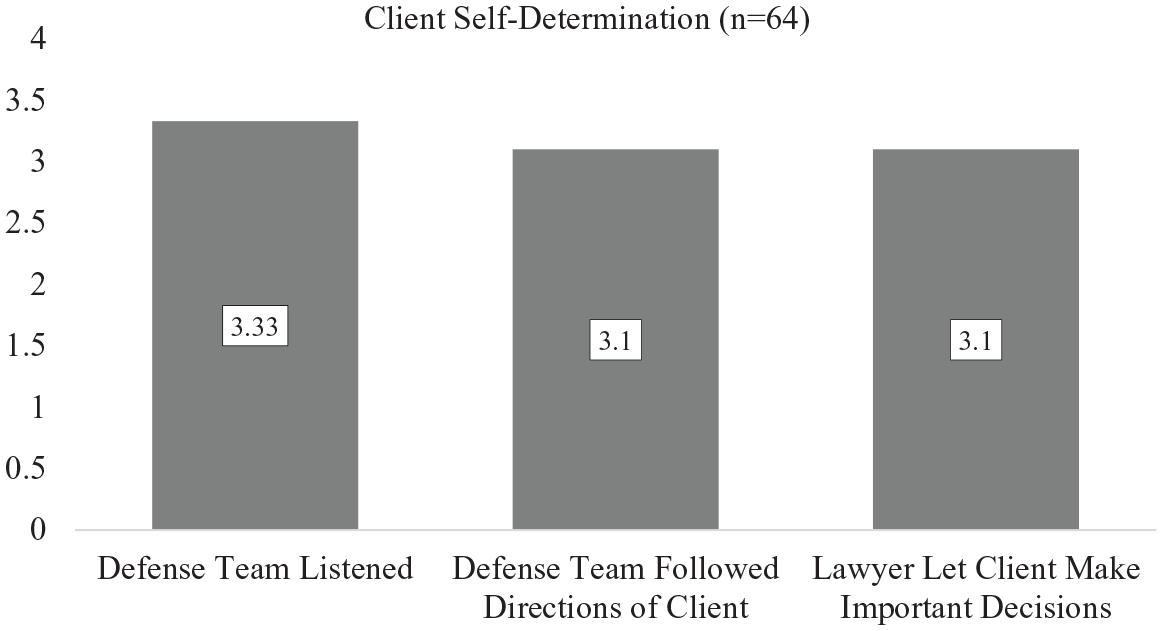
Agreement with statements of client self-determination (n = 64).
Research question 3: Are there other individual contextual factors associated with satisfaction?
The results indicated several individual contextual factors associated with satisfaction. Youth with an IEP/504 Accommodation Plan prior to juvenile justice involvement had higher satisfaction with the work perceived to have been provided by the defense team (p < .0001), and higher satisfaction with case outcome (p < .0001). Furthermore, a mental health diagnosis prior to justice involvement was also positively correlated with the work perceived to have been provided by the defense team (p < .0001), and satisfaction with case outcome (p < .0001). Increased client age was also associated with greater satisfaction with the work provided by the defense team (p < .0001), and satisfaction with case outcome (p < .0001). Finally, longer the length of service was positively correlated with increased satisfaction with the work from the defense team (p < .0001), and satisfaction with case outcome (p < .0001); see Table 2.
Correlation between contextual factors and satisfaction.

IEP: individualized education plan.
n = 57.
p < .0001 for all variables.
Research question 4: What do the clients and parents/guardians view as effective in regard to service delivery?
Both clients and parents/guardians indicated that the defense teams were best at communicating positively with the clients and they fought for the clients. Among the client respondents (n = 19), the top three responses were as follows: (1) felt positively communicated with (24%); (2) fought for the client (20%); and (3) obtained positive case outcomes (16%) or nothing/don’t know (16%). Parents/guardians (n = 47) felt that the defense team did well in the following primary areas: (1) positively communicated (24%); (2) fought for the client (19%); and (3) obtained positive case outcomes (17%), or that the team did ‘everything’ well (17%). In regard to helping the client feel positively communicated with, one client reported, ‘They asked me questions and told me how I could fight it [the case]. They explained the law to me step by step and talked about it’. A parent/guardian also reported, ‘They talked to him [the client], they came to us, they let him [the client] know he was in charge. They explained what was going on’. In regard to fighting for the client, one client reported, ‘They investigated a lot with the minor details . . . They turned the case around . . . In the law’s eyes, I was right’. A parent/guardian shared, ‘They fought for him. I’ve never seen a public defender fight like that before’.
Finally, even in instances of undesirable legal outcomes, there was evidence to suggest that participants believed that the LCCR team was performing effectively. As one parent/guardian stated,
I’m not quite sure what they could have done better. He already put himself in a situation where he knew he was in trouble . . . It was just a question of how much time he’d do . . . giving him 18 months in a juvenile facility as opposed to an adult facility . . . I think they did their job well and presented themselves well.
Research question 5: What do the youth and parents/guardians view as ineffective in regard to service delivery?
The largest share of clients responding to this question indicated there was nothing the defense team could have done better (38%). Following this, 23% (n = 3) of clients reported that the only thing the defense team could have done better was achieve a positive case outcome. One client stated, ‘[They] did the best they could’, while another stated, ‘[They] should have won the case’.
A total of 68 per cent (n = 30) of parents/guardians responding to this question felt that there was nothing the defense team could have done better. The next highest responses for areas of improvement, as reported by parents/guardians included reporting that the defense team could have made more contact (9%) and that they could have given more thought to the decisions that were reached (9%). One parent/guardian stated, ‘They could have contacted him (the client) more frequently before court’. Another parent/guardian said,
They should have truly thought about the things they were allowing her [the client] to make decisions about. They should have thought about how the decisions would have affected her [the client] then and in the long-term.
Clients and parents/guardians also reported opportunities for improvement in the LCCR model. One client noted, ‘They only helped me in court’, and would have liked to have received services after the case had closed. Likewise, another parent/guardian explained,
They helped him find a job, but when he had problems at the job, nobody was there to stick up for him. I know it’s not their responsibility, but it would have been nice if they could have been there to help him.
Discussion
The research examining desirable versus undesirable outcomes for system-involved youth has found that multi-systemic supports provided at the individual, social, and community levels can act as protective factors (Dawes, 2011; Evans et al., 2002; Gies, 2003; Shader, 2004; Stephens and Arnette, 2000). This is one of the first studies to examine if and how legal teams are perceived similarly as an area of support for justice system-involved youth, utilizing a holistic defense model.
In this study, youth client satisfaction with holistic juvenile public defense was evaluated with five research questions, with holistic defense referring to legal and social services provided by an attorney and at least one of the following: youth advocates, social workers, and/or investigators. Through quantitative analysis, it was found that holistic defense was positively associated with client satisfaction. According to the findings, other variables related to client satisfaction with their defense team included client age and overall duration of interaction with LCCR. While the majority of clients and parents/guardians felt that the defense teams communicated effectively and worked hard, dissatisfied or less satisfied clients and parents/guardians surveyed noted that the defense could have worked harder or communicated more effectively. Future studies should examine the potential dose-response relationship between communication and client satisfaction with holistic juvenile public defense team representation.
Currently, contact between the defense team and the client or parent/guardian family concludes immediately after case closure. Based on the qualitative data collected in this study, the holistic defense model could be expanded further to include interactions in the post-case period. These findings are consistent with other work on adult holistic defense research in other regions of the country (Anderson et al., 2019). Continuity of services by the LCCR and other implementing defense bodies or a directed hand-off to other community organizations could support this stage of case management.
Self-determination
In this study, self-determination was examined as part of client satisfaction. Because of the qualitative nature of this study, explicit statistical analysis was not performed to evaluate the potential quantitative relationship between self-determination and client satisfaction. However, the findings presented support that clients’ exercise of self-determination in the legal process may have a positive effect on satisfaction with the services being provided. Although further research is needed, the study authors speculate that increases in client satisfaction and self-determination may also increase client trust in the advice of counsel and adherence to services upon closure of their case. Previous research supports this theory among adult populations. According to Sandys and Pruss (2017), client satisfaction with public defense correlates with attorney communication and advocacy, and other literature consistently reinforces the positive relationship between trust and client satisfaction with legal defense (Sandys and Pruss, 2017). Fine and Cauffman (2015) draw similar conclusions, reporting that personal experiences within the justice system influence an individual’s perception of it. Other theories of procedural justice suggest that individuals who experience respectful and fair legal decision-making procedures are more likely to believe in the legitimacy of the law and, in turn, are less likely to reoffend (Penner et al., 2014). LCCR’s ability to allow and follow the guidance of clients during their representation contribute to client self-determination. Through empowering youth and providing more opportunities for autonomy, LCCR’s clients may experience an increased sense of control.
Individual contextual factors
The results of this study indicate that having an IEP/504 Accommodation Plan or a mental health diagnosis are positively correlated with satisfaction in case outcomes and the work completed by the legal team. Research indicates that having a team-based approach when working with youth with special needs or those with mental health needs increases the likelihood of success (Alltucker et al., 2006; Anthony et al., 2010; Evans et al., 2002).
The age of LCCR clients was positively correlated with satisfaction. In particular, older youth and youth who required services for an extended period of time were satisfied with LCCR’s holistic model. As youth ages, the general desire for independence increases (Cauffman and Steinberg, 2012). Youth also anticipate injustice of the legal system at increasing rates as they grow older (Woolard et al., 2008). Under this developmental framework, client satisfaction with the LCCR model would be expected, given its emphasis on client self-determination. Furthermore, this approach may also reduce youth perceptions of injustice as they navigate the legal system.
The results of this study suggest that as the length of services increased, satisfaction also increased. This may be due to increased time for clients and their defense teams to form positive, trusting, professional relationships. An increase in the amount of time the legal team spends with clients also provides additional opportunities to reach positive outcomes related and unrelated to the case (e.g. finding the client a job). The majority of LCCR’s clients who were represented felt supported by the organization’s model and appreciated the team-based approach. Future research should examine if the client satisfaction-length of services interaction is present among clients represented within traditional defense models, and if so, how this interaction compares to that of clients receiving holistic defense.
Strengths and limitations
There are limitations to the present study. The response rate for the entire possible sample (N = 354) was 19% (n = 66), and the individual response rates for clients and parents/guardians were 5% (n = 19) and 13% (n = 47), respectively. A low response rate may undermine a survey’s validity if the collected data reflects a sample that is not representative of the whole population (Groves and Peytcheva, 2008). Non-respondent bias, or the extent to which non-responding individuals differ from participating individuals, is unlikely to be high in the present study due to LCCR serving a demographically homogeneous population. As stated previously, the average age of an LCCR client is 15 years old, and the majority of these clients are Black, male, and living in the city of New Orleans, Louisiana. The present study’s sample of youth is descriptively similar to that of the average LCCR client, thus reducing the likelihood of non-respondent bias.
According to Al-Abri and Al-Balushi (2014), the advantages of satisfaction surveys rely heavily on standardized, psychometrically tested approaches. In the present study, the LCCR Client Satisfaction Survey was not explicitly tested for validity, thus limiting the generalizability of the study’s findings. Currently, there is no standardized tool for measuring client satisfaction in the juvenile justice system. This study provides the basis for extended research to develop and refine a standardized instrument to examine satisfaction among clients in the juvenile justice system.
Given the nature of public defense, all LCCR clients qualify as indigent. The study response rate may be a reflection of this indigent status: every LCCR client provided a telephone number to their public defense team at case closure; however, many of these numbers were out of service at the point of call or had been changed with no further information available, thereby impacting the response rate. Although comparable to national telephone survey response rates, which have decreased from 36 per cent in 1997 to 9 per cent in 2016 (Johnson, 2019; Keeter et al., 2017), the response rate of 19 per cent represents limited data collection. It is possible that different results would have been noted if another survey medium with a typically higher response rate had been selected. Future research should examine alternative options for receiving feedback from modern juvenile defense populations.
Another limitation of this study was that parent/guardian’s satisfaction with services was based on the perception of how they thought their child would respond to the questions (e.g. ‘I think my child is satisfied with the outcome of his/her case’). The primary focus of this study was on client satisfaction, and thus direct parent/guardian satisfaction comments were only captured in the open-ended questions if the parent/guardian chose to respond. However, this may also be viewed as a potential strength of the study. Due to the small sample of clients (n = 19), the sample of parents/guardians (n = 47) provides considerable additional perceptions of services. This allowed for further strength in the overall sample size (n = 66) to run analyses on. Because the concordance between client and parent/guardian perception is not known, the accuracy of parent/guardian perceptions is not necessarily known (e.g. parent/guardian may not have recalled the different defense team members met while the client may have). Previous research of patient satisfaction suggests there is generally agreement between child and parent perspectives, thus supporting the present study’s sample of parents/guardians (Lifland et al., 2018; Vetter et al., 2014). A future concordance study to determine whether the parent/guardian sample was congruent with the client sample’s perception of the same questions would address this potential limitation.
The present study did not examine if specific components of holistic defense were related to client satisfaction, which represents an additional limitation of the research. As stated in the literature review, holistic defense emphasizes legal and social support for clients, as well as representation from a team of interdisciplinary professionals. It is possible that satisfaction among LCCR clients is owed to factors unrelated to holistic defense. For example, LCCR client satisfaction may have been associated with the outsized number of individuals on their legal team, rather than the diversity between these professionals. According to previous research, public opinion of the criminal justice system and the traditional legal profession is poor in the United States (Galanter, 1997; Rotunda, 1999; Tyler and Huo, 2002; Wald and Pearce, 2011). Given this, the authors of this study surmise that holistic defense, which contrasts starkly with traditional approaches, is responsible for client satisfaction. However, future investigations of holistic defense should seek to understand which specific components are associated with client satisfaction.
A major strength of this study is its substantial inclusion of youths of color. Black adolescents typically have more negative attitudes toward the justice system. As is the case among patients with low opinions of the healthcare system, individuals with negative perceptions of the justice system are less likely to be compliant (Fine and Cauffman, 2015). These negative views have an adverse effect on youth’s self-perceptions of future success and are positively associated with recidivism (Abate and Venta, 2018). Recent literature has therefore called for interventions and programs designed to reduce negative attitudes (Abate and Venta, 2018). The LCCR’s utilization of holistic defense in the juvenile justice system is a demonstrably effective answer to this need, especially for minority youth, given this study’s findings of increased client satisfaction and perceptions of justice in the legal system. As previously discussed, the dearth of literature examining youth experiences in the juvenile justice system focuses largely on White youth (Brick et al., 2009; Romain and Hassell, 2014). The LCCR evaluation of holistic defense responds to this gap in the literature by providing the voice of minority youth populations, which is particularly important because these youth are more vulnerable to contact with the juvenile justice system (NAACP, 2019).
Conclusion
Standardized models for juvenile public defense, including holistic approaches, are limited. Moreover, the collection and reporting of outcomes data from these programs remains minimal in the United States and abroad (Hertz et al., 2015; NJDC, 2013; OJJDP, 2018; United States Department of Justice, 2011; Wachter, 2015). This study offers an example of a public defense organization’s holistic juvenile public defense model; however, given the novelty of the model presented, replication studies utilizing similar approaches are necessary to determine its effectiveness. The results of this study suggest that a holistic approach to juvenile public defense is a positive practice for working with system-involved youth and instilling a sense of control in their environment when operationalized as client and parent/guardian satisfaction. Further empirical and practice level research is necessary in other domains, as well as other countries, to critically evaluate the outcomes of the LCCR model and offer a comparison of those outcomes with other forms of juvenile defense.
Footnotes
Funding
The author(s) received no financial support for the research, authorship, and/or publication of this article.
