







Abstract
Language and literacy difficulties are prevalent in young people involved in youth justice services (YJS). Given the known importance of language for literacy development, few studies have examined the literacy abilities of young people involved in YJS who have language difficulties. The writing abilities of this population have yet to be examined despite their importance for participation in restorative justice. This study examined the word reading, spelling, reading comprehension and expository writing abilities of 48 young people aged between 12 and 18 years involved in YJS who were on community orders and identified as having language difficulties. The young people scored −1SD below all subtest norms and displayed extremely low abilities on the writing subtest. Young people known to YJS should be screened for potential language and literacy difficulties to support their access to interventions aimed at reducing recidivism.
Introduction
Many young people involved in youth justice services (YJS) have reading and writing difficulties (Brooks and Tarling, 2012; Bryan et al., 2007; Svensson et al., 2001). These literacy difficulties are identified in young people across community and custodial settings in England, Sweden, Australia, New Zealand and other countries. In these studies, literacy abilities are assessed using standardised assessments with comparisons made to assessment norms. Various aspects of literacy abilities are measured including word reading, reading comprehension, spelling, and reading fluency. Putnins (1999) found the reading ability of young people aged 15–16 years in a secure care setting in Australia was equivalent to those of 11 years of age based on the comparison with typically developing test norms. In the United Kingdom, Snowling et al. (2000) measured the word reading and spelling abilities of young people in a custodial setting aged 15–17 years. Word reading and spelling scores were significantly lower in these young people when compared with their non-offending peers who were matched for chronological age and social disadvantage. Variation in the literacy abilities of young people involved in the YJS is also evident. Svensson et al. (2001) assessed the literacy abilities of young people in the secure estate in Sweden to find that 28 per cent of the sample performed in the normative range for reading fluency, and approximately 50 per cent of the sample performed in the normative range for reading comprehension.
Studies have attempted to explore potential associations between literacy ability and offending behaviour. In New Zealand for example, a sample of incarcerated young people scored within the fourth percentile of reading comprehension test norms. These low scores also predicted re-offending rates, with the low reading comprehension scores being associated with prolific offending (Rucklidge et al., 2013). Identifying literacy difficulties in young people involved in the YJS is important to enable young people to engage in education and in programmes aimed at rehabilitation and recidivism. With evidence confirming that many young people in community and custodial settings require support with their literacy, these findings should be used to inform the delivery of such programmes.
In addition to studies identifying literacy difficulties, research has also established a high prevalence of language and communication difficulties in this population (Bryan et al., 2007; Hopkins et al., 2018; Hughes et al., 2017; Winstanley et al., 2019). Young people involved in YJS have reported difficulties in both their understanding of spoken language and their ability to effectively communicate with others. In addition, a limited knowledge and use of vocabulary have also been reported in this population (Hopkins et al., 2016). A recent systematic review (Anderson et al., 2016) confirmed the high prevalence of language and communication difficulties identified in young people involved in YJS. Similar to the literacy research, standardised assessments are used to identify these language and communication difficulties.
A challenge of the research into the language and communication abilities of these young people is the complex terminology used to describe the difficulties identified. The CATALISE review of terminology (Bishop et al., 2017) reached a consensus in adopting the term Developmental Language Disorder (DLD). DLD refers to language difficulties that cause functional impairment in everyday life that are associated with poor prognosis but are not associated with any known biomedical aetiology (Bishop et al., 2017). The prevalence of DLD in young people involved in YJS ranges from 19 per cent to over 90 per cent. This wide range is partly explained by the differences in assessments and criterion used to determine DLD (Anderson et al., 2016; Hughes et al., 2017). More recent studies in the United Kingdom and Australia (Hopkins et al., 2018; Snow and Powell, 2008) have included comparison groups of non-offenders who are matched on known confounds to both DLD and offending behaviour, such as socioeconomic background and engagement with education. In these studies, the young people involved with YJS were presented with standardised language assessments and scored significantly lower than the comparison participants. Due to the variation in how the term DLD is applied to this population in previous studies, the term language difficulties will be adopted in this current study. Language difficulties are used to refer to difficulties in spoken language and language understanding as measured by standardised language assessments.
The high prevalence of language difficulties has implications for young people’s engagement with and participation in YJS. Many therapeutic and educational interventions aligned to a restorative, rehabilitative model of offending prevention, require effective language and communication skills (Snow, 2013; 2019). Psychological interventions task young people to identify and express emotions and restorative conferences require young people to listen, comprehend and respond appropriately to emotive accounts provided by victims of crime (Snow, 2013). Recently, research has identified young people involved in YJS who have both language difficulties and literacy difficulties. Winstanley et al. (2019) assessed the language and literacy abilities of young people involved in the YJS at first entry. Word reading and reading comprehension difficulties were more prolific in a subsample who were also identified with DLD (Winstanley et al., 2019).
Language ability has a significant role in supporting the development of literacy. Understanding the relationship between sounds and written text (phonological decoding) is required for word reading and knowledge of vocabulary and grammar is also needed to understand written text (Snowling and Hulme, 2012; Spira et al., 2005). According to the simple view of reading (Hoover and Gough, 1990), reading comprehension is the product of both the ability to decode written words (either through successful identification of the sounds attached to written text or to fluent word recognition) and listening comprehension, which is the ability to understand spoken language, relying also on competent vocabulary, grammar and language processing abilities. Both skills are essential components of reading comprehension and proficiency in both must be present for successful reading comprehension to occur (Hoover and Gough, 1990). While both skills are important, the impact they have on reading comprehension changes over time, with listening comprhension skills having more of an impact once the decoding of printed words has been mastered (Nation, 2019). Reading comprehension is a complex and multifaceted construct, involving a combination of linguistic and cognitive skills including working memory, inferencing ability, text monitoring and the application of world knowledge (see Nation, 2019 for a review).
For writing, the model proposed by Flower and Hayes (1981) has been adapted to acknowledge the process in which children learn to write (see Berninger et al., 1996) and contains three components that are applied recursively. The first component is the planning stage in which ideas are generated and organised around a common goal. These ideas are then translated into language at the word, sentence and discursive level before then being transcribed into written text. The final component involves a review of the written text through reading and further editing. Children who are beginning to write are less able to demonstrate effective planning and reviewing due to the need to first attend to the translation process. Inaccuracies are commonly reported in samples of writing from young children and may include muddled theme development and errors in pronoun use. Children who are performing at this early stage of writing are able to demonstrate an ability to apply tenses correctly and begin to incorporate the use of simple connectives and active verbs appropriately (Mackie and Dockrell, 2004). Features that are typically present in the writing samples of young children who are in the early developmental stages of writing, are also evident in the writing samples of children with language difficulties. Such features include text and words that are short in length and contain inaccuracies in spelling and grammar. These features are consistent with the limitations that children with language difficulties display in their vocabulary, syntax, phonological processing and general cognitive processing capacity (Mackie and Dockrell, 2004).
With the exception of the Winstanley et al. (2019) study, there is a dearth of research that has assessed both the language and literacy skills of young people in community settings within YJS. Kippin et al. (2021) analysed samples of written narratives of young people aged 17 years who were identified as presenting with DLD and who were residing in detention centres in Australia. Spelling and punctuation errors were identified in their writing along with short and basic sentence structures. The young people in this sample also found it difficult to produce a coherently written narrative.
Written expository discourse is an aspect of literacy less explored in young people involved in the YJS, yet it is deemed to be central to the delivery of the school curriculum (Lundine and McCauley, 2016). It involves the construction of written text that presents, rationalises and evaluates factual evidence or opinion about specific concepts in a coherent structure (Montelongo et al., 2010). It is considered to be the most syntactically complex of discourse and also contains subject-specific concepts of which are considered abstract and low in frequency (Lundine and McCauley, 2016; Scott and Windsor, 2000). Subtypes of expository written discourse can include comparing and contrasting ideas as well as identifying problems and possible solutions to these. It also includes reference to cause and effect whereby the writer is able to clearly demonstrate explanations for the occurrence of an event. Young people in the YJS are expected to demonstrate these concepts in their written and spoken expository discourse that often forms part of their participation in educational and/or rehabilitative programmes, including for example, offender behaviour courses and cognitive behavioural therapy (Brazier et al., 2010; Gyateng et al., 2013; O’Carroll, 2016; Soppitt and Irvine, 2014). As part of the restorative process, young people in the YJS are also encouraged to write to and read letters from victims of crime. These letters are expected to contain insight into actions and emotions that demonstrate some understanding of cause and effect and should be structured in a way that resembles a clear argument directed to a specific audience (Ministry of Justice, 2015; Soppitt and Irvine, 2014; Winstanley et al., 2019). Therefore, language and literacy abilities (including writing) are important to enable young people to engage effectively in the restorative process.
Associations between language, literacy and offending behaviour are complex and multifactorial (Snow, 2019). Literacy is recognised as a protective factor for a young person’s likely involvement in offending behaviour. This is partly due to the positive associations that exist between literacy ability and outcomes in education and employment (Snow, 2016). Proficiency in spoken language and early literacy ability (including word reading and spelling), provides a foundation for children to develop competency in more complex literacy skills, such as reading comprehension. This, in turn, can support further learning and engagement in education (Snow, 2016). Young people with language and literacy difficulties are therefore at risk of disengaging with education, which may increase the risk of becoming involved in offending behaviour (Gross, 2008; Light and Dishion, 2007; Zhang et al., 2010). In fact, a significant proportion of young people involved in YJS who present with language and literacy difficulties are reported to have poor school attendance and experience of school exclusion (Bryan et al., 2015; Hopkins et al., 2018).
Social disadvantage has been recognised as a confound in research that has examined the relationship betweeen offending behaviour and language ability and has been found to be associated with children’s poor language and literacy outcomes (Hemmerechts et al., 2016; Law et al., 2019; Snow, 2019). A potential explanation for this association could be attributed to the home language and literacy environment children experience before starting formal education. Research reports associations between access to books at home, parenting behaviours such as maternal language input and parental engagement in shared literacy practices, all with later language and literacy outcomes (Hemmerechts et al., 2016; Hoff, 2006; Law et al., 2019). However, it is important to not overestimate the impact that social disadvantage may have in influencing language and literacy outcomes due to differences in how research defines and measures social disadvantage. Furthermore, social disadvantage often only accounts for a small percentage of overall variance in children’s language and literacy outcomes (Law et al., 2019). Parental engagement in literacy practice has also been found to be changeable over time, with parents of lower socioeconomic status (SES) more likely to transition to a greater engagement in literacy practice at a later time than parents of higher SES (Hemmerechts et al., 2016).
This study reports on the literacy abilities of a cohort of young people involved within YJS that had been identified as presenting with language difficulties, as published in a separate study (Hopkins et al., 2018).
The study asks the following research questions:
Research Question 1 (RQ1). Do young people involved in community YJS (aged 12 to 18 years) who have language difficulties also present with literacy difficulties (reading, writing and spelling)?
Research Question 2 (RQ2). If so, what is the profile of these literacy difficulties and is this associated with either SES or education attendance?
Method
Design
This study identifies and profiles the literacy abilities of young people involved in community settings within YJS who were identified with language difficulties in a previous study (Hopkins et al., 2018).
Participants
This was a collaborative study with a YJS in a large city in England. An opportunity sample of 52 young people was recruited from a youth offending service. The inclusion criteria specified the following: (1) English as a first language, (2) currently on court orders and not in custody or on other supervision programmes and (3) not receiving any current provision from speech and language therapy services. The participants recruited to the study were all on court orders ranging from 4 to 18 months (mean = 10 months; mode = 12 months). The majority of convictions were for theft or assault with other convictions including drug-related offences, vehicle theft, criminal damage and public order offences. The participants were 12 to 18 years of age with a mean age of 16 years. The majority of the sample was male (n = 46). Thirty three participants were white Caucasian, 11 were of mixed ethnic origin and eight were of Black Caribbean or Asian Pakistani origin.
Forty seven of the 50 participants had received a Statement of Special Educational Need (SEN). This is a legal document which mandates additional educational provision to support identified needs. Additional provision is usually through increased one-to-one support in school or a place in a special educational provision. The majority of the Statements of SEN were for social, emotional and mental health difficulties (SEMH). Sixteen participants had current or previous experience of looked after care.
In the previous study, this sample of participants was identified with language difficulties when compared to a matched group of non-offending peers. This was determined using a standardised assessment of language, the Clinical Evaluation of Language Fundamentals-Version 4UK (CELF-4UK) (Semel et al., 2006) and analysis of an expository spoken language sample, in which participants were scored on their ability to accurately and clearly describe the rules of their favourite game. The Understanding Spoken paragraphs subtest (measure of language understanding) and the Recalling Sentences subtest (measure of expressive language) from the CELF-4UK were completed by the participants. The expository language sample was analysed to identify participants’ mean length of utterance (MLU), clausal density index and the ratio of number of different words to total words spoken. Variance in performance on the language subtests was identified at the individual participant level. To meet the aims of this current study, two of the 52 participants were excluded from further analysis due to scoring in the normative range on the three language measures. All the remaining 50 participants scored at least −1SD below the standardised norms on at least one of these spoken language measures.
Demographic data were also collected. The SES of each participant was identified by comparing the post code of the school they attended to the National Indices of Multiple Deprivation (Department for Communities and Local Government, 2011). An index score of 5 or less was used to identify an area as socially disadvantaged. Any school identified as such also had to demonstrate lower than average GCSE pass rates (53% included Maths and English; Department for Education, 2014) and higher than average percentage rates of free-school meal entitlement (15%; Department for Education, 2018). Applying this criterion to the YOs meant that 72% of the sample were identified as living in socially deprived areas.
The educational attendance of the participants was determined by calculating the annual total attendance from year 1 to year 11 (or up until the participant’s last year of education if younger than 16 years of age). Complete data were available for 49 of the 50 participants. Where data were missing for a particular year, this was replaced with the mean percentage of overall attended days for this one participant. A mean number of 532 days, equating to a mean number of 2.8 years (1.5SD) of education was missed by the participants.
Assessment of literacy
The Wechsler Individual Achievement Test II – Second Edition UK (WIAT-II UK) (Wechsler, 2005) is a standardised assessment of reading, language and numerical attainment for children and young people aged 4 to 17 years. In this study, two reading subtests (word reading and reading comprehension) and two written language attainment subtests (spelling and written expression) were completed by the participants. The word reading subtest measures phonological awareness, word recognition and decoding skills. The reading comprehension subtest measures the ability to extract meaning from reading written text. To accurately compare reading comprehension scores across young people with varying reading ages who are of similar chronological age, the raw score was converted to a weighted reading score as per the assessment manual. The spelling subtest measures single word spelling where the participant has to write the spelling of a word read out by the assessor. The written expression subtest assesses written discourse. Participants are asked to write a persuasive argument in the form of a letter in response to a head teacher’s request for an enforced school uniform rule. Participants were asked to decide whether to agree or disagree with the rule and write a letter clearly stating their position arguing the reason behind their decision and the implications of this decision for themselves and for their school. This subtest was scored by combining scores assigned to different components of the written discourse rubric, which included spelling and punctuation errors, overall organisation, theme development and vocabulary. Inter-rater reliability was measured by comparing the first authors’ scoring to the scoring by an experienced Speech and Language Therapist (SLT) independent of the study. The SLT had experience in primary school age literacy teaching and was also familiar with this subtest. A random quarter of the sample of writing was provided to the independent rater who was blinded to the scoring completed by the researcher. On completion of the ratings, total scores of the random sample computed by the researcher and the SLT were compared using a Pearson correlation analysis, which produced a strong positive coefficient of 0.9 (p < 0.05) demonstrating strong reliability.
For each WIAT-II UK subtest, raw scores were converted to age equivalent standard scores using the test norms. Mean standard scores between 90 and 110 are considered average scores, 120 to 130 is superior, 130 and above is very superior. Standard scores below 90 indicate below average abilities, specifically 80 to 90 low average, 70 to 80 borderline and 70 and below is considered to reflect extremely low abilities.
All but two of the 50 participants completed at least one of the literacy subtests, resulting in a final sample of 48 participants.
Procedure
The WIAT-II UK was conducted by the first author; a psychologist with experience using language and literacy assessments. Assessment took place at the young person’s school or youth justice premises where the caseworkers for the participants were based. To adhere to safeguarding procedures, the researcher assessed the participants in close proximity to staff. Subtests were completed in a random order to control for order effects. The WIAT-II UK was scored according to the manual.
Ethical approval was received from the authors’ University Ethics Panel. The study also received approval from the relevant Local Authority.
Analysis
Using SPSS version 23, a descriptive analysis of each of the WIAT-II UK subtest scores of the participants was completed and mean subtest scores of the participants were compared to the normative data of 16 year olds reported in the WIAT-II UK test.
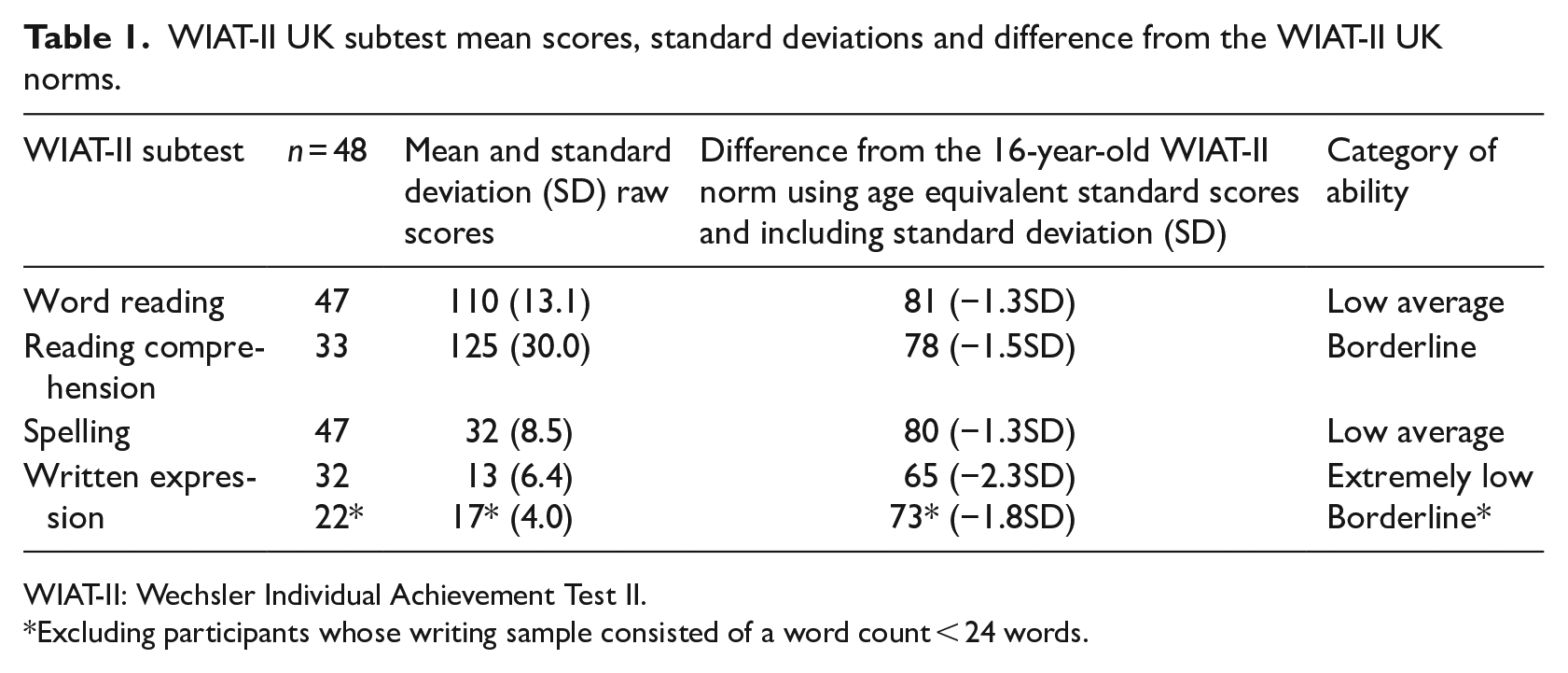
Of the 48 participants who completed the WIAT-II UK, several participants declined to complete all four subtests (see Table 1). This resulted in some missing data. To determine the potential impact of this missing data on the results, the participants who did and did not complete the four WIAT-II UK subtests were compared by a series of independent t-test analyses. No significant differences were found in the performance of both groups across any of the four subtests (p > 0.05).
WIAT-II UK subtest mean scores, standard deviations and difference from the WIAT-II UK norms.
WIAT-II: Wechsler Individual Achievement Test II.
Excluding participants whose writing sample consisted of a word count < 24 words.
Results
Table 1 shows the mean scores for the four WIAT-II UK subtests for the participants.
The participants gained mean scores below the expected norms for all four WIAT-II UK subtests (comparison made to the WIAT-II UK normative data for 16 years old). Scores on the writing and reading comprehension subtests were lower than the word reading and spelling subtests. The participants scored −1SD below the aged matched WIAT-II UK norms on each of the four subtests. The mean score for the reading comprehension subtest was in the borderline range, the word reading and spelling subtest mean scores were in the low average range and the mean score for writing expression was in the extremely low range. However, for the writing subtest, ten of the participants were unable to write more than the 24 words recommended by the test as the threshold for analysis and scoring. By excluding the writing scores of these 10 participants, the mean raw and standard equivalent mean scores increased slightly but still fell within a borderline range of ability. Further descriptive analyses of the writing samples revealed a mean score of 4 (1.2SD) out of a maximum score of 9 on the mechanics section, which included spelling and punctuation errors. A mean score of 8 (2.8SD) from a total of 17 was found for the organisation section of the writing sample and a mean score of 4 (1.1SD) from a total of 8 was found for theme development. Participants also scored a mean score of 1 (1.0SD) out of a possible total of 7 for the vocabulary section, which measured the range and appropriate use of vocabulary present in the writing sample. As it is only possible to compare whole subtest raw scores to their equivalent standard score using the WIAT-II UK, no further descriptive analysis of this data was possible.
Bivariate Pearson’s correlations were computed for each literacy subtest with the data obtained on total educational attendance finding no statistically significant associations with any of the literacy scores (p > 0.05). In addition, the sample of YOs were grouped according to their SES based on the criterion outlined in the method section (see p 6) and performance on each literacy subtest was then compared across the two groups. No obvious descriptive trends were found, nor any statistically significant differences reported on any of the literacy subtests between the SES groups (p > 0.05).
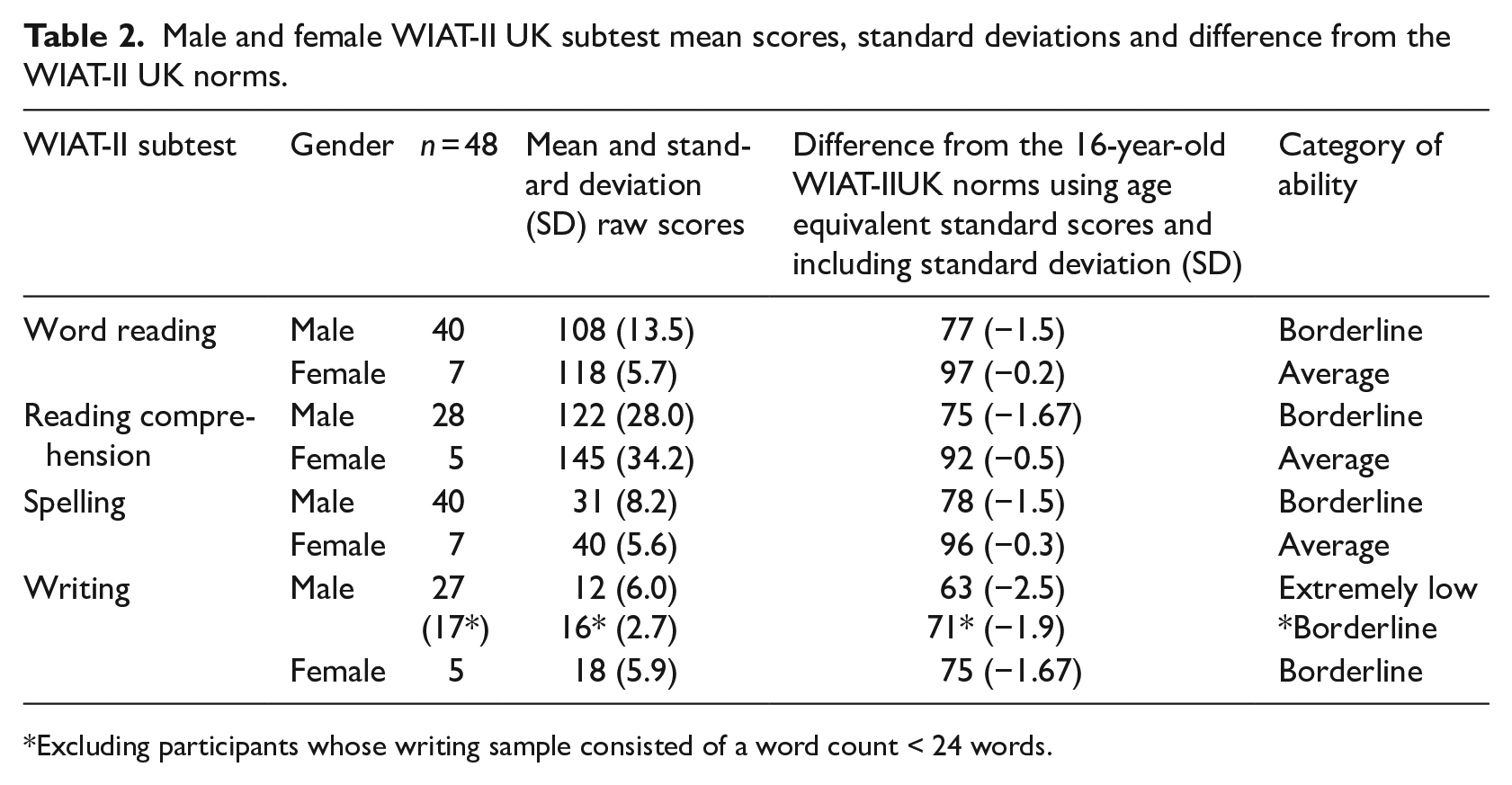
Given that male and female YOs were recruited to the study, a post doc analysis of literacy performance across gender was conducted. Descriptive analysis (see Table 2) of the literacy scores of female and male participants showed that the female participants scored higher than the male participants on each literacy subtest, yet both still scored below the subtest norms. After checking assumptions of normality and homogeneity of variance for each subtest for both groups, square root transformation was performed on the Word reading scores to reduce significant skew found in the male sub-group to an acceptable level (Field, 2009). A series of independent t-tests was then performed revealing statistically significant differences across gender for each literacy subtest apart from reading comprehension; Reading Comprehension: t(31) = 1.7, p = 0.11; Writing: t(30) = 2.3, p = 0.03; Word Reading: t(45) = 2.1, p = 0.04; Spelling: t(45) = 2.8, p = 0.00.
Male and female WIAT-II UK subtest mean scores, standard deviations and difference from the WIAT-II UK norms.
Excluding participants whose writing sample consisted of a word count < 24 words.
Discussion
This study explored the literacy abilities of young people within a YJS aged 12 to 18 years old who were identified with language difficulties, as reported in a previous study (Hopkins et al., 2018).
Four subtests from the WIAT-II UK assessed literacy ability (single word reading, reading comprehension, single word spelling and writing expression). When compared with the WIAT-II UK norms, the participants gained scores at least −1SD below the 16-year-old norms for each subtest, with larger discrepancies identified on the reading comprehension and writing expression subtests. The study confirms that young people with language difficulties who are involved in the YJS also have literacy difficulties but that these difficulties may be more prevalent in literacy activity that assess reading comprehension and written expression, particularly in the domains of expository writing. Interestingly, fifteen participants declined to complete the reading comprehension subtest and sixteen, the written expression subtest. None of these participants declined to complete the word reading subtest and all but one completed the spelling subtest. This indicates that these areas of literacy are perhaps perceived to be more difficult than the word reading and spelling subtests. This needs further confirmation in terms of the exact reasons that these young people declined to complete these subtests.
This indicative profile of relative strength in word reading and spelling suggests that these young people with language difficulties may have decoding skills that are considered to be more intact compared with the other aspects of literacy skills measured in this study. The single word reading and spelling subtests rely on decoding and phonetic skills placing less demand on other spoken language skills, although this theory requires confirmation by including assessments of phonological processing, such as non-word reading tests. In comparison, reading comprehension involves both decoding and language skills (Hoover and Gough, 1990). For example, to complete the reading comprehension subtest, participants need to decode but they also need intact spoken language comprehension abilities as well as lexical and grammatical knowledge to support this process (Nation, 2019). With this sample of young people involved in YJS having been identified as having language difficulties and with the sample scoring −1SD on both subtests, it is possible the sample have difficulties in both decoding ability and spoken language comprehension.
The reading comprehension subtest required participants to read passages of text and to then draw inferences from this discourse. Understanding written text at the discursive level places additional demands on executive functioning required to process, monitor and connect meaning embedded within text, while drawing on world knowledge to support inferencing (Cain et al., 2004; Muter et al., 2004; Nation, 2019; Snowling and Hulme, 2012). The participants in this study, therefore, may also have limitations in their ability to cognitively manage and process this information. The language difficulties may further impact on this process.
Language is also integral to writing. The participants found it difficult to produce a logically ordered written piece of text as indicated by their low mean scores on the organisation section of the expository writing subtest. Not only did participants find structuring their writing at a discursive level difficult but limitations were also evident at the sentence level in which basic connectives were used to link points together such as but, if, then. Many participants also included few subordinate conjunctions, such as because, if, although and other complex clauses in their writing. The participants scored poorly on the theme development section of their writing, finding expressing an argument challenging, with many failing to convey a clear position of argument without the consideration of multiple perspectives. It may be no surprise, therefore, that the participants found the organisation and development of their writing challenging when according to the adapted model of writing proposed initially by Flowers and Hayes (1981) (see Berninger et al., 1996), students are expected to have mastered the translation component of writing prior to demonstrating capability in the planning and reviewing stages of writing. The writing samples produced by the participants contained inaccurate and simplistic grammar conventions in addition to multiple punctuation and spelling errors. The sample scored particularly low on the diversity of their vocabulary and many of the participants were unable to produce a word count sufficient for an essay, all of which demonstrates difficulties at this translational stage of writing. The limitations found in the writing sample produced by these young people with language difficulties, align with those reported in writing samples of children with language difficulties (Mackie and Dockrell, 2004). This provides further evidence for the significant role that language has in supporting the development of writing.
The poor performance on the word reading, spelling and reading comprehension subtests in comparison to test norms found in these young people confirms findings obtained from other research of young people involved in YJS who either have or do not have language difficulties (Putnins, 1999; Rucklidge et al., 2013; Snowling et al., 2000; Winstanley et al., 2019). Kippin et al. (2021) explored the micro and macro elements of written narrative extracts produced by a sample of young people with a mean age of 17 years sentenced to detention centres in Australia and who presented with DLD. Our sample of young people found it difficult to produce expository text and similar findings are reported by Kippin et al. (2021). Participants in the Kippin et al. (2021) study found producing a coherent written narrative challenging and they demonstrated limitations in their ability to express time, location, consequence and character intention. Their written extracts also contained less complex sentence structures as demonstrated by the production of fewer subordinate connectors, shorter utterance lengths and a less diverse vocabulary. The majority of the sample also produced at least one spelling and punctuation error within their written narrative extract.
The very small number of female participants in this study performed slightly better than their male counterparts despite still scoring below the subtest norms. This supports the general trend reported in the literature concerning child literacy development (Snowling and Hulme, 2021). Although, this has yet to be confirmed by studies involving a substantial number of both male and female young people in YJS (Winstanley et al., 2019).
No association was found between the young people’s educational attendance and their literacy abilities even though the sample had missed an average of 2.8 years of schooling. Disengagement in education is a risk factor for offending behaviour and can exacerbate any language and literacy difficulties that a child or young person may already have (Gross, 2008; Light and Dishion, 2007; Zhang et al., 2010). Difficulties in language and literacy are likely to impact on a child’s engagement with the school curriculum and subsequent educational attainment. Therefore, children who begin schooling with poor language and literacy outcomes, are likely to fall further behind academically as they progress through the educational system (Snow, 2016). The poor literacy abilities of the young people in this study were most likely present during their early school years and would have persisted through their childhood and adolescence. As compensation for these difficulties, young people may resort to more aggressive and avoidant means of communication (Redmond and Rice, 1998). Consequently, this triggers support and intervention for social, emotional and mental health difficulties (SEMH). Due to the complex needs of such vulnerable young people and the comorbidity that exists between SEMH, language and literacy difficulties, difficulties in the latter are not routinely identified within this population (Hollo et al., 2014). None of the young people in this study had any prior receipt of speech and language therapy services – a finding previously reported in other studies (Bryan et al., 2015; Gregory and Bryan, 2011; Hopkins et al., 2018).
The young people in this study presented with spoken language and literacy difficulties with the majority of them growing up and living in areas of social disadvantage. However, no significant differences were found in the literacy abilities between the sub-groups of young people that met or did not meet the criterion for social disadvantage. This could be due to the lack of variance in overall literacy ability found in this small sample. The measure of social disadvantage was based on participants’ school data including post-code, free-school meal eligibility and GCSE attainment. There are many other factors involved in measuring social disadvantage and some of these have been shown to correlate with language and literacy outcomes. These include distal measures, such as parental education, or proximal measures that account for parental behaviours that exist within the home environment (Law et al., 2019).
Implications
This is the first study within the United Kingdom to examine the reading and writing abilities of young people involved in the YJS who have spoken language difficulties. The young people in this study presented with significant difficulties in reading comprehension and expository writing. This will impact on their ability to effectively participate in rehabilitation programmes that are dependent on language and literacy skills (Brooks and Tarling, 2012; Bryan et al., 2007; Lavigne and Van Rybroek, 2011; Sanger et al., 2008; Snow, 2013; 2016; Soppitt and Irvine, 2014). These programmes include offender management interventions aimed at recidivism or psychological interventions, such as cognitive behavioural therapy (Brazier et al., 2010; Gyateng et al., 2013; Kuhajda et al., 2011; O’Carroll, 2016). These programmes also require young people to demonstrate clear insight into their own thoughts, emotions and behaviours while listening to and comprehending the impact that this may have on other people (Hollin, 2019). This is also typical of restorative justice conferences that require young people to verbally participate in panel exchanges, to read and sign legal written contracts, and to write letters to victims as a way of expressing their remorse to demonstrate reparation (Ministry of Justice, 2015; Soppitt and Irvine, 2014; Winstanley et al., 2019).
Having access to support from specialist services, such as speech and language therapy within the YJS, could ensure interventions meet the language and literacy needs of young people (Brazier et al., 2010; RCSLT, 2018; 2022; Sanger et al., 2019). All verbal and written information needs to be accessible to young people. Highlighting key themes within complex written information is important and key information could be explained and presented through the use of alternative means, such as comic strips, videos or images (RCSLT, 2018; Sanger et al., 2019). Talking Mats® (TM, University of Stirling, Stirling, UK) could be incorporated as a way for young people to communicate their needs, wants and emotions using accessible images and key words (Murphy, 1998; RCSLT, 2018). Creative methods of delivery such as the arts, drama and music could be incorporated within offender management programmes to lessen the literacy and language burden while also increasing engagement (Ministry of Justice, 2016).
Young people are often exposed to complex legal terminology in the YJS. It is imperative this language is simplified, explained and presented in ways that are fully accessible to young people (Taylor, 2016). Furthermore, following any explanations given to the young person, they should be asked to demonstrate their understanding by asking them to explain the information in their own words rather than relying on a yes response to the closed question of do you understand? Vulnerable young people are more likely to respond in a way that presents a socially desirable version of themselves, which can mask any underlying language difficulty (Communication Trust, 2009). To support the emotional needs of young people with language and literacy difficulties, they should not be expected to write or read aloud in front of others unless in a ‘safe’ environment, such as a one-to-one meeting with a trusted professional (RCSLT, 2018). Similarly, effective communication is more likely to occur between a young person and a trusted professional who share mutual respect for one another (MacRae and Clark, 2021). Communication passports could also be used to provide essential information about the language and literacy needs of young people in YJS to professionals working with them to explain their needs and how to support them. These passports could also be developed by the young person with the help of a Speech and Language Therapist (SLT) as a way to develop their language and literacy but also to empower the young person (RCSLT, 2018).
The study highlights the need to identify literacy difficulties in young people involved in YJS and young people at risk of offending. Literacy difficulties may involve language difficulties and, therefore, assessment of language difficulties is also advocated. Snow (2016) advocate universal screening for language and literacy difficulties for young people at risk of offending. Referrals to more specialist intervention can then be put in place. To enable an accessible language and literacy environment, services need to know about the impact of language and literacy difficulties on a young person’s ability to engage and access education and programmes that aim to reduce recidivism.
Limitations
There are several methodological limitations to this study that must be considered. First, this is a small sample of young people involved in YJS. Second, although the young people were identified with spoken language difficulties, the exact nature and extent of these language difficulties are unknown and so a more extensive assessment of language should be incorporated to enable a robust diagnosis of DLD. Third, the assessment of literacy was limited to four subtests of the WIAT-II UK and not the complete assessment. This was due to limitations in the remit of the larger scope of this research that included the assessment of spoken language in this same sample of young people. However, on reflection given the number of young people who chose not to complete these subtests, it can be argued this is a comprehensive assessment of literacy for this population. The young people were recruited on an opportunity basis via their caseworkers. This would have increased the potential for selection bias, that is, case workers may have identified those they had concerns about and/or young people with perceived language and/or literacy difficulties may have opted to participate in the study. Finally, recruitment of a comparison group matched on age, years of education, level of language ability and socioeconomic background is needed to further understand the role of literacy and language ability in offending behaviour.
Summary
This study identified literacy difficulties across reading and writing in 48 young people in YJS aged between 12 and 18 years who were previously identified with language difficulties. Young people involved in the YJS and/or at risk of offending should be screened to identify literacy and language difficulties. Intervention and accessible language and literacy environments are needed to ensure these young people can engage effectively in programmes and other provision to reduce recidivism.
Footnotes
Acknowledgements
The authors would like to thank the young people who engaged in the study and for the staff at the Sheffield Youth Offending Team who continued to support this work. It was an absolute pleasure working with you all. Thanks also to the editor and reviewers for their supportive and constructive comments during what was a very tough time given the unexpected pandemic.
Funding
The author(s) received no financial support for the research, authorship, and/or publication of this article.
