







Abstract
This paper explores the social dynamics of adolescent co-offending and decision-making processes among co-offenders; and to investigate co-offending roles in relation to the nature of a specific crime. The sample consisted of 15 young people who were purposively sampled from a group of 14- to 17-year-old males who had been identified as at risk of criminal group involvement and referred to a community-based programme. Using a social identity framework, a thematic analysis was undertaken to investigate how the participants viewed their role in co-offending as part of a criminal group. Participants identified their roles in criminal groups as instigators, followers and group members. Planned crimes were either targeted or capitalised as part of other delinquent activities. Impulsive offending was opportunistic, impetuous or reactive. Furthermore, a new theoretical model to explain the social dynamics of co-offending was developed and the implications for co-offending prevention and intervention programmes are discussed.
Introduction
Co-offending and roles
Co-offending is a crime that is committed with others. The number of co-offenders can range from another individual to a much larger group, but typically entails a temporary association between two or three offenders (Reiss, 1988; Reiss and Farrington, 1991; Uhnoo, 2016). During adolescence, this process is seen to reflect the social role of peers (Goldweber et al., 2011; Piquero et al., 2002). It can be a means of social exchange and a way to elevate status (Calvó-Armengol and Zenou, 2004; Harding, 2014; Weerman, 2003). For adolescents in particular, co-offending offers the opportunity to acquire new skills with more experienced criminals (Van Mastrigt and Farrington, 2011). According to Gardner and Steinberg (2005), young people can be more vulnerable to involvement in occasional deviant behaviours because of their developmental stage and impulsive decision making (Galvan et al., 2006; Steinberg, 2008, 2010 in Thomas and McGloin, 2013).
Co-offending decreases as individuals age, become more autonomous and less dependent on the leadership or skills of others (Moffitt, 1993). However, the transition from co-offender to solo offender is not consistent across all categories of crime, it can be prolonged for some types of violent offending (Andresen and Felson, 2012). Not surprisingly, individuals who have protracted criminal careers demonstrate flexibility in their offending style (McCord and Conway, 2002; Reiss, 1986; Reiss and Farrington, 1991). For Moffitt (1993), the transition to solo offender (and so mixed-style offending across the lifespan) differentiates persistent adult and adolescent limited offenders. More recently, researchers identified that prolific offenders vary their style much earlier in their trajectories (Hodgson, 2007), with prolific adolescent offenders operating alone and as part of a group during the same phase of their lives (Ashton et al., 2020; Goldweber et al., 2011).
Although co-offending trajectories have been studied in some detail, the decision-making processes of temporary deviant groups are less researched (Hochstetler, 2001). There are relatively few qualitative studies on co-offending (Uhnoo, 2016) and limited empirical research on decision-making involving deviant peer groups. However, several important experimental works, focusing on co-offending and decision-making processes, were recently published (McGloin and Rowan, 2015; McGloin and Thomas, 2016; McGloin et al., 2021; Thomas and McGloin, 2013).
The criminological literature in this field has highlighted that adolescent traits such as impulsivity (Thomas and McGloin, 2013) and peer facilitation (Ashton and Bussu, 2020) both play an important role in deviant behaviour. However, it is not clear why and how personal characteristics moderate peer influence and how situational temptations can impact and/or influence different peer groups of young people (Thomas and McGloin, 2013).
For understanding the decision-making processes, we cannot simply adopt ‘traditional rational choice models’ for group crime, given that such models typically do not consider the interdependent nature of decision-making when in the ‘presence of others’ (Granovetter, 1978; McCarthy et al., 1998; McGloin and Rowan, 2015). In this regard, Thomas and McGloin (2013) and McGloin and Rowan (2015) have elaborated theoretical models (see Threshold Model of Collective Crime and Dual-System Approach) for understanding how young people engage with group offending and their decision-making processes in ‘the presence of others’.
McGloin and Thomas (2016: 459) have also established that the ‘presence of others shifts decision-making about risky/deviant behavior’. Young people are not only more likely to take risks, they are more vulnerable to peer influence on risk decision and preference (Galvan et al., 2006; Gardner and Steinberg, 2005; Steinberg, 2008, 2010; Thomas and McGloin, 2013). Nevertheless, it has been suggested that it is important for future research to explore ‘how young people draw on situational information to adjust their rational calculus before deciding to engage in deviance’ (McGloin and Thomas, 2016: 479). One such study (McGloin et al., 2021: 738) indicated that socially interdependent decision-making processes may be situation specific and also the importance of acknowledging the social context in offending decisions.
Several studies have identified different roles within co-offending groups; instigators/recruiters, who are often older and can include family members (Reiss, 1988; Van Mastrigt and Farrington, 2011) and joiners/followers (Moffitt, 1993; Reiss, 1988). Lopez (2008) found that adolescents who recounted group property crimes placed themselves at the centre of the offence action. Nevertheless, adolescents are capable of distinguishing roles in group offending (Uhnoo, 2016). However, researchers now agree that individuals can change their co-offending roles within a group. In particular, the positions of instigator and follower are dynamic, depending on the make-up of the group and the time of offence (Warr, 1996, 2002; Weerman, 2003).
Distinguishing between specific roles in the case of juvenile arsonists demonstrated that the stages of planning and the execution of an offence can be led by different group members (Uhnoo, 2016). This study found that not all roles were consistently present in the commissioning of an offence and in some cases an individual could fulfil multiple roles. In the preparatory phase five roles were identified: the motivator, the strategist, the person with the skills/experience, the person who provides information on an offending opportunity and the resources keeper (essential for fire starting which was the focus of the typologies). Four further roles were recognised for the implementation of the crime: the vehicle driver, the lookout, the fire-setter and the audience. Although not all these categories are necessary for other types of crime, the findings remind us that offending roles are fluid, particularly when regarding the social interactions of temporary offending groups.
According to Morselli et al. (2006), criminal mentors are prevalent and unique contacts among offenders, that emerge during the period (late adolescence and early adulthood) when most offenders become less involved in crime and are most likely to stop their criminal activity altogether. Criminal mentors also have an enduring impact on protégés’ criminal careers. (p. 35)
Morselli et al. (2006) also noted that systematic mentors and instigators are not necessarily present within the criminal event but are revealed to a substantial extent within the personal networks of co-offenders that shape the events in which individuals find themselves. Mentors are therefore not necessarily key accomplices for the offence but are key criminal contacts across the life course. (p. 37)
On the contrary, relevant research on peer mentoring shows the benefits for young people who were in prosocial peer groups (Butts et al., 2010; Humphreys and Teater, 2018). Furthermore, some peer mentoring programmes have integrated restorative practices and secondary desistance-oriented changes (Austria and Peterson, 2017; Maruna, 2016).
Group convergence
Deviant groups offer criminal learning opportunities and enable the transfer of knowledge and experience from older offenders to younger co-offenders (Van Mastrigt and Farrington, 2011). However, co-offending is not restricted to inexperienced offenders. Even practised thieves have reported taking part in an offence because of another person (Feeney, 1986; Hochstetler, 2001).
In his study of street crime groups, Hochstetler (2001) found that deviant social groups offer new criminal partnerships through the normalisation and encouragement of social offending. That group conformity stems from communication and individual expectations to meet group anticipations (Hochstetler, 2001). By ‘signalling’ in in this way, offenders construct offending opportunities and gauge responses.
Expressive and instrumental crimes
Co-offending has been found to increase criminogenic risk for both expressive and instrumental crimes (Andresen and Felson, 2010; Reiss and Biderman, 1980; Reiss and Farrington, 1991) and is associated with an increase in violence during the orchestration of an offence (Conway and McCord, 2002). This style of offending is more common for affray, burglary, robbery, vehicle taking and arson with the intent of endangering lives (Hodgson, 2007; Van Mastrigt and Farrington, 2009). These findings were supported by a US Department of Justice study (Oudekerk and Morgan, 2016), which found that more than half of serious violent crimes such as robbery and aggravated assault were committed by groups of adolescents. This phenomenon can be explained by the role of a group in facilitating impulsive violent offending, because it negates the need for a weapon (Zimring, 1981). Violent expressive offending is also prevalent during adolescence because of the developmental risk factor of low impulse control (Monahan et al., 2013). Although typically committed by individuals (Oudekerk and Morgan, 2016), an expressive violent response by a group member can encourage others to get involved, either because they feel obligated to support or because they also possess low levels of self-control (McGloin and Shermer, 2009).
Interventions for co-offending: Peers, roles and interpersonal dimensions
According to Social Learning Theory, young people are most likely to engage in delinquent and offending behaviours when they associate with peers who are already engaged in criminality. Antisocial attitudes and association with deviant peers are consistent predictors of recidivism (Watt et al., 2004). Lantz and Hutchison (2015: 658) explained that the removal of a highly central ‘instigator’/‘recruiter’ from a group is associated with desistance among connected co-offenders. They also suggested the need for future research to consider the mechanisms behind these ‘roles’ and why the arrest of co-offending partners is associated with desistance. At the same time, previous studies have demonstrated the importance of social learning processes in co-offending behaviours and the role of social learning/co-offending in the escalation of offending (Andersen, 2019; McCarthy and Hagan, 1995, 2001). In effect, co-offending groups provide a network of support, protection, knowledge and specialised skills development through social learning processes among co-offenders (Andersen, 2019; McCarthy and Hagan, 1995, 2001). For supporting prosocial relations among young people, several mentoring programmes were developed (see, for example, Newburn and Shiner, 2005; St James-Roberts et al., 2005). This approach can be useful to change the influence on a young person from criminal mentors to prosocial mentors.
Aims
The study has the following objectives: (1) to explore the social dynamics of adolescent co-offending and decision-making processes among co-offenders and (2) to investigate co-offending roles in relation to the nature of a specific crime.
Methodology
Sample and procedure
The study involved 15 participants who were purposively sampled from a group of 14- to 18-year-old males who had been referred to a community-based programme in Northern England for young people who had committed or were at risk of violent offending. To be included in the sample participants had to have self-reported offending with at least one other person. British Psychological Society ethical guidelines were adhered to, and ethical clearance was obtained from the Faculty Ethics Committee at Edge Hill University. The lead researcher explained the project aims to youth workers at the host organisation and provided them with information sheets for potential participants. The youth worker and researcher ran through the information sheet and consent form with the young person and reminded each of the participants that the involvement in the project was voluntary. If the participant was under 16 years of age, consent from their parent/carer was required before approaching the young person; separate consent was then obtained from the young person. Participants were reminded when signing the consent form, and again before the interview that declarations of homicide, sexual offences and terrorism would be reported to the authorities.
Method
Criminal narratives are especially useful for understanding co-offending, because they apply to both individuals and their group and are relevant to perpetrators and witnesses (Presser, 2009). Furthermore, exploring the personal interpretation of a crime and its significance to the perpetrator presents an important opportunity (Ferrell, 1999). We used semi-structured interviews in which the participant was asked to describe a delinquent or criminal act that occurred in the presence of at least one other person. Participants were asked to recall an activity when they got into trouble or broke the law with at least one other person involved in the offending. They were asked if the event was typical of the types of activities they had been involved in and how strong their memory was. To ensure consistency and clarity, participants were also asked to confirm the following questions: What were the events leading up to you committing the crime? Whose idea was it to commit the crime? What type of place or person did you pick? Who did you go with? What did you take with you? What did you do before you started? How did you start the crime? How long did the incident last? What did you gain from crime? What did you do to make sure that you didn’t get caught? What did you do immediately after the crime? Participants were also asked to complete a self-reported offending questionnaire in order to determine if their chosen crime narrative was typical of their offending behaviour. The interviews were between 20 and 60 minutes long and were audio-recorded and later transcribed verbatim and anonymised to protect the participants’ identities. Any identifying factors such as place names were also removed. Interviews took place over a 6-month period in 2019.
Data analysis
We chose an interpretative approach to reconstruct the ‘implicit theories’ (Ross, 1989) of participants in social science research, which can emerge through semi-structured interviewing. According to Charmaz (2006), we adopted a constructivist perspective, which valorises the researcher’s role as a ‘co-constructor of meaning’ who tries to avoid constraining participant responses within predefined categories (Bussu, 2016).
We conducted a thematic analysis (Braun and Clarke, 2006) to investigate how the participants viewed their roles in co-offending, using a social identity framework (Amiot and Aubin, 2013; Ellemers et al., 2002; Tajfel, 1979; Wood, 2014) that can be considered as a useful paradigm for explaining intergroup behaviour and how individuals feel about themselves based on their group membership (Wood, 2014).
The interview transcriptions were analysed by two researchers using ATLAS.ti. To examine the main findings, ATLAS.ti networks was used. The narrative interpretation process was progressive and interactive, and we returned to the text to reflect on different conceptual issues to discover new relevant aspects and their associations. In all networks quotations are provided with a link to a given code representing the segment from the codified document. Every code in each network provides two numbers: the first number represents the frequency of a given code within the interviews recorded; the second number refers to the number of direct associations among codes. The research time followed Seale’s (1999) research quality criteria (see Appendix 1) with theme saturation point (Walker et al., 2016) reached after 15 semi-structured interviews.
Findings
The macro analysis of the data identified two key themes that emerged from the interviews and which were evident across the corpus of data: crime planned versus opportunistic; and co-offending roles of instigator, follower and group instigation. Our Hermeneutic Unit of ATLAS.ti as described in the ‘Methodology’ section provided 18 families, 288 codes and 45 memos. Below is a synthesis of the core of data by network (Figure 1) and participants’ quotes (Tables 1 to 4). The network synthesises the most important dimensions emerging from the thematic analysis of ‘offender roles in co-offending’.
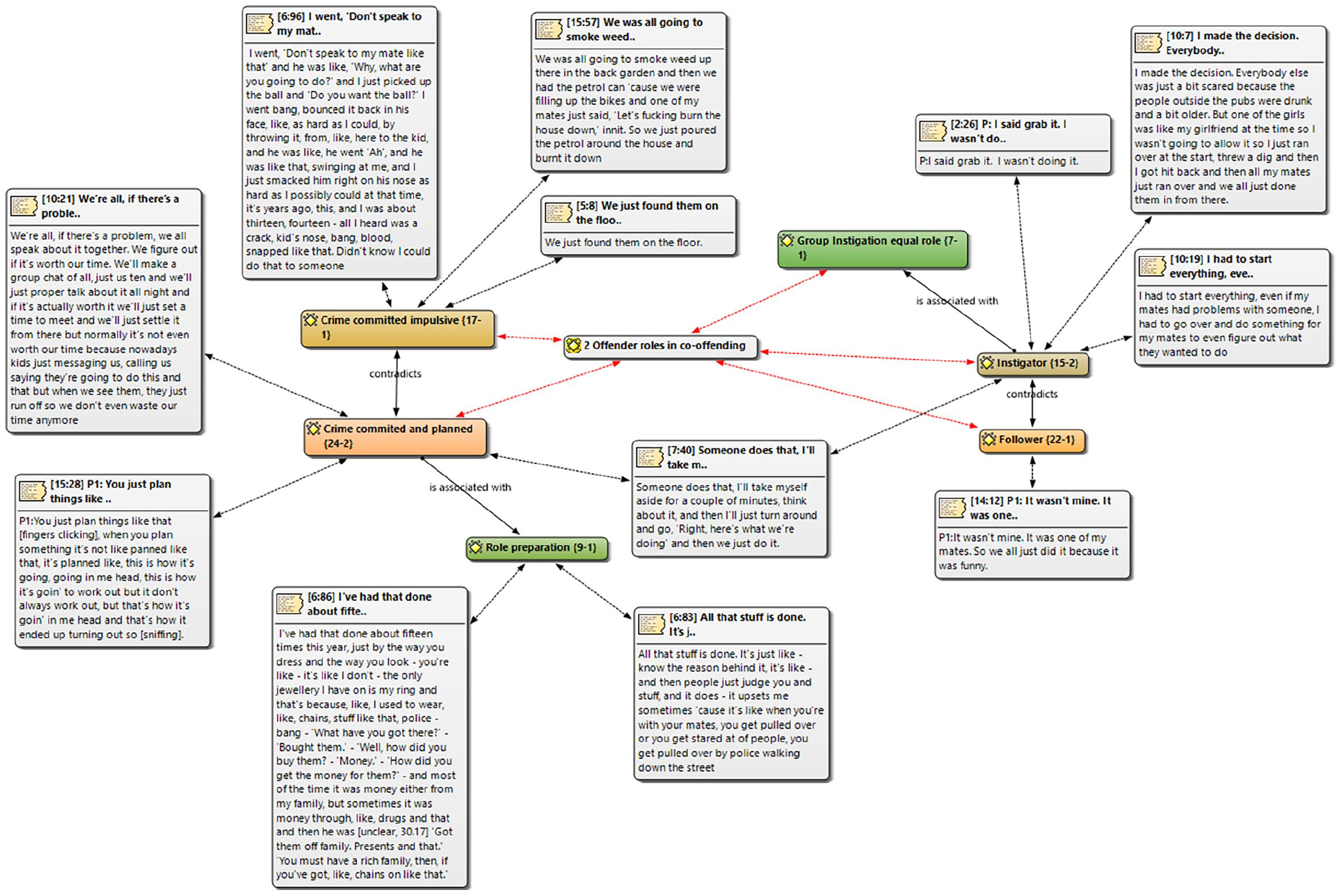
Offender roles in co-offending.
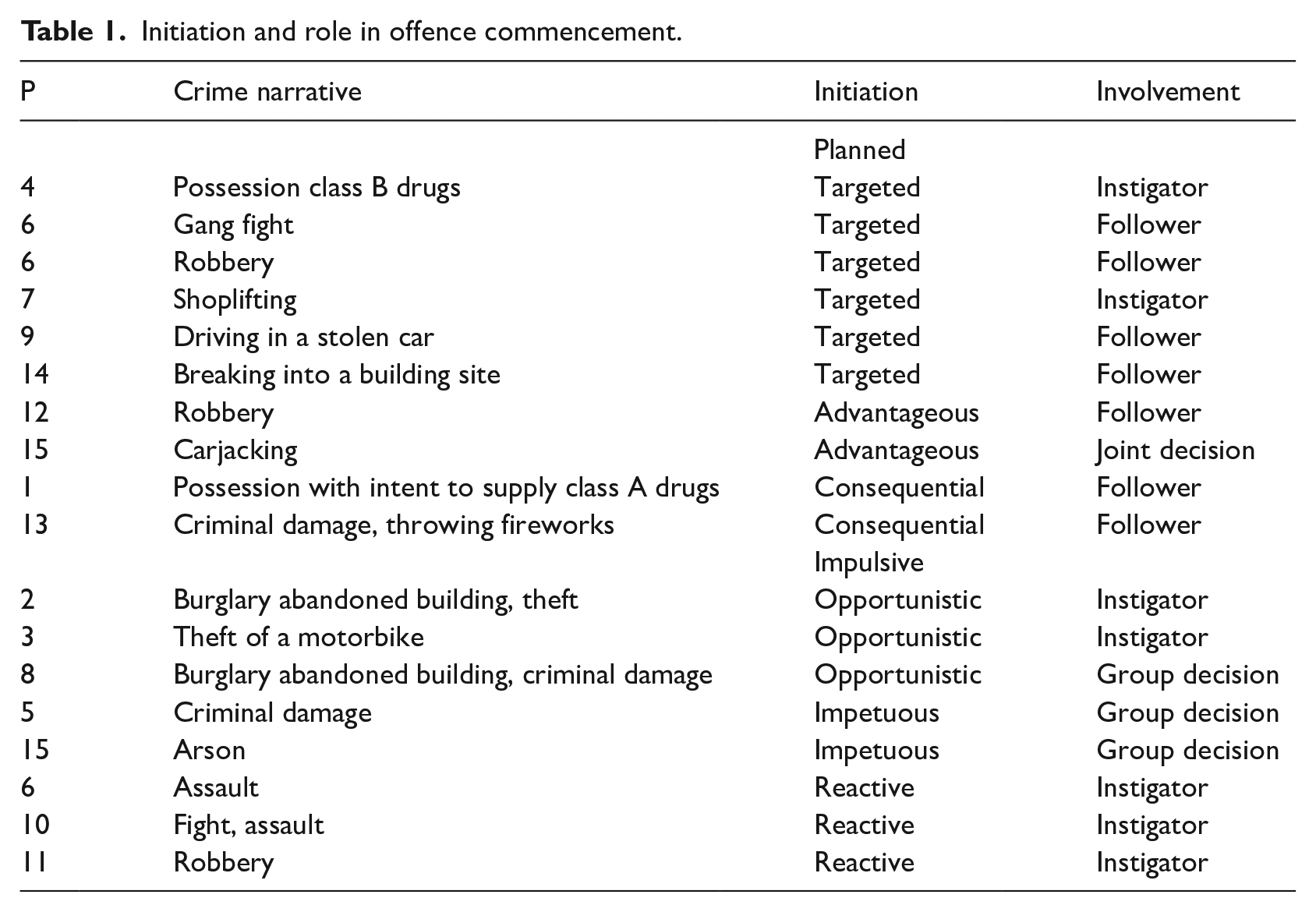
Initiation and role in offence commencement.
Crime planned or impulsive.

Followers.

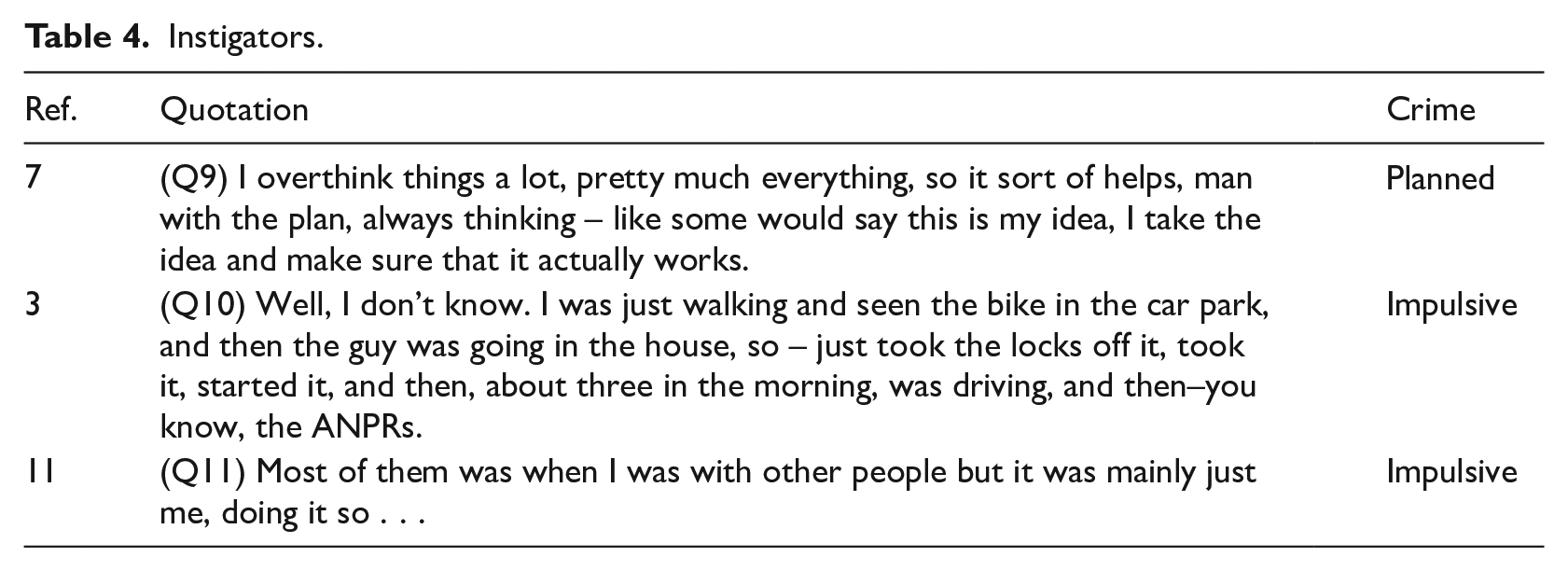
Instigators.
Co-offending and roles
Three co-offending roles emerged from the analysis: young people who instigated crimes, those who reported following the instructions or others and those who reported a joint or group decision (Table 1). The most significant and frequently used narratives were related to the first two categories (code ‘instigator’ 15 quotations; code ‘follower’, 22 quotations, Figure 1). These two roles can depend on several factors, for example, belonging to a group, stage of criminal career, type of crime committed, crime motivation, individual attitudes, self-confidence and planning capabilities. The roles of instigator and follower were evenly split between the crimes that were described by the sample, with a further three offences reported as a joint decision.
Participant 6 reported acting as both a follower and instigator (Table 1), showing that, for some at least, offending roles can be static. He initially described being pressured to take part in a planned robbery (Table 2, quote 1) and a gang fight (Table 3, quote 8), both for reasons of retaining social status. However, the same participant also explained that his lack of impulse control had led to reactive violent offending in the past, demonstrating that psychological and social risks can influence co-offending roles. He described an assault that had occurred when a young person disrespected his friend (Figure 1, 6:96): I went ‘Don’t speak to my mate like that’ and he was like ‘Why? What are you going to do?’ and I just picked up the ball and [said] ‘Do you want the ball?’ I went bang, bounced it back in his face, like, as hard as I could, by throwing it, from, like, here to the kid, and he was like, he went ‘Ah’, and he was like that, swinging at me, and I just smacked him right on his nose as hard as I possibly could at that time, it’s years ago, this, and I was about thirteen, fourteen – all I heard was a crack, kid’s nose, bang, blood, snapped like that. Didn’t know I could do that to someone.
The incident had occurred when the participant was in his early teenage years and upon reflection, he regretted his behaviour. He had responded with violence because he had lost control of his actions and did not try to justify his aggression.
Participant 15 described two offences that were group decisions. In the first, he described an incident that occurred while he and his friends were using off-road bikes illegally (Figure 1, 15:58): We was all going to smoke weed up there in the back garden and then we had the petrol can cause we were filling up bikes and one my mates just said, ‘let’s fucking burn the house down’, innit. So we just poured the petrol around the house and burnt it down.
His second offence (Table 2, quote 2) was also the result of a general plan to commit robberies and demonstrates an ability to plan an offence when the opportunity arises and reveals a degree of knowledge and practice in that the pair instinctively knew how to approach their victim.
Planned crimes
Two types of crime initiation emerged from the analysis: code ‘Crime committed planned’ (24 quotations and 2 nodes) and code ‘Crime committed impulsive’ (17 quotations and 2 nodes), (Figure 1). Table 1 shows the variety of offences that were described by participants and whether they were planned or impulsive. Out of a total of 18 offences, 10 involved a degree of planning or preparation. Three subcategories of premeditated crimes emerged (Table 1): specific crimes which were targeted (drugs, robbery, joyriding, gang fight, breaking into a building site), and those that occurred during other antisocial or criminal activities, which were either advantageous and associated with social or financial gains (robbery, carjacking) or consequential, which was the result of involvement with a deviant group (possession with intent to supply, criminal damage).
Advantageous/consequential crimes can be differentiated from impulsive offending because the individual or the group were involved in other illegal or delinquent activities when the crime occurred. This category includes crimes or opportunities that occurred during the orchestration of another crime, which could be planned or impulsive. For example, the aforementioned offences of arson and carjacking that were shared by Participant 15 and which were cited as group decisions. Both narratives referenced practice and knowledge between the co-offenders working as a group and acting instantaneously (Figure 1, 15:28): You just plan things like that [fingers clicking], when you plan something it’s now like planned like that, it’s planned like, this is how it’s going, going in me head, this is how it’s goin’ to work out but it don’t always work out, but that’s how it’s goin’ in me head and that’s how it ended up turning out so [sniffing].
For the most part, even targeted offences were only finalised just before they were commissioned (possession of drugs, gang fighting, robbery, breaking into a building site and shoplifting). Some participants reported having been instructed to take part in crimes. For example, Participant 6 described being encouraged by a friend to commit a robbery to claim a financial debt that he was owed. This offence served two separate purposes: to reclaim the money that was owed and to maintain social status ‘I’m doing this to look hard’. Similarly, Participant 6 was pressured into taking part in a group fight by his friends and was told that he needed to ‘back his boys’ (Table 3, quote 8). The fragile nature of these relationships is highlighted by the fact that he reported no longer being in contact with any of the group. Participant 13 described how a friend had brought fireworks out with him, thus planning antisocial behaviour (Table 3, quote 7); although he claimed that throwing one of them at a police car was an accident rather than an intended action.
A different type of coercion was described in another planned crime, which formed one of a series of related events to prepare and sell class A drugs (Table 1, participant 1; Table 3, quote 5). For this participant, preparing drugs had become part of his regular activities and he explained how he progressed from selling cocaine locally to being groomed and trained to prepare and traffic drugs under the control of an organised crime group. In this sense his offending had become part of his regular routine, and he described the training and implementation as if it were an everyday job.
Although the research indicated that planned crimes could involve both followers and instigators, only two young people initiated the offence that they described (Table 1). Participant 7 explained how he prepared for shoplifting (Table 4, quote 9), describing himself as a ‘man with a plan’. He explained that (Figure 1, 7:40), ‘I’ll take myself aside for a couple of minutes, think about it, and then I’ll just turn around and go, “right, here’s what we’re doing” and then we just do it’. Thus, demonstrating planning and leadership. Participant 4 described the purchase and use of cannabis in a public space as a common activity.
Weapon carrying was also cited by participants who committed robberies (Table 2, quote 2). In the case of Participant 11, he armed himself with a machete before travelling to another area with two younger cousins to attack a rival gang member. More generally, Participant 6 reported not wearing expensive items of jewellery to avoid police attention. Others reported avoiding police attention to their group by not wearing expensive items of jewellery (Figure 1, 6:83 and 6:86): I’ve had that done [stop and search] about fifteen times this year, just by the way you dress and the way you look – you’re like – it’s like I don’t – the only jewellery I have on is my ring and that’s because, like, I used wear like, chains, stuff like that . . . And most of the time it was money either from my family, but sometimes it was money through, like drugs and that and then he was [unclear].
Impulsive crimes
Out of eight impulsive crimes, three distinct subcategories were apparent (Table 1). These were offending when an opportunity presented itself (breaking into an abandoned building and taking a motorbike), behaving impetuously (arson, throwing stones at a car) and reacting to a stimulus (assault and robbery). Two examples cited previously took place when participants and/or their co-offenders were already involved in other deviant behaviour (arson, Figure 1, 15:58 and Table 2, quote 2). Further clarification of this process was given by Participant 15 (Figure 1, 15:28) when he described how he imagined the commissioning an offence when the opportunity presents.
Other opportunistic offences were committed to relieve boredom. When describing an incident when he threw stones at a car, Participant 5 reported (Figure 1, 5:8), ‘We just found them on the floor’. Participant 3 described stealing a motorbike to go joyriding with a friend (Table 4, quote 11). The action is also an example of an offender using criminal skills to facilitate a crime; he was able to deactivate the lock and start the vehicle without a key. Two other participants reported breaking into buildings when the opportunity presented. Participant 8 (Table 2, quote 3) described how someone told his group that there was an abandoned pool (game) club nearby. Although initially the young people went in to play pool and ‘smoke weed’, one of the friends started to break up the inside and the others followed, resulting in a charge of criminal damage. The second break-in, as described by Participant 2 (Table 2, quote 4) presented two offending opportunities. The first was to climb onto the roof of an abandoned building and the second was to break into a safe inside the building. Both examples demonstrate how breaking one set of rules for thrill seeking or relieving boredom can lead to an escalation of offending.
The third category of impulsive offending was reactive. Although Participant 11 left home with the intention of fighting a rival gang member, he robbed another young person who could not tell him where to find his intended target. As noted, he had prepared for the original offence by concealing a machete but committed the robbery without using his weapon because the victim did not put up a fight. He therefore committed an impulsive crime to achieve the objective of his plan. The robbery was not for financial gain (he said that he discarded the phone that he had taken), it was a response to punish the victim who was unable to give him the information he required. Inability to control aggression was also cited by some of the young people in this category (Figure 1, quote 6.96). All the offenders who acted on impulse were either instigators or described collective instigation as a group.
Instigator versus follower
Usually, instigators were proactive and impulsive and adopted assertive language when narrating their criminal activities like ‘I made the decision’, ‘I had to start’, ‘I said grab it’ (see Figure 1, quotations 10:07; 10:19; 2:26). In contrast, followers were ‘passively’ involved in criminal activities, they delegated responsibility and decisions: ‘we all just started doing it’ and ‘it wasn’t mine [idea] it was one of my mates’ (see Figure 1, quotations 5:1; 8:11; 14:12).
Followers
Table 3 reveals two different forms of social risk for followers: (1) antisocial and criminally active peers; and (2) adults who are involved in organised crime. Adult criminals ‘olders’ groom young people by offering protection, friendship and access to goods (Ashton and Bussu, 2020). They also normalise offending behaviours, and they escalate the seriousness of criminal involvement (Table 3, quotes 5 and 6). Peers can also pressure their friends to become involved in offending, typically in the sample this was for reasons of status or loyalty to a group (Table 3, quote 8). As noted, Participant 6 stated that he was forced to be involved in a gang fight because of a sense of loyalty towards his group. His role was consistent in has referenced being a follower for two crimes (robbery and a gang fight). His description of the events suggested that he did not see himself as the instigator in either situation, even though he was the aggressor, because he was acting under the instruction of friends.
Belonging to an antisocial group was also associated with being a follower; participants cited thrill seeking and boredom as reasons for involvement in offending, for example, Participant 13 and the fireworks (Table 3, quote 7). As noted, the role of follower was associated with planned offending, which suggests that the young people had a degree of choice before becoming involved. Therefore, teaching young people mechanisms to resist peer influence could therefore be an effective preventive measure.
Being in the company of a group that normalises antisocial behaviour was also a risk. When asked whose idea it had been to break into the building site, Participant 8 (Figure 1, 8:11) said ‘I don’t know, one person just said something and then everyone started so in the end there was about seven people who wanted to go and obviously because of the seven people everybody else ended up going’. He later confirmed (Figure 1, 14:12), ‘It wasn’t mine [idea]. It was one of my mates. So we all just did it because it was funny’.
Instigators
Instigators in the sample took part in both planned and impulsive offences (Tables 1 and 4). Participant 7 (Table 4, quote 9 and Figure 1, 7:40) described planning and then instructing his peers to operationalise his idea. Impulsive offending could be opportunistic (breaking into abandoned buildings and joyriding) or reactive violent offending (assault, fighting and robbery as a punishment). The ability to take advantage of an opportunity is exemplified by Participant 3 and his theft of a motorbike for joyriding (Table 3, quote 10). Participant 11 (Table 4, quote 11) demonstrated how an instigator can get other members of the group into trouble by acting autonomously but in the presence of others. This was also the case for Participant 10 who described starting a fight as a response to something that was said and his friends joining in to support him (Figure 1, 10:07 and 10:19). Participant 10 presented himself as a leader for his group (Figure 1, 10:19): ‘I had to start everything, even if my mates had problems with someone, I had to go over and do something for my mates to even figure out what they wanted to do’. He also stated that he acted alone rather than waiting for the group to offer support (Figure 1, 10:7): I made the decision. Everybody else was just a bit scared because the people outside the pubs were drunk and a bit older. But one of the girls was like my girlfriend at the time so I wasn’t going to allow it so I just ran over at the start, threw a dig and then I got hit back and then all my mates just ran over and we all just done them in from there.
Others were more self-aware and tried to shift culpability in the advent of being caught. Participant 2 ordered his companion to take the money that they found in the safe of an abandoned building (Figure 1, 2:26): ‘I said “grab it”. I wasn’t doing it’. This was so that if they were caught, his friend would be seen as the main perpetrator.
Group decision
Three of the impulsive crimes were instigated by a group decision (burglary, criminal damage and arson). As noted, Participant 5 said that all three members in his group had started throwing stones at a car at the same time (Figure 1, 5:1). Participant 8 stated that seven of his group had decided to explore the abandoned building and that the other had followed (Figure 1, 8:11). It seems probable in these scenarios that one group member decided to act; however, this was not acknowledged by the participants who reported that the group was responsible. However, in both instances cited by Participant 15 (for arson and carjacking), the offences were almost intuitive, which is in contrast to the traditional instigator and follower roles. This finding is relevant to the design of offending behavioural programmes, because different approaches are required depending on whether the young person is following others, instigating offences or is a member of social networks that normalise criminality.
Discussion
The young people in the research reported offending with the same social groups of peers, which is contrary to earlier research findings (Reiss, 1988; Reiss and Farrington, 1991; Uhnoo, 2016). This discrepancy can be partly explained by the younger age of the participants and a lack of autonomy (Moffitt, 1993). Limited social networks may also explain why offending with the same group was associated with the role of follower rather than instigator, because those who do not have the necessary skills or confidence are dependent upon others to commission a crime. However, prior research has suggested that co-offending roles are dynamic, depending on the composition of the group (Warr, 1996, 2002; Weerman, 2003). Our research specifically revealed role fluidity between expressive and instrumental crimes. For example, in the case of Participant 6, who was encouraged to join a fight and commit a revenge robbery, but who also initiated an assault when he lost his temper (Table 1; Figure 1, 6:96). This finding suggests that the overall category of crime might play a part in determining the role of offenders. In this case, Participant 6 only reported instigating an offence when he lost control of his anger; any behavioural intervention for this young person would need to target both peer influence and impulse control to be effective. This finding could also help to distinguish further between high-risk offenders who offend alone and in the company of others (Ashton et al., 2020), those who are vulnerable to criminal influence and those who offend on account of low impulse control. The significance of the deviant group may also impact upon roles. Participant 15’s description of the joint decision-making processes for arson and robbery did not support Uhnoo’s (2016) division of roles for arson. This discrepancy could be explained by a desire to place himself at the centre of the events he described (Lopez, 2008), or by the strength of group association as a junior member of an Organised Crime Group.
A transfer of knowledge from older to younger offenders (Van Mastrigt and Farrington, 2011) was also described by Participant 11, who had his younger cousins with him when he assaulted and robbed a young person who would not give him information. He reflected that offending in front of an audience was typical behaviour (Table 4, quote 11). However, this type of ‘learning’ relationship can also be coercive and involve threats of violence, particularly when adult criminals are involved. Participant 1 described learning how to prepare class A drugs (Table 1, Participant 1; Table 3, quote 5), but he also described violent control methods (Ashton and Bussu, 2020). The change in dependency on the group as people age (Moffitt, 1993) was referenced by Participant 10, who also reflected on how he initially felt protected by his older associates, but he later realised they were a negative impact on his life and that he viewed them differently (Table 3, quote 6). Hochstetler’s (2001) description of ‘signalling’ within a group to determine whether individuals are receptive to offending was described at the start of Participant 1’s involvement with organised crime groups and is relevant to child criminal exploitation prevention programmes. Knowledge of this process could be utilised for prevention strategies to warn young people of the criminal grooming process.
Prior research has indicated that co-offending is a criminogenic risk for both expressive and instrumental crimes (Andresen and Felson, 2010; Reiss and Biderman, 1980; Reiss and Farrington, 1991). The present study found that the additional element of planned versus impulsive offending, and the further classification of planned (targeted, advantageous, consequential); and impulsive (opportunistic, impetuous, reactive) are relevant to understanding the social dynamics of co-offending (Table 1 and Figure 2).
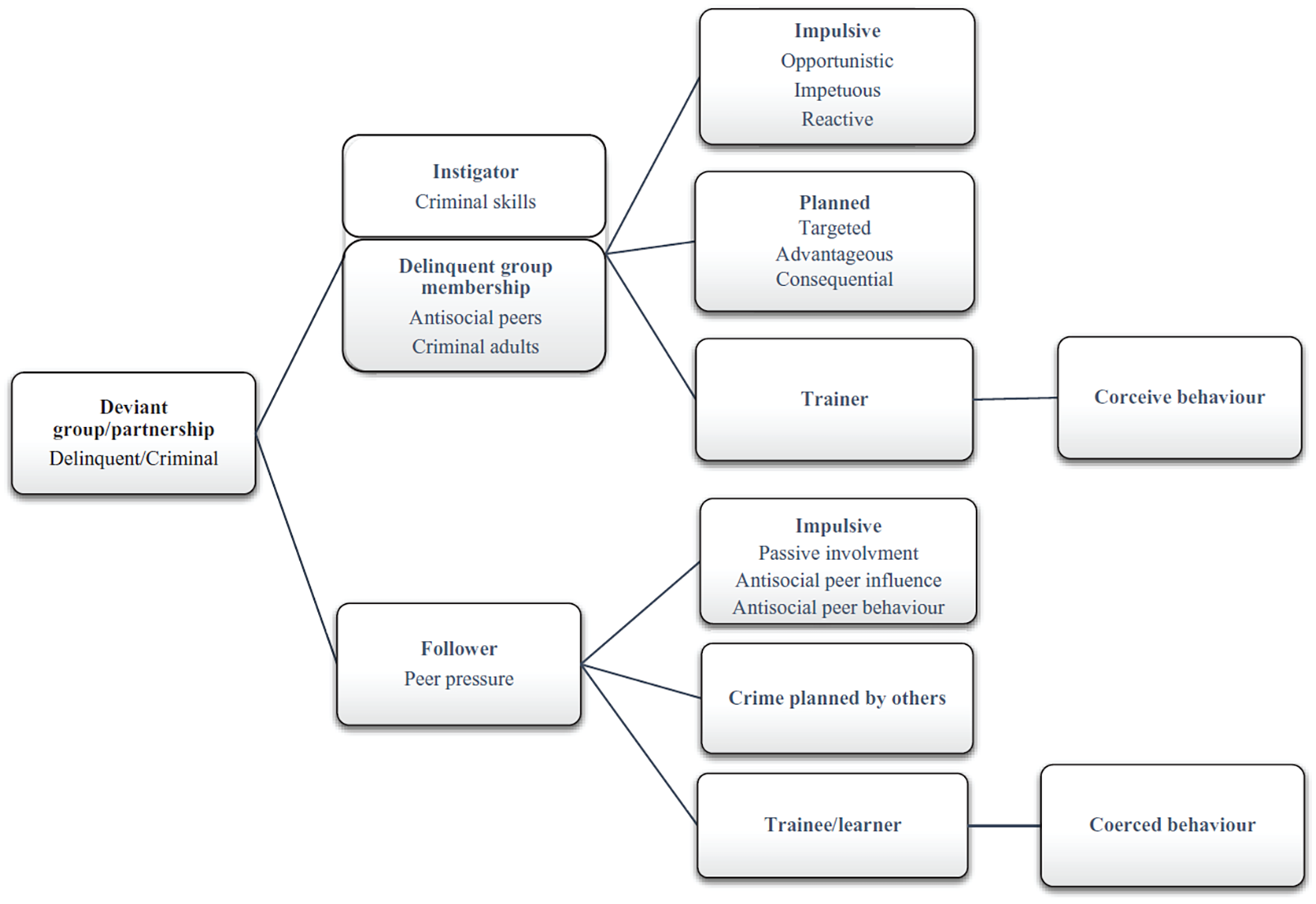
Model Of Social dynamics in Co-Offending (MOSCO).
Social dynamics of adolescent group and co-offending model
We propose a new Model Of Social Dynamics in Co-Offending (MOSCO, Figure 2; Table 1) that is based on the empirical results to emerge from the narratives, and which summarises the group dynamics described by the young people in the study. Our model aims to explain co-offending dynamics and considers three important dimensions to understand the co-offending behaviours: ‘instigator’, ‘group pressure’ and ‘follower’. The ‘instigator’ and ‘follower’ co-offending roles are coherent with previous studies (Moffitt, 1993; Reiss, 1988; Van Mastrigt and Farrington, 2011).
The offending role, specifically as ‘instigator’ or ‘follower’, is an important element to take into consideration. According to the literature these two roles are dynamic and versatile, depending on the make-up of the group and the type of offence (Warr, 1996, 2002; Weerman, 2003). However, the examples cited in our study suggest that those who regularly co-offend as part of a familiar group do not distinguish between roles. Instead, the group works as unified entity, offending is a normalised, and group decisions were cited. Lone instigators were involved in both impulsive and planned crimes and were able to fulfil this role as individuals or with others in a group through discussion or practised response. Instigators are proactive and decisive, but also present a risk to others who may be encouraged or coerced into joining the commissioning of an offence. Followers, on the contrary, were presented with new offending scenarios/opportunities. This was particularly true for those who were involved in the selling of drugs and who were trained to manufacture and traffic class A drugs as a part of organised crime operations.
Some group decisions involved ‘group pressure’, whereby ‘antisocial peers’ or ‘criminal adults’ instigate crime commission (see section ‘Group convergence). Group or partnership instigators are also ‘trainers’ who usually adopt coercive behaviour, as opposed to being coerced. The ‘coercive behaviour in group’, as either the victim or orchestrator of ‘criminal exploitation’ is an important element that requires careful examination for intervention strategies. Those participants who had been exploited by adult criminals reported trouble sleeping and the use of cannabis to self-medicate, supporting research that has identified the heightened risk for those who have been involved with adult gang members and Organised Crime Groups (Ashton and Bussu, 2020; Bennett and Holloway, 2004). Some young people move from having been groomed to recruiting and manipulating their peers (‘coercive behaviour’, Figure 2), or compel recruits to remain in a group (‘coerced behaviour’, Figure 2). The key for strategic intervention would be to prevent this shift from follower/coerced to instigator/coercive.
Those who are instigators or who referenced group decisions present some common behavioural characteristics. They can plan crimes (through targeting, taking advantage of an opportunity when involved in other offending, or because of commissioning a criminal act). Or they can also commit an impulsive offence, by responding to an opportunity or by responding impulsively because they are either confident of their skills and/or practised.
Instigators and adult crime group members usually plan the crime and make the decision about the target (target convergence; see section ‘Group convergence’). They act impulsively when there is a crime opportunity. In several of our cases the group members had not planned ‘a priori’ to commit a crime, but they were able to act spontaneously when they saw a target (see sections ‘Planned crimes’/‘Impulsive crimes’). Instigators and criminal adults (olders) also offer learning opportunities for the followers, and they transfer knowledge and experience. Young people who are followers need training for their roles (‘trainee’). They are tested by older criminals or by peers who are the ‘instigators’ (‘trainer’, Figure 2) or encouraged to self-train to improve their skills.
Following these reflections, we believe that researchers/practitioners need to consider the roles of youth co-offenders in more detail, especially the roles of followers whether they were willing, influenced or coerced. Followers require targeted rehabilitation programmes to support their independence and self-awareness to build resilience to those who manipulate them. Followers who are influenced or coerced by instigators require targeted rehabilitation programmes to support their independence and self-awareness, and to build resilience to those who manipulate them. Coercion and self-realisation are important dimensions for practitioners to explore and to include in rehabilitative and preventive programmes.
Conclusion
The literature suggests that co-offending behaviour is associated with numerous individual and social risk factors (Andresen and Felson, 2010; Ashton et al., 2020; Reiss and Biderman, 1980; Reiss and Farrington, 1991). In agreement with previous systematic reviews (Adler et al., 2016; Newman et al., 2012) the approaches that tend to be the most effective for reducing youth reoffending are targeted at young people who present the greatest risk of recidivism; individual needs and risk factors; personal abilities/skills; youth offending service user commitment and response; and the need to consider the wider context within which the offence occurred. Furthermore, according to Pooley (2020), youth offender programmes are most effective when they are implemented and are underpinned by a clearly articulated and evidence-based theory of change.
Prior research has also indicated that adolescent developmental limitations and membership of a delinquent group impact upon an individual’s decision-making processes (Galvan et al., 2006; Gardner and Steinberg, 2005; McGloin and Thomas, 2016; Steinberg, 2008, 2010; Thomas and McGloin, 2013). This was certainly the case for participants in our study who responded to individual or group instigations. As noted, it is well established that co-offending groups provide a network of support, protection, knowledge and specialised skills development through social learning processes among co-offenders (Andersen, 2019). According to our model and the previous literature mentioned (Ashton et al., 2020; Goldweber et al., 2011; McCord and Conway, 2002; Moffitt, 1993; Reiss, 1986; Reiss and Farrington, 1991; Uhnoo, 2016), we also consider it essential to implement interventions that take into consideration a young person’s role in the orchestration of an offence. For example, it will be useful to design and implement specific programmes to target young people who fulfil the ‘follower role’; specifically, to enhance the development of individual and interpersonal skills, and prosocial networks. Furthermore, we highlight the importance of implementing programmes that focus on young people’s independence and self-awareness, which are useful for building resilience and preventing their criminal exploitation.
We also believe that instigators and followers require targeted desistance support depending upon whether their offending is expressive, instrumental or both. In regard to our findings, some specific dimensions of rehabilitative and preventive programmes need to be carefully considered. Coercion and self-realisation are two further dimensions for practitioners to explore and to include in rehabilitative and preventive programmes (see, for example, Cann et al., 2005). Criminal mentors and instigators are not necessarily present during the criminal event, but can influence others consistently over periods of time (Morselli et al., 2006). This factor was present in some of the crime narratives for our study and is particularly relevant to criminal exploitation by adults or peers, especially through the use of social media. Although Lantz and Hutchison (2015) found that the removal of a highly central ‘instigator’/‘recruiter’ from a group was associated with desistance, some of our participants became instigators after leaving the group. This phenomenon was associated with two specific scenarios: a change of crime category (e.g. instrumental to expressive); or a participant becoming involved with another criminal group, often associated with organised crime (Ashton and Bussu, 2020). This occurrence can also be used to identify young people who are at greater risk of exploitation and/or escalated offending trajectories (Ashton et al., 2020; Goldweber et al., 2011; Moffitt, 1993). However, we need more research in this field and, also, preventive and rehabilitative programmes that focus on the specific roles or instigators/recruiters or follower, their risks and their personal needs.
Future Research
Given the small sample size and exploratory nature of the proposed model based on the findings of this research, a key priority for future research is to validate it using a broader range of samples and using construct testing such as factor analysis and structural equation modelling. Testing the relevance to and impact on practice should also be a future priority. Finally, in light of the variations of risk and behaviour depending on co-offending role that are highlighted in this paper, a review of youth offending programmes and an evaluation of their effectiveness for the different types of offender could prove valuable for both prevention and intervention strategies.
Supplemental Material
sj-docx-1-yjj-10.1177_14732254221136044 – Supplemental material for The Social Dynamics of Adolescent Co-offending
Supplemental material, sj-docx-1-yjj-10.1177_14732254221136044 for The Social Dynamics of Adolescent Co-offending by Sally-Ann Ashton and Anna Bussu in Youth Justice
Footnotes
Acknowledgements
The authors thank the organisation that facilitated this research, which cannot be named in order to protect the identity of the young people. They are also grateful to the participants for sharing their experiences and insight. The research was funded by an internal grant from Edge Hill University, which was awarded based on the original research design and proposal. No further involvement occurred during the research process or writeup.
Funding
The author(s) disclosed receipt of the following financial support for the research, authorship, and/or publication of this article: The research was funded by an internal grant from Edge Hill University.

Supplemental material
Supplemental material for this article is available online.
Author biographies
References
Supplementary Material
Please find the following supplemental material available below.
For Open Access articles published under a Creative Commons License, all supplemental material carries the same license as the article it is associated with.
For non-Open Access articles published, all supplemental material carries a non-exclusive license, and permission requests for re-use of supplemental material or any part of supplemental material shall be sent directly to the copyright owner as specified in the copyright notice associated with the article.
