







Abstract
The study aimed to analyze and evaluate interventions for improving resilience and/or well-being of youth incarcerated. A systematic literature review was conducted using the PICO approach, PRISMA protocol, and narrative synthesis. From 5962 articles, 26 met the inclusion criteria. Of these, six interventions enhanced resilience, while 18 improved well-being. The Expressive Writing Intervention (WRITE ON) demonstrated strong effectiveness for resilience, whereas Group Therapy and the Violence-Prevention Program showed notable benefits for well-being. Each intervention revealed strengths and limitations based on research and implementation evaluations. Although valuable insights were gained, the study could not provide conclusive evidence regarding overall adequacy.
According to UNICEF (2021) data, an estimated 261,200 adolescents were detained globally in 2020. Incarcerated youth placed in correctional facilities face various psychological challenges. Meta-analytical research by Livanou et al. (2019) revealed higher prevalence rates of anxiety, depression, and suicidal tendencies among female juvenile offenders, while males exhibited higher rates of behavioral and antisocial personality disorders. Detained juveniles often experience diminished self-esteem, engage in antisocial behavior, suffer psychological disorders, and endure emotional instability such as anger, stress, and frustration (Tasisa and Palanimuthu, 2021).
To navigate these challenges, incarcerated youth need resilience—not only as an individual capacity to address psychological issues and initiate a new life but also as a process supported by their surrounding environment (Konaszewski et al., 2021). This includes access to mental health services, community resources, and supportive relationships that can foster their reintegration into society (Steinberg et al., 2004). It is also important to recognize that youth, unlike adults, often have limited control over their circumstances, making external support systems essential in promoting resilience (Lee et al., 2012), one of which is case workers or youth justice system staff who play a critical role in ensuring the success of interventions aimed at strengthening resilience among incarcerated youth (Hodgkinson et al., 2024). Resilience is crucial, defined as an individual’s capacity to maintain and restore mental health despite challenging circumstances (Chmitorz et al., 2018), and it encompasses healthy psychological functioning and adaptive behaviors despite facing adverse conditions that would impede normative growth and adaptation (Mukherjee and Kumar, 2016). Resilience aids in self-acceptance, understanding personal competencies, coping with stress, maintaining well-being, and acts as a protective factor for mental health in incarcerated individuals (Clements-Nolle and Waddington, 2019; Huang et al., 2020).
Moreover, incarcerated youth in the juvenile justice system have the right to achieve optimal well-being as correctional facilities aim not only to punish but also to rehabilitate (Kelly et al., 2019). Well-being, a broad concept, includes hedonic well-being related to pleasure and happiness and eudaimonic well-being linked to achievement and purpose (Milton, 2018; Sharma et al., 2017). Viewing well-being from subjective and psychological perspectives expands its understanding (Martela and Sheldon, 2019). Attaining good well-being is crucial, as low life satisfaction in various aspects may lead to a prolonged delinquent behavior (de Ruigh et al., 2019).
Previous systematic reviews have primarily focused on specialized treatments for recidivism among juvenile sex offenders, resilience-based interventions to reduce recidivism in young people, and well-being and mental health interventions for incarcerated individuals. However, there remains a gap in systematic reviews exploring the effects of interventions or programs specifically aimed at enhancing resilience and well-being in incarcerated youth. Although a previous study by Hodgkinson et al. (2021) reviewed the effectiveness of resilience interventions in reducing recidivism among young people within the youth justice system, to the best of our knowledge, no studies have comprehensively explored the effectiveness of various interventions—beyond those solely based on psychological resources—in promoting resilience during youth incarceration.
Elliott et al. (2020) emphasized the need for promising interventions to enhance the effectiveness of the juvenile justice system. Simultaneously, research is required to identify successful, implementable, and cost-effective interventions (Elliott et al., 2020).
This study aims to provide an overview of interventions conducted to enhance resilience and well-being in youth incarcerated in the juvenile justice system and their evaluations. The findings can serve as a reference for juvenile correctional institutions, researchers, and practitioners in designing, implementing, developing, and evaluating policies related to psychosocial and rehabilitation programs for incarcerated youth.
Method
This study presents a systematic review utilizing the Preferred Reporting Items for Systematic Reviews and Meta-Analyses (PRISMA) protocol for reporting. Specifically, the systematic review adheres to the PRISMA flow diagram 2009 and PRISMA checklist 2015 guidelines (Moher et al.,2009, 2015). The research is registered with PROSPERO under the registration number CRD42021247671.
Review questions
The research addresses the following questions: (1) What interventions are appropriate for increasing the resilience and well-being of incarcerated youth? (2) How effective are these interventions in enhancing the resilience and well-being of incarcerated youth? (3) What are the advantages and disadvantages of interventions aimed at increasing the resilience and well-being in incarcerated youth?
Inclusion and exclusion criteria
Inclusion criteria encompass (1) articles in English or Indonesian; (2) research articles published within the last 20 years (2001–2021); (3) published primary research (quantitative, qualitative, or mixed methods); and (4) accessible research articles. Exclusion criteria include (1) articles in languages other than English or Indonesian; (2) research articles outside the 20-year timeframe (before 2001 and after 2021); (3) non-research articles (theses, conference papers, books, handbooks, book chapters, opinions, etc.) or gray literature and unpublished material; (4) secondary research (literature reviews, narrative reviews, scoping reviews, etc.); and (5) inaccessible research articles.
PICO criteria and scope
PICO criteria include (1) Population: youth incarcerated in the juvenile justice system; (2) Intervention: provided treatment; (3) Comparator: not specified; and (4) Outcome: resilience and/or well-being or their domains.
The population includes youth incarcerated in the juvenile justice system with various age categories and terms (e.g. juvenile offender, incarcerated adolescents, young offenders) because age limits in the juvenile justice system varies from 12 to 25 years depending on the jurisdiction of the youth justice system (Abrams et al., 2018; Leenknecht et al., 2020). The focus is on individuals as perpetrators in the juvenile corrections facilities, not witnesses or victims.
Interventions under review encompass various types, methods, or approaches, such as psychotherapeutic interventions (e.g. couple’s therapy, family therapy, parent training, group therapy) or non-psychotherapeutic interventions (e.g. social and community interventions). Traditional interventions include humanistic, behavioral, cognitive-behavioral, and family systems approaches, while contemporary interventions may use diverse approaches (Plante, 2011; Pomerantz, 2017; Trull and Prinstein, 2013).
The review includes research producing outcomes related to resilience and/or well-being or their domains. Related to resilience and/or well-being based on synonymous, similarities, or being one of type of resilience or well-being. Resilience domains consist of seven factor: emotion regulation, impulse control, empathy, optimism, causal analysis, self-efficacy, and reaching out (Reivich and Shatté, 2002). Well-being domains encompass Ryff psychological well-being which includes self-acceptance, positive relation with others, autonomy, mastery of environment, purpose of life, and personal growth (Hidalgo et al., 2010) and Diener subjective well-being including a cognitive dimension, that is, life satisfaction, and affective dimension, that is, positive affect (happy, proud, optimism, etc.) and negative affect (stress, anxiety, anger, etc.) (Brulé and Maggino, 2017).
Search strategy
Fourteen main databases are used, including ERIC, Taylor & Francis Online, Crossref (PoP7), Emeraldinsight, ScienceDirect, Scopus (PoP7), ProQuest, PubMed (PoP7), EBSCO, JSTOR, Wiley Online Library, Google Scholar (PoP7), Neliti, and Portal Garuda. Hand searching is employed as a supplementary basis for main databases. The database was accessed from SSO Universitas Diponegoro and e-resource Indonesian National Library on April 12–16, 2021.
Key search
Keywords align with PICO and use boolean search operators: (“young offender” OR “juvenile offender” OR “incarcerated youth” OR “incarcerated adolescent”) AND (intervention OR effect OR therapy) AND (resilience OR well-being) and (“anak yang berkonflik dengan hukum” OR “anak didik pemasyarakatan” OR “narapidana remaja”) AND (intervensi OR efek OR terapi) AND (resiliensi OR kesejahteraan).
Literature search
Literature selection follows the PRISMA flow diagram 2009, including identification, screening, eligibility, and inclusion (Moher et al., 2009). The selection and data-collection process based on inclusion and exclusion criteria was carried out by two researchers using Rayyan ai and Mendeley Desktop. This study used the MMAT (Mixed Method Appraisal Tools) critical appraisal form (Hong et al., 2018) which was carried out by two researchers. MMAT already includes critical appraisal tools for qualitative, quantitative, and mixed-method research.
Data extraction
Data extraction involves creating a list of relevant research data aligned with research questions, meeting other needs, and using PICO as a table reference (author, year, country, participants and setting, intervention, study design, measurement/data collection instruments, data analysis, outcomes, advantages, and disadvantages).
Data synthesis
Data synthesis employs a narrative synthesis method suitable for combining quantitative and qualitative studies. The presentation of results involves using a “summary of findings” table or diagram for transparent, structured, and simplified mapping and sorting of various research issues and questions (Schünemann et al., 2019). This study employs narrative synthesis, presented in a storytelling and descriptive format. The research utilizes tabulation tools and techniques, commonly used in all types of systematic literature reviews to visually represent quantitative and/or qualitative data (Popay et al., 2006). Findings from mixed-method studies included in this review will be extracted, identified, and synthesized based on the type of findings: quantitative findings will be compiled into the quantitative summary of findings table, while qualitative findings will be compiled into the qualitative summary of findings table. Identities of quantitative and qualitative study that consist study, year, country, total participants, age range of participants, investigated intervention, and study design listed in Supplementary Material. Table 1 illustrates the effectiveness of the interventions examined in the quantitative studies by identifying the outcome domains, improvements, changes, differences, statistical significance, and effect sizes of the implemented interventions.
Summary of quantitative study.
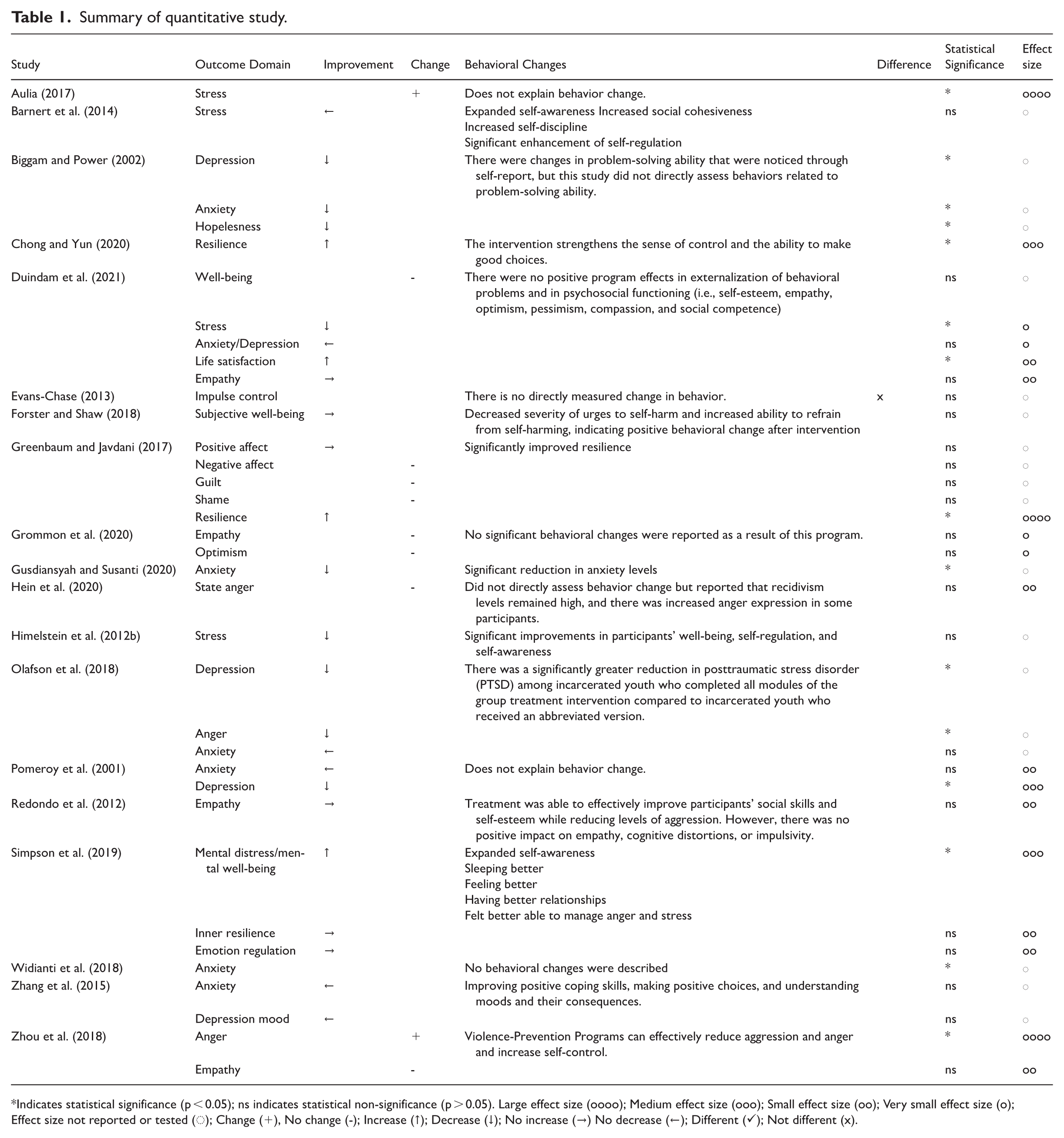
Indicates statistical significance (p < 0.05); ns indicates statistical non-significance (p > 0.05). Large effect size (oooo); Medium effect size (ooo); Small effect size (oo); Very small effect size (o); Effect size not reported or tested (◌); Change (+), No change (-); Increase (↑); Decrease (↓); No increase (→) No decrease (←); Different (✔); Not different (x).
Result
Literature search
The process of literature search until finding the literature to be reviewed involves several stages, as detailed in (Figure 1).
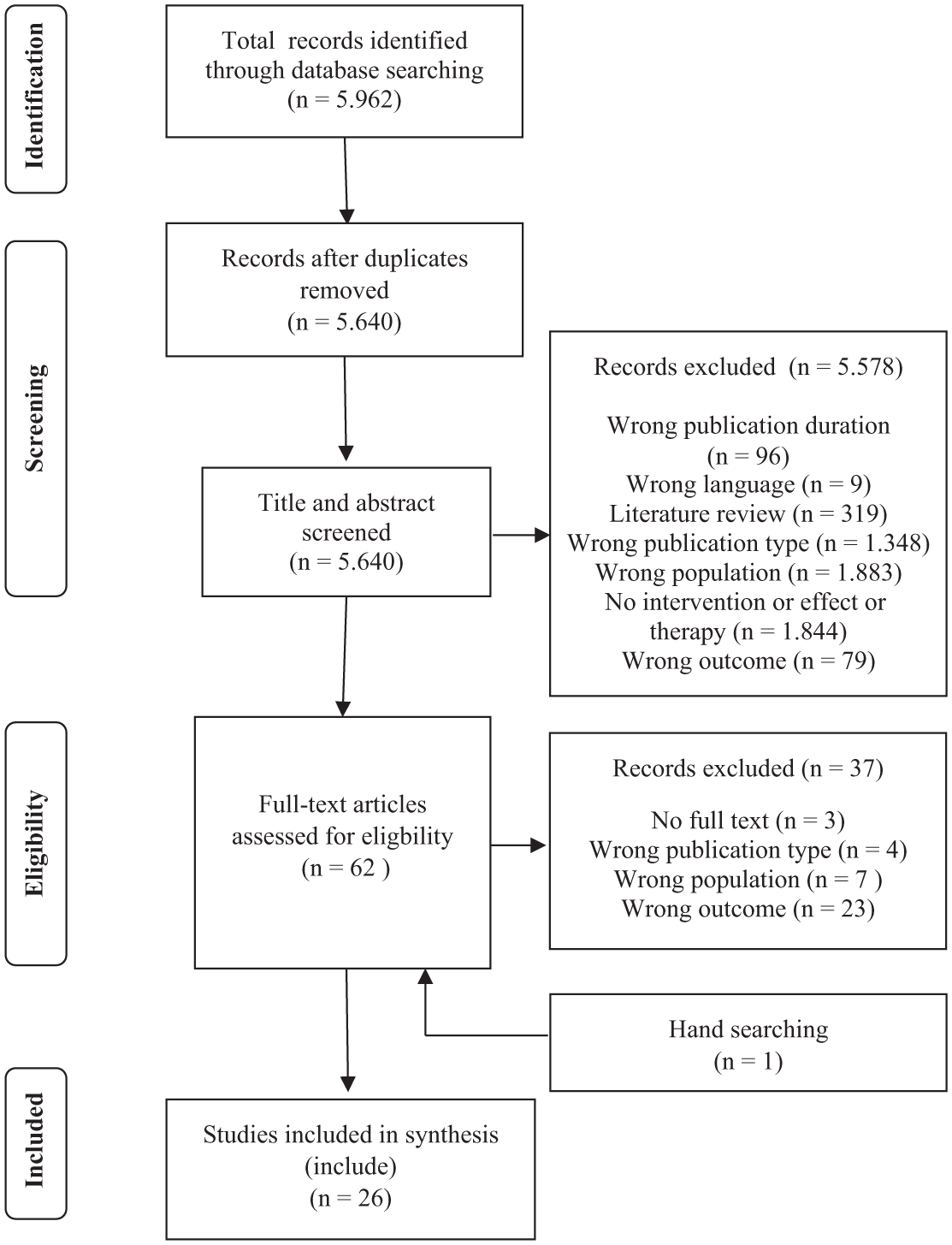
Flow chart search literature.
Characteristic
Based on 26 studies reviewed, it is known that there are studies with quantitative methods (n = 15) (i.e. Aulia, 2017; Biggam and Power, 2002; Duindam et al., 2021; Evans-Chase, 2013; Forster and Shaw, 2018; Greenbaum and Javdani, 2017; Grommon et al., 2020; Gusdiansyah and Susanti, 2020; Hein et al., 2020; Olafson et al., 2018; Pomeroy et al., 2001; Redondo et al., 2012; Widianti et al., 2018; Zhang et al., 2015; Zhou et al., 2018), qualitative method studies (n = 6) (i.e. Barrett, 2017; Evans-Chase et al., 2019; Himelstein et al., 2012a, 2014; Leonardi et al., 2017; Persons, 2009), and mixed-method studies (n = 5) (i.e. Barnert et al., 2014; Chong and Yun, 2020; Evans-Chase, 2015; Himelstein et al., 2012b; Simpson et al., 2019). As an important note, as mentioned in the Data synthesis section, findings from mixed-method studies are extracted based on the type of findings; quantitative findings will be grouped with other quantitative studies, while qualitative findings will be grouped with other qualitative studies. The studies were conducted in the United States (USA) (n = 13), United Kingdom (UK) (n = 4), Netherlands (n = 1), Spain (n = 1), Germany (n = 1), Indonesia (n = 3), Singapore (n = 1), China (n = 1), and South Korea (n = 1). Based on critical appraisal using MMAT, there are articles with scores of 5 (n = 10), 4 (n = 8), 3 (n = 7), or 2 (n = 1).
Appropriate interventions to increase resilience and well-being
Appropriate interventions to enhance resilience and well-being in incarcerated youth are assessed based on the significance of quantitative data and the positive experiences or beneficial outcomes identified through qualitative data. From the reviewed articles, it is known that two interventions have provided support significantly increase resilience, and four interventions have a positive impact on resilience. In addition, nine interventions are identified as significantly improving well-being, while nine interventions have a positive impact on well-being.
Effectiveness of interventions to increase resilience and well-being
Effective interventions are characterized by a large effect size. Based on the reviewed articles, only one intervention is effective in enhancing resilience, and two interventions are effective in improving well-being.
Advantages and disadvantages of interventions to increase resilience and well-being
The advantages and disadvantages of interventions are assessed through research and implementation evaluations. For research evaluations, it is worth noting that, in addition to quantitative studies, mixed-method studies with a quantitative component reviewed in this study will also be evaluated for statistical aspects, such as sample size, control group, and randomization besides the evaluation of the study phase and presence of bias. Meanwhile, the evaluation for purely qualitative studies only includes aspects of whether the study is still in the pilot phase and the presence of bias. Some evaluations from the reviewed research include (1) small sample size (e.g. Aulia, 2017; Barnert et al., 2014; Barrett and Katsiyannis, 2017; Biggam and Power, 2002; Forster and Shaw, 2018; Greenbaum and Javdani, 2017; Himelstein et al., 2012b; Olafson et al., 2018; Simpson et al., 2019; Zhang et al., 2015); (2) research still in pilot study phase (e.g. Barnert et al., 2014; Forster and Shaw, 2018; Greenbaum and Javdani, 2017; Himelstein et al., 2012b; Olafson et al., 2018; Simpson et al., 2019); (3) lack of a control group (e.g. Barnert et al., 2014; Barrett and Katsiyannis, 2017; Himelstein et al., 2012b; Pomeroy et al., 2001; Simpson et al., 2019); (4) lack of randomization (e.g. Barnert et al., 2014; Olafson et al., 2018); (5) presence of bias (e.g. Barnert et al., 2014; Barrett and Katsiyannis, 2017; Greenbaum and Javdani, 2017; Grommon et al., 2020; Hein et al., 2020; Himelstein et al., 2012a; Widianti et al., 2018).
In addition, some implementation evaluations from the reviewed articles are related to (1) intervention dosage, including the need for additional dosage for interventions like Dutch Cell Dogs (Duindam et al., 2021) and Dog Training Program (Grommon et al., 2020), excessively long durations for Mindfulness Training (Himelstein et al., 2014) and Mindfulness Meditation (Evans-Chase et al., 2019), and limited or insufficient duration and intensity for Cognitive-Behavioral Treatment (Redondo et al., 2012); (2) participant response, where Dog Training Program (Grommon et al., 2020), Paws for Progress (Dog Training Program) (Leonardi et al., 2017), Mindfulness-Based Intervention (Himelstein et al., 2012a), and Expressive Writing Intervention (WRITE ON) (Greenbaum and Javdani, 2017) received positive responses from participants, but participants in Internet-Based Instruction of Mindfulness Meditation found the class boring (Evans-Chase, 2015); (3) costs, where some interventions are classified as cost-effective, such as Dog Training Program (Grommon et al., 2020), Mindfulness Training with Mind Body Awareness (MBA) (Himelstein et al., 2012b), Self-Injury Group Psychotherapy Intervention (Forster and Shaw, 2018), and Expressive Writing Intervention (WRITE ON(Greenbaum and Javdani, 2017); (4) facilities and infrastructure, including the absence of personal iPod provision, difficulties in hearing instructions due to iPod volume, and unclear speaker voices in Internet-Based Instruction of Mindfulness Meditation (Evans-Chase, 2015); (5) accessibility and scalability, where Internet-Based Instruction of Mindfulness Meditation (Evans-Chase, 2015) is freely accessible on the Internet, and Expressive Writing Intervention (WRITE ON) (Greenbaum and Javdani, 2017) has scalability potential as it can be performed by various mental health professionals.
Discussion
The significant interventions
Based on the reviewed articles, several interventions have shown significant results in improving resilience, such as writing therapy and music therapy. These interventions have been shown to be beneficial in various studies. Expressive writing therapy, for example, has been found to enhance resilience (Glass et al., 2019) and reduce distress while improving psychological well-being (Ruini and Mortara, 2022). Similarly, music therapy has been identified as beneficial for building resilience (Scrine, 2021). Other research indicates that both writing therapy and music therapy are effective interventions for reducing anxiety and depression in students suffering from cancer, serving as non-pharmacological complementary treatments (Naseri et al., 2020).
Furthermore, the reviewed articles highlight several significant interventions for improving well-being, including mindfulness-based intervention, dog intervention, problem-solving intervention, group therapy, supportive therapy, trauma and grief therapy, psychoeducational intervention, and violence-prevention programs. Additional research reveals specific benefits of these interventions, such as mindfulness-based intervention improving emotional regulation (Ma et al., 2018), mental well-being (Zollars et al., 2019), overall well-being (Nam et al., 2019), and life satisfaction (Cejudo et al., 2019). Supportive therapy is noted for reducing anxiety (Karulkar, 2020); problem-solving intervention for decreasing depression and social phobia (Bayani et al., 2012); trauma and grief component therapy for providing anger-processing education (Moore et al., 2018); group therapy for lowering anxiety, depression, and distress (Yavuzsen et al., 2012); and violence-prevention programs for reducing anger (Messina et al., 2016).
The reviewed studies produce diverse outputs, both significant and non-significant. One factor that may influence significance is the sample size of the studies. The number of participants can affect significance; for instance, many participants may yield significant results even if the correlation is relatively small (Trull and Prinstein, 2013).
The effective interventions
Upon closer examination, it is revealed that only a few interventions are statistically effective in enhancing resilience, namely the Expressive Writing Intervention (WRITE ON) (Greenbaum and Javdani, 2017), and effective in improving well-being, such as Group Therapy (Aulia, 2017), and Violence-Prevention Program (Zhou et al., 2018).
Expressive Writing Intervention (WRITE ON) is deemed effective and suitable for implementation due to its appropriate dosage level, high participant satisfaction across all sessions, cost-effectiveness, sustained provision of psychological resources, and the potential for scalability, as it can be implemented by non-licensed mental health professionals (Greenbaum and Javdani, 2017). In addition, literature suggests why expressive writing intervention can be effective in enhancing resilience in juvenile offenders. The honest expression of adolescent life experiences in expressive writing can have a significant impact, involving adolescents constructively and using a transformative approach (Gold, 2014).
On the other hand, group therapy is considered effective and applicable because its implementation aligns with the necessary stages: the beginning stage, the work stage, and the closing stage (Aulia, 2017). Group therapy can effectively improve well-being in incarcerated youth for various reasons. Humans need groups to survive and thrive, and incarcerated youth in the same place, interacting, and having shared goals can be considered a group (Sandahl et al., 2021). Therefore, well-managed group therapy aimed at improving mental health and well-being in incarcerated youth can yield optimal outcomes. Through group therapy, participants can receive support, comfort, encouragement, and engage in reflection, helping them better understand themselves and others by paying attention to emotions, thoughts, and motives. This, in turn, aids in healing, improving communication, and managing life more effectively (Sandahl et al., 2021). Factors influencing group therapy include group composition and structure, interaction and goals within the group, group dynamics, and the role of the group leader (Sandahl et al., 2021).
Kisiel et al. (cited in Seifert, 2012) mention that increasing awareness and knowledge, developing skills in emotion and behavior regulation, getting opportunities for practice and feedback, and receiving social support play a role in the effectiveness of violence-prevention programs.
Based on several reviewed articles, it is evident that some factors may lead to the ineffectiveness of an intervention, such as being in the pilot study phase or using a quasi-experimental design with a small sample, lack of a control group, absence of random assignment, and the presence of bias. Plante (2011) suggests that potential threats to intervention effectiveness include bias that can compromise results and threats to the validity and reliability of the assessment process. Furthermore, factors affecting intervention outcomes that can influence significance and effectiveness include threats to internal and external validity (Trull and Prinstein, 2013). Internal validity threats include a lack of pre-matching, no control group, no random assignment, the presence of confounding variables, and researcher or participant expectations, while external validity threats include the inability to generalize beyond the conditions of the experiment or study (Trull and Prinstein, 2013).
One evaluation of several interventions reviewed is intervention dosage, where the duration and intensity of the intervention do not align appropriately. Noyes et al. (2019) state that the observed lack of effect may be due to poorly conceptualized interventions, such as theoretical failures or poor implementation.
The most used interventions
One interesting finding in this study is that mindfulness-based intervention, with its various developments, is the most frequently used intervention for incarcerated youth, albeit with varying outcomes and effectiveness. Mindfulness-based intervention is often employed for incarcerated youth because it has been shown to enhance mental health and well-being in adolescents (Dunning et al., 2019).
Apart from mindfulness intervention, dog intervention emerges as the most frequently implemented intervention for incarcerated youth, although with diverse outcomes and effectiveness. The varied results in the reviewed Dog Intervention studies can be explained by the examination of Human-Animal Interaction (HAI) variability. Some variabilities in HAI are linked to dynamic interactions between two organisms—animals and humans, variabilities in human and animal participants, the use of different methodologies in research, inadequate steps and protocols, and limited quantification of HAI (Rodriguez et al., 2021). In addition, Rodriguez et al. (2021) suggest addressing these variabilities by using experimental designs and statistical analyses that consider confounding variables, reporting detailed human and animal characteristics, creating manuals with standardized and replicable procedures such as duration, context, and the structure of animal-human interactions.
Several studies involving dog intervention have been conducted in various countries and on different subjects, such as the Dog Training Program for prisoners (Flynn et al., 2019), Dog Training Program for adult prisoners (Duindam et al., 2021), Dog-Assisted Intervention for students (Grajfoner et al., 2017), and Dog Training Program for veterans with PTSD (Whitworth et al., 2019). Furthermore, various mindfulness interventions have been implemented on different subjects, including Online Mindfulness-Based Intervention for the general public (Ma et al., 2018), Mindfulness Training through smartphones for employees (Bostock et al., 2019), Mindfulness Meditation Intervention for pharmacy students (Zollars et al., 2019), Mindfulness-Based Intervention for women with fibromyalgia (Cejudo et al., 2019), and Mindfulness-Based Intervention for students (Nam et al., 2019).
Conclusion
Interventions to enhance resilience and well-being in youth incarcerated in the juvenile justice system vary significantly. Despite less-than-adequate outcomes, this systematic review can contribute to providing an overview of efforts related to interventions that can be used by correctional institutions to optimize the conditions of incarcerated youth. When implementing an intervention, therapists and correctional institutions are encouraged to consider the strengths and weaknesses of the intervention and adapt it to the culture and conditions of each country.
Limitations and future research
This study has several limitations. First, the research includes all included articles found with the aim of exploring interventions that have been conducted, but the weakness lies in not all reviewed research articles being of high quality. In addition, the inclusion criteria were limited to articles published in English or Indonesian, excluding studies in other languages, gray literature, and unpublished materials. Research articles that were inaccessible were also excluded, potentially limiting the comprehensiveness of the findings. Future studies could expand the scope of systematic reviews by incorporating multilingual databases, gray literature, and preprints to provide a more holistic understanding of the available evidence. Second, this study cannot yet provide accurate results regarding the influence of interventions, so future researchers can refine systematic reviews using meta-analyses or other syntheses to obtain more accurate results. Third, researchers can develop various interventions using stricter experimental research because, based on the reviewed results, there are several experimental studies that still need refinement. Finally, this study is exploratory, and its scope is still broad, indicating there is still an open opportunity for further research.
Supplemental Material
sj-docx-1-yjj-10.1177_14732254261428270 – Supplemental material for Improving Resilience and Well-Being Among Youth Incarcerated in the Juvenile Justice System: Systematic Review of Exploring Intervention
Supplemental material, sj-docx-1-yjj-10.1177_14732254261428270 for Improving Resilience and Well-Being Among Youth Incarcerated in the Juvenile Justice System: Systematic Review of Exploring Intervention by Annisa Nur Hikmatus Sholikhah, Dian Veronika Sakti Kaloeti, Sigid Kirana Lintang Bhima and Nur Diana Indrawati in Youth Justice
Footnotes
Acknowledgements
We would like to thank the editor and the anonymous reviewers of Youth Justice for their valuable comments on this article.

Ethical approval
This study is a systematic literature review and does not involve human participants. Therefore, ethical approval is not required.
Consent to Participate
There are no human participants in this article, and informed consent is not required.
Author contributions
ANHS and DVSK conceived the study, developed the methodology, and performed the data analysis. DVSK and SKLB received the funding. ANHS, DVSK, and SKLB wrote the initial draft of the manuscript. ANHS, DVSK, SKLB, and NDI revised the manuscript critically. All authors approved the final version of the manuscript and agree to be accountable for their contributions.
Funding
The authors received financial support for the research, authorship, and/or publication of this article. This research was funded by the Riset Publikasi Internasional (RPI) scheme from Universitas Diponegoro (Grant No. 609-77/UN7.D2/PP/VIII/2023).
Declaration of conflicting interests
The authors declared no potential conflicts of interest with respect to the research, authorship, and/or publication of this article.
Supplemental material
Supplemental material for this article is available online.
Author biographies
References
Supplementary Material
Please find the following supplemental material available below.
For Open Access articles published under a Creative Commons License, all supplemental material carries the same license as the article it is associated with.
For non-Open Access articles published, all supplemental material carries a non-exclusive license, and permission requests for re-use of supplemental material or any part of supplemental material shall be sent directly to the copyright owner as specified in the copyright notice associated with the article.
