






Abstract
Youth involved in the Canadian criminal justice system often rely on a parent for advice and advocacy during their procession through the system. Despite the Youth Criminal Justice Act affording parents a significant role in their child’s case, there is limited evidence that parents, or adults broadly, can effectively advocate for their child. In this study, we modify an American measure of legal knowledge about youths’ rights for a Canadian audience and explore Canadian adults’ levels of knowledge. We found that adults overall had limited legal knowledge of youths’ rights, calling into question their ability to effectively overcome youths’ developmental limitations.
Adolescents involved in the justice system are at a developmental disadvantage relative to adults when it comes to their competency to make sound legal decisions and assert their due process rights (Feld, 1989; Schmidt et al., 2003; Steinberg and Cauffman, 1996). This developmental vulnerability has prompted both legal and psychological scholars to question how procedural fairness can be achieved for youth whose decision-making capacities are still developing. As a result, legal and developmental scholars have pushed for due process protections for youth charged with a crime to mitigate their diminished capacity. In recognition of the vulnerabilities of youth within the legal system, legislatures have introduced procedural safeguards.
Due to their still-developing psychosocial capacities and dependence on adults, juvenile justice policies in Canada and the United States often emphasize the key role that parents play as advocates for their children during police interrogations, navigation of the court system, and successful completion of court dispositions. For example, in Canada, the Youth Criminal Justice Act (YCJA, 2002) provides several important protections for youth that explicitly rely on bringing parents into the adjudicatory process. Accused youth in Canada must be given the opportunity not only to consult with legal counsel before making statements to police (s.146(2)(c)(i)), but also to consult with a parent (s.146(2)(c)(ii)). Post-conviction, the youth’s relationship with their parent(s) is taken into consideration when the youth may serve a sentence under supervision in the community (s.40(2)(d)(vi)). Parents are also required to be notified when their child is arrested (s.26(1)). Underlying these laws is the assumption that parents can, “serve as a buffer against the coercive elements of the juvenile justice system, help the child identify, secure, and communicate with counsel, and guide the child in critical decisions regarding plea, trial, and disposition” (Henning, 2006: 839).
Thus, there is an expectation that adults (e.g. a parent) can serve as a procedural safeguard in the Canadian youth criminal justice system. The YCJA’s emphasis on the role of parents during their child’s legal processing contains implicit, but significant, assumptions. Specifically, we argue the YCJA takes for granted that, by virtue of being an adult, parents can overcome their child’s developmental immaturity and assist them in making adaptive decisions within Canada’s legal system. This assumption represents a broader theoretical premise, rooted in developmental and socio-legal thinking: that maturity and adulthood naturally confer legal competence. One key assumption of the YCJA—that adults have the requisite legal knowledge to assist in advocacy—is the primary issue under exploration in this study. Accordingly, the present article offers both a conceptual and empirical contribution: conceptually, it interrogates the developmental and legal assumption that adulthood equates to procedural competence; empirically, it tests this assumption by examining what Canadian adults actually know about youths’ legal rights. We explore the veracity of this assumption by testing knowledge of youths’ legal rights among Canadian adults.
Youth as a vulnerable population needing procedural safeguards
Adolescence is a period of development characterized by impulsive behavior and sensitivity to rewards, resulting in a peak in risky behavior (Monahan et al., 2015). Developmental psychologists have theorized that the sharp increase in delinquent behavior among teenagers is due to the differential maturation speeds of the socioemotional areas of the brain and the cognitive control areas that regulate behavior (Icenogle et al., 2019; Steinberg, 2007). In conjunction with the neural salience of social rewards and sensation-seeking, adolescents are at risk for making risky decisions such as engaging in unprotected sex, abusing drugs and alcohol, and committing petty crimes (Monahan et al., 2015). Indeed, this behavior is so ubiquitous among youth that criminologists have suggested that most minor delinquency is “normative” behavior (Hirschi and Gottfredson, 1983).
Unfortunately, at the very time when youth are most likely to come into contact with the legal system, they are also at a heightened vulnerability to the coercive force of the investigatory and adjudicatory process of the legal system (Monahan et al., 2015). Several studies have documented deficiencies in youths’ understanding of Miranda rights (Woolard et al., 2008; Zelle et al., 2015). This has important implications for youths’ ability to invoke important rights such as the right to have an attorney or the right to remain silent. For example, 44% of juveniles in one study reported that they believed that they would be punished by the judge if they remained silent during police questioning (Zelle et al., 2015). Perhaps more concerning are studies documenting youths’ fundamental misconceptions about legal actors, with one study reporting that substantial numbers of adolescents believed that their defense attorney could disclose the information that they confided to the police (35%), the judge (52%), or their parents (66%) (Peterson-Badali and Abramovitch, 1992) and other studies finding that youth report refusing to talk to their attorney or lying to their attorney (Schmidt et al., 2003; Viljoen et al., 2005). Thus, legal scholars and developmental experts have raised serious questions about the competency of youth to understand and invoke their due process rights within the legal system.
Parents as a legal advocate in the United States
In recognition of the vulnerabilities of youth within the legal system, legislatures have introduced procedural safeguards. Within the United States, as well as other Western countries such as Canada, England, and Wales, laws and policies guiding the implementation of the juvenile justice system have emphasized the importance of parents as an adult advocate and safeguard. This is most clear in statutes regarding juvenile interrogations. For example, in the United States, there are two approaches by which judges decide whether youth “knowingly, intelligently, and voluntarily” waived their Miranda rights (Feld, 2006). Under the “totality of the circumstances” approach, one critical factor that judges may look at is whether the juvenile was given the opportunity to consult with a parent prior to waiving their rights. In some cases, mere contact with a parent is sufficient for judges to rule that a waiver was knowing, intelligent, and voluntary. Similarly, under per se approaches, the absence of a parent is sufficient for a waiver to be struck down (Cleary and Warner, 2017), highlighting the importance that parents play as a procedural safeguard in the minds and practices of justice officials. Indeed, a survey of juvenile interrogation laws in the U.S. found that 20 states currently supplement the Constitutionally required “totality of circumstances” test with additional protections for juvenile questioning, mandating a minimum of parental contact for either a statutorily protected subset of young juveniles or all minors under the age of 18, with some states further mandating parental permission or participation in juvenile interrogations (Jeffs and Brian, 2021).
Importantly, however, legal scholars and social scientists have questioned whether parents can serve as an adequate safeguard for their children within the justice system (Cleary and Crane, 2023; Farber, 2004). The vast majority of current research on adults’ legal knowledge related to youths is based on the US legal system, youth, and parents, with little attention paid to the role of parents and parental consultations in other jurisdictions. This growing body of evidence from the United States, however, casts doubt on policies that assume parents can serve as legal stewards. This includes policies such as those under the YCJA that presume that parents can overcome their child’s developmental limitations by virtue of being an adult (Peterson Badali and Broeking, 2004; Viljoen et al., 2005; Woolard et al., 2008), with some scholars cautioning that these policies unduly burden justice-involved families and do not actually reduce adolescents’ precarious legal positions (Broeking and Peterson-Badali, 2010). There is also the larger concern of parents serving as key agents of moral socialization (e.g. the domain-specific theory of socialization; Grusec and Davidov, 2010), which may complicate their ability to serve as an advocate for their child. For example, it is not uncommon that detained persons may be encouraged to tell the truth and “help themselves,” common tactics employed by police during interrogations (Kassin et al., 2010). Since adolescence is a risk factor for poor legal decision-making during interrogations, parental moral socialization strategies that encourage their children to be honest and tell the truth may not be appropriate in some legal contexts, such as interrogations.
Experts have also questioned whether parents have adequate knowledge of the legal system, their rights, and their child’s rights to serve as a safeguard (Grisso and Ring, 1979; Woolard et al., 2008). Indeed, extant evidence suggests that parents lack the requisite legal knowledge that would enable them to serve in a protective or advisory capacity for their child (Cavanagh and Cauffman, 2017; Cavanagh et al., 2020; Cleary and Warner, 2017; Woolard et al., 2008). Even when parents are present, they are not always effective advocates during key processing points, often because they are not aware of or do not understand their child’s legal rights. For example, while parents generally had better comprehension of their children’s Miranda rights than their children, both youth and parents demonstrated limited understanding of the obligations of police during interrogations (e.g. that police are not required to tell the truth; Woolard et al., 2008). Parents often misunderstand their own largely non-existent legal rights in the context of their child’s criminal case (i.e. that they cannot provide direction to their child’s lawyer or speak on behalf of their child; Cavanagh and Cauffman, 2017). Attorneys have also acknowledged the challenges of involving parents in the plea bargaining process specifically. For instance, despite the fact that a parent is not required to permit or endorse their child’s plea bargain, research indicates that judges still look for their approval and involvement before proceeding (Fountain and Woolard, 2021).
More broadly, the extant literature suggests that US parents’ legal knowledge may be highly variable (Cavanagh and Cauffman, 2017) and depends on demographic and social characteristics (Cavanagh et al., 2020; Woolard et al., 2008). Cavanagh and Cauffman (2017), for instance, found that mothers of youth arrested for the first time in the United States (Philadelphia, PA and Orange County, CA) received an average score of 66% (range: 34%–95%) on a 44-item true/false and multiple-choice test assessing basic knowledge such as “As the parent, I have the right to have an interpreter in the courtroom” and “Conversations I have with my son’s probation officer are confidential.” Likewise, Cleary and Warner (2017) found variability in parental knowledge of police interrogation practices and youths’ legal rights among US parents: While nearly 90% of parents knew that their child could stop answering police questions, only 23% knew that the police were permitted to lie to their child during questioning. This led the authors to conclude that parents in their sample showed significant gaps in their understanding of some police interrogation procedures, with particularly limited knowledge about the role of parents when youth are questioned by the police. More recently, Warner and Cleary (2022) found that US parents could only correctly answer about half of questions pertaining to interrogation rights and that approximately 30% of parents would advise their son to answer police questions when there was already compelling evidence of their involvement in a robbery, with parents who had less legal knowledge being more likely to advise their child to cooperate with police questioning.
Not only is legal knowledge highly variable, factors such as race and ethnicity, education, and income have been found to play an important role in US adults’ legal knowledge. For example, Black and Latina mothers demonstrated less knowledge of the workings of the juvenile justice system relative to White mothers (Cavanagh et al., 2020), while Black parents were 61% more likely to be designated as “at risk” for Miranda rights misunderstandings than White parents (Woolard et al., 2008). Likewise, parents with limited English fluency or who were born outside the United States displayed less legal knowledge than fluent English speakers and those born in the United States (Cavanagh and Cauffman, 2017). Socioeconomic status (SES) may also inform legal knowledge; parents with a college degree or higher performed better on a test of juveniles’ interrogation rights (Cleary and Warner, 2017), and both household income and level of education were associated with greater legal knowledge (Cavanagh and Cauffman, 2017). Thus, a parent’s social position may determine what legal knowledge they can call upon to assist their child in the legal process—converting legal knowledge into yet another resource that marginalized families may lack, compounding extant disparities.
Parents’ knowledge may additionally be influenced by factors beyond demographic ones. One important factor that has been explored is prior experience with the legal system. Although some researchers have found that a history of criminal justice involvement by the youth and/or the parent themselves increased knowledge of rights (Warner and Cleary, 2022; Woolard et al., 2008), other researchers have revealed that prior experience in the justice system does not confer any benefit in terms of justice system knowledge (Cavanagh et al., 2020; Viljoen et al., 2005; Zelle et al., 2015). In line with prior experience with the legal system, beliefs about procedural justice (i.e. beliefs that the legal system is fair and just) may also influence parental legal knowledge. Early legal socialization processes can influence beliefs about the legitimacy of the legal system, including perceptions of procedural justice (Tyler, 1990). Prior police contact has been found to reduce perceptions of procedural justice, including increasing cynicism toward the law (Vidal et al., 2017). It is possible that parents’ own prior contact with the criminal justice system as an adult or youth may increase their knowledge of the youth legal system and legal rights, yet some evidence suggests that mothers’ legal knowledge did not improve after multiple arrests of their sons, suggesting mere experience is not sufficient for improving legal knowledge (Cavanagh et al., 2020). Although the relationship between legal knowledge and procedural justice has not been fully explored, Vidal et al. (2017) noted that improved knowledge of the Mirandizing process and police interrogation practices reduced perceptions of procedural justice and police legitimacy. Thus, the relationships between prior justice system contact and procedural justice on legal knowledge may be paradoxical in nature: though contact should, in theory, increase legal knowledge, it may actually reduce it, alongside perceptions of procedural justice.
Parents as legal advocates in Canada
The current understanding of Canadian parents’ abilities to advocate for and understand their child’s rights in legal processing is limited. However, some evidence suggests that American studies are instructive for Canadian populations as well. For example, similarly to American children, Canadian youth appear to struggle with the comprehension and invocation of right to silence and right to counsel protections, with just under half (45%) of Canadian school children declining to make statements to police in a vignette study (Abramovitch et al., 1995). More recent evidence (Eastwood et al., 2016; Freedman et al., 2014) found Canadian youth to have overall poor understanding of their rights during an interrogation, though comprehension improved with age. Problematically, Canadian police officers reported rarely testing for youths’ understanding of their rights during interrogations (McCardle et al., 2021). Canadian evidence suggests that police are more likely to decide to lay charges or detain youth when parents do not appear interested in their child’s case or do not appreciate the seriousness of the situation (Carrington and Schulenberg, 2003). Canadian judges and justices of the peace considered numerous parent-related factors, such as supervisory capabilities and parents’ understanding of the court process, when deciding whether to release youth on bail (Varma, 2007). Canadian probation officers and lawyers also view parental support and involvement as very important for youths’ successful completion of dispositions and reducing recidivism (Peterson-Badali and Broeking, 2009). Thus, there is reason to believe that similar trends exist in Canada as in the United States, whereby parents are expected to have the necessary legal knowledge to participate in their child’s case but they do not—which is perhaps unsurprising given that there are no formal mechanisms to provide for or ensure this knowledge. To date, however, the legal literacy of Canadian adults and the extent to which legal knowledge varies along demographic and social characteristics has not been explored. This is likely because a formal legal knowledge instrument does not yet exist for the Canadian youth justice system. Accordingly, the present study also makes a psychometric contribution by adapting and validating a measure of legal knowledge for the Canadian context. This is an important gap, given the difference in the US and Canadian legal systems, and the significant role Canadian parents are endowed with by the YCJA.
Furthermore, although various social and demographic traits have been explored within the legal knowledge literature, the extent to which parents may differ from non-parent adults has not yet been investigated in either the Canadian or American context. There are several reasons why parents specifically may be expected to obtain more legal knowledge relative to their non-parent peers. First, becoming a parent is frequently accompanied by receiving and seeking out a deluge of advice and information (e.g. Glatz and Lippold, 2023). From the moment of conception, parents become lightning rods for social knowledge and received wisdom, passed on by their families and social groups, medical professionals, and social media. Parenthood is thus not just a physiological process, but also a socialization process, which likely confers specialized pockets of knowledge to adults who have obtained parenthood status that is not shared with adults who are not parents. In addition, parents may seek out knowledge as their children age or they may obtain vicarious knowledge from the experiences of other parents. Although there is limited evidence exploring how parents come to “know” about legal issues relevant to their children, some research has explored parent- and teen-specific factors associated with parents having “the talk” (i.e. what to do if stopped by police) with their children; despite often desiring to have “the talk,” only approximately half of parents had had it (Wylie et al., 2024). More recent evidence has explored the impact on Black youth of receiving “the talk” (i.e. about what to do if they are stopped by police) from their parents (Webb et al., 2025). These studies suggest that parents may have specific reasons to seek out legal knowledge relevant to their children that non-parents would not seek out. Thus, it is possible that adults who are parents have specialized knowledge related to children that may be absent in non-parent adults, including knowledge about youths’ rights in the criminal justice system. However, to date, no studies have examined this possibility.
To this end, the present study examines knowledge of youths’ legal rights among Canadian adults. First, we adapt an existing American measure of legal knowledge regarding youths’ rights for a Canadian audience. Second, in drawing upon developmental, criminological, and legal scholarship, we test the underlying assumption that adults can safeguard youths’ legal interests by examining how Canadian adults perform on said measure of legal knowledge of youths’ rights. Finally, we investigate whether demographic, social, and/or attitudinal characteristics impact adults’ legal knowledge, including their parenthood status.
The present study
The present study makes three interrelated contributions. First, conceptually, it challenges the developmental and socio-legal assumption embedded within the YCJA that adulthood (and by extension, parenthood) confers sufficient legal competence to safeguard youths’ rights. Second, empirically, it tests this assumption by assessing the legal knowledge of Canadian adults regarding youths’ rights. Third, psychometrically, it adapts an existing American measure of legal knowledge for the Canadian context. Using this measure, this study aims to investigate (1) to what extent Canadian adults are knowledgeable about youth’s legal rights and (2) whether there are any demographic or attitudinal factors that are associated with knowledge of Canadian youth justice. With respect to these research aims, we hypothesized that Canadian adults will perform similarly to the aforementioned evidence on American adults with regard to their legal knowledge, correctly answering between half and two-thirds of the legal knowledge questions (Cavanagh and Cauffman, 2017). We additionally hypothesized that some demographic characteristics (e.g. older age, more education) would predict higher legal knowledge, as older adults and those with more years of education may have been exposed to more information about the legal system through lived experience or classroom instruction. In line with this reasoning and prior literature (Warner and Cleary, 2022; Woolard et al., 2008), we also hypothesized that history of police contact would predict higher legal knowledge scores. For attitudinal measures, we hypothesized that higher scores on legal legitimacy and cynicism would predict higher legal knowledge scores. This is because individuals who are the most knowledgeable about the legal system may also be the most aware of its strengths and weaknesses. Finally, we hypothesized that merely being a parent would not be associated with a significant increase in Canadian adults’ legal knowledge of relevance to Canadian youth, in line with prior research among U.S. adults (e.g. Cavanagh and Cauffman, 2017; Woolard et al., 2008).
Method
Please note that following the principles of open science, all data and materials are available for interested researchers at the following link: https://osf.io/2usxg/?view_only=d1cf216d7c784cc0a5108e5083a1db06.
Participants
Adults (N = 394) were recruited online via Amazon Mechanical Turk (MTurk). Participants were eligible if they were Canadian, over the age of 18, and had a history of 95 percent plus approval in prior MTurk studies. We did not compute a power analysis a priori; instead all participants who were eligible were able to view the study, and data collection ceased once participant interest had been exhausted. Participants completed a Qualtrics survey of demographic questions and the measures described below. After removing 47 participants who completed the survey battery in less than 8 minutes (i.e. approximately half the time estimated for the survey to take) and three participants who indicated being under the age of 18, a total of 344 participants were included in the final analyses. All measures were administered on unique pages and required participants to click forward to continue.
Procedure
The survey contained five sections: demographics and background characteristics, attitudes toward youths’ legal rights, perceptions of procedural justice, and legal knowledge.
Measures
Demographics
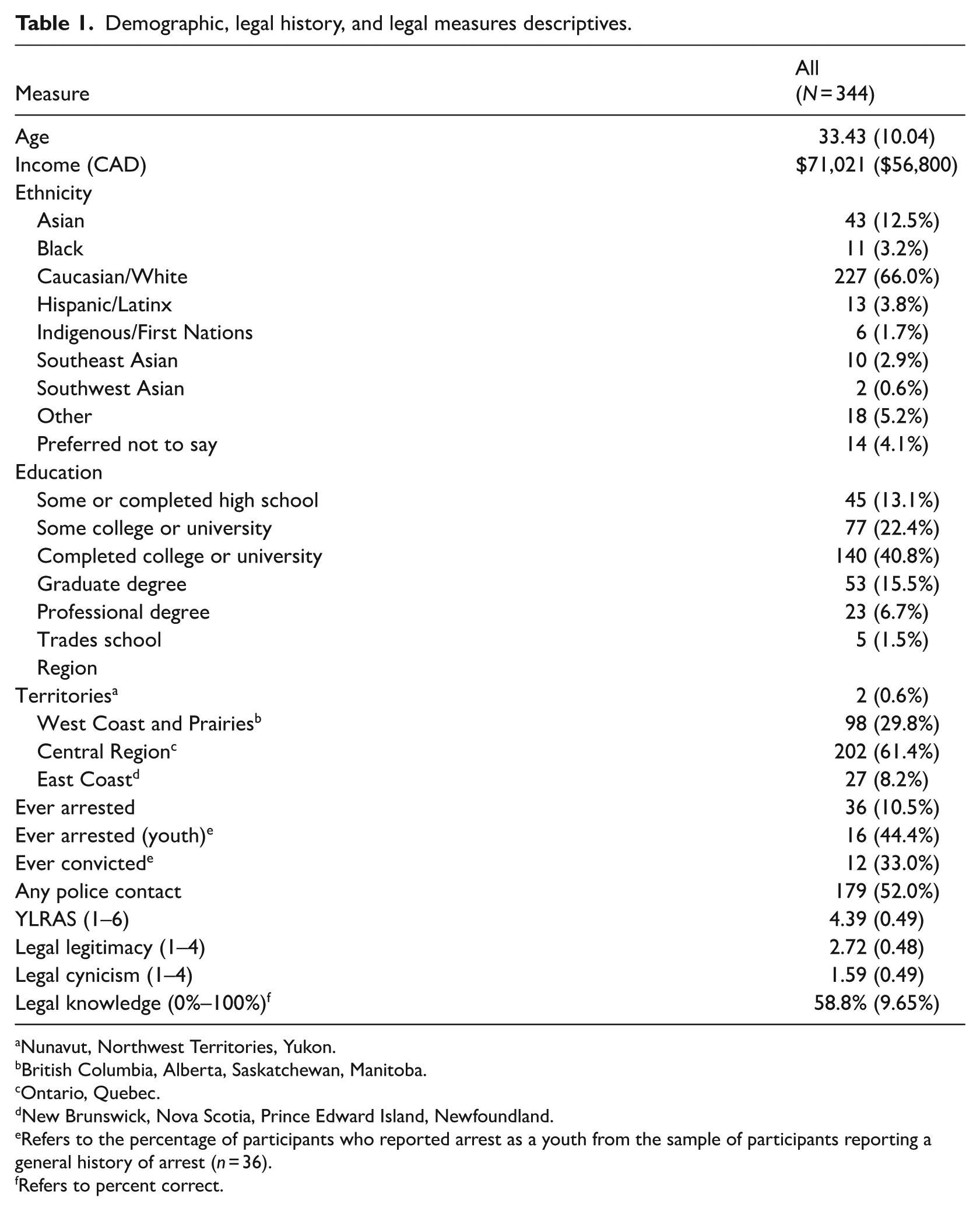
Participants reported their age, ethnicity, province, income in Canadian dollars, and education level (see Table 1). We note that we did not collect gender information from participants as gender-based analyses were not of interest; however, we discuss this limitation in the “Discussion” section.
Demographic, legal history, and legal measures descriptives.
Nunavut, Northwest Territories, Yukon.
British Columbia, Alberta, Saskatchewan, Manitoba.
Ontario, Quebec.
New Brunswick, Nova Scotia, Prince Edward Island, Newfoundland.
Refers to the percentage of participants who reported arrest as a youth from the sample of participants reporting a general history of arrest (n = 36).
Refers to percent correct.
Legal involvement
Participants reported their own history of any legal involvement (any criminal record, police contact, arrests) and any other contact with police that did not involve arrest or charges (e.g. a welfare check, witness to a crime, stopped and questioned without arrest; see Table 1).
Parenting status
Participants reported whether they were parents (“Are you a parent?” n = 158, 45.9%), their number of children (M = 1.74, SD = 1.00, range of 1–6) and children’s ages (range of 0–50), and their children’s previous legal involvement (any criminal record, police contact, arrests, child welfare involvement). Five parents (3.2%) reported their children having ever been arrested (range of 1–4 arrests), with four eventually convicted of a crime. An additional 14 parents (8.9%) reported their child as having police contact that did not involve arrest and 9 parents (5.7%) reported a history of their child’s involvement with child welfare (range of 1–7 incidents), with 3 still involved with a Children’s Aid Society.
Attitudes toward youths’ legal rights
The Youth Legal Rights Attitude Scale (YLRAS; Broeking, 2008) is a 20-item scale that measures respondents’ level of agreement with legal rights (i.e. what youth and parents should have rights to: “Young people should have rights that adults do not have,” “Parents should be involved in legal proceedings to protect young people’s rights”). The YLRAS demonstrated acceptable internal consistency (Cronbach’s α = 0.734), consistent with Peterson-Badali and Broeking (2009).
Procedural justice
The Legitimacy and Legal Cynicism subscales of the Procedural Justice Inventory (Fagan and Tyler, 2005) measure respondents’ beliefs about the legal system’s legitimacy and respondents’ legal cynicism. The Legitimacy subscale contains 11 items (e.g. “The courts generally guarantee everyone a fair hearing”) and is measured on a scale from 1 (strongly disagree) to 4 (strongly agree), with lower scores indicating lower perceived legitimacy of the justice system. The Legitimacy subscale demonstrated good internal consistency (Cronbach’s α = 0.859), consistent with Fagan and Tyler (2005). The Cynicism subscale contains 5 items (e.g. “There are no right or wrong ways to make money”) and is measured on a scale from 1 (strongly disagree) to 4 (strongly agree), with lower scores indicating lower legal cynicism. The Cynicism subscale demonstrated acceptable internal consistency (Cronbach’s α = 0.789), again consistent with Fagan and Tyler (2005).
Legal knowledge
Participants completed a modified version of a parent legal knowledge questionnaire assessing factual knowledge of youths’ and parents’ legal rights (Cavanagh and Cauffman, 2017). The scale was modified for Canadian respondents where appropriate (e.g. “district attorney” was replaced with “Crown attorney”; correct responses confirmed) and four additional items created in consultation with a Canadian legal professional to ensure accuracy at the time of data collection. The full scale (available in Appendix 1) contained 48 items with either multiple choice or true/false response options (e.g. “If the court gets your child a lawyer because they cannot afford to pay for one, who gets to decide how your child will plead?,” “Conversations I have with my child’s probation officer are confidential (kept private).” All items had a specific correct response and were not dependent on facts of a case nor on province of residence; in Canada, the Criminal Code is federal and administered by the provinces. Responses were scored as correct or incorrect and summed to create a raw score (i.e. out of 48) as well as converted to a percentage of correct responses.
The legal knowledge measure had somewhat low, but arguably still adequate, internal consistency (Cronbach’s’s α = 0.627), given that the measure’s internal reliability is likely reflecting the different domains of legal knowledge being measured. Indeed, in our above-linked online materials, we provide a breakdown of an exploratory factor analysis (EFA) that found a three-factor structure that best fit the measure. Despite the lower Cronbach’s alpha than the common standard of 0.7 being the acceptable level, we still opted to use the total score (percentage correct) as our measure of interest due to all legal knowledge domains being relevant to our key research questions. Furthermore, Nunnally (1967) argued that Cronbach alphas of ⩾0.5 were acceptable for exploratory research, whereas Hair et al. (2010) contend alphas of ⩾0.6 can be used in exploratory research. Given this study is the first to explore this measure in a Canadian context, we believe the current alpha level is acceptable for exploratory research purposes. Please see the “Results” section for an in-depth discussion of the legal knowledge measure and possible explanations for its lower internal consistency compared with the other measures included, and recommendations for future research on it.
Analysis plan
We adapted an existing measure of American parents’ legal knowledge for Canadian respondents. Best practices in scale development highlight the importance of examining latent factors underlying the development of measured constructs (Gau, 2011). Although a full psychometric analysis is not the goal of this article, in line with Gau’s (2011) recommendations, we provide the results of an EFA using item response theory of the newly adapted legal knowledge measure, the results of which can be viewed online at the materials linked above. The EFA revealed a three-factor structure that best fit the data, though eight items did not load onto any factor and were removed. All analyses below therefore rely on a 40-item scale.
To examine predictors of adults’ knowledge of youths’ legal rights, we employed a hierarchical ordinary least squares (OLS) regression framework grounded in theory rather than an exploratory stepwise approach. Specifically, we added predictors in three theoretically ordered blocks reflecting demographic, experiential, and attitudinal factors, respectively. This approach aligns with our conceptual model suggesting that demographic characteristics form a foundational set of individual differences, experiential variables (e.g. justice system contact) reflect exposure that may enhance or diminish knowledge, and attitudinal variables capture internalized views that may shape how people understand and engage with the legal system. Model 1 included the demographic predictors age and education, identified as relevant to legal knowledge in prior studies. Model 2 added experiential variables—participants’ prior police contact and history of arrest—to assess whether direct exposure to the justice system explained additional variance in knowledge. Model 3 added attitudinal variables—legal cynicism, legal legitimacy, and the YLRAS—to examine whether these beliefs further predicted legal knowledge beyond demographics and experience.
Finally, because the study was motivated by the role of parents as potential advocates for youth, we conducted supplemental analyses comparing parents and non-parents on all key variables. Group comparison analyses (i.e. parents vs non-parents) were conducted using bootstrapped t-tests and Chi-square analyses with a Bonferroni correction for multiple comparisons to identify any potential group differences.
Results
Bivariate analysis
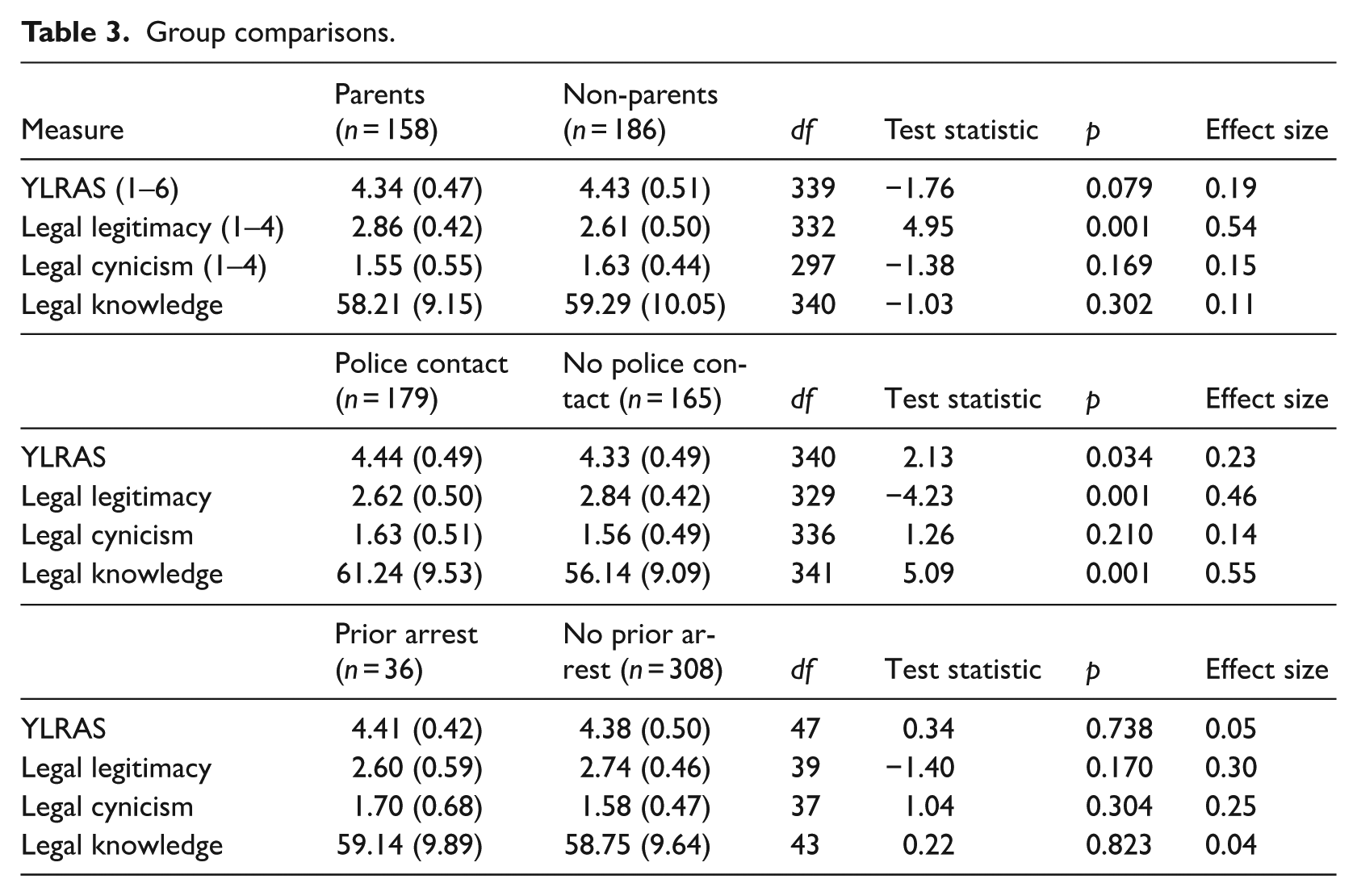
Participants overall scored 58.8% on the legal knowledge questionnaire (see Table 1). There was also no significant difference in legal knowledge between those with a college degree or higher or those without and those with or without a history of arrest or conviction, but participants with a history of police contact had significantly higher legal knowledge scores compared with those without such history (see Table 3). Because so few parents reported having a child with system involvement (e.g. contact with the police, n = 14), we could not explore whether being the parent of a justice-involved child was related to legal knowledge. However, parents of justice-involved youth (n = 5) correctly answered an average of 59.7% (SD = 10.92) of questions, indicating a slightly higher score but overall similar to the overall sample mean score.
We additionally examined whether there was a relationship between a participant’s prior criminal justice contact and their scores on the legal attitudes scales. These analyses revealed that participants who disclosed having had contact with the police reported lower levels of legal legitimacy compared with participants without prior police contact (see Table 3). No other significant relationships between prior justice-system contact and legal knowledge or attitudes emerged.
OLS regression
Three OLS regressions were conducted, adding variables to examine the effects of categories of variables on the overall model (see Table 2). These models revealed that older age, a history of police contact that did not include arrest and/or conviction, and endorsing more positive attitudes toward youths’ legal rights (YLRAS score) were associated with a higher percentage correct score on the measure of legal knowledge (see Table 2). Important to note is overall improved model fit, as indicated by the adjusted R2, as each model was run; while demographics (age) remain significant across all models, experiences (any police contact) and legal attitudes (support for youth rights) continued to explain additional variance in legal knowledge.
Predicting percent correct on the legal knowledge scale.
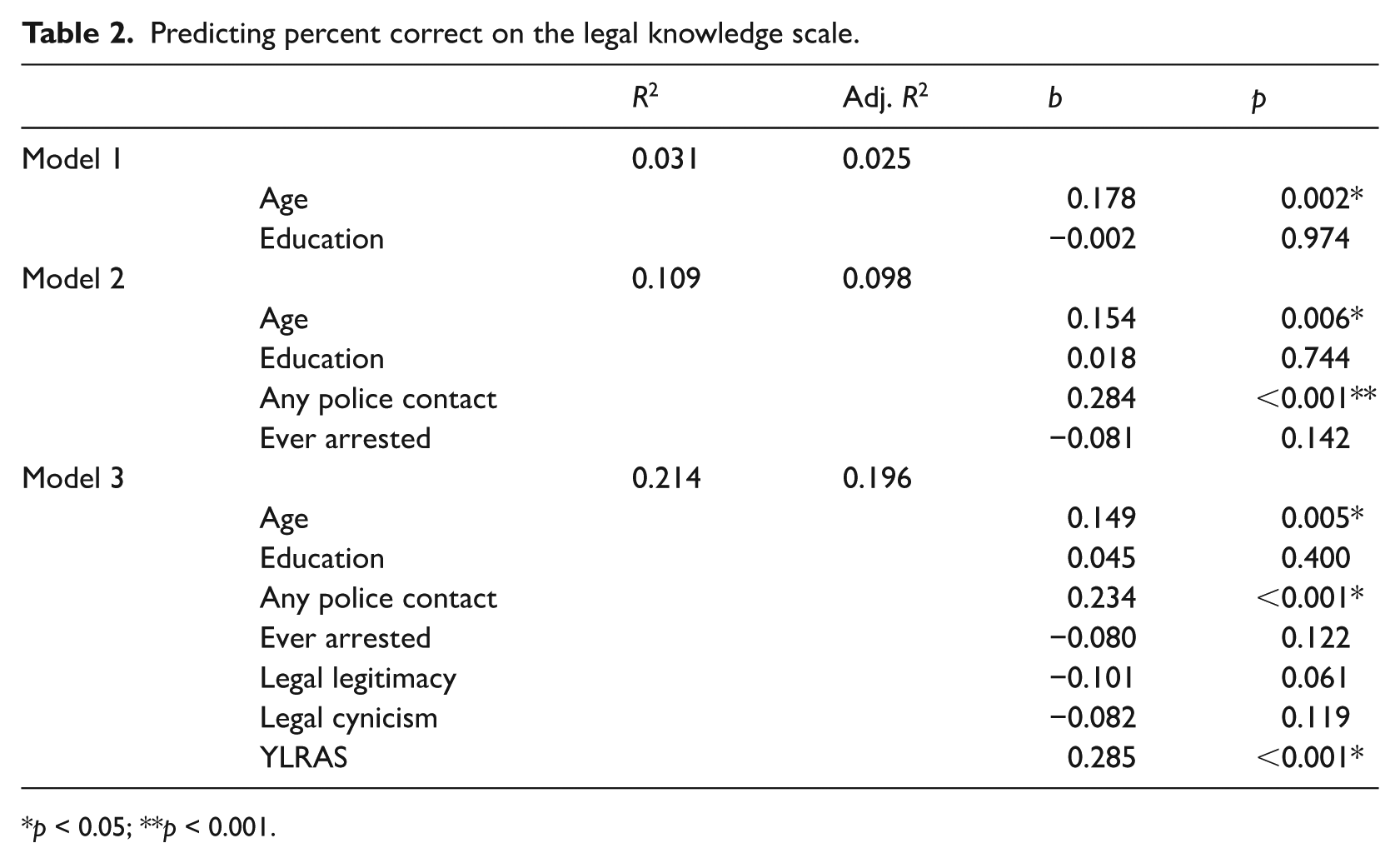
p < 0.05; **p < 0.001.
Parental status
Finally, in line with our suggestion that being a parent may confer certain types of knowledge that non-parents may not receive, we also considered whether parents may differ from non-parents on their level of legal knowledge. Parents (n = 158) and non-parents (n = 186) did not differ on any demographic or history of legal system involvement variables except age (t[269.66] = 10.34, p < 0.001) and education (χ2[5] = 17.99, p = 0.003), such that parents were older and had completed more post-secondary education (i.e. completed college or university, graduate or professional degree). For legal-related measures (see Table 3), parents endorsed significantly more legal legitimacy compared with non-parents, but did not differ significantly on the YLRAS or legal cynicism. Ultimately, parents did not differ significantly from non-parents on their level of legal knowledge with parents and non-parents answering 59.14% and 58.75% of the items correctly, respectively.
Group comparisons.
Discussion
Over the past three decades, legislative reforms in Canada and the United States have increasingly sought to centralize the role and responsibilities of parents and families in youth justice. Underpinning these policies, critics have argued, are unrealistic expectations of parents of justice-involved youth. The results of the present analyses indicate that these criticisms have merit. On a knowledge test concerning youths’ legal rights, Canadian adults demonstrated a relatively poor understanding of the justice process and procedures, answering just over half of the questions correctly. Indeed, the mean score of 58.8% is strikingly similar to results from US samples using comparable instruments (e.g. Cavanagh and Cauffman, 2017; Warner and Cleary, 2022), suggesting that limited adult legal knowledge is not unique to Canada but rather reflects a broader cross-national pattern of inadequate civic legal literacy.
Furthermore, parental status did not translate into better knowledge of youths’ legal rights, suggesting that merely being a parent does not result in a unique socialization that would endow parents with the capacity to serve as legal advocates for their children, despite their adult status. This finding has direct implications for the YCJA, which explicitly relies on parents to help safeguard youth’s procedural rights. Our results suggest that this reliance may be misplaced, as parents do not appear to possess greater legal understanding than other adults. In effect, the YCJA assumes a level of legal competency and procedural literacy that the present data indicate is not widespread among Canadian adults. This suggests that overall, adults are not well equipped to advocate for youth in a criminal context. Parents who wish to engage in the legal process with their child also do not fully understand their children’s rights and therefore cannot adequately serve in the role enshrined for them in the YCJA. Despite good intentions, the YCJA seems to place Canadian parents and their children in a vulnerable position within the justice system. These findings underscore a need to reconsider the assumption that parental advocacy can substitute for professional legal advice and protection. Below, we first discuss our findings related to predictors of legal knowledge, followed by discussion of the specific implications of the legal knowledge measure.
Factors associated with legal knowledge
In line with some prior literature, this study found that adults who themselves have had prior police contact demonstrated better understanding of youths’ legal rights. It has been suggested that personal experience with the justice system may confer experiential knowledge about how the system works which may benefit parents of justice-involved youth. However, our “prior police contact” variable did not include arrest or conviction; it is possible that police contact as a witness, victim, or support person may provide some knowledge of legal rights. It is also possible that age may explain some of this relationship between prior police contact and legal knowledge; older participants performed better on the measure of legal knowledge, even when accounting for related predictors such as education level. Age may also provide more opportunity for police contact, thus increasing legal knowledge.
This pattern also illuminates a paradox noted in the literature: that personal contact with the justice system may simultaneously increase knowledge while eroding perceptions of legitimacy (Fagan and Tyler, 2005). Consistent with this dynamic, participants in our study who reported prior police contact scored higher on legal knowledge but reported lower legal legitimacy. This tension suggests that experiential learning about the justice system may come at the cost of diminished trust in its fairness, raising complex questions about how legal literacy and legal confidence develop in tandem or opposition.
Perhaps most surprising was that adults who endorsed more positive attitudes toward youths’ legal rights also performed better on the legal knowledge measure. It may be that individuals who are more legally literate are more aware of the vulnerabilities that defendants, particularly youth defendants, face within the legal system, resulting in their higher endorsement of youths’ legal rights. Alternatively, it may be that individuals with poorer or misinformed perceptions of youth crime and legal rights are more likely to endorse more punitive attitudes toward youth offenders, an idea that has been supported by prior research in Canada (Baron and Hartnagel, 1996; Covell and Howe, 1996; Shaw and Woodworth, 2013). Interestingly, legal legitimacy and cynicism were unrelated to legal knowledge, so it may be that positive attitudes toward youths’ rights specifically matter for legal knowledge, but legal attitudes more broadly do not. Perhaps the absence of a relationship between legal cynicism and legal knowledge was due to a lack of variability in this sample. The legal cynicism variable had a possible value range from 1 to 4, with a mean of 1.59. This suggests a relatively low level of legal cynicism in this sample, a perhaps unsurprising finding given the social and demographic features of MTurk samples. However, MTurk samples have been found to be generally representative of the population, with some caveats that they are Internet users with an interest in research participation (e.g. McCredie and Morey, 2019). To what extent legal attitudes may be related to legal knowledge in more racially and socially diverse samples should be investigated further.
Indeed, it should be noted that our sample is fairly well educated, with nearly two-thirds of respondents indicating that they have at least some college education and nearly a quarter reporting a graduate or professional degree. As such, the results presented here should be seen as a conservative estimate of parental legal knowledge. However, it is important to note that in a post hoc analysis, no significant differences emerged between participants with a college degree or higher and those without on the legal knowledge measure. Fine et al. (2017) found that 61% of mothers of justice-involved youth reported education levels equal to or less than high-school completion or a GED. Importantly, in the current study and others (e.g. Cavanagh and Cauffman, 2017), education level is associated with legal knowledge such that parents with more education demonstrate higher rates of legal literacy, suggesting that legal knowledge among parents of justice-involved youth may be even lower than the 58.8 percent accuracy reported here. Thus, parents may lack the legal literacy required to meaningfully advise or inform their child or participate in other ways not captured in this measure (e.g. knowing how to access legal services, knowing what questions to ask attorneys). Related to legal literacy is again the larger concern of parents’ own moral socialization and that of their children regarding honesty, truth-telling, and accountability, which may serve them well in prosocial contexts but work against them in legal contexts. Parents are not always aware that police can lie during interrogations (Woolard et al., 2008), which could result in parents giving poor advice or incorrectly trusting the police accounts of the incident. Furthermore, as Varma (2007) noted, it is not uncommon that parents specifically ask for legal outcomes (e.g. custody and detention) that may be perceived by them as handing down a consequence for antisocial behavior. However, more serious outcomes being requested may reflects parents’ own moral desires, rather than effective legal responses or advice.
Limitations and strengths
While this study provides critical insights into the question of whether parents have the legal capacity to assist their child in navigating the Canadian justice system, we acknowledge several limitations. First, the legal knowledge measure used in this study was developed in conjunction with a legal practitioner and based on a pre-existing measure. While the current study provides some evidence that this measure captures important constructs about legal knowledge, future research should continue to evaluate the robustness of this instrument in different samples. We also recommend future research to consider shortened versions of this scale and other scales relevant to legal knowledge. Second, as reported earlier, an MTurk sample is likely more highly educated than, and therefore less representative of, parents of justice-involved youth. Indeed, very few participants reported having children with any justice system contact. Future research sampling parents of justice-involved youth may result in a different pattern of findings. That said, our findings should provide a conservative estimate of parents’ general legal knowledge. Finally, gender data was not collected in the demographic survey and so we cannot compare the legal knowledge of mothers versus fathers. Most prior studies of parents’ legal knowledge have involved mothers (e.g. Cavanagh and Cauffman, 2017) and indeed most parents who attend court with their children in Canada are mothers (Varma, 2007). Furthermore, there is recent evidence that parent gender significantly predicts interrogation knowledge, and the type of advice parents give to their child (Warner and Cleary, 2022). However, our primary research question concerned whether being an adult mattered for legal knowledge and not specifically being a mother or father. The YCJA also does not distinguish between parents’ gender identities, only that the role of the parent(s) is important. Future research should expand on the present findings and distinguish between mothers’ and fathers’ legal knowledge. Finally, this sample primarily consists of White and Asian adults. While there is growing evidence documenting the ways in which social privilege may influence parental legal knowledge and strategies for navigating legal encounters (Warner and Cleary, 2022), recent policy reviews have also highlighted the importance of considering the ways in which race and ethnicity may produce unique vulnerabilities and experiences with the criminal justice system that likely influence their knowledge and attitudes toward the law (Cleary and Crane, 2023). Thus, the findings of this study are largely limited to the knowledge of more privileged Canadian adults; however, it should be noted that White and Asian (specifically South Asian and Chinese) populations are the largest ethnic groups in Canada (Statistics Canada, 2022).
Despite these limitations, the current study breaks new ground by examining knowledge of youths’ legal rights within a Canadian sample, addressing a critical assumption underlying youth criminal justice policy in Canada. Furthermore, this study developed and validated a new legal knowledge instrument to facilitate the replication and extension of research on this topic. The paucity of research on parental legal literacy, in Canada as well as beyond its borders, is a significant gap that must be addressed if parents are to meaningfully contribute to their child’s legal involvement and outcomes.
Policy implications
Prior studies in the United States have suggested improving parental knowledge through parental education (Cavanagh and Cauffman, 2017). It is reasonable to predict that educating Canadian parents about their children’s legal rights could improve scores on the test of legal knowledge used in the present study. Given our findings, such efforts might include structured parent education programs offered through schools or community centers, as well as the development of plain-language materials explaining youth legal rights and the justice process. More broadly, the results support calls for civic legal literacy initiatives aimed at improving baseline public understanding of due process rights and legal protections for minors.
However, some scholars have pointed out that parents not only lack adequate legal knowledge but additionally face conflicts of interest that may hinder their ability to serve as an advocate for their child even if properly informed of their child’s rights (Farber, 2004; Henning, 2006). While parents in the United States typically face more conflicts of interest, including possible civil and criminal consequences as the result of their child’s delinquency, Canadian families likely also face familial conflicts that educational courses would not remedy. Varma (2007) in her study utilizing systematic social observations of Canadian juvenile court proceedings, for example, reported several cases in which mothers, who had reported being victimized by their adolescent child, asked the court to sentence their child to secure custody. Thus, while education for parents of justice-involved youth may be useful, it may be insufficient to address the concerns of legal and criminal justice scholars regarding parent–child conflicts of interest and parental advocacy.
Some experts have also suggested that youth entering the justice system should be provided mandatory, nonwaivable legal counsel (Farber, 2004; Feld, 1989, 2006; Feld and Schaefer, 2010; Grisso, 2024; Henning, 2006). The findings from this study, in conjunction with the prior literature, suggest that this recommendation for nonwaivable counsel is warranted. Indeed, some scholars have suggested that the recent emphasis on parents may be a misguided approach to procedural protections which should be aiming to fortify the youth’s ability to engage meaningfully with their due process rights (Jeffs and Brian, 2021). It is also possible that counsel itself is not always needed, but an advocate trained in the legal process may benefit. For example, the Texas approach to juvenile questioning requires the youth to meet with a magistrate. This strategy may be more fruitful in circumventing the financial costs associated with mandatory appointment of counsel while still providing more robust legal protections for youth that are not afforded by parents. Importantly, the absence of differences in knowledge between parents and non-parent adults found in this study suggest that states that recognize the potential legal conflicts of interest that may exist between parents and their justice-involved child (e.g. Kansas, Indiana, and Utah) and allow for “friendly adults” to act in place of parents does not open the door to disparities based on legal literacy for youth for whom it would not be wise to rely on parental advice, an important addition to the literature.
In conjunction with more reflective policy, evaluations should be conducted of the recent reformations to youth justice laws in Canada and abroad (e.g. more US states requiring that a parent or interested adult be present for or consent for youth waiving their Miranda rights; Jeffs and Brian, 2021) to fully understand the impact of placing parents in roles that require legal knowledge to perform well. Evaluation of these laws should strive to not only understand the effects parental roles as advocates or advisees may have on youth justice outcomes, but also to understand how these roles may impact the health and well-being of Canadian parents and families as a whole. The evaluations from these policies should then be compared with outcomes for US states moving toward mandatory counsel policies to identify whether these opposing policy tracks produce disparities in justice, developmental, or familial outcomes in order to inform youth justice reforms moving forward.
Conclusion
Parents’ legal knowledge of their child’s rights has significant implications for their ability to effectively support their child during legal involvement. However, despite the YCJA’s explicit inclusion of parents as having an important role, it appears that Canadian adults, in general, possess relatively little knowledge of youths’ legal rights and that parents do not appear to know more about youths’ legal rights than non-parents, findings that mirror studies from the United States. This calls into question the assumption that parents are prepared to effectively advise and advocate for their child during justice processing. While parents may be able to play an important supportive and rehabilitative role for justice-involved youth, the current study suggests that the role of legal advisor and procedural safeguard is not an appropriate or fair role for legislatures to place on parents.
Footnotes
Appendix 1
Acknowledgements
The authors thank Hayden Moore for her assistance with the modification and development of the legal knowledge questionnaire and R. Philip Chalmers for his assistance with Item Response Theory analysis and interpretation. Portions of this research were presented at the annual meeting of the American Psychology-Law Society in New Orleans, LA, USA (2020) and the American Psychology-Law Society in San Juan, Puerto Rico (2025).

Ethical considerations
This study received approval by the University of Ontario Institute of Technology’s ethical review board.
Funding
The authors received no financial support for the research, authorship, and/or publication of this article.
Declaration of conflicting interests
The authors declared no potential conflicts of interest with respect to the research, authorship, and/or publication of this article.