






Abstract
Procedural justice and legitimacy are increasingly recognized as central to policing. While prior research has established the justice–legitimacy link, most studies focus on general adult populations, with limited attention to system-involved individuals and even less to youth. This study examines the applicability of the process-based model by analyzing detained juveniles’ (n = 377) perceptions of procedural justice, trust and obligation to obey, and willingness to cooperate with police. Data collected from 2011 to 2013 show strong support for the framework, demonstrating that perceptions of procedural justice, trust, and obligation to obey significantly shape detained youths’ willingness to cooperate with the police.
Introduction
Over the past two decades, legitimacy has been increasingly recognized as an important outcome for the police (Mazerolle et al., 2013; Papachritos et al., 2012). Typically defined in terms of trust in the authority of the police and a normative obligation to obey the law (Reisig and Mesko, 2009), legitimacy represents a shift away from the instrumental, deterrence-based framework for securing law-abiding behavior among civilians. That is, civilians comply with the law (and cooperate with police) because they believe it is the right thing to do, not because they fear the repercussions of getting caught for a law violation. However, the emergence of legitimacy alters the dialogue over police, community relationships in several important ways, most notably, through recognition that every police, civilian encounter has the potential to affect perceptions of police, as well as civilian behavior in the future. This last element is perhaps the most important for police, as a large body of research has linked police legitimacy to increased levels of civilian compliance with police commands during an encounter, cooperation with police authority (e.g. reporting crimes), and obedience to the law (Hinds, 2009; Hinds and Murphy, 2007; Tyler, 1990; Tyler and Huo, 2002).
There are several pathways to achieve legitimacy, but the process-based, procedural justice mechanism has received the most attention and empirical support (Mazerolle et al., 2012; Tyler and Fagan, 2008; Tyler and Huo, 2002). When police exercise their authority fairly (i.e. in a procedurally just manner), civilian perceptions of police legitimacy become more positive (Mazerolle et al., 2013; Sunshine and Tyler, 2003; Tyler, 2006). Though the procedural justice-legitimacy link is well established in the literature, 1 much of the research in this area has relied on general population studies of adults, whereby research participants are asked to recall past encounters with police. Only a handful of studies have explored the procedural justice–legitimacy relationship among those who are actually involved with the criminal justice system (e.g. Papachristos et al., 2012; Paternoster et al., 1997; Reisig and Mesko, 2009), and even fewer studies have examined the question among system-involved youth (Fagan and Piquero, 2007; Fine et al., 2017; Lee et al., 2010; Piquero et al., 2005).
Juveniles who have been arrested and incarcerated offer a unique perspective on the police and the normative framework for law-abiding behavior (Brunson, 2007). Moreover, adolescents are still developing emotionally and psychologically (i.e. are undergoing legal socialization; Piquero et al., 2005), and they are more likely than adults to have future contact with police (Hurst and Frank, 2000; Murphy, 2015). Despite the prominence of procedural justice and legitimacy theory in policing research, the full procedural justice–legitimacy–cooperation framework has not been empirically tested among justice-involved youth. This gap is especially consequential given that detained adolescents are both developmentally distinct and disproportionately likely to experience continued contact with law enforcement. Empirically examining this framework with a sample of detained youth population can help determine whether foundational legitimacy processes operate similarly during adolescence and whether early justice experiences may shape long-term relationships with legal authority.
The current study explores the applicability of this framework to justice-involved youth. Specifically, this study examines whether perceptions of procedural justice impact perceptions of legitimacy (measured as trust and obligation to obey) and, in turn, whether these perceptions impact willingness to cooperate with the police. Examining perceptions of procedural justice and legitimacy among system-impacted detained youth provides a meaningful contribution to our knowledge base and furthers our understanding of how these important principles affect juveniles’ cooperation with police and law-abiding behavior (or lack thereof).
Procedural justice, legitimacy, and willingness to cooperate with the police
The concept of legitimacy has been widely used by social scientists for decades. In criminal justice research, it is often defined as “a psychological property of an authority, institution, or social arrangement that leads those connected to it to believe that it is appropriate, proper, and just” (Tyler, 1990: 375). Within the context of criminal justice organizations, specifically police agencies, research has focused on how legitimacy shapes the public’s attitudes and behavior (Crank, 2003; Tyler, 2004). Prior research has consistently connected enhanced police legitimacy to important outcomes for the police, most notably civilian compliance with police commands during an encounter, cooperation with police authority (reporting crimes, providing information about crimes, satisfaction, etc.) (Pryce, 2018), and obedience to the law (Hinds, 2009; Hinds and Murphy, 2007; Tyler and Huo, 2002). For example, Mastrofski et al. (1996) and McCluskey et al. (1999) examined public behaviors during encounters with police and reported that compliance with police commands was strongly associated with the perceived legitimacy (also see Mazerolle et al., 2012). Sunshine and Tyler (2003) and Tyler and Fagan (2008) confirmed the relationship between perceptions of legitimacy and cooperation with the police, including increased willingness to report a crime. Researchers have concluded that the more legitimate the police are perceived to be, the more likely people will be willing to cooperate with them (Mazerolle et al., 2013).
Legitimacy, however, does not occur in isolation (see Tankebe, 2013). Research indicates that attitudes toward police performance help shape perceptions of police legitimacy. That is, if the public perceives that the police are effective, they are more likely to view the police as legitimate (Hinds and Murphy, 2007; Tankebe, 2009). Other mechanisms for achieving police legitimacy include distributive justice (i.e. fairness in the distribution of police services and activities; Jonathan-Zamir and Weisburd, 2013), legal legitimacy (i.e. the law is perceived as being legitimate; Jackson et al., 2011), and tradition (i.e. the generational views of police in a community; Reiner, 2000).
However, the most studied and most supported mechanism for achieving legitimacy is procedural justice. Procedural justice is typically defined as the manner in which police treat the public and the fairness of the decisions that police make (Reisig and Lloyd, 2009; Sunshine and Tyler, 2003). Tyler and Wakslak (2004) identified three main components of procedural justice: (1) quality of decision making – perceived neutrality and consistency; (2) quality of treatment – being treated with dignity and respect, having one’s rights acknowledged; (3) trustworthiness – believing that the authorities are acting out of benevolence and a sincere desire to be fair. A fourth element (4) citizen participation (the opportunity to state one’s case), an element introduced in early procedural justice research (see Leventhal, 1980; Thibaut and Walker, 1975), is also a widely used component of procedural justice (see Mazerolle et al., 2012). Often described as the process-based model of regulation, or normative framework, these four factors shape police encounters with citizens and subsequently influence perceptions of police legitimacy (Tyler, 1990, 2006). 2
According to the normative framework, perceptions of legitimacy are influenced by the manner in which officers carry out procedures during specific encounters with police officers (Skogan and Frydl, 2004; Tyler, 2003, 2004). That is, legitimacy will be achieved if the individual believes that the police officer acted in a fair – or procedurally just – manner (Sunshine and Tyler, 2003). The literature supporting the procedural justice-legitimacy link is robust (see Mazerolle et al., 2013; Paternoster et al., 1997; Tyler, 1990). The effects of procedural justice on legitimacy, however, have been found to be mediated by a number of factors, including gender (Correia et al., 1996), race or ethnicity (Carter, 1985; Rice and Piquero, 2005), education (Cao et al., 1996), location of encounter and characteristics of the community (Jacob, 1971; Priest and Carter, 1999; Shafer et al., 2003), or type of contact (Skogan, 2005).
While studies have compared the different pathways for achieving police legitimacy, procedural justice has been found to be the most powerful (Hinds and Murphy, 2007; Murphy and Gaylor, 2010; Sunshine and Tyler, 2003). Furthermore, legitimacy can be damaged by police behavior that is perceived as being procedurally unjust (Fischer et al., 2008). For example, Gau and Brunson (2010) found that widespread use of pedestrian stops (i.e. stop and frisks or “Terry stops”) was perceived by young males as unfair, which led to diminished views of police legitimacy. Kane (2005) suggested that compromised legitimacy will not only lower citizen compliance and cooperation with the police but may also lead to increases in crime, especially in disadvantaged neighborhoods, as citizens solve their problems through alternative, sometimes violent means. Finally, this body of research supports the belief that, when treated in a procedurally just manner, individuals are more likely to perceive the police as legitimate regardless of the severity or nature of the outcome (i.e. being cited and released vs being arrested) (Tyler, 1990). Put succinctly, what is arguably most important is that procedural justice and legitimacy further impact willingness to cooperate with the police. Thus, procedurally just interactions can lead to increased perceived legitimacy, which in turn will lead to more willingness to cooperate with the police (Mazerolle et al., 2013; Tyler, 2006).
Youths’ perceptions of the police: A focus on procedural justice and legitimacy
A sizable body of research has examined youths’ perceptions of and attitudes toward the police (see Fine et al., 2017; Foster et al., 2022; Trinkner et al., 2019; Vidal et al., 2016). Studies have consistently found that age is negatively correlated to both satisfaction with and perceptions of the police (Hurst and Frank, 2000; Leiber et al., 1998; Rios, 2006; Schulhofer et al., 2011), with the levels of negativity increasing during late adolescence (Fagan and Tyler, 2005; Fine et al., 2020). Studies have also found that youths’ attitudes toward the police can be affected by community ties (Cao et al., 1996; Landau, 1981), social background (Leiber et al., 1998), commitment to anti-social behavior (Brick et al., 2009), prior contact with the police (Hofer et al., 2019; Slocum and Wiley, 2018; Slocum et al., 2016), and by the experiences of their friends (Brunson, 2007; Flexon et al., 2009).
Research on perceptions of and attitudes toward police has also shown consistent variation in attitudes across race and ethnicity. African American youth tend to be less supportive and less trusting of police compared to their white peers (Foster et al., 2022; Slocum and Wiley, 2018; Wu et al., 2015; Zhang et al., 2020). Although less studied, research indicates that Hispanic youth view police less favorably than white youth but more favorably than African American youth (Rengifo and McCallin, 2017; Slocum and Wiley, 2018; Wu et al., 2015). Findings from a study of detained youth suggested that, regardless of frequency of police contact, minority youth perceived the police as less legitimate, fair, and trustworthy compared to White youth (Vidal et al., 2016). Lee et al. (2010) found that ethnic identity played a complex role as African American adolescents with greater ethnic identity were more likely to view the police as discriminatory, but were also more likely to perceive the police as legitimate. The authors suggested that ethnic identity development may be a proxy for cognitive and psychosocial maturity. The same cognitive abilities that allowed youth to be more aware of racial discrimination may also make them mature enough to develop an understanding that the police were a necessary and legitimate institution for maintaining social order (Lee et al., 2010).
While prior research has examined global police perceptions, few studies have applied the procedural justice-legitimacy framework to youth, especially those who are justice system-involved. Piquero et al. (2005) tested the relationship between perceptions of procedural justice and two components of legal socialization – legitimacy and legal cynicism – among more than 1300 juvenile offenders between the ages of 14 and 18. They found that measures of legitimacy and legal cynicism were stable over time, and that youths’ procedural justice perceptions of police were positively associated with their perceptions of police legitimacy. Fagan and Piquero (2007) similarly found that procedural justice is a significant predictor of legitimacy (but not legal cynicism), which contributed to the decline in youth offending over time.
Comparing survey data from a community sample of Australian youth and adults, Murphy (2015) examined the importance of procedural justice for fostering youth support and cooperation with police. Results indicated that procedural justice held similar importance for both adults and youth in influencing perceptions of police legitimacy. However, age moderated how procedural justice influenced the willingness to report crime to the police, with procedural justice being particularly important for youth (Murphy, 2015). Using a sample of youth detained in a juvenile detention facility in the United States, Vidal et al. (2016) examined how youths’ actual experiences with the law, including frequency of contact with the police, related to their perceptions of support, fairness, and trust toward the police and the law generally. They found that youth with more police contacts viewed the police as less legitimate, reported lower perceived obligation to obey the law, and higher cynicism toward the law.
It is important to study the experiences of young people because the developmental process of legal socialization takes place during childhood and adolescence; youth come to learn about the law and the legitimacy of authority through their personal experiences and social interactions (Fagan and Tyler, 2005). While the studies described above provide some insights into the degree to which the normative, process-based framework is relevant for juveniles, a formal, complete test of the process-based model of regulation is necessary to be able to provide more concrete recommendations for policy and practice. Hence, an assessment of the effect of procedural justice on legitimacy, and in turn, on willingness to cooperate with the police, is necessary to provide suggestions for a positive relationship between the police and system-involved youth.
Present study
Although procedural justice theory has become the dominant framework for understanding police legitimacy and public cooperation, its full pathway, from perceptions of fairness to legitimacy and ultimately to cooperation, has not been empirically tested among justice-involved youth, particularly those in detention. This omission is both theoretically and practically significant. Detained adolescents are undergoing critical stages of legal socialization and are disproportionately likely to experience continued contact with law enforcement, making their perceptions of authority especially consequential. The present study addresses this gap by testing the integrated procedural justice–legitimacy–cooperation framework within a detained youth population.
The goal of this study is to examine the applicability of this framework for system-involved youth by using data from a sample of recently arrested and detained juveniles in a large Southwestern county (n = 377). Between 2011 and 2013, these youth responded to a series of validated survey items assessing their general perceptions of procedural justice and legitimacy, including perceptions of trust and obligation to obey, as well as their reported likelihood of cooperating with law enforcement (e.g. providing information or contacting the police). This study serves two purposes. First, we test whether the procedural justice-legitimacy (legitimacy measured as trust and obligation to obey) relationship persists among a sample of incarcerated juveniles while controlling for other relevant factors. Second, we test the final component of the normative framework by assessing the relationship between youth perceptions of procedural justice, legitimacy, and willingness to cooperate with police.
By extending this foundational model to a high-contact, developmentally distinct group, the study advances the procedural justice literature and provides new insight into how legitimacy processes operate during adolescence among those most directly embedded in the justice system. The paper concludes by discussing the theoretical and practical implications of the findings for the procedural justice-legitimacy model and the significance of fair police treatment during formal interactions involving youth.
Data and methods
As stated above, the current study examines data from interviews of 377 juveniles arrested in a large county in the Southwest, from 2011 through 2013. The overall goal of the research project through which these data were collected was to assess the prevalence and incidence of drug use among the detained population. The project methodology was grounded in a systematic sampling protocol with quarterly data collection from the county jail facility. During data collection periods, interviews are conducted with arrestees who are randomly selected based on booking time using a stock (i.e. arrested during non-data collection hours) and flow (i.e. arrested during data collection hours) selection process. Each selected arrestee was asked to complete the survey instrument, which gathered a range of self-report data on background and demographics as well as a wide range of individual-level attributes. Participants were also asked to provide responses to a questionnaire measuring perceptions of the police, which included questions conventionally used to measure perceptions of procedural justice and police legitimacy.
Methodological considerations
In recent years, scholars have raised concerns about how procedural justice and legitimacy are both defined and measured. Several researchers have emphasized the need to critically evaluate the constructs and suggested revisiting how they are conceptualized and operationalized (see Gau, 2011, 2014; Johnson et al., 2014; Reisig et al., 2007; Tankebe, 2013). In light of these discussions, this study first explored whether such measurement challenges were present with our sample. To investigate this, an exploratory factor analysis (EFA) was conducted to test the convergent and discriminant validity of the theoretical dimensions of procedural justice and legitimacy. Following the EFA, a confirmatory factor analysis (CFA) was performed to validate the identified factors and determine whether the conceptual models of procedural justice and legitimacy were supported by the data, following guidelines provided by Tabachnick and Fidell (2007).
While results from the EFA could be deemed acceptable, the CFA findings revealed that “trust” emerged as a separate construct from legitimacy. When the model included the “trust” item (Model 2), the fit indices indicated a weaker model fit (root mean square error of approximation (RMSEA) = 0.096; comparative fit index (CFI) = 0.986; Tucker–Lewis index (TLI) = 0.977; χ² = 58.086, ***p < 0.001). In contrast, excluding the “trust” item (Model 1) resulted in significantly improved fit statistics (RMSEA = 0.05; CFI = 0.997; TLI = 0.995; χ2 = 15.547), reflecting a better-fitting model. These outcomes supported the decision to treat trust as its own variable, operationalized accordingly based on the factor structure (see Supplemental Appendix B).
Outcome variables and main predictors: Procedural justice, trust, obligation to obey, and willingness to cooperate
Procedural justice
Guided by the results of the factor analysis and reliability tests, the procedural justice measure was derived from four valid and reliable questions covering quality of treatment, quality of decision making, and distributive fairness: Police treat citizens with respect; Police take time to listen to people; Police treat people fairly; Police respect citizens’ rights. Participants responded to each of the questions using a Likert-type scale with responses for “strongly disagree,” “disagree,” “agree,” and “strongly agree” (e.g. 0–3, higher scores indicated higher levels of procedural justice). The procedural scale was found to have strong reliability (4 items; α = 0.835).
Trust and obligation to obey
Guided by the results of the CFA, legitimacy was operationalized as trust and obligation to obey. 3 Two items were used to measure obligation to obey: You should accept police decisions, even if you think they are wrong; You should do what police tell you to do, even if you disagree. One item was used to measure trust: The police can be trusted to make decisions that are right for your community. Participants responded to each of the questions using a Likert-type scale with responses for “strongly disagree,” “disagree,” “agree,” and “strongly agree” (e.g. 0–3, higher scores indicated higher levels of procedural justice). The obligation to obey scale was found to have acceptable reliability (two items; α = 0.760).
Willingness to cooperate
The cooperation with police measure was created based on eight items: How likely you would call police to report a theft/burglary where you were the victim; How likely you would call police to report minor (misdemeanor) crime; How likely you would call police to report a serious (felony) crime; How likely you would call police to report a violent crime where you were the victim; How likely you would call police to report suspicious activity near your house/apartment/ residence; How likely you would call police to report suspicious activity near your neighborhood; How likely you would call police to provide information to help find a suspected criminal; How likely you would call police to provide information anonymously to help find a suspected criminal (same Likert-type scale as above). The cooperation scale showed robust reliability (eight items; α = 0.927).
Control variables
The interview instrument captured a range of individual-level variables that serve as important covariates in the examination of the procedural justice-trust and obligation to obey relationship. First, we include three individual-level demographic characteristics: gender, age, and race/ethnicity. Gender was measured using self-report data (male = 1). Age was measured using a self-reported continuous variable. Race/Ethnicity was measured using self-reported data and includes four different racial/ethnic groups: White, Black, Hispanic, and “other.” The “other” category includes those respondents who self-reported being Native American, Asian, Hawaiian or Pacific Islander, mixed, or from an “other” racial or ethnic group.
We also include two variables that allow us to control for social bonds: employment 4 and school attendance. Currently Employed measures whether the participant was employed at least part-time (currently employed = 1). Still Attending School is a self-reported item that measures whether the participant still attends school (yes = 1).
We include controls for the type of arrest, substance use, mental health issues, and prior detention. Specifically, we include dummy variables that measure whether the arrest was a Misdemeanor (yes = 1) or a Felony (yes = 1). Status offenses were used as the reference category. Furthermore, we include a number of situational factors. We control for drug and alcohol use by including variables that measure whether the participant tested positive for having used alcohol or drugs in the 48 hours prior to detention. Participants were asked, “Have you [ever] been told by a counselor, social worker, or doctor that you have a mental illness, or emotional problem?” If they responded yes, then their response was coded 1, indicating that they had been told they had a History of Mental Illness in the past. Participants were also asked, “Have you [ever] been incarcerated in county jail?” The responses were coded as yes = 1 and no = 0.
Finally, we also control for other perceptions of the police, which include “Police try to solve problems or do something when called,” labeled as Police Effectiveness, and “Police generally do not treat racial or ethnic minorities differently,” labeled as Distributive Fairness. For these two variables, participants responded to each of the questions using a Likert-type scale with responses for “strongly disagree,” “disagree,” “agree,” and “strongly agree” (e.g. 0–3, higher scores indicated higher levels of agreement with the statement).
Analysis plan
We conduct the analysis in steps. After assessing construct validity, we first estimate baseline models to assess the relationship between individual and situational characteristics and perceptions of the police, and then assess the relationship between individual and situational characteristics, procedural justice, and trust and obligation to obey. Finally, we assess the relationship between individual and situational characteristics, procedural justice, trust and obligation to obey, and willingness to cooperate. As such, some of our constructs of interest will serve as both dependent and independent variables.
Findings
Table 1 shows the sample descriptives. The sample consisted of 377 justice-involved youth, predominantly male (82.3%, n = 307) with a mean age of 15.55 years (SD = 1.424), ranging from 9 to 17 years old. Racial/ethnic composition was diverse: 48.5% identified as Hispanic (n = 181), 21.7% as White (n = 81), 12.6% as Black (n = 47), and 17.2% as Other (n = 64). Most participants were not employed (85.3%, n = 318), and 59.2% (n = 221) were still attending school at the time of the study. Arrest types included felony charges (39.2%, n = 144), status offenses (32.4%, n = 119), and misdemeanors (28.3%, n = 104). Substance use data revealed that 55.7% (n = 201) tested positive for drugs, whereas only 4.2% (n = 15) tested positive for alcohol. A substantial proportion had a history of mental illness (32.4%, n = 121) or prior jail incarceration (41.7%, n = 155).
Sample characteristics (n = 377).
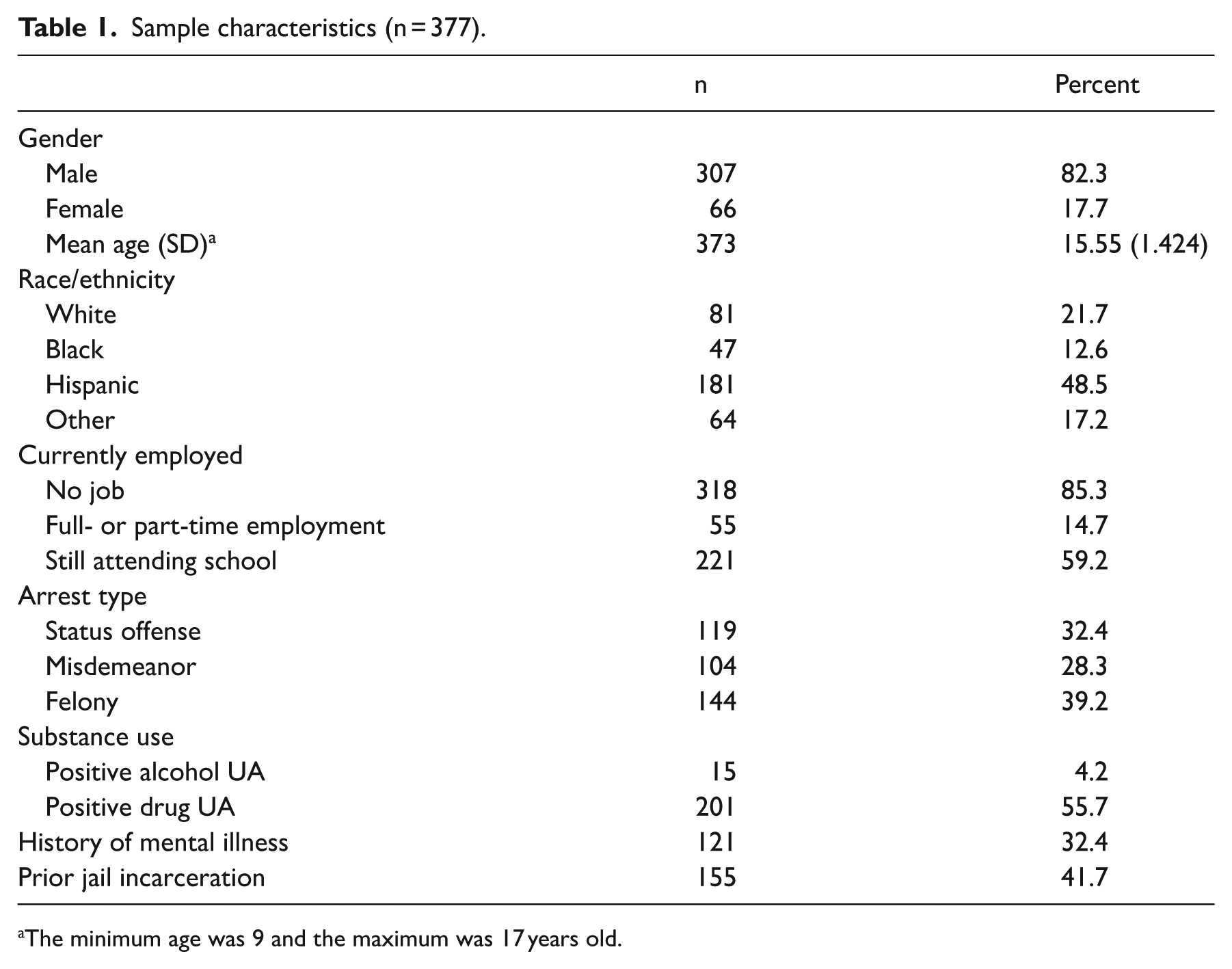
The minimum age was 9 and the maximum was 17 years old.
Baseline models
To examine the predictors of youth perceptions of police, two baseline regression models were estimated with trust in police and obligation to obey as dependent variables (Table 2). The model predicting trust explained approximately 18.3% of the variance (Adjusted R2 = 0.183) and included a range of demographic, justice system, and perception-based variables. Among all predictors, perceptions of distributive fairness (β = 0.198, p < 0.001) and police effectiveness (β = 0.249, p < 0.001) were the strongest positive and statistically significant predictors of trust.
Baseline models assessing legitimacy measured as perceived trust and obligation to obey.
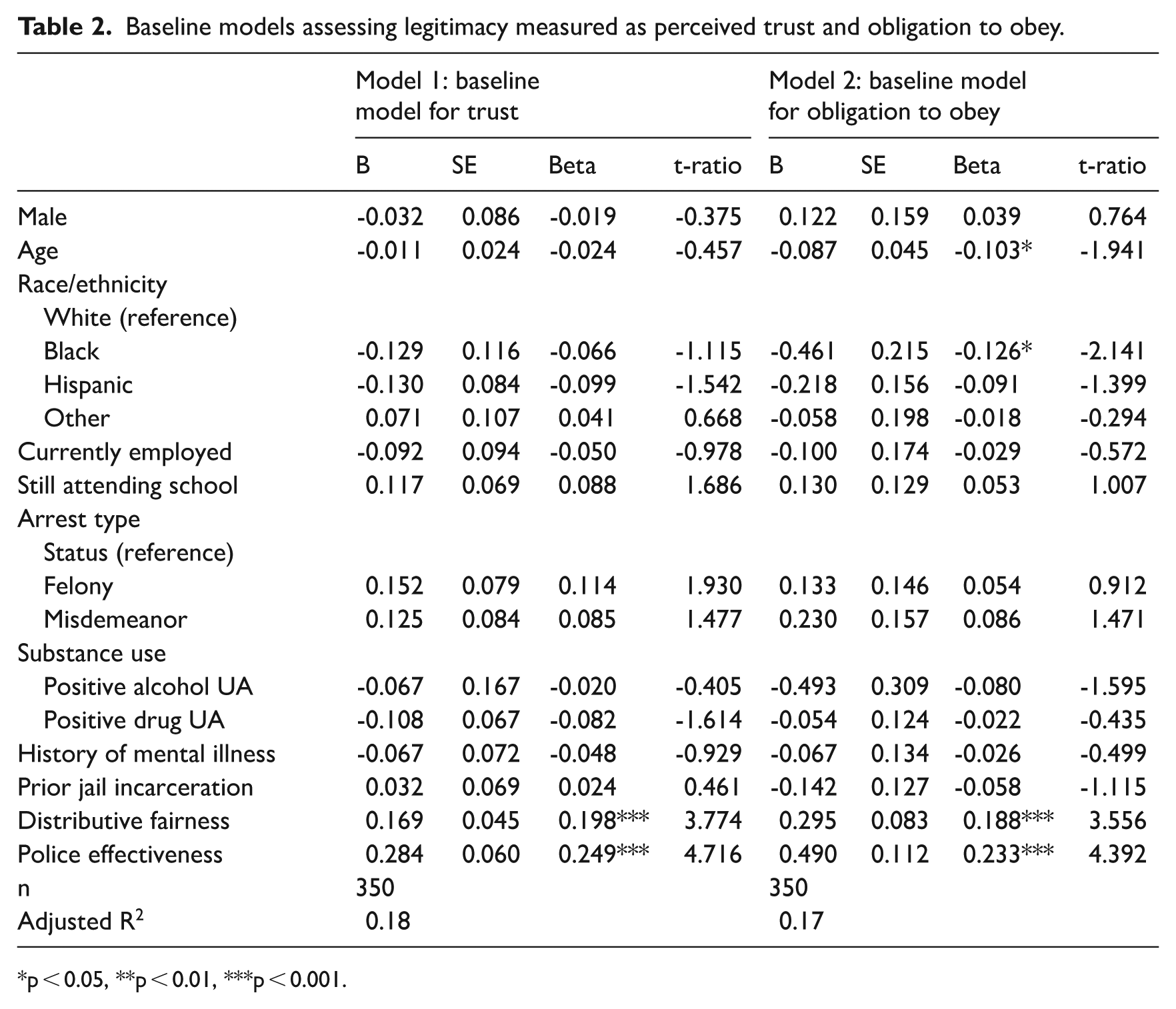
p < 0.05, **p < 0.01, ***p < 0.001.
In the second model predicting obligation to obey the police, which explained 17.1% of the variance (Adjusted R2 = 0.171), perceptions of police effectiveness (β = 0.233, p < 0.001) and distributive fairness (β = 0.188, p < 0.001) were again the strongest and most consistent predictors. In addition, age (β = −0.103, p < 0.05) and identifying as Black (β = −0.126, p < 0.05) were negatively associated with obligation to obey, suggesting that older youth and Black respondents expressed lower levels of obligation. Overall, both models highlight that youths’ perceptions of fair treatment and effectiveness by police are more predictive of trust and obligation to obey attitudes than individual demographics or legal system contact.
Procedural justice models
To evaluate the unique influence of procedural justice on youths’ perceptions of police trust obligation to obey, two additional regression models were estimated using trust in police and obligation to obey as dependent variables (Table 3). The model predicting trust accounted for 30.3% of the variance (Adjusted R2 = 0.303), and the model predicting obligation to obey explained 28.2% of the variance (Adjusted R2 = 0.282), both reflecting substantial improvements in explanatory power over the baseline models. In both models, procedural justice emerged as the strongest and most consistent predictor. Specifically, perceptions of procedural justice significantly predicted trust (β = 0.401, p < 0.001) and obligation to obey (β = 0.386, p < 0.001), with large effect sizes. In addition, perceptions of police effectiveness (β = 0.141, p < 0.001 for trust; β = 0.130, p < 0.05 for obligation) and distributive fairness (β = 0.123, p < 0.01 for trust; β = 0.116, p < 0.05 for obligation) also contributed significantly to trust and obligation to obey. Few demographic or system-involvement variables were statistically significant, though having been arrested for a felony predicted slightly higher trust (β = 0.114, p < 0.05). Overall, the models confirm that youths’ perceptions of police fairness and procedural justice – more than personal characteristics or past legal contact – are central to shaping trust and felt obligation to obey the police.
Models assessing the influence of procedural justice on legitimacy measured as perceived trust and obligation to obey.
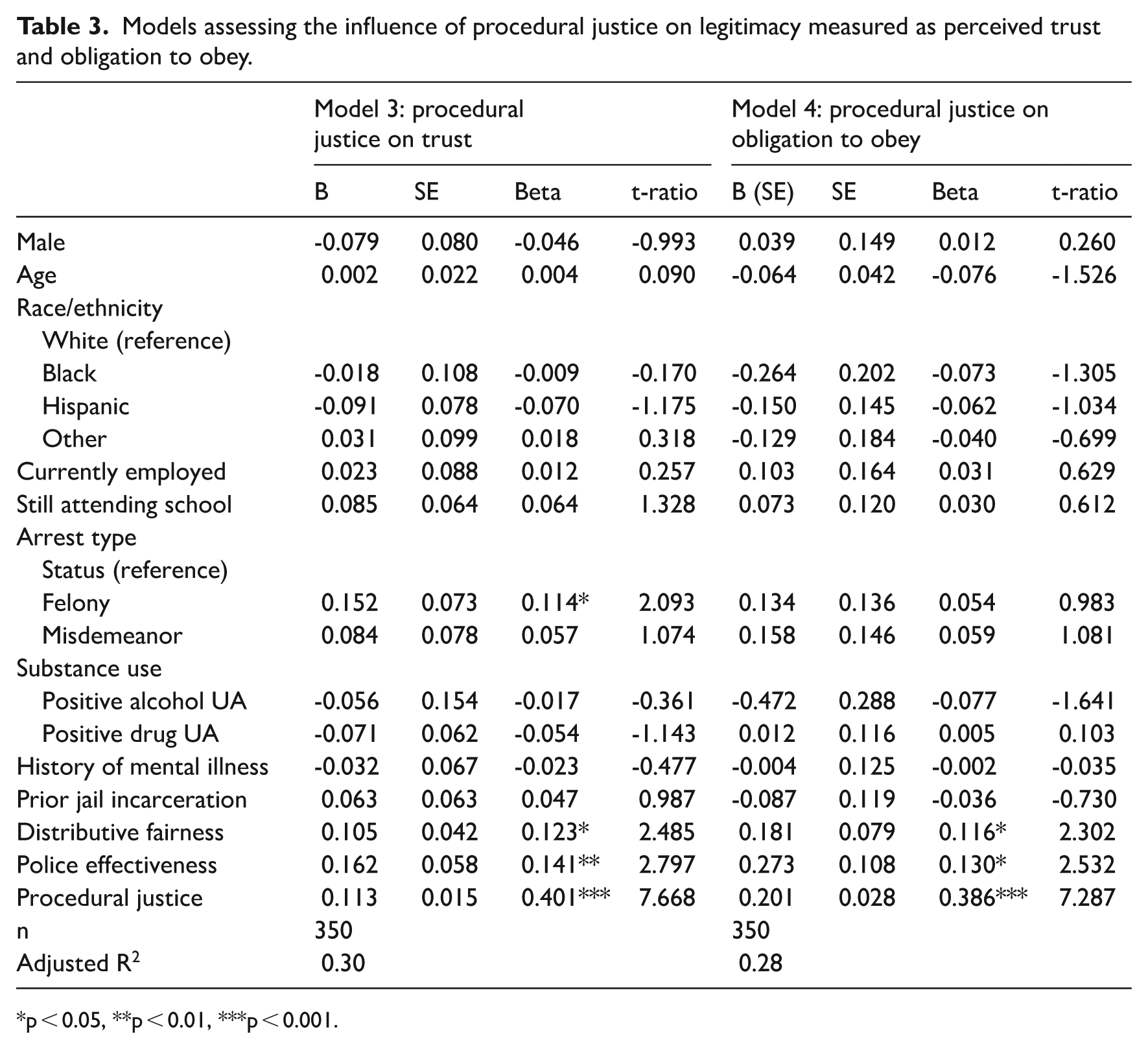
p < 0.05, **p < 0.01, ***p < 0.001.
Predicting willingness to cooperate
Two multiple regression models were estimated to assess how procedural justice and trust and obligation to obey predict cooperation with the police (Table 4). Model 5 included procedural justice and trust as key predictors, while Model 6 substituted trust with obligation to obey. Both models were statistically significant and explained substantial variance in cooperation, with Model 5 accounting for 27.5% (Adjusted R2 = 0.275) and Model 6 for 25.5% (Adjusted R2 = 0.256) of the variance. In Model 5, both trust (β = 0.229, p < 0.001) and procedural justice (β = 0.182, p < 0.01) were significantly and positively associated with cooperation. In Model 6, obligation to obey (β = 0.155, p < 0.01) and procedural justice (β = 0.214, p < 0.001) also emerged as significant predictors. These findings confirm that both procedural justice and perceived trust and a sense of moral duty are central to promoting cooperative attitudes among youth.
Models assessing the influence of procedural justice on legitimacy, measured as perceived trust and obligation to obey, on cooperation.
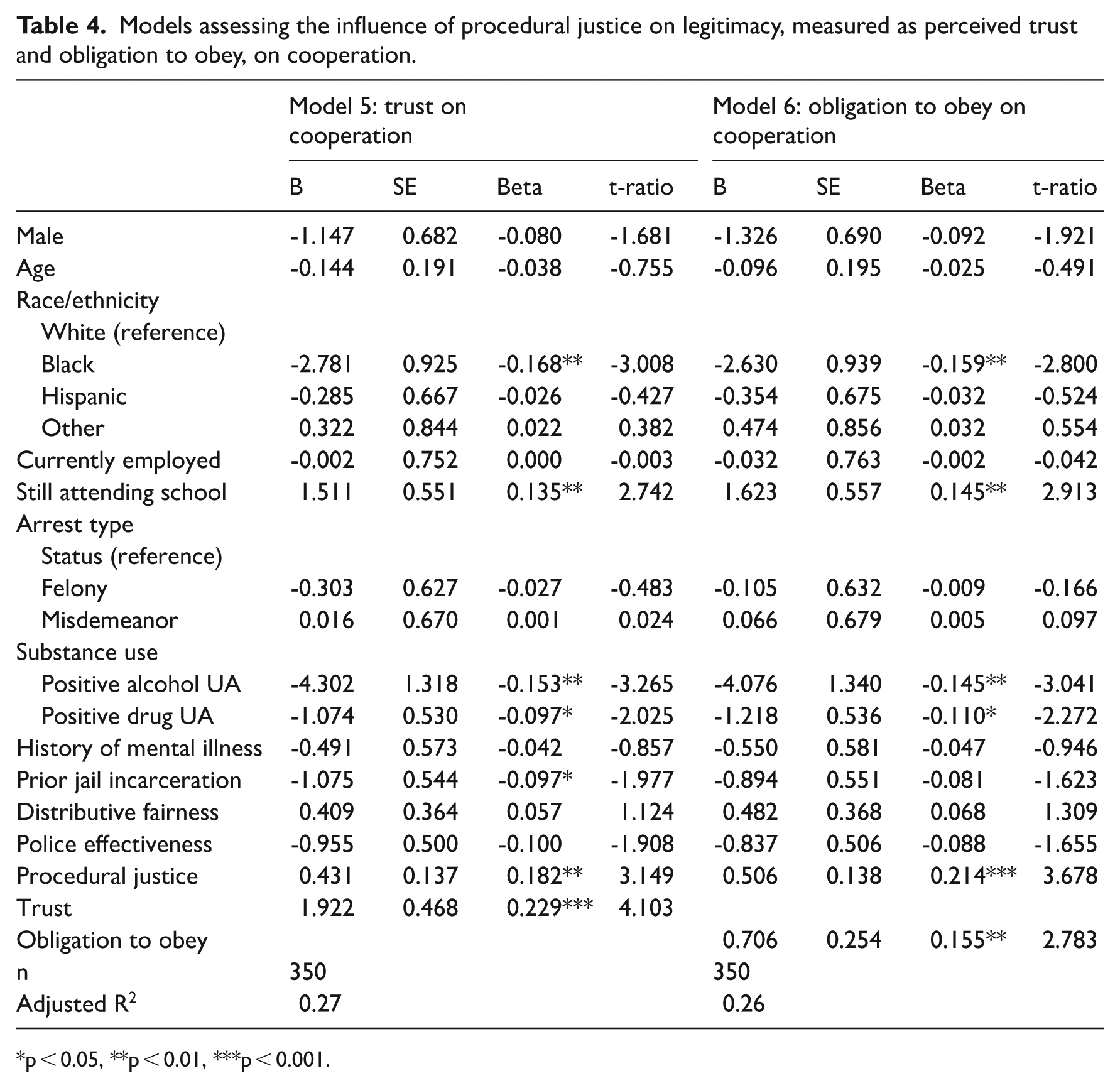
p < 0.05, **p < 0.01, ***p < 0.001.
In both models, being Black was negatively associated with cooperation (Model 5: β = −0.168, p < 0.01; Model 6: β = −0.159, p < 0.01), suggesting a perceived trust and obligation to obey gap for Black youth. Still attending school was positively related to cooperation across models (β = 0.135–0.145, p < 0.01), while substance use (alcohol or drugs) was negatively associated with cooperation. Prior jail incarceration was negatively associated with cooperation, but only for the trust model. Though unconventional to discuss non-significant findings, it is worth mentioning that distributive fairness and police effectiveness did not reach statistical significance in either model – a substantial change from the first four models (Tables 2 and 3). These results highlight that while structural and experiential factors such as race and system contact remain relevant, cooperation is most strongly influenced by whether youth perceive police as procedurally just and whether they trust or feel morally obligated to comply with law enforcement.
Discussion
The goal of this study was to evaluate the applicability of the process-based model, or normative framework, by assessing the relationship between youth perceptions of procedural justice, trust and obligation to obey, and willingness to cooperate with police for system-involved youth by using data from a sample of recently arrested and detained juveniles in a large Southwestern County (n = 377) between 2011 and 2013. This study serves two purposes. First, we test whether the normative process-based model persists among a sample of incarcerated juveniles while controlling for other relevant factors. Second, we test the final component of the normative framework by assessing the relationship between youth perceptions of procedural justice, trust and obligation to obey, and willingness to cooperate with police. In doing so, we provide the first empirical assessment of the procedural justice-trust and obligation to obey-cooperation framework that focuses on a sample of system-impacted youth. The results of this study provide robust support for the procedural justice and police trust and obligation to obey framework and its application in understanding youth willingness to cooperate with the police.
Across all models, procedural justice emerged as the most consistent and powerful predictor of trust, obligation to obey, and willingness to cooperate with law enforcement. These findings align closely with Tyler’s (1990, 2006) assertion that perceptions of fairness, respectful treatment, and impartiality drive trust and obligation to obey attitudes, such as perception of trust and the sense of obligation to obey, more than demographic characteristics or punitive experiences. In both trust and obligation models, procedural justice not only predicted outcomes independently but also enhanced the explanatory power of the models substantially. Furthermore, distributive fairness and perceptions of police effectiveness, both conceptually adjacent to procedural justice, also contributed positively to perceived trust and obligation to obey, albeit to a lesser degree. This provides support to the view that perceptions of the police matter.
Models predicting cooperation revealed that procedural justice was also a direct facilitator of voluntary compliance and engagement among detained youth. Trust and obligation to obey, themselves products of fair treatment, likewise predicted cooperation, highlighting the interconnected nature of these constructs. These findings resonate with legal socialization theory, which emphasizes the developmental processes by which young people form stable attitudes about legal authority (Fagan and Tyler, 2005; Trinkner and Tyler, 2016). Youth who view the police as procedurally just are more likely to internalize law-related norms and demonstrate law-abiding behavior not because of fear, but because of moral alignment.
At the same time, the data reveal concerning patterns regarding racial disparities. Black youth consistently reported lower levels of obligation to obey and cooperation, even when controlling for other factors, echoing long-standing concerns about unequal treatment and trust erosion in communities of color (Fine et al., 2016; Tyler and Huo, 2002). From our perspective, this points to a deeper legitimacy crisis in the neighborhoods that have historically strained relations with the police, where trust and obligation to obey has been eroded. Similarly, youth with prior detention experiences were also less cooperative. A qualitative study of formerly incarcerated youth identified themes that highlighted experiences of youth not feeling respected, cared for, or heard by adults in the facility, impacting their willingness to trust staff (Enujioke et al., 2025). Repeated system involvement likely further weakens trust, reducing the likelihood that a youth’s willingness to cooperate. Moreover reduced cooperation and compliance in detention leads to punishment, further weakening trust among youth and adults (see Nuño, 2018). Finally, youth who tested positive to substance use at the time of intake also reported less cooperation, pointing to how substance use can compound trust and obligation to obey deficits in adolescents.
These findings carry clear policy implications. To cultivate trust and a sense of obligation to obey among youth, particularly system-involved youth, law enforcement agencies must move beyond compliance-focused tactics and instead embed procedural justice into their everyday practices. This includes treating young people with dignity, providing a voice in interactions, making decisions transparently, and demonstrating impartiality. Youth-focused policing initiatives, such as school resource officer programs, diversion efforts, and community outreach, should be evaluated and restructured based on their adherence to procedural justice principles. By investing in relational trust and obligation to obey rather than coercive control, law enforcement can play a constructive role in fostering positive legal socialization and sustainable community cooperation.
Limitations and opportunities for advancement
No study is without limitations. In this study, our sample being limited to one southwestern county serves as an important limitation, as it can affect generalizability. We encourage future research to assess the full normative framework by assessing the relationship between youth perceptions of procedural justice, trust and obligation to obey, and willingness to cooperate with police using a nationally representative sample. Furthermore, the convergent evidence across multiple fit perspectives strongly recommends the adoption of the simpler two-factor structure for both theoretical and practical applications. Finally, studies should employ longitudinal designs that assess the full normative framework to help determine whether these perceptions persist into adulthood.
Conclusion
The main takeaway from this study is clear: if society wants cooperative, law-abiding, and productive adults, we must treat youth in general, and justice-involved youth specifically, with fairness, dignity, and transparency. Procedural justice is not a luxury, it’s a necessity. Trust and a sense of obligation to obey cannot be demanded and still carry the same weight; it must be earned through consistent, respectful treatment. When police model fairness, they do not just uphold the law, they teach it. For many young people, that lesson could be the difference between rejecting the system and finding a productive future within it. This is an excellent opportunity for police to employ procedural justice as a practical tool beyond a simple theoretical framework. For many young people, this police interaction is their first encounter with authority, and the officer’s approach can significantly impact the youth’s perception of fairness. Being a fair authority figure in the early stages of these individuals’ lives can help shape more law-abiding youth who become productive adults.
Supplemental Material
sj-docx-1-yjj-10.1177_14732254261453205 – Supplemental material for Procedural justice, trust and obligation to obey, and willingness to cooperate with the police: A test of the process-based model of regulation using a sample of detained youth in the United States
Supplemental material, sj-docx-1-yjj-10.1177_14732254261453205 for Procedural justice, trust and obligation to obey, and willingness to cooperate with the police: A test of the process-based model of regulation using a sample of detained youth in the United States by Lidia E. Nuño, George G. Garza, Veronica M. Herrera and Gilbert F. O’Brien in Youth Justice
Footnotes

Funding
The authors received no financial support for the research, authorship, and/or publication of this article.
Declaration of conflicting interests
The authors declared no potential conflicts of interest with respect to the research, authorship, and/or publication of this article.
Supplemental material
Supplemental material for this article is available online.
Notes
Author biographies
References
Supplementary Material
Please find the following supplemental material available below.
For Open Access articles published under a Creative Commons License, all supplemental material carries the same license as the article it is associated with.
For non-Open Access articles published, all supplemental material carries a non-exclusive license, and permission requests for re-use of supplemental material or any part of supplemental material shall be sent directly to the copyright owner as specified in the copyright notice associated with the article.
